A Lone Wyoming Rancher Opened His Door to Find Four Children Waiting With Bags and a Letter From Their Mother—Then He Read Her Final Request: “Don’t Come Looking for Me.”
PART3:
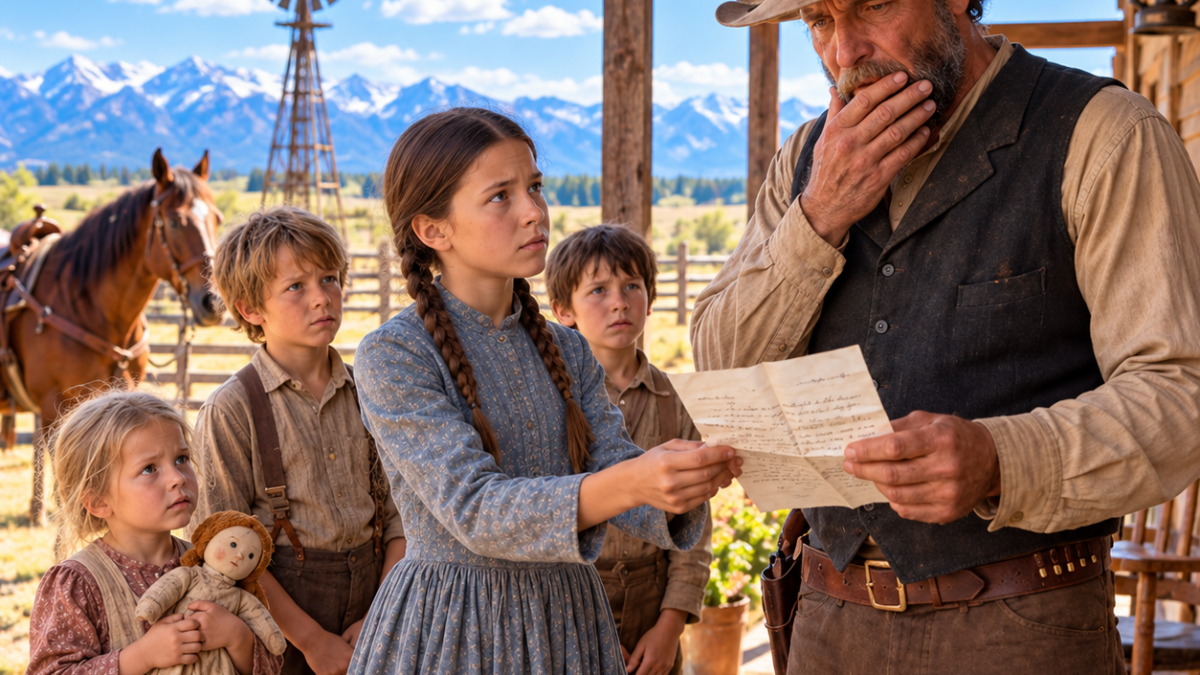
Their mother had sent them to him.
Not to town.
Not to kin.
Not to the sheriff.
To him.
Ezekiel had lived alone for so long that silence had become less a condition of the house than part of its structure. His mornings had order. Coffee before sunup. Horses fed. Cattle checked. Fence line if needed. Supper whenever the work was done. Bed when tired.
No crying.
No small boots.
No questions asked before breakfast.
No little girl clutching a rag doll and looking at him as if the answer to the whole world might be hidden somewhere under his beard.
He cleared his throat.
“I don’t rightly know how to feed four children properly.”
He said it to no one in particular.
The oldest girl regarded him with guarded eyes.
“Mama said you’d figure it out.”
“She did, did she?”
“She said you always did with horses.”
“Horses are simpler than children.”
“That’s what Mama said you’d say too.”
Then she walked past him into the house as if the matter were settled.
The twins followed.
The little girl hesitated on the threshold, looked once toward the empty road, then stepped inside after them.
Ezekiel stood alone on his porch a moment longer, Vera’s letter in his hand, watching the wind erase the wagon marks.
His quiet, solitary life had ended sometime in the last five minutes.
He had not even properly agreed to it.
Vera Langley had always had a talent for that.
They had grown up on neighboring land, though neighboring in Wyoming meant miles of open range between front doors. Their families had known each other since before either child could remember. As children, Ezekiel and Vera had spent summers crossing fence lines, arguing over creeks, racing half-broke ponies, stealing green apples, and returning home muddy enough to horrify both mothers.
He remembered Vera at eight years old, marching straight into his father’s barn to accuse him of stealing her fishing spot.
“You can’t own water,” he had told her, considerably more confident at eight than he had been about most things since.
“I can own the best spot on it,” Vera had said.
Then she had claimed it anyway.
That was Vera.
Quiet when she chose to be.
Stubborn when it mattered.
Certain in a way that made grown men underestimate her until they had already lost the argument.
Their lives had gone different ways.
Vera married Thomas Langley, a kind, broad-shouldered man who laughed easily and worked hard. They built a modest life on the Langley place and filled it, one child at a time, with noise and worry and the kind of love that leaves shirts mended by firelight.
Ezekiel never married.
Not because he hated the idea.
Not even because no woman had ever looked kindly at him.
Life simply narrowed around him after his parents died. The ranch needed hands. The cattle needed tending. Seasons became years. Years became habit. Habit became identity. People in town called him a content bachelor, and Ezekiel let them because it saved explaining that content and accustomed are not always the same thing.
Vera and Thomas remained neighbors in the old way.
They did not see each other daily.
Sometimes not for months.
But when a storm knocked down fence, Thomas came.
When Vera needed a team lent for plowing, Ezekiel sent one.
When Ezekiel broke his wrist ten years earlier, Vera appeared at his door with stew, bread, and the same sharp look she had worn at eight years old.
“You’ll starve before you ask for help.”
“I can cook.”
“You can heat beans. That is not the same thing.”
Then she walked inside and set the pot on his stove.
The old trust never wavered.
Ezekiel simply had not expected that trust to arrive in the form of four children and a letter telling him not to follow.
He made flapjacks that first morning.
Badly.
The batter was too thick. The first two burned. The third tore apart when he tried to turn it. By the fourth, he had achieved something flat enough to place on a plate and pale enough to suggest it had once considered becoming food.
The twins ate them anyway with the cheerful indifference of boys who had clearly eaten worse.
Delia cut hers into careful pieces and watched him between bites.
Nell pushed hers around the plate without eating.
Her rag doll sat in her lap, its cloth face faded from years of being loved past reason.
Ezekiel stood by the stove feeling as if four coyotes had wandered into the house and expected him to teach school.
“You children want molasses?”
Sam, the twin with eyes toward the horses, nodded immediately.
Eli, the other twin, said, “Mama says too much molasses makes Sam act like a raccoon in a flour barrel.”
“I do not,” Sam said.
“You do.”
“You fell in the flour.”
“I was pushed.”
“By gravity,” Delia said.
Ezekiel looked at her.
She returned to her flapjack.
Nell did not smile, but she watched.
That was something.
After breakfast, Ezekiel read Vera’s letter a third time in the pantry, out of sight of the children.
Thomas’s death had been ruled an accident months earlier.
A fall from a washed-out ridge road after dark, horse found three miles away, body below the cutbank. Folks had called it a tragedy. Ezekiel had ridden to the funeral, stood at the back, watched Vera hold herself upright with Nell pressed against her skirt, and thought she looked less like a widow than a woman listening for a lie.
He should have asked more.
That thought came now and struck hard.
He should have ridden over.
Should have sat on her porch.
Should have asked what her eyes already seemed to know.
But grief makes people careful around each other. He had mistaken her silence for privacy and his own distance for respect.
Now she was gone, chasing proof against Edmund Voss.
Ezekiel knew the name.
Everyone did.
Voss owned land across three counties, cattle enough to darken hillsides, and influence in rooms where men lowered their voices when he entered. He was polite in town, generous to churches, friendly with judges and bankers, and perfectly capable of ruining a man while shaking his hand.
If Vera believed Voss had killed Thomas over land, then Vera was either wrong in a way that grief can make a person wrong, or she was in more danger than her letter admitted.
Ezekiel folded the page.
Do not come looking for me.
He looked through the pantry doorway.
Four children sat at his table.
Delia had begun stacking plates without being asked.
Eli and Sam were arguing in whispers over who got the last burned flapjack.
Nell sat very still, staring toward the window as if waiting for her mother to return before the sun climbed higher.
Ezekiel put the letter in his shirt pocket.
For the first time in years, his house felt too small and too large at once.
That evening, after a day that seemed to last a month, he found Delia sweeping the kitchen badly but earnestly.
“You don’t have to do that,” he said.
“Mama says there is no such thing as staying in a house without helping it.”
“This house survived a long while without much sweeping.”
“I can tell.”
Ezekiel looked at the floor.
“That so?”
“Yes.”
He almost smiled.
Almost.
From the next room came a crash.
Then two boy voices.
“He started it!”
“He put the bucket there!”
“You kicked the bucket!”
“With my foot, not on purpose!”
Ezekiel closed his eyes.
Delia leaned on the broom.
“They fight when they’re scared.”
“They fight when they’re breathing.”
“That too.”
He went into the main room and found Sam and Eli standing beside an overturned bucket of kindling. Each looked guilty. Each looked ready to accuse the other of war crimes.
Ezekiel pointed to Sam.
“You pick up the kindling.”
He pointed to Eli.
“You stack it.”
“That’s not fair,” Eli said.
“To who?”
Eli opened his mouth.
Closed it.
Sam grinned.
Ezekiel pointed at him.
“You grin, you sweep.”
Sam stopped grinning.
Delia watched from the kitchen with something like approval.
It was the first time Ezekiel realized she had been measuring him.
Not for kindness.
Children expect kindness to fail under inconvenience.
She was measuring whether he would stay steady after noise.
That night, after the twins had been sent to the loft and Nell had been coaxed under a quilt in the small room beside Delia, Ezekiel found the oldest girl standing in the hallway with the rag doll in her hands.
“She won’t sleep unless I tell her Mama knows where we are.”
Ezekiel rubbed one hand over his face.
“Does she?”
“Know?”
“Yes.”
Delia looked at him as if deciding whether truth mattered more than comfort.
“Mama knows this ranch better than the road to town.”
“That’s what I thought.”
“You can tell Nell that.”
“You could tell her.”
“She asked if you believed it.”
That struck deeper than he expected.
Ezekiel took the doll.
Its yarn hair was coming loose.
“I believe your mother knows exactly where to find you.”
Delia studied his face.
“Do you believe she’ll come back?”
The easy answer rose first.
Of course.
But Delia did not need easy.
She had been handed too much responsibility already to be paid in soft lies.
“I believe she means to,” he said.
Delia looked down.
“That’s what I believe too.”
A moment passed.
Then she took the doll back.
“Nell talks when she’s ready,” she said.
“Does she talk to you?”
“Yes.”
“Boys?”
“Sometimes.”
“Me?”
“No.”
“I noticed.”
“Mama says forcing it only makes it worse.”
“Your mother seems to have prepared you to manage me.”
Delia’s mouth twitched.
“She said you were a good man who didn’t always know what to do with people.”
Ezekiel sighed.
“That sounds like Vera.”
The first week humbled him.
He learned that four children were not one problem multiplied by four. They were four separate worlds with different weather.
Delia carried herself like a second mother and resented being treated like one.
Sam gravitated toward the horses every chance he got. He grew quiet around them, patient in a way that made Ezekiel look twice. The boy could be loud at the table, reckless with chores, and incapable of closing a door gently, but near a nervous mare he became soft-voiced and careful.
Eli took to fence work with stubborn thoroughness, complaining the entire time.
“This post is crooked.”
“Then straighten it.”
“The dirt is too hard.”
“Then dig.”
“My hands hurt.”
“Then switch hands.”
“I hate fence.”
“Fence hates you back.”
Eli considered that, then dug harder.
Nell watched everyone.
Wide-eyed.
Silent.
Not frozen exactly.
Present, but distant.
She followed Ezekiel by the end of the week, always at a careful distance, never close enough to be accused of it. If he went to the barn, she appeared near the door. If he chopped wood, she sat on the porch steps with her doll. If he checked the chicken coop, she watched from behind the water barrel.
He pretended not to notice.
Delia noticed him pretending not to notice.
“Good,” she said one afternoon.
“What?”
“You’re not asking why she follows you.”
“I figured she’d tell me if it mattered.”
“She might not.”
“Then she can follow anyway.”
Delia nodded once, as though he had passed another examination.
Ezekiel learned to braid hair that first week.
Badly.
His large, work-roughened hands were not made for ribbons, snarls, or patience with fine strands. Nell sat on a stool in front of him while he attempted what Delia had described as “simple.”
By the time he finished, the braid curved sideways like a wounded snake.
Delia walked in, took one look, and said, “You’re pulling too tight.”
“I am doing my best.”
“Your best looks like it hurts.”
Nell did not speak, but she reached up and touched the braid with grave concern.
Delia stepped behind her sister.
“Watch.”
Ezekiel watched.
He had gentled colts.
Delivered calves.
Set fence in frozen ground.
Stitched a horse’s shoulder by lantern light during a storm.
None of that had prepared him for how carefully a child’s hair needed handling.
The next morning, he tried again.
It was still crooked.
Nell touched it, considered, and left it in place.
Ezekiel took that as victory.
At night, after the house finally settled, he sat at the table with Vera’s letter.
Do not come looking for me.
He hated those words.
He understood them.
That made it worse.
Vera had known if she asked for help finding proof, he would have ridden after her. She had not asked. She had given him the harder task because she knew him well enough to trust he would hate it and do it anyway.
Keep them safe.
So he did.
He moved the children’s bedding away from the window in the loft.
He kept a loaded rifle above the kitchen door.
He rode the perimeter twice as often.
He told the children it was because spring storms loosened fence posts.
Delia did not believe him.
She did not challenge him either.
A week became two.
Two became four.
By the end of the first month, the children had changed the shape of the ranch.
There were boots by the door in sizes Ezekiel had never owned.
There were small shirts drying on the line.
There were school slates on the table because Delia insisted the boys’ figures would rot if left alone all summer.
There was a rag doll under chairs, in the pantry, once inexplicably in the flour bin.
There was laughter at unexpected hours.
There was crying too.
Nell cried quietly sometimes, face turned into her pillow.
Eli cried loudly once after falling from the hayloft and declaring he had broken every bone in his body.
He had bruised his shoulder.
Sam cried in the barn after a mare rejected him and turned away when he offered grain.
“She doesn’t like me,” he said, wiping his face angrily with his sleeve.
“She doesn’t trust sudden hands,” Ezekiel said. “That’s not the same.”
Sam sniffed.
“How do I make her trust me?”
“You don’t make her. You give her reason.”
“That takes too long.”
“Most things worth having do.”
Sam leaned against the stall door.
“Do you think Mama is taking too long?”
Ezekiel went still.
The mare blew softly through her nose.
“No,” he said finally. “I think she’s doing something hard and trying to do it right.”
Sam nodded.
Then, after a long moment, he said, “I talk to the horses because they don’t ask where she is.”
Ezekiel looked at the boy.
The right words did not come.
So he put one hand on Sam’s shoulder.
The boy leaned into it.
Some needs, Ezekiel was learning, were not solved by answers.
One evening, he returned from the far pasture later than expected and found all four children waiting at the gate.
Delia stood with arms crossed.
The twins ran the last stretch beside his horse, each trying to outrun the other.
Nell stayed at the gate.
But when he dismounted, she walked to him and lifted both arms.
Ezekiel froze.
Only for a second.
Then he picked her up.
She weighed almost nothing.
Her small body settled against his chest with a trust that undid something in him he had not known was still capable of being undone.
She did not speak.
She rested her head against his shoulder.
Delia looked away.
Sam and Eli argued over who had reached the horse first.
The sun slid low behind the hills.
Ezekiel stood in his own yard holding a child who was not his, and for the first time in thirty years, the quiet he had once called peace felt like something poorer.
Far from the ranch, Vera Langley slept in rented rooms with chairs pushed under doorknobs.
She traveled under her maiden name in larger towns and asked questions carefully. Land offices. County record rooms. Clerks who looked helpful until she mentioned Edmund Voss. Men who suddenly remembered urgent business. Ledgers with missing pages. Files mislaid in locked cabinets. Witnesses who agreed to speak and vanished before testimony could be taken.
She learned quickly that Voss’s influence did not announce itself.
It appeared as hesitation.
As silence.
As a clerk saying, “I’m not sure where that record’s gone.”
As a boarding house owner suddenly unable to recall whether a man had stayed there.
As a former ranch hand crossing the street when he recognized the name Langley.
At night, Vera wrote everything down by candlelight.
Dates.
Names.
Amounts.
Land descriptions.
Rumors.
Refusals.
She feared forgetting some small detail that might later matter.
And always, beneath the work, the ache of her children remained.
She missed Delia’s serious face.
Sam’s impatient questions.
Eli’s complaints.
Nell’s quiet little hand in hers.
She missed Thomas too, but Thomas was gone in a way that had become a fixed pain. The children were gone by her choice, and that pain moved. It accused. It asked whether safety and abandonment could ever wear the same face.
Then letters came.
The first was from Delia, written in careful, determined handwriting.
Dear Mama,
Mr. Barrow makes flapjacks worse than anyone living but we eat them because he looks proud when they are not black. Sam says the bay mare understands him. Eli says Sam is dumb. Eli fell from the hayloft and did not die though he yelled like he meant to. Nell does not talk to Mr. Barrow yet but she follows him everywhere and he pretends not to see. He tried to braid her hair. I fixed it.
We are safe.
Come back when you can.
Your daughter,
Delia
A pressed wildflower fell from the envelope.
Delia had added at the bottom:
Nell picked this for you. She said I could write that.
Vera held the flower for a long time.
Then she pressed it inside her traveling ledger, between a note about falsified land filings and a receipt from the county clerk’s office.
Hope and evidence, side by side.
That felt about right.
The danger reached Ezekiel’s ranch on an afternoon hot enough to make even the flies lazy.
Three men rode in from the south.
Ezekiel saw them from the corral and knew before they reached the yard that they were not lost.
Men who are lost look around.
These men looked at the house.
At the porch.
At the barn.
At the laundry line.
Ezekiel set down the brush he had been using on the bay mare and stepped into the yard.
The lead rider was thin, clean-shaven, and too casual.
Men with casual eyes often carried the sharpest intentions.
“Afternoon,” the rider said.
“Afternoon.”
“Looking for Vera Langley.”
“Haven’t seen Vera in some time.”
It was truthful in the narrowest sense.
The man’s eyes drifted past him.
Four tin cups dried on the porch rail from breakfast.
A rag doll lay forgotten on the top step.
A child’s coat hung on a peg too low for any grown man’s shoulders.
“Considerable amount of washing for one bachelor,” the man observed.
Ezekiel did not miss a beat.
“Sister’s children visit some summers.”
“That so?”
“Gone back to town this week, matter of fact.”
The rider studied him.
Ezekiel looked back.
Inside the house, he could feel the children watching.
He hoped to God they were staying away from the windows.
The rider smiled thinly.
“If Vera comes by, tell her folks are worried.”
“Folks?”
“Interested folks.”
“I’ll pass the sentiment if I see her.”
The men lingered just long enough to make leaving feel like a choice instead of retreat.
Then they turned their horses and rode off.
Ezekiel watched until they disappeared beyond the rise.
Only then did he breathe properly.
When he entered the house, Nell stood by the front window, face pale, doll clutched tight.
Delia stood behind her.
The twins were silent near the stove.
“What did they want?” Delia asked.
“Asked about cattle prices.”
“That is not true.”
“No.”
Delia’s jaw tightened.
Ezekiel knelt to Nell’s height.
“Those men are gone.”
Her eyes searched his face.
“Will Mama know where to find us?” she whispered.
It was the first thing she had ever said directly to him.
The words nearly broke him.
He kept his voice steady.
“Your mama knows this ranch better than the road to town. She will find you.”
Nell studied him.
“You promise?”
It was a dangerous thing, a promise.
A man ought not make one unless he knew where to stand when it came due.
But looking into Nell’s face, Ezekiel understood that some promises are not predictions.
They are places to shelter until the truth arrives.
“I promise you that much.”
Nell nodded.
Then she stepped forward and leaned into him.
Behind her, Delia turned away quickly.
The twins pretended to examine the stove.
Ezekiel placed one arm around Nell’s small shoulders and looked toward the road.
That night, he slept in a chair by the door with the rifle across his knees.
It took Vera nearly two months to gather proof enough to matter.
The breakthrough came from a former Voss ranch hand named Colby Raines, found two counties over in a mining town where guilt had been slowly drinking him hollow.
At first, he refused to speak.
Then Vera placed Thomas’s pocket watch on the table between them.
Its glass was cracked from the fall that had supposedly killed him.
“Thomas was a good man,” she said.
Colby stared at the watch.
“He was.”
“Then be one for five minutes.”
The words landed.
Colby closed his eyes.
When he opened them, he looked older.
He had been paid to follow Thomas the week before he died, reporting his movements to Voss’s foreman. He had not been present at the ridge. He insisted on that. But he had seen something in Voss’s private ledger days later, disguised among ordinary ranch expenses.
Langley matter settled.
The entry alone might not have been enough.
But paired with falsified land records, witness testimony from two families Voss had pressured, a clerk willing at last to admit records had been altered, and Colby’s signed statement, it became what the sheriff had asked for.
Something a bench could hear.
The sheriff read everything twice.
Then he looked at Vera.
“You understand what happens if we move on this.”
“Yes.”
“Voss will not come quietly.”
“He has had months to make me afraid.”
“And?”
Vera lifted her chin.
“I sent my children away. There is nothing left in me he can frighten gently.”
The sheriff acted.
For the first time in years, Edmund Voss found himself answering questions money could not simply smooth away.
He arrived at the sheriff’s office expecting deference.
He found a room full of evidence.
“This is a considerable overreach,” Voss said, his composure cracking at the edges. “A grieving widow’s wild theories hardly constitute proper evidence.”
The sheriff laid the ledger page beside Colby’s signed statement.
“A grieving widow’s wild theories, matched against a former employee willing to testify and your own handwriting calling a dead man’s murder a settled matter.”
Voss’s face changed.
Only slightly.
But Vera saw it.
The investigation widened from there.
Thomas Langley’s death stopped being an isolated tragedy and became the first loose stone in a wall built from intimidation, forged records, coerced sales, threatened widows, and ruined small ranchers.
Families who had been too frightened to speak found courage in numbers.
Men who had taken Voss’s money tried to bargain.
Clerks remembered where missing files had gone.
The territory did not become just overnight.
No place does.
But for once, influence met evidence strong enough to hold.
When it was finally over, Vera returned to Ezekiel’s ranch expecting to find her children exactly as she had left them.
She was wrong.
They were still hers.
That was never in question.
They ran to her the moment she stepped down from the wagon.
All four at once.
Delia reached her first and tried not to sob.
The twins collided with her waist so hard she nearly fell.
Nell hit last, small arms locking around her mother’s neck, crying into her shoulder with the force of a child finally allowed to stop being brave.
Vera sank to her knees in the yard and held them.
“My babies,” she whispered.
Over and over.
“My babies.”
Ezekiel stood back near the porch.
He gave the reunion its proper space.
But Nell kept looking over Vera’s shoulder toward him every few seconds, as though confirming he was still there.
Vera noticed.
Of course she noticed.
The first rush of reunion hid many things.
But not that.
Over the next days, the small changes struck her hardest.
Ezekiel handed Sam a cup without being asked, already knowing the boy preferred water cool rather than fresh from the bucket.
He caught Eli’s chin gently when the boy started to lie about a chore left unfinished.
“Try again,” Ezekiel said.
Eli sighed.
“I forgot.”
“Better.”
He knew Delia needed to be asked for help, not assumed into it.
He knew Nell liked her blanket folded twice before sleep.
He knew Sam went quiet when worried.
He knew Eli pulled his ear before lying.
He knew Delia’s shoulders climbed toward her ears when adults argued within hearing.
He knew Nell still woke from dreams and needed a lamp low, not bright.
Vera watched him move through her children’s needs with the unthinking knowledge of someone who had earned it one day at a time.
“You learned them,” she said quietly one evening.
Ezekiel was rinsing cups at the pump.
He looked over.
“I only learned what you’d already taught them to be.”
“That is not the same thing.”
“No,” he admitted. “I suppose it isn’t.”
A strange ache rose in Vera’s chest.
Gratitude.
Certainly.
But something else too.
Something that felt almost like grief and almost like hope, which made it dangerous.
She stayed that first week, ostensibly to help the children readjust.
No one challenged the word ostensibly.
Even Eli knew better.
One afternoon, she walked the fence line between her property and Ezekiel’s while the children napped after a morning of too much excitement and not enough sleep.
Ezekiel repaired a loose post.
Badly.
“You still hammer a nail crooked,” Vera observed.
“You still notice things nobody asked you to notice.”
“Somebody has to.”
“Suppose that’s always been true of you,” he said. “Marched into my father’s barn at eight years old accusing me of stealing your fishing spot.”
“It was the best spot on the creek.”
“It was.”
She stopped.
“You never admitted that.”
“Didn’t want to lose the argument.”
Vera laughed.
The sound surprised both of them.
It came easily for the first time in months and startled the air around them.
“Nell says you are improving at braiding.”
“Nell is kind to injured animals. Her judgment on braiding should be considered suspect.”
“I saw her braid this morning. It was crooked.”
“Took me three weeks to get it that crooked. Considerable improvement over the first attempt.”
Vera smiled.
Then the smile softened into something more serious.
“Thank you, Zeke.”
He kept his eyes on the fence post.
“For what?”
“For not coming after me.”
His hammer stopped.
“That was not easy.”
“I know.”
“I hated every mile I didn’t ride.”
“I know that too.”
He looked at her then.
“I stayed because you asked.”
Her throat tightened.
“That is why I trusted you with them.”
That evening, after the children were asleep, Vera found Ezekiel on the porch.
For thirty years, that porch had held one chair.
Now there were three, one broken stool, two small boots, a doll missing one button eye, and a half-finished wooden horse Sam had been carving badly with Eli’s knife.
Vera sat beside Ezekiel without asking.
He did not look surprised.
“Nell told me before I’d even gotten off the wagon that you’re staying too,” Vera said.
Ezekiel went still.
“She called you Papa before either of us said a single word about what happens next.”
“I noticed.”
“I don’t want you feeling obligated by a five-year-old’s certainty.”
He looked toward the dark yard.
“Nell can call me whatever makes her feel safe. I’ll answer to it gladly, whatever comes of the rest of this.”
Vera turned to him.
“But?”
“But I don’t want you thinking the children have decided something you and I haven’t decided for ourselves. That wouldn’t be fair to either of us. Building a life on a child’s wishful thinking rather than our own honest choice.”
She looked at him for a long moment.
“That is a great deal of restraint for a man who spent two months practically raising my children.”
“Restraint is about the only thing I’ve had considerable practice at these thirty years alone.”
The honesty of it sat between them.
Soft.
Painful.
Clean.
After he went inside, Vera remained on the porch.
The night insects called from the grass. The stars hung sharp above the ridge. Somewhere in the house, one of the twins muttered in sleep.
She thought of Thomas.
His laugh.
His off-key humming while mending harness.
The way he had lifted Nell high in the air until she shrieked with delight.
The life they had built.
The injustice of losing him.
The guilt came next, as it often did when she found herself aware of Ezekiel in ways that had nothing to do with gratitude.
As though feeling warmth for another man might diminish what Thomas had been.
As though love were land and could be stolen by new fencing.
But watching Ezekiel with her children had taught her something grief had tried to hide.
Thomas would have wanted them safe.
Loved.
Known.
Raised by someone who took the responsibility as seriously as breath.
Choosing to build something new did not erase what she had already built.
It meant she was still capable of building.
The next evening, Nell climbed into Ezekiel’s lap while Vera watched from across the room.
The little girl settled there with the authority of someone who had made a legal filing.
“You’re staying too, Papa,” she said.
Ezekiel went very still.
His eyes found Vera’s.
Uncertain.
Careful.
Ready to correct the word if correction was needed.
Vera crossed the room and sat beside them.
“Let her have it,” she said softly. “Seems she worked out the ending before either of us managed to.”
Ezekiel did not move.
“Vera—”
“I’ve had two days to think it through properly. Same as you asked.”
Nell watched her mother.
The twins pretended not to listen from the floor.
Delia stood in the doorway, completely still.
Vera looked at Ezekiel.
“I choose this. Not because Nell said the word first. Because I have watched you become the kind of man worth choosing.”
The room changed.
Quietly.
Entirely.
Ezekiel swallowed.
“Then I choose it too,” he said. “Same reasons.”
Nell smiled and tucked her head under his chin.
Delia turned away, but not before Vera saw her face break open with relief.
Sam punched Eli in the arm.
Eli punched him back.
“Stop that,” Ezekiel said automatically.
The boys stopped.
Then everyone laughed.
They spent that autumn and the following spring rebuilding Vera’s property alongside their new arrangement.
The Langley house had suffered from months of neglect and the shadow of fear. Shutters hung loose. Fence sagged. The barn roof leaked. Weeds rose along the kitchen path.
“Seems wrong letting it sit idle,” Vera said the first time they rode out to survey the damage. “Thomas loved this place. Whatever else happened here.”
“Then we’ll bring it back,” Ezekiel said. “Doesn’t need to sit empty simply because the two houses are becoming one family.”
They worked both properties as one operation.
The children split their time between the two houses until the distinction slowly stopped mattering.
Sam spent most days with the horses and swore they answered him plainly enough if a person listened properly.
Eli took over fence work with loud complaints and growing pride.
Delia began managing household accounts, correcting both adults with the calm severity of a banker.
Nell followed Ezekiel less because she needed to know he was there and more because she wanted to be where he was.
They married the following spring.
Not at a church.
Not in town.
On the fence line between their two properties, where the old boundary had once separated two families that had somehow, after thirty years, become one.
All four children stood beside them.
Nell insisted on holding both their hands throughout the entire service, which complicated the vows but improved them.
Sam and Eli conducted themselves with a solemnity far beyond their usual behavior, though Eli whispered that Sam was standing on his foot and Sam whispered that Eli’s foot had been poorly placed.
Delia stood closest of all.
Her guardedness, worn for months like armor, was gone.
When the minister asked whether Ezekiel took Vera and the children as his family, Ezekiel looked first at Vera, then at each child.
“I do,” he said.
Nell said, “Good.”
Several people laughed.
Vera cried anyway.
Years later, that same porch where four children once waited silently with their mother’s letter became something else entirely.
A place crowded most evenings with muddy boots, half-finished chores, school slates, sewing baskets, harness leather, and the particular noise of a family too full and too busy to stay quiet for long.
Ezekiel still hammered nails crooked.
Vera never once let him forget it.
Delia grew into a capable young woman with her mother’s stubborn certainty and her own sharp kindness. She could tally accounts faster than either parent and once informed a banker twice her age that his figures wandered more than unbranded cattle.
Sam became the sort of man who could calm a frightened horse by standing still long enough for the animal to believe him.
Eli built fences straight enough to shame neighbors and complained through every rail.
Nell, older now, braided hair better than Ezekiel ever managed and still kept the old rag doll on a shelf above her bed.
“He has improved,” she told Vera once, inspecting Ezekiel’s braid on a younger cousin visiting for the summer.
“He has,” Vera agreed.
“Took him the better part of a decade.”
“Some men need time.”
On the porch some evenings, Vera watched her family settle around her and thought of the letter she had once left on that same railing.
Do not come looking for me.
At the time, the words had carried fear.
Now, looking at Ezekiel with Nell asleep against his side, Sam and Eli arguing over a saddle repair, and Delia reading figures aloud from the ledger, Vera understood that the letter had also carried faith.
She had not abandoned her children.
She had placed them where love could hold them while justice was still too far away.
Ezekiel Barrow had spent thirty years believing he needed nothing beyond cattle and silence.
Then one morning, four children stood on his porch and taught him, one exhausting day at a time, exactly what he had been missing.
Vera Langley had made the hardest choice of her life.
Leaving her children behind so she could chase the truth about her husband’s death and secure the land he had died protecting.
She had not run because she was weak.
She had left because she loved them too much to let fear use them as a chain.
And somewhere between a folded letter, burned flapjacks, crooked braids, guarded promises, and four children waiting at a gate, a lonely rancher discovered that family is not always born in a single house.
Sometimes it arrives on your porch before sunrise.
Sometimes it carries small bags and a mother’s impossible trust.
Sometimes it changes the shape of your whole life before you have time to say yes.
And sometimes, if you are brave enough to keep the promise, two pieces of land, two wounded hearts, and four waiting children become one home.


