A Little Girl Tied Her Hand to My Harley So They Couldn’t Take Her Brother Away
A Little Girl Tied Her Hand to My Harley So They Couldn’t Take Her Brother Away
The little girl did not scream, did not beg, and did not cry when the adults decided her little brother would be taken to a different foster home that afternoon.
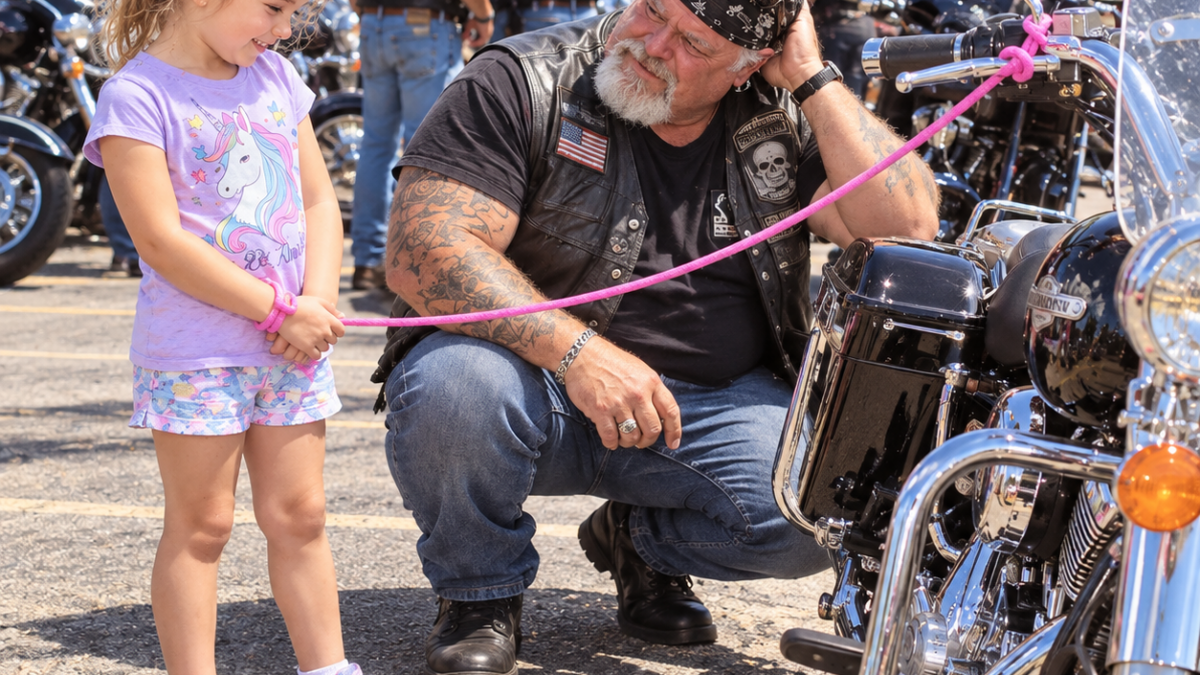
She walked across a crowded charity fundraiser, chose the biggest, loudest, scariest-looking motorcycle in the parking lot, and tied her wrist to the handlebars with a pink jump rope.
By sunset, that rope would expose a system full of tired excuses, a widower with an empty bedroom, and twenty-three bikers who suddenly understood that protecting children sometimes starts by refusing to move.
I have seen grown men freeze in front of a Harley.
Not because the machine itself is evil, though some people like to think so.
It is just metal, rubber, gasoline, noise, and whatever story a person brings to it.
To some folks, a Harley means trouble.
To some, freedom.
To cops, depending on the county, it means paperwork.
To kids, most of the time, it means thunder you can sit on.
That Saturday in April, my bike meant one thing to a seven-year-old girl with a pink jump rope in her hands.
A barricade.
We were parked outside the community center on Fifth Street for the River Saints charity cookout. Twenty-three motorcycles lined the edge of the lot, polished more than any of us would admit, chrome catching the midday sun, flags hanging from a few rear fenders, helmets on seats, leather vests tossed over handlebars.
We had hot dogs on the grill, face painting near the sidewalk, a bounce house sagging slightly in the grass, donation jars on folding tables, and a banner that read RIVER SAINTS FAMILY FUND DAY.
Underneath, in smaller letters, was our club motto.
Bikers protect people.
That motto had started as a joke years earlier after a newspaper called us “rough-looking volunteers” during a toy drive. Prez made patches the next month because Prez believes any insult can be turned into a uniform if you stitch it well enough.
My name is Daniel Mercer, though almost nobody in the club calls me that.
To them, I am Mason.
Long story.
I will only say it involved a brick wall, a bad bet, and the fact that I am apparently built like construction material.
I had been with the River Saints for seventeen years by then. Long enough to know how people looked at us. Long enough to stop caring most days. We raised money for children’s hospitals, ran holiday toy drives, escorted veterans to appointments, and taught a free motorcycle safety class every summer, but to some folks, leather is leather, and a beard is a confession.
That little girl did not see us that way.
She saw a sentence on a patch and believed it.
I was standing near the grill arguing with Big Tony about whether hot dogs should be turned once or constantly bullied when I noticed movement near my bike.
At first, I thought some kid had climbed on it.
That happens.
PART2:
Parents lose track for half a second, and suddenly a five-year-old in face paint is reaching for the throttle like he plans to cross state lines.
I set down my soda and walked over.
Then I stopped.
A little girl, maybe seven years old, was standing beside my Harley.
She had brown hair in two messy braids, purple sneakers with one lace undone, and a yellow sweatshirt too warm for the weather. Her face was serious in a way children’s faces should not be serious. In her hands was a pink jump rope with glitter handles.
One end was tied around her wrist.
The other end was halfway around my handlebars.
She was making a knot.
Not a messy kid knot.
A real knot.
The kind a child learns because she has had to tie bags, shoes, blankets, maybe too many things that should have been someone else’s job.
I crouched slowly.
“Hey there.”
She did not jump.
Did not cry.
PART3:
Did not even blink.
She pulled the rope tight.
“What are you doing?”
She looked me straight in the eye.
“If I’m stuck to your motorcycle, they can’t put Caleb in the car.”
I glanced across the lot.
That was when I saw him.
A little boy, maybe four, standing beside a gray minivan near the far end of the parking lot. He was small even for four, with a round face, dark hair sticking up at the crown, and both hands wrapped around the twisted top of a black garbage bag.
Not a backpack.
Not a suitcase.
A garbage bag.
Everything he owned was in it.
Beside the van stood a large man in a flannel shirt, work boots, and jeans. He had a crucifix on a chain around his neck and the posture of someone who wanted to seem calm because he knew people were watching. Behind him, a young woman with a clipboard walked fast in our direction, already wearing the exhausted apology of a person used to being blamed before she finished explaining.
The little girl followed my eyes.
“That’s Caleb,” she said. “He’s my brother.”
“What’s your name?”
“Maya.”
I looked at the knot again.
“Maya, why are they putting Caleb in the car?”
She swallowed.
Not crying.
Just forcing something down.
“He’s going to a new foster house. I’m not.”
That sentence took the noise out of the parking lot.
The grill hissed behind me.
Kids shrieked near the bounce house.
A motorcycle engine coughed somewhere on the street.
But for me, everything narrowed to the pink rope around that child’s wrist.
“They’re splitting you up?”
She nodded once.
“They said it this morning. They thought I was brushing my teeth, but I heard. Caleb gets the man. I go back to Maple House.”
The caseworker reached us.
“I am so sorry,” she said before I could speak. “Maya, honey, you cannot tie yourself to this gentleman’s motorcycle.”
Maya’s fingers tightened around the rope.
“It says bikers protect people.”
The caseworker closed her eyes for half a second.
She was young. Late twenties maybe. Black hair pulled into a ponytail, navy blouse wrinkled at the sleeves, badge clipped to her waistband, and a clipboard held against her chest like a shield.
“Maya,” she said, careful and soft, “we talked about this.”
“No,” Maya said. “You talked. Caleb cried. That’s not talking.”
The foster dad had started walking toward us.
I had already decided I did not like him.
That was not fair.
I know that now.
But when a seven-year-old child ties herself to your motorcycle to avoid a man, your instincts do not pause for balanced character assessment.
The girl leaned toward me.
Her voice dropped to a whisper.
“Please. He still wets the bed. Nobody else knows to check.”
I have been in bar fights.
I have picked up friends from ditches after wrecks.
I have stood beside a brother in leather while he called his mother to say her other son was not coming home.
But I am telling you, nothing ever hit me the way that sentence did.
He still wets the bed.
Nobody else knows to check.
Not, I’ll miss him.
Not, I’m scared.
Not, they promised we’d stay together.
The first thing she thought to protect was her brother’s dignity.
I looked over my shoulder.
Twenty-three bikers had gone quiet.
When bikers go quiet all at once, even the air notices.
Prez stepped out from the crowd.
His real name was Marcus Webb.
Most people did not know that unless they had filled out paperwork with him, been bailed out by him, hired by him, or buried someone with him.
He was sixty-two, broad as a church door, with a white beard, dark skin, and eyes that made loud men remember they had other volume options. He had run construction crews for forty years and our club for thirty. He never raised his voice because he had learned early that quiet, placed correctly, lands harder.
He walked to my bike, looked at the rope, then at Maya.
Then he looked at the caseworker.
“Before anybody touches that rope,” he said, “you need to know who you’re talking to.”
The caseworker’s hand froze halfway toward the knot.
The foster dad stopped a few feet away.
Maya looked up.
Prez removed his sunglasses.
“My name is Marcus,” he said. “In 1974, a caseworker put me in a car in a parking lot just like this one. My sister Dina stood on the curb screaming my name. I was six. She was nine.”
Nobody moved.
Even the kids near the face painting table seemed to sense that something heavier than a fundraiser had entered the lot.
“They told her she’d see me at Christmas,” Prez said. “They told me she was coming next week. Both of those were lies, and I don’t think the people who said them even knew they were lying. That’s the worst part. Everybody was just doing their job.”
The caseworker’s hand dropped.
Prez looked toward Caleb by the van.
“I found Dina in 2003. Twenty-nine years later.”
His voice did not change.
That made it worse.
“I found her name carved on a headstone in Dayton. She’d been gone eleven years by then. So before you untie that little girl, I want you to look at her brother over there and tell me, to my face, this is the only way.”
The caseworker’s eyes filled fast.
She hated that.
You could see it. Professionals in broken systems learn to fear tears in public because tears are treated like weakness, and weakness gets used against them.
“My name is Elena Alvarez,” she said. “And I don’t want to separate them.”
“Then don’t.”
“I don’t have a placement that can take both.”
“Find one.”
“I have been trying for three weeks.”
There was no defensiveness in her voice now.
Only exhaustion.
“I called every home on the approved sibling list in three counties. Two are full. One had a licensing issue. One family had a medical emergency. One can take Maya but not Caleb because they already have two toddlers. Mr. Hutchins was approved for one child, and Caleb needed a placement today.”
Maya spoke from beside my bike.
“You could call more people. You have a phone. I saw it.”
A couple of the guys laughed softly.
Not mean laughter.
The kind that comes out when a kid says the plain thing every adult is trying to step around.
Miss Alvarez looked at Maya.
“You’re right,” she said. “I do have a phone.”
That answer surprised me.
It surprised Maya too.
The foster dad, the big man in the flannel shirt, still had not spoken.
He stood there staring at Caleb across the lot.
Then he turned and walked back toward the minivan.
My shoulders tightened.
Maya pulled against the rope.
“No.”
“Wait,” Prez said.
Something in his voice stopped all of us.
The foster dad crouched in front of Caleb. He said something too quiet for us to hear. Caleb nodded. The man took the garbage bag out of the boy’s hands, set it on the ground gently, then held out one hand.
Caleb took it.
They walked toward us together.
When Caleb saw Maya tied to my bike, he broke into a run.
Four-year-old legs.
Sneakers slapping asphalt.
He hit her so hard she rocked backward into the Harley, and her tied hand yanked the handlebars. I lunged and grabbed the frame before eight hundred pounds of motorcycle could tip onto both children.
Maya wrapped her free arm around Caleb.
“I tied myself to the motorcycle,” she told him, calm as a weather report. “You can’t leave now.”
Caleb nodded.
“Okay.”
Just that.
Okay.
Like his sister tying herself to a stranger’s Harley was a normal Saturday plan.
The foster dad stood with his hands in his pockets.
Then he looked at Miss Alvarez.
“Three weeks you’ve been calling?”
“Yes.”
“Why didn’t anybody call me about the girl?”
Miss Alvarez blinked.
“Your home study approved you for one child. You told the agency one.”
“I told the agency one because my wife passed in January and I didn’t think I could handle more than one.”
His voice stayed flat and steady, but his jaw worked when he said wife.
“Nobody told me the one came with a sister. I found out this morning when he asked if Maya could visit.”
The parking lot went still again.
His name, we learned, was Dale Hutchins.
He was forty-one.
Welder.
Widower.
No kids of his own.
Had taken foster classes with his wife, Karen, before she got sick. After she died, he finished the licensing process because, as he later put it, “the paperwork was the only thing still moving forward, so I followed it.”
He had asked for one child because grief had convinced him that one was all he could safely fail.
“He hasn’t let go of that garbage bag since I picked him up,” Dale said, looking at Caleb. “Wouldn’t let me put it in the trunk. In the van just now, he told me why.”
Maya’s face changed.
Dale looked at her.
“He said Maya packed it for him.”
Caleb buried his face against her side.
“He said she puts a cereal bar at the bottom, wrapped in one of his shirts, every time they get moved. So he won’t be hungry at the new place before he learns where the kitchen is.”
I felt Big Tony shift beside me.
Big Tony is the size of a vending machine and has fists like canned hams. He once reset his own dislocated finger with electrical tape and spite. That day, he turned away and wiped his face with the heel of his hand.
Maya shrugged.
“Sometimes the new houses don’t feed you right away,” she said. “They forget. They’re not being mean. They just forget.”
That sentence should be carved into the desk of every adult who signs paperwork about children.
They’re not being mean.
They just forget.
Miss Alvarez turned away.
When she turned back, her eyes were wet and angry about it.
“Mr. Hutchins,” she said, “are you saying what I think you’re saying?”
“I’m saying I want to know what it takes.”
“To take both?”
“Yes.”
“It’s not simple.”
“Nothing about this looks simple.”
“You’d need an updated home study. Approval for two placements. Bedroom space verified. Safety inspection. Capacity review. Training addendum. It could take weeks, maybe more.”
Dale nodded once.
“I’ve got a second bedroom.”
Maya looked up sharply.
Dale saw it.
“It’s full of my wife’s craft stuff,” he said. “Fabric. Yarn. A sewing machine she used twice and swore at both times. I can clear it out.”
Maya’s fingers tightened around Caleb.
Miss Alvarez shook her head.
“I can’t place Maya with you today. You’re a stranger to her. Checks exist for a reason. I do not have authority to move her into an unapproved placement because a parking lot full of bikers is upset.”
Prez nodded.
“Good.”
Miss Alvarez blinked.
“Good?”
“Rules protecting kids should not disappear because adults got emotional.”
For the first time, she looked at him with something other than fear.
“But,” Prez continued, “rules should not become excuses either. Call someone who does have authority.”
“It’s Saturday.”
“Kids get split up on Saturdays,” Prez said. “So somebody’s working.”
Miss Alvarez stared at him.
Then she stepped away, pulled out her phone, and started making calls.
While she did, the fundraiser rearranged itself around Maya and Caleb.
That is the thing people do not understand about bikers unless they spend time with the right kind.
A lot of us came up hard.
Not all.
Some had decent homes, college degrees, good parents, clean records, retirement accounts, and lower backs destroyed by age instead of bar fights. But enough of us knew what it meant to be small and powerless that when a kid with a garbage bag stood in front of us, every man there saw something familiar.
Big Tony bought both kids hot dogs.
Sandra, who rode a Softail and used to teach kindergarten before she retired, sat beside Caleb and somehow got him laughing by making a napkin into a chicken.
One of the prospects found a bathroom key. Maya refused to untie herself completely, but she let us loosen the rope from the handlebar and slide it down so she could sit in the shade beside the bike with Caleb tucked against her.
The knot stayed around her wrist.
“You can trust people and still keep your rope on,” she told me.
Seven years old.
I wrote that down on a napkin because I did not want life to sand the edges off it later.
I still have that napkin in my wallet.
I sat on the curb beside her.
My bike stood between us and the sun.
“How many houses have you been in?” I asked.
She counted on her fingers.
“Four. Caleb’s been in three. He came later because he was a baby.”
“Where was the last one?”
“Miss Patrice’s. She was nice. Her hip broke. It wasn’t her fault.”
She picked at the rope.
“Everybody keeps saying nothing is anybody’s fault. But Caleb still has to go in the van.”
I had no smart answer.
So I told her the truth.
“When I was nine, my dad took off. My mom worked nights. My big brother Ray made my school lunches for two years. Peanut butter, no jelly, because jelly costs more. I didn’t find out until I was grown that some nights he didn’t make himself one.”
Maya looked at me for a long moment.
“That’s the cereal bar,” she said.
“Yeah,” I said. “That’s the cereal bar.”
She looked at Caleb, who was eating a hot dog with both hands while Sandra praised every bite like he had invented food.
“Did your brother stay with you?”
“Yes.”
“Good.”
I nodded.
“Yeah. Good.”
It was the first time I truly understood that my life had been hard in ways I carried proudly, but it had also been spared in ways I had never properly thanked anyone for.
Ray and I were poor.
We were scared.
We grew up too fast.
But nobody put him in one car and me in another while adults promised Christmas.
Miss Alvarez came back after forty minutes.
Her ponytail had come half loose. Her voice had that sharp edge people get when they have spent political capital they were not sure they possessed.
“Okay,” she said. “Here’s what I can do, and here’s what I cannot do.”
Maya sat straighter.
“I cannot place Maya with Mr. Hutchins today.”
Maya’s face fell.
Miss Alvarez crouched fast.
“But I spoke to my supervisor. The case plan is being amended for emergency sibling review. Mr. Hutchins can file for a second placement starting Monday. The review starts immediately. And until there is a decision, there will be sibling visits every week. Minimum. In writing. Not when possible. Not if schedules allow. In writing.”
Maya stared at her.
“People break writing.”
No one laughed.
Because the kid had been through four homes, and she knew things.
Miss Alvarez nodded.
“They do. Sometimes they do.”
That honesty mattered.
Prez stepped forward.
“Then here’s what else happens.”
Miss Alvarez looked up.
“Our club does supervised family events every month. Toy runs. Hospital visits. Reading program at the library. School supply drives. Official, background-checked, boring paperwork. Sandra handles it because she’s the only one who enjoys forms.”
Sandra waved from the picnic table.
Prez continued.
“We’ll host sibling visits. Public place. Supervised. Every month, in addition to whatever else you set up. If a visit gets canceled, twenty-three ugly old men in leather are going to call your office and ask why. Politely.”
“Very politely,” Big Tony said.
Big Tony sounds like gravel in a barrel, so the word politely came out like a threat wearing church clothes.
Miss Alvarez almost smiled.
“I’ll note the community support in the file.”
“Note the whole sentence,” Sandra called.
Miss Alvarez wrote it down.
Then came the part none of us could fix.
Because at the end of all the calls, all the promises, all the hot dogs and sudden community support, Caleb still had to get in the van.
Today’s placement was today’s placement.
That part nobody could untie.
Maya knew it before anyone said it.
Kids like her always know where hope stops.
She stood, worked the knot loose from my handlebar, and walked Caleb back toward the gray minivan herself, holding his hand. The pink jump rope still hung from her wrist.
She picked up the garbage bag and gave it to him.
Then she looked up at Dale Hutchins.
Forty pounds of little girl stared up at six feet of grown man like she was the one conducting the home study.
“He gets scared of the dark, but he won’t say it,” she said. “Leave the hallway light on and tell him it’s for you, not him.”
Dale nodded.
“He’ll eat vegetables if they’re in soup.”
“Okay.”
“And check the bed in the mornings, but don’t make it a big thing. Just say the sheets needed washing anyway.”
Dale listened like she was a doctor giving discharge instructions.
Then he crouched until he was on her level.
“Anything else?”
Maya thought.
“He likes when you sing in the car. Any song. Even bad singing.”
Dale swallowed.
“I’ve got bad singing covered.”
Caleb hugged his sister so hard the garbage bag crinkled between them. She whispered something in his ear. He nodded. Then he climbed into the booster seat holding that bag on his lap.
Bottom of the bag, wrapped in a shirt, was the cereal bar.
I had watched Maya check.
The van pulled away.
Maya stood in the lot and watched it the whole way to the road.
No crying.
Jaw set.
Jump rope wound around her fist.
Miss Alvarez placed a hand on her shoulder.
“Time for us to go too, Maya.”
Maya nodded.
But first she walked back to my Harley.
She patted the gas tank twice.
Gentle.
The way you would pat a horse that had done its job.
“Thanks for letting me borrow your motorcycle,” she said.
I crouched in front of her.
“Any time.”
She studied me.
“I mean that,” I said. “Any time.”
That should have been the end of the story.
It was not.
Real stories do not end where the heart wants to place the music.
The home study took nine weeks.
Nine weeks of phone calls.
Forms.
Inspections.
Background checks.
Capacity reviews.
Policy words that sounded clean until you remembered two children were sleeping in separate places while adults moved papers between desks.
Dale did exactly what he said he would do.
He cleared the craft room.
Not all the way.
Sandra told us that when she helped him move boxes, he kept one shelf of his wife’s fabric in the closet.
“He said maybe Maya would want to learn to sew someday,” Sandra said. “And it felt right that the thread was Karen’s. Sort of. Like families get stitched together out of whatever is left over.”
Dale bought a bedspread with yellow flowers because he remembered Maya’s sweatshirt from the fundraiser.
Then he worried that buying yellow was too much.
Then he bought a purple one too and kept both receipts because grief and foster parenting had apparently turned him into a man afraid of choosing wrong blankets.
Caleb, according to Dale, slept with the hallway light on every night.
Dale told him it was because he did not like dark hallways.
Caleb believed him in the generous way little children sometimes allow adults to preserve everyone’s pride.
The first sibling visit happened at the library on Fifth.
Maya arrived with Miss Alvarez from Maple House.
Caleb arrived with Dale.
The River Saints arrived with seventeen volunteers, six boxes of donated books, and one very nervous children’s librarian who kept looking at our vests as if trying to decide whether the alphabet rug had ever witnessed this much leather.
Sandra had arranged everything properly.
Permission forms.
Supervision plan.
Sign-in sheets.
Emergency contacts.
A table of snacks.
A reading corner.
Big Tony wore a shirt with no skulls because Sandra told him “children’s literacy does not require flames.”
Maya walked in still wearing the pink jump rope around her wrist like a bracelet.
Caleb saw her and ran.
That became the pattern.
Every visit began with running.
Every visit ended with instructions.
Maya would remind Dale about Caleb’s food, pajamas, nightmares, favorite dinosaur, new fear, old fear, and whether he was pretending not to like carrots this week.
Dale wrote things down.
That mattered to her.
The first time he pulled a little notebook from his pocket and said, “Slow down, Maya, I want to get this right,” she stared at him like he had performed a miracle.
Adults forget.
Paper remembers.
Miss Alvarez came to two visits on her own time.
That told me something about her.
People like to talk about systems as if systems are machines. They are not. They are people trapped inside machinery, some turning the gears, some being ground by them, some trying to jam a wrench into the right place without losing their hands.
Miss Alvarez was young.
Too young to have that tired a face.
At the second visit, I found her standing outside the library with a coffee she had not touched.
“You okay?” I asked.
She laughed once.
“No.”
“Fair.”
She looked through the window at Maya reading to Caleb while he leaned against her shoulder.
“I have eight sibling groups on my caseload,” she said. “Eight. You think this is the only one? It isn’t. It’s just the one that tied itself to a Harley in front of witnesses.”
I said nothing.
She shook her head.
“I became a caseworker because I wanted to help kids. Now half my job is explaining why help has a waiting list.”
“That why you stayed?”
“What?”
“You could have cut the rope and moved on.”
She looked at me, offended.
“No.”
“Good.”
“I almost did,” she said quietly.
That honesty caught me off guard.
“I almost did because we were late, because Dale was waiting, because Maple House expected Maya back, because my supervisor wanted the placement completed, because I had three calls unanswered, because there were rules, because I was tired, because a part of me thought if I let one little girl stop everything with a jump rope, I’d never get through the day.”
She looked down at her coffee.
“Then Marcus told that story about his sister.”
“Dina.”
“Yeah.”
For a moment, neither of us spoke.
Then she said, “I don’t want to be someone’s parking lot story in forty years.”
That one stayed with me too.
A month into visits, trouble came from a man named Richard Kline.
He was an agency supervisor, not Miss Alvarez’s direct supervisor, but close enough to paperwork to believe he owned the air around it. Gray suit. Clean shoes. Voice like a locked filing cabinet.
He attended the third library visit because, according to Sandra, someone at the agency was “concerned about optics.”
That meant bikers.
We always mean optics to somebody.
Mr. Kline arrived with a tablet, a folder, and a face already arranged into disapproval. He watched Maya and Caleb hug. Watched Dale sit nearby with his little notebook. Watched Sandra guide three kids through a reading activity. Watched Big Tony help a boy sound out the word motorcycle with the seriousness of a priest translating scripture.
Then Kline looked at Prez.
“I appreciate community enthusiasm,” he said, “but the department cannot appear influenced by motorcycle club pressure.”
Prez nodded.
“Good.”
Kline seemed wrong-footed.
“Good?”
“Children’s placements should not be decided by pressure.”
“Exactly.”
“They also shouldn’t be decided by a shortage of imagination.”
Kline’s smile thinned.
“This is a matter for trained professionals.”
Sandra appeared beside Prez with a binder.
Sandra’s binders are legendary.
Men have confessed old crimes under less paper pressure.
“We are background-checked,” Sandra said. “Trained as event volunteers through the county hospital system, registered for the library reading program, and approved for supervised family support events. Here are copies of clearances, insurance documents, site permissions, sign-in records, incident protocols, and emergency contacts.”
She handed him the binder.
It weighed nearly as much as Caleb.
Kline adjusted his grip.
Sandra smiled.
“Community support. In writing.”
Miss Alvarez turned away, but I saw her shoulders shake.
Kline flipped through the binder.
“You people are very organized.”
Prez said, “We’ve been underestimated before.”
Kline did not become kind that day.
But he became careful.
Careful was enough.
The visits continued.
Dale kept showing up.
That sounds small.
It was not.
For kids like Maya and Caleb, consistency is not boring. Consistency is proof.
Dale showed up with snacks approved by Maya.
Showed up with Caleb in clean clothes that matched badly but were clearly chosen with effort.
Showed up with questions.
Showed up when Caleb had a cold.
Showed up when Maya was angry and refused to speak for the first fifteen minutes because Maple House had changed staff again and nobody told her until breakfast.
Dale sat three chairs away and waited.
When she finally looked at him, he said, “I’m still here.”
Maya looked down at her jump rope.
“I see that.”
At the sixth visit, she let Dale read the book instead of her.
At the seventh, she corrected his voices.
“That bear doesn’t sound like that.”
“How does he sound?”
“Lower.”
Dale lowered his voice until the librarian looked concerned.
Caleb laughed so hard he slid off the cushion.
At the eighth visit, Maya fell asleep with her head on Sandra’s lap while Caleb built a block tower with Big Tony.
Maya never napped in public.
Miss Alvarez stood near the doorway and cried quietly into a napkin.
Nobody mentioned it.
In July, the placement was approved.
We found out because Dale called the clubhouse.
I answered.
River Saints clubhouse, if you can’t behave, call back later.
There was a pause.
Then Dale said, “It’s approved.”
I stood up so fast my chair fell over.
Big Tony looked across the room.
“What?”
I held up one hand.
Dale’s voice shook.
“They approved Maya. She can move in Saturday.”
By then, the whole clubhouse had gone silent.
Dale cleared his throat.
“I was wondering if a few of you would be willing to be there when I pick her up.”
“You want us at the group home?”
“She trusted you before she trusted me,” he said. “Feels right you’re there.”
I looked at Prez.
He nodded once.
“We’ll be there.”
Saturday morning, seven of us rode to Maple House.
Not loud.
No revving.
No show.
We parked out front, engines off, helmets under arms, just there.
Maple House was a square brick building with cheerful murals painted on one side and security cameras above the door. Places like that always break my heart because people try so hard to make them look child-friendly, but no mural in the world can make up for being a place children wait to leave.
Dale arrived in his pickup ten minutes later.
Caleb was in the back seat, face pressed to the window.
When he saw us, he waved with both hands.
Dale got out wearing a blue button-down shirt so new it still had fold lines.
“You look like church attacked you,” Big Tony said.
Dale looked down.
“Too much?”
“Kid won’t care.”
“She might.”
“She’s seven.”
“She notices everything.”
Big Tony nodded.
“That’s true.”
The door opened.
Maya stepped out with Miss Alvarez beside her.
She had a purple suitcase.
A real suitcase.
Not a garbage bag.
Dale had bought it.
First suitcase she had ever owned.
She stopped on the steps when she saw the motorcycles.
For a second, she looked smaller than I remembered.
Then she reached into her sweatshirt pocket and pulled out the pink jump rope.
She held it up.
“Do I need it?” she called.
I swallowed.
“No,” I called back. “Not this time.”
She looked at the rope for a long moment.
Then she came down the steps, walked straight to me, and placed it in my hands.
“You keep it,” she said. “In case some other kid needs to tie themselves to something.”
I could not speak.
I nodded because anything else would have come out broken.
Dale crouched as she approached.
He did not reach for her.
He had learned.
Maya stood in front of him.
“Did you leave the hallway light on?”
“Yes.”
“Did you buy cereal bars?”
“Yes.”
“What kind?”
“Oatmeal chocolate chip and strawberry.”
“Caleb hates strawberry.”
“I know. Those are for you.”
She blinked.
For a second, all her armor cracked.
Not fully.
Just enough for a child to look through.
“You got some for me?”
“Yes.”
She looked at Caleb in the truck.
He was bouncing in his seat.
Then she looked back at Dale.
“I don’t know if I’ll like living there.”
“That’s okay.”
“I might be mad.”
“That’s okay.”
“I might keep my suitcase packed.”
Dale’s throat worked.
“That’s okay too.”
She studied him.
“For how long?”
“As long as you need.”
Miss Alvarez looked down at her clipboard too quickly.
Maya nodded once.
Then she walked to the truck.
Caleb shouted, “Maya!”
She opened the door and climbed in beside him.
Dale stood there a second like his knees had forgotten their job.
Prez touched his shoulder.
“Go on.”
Dale nodded and got into the driver’s seat.
As the truck pulled away, all three of them inside, I heard singing.
Bad singing.
Truly terrible.
Some old country song Dale clearly knew only half the words to.
Caleb laughed.
Then, after a moment, I saw Maya in the back seat, not smiling exactly, but not stopping him either.
That was enough.
The pink jump rope hangs in our clubhouse now.
Big Tony built the frame in his garage.
Sandra ordered the brass plate.
Prez hung it under the club charter, right where every new prospect has to see it.
The plate reads:
You can trust people and still keep your rope on.
People ask about it sometimes.
Visitors.
New riders.
Donors at fundraisers.
A city councilman once asked if it was “symbolic.”
Big Tony told him, “Everything is symbolic if you don’t know the story.”
So we tell it.
We tell about Maya and Caleb.
About the garbage bag.
About the cereal bar wrapped in a shirt.
About Miss Alvarez making calls when it would have been easier to cut the rope.
About Dale finding out the child he was taking came with a sister.
About Prez and Dina.
About the way a parking lot full of bikers learned that day that sometimes protection does not mean fighting.
Sometimes it means witnessing.
Sometimes it means paperwork.
Sometimes it means hosting library visits and calling offices politely.
Sometimes it means holding a motorcycle steady while a little girl ties herself to it because every other adult structure in her life has moved.
Maya did move in with Dale and Caleb.
Not perfectly.
Nothing real happens perfectly.
The first week, she slept with her suitcase beside the bed.
The second week, she hid cereal bars in three different places.
The third week, she got mad because Dale washed her sweatshirt without asking.
The fourth week, she cried because the clean sweatshirt smelled like his house and not Maple House anymore, and that made her feel like she was betraying every place she had survived before.
Dale called Sandra in a panic.
Sandra told him grief does weird things in laundry rooms.
He wrote that down.
Months later, Dale petitioned for long-term placement.
Later still, he adopted them both.
The adoption hearing was the first time I ever saw Maya wear a dress voluntarily. Purple, to match the suitcase. Caleb wore a bow tie and untied it before the judge finished speaking.
Miss Alvarez came.
Prez came.
Sandra came.
Big Tony came and cried louder than anyone.
Dale stood before the judge with one hand on each child’s shoulder. When asked if he understood the legal and permanent responsibility he was accepting, he said yes in a voice that cracked on the smallest word in the English language.
Maya raised her hand.
The judge smiled.
“Yes, Maya?”
“Can I say something?”
“Of course.”
She looked at Dale.
“He sings bad, but he leaves the light on.”
The courtroom laughed softly.
Then she added, “And he remembers.”
That was the part that made Dale cover his face.
He remembers.
For a child who had been moved, separated, promised, delayed, and forgotten in all the ways adults explain as nobody’s fault, remembering was everything.
After the adoption, we gathered in the courthouse parking lot.
No motorcycles that day, at Maya’s request.
She said, “Today is not a rope day.”
So we came in trucks and cars like ordinary people, which made everyone deeply uncomfortable.
Maya walked over to me after the photos.
She was older by then.
Not much.
Enough.
“You still have it?” she asked.
“The rope?”
She nodded.
“At the clubhouse.”
“In case some other kid needs it?”
“Yeah.”
She thought about that.
“Maybe they won’t need to tie themselves if people see it first.”
I had to look away.
Some kids should not be smarter than the world.
But some are because the world leaves them no choice.
Years have passed since that April fundraiser.
Maya is twelve now.
Caleb is nine.
Dale’s bad singing has not improved, though Caleb has joined in, making the situation worse for everyone in a half-mile radius.
Maya did learn to sew.
Not from Dale, obviously.
From Sandra, using Karen’s fabric from the craft room closet. The first thing she made was a crooked little bag for cereal bars. She gave one to Caleb. One to Dale. One to Miss Alvarez.
She gave me one too.
Mine hangs from the mirror of my Harley.
Pink thread.
Bad stitching.
Perfect.
Miss Alvarez stayed in social work longer than any of us expected. She got promoted eventually, though she still attends the River Saints family events whenever she can. She says community support matters in files.
Prez says files matter when people do.
Dina’s name is on a small patch inside Prez’s vest now.
Maya asked him once why he did that.
He told her, “So she rides with me.”
Maya accepted that completely.
Children understand sacred things better than adults.
I still ride the same Harley.
There is a tiny scuff near the handlebar where the jump rope knot pulled tight that day. I could buff it out. I never have.
Some marks are damage.
Some are proof.
Every time I see it, I remember Maya standing in that parking lot, jaw set, wrist tied to my bike, trying to stop a van with nothing but a rope and love.
People think courage looks loud.
Most of the time, it does not.
Sometimes courage is seven years old, wearing purple sneakers, whispering that her brother wets the bed and nobody else knows to check.
Sometimes courage is a young caseworker admitting rules matter and then using every rule she can find to keep a promise alive.
Sometimes courage is a widower clearing out a craft room he thought he would never touch because a little boy came with a sister.
Sometimes courage is twenty-three bikers learning that the most important thing they can do is stand still long enough for a child to be heard.
That day, Maya thought she was borrowing my motorcycle.
She was wrong.
She gave us something.
A rope.
A sentence.
A responsibility.
She taught us that trust is not the same as letting go of every knot.
Sometimes trust begins with keeping one tied until the right people prove they will not cut it.
And if another child ever walks into one of our fundraisers carrying everything they own in a garbage bag, I know exactly what we will do.
We will make room.
We will make calls.
We will write things down.
We will stand between that child and the easy answer.
And if all else fails, there is a pink jump rope hanging on the clubhouse wall, waiting.
Just in case somebody needs to tie themselves to something that will not move.


