A Landlord Called This Great Dane a Monster After a Fire Destroyed an Apartment, But the Truth Came In Wearing a Hospital Bracelet
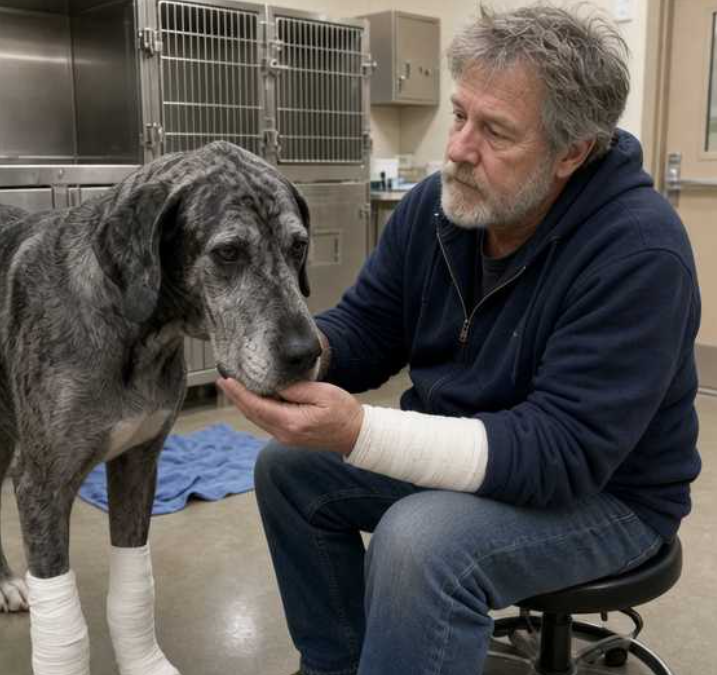
A Landlord Called This Great Dane a Monster After a Fire Destroyed an Apartment, But the Truth Came In Wearing a Hospital Bracelet
The landlord said Moose had attacked his tenant, destroyed the apartment, and deserved to disappear before anyone asked questions.
But the enormous Great Dane spent the whole night bleeding in silence, staring at our clinic door like the only person who loved him might still come back.
When an old man in hospital bandages finally arrived whispering, “Please tell me my dog is here,” every lie in that room began to fall apart.
I work the night shift at an emergency veterinary clinic on the edge of Dayton, Ohio, in a low brick building squeezed between a twenty-four-hour pharmacy and a laundromat that always smells like bleach and wet denim.
Most people never notice us unless something terrible happens.
They drive past our blue sign a hundred times on their way to work, church, school pickup, or the grocery store. They don’t think about the fact that while the rest of the city sleeps, there are people inside that building holding animals through seizures, giving oxygen to cats pulled from fires, stitching up dogs hit by cars, and telling strangers the kind of news that can break a person in half.
My name is Claire Bennett, and by then I had been a veterinary technician for eleven years.
Long enough to know that panic has a sound.
It is the sound of a mother carrying in a limp puppy wrapped in a dish towel.
It is the sound of a grown man trying not to sob when he asks if we can save his old lab just one more time.
It is the sound of claws skidding on tile, doors swinging open, monitors beeping too fast, and someone saying, “Please, please, please,” to a God they may not have spoken to in years.
But the night Moose came in, there was no panic.
That was the first thing that felt wrong.
It was 1:14 in the morning, rain dragging silver lines down the front windows, when a black pickup pulled crookedly into the fire lane outside the clinic. I was at the front desk entering discharge notes for a cat named Pickles who had eaten half a ribbon and somehow survived with more attitude than gratitude.
Dr. Marisol Vega was in the treatment room rechecking a dachshund with pancreatitis. Our receptionist had gone home sick at midnight, so I was covering phones, intake, triage, and the front lobby, because emergency medicine is mostly skill, caffeine, and pretending you have six hands.
The pickup’s headlights stayed on.
For a few seconds, nobody came inside.
Then the driver’s door opened, and a man stepped out into the rain.
He was maybe in his late fifties, thick through the shoulders, with slicked-back gray hair and a tan jacket that looked expensive in a way that tried hard to seem casual. He slammed the truck door with a force that made me look up.
The passenger door opened next.
At first, I thought he had brought in a small horse.
Then the animal lowered his head under the doorframe and stepped into the light.
He was a Great Dane. A huge blue-gray Great Dane with a white patch on his chest and legs so long they seemed almost too fragile to hold up the weight of him. His head was massive, noble, almost carved, with soft hanging ears and eyes the color of old pennies.
Blood spotted the tile beneath his paws.
His muzzle was cut in three places. One front paw was wrapped badly in what looked like a kitchen towel, already soaked through. Tiny shards of glass glittered in the fur around his chest and forelegs.
The man yanked the leash.
The dog flinched.
That was the second thing that felt wrong.
PART2:
A dog that had just attacked someone usually came in one of two ways. Either he was still flooded with adrenaline and fear, thrashing against restraint, or he was shut down so completely he barely registered the room. But this Great Dane did neither.
He lowered his head, tucked his tail, and tried to move behind the man as if he wanted to disappear.
“Can I help you?” I asked, already reaching for an intake form.
The man threw the leash toward the counter like he was handing over evidence.
“He destroyed the apartment and attacked my tenant,” he said. “Nobody can control him. I want him gone.”
His voice was loud enough to wake the dachshund in the back.
I looked from him to the dog.
The Great Dane was shaking so hard his collar tags clicked softly together.
“Sir,” I said, keeping my tone calm, “is the tenant okay?”
The man made a dismissive noise. “He’s at the hospital.”
“Did the dog bite him?”
“That’s what I said, isn’t it?”
“No,” I replied, and I remember the way his eyes narrowed when I didn’t accept his anger as an answer. “You said he attacked him. I’m asking whether there was a bite.”
He leaned forward with both palms on the counter. He smelled like rain, leather, and smoke.
“I don’t know how you people classify these things,” he said. “The old man is injured. The apartment is wrecked. Doors broken. Furniture knocked over. Glass everywhere. The dog had blood on him. What more do you need?”
What I needed was the truth.
But the truth rarely walks in first.
Usually, it arrives late, out of breath, wearing grief on its face.
“What’s the dog’s name?” I asked.
The man hesitated.
That was the third thing that felt wrong.
He looked down at the animal like the name was printed somewhere on him.
“Moose,” he said finally. “I think.”
The Great Dane’s ears lifted at the sound.
PART3:
Not much. Just a small movement, the way a child might flinch when called by a teacher they do not trust.
I came around the counter slowly and crouched, turning my body sideways so I wouldn’t look threatening.
“Hi, Moose,” I said softly.
The dog looked at me.
I have seen fear in animals so many times I sometimes dream about it. Fear has shapes. It can be sharp and frantic, like a trapped bird. It can be blank and distant, like an animal already leaving its body before death arrives. It can be hot and dangerous when pain has stripped away trust.
Moose’s fear was different.
It was confused.
He looked like he had done everything he knew how to do, and somehow everyone was angry at him for it.
I held out the back of my hand.
The landlord jerked the leash. “Careful. He’s vicious.”
Moose lowered himself to the floor.
A vicious dog does not usually make himself smaller.
Dr. Vega came out then, peeling off gloves. She was forty-six, five-foot-two on a generous day, with the kind of presence that could quiet a room without raising her voice. Her dark hair was pulled into a tight bun, and there was a small smear of iodine on her cheek.
“What’s going on?” she asked.
The landlord straightened a little, as if her white coat made him perform concern.
“This animal attacked my tenant,” he said. “I’m surrendering him.”
Dr. Vega’s gaze moved over Moose, pausing on the paws, the muzzle, the towel, the glass.
“Was there a fire?” she asked.
The man’s expression flickered.
It lasted less than a second.
But I saw it.
“There was smoke damage,” he said. “Small kitchen incident. The dog made it worse.”
“Was the fire department called?”
“I don’t see how that matters.”
“It matters because this dog appears to have injuries consistent with broken glass and possible smoke exposure.”
The landlord laughed once, sharp and humorless. “You animal people always do this. You see some oversized mutt bleeding on the floor and suddenly he’s a hero.”
Moose whined.
Not loudly.
Just once.
I felt it in my chest.
Dr. Vega didn’t blink. “We need to examine him.”
“You can do whatever you want after I sign him over,” the landlord said. “I’m not paying for it.”
“There is an emergency stabilization fee for surrendered injured animals,” Dr. Vega said.
“No.”
The word landed flat and cold.
“He needs treatment,” I said before I could stop myself.
The landlord turned on me. “Then treat him. I’m giving him to you.”
“That’s not how this works,” Dr. Vega said.
He pulled a folded set of papers from inside his jacket and slapped them on the counter. “I own the building. Tenant’s lease says unregistered animals may be removed after damages. He kept this beast without permission. I’m surrendering it as abandoned property.”
I looked at Moose again.
He was wearing a collar with a tag.
Not a fancy tag. A scratched bone-shaped piece of metal that read MOOSE in uneven block letters, with a phone number underneath.
“That dog is not abandoned property,” I said quietly.
The landlord followed my eyes to the tag, then reached down and flipped it over with two fingers as if the metal disgusted him.
“Call the number,” he said. “See who answers. Nobody. The old man is sedated somewhere, probably after that thing mauled him.”
“Do you have the tenant’s name?” Dr. Vega asked.
“Harold Whitaker.”
“And your name?”
“Graham Bell.”
He said it like we should recognize it.
In Dayton, people like Graham Bell often assumed they were known. He owned older apartment buildings with names like The Willows and Oak Terrace, places with peeling balconies and rent that somehow kept rising. I had heard his name before, usually attached to complaints from people who could not afford lawyers.
Dr. Vega slid the surrender form toward him. “You understand that by signing this, you are stating you have legal authority to surrender this animal.”
“I understand exactly what I’m doing.”
He signed hard enough to nearly tear the paper.
Then he tossed the pen down, looked at Moose, and said, “Should’ve put him down years ago.”
Moose lowered his head until his chin touched the tile.
Something hot moved behind my ribs.
I have always been good at staying professional. You have to be. You cannot scream every time someone is cruel. You cannot cry every time an animal suffers because a human failed them. You learn to swallow the anger and use your hands.
But that night, I wanted to ask Graham Bell what kind of man looks at a bleeding animal and sees inconvenience.
Instead, I picked up the leash.
Moose stood slowly, his joints trembling.
“Come on, sweetheart,” I whispered.
The landlord scoffed behind me. “Sweetheart. That’s rich.”
Moose followed me into the treatment room, every step leaving a small red mark on the floor.
He was so tall his back nearly reached my waist, but he moved like an apology.
In the treatment area, the fluorescent lights revealed the full extent of his injuries. Cuts across the muzzle. Singed whiskers. Redness around the eyes. Glass embedded in the pads of both front paws. A deep slice between two toes. Bruising along his shoulder. Smoke smell trapped in his coat.
Dr. Vega listened to his lungs.
“Harsh,” she murmured. “Not terrible, but he inhaled smoke.”
I clipped the leash to the wall hook and ran my hand lightly down his neck. “It’s okay, Moose. We’ve got you.”
He leaned into me for one second.
Just one.
Then he caught himself, as if comfort was something he wasn’t sure he was allowed to accept.
We gave him pain medication. We flushed his eyes. We cleaned the cuts on his face and started removing glass from his paws. He never growled. Never snapped. Never even lifted a lip.
When the worst shard came out, he made a sound I had never heard from a dog that large.
A thin, broken cry.
I had to turn my head and breathe through my nose.
“You okay?” Dr. Vega asked quietly.
“Fine.”
She glanced at me, not believing it, but she didn’t push.
That was one of the things I loved about Marisol Vega. She understood that emergency clinics are full of people pretending to be fine so the next living creature in front of them can keep breathing.
By three in the morning, Moose was bandaged, medicated, and settled in the largest recovery kennel we had. It still barely contained him. His head rested near the door, eyes fixed on the hallway.
Every time footsteps passed, he lifted his head.
Every time the outer door opened, he tried to stand.
Every time he realized the person coming wasn’t Harold Whitaker, he lay back down with a sound too soft to be called a whimper and too sad to be called anything else.
“He’s waiting,” I said.
Dr. Vega stood beside me with a clipboard against her chest. “Yes.”
“For the man he supposedly attacked.”
“Yes.”
I looked down at the surrender form. Graham Bell’s signature cut across the bottom like a wound.
“Something’s wrong.”
“A lot is wrong,” she said.
“Can we call the tag number?”
“I already tried. No answer. Left a voicemail.”
“What about the hospital?”
“We can’t call every hospital asking about a patient. Privacy laws.”
“I know.” I rubbed my forehead. “I know. I just…”
Dr. Vega’s face softened. “Go sit with him.”
“I’m on shift.”
“And right now, he’s your patient.”
So I sat outside Moose’s kennel from 3:20 until nearly 5 a.m., with my back against the opposite wall and my knees pulled to my chest. Rain whispered against the roof. Machines hummed. Somewhere a beagle barked in his sleep.
Moose watched the hallway.
His eyes were open, but they were not looking at me.
They were looking for someone he loved.
At 4:07, I checked the phone number on his tag again. The metal was worn, the numbers scratched, but still readable. I entered it into our system under “possible owner contact.” Then, against policy but not against my conscience, I wrote the tenant’s name in the notes.
Harold Whitaker.
I didn’t know him yet.
All I knew was that somewhere in the city, an old man was injured, and his dog was lying in our clinic with glass in his paws because a landlord had decided the simplest story was the one that made the dog disposable.
The next morning, the clinic changed shifts.
Day staff arrived with coffee, dry shoes, and that fresh kind of energy night workers resent even when we love them. I gave report to Megan, the lead day tech, then stayed an extra hour because I couldn’t bring myself to leave Moose.
He still wouldn’t eat.
We offered chicken, canned food, warmed broth, even peanut butter on a tongue depressor.
Nothing.
He sniffed everything politely, then turned his head toward the door.
“He needs his person,” Megan said.
“He needs a lot of things.”
She looked at his chart. “Surrendered as aggressive?”
“That’s what the landlord claims.”
Megan made a face. “This dog?”
Moose blinked at her.
Megan reached through the kennel bars and scratched his chin. “Yeah, you look terrifying. Absolutely ferocious. Bet you’d apologize if someone stepped on your tail.”
His tail thumped once.
It was the first wag I saw.
I should have gone home then. My body was heavy with exhaustion, and my scrubs smelled like antiseptic and smoke. But I sat in my car for twenty minutes in the parking lot, staring at the gray morning, unable to start the engine.
Maybe because I was thinking about Moose.
Maybe because I was thinking about my father.
My dad had died three years earlier, and grief has strange habits. It sleeps in you for months like an animal under the porch, then one ordinary thing wakes it up.
My father had been a quiet man named Daniel Bennett who worked thirty-six years repairing elevators. He hated hospitals, loved burnt coffee, and believed every dog deserved a middle name even if you didn’t know the first one. When he got sick, our old mutt Rosie would sleep beside his recliner and bark whenever his oxygen tube kinked.
After he died, people kept saying, “At least he’s not suffering anymore,” like that was supposed to help.
But I had learned something from Rosie.
Love does not stop looking for you just because the room is empty.
That morning, Moose looked the way Rosie had looked for weeks after we carried my father out for the last time.
I drove home with tears burning my eyes, showered, slept badly for four hours, and woke up to a voicemail from the clinic.
It was Megan.
“Claire, hey. Call us when you’re up. Moose’s owner is here. Or tenant. Or whatever. You’re going to want to come in.”
I don’t remember putting on shoes.
I barely remember driving.
When I walked into the clinic lobby, the first thing I saw was the man sitting in the corner chair near the vending machine.
He looked too fragile to be standing, let alone walking around a city looking for a dog.
He was in his late seventies or maybe early eighties, tall but stooped, with thin white hair combed carefully to one side. His left arm was wrapped from wrist to elbow in clean hospital bandages. There was a hospital bracelet still around his right wrist, and a square of gauze taped near his collarbone where an IV had been. Smoke had stained the edges of his gray cardigan. His shoes didn’t match. One was a brown loafer. The other was a black slipper with a rubber sole.
In both hands, he held a printed photo.
The photo had been folded and unfolded so many times the paper was soft at the creases.
Moose sat beside a Christmas tree in it wearing antlers.
I knew before he spoke.
This was Harold Whitaker.
Megan stood behind the counter, looking like she had been trying very hard not to cry.
The old man looked up when the lobby door opened.
His eyes found my scrubs, then my name badge.
“Are you Claire?” he asked.
I nodded. “Yes, sir.”
His mouth trembled. “They said you were here when he came in.”
“I was.”
He stood too fast and swayed.
I moved toward him, but he waved me off with embarrassed dignity.
“Please,” he said, holding up the photo. “Please tell me he’s here.”
There are moments in medicine when you know the truth will hurt no matter how gently you hand it over.
This was not one of them.
“Yes,” I said. “Moose is here.”
The old man closed his eyes.
His knees almost buckled.
Megan came around the counter with a chair, but he lowered himself back down before she reached him. He pressed the photo against his chest and began to cry without making a sound.
Not dramatic crying.
Not loud.
Just tears slipping down a face that had probably spent a lifetime trying not to show too much.
“He’s alive?” he whispered.
“He’s alive,” I said. “He has injuries, but he’s stable.”
His shoulders shook once.
“Thank God.”
Dr. Vega came out of Exam Room Two.
“Mr. Whitaker?”
He stood again, slower this time.
“I’m Dr. Vega.”
“Can I see him?”
“We’ll take you back,” she said. “But first, I need to ask you what happened.”
His expression changed.
The relief did not leave, but something else entered beside it.
Shame.
Fear.
Maybe humiliation.
He glanced around the lobby, where a woman with a carrier and a teenage boy holding a rabbit were pretending not to listen.
“Mr. Bell told us Moose attacked you,” Dr. Vega said gently.
The old man stared at her.
Then his eyes filled again, but these tears were different.
They were angry tears.
“No,” he said.
The word came out barely louder than a breath.
Then stronger.
“No. Moose never attacked me.”
The woman with the carrier looked up.
The teenage boy stopped stroking the rabbit.
Harold Whitaker drew himself as straight as his injuries allowed.
“There was a fire,” he said. “I was asleep in my chair. I’d taken my medicine. I don’t always hear well without my aids, and I must have left a towel too close to the stove after making tea.”
His voice cracked.
“I didn’t wake up when the smoke alarm started.”
He looked down at Moose’s photo.
“Moose woke me.”
The lobby became completely silent.
“He jumped on me first,” Harold said. “He knows he’s not supposed to. He’s too big. I always tell him, ‘Moose, you’ll flatten me one day.’ But he kept pushing his head under my arm. Then he started barking. Not like he does when the mailman comes. Different. Scared.”
I felt Dr. Vega go still beside me.
“I was confused,” Harold continued. “The room was dark, full of smoke. I couldn’t get my feet under me. I think I fell. The coffee table went over. The lamp went over. Moose kept circling, knocking things out of the way. I couldn’t see the hallway. I couldn’t breathe.”
He lifted his bandaged arm.
“He grabbed my sleeve.”
His voice broke completely then.
“He pulled me. Not biting. Pulling. He dragged me toward the patio door because the hall was full of smoke. I couldn’t open it. My hand wouldn’t work. I was coughing too hard. So he…”
Harold covered his mouth.
“So he went through it,” I said softly.
The old man nodded.
“He threw himself at the glass door until it broke. Then he came back for me.”
I closed my eyes for one second.
The cuts on Moose’s muzzle.
The glass in his paws.
The bruised shoulder.
All of it rearranged itself inside my head.
Not attack.
Escape.
Not aggression.
Rescue.
“He pulled until I followed him outside,” Harold whispered. “I remember cold air. Rain on my face. Then I was on the ground. He lay beside me and barked. He barked until Mrs. Alvarez from downstairs came out screaming. Then I don’t remember much.”
Dr. Vega’s jaw tightened. “And Mr. Bell?”
Harold’s face hardened in a way I had not expected.
“Graham came after the ambulance. I heard him shouting about the door before they shut the ambulance. Not asking if I could breathe. Not asking if I was alive. Shouting about the damn door.”
He looked at me then, directly, desperately.
“They wouldn’t let Moose in the ambulance. I tried to tell them he was hurt, but I couldn’t get the words out. Mrs. Alvarez said she would watch him. Then later at the hospital, a nurse told me my landlord had taken him.”
His voice dropped.
“I called him from the hospital. Graham said Moose was gone. He said I should be grateful he didn’t have animal control put him down.”
The woman with the carrier made a soft horrified sound.
Harold’s hand tightened around the photo until it wrinkled.
“I checked myself out against medical advice this morning because nobody would tell me where my dog was.”
“Mr. Whitaker,” Dr. Vega said, “you should still be in the hospital.”
“I know.”
“You may have smoke inhalation complications.”
“I know.”
“You could collapse.”
“I know.”
“Then why did you leave?”
Harold looked toward the hallway leading to the treatment area.
“Because Moose would think I abandoned him.”
No one in that lobby spoke.
I had spent years watching people cry over animals, but there are certain sentences that change the air in a room.
That one did.
Because everyone understood it.
Everyone who had ever loved a creature that waited by the door understood that Harold Whitaker had dragged his injured body out of a hospital not because he was reckless, but because love had given him one more thing to survive.
Dr. Vega turned toward me. Her voice was professional, but her eyes were wet.
“Claire, take Mr. Whitaker to Moose.”
I led him down the hallway slowly. He touched the wall once to steady himself but refused my arm until halfway there, when his breath caught and pride lost to weakness.
“Sorry,” he said.
“Don’t be.”
The recovery ward was dimmer than the treatment room. We kept it that way for animals coming out of anesthesia or shock. Moose was in the last kennel on the left, his enormous body curled awkwardly on a pile of blankets.
His head was up before we reached the door.
At first, he only stared.
Then he made a sound I will hear until the day I die.
It was not a bark.
It was not a howl.
It was grief recognizing home.
His whole body began to tremble. The bandages on his paws scraped against the kennel floor as he tried to stand. His tail hit the metal wall once, twice, then faster. He pressed his head against the bars so hard I worried he would hurt himself again.
Harold made a broken sound.
“Moose.”
The Great Dane cried out.
Harold dropped to his knees so quickly I had to catch his shoulder.
“Easy,” I said. “Both of you, easy.”
But there was no stopping what happened next.
I opened the kennel.
Moose did not charge.
He did not lunge.
He stepped out slowly, painfully, as if every paw hurt, as if every muscle remembered smoke and glass and panic. Then he lowered his huge head into Harold Whitaker’s lap.
Harold wrapped his good arm around him and bent over him with a sob that seemed to come from every lonely year of his life.
“My boy,” he whispered. “My good boy. I’m sorry. I’m so sorry.”
Moose closed his eyes.
For the first time since he had arrived, he stopped shaking.
I stood in the doorway with one hand over my mouth, trying and failing to hold myself together.
Dr. Vega came behind me, silent.
Megan appeared at the corner, wiping her cheek with the back of her wrist.
Even the animals seemed quiet for a moment.
Harold kept talking into Moose’s neck.
“You saved me,” he said. “You saved me, and I let him take you. I’m so sorry.”
Moose pressed closer.
There is something sacred about the way dogs forgive.
Not because humans always deserve it.
Because dogs love in a language that has never needed pride.
We gave them fifteen minutes before Dr. Vega gently insisted on examining Harold’s oxygen levels. He argued until Moose lifted his head and whined, and then Harold sighed.
“All right,” he said. “But he stays where I can see him.”
So we set Harold up on a stool in the treatment room with Moose on a blanket beside him. We checked Harold’s pulse ox with equipment technically meant for staff, not clients. It read lower than Dr. Vega liked.
“You need medical care,” she said.
“I need my dog.”
“You need both.”
He looked down at Moose. Moose looked back.
I think Harold knew she was right. He just didn’t know how to trust the world with his dog twice in one day.
That was when Graham Bell walked back into the clinic.
The front door opened with the kind of force that announces a person before they speak.
“I need copies of the surrender paperwork,” he called from the lobby. “And I need confirmation that the animal won’t be released back to the tenant.”
I saw Harold’s face drain of color.
Moose felt it before I did.
His head lifted.
A low sound rolled through his chest.
Not a snarl.
A warning.
Graham appeared in the treatment room doorway, holding his phone in one hand, his jacket collar turned up against the rain.
He stopped when he saw Harold.
For one second, his face showed surprise.
Then annoyance covered it like a curtain.
“Harold,” he said. “You shouldn’t be out of the hospital.”
Harold stood slowly. Moose stood with him, despite the bandages.
“You took my dog.”
Graham glanced at Moose, then at us.
“I removed a dangerous animal from my property after it caused extensive damage and injured you.”
“You liar,” Harold said.
His voice was thin but steady.
The word hung there.
I saw Graham’s eyes flick toward Dr. Vega, toward me, toward Megan at the end of the hall.
He smiled, but it didn’t reach his eyes.
“Careful,” he said. “You’re confused. Smoke inhalation can do that.”
Something inside me went cold.
I had seen cruel people before. People who yelled about bills while their pets suffered. People who wanted euthanasia for inconvenience. People who abandoned old dogs when puppies were cuter.
But Graham Bell did something worse.
He tried to make an injured old man doubt his own truth in front of strangers.
Harold’s hand tightened on Moose’s collar.
“I know what happened.”
“Do you?” Graham asked. “Because when I arrived, you were barely conscious, the apartment was destroyed, and that animal was covered in blood.”
“His blood,” Harold said.
“Maybe. Maybe not.”
Moose took one step forward.
Harold immediately touched his head. “Stay.”
Moose stopped.
The obedience was instant.
Graham saw it.
We all saw it.
The so-called uncontrollable dog stopped at a whispered word from a man who could barely stand.
Dr. Vega folded her arms. “Mr. Bell, this is a medical treatment area. You can wait in the lobby.”
“I need assurance that dog will not be returned to my building.”
“That is not your decision.”
“The surrender form—”
“Is under review.”
His smile disappeared. “Under review?”
“Yes,” Dr. Vega said. “Given new information about the incident, there are questions about your authority to surrender the animal.”
“I own the property.”
“You do not own the dog.”
“He was kept in violation of lease terms.”
“That is a housing dispute,” she said. “Not ownership.”
Graham’s face reddened. “Do you have any idea how much damage that dog caused?”
Harold spoke before any of us could.
“How much is my life worth, Graham?”
The room went silent.
Graham looked at him.
Harold’s eyes were wet, but his voice did not shake.
“You stood outside while they loaded me into an ambulance,” he said. “I could hear you screaming about the patio door. I was choking on smoke, and you were screaming about the patio door.”
Graham pointed at him. “You were not supposed to have that dog.”
“I told you about Moose when I moved in.”
“You told me about a dog. You didn’t tell me about a two-hundred-pound liability.”
“He is one hundred fifty-eight pounds,” I said automatically.
Everyone looked at me.
I regretted nothing.
Graham glared. “This is none of your business.”
“Actually,” Dr. Vega said, “it became our business when you brought an injured animal into our clinic and misrepresented what happened.”
He stepped closer.
Moose’s body stiffened.
Harold whispered, “Easy.”
Again, Moose obeyed.
Graham noticed that, too.
And because men like Graham Bell cannot stand evidence that humiliates them, he lashed out.
“You sentimental fools,” he snapped. “The dog broke through a glass door. That alone is proof he’s dangerous. Next time it’ll be a child.”
“He broke through a glass door because the hallway was full of smoke,” I said.
Graham turned on me. “Were you there?”
“No.”
“Then shut up.”
Dr. Vega moved between us so fast I barely saw it.
“You will not speak to my staff that way.”
His jaw tightened.
For a moment, I thought he might shout.
Instead, he looked at Harold and lowered his voice into something colder.
“You know what happens next, don’t you? Insurance gets involved. Fire marshal gets involved. Lease violations get reviewed. You’re on a fixed income, Harold. You really want to make this ugly?”
There it was.
Not concern.
Not justice.
Leverage.
Harold flinched like the words had struck him.
Moose pressed against his leg.
Graham saw the flinch and smiled again.
“Be reasonable,” he said. “Let the clinic handle the dog. Find yourself another place when you’re discharged. I’ll even waive part of the cleaning fee.”
Harold stared at him.
“You’re evicting me?”
“You made the unit uninhabitable.”
“There was a fire.”
“Started in your kitchen.”
“I nearly died.”
“And I sympathize,” Graham said, without a trace of sympathy. “But property damage doesn’t disappear because you had a bad night.”
I watched Harold absorb the sentence.
Some people look smaller when they are humiliated.
Harold didn’t.
He looked older. More tired. But not smaller.
He looked at Moose, then at Graham.
“For twelve years,” he said quietly, “I paid my rent on time.”
Graham sighed. “This isn’t personal.”
“You raised it every year anyway.”
“Costs rise.”
“When my wife died, I asked for two extra days because the pension check came late. You left a notice on my door.”
“That was policy.”
“When the heat failed last January, you told me to wear socks.”
Graham’s eyes flicked toward us again, irritated by witnesses.
“That has nothing to do with this.”
“You were never kind,” Harold said. “But last night, you were something worse.”
Graham’s face hardened.
“You should be careful what you accuse people of when you can’t afford the consequences.”
That was the moment he exposed himself.
Not legally.
Not completely.
But morally.
And everyone in that room felt it.
Dr. Vega stepped forward. “Mr. Bell, leave.”
“This isn’t over.”
“No,” she said. “It isn’t.”
He turned and walked out, shoes striking the tile like punctuation.
The front door slammed.
Harold sat down slowly, one hand on Moose’s neck.
For a long moment, nobody spoke.
Then Harold whispered, “I don’t know where we’re supposed to go.”
That sentence hurt more than anything Graham had said.
Because beneath the drama, beneath the fire and the lies and the bleeding dog, there was a simple truth people like Graham count on.
Old men get tired.
Poor tenants get scared.
Animals cannot testify.
And if nobody steps between cruelty and the vulnerable, cruelty often wins by default.
Dr. Vega looked at me.
I looked at Megan.
Megan looked down the hall toward the lobby, where half the day staff had overheard everything.
Then Dr. Vega pulled out her phone.
“Harold,” she said, “do you have anyone we can call?”
He shook his head. “My wife passed six years ago. We had no children.”
“No friends?”
“A few from church. I stopped going when my knees got bad.”
“Neighbors?”
“Mrs. Alvarez. She called 911.”
“Good,” Dr. Vega said. “We’ll start there.”
Harold blinked. “Start what?”
“Putting the truth in writing.”
By noon, the clinic had become something halfway between a veterinary hospital and a command center.
Dr. Vega documented every injury on Moose’s body with photographs: the cuts on his muzzle, the pattern of glass shards embedded in his pads, the bruising on his shoulder consistent with impact, the absence of bite wounds on Harold’s clothing once he later brought them in, the soot in Moose’s coat, the smoke irritation in his eyes.
Megan called the non-emergency police line and asked how to file a report regarding a false dangerous animal claim and possible unlawful surrender.
I called the number Harold gave us for Mrs. Alvarez.
She answered on the fourth ring, breathless and suspicious.
“Who is this?”
“My name is Claire Bennett. I’m a veterinary technician at Dayton Emergency Animal Clinic. I’m calling about Harold Whitaker and his dog, Moose.”
There was a sharp inhale.
“Is Moose alive?”
“Yes.”
The sound she made was half sob, half prayer.
“Thank you, Jesus.”
“Mrs. Alvarez, would you be willing to tell us what you saw last night?”
“Baby, I’ll tell anybody.”
And she did.
She told me she lived in the unit below Harold. She had been watching television late because her arthritis kept her awake. She smelled smoke, then heard Moose barking “like the building itself was screaming.” She ran outside and saw Harold on the patio grass, coughing, with Moose standing over him, barking toward the upstairs windows.
“Mr. Bell came ten minutes later,” she said, voice sharpening. “First thing out of his mouth was, ‘Look at my door.’ Not ‘Harold, are you okay?’ Not ‘Somebody help the dog.’ That dog had blood all over his feet, honey. Blood. And Mr. Bell called him a menace.”
“Did Moose behave aggressively?”
“Toward Harold? Never. Toward the firefighters? No. He was scared. He kept trying to get back to Harold. A firefighter had to hold him. But that dog listened when Harold told him stay, even coughing half to death.”
“Did you see Mr. Bell take Moose?”
“Yes. After the ambulance left, I said I would keep him until Harold came back. Graham told me tenants weren’t allowed to harbor dangerous animals. I told him I was seventy-three, not stupid. He took Moose anyway.”
“Did Moose resist?”
“He was limping and crying. Graham dragged him by the leash.”
I gripped the phone harder.
“Would you be willing to make a statement?”
“Already called my nephew,” she said. “He’s a lawyer.”
That was when I first smiled.
Not because any of this was good.
Because cruelty had miscalculated.
Graham Bell had looked at Harold and seen an old man with no family.
He had looked at Moose and seen a dog with no voice.
He had not counted on Mrs. Alvarez.
He had not counted on Dr. Vega.
He had not counted on a clinic full of exhausted women who had survived too many night shifts to be intimidated by a landlord in a nice jacket.
Most of all, he had not counted on Moose still being alive when the truth arrived.
By late afternoon, Harold finally agreed to go back to the hospital, but only after Dr. Vega promised Moose would remain at the clinic under medical hold and no one would release him to Graham.
The reunion had steadied Moose enough that he ate half a bowl of chicken by hand from Harold’s fingers before the ambulance transport arrived.
Harold kept apologizing.
To us.
To the paramedics.
To Moose.
“I can’t pay for all this,” he said when Dr. Vega handed him a copy of the treatment estimate.
“I didn’t ask you to pay today,” she said.
“But I will. I’m not charity.”
“I know.”
“I have some savings.”
“Harold.”
He looked up.
Dr. Vega’s voice softened. “You and Moose have enough to survive right now. Let us help with the rest.”
His mouth tightened.
Pride is not arrogance when it is the only thing life has let you keep.
“I don’t like owing people,” he said.
“You don’t owe us,” I told him. “Moose already paid.”
He looked at me, confused.
“He saved a life,” I said. “We’re just returning the favor.”
Harold’s face crumpled.
Before they wheeled him out, he asked to see Moose one more time.
We brought Moose into the side hall. He was sedated enough to be calm, but the moment he saw Harold on the stretcher, he tried to limp toward him.
“No, buddy,” Harold whispered, reaching down. “You stay. You heal.”
Moose put his giant head against Harold’s hand.
The paramedic, a broad man with tattoos down both arms, turned away and coughed like he had suddenly developed allergies.
“I’ll come back,” Harold promised. “You hear me? I’ll come back.”
Moose watched the stretcher roll out.
He did not bark.
He did not panic.
This time, he had been told.
Sometimes that is enough.
Sometimes love can endure separation if it knows it has not been abandoned.
Over the next two days, the story spread quietly at first.
Not online.
Not yet.
Through people.
Mrs. Alvarez told her nephew, who told a housing advocate, who called Harold at the hospital. A firefighter who had responded to the scene stopped by the clinic after shift because he “wanted to check on the big guy.” He confirmed Moose had been outside with Harold when they arrived and that the broken patio door had likely provided the only breathable escape route.
“He bought that man minutes he didn’t have,” the firefighter told us, standing beside Moose’s kennel with his helmet under one arm. His name was Captain Reese. He had soot still under one fingernail. “Another five minutes in that apartment and we’d be having a different conversation.”
Moose sniffed his glove.
Captain Reese knelt carefully. “You did good, buddy.”
Moose licked his chin.
The captain laughed, then wiped his face quickly.
“Smoke got in my eye,” he said.
“Of course,” Megan replied.
On the third day, Graham Bell returned with animal control.
He walked in ahead of the officer like a man arriving with reinforcements.
The animal control officer was a woman named Denise Turner, and I knew her from years of late-night stray pickups and bite quarantine cases. She was practical, fair, and allergic to nonsense.
Graham pointed toward the treatment room.
“That dog is under my surrender paperwork,” he said. “I’ve reported him as dangerous. I want him removed.”
Denise looked tired before she even reached the counter.
Dr. Vega handed her a folder.
“Before anyone discusses removal, you’ll want to review this.”
Graham frowned. “What is that?”
“Medical documentation,” Dr. Vega said. “Witness statements. Fire department contact information. Injury photographs. The owner’s statement.”
“I surrendered the animal.”
“You surrendered an animal you did not own.”
“That tenant violated his lease.”
Denise held up one hand. “Mr. Bell, lease violations do not automatically transfer ownership of a licensed dog.”
“He attacked a tenant.”
Denise opened the folder.
“Did he?”
Graham’s face tightened.
I stood behind the counter beside Megan, trying to look neutral and failing.
Denise read in silence for a long time.
The lobby was full that afternoon. A golden retriever with a bandaged ear. A woman holding a coughing cat. A father and daughter with a hamster in a shoebox. Everyone pretended not to watch and absolutely watched.
Finally, Denise looked up.
“Mr. Bell, do you have medical documentation of a bite?”
“The tenant was hospitalized.”
“For smoke inhalation and lacerations,” Denise said. “According to this.”
“The dog caused—”
“The fire department says the dog was found outside beside the tenant. Multiple witnesses state the dog was barking to alert neighbors. The veterinary report indicates injuries consistent with broken glass, not a fight. The owner denies being bitten. So I’ll ask again. Do you have documentation of a bite?”
Graham’s mouth opened, then closed.
Public humiliation does strange things to cruel men.
Some shrink.
Some explode.
Graham chose the second.
“This is absurd,” he snapped. “You’re all letting emotion cloud the facts. That animal destroyed my property. A door alone costs more than that old man makes in a month.”
The lobby went silent.
The little girl with the hamster looked at him like he was something she had found under a rock.
Denise’s expression changed.
Not dramatically.
Just enough.
“Mr. Bell,” she said, “are you attempting to use a dangerous dog report to resolve a property damage dispute?”
“No.”
“Because that would be false reporting.”
“I am protecting future tenants.”
“From a dog that is currently lying on a blanket with bandaged feet after pulling his owner out of a fire?”
Graham’s nostrils flared.
“You people are turning this into a fairy tale.”
“No,” Denise said. “You did that when you brought us a villain who turned out to be the hero.”
Someone in the lobby made a small sound.
Maybe a laugh.
Maybe a gasp.
Graham heard it.
His face went dark red.
“This clinic will be hearing from my attorney,” he said.
Dr. Vega nodded. “Please have your attorney contact ours.”
We did not have an attorney.
Not yet.
But Graham didn’t know that.
He left without Moose.
Animal control closed the dangerous dog complaint as unsupported pending further evidence.
That should have been the beginning of the end.
It wasn’t.
People like Graham Bell do not simply lose and reflect. They rearrange the battlefield.
Two days later, Harold called the clinic from his hospital room sounding weaker than before.
“They put a notice on my door,” he said.
I was in the pharmacy counting gabapentin.
“What kind of notice?”
“Eviction. Lease termination. Damages. It says I kept an unauthorized dangerous animal and caused a fire through negligence.”
My stomach dropped.
“Did you call Mrs. Alvarez’s nephew?”
“He came by. He said he’ll help, but Graham has attorneys. Real ones.”
His voice sounded small through the phone.
Then he added the words that broke me.
“Claire, if I lose the apartment, I can’t keep Moose.”
I sat down on the pharmacy step stool.
The clinic noise faded around me.
“I won’t let that happen,” I said.
As soon as I said it, I knew it was too big a promise.
I had no power over courts or landlords or insurance companies. I had rent of my own. Student loans. A twelve-year-old car with a check-engine light I referred to as “emotional support.” I was a vet tech, not a lawyer, not a judge, not a miracle worker.
But there are moments when a promise is not a guarantee.
It is a refusal to stand still.
“We won’t let that happen,” I corrected.
After I hung up, I told Dr. Vega.
She listened without interrupting. Then she took off her glasses, rubbed her eyes, and said, “All right.”
“All right what?”
“All right, we stop reacting.”
She called her husband, Luis, who actually was an attorney, though he handled small business contracts, not housing disputes. Luis called a friend who worked with a tenant rights nonprofit. Mrs. Alvarez’s nephew sent photographs of the damaged apartment. Captain Reese sent the fire incident report as soon as it was available. Megan found the clinic’s security footage from the night Graham surrendered Moose, including audio from the lobby.
That footage changed everything.
Because Graham had not just lied.
He had performed the lie.
The camera showed him yanking Moose through the door, calling him dangerous, refusing treatment, signing surrender papers, and saying, “Should’ve put him down years ago.”
It also captured something none of us remembered clearly in the chaos.
When Dr. Vega asked, “Was there a fire?” Graham had said, “Small kitchen incident. The dog made it worse.”
Not “I don’t know.”
Not “I wasn’t there.”
He admitted knowing about the fire.
He admitted minimizing it.
And he still claimed Moose attacked Harold.
Luis watched the footage in Dr. Vega’s office with his laptop balanced on a stack of prescription food invoices.
“Well,” he said, “he’s either malicious or remarkably stupid.”
“Can we prove both?” Megan asked.
Luis smiled faintly. “I like your staff.”
Dr. Vega leaned against the desk. “What can Harold do?”
“Contest the eviction. File complaints. Potentially pursue damages for wrongful removal of the dog and retaliation, depending on the facts. The false dangerous animal report helps show motive. But it’s not fast.”
“How fast is not fast?” I asked.
Luis looked at me.
The answer was in his silence.
Harold didn’t have months.
His apartment was uninhabitable from smoke and damage. The landlord was refusing temporary accommodation, claiming the fire was Harold’s fault. Harold was still in the hospital and terrified that every day away from home made him weaker in the eyes of the law.
Moose remained at the clinic because he still needed wound care and because we had nowhere else safe to send him. He improved physically, but emotionally, he floated between hope and dread.
Whenever Harold called, we put him on speaker.
I know dogs don’t understand phones the way we want them to.
But Moose understood Harold’s voice.
Every evening at 7 p.m., if the clinic wasn’t in chaos, I sat beside Moose’s kennel and called Harold.
The first time, Harold said, “Moose? Hey, boy. It’s me.”
Moose’s ears lifted.
Then his tail moved.
Then he pressed his nose to my phone so hard he left fog on the screen.
Harold laughed and cried at the same time.
“I’m coming back,” he said through the speaker. “Don’t you listen to anybody else. I’m coming back.”
Moose whined.
“He’s listening,” I told him.
“He always did,” Harold said. “Better than most people.”
Over those calls, I got to know Harold.
He had been a high school shop teacher for thirty-one years. His wife, Elaine, had taught music in the same district. They met at a faculty Christmas party because he spilled punch on her shoes and spent the next forty-three years claiming it was strategy.
They had wanted children but never had them.
“Life didn’t choose that for us,” he said one evening. “So Elaine said we’d fill the house other ways.”
They fostered dogs.
Not puppies.
The old ones. The limping ones. The ones missing eyes or trust or both.
Moose had come to them eight years earlier after being found wandering near a closed factory in February, ribs showing, ears frostbitten at the tips. He had been too big for most adopters, too anxious for families with small children, and too expensive for people who liked the idea of rescue more than the reality of vet bills.
Elaine took one look at him and said, “That’s not a dog. That’s a sad furniture set.”
Harold laughed telling it.
Then his voice softened.
“She had a way of loving things before they were easy to love.”
Elaine died of a stroke six years later.
For weeks after the funeral, Moose slept on her side of the bed and refused to move.
“I thought I was taking care of him,” Harold said. “But after Elaine died, he’s the reason I got up. Dogs need breakfast. Dogs need walks. Dogs need you to keep moving even when you don’t see the point.”
He went quiet.
Then he added, “When you live alone at my age, people start talking to you like you’re already half gone. Moose never did. To him, I was still the whole world.”
I looked at Moose, asleep with his chin on his paws.
“No,” I said. “You are his whole world.”
The story might have stayed local, contained to a clinic, a hospital room, a landlord’s office, and a few angry witnesses.
Then Graham made his second mistake.
He posted online.
It was a photo of Harold’s broken patio door and smoke-blackened living room, taken from an angle that made the damage look wild and senseless.
The caption read:
“This is what happens when tenants hide dangerous animals in rental units. Elderly tenant hospitalized after dog became uncontrollable during kitchen fire. Property owners are always blamed until people see the truth.”
He did not use Harold’s name.
But he did not need to.
People in the building knew.
People in the neighborhood knew.
By the time Mrs. Alvarez showed it to us, the post had been shared hundreds of times in a local community group. The comments were exactly what you would fear.
“Put the dog down.”
“Landlords deal with so much.”
“This is why big breeds shouldn’t be in apartments.”
“Hope the old man sues.”
“Dog probably started the fire knocking stuff over.”
Harold saw it from his hospital bed.
He called me that night, and for the first time, he sounded defeated.
“Maybe I should let Moose go somewhere else,” he said.
I was sitting beside Moose, changing the bandage on his right paw.
Moose was being very brave about it, though he kept attempting to rest his entire head on my shoulder, which made medical precision challenging.
“What do you mean?” I asked.
“Somebody younger. Somebody with a house. Somebody Graham can’t hurt.”
“Harold—”
“I can’t protect him.”
His voice cracked.
“I couldn’t stop Graham from taking him. I couldn’t stop people from calling him a monster. I couldn’t even stay awake when the fire started.”
Moose lifted his head at the sound of Harold’s distress.
I swallowed hard.
“Listen to me,” I said. “You didn’t fail him because you needed saving.”
Harold didn’t answer.
“Moose doesn’t think you failed him.”
Silence.
Then he whispered, “How do you know?”
I looked at the dog pressed against my side, wounded paws wrapped in clean white gauze, eyes fixed on the phone because his person was inside it.
“Because he’s still waiting for you.”
That night, after my shift, I sat in the empty break room with Graham’s post open on my phone.
My thumb hovered over the comment box.
I typed three responses and deleted all of them.
The angry one.
The professional one.
The devastating one that would definitely have gotten me fired.
Then Dr. Vega walked in.
“You saw it,” she said.
“Yes.”
“Don’t comment.”
“I wasn’t.”
“You were.”
“I was thinking about it.”
“Your thinking face looks like arson.”
I put the phone down. “He’s destroying them.”
“I know.”
“People believe him.”
“Some do.”
“They’re calling Moose dangerous.”
Dr. Vega sat across from me. She looked exhausted. We all did.
“Claire, we have to be careful. Medical records, ownership issues, defamation. We can’t just post everything.”
“So he gets to lie in public while we protect privacy?”
“For now.”
I hated those words.
For now.
They are responsible words. Legal words. Adult words.
They taste like ash when someone is being crushed.
Then Dr. Vega slid her phone across the table.
On the screen was a message from Luis.
The tenant rights nonprofit had agreed to take Harold’s case.
And a local reporter wanted to speak with him.
“No,” I said immediately. “He’s too fragile.”
“She does human-interest pieces. Luis says she’s careful.”
“Or she’ll turn him into content.”
Dr. Vega nodded slowly. “Maybe. But Graham already made it public. The difference is, right now only his version has a microphone.”
I looked at Moose’s chart on the counter. Weight. Temperature. Medication schedule. Wound progress.
Facts.
All our work came down to facts.
This happened.
This hurt.
This treatment helped.
But stories were different.
Stories could wound or heal depending on who told them first.
“Does Harold want to talk?” I asked.
“I don’t know. That’s his decision.”
The next morning, I drove to the hospital before my shift.
Harold was in a small room on the fifth floor, wearing a nasal cannula and staring out the window at a parking garage. His skin looked gray with fatigue, but his eyes brightened when I entered.
“Where’s Moose?” he asked.
“At the clinic, flirting with Megan for turkey slices.”
He smiled.
Then the smile faded.
“You came about the reporter.”
I sat in the chair beside his bed. “Only to talk.”
He looked down at his hands.
“They said I don’t have to.”
“You don’t.”
“They said it might help.”
“It might.”
“They said Graham already told everyone his story.”
“He did.”
Harold’s fingers tightened around the blanket.
“I hate that people know my business.”
“I know.”
“I hate that they saw my apartment like that. Elaine’s chair was in that picture. Did you notice?”
I had.
In the corner of Graham’s photo, half-covered in soot, was a floral armchair with wooden arms worn smooth by use.
“That was where she read,” Harold said. “Every morning. Coffee on the table. Moose at her feet. Graham posted it like garbage.”
His face trembled.
“Forty-two years of marriage, and he turned what was left of her into evidence against me.”
I didn’t know what to say.
So I said the truth.
“I’m sorry.”
Harold wiped his eyes with the heel of his hand, irritated at the tears.
“My father used to tell me dignity is what you keep when people take everything else.”
He gave a small, bitter laugh.
“Turns out dignity doesn’t pay for attorneys.”
“No,” I said. “But truth helps.”
He looked at me.
“What if they still believe him?”
“Then we keep telling it.”
“What if I lose?”
“Then we figure out the next thing.”
He studied my face. “You talk like someone who’s lost before.”
The question was gentle, but it found an old bruise.
“My dad died three years ago,” I said. “Cancer. Rosie, his dog, kept trying to lead us to his chair after the funeral. Like we had misplaced him.”
Harold’s eyes softened.
“For months,” I continued, “I thought grief was just missing him. Then one day I realized part of grief is being angry at everyone who keeps living normally when your whole world has stopped.”
Harold looked toward the window.
“Yes,” he whispered. “That’s it.”
“I think Moose felt that when Elaine died.”
“He did.”
“And I think he feels it now. But you’re not gone. You’re here.”
“For how long?”
The words were so quiet I almost didn’t hear them.
Fear sat between us then, honest and heavy.
Old age is full of losses people expect you to accept politely. Your balance. Your hearing. Your independence. Your friends. Your home. Your dog. Your right to be believed.
Harold had almost died, and now the world was asking him to defend the fact that he had deserved saving.
I leaned forward.
“For as long as you’re here,” I said, “Moose deserves to be with you. And you deserve not to have someone punish you because your dog saved your life in a way that damaged a door.”
Harold closed his eyes.
A tear slipped down into the crease beside his nose.
“I’m tired,” he said.
“I know.”
“But Elaine would be furious if I quit.”
I smiled.
“I wish I’d met her.”
“She would’ve liked you,” he said. “She liked women with backbone.”
“Then talk to the reporter,” I said. “Not for the internet. Not for strangers. For Elaine’s chair. For Moose. For yourself.”
He opened his eyes.
“What if I cry?”
“Then you cry.”
“My students used to think I was tough.”
“You are.”
He looked at me for a long moment.
Then he nodded.
The reporter’s name was Natalie Price. She came the next afternoon with a small camera crew, though “crew” was generous. It was one man named Theo with a camera and a bag of equipment he carried like he was afraid of bumping into anything expensive.
Natalie was in her thirties, with kind eyes and a voice that stayed calm without becoming sugary. She interviewed Harold in the hospital, Mrs. Alvarez outside the apartment building, Captain Reese at the fire station, and Dr. Vega at the clinic.
She asked to film Moose.
Dr. Vega said yes, but only if it did not stress him.
When Natalie entered the recovery area, Moose was lying on his blanket wearing a soft inflatable collar because he had discovered that bandage chewing was an activity.
He looked less heroic than mildly embarrassed.
Theo lowered the camera.
Moose lifted his head.
Natalie put a hand over her heart.
“Oh,” she said.
People did that around Moose. They expected size to hit them first. Instead, it was gentleness.
I sat beside him so he would stay calm.
Natalie crouched several feet away.
“Hi, Moose,” she said softly. “I heard you’re a very good boy.”
Moose’s tail thumped.
Theo filmed his bandaged paws. His healing muzzle. The way he leaned into my knee. The way his ears lifted when I played Harold’s voicemail.
Then Natalie asked me on camera, “What did you think when you first saw him?”
I froze.
“I’m not the story,” I said.
“No,” she agreed. “But you were there when someone tried to make him one thing, and his injuries told you he was another.”
I looked down at Moose.
His eyes were half-closed, trusting me more than he had on that first night.
“I thought he looked scared,” I said. “Not dangerous. Scared. And I remember thinking he was waiting for someone to explain why everyone was angry when all he had done was survive.”
My voice shook on the last word.
Natalie waited.
Good reporters understand silence.
“Animals don’t understand property damage,” I continued. “They understand smoke. Pain. Fear. The person they love not moving when they should be moving. Moose broke through glass because he knew Harold had to get out. That’s not destruction. That’s devotion.”
Theo lowered the camera slightly.
Natalie blinked hard.
The segment aired the following evening.
The headline was simple:
“Dog Accused of Attack May Have Saved Owner From Fire.”
But the story was anything but simple.
It showed Graham’s post without repeating his lies as fact. It showed the broken patio door and then Moose’s bandaged paws. It showed Captain Reese explaining that the dog’s actions likely helped Harold survive. It showed Mrs. Alvarez saying, “That dog barked like he was begging the whole world to wake up.”
It showed Harold in his hospital bed holding Moose’s Christmas photo.
And when Natalie asked what Moose meant to him, Harold looked down at the picture for a long time.
“My wife used to say love is not a feeling,” he said. “It’s who stays when things get hard. Moose stayed. Then he went through glass for me. I don’t know how to repay that except to tell the truth about him.”
The story exploded.
Not nationwide.
Not in the way people exaggerate online.
But locally, powerfully, enough.
The community group that had condemned Moose began deleting cruel comments. Then came apologies. Then donations.
People brought blankets to the clinic. Gift cards. Dog food. A retired nurse offered to drive Harold to follow-up appointments. A contractor offered to repair the patio door for free, which was both kind and complicated since Graham owned the property and refused access.
A woman from Harold’s old school district recognized him from the news and wrote, “Mr. Whitaker taught me how to build a bookshelf in 1998. He stayed late every day because my dad had left and I didn’t know how to use tools. That man deserves better.”
Then another former student wrote.
Then another.
Soon the comments were full of people telling stories about Harold.
He fixed a student’s wheelchair ramp.
He bought lunch for kids who pretended they forgot theirs.
He drove three hours to attend the funeral of a former student who died in Afghanistan.
He taught half a town how to measure twice and cut once.
And Graham Bell, who had counted on Harold being invisible, discovered that invisibility is not the same as being unloved.
The pressure mounted.
The city housing office opened an inquiry into Graham’s properties after multiple tenants submitted complaints. The fire marshal’s report noted that while the kitchen fire likely began accidentally, delayed maintenance on a faulty smoke detector in the hallway may have contributed to the danger. Mrs. Alvarez testified that she had complained about smoke alarms before.
That detail mattered.
A lot.
Because Graham had framed Harold as negligent.
But if building safety issues played a role, the story shifted again.
The landlord who blamed an old man and his dog had possibly ignored warnings that could have killed tenants.
Graham’s attorney sent a letter demanding the clinic stop “participating in defamatory public narratives.”
Luis framed it in his office.
Not really.
But he wanted to.
Harold’s case moved faster after the news segment. Public pressure does not replace law, but it can make institutions remember urgency. The nonprofit helped him challenge the eviction. A temporary order prevented Graham from disposing of Harold’s belongings or penalizing him further while the matter was reviewed.
The clinic created a donation fund for Moose’s care, carefully structured through a rescue partner so everything stayed transparent. Money came in from people who had never met him.
Five dollars.
Ten.
Twenty.
One envelope arrived with no return address, containing forty-three dollars in cash and a note written in shaky blue ink:
“For the big dog who saved his dad. I’m old too. I know what it means to have only one friend.”
I read that note in the break room and cried so hard Megan had to take over appointments for ten minutes.
Moose healed.
Slowly.
Glass wounds are cruel because they look clean at first, then reveal deeper damage. His right front paw became infected despite antibiotics, and for two days he limped badly and refused food again. Harold, now discharged to a short-term rehabilitation facility, panicked when we told him.
“Let me talk to him,” he said.
So every few hours, we called.
“Moose,” Harold would say, voice firm. “You eat for Claire.”
Moose would stare at the phone.
“Don’t make me come down there in this ridiculous gown.”
Moose would sigh.
Sometimes he ate.
Sometimes he didn’t.
But he always listened.
Harold’s recovery was harder.
Smoke inhalation had irritated his lungs. The fall had bruised his ribs. The cut on his arm needed dressing changes. More than that, he carried a guilt that no doctor could bandage.
When Moose was finally cleared to visit him at the rehab center, the staff arranged it in the small courtyard behind the building.
It was a cold afternoon, bright and windy. Maple leaves scratched across the concrete. Moose wore a harness because his paws were still tender, and Megan had found him a blue bandana that said BRAVE in white letters.
“Too much?” she asked.
I looked at the giant dog standing solemnly in a bravery bandana.
“Not enough.”
Harold was waiting in a wheelchair under a bare tree, wrapped in a plaid blanket. He looked thinner than before, but color had returned to his face.
The moment Moose saw him, he stopped.
Harold’s hands gripped the armrests.
For a second, neither moved.
Then Moose walked forward.
Not running.
Not pulling.
Walking with careful, painful dignity, like he understood both of them were healing.
Harold reached out.
Moose lowered his head into his lap, exactly as he had at the clinic.
The old man bent over him.
“My boy,” he whispered.
Around the courtyard, nurses turned away. A physical therapist wiped her glasses. Megan pretended to be very interested in a shrub.
Harold held Moose’s face gently between both hands.
“I told you I’d come back.”
Moose licked his chin.
Harold laughed through tears.
“That’s disgusting,” he said. “Do it again.”
Moose did.
For twenty minutes, they sat like that, the old man and the enormous dog, both wounded, both alive because one of them had refused to leave the other behind.
Natalie’s follow-up story used only a few seconds of that reunion, with Harold’s permission.
It was enough.
Public sympathy hardened into public accountability.
A city council member asked why complaints against Graham Bell’s buildings had gone unresolved. A local legal aid group organized tenants from three of his properties. Former residents came forward with photographs of mold, broken locks, faulty heaters, and ignored maintenance requests.
Graham tried to defend himself in an interview outside one of his buildings.
It did not go well.
“I provide affordable housing,” he said into a cluster of microphones. “Sometimes tenants create problems and expect owners to absorb the cost.”
A reporter asked, “Did you tell Harold Whitaker his dog was gone while he was hospitalized?”
Graham blinked.
“I don’t recall the exact wording.”
“Did you surrender Moose as aggressive despite witnesses saying the dog saved him?”
“I acted on information available at the time.”
“Did you refuse to allow Mrs. Alvarez to hold the dog until Mr. Whitaker was discharged?”
“No comment.”
“Did you post photographs of Mr. Whitaker’s damaged apartment online before the investigation concluded?”
Graham’s mouth tightened.
“That post was taken out of context.”
It was a phrase people use when the context is exactly the problem.
Within a week, Graham withdrew the dangerous animal allegation entirely.
Two days later, his attorney offered to settle Harold’s housing dispute confidentially.
Harold refused the confidentiality clause.
“I spent enough years quiet,” he told Luis.
The final agreement did not make Harold rich. Real life rarely does. But it gave him what mattered.
Graham waived all alleged damage fees, returned Harold’s deposit, paid temporary relocation costs, and agreed not to interfere with Moose’s ownership. The city inspection process against his properties continued separately. The false report issue remained documented. His reputation, which he valued more than kindness, took the hit he had tried to place on Moose.
But Harold still had no apartment.
That problem was solved by someone none of us expected.
Elaine Whitaker.
Or rather, by what Elaine had left behind.
When Harold was finally allowed to retrieve his belongings from the damaged unit under supervision, I went with him because he asked me to.
The apartment smelled like smoke and wet drywall.
The living room was worse than the photos.
The floral chair was ruined.
Its fabric had darkened with soot, one arm scorched near the edge. Harold stood in front of it for a long time, one hand over his mouth.
“I bought her that chair at an estate sale,” he said. “She said it was ugly enough to have character.”
Moose, wearing protective booties, sniffed the chair and whined.
Harold touched the back cushion.
“I’m sorry, sweetheart,” he whispered.
We packed what could be saved. Photographs. A toolbox. Elaine’s music books. Moose’s bowls. A ceramic cookie jar shaped like a rooster. Harold insisted it was hideous and irreplaceable.
In the bedroom closet, behind a stack of old winter coats, we found a metal file box.
Inside were insurance papers, tax records, birth certificates, Elaine’s teaching license, and a folder labeled in her handwriting:
IF HAROLD PRETENDS HE DOESN’T NEED HELP
I laughed before I could stop myself.
Harold stared at it.
Then he sat on the edge of the bed and opened the folder.
Inside was a letter.
The paper had yellowed slightly. Elaine’s handwriting was neat, musical, slanted to the right.
Harold read silently at first.
Then his hands began to shake.
“Would you read it?” he asked.
“Are you sure?”
He nodded.
So I read Elaine’s words aloud in the smoke-damaged bedroom.
“Harold, if you are reading this, you are probably being stubborn. I say that with love, but also with the authority of a woman who watched you try to fix a broken garage door during a thunderstorm because you didn’t want to ‘bother anyone.’ You are allowed to need people. You are allowed to accept help. You are not a burden because life became heavy.”
My voice caught.
Harold stared at the floor.
I kept reading.
“There is an account at Liberty Credit Union. I opened it when we sold my mother’s house. You told me to spend the money on a cruise. I told you I would think about it. I thought about it and decided future Harold might need it more than cruise Harold. Don’t argue with me. I already won because I am writing this when you can’t interrupt.”
Harold let out a sound somewhere between a laugh and a sob.
The account information was attached.
It was not a fortune.
But it was enough.
Enough for a deposit.
Enough for moving costs.
Enough to choose something better than desperation.
Harold covered his face.
“She knew,” he whispered.
I folded the letter carefully.
“She loved you.”
He nodded, crying openly now.
“She always said Moose and I were the same. Too big, too loyal, and impossible to move once settled.”
Moose rested his head on Harold’s knee.
Harold placed one trembling hand on his head.
“All right,” he said, looking up toward the ceiling as if Elaine might be listening. “You win.”
Three weeks later, Harold moved into a small ground-floor cottage behind a retired couple’s farmhouse fifteen minutes outside the city.
It belonged to a woman named June Peterson, one of Elaine’s former colleagues, who had seen the news story and called the clinic.
“I’ve got a guest cottage,” she told Dr. Vega. “It needs paint, and the porch leans a little, but it has a fenced yard and no stairs. Would he accept help?”
Dr. Vega looked at me.
I said, “Probably not.”
June said, “Tell him it’s not help. Tell him I need someone to keep an eye on the place and tell my husband his tomatoes are mediocre.”
That worked.
Harold visited before signing anything, suspicious and proud, with Moose beside him. The cottage was small but warm, with yellow curtains, a ramp to the porch, and a fenced patch of grass where Moose immediately sniffed every corner like an inspector.
June’s husband, Frank, came out holding a basket of tomatoes.
Moose stared at him.
Frank stared back.
“You like tomatoes?” Frank asked.
“Don’t give my dog tomatoes,” Harold said automatically.
Frank grinned. “Good. More for me.”
June elbowed him.
The lease was fair. The rent was lower than Harold expected. The Petersons refused to call it charity.
“We need somebody decent back here,” June said. “Last tenant tried to raise ferrets illegally.”
“Ferrets are legal,” Frank said.
“Not thirty-seven of them.”
Harold signed.
Moving day became a community event, though Harold tried to prevent that too.
He failed spectacularly.
Former students arrived with trucks. Mrs. Alvarez brought empanadas and supervised everyone despite being five feet tall and unstoppable. Captain Reese and two firefighters carried the salvaged toolbox like it contained crown jewels. Megan brought Moose a new orthopedic bed donated by the clinic staff. Dr. Vega arrived with a housewarming plant Harold immediately looked afraid of killing.
I brought Rosie’s old leash.
Not to give to Moose.
Just because I found it in a drawer that morning and needed my father with me somehow.
Harold noticed.
“That your dad’s dog’s leash?”
I nodded.
He touched my shoulder gently.
“He’d be proud of you.”
I had been praised before. By teachers, bosses, clients.
But that sentence nearly undid me.
Because grief is strange, and sometimes another person’s father-shaped voice can hand you back a piece of your own.
Inside the cottage, Harold placed Elaine’s saved photographs on the mantel. Their wedding picture. A school portrait of her laughing at something off-camera. Moose as a younger dog with frosting on his nose. The Christmas antlers photo.
The ruined floral chair could not be saved, but one of Harold’s former students, now an upholsterer, salvaged a piece of fabric from the back where the smoke damage was lightest. She stretched it into a small frame.
Harold hung it beside Elaine’s photo.
“Ugly enough to have character,” he said softly.
Moose explored the cottage with solemn concentration. He sniffed the kitchen, the bedroom, the bathroom, the back door. Then he walked to the living room, circled twice on his new bed, and lay down with a sigh so deep everyone stopped talking.
Harold looked at him.
Moose looked back.
Then Moose closed his eyes.
Home is not always the place you planned to stay.
Sometimes home is the first place your body stops bracing for loss.
Months passed.
Moose’s fur grew back over the cuts on his muzzle, though a thin pale scar remained near his nose. His paws healed, but he always walked a little carefully on cold mornings. Harold joked that both of them could predict rain with their joints.
The legal proceedings against Graham’s properties continued in the slow, grinding way of real accountability. Some tenants received repairs. Some received settlements. Some moved out. Graham sold two buildings and complained publicly about “trial by media,” though he never again mentioned Moose by name.
But justice is not only court orders.
Sometimes justice is a dog sleeping safely under a kitchen table while his person drinks tea.
Sometimes it is an old man walking without fear past a landlord who once thought he could erase him.
Sometimes it is a community remembering that people become vulnerable not because they matter less, but because life has asked them to carry more.
Harold started visiting the clinic every other Friday once he was strong enough to drive again.
At first, he came for Moose’s checkups.
Then he came with cookies.
Then he came because Moose insisted.
The staff adored him.
He fixed the wobbly shelf in the pharmacy without asking. He sharpened our old scissors. He built a small wooden ramp for arthritic dogs who struggled with the scale. He labeled it “For Distinguished Patients,” because that was the kind of man he was.
One night, nearly six months after the fire, I was working another overnight shift when an emergency came in just after midnight.
A young woman carried in a terrier wrapped in a towel, sobbing so hard she could barely explain that the dog had been hit by a car. Behind her came her father, angry and scared, demanding to know costs before we had even checked the dog’s pulse.
The lobby filled with panic.
The old familiar sound.
I moved fast, took the dog back, called for Dr. Vega, placed an IV catheter, helped stabilize him. He survived the first hour. Then the second.
At 4 a.m., while the terrier slept under warming blankets, I stepped outside into the cold to breathe.
My phone buzzed.
It was a photo from Harold.
Moose was lying on his back in the cottage living room, all four legs in the air, mouth open, completely undignified.
The message said:
“Hero exhausted from guarding me against suspicious squirrels.”
I laughed.
Then I cried a little.
Not the broken kind of crying.
The healing kind.
The kind that comes when something terrible did not get the final word.
A week later, the fire department held a small ceremony.
Harold hated the idea.
Moose loved the attention.
It took place outside Station 12 on a clear Saturday morning. Someone had hung a banner that read COMMUNITY HERO RECOGNITION. Harold kept muttering that it was too much. Moose wore his blue BRAVE bandana again and accepted admiration like a humble king.
Captain Reese gave a short speech.
“This recognition is for Moose,” he said, “whose actions during a residential fire helped save the life of Harold Whitaker. But it is also a reminder to all of us that courage doesn’t always look the way we expect. Sometimes it has four legs, bandaged paws, and refuses to leave someone behind.”
Harold stood beside Moose, one hand on his harness.
Reporters took photos. Children asked to pet him. Moose leaned gently into every small hand.
Then Captain Reese handed Harold a framed certificate.
Harold stared at it.
“I don’t know what to say,” he murmured.
Captain Reese smiled. “Say what you’d say to Moose.”
Harold looked down at the huge dog beside him.
Moose looked up, eyes bright, tongue hanging slightly out of one side of his mouth.
Harold bent, old knees protesting, and placed both hands on Moose’s face.
“You did good,” he whispered. “You did so good.”
Moose licked him.
Everyone laughed.
But I saw Harold’s eyes.
Behind the laughter was something deeper.
A man who had nearly lost everything was standing in public, not as a problem, not as a burden, not as a tenant to be managed or an old man to be dismissed, but as someone loved enough to be saved.
After the ceremony, Harold found me near the edge of the crowd.
“Walk with us?” he asked.
We went behind the station where the noise softened. Moose ambled between us, sniffing grass, his bandana crooked.
Harold was quiet for a while.
Then he said, “I used to think the worst part of getting old would be dying.”
I didn’t answer.
He looked toward the fire trucks gleaming in the sun.
“But it’s not. The worst part is people starting to decide your life is small enough to handle without asking you.”
Moose stopped to investigate a leaf.
“Graham looked at me and saw a rent check,” Harold continued. “Then a liability. Then an inconvenience. When the fire happened, he saw a chance to get rid of the parts of my life that bothered him.”
He looked down at Moose.
“But Moose saw me.”
His voice thickened.
“He saw me when I couldn’t see myself through the smoke.”
I swallowed hard.
Harold turned to me.
“You saw him.”
I shook my head. “He made it obvious.”
“No,” Harold said. “Cruel people make lies loud. It takes effort to hear the quiet truth under them.”
I did not know what to do with that, so I looked away.
He touched my arm gently.
“You gave him time for the truth to arrive.”
The words landed somewhere deep.
Because that was what we had done.
Not saved the world.
Not fixed every injustice.
Not stopped every Graham Bell from finding another vulnerable person to threaten.
We had given truth enough time to breathe.
Moose leaned against my leg, nearly knocking me sideways.
Harold laughed.
“He does that when he likes someone.”
“Good to know. I thought I was being shoved by a sofa.”
“He’s a sensitive sofa.”
We stood there in the sunlight, the three of us, while life moved around us in ordinary ways. Cars passed. A child laughed. Somewhere inside the station, a phone rang.
Six months earlier, Moose had crashed through glass into smoke and rain because love demanded action.
Six months earlier, Harold had woken on the ground to the sound of his dog barking for help.
Six months earlier, Graham Bell had looked at broken furniture, shattered glass, and blood on a dog’s paws and decided the easiest lie was that the dog was a monster.
But lies only win when everyone agrees not to look closer.
And we had looked closer.
We saw the pattern of glass in Moose’s wounds.
We heard the tremble in Harold’s voice.
We noticed the way a supposedly dangerous dog obeyed a whisper from the man he had allegedly attacked.
We watched arrogance expose itself.
We followed the trail from cruelty to truth, from truth to justice, from justice to healing.
Harold eventually framed Moose’s hero certificate and hung it in the cottage living room beneath Elaine’s photo.
He told me she would have pretended not to make a fuss, then invited every neighbor over to see it.
Moose, for his part, had no interest in fame.
He cared about breakfast, Harold’s recliner, suspicious squirrels, and making sure no one cooked tea without supervision.
Every now and then, Harold still woke at night from dreams of smoke. When that happened, Moose climbed halfway onto the bed, despite being absolutely too large for such behavior, and pressed his body against Harold until the dream loosened its grip.
And sometimes Moose dreamed too.
His paws twitched. His breath quickened. A soft whine escaped him.
Harold would place a hand on his side and whisper, “We’re out, boy. We’re out.”
Then Moose would settle.
Because that was the truth now.
They were out.
Out of the smoke.
Out of Graham Bell’s building.
Out of the lie that had nearly stolen a hero’s life.
The last time I visited the cottage, spring had returned to Ohio. The yard was soft and green, and Moose lay in a patch of sun while Harold planted tomatoes badly under Frank Peterson’s supervision.
“You’re drowning them,” Frank said.
“They’re plants,” Harold replied. “They drink.”
“They’re not sailors.”
June sat on the porch laughing into her iced tea.
I sat beside her, watching Moose roll onto his side with a groan of pure comfort.
Harold caught me looking at him.
“Hard to believe, isn’t it?” he said.
“What?”
“That anyone ever called him dangerous.”
Moose opened one eye, then closed it again.
I thought about the night he came in. Blood on the floor. Glass in his paws. Graham’s voice saying, “I want him gone.” Moose lowering his head as if the world’s anger belonged to him.
Then I looked at him now.
Safe.
Loved.
Home.
“No,” I said. “Not hard to believe.”
Harold’s smile faded.
I looked at him.
“It’s easy for people to fear what they don’t understand,” I said. “It’s easy to blame the biggest thing in the room. It’s easy to look at damage and decide whoever looks strongest must have caused it.”
Moose sighed in the sunlight.
“But sometimes the biggest thing in the room is the gentlest,” I said. “Sometimes the damage is proof of sacrifice. Sometimes the blood on the floor belongs to the one who fought hardest to save someone else.”
Harold’s eyes grew wet, but he smiled.
“You sound like Elaine.”
“I’ll take that as a compliment.”
“It was.”
Moose lifted his head at Elaine’s name.
Harold saw it and laughed softly.
“Yeah,” he told Moose. “We’re talking about her.”
The Great Dane stood slowly, stretched, and walked over to Harold. He pressed his scarred muzzle against the old man’s chest, nearly knocking dirt from his hands.
Harold wrapped both arms around him.
For a moment, nobody spoke.
The afternoon held still around them.
A man who had been nearly erased.
A dog who had been nearly condemned.
Both alive.
Both believed.
Both home.
Some people had seen a destroyed apartment, a broken glass door, overturned furniture, and a frighteningly large dog covered in blood.
Graham Bell had seen money.
Strangers online had seen a monster.
But Harold knew the truth from the beginning, even when smoke stole his breath and lies stole his voice.
Moose had not destroyed that apartment.
He had fought his way through it.
He had shattered glass with his own body because the man he loved was trapped on the other side of survival.
He had bled across tile, grass, and clinic floors, then waited in silence while humans argued over paperwork, property, and blame.
He had been called dangerous because sacrifice often leaves a mess behind.
But love is not always clean.
Sometimes love knocks over furniture.
Sometimes love breaks doors.
Sometimes love drags you through smoke when you are too weak to stand.

