A Gray-Bearded Biker Fixed My 8-Year-Old’s Broken Bike and Rode Away—Then My Son Asked, “Mom, How Did He Know My Name?
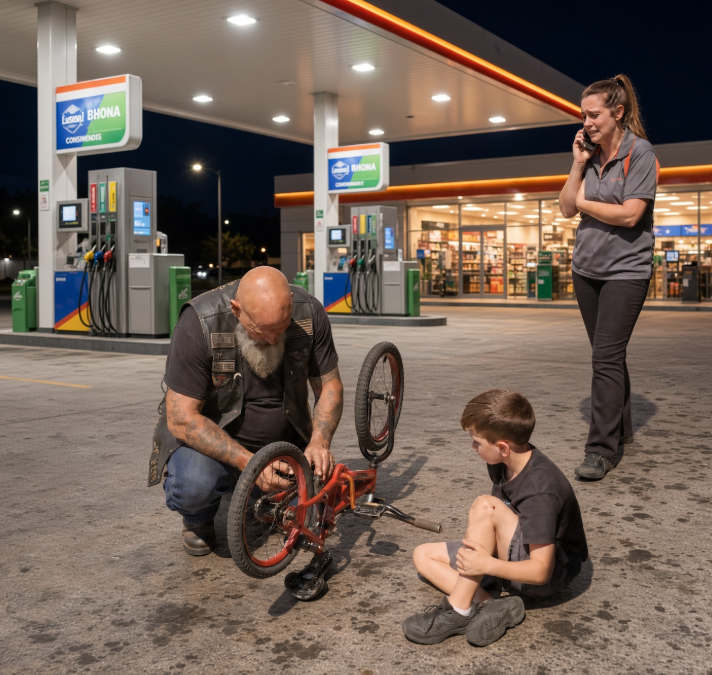
A Gray-Bearded Biker Fixed My 8-Year-Old’s Broken Bike and Rode Away—Then My Son Asked, “Mom, How Did He Know My Name?
A gray-bearded stranger fixed my eight-year-old son’s broken bike chain in a gas-station parking lot and rode away before I could even thank him—but not before quietly saying my dead husband’s name.
I had spent five years blaming that biker club for Ryan’s death, throwing away every letter they sent and refusing to let my son know the men his father once called brothers, so when I discovered they had been secretly putting money aside for Caleb every month since the funeral, I thought guilt was finally collecting its payment.
Then the old biker told me what Ryan had said on the morning he died, and I realized I had not only buried my husband—I had buried half of my son’s history with him.
My name is Jenna Brooks.
The first thing I remember about Walt is his hands.
Not his beard.
Not the leather vest.
Not the motorcycle.
His hands.
They were enormous.
Scarred across the knuckles.
Black around the fingernails with grease that looked permanently embedded in the skin.
The kind of hands that had probably spent forty years opening stubborn bolts, rebuilding engines, and fixing things other people had already decided were broken beyond repair.
Those hands were wrapped around my son’s bicycle chain when I first saw him again.
Though at the time, I did not know I had seen him before.
I was too busy falling apart.
It was a Thursday afternoon in August.
Hot enough that the parking lot outside Miller’s Gas & Go shimmered in the distance.
I had stopped because my fuel light had been on for twelve miles and because Caleb had been begging for a blue sports drink since we left my sister’s apartment.
We had eighty-two dollars in checking.
Rent was twenty-one days late.
My landlord had taped a FINAL NOTICE to the door that morning.
And my supervisor had already warned me that if I missed one more shift, I would not have a job to be late for.
Those were the numbers running through my head.
Eighty-two dollars.
Nine hundred and forty due.
Three days until payday.
One more absence.
Maybe that is why I was yelling at my sister when it happened.
Not angry at her.
Angry at everything.
She was saying:
“Jenna, you can’t keep doing this.”
I stood beside pump seven with my phone pressed against my ear.
“What exactly would you like me to stop doing, Michelle?”
“Working two jobs.”
“Oh, great.”
“Stop.”
“You going to pay the rent?”
“That isn’t what I meant.”
“Then what did you mean?”
PART2:
Caleb was riding his bike in slow circles near the edge of the parking lot.
I had taken it out of the trunk so he could burn off energy while I pumped gas.
It was a secondhand BMX bike from a yard sale.
Too big when I bought it.
Just right now.
The paint was chipped red.
Front brake squealed.
The chain had been slipping for weeks.
I knew that.
I had planned to fix it.
Planned.
There are so many things poor people plan.
Dentist appointments.
Oil changes.
New shoes.
Repairs.
You keep moving each one to the next paycheck until the thing breaks or the pain becomes impossible to ignore.
Michelle was still talking.
“You need help.”
“I need money.”
PART3:
“I can help with groceries.”
“I’m not taking more from you.”
“Why?”
“Because you have two kids.”
“And you have one.”
“That’s my point.”
Then I heard the sound.
Metal grinding.
A hard clunk.
Then Caleb yelled.
I turned.
His rear wheel had locked.
The bike went sideways.
Caleb hit the pavement knee-first.
The bicycle landed partly across his leg.
“Caleb!”
I dropped the gas nozzle.
Phone still against my ear.
Ran three steps.
Then stopped because a man reached him first.
He had been standing beside a motorcycle in the next bay.
Big touring bike.
Black.
Chrome dulled from use.
The man wore jeans, boots, a faded black T-shirt, and a leather vest.
His beard hung gray almost to his chest.
He looked somewhere in his sixties.
Maybe older.
He moved faster than I expected.
He lifted the bicycle off Caleb.
“You all right, buddy?”
Caleb’s face was twisted.
His knee was bleeding.
“I think so.”
The man crouched.
Checked the knee without touching it.
“Road rash.”
“Hurts more than it looks.”
Caleb sniffed.
My sister was saying through the phone:
“What happened?”
I answered automatically.
“He fell.”
“Is he okay?”
“I don’t know.”
The man flipped the bike upside down.
The chain hung loose beside the sprocket.
He did not ask permission.
Under normal circumstances, maybe I would have objected.
That afternoon, I did not have the energy.
He rotated the pedal.
Examined the rear wheel.
Then reached into one of the motorcycle’s side cases and pulled out a small roll of tools.
His movements were calm.
Specific.
No wasted motion.
He put the chain back around the rear sprocket.
Loosened the wheel.
Pulled it back slightly.
Tightened something.
Spun the crank.
Listened.
Adjusted again.
Two minutes.
Maybe three.
That was all.
I finally ended the call with Michelle.
“Call you back.”
I shoved the phone into my pocket.
The biker spun the wheel once more.
Then looked at Caleb.
“Hold that steady.”
Caleb grabbed the handlebar.
The man tightened one final nut.
Then said something too quietly for me to hear.
Caleb’s eyes changed.
Not fear.
Recognition without understanding.
The man wiped his hands on his jeans.
Patted Caleb once on the shoulder.
“Keep your thumb away from the chain.”
Caleb nodded.
“Yes, sir.”
The man stood.
I started toward him.
“Hey.”
He heard me.
I know he did.
He looked once in my direction.
Then turned toward the motorcycle.
“Sir?”
He swung one leg over.
I raised my hand.
“Thank you.”
The engine started.
Deep.
Heavy.
He pulled his helmet on.
I walked faster.
“Wait.”
He rolled out.
No dramatic glance back.
No wave.
He simply rode toward the exit and disappeared into traffic.
I stood there feeling ridiculous.
Then Caleb said:
“Mom?”
I turned.
He was staring toward the road.
“What?”
“How did that man know my name?”
My skin went cold.
“What?”
“He called me Caleb.”
“He probably heard me.”
Caleb shook his head.
“You didn’t say my name.”
“I yelled it when you fell.”
“No.”
I replayed it.
Had I?
Maybe.
I thought I had shouted Caleb.
But memory was messy.
I had been on the phone.
I said:
“He heard your aunt.”
“She didn’t say it.”
“How do you know?”
“Because I was listening.”
He looked at me seriously.
“Mom, he knew me.”
“No, he didn’t.”
“Yes.”
“Caleb.”
“When he fixed the chain, he said, ‘Hold it steady, Caleb. Your dad used to drop his chain every other week too.’”
Everything around me went quiet.
The pumps.
Traffic.
Music coming faintly from the gas station speakers.
Gone.
I stared at my son.
“What did he say?”
Caleb repeated it.
Slowly this time.
“Your dad used to drop his chain every other week too.”
My mouth went dry.
“What else?”
“Nothing.”
“Nothing else?”
“He told me not to put my thumb near the chain because Dad did that once and almost lost a nail.”
My legs weakened.
Caleb looked frightened.
“Mom?”
I sat on the concrete curb.
“What?”
“Why are you crying?”
I touched my face.
I hadn’t known I was.
Caleb’s father had been dead five years.
Ryan Brooks died on Route 9 when Caleb was three.
A pickup truck ran a red light.
The driver was texting.
Ryan’s motorcycle hit the passenger side of the truck hard enough that the helmet cracked.
He died before the ambulance arrived.
For five years, I had reduced that story to one sentence whenever Caleb asked.
Daddy had an accident.
That was all.
Not because I wanted to lie.
Because every additional detail belonged to a world I had spent half a decade trying to erase.
Ryan rode motorcycles.
Ryan belonged to a motorcycle club.
Not an outlaw gang.
Nothing illegal.
Most of them had ordinary jobs.
Mill workers.
Truck drivers.
Mechanics.
Electricians.
Veterans.
They called themselves Iron Hollow Riders.
Ryan called them brothers.
I called them the reason he was dead.
That was not fair.
I knew it even then.
Grief does not require fairness.
The first motorcycle entered Ryan’s life before I did.
He had been twenty-two.
I met him at twenty-four.
By then Sundays belonged to rides.
I never liked it.
The stories about accidents lived in my imagination.
Wet pavement.
Drunk drivers.
Deer.
Blown tires.
Every time his phone rang late during a ride, my heart stopped.
Ryan always laughed.
“You worry professionally.”
“I have talent.”
“I’m careful.”
“So are people who get hit.”
He would kiss my forehead.
“I’m coming home.”
Most Sundays he did.
Until the one he didn’t.
Forty motorcycles came to the funeral.
I hated every one.
The church parking lot looked like a rally.
Black leather.
Chrome.
Boots.
Engines outside before service.
Men hugging one another.
Men crying without hiding it.
I sat in the first pew holding three-year-old Caleb.
He sucked his thumb through half the service.
At the cemetery, rain began.
Not hard.
A cold drizzle.
I stood beside Ryan’s grave while people filed past.
One of the bikers waited until almost everyone else had gone.
Gray beard.
Not as long then.
Brown mixed with gray.
He approached slowly.
“Jenna.”
I held Caleb tighter.
“My name’s Walt Turner.”
I knew the name.
Ryan talked about him often.
Walt taught me this.
Walt helped rebuild the carb.
Walt says I’m running it too rich.
Walt says—
Walt.
The man Ryan called an old man even though Walt was probably only fifty-eight then.
He stopped several feet away.
“Ryan was like a son to me.”
Something in me exploded.
I said:
“Don’t.”
Walt stopped.
“I just wanted—”
“Don’t say that.”
His eyes changed.
I was shaking.
“If he was like a son to you, you should’ve kept him home.”
“Jenna—”
“He’d be alive if he’d never met you people.”
Walt took the words.
Did not defend himself.
That made me angrier.
“You put him on those bikes.”
“No.”
“I did teach him.”
“Then this is on you.”
Caleb was crying now because I was yelling.
I did not stop.
“You want to help me?”
Walt nodded slowly.
“Anything.”
“Stay away from us.”
He closed his eyes.
Then nodded once.
“If that’s what you want.”
“It is.”
He reached into his vest.
I recoiled.
He stopped.
Removed a business card.
Set it on the wet grass near a flower arrangement.
“My number.”
“I don’t want it.”
“If you ever do.”
“I won’t.”
He looked at Caleb.
Then at me.
“I’m sorry.”
“Go.”
So he went.
I found the card two hours later among the flowers.
I threw it away.
Two weeks after Ryan’s funeral, I sold his motorcycle.
The buyer asked why I was crying while signing title.
I said allergies.
I threw away Ryan’s vest.
I gave his helmet to the shop because I could not look at the scrape marks.
Boxes of club patches, ride photographs, old magazines, tools.
Gone.
When cards came from Iron Hollow Riders, I threw them away unopened.
Christmas.
Caleb’s birthday.
Ryan’s birthday.
Every year.
At first they came often.
Then less.
Eventually almost never.
I changed my phone number after one of them left a voicemail asking if we needed anything.
I told myself I was protecting Caleb.
Maybe part of me was.
But mostly I was protecting myself from a version of Ryan that existed somewhere outside my control.
His club knew stories I did not know.
They knew who he was before me.
They knew jokes I had not heard.
Roads he loved.
Mistakes.
Embarrassments.
I was angry that they possessed pieces of my husband while I was stuck with the final image of him under a white sheet.
So I made my own version.
Ryan was a father.
My husband.
A warehouse supervisor.
Funny.
Messy.
Loved pancakes.
Sang badly.
I removed motorcycles from the story.
Which meant I removed the men attached to them.
And now one of those men had knelt in a gas-station parking lot and said my son’s name.
I drove to work with my hands shaking.
Caleb sat in the back beside his bike.
“Mom?”
“What?”
“Did Dad have a bike like that man?”
I stared at road.
“Yes.”
“Was he a biker?”
I hated the word.
“Yes.”
“Did you ride?”
“No.”
“Did you like his bike?”
“No.”
Caleb laughed.
“Why?”
“Because it scared me.”
“Did Dad know?”
“Oh, yes.”
“Did he still ride?”
“Yes.”
“That’s rude.”
Despite everything, I laughed.
It came out like a sob.
Caleb looked out window.
“Did the gray man know him?”
“Yes.”
“How?”
“I think he was a friend.”
“What’s his name?”
I hesitated.
“Walt.”
Caleb said the name softly.
“Walt.”
I survived my shift.
Barely.
I worked the front desk at an urgent-care clinic from three until eleven.
All evening I entered insurance numbers and answered calls while the same images replayed.
Walt at Ryan’s grave.
Walt in the parking lot.
His hands on Caleb’s bike.
Your dad used to drop his chain every other week.
I had forgotten that.
Ryan’s first bike had a chain that always loosened.
He refused to fix it properly.
I would hear him in driveway swearing.
Walt would tell him:
“You want me to set it?”
Ryan:
“No.”
“You’re doing it wrong.”
“I like character.”
“That ain’t character. That’s stupidity.”
Ryan’s chain came off constantly.
I had forgotten.
One stupid memory.
Gone.
Returned by stranger.
At midnight, Caleb was asleep.
I sat on my bed with my phone.
Typed:
Iron Hollow Riders Ohio.
Facebook page appeared.
My thumb hovered.
Five years.
I had not searched once.
I opened it.
First photograph:
Twenty-three motorcycles outside a veterans’ center.
Next:
Food drive.
Next:
A little girl with leukemia sitting on a stationary Harley while men in Santa hats stood around her.
Next:
Toy delivery at children’s hospital.
They looked older.
Some unfamiliar.
Then Walt.
Gray beard longer.
Same eyes.
I scrolled.
Years backward.
Fundraisers.
Funerals.
Weddings.
Ryan began appearing.
My chest tightened.
There he was beside a grill.
There he was making a face at camera.
There he was kneeling beside motorcycle.
There he was next to Walt.
A photograph from six years earlier.
Ryan had one arm around Walt’s shoulders.
Caption:
Father and son if neither one had enough sense to be related by blood.
I put phone down.
Picked it up again.
Scrolled farther.
Then found the post.
Five years earlier.
Seven days after Ryan’s funeral.
A photograph of Ryan on his motorcycle.
Laughing.
Alive.
Caption:
Starting today, we’re setting aside twenty dollars per brother each month for Caleb Brooks.
Ryan never got the chance to watch his boy grow up.
We did.
This isn’t charity and it isn’t payment.
It belongs to the kid.
We will keep it until Jenna is ready.
No calls.
No pressure.
No visits.
Her wishes stand.
But the door stays open.
Until Jenna is ready.
I read it again.
Then again.
Two hundred eleven comments.
Some names I remembered.
Boone.
Marcus.
Dale.
Walt.
One comment from Walt:
Every month.
I clicked comments.
Month later someone had posted:
Deposits made.
Next year:
Still going.
Another:
Ryan’s boy turns four today.
Fund deposit made.
Five:
Happy birthday, little man.
Six.
Seven.
Eight.
Every birthday.
Every Christmas.
I had thrown their cards away.
They had kept putting money away.
I turned phone face down.
Then back over.
I hated them.
Or I wanted to.
Anger had been architecture in my life.
I had built entire rooms inside it.
Without anger, grief would have nowhere to live.
At six in morning, I called my sister.
Michelle answered:
“Is Caleb okay?”
“Yes.”
“Are you okay?”
“No.”
“Helpful.”
“I need you to watch him.”
“When?”
“Today.”
“Work?”
“No.”
“Where are you going?”
I stared at Facebook photo.
“The bike shop.”
Silence.
“What bike shop?”
“Theirs.”
Michelle knew.
“You sure?”
“No.”
“Good.”
“What does that mean?”
“It means if you said yes, I’d know you were lying.”
I dropped Caleb off at eight.
Did not tell him where I was going.
Iron Hollow Cycles sat on Ferris Street.
Cinder-block building.
Two bay doors.
Hand-painted sign.
Three motorcycles out front.
I parked across road.
Sat twenty minutes.
At minute ten, I nearly left.
At fifteen, I started engine.
At sixteen, turned it off.
At twenty, opened door.
The smell reached me first.
Oil.
Rubber.
Metal.
Old coffee.
Same smell Ryan used to bring home on his clothes.
I nearly turned around.
Inside, Walt was bent over motorcycle.
He looked up.
The wrench in his hand stopped.
His entire body went still.
“Jenna.”
I hated that he remembered immediately.
“You fixed Caleb’s bike.”
“Yes.”
“You said Ryan’s name.”
Walt put wrench down.
“I did.”
“Why?”
He wiped his hands.
“I didn’t plan to.”
“You knew who he was.”
“Not at first.”
“You called him Caleb.”
Walt looked at me carefully.
“I knew when I got close.”
“How?”
He almost smiled.
“Because he has Ryan’s face.”
I swallowed.
“That’s not enough.”
“It was for me.”
He nodded toward wall.
Photographs.
Ryan in three.
Walt continued:
“Ryan told us his boy’s name before you were showing.”
I looked at him.
“What?”
“He came into shop one morning grinning like a fool.”
“Said if it was a boy, Caleb.”
“After your grandfather.”
“He told everyone before you even told your own sister, apparently.”
“That idiot.”
Walt smiled.
“There she is.”
“What?”
“Nothing.”
I stared.
He looked down.
“I’m sorry.”
“For what?”
“For yesterday.”
“I shouldn’t have said Ryan’s name to Caleb.”
“He was scared.”
“He was biting inside of his cheek.”
I froze.
Ryan did that.
Always.
When nervous.
During our wedding vows.
During Caleb’s birth.
When police stopped him once for speeding.
Inside cheek.
“I saw it.”
Walt said.
“And suddenly I was looking at Ryan at eight years old in my head even though I never knew Ryan at eight.”
He rubbed beard.
“I told him his dad dropped chains too.”
“I shouldn’t have.”
“But I didn’t mean harm.”
“You left.”
“You were walking toward me.”
“Yes.”
“You told me five years ago to stay away.”
His voice held no accusation.
“I’ve stayed away.”
“I wasn’t going to decide that a broken bicycle gave me permission to ignore you.”
“So you just rode off.”
“Yes.”
“Why didn’t you at least let me thank you?”
Walt’s eyes softened.
“Because I didn’t fix his bike for thanks.”
Silence.
I hated how reasonable he was.
“I saw the fund.”
Walt’s face changed.
He walked to filing cabinet.
Opened drawer.
Removed a green ledger.
Set it on bench.
“Every deposit.”
I opened.
Handwritten lines.
Dates.
Names.
Amounts.
Twenty dollars.
Twenty.
Twenty.
Some larger.
December bonuses.
Birthday deposits.
One name had note:
Passed — Feb.
Next month another name added extra twenty under same line.
I looked.
“What is this?”
“Eleven thousand four hundred sixty dollars as of last month.”
My fingers stopped.
“What?”
“In Caleb’s account at Marietta Community Credit Union.”
“Custodial trust.”
“Your name and his.”
“You can access it.”
I stared at him.
Eleven thousand four hundred sixty.
Rent late.
Eighty-two checking.
My chest tightened.
“Why?”
Walt pulled stool out.
Sat.
His knees moved stiffly.
“Because Ryan was ours.”
“That’s not an answer.”
He looked at me.
“Because we owed him.”
“For what?”
Walt stared at photographs.
Then said:
“I taught Ryan to ride.”
“I know.”
“No.”
“You know I rode with him.”
“That’s different.”
Walt leaned forearms on knees.
“He was twenty-two.”
“Working loading dock.”
“Had never touched motorcycle besides sitting on one at county fair.”
“He saw mine.”
“Asked questions for two months.”
“I found him an old Honda.”
“Taught him.”
“How to brake.”
“Lean.”
“Read traffic.”
“Everything.”
His voice lowered.
“And that Sunday?”
I went cold.
“What about it?”
“Ryan had told me the week before he was thinking about cutting back.”
“Caleb was little.”
“You were tired.”
“He said Sundays were becoming harder.”
“I called him anyway.”
I stared.
Walt kept going because stopping would be cowardice.
“I told him it was going to be perfect weather.”
“Short ride.”
“Breakfast across state line.”
“He said no.”
“Then I talked him into it.”
My mouth went dry.
“No.”
“He came because I asked.”
“No.”
“He was riding home from that ride when truck hit him.”
I stood so fast stool fell.
Walt did not move.
“You never told me.”
“No.”
“Why?”
“Because at graveside you told me I killed him.”
His face twisted.
“And part of me believed you.”
Rage rose.
Fresh.
Five years vanished.
“You should’ve told me.”
“Yes.”
“You let me think—”
“What?”
“That he just decided to ride.”
“He did decide.”
“Because you pushed him.”
“Yes.”
I slapped him.
I had never slapped anyone in my life.
The sound cracked through shop.
Walt’s face moved sideways.
He stayed seated.
Did not raise hand.
Another man emerged from back room.
Stopped.
Walt held up palm.
“Leave it.”
The man disappeared.
I was shaking.
“I hate you.”
Walt nodded.
“I know.”
“I hate you.”
“I know.”
“My son grew up without his father because—”
“A man ran a red light while texting.”
Walt looked directly at me.
“That killed Ryan.”
“My call put him on road.”
“I carry that.”
“But I did not drive the truck.”
The distinction made me angrier because it was true.
“You want me to forgive you?”
“No.”
“Then why save money?”
“Because guilt needed somewhere useful to go.”
He looked at ledger.
“Mine.”
“Theirs.”
“We couldn’t give Ryan back.”
“We could put something aside for his boy.”
“You should have sent it.”
“You would’ve returned it.”
“I threw everything away.”
“I know.”
“How?”
“The cards stopped being cashed.”
I almost laughed.
“Of course.”
Walt rubbed cheek where I hit him.
“I thought you were protecting yourself.”
“I was.”
“And Caleb.”
“Yes.”
“Maybe.”
The word cut.
“What does that mean?”
Walt stood slowly.
“It means Ryan was more than death on Route 9.”
“I know that.”
“Does Caleb?”
I stared.
Walt looked at photographs.
“Does he know his dad sang at stoplights?”
“Does he know Ryan couldn’t cook eggs without burning them?”
“Does he know he cried at dog movies?”
“Does he know he hated mayonnaise?”
“He doesn’t need you to tell him—”
“Does he know Ryan once rode ninety miles because you texted saying you were craving cinnamon rolls from that bakery in Columbus?”
I stopped.
I had forgotten.
“Does he know his dad carried a picture of you two in his wallet until it split?”
“Stop.”
“Does he know—”
“Stop.”
Walt did.
Silence filled shop.
I sat on stool.
My anger collapsed into something worse.
Truth.
I had told Caleb his father loved him.
Of course.
I showed family photographs.
Christmas.
Beach.
Hospital after birth.
But the living details?
The ones that made Ryan a person rather than dead father?
I had buried those because they led to motorcycles.
Every road to Ryan seemed to pass through the thing that killed him.
So I closed road.
Walt said quietly:
“You had every right to tell us to leave you alone.”
“We honored it.”
“But Jenna…”
I looked up.
“Caleb’s old enough to ask now.”
“He’s already asking.”
“You don’t have to like us.”
“You don’t have to forgive me.”
“But there are things about his dad you don’t know.”
“And things you’ve forgotten.”
“He shouldn’t lose those because we failed you.”
I looked at Ryan laughing in photograph.
“How many stories?”
Walt smiled sadly.
“Five years’ worth?”
“No.”
“Before.”
“Hundreds.”
My eyes filled.
“I don’t know if I can.”
“Then don’t today.”
He pointed toward ledger.
“That account waits.”
“So do we.”
I thought of rent.
“Can I use the money?”
“Yes.”
“For anything?”
“Legally, it’s for Caleb’s benefit.”
“Rent keeps him housed.”
“That qualifies in my book.”
I hated needing it.
Walt seemed to read me.
“Don’t turn it into charity.”
“It isn’t.”
“It came from men who loved Ryan.”
“That’s Caleb’s inheritance from them.”
I wiped my face.
“He needs his chain fixed properly.”
Walt blinked.
“It is fixed.”
“You said somebody should teach him.”
His expression changed.
Careful hope.
“Yes.”
“I don’t know how.”
“No.”
“You do.”
“Yes.”
I stood.
“I’m not forgiving you.”
“I didn’t ask.”
“I’m not joining anything.”
“God forbid.”
“I don’t want him on motorcycles.”
Walt nodded.
“Then he won’t get on one with engine running.”
“You swear?”
“On Ryan.”
That hurt.
But I believed him.
I picked up my purse.
“Caleb’s at Michelle’s.”
Walt stayed absolutely still.
“I could bring him.”
“If you want.”
“I don’t know what I want.”
“That’s enough.”
I reached door.
“Walt.”
“Yes?”
“I hit you.”
“You did.”
“I’m sorry.”
He rubbed cheek.
“I’ve had worse.”
“That doesn’t make it okay.”
A small smile.
“No.”
“I’m still angry.”
“You can be both.”
That sentence followed me.
I picked up Caleb.
My sister looked at my face.
“What happened?”
“I slapped him.”
Michelle stared.
“You did what?”
“He told me something.”
“What?”
I explained in fragments.
The Sunday ride.
The fund.
The stories.
When I finished, Michelle leaned against counter.
“Oh.”
“Yeah.”
“Are you taking Caleb?”
“I think.”
She looked toward living room where Caleb was playing video game.
“Jen.”
“What?”
“Ryan chose that ride too.”
I snapped:
“I know.”
“No.”
“You know as a sentence.”
“Walt didn’t put Ryan on the bike at gunpoint.”
“I know.”
“Ryan loved riding.”
“I know.”
“You’ve spent five years pretending that part was done to you.”
I stared.
Michelle continued gently:
“Ryan’s death was done to you.”
“His life wasn’t.”
I hated her for thirty seconds too.
Then I said:
“Get Caleb’s shoes.”
At noon, we returned to Iron Hollow.
Caleb walked in slowly.
Four men were there now.
Apparently Walt had called them.
I almost turned around.
Then I noticed something.
No motorcycles running.
Helmets put away.
No one crowded Caleb.
They stood back.
Giving him room.
Walt came forward.
“Hey, buddy.”
Caleb smiled.
“You’re the chain guy.”
“That’s me.”
“Mom says you knew Dad.”
Walt looked at me first.
Permission.
I nodded.
“I did.”
Caleb’s eyes moved to wall.
Then stopped.
“Mom.”
I knew.
Ryan.
One photograph showed him sitting backward on a chair, laughing.
Hair windblown.
Leather vest.
Motorcycle behind him.
“That’s Dad.”
“Yes.”
“He looks young.”
“He was.”
“Did he ride that?”
Walt answered:
“Yep.”
“Was he good?”
The men exchanged looks.
One named Marcus laughed.
“Eventually.”
Caleb grinned.
“Was he bad?”
“Terrible.”
Walt pointed toward bike.
“Come here.”
Caleb approached.
Walt lifted his red bicycle onto stand.
“Your dad had one problem.”
“What?”
“He thought chain tension was a suggestion.”
Caleb looked confused.
Walt showed him.
“This much slack.”
“Not this much.”
“He ran his loose.”
“Why?”
“He claimed he liked how it sounded.”
“That’s dumb.”
Walt nodded solemnly.
“Exactly what I told him.”
Caleb laughed.
I stood near door.
Walt gave him wrench.
Showed rear axle.
Quarter turn.
Alignment.
Check both sides.
Spin crank.
Listen.
Feel.
Caleb absorbed everything.
Then asked:
“Did Dad know how to fix bikes?”
“Motorcycles.”
“Not bicycles?”
“Motorcycle chain is same principle.”
“Was he better than me?”
Walt looked at him.
“At eight?”
“No.”
Caleb brightened.
One of the men handed me coffee.
He was heavyset.
Salt-and-pepper hair.
“Black?”
“How did you know?”
“Ryan complained you drank it like punishment.”
I laughed unexpectedly.
“What’s your name?”
“Marcus.”
“I remember.”
He nodded.
“I was at funeral.”
“I know.”
“I’m sorry.”
“For what?”
“For not trying harder after.”
I looked at him.
“I told you not to.”
“Still.”
“No.”
This mattered.
“No.”
I shook my head.
“You did what I asked.”
Marcus looked relieved and sad.
“Okay.”
We stayed two hours.
Caleb learned chain.
Removed front wheel.
Used tire levers.
Then stared at a Harley.
“Can I sit?”
Walt looked at me.
I hesitated.
Every nerve screamed no.
Then:
“Engine stays off.”
“Absolutely.”
Walt held bike upright.
Caleb climbed on.
Hands on grips.
He made engine sounds with his mouth.
The men laughed.
Nobody started it.
Nobody teased me.
Nobody said I was overprotective.
I noticed.
Before we left, Walt put Caleb’s bike in trunk.
“Account’s at Community Credit Union.”
“I know.”
“You don’t have to use all.”
“I’m going to pay rent.”
“Good.”
“And put rest back.”
“Good.”
“I didn’t come because of money.”
He looked at me.
“I know.”
“Why?”
“Because if it was money, you’d have come after reading eleven thousand.”
“You came before knowing how to get it.”
Fair.
Caleb was in back seat already talking.
“Mom, Walt says Dad sang when he rode.”
I looked at Walt.
He smiled.
“Loud.”
Caleb said:
“Was he good?”
“No.”
“Terrible.”
“What did he sing?”
Marcus called from bay:
“Anything he didn’t know words to!”
Caleb laughed.
I rolled window down.
“Walt.”
He stepped closer.
“Thank you.”
He waited.
“For the chain.”
He nodded.
“Anytime.”
The next morning I went to credit union.
Account existed.
Every deposit documented.
No one had touched a cent.
I paid rent.
Three months.
Then utilities.
Bought Caleb school shoes.
Used only what we needed.
For first time in years, I slept without calculating eviction.
That should have made me grateful.
Instead, guilt came.
Walt had expected it.
He called once.
First time we spoke by phone in five years.
“You sound mad.”
“I feel like I took money from dead husband’s friends.”
“That’s exactly what you did.”
I almost hung up.
He continued:
“Money they put there for Caleb.”
“Use it for Caleb.”
“I should be able to do this myself.”
“Why?”
“Because I’m his mother.”
“That doesn’t mean alone.”
“I’ve done alone.”
“Yes.”
“You want a medal?”
I laughed despite myself.
“You’re annoying.”
“So was Ryan.”
“Don’t compare me.”
“He did.”
“What?”
Walt paused.
“Ryan used to say you two were same kind of stubborn.”
I closed my eyes.
“He said that?”
“Constantly.”
Another Ryan detail.
One more piece.
Walt never flooded me with them.
He could have.
Instead, he waited.
Sunday came.
Caleb asked:
“Can we go see Walt?”
I almost said no.
Then remembered.
“Why?”
“He said he’d show me how brakes work.”
I texted Walt.
You at shop?
Answer:
Till 2.
No invitation.
No pressure.
We went.
That became pattern.
Not every Sunday.
Some.
Caleb learned tools.
I drank coffee.
Men told stories.
At first I stopped them whenever motorcycles entered.
Then I realized that was impossible.
Ryan’s life contained motorcycles.
Avoiding them meant avoiding half of him.
So I learned to listen without turning every road into Route 9.
One story:
Ryan once spent four hours helping a stranger whose trailer wheel bearing failed.
One:
He got lost on a charity ride while leading entire group.
One:
He forgot anniversary and rode eighty miles in rain to buy me pie from place where we had first date.
That one I remembered.
Different version.
I thought he had gone because he felt guilty.
They knew he had made three of them come along because he was terrified I would leave him.
Another:
Ryan gave Walt his coat during cold ride because Walt lied about not being cold.
Another:
He cried when Marcus’s dog died.
Caleb listened.
Every detail became treasure.
One Sunday, he asked:
“Was Dad brave?”
Walt thought.
“Sometimes.”
“Was he scared?”
“Often.”
“Of what?”
“Your mom.”
Everyone laughed.
I threw rag at Walt.
Then he answered seriously.
“Being a good dad.”
Caleb frowned.
“Why?”
“Because he wanted it so bad.”
I looked away.
Ryan had told me once, in hospital after Caleb was born:
“I don’t know how to be somebody’s dad.”
His father left when he was six.
I said:
“You learn.”
Ryan whispered:
“What if I mess him up?”
I had forgotten.
Walt remembered similar conversation.
That night, I showed Caleb videos.
For first time.
Old phone backups.
Ryan holding baby Caleb.
Ryan dancing badly in kitchen.
Ryan singing.
Loud.
Off-key.
Caleb stared.
Then began laughing.
“That sounds like me.”
“Yes.”
I cried.
Caleb did not panic at my tears anymore.
He leaned against me.
“Mom?”
“What?”
“Why didn’t you show me before?”
There it was.
I considered lying.
“You were little.”
True.
Not enough.
“Because it hurt.”
“Dad?”
“Remembering him.”
“Did you think I’d be sad?”
“Partly.”
He waited.
I said:
“I was angry at the bikes.”
“At Walt?”
“Yes.”
“Why?”
I told child-sized truth.
“Walt asked Dad to go riding the day he died.”
Caleb was quiet.
“So Walt killed him?”
“No.”
Immediate.
Important.
“No.”
“The driver who ran the red light caused crash.”
“Dad chose to ride.”
“Walt asked.”
“All those things can be true.”
“Are you mad at Walt?”
“Sometimes.”
“Do you like him?”
“Sometimes.”
Caleb laughed.
“That’s confusing.”
“Yes.”
“Can you be mad and like somebody?”
I thought of Walt saying:
You can be both.
“Yes.”
That became our family language.
Both.
I loved Ryan.
I was furious he rode that day.
Both.
Walt carried guilt.
He was not responsible for another driver’s crime.
Both.
I protected Caleb.
I also deprived him of memories.
Both.
Grief had trained me to demand one clean answer.
Life refused.
Three months after gas station, Caleb’s chain had not come off once.
He checked tension himself.
Before every ride.
Thumb clear.
Walt-approved.
I bought a secondhand ten-speed from thrift store.
Walt tuned it.
Refused money.
I tried leaving cash under coffee mug.
He mailed it back taped to a note:
STOP IT.
So Sunday mornings, Caleb and I rode bike path by river.
Not motorcycles.
Bicycles.
I followed.
Sometimes he rode too fast.
Sometimes I yelled.
Sometimes he sang.
First time I heard it, I almost crashed.
Loud.
Off-key.
Exactly Ryan.
I slowed.
Listened.
Did not tell Caleb to stop.
Winter came.
Iron Hollow Riders held toy drive.
Caleb wanted to help.
I agreed.
We wrapped toys at shop.
Forty bikes later transported them to children’s hospital.
Caleb rode in my car.
Not motorcycle.
No one asked.
At hospital, a little boy with leukemia climbed onto stationary bike for photograph.
I watched Walt kneel beside him.
Same hands.
Same patience.
I thought:
This man has been doing this all along.
My grief had frozen him into villain from graveside.
He had continued being a whole person when I wasn’t looking.
That realization humbled me.
People do not become only what we need them to be in our pain.
A year passed.
The fund continued.
I asked them to stop monthly deposits.
They refused initially.
“It’s tradition.”
I insisted.
“Caleb has enough.”
Walt said:
“College isn’t cheap.”
I said:
“You gave five years.”
“Let new money go to another kid.”
They argued.
Then agreed.
The club renamed monthly fund.
Ryan Brooks Road Home Fund.
Emergency grants for children of deceased local workers and riders.
First recipient was daughter of truck driver killed in warehouse accident.
That felt right.
Caleb’s remaining money stayed in education account.
At nine, he wanted a dirt bike.
“No.”
At ten:
“Mini bike?”
“No.”
At eleven:
“Electric scooter?”
“Nice try.”
Walt backed me publicly.
Privately he said:
“Eventually.”
I glared.
He held hands up.
“Eventually is not today.”
At twelve, Caleb asked again about motorcycles.
This time, I did not instantly say no.
I said:
“Safety course first.”
He almost fainted.
Walt looked at me.
“Sure?”
“No.”
“Good.”
I hated when people said that.
We started with closed training lot.
Small motorcycle.
Helmet.
Armor.
Professional instructor who was not Walt.
My condition.
Walt agreed.
I watched from fence.
First time Caleb rolled forward, my body remembered hospital phone call from five years ago.
Actually no.
Not remembered.
Re-enacted.
My heart raced.
Hands numb.
Breathing shallow.
I nearly stopped lesson.
Then Walt stood beside me.
Did not touch.
Did not say relax.
He knew better.
“You can end it.”
he said.
I looked at him.
“If you need to.”
“Do I?”
“I can’t answer that.”
Caleb rode slow circle.
Instructor beside him.
Safe.
Controlled.
I whispered:
“I hate this.”
Walt nodded.
“Reasonable.”
“I want to drag him off.”
“Also reasonable.”
“If something happens—”
“Something can happen anywhere.”
I snapped:
“Don’t.”
“Sorry.”
We watched.
Then Walt said:
“Ryan’s crash made motorcycles the shape of your fear.”
“Doesn’t mean fear is wrong.”
“Just means shape isn’t whole story.”
Caleb completed lesson.
Nothing happened.
I cried in car afterward where he could not see.
Then told him I was proud.
Both.
Years later, Caleb became exactly kind of teenager Ryan would have adored and driven me crazy raising.
Tall.
Brown hair.
Biting inside cheek when nervous.
Mechanically curious.
Terrible singer.
He worked Saturdays at Walt’s shop.
Real wage.
Taxes.
Walt insisted.
Caleb’s first job was cleaning parts.
Then tires.
Then oil.
At sixteen, he bought an old Honda with his own savings.
I wanted to die.
Walt made him rebuild half of it before riding.
“Why?”
Caleb complained.
“So you know what holds you alive.”
That sentence I liked.
At seventeen, Caleb found Ryan’s old motorcycle.
Not physically.
Online.
The bike I had sold after funeral had changed hands twice.
Caleb tracked VIN through old paperwork Michelle had secretly kept.
He came to me.
“Mom.”
I saw his face.
“No.”
“I didn’t ask yet.”
“No.”
“It’s for sale.”
“No.”
“Listen.”
“I said no.”
“It was Dad’s.”
I left room.
Old Jenna.
Run first.
Walt called later.
“You want me involved?”
“No.”
“Okay.”
I expected argument.
None.
That made me call him back.
“What do you think?”
“Honestly?”
“Yes.”
“Bike is a machine.”
“Meaning?”
“It won’t bring Ryan back.”
“Won’t kill him again either.”
“It’s metal.”
“What matters is what Caleb thinks he’s buying.”
That was answer.
I sat with Caleb.
“What are you buying?”
He frowned.
“Dad’s bike.”
“No.”
“What do you mean?”
“You’re buying a motorcycle that used to belong to Dad.”
“If you think owning it gives you him, I won’t help.”
Caleb stared.
Then nodded slowly.
“I want to restore it.”
“Why?”
“Because Walt taught Dad on it.”
“And maybe one day I can hear what it sounded like.”
My throat tightened.
“That’s different.”
We bought it.
Using Caleb’s savings.
Not fund.
Important to him.
Bike arrived rusty.
Neglected.
Not cinematic.
Walt stood beside it.
Put hand on tank.
For first time, I saw him cry openly.
“Hey, old girl.”
Caleb looked at him.
“You remember?”
“Every stupid mile.”
They restored it over eleven months.
I watched.
Sometimes helped.
Cleaned chrome.
Sorted bolts.
Learned names of parts I had once refused to hear.
The finished bike sat in shop.
Ryan’s old blue Honda.
Caleb did not ride immediately.
He waited until eighteen.
Safety course advanced.
License.
Protective gear.
Then first ride.
Walt led.
I followed in car.
Thirty miles.
No Route 9.
My rule.
At overlook, they stopped.
Caleb removed helmet.
His face looked so much like Ryan I had to look away.
Walt came to me.
“You okay?”
“No.”
“Want to stop?”
“No.”
Both.
Caleb graduated high school.
At ceremony, he wore small metal chain link on necklace.
Walt made it from one of Ryan’s old chains.
I thought that was too much.
Then saw Caleb touching it before walking stage.
Said nothing.
He went to technical college.
Automotive engineering.
Not because of bikes only.
Because things made sense to him when he could take them apart and understand why they failed.
He said:
“People are harder.”
Walt replied:
“That’s why I fix engines.”
Caleb laughed.
The night before college, we sat at kitchen table.
He asked:
“Mom, do you wish I never met Walt?”
Question stopped me.
Five years earlier, answer yes.
Now?
“No.”
“Do you forgive him?”
I thought long.
“For asking Dad to ride?”
“I don’t think that’s mine to forgive anymore.”
“What?”
“The truck driver caused crash.”
“Dad chose ride.”
“Walt asked him.”
“I blamed Walt because I needed somewhere to put something too big.”
“That doesn’t mean he did nothing wrong.”
“He pressured your dad after Dad said no.”
“That mattered.”
“But he’s spent twenty years owning it.”
Caleb nodded.
“So yes?”
“I forgive him.”
Saying it felt strange.
Not dramatic.
Quiet.
I realized I had forgiven him gradually long before sentence.
Caleb asked:
“Did you forgive Dad?”
That hurt differently.
“For riding?”
“Yes.”
I smiled sadly.
“I think so.”
Then:
“Mostly.”
He laughed.
“Both?”
“Always.”
Walt grew older.
Knees worse.
Hands less steady.
Beard fully white.
At seventy-two, he retired from daily shop work.
The club threw barbecue.
Caleb came home from college.
I baked cake badly.
Walt complained icing tasted like transmission fluid.
I told him to suffer.
During speeches, Marcus said:
“Walt has spent fifty years fixing what other people break.”
I looked at him.
Thought of gas station.
Chain.
Family.
Me.
Afterward, Walt sat outside shop alone.
I joined.
“You okay?”
“No.”
I smiled.
“Good.”
He looked at me.
“You stole that.”
“Yes.”
We sat.
Then I said:
“I owe you something.”
“No.”
“Shut up.”
He did.
“At Ryan’s funeral…”
Walt looked away.
“I told you his death was your fault.”
“You were grieving.”
“I meant it for years.”
“I know.”
“I made you carry something that wasn’t all yours.”
Walt’s eyes filled.
“It was partly mine.”
“Yes.”
“Both.”
He smiled.
“Damn kid taught us a word.”
“I’m sorry.”
He nodded.
Then:
“I’m sorry too.”
“For?”
“Calling Ryan that Sunday.”
“You’ve said.”
“Not enough.”
I touched his arm.
“Late isn’t never.”
He looked at me.
“Where’d you hear that?”
“Some old idiot.”
He laughed.
Years passed.
Caleb married.
A woman named Anna who rode better than he did.
I refused to like that fact.
Walt loved her immediately.
At wedding, Caleb had table with photo of Ryan.
And one of Walt.
I noticed both.
During toast, Caleb said:
“I had one father for three years.”
“And then for five years, I had stories.”
“Then a gray-bearded man put a chain back on my bike.”
“After that, I got both.”
I cried so hard I missed next sentence.
Walt pretended allergies.
When Caleb’s first son was born, he named him Ryan Walter Brooks.
I objected to middle name.
Not seriously.
Walt did.
“Kid has to carry that?”
Caleb said:
“You’ll survive.”
Walt held baby like fragile engine part.
Terrified.
“You know how to hold him?”
I asked.
“No.”
“Good.”
Caleb laughed.
The cycle continued.
Walt died at seventy-eight.
Heart attack.
In sleep.
No hospital drama.
No final speech.
Just gone.
Caleb got call first because by then Walt’s emergency contact list had:
Marcus.
Caleb.
Me.
Caleb drove to my house.
Didn’t call.
He stood at door.
I knew from face.
“No.”
He nodded.
I sat down right there in hallway.
Walt had been part of our lives for fifteen years after gas station.
Longer than Ryan.
That fact felt impossible.
At funeral, motorcycles filled church parking lot again.
Same sound that once made me hate them.
This time, I stood among them.
Not because fear vanished.
Because meaning changed.
Marcus came over.
Old now too.
Said:
“He loved you two.”
I nodded.
“He spent five years thinking he’d never get chance.”
That hurt.
Caleb spoke.
He brought red BMX bike.
Yes.
The actual bike.
Walt had insisted we never throw it away.
It sat beside casket.
Caleb said:
“When I was eight, my chain came off in a gas-station parking lot.”
“Walt fixed it.”
“Everybody tells this story like the chain mattered.”
“It didn’t.”
“The chain was three dollars’ worth of metal.”
“What mattered was he fixed it and left.”
“Because my mother had told him five years earlier to stay away.”
“He respected a boundary even when respecting it hurt him.”
Caleb looked at me.
“And then my mom came back.”
“I think that’s the part Walt was proudest of.”
My throat closed.
Caleb continued:
“People talk about forgiveness like someone walks across a room, says sorry, and everything resets.”
“That wasn’t our family.”
“Ours took years.”
“Loose bolts.”
“Bad memories.”
“Money nobody asked for.”
“Stories we thought we didn’t want.”
“Coffee.”
“Bike rides.”
“A lot of arguments.”
“And one word we used constantly.”
He smiled.
“Both.”
“Walt taught me Dad’s death could hurt and Dad’s life could still be beautiful.”
“Mom taught me fear and courage can exist in the same person.”
“Dad, from what I’ve been told, mostly taught everyone how not to tension a chain.”
People laughed.
Even me.
After funeral, Caleb gave me an envelope.
Walt’s handwriting.
Jenna.
I waited three days before opening.
Inside:
Jenna,
If this is being read because I finally managed to die, first of all, tell Marcus he still owes me forty dollars.
Second, don’t make me into a better man than I was.
I spent too many years doing that to Ryan after he died, and dead people don’t need improved biographies.
I was stubborn.
I was pushy.
I called Ryan on a Sunday after he said no.
I regret that and I always will.
But you taught me regret doesn’t have to be the only thing a person does with the years afterward.
You came into the shop angry and let your son walk through a door you had every reason to keep closed.
That took more courage than you ever gave yourself credit for.
Ryan would be proud of Caleb.
He’d also be unbearable about the fact that the boy became a better mechanic than either of us.
And Ryan would be proud of you.
I know you’ll argue.
You always do.
But I knew the man before grief turned him into a photograph.
He loved you.
Not perfectly.
Very loudly.
Take care of yourself.
And for God’s sake, tell Caleb not to run that old Honda chain loose because his father’s stupidity is not a family tradition.
Walt
P.S. You still make terrible coffee.
I read it twice.
Then once more.
I kept it.
The green ledger too.
After Walt died, Marcus gave it to Caleb.
Every monthly deposit.
Sixty months.
Names.
Twenty dollars.
Twenty dollars.
Twenty.
Caleb framed one page in his garage.
Not because of money.
Because it represented consistency.
Five years when we had cut them off.
No recognition.
No thank-you.
No guarantee they would ever meet Caleb.
They kept depositing.
People like dramatic kindness because dramatic kindness photographs well.
Consistency rarely does.
Twenty dollars every month.
That was love with no audience.
Today Caleb is thirty-one.
He owns a repair shop.
Not motorcycle-only.
Cars.
Bikes.
Anything with an engine and a problem.
The sign says:
BROOKS & TURNER MOTOR WORKS.
When he showed me name, I cried.
“You left Ryan out.”
Caleb said:
“Brooks is Dad.”
I had not thought.
Of course.
Brooks.
Turner.
Both fathers.
Different ways.
Same sign.
There is a photograph over register.
Ryan laughing on his motorcycle.
Beside it, Walt fixing Caleb’s red BMX bike.
Not actual parking-lot photo.
None existed.
It is one we recreated years later as joke.
Walt on pavement.
Caleb holding bike.
Both laughing.
Underneath hangs one chain link.
Old.
Greasy.
Caleb sometimes tells customers story.
Sometimes not.
A few years ago, a woman came into shop with her seven-year-old daughter.
Car trouble.
Couldn’t afford full repair.
Caleb fixed immediate safety issue.
Charged almost nothing.
Woman cried.
Said she would return with rest.
Caleb told her:
“Put it toward something good.”
I heard.
Looked at him.
He smiled.
Ryan never used that phrase.
Walt didn’t either.
Maybe some kindnesses become family traditions without anyone noticing.
I still drive past Miller’s Gas & Go occasionally.
Pump seven was replaced.
Parking lines repainted.
The exact patch of pavement where Caleb fell means nothing to anyone else.
To me it is hinge.
Before that parking lot, I had survived by narrowing life.
Ryan had been husband.
Father.
Victim.
I removed every dangerous detail.
Walt was culprit.
Motorcycles were death.
Iron Hollow was threat.
Grief likes simple villains.
They let you organize chaos.
After parking lot, the categories broke.
Ryan loved us.
Ryan made risky choices.
Both.
Walt pressured him to ride.
Walt spent years honoring him.
Both.
I was protecting my child.
I was hiding pieces of his father.
Both.
Caleb needed safety.
He also needed history.
Both.
Forgiveness did not erase responsibility.
Anger did not make every accusation true.
Both.
That is what I wish someone had told me at thirty.
Life will hand you two truths that seem incompatible.
Your job is not always to choose.
Sometimes your job is to learn how to hold both without dropping either.
When people ask how Walt knew Caleb’s name, I tell them the simple version.
He had known it before Caleb was born.
Ryan told his friends.
He bragged.
He planned.
He loved that name.
Caleb after my grandfather.
Walter had carried it in memory five years.
Then one hot afternoon, he saw Ryan’s face riding a red bicycle in circles around gas pumps.
A chain slipped.
A child fell.
And an old man who had promised to stay away made one exception.
Not to introduce himself.
Not to reclaim a place in our lives.
Just to put the chain back.
Then leave.
If Caleb had not asked:
“How did that man know my name?”
I might never have searched.
Never opened Facebook page.
Never seen the fund.
Never entered shop.
Never learned Ryan’s stories.
Never let Walt teach Caleb.
Never ridden river path.
Never restored the Honda.
Never learned how much of my anger was grief looking for address.
One question.
That was all.
Children do that.
They find loose threads adults have spent years tying down.
Then pull.
Sometimes everything falls apart.
Sometimes what falls apart needed to.
I do not regret telling Walt to leave me alone at funeral.
I was twenty-eight.
Widowed.
Holding a three-year-old.
My husband had been dead three days.
I had every right to boundaries.
I regret believing the boundary had to become permanent because changing my mind would somehow betray the woman who had made it.
We are allowed to change what we can carry.
We are allowed to reopen doors.
Not because people deserve access automatically.
Because sometimes we become ready.
Walt understood.
He never knocked.
Never demanded.
Never used fund to force gratitude.
He waited.
Until a bicycle chain came off.
Even then, he fixed only the chain.
I was the one who crossed road next morning.
That matters to me.
Because the best thing Walt ever did was not save us.
He did not.
He left room for us to decide.
And when we stepped toward him, he stayed.
Caleb rides every Sunday now.
Sometimes motorcycle.
Sometimes bicycle with his son.
Ryan Walter is six.
He has his grandfather Ryan’s smile.
Walt’s patience with tools.
Apparently my stubbornness.
Poor child.
Before every bicycle ride, Caleb kneels beside him.
Checks tires.
Brakes.
Helmet.
Then chain.
He takes his son’s thumb.
Moves it away.
“Never put this near moving chain.”
Ryan Walter rolls his eyes.
“I know, Dad.”
Caleb smiles.
“My dad didn’t.”
“Grandpa Ryan?”
“Yep.”
“He was bad at bikes?”
“He was bad at chains.”
“Who taught you?”
Caleb looks at me sometimes when answering.
“Grandpa Walt.”
Then the boy asks:
“Who taught Grandpa Walt?”
Caleb laughs.
“I don’t know.”
I do not know either.
Not every chain needs traced back forever.
It is enough that one person learns something and passes it on.
After Walt died, I finally rode on motorcycle.
Once.
Caleb drove.
I was fifty-two.
Terrified.
Helmet.
Protective jacket.
Fifteen miles per hour around closed training lot.
At end I hit his shoulder.
“That’s enough.”
He laughed.
“You did great.”
“I hated every second.”
“Dad would be proud.”
“Your dad would’ve laughed.”
“Also true.”
I got off.
Legs shaking.
Never did it again.
Didn’t need to.
The point was never conquering motorcycles.
Fear does not have to disappear to stop controlling you.
That took me decades to understand.
I can hear one now without seeing Route 9 first.
Most days.
Sometimes memory still wins.
Also okay.
Ryan is buried at Oak Ridge Cemetery.
Walt is buried four rows away.
Not planned.
Small town.
Caleb visits both.
I go occasionally.
First time after Walt’s funeral, I stood between graves.
Ryan left.
Walt stayed.
Then Walt left too.
I thought about all the anger I had spent keeping people separated.
In death, geography ignored me.
I put one hand on Ryan’s stone.
Then Walt’s.
“You two caused a ridiculous amount of trouble.”
Wind moved trees.
No answer.
Good.
I had spent enough years letting dead men speak through my own assumptions.
Now I let silence be silence.
Caleb arrived later with his son.
Little Ryan put a toy motorcycle on Walt’s grave.
Then changed mind and moved it to Ryan’s.
Then looked confused.
“Who gets it?”
Caleb crouched.
“They can share.”
The child considered.
Then placed it between stones.
Perfect.
That is where the whole story belongs.
Between.
Not one man replacing another.
Not one memory erasing pain.
Not forgiveness pretending no one failed.
Between.
A space wide enough for contradictions.
Ryan was Caleb’s father.
Walt became family.
I loved Ryan.
I resented him.
I forgave Walt.
I never stopped wishing he had not made that Sunday call.
Caleb loves motorcycles.
I still worry.
Every one of those things is true.
The chain Walt fixed that afternoon probably cost less than ten dollars.
The repair took under three minutes.
He left before I could thank him.
At the time, I thought he was just an old stranger doing something kind.
Caleb knew better before I did.
Children notice when adults recognize them.
The way Walt said his name.
The way he looked at his face.
The story about the loose chain.
My son understood that something bigger had happened.
He asked one question.
And five years of silence cracked.
I used to think what Ryan left Caleb was absence.
Now I know better.
He left a laugh on a shop wall.
A terrible singing voice.
Bad chain habits.
Stories.
Men who remembered him.
A savings account filled twenty dollars at a time.
A gray-bearded friend who carried guilt too long.
A mother who eventually learned grief does not have to guard every door forever.
And one old motorcycle that still runs because two generations rebuilt it.
Caleb still sings when he rides.
Loud.
Off-key.
Sometimes I hear him coming down our street before I see him.
For years that sound would have broken me.
Now I stand on porch and listen.
Not because fear is gone.
Not because Ryan’s death became beautiful.
It didn’t.
A man died because another driver looked at a phone instead of a red light.
Nothing redeems that.
But Ryan’s death is not the only thing Ryan left.
That is what Walt returned to us.
Not money.
Not motorcycles.
Not even stories.
Permission to remember a whole person.
A husband who worried me.
A father who adored a boy too young to remember.
A friend who sang terribly.
A rider who ran his chain loose because he liked the sound.
A man who was alive before he became the worst phone call of my life.
Five years after Ryan died, a gray-bearded stranger knelt on hot pavement and put my son’s bicycle chain back where it belonged.
He tightened the wheel.
Spun the pedal.
Told Caleb to keep his thumb clear.
Then he disappeared before I could thank him.
I thought he had fixed a bike.
I was wrong.
He had loosened the one thing I had spent five years locking shut.
And for the first time since Ryan died, I was finally ready to open it.


