A Former U.S. Marine Found a Wounded German Shepherd Buried in a Montana Snowdrift—Hours Later, the Dog Refused to Stay Inside and Led Him Back Into the Blizzard Toward Something Hidden in the Mountains.
PART3:
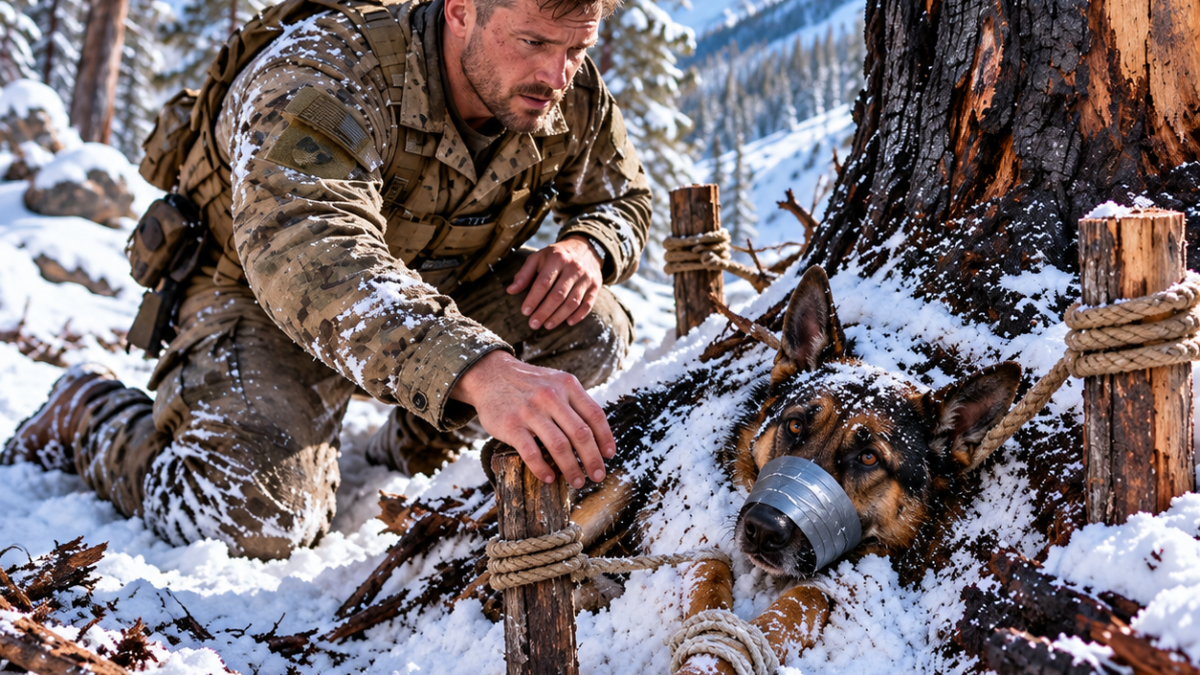
Nathan scraped it clear with shaking fingers.
USMS SOG.
United States Marshals Service.
Special Operations Group.
This was not a lost hunting dog.
This was not a ranch dog caught in weather.
This was a working K9.
Nathan slid both arms beneath the animal.
“Come on. I’ve got you.”
The dog let out a weak, rattling groan as Nathan lifted him.
He weighed nearly eighty pounds, dead weight made heavier by ice. Nathan’s bad knee screamed as he staggered toward the cabin, but he clamped his teeth and pushed through it.
“Stay with me,” he said. “Come on, Marine rules tonight. Nobody dies on my porch.”
He kicked the cabin door shut behind them.
Warmth from the wood stove hit like a wall.
Nathan laid the shepherd on a thick wool rug and went to work.
He did not think.
Thinking came later.
His combat lifesaver training took over the way old training does in the moments when panic would only get people killed.
Trauma kit.
Blankets.
Warm water.
Shears.
He cut away the harness carefully.
The left side was soaked in a dark, sticky substance that had begun to freeze.
Blood.
A lot of it.
The dog had not simply been trapped in the storm.
He had been in a firefight.
A deep laceration tore across the left shoulder, ugly and uneven, consistent with shrapnel or a grazing bullet wound. Blood loss had been severe, but the freezing temperatures had slowed it just enough to keep him alive.
“Lucky and unlucky,” Nathan muttered.
The dog’s eyes fluttered.
“Yeah, I know. Story of my life too.”
He packed the wound with hemostatic gauze and wrapped it tight. He checked the paws. Torn pads. Frozen blood. Scrapes along the ribs. No obvious broken bones. Shock, hypothermia, blood loss.
Bad.
But not hopeless.
On the dog’s collar, a stamped metal tag caught the firelight.
K9 KAISER.
“Kaiser,” Nathan said softly. “All right. That’s who you are.”
For three hours, Nathan sat on the floor beside him.
He fed him drops of warm chicken broth from a syringe. He changed blankets as they grew damp. He rubbed circulation back into the dog’s ears and paws. He checked the bandage again and again, watching for fresh bleeding.
Outside, the storm hammered the cabin.
Inside, the fire crackled.
Kaiser’s breathing slowly deepened.
Amber eyes opened once, unfocused and glassy, then found Nathan’s face.
“There you are,” Nathan whispered.
Kaiser blinked.
Nathan leaned back against the sofa, suddenly exhausted.
“What the hell were you doing out there?”
The question stayed in the room.
A U.S. Marshals tactical K9, wounded and half frozen, twenty miles deep in the Bitterroot wilderness during a historic whiteout.
There were only two possibilities.
Either Kaiser had escaped from something.
Or he had been trying to get to someone.
Around two in the morning, Kaiser’s ears twitched.
Nathan sat up instantly.
The dog lifted his head.
“Easy,” Nathan said. “Stay down.”
Kaiser ignored him.
The shepherd pushed onto his front legs, trembling violently. His back legs struggled for purchase on the rug. His bandaged shoulder shook under the effort.
“Kaiser. Down.”
The dog did not obey.
That told Nathan more than obedience would have.
Kaiser was not confused.
He was not panicking.
He had a mission.
He limped across the cabin floor toward the heavy oak front door. Blood smeared faintly from his torn paws. He pawed at the wood, then turned his head toward Nathan.
His eyes were wide.
Urgent.
Intelligent.
He was not trying to escape.
He was trying to lead.
Nathan looked at the frosted window.
Beyond it was white death.
Windchill far below zero.
No visibility.
No road.
No help.
Going back out into that storm was madness.
Kaiser barked once.
Deep.
Guttural.
A command more than a plea.
Nathan closed his eyes.
He knew that bark.
Not personally.
But he knew the meaning.
I found you.
Now follow me.
Marines do not leave men behind.
Nathan stood.
His knee protested so sharply he nearly sat back down. He grabbed the edge of the table, breathed through the pain, then limped to the gun safe.
Customized AR-15.
Full magazine.
One spare.
Sidearm.
Flashlight.
Snowshoes.
White winter camouflage shell.
Emergency pack.
Thermal blanket.
Pry bar.
He checked everything with the quick, controlled movements of a man who had once done this while mortars fell in the distance.
Kaiser watched from the door, shaking, barely able to stand, but refusing to lie down.
“All right,” Nathan said, chambering a round. “Show me.”
The moment he opened the door, the storm tried to throw them back inside.
Cold hit like a physical blow.
Kaiser plunged into the snow.
He moved badly.
Limping.
Staggering.
But his nose stayed low, catching something in the violent updrafts that Nathan could not see, hear, or understand.
Nathan followed.
Every step burned.
His lungs felt full of crushed glass. Snow filled the beam of his flashlight until it seemed he was shining light into a wall. His bad knee throbbed with a relentless rhythm, but he forced it into the background.
Kaiser led him away from the cabin.
Away from the logging road.
Toward the steep, dense timber behind the ridge.
They pushed nearly a mile through the blinding white abyss.
Then Kaiser stopped.
The dog’s ears flattened.
A low growl rumbled in his chest.
Nathan dropped to one knee and shouldered his rifle.
He scanned the tree line through his optic, but the heavy snow washed everything into moving ghosts.
Slowly, he crept forward.
The ground vanished beneath him.
He caught himself against a thick pine trunk just before stepping off the edge of a steep rocky ravine.
Below, half buried in a massive snowdrift, lay the crushed black shape of an overturned armored SUV.
Nathan’s pulse slowed.
Not from calm.
From focus.
The vehicle had gone off a hidden mountain pass above, tumbled down the embankment, ripped through small trees, and landed roof-first in the creek bed.
But the crash was not the whole story.
Nathan slid down the icy slope, rifle raised.
The smell of diesel fuel hit first.
Then blood.
Then burned rubber.
The SUV was unbadged.
Blacked out.
Reinforced ballistic glass spiderwebbed but not shattered.
Kaiser limped toward the rear hatch, whining frantically, digging at snow packed against the crumpled metal.
Nathan moved to the driver’s side.
The door hung twisted off its hinges.
Inside, suspended upside down by his seat belt, was a man in tactical gear.
Dead.
His neck rested at an impossible angle.
Nathan swept his flashlight over the interior.
His beam froze on the driver’s side window.
The armored glass was pocked with heavy-caliber impacts.
White-centered craters clustered near the driver’s head.
Someone had shot them off the road.
“Hey!” Nathan shouted over the storm. “Is anyone alive?”
For one second, only wind answered.
Then came a faint metallic tapping from the rear compartment.
Kaiser barked.
Nathan rushed to the back.
The hatch was jammed shut by the impact. He slung his rifle behind him, pulled the pry bar from his pack, and wedged it into the seam.
His muscles screamed.
The metal shrieked.
Once.
Twice.
The hatch popped.
A wave of snow and freezing water spilled out.
Inside the cramped cargo area, upside down against the roof of the overturned vehicle, was a woman.
Late twenties.
Bruised face.
Dried blood across her temple.
Eyes fiercely alert.
Her right wrist was handcuffed to a thick stainless-steel briefcase.
Her left hand gripped a SIG pistol pointed directly at Nathan’s chest.
“Drop it!” she screamed, voice cracking from cold. “Drop the weapon!”
“Easy,” Nathan barked, hands visible but rifle still slung. “I’m a Marine. Your dog found me.”
Her eyes flicked to Kaiser.
“Kaiser found me,” Nathan said.
At the sound of his name, the German Shepherd shoved past Nathan’s legs, scrambled into the cargo opening, and licked the woman’s frozen face.
Her pistol dropped.
She burst into tears.
“I thought he was dead,” she sobbed, burying her face in the dog’s fur. “They shot him when we went off the ridge. I thought he was dead.”
Nathan grabbed her by the shoulder of her tactical jacket.
“We need to move. Who are you?”
“Deputy Marshal Samantha Hayes,” she said through chattering teeth. “We were transporting evidence. We were ambushed. They knew our route.”
Nathan pulled her from the wreckage.
She cried out as her left leg dragged.
Her ankle was broken, swollen hard against the boot.
Nathan hauled her onto his back in a fireman’s carry. The steel briefcase slammed painfully against his spine.
“Who ambushed you?”
“Mercenaries,” Samantha gasped near his ear. “Hired by the man we were supposed to testify against. They have local radio frequencies. Thermal drones. They won’t stop.”
A rifle cracked above them.
A chunk of pine bark exploded inches from Nathan’s head.
He dropped hard into the snow, dragging Samantha behind a fallen Douglas fir. Kaiser flattened beside them, silent and instantly combat-aware despite the wound in his shoulder.
The second shot snapped through the trees.
Then a third.
Nathan wiped blood from his cheek where a wood splinter had cut him.
“How far is your cabin?” Samantha whispered.
“Too far to run with you on my back and them above us.”
He flipped his rifle from safe to semi-auto.
The wind died for half a breath.
Through the falling snow, three red laser beams swept across the ravine.
Methodical.
Patient.
Professional.
Not local thugs.
Not desperate criminals.
A cleanup crew.
Nathan counted what he had.
Low ground.
One magazine loaded.
One spare.
Wounded K9.
Injured federal agent.
Unknown number of hostiles.
Bad knee.
Whiteout conditions.
In a conventional firefight, they were dead.
But the Bitterroot Mountains did not offer conventional battlefields.
Out here, the cold was the apex predator.
And Nathan knew how to make it hunt for him.
“Listen carefully,” he whispered.
He pulled a Mylar emergency blanket from his pack.
“They have thermal. This will mask you. You and Kaiser get under that root system. Do not move. Do not shoot unless they step on you.”
Samantha stared at him.
“You can’t leave us. There are at least three. They’re professionals.”
Nathan looked up the slope.
“I was Force Recon.”
“So were half of them, probably.”
“Maybe,” Nathan said. “But this is my mountain.”
Kaiser whined low, wanting to follow.
Nathan held up one fist.
Stay.
The dog trembled.
Not from fear.
From the unbearable conflict between training and loyalty.
“Stay,” Nathan repeated.
Kaiser obeyed.
Samantha dragged herself into the hollow beneath the massive root system. Kaiser curled around her, giving what warmth his battered body still held.
Nathan threw the Mylar blanket over them, packed snow across it, and erased the edges with his gloves.
Then he crawled away on his belly.
He did not run from the mercenaries.
He flanked them.
Moving parallel to the ridge, invisible in white camouflage and blowing snow.
His knee screamed.
He ignored it.
Pain was information.
Not an order.
Through the storm, he caught the faint crunch of snowshoes.
Voices.
Radio static.
“Thermal shows weak heat near the vehicle. Fading. Look for blood trail.”
Nathan settled behind a snow-covered rock and waited.
He did not have thermal.
He did not need it.
The wind shifted.
For one fraction of a second, the curtain of snow parted.
He saw the point man.
Large figure.
Dark winter gear.
Night-vision goggles.
Scanning the ravine.
Nathan did not aim center mass.
Body armor would catch it.
He exhaled halfway and squeezed the trigger.
Crack.
The point man dropped, screaming, a round shattering his knee.
The remaining two opened fire blindly.
Suppressive fire ripped into the tree line. Pine bark, frozen sap, and wood fragments exploded around Nathan.
He did not stay to admire the effect.
He rolled backward down the embankment and vanished into brush.
The mercenaries made the first critical error.
They fired at the muzzle flash.
Then abandoned their clean sweep.
“Contact left! Suppress!”
Nathan circled wide.
He came up behind their original position.
The wounded point man thrashed in the snow, trying to apply a tourniquet with shaking hands.
Nathan closed the distance in three silent strides.
He clamped a gloved hand over the man’s mouth and pressed a combat knife to his carotid artery.
“Quiet.”
The man froze.
Nathan stripped him of his radio, spare magazines, and a flashbang grenade.
Then he drove the hilt of the knife into the base of the man’s skull.
The mercenary went limp.
Nathan keyed the stolen radio.
“He’s behind us!” he shouted, pitching his voice into panic. “He circled back. I’m hit!”
He tossed the radio into a deep snowdrift and moved.
The diversion worked.
The remaining two broke formation, shouting into the storm as they rushed toward their fallen teammate.
That was the opening.
Nathan sprinted back to the root system, digging furiously through the snow.
Samantha came out with her pistol aimed at his face.
“It’s me.”
She lowered it.
“Let’s go.”
He hauled her onto his back again.
Kaiser struggled upright, amber eyes locked on Nathan.
They climbed.
Every yard was a fight.
Samantha’s breath came in sharp, pained bursts. Kaiser left red spots in the snow. Nathan’s knee buckled twice, but he caught himself both times with the rifle and kept moving.
By the time the dark silhouette of the cabin appeared through the blizzard, Nathan was running on adrenaline and muscle memory alone.
He kicked open the door, dragged Samantha and Kaiser inside, then slammed it shut and threw every bolt.
The cabin felt smaller now.
Less like refuge.
More like a fort before siege.
Nathan dumped Samantha onto the sofa. The briefcase hit the floor with a metallic thud.
He moved fast.
Storm shutters.
Door brace.
Lights off.
Fire damped low.
Shotgun from the safe.
Extra shells.
“Your blood,” Samantha gasped, looking at the red trail across the floor. “They’ll track it.”
“Let them.”
Nathan tossed her a combat shotgun.
“This cabin has foot-thick log walls and a reinforced door. If they want in, they pay for it.”
Then he looked at the stainless-steel briefcase cuffed to her wrist.
“But I need to know why they’re coming.”
Samantha’s eyes shifted.
To Kaiser.
To the windows.
To Nathan.
“What is in the box?” he asked. “Why are trained contractors willing to freeze to death in a blizzard to kill you?”
For a moment, she hesitated.
Then she reached into her boot and removed a small encrypted key fob.
She inserted it into the briefcase lock.
A green light flashed.
The latches opened.
Inside was an encrypted hard drive and a stack of handwritten ledgers sealed in plastic.
“Two days ago,” Samantha said, “my unit raided a safe house tied to the Romanov syndicate. We expected fentanyl routes, shell companies, maybe weapons manifests.”
Nathan lifted the top ledger.
Dates.
Offshore account numbers.
Initials.
Judicial codes.
Badge numbers.
Samantha’s voice hardened.
“We found their payroll.”
Nathan looked up.
“Who?”
“Local cops. Federal judges. State senators. High-ranking law enforcement.”
Her face changed.
The next words hurt more than the cold.
“I found a matching routing number. It belongs to Chief Inspector Robert Dunn.”
Nathan knew the tone before she finished.
“My commanding officer,” Samantha said. “The man who ordered this transport route tonight. He knew the storm was coming. He knew the radios would be unreliable. He sent us into a slaughterhouse.”
The cabin seemed colder.
The men outside were not just mercenaries.
They were a cleanup crew deployed by the very people sworn to protect the law.
If Samantha died on that mountain, the truth died with her.
Buried under ten feet of snow.
Kaiser’s head snapped up.
A low growl vibrated through his battered chest.
Nathan moved to the window slit.
Nothing but white.
Then came the heavy thud of boots on the porch.
The storm had not shaken them.
The final stand had arrived.
“Behind the stove,” Nathan ordered.
The cast-iron stove was thick enough to stop small-arms fire.
Samantha dragged herself behind it, pulling the briefcase with her, shotgun leveled at the door.
Kaiser stood in the center of the room.
Teeth bared.
Ignoring the pain in his shoulder.
A voice barked from outside through a bullhorn.
“Miller! We know who you are. Corporal Nathan Miller. Force Recon. Helmand Province. We have no quarrel with you.”
Nathan took position behind a massive oak support pillar.
“Funny place for a social call.”
“Slide the briefcase out. You and the dog live.”
“And the deputy?”
“She is a traitor to the badge. She stole classified property.”
Nathan’s jaw tightened.
“I took an oath to defend against all enemies, foreign and domestic.”
He racked a shell into the shotgun.
“Looks like you fell into the domestic category.”
The front door exploded inward.
A breaching charge blew wood, iron, and snow through the cabin.
The shockwave slammed Nathan to one knee. Smoke filled the room. Freezing wind rushed in. Two men poured through the shattered doorway with submachine guns and strobing tactical lights.
The cabin became chaos.
White light.
Smoke.
Gunfire.
Splinters.
Samantha fired from behind the stove.
Her shotgun blast caught the second man in the chest and threw him backward onto the porch.
The lead mercenary was faster.
He rolled behind the kitchen island and blind-fired a burst that chewed through Nathan’s oak pillar, raining splinters across his shoulders.
Then Nathan saw the man’s hand go to his vest.
Grenade.
The mercenary pulled the pin.
Nathan had no angle.
If the grenade landed inside the cabin, everyone died.
Before Nathan could move, Kaiser launched.
The wounded German Shepherd crossed the room in a black-and-tan blur.
He vaulted over the kitchen island and collided with the mercenary midair.
The man screamed as Kaiser’s jaws clamped onto his forearm with bone-crushing force.
The grenade slipped free.
It rolled across the floorboards.
“Grenade!”
Nathan dove, scooped the explosive, and hurled it out through the blown doorway.
The explosion rocked the cabin.
The porch vanished in snow, fire, and debris.
Inside, the fight turned brutal.
The mercenary drew a combat knife with his free hand and drove it toward Kaiser’s ribs.
Nathan closed the distance and swung the wooden stock of his shotgun into the side of the man’s head.
Once.
Hard.
The mercenary collapsed.
Silence descended, broken only by wind roaring through the destroyed doorway and the crackle of the wood stove.
Nathan dropped beside Kaiser.
The dog panted heavily, muzzle bloodied, amber eyes bright and alert.
Then Kaiser licked Nathan’s face.
Rough.
Wet.
Alive.
Nathan let out a breath that felt like it had been trapped in his chest for hours.
“Good boy, Kaiser.”
His hands shook as the adrenaline began to crash.
“Good boy.”
Samantha pulled herself upright behind the stove.
“Is it over?”
Nathan looked past the shattered doorway.
The eastern horizon was turning bruised purple.
The snowfall had weakened to a flurry.
The wind was dying.
“Yeah,” he said, leaning against the counter as pain finally claimed his knee. “It’s over.”
Three hours later, rotor blades shattered the mountain silence.
Nathan had powered his ham radio once the storm cleared and sent an encrypted SOS directly to the FBI regional field office, bypassing the compromised Marshals chain of command entirely.
Two Blackhawks touched down in the clearing beyond the cabin.
FBI Hostage Rescue agents poured out, securing the surviving mercenaries and taking custody of the Romanov syndicate ledger.
Medical personnel rushed inside.
Samantha was loaded onto a stretcher, pale but conscious.
As they carried her toward the helicopter, she grabbed Nathan’s sleeve.
“You saved my life, Miller.”
Nathan glanced at Kaiser, who sat pressed against his leg despite the medic trying to examine him.
“He started it.”
Samantha managed a weak smile.
“I don’t know how to repay you.”
“Make sure Chief Inspector Dunn gets a cell with a window.”
Her smile became real.
“I’ll do my best.”
A flight medic approached Nathan carefully, eyes on the massive German Shepherd.
“Sir, we have a veterinary trauma unit on standby in Helena. We need to transport the K9.”
Nathan looked down.
Kaiser nudged his nose against Nathan’s palm.
The bond had been forged in one freezing, blood-soaked night.
But some bonds do not need time.
They need truth.
“I’m coming with him,” Nathan said.
The medic nodded immediately.
No one argued.
The investigation that followed shook the foundations of the justice system.
Chief Inspector Robert Dunn was indicted on federal racketeering, corruption, conspiracy, and attempted murder charges. Judge Leonard Castile, three senior law enforcement officials, and multiple state-level political aides went down with him.
The Romanov syndicate’s operations were dismantled piece by piece.
Routes closed.
Accounts frozen.
Witnesses protected.
Cases reopened.
All because one wounded dog refused to die in the snow before finishing his mission.
Samantha Hayes recovered slowly.
Her ankle required surgery.
Her frostbite took months to heal.
Her career survived only because the evidence she carried was too powerful for anyone to bury once the FBI had it.
She earned a promotion.
A commendation.
And a reputation for trusting the right dog at the right time.
Kaiser recovered too, though not enough to return to fieldwork.
The shrapnel damage to his shoulder left a permanent limp after long exertion. His paws healed. His coat grew back thick and glossy. His amber eyes stayed sharp.
But the Marshals Service knew the truth.
He had given enough.
The hero of the storm needed retirement.
He needed quiet.
He needed a home with someone who understood that surviving battle does not mean the battle has finished surviving inside you.
Two months after the blizzard, as the winter snows began to soften in Montana, a black SUV climbed the rebuilt road to Nathan Miller’s cabin.
Nathan stood on the porch with a cane in one hand and a mug of coffee in the other.
The cabin had a new front door.
New windows.
New porch boards.
Scars, repaired but visible.
Like him.
Like Kaiser.
Samantha stepped from the SUV first, walking with a boot brace and a careful limp.
Then she opened the rear door.
Kaiser bounded out.
His limp was barely noticeable at first.
His tail whipped furiously.
He crossed the yard at full speed and launched himself up the porch steps.
Nathan barely had time to set down the coffee before eighty pounds of German Shepherd hit his chest.
He laughed.
A real laugh.
One that startled him with its own sound.
Kaiser pressed his head beneath Nathan’s chin, whining like the massive hardened K9 was suddenly a puppy again.
Nathan buried his face in the thick fur.
For the first time in years, the smile on his face did not feel borrowed.
Samantha leaned against the SUV and watched them.
“He chose you,” she said.
Nathan looked up.
Kaiser stayed pressed against him.
“I found him buried in a snowbank.”
“No,” Samantha said softly. “You found him because he made it to your door.”
Nathan’s hand moved over the scarred shoulder.
The dog leaned into the touch.
Samantha handed him a folder.
“What’s this?”
“Retirement transfer. Medical records. Adoption authorization. Official commendation. And a ridiculous amount of paperwork saying what he already decided.”
Nathan opened the folder.
K9 KAISER — RETIRED.
Permanent placement approved.
Nathan Miller.
Bitterroot County, Montana.
He swallowed hard.
“I don’t know if I’m fit to take care of him.”
Samantha looked at the cabin.
At the repaired doorway.
At the mountain that had almost killed all three of them.
Then back at the former Marine with the bad knee and haunted eyes.
“None of us were fit for what happened that night,” she said. “We showed up anyway.”
Kaiser licked Nathan’s jaw.
Nathan closed the folder.
“Well,” he said, voice rough, “I guess we’ll figure it out.”
They did.
Not perfectly.
Never perfectly.
Kaiser hated fireworks.
Nathan hated them too.
The first thunderstorm after Kaiser came home sent the dog pacing from door to window, body tight, ears pinned. Nathan sat on the floor beside the wood stove and said nothing. After twenty minutes, Kaiser lay down beside him, head on his bad knee.
Neither of them slept much that night.
But neither of them spent it alone.
Spring came slowly to the Bitterroots.
Snow melted into clear water that ran down the ravines and filled the creek beds. Pine branches lifted under the loss of weight. Elk returned to the meadow. The logging road became passable again.
Nathan built a wider porch.
Kaiser supervised.
Nathan repaired the woodshed door.
Kaiser stole one glove and refused to apologize.
Nathan walked farther each morning.
At first, only to the tree line.
Then the ridge.
Then the trail where he had followed Kaiser into the storm.
His knee hurt.
His lungs burned.
Some days, memory hit harder than weather.
But Kaiser walked beside him, limping slightly when the ground was uneven, always watching, always aware.
Two veterans learning the difference between vigilance and fear.
One evening, months later, Nathan stopped at the edge of the ravine.
The wreckage was gone now.
Federal crews had removed every trace of the armored SUV.
Snow had melted.
Grass had begun to grow where blood once darkened the ice.
Kaiser stood beside him.
The dog sniffed the air, then sat.
Nathan looked down.
“You led me here half dead.”
Kaiser’s ears flicked.
“You’re stubborn.”
The dog leaned against his leg.
Nathan looked out over the mountains.
For years, he had believed his life had narrowed to survival.
Wake up.
Check locks.
Avoid town.
Cut wood.
Sleep badly.
Repeat.
Then a wounded dog appeared in the snow with a badge on his harness, blood in his fur, and a mission in his eyes.
Kaiser had not asked whether Nathan was ready.
He had simply demanded that he follow.
And because Nathan followed, a woman lived.
A criminal conspiracy cracked open.
A corrupt inspector fell.
A dog came home.
And a Marine who had hidden from the world remembered that survival was not the same as purpose.
Nathan rested his hand on Kaiser’s head.
The shepherd closed his eyes.
The wind moved through the pines.
Not screaming now.
Just wind.
Nathan breathed in.
Slow.
Then out.
For the first time in a long time, the silence did not feel empty.
It felt earned.
People later told the story as if Nathan Miller had saved Kaiser from the snow.
That was true.
But incomplete.
Kaiser saved him back.
The dog had dragged him out of a different kind of blizzard.
One with no weather.
One made of grief, isolation, pain, and the belief that the useful part of him had been left behind in a war zone.
Kaiser found him there.
Buried.
Still breathing.
Waiting without knowing he was waiting.
And just like Nathan had done that night in the snow, Kaiser refused to leave him behind.
Years later, when people asked Nathan why he had followed a wounded dog into a whiteout with almost no information and no backup, he always gave the same answer.
He would look down at Kaiser, whose muzzle had gone gray but whose amber eyes still held the mountain light.
Then he would say, “Because he asked like someone was still alive.”
And sometimes, that is all the reason a good man needs.


