A Former Navy SEAL Went to the Shelter for a Quiet Old Dog—Then a Worker Begged Him to Meet the German Shepherd Scheduled to Die at Midnight.
PART3:
An explosion outside Kandahar ended twelve years with SEAL Team Three and introduced me to civilian medicine, physical therapy, tinnitus, chronic headaches, and the special kind of bureaucracy that asks you to prove an injury happened while you’re still carrying pieces of it.
Dr. Harris said:
“You need a dog.”
“No.”
“Yes.”
“No.”
“Not a protection dog.”
“Good.”
“Not a working dog.”
“Better.”
“A simple dog.”
I laughed.
“What is a simple dog?”
“Golden retriever.”
“No.”
“Labrador.”
“Maybe.”
“Basset hound.”
“Now you’re insulting me.”
He smiled.
“Older dog.”
“That part I like.”
“Quiet.”
“Yes.”
“Lazy.”
“Perfect.”
“One that sleeps on your rug, breathes loudly, wants dinner, and doesn’t know the sound of gunfire.”
That sentence landed harder than he intended.
Or exactly as hard as he intended.
I looked back toward the window.
Dr. Harris lowered his voice.
“Something that reminds your nervous system the world can contain ordinary needs.”
“What does that mean?”
“It means maybe at three in the morning you’ll have to think about whether a dog needs to pee instead of who didn’t make it home ten years ago.”
I hated him for saying it.
Which usually meant he had found the truth.
Three weeks later I drove down from my cabin.
Bitterroot Mountains.
Early October.
Snow already sitting on the high ridges.
My place was forty minutes outside town on a dirt road that became unreasonable every winter.
Weather-beaten cedar.
One bedroom.
Wood stove.
Small workshop.
No neighbors close enough to ask questions.
When I bought it after retirement, I told myself isolation would heal me.
Quiet sounded like medicine.
Turns out quiet is dangerous when your own head knows how to fill it.
At night the wood stove popped and became distant rifle fire.
A branch scraped the roof and I was somewhere else.
Truck headlights turned on the county road below and my body reacted before logic did.
I knew exactly what was happening.
That almost made it worse.
You can understand trauma completely and still not negotiate with it.
Valley Hope Animal Rescue sat beside an agricultural supply warehouse south of town.
Concrete.
Chain-link runs.
A faded sign with painted paw prints.
I stayed in my Bronco for almost six minutes.
Then told myself I had survived helicopters piloted by men whose confidence exceeded their judgment.
I could survive dogs.
The lobby smelled like bleach, wet fur, kibble, and stress.
A hundred animals seemed to bark at the same time.
I stopped inside the door.
My shoulders tightened.
Old habit.
Locate exits.
Count people.
Hands.
Doors.
Noise sources.
Then I caught myself.
Shelter.
Montana.
Dogs.
No mission.
A young woman behind the desk looked up.
Early thirties.
Brown hair in a loose knot.
Purple scrub top beneath a fleece vest.
Name tag:
EMILY SAUNDERS.
She gave me the professional shelter smile.
Warm but exhausted.
“Hi. Can I help you?”
“I’d like to adopt.”
Her smile became real.
“That’s the best answer I get all day.”
“Older dog.”
“Even better.”
“Quiet.”
“We can do quiet.”
“No puppies.”
She laughed.
“Definitely.”
“No working breeds.”
That made her pause.
“All right.”
“Retriever would be fine.”
“We have Buster.”
“What is Buster?”
“Nine-year-old Lab mix.”
“Energy?”
“He considers standing up optional.”
“I like Buster already.”
“He snores.”
“Excellent.”
“Food motivated.”
“Understandable.”
“Loves women, men, children, cats, delivery drivers, vacuum cleaners, and possibly tax auditors.”
“Let’s not get carried away.”
Emily pulled a binder from beneath the desk.
I relaxed.
This was exactly what I wanted.
Then she looked at my cap.
Old green canvas.
Faded trident embroidered on the front.
I’d worn it so long I forgot what strangers saw.
Her eyes moved to my cane.
Then back to my face.
“You were Navy?”
“Long time ago.”
She swallowed.
Not admiration.
Something else.
Nerves.
She looked toward a steel door beyond the front counter.
“Can I ask you something?”
“You already did.”
Her mouth tightened.
“Before Buster.”
“No.”
“You don’t know what I’m asking.”
“I know enough.”
“There’s another dog.”
“No.”
“He’s in quarantine.”
“Definitely no.”
“Mr…”
She looked at the intake sheet.
“Evans.”
“Mr. Evans, please.”
That word stopped me.
Please.
Not sales pitch.
Desperation.
I sighed.
“What kind?”
“German Shepherd.”
“No.”
“Former K9.”
“No.”
“Large.”
“No.”
“Aggression history.”
“Emily.”
“He’s scheduled for euthanasia tonight.”
I looked at her.
“Then I’m not your guy.”
Her eyes turned wet.
Not theatrically.
She was trying not to let them.
“He hasn’t eaten in five days.”
I said nothing.
“He hasn’t barked once in three weeks.”
“That’s not necessarily good.”
“I know.”
“Why is he here?”
“A private contractor surrendered him.”
“Military contractor?”
“They wouldn’t give us much information.”
I did not like that sentence.
“They said his handler was killed overseas.”
Something moved under my ribs.
I pushed it down.
“They said the dog became uncontrollable after that.”
“Then he needs an experienced evaluation.”
“We had one.”
“And?”
“Six stitches.”
I closed my eyes.
“Emily.”
“I know.”
“No, you don’t.”
“I know you didn’t come for this.”
“Correct.”
“I know it’s unfair to ask.”
“Correct.”
“And I know Buster deserves you too.”
“Then show me Buster.”
She gripped the edge of the desk.
“The veterinarian won’t enter Atlas’s kennel tonight.”
“Atlas?”
“That’s the name on his intake.”
“What happens?”
Emily’s voice dropped.
“Animal control comes with restraint equipment.”
I knew what she meant.
I didn’t want the picture.
She gave it to me anyway.
“They’ll remove him mechanically because nobody can safely approach him.”
I looked toward the steel door.
Emily said:
“He’s terrified.”
“Aggressive.”
“Yes.”
“Those aren’t mutually exclusive.”
Her expression changed.
Exactly.
She whispered:
“I think he’s grieving.”
I hated that word.
Grieving.
People use it too casually.
Dog doesn’t eat?
Grieving.
Dog waits by a door?
Grieving.
Human stares at mountains for nineteen months?
Healing.
We have strange standards.
Emily said:
“You don’t have to adopt him.”
“Good.”
“Just look.”
“Why me?”
Her eyes went to my hat again.
I almost removed it.
“Because every trainer who’s gone in there tried to control him.”
“And?”
“You looked like somebody who might understand what he’s waiting for.”
I should have walked out.
I had driven down the mountain for uncomplicated.
Buster was ten yards away somewhere, probably sleeping with his tongue out.
I had earned simple.
Twelve years.
Friends buried.
Marriage that had quietly died because neither of us knew how to live around deployments anymore.
Left knee destroyed.
Career ended.
Cabin.
Silence.
I had earned one lazy dog.
Then Emily said:
“He’s going to die alone.”
That did it.
I handed her my car keys.
“Why?”
“Because if this goes badly, tell somebody where my truck is.”
Her face went white.
“That was a joke.”
“Okay.”
“Mostly.”
“Mr. Evans—”
“Matthew.”
She nodded.
“Matthew, I’m serious. He is dangerous.”
“So are frightened people.”
“Dogs aren’t people.”
“No.”
I looked toward the door.
“Sometimes they’re easier.”
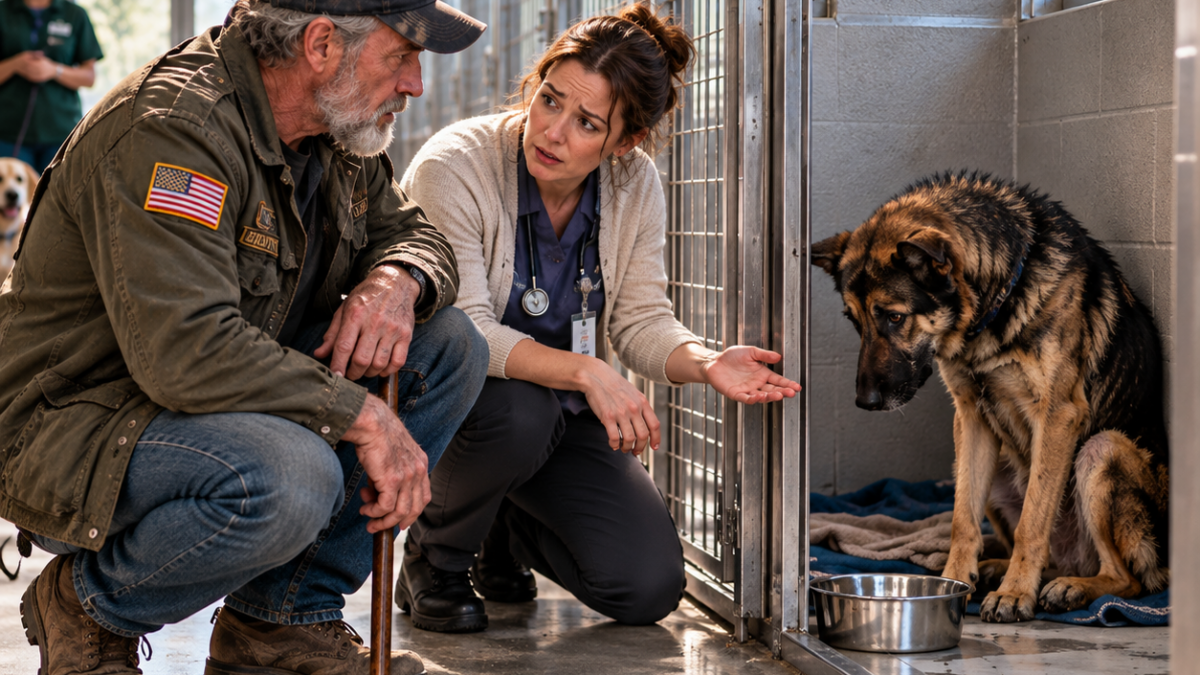
She led me into the quarantine wing.
The noise faded the moment the steel door closed behind us.
That was worse.
Main kennel barking had been chaos.
Quarantine was silence.
Concrete corridor.
Fluorescent lights.
Drain channels.
Stainless-steel bowls.
Several empty enclosures.
A beagle under a heat lamp.
A pit mix recovering from surgery.
Then kennel 42.
Atlas sat in the exact center.
Didn’t move.
Ninety pounds, maybe more.
Almost black over the back and shoulders.
Deep mahogany legs.
Wide skull.
Torn left ear.
Jagged scar across the muzzle.
Heavy leather tactical collar.
Not shelter equipment.
Real working collar.
Old.
Worn.
The dog looked at me.
I stopped.
Emily whispered:
“See?”
I did.
The eyes.
Handlers know eyes.
Good working dogs are alive in ways that can be unsettling.
Constant information.
Constant calculation.
Where are you?
What do you need?
What changed?
Atlas had none of that.
His amber eyes were open.
Nothing behind them.
I had seen that look on men.
After bad nights.
After casualty notifications.
After aircraft rides home where one seat remained empty.
I saw it in my bathroom mirror more mornings than I admitted to Dr. Harris.
Emily said:
“Matthew?”
“How long has he been like this?”
“Since intake.”
“Water?”
“Some.”
“Food?”
“Barely at first. None for five days.”
“Medical?”
“Bloodwork looks acceptable from the sample we got during initial sedation.”
“Initial sedation?”
“They drugged him for transport.”
Of course.
“Who surrendered him?”
“Northstar Response Group.”
I knew the name.
Private security.
Government contracts.
Logistics.
Overseas support.
Some legitimate.
Some deliberately vague.
“Handler’s name?”
“Redacted on what they gave us.”
“Cause of death?”
“They said operational incident.”
“Where?”
“They wouldn’t say.”
I looked at Atlas.
“That’s not normal.”
Emily laughed without humor.
“Nothing about him is normal.”
I walked closer.
At ten feet, his ears changed.
Five feet, shoulder muscles tightened.
Three feet, a vibration started.
Not barking.
Growl.
Low enough to feel.
Emily grabbed my sleeve.
“That’s enough.”
I looked down at her hand.
She released.
“Sorry.”
“You should leave.”
“What?”
“If I’m going in.”
“You are not going in.”
“You brought me back here because you hoped I would.”
“I hoped he’d react differently.”
“He is.”
“He’s threatening you.”
“He hasn’t moved.”
“He nearly took Jeff’s arm off.”
“Jeff?”
“Behavior consultant.”
“What did Jeff do?”
“Entered with a catch lead.”
“Eye contact?”
“Probably.”
“Food lure?”
“Yes.”
“Reached over him?”
“I wasn’t inside.”
Atlas’s growl deepened.
I removed my cap.
Placed it on the floor.
Then my jacket.
Then I handed Emily my cane.
She stared.
“What are you doing?”
“Removing things.”
“That does not explain anything.”
“Close the corridor door.”
“No.”
“Emily.”
“If he attacks you—”
“Then open it after.”
“You’re insane.”
“Possibly.”
“Matthew.”
I looked at her.
“Don’t let anyone come through that door while I’m inside.”
She shook her head.
“You said you wanted a simple dog.”
“I still do.”
“Then what are you doing?”
“Looking.”
I unlocked the kennel.
Slowly.
Atlas’s lips lifted.
Full teeth.
Beautiful teeth.
Very effective teeth.
I opened the gate six inches.
Then wider.
Stepped in.
Did not reach.
Did not present a hand.
Did not stare into his eyes.
I turned slightly sideways.
Lowered myself carefully.
My knee screamed.
I ignored it.
Sat on the concrete with my back against the wall.
About seven feet from him.
Then I did nothing.
That was the hardest thing.
Handlers always want action.
Command.
Correct.
Reward.
Control.
Atlas needed none of those.
He needed the room not to demand anything.
His growl continued.
Two minutes.
Three.
My leg went numb.
Emily watched through the fence.
Atlas stood.
Every muscle in my body wanted to prepare.
I did the opposite.
Slow breath.
Hands open.
He moved one step.
Stopped.
Another.
His nose worked.
He smelled my boots.
My knee brace.
The old canvas shirt beneath my T-shirt.
Maybe he smelled fear.
Dogs always do.
People have this romantic idea that elite operators don’t experience fear.
Nonsense.
Fear keeps you alive.
Panic kills you.
Atlas came closer.
Three feet.
Then stopped.
His head lowered.
I said one word.
An old Czech calming cue commonly used around European working dogs.
Not loud.
Not sharp.
Just familiar.
Atlas froze.
His ears came forward.
The growl stopped.
Emily covered her mouth.
I said:
“Good.”
English this time.
His eyes changed.
Not much.
A flicker.
Recognition of structure.
Maybe not me.
Maybe memory.
He stepped close enough that I felt his breath.
I did not touch him.
He sniffed my shoulder.
My neck.
Then the dog who had tried to attack three professionals lowered his head onto my chest.
Not gently.
All ninety pounds of him leaned.
I almost fell sideways.
A sound came out of Atlas.
Long.
Shuddering.
Not a growl.
Not quite a whine.
More like a breath he’d been holding since another country.
My eyes burned.
“Yeah.”
His weight increased.
“I know.”
I did not know.
That was the truth.
But sometimes “I know” means only:
You don’t have to explain.
I put one hand behind his torn ear.
He closed his eyes.
Behind the gate, Emily started crying.
I said:
“Don’t.”
She laughed through tears.
“I’m trying.”
Atlas pressed harder.
“You’re heavy.”
No reaction.
“I came here for a Labrador.”
His tail moved.
Once.
“That’s manipulative.”
Emily whispered:
“He hasn’t done that.”
“What?”
“His tail.”
I swallowed.
Atlas lifted his head.
Looked at me.
There was light now.
Not much.
Enough.
I heard myself say:
“We’re going home.”
Emily made a sound somewhere between laughing and sobbing.
Three hours later, Atlas sat in the passenger seat of my 1978 Ford Bronco.
Buster had been adopted that afternoon by a retired schoolteacher.
Emily called me later specifically to tell me because she knew I’d feel guilty.
I did anyway.
Atlas did not understand guilt about Labradors.
He stared through the windshield.
The paperwork had been complicated.
The shelter director resisted.
Liability.
Behavior.
History.
Emily argued.
The veterinarian examined Atlas while I stayed beside him.
Atlas tolerated her.
Barely.
Then Northstar Response Group was called for authorization.
That conversation became strange.
The representative seemed surprised Atlas was still alive.
Then angry.
“He isn’t eligible for adoption.”
The shelter director said:
“Your surrender documents transferred ownership.”
“He was designated dangerous.”
“The county process allows qualified placement.”
“We request euthanasia be carried out immediately.”
I listened from ten feet away.
Something inside me tightened.
Why did a contractor care what happened to a dog they had surrendered?
The director asked:
“Would you like to reclaim him?”
Silence.
Then:
“No.”
“Then the transfer stands.”
They hung up.
Emily looked at me.
I looked at her.
Neither said anything.
But we were thinking the same thing.
Atlas was not simply unwanted.
Somebody wanted him gone.
The mountain road climbed.
Atlas leaned slightly into turns.
Never once lay down.
Old work habit.
Stay ready.
At the cabin, he inspected every room.
Front door.
Back door.
Bedroom.
Kitchen.
Windows.
Then returned to the front entrance and lay facing it.
I put down water.
Food.
“Off duty.”
He looked at me.
“You’re retired.”
Nothing.
“So am I.”
Nothing.
“This arrangement is going well.”
I sat in the chair.
Atlas remained by the door.
That first night neither of us slept.
Around midnight I heard him stand.
My hand moved before my brain.
Then stopped.
Cabin.
Dog.
I looked toward the living room.
Atlas stood beside my chair.
He had been staring at me.
“What’s wrong?”
He moved closer.
Pressed his shoulder against my leg.
I understood.
Nightmare.
Mine.
I must have made noise.
Atlas lay at my feet.
His back touching my boot.
At 2:17, I slept.
Until 5:41.
Three hours and twenty-four minutes straight.
Best sleep I’d had in nearly two years.
Dr. Harris would later become unbearable about that fact.
The next morning Atlas ate half his breakfast.
By day three, all of it.
By day five, he had discovered the rug in front of the stove.
By day nine, he no longer slept facing the door every minute.
Sometimes he slept sideways.
Progress.
We established routines.
Morning walk.
Food.
Wood.
Physical therapy exercises for me.
Slow conditioning for him.
He hated my cane.
Not fear.
Disapproval.
If I left it leaning somewhere unstable, he moved away from it like poor equipment offended him professionally.
He had nightmares too.
His paws moved.
Breathing changed.
Once he woke snapping at empty air.
I did not touch him.
Just spoke.
He found me.
Settled.
Two broken systems learning not every alarm required action.
Then I found the collar seam.
It happened on the twelfth day.
Atlas had rolled in something dead.
No amount of military dignity survives a dead porcupine carcass.
I washed him outside with warm water.
He tolerated it like betrayal.
When I cleaned beneath the heavy tactical collar, my thumb found a hard rectangular shape under the lining.
Not identification chip.
Too large.
I removed the collar.
Atlas watched.
I turned it under the kitchen light.
Hand stitching.
Different thread near one seam.
Someone had opened it and closed it again.
I used a small seam ripper.
Not a knife.
Carefully.
Inside were two things.
A metal dog tag.
Blood darkened around the edge.
And a microSD card sealed inside waterproof wrapping.
I stared.
Atlas stood beside me.
The dog tag read:
CHRISTOPHER PIKE
Then service information.
My throat tightened.
I knew the name.
Not personally.
Professionally.
Christopher Pike had been associated with a government intelligence support program that crossed paths with special operations units.
Three years earlier, he had been listed as killed during an overseas incident.
Body not recovered.
Official story:
Hostile action.
Atlas looked at the tag.
Then at me.
“Pike was yours?”
His ears moved.
I sat.
The room felt colder.
That night I did not put the card into anything.
Contrary to what movies suggest, finding unexplained digital media tied to classified government history does not make a rational retired operator immediately start typing secret passwords into an old laptop.
It makes him call an attorney.
Then someone trustworthy.
My attorney was useless for intelligence matters but excellent at saying:
“Do not access unknown data.”
Good advice.
My second call went to Alan Prescott.
Former federal investigator.
Worked liaison assignments with us years earlier.
Now supervisory special agent with the FBI in Denver.
We had not spoken in six years.
He answered:
“Matthew Evans.”
“You still owe me fifty dollars.”
“You disappeared for six years to collect?”
“I found something.”
Tone changed instantly.
“What?”
“Christopher Pike’s dog tag.”
Silence.
“Say that again.”
I did.
“Where?”
“In a working-dog collar.”
Another silence.
“Dog’s name?”
“Atlas.”
Alan inhaled.
“Do not connect anything electronic you found to a computer.”
That told me more than I wanted.
“I didn’t.”
“What else?”
“Memory card.”
“Leave it sealed.”
“It is.”
“Where are you?”
“Home.”
“Anyone know you have it?”
“Shelter knows I adopted the dog.”
“Contractor?”
“Yes.”
“Which?”
“Northstar Response.”
Alan swore quietly.
“Lock your doors.”
“That dramatic?”
“I’m getting on a flight.”
“I didn’t say come.”
“You called me using Christopher Pike’s name.”
Fair.
Two federal agents arrived before Alan.
Professional.
Identification.
Chain of custody.
They photographed everything.
Took the card.
Left me a receipt.
Atlas did not enjoy strangers touching the collar.
I kept one hand on him.
Alan arrived near midnight.
Older.
More gray.
Same tired eyes.
He saw my cane.
Said nothing.
Good friend.
Then Atlas.
“That’s him?”
“Yes.”
Alan stayed near the doorway.
“Can I approach?”
I nodded.
“Let him decide.”
Atlas sniffed.
Accepted Alan after thirty seconds.
Alan looked at the scar.
“Tough dog.”
“You should see the other guy.”
“Has he bitten you?”
“No.”
“Anyone?”
“Almost everyone before me.”
“Special.”
“Traumatized.”
Alan sat.
“What exactly did Northstar say when the shelter called?”
I told him.
He wrote it down.
“Did they request euthanasia in writing?”
“Shelter may have the record.”
He nodded.
“I need their paperwork.”
“Emily will help.”
Alan looked at me.
“Do you know why Pike’s tag would be hidden in the dog’s collar?”
“No.”
“Did you ever work with Pike?”
“Indirect overlap.”
“He trusted working dogs.”
“I heard.”
“Atlas may have been his.”
“That seems likely.”
Alan stared at the stove.
“Pike’s death never sat right with people.”
“Meaning?”
“The official investigation had gaps.”
“Gaps happen.”
“Not like these.”
I waited.
Alan shook his head.
“I can’t discuss more.”
“Then don’t.”
He looked surprised.
“Retirement improved you.”
“No.”
We slept badly.
At 4:12 a.m., Atlas stood.
No bark.
Head toward the road.
Body rigid.
I was awake immediately.
Headlights appeared through trees.
One vehicle.
Then another.
Stopped below the cabin.
Alan was on his feet.
He called local federal support and county law enforcement.
No movie heroics.
No last stand.
No wandering outside with firearms pretending age had not happened.
We turned exterior lights on.
Stayed inside.
Documented.
Waited.
The vehicles remained for several minutes.
Then reversed down the road before deputies reached them.
Could have been hunters.
Lost tourists.
Somebody scouting property.
Or somebody watching.
We did not know.
That uncertainty mattered.
Alan said:
“You’re coming to town.”
“No.”
“Yes.”
“Atlas doesn’t do hotels.”
“We have a secure property.”
“No kennel.”
“He stays with you.”
I looked at him.
“Nonnegotiable.”
“Fine.”
That’s how Atlas and I spent four nights at a federal guest facility while investigators reviewed evidence.
I hated every second.
Atlas hated fluorescent hallways.
We survived.
The card contained video, financial records, correspondence, and location data.
I never saw most of it.
I did not need to.
Alan told me only what later became public through court filings.
Christopher Pike had discovered evidence that certain Northstar subcontractors and executives were falsifying procurement records and moving restricted equipment through corrupt supply channels overseas.
Not an international supervillain empire.
Something more believable.
Greed.
War is expensive.
Confusion makes theft easy.
Pike collected proof.
Reported concerns internally.
Then died under circumstances originally categorized as hostile action.
Subsequent evidence suggested his location may have been compromised by people connected to the contractors he was investigating.
Atlas survived.
Pike apparently placed copies of key evidence in the dog’s collar because he believed human communication channels were compromised.
After Pike’s death, Atlas was recovered by a contractor-connected team.
Instead of being transferred through normal military working-dog channels, his paperwork was manipulated.
Ownership obscured.
Behavior reports exaggerated.
Eventually he was sent to Valley Hope with euthanasia recommendation.
Why not simply destroy the card?
Investigators believed nobody initially knew it existed.
Later, somebody reviewing Pike’s recovered notes learned he had used his dog’s equipment to conceal material.
By then Atlas had moved through several temporary facilities.
Northstar began trying to locate him.
The shelter’s euthanasia request suddenly made more sense.
So did the two vehicles.
Agents eventually identified one driver as a Northstar subcontractor.
He claimed he had been sent to “confirm the dog’s location for insurance records.”
At four in the morning.
On a mountain road.
Federal investigators did not find that explanation persuasive.
The case expanded.
Subpoenas.
Search warrants.
Financial audits.
Internal reviews.
No dramatic arrest the next morning.
Real investigations move slowly.
Paper by paper.
Account by account.
And unlike the stories people tell online, one memory card did not instantly “take down” an entire corporation.
It did something more useful.
It gave investigators a map.
Names.
Transactions.
Dates.
Enough independent evidence to start proving what Pike had already suspected.
Northstar’s CEO resigned three months later.
Several executives were indicted over fraud, obstruction, and conspiracy-related allegations.
Government contracts were suspended during review.
A former operations director accepted a plea and began cooperating.
The question surrounding Pike’s death was reopened.
That part mattered most to me.
Not because I knew him well.
Because Atlas did.
I learned his full history during the investigation.
Christopher Pike was not his first handler.
A military K9 trainer named Senior Chief Daniel Mercer had started Atlas.
Then Pike worked with him for nearly three years during intelligence support deployments.
After Mercer transferred, Pike became Atlas’s person.
There are technical words.
Handler.
Assignment.
Control.
Operational pairing.
The dog doesn’t care.
There is simply:
My person.
Pike died.
Atlas stayed with the body.
Would not leave.
Recovery personnel had to remove him.
That explained the aggression.
The shutdown.
The refusal to eat.
He had already lost his person.
Then strangers kept moving him.
Restraining him.
Sedating him.
Handling him like damaged equipment.
By the time Emily saw him, Atlas had stopped believing anyone stayed.
That realization changed how I looked at everything.
The first night he leaned against my chest.
The door watching.
The panic around vehicles.
The way he woke when I moved in the cabin.
He wasn’t protecting property.
He was preventing disappearance.
I knew that feeling too well.
Two weeks after we returned home, Dr. Harris came to the cabin.
He claimed it was because I missed appointments.
I accused him of wanting to meet Atlas.
Both were true.
Atlas watched him enter.
Dr. Harris sat carefully.
“Hello, Atlas.”
No response.
“Matthew says you’re complicated.”
“I said no such thing.”
“You said, and I quote, ‘The dog has issues.’”
“Different.”
Atlas sniffed him.
Then lay near my chair.
Dr. Harris smiled.
“I told you to get a simple dog.”
“You failed.”
“I have never been happier to fail.”
“You are visibly pleased with yourself.”
“Yes.”
We talked.
Not about Northstar.
About sleep.
Five hours average.
Sometimes six.
Nightmares reduced.
Meals regular because Atlas ate better if I ate nearby.
Daily walks.
Physical therapy improved because the dog forced movement.
Calls to my sister resumed because her daughter wanted pictures of Atlas.
Dr. Harris wrote notes.
Then:
“What happens if Atlas improves?”
“What do you mean?”
“If he becomes less dependent.”
“I hope he does.”
“What happens if you do?”
I stared.
He waited.
I hated that.
Finally:
“I don’t know.”
“Good.”
“That’s good?”
“It’s honest.”
Atlas yawned.
Dr. Harris pointed.
“Your therapist agrees.”
Months passed.
Winter arrived properly.
Three feet of snow near the cabin.
Atlas loved it.
He would bury his face until only his torn ear showed.
The first time I laughed unexpectedly, the sound frightened me.
Literally.
I had forgotten my own laugh.
Atlas bounced backward.
Barked once.
First bark since the shelter.
I froze.
He barked again.
Then grabbed my glove and ran.
“Absolutely not.”
He ran faster.
Thirteen minutes later, a medically retired Navy SEAL with a destroyed knee was chasing a German Shepherd through snow because the dog had stolen one glove.
Dr. Harris would’ve written a paper.
Emily visited in January.
She brought Buster.
The Labrador had been adopted by Mrs. Doreen Walsh, retired librarian, seventy-four.
Doreen wanted Atlas to know the dog he accidentally displaced was “doing fine.”
Buster entered my cabin.
Saw the fire.
Lay down.
Never acknowledged Atlas.
Atlas stared.
Buster snored.
Emily whispered:
“Simple.”
I looked at Buster.
Then Atlas.
“Maybe too simple.”
Emily smiled.
“You would’ve lasted three days.”
“Two.”
She sat at the table.
Atlas approached her slowly.
She stopped breathing.
He smelled her.
Then pressed his head against her waist.
Emily started crying.
Again.
“You do this a lot.”
She hugged him.
“He remembers.”
“Yes.”
“I thought he’d die in that kennel.”
I looked toward the fire.
“So did he.”
She wiped her face.
“Do you ever think about what would’ve happened if you hadn’t come that day?”
“No.”
That was a lie.
Every day.
Midnight.
Animal control.
Catch pole.
Atlas believing Pike had disappeared and every human afterward had decided he was a problem to remove.
I couldn’t think about it long.
Emily said:
“Sometimes I feel guilty about all the others.”
“What others?”
“Dogs we couldn’t save.”
I understood.
Different battlefield.
Same math.
“Don’t.”
“Easy for you to say.”
“No.”
I looked at her.
“It’s exactly why I’m saying it.”
She understood.
Survivor’s guilt isn’t exclusive.
It changes uniforms.
One afternoon Alan called.
“Pike’s sister wants to meet Atlas.”
I didn’t answer immediately.
“Name?”
“Sarah Pike.”
“Does she know what happened?”
“Enough.”
“What does she want?”
“To see the last living thing that came home from her brother’s final assignment.”
That sentence made the decision.
She came in March.
Early spring.
Mud everywhere.
Atlas sat beside me on the porch.
Sarah was forty-two.
School principal from Oregon.
Christopher’s younger sister.
Same eyes as the old photograph Alan showed me.
She stopped at the bottom of the steps.
Atlas stood.
Every muscle in my body became aware.
Sarah did not reach.
Good.
She whispered:
“Atlas?”
His ears lifted.
She started crying.
Not loudly.
Atlas took one step.
Then another.
Smelled her hands.
Her coat.
Then her face.
Sarah sank onto the bottom step.
Atlas placed his head in her lap.
She broke.
I looked away.
Some moments belong to the people inside them.
Eventually she said:
“Chris talked about him constantly.”
I sat on the opposite end.
“What did he say?”
“That Atlas was smarter than every supervisor he ever had.”
“Likely.”
“That he hated helicopters.”
“Atlas or Pike?”
“Both.”
We laughed.
She opened a canvas bag.
Photographs.
Pike and Atlas.
Desert.
Training yard.
Aircraft hangar.
Pike sleeping in a chair with Atlas’s head across his boots.
One photo stopped me.
Pike kneeling beside Atlas.
Same collar.
The hidden seam visible if you knew where to look.
On the back:
If I ever disappear, trust the dog.
I handed it back.
Sarah looked at me.
“He did.”
“Yes.”
Then:
“Why did you take him?”
I considered.
“I didn’t.”
She frowned.
“He chose before I did.”
Sarah stayed four hours.
Before leaving, she asked:
“Will you keep him?”
I almost laughed.
“That question is about five months late.”
“I mean permanently.”
“Yes.”
She nodded.
“Good.”
Then she hugged me.
I am not good at surprise hugging.
Atlas watched closely.
When she left, he stood at the road until her car disappeared.
Then came inside.
Did not wait at the door all night.
Another piece settling.
The Northstar case reached federal court that summer.
I testified briefly.
Only about the shelter transfer, collar discovery, and preservation of evidence.
Defense attorneys tried to make me sound like a retired operator hunting conspiracies.
One asked:
“Mr. Evans, you suffer from post-traumatic stress symptoms, correct?”
“Yes.”
“Hypervigilance?”
“Yes.”
“Difficulty sleeping?”
“Yes.”
“Do you sometimes perceive threats other people do not?”
“Sometimes.”
The attorney paused, thinking he’d won something.
I continued:
“That is why I did not investigate the contents myself.”
He looked up.
“I contacted counsel and federal law enforcement.”
Silence.
“And the vehicles at my property were later connected to a Northstar subcontractor.”
Prosecutor objected before I finished.
Judge handled it.
Point remained.
Another attorney asked:
“You entered the kennel of an animal trained to attack people.”
“Yes.”
“Against staff advice?”
“Yes.”
“Would you consider that normal judgment?”
“No.”
A few jurors smiled.
“Then why should the court trust your judgment about anything that occurred afterward?”
I looked at him.
“Don’t.”
He blinked.
“Trust the photographs.”
“The chain of custody.”
“The shelter records.”
“The government filings.”
“The people who investigated.”
“I am one witness.”
That was the end of that.
I had spent too much of my life around men who made themselves the center of every operation.
Bad habit.
Good systems do not depend on one hero.
Neither did this case.
The evidence stood.
Multiple defendants ultimately pleaded or were convicted on financial and obstruction-related charges.
One former Northstar executive admitted company personnel had taken steps to locate and eliminate evidence connected to Pike’s investigation, including manipulating Atlas’s disposition.
The government formally amended aspects of Pike’s death review.
His family received an official acknowledgment that his reporting contributed to exposing the scheme.
Not justice in the cinematic sense.
Pike remained dead.
Atlas remained scarred.
People had lied.
But truth entered the record.
Sometimes that’s what justice looks like when everything else is gone.
The biggest ceremony came in September.
I almost didn’t attend.
Sarah insisted.
Emily came.
Alan.
Dr. Harris.
A representative from the working-dog program.
Small gathering at a federal training center outside Missoula.
They honored Pike posthumously.
Then recognized Atlas.
The announcer read a formal citation.
Atlas yawned.
Perfect.
Sarah laughed through tears.
When they called me forward, I stayed seated.
The official looked confused.
Sarah whispered:
“Go.”
“No.”
“Matthew.”
“This isn’t mine.”
She looked at me.
“You brought him home.”
“He brought the evidence.”
“You brought him home.”
Atlas stood.
Walked toward the front without me.
Everyone laughed.
I had no choice.
I followed.
They placed a retirement collar on him.
No medal dangling where he could chew it.
A small plaque.
ATLAS
FOR COURAGE, SERVICE, AND LOYALTY BEYOND DUTY.
I read it.
Then looked at the dog.
He looked back.
“Still want the old one?”
His tail moved.
The original tactical collar stayed with Sarah after the trial.
We agreed.
It belonged to Pike’s history.
I kept the dog.
Fair trade.
The strange thing was that after public attention, people wanted to turn Atlas into a symbol.
News programs.
Documentary producers.
Podcasts.
Book offers.
I refused almost everything.
Not because the story didn’t matter.
Because Atlas had spent enough of his life being useful to institutions.
He deserved boring.
We went back to the mountain.
Firewood.
Walks.
Snow.
Food.
Occasional trips to Valley Hope.
Atlas became surprisingly good with frightened shelter dogs.
Not inside cages.
Outside in neutral yards.
Emily would bring out a shutdown dog.
Atlas ignored them.
That was his gift.
No pressure.
Some dogs need another dog to show them nothing is being demanded.
One afternoon, a young shepherd mix named Molly had refused to leave her kennel for six days.
Emily brought Atlas.
He lay twenty feet away.
Molly watched.
Ten minutes.
Fifteen.
Then crept out.
Sat.
Atlas did nothing.
Molly moved closer.
Atlas yawned.
She finally lay five feet from him.
Emily whispered:
“He’s doing what you did.”
I watched.
“No.”
“He is.”
I thought about kennel 42.
Sitting on concrete.
Demanding nothing.
Maybe she was right.
Dr. Harris loved that too.
Of course.
“So now you volunteer at the shelter.”
“Sometimes.”
“You visit your sister monthly.”
“Yes.”
“You sleep six hours.”
“Sometimes.”
“You have lunch with Alan when he’s in town.”
“Unfortunately.”
“You’re helping with a working-dog retirement advisory group.”
“They asked technical questions.”
“You answered.”
“Yes.”
“And all this happened after you got the dog I told you to get.”
“No.”
He smiled.
“No?”
“You told me to get a simple dog.”
“True.”
“This is malpractice.”
He laughed.
“How is the haunted mind?”
I looked out the window.
“Still haunted.”
His smile faded.
“But?”
“But there are other things in the house now.”
That was the best description I had.
Healing did not erase anything.
Men remained dead.
Knee still hurt.
Tinnitus still screamed on quiet mornings.
Some smells could still pull me backward without warning.
Atlas did not cure me.
I didn’t cure him.
That is another story people like because it’s tidy.
Two broken veterans save each other.
No.
We made the broken places less lonely.
That is different.
Atlas still woke from dreams.
So did I.
Sometimes he paced.
Sometimes I sat on the porch at three a.m.
Sometimes we both had good weeks.
Sometimes not.
But now if I woke in darkness, I heard his breathing.
If he woke disoriented, he found my hand.
No miracle.
Routine.
Trust.
A thousand small repetitions.
That’s most healing.
Two years after I adopted Atlas, his hips began failing.
He was eleven by then according to revised records.
The shelter paperwork had listed eight.
Another lie.
The orthopedic veterinarian looked at X-rays.
“Arthritis.”
“I can see that.”
“Significant.”
“What can we do?”
Medication.
Weight control.
Physical therapy.
Swimming.
Atlas despised water unless operational necessity had once required it.
The first hydrotherapy session became a negotiation.
He looked at the pool.
Then at me.
Absolutely not.
“You have jumped from aircraft.”
Nothing.
“Been in helicopters.”
Nothing.
“Crossed rivers.”
Nothing.
“This is four feet of warm water.”
He turned toward the door.
The therapist laughed.
“Strong personality.”
“You have no idea.”
Eventually we got him in.
He glared at me for forty minutes.
That evening he slept better than he had in months.
Next week he walked to the pool himself.
Pride has limits.
Sarah visited regularly.
She brought Pike stories.
We assembled Atlas’s life from fragments.
Puppy training.
First deployment.
Bad habit of stealing gloves.
Hatred of bananas.
Pike once wrote in an email:
Atlas will enter a burning building but refuses to walk past a plastic lawn flamingo.
I tested that.
Bought one.
Placed it near the driveway.
Atlas stopped forty feet away.
Would not move.
I laughed until my knee hurt.
I sent Sarah a picture.
She replied:
Chris wasn’t lying.
The flamingo remained for a week.
Atlas eventually tolerated it.
Never trusted it.
Reasonable.
Emily adopted her own senior dog.
Buster’s friend.
Dr. Harris retired from the VA.
He pretended that meant our work was finished.
I found another therapist.
He seemed offended.
“You replaced me quickly.”
“Professional advice.”
“What?”
“Anchor outside your own head.”
He rolled his eyes.
Before retiring, he came to the cabin one last time.
Atlas lay by the stove.
Dr. Harris said:
“You know, when I told you to get a dog, this is not what I pictured.”
“Neither did I.”
“What did you picture?”
“Yellow Lab.”
“Named?”
“Probably something embarrassing.”
“Biscuit?”
“Leave.”
He laughed.
Then looked at Atlas.
“I’m glad you didn’t get Biscuit.”
“So am I.”
Atlas lifted his head.
I scratched behind the torn ear.
There are moments when you recognize happiness only because you remember exactly how impossible it once felt.
That was one.
Not joy.
Nothing dramatic.
A fire.
Coffee.
Dog.
Snow outside.
No one hunting us.
No investigation.
No institution calling.
No ambulance.
No helicopter.
Just ordinary.
That was what I had wanted at Valley Hope.
I thought ordinary meant finding an ordinary dog.
I was wrong.
Ordinary can be built with an extraordinary one.
Atlas turned thirteen.
Then fourteen.
His muzzle went gray.
Black coat faded around the face.
Scar looked softer beneath old fur.
We stopped mountain hikes.
Walked the property.
Then driveway.
Then porch.
I built a ramp.
He refused it.
Tried stairs.
Nearly fell.
I said:
“Your pride is going to kill both of us.”
He used the ramp after that.
Sarah came for his fourteenth birthday.
Emily too.
Alan brought steak.
“You can’t feed him that.”
“You fed him MREs.”
“Not by choice.”
Atlas ate steak.
Birthday rules.
Emily brought the original intake photograph.
Kennel 42.
Atlas sitting dead center.
Hollow eyes.
She placed it beside a photo from that morning.
Atlas asleep on my boots.
We stared.
Emily said:
“Same dog.”
“No.”
She looked at me.
I corrected:
“Same dog.”
I touched the second photograph.
“Different expectation.”
That winter was hard.
Atlas developed kidney problems.
Manageable.
Then less manageable.
The veterinarian was honest.
I appreciated that.
“Months.”
“How many?”
“Matthew.”
“I know.”
Could be weeks.
Could be months.
Focus on comfort.
I had given those words to families in different forms before.
Now somebody gave them to me.
I hated every syllable.
I changed routines.
More porch.
Less walking.
Food he liked.
Medication hidden badly because Atlas always knew.
One January night, snow fell silently.
Atlas would not settle.
I lay on the floor beside him.
He put his head on my chest exactly as he had in kennel 42.
Four years disappeared.
Concrete floor.
Fluorescent light.
Torn ear.
Growl.
Then surrender.
I whispered:
“I’ve got you.”
His breathing slowed.
The next morning, he ate breakfast.
I knew anyway.
Sarah drove from Oregon.
Emily closed the shelter office for half a day.
Alan came.
My sister.
Even Dr. Harris, retired and annoying, arrived with cheap hard candy.
Atlas had accumulated people.
That surprised me.
I had too.
He died at the cabin.
No clinic.
Veterinarian came to us.
Atlas lay on the rug in front of the wood stove.
Pike’s photograph beside him.
The retirement plaque on the mantel.
My hand behind his ear.
Sarah’s hand on his shoulder.
I told him:
“You’re off the clock.”
His eyes opened.
He looked at me.
I smiled.
“For real this time.”
Then he was gone.
I did not handle it well.
There is no dignified version of losing a dog you’ve built your life around.
I sat on the floor.
Cried.
Could not stand.
Sarah stayed.
Nobody told me to be strong.
Thank God.
Three days later, I drove to Valley Hope.
Emily saw me alone.
Her face broke.
She came around the desk.
Hugged me.
I let her.
Then she asked:
“Do you want to see kennel 42?”
“No.”
We saw it anyway.
Empty.
Clean.
Door open.
I stood outside.
“This is where it happened.”
“Yes.”
“I came for Buster.”
“I know.”
“You ruined my life.”
She laughed and cried.
“Sorry.”
“No, you’re not.”
“No.”
We mounted a small plaque outside the quarantine wing.
Not about secrets.
Not about federal investigations.
Just:
ATLAS
HE WAS NOT AGGRESSIVE BECAUSE HE HAD NOTHING TO GIVE.
HE WAS AFRAID BECAUSE HE HAD ALREADY GIVEN EVERYTHING.
PLEASE LOOK TWICE BEFORE DECIDING AN ANIMAL IS BEYOND SAVING.
I wrote the first line.
Emily wrote the rest.
She asked if I’d consider helping evaluate difficult former working dogs when shelters called.
My immediate answer:
“No.”
She waited.
I hated that she had learned from Dr. Harris.
Six months later, I was consulting.
Not handling.
Not rescuing every case.
That’s impossible.
But helping staff distinguish fear from predatory aggression.
Shutdown from indifference.
Grief from instability.
Sometimes the answer was still no.
Some animals could not safely be placed.
Compassion does not require lying about risk.
But several dogs lived because somebody looked twice.
One went to a retired Army medic.
One to a prison-veteran rehabilitation program.
One to a police trainer who understood exactly what he was taking home.
And one—the funniest outcome—went to Mrs. Doreen Walsh after Buster died.
A retired working Labrador named Moose.
I told her:
“He’s complicated.”
She said:
“So am I.”
Fair.
Years passed.
The Northstar case became an article people occasionally sent me.
“Did you see this?”
Yes.
“Is that your dog?”
Was.
“Were you really a SEAL?”
Unfortunately.
“Did Atlas uncover a conspiracy?”
No.
Pike did.
Atlas carried what Pike entrusted to him.
People always wanted the dog to be a detective.
He wasn’t.
He was loyal.
Sometimes loyalty is enough to carry truth farther than powerful people expect.
Christopher Pike’s sister started a small fund in his name for retired contract and military dogs caught between agencies.
Northstar paid into it as part of civil settlements.
That felt appropriate.
Emily joined its board.
I refused.
Boards are where common sense goes to die.
I advised.
No voting.
Better.
At sixty-eight, my knee got worse.
At seventy, I finally sold the mountain cabin.
That shocked everyone.
Including me.
I moved closer to Missoula.
Smaller property.
One story.
No stairs.
Neighbors within shouting distance.
Dr. Harris sent me a postcard:
LOOK WHO FINALLY JOINED CIVILIZATION.
I mailed it back:
ADDRESS UNKNOWN.
He called laughing.
I adopted another dog eventually.
It took three years.
Not German Shepherd.
Not Malinois.
Not working dog.
I walked into Valley Hope.
Emily was still there.
Older.
Director now.
She saw me.
“You want complicated?”
“No.”
“Sure?”
“Emily.”
She grinned.
Then brought out a twelve-year-old yellow Lab.
Arthritis.
Overweight.
One cloudy eye.
Name:
Biscuit.
I stared at her.
“You did this.”
“I swear I didn’t.”
Biscuit walked over.
Sat on my foot.
Farted.
Emily folded over laughing.
I looked down.
“You’re disgusting.”
Biscuit wagged.
I adopted him.
Dr. Harris nearly died from satisfaction.
Biscuit was everything I originally requested.
Simple.
Lazy.
Loved food.
No tactical awareness whatsoever.
Once a delivery driver opened the front gate and Biscuit showed him where I kept the treats.
Traitor.
He slept through thunderstorms.
Snored through fireworks.
Did not care when I woke from nightmares.
Actually, that’s not true.
He cared differently.
Atlas would rise.
Watch.
Assess.
Biscuit would open one eye, confirm I remained capable of operating the refrigerator, and go back to sleep.
That helped too.
Different dogs.
Different seasons.
I never asked Biscuit to be Atlas.
That’s important.
Love is not replacement.
Sarah once visited and saw Biscuit sprawled upside down across the rug.
She said:
“Atlas would’ve been embarrassed.”
“Deeply.”
Biscuit farted.
She laughed.
I looked at the wall.
Two photographs.
Atlas beside me on the cabin porch.
Pike with Atlas years earlier.
The same dog.
Two men.
Two lives.
Then Biscuit sleeping below them.
Three, if you count ridiculousness.
People sometimes ask which dog saved me.
I dislike the question.
Atlas didn’t save me.
Biscuit didn’t.
Dr. Harris didn’t.
Emily didn’t.
I did not save Atlas either.
The truth is less dramatic.
Emily opened a door.
I sat down.
Atlas took a step.
Then another.
Dr. Harris told me to find something that needed me.
He forgot to mention I might need it equally.
Healing was not a rescue.
It was a negotiation.
Every morning.
Get up.
Feed dog.
Open door.
Walk.
Eat.
Sleep.
Call someone back.
Allow someone in.
Repeat.
Atlas taught me the most difficult version.
Biscuit taught me the easiest.
Both mattered.
I still have Atlas’s first shelter intake sheet.
Emily gave me a copy after he died.
Behavioral designation:
EXTREME AGGRESSION.
PLACEMENT NOT RECOMMENDED.
EUTHANASIA AUTHORIZED.
Underneath, in Emily’s handwriting added years later:
ADOPTED 10/18 — MATTHEW EVANS.
Then:
LIVED FOUR MORE YEARS.
That is all.
No mention of Pike.
Northstar.
Federal case.
Ceremonies.
Just four more years.
That line means more than the rest.
Four winters.
Four springs.
Four years by the stove.
Four years of snow.
Steak birthday.
Sarah visits.
Shelter dogs.
Porch mornings.
Nightmares.
Healing.
Ordinary days.
People underestimate ordinary days because nobody makes movies about them.
But when you’ve nearly lost all of them, ordinary becomes sacred.
The last photograph I keep of Atlas was taken maybe six weeks before he died.
No tactical collar.
No plaque.
No dramatic mountains.
He’s asleep on his back near the stove.
One rear leg crooked.
Mouth slightly open.
Completely vulnerable.
The dog nobody could touch.
The dog contractors called dangerous.
The dog somebody wanted erased.
Sleeping like nothing in the world could reach him.
That was victory.
Not indictments.
Not headlines.
Not medals.
Sleep.
Trust.
Home.
The morning I first entered Valley Hope, I told Emily I wanted a dog with no history.
I thought history was the problem.
I was wrong.
History doesn’t make us unworthy of peace.
Sometimes it just means peace has to be learned differently.
Atlas came to me carrying another man’s blood on a tag hidden inside his collar.
I came to him carrying names nobody could see.
Neither of us was simple.
Neither of us was finished.
And in kennel 42, on a freezing concrete floor under a dying fluorescent light, two creatures who had spent years being useful to everyone except themselves made the smallest possible agreement.
I would not demand that he forget.
He would not demand that I pretend.
We would just stay.
One more minute.
One more night.
One more winter.
One more ordinary morning.
I had walked into that shelter hoping to find something uncomplicated enough to quiet my haunted mind.
Instead, they begged me to meet a grieving German Shepherd everyone else had decided was too broken to save.
Atlas never became simple.
Neither did I.
But eventually the cabin stopped feeling like a prison.
The silence stopped sounding like war.
And for four years, every time I woke in the dark and reached down, there was a scarred old shepherd breathing beside me, reminding me without saying a word that surviving and living were not the same thing.
We had already survived.
Together, we finally learned the other part.

