Former Navy SEAL Fixed an Old Man’s Truck for Free—“Stay Away from My Father,” His Daughter Said
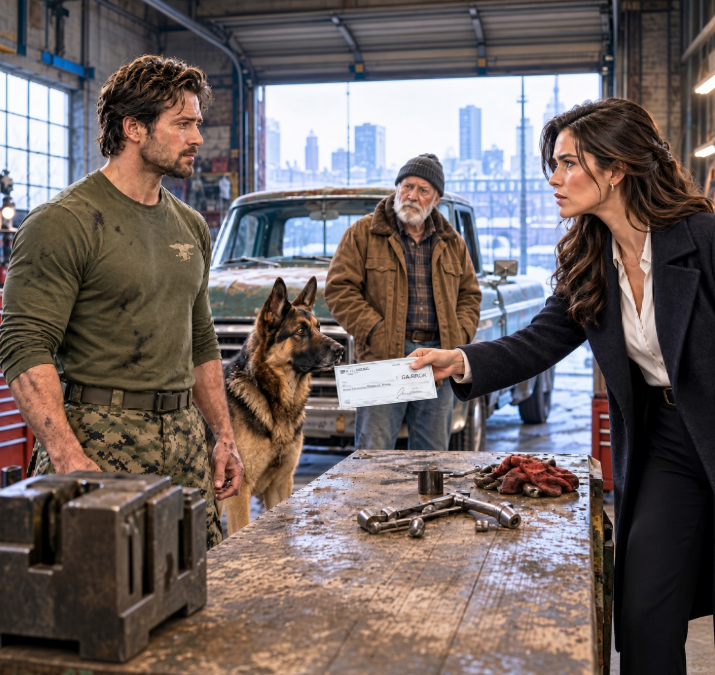
Former Navy SEAL Fixed an Old Man’s Truck for Free—“Stay Away from My Father,” His Daughter Said
The check for thirty-six thousand dollars sat on Mason Reed’s workbench like a loaded weapon.
Across from him stood Julia Witcom, polished, cold, and certain, telling him to take the money and stay away from her father.
Four days earlier, Mason had only stopped in a snowstorm to fix an old man’s broken truck for free, never knowing that single act of kindness would walk straight into his garage and put a price on his character.
The old red sign above Reed Motorworks had been fading for years.
Mason Reed noticed it every morning.
He noticed the way the word Reed still held most of its color, while Motorworks had begun disappearing letter by letter, as if the winter wind along East Trent Avenue had decided to erase the second half of his father’s life one gust at a time.
His father, Jack Reed, had painted that sign by hand more than twenty years earlier. He had stood on a ladder in the parking lot with a paintbrush clenched between his teeth, arguing with Mason’s mother about whether the red was too bright.
“It’s supposed to be bright,” Jack had said. “People need to find us.”
Now people found him less often.
The newer service centers around Spokane Valley had clean websites, online scheduling, shuttle service, waiting rooms with leather chairs, financing options, and smiling service advisors who called every repair an experience.
Reed Motorworks had a coffee pot old enough to vote, an office calendar filled with handwritten notes, a furnace that rattled like it had unfinished business, and Mason.
It also had Atlas.
The German Shepherd lay beneath Jack’s old workbench most mornings, chin on his paws, eyes half closed but never truly asleep. Atlas was eight years old now, darker around the muzzle than he had been during Mason’s final years in uniform. He had worked beside Mason through the last part of his Navy career, and some habits had followed both of them home.
Atlas preferred corners.
Doorways.
Places where he could see most of the room.
At Reed Motorworks, that meant the space beneath Jack’s workbench, where he could watch the office door, the two open service bays, the customer entrance, and the street beyond the glass.
Mason understood the preference.
He checked exits too.
He no longer thought about it most of the time. His eyes simply did the work before his mind caught up.
Out of the Navy five years.
Out of the teams five years.
PART2:
Out of the life that had taught him to repair equipment under bad conditions with worse options.
But some things did not discharge.
They lived in the body.
They lived in how he entered rooms, how he slept, how he listened to a vehicle before touching it, how he looked at strangers’ hands before their faces.
A former Navy SEAL did not become a mechanic overnight.
Jack had made sure Mason understood that.
The teams had taught him how to make machines survive.
Jack taught him how to make them right.
There was a difference.
Mason had come home thinking he knew pressure, tools, engines, electronics, field repairs, improvisation, heat, cold, dust, bad timing, and worse consequences. Jack had let him think that for three days.
Then he handed Mason a rusted alternator bracket, pointed to a nineteen-year-old farm truck, and said, “Don’t make it work. Fix it.”
For three years after Mason left the Navy, he worked beside his father in that garage.
Jack corrected him constantly.
Not cruelly.
Worse.
Precisely.
“That’s tight. It ain’t right.”
“Don’t sell a part when a connection failed.”
“That woman out there needs truth more than she needs a bill.”
“You can patch something to get a man home. You don’t patch it and call it repaired.”
Mason had rolled his eyes at half of it and absorbed all of it.
Then Jack died.
No warning dramatic enough to respect him.
No long farewell.
PART3:
Just a heart attack in the office on a Thursday morning, the coffee pot still half full, his pencil resting across a service invoice, Atlas barking in the bay until Mason ran in and found him on the floor.
Jack left him Reed Motorworks, a battered toolbox, loyal customers, a building with a loan tied to it, and a way of doing business that had never cared much for margins.
For two years, Mason kept the garage alive.
Alive was not the same as healthy.
By the last week of November, winter had settled over Spokane Valley without ceremony. Mornings arrived hard and dry, laying frost over warehouse roofs and turning the industrial blocks along East Trent Avenue into a grid of cold metal, gray pavement, and rattling signs.
Inside Reed Motorworks, the furnace clicked on, shook for twelve seconds like a machine reconsidering its calling, then went silent.
Mason looked up at the vent.
“Helpful,” he said. “Very helpful.”
Atlas lifted his head from under the workbench, watched the vent with suspicion, then lowered his chin again.
The day did not improve.
A woman brought in a seven-year-old SUV after another shop had quoted her several thousand dollars. Mason could have agreed with the first diagnosis and nobody would have questioned it. The symptoms were vague enough. The customer was worried enough. The vehicle was old enough.
Instead, he traced the issue to a damaged connector and one smaller failed part.
He charged her a fraction of what she expected.
She nearly cried in the office.
Mason watched her drive away and knew honesty had just cost him the kind of invoice his monthly numbers badly needed.
Later, one of Jack’s oldest customers brought in a grinding front wheel. The man lived mostly on retirement income and apologized before Mason even gave him the estimate. Mason split the bill into two payments without being asked.
Atlas received a biscuit from the old man and more gratitude than Mason did.
Near closing, another customer wanted to spend almost four thousand dollars keeping an aging sedan alive. Mason got under it, looked at the rust, the failing lines, the tired suspension, the corrosion hiding near the frame, and came back out wiping his hands on a rag.
“Don’t do it,” he said.
The woman blinked.
“You don’t want the job?”
“I want you to have a car next winter. This one’s asking you to spend money it won’t repay.”
She thanked him.
Left.
Another repair gone.
Jack would have approved.
Jack was also dead, which meant he no longer had to make payroll.
That evening, after the last customer left, Mason stood in the office and stared at the board above Jack’s old desk.
Bank notice.
Supplier invoice.
Insurance renewal.
Heating estimate.
Commercial loan meeting.
Parts account balance.
A reminder in his own handwriting:
NO MORE FREE RESCUES.
He had written it three nights earlier after running numbers until the numbers stopped being math and became weather.
No more unpaid favors.
No more quick jobs for free because someone looked tired.
No more telling himself that one good week would fix what two bad years had built.
Reed Motorworks had become the one thing Mason kept asking to wait while he helped everyone else.
Atlas padded into the office and sat beside him.
Mason looked down.
“We have forty-five days if the bank’s feeling generous.”
Atlas stared back.
“Don’t look at me like that. You have no income.”
Atlas yawned.
Mason shut off the lights early.
The first snow looked harmless when he left the garage.
By the time he reached the main road, it was not.
Wet flakes thickened against the windshield. Wind pushed them sideways through the headlights. Lane markings blurred. Traffic slowed into a line of red taillights and cautious mistakes.
Mason checked the clock.
The bank meeting was across town.
He could still make it.
Barely.
If nobody did anything stupid.
That was when he saw the hazard lights.
An old green pickup sat angled near the shoulder with its hood raised. Snow gathered along the windshield. The driver’s door was open. An elderly man in a faded canvas coat stood beside the truck, one hand braced on the fender, the other holding a flashlight into the engine bay.
Mason eased off the gas.
The man looked stubborn rather than frightened.
That was the problem.
Jack had looked the same way whenever weather, age, or common sense tried to tell him what to do.
Mason drove past.
He did.
He passed the truck.
Relief came first.
The man probably had a phone.
Roadside assistance existed.
Other drivers existed.
Mason had a bank meeting that might decide whether the garage his father built would still belong to him in a few months.
Those were good reasons.
Sensible reasons.
Responsible reasons.
In the rearview mirror, the amber hazard lights grew smaller.
Atlas turned his head and kept watching them.
Mason kept driving.
The next intersection appeared through the snow.
He stopped at the light.
“Don’t start,” he said.
Atlas said nothing.
That was the worst thing about him.
He judged silently.
Mason looked at the clock again.
Then at the road ahead.
Then at the shrinking amber lights in the mirror.
He exhaled.
Muttered something Atlas politely ignored.
Then turned around.
“One more,” he said. “Then we’re done saving strangers.”
Atlas gave no sign that he believed him.
By the time Mason pulled in behind the pickup, snow had begun collecting along the shoulder. He switched on his hazards, grabbed his roadside bag, and stepped into the cold.
The old man looked up.
“I’m fine,” he said.
Mason glanced at the dead truck, then the raised hood, then the snow blowing sideways over both of them.
“That’s encouraging.”
One corner of the old man’s mouth moved.
“Didn’t ask for help.”
“Good. I didn’t ask to miss a meeting. We’re both disappointed.”
The old man studied him.
His face was weathered, sharp-eyed, seventy maybe, with the kind of posture men kept when they had spent their lives expecting machines and people to disappoint them occasionally. His coat had a zipper that barely worked. His gloves were old. His boots were practical, not new.
“Harold Witcom,” he said.
“Mason Reed.”
“You a mechanic?”
“On good days.”
“This a good day?”
Mason looked at the weather.
“No.”
He stepped closer to the engine bay.
“What happened?”
Harold described the symptoms with unusual precision. Power loss gradual. Lights dimmed before the engine quit. No hard misfire. Belt chirping for weeks but not related, probably. Dash flicker two days earlier. Temporary recovery after restart.
Mason noticed.
Most stranded drivers described feelings.
“It made a weird noise.”
“It just died.”
“It hates me.”
Harold described sequence.
“You’ve done this before,” Mason said.
“Once or twice.”
Mason checked the obvious things first. Battery connections. Belt. Alternator lead. Grounds. He traced the issue to a deteriorating electrical connection near the engine block. Cold and wet had pushed the weak connection past its limit.
Harold held the flashlight exactly where Mason needed it before Mason asked.
That earned him a glance.
Mason cleaned and secured the connection, protected the damaged section as well as he could, then stepped back.
“This is temporary,” he said. “It’ll get you home, maybe around town for a bit if luck wants to make poor decisions with you. But it needs a proper repair.”
Harold nodded before he finished.
Atlas stood beside Mason’s open vehicle door, watching both men.
Harold looked toward him.
“That dog always look at people like he’s reviewing their paperwork?”
“Only the suspicious ones.”
Harold laughed once.
The truck started on the second try.
Its headlights steadied.
The engine settled into a rough but dependable idle.
Harold reached for his wallet.
Mason checked his phone.
The bank meeting had already begun. Several missed calls waited on the screen.
He put the phone away.
“Keep it.”
Harold frowned.
“You fixed the truck.”
“I missed the meeting. At least one of us should get home before the roads freeze.”
Harold did not move his hand from his wallet.
Mason pointed at the engine.
“Spend it fixing that connection properly.”
The old man looked at him for a long moment, then put the wallet away and reached behind the seat. He came back with an old steel thermos.
He poured coffee into the lid and handed it over.
It was strong enough to remove paint.
But it was hot.
Snow hissed softly against the hood.
Harold leaned against the fender as if neither cold nor time had any authority over him.
“Where do you work?”
“Reed Motorworks.”
“Family place?”
“My father’s.”
Harold nodded like that explained more than Mason had said.
Before leaving, he wrote Mason’s name and number in a small notebook.
“I’ve got a few old vehicles,” he said. “Might need someone who still fixes things instead of replacing them.”
Mason glanced at the truck.
“Start with this one.”
Harold almost smiled.
Then he climbed into the pickup and drove away.
Mason returned to his vehicle, sat behind the wheel, and listened to the bank voicemail twice before calling back.
The loan officer agreed to meet him the following morning.
By then, the snow had eased.
The consequences had not.
The next day, the bank gave him forty-five days.
Forty-five days to bring the loan into a range they could restructure.
Forty-five days to produce numbers Reed Motorworks was unlikely to produce on its own.
Once normal operating expenses were counted, Mason needed roughly seventeen thousand eight hundred dollars more than the garage could realistically generate.
The loan officer said it kindly.
That made it worse.
People who enjoyed giving bad news were easier to resent.
Mason drove back under a hard pale sky.
The Reed Motorworks sign looked even more faded in daylight.
Inside, Atlas lifted his head from a folded blanket.
The furnace clicked on, rattled, shut off.
Mason stood beneath the vent.
“You’re becoming symbolic,” he told it.
Atlas lowered his head again.
Forty-five days had begun.
Three days after the snowstorm, Mason was replacing a front wheel bearing on a delivery van when he heard an engine outside that sounded familiar for all the wrong reasons.
Not broken.
Just old enough to have a voice.
Uneven idle.
Soft belt chirp.
A little exhaust leak.
A truck that had been promising to fail for several winters but had never found the courage.
Mason rolled out from beneath the van and wiped his hands on a shop towel.
Harold Witcom’s green pickup stopped outside bay two.
Atlas lifted his head beneath Jack’s workbench.
Harold climbed out carrying the same battered thermos.
This time he looked less like a stranded driver and more like a man who had arrived exactly where he intended to be.
“You break down again?” Mason asked.
Harold looked offended.
“The truck’s fine.”
Mason glanced toward the hood.
“Then I assume you came to apologize for the coffee.”
Harold looked down at the thermos.
“Don’t push your luck.”
He walked into the garage without asking permission, slowly enough that Mason had time to notice what he was looking at.
Not the waiting area.
Not the faded walls.
The work.
Harold studied the shelves where filters and fittings were labeled in black marker. He paused beside the alignment rack, looked over the floor drains, then stood for several seconds in front of Jack’s old toolbox.
The name REED was still painted across the top drawer in Jack’s blocky handwriting.
Harold did not touch it.
That earned him more trust than Mason expected.
“Your father?” Harold asked.
Mason nodded.
For a moment, the garage filled with ordinary sounds.
Heat pipes ticking.
A wet tire outside hissing over pavement.
Atlas breathing quietly beneath the bench.
Jack Reed had been able to hear a failing bearing before most customers finished describing the noise. He distrusted unnecessary parts, glossy sales language, and anyone who referred to a repair bay as a service experience.
Mason had once thought the Navy made him good at fixing things.
Then he came home, and Jack spent three years showing him that keeping something alive under pressure was not the same as understanding why it failed.
Harold seemed to understand without being told.
“You worked with him long?”
“Three years after I got out.”
“Not long enough.”
“No.”
Harold nodded as if that answer belonged to both of them.
Then he turned back toward the bays.
“I’ve got some vehicles stored across town. Need someone to inspect them properly. Old pickups. Service trucks. Couple utility rigs. Maybe more, depending what you find.”
Mason wiped his hands slower.
“How many is some?”
“Seven to start.”
Seven inspections were not a favor.
Seven vehicles meant labor, scheduling, maybe parts, maybe more work.
Enough money to matter.
Mason reached for a service pad and started explaining rates.
Harold did not ask for a discount.
That alone separated him from most people who began sentences with “I’ve got several vehicles.”
As Mason wrote, Harold’s questions changed.
How did Mason handle vehicles that spent more time idling than driving?
What failed first after repeated winter exposure?
Did he prefer replacing suspect components early or waiting for measurable wear?
How often had he worked around fleet vehicles that could not afford long downtime?
The questions were too sharp to be casual.
Mason stopped writing.
“You collect old trucks professionally?”
Harold took a drink from his thermos.
“I spent a long time around logistics.”
That was all.
Mason had known men in the teams who could answer a question with three words and somehow make it clear the conversation was over.
Harold had the same talent.
He moved toward the open bay door and looked out at the dull winter light.
“My daughter runs the company now.”
There was pride in the sentence.
And something else underneath it.
Fatigue maybe.
Or the resignation of a father who knew pride and peace were not always delivered together.
“Good at it?” Mason asked.
“Annoyingly.”
Mason smiled despite himself.
Harold kept looking at the road.
“Smartest person I know. Remembers every number she reads. Finds problems before most people know there is one.”
“Sounds useful.”
“It is.”
The pause after that said useful was not the whole story.
Harold finally turned.
“She won’t like you.”
Mason leaned against the workbench.
“You’ve known me four days.”
“That should be enough for her.”
Mason assumed it was a joke.
Harold did not explain.
Before leaving, he tore a page from Mason’s service pad and wrote an address on the back.
Private storage facility.
Industrial corridor.
Monday.
9:00.
Mason looked at the page.
“For the seven vehicles?”
“For a start.”
“And after that?”
Harold pulled on his gloves.
“Maybe we talk about something larger.”
He started toward the truck, then stopped beside Atlas.
The German Shepherd remained stretched beneath the bench, watching him.
Harold looked down.
“He still reviewing me?”
“Results aren’t final.”
Harold gave the dog a faint nod.
“Fair.”
Then he left.
For the rest of the weekend, Mason tried not to think about the phrase something larger.
He had learned not to build hope from vague promises.
Seven paid inspections were enough.
Monday morning arrived under freezing fog.
Moisture clung to the windows and turned the parking lot into a gray sheet of slush bordered by ice. Mason reached the garage before seven, swept both bays, cleared the workbench, and checked Harold’s handwritten address twice.
At 8:15, tires rolled slowly over the gravel outside.
Mason looked through the office window, expecting the green pickup.
A black SUV stopped beneath the faded Reed Motorworks sign instead.
It was clean in the deliberate way expensive vehicles stayed clean even when the rest of winter had surrendered.
A woman stepped from the rear door wearing a dark wool coat and black boots almost untouched by road salt.
Mid-thirties.
Straight posture.
Controlled expression.
Eyes that crossed the garage once and cataloged more than most people saw in ten minutes.
She did not look lost.
Atlas rose but stayed beside the workbench.
Mason put down the rag in his hand.
“Can I help you?”
The woman said his full name.
“Mason Daniel Reed.”
Hearing his middle name changed the temperature of the room more effectively than the failing furnace ever had.
Mason studied her.
“That depends.”
“Julia Witcom.”
The connection took a second.
“Harold’s daughter.”
Mason glanced toward the SUV.
“No Harold?”
“He won’t be meeting you this morning.”
His first thought must have shown.
Julia added, “He’s fine.”
Only then did Mason relax slightly.
Julia stepped farther inside.
Her attention moved over the shop without touching anything. Old lift. Shelves. Jack’s workbench. Atlas. The faded sign visible through the window.
“I wanted to speak with you before you had another conversation with my father.”
The phrasing carried more weight than the words.
Mason folded the shop towel once and set it aside.
“About the vehicles?”
“About him.”
She opened a slim leather folder.
The first thing she gave him was not an explanation.
It was a name.
Northline Emergency Logistics.
Mason knew it.
Most people in Eastern Washington knew it, even if they did not know much about the family behind it.
Northline trucks moved generators, utility equipment, replacement parts, mobile support units, and emergency supplies throughout the Pacific Northwest whenever storms, outages, and damaged infrastructure made ordinary shipping less ordinary.
Harold Witcom had founded it decades earlier.
Mason looked toward the empty parking spot where he had expected the old green pickup.
Suddenly, Harold’s questions about idling vehicles, downtime, winter corrosion, and maintenance made sense.
“Your father left out a few details.”
“He does that.”
Julia placed several pages on Jack’s workbench.
Mason’s business name sat at the top.
Below it were numbers.
Loan balance.
Late payments.
Supplier terms.
Estimated monthly revenue.
Bank deadline.
Forty-five days.
Seventeen thousand eight hundred dollars.
Mason stared at the pages.
Then at her.
“You looked into my garage.”
“And you,” she said.
No fraud complaints.
No criminal history.
Strong customer reviews.
Good technical reputation.
Serious financial pressure.
She spoke as if reading weather data.
That calmness bothered Mason more than anger would have.
Julia tapped the bank figure.
“You are under significant pressure, Mr. Reed. Then you happen to meet my father on the side of the road. You help him for free. Three days later, he wants to bring you into private vehicle work.”
Mason let out a short breath.
“You think I planned the snow?”
Julia did not smile.
“Wealthy men are noticed in ways they rarely understand themselves.”
Mason looked toward the bay door.
“Your father was standing beside a twenty-some-year-old pickup wearing a coat with a zipper that barely worked.”
“My father prefers looking ordinary.”
“He succeeded.”
That almost moved something in her expression.
Almost.
Mason pushed the papers back.
“I didn’t know who he was.”
Julia left them where they were.
“People in financial trouble sometimes become very good at recognizing opportunity.”
There it was.
The edge.
Mason felt anger arrive cold, not hot.
“If I were hunting billionaires, I’d probably pick somewhere warmer than the side of a highway.”
Her face remained composed.
The argument moved in circles after that.
Every answer Mason gave became evidence of another possibility.
If he had accepted money on the road, he might have been taking advantage.
Because he refused it, Julia suggested he might have been creating a larger obligation.
There was no version of the story Mason could tell that her suspicion could not absorb.
He recognized the structure before she did.
“That’s convenient.”
Julia’s eyes narrowed slightly.
“What is?”
“If I take his money, I’m using him. If I don’t, I’m playing a longer game.”
“I didn’t say that.”
“You didn’t have to.”
For the first time since entering the garage, her control tightened visibly.
Mason had dealt with pressure from people who shouted, threatened, negotiated, and tried to intimidate.
Julia did none of those things.
She simply kept placing facts between them until they began to feel like accusations.
Then she mentioned the garage.
The loan.
The supplier.
The bank.
The building.
That changed something.
Mason’s voice dropped.
“You don’t get to use my father’s garage as proof that I’m dishonest.”
Julia glanced toward the faded sign outside.
When she spoke again, her tone softened by less than an inch.
“Then you understand why someone might become protective of what their father built.”
The sentence landed harder than he wanted it to.
For a second, Mason saw something behind her polished certainty.
Not warmth.
Fear wearing a good coat.
It disappeared almost immediately.
Julia reached into the folder again and removed a checkbook.
Mason stared.
“You’re serious?”
She wrote carefully, tore the check free, and slid it across Jack’s old workbench.
$36,000.
Mason did not touch it at first.
That number was not abstract.
It was the bank.
The supplier.
The furnace.
The lift.
Insurance.
Breathing room.
Forty-five days turned into something survivable.
He finally picked it up.
Atlas lay down beside Jack’s empty stool.
Julia waited.
“That compensates you for your time,” she said, “your roadside assistance, and any inconvenience involving my father.”
Mason looked at the amount again.
Then she gave the condition.
No private work for Harold.
No meetings.
No business proposals.
No calls initiated by Mason.
Nothing that allowed what began beside the road to become something larger.
Mason held the check long enough to feel every practical argument for keeping it.
He could call the bank before lunch.
He could bring the supplier account down.
He could fix the furnace before winter turned the garage into a walk-in freezer.
Jack’s garage might survive because a woman who distrusted him had decided his absence was worth thirty-six thousand dollars.
His gaze moved to the toolbox.
Then Jack’s stool.
Then Atlas.
Finally, Mason placed the check on the workbench and slid it back across.
Julia looked down at it.
“The amount isn’t the problem,” Mason said.
Her eyes returned to him.
“The condition is.”
For the first time since she entered Reed Motorworks, Julia Witcom had nothing ready to say.
She collected the paperwork slowly.
The check went into the folder last.
At the door, she paused as though she expected one of them to add something.
Neither did.
Then she walked into the freezing fog, and the black SUV disappeared beyond the wet front windows.
Five minutes later, Mason stood in the office staring at the board above Jack’s desk.
Bank notice.
Supplier invoice.
Insurance renewal.
Heating estimate.
Every piece of paper carried a number.
None cared about dignity.
Atlas came in and sat beside him.
Mason looked at the dog.
“That may have been the dumbest decent thing I’ve done all year.”
Atlas offered no opinion.
At that moment, it felt suspiciously like agreement.
The consequences of refusing thirty-six thousand dollars were not philosophical for long.
The next morning at 8:12, Mason’s parts supplier called.
The conversation lasted less than four minutes.
Until Reed Motorworks brought its account down, every new order would have to be prepaid.
No more thirty-day terms.
No exceptions for longtime customers.
No promise that a fleet invoice was coming soon.
Mason understood.
That made it worse.
He spent the next hour calling customers who owed him money.
One small delivery company promised to send twenty-five hundred dollars by Friday.
Another commercial customer apologized three times before asking for ten more days.
The largest outstanding invoice belonged to a contractor whose accounting department had apparently developed the ability to lose paperwork every time Mason called.
By lunch, Mason had recovered eight hundred dollars.
Better than nothing.
Nowhere close to enough.
The temptation to blame Julia surfaced occasionally.
Mason knew better.
She had not created his debt.
She had walked into the middle of it, put a price on his disappearance, and left him staring at problems already there.
That evening, after the last customer drove away, Mason lowered the thermostat another two degrees and crawled under the leaking lift in bay one.
Atlas settled on a folded blanket nearby.
The repair should have been hired out.
Mason knew that.
Hiring someone required money, and money had become a subject with too many opinions attached.
He worked until hydraulic fluid streaked one sleeve of his coveralls and cold concrete pulled heat through his shoulders.
Somewhere above him, the garage radio played softly beneath the furnace rattle.
Jack would have hated the situation.
Mason could almost hear his father asking whether pride was paying interest.
The thought annoyed him because it sounded accurate.
He had defended something important by refusing Julia’s check.
He was still certain of that.
What he was less certain about was whether dignity and stubbornness had tangled together somewhere along the way.
The lift finally held pressure shortly before ten.
Mason stood, rolled one shoulder, and looked toward Jack’s stool.
“Good news,” he told Atlas. “We’re still broke, but now we can lift things.”
Atlas thumped his tail once.
Harold called the next morning.
Mason watched the name appear on his phone and let it ring.
There were enough Witcom complications inside Reed Motorworks already.
Harold called again that afternoon.
Mason let that one go too.
He was not angry with the old man exactly.
Harold had not written the check.
But Mason had no desire to become disputed property in a family argument between a billionaire founder and the daughter who believed strangers needed financial screening before being allowed within ten feet of him.
The following days returned to ordinary work.
Brake pads.
A failing alternator.
A heater core Mason wished belonged to anyone else.
He collected partial payments, prepaid for parts he used to order on account, and kept moving because motion felt better than waiting.
Late Friday afternoon, light snow began drifting past the front windows.
Quiet snow.
Falling almost vertically in still air.
Whitening the edges of the parking lot without covering the pavement.
Mason was finishing a wheel bearing when headlights moved across the inside wall.
He knew the engine before he saw the truck.
Harold’s old green pickup stopped beneath the faded Reed Motorworks sign.
Mason closed his eyes for half a second.
Atlas stood.
Harold climbed from the driver’s side wearing his familiar canvas coat.
The passenger door opened next.
Julia stepped down.
No polished SUV.
No charcoal suit.
No leather folder.
She wore jeans, winter boots, and a dark sweater beneath a plain coat. Her hair was tied back with less precision than Mason remembered.
Without armor, she looked younger.
Mostly, she looked uncomfortable.
Harold pointed toward the garage door.
Julia gave him a look suggesting the ride over had contained several conversations neither wanted repeated.
Then they came inside.
Harold removed his cap and placed it carefully on the workbench.
He did not apologize for Julia.
He did not explain her.
He simply made it clear with the efficient posture of a man who had managed difficult people most of his life that she had something to say and he intended to stand far enough away to make sure she said it herself.
Julia faced Mason.
Her apology was shorter than he expected.
She admitted she had investigated him because suspicion had been easier than asking questions.
She had treated his financial pressure as evidence of poor character.
She had used the possibility of losing his father’s garage as leverage.
There was no but attached.
No explanation disguised as an excuse.
That mattered.
Mason had spent several evenings imagining what he would say if Julia returned. Most versions were sharper than anything useful.
Standing across from her now, he discovered anger was easier when she was absent.
He accepted that she understood what she had done.
He did not tell her it was fine.
It had not been.
The more important question remained.
“Why did you assume the worst?”
Julia’s expression changed slightly.
Harold moved toward the front window and looked out at the falling snow.
For once, he seemed uninterested in helping the conversation along.
Julia rested one hand against the edge of an empty workbench but did not sit on Jack’s stool.
“My mother’s name was Margaret,” she said.
Mason waited.
“She and my father were married nearly forty years. She was the person who could make him leave a depot before midnight, take a vacation without bringing three phones, or admit being tired wasn’t weak leadership.”
Harold stayed at the window.
“When she died, he didn’t collapse dramatically. He just started disappearing from the life he built.”
Julia’s voice remained steady, but it cost her more now.
“He stopped attending some meetings. Drove old routes instead. Visited depots Northline no longer needed. Bought trucks that reminded him of the company’s early years. Sometimes he spent entire afternoons talking with mechanics and retired drivers.”
Mason looked through the window at the old green pickup.
He understood it differently now.
“During that time,” Julia continued, “one of Northline’s longtime executives took advantage of his distance from the company.”
Harold did not move.
“The man had been trusted for years. Close enough to the family that I saw him at holiday dinners. He routed contracts through companies connected to people he knew, hiding inflated costs behind legitimate work.”
Northline discovered it.
Most of the financial damage was recovered.
The other damage remained.
Harold had built a company by trusting people until they gave him a reason not to.
After the betrayal, he began questioning the instinct that had made employees loyal to him.
Julia watched it happen.
She also spent months in rooms where executives questioned whether she was ready to lead.
So she learned to arrive with every number memorized.
Every weakness identified.
Every risk mapped before anyone else could pretend it was not there.
Being prepared became being guarded.
Being guarded became assuming motives before people had time to hide them.
Eventually, she began investigating people around Harold before she met them.
Mason understood the progression.
He did not approve of where it ended.
“You weren’t protecting a fortune,” he said.
Julia looked down.
“No.”
“You were protecting the part of him that still wants to believe people can be decent.”
Harold’s shoulders shifted at the window.
Julia nodded once.
Understanding changed the shape of her mistake.
It did not erase it.
Mason made that clear.
“If you have a question about me, ask me. If you don’t believe the answer, walk away. But you don’t use money, investigators, or your position to decide my value again.”
Julia met his eyes.
“Agreed.”
Harold finally turned from the window.
“Excellent,” he said. “Are we done growing as people? Because this garage is cold enough that I’m starting to remember the snowbank fondly.”
Julia lowered her eyes, but Mason caught the beginning of a smile.
The tension loosened.
Harold picked up his cap, then reached inside his coat.
Mason immediately looked suspicious.
“If that’s another checkbook, you can both leave.”
“It’s not,” Harold said.
He pulled out several photographs and spread them across the workbench.
They showed an old warehouse near the northeast industrial area, not far from North Sullivan Road.
Brick walls.
Tall windows.
Wide bays.
Years of dust and neglect.
Harold had bought it the previous month.
He called the project Second Watch Veterans Technical Center.
The name stayed with Mason.
Second Watch.
Not first.
Not last.
A watch for people who had already served once and still had something useful left to give.
Harold did not want a polished charity built for photographs and donor plaques. He wanted a practical place for veterans who had reached the stage of life when too many people began speaking about experience as if it had an expiration date.
Many would be over fifty.
Some had left the military decades earlier and spent years in other trades.
Some had been laid off.
Some were retired and restless.
Others wanted to learn enough modern systems to remain useful in workplaces that had changed around them.
The center would offer technical training, part-time pathways, mentoring opportunities, and a place where older veterans could contribute without pretending they were twenty-five.
Mason studied the photographs longer than he intended.
The warehouse reminded him of Reed Motorworks before Jack made it his own.
Empty space waiting for a reason to matter.
Then suspicion returned.
“If this is payment for the roadside repair, I’m not interested.”
Harold looked irritated.
Julia answered quietly.
“It isn’t.”
Harold had watched Mason work.
He had seen how the garage was organized, how Mason spoke to customers, how he chose repairs based on what people needed rather than what produced the largest invoice.
He had also noticed something Mason himself rarely considered unusual.
Mason respected old equipment without romanticizing it.
He knew the difference between worn out and worth saving.
Harold needed someone to shape the technical side of Second Watch with that same judgment.
Not because Mason had been kind to him.
Because Mason was good at his work.
That landed harder than Mason expected.
Jack had been the last person to say it so plainly.
Julia reached into her coat.
This time Mason only raised an eyebrow.
She produced a thin contract packet.
Six months salary.
Benefits.
Clearly defined authority over technical planning.
Regular milestones.
No ownership transfer.
No hidden repayment.
No condition involving Harold’s personal life.
At the end of the project, if Second Watch opened successfully, the arrangement could become permanent.
Mason looked at Harold.
Then Julia.
Then the first page.
A week earlier, thirty-six thousand dollars had been offered to make him disappear.
Now work was being offered because someone believed he belonged in the room.
Those were not the same thing.
He did not sign.
Not yet.
He closed the packet and held it beneath one hand.
“I’ll read it.”
Harold nodded once.
Julia did too.
For the first time, neither Witcom seemed interested in pushing him toward an answer.
Outside, snow continued settling quietly on the old pickup.
Inside Reed Motorworks, Atlas walked over, sniffed the edge of the contract, and lay down across Mason’s boots.
Harold looked at the dog.
“I assume that means he’s reviewing the terms.”
Mason looked down at Atlas.
“He charges more than I do.”
And for the first time since the black SUV had appeared outside his garage, Julia laughed.
By the first week of January, Spokane Valley had settled into a harder winter.
The sky cleared enough to turn snow on warehouse roofs almost white-blue beneath the sun, but the temperature stayed well below freezing. Metal burned cold through gloves. Every truck door seemed reluctant to open before sunrise.
Mason signed the six-month contract after a lawyer reviewed it.
That mattered to him.
No favors hidden in language.
No ownership changes.
No clause giving Northline control over Reed Motorworks.
The agreement paid him to design, organize, and operate the technical side of Second Watch through opening and its first months.
For the first time in weeks, he had income he could count on.
It did not save the garage.
It gave him room to breathe while he tried.
Mason began splitting his days between Reed Motorworks and the warehouse near North Sullivan Road.
Atlas went with him most mornings, riding quietly in the rear and learning the new building faster than some contractors.
Second Watch was dust, exposed walls, old concrete, and steady work.
The building had good bones.
High ceilings.
Wide bays.
Thick exterior walls.
Enough space to create work areas without making the place feel crowded.
Years of neglect showed everywhere.
Mason preferred that to something overdesigned.
Empty buildings were honest about what they needed.
Harold saw possibility in almost everything.
Julia saw the budget.
Mason saw what would fail first if they chose badly.
That difference became obvious during the second week.
Mason wanted heavier workbenches with adjustable heights, wider aisles between certain stations, and rolling equipment stands that cost more than the basic versions.
Julia had already priced cheaper options.
She studied the numbers without saying much.
Mason knew that look.
It was the same one she had worn before writing the check.
Only now he no longer assumed it meant trouble.
Julia asked why a training center needed commercial-grade equipment in spaces where many people would only be learning.
Mason walked her through the room instead of answering across a table.
He stopped beside a temporary bench.
“Imagine someone sixty-five working here for two hours.”
Julia looked at it.
“It’s a table.”
“It’s too low.”
“For some people.”
“For the people this place says it’s built for.”
He pointed toward a fixed engine stand near the wall.
“A younger person shifts around that without thinking. Somebody with a bad knee spends half the session fighting the layout before touching the work.”
Julia listened.
“Saving money here just moves the cost somewhere else,” Mason said. “Fatigue. Minor injuries. People quitting because the room makes them feel older than they are.”
Julia looked around again.
Approved the change.
Mason tried not to look surprised.
A week later, the advantage belonged to her.
He wanted to replace an entire section of storage shelving after finding rust along the lower supports. To Mason, visible corrosion meant suspicion, and suspicion usually meant replacement before failure became expensive.
Julia asked for an independent inspection.
Mason did not like the delay.
The report came back two days later.
Only one section needed replacement.
The rest could be cleaned, reinforced, and reused safely.
The savings were significant.
Mason read the report twice.
Then found Julia in the temporary office.
“You were right.”
She looked up from her laptop.
“Should I document this?”
“Don’t make it strange.”
Julia almost smiled.
After that, their disagreements changed.
They still had them.
Mason cared about durability, safety, and whether equipment could survive years of use.
Julia cared about schedule, cost, staffing, and whether a good idea would still be affordable six months later.
But gradually, the goal stopped being proving the other person wrong.
They began asking better questions.
What are you seeing that I’m not?
What am I missing?
The shift was small enough neither commented on it.
Harold noticed.
Harold noticed everything he pretended not to notice.
He started appearing at Second Watch most mornings in the same canvas jacket Mason had first seen beside the broken pickup. Julia once brought him a suit coat for a donor visit. Harold left it hanging in the office and by lunch was in one of the bays arguing with a contractor about whether an old piece of equipment deserved repair or replacement.
Nobody won.
Harold seemed delighted.
He also refused to behave like a benefactor.
When workers thanked him for funding the project, he redirected attention elsewhere.
When a veteran organization sent a letter praising his generosity, he folded it and placed it beneath maintenance catalogs.
He wanted Second Watch to feel useful before it felt impressive.
Mason understood that.
Atlas did too.
Within two weeks, the German Shepherd developed a routine. He inspected the front office, walked the main aisle with Mason, then settled near whichever workbench received the most morning sun.
People began arriving early because they knew he would be there.
One of them was Frank Delaney.
Frank was sixty-three, broad through the shoulders despite having lost weight over the years, with gray hair clipped short and hands carrying small scars from decades around machinery. He had served in the Army and worked in a motor pool when he was younger.
After leaving the military, he spent most of his civilian career doing maintenance in warehouses and distribution facilities.
The last one closed.
Frank did not call himself unemployed.
He said he was between reasons to set an alarm.
He first came to Second Watch because a veteran service coordinator mentioned the program. He stood near the entrance for nearly ten minutes before walking farther inside.
Mason noticed but did not approach immediately.
People who had spent years being useful often hated being treated like they had arrived needing rescue.
Frank eventually wandered toward Atlas.
That solved the introduction.
He crouched slowly and held out one hand.
Atlas sniffed it, then allowed Frank to scratch behind one ear.
“I’m not here to start another career,” Frank said.
Mason was checking a delivery list nearby.
“Good.”
Frank looked over.
“We’re not handing them out.”
That got the smallest possible laugh.
Frank came back the next morning.
Then again two days later.
At first, he spoke mostly to Atlas.
He asked the dog questions nobody expected answered. Complained about the coffee. Sat on an unfinished bench during breaks while Atlas settled beneath his knees as if the arrangement had existed for years.
Eventually, Frank began commenting on the work around him.
Not correcting.
Not trying to take over.
Just noticing.
A tool stored too far from where it would be used.
A cart wheel that needed attention.
A young contractor wasting time walking back and forth because material had been stacked badly.
Mason recognized the habit.
Experience had a hard time staying silent forever.
Julia noticed Frank for a different reason.
A veteran employment program might help cover some of his retraining and equipment costs, but his paperwork had stalled months earlier because of missing records and forms he had stopped trying to chase.
Julia asked permission before touching the problem.
That alone mattered.
Two days later, she arranged a call, found the missing documentation, and printed a clean checklist for Frank.
She did not hand him the finished solution.
She put everything in order so he could finish it himself.
Mason saw that it complicated the version of Julia he had built in his head.
So did the sponsor meeting later that week.
A regional company offered to fund several pieces of equipment if Second Watch placed large branded signs throughout the training floor and used sponsor messaging at every public event.
The money would have helped.
Julia turned it down.
She accepted a smaller contribution with simpler recognition.
Her reason was straightforward.
“Veterans aren’t going to spend their time learning inside a billboard.”
Harold looked unusually pleased when he heard.
Mason said nothing.
But something shifted again.
Control and care could look similar from far away.
Sometimes even close up.
He was beginning to learn the difference.
Julia’s understanding of Mason changed more slowly.
One morning, she followed him through a section of the building cleared for equipment installation. Mason stopped before entering. His eyes moved automatically toward both doors, the corner behind a temporary wall, the open path between stacked crates, and the nearest exit.
Then he walked in.
Julia noticed.
“Do you always do that?”
Mason paused.
“Do what?”
“Look at every way out before you enter.”
He considered it.
“I guess.”
“You didn’t know?”
“Not until you asked.”
That was all he said.
His military past existed like that now.
Not as stories he told.
As habits he forgot other people did not have.
A few days later, a delivery arrived three hours late and half the planned installation became impossible before closing. The crew immediately began discussing how to recover the full schedule.
Mason did not.
He removed two nonessential tasks, moved one crew to a different area, delayed a cosmetic job, and gave everyone clear next steps.
Nobody rushed.
Nobody stood around.
The lost afternoon became half a lost afternoon.
Julia watched from the doorway.
She had expected him to protect the plan.
Instead, he protected the people working inside it.
Later, she asked whether that came from the Navy.
Mason thought about it.
“Partly. The rest came from Jack.”
“What did he teach you?”
“My father used to say panic was just confusion moving fast.”
Julia looked toward the work floor where people had already settled into their revised jobs.
“He sounds like he knew people.”
“He knew engines better.”
“Same thing?”
Mason almost smiled.
“Some days.”
By the end of the month, Second Watch no longer felt like Harold’s idea, Julia’s project, or Mason’s contract.
It had begun becoming a place.
Frank had his own coffee mug in a cabinet, despite insisting he was not officially part of anything. Harold had claimed a chair nobody else wanted. Atlas had learned which doors opened into warm rooms, and Mason had stopped counting how many times Julia surprised him.
One afternoon, he found her standing beside Frank while he reviewed the final page of his veteran program paperwork.
She did not hover.
Did not explain it for him.
She simply waited until he finished, then pointed out the line he had missed.
Frank signed it.
Atlas slept beneath the table.
For a moment, Mason saw Julia not as the woman who had entered Reed Motorworks with a background report, but as someone who had spent years believing protection meant controlling every unknown and was slowly discovering another way.
Across the room, Julia looked up.
Mason was holding a worn equipment catalog and arguing with Harold about whether a thirty-year-old drill press deserved another life.
She watched him laugh at something Harold said, then kneel to inspect the machine instead of dismissing it because of age.
The man she had once called resistant to change did not fear change.
He wanted a reason for it.
That distinction mattered.
Outside Second Watch, Reed Motorworks continued balancing on a narrow line.
The six-month contract gave Mason dependable income and allowed him to keep negotiations with the bank moving. Several overdue customers finally paid enough to reduce pressure. The parts supplier loosened restrictions slightly after Mason brought the account down.
But the garage was not saved.
Not yet.
It had simply stopped falling quite so quickly.
Mason still opened early several mornings each week and returned after Second Watch when customer jobs required it.
Julia began stopping by occasionally.
At first, she came because documents needed signatures or because Mason left something at the center. Then she began noticing the garage itself.
Not equipment.
Systems.
Or the absence of them.
One afternoon, she stood near the office while Mason searched through a stack of paperwork for an estimate he knew he had written two weeks earlier.
He found it under an invoice, a supplier statement, and a handwritten note reminding him Mrs. Callahan’s Buick needed an oil change sometime in February.
Julia said nothing.
That made Mason suspicious.
Later, a customer called asking whether it was time for scheduled maintenance.
Mason knew the vehicle immediately.
He knew what had been repaired the previous spring. He remembered the faint vibration the customer complained about and which tire had been replaced.
What he did not know was when anyone last contacted the customer.
There was no reminder system.
Jack had remembered customers because Jack had known most of them for twenty years.
Mason inherited that habit in a business with fewer familiar faces and less time.
Julia still did not criticize.
That surprised him more than criticism would have.
She began asking questions instead.
How did customers schedule?
Mostly by phone.
What happened when Mason missed a call?
They left a message.
Who followed up?
Mason did.
When?
“When I can.”
Julia looked toward the office.
The desk carried more paper than surface.
A calendar hung beside it, crowded with handwritten notes.
There were things Jack’s system did beautifully.
Every repair had context.
Longtime customers were known as people, not account numbers.
Nobody was pushed through the garage like inventory.
But the system had been built for a smaller world, when Jack could carry half the business in his head.
Mason had been treating those habits as part of the garage’s identity.
Julia seemed to understand that criticizing them directly would make him defend them.
So she waited.
A few evenings later, she found him trying to locate a warranty record while Atlas slept near the heater.
Julia picked up one of Jack’s old service books.
Its pages were filled with neat handwriting.
She turned several pages without comment.
Then set it down.
“If your father had been offered something that let him spend less time chasing paperwork and more time fixing cars, would he really have refused it?”
Mason looked at her.
His first instinct was yes.
Jack disliked computers.
Jack distrusted anything described as an upgrade.
Jack kept a wall phone in the office three years after everyone else stopped using one.
But Mason remembered something else.
His father bought his first electronic diagnostic scanner the moment he became convinced it helped him diagnose cars more accurately. He replaced handwritten parts catalogs when digital ordering became faster.
Jack had resisted useless change.
He had not resisted useful tools.
Mason looked around the office.
Old calendar.
Unpaid invoices.
Estimates waiting for follow-up.
Notebook filled with customer reminders in three different pens.
For two years, he had told himself preserving Reed Motorworks meant preserving the way Jack ran it.
For the first time, that idea felt incomplete.
Maybe some things were tradition.
Maybe some things were only habits that had outlived the man who created them.
Mason did not answer Julia.
Not yet.
But after she left, he remained in the office longer than usual, looking at Jack’s service book beneath the fluorescent light.
Atlas raised his head once.
Mason turned another page.
This time, he was no longer asking what his father would have kept.
He was beginning to wonder what Jack would have changed.
Winter changed its mind in early February.
For three days, temperatures climbed just enough to soften snow along Spokane Valley’s industrial roads. White shoulders turned gray. Parking lots became shallow slush. Water ran beneath old banks and collected in every low place it could find.
Then the temperature dropped.
By sunrise, yesterday’s puddles had become glass.
Inside Second Watch, the building no longer felt like construction.
Not entirely.
There were unfinished details. Walls needing paint. Labels missing from storage cabinets. One classroom with chairs stacked in a corner because nobody had agreed where they belonged.
But the place had habits.
Coffee appeared before seven.
Someone always forgot to turn off the radio in the parts room.
Harold left gloves in a different place every afternoon and blamed everyone else.
Veterans began arriving early enough that Mason sometimes found the front lights already on.
Most importantly, the people coming through Second Watch showed Mason what the center actually needed to become.
Harold’s first idea leaned heavily toward automotive work because that was the world he understood. Mason had initially thought the same way.
Then the veterans arrived.
Some wanted diagnostics training.
Others had spent enough years crawling under vehicles and had no interest in doing it again.
One man from Air Force logistics discovered he was better suited to parts coordination and inventory than physical repair.
A retired Navy electrician had no desire to return full time but enjoyed helping others understand wiring diagrams that looked impossible until he explained them.
The program began changing around the people instead of forcing people into the program.
Mason liked that.
It reminded him of something Jack said when customers got attached to a diagnosis before the car had been inspected.
Don’t repair the story. Repair the problem.
Second Watch was not there to turn every veteran into a mechanic.
It was there to make experience useful again.
That difference mattered.
Frank Delaney understood before anyone explained.
He still insisted he was not an instructor.
He said it often enough that people stopped listening.
One cold Tuesday, Mason found Frank beside another veteran at a diagnostic station. The man had started pressing buttons faster, as if frustration might frighten the machine into cooperation.
Frank never touched the controls.
He asked what changed before the warning appeared.
Then asked what stayed the same.
Within minutes, the other man found the issue himself.
Frank stepped away like nothing important had happened.
Mason watched him cross the room toward the coffee pot.
Three weeks earlier, Frank had stood near the entrance saying he was not interested in learning anything new.
Now he was teaching without admitting it.
Atlas followed him.
That had become another Second Watch habit.
The German Shepherd somehow developed a schedule that included Mason only when convenient. He spent mornings near the main work area, afternoons beside whoever seemed most likely to drop a cracker, and breaks under the table where Frank drank coffee.
Men who rarely spoke about themselves talked to Atlas freely.
Some told him about dogs they had owned years ago.
Some simply sat.
Nobody tried to improve the arrangement.
It worked.
Harold once stood in the doorway watching three men patiently wait for Atlas to finish greeting someone else.
“That dog has better attendance than half the Northline board.”
Mason glanced over.
“He listens better too.”
Harold considered.
“Lower salary.”
Moments like that kept Second Watch from becoming too serious about itself.
The project had weight already.
Budgets.
Deadlines.
Safety checks.
Reed Motorworks bills.
Mason and Julia still disagreed.
But disagreement no longer felt like danger.
Mason stopped assuming every question from Julia meant she intended to cut something.
Julia stopped assuming every objection from Mason was another attempt to preserve the past.
They learned each other’s patterns.
When Mason became unusually quiet over a purchase list, Julia knew he had found something he did not trust.
When Julia removed her glasses and placed them beside her laptop, Mason knew the numbers were about to become unpleasant.
Sometimes he could tell she would reject an idea before she spoke.
Sometimes she approved one before he finished defending it.
The familiarity arrived without announcement.
One evening, long after most crews left, they sat at a folding table reviewing the final equipment schedule. Snowmelt tapped steadily from the roof outside.
Mason reached the section covering the classroom and light work areas.
The numbers were higher than he remembered.
He checked again.
Julia had added taller chairs with better support, adjustable work surfaces, and several changes to equipment placement that made the room easier to move through without unnecessary bending or lifting.
Mason looked across the table.
“You changed this.”
Julia kept reading.
“I corrected it.”
“That’s an interesting word.”
She finally looked up.
“You were going to argue about those chairs for another three weeks.”
“I had a strong case.”
“You had the same case six times.”
Mason studied the revised layout.
She had remembered nearly everything he raised.
Not just expensive equipment.
The smaller things.
Where someone with a stiff knee would stand.
How far a person would carry a heavy part.
Whether a work surface could adjust instead of forcing the worker to adjust.
Mason did not thank her immediately.
Something about doing so felt too formal now.
Instead, he nodded once.
Julia understood anyway.
Their conversations had started requiring fewer words.
Harold noticed that too.
Unfortunately, he possessed just enough restraint to pretend otherwise roughly half the time.
The other half, Mason caught him looking between them with the satisfied expression of a man watching two people slowly discover something he had already decided was obvious.
Mason ignored him.
Julia ignored him more professionally.
A few days before the final inspection, freezing drizzle moved across Spokane Valley and left a clear skin of ice over everything it touched. By evening, railings, truck roofs, and parking lot edges had hardened beneath a glassy layer.
Inside Second Watch, the center looked almost finished.
Classrooms ready.
Tools labeled.
Workbenches placed where Mason and Julia had argued for weeks.
Frank’s coffee mug had somehow acquired permanent residence beside the break room sink, though he still insisted he was not staff.
Atlas had claimed a warm patch near the main hallway.
The final inspection was scheduled for the following morning.
For the first time in months, opening day felt real.
That lasted until shortly after seven.
One of the technicians asked Mason to come to the workshop area.
The problem was easy to understand even if the equipment behind it was not.
Part of the safety system serving the workshop was not working reliably.
Nobody was in danger.
Nothing had failed catastrophically.
But until the issue was corrected and checked again, that part of Second Watch could not be approved for use.
Mason stood in the workshop while the technician explained what could be completed that night and what would have to wait.
Julia arrived halfway through.
She listened without interrupting, then looked toward the schedule taped to a wall.
Harold wanted to call more people.
Mason looked around the room.
For months, opening day had been treated as a finish line. Every delivery, budget meeting, repair, and argument pointed toward it.
Now the easy response would be trying to save everything at once.
Mason had learned long ago that was how tired people made bad decisions.
He asked the technician one question.
“What can safely be fixed by professionals tonight?”
The answer gave him the first boundary.
Everything outside that boundary became someone else’s job.
Technical work stayed with technicians.
Mason turned to the rest of the center.
Affected workshop closed off.
Classrooms ready.
Diagnostic area usable.
Common spaces clear.
Final cleanup and safety checks possible.
That became the plan.
Not the opening they wanted.
The opening they could responsibly prepare for.
Mason gathered the people still in the building and divided the remaining work into small jobs.
No speeches.
No drama.
No one carrying more than they should.
Frank and two veterans checked hallways and cleared anything near doors.
Another group moved unopened boxes into storage.
Julia went through the room list and marked which areas could open if the workshop stayed closed.
Harold attempted to move a heavy folding table alone.
Mason saw him from across the room.
So did Julia.
“Put it down.”
They said it at the same time.
Harold stopped.
Looked from one to the other with deep disappointment.
“I’m seventy-three, not medically mysterious.”
Julia pointed toward a lighter stack of chairs.
Harold muttered something about hostile management and moved the chairs instead.
The moment broke tension enough.
Work continued.
Atlas moved through the building as if supervising.
At one point Mason turned a corner and found the German Shepherd stretched directly across the cleanest part of a hallway everyone needed to use.
“Atlas.”
The dog opened one eye.
Mason pointed.
Atlas stood slowly, moved three feet aside, and lay down again with the dignity of someone complying under protest.
Frank watched from the doorway.
“He’s management now.”
“He works fewer hours than Harold.”
Harold heard from the next room and objected loudly enough to prove the point.
By ten, the building had changed.
Not physically by much.
But anxiety had become organized.
Julia noticed.
She had seen Mason under pressure before in smaller moments. Late delivery. Scheduling problem. Equipment argument.
This was different.
No one in the room seemed confused about what mattered next.
Mason did not move faster than everyone else.
Did not raise his voice.
He simply kept narrowing the problem.
When someone asked about a detail that could wait, he moved it aside.
When two people reached for the same task, he sent one somewhere useful.
When Frank offered to stay on his feet another hour after his knee began bothering him, Mason shifted him to the table with checklists.
Julia understood then where the Navy still lived in him.
Not in stories.
Not posture.
Not anything theatrical.
It lived in the way he reduced chaos until people could see the next useful thing.
By midnight, the workshop was isolated.
Hallways clear.
Approved sections checked twice.
Technicians still working.
Outside, freezing drizzle stopped.
The temperature kept falling.
Around two in the morning, people began leaving in small groups. Mason insisted older veterans go home.
Frank objected until Atlas walked over and leaned against his leg.
Mason looked at the dog.
“Good. Now you’re helping.”
Frank gave Atlas a tired scratch and finally agreed.
Harold stayed longer than anyone expected.
Julia found him in the break room with coffee gone cold.
He looked less like the founder of Northline than an old man watching something he cared about reach a moment he could not control.
She sat across from him.
Neither said much.
Near dawn, technicians finished what they could.
The affected workshop still could not be signed off.
Mason accepted it.
The rest of the center was ready.
That had to be enough.
Inspectors arrived shortly after eight.
Morning light reflected sharply from the ice outside. Inside, the building smelled faintly of coffee, clean floors, and fatigue.
Mason walked them through the center.
He did not hide the workshop problem.
He explained it first.
That mattered.
The inspection moved slowly.
Doors.
Walkways.
Lighting.
Clear exits.
Basic safety.
Nothing felt dramatic until one alarm test sounded without much warning.
Frank had returned early.
The noise caught him off guard.
He stopped in place, shoulders tightening.
Mason saw it.
So did Atlas.
The dog looked toward Mason and waited.
Mason gave a small hand signal.
Atlas crossed the room and sat beside Frank.
Frank rested one hand against the dog’s neck.
A few breaths later, tension left his shoulders.
He nodded once and returned to work.
One inspector noticed.
Said nothing.
Later, another inspector set a clipboard on the edge of a table while checking a doorway. It slipped to the floor.
Atlas looked to Mason again.
Another small cue.
The German Shepherd picked it up carefully and carried it back.
Harold watched from several feet away.
“At least one employee passed,” he said.
Julia closed her eyes.
The inspector smiled despite himself.
It was the first light moment of the morning.
The final conversation happened near the main entrance.
The result was not perfect.
The workshop with the unresolved safety issue would remain closed.
No exceptions.
Classrooms, diagnostic area, office spaces, and other approved sections could open with restrictions while remaining work was completed.
Inspectors would return after repair.
Julia listened closely.
Disappointment on her face was controlled but visible.
For months, she had measured the project against a clean opening date.
Now Second Watch would begin with one section behind a closed door.
Mason did not argue.
Did not ask anyone to overlook anything.
He confirmed what could open, what had to remain closed, and what needed to happen before follow-up.
That calmness seemed to matter more than persuasion would have.
After inspectors left, Julia stood in the hallway looking toward the closed workshop.
“We were supposed to be finished.”
Mason leaned against the wall beside her.
“We’re ready enough to open safely.”
“That isn’t the same thing.”
“No.”
He let the silence sit.
Then he told her a lesson Jack had not taught him.
That one came earlier.
“A good plan isn’t one that survives every problem unchanged.”
Julia looked toward the classrooms where chairs waited.
Then at the temporary barrier closing the workshop.
Mason continued.
“A good plan still gives people a way forward after something goes wrong.”
For once, she did not open the schedule.
Three days later, the technicians finished the remaining work.
Inspectors returned.
The workshop passed.
By afternoon, the temporary barrier was gone.
Second Watch could open fully.
Mason stood in the center of the workshop while Atlas wandered in, circled once, and lay down beneath one of the adjustable workbenches Julia had approved weeks earlier.
Frank came through the doorway behind him.
Harold followed, carrying coffee.
Julia entered last.
For several seconds, nobody said anything.
The room was not perfect.
Marks on the floor.
One cabinet door closing harder than the others.
A corner that would eventually need another coat of paint.
Mason looked around anyway.
Second Watch was ready.
Not because nothing had gone wrong.
Because they had learned what to do when it did.
Opening day arrived beneath a clear morning sky and six inches of fresh snow.
The roads had been plowed before sunrise. Steam lifted from rooftops as daylight spread across Spokane Valley, turning warehouse roofs bright enough to make people squint.
Second Watch did not open with a crowd large enough to block traffic.
Harold resisted that idea from the beginning.
There were veterans.
Family members.
Instructors.
A few Northline employees.
Local partners.
People who had carried boxes, argued over equipment placement, cleaned floors, filled forms, and discovered that opening a building required far more decisions than anyone admitted at the start.
That was enough.
Inside, coffee disappeared faster than expected.
Atlas moved through the room with confidence, as if the event had been arranged for him.
Harold wore his old canvas jacket.
Julia had brought a suit coat anyway.
It remained hanging in her office.
Mason found Harold near the main bay, listening to Frank Delaney explain a diagnostic tool to another veteran.
A few months earlier, Frank had stood near the entrance saying he was not looking for another career.
Now he leaned against a workbench, patient and unhurried, showing someone else where to begin.
He never grabbed the controls.
He asked questions.
What changed?
What stayed the same?
What had the machine already told them?
Mason recognized his own influence in that, though Frank would likely deny it.
More importantly, Frank looked different.
Not younger.
That would miss the point.
He looked occupied.
There was somewhere his attention belonged.
A local utility contractor had offered him part-time work three days a week inspecting returned equipment, reviewing maintenance records, and helping younger mechanics catch problems before they became expensive.
Frank accepted.
He did not call it a new career.
He said he was tired of having Mondays with nowhere to go.
That answer stayed with Mason longer than any speech could have.
The short opening ceremony ended without much ceremony.
Harold refused a podium.
Julia gave a brief welcome.
Mason said even less.
Second Watch had not been built to make speeches about veterans.
It was built to give people a place to use what they still knew.
That seemed explanation enough.
Afterward, Frank found Mason near the workshop and asked him to bring Harold outside.
They followed him around the side of the building to a sheltered space near the main entrance.
A bench sat against the brick wall.
Heavy.
Simple.
Handmade.
Frank had built the frame from leftover steel that once supported old warehouse shelving. The seat and back came from reclaimed timber found inside the building, sanded smooth but not polished enough to erase every mark.
Mason ran one hand across the wood.
Old nail holes remained.
Frank had left them.
At the center of the backrest was a small brass plaque.
SECOND WATCH.
Frank stood with both hands in his coat pockets.
For once, he seemed uncomfortable being the person everyone looked at.
He did not make a speech.
He only said the center had reminded him of something he had apparently forgotten for a while.
“Useful and young aren’t the same word.”
Harold looked away.
Mason understood why.
Frank had spent enough years being needed that losing that feeling had been harder than losing a job.
Now he had made something with his hands and placed it outside a building where other people might find their own reason to come back tomorrow.
Harold sat first.
Mason joined him.
Atlas walked beneath the bench, turned once, and lay down across both men’s boots.
Harold looked down.
“Well, ownership appears settled.”
Frank laughed.
So did Mason.
The bench stayed.
By late afternoon, most visitors had gone.
Mason was helping stack chairs when Julia appeared carrying a folder.
He stopped.
She noticed his expression.
“You realize not every folder contains an ambush.”
“Statistically, I’m still cautious.”
Julia handed it over.
Northline wanted Mason to continue running the technical side of Second Watch after the six-month project term.
Longer term.
Stable salary.
Benefits.
Enough authority to make the work worth accepting.
Mason read more carefully than Julia expected.
Then he reached the second proposal.
Northline also wanted to invest in Reed Motorworks.
Not buy it.
Not rename it.
Not absorb it into Northline.
The plan was to help Mason expand enough to handle a limited number of fleet accounts without turning the garage into something Jack Reed would not recognize.
Defined terms.
Mason retained control over repair standards, staffing, and customer recommendations.
No clause requiring him to sell unnecessary work.
No condition that he stop serving longtime customers.
No attempt to replace the old name above the door.
Mason closed the folder halfway.
“And if I say no?”
Julia leaned against the table.
“Second Watch still wants you.”
That answer mattered more than the proposal.
The first time Julia offered him money, it was attached to disappearance.
This time, it was attached to work he had already proven he could do.
There was another difference.
Over previous weeks, Julia had begun helping Reed Motorworks with Mason’s permission.
She had not redesigned the garage.
She organized the parts Mason had never been good at organizing.
Customers could request appointments online without losing the option to call.
Service reminders went out automatically instead of depending on Mason remembering Mrs. Callahan’s Buick had been due three weeks earlier.
Outstanding invoices were tracked.
Estimates waiting for approval no longer vanished beneath supplier statements.
Julia also helped arrange a small number of predictable fleet accounts, carefully scheduled so the garage would not become overwhelmed.
The website remained plain.
The waiting room kept the same old chairs.
There was no espresso machine.
No leather sofa.
The coffee pot remained old enough to vote.
Most importantly, Mason still told customers the truth.
If a vehicle was worth fixing, he said so.
If it was time to stop spending money on it, he said that too.
Julia had not made Reed Motorworks more aggressive.
She had made it less forgetful.
The bank noticed stable Second Watch income, improved collections, and new fleet agreements. Mason had enough consistency for the loan to be restructured.
The heater was replaced.
The lift received the parts it actually needed.
Mason hired another veteran from Second Watch for part-time work and created scheduled hours each month for customers facing real financial difficulty.
That mattered to him.
For years, helping people had meant giving away time whenever someone asked.
Now the garage could plan for kindness instead of allowing kindness to quietly drain it.
Jack might have called that suspiciously organized.
Mason thought he would have approved anyway.
The sign outside Reed Motorworks was repainted in the same red Jack had used years earlier.
Mason kept the old lettering style.
Inside, Jack’s stool remained beside the workbench.
Nobody sat on it.
Some traditions were still traditions.
Others had only needed better paperwork.
Several weeks after opening day, Harold called Mason and Julia to a small vehicle bay behind Second Watch.
The green pickup waited beneath the lights.
For the first time since Mason had known it, the truck looked ready for another twenty years.
Body repaired.
Engine rebuilt.
Seats restored.
Chrome cleaned rather than replaced wherever possible.
Harold walked around it slowly, taking in each change.
Julia opened the passenger door.
Most of the interior looked renewed.
One thing did not.
Beneath the dashboard sat an old CB radio.
Scratched casing.
Faded microphone.
A strip near the cord that had once been wrapped and rewrapped enough times to leave a permanent mark.
Julia had originally suggested replacing it with something cleaner.
Mason had not.
He repaired the bracket, cleaned the contacts, secured the microphone, and left the case exactly as it was.
Harold reached through the open door and touched it.
For several seconds, he said nothing.
When Northline had consisted of only a few trucks, that radio had been one way drivers stayed connected across long winter routes. Margaret used to call the base station when weather turned bad. She would ask whoever answered how far Harold was from home.
Sometimes Harold would hear her voice through that radio before he reached Spokane.
He rubbed his thumb across the worn microphone.
Then stepped away before anyone could turn the moment into something larger than he wanted.
“Runs better now?”
Mason nodded.
“Much.”
Harold looked pleased.
“Good.”
He left them standing beside the truck.
Julia remained near the passenger door.
Across the lot, Reed Motorworks could be seen beyond the edge of the property, its repainted sign bright against the late winter gray.
She looked toward it.

