A First Grader Asked Her Biker Dad to Stop Waiting at the School Gate After Kids Called Him a “Monster”—The Next Morning, the Entire School Heard Something Coming Down the Road.
PART3:
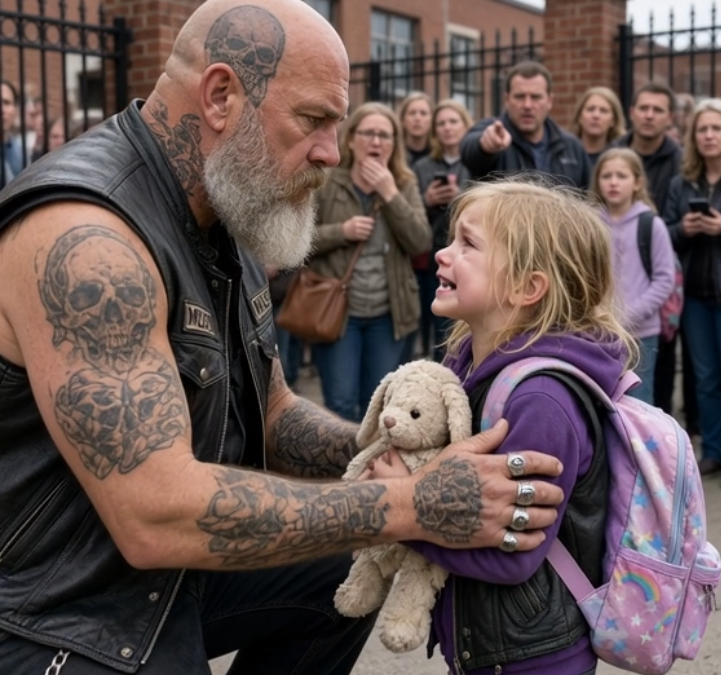
Cole crouched in front of Maddie, making his large frame small in front of everyone.
“Did I embarrass you?” he asked.
Maddie shook her head, but her eyes filled.
“I just want you to park where nobody can see.”
The old highway diner sat half a block away from the school. Parents sometimes used it when the parking lot was full, but children could not see it from the playground.
Cole nodded once.
No anger.
No argument.
No wounded pride.
“Okay,” he said quietly. “I’ll be at the diner.”
Then he touched two fingers to the butterfly keychain on her backpack.
“I’ll still be close.”
Maddie walked inside with me, but she looked back twice.
Cole stayed on one knee until she disappeared through the door.
The next week, Cole parked by the diner every morning and every afternoon.
From my classroom window, I could see him standing under the faded red sign, arms folded, watching the school from far away.
He looked like a man waiting outside his own life.
Maddie saw him too.
Even when she pretended not to.
By Tuesday, the teasing grew worse.
I heard pieces of it during recess.
“Motorcycle club.”
“Scary jacket.”
“My mom saw pictures online.”
Then Maddie shouted, “Stop talking about my dad!”
I started across the playground, but before I reached them, Evan said something I could not hear.
Maddie’s hand flew out.
It was not hard.
It was not dangerous.
It was a small, shaking slap from a little girl who had run out of words.
Still, it was enough.
By lunchtime, the office had called Cole.
At 12:10, his Harley pulled into the front lot.
Not the diner.
The front curb.
The office went silent when he walked in.
He held his helmet in both hands. His leather jacket creaked when he sat in the small chair across from Principal Marianne Holt.
Maddie sat beside me, staring at her shoes.
Principal Holt cleared her throat.
“Mr. Mercer, Maddie put her hands on another student today.”
Cole looked at his daughter.
“Did you do that?”
Maddie nodded.
“Why?”
For a moment, nobody spoke.
Then Maddie whispered, “He called you a monster.”
Cole closed his eyes.
In that second, the biker disappeared.
Only the father remained.
And he looked tired in a way that had nothing to do with sleep.
Principal Holt said, “We are also addressing the teasing.”
Cole opened his eyes.
“Please address what came before the slap,” he said. “Because my daughter did not wake up this morning wanting to be in trouble.”
His voice was low.
Controlled.
But every adult in that room felt it.
We expected anger.
We expected shouting.
We expected the kind of scene people record on phones.
But Cole did not raise his voice.
He looked at Maddie, and his expression softened.
“I’ll keep waiting at the diner,” he said.
Maddie lifted her head.
“Daddy…”
Cole swallowed.
“If seeing me makes your day harder, I’ll stay where you asked me to stay.”
I wanted to stop him.
I did not know how.
Children can ask for distance without understanding how lonely it makes the person who loves them.
Cole stood at the door and looked back once.
“Don’t use your hands again, peanut,” he said gently. “Your voice matters more.”
Maddie nodded as tears rolled down her cheeks.
When Cole left, the Harley started outside.
It sounded like thunder trying not to break.
The next morning, I arrived early.
Teachers always say we come early to prepare the classroom.
The truth is, sometimes we come early to prepare ourselves.
I had just unlocked Room 8 when I heard the first engine.
Then another.
Then more.
Not loud.
Not wild.
Steady.
Measured.
A deep rolling sound moving down the road before the sun had fully warmed the pavement.
I stepped to the window.
Forty-five motorcycles came around the corner by the diner in a slow line. Their headlights glowed through the cold morning air. Men and women in leather, denim, gloves, and worn boots parked along the curb in perfect order.
They did not rev their engines.
They did not shout.
They did not block the road.
One by one, they shut off their bikes.
The silence that followed was heavier than the sound.
Parents froze near the drop-off lane.
Some reached for their phones.
Some held their children closer.
Cole arrived last.
Maddie was not on the motorcycle. She arrived with her grandmother in a silver SUV. That mattered because Cole was careful.
Always careful.
When Maddie stepped out, her face went pale.
Cole walked toward her and crouched.
“Too much?” he asked.
Maddie looked at the long row of bikers.
A Black rider with a white beard removed his sunglasses and gave her a respectful nod. A woman with silver hair and a red scarf held a small paper flower. A younger rider stared at the pavement, clearly trying not to look frightening.
Nobody smiled too wide.
Nobody performed for the cameras.
Maddie whispered, “Why are they here?”
Cole looked down.
“Because I told them not to come.”
That was the moment I understood something important.
Cole had not called them for help.
He had asked them to stay away.
He had wanted to carry the shame quietly.
But they came anyway.
Not to scare anyone.
Not to prove power.
They came to stand where he had been told to disappear.
The older rider stepped forward slowly. His name was Walter “Bishop” Grant, and he had known Cole for nearly eighteen years.
He stopped a safe distance from Maddie and lowered himself to one knee.
“Morning, young lady,” he said gently. “Your daddy told us to keep away from the school.”
Maddie blinked.
“Then why didn’t you?”
Bishop’s voice softened.
“Because sometimes a good man forgets he does not have to stand alone.”
Principal Holt appeared at the entrance, nervous but calm. The school officer stood beside her, watching carefully.
Cole lifted one hand toward the riders.
“Everyone stays back,” he said.
Every biker obeyed immediately.
That silence said more than noise ever could.
Maddie reached for her father’s hand.
This time, she did not let go.
Then she asked the question that broke every adult watching.
“Daddy, are they bad people?”
Cole’s face changed.
“No, peanut.”
“Then why does everyone act scared?”
Cole looked at the parents, then back at his daughter.
“Because sometimes people see the jacket before they see the heart.”
Maddie held his hand tighter.
And with forty-five bikers standing quietly behind them, she walked through the school gate.
The story could have ended there.
It would have been easy.
A little girl defended by bikers.
A school surprised.
A town learning a lesson.
But real stories have roots, and Cole’s roots reached far deeper than that morning.
That afternoon, Principal Holt called a private meeting with the families involved, a few staff members, Cole, and two representatives from his club.
Evan’s parents came too.
His father wore a clean vest and the tight expression of a man who believed he had been inconvenienced. His mother looked embarrassed before anyone spoke.
Cole came without the full group.
Only Bishop and the silver-haired woman, Nora Delgado, came with him.
Evan’s father spoke first.
“I don’t want my son frightened by a motorcycle group outside his school.”
Cole said nothing.
Bishop answered calmly.
“Nobody came for your son.”
“Forty-five bikers at an elementary school sends a message.”
Nora leaned forward.
“Yes,” she said. “It says a child should not be ashamed of the person who loves her.”
The room went quiet.
Principal Holt looked at Cole.
“Mr. Mercer, can you help us understand why this meant so much?”
Cole stared at his hands.
At the words on his knuckles.
STAY KIND.
When he finally spoke, his voice was rough but steady.
“Because years ago, I made the opposite choice.”
No one moved.
Cole rubbed his thumb over the ink.
“My oldest daughter’s name was Lily.”
Maddie’s grandmother covered her mouth.
Cole continued.
“She was eight. Different town. Different school. Children made comments about me there too. I was younger then. Angrier. I thought the way to prove I was strong was to act like nothing hurt.”
His eyes stayed on the table.
“One day, Lily asked me not to pick her up near the school. She said kids laughed at my bike. Said they called me names. Said they made engine sounds when she walked by.”
Bishop looked down.
Nora closed her eyes.
Cole swallowed.
“I thought giving her space was love.”
His voice cracked slightly.
“So I stayed away.”
The room was completely still.
“A few weeks later, she got off the bus early because she did not want anyone seeing me waiting near the stop. She tried to walk home by herself. There was an accident on the road.”
He paused.
No one asked for details.
No one needed them.
“She stayed with us for two days,” he said. “Then she was gone.”
Maddie’s eyes filled with tears.
Cole touched the words on his knuckles.
“The last note she ever wrote me was still in her backpack. Crumpled up in the bottom pocket. I found it after the funeral.”
His voice fell almost to a whisper.
“She had written, Daddy, stay kind even when people are mean.”
No one in that room breathed normally after that.
“I wasn’t kind after she died,” Cole said. “Not for a while. I was angry at everybody. The kids who teased her. Their parents. The school. Myself. God. Anybody who stood close enough. Bishop and Nora carried me through most of that year.”
Bishop’s jaw tightened.
Nora wiped her cheek quickly.
Cole looked at Maddie.
“When Maddie asked me to wait by the diner, I heard Lily all over again. And I thought maybe stepping back was love. Again.”
Maddie began to cry.
Cole’s face shifted, but he stayed seated. He did not reach for her until she moved first.
She got out of her chair and went to him.
He pulled her onto his lap like she still weighed nothing.
“I’m sorry, Daddy,” she cried into his vest.
Cole closed his eyes.
“No, peanut. No. You are a child. You were trying to survive something adults put on you. You do not apologize for that.”
Evan sat beside his mother, staring at the table.
His father had gone pale.
Until then, Mr. Brooks had looked irritated.
Now he looked like a man standing too close to a fire he had not meant to light.
“I didn’t know,” he said.
Cole looked at him.
“That’s the trouble with words,” Cole said quietly. “They don’t need you to know the whole story before they do damage.”
Evan’s mother put one hand over her mouth.
Evan whispered, “I’m sorry, Maddie.”
Maddie did not answer right away.
She was still crying against Cole’s chest.
Then she lifted her head and looked at the boy.
“You hurt my dad.”
Evan nodded, tears running down his own face now.
“I know.”
“And me.”
“I know.”
“Don’t call people monsters.”
“I won’t.”
Maddie sniffed.
“My dad fixes bikes and makes pancakes and he knows how to draw horses.”
Evan wiped his face.
“My dad can’t draw horses.”
For one terrible second, I thought Maddie might laugh.
She did not.
She said, “Maybe my dad can teach him.”
That was six-year-old mercy.
Messy.
Confusing.
Too generous.
More honest than anything the adults had managed.
Principal Holt cleared her throat.
“I think,” she said carefully, “this school has work to do.”
She was right.
The next week, we began with language.
That sounds small.
It was not.
Principal Holt sent a letter home that did not mention bikers, patches, or any child by name. It spoke about appearance, assumptions, respect, and the way children borrow adult fear before they understand it.
Some parents praised it.
Some rolled their eyes.
One father wrote an email saying the school had become “too sensitive.”
Principal Holt printed it, placed it in a folder, and continued doing the right thing.
In Room 8, I changed our morning lesson.
Instead of the worksheet I had planned, I placed two paper bags on my desk.
One was plain brown, wrinkled, with a torn corner.
The other was shiny, decorated with gold stars.
I held up the shiny one first.
“What do you think is inside?”
“Candy!” one child shouted.
“A present!”
“Something fancy!”
Then I held up the brown bag.
“What about this one?”
“Trash.”
“Lunch.”
“Something old.”
I opened the shiny bag.
Inside was a rock.
Then I opened the wrinkled bag.
Inside were twenty tiny paper hearts.
The class went quiet.
Maddie looked at me.
Evan looked at his desk.
“People are not bags,” I told them. “But sometimes we treat them that way. We guess what is inside by looking at the outside.”
A little girl named Sofia raised her hand.
“My grandma says tattoos are stories.”
Maddie sat up straighter.
“That is a good way to say it,” I told her.
The next Friday, Cole came to school.
Not for pickup.
For class.
He arrived in jeans, boots, and a clean black shirt. No vest. No patches. No bike at the curb. He carried a paper bag in one hand and looked more nervous than I had ever seen him.
Maddie walked beside him proudly, holding two of his fingers.
The children sat on the rug.
Cole stood at the front of Room 8 like a man preparing to testify.
“You can sit if you want,” I told him.
He looked at the tiny first-grade chair.
“I’m not sure I can get back up.”
The children laughed.
That helped.
Cole held up his hands.
“You all have asked about my tattoos.”
Several children nodded.
Maddie whispered, “It’s okay.”
He smiled at her.
“This one,” he said, pointing to a small blue butterfly near his wrist, “was for my daughter Lily. She liked butterflies.”
He touched a little crescent moon on his forearm.
“This one was for Maddie when she was born. She used to sleep all day and stay up all night, so I called her my moon baby.”
Maddie grinned.
He turned his hand so the children could see his knuckles.
“These words are from something Lily wrote me.”
Evan raised his hand.
Cole looked at him.
“Yes?”
“Can you still be kind when you’re mad?”
Cole considered that.
“Not always right away. But you can try not to be cruel while you’re waiting to get there.”
I wrote that sentence down later.
Teachers collect useful sentences the way some people collect coins.
Then Cole reached into the paper bag.
“I brought something.”
Out came a stack of small wooden hearts.
Forty of them.
Each one sanded smooth.
Each one with two words burned carefully into the front.
STAY KIND.
“I made these with my club,” Cole said. “You don’t have to take one. But if you do, it means you remember people have stories you can’t see.”
Every child took one.
Evan was last.
He stood in front of Cole with his wooden heart held in both hands.
“My dad said he was wrong,” Evan whispered.
Cole crouched.
Adults in first-grade rooms are always crouching. There is something humbling about constantly lowering yourself to speak to children properly.
“Did he?”
Evan nodded.
“He said sometimes grown-ups say dumb things when they’re scared.”
Cole’s mouth moved slightly.
“That’s true.”
“I’m sorry I repeated it.”
Cole looked at him for a long moment.
Then he held out his fist.
Evan stared.
Maddie whispered, “You bump it.”
Evan bumped Cole’s fist.
Across Cole’s knuckles, the words faced upward.
STAY KIND.
After that, things did not become perfect.
They never do.
Children are still children.
Parents are still parents.
Whispers still happened.
But something had shifted.
Cole began picking Maddie up at the school gate again.
The first afternoon he returned to the curb, Maddie ran like she had at the beginning of the year.
Pink backpack bouncing.
Sneakers flashing.
Cole dropped to one knee.
“Slow down, peanut.”
She did not slow down.
She crashed into his arms and held on.
Only this time, when she pulled back, she turned toward the other parents.
“This is my dad,” she announced to no one and everyone. “He is not a monster.”
A few parents looked away.
A few smiled.
Evan, standing beside his mother, said loudly, “He makes wooden hearts.”
Maddie nodded.
“And pancakes.”
Cole looked at me over her shoulder with an expression I have never forgotten.
It held grief.
Relief.
Fear.
Gratitude.
All the things parents carry when their children forgive the world a little faster than they do.
Three weeks later, the school held its annual fall cleanup.
Usually, we got ten volunteers.
Mostly mothers.
Sometimes one grandfather.
That year, thirty-two bikers showed up at 7 a.m.
Principal Holt stood in the parking lot with a clipboard and the face of a woman deciding whether she was about to regret every choice she had ever made.
Bishop approached her first.
“Morning, ma’am,” he said. “Cole says you have playground gravel needs moving.”
Principal Holt blinked.
“Yes.”
“We brought shovels.”
They had.
They also brought paint, lumber, toolboxes, work gloves, a power washer, and one large man named Tank who looked terrifying until he spent twenty minutes repairing the kindergarten tricycle shed while humming nursery rhymes.
By noon, the playground fence was fixed, the picnic tables were sanded, the garden boxes were rebuilt, and the squeaky gate that had annoyed me for eight years finally stopped screaming.
Nora Delgado sat with a group of mothers and showed them how to patch denim knees.
Bishop helped two fifth graders paint hopscotch squares.
Cole and Maddie planted desert marigolds near the front sign.
Evan and his father worked beside them.
Awkwardly at first.
Then less so.
At lunch, Mr. Brooks approached Cole with two paper plates of hot dogs.
He held one out.
“I owe you more than an apology,” he said.
Cole took the plate.
“That’s a start.”
“I was careless.”
“Yes.”
“I scared my son with my own ignorance.”
Cole looked across the playground at Maddie and Evan carrying a watering can between them.
“You taught him what you knew,” Cole said. “Now teach him better.”
Mr. Brooks nodded.
“I’m trying.”
“Good.”
That was all.
But sometimes all is enough for a start.
By winter, the bikers were no longer a spectacle at the school.
They were volunteers.
They read during Literacy Week.
They escorted the charity toy drive.
They donated helmets for Bicycle Safety Day.
They built a ramp for a student whose surgery made stairs difficult.
Nora started a small winter coat closet after discovering three children had been sharing one jacket between them.
Bishop came every Friday morning to help with crosswalk duty. He wore a neon vest over his leather one and took the job with the seriousness of a military operation.
The children adored him.
“Mr. Bishop,” one little boy asked, “were you born old?”
Bishop said, “Yes.”
The boy nodded, satisfied.
Cole still looked rough.
That did not change.
His boots were still heavy.
His tattoos still ran down both arms.
His motorcycle still sounded like thunder when he left the curb.
But the children stopped hearing thunder as danger.
They heard it as Maddie’s dad.
And Maddie stopped hiding.
One afternoon in December, during art time, I saw her drawing her family again.
This time, the tall man had a face.
A beard.
A leather vest.
A giant smile.
Behind him stood a row of motorcycles, each one decorated with hearts.
Above the picture, in careful first-grade letters, she had written:
MY DAD STAYS KIND.
I kept that drawing on my classroom wall for the rest of the year.
In April, we held our spring open house.
Parents wandered through classrooms, admiring construction-paper flowers, crooked handwriting, and science projects that mostly involved beans in plastic cups.
Cole came late because he had worked a long shift at the repair shop.
His hands were scrubbed clean but still held grease around the nails.
Maddie dragged him straight to our wall of student writing.
“Read mine,” she said.
Cole leaned down.
Her page was titled:
The Bravest Person I Know.
He read silently.
I watched his face.
My daddy is brave because people sometimes think he is scary but he is not scary to me. He waits for me even when I ask him to wait far away. He says my voice matters more than my hands. He misses my sister Lily. I do too even though I never met her. I think she would like me. My daddy has words on his hands. They say stay kind. That means do not let mean people teach your heart to be mean back.
Cole put one hand against the wall.
For a moment, he could not speak.
Maddie leaned into his side.
“Did I spell everything right?”
He laughed once through his nose, rough and broken.
“Not even close, peanut.”
She grinned.
“But it’s good?”
Cole crouched and pulled her into his arms.
“It’s the best thing I ever read.”
From across the room, Evan watched them.
Then he tugged his father’s sleeve.
Mr. Brooks bent down to listen.
Evan whispered something.
His father looked over at Cole.
Then nodded.
A few minutes later, Evan came up holding a folded paper.
“This is for you,” he told Cole.
Cole took it carefully.
Inside was a drawing of a man on a motorcycle.
Above him, in uneven letters, Evan had written:
I AM SORRY I SAID MONSTER.
Underneath, in smaller letters:
YOU ARE MADDIE’S DAD.
Cole read it.
Then he looked at Evan.
“You know something?” Cole said.
“What?”
“You made a mistake.”
Evan’s face fell.
Cole tapped the paper.
“Then you made it right. That takes courage.”
Evan stood a little taller.
Cole held out his fist.
Evan bumped it.
Maddie watched, arms folded, judging whether the moment satisfied justice.
Apparently it did, because she nodded once and went back to showing her grandmother the bean plant.
Near the end of the year, our class held one final sharing circle.
The prompt was simple:
Something I learned this year.
Most answers were what you expect from first graders.
“I learned subtraction.”
“I learned caterpillars turn into butterflies.”
“I learned how to tie my shoes.”
“I learned that glue does not taste good.”
Then Maddie raised her hand.
She rarely waited to be called on, but that day she did.
“Yes, Maddie?”
She stood.
“I learned that if someone says your dad is a monster, you should not slap them.”
Several children nodded solemnly.
“Good lesson,” I said.
“You should use your voice.”
“Yes.”
“And maybe the person saying it is scared because somebody taught them to be scared.”
I looked at Evan.
He was looking at Maddie.
Maddie continued.
“But that does not mean you have to hide your dad at the diner.”
My throat tightened.
“No,” I said softly. “It does not.”
Maddie sat down.
Then she looked out the window.
Cole was waiting at the curb beside his Harley, helmet under one arm.
When the final bell rang, Maddie ran.
She always ran.
And Cole, as always, lowered himself to one knee.
“Slow down, peanut.”
She did not slow down.
She threw herself into his arms.
He caught her gently.
As if she were something precious made of glass.
But I knew better by then.
Maddie was not glass.
Neither was Cole.
They were something stronger.
Something cracked once, maybe more than once, but not broken.
Something that had learned the hardest lesson kindness can teach:
You can be hurt and still refuse to become cruel.
You can be judged and still refuse to disappear.
You can carry grief on your skin, in your hands, across your knuckles, and still kneel down every afternoon so your child knows exactly where home is waiting.
Years later, I still think about that morning.
Forty-five engines rolling quietly toward an elementary school.
Forty-five bikers who came not to frighten children, but to remind one father that shame should never get the final word.
I think about Cole standing at the gate, ready to stay away because his daughter asked him to.
I think about Maddie reaching for his hand.
I think about Evan learning that fear can be inherited, but so can courage.
And I think about those two words on Cole Mercer’s knuckles.
STAY KIND.
Not because kindness is easy.
Not because people deserve it every time.
Not because the world is gentle.
But because sometimes a child is watching.
And children repeat what adults leave lying around.
So we ought to leave better things.


