A Firefighter Found a Badly Burned Mother Cat Inside a Fire-Ravaged Apartment—Then He Lifted Her Body and Saw What She Had Been Protecting Underneath.
PART3:
“That’s not enough!”
“I know.”
He said it like he meant it.
That made it worse.
Ava stood outside in the street wearing leggings, a diner T-shirt, and one sock, staring up at the windows of the building while flames chewed through the place where everything she owned waited above her.
Her phone was inside.
Her wallet.
Her work shoes.
Her grandmother’s necklace.
Her social security card.
The notebooks from the medical assistant program she was trying to finish at night.
Her clothes.
Her photographs.
Everything.
But she only kept saying, “Marnie is up there.”
An older woman from 1A wrapped a blanket around Ava’s shoulders.
Ava shrugged it off without meaning to.
“She’s up there.”
Smoke poured from the third-floor windows.
The ladder truck arrived.
Firefighters moved with a speed that looked chaotic until you realized every person knew exactly what to do. Hoses unrolled. Air tanks strapped. Radio calls cracked through the night. Water hit flame and turned instantly to steam. The building groaned in a way that made everyone on the sidewalk flinch.
Ava kept her eyes on the third floor.
Unit 3F was at the end of the hall, farthest from the stairs.
The farthest place from help.
Captain Dana Mercer heard about the cat and kittens over the radio at 12:09.
By then the main body of fire had been knocked down, but the building was still dangerous. Hot spots remained in the walls. The third floor was filled with smoke and unstable heat. The hallway ceiling had blistered. Nobody was going inside for pets during active suppression unless conditions allowed it, and conditions rarely care about what people love.
But firefighters remember.
Even when they cannot act immediately, they remember.
At 12:31, after the flames were mostly down and the crews began the search and overhaul phase, Captain Mercer sent Firefighter Ethan Cole and Lieutenant James Porter up to the third floor with thermal imaging equipment to check for hot spots, structural compromise, and secondary hazards.
“Unit 3F,” she told them over the radio. “If conditions allow, check for reported cats. Adult female, two kittens.”
Ethan Cole was thirty-four years old and had been a firefighter for twelve years. He had pulled people from cars, carried an unconscious man down three flights of stairs, delivered one baby in the back of an ambulance before paramedics arrived, and once rescued a parakeet from a chimney while an entire family applauded from the lawn.
He had also found pets too late.
Every firefighter has.
Dogs under beds.
Cats in closets.
Rabbits in cages.
Fish in tanks gone cold.
Animals do not understand evacuation plans.
They hide where they feel safest, and sometimes safety is exactly where smoke goes to settle.
Ethan did not say anything dramatic when Captain Mercer mentioned the cats.
He only answered, “Copy. We’ll check 3F.”
The third-floor hallway was blackened and wet. Water dripped from the ceiling. The walls steamed faintly. Flashlight beams cut through smoke haze that still clung low in the corridor, stubborn as guilt.
Most apartment doors stood open or broken.
Inside, rooms looked as if night had been burned into them. Furniture warped. Plastic melted. Curtains gone. Family photos blistered in frames. Mattresses soaked. Cabinets swollen from water. Lives reduced to shapes.
Unit 3F was at the end of the hall.
The door had held longer than others.
That helped.
Ethan forced it open carefully.
The studio beyond was ruined but not fully consumed. Smoke damage everywhere. Heat damage along the ceiling. The kitchenette cabinets blackened. The mattress half-burned on one side. A dresser near the wall had warped, drawers swollen shut.
Ethan swept the thermal camera.
No human signatures.
He moved through the room.
“Anything?” Porter asked behind him.
“Not yet.”
Then Ethan heard it.
Not a meow.
Not exactly.
A thin, high sound so faint he almost mistook it for water dripping onto hot debris.
He held up one hand.
Porter froze.
There it was again.
A kitten.
Ethan turned toward the bathroom.
The bathroom door was closed.
That alone made him pause.
Every other interior door in the unit stood open or had warped from heat. This one was pulled shut, not latched perfectly but closed enough to matter.
Ethan pushed it inward.
The bathroom was small, barely wide enough for a sink, toilet, and old porcelain tub. The ceiling above the doorway was dark with heat. The shower curtain had melted into a twisted shape on the rod. Smoke stains streaked the wall.
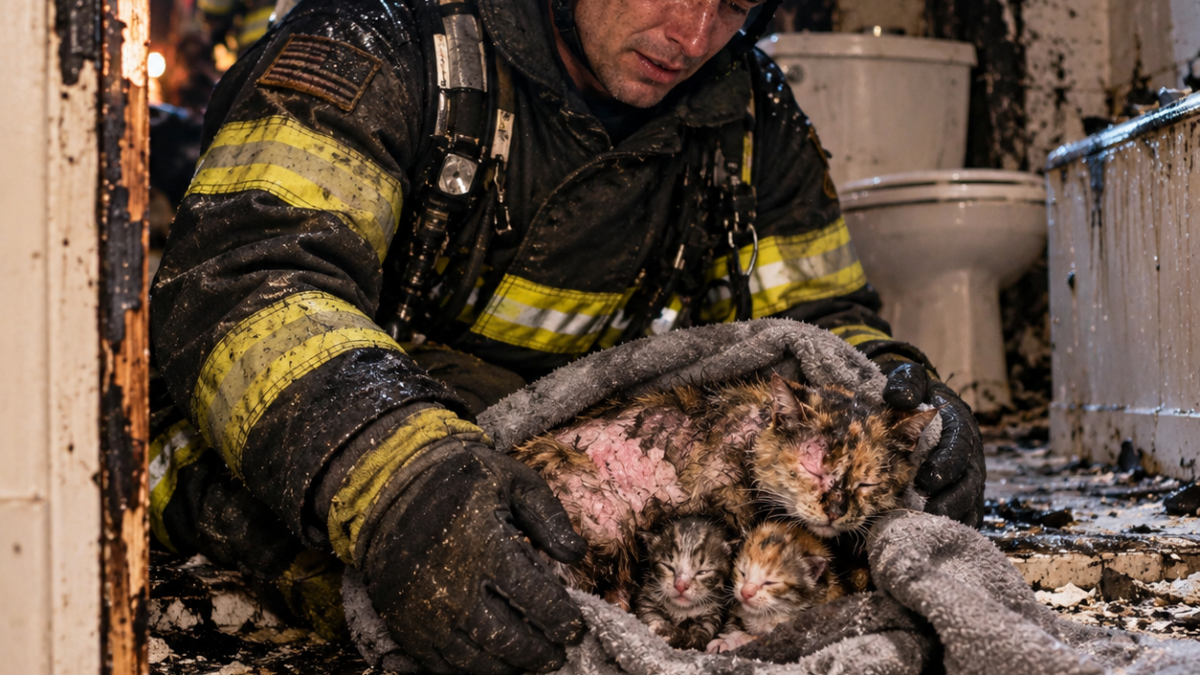
And on the tile floor, against the tub, lay a tortoiseshell cat.
At first, Ethan thought she was dead.
Then her side moved.
Barely.
“Captain,” he said into the radio, and his own voice sounded different to him. “I need you at 3F. Bathroom. Now.”
Porter stepped in behind him.
“Oh God.”
The cat was alive.
Barely.
Her body was stretched flat against the tile, belly down, front legs extended, back legs stretched behind her, as if she had tried to cover as much ground as possible with herself. Her back was burned from the base of her neck almost to her tail. Much of the fur was gone, exposing raw, blistered skin. The tips of her ears were curled and blackened. Her eyes were swollen shut. Her breathing was wet and fast, each breath a small fight.
But she was not alone.
Ethan saw movement beneath her chest.
He lowered himself carefully.
“Porter,” he whispered.
“I see them.”
Two kittens were tucked beneath the mother cat’s body.
Not beside her.
Under her.
Pressed into the space between her front legs and her chest, completely shielded by her burned back. Their eyes were still sealed shut. They were around ten days old. Their tiny bodies were warm. Their fur smelled of smoke but was not burned. Their breathing was steady.
Marnie had made herself into a roof.
The fire had taken her back instead of theirs.
Ethan stared.
For a moment, the room, the radio, the smoke, the ruined apartment, everything narrowed to the sight of that ruined mother cat lying perfectly still over her living babies.
Porter crouched beside him.
“Bathroom stayed cooler,” he said quietly, though both men already understood.
Tile instead of carpet.
Porcelain instead of wood.
Closed door.
Low floor.
Marnie had chosen the one room with the best chance.
Then she had held the door.
That became clear when Captain Mercer arrived.
Scratch marks gouged the lower inside of the bathroom door. Deep, frantic grooves in the paint and soft wood. Not random. Concentrated near the bottom edge, where the door met the frame.
“She pushed it shut,” Porter said.
Captain Mercer crouched and looked.
“Or kept it shut.”
The three firefighters stood in silence.
No one wanted to say what all of them knew.
A cat had made tactical decisions in a fire better than some panicked humans do.
Close the door.
Get low.
Choose tile.
Cover the babies.
Hold.
Ethan removed his gloves only long enough to adjust the emergency blanket, then put them back on. He slid both hands under Marnie as gently as possible.
Her skin stuck slightly to the outer layer of his gloves.
His stomach turned.
She did not cry.
Not once.
That was worse than if she had screamed.
Animals in extreme shock sometimes go beyond complaint.
He lifted her carefully, keeping her body level.
The two kittens rolled free from beneath her and immediately began crying.
Strong cries.
Angry cries.
Alive cries.
Ethan looked down at them.
That was the moment he understood they were okay.
Not safe yet.
Not guaranteed.
But strong.
They were crying because they had breath to spend.
He wrapped Marnie and both kittens in the emergency blanket and carried them out of the bathroom against his chest.
As he stepped into the hallway, Captain Mercer radioed down.
“Animal victims coming out. Adult cat critical. Two neonates viable. We need transport to veterinary care now.”
Ava heard only fragments from the street.
Adult cat critical.
Two neonates viable.
She did not know what neonates meant, but she knew two.
Two kittens.
She pushed forward.
A firefighter stopped her gently.
“Ma’am, wait.”
“Are they alive?”
“They’re bringing them down.”
“Are they alive?”
He looked toward the door.
“I think so.”
Ethan came out of the building holding the blanket bundle.
People on the sidewalk quieted.
Not because they knew what was inside.
Because of his face.
He handed the bundle to the emergency veterinary volunteer who had arrived after hearing the call on the scanner. Dr. Caroline Hayes ran a small clinic six blocks away and often responded to fire scenes when animals were involved. She opened the blanket just enough to assess.
Ava saw Marnie.
Then the kittens.
She made a sound that did not belong to language.
“Marnie!”
The cat’s burned face did not turn.
Her eyes were swollen shut.
Her body barely moved.
But the kittens cried.
Ava reached for them.
Dr. Hayes caught her hands.
“Listen to me. They’re alive. She’s alive. I have to go now.”
“Can I come?”
“Yes. Ride with my tech.”
Ava nodded wildly, tears cutting clean lines through soot on her face.
Ethan stood on the curb.
His hands were still out in front of him, palms slightly open, as if he could feel the cat’s weight after she was gone.
Captain Mercer touched his shoulder.
“Cole?”
He took one step backward.
Then another.
Then he sat down on the curb.
Hard.
Helmet still on.
Air tank still strapped.
Soot across his neck.
He sat there with both elbows on his knees and stared at the wet pavement.
Porter stood beside him.
Neither man spoke.
After a minute, Ethan pulled off one glove.
Then the other.
He looked at them.
There were patches on the gloves where burned skin and fluid had stuck.
He closed his eyes.
Captain Mercer sat beside him.
Not too close.
Close enough.
“Twelve years,” Ethan said finally.
His voice was rough.
“I’ve seen a lot.”
“I know.”
“She knew exactly what she was doing.”
Captain Mercer looked toward the veterinary van pulling away.
“Yes,” she said. “She did.”
At Hayes Animal Clinic, the next thirty-one days became a war fought in quiet rooms.
Marnie was listed as a critical burn patient.
Tortoiseshell female.
Approximate age: three years.
Smoke inhalation.
Burns over roughly forty percent of the body.
Severe dorsal burns from neck to tail.
Ear-tip damage.
Eye swelling.
Respiratory compromise.
High infection risk.
Nursing mother.
Two viable kittens.
Ava sat in the waiting room wearing donated sneakers two sizes too big and a sweatshirt from a firefighter she did not know. She had no phone. No wallet. No apartment. No bed. No proof of anything except her own name and the terrible truth that everything she owned was either burned, soaked, or sealed inside a building she could not reenter.
But every time someone asked what she needed, she said, “How is Marnie?”
Dr. Hayes did not lie.
“She is very badly hurt.”
“But she can live?”
“She can. That does not mean she will.”
Ava nodded like she understood the difference.
She did not.
Not then.
The kittens were examined first because they were easier to save.
Button and Blue were smoky but unburned. Their lungs sounded clear. Their body temperatures were acceptable. They needed warmth, monitoring, and feeding if Marnie could not nurse.
A vet tech named Jonah held the kittens against his chest while another tech prepared formula.
“They’re strong,” Jonah told Ava.
Ava stared at the tiny moving bundles.
“She covered them?”
Jonah looked toward the treatment room.
“Yes.”
“With her body?”
“Yes.”
Ava sat down before her legs gave out.
Marnie needed oxygen.
Fluids.
Pain control.
Wound care.
Antibiotics.
Eye treatment.
Burn dressings.
A feeding plan.
The first night, Dr. Hayes did not go home.
Neither did Ava.
She slept in a chair in the lobby for forty minutes at a time, waking whenever footsteps approached. At 4:00 a.m., Dr. Hayes came out holding a paper cup of coffee and sat beside her.
“She made it through the first few hours,” the vet said.
Ava covered her face.
“Can I see her?”
“For a minute.”
Marnie lay in an oxygen kennel lined with sterile pads. Her body was bandaged across the worst burns, though much of the injury still showed around the edges. Her eyes were swollen shut. A small IV catheter was taped carefully to one leg. Her breathing sounded wet and fragile.
Ava pressed her fingers to the glass.
“Marnie,” she whispered.
The cat did not move.
Ava swallowed a sob.
“I’m sorry. I’m so sorry. I wasn’t there.”
Dr. Hayes stood behind her.
“You could not have gone back into that fire.”
“She did.”
The vet did not answer.
Because that was true.
On the second day, the news crews arrived.
The apartment fire had already been a local story. Fourteen residents displaced. Old building. Red Cross assistance. Fire department response. No human fatalities.
Then someone heard about the cat.
A mother cat found burned in a bathroom shielding two kittens.
By evening, the story spread across the city.
People wanted updates.
Wanted photos.
Wanted to help.
Wanted to call Marnie a hero.
Ava hated and needed all of it at once.
Donations began coming into the clinic. First small amounts. Twenty dollars. Fifteen. Fifty. Then bags of kitten formula, towels, soft blankets, gift cards, cat beds, carriers, food, litter, clothes for Ava, toiletries, a used phone, shoes that fit, a winter coat.
A donation center set up a table for displaced residents from the building.
Ava went once.
She took socks, a toothbrush, two pairs of jeans, and a duffel bag.
A volunteer named Denise helped her sort through clothes.
“You’re the girl with the cat,” Denise said gently.
Ava stiffened.
“I’m Ava.”
Denise nodded immediately.
“I’m sorry. Ava.”
That helped.
A little.
Ava selected only what she needed. When Denise encouraged her to take more, Ava shook her head.
“I have nowhere to put it.”
“Where are you staying?”
“My aunt’s basement.”
“With the kittens?”
“With all three cats, if Marnie lives.”
Denise’s eyes softened.
“When she lives,” she said.
Ava looked at her.
Denise did not correct herself.
At the clinic, Marnie fought in the smallest possible ways.
She survived the first night.
Then the second.
Then the third.
Her breathing improved slowly. The oxygen helped. The swelling around her eyes reduced enough that Dr. Hayes could confirm the eyes themselves had not been destroyed. She could not see well yet, but she might again.
Her burns were another matter.
Burn wounds are cruel because they keep changing after the fire is out.
Tissue declares itself slowly.
Some skin that looks damaged may recover.
Some that looks recoverable dies.
Bandages must be changed.
Wounds cleaned.
Infection watched for constantly.
Pain managed carefully.
Marnie endured it without the anger everyone expected from a tortoiseshell.
That worried Dr. Hayes.
“She’s too quiet,” she told Jonah.
“She’s exhausted.”
“Yes. But she should hate us more.”
Jonah looked at the cat lying limp beneath sedation.
“You want her to hate us?”
“I want her to have enough left to object.”
For nine days, Marnie remained on fluids.
For eleven, she needed careful respiratory monitoring.
Two infections began during recovery.
The first along the burned skin near her shoulders.
The second deeper, near the flank where heat damage had been severe and bandage changes were hardest.
Each time, Dr. Hayes adjusted antibiotics.
Each time, Ava sat beside the kennel and whispered through the glass.
“You don’t have to be brave all the time,” she said once.
Marnie’s swollen eyes were still mostly closed.
Her ears, blackened at the tips, twitched faintly.
Ava leaned her forehead against the kennel door.
“I know that’s dumb. You’re a cat. You don’t know what brave means.”
Dr. Hayes, standing in the doorway, thought the opposite.
Some animals know bravery better than people.
They simply never call it that.
The kittens were kept nearby but separate at first.
Their safety mattered too.
They were bottle-fed around the clock by clinic staff and, once Ava learned how, by Ava herself. Button drank aggressively, paws kneading the air. Blue took longer, making tiny clicking sounds against the bottle nipple.
Ava named them officially on day five.
Button kept his temporary name because it suited him.
Blue became Smoke, because Ava said if something survived smoke, maybe it deserved to own the word.
Jonah argued that naming a kitten Smoke after a fire was emotionally complicated.
Ava said, “So is life.”
Jonah accepted that.
On day fourteen, Marnie stopped eating.
It began with one refused meal.
Then another.
Then a full day.
Her bloodwork was not good but not hopeless. Her temperature fluctuated. The wounds hurt. The infections had weakened her. She had endured procedures, drugs, bandages, and isolation from the kittens she had nearly died protecting.
Ava knew something was wrong before anyone said it.
Dr. Hayes found her in the treatment hallway staring at the closed recovery room door.
“She won’t eat,” Ava said.
Dr. Hayes inhaled.
“No.”
“Is she dying?”
The vet did not answer fast enough.
Ava pressed both hands to her mouth.
“We are not there yet,” Dr. Hayes said.
“That means maybe.”
“It means we are concerned.”
“Say it like a person.”
Dr. Hayes nodded slowly.
“If she does not start responding, she may not survive.”
Ava sat on the floor.
Not dramatically.
Her knees simply stopped helping.
Jonah moved toward her, but she waved him off.
“I lost everything,” she whispered.
Dr. Hayes crouched beside her.
“I know.”
“No, I mean…” Ava shook her head. “The apartment, my clothes, my books, my pictures, my grandmother’s necklace. I know people say stuff can be replaced, but some stuff can’t. And I keep telling myself it’s okay because Marnie got the babies out. So if she dies now…”
Her voice broke completely.
“If she dies now, I don’t know where to put that.”
Dr. Hayes had been a veterinarian for twenty-three years.
She had no perfect answer.
She placed one hand on Ava’s shoulder.
“We try the next thing.”
“What’s the next thing?”
Dr. Hayes looked toward the small incubator where Button and Smoke slept in a knot of fleece and warmth.
“We bring her babies.”
There were risks.
Infection control.
Stress.
Wound contamination.
Marnie’s pain.
The kittens’ safety.
But medicine is not only chemistry and sterile technique. Sometimes the body needs a reason to keep fighting that no syringe can provide.
On day fifteen, they prepared the recovery cage with fresh sterile padding. Marnie lay on her side, bandaged across much of her back and flanks, rear legs partially immobilized to protect healing tissue. Her eyes were only partly open, narrow slits beneath swelling. Her tongue was blistered. Her body was weak.
Dr. Hayes carried Button.
Jonah carried Smoke.
Ava stood at the back of the room, both hands clenched.
Marnie smelled them before they made a sound.
Her head lifted.
Barely.
But it lifted.
Her nose moved.
Button squeaked.
Marnie’s ears twitched.
Smoke answered with a tiny cry.
Then, for the first time since the fire, Marnie purred.
It was not loud.
It was not smooth.
It rattled under the damage in her chest, uneven and rough.
But it was a purr.
Ava sobbed.
Marnie dragged herself forward.
Her back legs were bandaged and stiff, so she used only her front legs, pulling her burned body across the blanket inch by inch. Every person in the room froze, afraid to stop her, afraid to let her continue.
“Easy,” Dr. Hayes whispered, though no one knew who she was speaking to.
Marnie reached the kittens.
Button rooted instantly toward her.
Smoke tucked beneath her chin.
Marnie curled around them as much as her injuries allowed.
Then she began grooming them.
Her tongue was blistered.
She groomed them anyway.
Slow.
Careful.
Button’s head.
Smoke’s back.
Between tiny ears.
Across closed eyes.
Over paws.
A mother restoring order to the only world that mattered.
Jonah turned away.
Dr. Hayes wiped her face with the sleeve of her coat.
Ava stepped closer and lowered herself beside the cage.
“Marnie,” she whispered.
The cat did not look at her.
She was busy.
For the first time in two weeks, Marnie ate that night.
Not much.
Enough.
Then more the next morning.
Recovery did not become easy after that, but it became possible.
The kittens visited under supervision every day.
At first for minutes.
Then longer.
Marnie’s appetite improved after each visit. Her pulse steadied. She tolerated bandage changes better when the kittens were returned afterward. Dr. Hayes began marking progress not only in temperature, bloodwork, wound margins, and appetite, but in the way Marnie’s body changed when Button and Smoke cried.
Her ears lifted.
Her paws flexed.
Her breathing deepened.
Fight returned.
On day twenty-two, Ava was allowed to hold Marnie for the first time after the fire.
Not fully.
Not against her chest.
The burns were too severe, the bandages too delicate. But Dr. Hayes helped position a thick pillow across Ava’s lap, then placed Marnie carefully on top.
The cat weighed almost nothing.
That shocked Ava all over again.
Before the fire, Marnie had been compact and sturdy, a little round from nursing, quick to smack a hand if a person forgot boundaries. Now she felt like a bundle of bones, bandages, heat, and will.
Ava lowered her face near Marnie’s head.
“I thought I lost you.”
Marnie’s eyes opened slightly.
Clouded.
Still swollen.
Still there.
Ava cried quietly into the pillow.
Marnie raised one paw, slowly, and placed it on Ava’s wrist.
The paw pads were intact.
The same paws that had held her body up over the kittens on the bathroom floor.
Ava covered that paw with two fingers.
“I know,” she whispered. “You saved them.”
Marnie did not purr.
She was tired.
But she did not move her paw.
On day thirty-one, Marnie left the clinic.
She did not leave healed.
That distinction mattered.
The burns had closed enough to manage at home. Infection controlled. Pain plan established. Bandage schedule arranged. Hearing partially damaged. Rear movement slow. Coat loss permanent across much of her back. The fur that would return would come in thin and patchy over pale, rippled scar tissue.
She would never be the same.
But she was alive.
Button and Smoke rode in one carrier.
Marnie rode in another, lined with soft fleece and a towel Ava had slept with the night before.
Dr. Hayes carried the discharge instructions in a folder thicker than Ava’s lease had been.
“You call for anything,” she said.
“I know.”
“I mean anything. If she stops eating, call. If the wounds smell different, call. If the kittens seem weak, call. If you panic, call.”
Ava smiled through tears.
“If I panic?”
“Yes.”
“Is that medical?”
“It is today.”
Jonah loaded donated supplies into Ava’s aunt’s car. Food. Litter. Bandages. Saline. Blankets. A donated heating pad. Kitten formula, just in case. Toys too, though Marnie would not play for a long time and the kittens were still too small to care.
Ava hugged Dr. Hayes.
Then Jonah.
Then stood awkwardly in front of Ethan Cole, who had come by after shift.
He had visited twice before but never stayed long. He seemed uncomfortable inside the clinic, not because of the animals, but because Marnie always looked at him—when her eyes could open—as if she knew he had been the one to lift her away from the bathroom floor.
Ava did not know how to thank him.
So she said, “You found them.”
Ethan shook his head.
“She saved them.”
“You carried them out.”
“After she did the hard part.”
Ava looked down.
“She knew exactly what she was doing.”
Ethan’s face changed.
He laughed once, softly, but not because anything was funny.
“That’s what I told my captain.”
Ava looked up.
“What?”
“The night of the fire. I sat on the curb and told her that.” He glanced toward Marnie’s carrier. “She knew exactly what she was doing.”
Neither of them had known the other had said the same sentence.
For a moment, they stood in the clinic parking lot with winter air around them, both looking at the burned tortoiseshell cat inside the carrier.
Some truths arrive in different mouths because they belong to the same evidence.
Ava moved into her aunt’s basement with two suitcases and three cats.
It was not ideal.
The basement had low ceilings, a laundry area, an old sofa bed, a space heater, and concrete walls painted pale yellow by someone optimistic decades earlier. But it was dry. It was safe. There was a small window near the ceiling where sunlight entered for exactly forty-two minutes each afternoon.
Ava arranged Marnie’s recovery bed beneath that light.
Button and Smoke grew.
Fast.
Kittens do not know tragedy unless it interrupts food, warmth, or play. Within weeks, they were tumbling over donated blankets, wrestling with each other’s ears, chewing on Ava’s shoelaces, and climbing Marnie as if their mother’s scarred body were the first mountain in the world.
Marnie tolerated it.
Mostly.
Sometimes she lifted one slow paw and pressed a kitten down with weary authority.
Her walk remained slow.
Her hearing never fully returned. Loud sounds startled her only if they vibrated the floor. Ava learned to approach from the front, tapping lightly before touching. The scars across Marnie’s back healed into pale, ridged tissue. Fur returned in uneven patches, thin and strange, never fully covering what the fire had taken.
She never jumped again.
Not onto the sofa.
Not onto the bed.
Not even onto the low storage crate Ava placed near the window.
If Marnie wanted something, she waited.
Ava lifted her.
Every time.
At night, something happened that made Ava sleep with her phone nearby in case she needed to record it, though she rarely did because some things felt too private.
Marnie slept the same way every night.
Flat on her belly.
Front legs spread wide.
Back legs extended behind her.
Body low and broad against the blanket.
Button and Smoke tucked beneath her chest and between her front legs, exactly where they had been found in the bathroom.
At first, Ava thought it was coincidence.
Then habit.
Then something else.
Even as the kittens grew too large to fit comfortably under her, Marnie kept doing it. She shifted her scarred body over them. She covered their heads when they slept. She tucked her chin low, ears angled, half-alert even in dreams.
Button and Smoke accepted this as normal.
They crawled under her long after they were too big.
At six months old, Button’s tail stuck out one side and Smoke’s hind legs out the other, but Marnie still spread herself over them, shielding them from a fire that had ended months earlier.
Ava once tried to gently move Smoke beside her instead of under her.
Marnie woke instantly.
Ava never tried again.
The fire lived inside Marnie’s body.
Not just in the scars.
In posture.
In sleep.
In the way she chose tile floors during storms.
In the way she refused to enter bathrooms for months, then one day went into the basement bathroom, sniffed the door, turned around, and left with a look of final judgment.
In the way she froze when someone lit a candle upstairs.
After that, Ava asked her aunt not to burn candles.
Her aunt threw every candle in the house away.
“No cat who survived that is going to be scared in my basement,” she said.
Ava cried in the laundry room after hearing it.
Life rebuilt slowly.
Not dramatically.
Slowly.
Ava got new documents.
A new phone.
A secondhand bed frame.
Textbooks donated by someone from her medical assistant class.
A work uniform from a diner coworker who had bought two extra and claimed they “didn’t fit right,” though they fit Ava perfectly.
The apartment building was condemned.
Then fenced off.
Then eventually torn down.
Ava went back once before demolition, escorted by an inspector, to see if anything from unit 3F could be recovered.
Almost nothing could.
A metal spoon.
One cracked mug.
A photo frame without the photo.
The dresser drawer where Marnie had given birth was burned and soaked beyond saving.
Ava stood in the ruined studio wearing a hard hat and borrowed boots, looking at the blackened doorway to the bathroom.
The scratch marks were still visible at the bottom of the door.
Deep.
Parallel.
Desperate.
Purposeful.
Ava knelt in front of them.
The inspector waited behind her.
“She did this?” he asked.
Ava touched one groove.
“Yes.”
“Smart cat.”
Ava shook her head.
“Mother.”
There was a difference.
The bathroom tile was cracked from heat and water, but one small piece near the tub had broken loose. The inspector allowed Ava to take it.
She wrapped it in a cloth and brought it back to the basement.
For a long time, she did not know why.
Then she placed it near Marnie’s bed.
Marnie sniffed it once, pressed one paw briefly against it, and lay down with Button and Smoke tucked beneath her.
After that, Ava understood.
Not a souvenir.
A witness.
Marnie lived four more years.
Four years is a long time when counted in scars.
Four summers in the small yard behind Ava’s aunt’s house, where the sun warmed Marnie’s back but Ava always made sure shade was close.
Four winters on heated blankets.
Four birthdays for Button and Smoke.
Four annual visits from Firefighter Ethan Cole, who came every March with a small bag of treats and always sat on the floor so Marnie could decide whether to approach him.
The first year, she did not.
The second, she sniffed his boot.
The third, she touched his knee with her nose.
The fourth, she climbed slowly into his lap.
Ethan cried then.
He tried not to.
Failed.
Ava pretended not to notice, because kindness sometimes means letting people believe they are hidden.
Button grew into a big dark cat with a tan spot still visible on his nose. He became bold, affectionate, and convinced every visitor came to see him.
Smoke remained pale gray and soft-voiced, with a habit of sleeping against Marnie’s scarred side as if trying to warm the parts of her the fire had changed.
They had no burn scars.
No lung damage.
No physical trace of the night that shaped their lives.
That was the point.
Marnie carried the evidence so they did not have to.
Ava finished her medical assistant program.
She got a job at a pediatric clinic.
Then a better apartment.
Ground floor.
Sprinkler system.
Two exits.
Tile bathroom.
Ava checked before signing the lease.
Marnie inspected the apartment slowly, limping from room to room. She spent the longest time in the bathroom. She sniffed the tile. The tub. The door. Then she lay down in the middle of the floor.
Ava stood in the doorway.
“Is that approval?”
Marnie closed her eyes.
Approval enough.
In the new apartment, Marnie still slept over Button and Smoke.
They were full-grown by then.
Ridiculously too large.
But every night, they folded themselves down, and their mother arranged her damaged body above them, front legs wide, belly low, head lowered like she was listening for smoke that was no longer there.
Some nights, Ava woke and watched them.
The city outside her window hummed.
Cars passed.
Someone’s music played faintly through a wall.
Button snored.
Smoke twitched in dreams.
Marnie stayed over them.
Protecting them from something that had already happened but, inside her, never stopped happening.
Ava used to find that heartbreaking.
Then, slowly, she began to see something else.
Marnie was not only trapped in that night.
She was also repeating the moment she won.
The moment she chose tile.
Closed the door.
Covered her babies.
Held.
Survived long enough for help.
Every night, her body returned to the fire.
But every morning, Button and Smoke woke up alive beneath her.
Maybe that mattered too.
Maybe sometimes trauma repeats not only what hurt us, but what saved us.
Marnie died in her sleep four years after the fire, on a warm April morning with sunlight on the floor.
Ava found her lying in the same position.
Flat on her belly.
Front legs spread.
Back legs behind her.
Button and Smoke curled beneath her chest, both awake but silent.
For one terrible second, Ava was back in a burned apartment she had never seen during the fire but had imagined a thousand times.
Then Smoke lifted his head and meowed softly.
Marnie did not move.
Ava sat down beside them.
She touched Marnie’s scarred back.
The skin beneath the thin patchy fur was cool.
Peaceful.
No panic.
No smoke.
No alarms.
Just sunlight.
Button pressed his face against Marnie’s front leg.
Smoke remained tucked beneath her.
Ava cried for a long time before calling Dr. Hayes.
The vet came to the apartment because she said Marnie had earned house calls for eternity.
Ethan came too after his shift.
He stood in the doorway with his cap in his hands, older now, quieter, eyes already wet.
“She was on top of them?” he asked.
Ava nodded.
“Same way?”
“Same way.”
He sat down on the floor.
Not because he had to this time.
Because four years earlier he had sat on a curb with a burned cat’s weight still in his gloves, and some circles need closing gently.
Button and Smoke eventually moved away from Marnie’s body, but not far.
Ava wrapped Marnie in the softest blanket she owned.
The same one she had bought after moving into the new apartment, when she could finally afford something new that had never smelled like smoke.
They buried her in a small pet cemetery outside the city, beneath a young maple tree.
Ava placed the broken bathroom tile in the grave with her.
Ethan placed a fire department patch beside it.
Dr. Hayes placed a small tag from the clinic’s recovery cage.
Button and Smoke stayed home, because Ava decided they did not need to watch their mother leave twice.
Marnie’s marker was simple.
MARNIE
SHE KNEW EXACTLY WHAT SHE WAS DOING
People who did not know the story sometimes found the sentence strange.
People who knew never did.
Years later, Ava would still tell it when someone asked about the two grown cats in her apartment who slept pressed together every night beneath a framed photo of a tortoiseshell with scarred skin and uneven fur.
She would tell them about the fire.
About the bathroom.
About the firefighter who carried them out.
About the vet who fought for thirty-one days.
About day fifteen, when a burned mother cat smelled her kittens and purred before she could fully open her eyes.
About the blistered tongue that groomed them anyway.
About losing everything and moving into a basement with two suitcases and three cats.
About how Button and Smoke grew up with no scars because their mother took the fire onto herself.
But Ava never told it like a sad story.
Not only.
Because sadness was too small for Marnie.
Marnie’s story was about pain, yes.
And fire.
And loss.
But more than that, it was about a mother making decisions in a room full of smoke.
It was about instinct sharpened into courage.
It was about a body becoming a shield.
It was about a creature the world might have called small choosing, in the worst moment of her life, to become larger than the danger above her.
Fourteen people escaped that building.
Two kittens survived because one cat stayed.
And the firefighter who found her never again heard the phrase “just an animal” without thinking of the bathroom in unit 3F, the closed door, the scratch marks near the floor, the burned back, and the two tiny lives breathing safely underneath.
He would remember sitting on the curb, unable to stand.
He would remember saying, “She knew exactly what she was doing.”
And he would remember the terrible, beautiful truth of it.
She did.
The fire came from above.
So Marnie became the roof.
The smoke filled the air.
So she pushed her babies to the floor.
The door threatened to open.
So she held it shut.
Her body burned.
So theirs would not.
And every night for the rest of her life, she slept the same way—not because she had forgotten the fire, but because she remembered, better than anyone, the shape of the love that had saved them.

