A DISGRACED NAVY SEAL RESCUED A MOTHER DOG AND 2 PUPPIES—THEN SHE SAVED HIS K9 PARTNER
PART3:
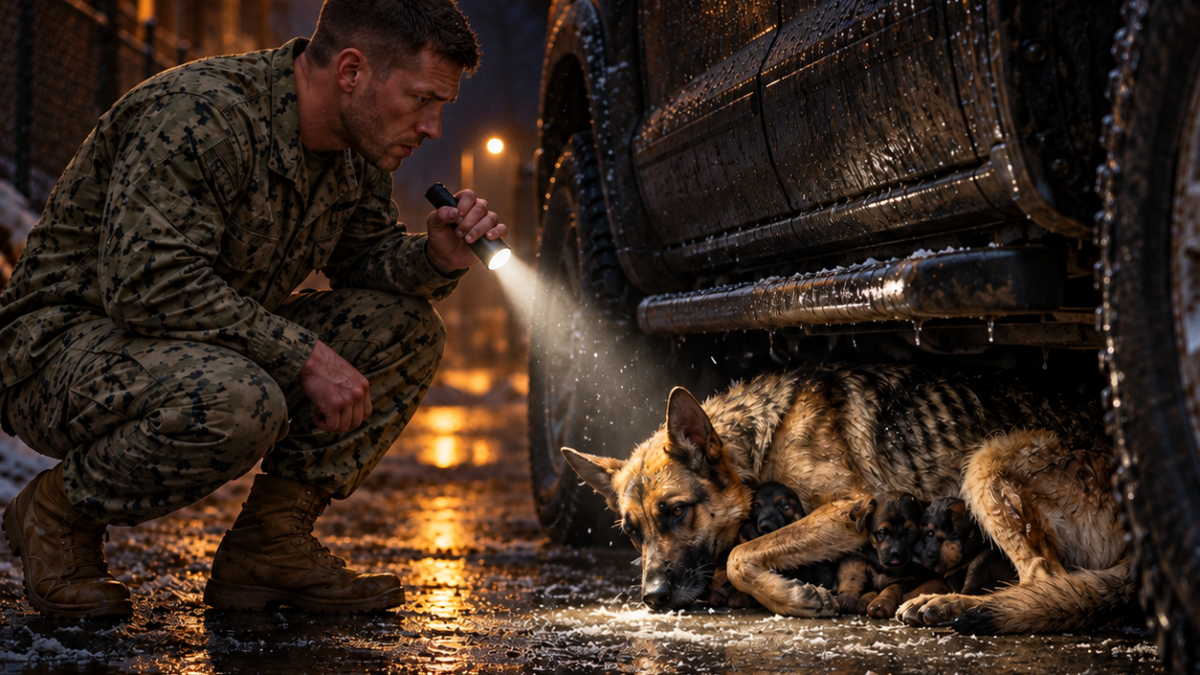
A female German Shepherd lay curled beneath the van, body wrapped tight around two tiny puppies. Snow had blown under the frame and gathered around her ribs. Her fur was sable brown and black, darker along her back, her muzzle charcoal, her eyes watchful in a way that held more caution than aggression.
A length of old leash was caught beneath the van.
Every time she tried to shift, it pulled her back.
The puppies were pressed against her belly.
One was bigger, fluffy golden brown with dark ears and oversized paws.
The smaller one barely moved.
I lowered myself onto the cold ground.
“Easy,” I murmured.
Her ears tightened.
I did not reach.
Working around dogs teaches you one thing fast.
Fear does not care about good intentions.
I placed one open hand in the snow, palm up, far enough away that she did not have to decide too quickly.
The wind cut through my uniform.
Snow melted against my sleeve.
The mother dog watched me.
I waited.
Finally, she leaned forward and smelled my glove.
Not trust.
Not yet.
But permission to remain.
I moved slowly, keeping my hand low and visible, and reached toward the trapped leash.
The metal under the van made it awkward. My fingers went numb almost immediately. The dog tensed once when the leash shifted, but I stopped, let her breathe, then started again.
“Take your time,” I whispered.
Maybe she understood the tone.
Maybe she only understood that I had not hurt her yet.
When the leash came free, she still did not move.
She pressed herself tighter around the puppies as if the cold world beyond the van was worse than staying trapped.
I took off my winter jacket and spread it beside the opening.
The larger puppy crawled forward first, wobbling with the stubborn courage of something too young to know how close it had come to dying.
The smaller one followed only because her brother’s movement opened space.
I gathered them into the jacket and held them against my chest.
The mother rose instantly.
She stayed so close to me that her shoulder brushed my arm.
“Good girl,” I said.
Her eyes remained on the puppies.
Always the puppies.
I carried them to the pickup and placed them on the passenger seat, wrapped in my jacket. Then I went back for their mother.
She stood at the open door, staring inside as if the truck represented a decision she did not know how to make.
I stepped back.
No pressure.
No leash pull.
No hand on her collar.
After a moment, she climbed in.
That was when I knew I was not leaving town that night.
The smaller puppy barely moved beneath the jacket.
I checked my phone for the nearest veterinary clinic and saw one light still on across town.
Whitaker Veterinary.
I called ahead.
A woman answered on the third ring.
“Whitaker Veterinary. This is Norah.”
“I found a mother German Shepherd and two puppies under a van,” I said. “The small one is weak. I’m ten minutes out if the roads hold.”
There was no hesitation.
“Bring them inside.”
The drive across Pine Hollow felt longer than any convoy I had ever ridden in.
The streets were almost empty, streetlights glowing through snow like blurred candles. I kept one hand near the puppies at every stop, watching for breath beneath the jacket.
The mother dog sat stiff beside them, eyes on the windows, body angled protectively.
She did not bark.
She did not whine.
She simply watched.
I knew that kind of watching.
Sam watched that way.
As if the world was a language and every movement meant something.
Norah Whitaker opened the clinic door before I reached it.
She was in her thirties, auburn hair tied into a loose bun, calm eyes, sleeves rolled to the elbows. She did not ask why a man in Navy camouflage looked like he had just walked out of his own funeral.
She looked at the bundle in my arms.
“Inside,” she said.
That was all.
I liked her immediately.
She took the puppies while I guided the mother into the exam room. The dog walked low, close to me, never taking her eyes off Norah’s hands.
“What’s her name?” Norah asked.
“She doesn’t have one.”
“Then we’ll work without one for now.”
She examined the mother first.
Three years old, maybe.
Thin but not failing.
Worn fur beneath the collar.
Old mark on one paw.
Then she moved to the puppies.
The larger male had stronger lungs and better color.
The smaller female was colder, weaker, and slow to respond.
Norah found a short blue thread caught near the small puppy’s nail and removed it carefully with tweezers.
“Is that important?” I asked.
“Maybe. Maybe not.”
She placed it on a small white pad instead of throwing it away.
That told me something about her.
She respected small evidence.
People who do that tend to respect truth.
While she worked, I stood in the hallway, melted snow dripping from my sleeves onto the tile. My phone buzzed once.
A voicemail from my sister Clare.
I played it again, though I already knew every word.
The key is still where Dad left it. The heating system works. If you want to come home, you can.
Home.
I had avoided that word since my father’s funeral.
The house outside Pine Hollow had been his for more than thirty years. After he died, I told myself I would sell it. I told Clare that too. I said it was too much property, too many memories, too much work.
The truth was simpler.
I did not know how to stand inside the rooms he had left behind.
I did not know how to be a son after the father was gone.
So I kept taking assignments.
Deployment made grief useful.
Distance made guilt quieter.
Norah came out with a clean towel in her hands.
“The small one is responding,” she said. “Carefully, but responding.”
I let out a breath I had not realized I was holding.
The mother dog rested near the exam table, still tense, still watching.
I reached into my bag for a spare glove. Travis had handed it to me during equipment prep before the failed recovery operation. I had thrown it in my pack without thinking.
The moment I pulled it out, the mother dog recoiled.
She stepped in front of the puppies, shoulders tight, eyes fixed on the glove.
I froze.
Norah noticed.
So did I.
Slowly, I folded the glove and put it away.
The mother did not relax until Norah handed me a different towel.
“What was that?” Norah asked.
“I don’t know.”
But I did not like the way my stomach tightened.
That night, I named the mother Hazel because she needed something gentle that did not make her sound fragile.
The larger puppy became Finn.
The smaller one became Piper.
By then, I had called Clare.
She answered after the third ring.
For a second, neither of us spoke.
There were years inside that silence.
Then I said, “I need you to turn on the heat.”
A pause.
“What?”
“There are three dogs coming home with me.”
Clare did not ask whether I was serious.
She knew better.
By the time I reached the house, the storm had shifted east, leaving the driveway bright beneath the porch light she had left on for me.
The house smelled exactly the same.
Dry wood.
Old books.
Cedar polish.
My father.
The kitchen clock was still seven minutes slow. The curtain by the front window still hung unevenly. The floorboard near the hall still creaked under my left boot.
Nothing had changed.
That made it worse.
I carried Finn and Piper into the living room and laid them on a clean blanket beside the heating vent. Hazel followed, but stopped several feet away, studying the room.
She did not trust houses yet.
Maybe she did not trust people.
I understood both.
I lowered the puppies onto the blanket, placed a shallow dish of water nearby, and stepped back.
Only after I turned away did Hazel approach.
She sniffed the blanket.
Checked Finn.
Checked Piper.
Then curled around them like the whole world outside her body was negotiable.
I left food near the edge of the room.
I did not watch her eat.
That matters with hungry animals.
It matters with hungry people too.
The first night passed in small tasks.
Blankets.
Warm water.
Phone calls to Norah.
Piper’s feeding schedule.
Finn’s temperature.
Hazel’s body language.
I wrote every instruction on the back of an old grocery list because if I stopped moving, I would think about Sam.
Where he was.
Whether he had eaten.
Whether he thought I had left him.
Before dawn, Hazel sat beside the puppies with her head raised, listening to the house.
The furnace clicked.
A branch brushed the roof.
A vehicle passed far beyond the trees.
Each time, Hazel looked toward the hall before returning to the litter.
Sam had always done the same thing.
Listening not like a dog startled by sound, but like a teammate identifying a pattern.
On the second morning, Clare arrived with groceries, towels, and her nine-year-old son Owen.
Clare was thirty-four, careful, guarded when worried, and far kinder than I deserved. Owen had unruly brown hair, serious hazel eyes, and the kind of earnestness that made him treat every small job like sacred duty.
He entered the living room slowly.
He did not rush the puppies.
Did not squeal.
Did not reach.
He sat on the floor several feet away and waited.
Finn crawled toward him first, placed one tiny paw against Owen’s sneaker, and promptly fell asleep.
Owen looked up at me as if he had been chosen by a king.
“He came to me.”
“He did,” I said.
Owen took a notebook from his backpack and began copying Norah’s feeding times into a chart. He taped it to the refrigerator, checked each mark twice, and then added names in uneven handwriting.
HAZEL.
FINN.
PIPER.
Below them, with a space left blank, he wrote:
SAM.
I stared at the name.
Owen followed my eyes.
“For when he comes back,” he said.
I did not correct him.
That evening, Hazel saved us the first time.
She had been nursing Piper while Finn slept against her side when her entire body went still. Her head lifted. Ears forward. Eyes toward the back door.
A low warning sound came from her chest.
Not a bark.
A warning.
I turned off the kitchen light and moved to the side window without standing directly in front of it.
A figure stood near the detached garage.
Delivery jacket.
No package.
One hand near the lock.
I picked up my phone and called the local non-emergency line, giving only what I could observe.
The porch light came on automatically.
Hazel barked once.
Sharp.
Hard.
The figure stepped away from the garage and crossed the snow toward the driveway. A vehicle started down the road and faded into the dark.
I did not chase.
The old me wanted to.
The angry me wanted to.
The man who had just lost his team, his dog, and his name wanted to run that figure down and drag answers out of him with both hands.
But Piper was sleeping in the living room.
Finn was curled near Owen’s chart.
Hazel was trusting me not to turn the house into another battlefield.
So I stayed inside.
When officers cleared the area and I finally checked the garage, I found the lock scratched but not opened.
Near the base of the door lay a small orange piece of plastic half-buried in snow.
It carried a faded industrial emblem and part of a word I could not fully read.
But I recognized enough to feel my pulse change.
Northridge.
Northridge Logistics had transported equipment for the training center.
Northridge had been connected to the operation where Sam was blamed.
I photographed the fragment in place, then bagged it cleanly.
Evidence first.
Anger later.
I sent the photos to Maya Brooks.
Maya was one of the few investigators who had not treated me like a man trying to save face. She never promised what she could not prove. I respected that, even when I hated it.
Her reply came minutes later.
Preserve everything. I’ll call in the morning.
The next morning, Norah called first.
“I traced Hazel’s microchip,” she said.
I stood at the kitchen counter, staring toward the garage.
“And?”
“The registration goes back to a rescue organization that closed almost two years ago. I found a former records manager. Hazel was transferred to a guard dog training business operated by Wade Keller.”
The name meant nothing.
Then Norah continued.
“Keller also managed warehouse spaces leased to Northridge Logistics.”
I looked at the sealed bag on the table.
The orange plastic fragment.
The scratched garage lock.
Hazel’s reaction to Travis’s glove.
Now Northridge again.
Nothing was proof yet.
But coincidence had begun stacking itself into a shape.
At the clinic that afternoon, Hazel reacted again.
We had just reached the entrance when a delivery truck turned into the neighboring store lot. Blue mountain emblem on the side. Northridge colors.
Hazel lowered instantly.
Paws locked.
Body pulling backward toward the pickup.
I did not force her forward.
I moved with her to a sheltered space beside the clinic and waited.
Her breathing came fast through her nose. Her eyes stayed fixed on the truck until it disappeared.
Norah saw all of it.
“It might be recognition,” she said after we got inside. “A sound, a scent, a shape. Something she associates with a difficult memory. We record it. We do not turn it into a conclusion yet.”
I nodded.
That was the discipline I needed.
Not certainty.
Evidence.
Maya called on the way home.
She had checked traffic records. A vehicle with the same plate had been seen near the visitor parking area the day I found Hazel.
Again, not proof.
But not nothing.
That night, Ben Lawson called.
Ben was a young equipment technician who had assisted the team before the failed recovery operation. He spoke like someone trying to confess without opening the door all the way.
“I heard you sent camera information to Maya,” he said.
“I did.”
“There’s something I should tell you about Travis’s body camera.”
My hand tightened around the phone.
Ben said he had helped remove the camera for inspection before the operation. He remembered a longer diagnostic sequence than the one shown during the review.
The official clip began just before Sam moved toward Travis.
Ben believed the device had recorded several minutes earlier.
“Do you have the file?” I asked.
“No. But I know which maintenance unit handled it.”
“Tell Maya.”
“I signed something too,” he admitted. “A dispatch sheet. Travis asked me to acknowledge a shipment before the operation. I checked the outside labels, but I didn’t complete the full inspection. He said everything had already been verified.”
Anger came fast.
Hot.
Sharp.
Because that kind of mistake had cost me everything.
Then I heard the way Ben was breathing.
Young.
Scared.
Ashamed.
I remembered being young enough to confuse confidence with authority.
“Give Maya everything,” I said. “Including the part that makes you look bad.”
“Do you think I’ll lose my job?”
“I don’t know.”
A silence.
“That’s not comforting.”
“It’s honest.”
He stayed quiet.
Then he said, “Maybe I needed honest.”
After the call, I grabbed my coat.
Clare saw me from the hall.
“Where are you going?”
“To clear my head.”
“Are you going for a drive, or are you planning to find Travis?”
I said nothing.
That answered her.
She did not block the door.
My sister was too smart for that.
Instead, she said, “Sam has less than a day, Ethan. You confront Travis, and you give everyone a reason to turn away from the evidence.”
“I know.”
“No. You don’t. You know it like a soldier knows an order. I need you to know it like someone who wants Sam alive.”
That hit harder.
From the living room, Owen adjusted a blanket around Piper. Hazel watched me from the floor, head raised but body relaxed.
This house was holding fragile things now.
Not just puppies.
Not just a mother dog.
Trust.
My sister’s.
Owen’s.
Hazel’s.
Maybe mine.
I put the keys on the table.
Then I called Maya.
“I’m staying home,” I said when she answered. “Tell me what you need from me.”
At 2:17 the next morning, the break came.
Maya’s team recovered a diagnostic copy from an old equipment drive.
The file contained several minutes of footage and a short audio segment before the recovery operation.
It did not contain a dramatic confession.
Real life rarely gives you that.
What it showed was worse in its quiet way.
Travis speaking with a Northridge coordinator near a service vehicle.
A change in transport schedule.
An alternate route not yet announced to the full team.
A revised shipping document.
Access logs placing Travis at a Northridge-leased warehouse outside normal hours.
Altered labels.
Residue on Travis’s pouch from a training explosive material in the odor category Sam had been taught to identify.
And the missing minutes.
When Maya showed me the expanded footage, I felt something inside me shift.
There I was on-screen with Sam at my left leg.
Controlled.
Focused.
Checking the surroundings.
Returning to position.
Waiting.
Then Travis entered the frame.
Sam’s head turned.
His nose lifted.
Not at Travis’s face.
At the pouch near Travis’s right hip.
Maya replayed it.
Slower.
Sam looked away when I gave a command.
Corrected position.
Then returned his attention to the same pouch.
Again.
And again.
Travis crossed behind us.
Sam tracked the pouch.
Then Travis reached down, his hand making contact with Sam’s shoulder as the dog moved closer.
Sam reacted by catching the outer part of Travis’s protective sleeve.
Not a full attack.
Not loss of control.
A targeted response after repeated odor interest and contact.
Once distance opened, Sam settled beside me again.
I sat in that room and stared at the screen.
For days, I had asked why Sam ignored me.
Now I understood I had been asking the wrong question.
“He heard me,” I said.
David Ross, the working dog specialist Maya had brought in, nodded.
“He corrected position. That matters.”
“He wasn’t gone.”
“No,” David said. “He was not simply beyond command.”
I leaned forward.
“The pouch.”
Maya placed a lab report on the table.
“Testing found traces of a training explosive material. It may explain why Sam kept returning to it. We still need the handling history and full records.”
But the old finding no longer made sense.
Sam had not randomly gone after a teammate.
He had identified something he had been trained to find.
And the man carrying it had accused him of being uncontrollable.
Later that morning, Maya requested an emergency hold on Sam’s order.
I drove to the facility before the paperwork arrived.
Not fast.
Not reckless.
I did not call Travis.
I did not call anyone connected to Northridge.
I checked in through the front office and walked to the outer fence with Sam’s old leash in my hands.
The facility supervisor, Marilyn Cross, spoke gently.
“The order hasn’t come through yet.”
I nodded.
I stood by the fence and waited.
That was all I could do.
Waiting is harder than combat in some ways.
In combat, fear has direction.
Waiting makes fear sit beside you and talk.
I folded and unfolded the leash strap between my fingers.
I thought about Sam placing one paw over my boot beside vehicles when we waited for transport.
If I shifted my foot, he always found it again.
As if he needed to confirm I was still there.
My phone buzzed.
A photograph from Clare.
Finn had fallen asleep across Owen’s feeding chart, one paw covering the word SAM.
For the first time in days, I smiled.
Then Maya called.
“The hold has been signed,” she said. “The facility received it.”
I closed my eyes.
“So Sam is staying.”
“Sam is staying. The transfer is stopped while review continues.”
I rested one hand against the cold fence and lowered my head.
I did not shout.
Did not celebrate.
Did not pump a fist.
Relief does not always come loud.
Sometimes it just lets you breathe.
Over the next several days, the review widened.
The warehouse inspection connected Hazel to the Northridge-leased facility. Investigators found old guard dog compartments, dusty bowls, bedding, and a torn blanket with blue stitching similar to the thread Norah had removed from Piper’s paw.
An old collar matched Hazel’s microchip registration.
A warehouse employee named Luis Romero identified Hazel from a photograph and admitted he had seen her there with the puppies. He had asked whether a rescue would take them. Wade Keller told him transportation had been arranged.
The service vehicle had later entered the support area near the training center.
Somewhere in that chain, an enclosure latch failed.
Hazel escaped with her puppies and ended up beneath that van in the snow.
The orange fragment at my garage tied back to Northridge equipment.
Messages suggested someone believed I had a missing recording device.
I never had it.
But they thought I did.
That was why someone came to the garage.
Travis was taken into custody for questioning after the full evidence package was submitted.
I did not ask for details that did not belong to me.
Not because I did not want them.
Because I had finally learned that wanting the truth and interfering with it are not the same thing.
The final decision on Sam came three days later.
I was standing at the kitchen sink when Maya called.
“The original finding has been withdrawn,” she said.
I gripped the counter.
She continued, “The irreversible order has been cancelled.”
I could not speak.
“Ethan?”
“Can I see him?”
“The release papers are being prepared.”
At the facility, Marilyn handed me the final forms and stepped aside.
The hallway door opened.
Sam came through with the same controlled confidence I knew better than my own reflection.
He saw me.
Then he moved.
Not running wild.
Not frantic.
Just direct.
Certain.
He pressed against my legs and pushed his nose into my jacket as if checking every part of me was still there.
I dropped to one knee and wrapped both arms around him.
I had prepared sentences.
Apologies.
Promises.
Explanations.
None of them survived.
Sam did not need a speech.
He needed my hands in his fur and my breath steady enough to prove I was real.
Marilyn gave us privacy.
I stayed there on the floor until Sam finally leaned his full weight into me.
Outside, he settled in the back of my pickup, alert but calm.
I closed the door, climbed into the driver’s seat, and called Clare.
“We’re coming home,” I said.
Then I called Norah.
“I need to introduce Sam to Hazel carefully.”
“You need to do everything carefully,” she said.
“I know.”
“No forced contact. Tall gate. Short sessions. Quiet room. Let Hazel protect her puppies without feeling challenged.”
“Yes, ma’am.”
“And Ethan?”
“Yes?”
“Breathe before you open the door.”
I did.
At home, Owen had placed a clean white towel on the chair near the entry.
“That’s for Sam,” he told me when we came in.
Sam noticed the house first.
Then Hazel.
She stood between him and the puppies, calm but protective.
Sam did not challenge her.
He looked at me.
Waited.
I clipped the tall gate between the living room and hall. Hazel remained on one side with Finn and Piper. Sam sat on the other, ears forward, body still.
Finn treated the entire arrangement as an invitation to investigate.
He waddled toward the gate and stuck his nose through the gap.
Hazel made a small sound.
Sam lowered himself to the floor.
No threat.
No push.
Just presence.
Piper stayed pressed against Hazel’s side, but lifted her head when Sam breathed out.
That was the first meeting.
Nothing dramatic happened.
That was exactly what I wanted.
Over the next days, trust arrived in inches.
Hazel stopped standing every time Sam entered the room.
Sam stopped watching the puppies like a mission and began watching them like a tired uncle.
Finn tried to climb his paw.
Piper eventually fell asleep near the gate while Sam lay opposite her.
On the first supervised yard walk, Hazel kept the puppies close while Sam stayed beside me.
Wide circles.
Quiet voices.
No pressure.
A few days later, Hazel allowed Sam to sniff the puppies’ blanket.
He examined it carefully, then looked toward me as if asking whether he had done enough.
I nodded.
He lowered himself near the window without taking Hazel’s bed.
That was when Hazel made the first real choice.
She curled beside Finn and Piper, watched Sam for a moment, then rested her chin on the blanket.
Not surrender.
Trust.
The house changed after that.
Clare came every Friday with Owen and stopped pretending she was only delivering groceries. Owen kept the dog chart like an official military log, adding stars when Piper gained weight and dramatic warnings when Finn tried to eat paper.
Norah visited more often than the puppies medically required.
I did not point that out.
She never treated me like a wounded hero.
I never treated her like someone responsible for repairing me.
That helped.
Ben came by once with replacement camera parts and an apology he had clearly rewritten several times.
He looked at Sam, then at me.
“I should have checked the shipment.”
“Yes,” I said.
“I trusted Travis.”
“Yes.”
“I’m sorry.”
I did not tell him everything was forgiven.
That would have been too easy.
Instead, I said, “Accountability matters most when it changes how you work afterward.”
He nodded.
Then he helped install better security lights around the property.
Luis Romero found another job after his cooperation was formally recognized. He called one afternoon to say his daughter had started a new school closer to home. His voice held relief, and I realized the investigation had protected more than Sam.
It had protected people who almost disappeared inside other people’s wrongdoing.
I completed my departure from active service under a corrected record.
Some people expected me to fight my way back.
I could have requested reassignment.
I could have forced hearings.
I could have spent the next year proving I still belonged.
But one evening, I looked across my father’s living room and saw Sam asleep by my boot, Hazel near the fireplace, Finn chewing the corner of Owen’s chart, Piper tucked under Hazel’s chin, Clare laughing in the kitchen, and Norah writing down puppy weights at the table.
For the first time in years, I did not want to leave.
Sam deserved a future not built around suspicion.
So did I.
With Norah’s help, we converted part of the garage into a small recovery area for dogs that needed temporary care. Strict limits. Clear schedules. No saving the world to avoid living in it.
That rule was Norah’s.
She was right.
Owen painted the sign himself.
The letters were uneven, and one word leaned badly to the left.
COLE’S SECOND CHANCE.
I hung it beside the garage door.
He stood back, hands on his hips.
“It looks official.”
“It looks crooked.”
He considered that.
“Officially crooked.”
Fair enough.
By early spring, the snow disappeared from the yard.
Hazel stretched on the porch in pale sunlight while Finn and Piper chased each other through the grass. Piper was still smaller, but quick enough now to steal Finn’s place near the water bowl and look innocent afterward.
Sam rested with his head against my boot.
He still checked doors.
Still watched windows.
Still placed one paw over my foot when waiting beside the truck.
But he slept deeper now.
So did I.
One evening, Clare called everyone inside for dinner.
The dogs rose in their own order.
Hazel first.
Then Finn and Piper.
I held the door open and waited for Sam.
He paused on the threshold, looked back once, and checked that I was still there.
I placed my hand on his shoulder.
“Go on,” I said.
Together, we stepped into the bright house.
Warm food.
Familiar voices.
Four waiting dogs.
A life I had not planned.
A home I had almost sold because I thought grief lived in the walls.
I had opened my door to Hazel and her puppies when I barely knew how to face another day. I thought I was saving them from the cold.
But Hazel had carried the first clues home with her.
Her fear of Travis’s scent.
Her reaction to Northridge.
The blue thread.
The warehouse trail.
The timing that led Maya back to the missing footage.
She did not understand corruption.
She did not know evidence.
She was just a mother protecting her puppies.
And somehow, by surviving, she helped save Sam.
People like to say animals rescue us.
Most of the time, that sounds too simple.
Too soft.
But sometimes simple things are true.
Hazel needed shelter.
Finn needed warmth.
Piper needed care.
Sam needed someone to ask the right question.
Clare needed me to stop leaving.
Owen needed proof that charts and hope could matter.
Norah needed me to accept help without turning it into debt.
And I needed all of them to show me that losing one life did not mean refusing the next one.
I was not the man I had been before the review board.
I was not a SEAL waiting for orders.
I was not only Sam’s handler.
I was not only the son who missed his father too late.
I was the man who stopped in the snow because he heard scratching beneath a van.
That was where the new life began.
Not in a hearing room.
Not in a courtroom.
Not when Travis was exposed.
Not even when Sam came home.
It began when I knelt in the snow, opened my hand, and waited for a frightened mother dog to decide whether I was safe.
Hazel chose to trust me for one night.
That was all.
One night became a house with heat.
A feeding chart.
A sister at the table.
A nephew taping names to the refrigerator.
A veterinarian who stayed after closing.
A retired K9 sleeping near a mother dog who had once been afraid of every shadow.
A garage sign painted by a nine-year-old boy.
A home.
Months later, people still asked how a disgraced Navy SEAL cleared his name.
I always told them the same thing.
I did not do it alone.
A mother dog led us back to the truth.
A puppy’s blue thread mattered.
A young technician told the uncomfortable part.
An investigator followed facts instead of anger.
A sister made me put down my keys.
A veterinarian reminded me not to turn fear into proof.
And Sam, my partner, waited long enough for the world to finally see what he had been trying to tell us all along.
He had not failed the mission.
He had found the betrayal.
We just needed to learn how to listen.

