A Disabled Marine Paid $1 to Save a Scarred German Shepherd Hours Before Euthanasia—Three Days Later, the Dog Reacted to a Sound in His Kitchen in a Way No Stray Ever Should.
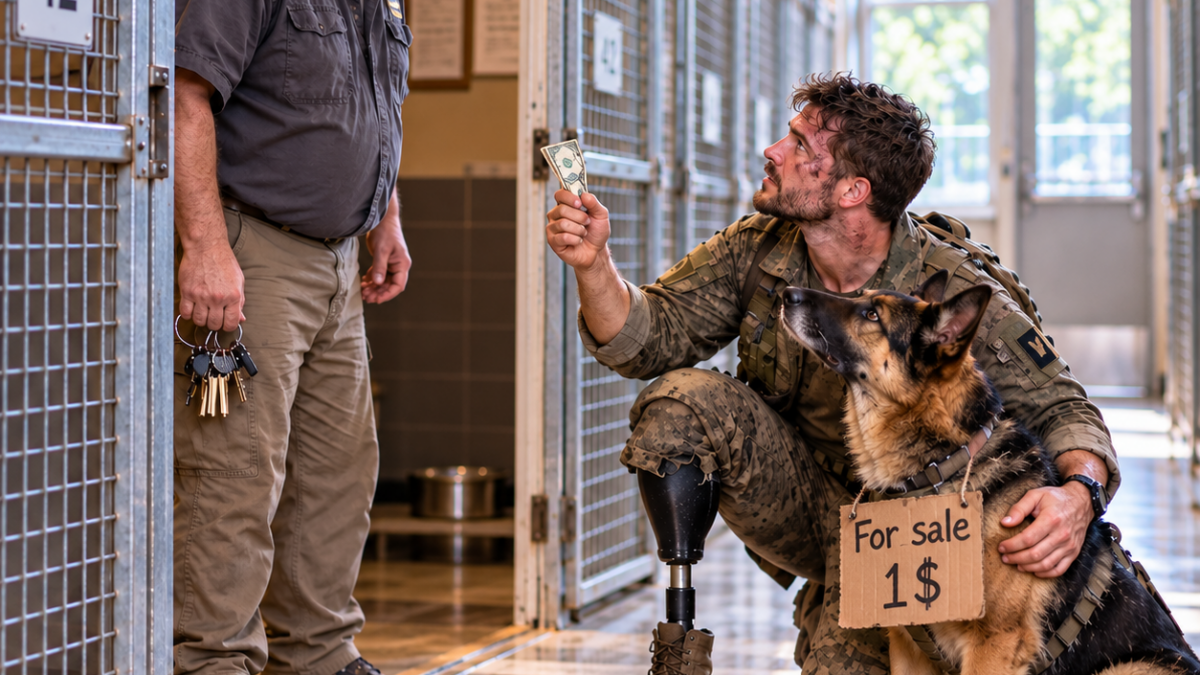
A Disabled Marine Paid $1 to Save a Scarred German Shepherd Hours Before Euthanasia—Three Days Later, the Dog Reacted to a Sound in His Kitchen in a Way No Stray Ever Should.
The shelter called the German Shepherd unadoptable.
A scarred, starving, aggressive dog with a midnight euthanasia order and no one left willing to stand between him and the needle.
Corporal David Reed bought him for one crumpled dollar bill, thinking he was saving a broken animal’s life.
But when the dog responded to an old battlefield command and revealed the lightning-shaped scar under his matted fur, David realized this was not a rescue.
It was a reunion.
The rain in Montgomery County, Pennsylvania, had not stopped for three days.
It fell in heavy gray sheets across the empty fields, across the sagging fences, across the rusted mailbox at the end of David Reed’s long gravel drive. It ran down the windows of his old farmhouse in trembling lines, blurred the tree line beyond the pasture, and turned the yard into a slick mess of mud and dead leaves.
The world outside looked exactly like the inside of David’s mind.
Gray.
Cold.
Unforgiving.
At twenty-eight years old, Corporal David Reed moved like a man twice his age. His left leg had been rebuilt badly after the blast, a mess of steel rods, scar tissue, nerve damage, and pain that did not care about physical therapy schedules. On damp mornings, the femur throbbed like the war had followed him home and taken up residence inside the bone.
But the leg was only the visible injury.
The worse damage lived where nobody could X-ray it.
In the way he slept with every light on.
In the way he counted exits in grocery stores.
In the way fireworks turned his hands cold.
In the way a dropped pan could put him back in the Sangin Valley before he had time to breathe.
David had been medically retired from the United States Marine Corps after a catastrophic ambush in Afghanistan four years earlier. The doctors had written phrases into his file that sounded clean enough on paper: traumatic injury, chronic pain, major depressive symptoms, severe post-traumatic stress response, reintegration difficulty.
Reintegration.
That was one of those words civilians liked.
It suggested something had once fit together and only needed careful hands to put it back.
David did not feel like something disassembled.
He felt like wreckage.
His days were measured in bitter black coffee, prescription bottles, VA appointments, and silence. The farmhouse had belonged to his grandfather once. It sat alone at the edge of seventy acres no one farmed anymore, surrounded by fields that had gone wild and fences David kept meaning to repair but rarely did.
The house had too many rooms for one man.
That was part of the problem.
Every sound became suspicious because there were so few sounds left.
The refrigerator hummed.
The floorboards creaked.
Rain struck the roof.
Wind scraped branches along the siding.
PART2:
Sometimes, at two in the morning, David would sit upright in bed, heart hammering, convinced he had heard a dog whining outside his door.
He never had.
Odin was dead.
He had to remind himself of that more often than any man should have to remind himself of anything.
Odin was dead.
Odin had died in Afghanistan.
Odin had not come home.
Odin had not been waiting outside the bedroom door.
Odin was not the shadow that moved at the edge of his vision when the house got too quiet.
Dr. Sarah Jenkins had been the first person brave enough to say the word dog to him again.
She was his VA therapist, a woman in her forties with kind eyes, steel nerves, and the irritating habit of not accepting the first three lies he gave her.
“You need an anchor, David,” she said during their Thursday session.
He sat in the chair opposite her desk, cane propped against his knee, jaw tight.
“I have a cane.”
“That is not what I mean.”
“I know what you mean.”
“Then stop making it harder.”
He looked out the window.
Rain streaked the glass there too.
PART3:
“Something to care for,” she said. “Something alive. Something that forces you to get out of bed when the memories get loud.”
“I’m not getting a dog.”
“I did not say dog.”
“You meant dog.”
“I meant an anchor.”
“I had a dog.”
The words came out sharper than he intended.
Dr. Jenkins did not flinch.
“I know.”
“No. You read a file.”
Her face softened.
“That is true. I read a file.”
David’s hand tightened around the cane handle.
“Odin wasn’t a pet.”
“I know.”
“He was my partner.”
“I know that too.”
“No, you don’t.”
For once, she let the silence sit.
Then she said, “Tell me what I don’t know.”
He almost walked out.
Instead, he looked at the rain and said nothing for a long time.
When he finally spoke, his voice was low.
“Odin knew before anyone else did. Before the ground changed. Before the air changed. Before the hair stood up on my neck. He knew.”
Dr. Jenkins waited.
“He saved us more times than command ever put in reports. Cleared compounds. Found wires buried under trash. Found pressure plates under rugs. Sat in doorways and refused to move until we listened. He was smarter than half the battalion and had better hygiene than most of us.”
A ghost of a smile moved across David’s face.
Then vanished.
“He trusted me.”
“That matters.”
“It was my job to bring him home.”
Dr. Jenkins leaned forward slightly.
“David.”
“He died because I didn’t.”
“That is survivor’s guilt speaking.”
“No,” he said. “That’s math.”
She did not argue with him then.
Therapists, the good ones, know when a wound is too raw for reason to enter.
But at the end of the session, she handed him a printed list of local shelters and rescue organizations.
He stared at it.
“No.”
“Put it in your truck.”
“No.”
“Then throw it away in your truck.”
He almost laughed despite himself.
Almost.
The list stayed folded in his jacket pocket for two days.
On the third day, when the rain had made the farmhouse feel like a coffin and the silence in the living room had become so loud he could hear his own pulse behind his eyes, David drove to Oak Haven County Animal Control.
He told himself he was only looking.
That was the first lie.
The gravel lot was half flooded when he pulled in. His rusted Chevrolet pickup groaned as he cut the engine. For a moment, he sat with both hands on the wheel, watching water run down the windshield.
He could still leave.
No one knew he was here.
No one would know if he drove back home, made coffee, took his pills, and let the day disappear the way most days did.
Then a dog barked from inside the concrete building.
Not Odin’s bark.
Nothing like Odin’s bark.
Still, it went straight through him.
David opened the truck door, grabbed his cane, and stepped into the rain.
The shelter smelled of industrial bleach, wet fur, fear, and old despair.
It was a grim concrete building with flickering lights and chain-link runs stretching down dim corridors. Somewhere behind the walls, dogs barked in overlapping waves, each one desperate to be heard over the others.
At the front desk sat Greg Farnsworth, a heavyset man with thinning hair, a stained coffee mug, and the face of someone who had seen too much misery for too little pay and had survived by caring less every year.
He did not look up.
“Can I help you?”
“I’m just looking,” David said.
His voice was rough from disuse.
Greg gestured lazily with his pen toward the hall.
“Row B is adoptables. Row C is strays. Don’t go past Cage 40.”
David frowned.
“Why?”
“Behavioral issues past that. Scheduled for the needle tonight.”
The word needle hit harder than David expected.
Greg looked up then, noticed the cane, the posture, the eyes.
“You military?”
“Was.”
Greg nodded once, as if that explained something but did not change anything.
“Adoption forms are on the clipboard.”
David walked down the hall.
Row B was chaos.
Dogs rushed the mesh as he passed. Paws scraped chain-link. Tails wagged with frantic hope. Some barked. Some spun. Some jumped. A brown mutt pressed a tennis ball through the fence. A white pit mix whined so softly David nearly stopped.
He should have stopped there.
Any normal man looking for an anchor would have chosen a dog that still believed in people.
But the noise began tightening around his chest.
Too many bodies.
Too much metal.
Too much need.
He was about to turn around when he noticed the silence.
At the very end of the corridor.
Past Cage 40.
Past a red warning sign.
Cage 42.
No barking came from there.
No whining.
No scratching.
Just stillness.
David took one step closer.
Then another.
In the darkest corner of the concrete run lay a German Shepherd.
At first, he seemed too thin to be real.
His ribs pressed sharply beneath a dull, matted black-and-tan coat. Patches of fur were missing, revealing pink scar tissue and old wounds. One front paw was swollen. His nails were cracked. A heavy chain mark circled his neck where fur had been rubbed raw. His muzzle was gray, but not from age alone. Hard years had put that gray there early.
The dog lifted his head.
David stopped breathing.
The eyes were amber.
Hypervigilant.
Empty of hope.
Not wild.
Not confused.
Calculating.
Waiting.
The Shepherd did not bark.
Did not lunge.
He simply watched the door like a prisoner who had already counted every way out and found none.
David stepped closer to the chain-link.
A low growl rolled through the run.
It vibrated in David’s chest.
Not rage.
Warning.
Survival.
“I told you not to go down there.”
Greg’s voice echoed behind him.
David did not look away from the dog.
“That one’s a lost cause,” Greg said, stopping several feet back. “Animal control pulled him from a scrapyard down in Trenton two days ago. Tied to a rusted-out Ford with a logging chain. Owner was cooking meth. Took off when police raided.”
The dog’s ears moved at the sound of Greg’s voice.
Not toward him.
Away.
David noticed.
“Dog’s vicious,” Greg continued. “Won’t let anyone touch him. We’re putting him down at midnight.”
David’s jaw tightened.
“What’s his name?”
“No name came with him. We put Buster on the intake card.”
The dog’s eyes remained locked on David.
Buster.
The name did not fit.
Not even close.
There was something in the way the Shepherd held his head despite starvation. Something in the cold discipline of his stare. Something in the way he had positioned himself in the corner where he could see the door and the hall at the same time.
A junkyard stray did not hold a tactical angle.
David knew that before he let himself know it.
Greg sighed.
“You don’t want that dog.”
David leaned on his cane.
The Shepherd trembled once, so small that most men would have missed it.
David did not.
Two discarded casualties of a world that did not know what to do with them anymore stared at each other through chain-link.
“I want him,” David said quietly.
Greg laughed.
It was harsh and dismissive.
“You can’t have him, buddy. He’s classified dangerous. County policy. Liability. If I let you walk out of here with that animal and he tears someone open, I lose my pension.”
David finally turned.
The tired slouch left his shoulders.
For one flicker of a second, the man standing in that shelter hall was no longer a half-broken veteran with a cane.
He was a Marine corporal again, standing in dust and heat, giving orders under fire.
Greg saw it.
His laugh died.
David reached into his worn denim jacket, pulled out his leather wallet, and removed a single crumpled one-dollar bill.
He slapped it against the metal railing of the cage.
“You’re going to euthanize a county liability at midnight,” David said. “That costs the county money. Drugs, vet, disposal. I am purchasing county property for one dollar.”
Greg stared at him.
“You mark him deceased, transferred, rescue hold, I don’t care. But he leaves with me.”
“That’s not how this works.”
“Then call someone who can tell you how it works when a medically retired Marine with nothing left to lose asks why a county shelter killed a dog it could have released for private assumption of liability.”
Greg swallowed.
“You threatening me?”
“No.”
David’s eyes did not move.
“I’m explaining paperwork.”
The rain hammered the roof.
The Shepherd’s growl had stopped.
Greg looked at the dollar.
Then at David.
Then at the dog.
“Fine,” he muttered. “But I’m not putting the slip lead on him. If he bites your hand off, that’s on you.”
“Open the cage.”
Greg unlocked the padlock with a shaking hand and backed away fast.
David stepped into the enclosure.
The Shepherd scrambled backward, pressing his body against the cinder block wall. Teeth bared. Eyes hard. Growl back now, louder, echoing in the concrete run.
David did not reach.
Did not speak in baby talk.
Did not tell the dog it was okay.
It was not okay.
They both knew that.
Instead, David lowered himself carefully to the wet concrete floor.
Pain flared up his ruined leg, bright and sharp. He clenched his jaw and kept going until he sat with his back against the opposite wall, cane laid beside him, hands open on his knees, eyes lowered to the floor.
He made himself small.
Silent.
No pressure.
Ten minutes passed.
Greg left.
The kennel hall kept barking around them.
David breathed through the pain.
The Shepherd watched.
At minute twelve, the growl softened.
At minute seventeen, it stopped.
At minute twenty-one, the dog took one step forward.
Then froze.
David did not move.
Another step.
The dog’s nose worked the air around him.
Rain.
Coffee.
Pain sweat.
Old leather.
Metal from the brace strapped under David’s jeans.
And something else.
Something beneath the years.
The dog nudged David’s elbow.
David closed his eyes for half a second.
With excruciating slowness, he raised one hand and rested it on the dog’s bony shoulder.
The Shepherd flinched.
Hard.
Expecting a strike.
David did not move.
His hand remained steady.
Gentle pressure.
No grab.
No trap.
No collar.
After a long moment, the dog exhaled.
A shudder moved through him from ribs to tail.
Then he collapsed against David’s side like his body had run out of the strength required to be alone.
David looked down at him.
“Let’s go home, buddy.”
The ride back to the farmhouse was silent.
The Shepherd refused to sit on the truck seat. He curled instead on the passenger side floorboard, nose tucked near the door, body angled so he could watch David’s hands and the road at once.
At the farmhouse, David opened the passenger door and stepped back.
The dog did not move.
David left the truck door open and walked inside.
Twenty minutes later, muddy paws crossed the threshold.
The dog entered low, scanning.
Front door.
Window.
Hallway.
Kitchen.
Back door.
Staircase.
Possible exits.
Possible threats.
He chose the darkest corner of the living room, pressed his back to the wall, and lay down facing both the front door and the hall.
David stood in the kitchen doorway watching him.
No junkyard dog did that by accident.
He filled two bowls, one with kibble and one with water, and set them down near the corner.
The dog stared at them.
Would not touch either.
David sighed.
“All right.”
He took a handful of kibble and tossed it across the floor, piece by piece, away from the bowl.
The dog tracked the first piece.
Snatched it.
Chewed.
Waited.
David tossed another.
The dog ate.
Ravenously.
“All right,” David muttered. “We do it your way.”
That night, while rain battered the Pennsylvania roof, a ghost from Afghanistan slept in David Reed’s living room.
The first forty-eight hours were a tense negotiation of space and rules neither of them spoke aloud.
David named him Buster because the shelter card had to say something.
But the name felt hollow.
Every time he said it, the dog’s ears barely moved. Not recognition. Not refusal. Just indifference.
Buster was not Buster.
David knew that.
He just did not know what else to call him.
The dog did not chew furniture. Did not bark at the mailman. Did not beg for food. Did not approach windows directly. Never exposed his back to an open doorway. Slept only in places where two walls met. Woke before David entered a room.
On the second night, thunder rolled over the farmhouse.
The dog did not bark.
He pressed himself low beneath the kitchen table, eyes open, breathing controlled.
David lay awake upstairs, listening.
On the third morning, the truth began clawing its way out.
David stood in the kitchen pouring coffee.
The dog lay in his usual position near the cabinet, a tactical vantage point where he could see the front door and the hall. The rain had faded to drizzle. The house smelled of coffee, damp wool, and wet dog.
David reached for a spoon.
His hand spasmed.
The spoon slipped.
It hit the tile floor with a sharp metallic clatter.
A normal dog would have jumped.
Scrambled.
Barked.
The Shepherd did not panic.
He dropped instantly flat to the floor, belly down, front paws crossed over his snout to protect his nose, body completely silent.
David froze.
Coffee pot suspended midair.
Breath locked in his chest.
That was not the reaction of an abused junkyard dog.
That was a trained response.
Incoming fragmentation.
Misfire.
Blast debris.
Protect the nose.
Stay silent.
Stay alive.
The kitchen disappeared.
For one brutal second, David was back in heat and dust.
Afghanistan.
The Sangin Valley baked under a white sun, one hundred fifteen degrees before noon. Sweat ran beneath David’s helmet and into his eyes. Dust coated his tongue. The patrol moved slowly through the village, rifles up, boots careful, every doorway a question.
Three paces ahead of him on a loose lead moved Odin.
Ninety pounds of German Shepherd muscle, focus, and controlled violence.
Odin was not equipment.
He was not property.
He was David’s shadow.
His partner.
His best friend.
The battalion called Odin a legend, but David knew the dog hated loud praise and preferred chicken jerky stolen from Staff Sergeant Carter’s pack.
“Find it, Odin,” David whispered. “Seek.”
Odin’s nose moved along the ground.
Then he froze.
Tail dropped.
Ears forward.
Body rigid.
The signal.
IED.
“Hold!” David shouted.
The squad stopped.
Then the world came apart.
The first explosive Odin found had been a decoy.
The real ambush waited in the tree line.
Gunfire cracked open the air. RPG backblast flashed from a wall. Men shouted. Dust erupted. David felt the ground lift under him as the secondary IED detonated.
Then heat.
Metal.
Pain.
The sensation of flying.
His leg tearing open.
White light.
And Odin’s scream.
A high, panicked yelp that had lived inside David’s nightmares for four years.
When David woke a week later at Landstuhl Regional Medical Center in Germany, Captain Miller stood at the foot of his bed.
“You’re going home, Reed,” Miller said softly. “You did good.”
David’s throat felt scraped raw from the intubation tube.
“Where’s Odin?”
Miller looked away.
That was when David knew.
“I’m sorry, son,” the captain said. “Odin didn’t make it out of the blast radius. We couldn’t recover remains before the compound was overrun.”
David had stared at the ceiling.
No tears came then.
The grief had been too large for tears.
A part of him stayed in the dirt that day with the dog he had failed to bring home.
A crack of thunder slammed David back into his kitchen.
The coffee pot trembled in his hand.
On the floor, the Shepherd remained in perfect tactical down-stay, paws shielding his snout, eyes open, breathing tight but controlled.
David set the coffee pot down.
His heart hammered against his ribs.
Impossible.
It was impossible.
There were thousands of military dogs.
Hundreds trained with similar commands.
Trauma could make a man see ghosts where only coincidence stood.
But he could not stop himself.
He stepped toward the dog.
His voice shook.
“Hier.”
Come.
The dog’s ears snapped up.
Despite the thunder, despite the fear, he broke position, trotted to David, and sat squarely at his left heel, head lifted, eyes locked.
David’s knees nearly failed.
“Zit,” he whispered.
The dog remained seated.
“Af.”
Down.
The dog dropped instantly to his belly.
David covered his mouth.
“No,” he said. “No, no, no.”
The dog stared up at him.
Focused.
Waiting.
There were only two ways to know.
Two things entirely unique.
David lowered himself painfully to one knee.
“Come here, boy.”
He led the dog to the downstairs bathroom.
The Shepherd hated the tile. His paws slipped once, and his body went rigid. David stopped.
“It’s okay. I’ve got you.”
He turned on warm water in the tub.
The dog watched, trembling.
“I just need to wash off the grime.”
It took ten minutes to coax him in.
The dog weighed barely sixty pounds now, though his frame belonged to a ninety-pound working shepherd. David lifted him carefully, pain shooting through his leg, and set him in the tub.
The water ran brown.
Then black.
Grease, mud, flea dirt, toxic scrapyard residue.
David worked mild shampoo into the matted fur, hands moving gently over ribs, spine, legs. The dog stood stiff at first, then slowly lowered his head under David’s touch.
When David reached the left ear, his breath stopped.
During a night raid in 2021, Odin had gotten caught in a coil of rusted concertina wire while pushing through a breach. The wire had torn the cartilage of his left ear, leaving a jagged lightning-bolt scar where fur never grew back.
David rubbed away dried mud from the Shepherd’s ear.
There it was.
A white scar.
Sharp.
Jagged.
Lightning.
A sob tore through David’s throat.
He gripped the edge of the tub.
But he needed the final proof.
Every military working dog carried identification. Odin’s specialized unit had used a tattoo on the inner left thigh because of his ear damage and operational classification.
David’s hands shook.
“Easy, buddy.”
The dog looked back at him.
Trusting.
That hurt most.
David gently asked him to roll.
The dog complied, exposing his vulnerable belly.
David washed away dirt from the inner left thigh. The skin was scarred, covered in rashes, flea bites, and old irritation.
Then faint green ink appeared.
A seven.
A four.
A hyphen.
A capital B.
74-B.
David collapsed backward onto the bathroom floor.
The soaking wet Shepherd scrambled from the tub and pressed into him.
David wrapped both arms around the animal and buried his face in wet fur.
“Odin,” he cried.
The dog froze.
Then whined.
A sound unlike any he had made since the shelter.
“Odin,” David said again, voice breaking completely. “It’s you. Oh my God. It’s you.”
The dog began licking his face frantically.
Not like a stray seeking food.
Like a partner finding his handler beneath four years of pain, abuse, and distance.
David held him and wept with a force that shook his whole body.
Grief and joy collided so hard he could barely breathe.
Odin was alive.
Odin was here.
His partner.
His best friend.
The hero who had saved his life in the Sangin Valley.
Alive.
But as the first wave of reunion passed, something darker rose beneath it.
Cold.
Sharp.
Furious.
Captain Miller had looked him in the eye and said Odin was dead.
The official report classified Odin as killed in action, remains unrecovered due to hostile territory.
So how had a decorated American war dog ended up starved, scarred, and chained to a meth dealer’s truck in a New Jersey scrapyard?
David wiped his face.
His eyes hardened.
Someone had lied.
Someone had stolen his dog.
Someone had betrayed a Marine, and worse, betrayed a soldier who could not speak for himself.
David did not only have Odin back.
He had a mission.
The next morning, sunlight finally broke through the Pennsylvania clouds.
Odin slept on a thick blanket beside the stove, clean now, still too thin, but warmer. His paws twitched in the grip of some fading nightmare.
David sat at the kitchen island with an open laptop, a cold cup of coffee, and eyes burning from a sleepless night of research.
He had dug through old emails.
Medical records.
After-action reports.
News archives.
Veterans’ forums.
Anything he could access.
The official Department of Defense file on Odin was brief.
Subject: MWD 74-B
Status: KIA
Remains: Unrecovered due to hostile territory
Clean.
Neat.
False.
David picked up his phone and called a number he had not dialed in three years.
It rang four times.
A gruff voice answered.
“Carter. Talk to me.”
Master Sergeant William Carter had been David’s squad leader before the ambush. Still active duty. Still connected. Still the kind of man who could find paperwork buried under six layers of military bureaucracy if properly motivated.
“Bill. It’s Reed.”
Silence.
Then the voice softened.
“Davey. Hell, man. It’s been a minute. How are you holding up?”
“I need a favor.”
“That tone usually means a bad idea.”
“It’s a big one. Off the books.”
Carter sighed.
“Talk.”
“I need the unredacted field logs from the Sangin op. Specifically the recovery sweep after I was medevaced.”
Another silence.
Longer.
“Davey.”
“Don’t.”
“You know I can’t just—”
“Bill.”
Carter’s voice lowered.
“You’ve got to let that day go.”
David looked at Odin.
The dog’s ear twitched in sleep.
“I’m looking at him right now.”
“What?”
“Odin is alive.”
Carter said nothing.
“He’s asleep in my kitchen.”
When Carter finally spoke, all casual warmth had vanished.
“Reed, are you off your meds?”
“I gave him a bath last night. He has the lightning scar on the left ear. He responded to Dutch counter commands. Tattoo on inner thigh reads 74-B.”
“Jesus.”
“I bought him for a dollar at a kill shelter yesterday. He was chained to a meth dealer’s truck in Trenton.”
David’s hand tightened around the phone.
“Someone left him behind. Someone brought him stateside. I need to know who.”
Keyboard clicks sounded faintly.
“Give me two hours,” Carter said.
Then hung up.
It took four.
David spent them sitting on the floor beside Odin.
The dog woke once, lifted his head, and pressed his muzzle into David’s knee.
“I know,” David whispered.
Odin sighed.
When the phone finally rang, David answered before the first buzz finished.
“You’ll want to sit down,” Carter said.
“I am.”
“I dug past the casualty report and into logistics manifests from the forward operating base.”
David stopped breathing.
“Odin didn’t die in the blast.”
David closed his eyes.
“He was thrown clear. Deafened. Disoriented. Your unit was pulled under heavy fire. A private military contractor group, Vanguard Logistics, was sent in three days later to sweep the sector and recover sensitive equipment.”
“They found him.”
“They found him.”
Odin lifted his head at the change in David’s breathing.
Carter continued, voice tight with disgust.
“They didn’t report it to command. Vanguard was running a side hustle. Tactical explosive detection dogs can be worth fifty grand or more to private security firms. A Vanguard extraction specialist named Richard Gable signed off on a cargo manifest listing salvaged tactical hardware.”
David’s jaw clenched.
“He smuggled Odin out.”
“Private charter. Manifest masked as returning civilian security assets.”
The pieces locked together with sickening clarity.
Odin had not been betrayed by Marines.
He had been stolen by a war profiteer.
“But Odin was traumatized,” David said.
“Exactly.”
Carter’s voice softened.
“The blast broke you, Davey. Looks like it broke him too. Gun-shy. Noise-reactive. Combat fatigued. Useless to the kind of clients Gable wanted. He couldn’t sell him as elite security anymore.”
“So he dumped him.”
“Probably sold him for pennies to some junkyard dog fighter or drug runner stateside. Recoup transport costs. Make him disappear.”
David looked at Odin’s scarred ribs.
His missing fur.
The chain mark around his neck.
A cold fury settled in him so completely that it became calm.
“Where is Richard Gable now?”
“Don’t do something stupid.”
“Where?”
“Newark. Runs a private security consulting firm. But listen to me, David. You cannot kick his door in. You’ll end up in federal prison, and Odin will lose you again.”
David’s fingers curled around the phone.
“I’m not kicking his door in.”
“Good.”
“I’m tearing his life apart legally.”
Carter exhaled.
“That sounds more dangerous.”
“Send me the files.”
For the next three months, the farmhouse became a war room.
Maps covered one wall.
Cargo manifests.
Vanguard Logistics corporate filings.
Names.
Dates.
Bankruptcy records.
Contractor rosters.
Flight data.
Redacted reports.
Unredacted ones Carter swore did not come from him, even though they arrived through channels only Carter would know.
David did not go to the local police.
This was bigger than a stolen dog.
Odin was classified government property.
A military working dog.
A combat veteran.
A living witness to fraud, theft, illegal transport, and animal cruelty.
David contacted a federal prosecutor in New Jersey named Andrea Morales, known among defense contractors as someone who enjoyed hunting war profiteers the way other people enjoyed fishing.
Her first call lasted seven minutes.
Her second lasted two hours.
By the third, she had a task force.
But while the legal war built quietly, the more important work happened inside the farmhouse.
Odin had to learn the world was not still exploding.
So did David.
Dr. Sarah Jenkins began making house calls.
The first time she saw Odin, she stood in David’s kitchen with both hands over her mouth.
“Is this—”
“Yes.”
She looked at David.
For once, the therapist had no words.
Odin stood beside David’s left leg, thin but steady, watching her with military suspicion.
Dr. Jenkins crouched.
Not too close.
“Odin,” she said softly.
The dog’s ears moved.
“Thank you for coming home.”
David looked away.
Healing did not arrive cleanly.
It came in difficult, stubborn pieces.
When thunder rolled over the fields, Odin shook so hard the windows could have broken and he would not have noticed. David sat on the floor beside him, wrapped a weighted blanket around the dog’s shoulders, and breathed slowly until both of them stopped drowning in a storm that was not Afghanistan.
When David woke screaming from night terrors, Odin was already there, pressing his heavy head against David’s chest, pinning him to the present.
When Odin refused to eat from a bowl, David scattered kibble across the floor until one day the dog chose the bowl on his own.
When David refused to leave the house, Odin stood at the door with the leash in his mouth and stared until the Marine cursed, grabbed his cane, and followed.
They rebuilt each other by routine.
Morning meds.
Breakfast.
Short walk.
Rest.
Stretching.
Training review.
Therapy call.
Dinner.
Perimeter check.
Sleep, if sleep came.
Slowly, Odin’s ribs disappeared beneath healthy black-and-tan fur. The chain mark faded. The dullness left his eyes. His body filled out. His tail lifted. His commands sharpened.
And David changed too.
He used the cane less.
Then only on bad days.
Then sometimes forgot it by the door.
Dr. Jenkins noticed before he did.
“You’re standing straighter.”
“No, I’m not.”
“Odin disagrees.”
The dog sat beside him, tongue out, looking pleased with himself.
David snorted.
“Traitor.”
The deposition happened on a crisp Tuesday morning in October.
Downtown Newark looked too polished for the ugliness hiding inside the conference room. Mahogany table. Glass walls. Defense attorneys in expensive suits. Federal prosecutor Andrea Morales at one end with a clean legal pad and the expression of a woman who had already decided exactly where the knife would go.
Across from her sat Richard Gable.
Slick hair.
Tailored suit.
Silver watch.
Confidence built from years of assuming no one would ever dig deep enough.
He denied everything smoothly.
He had never knowingly transported military assets outside authorized channels.
He had no memory of MWD 74-B.
Vanguard Logistics had followed all applicable regulations.
Records from Afghanistan were chaotic and unreliable.
He was sorry for Corporal Reed’s injuries, of course, but—
The conference room doors opened.
David walked in.
He did not wear dress blues.
He wore dark jeans, boots, and a black jacket.
No cane.
At his left heel walked Odin.
Full weight restored.
Coat gleaming.
Eyes bright.
A heavy leather harness sat across his shoulders, fitted carefully to avoid old scar tissue. On it gleamed a brass badge:
US MARINE CORPS K9 VETERAN
MWD 74-B ODIN
Richard Gable’s face drained of color.
He stared at the dog’s left ear.
At the lightning scar.
Odin stared back.
Silent.
Steady.
Alive.
Prosecutor Morales slid a photograph across the table.
Odin chained to the rusted Ford in Trenton.
Then another.
Odin in Afghanistan, standing beside David in full working kit.
Then a manifest.
Then a flight record.
Then a payment transfer.
“Mr. Gable,” she said, “this is Corporal David Reed. This is military working dog 74-B, Odin. Would you like to revise your statement regarding your cargo imports in 2022?”
For the first time all morning, Richard Gable had nothing to say.
He was indicted on twenty-two federal counts.
Fraud.
Theft of government property.
Falsification of Department of Defense manifests.
Illegal transport.
Conspiracy.
Animal cruelty.
The case exploded across the media once charges were unsealed.
Vanguard Logistics collapsed under scrutiny. Other handlers came forward. Other missing dogs were investigated. A congressional oversight committee began reviewing the treatment, tracking, and retirement of military working dogs overseas.
Reporters called David a hero.
He hated that.
Odin was the hero.
David had only paid attention when the world told him not to.
The legal victory mattered.
Of course it did.
But it was not the moment David remembered most.
The moment came in winter.
Snow blanketed the Montgomery County fields in clean white silence. The farmhouse roof held a thick soft layer. The repaired fence line ran dark against the pasture. Smoke rose from the chimney.
David stood on the back porch with a mug of black coffee warming his hands.
He had not taken painkillers that morning.
He had not needed the cane in weeks.
At the edge of the tree line, Odin stood half-hidden in snow up to his chest, ears high, tail lifted, body alive with anticipation.
David smiled.
“Odin!”
The Shepherd exploded into motion.
A black-and-tan blur through white drifts.
Snow flew behind him. His ears pinned back. His mouth opened in pure joy. He bounded across the field like the years had fallen away, like no chain had ever held him, like no one had ever written KIA beside his name.
He hit the porch steps at full speed and slammed his head into David’s hip.
David laughed.
A real laugh.
The kind he had thought Afghanistan took from him.
He dropped to his knees in the snow and buried his face in Odin’s warm fur.
The dog’s tail wagged so hard his whole body shook.
They had both been discarded.
Both labeled broken.
Dangerous.
Lost.
Ruined by ghosts of a war fought thousands of miles away.
But looking into Odin’s bright amber eyes, David understood the truth.
They had not been broken beyond repair.
They had been waiting.
Waiting for recognition.
Waiting for the right voice.
Waiting for someone to look past the scars, the growls, the records, the files, the word unadoptable, the official reports, the neat lies, and say the name that still belonged to them.
Odin.
David pressed his forehead to the dog’s.
“I brought you home,” he whispered.
Odin licked his face.
David laughed again, crying now too, but not the way he had cried on the bathroom floor.
Those tears had been grief breaking open.
These were different.
These were proof that something living could still grow in ground everyone else had called ruined.
Years later, people would tell the story as if it turned on the dollar.
A Marine bought a broken K9 for one dollar and discovered it was his missing partner.
That was true.
But it was not the whole truth.
The dollar only opened the cage.
The real rescue happened after.
In the bathroom, when mud washed away and the old scar appeared.
In the kitchen, when thunder came and neither of them faced it alone.
In the nights when Odin pulled David out of nightmares and David pulled Odin out of his.
In the morning walks.
In the legal files.
In the refusal to let a clean report bury a dirty truth.
In the farmhouse that stopped being silent.
In the snow, when a dog once left for dead ran home through the white fields and found his Marine waiting.
Some bonds are not ended by distance.
Some names do not die because paperwork says they did.
Some soldiers come home late.
Some come home limping.
Some come home scarred, starving, and called dangerous by people who never knew what they survived.
But home is not always a place you reach on time.
Sometimes home is a man with a ruined leg kneeling in the snow.
Sometimes home is a dog with a lightning scar pressing his head into the only hands that ever truly knew him.
And sometimes, the thing everyone else calls broken is only waiting for the one person who remembers its true name.


