A Couple Drove 45 Minutes Home With the Shelter Kitten They Chose—Then One Detail About the Blind Kitten They Left Behind Made Them Turn the Car Around.
PART3:
He glanced at me. “You say that like you’re humoring me.”
“I’m not humoring you.”
“You have a dangerous face.”
“I have a normal face.”
“You have a face that once brought home a three-legged raccoon in a laundry basket.”
“That was one time, and wildlife rescue said I handled it appropriately.”
“You fed it blueberries in our bathtub.”
“It was stressed.”
Ben shook his head, but he was smiling.
That was the last easy moment before everything changed.
The shelter sat behind a veterinary clinic at the edge of town, a low brick building with peeling white trim and a sign that read SECOND CHANCE ANIMAL RESCUE in blue letters faded by too many winters. Inside, the air smelled like disinfectant, wet dog, old towels, and hope trying very hard to survive fluorescent lighting.
The dog wing erupted the second we walked in.
Barking, whining, paws scraping against kennel doors. Ben stiffened. I reached for his hand without thinking, and he squeezed once, hard. Murphy had been a shelter dog. Old grief has strange doors, and apparently one of ours sounded like a Labrador crying behind chain link.
The cat room was quieter.
Not silent. Never silent. Kittens squeaked. An orange cat yelled from the top of a tower. A black-and-white senior stared at us with the exhausted judgment of a retired school principal. A volunteer in purple scrubs led us past enclosures with laminated cards clipped to the front.
“This little guy came in with a group of kittens last month,” she said, stopping in front of a lower cage. “He’s sweet. Very gentle. A little shy at first, but he warms up.”
The gray tabby was sitting at the back of the enclosure.
He did not rush forward.
He did not paw at the glass.
He did not perform cuteness like the calico beside him, who was throwing herself dramatically against her blanket as if auditioning for a soap opera.
The tabby just looked at us.
Big eyes.
Steady.
Almost careful.
Like he was trying not to hope too much.
Something in my chest shifted.
Ben crouched beside me.
“Well,” he said softly.
I looked at him. “What?”
He kept his eyes on the kitten. “He looks like he’s already forgiven us for being late.”
That was when I knew Ben was done.
The volunteer opened the enclosure and placed the kitten in my arms.
He was smaller than he had looked behind the glass, all soft fur and sharp little shoulder blades. He trembled once, then tucked his head under my chin. I felt the tiny pressure of his paws through my sweater.
“Oh,” I whispered.
Ben swallowed.
The volunteer smiled. “That happens a lot.”
I sat in a plastic chair while the kitten slowly unfroze in my lap. He sniffed my sleeve. He put one paw on my wrist. Then he looked up at Ben.
Ben extended a finger.
The kitten sniffed it, then pressed his forehead against Ben’s knuckle.
My husband looked away for a second.
He pretended to read the adoption card.
I pretended not to notice his eyes.
The kitten’s temporary shelter name was Caleb.
He was twelve weeks old.
No major medical issues.
Eating well.
Litter trained.
Good with handling.
A sensible kitten.
The kind we had promised each other we would choose.
The kind of kitten that made you think, Okay. Yes. This is the one. We can do this.
So we did.
We signed the papers. We paid the fee. The volunteer placed him in the carrier with the fleece blanket. Ben thanked the woman at the desk. I kept one hand on top of the carrier because I already felt responsible for every breath inside it.
It should have been the happy ending right there.
But on the way out, I glanced toward the far corner of the cat room.
That was when I saw the other kitten.
Tiny.
Smaller than the tabby.
Black with a little white patch under her chin, like someone had touched her with a paintbrush and then changed their mind. She was tucked into the back of an enclosure, almost hidden behind a folded towel. She didn’t come forward. Didn’t meow. Didn’t reach through the bars.
Her eyes looked cloudy.
Unfocused.
Not injured exactly.
Just lost.
I stopped walking.
Ben noticed immediately.
“No,” he said softly.
I stepped closer anyway.
The black kitten turned her head when I spoke, but not toward me. Toward the sound. Her ears twitched, searching. Her little body stayed pressed against the towel as if the room were too large and she had chosen the only small place she understood.
“She’s blind,” I whispered.
The volunteer behind the desk heard me.
“Yes,” she said gently. “We think congenital. She gets around better than people expect, but she’s timid. She relies a lot on sound.”
“What’s her name?”
“June. That’s what we’ve been calling her.”
June.
A small, soft name for a small, soft creature the world had already made harder.
I knelt in front of the enclosure. “Hi, June.”
Her ears moved.
She lifted her face.
For one second, I imagined she was looking at me, even though I knew she wasn’t.
There’s something about quiet animals that gets to me more than the noisy ones.
The loud ones ask to be saved.
The quiet ones look like they’ve already made peace with being forgotten.
“Laura,” Ben said.
I knew that voice.
Not angry.
Afraid.
Afraid of me.
Afraid of himself.
Afraid of the version of us that might say yes before our bank account could catch up.
I stood slowly.
“I know,” I said.
And I did know.
One cat.
That was the agreement.
So I walked out.
We got in the car.
We drove.
For maybe ten minutes, neither of us said much. The tabby shifted in his carrier and made a tiny questioning sound. I slipped my finger through the door, and he pressed his nose against it. He was already trusting us. Already ours.
Still, I couldn’t stop seeing that little black kitten in the corner.
Her cloudy eyes.
The white mark under her chin.
The way she turned toward my voice but not quite to me.
At a red light, Ben glanced over.
“You’re thinking about her.”
I stared out the windshield.
“Yes.”
He nodded once.
“Me too.”
That somehow made it worse.
Because if only one of us had felt it, maybe common sense would have won. If Ben had said, “Laura, we can’t,” I might have cried quietly, hated myself for a few days, then folded June into the private cabinet where human beings store the mercies they were too afraid to attempt.
But now the whole car felt full of her.
The silence.
The guilt.
The image of her sitting in that corner while bigger, healthier, easier cats got noticed first.
“We said one,” I whispered.
“I know.”
“We had reasons.”
“I know.”
“We’re not bad people because we made a plan.”
Ben exhaled slowly.
“No,” he said. “But I’m starting to wonder if the plan was made before we knew enough.”
I looked at him then.
He kept driving.
The tabby stirred in the carrier.
For a moment, the road ahead blurred.
We kept driving anyway.
We made it almost forty-five minutes.
Then Ben pulled into a gas station, parked beside an ice machine, and shut off the engine.
The sudden silence rang in my ears.
He sat there for a second with both hands on the steering wheel, staring straight ahead at a poster advertising two hot dogs and a soda for $4.99.
Then he said, “If we go home like this, you and I are going to talk about that kitten all night.”
I laughed once.
Then I started crying.
Not dramatic crying.
Not movie crying.
Just that tired, embarrassed, middle-aged kind where you are relieved and ashamed and terrified all at once.
“Are we being irresponsible?” I asked.
Ben looked at the carrier.
The tabby had lifted his head. His eyes were open now, watching us through the little door.
“I think,” Ben said, “we’re about to find out what kind of people we are.”
So we turned around.
By the time we got back to the shelter, my heart was pounding so hard it felt ridiculous. I hurried inside half afraid someone else had taken her, half afraid she was still there and we would have no excuse left.
She was still there.
Still in the corner.
Still quiet.
The volunteer looked surprised when we walked back in.
“Everything okay?”
I could barely speak. “The black kitten. June. Is she still available?”
A look passed over the woman’s face.
Tender.
Relieved.
A little sad.
“She is.”
“We want to meet her.”
The volunteer unlocked the enclosure.
“Just move slowly,” she said. “Talk before you touch her.”
I knelt, my knees cracking beneath me, and said, “Hi, June. It’s me again.”
The kitten’s ears lifted.
She turned toward my voice.
Not perfectly.
But enough.
The volunteer gently brought her out and placed her in my lap.
June froze.
Her body was impossibly small, more bones than kitten beneath the fur. She did not tremble the way the tabby had. She went still in a different way, the way frightened creatures do when movement feels dangerous.
I kept my hands loose.
“You’re okay,” I whispered. “I know. This is a lot.”
Ben crouched beside us.
“Hey, little one,” he said.
June turned toward him.
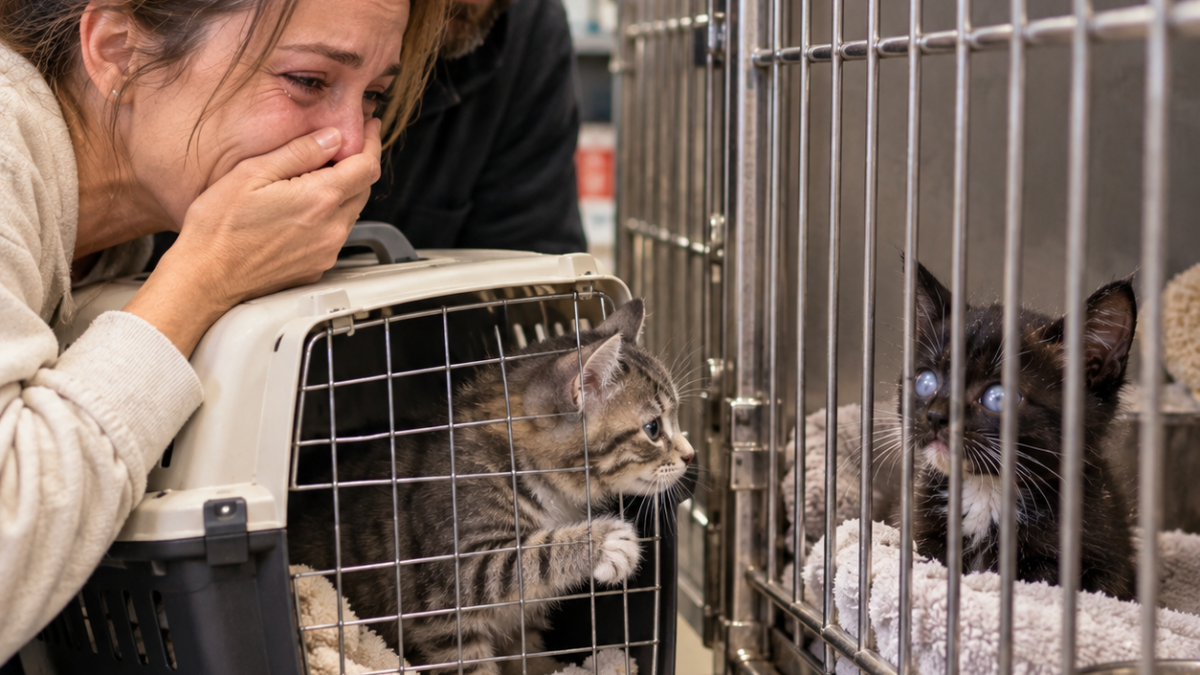
Then the tabby chirped from the carrier.
It was the smallest sound.
A soft, bright trill.
June’s whole body changed.
Her head lifted.
Her ears shot forward.
The tabby chirped again, louder this time, pressing his nose against the carrier door.
June made a sound back.
Not a meow.
Not exactly.
Something between a question and a sob.
She stepped off my lap before I could stop her, wobbling slightly on the slick floor. The volunteer reached out, but I held up one hand. June moved toward the carrier sound by sound, tiny paw after tiny paw, until her nose touched the metal door.
The tabby pressed himself against the other side.
They both began chirping.
Ben’s face changed.
“What…” he whispered.
The volunteer went very still.
I looked at the adoption card clipped to June’s enclosure.
My hand started shaking before my mind understood why.
Same birthday.
Same litter.
Same intake date.
I looked from June’s card to the papers in my purse.
Then to the little gray tabby in the carrier.
Brother and sister.
“Oh my God,” I said.
Ben took the papers from me, read them, and covered his mouth.
The volunteer’s eyes filled with tears.
“We try to keep littermates together when we can,” she said quietly. “But special-needs animals… it’s harder. And he had interest right away.”
“He never cried until we came back,” Ben said.
His voice sounded broken.
June had pressed one paw against the carrier door.
The tabby had done the same from inside.
Two tiny paws.
One metal door.
All our sensible plans collapsed under the weight of that.
I broke right there.
So did Ben.
We brought them both home.
We named the gray tabby Elliot because Ben said he looked like an Elliot—gentle, thoughtful, the kind of cat who would remember your birthday if he had thumbs. June stayed June. The name already belonged to her. Soft, warm, easy to miss if you weren’t paying attention.
The first night, we did not sleep much.
Elliot cried whenever the house went quiet.
June cried whenever she couldn’t hear him.
That was how we learned the truth of what we had brought home.
Not two kittens.
Not even just siblings.
A whole little world that had nearly been split in half because one of them was easier to choose.
We set them up in the guest room at first, with blankets, food, water, two litter boxes, and enough toys to embarrass ourselves. Ben moved the furniture away from the walls so June would have clearer paths. I crawled on the floor with my eyes closed, trying to understand the room from her height.
“This is insane,” Ben said from the doorway.
“I’m gathering data.”
“You’re crawling into a laundry basket.”
“I’m checking hazards.”
“You’re becoming one.”
I threw a sock at him.
He laughed, and for one flashing second, I heard our house sound alive again.
Then June bumped softly into the leg of the nightstand and froze.
I stopped laughing.
Elliot heard it from across the room. He walked over and pressed his side against hers.
She leaned into him.
Just like that, the room made sense to her again.
That became the rhythm of those first few weeks.
Elliot moved first.
June listened.
If he walked to the food bowls, she followed.
If he climbed onto the low cushion we placed by the window, she found his warmth and settled beside him.
If he stopped at a doorway, she stopped too, waiting for the little chirp that told her the world continued.
Ben bought him a tiny bell collar.
Not because Elliot needed it.
Because June did.
The first time we put it on him, he looked deeply betrayed. He sat in the middle of the floor and refused to move while the bell gave one pathetic little jingle.
Ben crouched in front of him.
“I know, buddy,” he said. “Marriage is also full of compromises.”
Elliot gave him a look that said he would consult his attorney.
But he wore it.
For June.
The first week was messy.
June missed the litter box twice.
Once on a rug I had already been meaning to replace, and once directly beside Ben’s shoe with such precision that I suspected judgment.
Elliot figured out where everything was by the second day.
June figured it out too, but only when he was there.
If he moved, she moved.
If he stopped, she stopped.
If he chirped, she turned like a flower finding light.
I remember standing in the kitchen that third morning with a paper towel in one hand and a cup of coffee going cold in the other. June had bumped into the cabinet, backed up, bumped again, then found Elliot’s side and pressed herself against him like the world had been solved.
Ben walked in, looked at the floor, looked at me, and said, “You thinking what I’m thinking?”
“That we’re idiots?”
He nodded. “A little.”
I laughed.
Then June tucked her head under Elliot’s chin, and Elliot began washing her ears with solemn devotion.
Just like that, I wasn’t sorry.
Tired, yes.
Worried, absolutely.
Sorry, no.
Not easy.
Not magical.
Just deeply, stubbornly worth it.
The thing people do not always tell you about rescuing an animal with special needs is that the hard part is not always the animal.
A lot of the time, the hard part is other people.
People love a rescue story when it stays neat.
They love before-and-after photos.
They love a sleeping kitten in a blanket.
They love the sentence We saved her.
What they do not always love is the middle.
The bills.
The anxiety.
The little accommodations.
The way your house slowly becomes a map for a creature who cannot afford surprises.
The fact that real compassion often looks less like a movie and more like moving the coffee table two inches and then never changing the furniture again.
My sister Marlene came over a week after we brought them home.
She was older than me by four years and had spent those four years acting like management had placed her in charge of my common sense. She was not cruel. That made her more dangerous. Cruel people are easy to dismiss. Reasonable people can climb inside your head and rearrange the furniture.
She stood in our living room holding a mug of tea, watching June follow Elliot’s bell through the hallway.
“Well,” she said. “This is sweet.”
I waited.
Marlene took a sip.
“But are you sure this was smart?”
There it was.
Smart.
Practical.
Responsible.
All the words that sound like wisdom until they land on something you love.
Ben was sitting on the floor pretending not to listen while Elliot chewed his shoelace.
I folded a dish towel too carefully.
“What do you mean?”
Marlene gave me a look.
“You know what I mean. You went for one kitten and came back with two, and one is blind. You and Ben aren’t exactly swimming in extra cash.”
“We know.”
“Vet bills can get expensive.”
“We know.”
“And if something happens? If they need special care? If one gets sick?”
Ben looked up then.
“If one gets sick, we deal with it.”
Marlene turned to him. “I’m not trying to be harsh.”
“No,” he said. “You’re trying to be realistic.”
She relaxed slightly.
Ben added, “Sometimes those sound more alike than they should.”
Silence.
Marlene looked wounded.
I almost apologized.
Old habit.
Instead, I watched June walk slowly across the rug. Elliot was on the couch now, the bell quiet. June stopped in the middle of the room, uncertain. She lifted one paw and set it down again. I opened my mouth to call her, but Ben made a soft clicking noise with his tongue.
June turned.
She walked toward him.
One step.
Then another.
When she reached his hand, he let her sniff his fingers before touching her head.
Marlene watched.
Something in her face changed, but not enough.
“She is sweet,” she said.
“She is,” I answered.
“I just hope you’re prepared.”
I wanted to say, prepared for what? For inconvenience? For love to ask something from us? For a living being not to arrive perfectly packaged?
Instead, I said, “We’re learning.”
Marlene sighed.
“I worry about you.”
“I know.”
She reached for my hand.
That was what made it complicated.
People can hurt you with genuine concern.
That night, after she left, I sat on the edge of the bed and cried because I hated that her words had found a place inside me.
Ben came in quietly.
“Hey.”
“I know what you’re going to say.”
“What am I going to say?”
“That she means well.”
He sat beside me.
“No,” he said. “I was going to say she annoyed the hell out of me.”
I laughed through tears.
He put his arm around me.
“Laura, we’re not reckless because we didn’t walk away from a blind kitten.”
“What if she’s right?”
“About what?”
“What if love isn’t enough?”
He was quiet for a long time.
Then he said, “Love isn’t food. It isn’t medicine. It isn’t money. So in that way, no, love isn’t enough.”
I wiped my face.
He continued.
“But love is why people find the food, pay for the medicine, figure out the money, ask for help, stay up all night, change the furniture, and try again after getting it wrong. So maybe love isn’t everything. But it is the thing that makes everything else worth doing.”
I looked at him.
“Since when are you profound?”
“Since we became outnumbered by cats.”
He kissed my forehead.
Across the room, Elliot jumped onto the bed with the soft jingle of his bell. June followed the sound, bumped lightly into the bed frame, then chirped in frustration.
Ben got down immediately.
“Come on, June Bug,” he said in the low voice he had invented just for her. “Bench is right here.”
He tapped the little ottoman by the bed.
June turned toward the sound.
She climbed onto the ottoman.
Then onto the bed.
Then straight onto Ben’s pillow, where she settled like a queen claiming ancestral land.
Ben stared at her.
“That’s my pillow.”
June tucked her paws under herself.
“Apparently not,” I said.
He sighed and lay down on the very edge of the mattress.
I slept better than I had in months.
The first real vet bill came sooner than expected.
Not for June.
For Elliot.
He was five months old when he stopped eating one morning.
Elliot loved food in the polite, composed way he loved most things. He never attacked the bowl like June did once she figured out dinner. He sat, sniffed, and ate with tiny, careful bites.
So when he turned away from breakfast, I noticed.
By noon, he was under the dining room chair, eyes half-closed, body curved inward.
If you have lived with animals, you know that look.
The one that says something is wrong in a language with no nouns.
We took him to Dr. Patel, our veterinarian, a calm woman with silver-threaded hair and the unnerving ability to sound gentle while explaining terrifying possibilities.
“He may have eaten something,” she said after the exam. “Or we could be looking at an intestinal issue. I want to keep him for fluids and imaging.”
June cried the entire drive home without him.
Not loudly.
That was worse.
Just small, questioning sounds from the carrier, over and over, as if she were calling into darkness and expecting one specific voice to answer.
When we got home, she searched the house like a ghost.
His blanket.
The food bowls.
The windowsill.
The corner by the hall vent where they wrestled.
The ottoman by the bed.
His bell was not there.
His smell was fading beneath the sharp scent of fear from the vet office.
Finally, June sat in the middle of the living room and made a sound I had never heard before.
Thin.
Polite.
Devastating.
Ben sank to the floor first.
I followed.
June turned her head between us.
For the first time since we brought her home, it hit me in full force how much of her sense of safety had been built around another living body.
People love to use words like dependent as if needing someone is an illness.
A child clings to a parent.
An old man misses his wife.
A dog waits by the door.
A blind cat follows her brother.
And someone always wants to diagnose what might simply be attachment.
But sitting there that night, listening to June call into a room that would not answer back, I did not think, This is unhealthy.
I thought, This is what separation does to creatures who love honestly.
Ben started tapping the floor lightly, the way he did when she was unsure.
I called her name from across the room.
She stood, turned toward my voice, then hesitated.
“Come on, baby,” I whispered.
She walked toward me.
Not confidently.
Not gracefully.
But she came.
When she reached my lap, she climbed into it with a desperation that nearly undid me.
That was the night June chose us too.
Not just Elliot.
Us.
She slept on my chest until four in the morning.
Ben stayed awake beside me, one hand on her back.
Neither of us said what we were both afraid of.
What if Elliot did not come home?
The next day, Dr. Patel called.
Foreign object.
A piece of foam from a toy mouse.
Minor obstruction.
They were able to treat him without surgery, but he needed monitoring.
“We caught it early,” she said.
I sat down on the kitchen floor because my legs stopped being reliable.
Ben covered his face with both hands.
When Elliot came home that evening, he smelled like disinfectant, stress, and betrayal. June found him before I even set the carrier down all the way.
She pressed her face against the mesh and let out that strange breathy sound again, part chirp, part sob.
When I opened the carrier door, she nearly crawled inside on top of him.
Elliot was tired and not remotely interested in being climbed.
But he touched his nose to her forehead.
One gentle touch.
Yes. I’m here.
You can stop searching now.
I have seen human reunions with less sincerity.
The bill hurt.
Of course it did.
It was $734 after the emergency fee, fluids, imaging, medication, and follow-up. We put part of it on a credit card. Ben skipped replacing the broken garage door opener. I canceled a weekend trip to Cleveland to see a friend. We tightened groceries. We did what normal people do when love becomes expensive.
Marlene found out because my mother told her because families are built on love and terrible information security.
She called on a Tuesday.
“Seven hundred dollars?” she said.
“Hello to you too.”
“Laura.”
“He’s okay.”
“That is not the point.”
“It’s a pretty big point to me.”
She sighed. “I’m glad he’s okay. I am. But this is exactly what I meant.”
I was standing in the laundry room folding towels. June was at my feet, attacking a sock with ferocious incompetence. Elliot sat nearby wearing a recovery cone the size of a satellite dish, looking personally humiliated.
I watched them and felt a sudden calm come over me.
“You were right,” I said.
Marlene went quiet. She had not expected that.
“I was?”
“This is expensive. It is inconvenient. It is scary. We are not always sure what we’re doing.”
“Well, then—”
“But you were wrong about one thing.”
“What?”
“You thought knowing that would make me regret them.”
June caught the sock and rolled over, victorious.
“I don’t,” I said.
Marlene said nothing.
I hung up feeling both terrible and free.
A few months later, I made the mistake of posting a photo of them online.
Nothing dramatic.
Just Elliot and June asleep nose-to-nose in a patch of sun, his gray paw draped over her black shoulder. The caption said:
We went to the shelter for one kitten. We drove away with one. Then we turned around for the blind sister we couldn’t stop thinking about. Best wrong turn we ever made.
I expected people to say it was sweet.
Many did.
Some said we were angels, which I do not believe and frankly do not trust. Angels do not complain about litter tracking, and I had complained twice that morning.
But the comments split faster than I expected.
That’s beautiful, but I hope you can afford a special-needs cat.
Love doesn’t pay vet bills.
Shelters guilt people into taking animals they can’t handle.
Disabled pets should go to trained homes.
Sometimes love isn’t enough.
That last sentence appeared again and again.
Sometimes love isn’t enough.
I understood what they meant.
Food matters.
Medicine matters.
Stability matters.
Preparation matters.
Of course they do.
But people throw that sentence around like it is profound, when half the time what they really mean is this:
If love also requires effort, sacrifice, inconvenience, uncertainty, and money, then maybe only comfortable people should be allowed to practice it.
That part, I reject.
Not because effort does not matter.
Because compassion cannot become a luxury item.
If only wealthy people are permitted to love imperfect lives, what exactly are the rest of us supposed to do with our hearts?
Stand back and wait for someone richer to be kind?
I stared at the comments until Ben gently took the phone from my hand.
“Do not fight strangers on the internet,” he said.
“They’re wrong.”
“Yes.”
“They’re calling her a burden.”
“She is currently asleep in my laundry basket on top of clean underwear. That does feel like a burden.”
I glared at him.
He smiled.
Then he looked at the phone again, and the smile faded.
“She’s not a burden,” he said quietly. “She’s June.”
He deleted the app from my phone for the night.
I pretended to be annoyed, but I slept better.
By the end of the first year, June knew the house better than some sighted visitors.
She knew the sound of the pantry door.
She knew Ben’s truck before it reached the driveway.
She knew the difference between my slippers and Marlene’s heels.
She knew the third stair creaked, the rug edge curled near the hallway, and the safest route from the bedroom to the sunny spot by the back door.
She also became funny.
That mattered.
People make disabled animals into saints or tragedies, and neither is fair.
June was not an inspirational poster.
She was a menace with excellent timing.
She learned to slap the cabinet door whenever dinner was late.
She stole bread if we left it too close to the counter edge.
She once got herself tangled in a reusable grocery bag and ran through the hallway sounding like a home invasion. Ben dropped a coffee mug. Elliot fled under the couch. I laughed so hard I had to sit down.
That was another thing people got wrong.
They assumed her life was sad because they encountered it through pity first.
But pity is a terrible translator.
Pity sees limitation and stops there.
Love sees adaptation.
Pity sees what is missing.
Love watches what is still fully, gloriously there.
June played with crinkle balls by sound. She wrestled Elliot by smell and memory. She leapt onto the couch by brushing her whiskers against the cushion edge. She found sunbeams by warmth. She knew where we were by breath, by footsteps, by the quiet human noises people do not know they make until a blind cat teaches them.
And Elliot remained her patient little guide.
He was not perfect.
Let’s not turn him into a saint either.
He stole chicken from Ben’s sandwich once and ran with it dangling from his mouth like a battlefield flag. He learned how to open the bathroom cabinet. He knocked over a plant Marlene gave me and then sat beside the dirt with such a shocked expression you would have thought gravity had betrayed him personally.
But with June, he was tender in a way that made adults go quiet.
If she got turned around, he chirped.
If she startled, he touched her side.
If she could not find him, he went back.
Every night, he waited at the bedroom doorway until she caught up. Then they climbed onto the bed together.
He settled first.
She circled twice, found the curve of him, and folded herself against his body like she had arrived somewhere earned.
Every single night, Ben looked over and said the same thing.
“Good thing we went back.”
Yes.
Good thing we did.
Then came the winter that nearly took Ben from me.
It began with a cough he blamed on weather.
Ben was fifty-four then, the age where men start saying things like “It’s nothing” with the reckless confidence of people who have never read a medical bill closely enough. He had been working long hours at the county garage, coming home tired, smelling of cold air, oil, and metal. He coughed through dinner. Coughed in bed. Coughed so hard one morning that June jumped off the blanket and hid under the dresser.
“You need to see a doctor,” I said.
“It’s a cold.”
“It’s been three weeks.”
“It’s a committed cold.”
“Ben.”
He sighed. “I’ll go Friday.”
He did not make it to Friday.
On Wednesday night, I woke to a sound that did not belong in our bedroom.
A wet, struggling gasp.
I turned on the lamp.
Ben sat on the edge of the bed, one hand pressed against his chest, his face gray.
“Ben?”
He tried to answer.
Could not.
Elliot was already awake, standing rigid by his feet. June stood beside him, ears high, body tense. Ben took another breath that sounded like something tearing.
I called 911 with hands that did not feel like mine.
Pneumonia.
Severe.
Complications.
Five days in the hospital.
The first night, I came home alone because the nurses told me to sleep, as if sleep were a reasonable thing to ask of someone whose husband had oxygen tubes in his nose and fear sitting beside him like a third person.
The house was wrong without Ben.
His boots by the door.
His coffee mug in the sink.
His jacket over the chair.
Elliot searched first.
Then June.
Not frantically.
Worse.
Methodically.
They checked the bed.
The recliner.
The laundry room.
The kitchen.
The garage door.
June sat at the top of the basement stairs and made that thin questioning sound I had only heard once before, the night Elliot stayed at the vet.
I sat on the floor and broke.
Not elegant sadness.
Not controlled tears.
I folded forward and sobbed into my hands until Elliot climbed into my lap and June pressed herself against my knee, both of them anchoring me while the house spun.
“I can’t lose him,” I whispered.
Elliot chirped.
June leaned harder against me.
I do not know what animals understand about hospitals.
I do not know what June understood about illness, machines, oxygen levels, IV antibiotics, or the way the word stable can still terrify you when it is spoken in a hospital hallway.
But she understood absence.
She understood fear.
And in the only way she knew how, she stayed close.
When Ben came home five days later, thinner and weak enough to need help up the porch steps, June heard his voice from the carrier in my hands before she heard anything else.
We had brought the cats into the bedroom and closed the door before he arrived so they would not dart underfoot. But the second Ben said, “I’m okay,” from the entryway, June began crying.
Not the small questioning sound.
A full, broken, desperate cry.
I opened the bedroom door.
Elliot came out first.
June followed the bell.
Ben sat carefully in the recliner.
Elliot jumped onto the armrest.
June climbed, slipped, tried again, and reached Ben’s lap with such determination that he started crying before she even settled.
“Hey, June Bug,” he whispered.
His voice cracked.
She pressed her face into his hospital sweatshirt.
Elliot tucked himself against Ben’s side.
I stood in the doorway watching my husband—my practical, quiet, stubborn husband—cry with both cats on him, and I understood something I had been too young to understand before.
Love does not make life safe.
It makes life bearable when it is not.
Ben recovered slowly.
Too slowly for his liking.
June appointed herself supervisor.
For weeks, she slept near his recliner during the day. Elliot stayed close too, but June was the one who lifted her head every time he coughed. She would walk across the blanket, find his chest, and place one paw there, as if personally monitoring the engine.
“She thinks you are poorly built,” I told him.
“She’s right,” Ben wheezed.
Marlene came by with soup.
She stood in the living room watching June curled beside Ben’s ribs while Elliot slept on his feet.
Her face changed.
It had been changing for a while, slowly, the way ice thins from beneath before the surface gives.
“I was wrong,” she said.
Ben opened one eye. “About soup? It’s good.”
“About them.”
I looked at her.
She swallowed.
“I thought you were making your life harder for no reason.”
I waited.
She touched the back of a chair.
“But I think maybe they gave you something to come home to. Both of you.”
The room went quiet.
June lifted her head toward Marlene’s voice.
Marlene’s eyes filled.
“She really knows him,” she whispered.
“Yes,” I said.
Marlene knelt slowly by the recliner.
“Hi, June.”
June turned toward her.
Marlene held out her fingers first, finally remembering to ask permission from a cat who could not see her coming.
June sniffed.
Then she bumped her head into Marlene’s hand.
My sister began to cry.
“I’m sorry,” she whispered.
I do not know if she was apologizing to June or to me.
Maybe both.
June forgave her immediately, which was generous.
I took longer.
But I got there.
The years passed in the ordinary, miraculous way years do when no one is paying attention.
Elliot and June became woven into our house so completely that I could no longer remember what empty quiet sounded like. Their routines became our routines. Their needs became normal. The accommodations that once seemed serious became invisible.
We did not move the coffee table.
We placed textured rugs near doorways so June could orient herself.
We kept a small bell on Elliot’s collar until he was old enough to object by hiding it in a shoe.
We announced ourselves when we entered rooms.
We stopped saying poor thing when describing June to anyone because she was not poor anything.
She was June.
Bossy at dinner.
Suspicious of cucumbers.
Devoted to Ben’s recliner.
Capable of detecting a cheese wrapper from three rooms away.
Elliot mellowed into a large, dignified tabby with a white chin and the patient air of a librarian. June stayed smaller. Her cloudy eyes never cleared, but her face grew more expressive with age, as if she had learned to listen with every muscle.
At three, they were inseparable.
At six, they had routines so elaborate Ben said we were living in a feline monastery.
At nine, Elliot slowed down.
Just a little.
Enough that I noticed before I admitted it.
He still waited at doorways, but sometimes he sat while waiting.
He still jumped onto the bed, but he used the ottoman more often.
He still led June, but she began leading herself sometimes.
At first, that filled me with pride.
Then, unexpectedly, with grief.
Because independence in a creature you love can be beautiful.
It can also be practice for absence.
Dr. Patel found the tumor when Elliot was ten.
I had taken him in because he was losing weight. I thought thyroid. Teeth. Age. Something manageable, because hope often disguises itself as a differential diagnosis.
Dr. Patel examined him quietly.
Too quietly.
Bloodwork.
X-rays.
Ultrasound.
A mass near the intestine.
Possibly cancer.
Possibly aggressive.
Biopsy would confirm, but treatment options were limited, costly, and hard on him.
I sat in the exam room with Elliot on the table, one hand on his back, while Dr. Patel explained choices no one should have to make for someone who cannot understand why love suddenly involves needles and estimates.
Ben was beside me.
He held the folder they gave us.
His hands shook.
“What would you do if he were yours?” I asked.
Dr. Patel did not answer quickly.
I respected her for that.
“I would think about quality of life,” she said. “I would think about comfort. I would think about what he loves most.”
June.
That was my first thought.
Not food.
Not toys.
Not sunbeams.
June.
“What about his sister?” Ben asked, voice rough. “She’s blind. She depends on him.”
Dr. Patel’s face softened.
“She depends on him,” she said. “But she also depends on you.”
At home, Elliot walked slowly from the carrier.
June found him immediately.
She smelled the vet on him and recoiled for half a second.
Then she pressed her whole body into his side.
He leaned back.
Not with his old strength.
But enough.
That night, they slept together on the couch while Ben and I sat across from them pretending to watch television. The sound was low. Neither of us followed the show. Elliot’s breathing seemed too loud and too soft at the same time.
“What if she falls apart?” I whispered.
Ben did not look away from them.
“Then we hold her together.”
“What if we can’t?”
He reached for my hand.
“Then we try anyway.”
We chose comfort care.
There are people who will judge that.
People judge everything from far away.
I know because I used to be afraid of them.
But distance makes hard choices look cleaner than they are. In the room where love lives, nothing is clean. It is fur on your shirt, pill dust on your fingers, a chart of symptoms on the fridge, your husband measuring medication under a kitchen light while trying not to cry.
Elliot had good weeks.
Then good days.
June changed with him.
At first, she stayed close because she always had.
Then she stayed close because she knew.
Do not ask me how.
She knew.
She stopped sleeping at the foot of the bed and slept against him wherever he settled. If he got up for water, she rose too, even when he no longer wore a bell. If he stumbled, she touched his shoulder. If he stopped in the middle of a room as if he had forgotten why he came there, she sat beside him and waited.
The guide became guarded.
The brother who had spent his whole life leading was now being led by the sister he once protected.
It broke us.
It healed something too.
One evening near the end, Elliot made it to the bedroom doorway and stopped.
June was behind him.
For ten years, he had paused there for her.
That night, his legs trembled.
June stepped forward.
She touched her nose to his side, then walked through the doorway first.
One step.
Then another.
Then she turned back and chirped.
Elliot lifted his head.
He followed her.
Ben covered his face.
I pressed my hand over my mouth.
June led him to the bed.
The next morning, we called Dr. Patel.
Elliot’s last day was bright.
It felt offensive at first, that the sun should be so generous on a day that was taking so much. But maybe that was kindness too.
We opened every curtain.
Ben made scrambled eggs because Elliot had always appeared whenever eggs existed, though we rarely gave him more than a tiny bit. That morning, he got a small plate. He ate two bites and seemed pleased.
June sniffed his plate, stole a bite, and Ben laughed through tears.
“Some things don’t change,” he said.
Marlene came.
She brought no advice.
Just a blanket she had knitted badly but lovingly, with uneven blue stripes and one corner too long. She sat on the floor and let June sniff her hands before touching her.
Mrs. Carter from next door came with flowers.
Even my mother, now eighty-one and moving slowly with a cane, came to sit in the chair by the window. She had never fully understood animals living inside houses, but she had learned to love Elliot because Elliot had once sat beside her for an entire afternoon after my father died.
“He’s a gentleman,” she said softly.
“Yes,” Ben whispered. “He is.”
Dr. Patel came to the house at four.
Elliot lay on the blanket in the sun. June was curled against him, her head resting on his shoulder.
Dr. Patel knelt and spoke quietly.
We signed the papers.
I hated the pen.
I hated my name.
I hated that mercy could look so much like permission.
Before the first injection, June lifted her head.
Elliot turned toward her.
He was so tired.
Still, he touched his nose to her forehead.
One last time.
Yes.
I’m here.
You can stop searching now.
Then he relaxed.
His breathing slowed.
Ben held him.
I held Ben.
June stayed pressed against Elliot until his body became still.
Afterward, she did not cry.
That frightened me most.
She sniffed him carefully. His face. His ears. His paws. The place where his bell used to be. Then she sat beside him and tilted her head as if listening for a sound that had always been there.
No one moved.
Finally, June made one tiny chirp.
A question.
The room broke.
Ben stood and walked outside because he did not want us to hear the sound he made, but we heard anyway.
I gathered June into my arms.
For once, she did not resist being held.
She pressed her face into my sweater, and I felt her body tremble.
Not panic.
Recognition.
A world she had known from birth had gone silent.
The weeks after Elliot were harder than I expected, even though I had expected them to be hard.
Grief came in layers.
My grief.
Ben’s grief.
June’s grief.
The house’s grief.
There were physical absences everywhere: the empty bowl, the quiet doorway, the missing bell, the unused side of the bed. But June’s grief had movement. She searched.
At first, she checked his usual places again and again.
The window.
The hallway.
The recliner.
The ottoman.
The sun patch near the back door.
At night, she walked to the bedroom doorway and waited.
For the first time in ten years, no one waited back.
So I did.
Every night, I got out of bed, walked to the doorway, and tapped the floor softly.
“June,” I whispered. “I’m here.”
She turned toward me.
Slowly, she came.
Sometimes Ben did it.
Sometimes both of us.
We became the sound she followed.
Not as good as Elliot.
Never as good.
But enough to keep the dark from swallowing the room.
Marlene visited more.
She did not say much. She brought groceries, sat on the floor, and let June choose whether to approach. One afternoon, June climbed into her lap and fell asleep.
Marlene looked at me with tears in her eyes.
“She trusts me?”
“Yes.”
“I don’t deserve that.”
“Maybe not,” I said.
She nodded.
Then I sat beside her.
“But she gave it anyway.”
Marlene cried silently while June slept.
Forgiveness is strange. It does not always announce itself as a warm feeling. Sometimes it appears as the absence of a wall you got tired of holding up.
June did not become okay all at once.
None of us did.
But one morning, three months after Elliot died, I woke to a sound I had not heard in a long time.
A toy.
A crinkle ball.
I opened my eyes.
June was in the hallway, batting a small silver ball across the floor, following it by sound. She swatted. Listened. Pounced in the wrong direction. Corrected. Pounced again.
I lay still.
Ben woke beside me.
Neither of us spoke.
June slapped the ball into the baseboard, startled herself, then jumped sideways with such dramatic offense that I burst out laughing.
She froze.
Turned toward my laugh.
Then came trotting into the bedroom, tail high, as if to say she had meant to do that.
Ben laughed too.
And just like that, the house took one small breath.
A few weeks later, I went back to Second Chance Animal Rescue.
Not to adopt.
I told myself that all morning.
I was dropping off towels and unopened food Elliot had not finished. That was all. A practical errand. A kind gesture. A way to turn grief into something useful.
Ben did not argue when I said I wanted to go alone.
He only kissed my forehead and said, “Take your time.”
Second Chance looked almost the same.
Same blue sign.
Same disinfectant smell.
Same barking dog wing.
Same cat room with its mixture of hope and fluorescent sadness.
I handed the towels to the volunteer.
She thanked me.
I should have left.
Instead, I walked toward the cat room.
Just to look.
Humans lie to themselves with such sincerity.
There were kittens climbing the glass.
A huge orange cat asleep upside down.
A senior tortoiseshell with cloudy eyes who looked like she had seen things.
And in the far corner, in the bottom enclosure, a little black-and-white kitten sat perfectly still behind a folded towel.
My heart stopped.
Not because she looked like June.
She didn’t.
This kitten had one white front paw, one black, and a crooked stripe down her nose. Her eyes were clear, but she was not looking at the visitors. She was looking down.
No.
Not looking.
Listening.
A volunteer beside me said, “That’s Maple. She’s very shy.”
I swallowed.
“What’s her story?”
“Found behind a grocery store. She’s not blind, but she startles easily. We think something happened before she came in. She doesn’t show well.”
Doesn’t show well.
The shelter language for animals who do not know how to sell themselves.
I crouched.
“Hi, Maple.”
The kitten’s ears twitched.
She did not move.
I thought of June in that corner ten years ago.
I thought of Elliot waiting at doorways.
I thought of the life we almost missed because we wanted love to be neat.
Then I stood.
Not today, I told myself.
June was old now.
Grieving.
Blind.
She did not need chaos.
We were older too.
Vet bills were real.
Heartbreak was real.
Practical concerns did not become meaningless just because love was beautiful.
I walked out.
I made it all the way to my car.
Then I sat behind the wheel and started crying.
Not because I knew we should adopt Maple.
Because I knew I was once again being asked what kind of person grief had made me.
I called Ben.
He answered on the second ring.
“Everything okay?”
“No.”
“What happened?”
“There’s a kitten.”
A long silence.
Then he sighed.
“Of course there is.”
“She’s shy. Not blind. Just scared.”
“Laura.”
“I know.”
“Do you?”
“No.”
He was quiet.
Then he said, “Come home. We’ll talk.”
I drove home with the towels still gone and my heart full of a creature I had no right to carry yet.
That night, we talked.
For hours.
About June.
About money.
About age.
About Elliot.
About whether love for one animal meant protecting their peace or trusting them to make room.
June slept on Ben’s lap while we spoke, as if pretending she was not the subject of a family meeting.
“What if it helps her?” Ben asked.
“What if it hurts her?”
“What if both?”
I rubbed my eyes.
“I don’t want to replace him.”
Ben reached across the table and took my hand.
“No one replaces anyone.”
June lifted her head.
The next morning, we brought June to the shelter in her carrier to meet Maple in a small visiting room.
I was terrified.
Ben was worse. He kept saying relaxed things in a voice so tense it could cut wire.
Maple came in first, low to the ground, eyes wide.
June sat in the carrier, listening.
I opened the door.
June stepped out slowly.
Maple froze.
June froze.
The room held its breath.
Then Maple made a tiny sound.
June turned toward it.
Not perfectly.
But enough.
She walked forward.
One step.
Then another.
Maple did not run.
June reached her, sniffed her face, then sat down beside her.
Not touching.
Just beside.
The volunteer wiped her eyes.
Ben whispered, “Good girl, June Bug.”
Maple leaned, just barely, until her shoulder touched June’s.
June did not move away.
That was how Maple came home.
Not because she replaced Elliot.
Because Elliot had taught June how to guide, and June, in her grief, still had love left to give.
The first night, Maple hid behind the washing machine.
June sat outside the laundry room door for two hours.
Not crying.
Waiting.
At midnight, Maple crept out.
June chirped.
A small, careful sound.
Maple followed.
Not because June could see the way.
Because June knew the house by memory.
She led Maple to the water bowl.
Then to the blanket near the couch.
Then, slowly, toward us.
Ben sat on the floor with both hands open.
Maple did not come to him that night.
But she watched June settle beside his knee.
And sometimes that is the beginning of trust.
Watching someone else survive tenderness.
Months passed.
Maple became bold in uneven bursts, just as June once had. She climbed curtains. Stole socks. Hid toys in Ben’s work boots. She made June younger in small ways. Not a kitten again. Never that. But more awake.
June taught her the house.
She taught her where the sun warmed the floor.
Where crumbs fell.
Where Ben sat after dinner.
Where I kept treats in the pantry even though I said I did not.
Sometimes, in the evening, June would walk to the bedroom doorway and pause.
For years, Elliot had waited there for her.
For months after he died, we had waited there for June.
Now Maple waited behind her.
And June, blind June, quiet June, the kitten we almost left behind, would chirp once and lead the way.
The first time it happened, Ben and I looked at each other across the bed and cried without shame.
“Good thing we went back,” he whispered.
I could not answer.
Because that sentence had become bigger than the day at the shelter.
Good thing we went back.
For June.
For Elliot.
For ourselves.
For every version of love we almost dismissed because it looked inconvenient from a distance.
June lived two more years.
Good years.
Slower years.
Years of sunny windows, soft blankets, Maple’s ridiculous ambushes, Ben’s low voice, Marlene’s careful hands, and evenings when the house felt full but not crowded.
Her last decline came gently at first.
More sleep.
Less appetite.
Longer pauses in doorways.
Dr. Patel said kidney disease, age, time.
Time.
The word that eventually comes for every love story.
We managed it with fluids, medication, warmed food, and denial measured carefully in teaspoons. June tolerated treatment with a dignity that made me ashamed of every minor inconvenience I had ever complained about.
Maple stayed close.
Not the way Elliot had.
Different love has a different shape.
Maple was clumsy with tenderness, young and awkward and too full of nervous energy. She would sit beside June, then accidentally step on her tail. She would groom her head too hard. She would bring toys and drop them against June’s side like offerings from a well-meaning tornado.
June accepted all of it.
Near the end, June stopped sleeping on the bed.
She preferred the old cushion by the back door, where morning sun arrived first.
One night, after she refused dinner completely, Ben and I sat on the kitchen floor on either side of her.
Maple lay nearby, unusually still.
“I’m not ready,” I whispered.
Ben’s face had aged since Elliot died. So had mine. Grief and love both leave marks if you are paying attention.
“I know,” he said.
“She was the one in the corner.”
He nodded, tears running silently into his beard.
“She was supposed to be forgotten.”
“She wasn’t.”
I touched June’s back.
Her fur was thinner now, but still soft.
“No,” I whispered. “She wasn’t.”
Dr. Patel came the next afternoon.
Marlene arrived before noon.
My mother was gone by then, my father too, but Mrs. Carter came with flowers again. The volunteer from Second Chance, now the shelter director, sent a card that said:
Thank you for coming back.
I read it three times and cried each time.
We placed June on the blue blanket Marlene had made for Elliot. Maple curled beside her, nose tucked near June’s shoulder. For a while, everyone just sat in the quiet.
Then Ben began tapping the floor softly.
I looked at him.
He was crying.
He tapped again.
The sound from years ago.
The sound that had guided June when she was lost.
June lifted her head a little.
I said, “We’re here, baby.”
Marlene whispered, “We’re all here.”
Maple made a tiny questioning sound.
June turned toward her.
Blind eyes.
Clouded eyes.
Eyes that had never seen the house, or us, or Elliot, or Maple, or the life she had changed.
Yet somehow she had known all of us better than many sighted creatures ever could.
She touched her nose to Maple’s forehead.
One gentle touch.
My heart broke so completely that for a second I could not breathe.
Then she settled back against the blanket.
I leaned close.
“Do you remember?” I whispered. “We came back.”
Her ear flicked.
“We came back for you.”
The first injection softened her.
Ben held one side of her.
I held the other.
Maple stayed pressed against her.
The room was full of sunlight.
Before the second injection, I said the thing I had wanted to say for twelve years.
“You were never too much.”
June’s breathing slowed.
Stopped.
The quiet that followed was not empty.
It was full of everything she had left behind.
Maple cried that night.
So did we.
But the next morning, when the sun reached the back door, Maple walked to June’s cushion, sniffed it, and sat down.
For a long time, she did nothing.
Then she looked toward the bedroom hallway and chirped.
Not June’s chirp.
Not Elliot’s.
Her own.
A small sound entering a house that had known how to lose and still remain open.
Ben took my hand.
And somehow, through tears, we smiled.
Years have passed since then.
Maple is older now, rounder, still dramatic, still stealing socks as if preparing for some future shortage. Ben’s hair is white at the temples. My hands ache when it rains. Marlene has become the person who texts me photos of adoptable senior cats with the message Don’t panic, I’m only looking.
On the wall above the little bench by the bedroom door, we have three framed photos.
Elliot as a kitten, gray and solemn, one paw pressed against the carrier door.
June that same day, black fur and white chin, tucked behind a folded towel in the shelter corner.
Maple, years later, sitting proudly beside a pile of stolen socks.
Under Elliot’s photo, Ben placed a small brass plate that says:
He waited.
Under June’s:
She was worth coming back for.
Under Maple’s:
She learned the way home.
People who visit sometimes ask about them.
If they have time, I tell the whole story.
I tell them about the shelter.
The plan.
The carrier.
The gas station.
The decision.
The litter cards.
The night Elliot got sick.
The comments online.
The pneumonia.
The tumor.
The grief.
The kitten who came after.
I tell them that compassion is not as clean as people want it to be.
I tell them love is not proven by how easy something is to choose.
I tell them responsibility without tenderness becomes cruelty wearing respectable clothes.
And I tell them the part I still think about most.
We almost kept driving.
Forty-five more minutes and our life would have looked fine from the outside.
One sweet cat.
One sensible decision.
One story that ended neatly.
But neat is overrated.
Our actual life was messier.
More expensive.
Less convenient.
Far more breakable.
Better too.
Every night for ten years, a gray tabby waited at the bedroom doorway for his blind sister.
Every night, she found him.
Every night, two small creatures reminded us that being easy to choose is not the same thing as being more worthy.
And every time someone says, “Sometimes love isn’t enough,” I think of all the things love made us do.
Turn the car around.
Pay the bill.
Move the furniture.
Ask for help.
Stay awake.
Learn the sound someone needs to follow.
Sit on the floor when the world goes dark.
Come back.
Especially come back.
Because sometimes the life you can live with is not the same as the life that was meant for you.
Sometimes the sensible choice is only sensible because you haven’t yet looked closely enough at what it leaves behind.
And sometimes the smallest, quietest creature in the corner will teach you the most uncomfortable, necessary truth of all:
Being harder to choose does not make anyone less worth choosing.

