A Cat Lost Both Ears and Part of Her Face After Crawling Into a Warm Car Engine—Then the Mechanic’s 7-Year-Old Daughter, Born Without a Left Ear, Whispered, “We Look Alike.”
PART3:
“Now!”
I released the hood.
Lifted it.
And for several seconds I could not understand what I was looking at.
There was white fur.
Blood.
The black plastic radiator shroud.
More white fur.
A small body wedged between the radiator assembly and engine block.
Then two enormous yellow-green eyes looked up at me.
A cat.
Young.
Maybe six pounds.
White from nose to tail except that the right side of her face was now almost completely red.
“Oh my God.”
Carlos came beside me.
Then stopped.
“Jesus.”
“Don’t touch her.”
“I wasn’t going to.”
The fan blade had caught her.
It was obvious immediately.
Both ears were gone.
Not torn halfway.
Not injured at the tips.
Gone almost completely at the base.
Two open wounds sat where ears should have been.
The right side of her face was split from the cheekbone toward the jaw.
Skin and fur had been torn away.
I could see muscle.
For one terrible moment I thought I could see bone.
Blood coated the engine components beneath her.
But something else was wrong.
She wasn’t simply wedged.
She was stuck.
I reached carefully toward her shoulder.
The cat did not swipe.
Did not scream.
Did not try to bite.
She purred.
“Easy.”
I touched the fur along her left side.
It did not move.
I tried again.
Nothing.
“She’s glued.”
Carlos stared.
“With what?”
Then I understood.
The engine had been warm when Mrs. Ellison dropped the vehicle off the previous evening.
The cat had probably crawled into the compartment sometime after we closed.
Warm metal.
Shelter from wind.
Protection from fourteen-degree weather.
When I started the engine, the fan struck her.
Blood sprayed across warm metal.
Some of it had dried almost immediately.
Other blood from whatever injuries she had sustained while trapped overnight had already hardened.
Her fur was literally stuck against the engine block.
“Oh God.”
Carlos whispered, “What do we do?”
“Water.”
“Cold?”
“Warm. Not hot.”
He ran.
I put one hand near the cat’s chest.
Not touching the wounds.
“Hey, sweetheart.”
Purr.
The vibration traveled through my fingers.
“You’re okay.”
It was a stupid thing to say.
She was obviously not okay.
Both ears were gone.
Half her face was open.
She was stuck to an engine.
But human beings say ridiculous things when confronted with pain we cannot immediately solve.
You’re okay.
I’ve got you.
Hang on.
As though language can hold a body together.
Carlos returned with a bowl of warm water, clean shop towels, and gloves.
I wet a cloth.
Placed it against the dried blood.
The cat flinched.
Then purred harder.
Carlos stared at me.
“Is she—”
“Conscious.”
“I mean the purring.”
“I hear it.”
“Why is she purring?”
“I don’t know.”
We worked slowly.
Millimeter by millimeter.
Warm water.
Pause.
More water.
Wait.
Never pull.
Never tear skin.
The cat lay almost completely still.
I have removed cats from engines before.
Most mechanics have.
Especially in winter.
Usually you hear scratching.
Sometimes a terrified animal bolts the second the hood opens.
Once I spent twenty minutes trying to remove an orange tabby from beneath a pickup because the cat had decided my hand was personally responsible for every injustice in its life.
They bite.
Scratch.
Fight.
That is normal.
This cat did none of it.
She purred.
Constantly.
At first I thought she was somehow calm.
Later the veterinarian explained that cats sometimes purr under extreme stress, pain, or fear.
Not always happiness.
Sometimes self-soothing.
Maybe that was what she was doing.
But in that moment it felt different.
Because my hands were shaking.
Carlos was pale.
And every time I thought I might hurt her more by moving the wrong patch of fur, that little vibration continued beneath my fingers.
Purr.
Purr.
Purr.
As if she were telling me not to panic.
As if the injured animal was steadying the human.
After twenty minutes, we freed one shoulder.
After thirty, her front legs.
The worst area was beneath her right side.
Blood had dried thickly between her coat and the metal.
I did not have the proper scissors.
Carlos ran next door to the pharmacy.
The pharmacist loaned us a pair of small surgical scissors from their first-aid supply after Carlos apparently said, “We have a cat glued to an engine.”
I would have liked to hear that conversation.
At forty-three minutes, the final patch separated.
I slid one hand beneath her chest.
One beneath her hips.
Lifted.
She weighed almost nothing.
The purring stopped.
For one terrifying second I thought she had died.
Then her paw touched my wrist.
And the purring started again.
Carlos let out a breath.
“Don’t ever do that again.”
The cat blinked.
I wrapped her in a clean towel.
“Call Northside Veterinary.”
“They aren’t open.”
“Emergency number.”
He dialed.
I carried her to my truck.
The inside of my jacket became soaked with blood.
I did not notice until later.
Dr. Elaine Foster met us at the clinic twelve minutes later.
She had known my family for years.
She had treated my father’s Labrador.
My mother’s impossible Siamese.
Three raccoons Carlos had once found in a parts shipment.
She saw the towel.
Her face changed.
“What happened?”
“Fan blade.”
“Inside.”
They took the cat immediately.
I stayed.
I didn’t know why.
She wasn’t mine.
I had two vehicles waiting.
Customers coming.
A business to run.
Carlos could have dropped her off.
The clinic had her.
There was nothing else I could do.
But when the technician carried the cat away, she lifted her head.
And looked at me.
That was enough.
I sat in the waiting room.
At 8:22, my father called.
“Where are you?”
“Northside Vet.”
Silence.
“You okay?”
“Yes.”
“Is Grace okay?”
My daughter.
“No. Grace is fine.”
“Then why are you at a vet?”
“Cat.”
“What cat?”
“Long story.”
He sighed.
“I’ll open the shop.”
That was the full extent of my father’s emotional support.
Thirty minutes later, Dr. Foster came out.
I stood.
“She alive?”
“Yes.”
My knees nearly gave out.
“What are we dealing with?”
Dr. Foster sat beside me.
“Severe facial trauma.”
“I know.”
“Both external ears have been amputated very close to the base.”
“Can you fix them?”
“No.”
I knew the answer before asking.
Still hurt.
“She’ll never have ears?”
“She’ll have auditory canals, but externally, no pinnae.”
“Can she hear?”
“We don’t know yet.”
I rubbed my face.
“And the cheek?”
“Significant full-thickness tissue loss.”
“How significant?”
“About seven centimeters.”
I thought in inches.
Almost three.
On a six-pound cat, that was enormous.
“Muscle exposed?”
“Yes.”
“Bone?”
“A small area near the zygomatic arch.”
I looked away.
“Her eye?”
“Corneal abrasion.”
“Blind?”
“We don’t think so.”
“That sounds like there’s a but.”
“There are many buts.”
She softened her voice.
“Daniel, she’s badly injured.”
“Can you save her?”
“Yes.”
The answer came fast.
I looked at her.
“You’re sure?”
“She survived the initial trauma. She’s stable enough for surgery. No major thoracic or abdominal injury that we can detect.”
“What surgery?”
“We need to clean and debride the wounds, control infection risk, repair the tissue around both ear canals, and protect the facial wound. That side may require staged reconstruction.”
“How much?”
Dr. Foster hesitated.
“Financially?”
“Yes.”
She told me.
It was not a small number.
I laughed once.
Not because it was funny.
“Of course.”
“You’re not obligated to pay.”
“Who is?”
“She appears to be stray.”
“So nobody.”
“The county shelter may accept her.”
“What happens then?”
“They’ll make a treatment decision based on prognosis and available resources.”
I understood what that meant.
“What would you do if money didn’t matter?”
Dr. Foster looked me directly in the eye.
“Treat her.”
“Quality of life?”
“If healing goes well, potentially very good.”
“Pain?”
“Manageable.”
“Can she eat?”
“Probably, once swelling improves.”
“Walk?”
“Yes.”
“See?”
“Likely.”
“Hear?”
“We need more testing, but losing the outer ears doesn’t automatically mean deafness.”
I reached for my wallet.
Dr. Foster stopped me.
“Think first.”
“I am.”
“No.”
She shook her head.
“You’re reacting.”
“So?”
“So this could be ten weeks of treatment.”
“Okay.”
“Multiple procedures.”
“Okay.”
“Wound management.”
“Fine.”
“Possibly skin-flap reconstruction.”
“Do it.”
“Daniel.”
“What?”
“This cat may look very different when we’re finished.”
I stared at her.
Then I said something I did not realize would matter later.
“So what?”
She studied me.
Then nodded.
“Okay.”
The first surgery lasted almost three hours.
I went back to work.
Mechanically.
That is the only word for it.
Customers spoke.
I nodded.
Phones rang.
I answered.
My father asked what happened.
I explained.
He looked at the blood on my shirt.
“You paid?”
“Yes.”
“How much?”
I told him.
He whistled.
“That is an expensive cat.”
“She’s not my cat.”
He looked at me.
“Sure.”
At three that afternoon, Dr. Foster called.
The surgery had gone well.
The damaged tissue around both ear bases had been cleaned and closed.
The right facial wound could not be closed completely.
Too much skin was missing.
They had placed a temporary dressing.
Later they would need a rotational skin flap.
I drove to see her after work.
The cat looked worse.
That surprised me.
Medicine often does that.
Bandages.
Swelling.
Stitches.
Shaved fur.
A feeding tube secured along one side.
Where her ears had been were two smooth, bandaged curves.
Her head looked round.
Strange.
Small.
Dr. Foster opened the cage.
The cat lifted her eyes.
Then purred.
I laughed.
“You have got to be kidding me.”
Purr.
“Seriously?”
Dr. Foster smiled.
“She does that when anyone touches her.”
“Anyone?”
“Mostly.”
I put one finger beneath her chin.
The purr deepened.
“What are we calling her?”
Dr. Foster asked.
“I don’t know.”
“You need something for the chart.”
“She’s not mine.”
“Daniel.”
“What?”
“You paid for surgery and have visited twice today.”
“That does not constitute ownership.”
“Name.”
I looked at the cat.
No ears.
Half her face bandaged.
Still purring.
“Piper.”
“Why Piper?”
“No idea.”
The cat blinked.
Dr. Foster typed it.
“Piper Reeves?”
“No.”
She looked at me.
“Piper Unknown.”
“For now.”
“For now.”
That evening I went home late.
Grace was at the kitchen table doing homework.
My wife, Laura, died when Grace was three.
Breast cancer.
Eleven months from diagnosis to funeral.
I do not tell people that unless it matters.
It matters here.
Because after Laura died, Grace became the center of every decision I made.
I became father.
Mother badly.
Lunch packer.
Hair-brusher with questionable skill.
School-calendar manager.
Birthday-party negotiator.
Monster checker.
I learned how to make pancakes shaped vaguely like hearts.
I learned girls’ shoes apparently have no logical sizing system.
I learned that grief in a child comes in sideways.
Sometimes tears.
Sometimes anger.
Sometimes refusing to wear a yellow shirt because Mom had bought it.
Grace was seven when I found Piper.
She had been born with microtia.
Her left external ear never developed normally.
There was a small ridge of cartilage.
No full outer ear.
Her hearing on that side was reduced.
The right ear was completely normal.
When she was younger, she never cared.
Then kindergarten began.
Children notice difference.
First grade made it worse.
One boy asked whether a dog had eaten her ear.
Another called her “half-head.”
Children can be unbelievably tender.
They can also discover cruelty before learning how much damage it does.
Grace began growing her hair long.
At first I thought she liked it.
Then I noticed she always brushed it across the left side of her face.
Pictures.
School.
Swimming.
Wind.
If her hair moved, she moved it back.
I once said, “You don’t have to hide your ear.”
She snapped, “I’m not.”
I never said it again.
That night she looked at my shirt.
“You have blood.”
“Cat.”
“What?”
“Long story.”
“Is it dead?”
“No.”
“What happened?”
I hesitated.
Grace had known hospitals.
Scars.
Pain.
I did not want to scare her.
“A cat climbed into a car engine to keep warm.”
“Why?”
“Because it was freezing outside.”
“And?”
“The engine started.”
Her face changed.
“Did it get hurt?”
“Yes.”
“Bad?”
“Yes.”
“Can I see it?”
“Not now.”
“Why?”
“She’s at the hospital.”
“A cat hospital?”
“Vet.”
“Does she have a name?”
“Piper.”
“You named her?”
“The doctor made me.”
Grace smiled.
“She can’t make you.”
“You have never met Dr. Foster.”
“What color is Piper?”
“White.”
“Is she fluffy?”
“Short hair.”
“Does she bite?”
“No.”
“Does she have all her legs?”
“Yes.”
“All her tail?”
“Yes.”
“All her ears?”
I froze.
Grace noticed.
Kids always notice the thing adults hesitate around.
“What?”
I sat across from her.
“She lost them.”
“Both?”
“Yes.”
Grace’s hand rose unconsciously toward the hair covering the left side of her head.
“What does she look like?”
I could have said injured.
I could have said different.
I said, “Like Piper.”
Grace frowned.
“What does that mean?”
“It means she looks like herself.”
She considered that.
“Can I meet her?”
“Maybe when she’s stronger.”
“Tomorrow?”
“No.”
“Saturday?”
“We’ll see.”
“You always say that when you mean no.”
“I mean we’ll see.”
Saturday, Dr. Foster agreed.
Grace wore a blue sweatshirt.
Jeans.
Sneakers.
Hair covering the left side of her face.
We walked into the recovery room.
Piper was eight days post-injury.
The dressings had been reduced.
For the first time, you could really see her.
Her head was smooth.
Where ears should have risen into points, there were rounded contours.
The right side of her face was shaved.
A long wound ran along her cheek.
Stitches crossed sections of it.
There was swelling.
Her face looked uneven.
Grace stopped.
I watched her.
Not Piper.
Grace.
I expected fear.
Maybe sadness.
Instead Grace stepped closer.
“She really has no ears.”
“No.”
“Can she hear?”
I nodded.
“Some.”
Dr. Foster said, “Especially certain sounds.”
Grace snapped her fingers.
Piper’s head turned.
Grace’s eyes widened.
“She heard me.”
“Yes.”
Grace crouched.
Piper watched her.
Then walked forward.
Slowly.
Grace sat on the floor.
Piper stepped out of the low recovery bed.
Walked directly into Grace’s lap.
No hesitation.
Grace froze.
“Dad.”
“Stay still.”
“She’s on me.”
“I can see that.”
“What do I do?”
“Pet her.”
“Where?”
“Anywhere that isn’t stitched.”
Grace touched Piper’s back.
The purring began.
Her face changed.
I had seen that expression before.
The first time she rode a bicycle.
The morning she discovered pancakes could contain chocolate chips.
The day Laura let her wear rain boots to church.
Surprised joy.
Piper curled into her.
Grace touched the top of the cat’s head.
Where an ear should have been.
Very gently.
“Does this hurt?”
Dr. Foster answered.
“Not if you touch carefully.”
Grace looked at the smooth curve.
Then at Piper’s other side.
Two ears gone.
No way to hide it.
Grace was quiet for a long time.
Then she did something that made me stop breathing.
She pushed her hair behind her left side.
Fully.
The little ridge where her ear had not developed became visible.
She never did that in public.
Almost never at home anymore.
She leaned toward Piper.
Whispered:
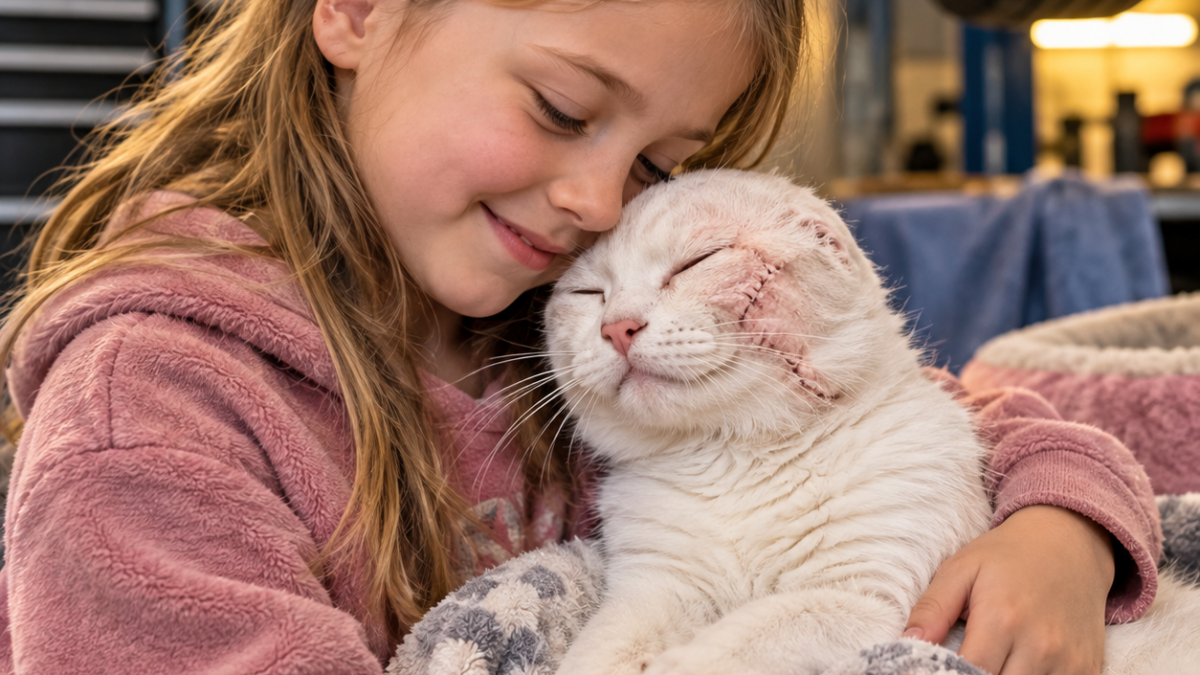
“You look like me.”
I looked at Dr. Foster.
Her eyes filled.
Piper lifted her face.
Then pressed the scarred right side of her cheek against Grace’s left cheek.
Exactly the side Grace always hid.
Grace closed her eyes.
Piper purred.
I had been standing.
I sat down because suddenly my legs did not feel dependable.
Grace whispered, “Dad?”
“Yeah?”
“Can she come home with us?”
There are questions parents know they should consider rationally.
Housing.
Money.
Time.
Existing responsibilities.
Veterinary care.
Long-term needs.
I considered none of them.
“Yes.”
Dr. Foster laughed.
“You don’t even know when she can leave.”
“I know.”
Grace opened her eyes.
“For real?”
“For real.”
She hugged Piper carefully.
“She’s mine?”
I started to say ours.
Then stopped.
Because Piper had already answered.
Over the next ten weeks, our lives reorganized around a cat who was supposedly temporary.
Piper underwent a second major procedure.
The right cheek wound would not close by simple suturing.
Too much tissue was missing.
Dr. Foster and a veterinary surgeon named Dr. Harmon planned a rotational skin flap.
Healthy skin from the left side and upper neck would be gradually mobilized across the damaged area.
I hated the description.
Grace asked to see the diagrams.
Of course she did.
“Does it hurt?”
“She’ll be asleep.”
“After?”
“Some.”
“Will she look normal?”
That word.
Normal.
I sat beside her.
“What do you think normal means?”
She shrugged.
“Like other cats.”
“Piper won’t.”
Grace looked at the floor.
“Do I look normal?”
There are sentences that expose every bad instinct in a parent.
My first impulse was to say yes.
Of course.
You’re perfect.
You’re beautiful.
All technically loving.
All avoiding the question.
I said, “You look like Grace.”
She rolled her eyes.
“You said that about Piper.”
“Because it’s true.”
“That doesn’t answer.”
I thought carefully.
“You look different from most kids in one specific way.”
She touched her hair.
“My ear.”
“Yes.”
“So not normal.”
“No.”
I shook my head.
“Different and abnormal aren’t the same thing.”
“They kind of are.”
“Statistically maybe.”
“What does statistically mean?”
“Never mind.”
She smiled.
Then became serious.
“The kids think it looks weird.”
“I know.”
“Piper looks weird too.”
I could have corrected her.
Instead I said, “At first, yeah.”
Grace looked surprised.
“You think so?”
“The first time I saw her without bandages, my brain expected ears.”
“Me too.”
“That doesn’t mean bad.”
Grace leaned back.
“What does it mean?”
“It means our brains notice patterns.”
She thought about that.
“Then get used to new ones?”
“Exactly.”
She looked through the glass at Piper.
“Then maybe people can get used to me.”
My throat tightened.
“People worth knowing can.”
The skin-flap surgery succeeded.
Healing was slow.
The grafted area swelled.
Then settled.
Some fur grew differently.
Some did not.
The right side of Piper’s face remained flatter.
Tighter.
A raised scar ran from cheekbone toward jaw.
Three whiskers never returned.
Her skull silhouette became perfectly round from the front.
No ears.
Just smooth curves.
She looked unlike any cat I had ever seen.
Grace thought she was gorgeous.
“Like a seal,” she said.
“A seal?”
“Baby seal.”
Piper blinked.
“See?”
“I don’t think that’s agreement.”
“It is.”
At home we prepared.
I bought a heated bed.
Grace rejected it.
“She’ll sleep with me.”
“Not immediately.”
“Why?”
“Because she needs controlled recovery.”
“My room is controlled.”
I looked at the floor.
Socks.
Books.
Crayons.
A stuffed giraffe hanging upside down from a lamp.
“Your room is a federal disaster area.”
“That is rude.”
“We’re putting Piper’s recovery bed in my room.”
“No.”
“Grace.”
“She needs someone.”
“She’ll have me.”
“You sleep.”
“So do you.”
“I wake up.”
“When?”
“When things happen.”
“What things?”
“I don’t know yet.”
She crossed her arms.
Piper went into Grace’s room the first night.
I lost that negotiation.
For the first week, I slept on the floor.
Grace in bed.
Piper in a recovery pen beside her.
Every night around two, Piper started purring.
Every night Grace’s hand dropped through the bars.
Piper pressed against it.
By week four, the pen door remained open.
Piper climbed onto Grace’s mattress.
Always the left side.
Never the right.
At first I assumed it was coincidence.
Then I noticed the pattern.
Grace slept mostly on her back.
Piper curled near her shoulder.
Her smooth head rested beside Grace’s left temple.
The place where an ear should have been.
“Look,” I told my father one morning.
He stood in the doorway.
Piper asleep.
Grace asleep.
Their heads touching.
My father grunted.
“What?”
“Nothing.”
“You’re crying.”
“I am seventy-two years old. My eyes leak.”
“That isn’t how anatomy works.”
“Go fix a car.”
My father fell in love with Piper while pretending he had not.
He claimed animals did not belong in the garage.
Then I found a cat bed beneath his workbench.
“What is that?”
“Rag storage.”
“It’s shaped like a cat.”
“Efficient design.”
A week later Piper began coming to work.
She sat on a blanket in the office.
Customers stared.
Children asked questions.
Adults tried not to.
A woman once whispered, “What happened to her?”
I told her.
She cried.
A man said, “Poor thing.”
Grace happened to be there.
She corrected him.
“She isn’t poor.”
The man blinked.
“I mean she’s been through a lot.”
“So?”
Grace’s tone was not rude.
Just direct.
“She has food.”
“Yes.”
“A house.”
“Yes.”
“Me.”
He smiled.
“You’re right.”
Grace nodded.
“She’s rich.”
Piper became our shop mascot.
Customers brought treats.
Some came in solely to see her.
Carlos printed a tiny employee ID badge.
PIPER REEVES
QUALITY CONTROL
He clipped it to her collar.
I told him he needed more work.
He said, “She boosts customer retention.”
He was probably right.
But the part of the story people liked most was always Grace.
Word got around.
Mechanic finds cat.
Cat loses ears.
Mechanic’s daughter born without ear.
Daughter adopts cat.
It sounds almost manufactured when reduced like that.
Too perfect.
Real life did not feel perfect.
There were dressing changes.
Infection scares.
A night Piper tore out two sutures because she discovered she could hook the recovery collar against a drawer pull.
Grace crying because she thought the surgery failed.
Me sleeping on the floor.
Bills.
Medication alarms.
Vomiting after antibiotics.
Eye drops Piper hated.
Pain medication she loved far too much.
Grace had her own problems too.
School had not magically become kinder because she owned a matching cat.
One Monday in March, I got a call from the principal.
Grace had shoved a boy.
Hard enough that he fell into a desk.
I arrived furious.
Then found Grace sitting outside the office.
Hair loose.
Left side exposed.
Crying.
“What happened?”
“Nothing.”
“Grace.”
“He pulled my hair.”
My anger changed shape.
“Why?”
She stared at her shoes.
“Wanted to show people.”
My hands went cold.
“Show what?”
She looked at me like I was stupid.
“My ear.”
I sat beside her.
“What did he say?”
“Nothing.”
“Grace.”
She whispered, “Monster ear.”
I closed my eyes.
There are forms of anger that feel almost clean.
A stranger hurts you.
You want distance.
Someone hurts your child and the anger is different.
Primitive.
Immediate.
Useless.
The principal explained that the boy, Tyler, had been disciplined.
His parents were coming.
Grace had shoved him only after he grabbed her hair a second time.
“She still can’t push people,” the principal said.
“I know.”
“Dad—”
“You can’t.”
Grace looked betrayed.
“He touched me.”
“I know.”
“He wouldn’t stop.”
“I know.”
“So I made him.”
That silenced me.
The principal said gently, “We are not blaming Grace for defending herself.”
Good.
Because I was about one sentence away from becoming unemployed.
Tyler’s parents arrived.
His mother looked horrified.
His father looked defensive.
“He’s eight.”
I stared.
“So is she.”
“He didn’t understand.”
“He understood enough to call her a monster.”
His mother’s face collapsed.
“He said that?”
Tyler’s father crossed his arms.
“Children say things.”
Grace spoke from beside me.
“Then children can apologize.”
Every adult looked at her.
She pushed her hair behind her ear.
Completely.
Her hand shook.
But she left it there.
Tyler entered with the counselor.
He looked at Grace.
Then at the floor.
“Sorry.”
Grace said nothing.
The counselor prompted.
“For what?”
Tyler mumbled.
“For pulling your hair.”
“And?”
“For saying your ear was a monster.”
Grace’s eyes filled.
Tyler looked uncomfortable.
Then he noticed my phone screen.
A picture of Piper.
“What’s that?”
Grace looked at him.
“My cat.”
“Why doesn’t it have ears?”
“Fan blade.”
He grimaced.
“Gross.”
The adults froze.
Grace did not.
“She almost died.”
“Oh.”
“She has scars.”
Tyler stared at the photograph.
“Does it hurt?”
“Not anymore.”
“Can she hear?”
“Yes.”
“Is she nice?”
Grace shrugged.
“To me.”
Tyler looked at Grace’s ear.
Then the cat.
“Did you get her because she looks like you?”
“Yes.”
He thought for several seconds.
Then said, “She’s cool.”
Grace’s face changed.
Not forgiveness.
Not friendship.
But something loosened.
“You can see her sometime.”
I almost interrupted.
Then stopped.
Tyler looked surprised.
“Really?”
“If you don’t pull my hair.”
“Okay.”
Three weeks later, Tyler came to the garage with his mother.
He met Piper.
Piper sat in his lap.
He touched the smooth place where her ears once were.
Very carefully.
“Does she know they’re gone?”
Grace looked at me.
I let her answer.
“Of course.”
“How?”
“Because it’s her head.”
That was Grace’s entire philosophy of disability in one sentence.
Tyler nodded.
Then asked, “Do you know your ear is different?”
Grace stared at him.
“Yes, Tyler.”
“Right.”
He looked embarrassed.
Grace laughed.
That laugh became the beginning of something.
Not close friendship.
But peace.
And I realized something uncomfortable.
For years, I had wanted to protect Grace from every stare.
Every question.
Every awkward moment.
I had sometimes answered for her before she could answer herself.
I had sometimes treated curiosity like cruelty because cruelty had made me afraid.
Grace did not want that.
She wanted control over the story.
Sometimes she wanted privacy.
Sometimes she wanted to say, “I was born this way.”
Sometimes she wanted to say, “None of your business.”
Sometimes she wanted to compare ears with a cat.
That choice belonged to her.
Piper taught me that too.
People asked if she suffered because she looked different.
I learned to say:
“No. She suffered because she was injured.”
Those are not the same sentence.
The scar was not the pain.
The missing ears were not the pain.
The fan blade had been the pain.
The wounds.
The surgeries.
The recovery.
Once healed, Piper simply had the body she had.
People projected tragedy onto what remained.
Grace understood before I did.
One evening during Piper’s tenth week of recovery, Dr. Foster performed the final examination.
“Everything looks good.”
Grace clapped.
Piper jumped.
“Sorry.”
Dr. Foster laughed.
“She can officially graduate from surgical care.”
“No more cone?”
“No more cone.”
Grace pulled the soft collar off.
Piper immediately licked her shoulder for nearly three minutes.
“She has been waiting ten weeks to do that.”
“She has priorities.”
Dr. Foster looked at me.
“You know I need to ask.”
“What?”
“Are you officially adopting her?”
Grace stared at me.
“What do you mean officially?”
I smiled.
“Paperwork.”
“She already lives with us.”
“Yes.”
“She sleeps in my bed.”
“Yes.”
“Her food is in our kitchen.”
“Yes.”
“She has an employee badge.”
“Carlos does not have legal authority.”
Grace folded her arms.
“She is ours.”
Dr. Foster handed me the form.
“You heard management.”
I filled it out.
Animal name: Piper.
Species: Cat.
Color: White.
Distinguishing features.
I stared at the blank line.
There were many obvious answers.
Bilateral ear loss.
Facial scarring.
Asymmetry.
Instead I wrote:
Impossible to confuse with anyone else.
Dr. Foster read it.
Smiled.
“Accurate.”
Owner name.
I wrote:
Daniel Reeves.
Then Grace leaned over.
“And Grace.”
I added:
Daniel and Grace Reeves.
She nodded.
“Better.”
That night Piper slept beside her.
I stood in the doorway.
Grace was asleep on her right side.
Hair spread across the pillow.
For once, it had fallen away from the left side of her face.
Her small incomplete ear was visible.
Piper was curled against that side.
Smooth earless head tucked beneath Grace’s jaw.
Scarred cheek pressed against hers.
Two bodies marked in completely different ways.
Neither hiding.
I took a picture.
Did not post it.
Did not send it to anybody.
Some things do not need an audience.
Months passed.
Piper’s fur grew back.
Mostly.
The texture remained different on the grafted side.
The scar never disappeared.
The right cheek stayed flatter.
She learned new ways of orienting toward sound without external ears.
She became excellent at detecting refrigerators opening.
Less excellent at detecting me telling her to get off the workbench.
Selective hearing apparently survived trauma.
Grace changed too.
Slowly.
Not because Piper magically healed years of embarrassment.
That would make a good internet story.
It would also be dishonest.
Grace still had bad days.
She still sometimes wore her hair down at school.
She still cried when an older child stared at the pool.
She still asked whether surgery could “make it normal.”
We met with specialists.
Discussed reconstructive options.
Prosthetics.
Future decisions.
I made one promise.
“You don’t have to choose anything because other people are uncomfortable.”
“What if I want an ear?”
“Then we’ll talk about it.”
“What if I don’t?”
“Then we won’t.”
“What if I change my mind?”
“You’re allowed.”
She thought about that.
“Piper can’t get ears.”
“No.”
“Does she care?”
“I don’t know.”
Grace looked at the cat.
Piper was sleeping upside down in a laundry basket.
“I don’t think she cares.”
“Probably not.”
“Then maybe I’ll decide later.”
“Good plan.”
In April, the school held picture day.
Grace came downstairs in a yellow dress.
Hair pulled into a ponytail.
Both sides of her face visible.
I stopped walking.
She noticed.
“What?”
“Nothing.”
“You’re staring.”
“Sorry.”
She touched her left side.
“Should I wear it down?”
“No.”
Too fast.
Grace narrowed her eyes.
“I mean whatever you want.”
She looked at herself in the hallway mirror.
Piper sat behind her.
Round white head.
No ears.
Scar visible.
Grace smiled.
“Up.”
I drove her to school.
At pickup, she climbed into the truck.
“How’d it go?”
“Fine.”
“Anybody say anything?”
“Yes.”
My stomach tightened.
“What?”
“Emma said she liked my hair.”
“Okay.”
“Tyler said Piper looks more intimidating than me.”
I almost smiled.
“And?”
“I said that’s because she has killed before.”
My head snapped toward her.
“Grace.”
“She killed a moth.”
“That is not what you implied.”
“He deserved fear.”
I laughed despite myself.
In May, her school held a “Something Special About My Family” presentation.
Parents were invited.
Grace refused to tell me what hers was about.
I sat in the third row of the classroom.
Children gave presentations about grandparents.
Military parents.
Family recipes.
Twins.
A little boy brought a violin.
Then Grace walked to the front.
She carried a photograph.
Piper.
Of course.
She taped it to the board.
“My family has a cat named Piper.”
Some kids already knew.
“She got hurt in a car engine.”
Grace pointed toward the photograph.
“She lost both ears and some skin on her face.”
She pushed her hair behind her left side.
“I was born without a full ear on this side.”
The room became still.
“When I first met Piper, I thought she looked like me.”
She smiled.
“But actually she doesn’t.”
I leaned forward.
“She’s white and furry.”
Children laughed.
“She has two missing ears.”
“I have one little ear.”
“Her scar happened later.”
“I was born this way.”
“So we’re not the same.”
Grace looked toward me.
Then back at her class.
“But we match in one important way.”
She paused.
“People stare before they know us.”
My throat closed.
“Sometimes people think different means hurt.”
“Sometimes it does.”
“Piper was hurt when the accident happened.”
“But looking different doesn’t hurt her now.”
Grace’s voice became stronger.
“Being laughed at hurts.”
The classroom was silent.
“So if you see somebody who looks different, you can ask nice questions if they want to answer.”
She looked directly at Tyler.
He nodded.
“Or you can just say hi.”
Then she held up another photograph.
Piper asleep beside her head.
“Our cat sleeps on my left side.”
Grace smiled.
“My dad says it’s coincidence.”
“I do not,” I whispered.
She heard me.
“Yes, you do.”
The class laughed.
Then Grace said:
“I think she knows.”
That presentation changed nothing about anatomy.
Grace still had microtia when she sat down.
Piper still had no ears.
But something changed in the room.
Children asked questions.
Good ones.
Does Piper hear?
Does Grace hear?
Does Piper’s scar need medicine?
Can cats wear fake ears?
Grace found that hilarious.
Could Grace feel where her ear was missing?
What happens when you wear glasses?
One girl said her brother was born with two fingers fused.
Another said she had a scar beneath her shirt from heart surgery.
A boy showed everybody a hearing aid he had previously kept hidden behind his hair.
Differences appeared all over the classroom once somebody gave them permission.
That was the part I remembered.
Not that Piper made Grace feel normal.
Piper made “normal” seem like a smaller, less useful word.
Summer arrived.
Piper became obsessed with sitting in sunny windows despite being an entirely white cat and therefore medically required to limit excessive sun exposure.
Dr. Foster recommended pet-safe sunscreen on vulnerable skin.
Try putting sunscreen on an earless cat who believes all touching should benefit her directly.
Grace became better at it than me.
“Hold her like this.”
“I am holding her.”
“No, Dad. You’re making it a fight.”
“She’s attacking my wrist.”
“Because you’re making it a fight.”
Seven years old.
Already criticizing technique.
Like my father.
One afternoon my dad watched Grace apply the sunscreen.
Piper purred.
He said, “She does it better.”
“I know.”
“You’re too tense.”
“Thank you.”
“Animals feel that.”
“Dad.”
“What?”
“Go reorganize something.”
He smiled.
Piper walked across the garage.
Customers knew her now.
People stopped by with food.
Toys.
One woman crocheted her a little hat with fake cat ears.
Grace hated it.
Not because it was ugly.
It was.
But because of the ears.
“She doesn’t need fake ones.”
The woman looked embarrassed.
“I thought it was cute.”
Grace softened.
“It’s a nice hat.”
She removed the crocheted ears with scissors.
Then put the little round cap on Piper.
“Now it’s better.”
The woman later told me that moment stayed with her.
“I thought replacing what was missing was kindness.”
Grace had simply shrugged.
“She wasn’t missing it.”
Children make complicated ideas embarrassingly clear.
Piper’s story eventually reached local social media.
Carlos posted a picture without asking me.
I nearly fired him.
Then the post spread.
Mechanic Rescues Cat From Engine.
Earless Cat Adopted by Girl With Microtia.
Thousands of reactions.
Comments.
Messages.
Most kind.
Some strange.
People wanted to donate.
We sent money to a local rescue and veterinary assistance fund.
Then one comment appeared beneath a photograph of Grace and Piper.
“That poor child. Her parents should have corrected that ear years ago.”
I stared at it too long.
Then another:
“Why would you put a deformed animal with a deformed kid?”
I saw red.
Literally.
My vision narrowed.
I started typing.
Deleted it.
Started again.
Deleted it.
Then Grace walked into the office.
“What are you doing?”
“Nothing.”
“You look mad.”
“Customer.”
She came closer.
I closed the page.
Too late.
She saw her photo.
“Is that me?”
“Yes.”
“Why?”
“Carlos posted Piper.”
“Are people saying stuff?”
I hesitated.
She held out her hand.
“Show me.”
“No.”
“Dad.”
“You’re seven.”
“So?”
“Some people online are stupid.”
“I already go to school.”
Fair.
I showed her the nice comments first.
She smiled.
Then she scrolled.
Found the bad one.
Read it.
Her face became still.
“Deformed.”
I wanted to smash the computer.
Instead I asked, “What are you thinking?”
“Is that what I am?”
“No.”
Too fast again.
Grace looked at me.
“What does it mean?”
I forced myself to calm down.
“It means formed differently than expected.”
“So kind of.”
I hated the word.
She continued scrolling.
Another person had replied to the cruel comment.
The response came from a woman named Rachel:
My daughter has microtia too. She isn’t deformed. Her anatomy developed differently. Please remember there is a real child in this picture.
Then another:
I’m 34 and have microtia. I spent half my childhood thinking I needed to apologize for my face. I wish I’d had a cat like Piper.
Another:
My son was born with one hand. Differences are not tragedies.
Another:
Piper is perfect.
Grace read silently.
Then she looked at me.
“Can I answer?”
“What do you want to say?”
She thought.
Then typed with two fingers:
Piper does not need ears to be Piper and I do not need two ears to be Grace.
I stared at the sentence.
“Good?”
“Very.”
She added:
But don’t be mean.
Then hit send before I could stop her.
Thousands of people liked it.
Grace did not care.
She wanted dinner.
That night Piper slept against her.
Life went on.
That is the part viral stories often skip.
After the remarkable moment, there are still lunches.
Laundry.
Vet bills.
School mornings.
Garage invoices.
People complaining their brakes cost too much.
Cats vomiting on carpets.
Children refusing vegetables.
Healing becomes ordinary.
And ordinary is where you discover whether love was real or merely emotional.
Piper needed ongoing care.
Ear canals cleaned carefully.
Scar tissue monitored.
Sun protection.
Occasional eye drops.
Annual exams.
She hated nail trims.
Loved turkey.
Developed a criminal obsession with shop rags.
She once stole a customer’s glove and hid it in Grace’s bed.
Nobody knows why.
Grace began third grade.
She wore her hair up more often.
Not always.
That mattered.
Confidence is not a straight line.
One morning she came downstairs with her hair covering her left side again.
I said nothing.
She noticed.
“You aren’t going to tell me not to hide?”
“No.”
“Why?”
“Because maybe you’re not hiding.”
“I am.”
I paused.
“Okay.”
“You’re supposed to tell me to be brave.”
“Do you want me to?”
“No.”
“Then I’m not.”
She looked relieved.
Some days Piper did not change Grace.
Some days Grace was still a child tired of being stared at.
That was allowed too.
A year after the accident, February returned.
Cold again.
Not fourteen degrees.
Twenty-one.
Still enough that I banged on every hood in the lot before starting vehicles.
Every hood.
Every morning.
Carlos mocked me.
“You know cats won’t always move just because you knock.”
“I know.”
“So?”
“I knock.”
We also posted signs.
CHECK YOUR ENGINE IN COLD WEATHER.
A local rescue partnered with us on winter awareness.
People thought Piper was the campaign mascot.
I hated the word mascot.
Grace loved it.
“She gets a job.”
“She already has quality control.”
“Two jobs.”
“She needs a union.”
Piper sat beside the sign in the shop lobby.
Round head.
Yellow-green eyes.
Long scar.
No attempt to hide anything.
Customers noticed.
That was useful.
People began banging on hoods.
Looking underneath.
Checking before starting engines.
In January, a man came in just to tell us he’d found a kitten beneath his pickup after seeing Piper’s poster.
He had knocked on the hood.
Heard movement.
Waited.
A black kitten crawled out.
No injury.
“Your cat saved it.”
I looked toward Piper.
She was asleep on an invoice printer.
“She was barely involved.”
Grace objected.
“She inspired awareness.”
I stared.
“Who are you?”
“Third grade.”
“Apparently.”
The man donated fifty dollars to the rescue.
That felt like a better anniversary than a cake.
Years passed.
Grace grew.
Piper grew rounder.
My father’s hair disappeared completely while he insisted Piper’s fur on his jacket came from “static electricity.”
When Grace was ten, we met with a reconstructive surgeon again.
Her choice.
Not mine.
He explained options.
Rib cartilage reconstruction.
Prosthetic possibilities.
Future considerations.
Grace listened.
Asked questions.
Then said, “Do I need one medically?”
“No.”
“Will it make my hearing normal?”
“No.”
“Then why would I do it?”
The surgeon answered honestly.
“Appearance, mostly.”
Grace thought.
“Can I decide when I’m older?”
“Absolutely.”
She nodded.
“Then later.”
In the parking lot I asked, “You okay?”
“Yes.”
“You sure?”
She looked at me.
“Dad.”
“What?”
“I know what I look like.”
The sentence reminded me of Tyler years earlier.
Does she know her ears are gone?
Of course.
It’s her head.
I smiled.
“Okay.”
Piper was waiting at home.
The second Grace sat down, Piper climbed into her lap.
“You’re clingy,” Grace said.
Purr.
“You know I almost got an ear today?”
Purr.
“Didn’t.”
Purr.
“Good talk.”
At twelve, Grace cut her hair.
Short.
Above her jaw.
Both sides visible.
I tried not to react dramatically.
She caught me anyway.
“Don’t cry.”
“I’m not.”
“You are.”
“My eyes leak. Family condition.”
“Grandpa says that.”
“He taught me.”
Piper was older by then.
Still healthy.
Still oddly shaped.
Still sleeping on Grace’s left side.
At fourteen, Grace entered a school photography contest.
Her submission was a black-and-white portrait of Piper.
Close-up.
Scar visible.
Smooth skull.
Eyes looking slightly away from the lens.
Title:
Nothing Missing.
I asked why.
Grace said, “Because everyone always starts with what isn’t there.”
The photograph won second place.
She complained.
“What got first?”
“Sunset.”
“Typical.”
At sixteen, she gave a talk to younger students about craniofacial differences.
Piper appeared in the final slide.
The old photograph.
Seven-year-old Grace sitting on a clinic floor.
Hair pushed aside.
Piper’s injured face pressed against hers.
Grace titled the slide:
RECOGNITION.
I sat in the back.
She said:
“When I was little, I thought confidence meant never caring what people thought.”
Pause.
“It doesn’t.”
Another pause.
“Sometimes people hurt your feelings.”
“Sometimes you hide.”
“Sometimes you get tired.”
“But seeing Piper made me understand something.”
The room waited.
“She didn’t become worthy after she healed.”
My chest tightened.
“She was worthy while bleeding in the engine.”
“While scarred.”
“While strange-looking.”
“Before anybody called her inspiring.”
Grace looked at the photograph.
“And if that was obvious about a cat, eventually I realized it had to be true about me too.”
I cried openly.
My father, sitting beside me, whispered, “You leak a lot.”
“Shut up.”
He was crying too.
When Piper got older, her favorite place remained Grace’s bed.
Always left side.
Grace went to college twenty minutes from home, partly because she claimed the program was good and partly because she refused to admit she wanted to remain near Piper.
Piper was thirteen.
Sleeping more.
Moving slower.
Kidneys not perfect.
Arthritis.
She stayed with me during the week.
Grace came home constantly.
One Friday night I walked past her room.
Grace was asleep.
College textbooks open.
Piper beside her head.
Same position as that first year.
Smooth skull near Grace’s left temple.
I stood there longer than I should have.
Thirteen years had passed.
I could still see a seven-year-old child sitting on a veterinary floor.
Hair moved aside.
Four words.
She looks like me.
Piper died at fourteen.
Quietly.
Kidney disease.
We had time to prepare.
Which did not prepare us.
Grace was twenty-one.
She came home from college and stayed on the floor beside Piper for two nights.
On the final morning, Piper no longer wanted food.
Would not drink.
Dr. Foster had retired, but she came anyway.
“I delivered her into this family,” she said. “I’m finishing the job.”
Piper lay in Grace’s lap.
Her scar had faded.
Not disappeared.
The fur around it had gone thin and white.
Her head still looked perfectly round.
Grace stroked the smooth place where an ear had once been.
“I don’t remember my bed without her.”
I sat beside them.
“I know.”
“Dad?”
“Yeah?”
“Do you remember the engine?”
Every second.
“Yes.”
“Was it as bad as you said?”
I had always edited the worst details when she was young.
“Yes.”
Grace looked at Piper.
“She was really stuck?”
“Yes.”
“By blood?”
I nodded.
“And she purred?”
“The whole time.”
Grace smiled through tears.
“She was weird.”
“Very.”
Piper’s chest rose slowly.
Grace bent down.
Pressed her left cheek against Piper’s scarred right side.
Exactly as she had the first day.
Two faces.
Older now.
Still fitting.
“You saved me first,” Grace whispered.
I almost corrected her.
Piper had not saved Grace.
Grace was never broken.
But then I understood what she meant.
Not saved her life.
Saved something softer.
A child who had begun believing difference meant something had gone wrong with her.
Piper had arrived without needing words and showed her another possibility.
Different.
Scarred.
Loved.
Whole.
Dr. Foster administered the sedative.
Piper relaxed.
Then the final medication.
Grace held her.
I kept one hand against Piper’s side.
Her breathing slowed.
One last breath.
Then stillness.
No purr.
That silence hurt more than the engine noise ever had.
Grace cried into my shoulder.
I cried too.
Dr. Foster waited.
Eventually Grace looked at Piper.
“She looks like herself.”
I laughed through tears.
“Yes.”
That afternoon we buried Piper beneath the maple tree behind our house.
My father placed her old employee badge inside the box.
QUALITY CONTROL.
Carlos brought the little cap with the fake ears removed.
Grace placed it beside her.
Then changed her mind.
“No.”
She took it back.
“What?”
“She never liked hats.”
Fair.
We buried her without it.
Months later, Grace came home carrying a framed photograph.
Her college photography department had printed Nothing Missing professionally.
She hung it in our garage waiting room.
Customers still ask.
“Who’s that?”
I tell them.
Not every detail.
Usually:
“She crawled into an engine during winter.”
“Got badly hurt.”
“Came home with us.”
If they ask why a photograph of a cat belongs in an auto shop, I point toward the winter safety sign.
CHECK BEFORE YOU START.
Sometimes I add:
“My daughter loved her.”
That’s enough.
Grace works with children now.
Pediatric audiology.
She decided against reconstructive surgery.
Her choice.
She wears her hair short.
Sometimes she uses a bone-conduction hearing device.
Sometimes she doesn’t.
On the wall of her office are two photographs.
One of Piper.
One of seven-year-old Grace holding her.
Children ask about the cat.
Grace tells them:
“She lost her ears in an accident.”
Parents sometimes say, “Oh, how sad.”
Grace always answers carefully.
“The accident was sad.”
Then she smiles.
“Her life wasn’t.”
I think that is the best sentence anyone has ever said about Piper.
The accident was terrible.
What happened after was not.
We make a mistake when we take the worst moment in a life and use it to define everything that follows.
Piper was not the cat whose ears got cut off.
Not to us.
She was the cat who stole roast chicken.
The cat who slept on one side of Grace’s pillow.
The cat who hated sunscreen.
The cat who sat on invoices.
The cat who inspired my father to buy “rag storage” shaped suspiciously like a pet bed.
The cat who taught an eight-year-old bully how to ask instead of laugh.
The cat who made drivers check warm engines on winter mornings.
The cat who appeared in school presentations.
The cat whose face was scarred and asymmetrical and eventually so familiar that I stopped noticing it unless somebody else stared.
She lived fourteen years.
Only one morning belonged to the fan blade.
That distinction matters.
After Piper died, I found the original towel.
I had no idea we still had it.
My father had apparently tucked it into a sealed plastic box in a storage cabinet at the garage.
The old bloodstains had turned brown.
I held it for a long time.
Then threw it away.
I expected that to feel like losing something.
It didn’t.
We had enough relics.
Photos.
Memories.
The employee badge.
A little white fur still woven into the passenger seat of my truck no matter how many times I cleaned it.
And Grace.
Most of all Grace.
One January morning, years after Piper was gone, a customer arrived before opening.
Young woman.
Little boy in the passenger seat.
She knocked on the garage door.
I opened it.
“Sorry,” she said. “I know you’re closed.”
“What happened?”
She pointed toward her car.
“I heard something under the hood.”
My stomach tightened.
“Did you start it?”
“No.”
“Why not?”
She pointed toward the safety poster.
Piper’s photograph was in the corner.
“I remembered that cat.”
We opened the hood.
There, curled beside the battery, was a tiny brown tabby.
Alive.
Uninjured.
Terrified.
It took us twenty minutes to coax him out.
The boy named him Bolt.
His mother adopted him two days later.
That evening I called Grace.
“You won’t believe what happened.”
She did.
Immediately.
“Engine cat?”
“Yes.”
“Hurt?”
“No.”
“Good.”
“Mom saw Piper’s sign.”
Silence.
Then Grace said, “She saved another one.”
I leaned against my toolbox.
“Maybe.”
“No maybe.”
I looked at the photograph on the wall.
Smooth white head.
Raised facial scar.
Eyes calm.
Piper had been dead for years.
And still some driver had turned a key halfway, remembered a picture, stopped, and checked.
Maybe that counts.
The old garage is mine still.
My father is gone now.
Carlos runs more of the day-to-day work because my back has finally filed an official complaint about twenty-three years of bending over engines.
Every cold-weather season, we put Piper’s sign near the register.
People ask why she had no ears.
I tell them.
Sometimes they look horrified.
Sometimes they look sad.
Children usually respond best.
“Did she die?”
“No. Not then.”
“Could she hear?”
“Yes.”
“Was she ugly?”
Adults panic at that question.
I don’t.
“I thought she looked strange the first time.”
“Did you later?”
“No.”
“Why?”
“Because eventually she just looked like Piper.”
Kids understand.
Adults often need longer.
I used to believe my job as Grace’s father was to convince her she was no different from anyone else.
I was wrong.
She was different.
Everybody is, eventually, in one way or another.
My job was to make sure she never confused different with lesser.
I did not teach her that well.
A six-pound white cat did most of the work.
The cat did not give motivational speeches.
She did not understand craniofacial anatomy.
She did not know what microtia was.
She never knew children had mocked Grace.
She did not know people online had called either of them deformed.
She knew warmth.
Pain.
Fear.
Food.
Sun.
Hands.
Beds.
The sound of Grace’s voice.
And somehow that was enough.
Because when Grace first sat in front of Piper, she did something she had refused to do around almost anyone for months.
She moved her hair.
Not because I told her she was beautiful.
Not because a teacher said differences should be celebrated.
Not because a counselor taught confidence.
She looked at another living creature whose body did not match the expected outline.
And recognized herself without shame.
That was the miracle.
Not that Piper survived.
Though medically, that came close.
Not that we adopted her.
Not that the internet loved the story.
It was that moment on the floor.
My daughter touching the side of her own head.
Looking at a scarred cat.
And realizing similarity could feel like comfort instead of humiliation.
People later told Grace:
“You rescued Piper.”
She always corrected them.
“No.”
Then they would smile and expect her to say Piper rescued her.
She didn’t.
She said:
“My dad got her out of the engine. The vets fixed what they could. I just gave her my bed.”
That was Grace.
Practical.
Then, if people pushed, she sometimes added:
“But she helped me stop hiding.”
I think that is enough.
I still have the photograph from Piper’s first night home.
Grace asleep.
Seven years old.
Hair pushed away from her face.
Piper curled on her left side.
Earless white head resting exactly where Grace’s missing ear would have been.
People who see it call it perfect.
I understand what they mean.
But perfect is the wrong word.
Neither of them needed completion.
Neither body was a puzzle missing a piece.
Grace did not need an ear to complete her face.
Piper did not need ears to complete hers.
The beauty was not that two incomplete things became whole when put together.
The beauty was that two already whole lives recognized something familiar in one another.
And after that, neither one had to explain.
Sometimes I close the garage late in winter.
The metal doors come down.
Tools go quiet.
The concrete smells like oil and cold.
Before I start my truck, I still hit the hood twice.
Habit.
Then wait.
Every time.
Carlos once asked if I thought Piper might somehow be under there.
“No.”
“Then why?”
I looked at him.
“Because once is enough.”
He nodded.
Never mocked me again.
I get into the truck.
Turn the key.
And occasionally, for just a second before the engine starts, I remember that February morning.
The scream.
The terrible sound beneath the hood.
The blood.
My hands shaking.
And then—
The purring.
Soft.
Steady.
Unbelievable.
A frightened, broken little cat trapped against hot metal, somehow producing the gentlest sound in the world.
I did not know it then.
But that sound would eventually follow us through fourteen years.
Through surgery.
Through school bullying.
Through scar tissue.
Through picture day.
Through a child’s growing confidence.
Through countless nights on the left side of a bed.
Through one final afternoon beneath a maple tree.
And long after Piper herself was gone, it would still be there in the choices we made because of her.
Check the engine.
Ask before judging.
Let children choose what they do with their own differences.
Do not assume visible damage means a damaged life.
Do not confuse changing a body with repairing a person.
And never decide that something is incomplete simply because it does not look the way you expected.
Grace understood that at seven.
I needed longer.
Maybe most adults do.
But I remember the exact second she understood.
She sat cross-legged on a veterinary clinic floor.
A badly injured white cat climbed into her lap.
Grace pushed the hair away from the part of herself she had learned to hide.
Piper lifted her round, earless head.
My daughter looked into those yellow-green eyes and whispered:
“We look the same.”
Then Piper pressed her scar against Grace’s face.
Right side to left.
And stayed there.
No ears.
One missing ear.
Two scars the world would have noticed before anything else.
Yet all I could see was my daughter smiling.
Not despite how she looked.
Not because somebody had convinced her she was brave.
She smiled because for the first time in a long time, she had looked at difference and found companionship waiting there.
That cat entered our lives because she was trying not to freeze.
She crawled toward warmth.
She found an engine.
The engine almost killed her.
Then somehow, through blood, surgery, pain, and impossible luck, she found another kind of warmth.
A seven-year-old girl who knew exactly what it felt like when strangers stared at the outline of your head before they bothered to see you.
People say Piper became part of our family.
They’re right.
But I think Grace said it better when she was little.
One night I was tucking her into bed.
Piper was already curled beside her.
I asked:
“Why do you think she always sleeps on that side?”
Grace touched Piper’s smooth head.
Then touched her own left side.
“She knows there’s room.”
I laughed.
At the time I thought she meant room on the pillow.
Years later, I’m not so sure.
Maybe Grace meant something larger.
Maybe that is what love is sometimes.
Not fixing what is missing.
Not pretending nothing was lost.
Not covering scars.
Not insisting bodies are identical.
Just making room.
For the face somebody has.
For the story they carry.
For the part they hide.
For the part they cannot hide.
Piper had no ears.
Grace had one.
Neither needed the other to become complete.
They simply found room beside each other.
And from that first day forward, Piper slept exactly where she had always seemed meant to be.
On Grace’s left side.
Scar against skin.
Smooth head against pillow.
Two faces the world might once have called incomplete.
And somehow, together, nothing about either one looked missing at all.

