A Biker Rode Into a Wildfire After Crews Said a Disabled 4-Year-Old Couldn’t Be Reached—Then He Came Out of the Smoke Carrying Something No One Expected.
PART3:
He had been fighting fires for thirty years. He had carried people from wrecks, dug through collapsed houses after mudslides, and once stayed inside a burning feed store to free horses while the roof came down behind him. He was a hard man with a soft voice, the kind of public servant nobody thanked until the night they needed him.
But that day, he looked at the ridge and saw what all his training told him.
No crew could go in.
Not and come back.
“We can’t send anyone up there right now,” he said.
Sandra stared at him.
“No.”
“I’m sorry.”
“No. He’s four. He’s alone. He has oxygen. He can’t—” Her voice broke so badly the rest disappeared.
“We’re trying to get air support—”
“There’s no time!”
“I know.”
“You don’t know! You don’t know what happens when he can’t breathe!”
She grabbed his sleeve.
People looked away because grief that raw feels indecent to witness unless you are brave enough to help, and most of us were not.
“Please,” she begged. “Please. He’s my baby.”
The chief closed his eyes for half a second.
When he opened them, he looked older.
“If I send my people into that, I may lose them too.”
Sandra made a sound I had never heard before.
Not a scream.
Not a sob.
Something beneath both.
She dropped to her knees on the asphalt.
That was when Wolf stepped forward.
I had seen him earlier, standing near the line of motorcycles parked by the old baseball field. There were maybe twenty of them, members of the Savage Sons Motorcycle Club, all leather vests, boots, beards, tattoos, and the kind of silence that made respectable people uncomfortable. They had arrived before dawn, not because anyone invited them, but because they had trucks, generators, chainsaws, and a clubhouse on the edge of town large enough to shelter displaced families.
I knew exactly who they were.
We all did.
And if I am honest, most of us had decided who they were before any of us had bothered to learn anything else.
Six months earlier, the Savage Sons had bought the abandoned furniture warehouse off Mill Road. The warehouse had sat empty for nearly a decade, gathering graffiti, rats, and teenagers with spray paint. No one cared about it until the bikers bought it. Then suddenly everyone cared a great deal.
The Pine Hollow Neighborhood Association, of which I was secretary, held three emergency meetings.
Emergency.
That was the word we used.
Not about the roof falling in at the senior center.
Not about the crosswalk near the school where drivers ignored the flashing lights.
No.
The emergency was bikers.
People said they would bring noise.
Crime.
Drugs.
Loose women.
That phrase was actually used by Mrs. Cavanaugh, who had not updated her fears since 1978.
Someone circulated a petition demanding zoning review. Someone else posted photos of men in leather online with captions like Keep Pine Hollow Safe and Not in Our Backyard. The local Facebook group became a fever swamp of rumors.
I am ashamed to say I signed the petition.
I told myself it was about traffic, noise, public safety.
But when I saw Wolf walk toward Sandra through smoke and ash, I knew the truth.
It had been about fear.
Fear of people who looked different.
Fear of men who did not ask permission to occupy space.
Fear dressed up as civic responsibility.
Wolf was the president of the Savage Sons.
I knew his road name because everyone did.
Nobody called him by his legal name, though later I would learn it was Caleb Mercer. He was six-foot-four, maybe more, with broad shoulders, long graying hair tied at the back of his neck, and a beard threaded with silver. His arms were covered in tattoos: flames, wings, names, dates, a little boy’s handprint over his left forearm. His leather vest bore the Savage Sons patch—a black wolf skull over crossed pistons—and enough road dust to prove it was not decorative.
He walked to Sandra and crouched in front of her.
Not close enough to crowd.
Close enough to be heard.
“What’s his name?”
Sandra blinked at him through tears.
“What?”
“Your boy. What’s his name?”
“Tommy.”
“Where in the house?”
“Back bedroom. Right side. He sleeps in a medical bed. Oxygen beside it. His wheelchair—”
“Color?”
“Blue. But he can’t—”
“Does he scare easy?”
That question broke something in her face.
“Yes,” she whispered. “But he likes deep voices. Men’s voices. His dad left when he was a baby, but he likes when my brother talks to him.”
Wolf nodded once.
“What does he need first?”
“Oxygen. If the power’s out, his concentrator won’t work. There’s a portable tank by the bed. Green bag. Mask in the side pocket.”
“How heavy?”
“The tank? Maybe five pounds.”
“The boy.”
She stared at him.
“Thirty-one.”
Wolf stood.
Chief Reeves stepped in front of him.
“No.”
Wolf looked at him calmly.
“Wasn’t asking.”
“You will die up there.”
“Maybe.”
“The road’s gone.”
“Then I won’t use the road.”
The chief’s jaw tightened. “I can’t let you through.”
Wolf’s eyes shifted toward the ridge, where black smoke rolled over the treetops.
“You going to arrest me before or after that kid runs out of air?”
The chief said nothing.
One of Wolf’s brothers, a lean man with a shaved head and a patch that read GRIZZ, stepped forward. “Prez.”
Wolf held up one hand.
No speech.
No dramatic promise.
He turned to Sandra.
“I’ll bring him if I can.”
That if was the most honest kindness anyone had given her.
Not when.
Not I promise.
If.
Sandra grabbed his wrist.
“Please.”
Wolf looked down at her hand.
For one second, something flickered across his face.
Pain.
Old pain.
The kind not caused by smoke.
Then he nodded.
“You stay here.”
He walked to his Harley.
The motorcycle was black, dented, loud, and too heavy for any sane person to aim toward a wildfire. Grizz tried to grab his arm.
“Caleb.”
That was the first time I heard anyone use his real name.
Wolf looked at him.
“Not now.”
“There’s a fire break trail behind the water tower,” Grizz said quickly. “Old logging cut. Might get you two miles in.”
Wolf nodded once.
Another biker tossed him a wet bandana.
Someone else handed him a small axe.
Chief Reeves shouted into his radio, furious and desperate.
“Do not open that roadblock!”
But Wolf did not use the roadblock.
He swung onto the Harley, started the engine, and drove across the ditch, through the dry field behind the engines, and into the smoke.
For a moment, the roar of the bike was louder than the fire.
Then the smoke swallowed him.
Sandra screamed his name, though she had only known it for seconds.
No one moved.
The chief cursed under his breath and turned to his crew. “Track him as long as you can. If he makes contact, we support extraction. Nobody else goes in unless I say it.”
The minutes after that did not move like minutes.
They stretched.
Bent.
Became something punishing.
Sandra sat on the ground near the ambulance, rocking back and forth with her arms wrapped around her stomach. I sat beside her because nobody else did, and because shame had already begun to crawl up my throat. She did not seem to notice me. Her lips moved constantly.
At first I thought she was praying.
Then I heard.
“He likes dinosaurs. He likes blue cups. He doesn’t like loud alarms. He needs his blue blanket. He needs his blue blanket. He needs his blue blanket.”
Over and over.
A mother’s inventory against terror.
Chief Reeves paced near the engines, radio at his mouth, eyes never leaving the ridge. The Savage Sons stood together by their motorcycles. None of them spoke much. They watched the fire like men watching a door they might have to kick down.
Ten minutes passed.
Then fifteen.
The radio crackled with fragments.
“Visibility zero…”
“Spot fires…”
“Structure involved…”
“Power lines down…”
At nineteen minutes, someone said they heard a motorcycle engine near the upper draw.
At twenty-three minutes, the sound vanished.
At twenty-eight, Sandra stood suddenly.
“What happened?”
Nobody answered.
At thirty-one minutes, Chief Reeves pressed his radio harder to his ear.
“Say again?”
Static.
Then: “No visual.”
Sandra looked at him.
“No visual means what?”
“It means smoke’s too heavy.”
“No. No, don’t say that like it means nothing.”
At thirty-six minutes, the fire surged west.
A wall of heat rolled down toward the checkpoint so hard that firefighters shouted for people to move back. Ash spun through the air. Someone’s little dog started barking hysterically from inside a carrier. A woman fainted near the gym doors.
Sandra tried to run toward the road.
I grabbed her from behind.
She was stronger than grief should allow.
“Let me go!”
“Sandra, no!”
“My son is up there!”
“I know.”
“You don’t know!”
She collapsed against me, and I held her while she screamed into my shirt.
I had no right to comfort her.
I had signed petitions against the man who might be dying for her child.
At forty-four minutes, Grizz walked to Chief Reeves.
“We’re going.”
“No, you are not.”
“That’s our brother.”
“And I will not lose five more people because one man made a reckless choice.”
Grizz stepped close.
“He made a human choice.”
The chief’s face hardened.
Before he could answer, another firefighter shouted.
“Movement!”
Everyone turned.
At first, I saw nothing.
Only smoke.
Then a shape appeared through the gray.
Large.
Unsteady.
Walking.
Not riding.
Walking.
The figure came out of the smoke like something carved from the fire itself.
Wolf.
His Harley was gone.
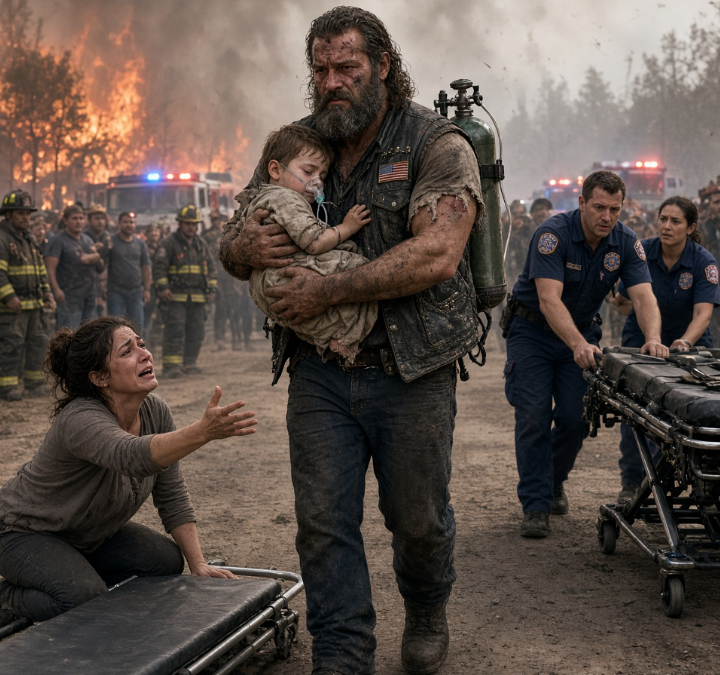
His vest was scorched and half-melted at the back. His arms were torn open from shoulder to wrist, bleeding through soot. His hair had partly burned loose from its tie. His face was blackened with ash, eyes red and streaming. On his back was a portable oxygen tank strapped with what looked like electrical cord and pieces of leather. Against his chest, bound tightly with what remained of Wolf’s shirt, was Tommy.
Small.
Limp.
Masked.
Alive.
For one second, the entire checkpoint froze.
Then Sandra screamed.
Not fear this time.
Something bigger.
“Tommy!”
Wolf staggered forward.
“Medic,” he rasped.
His voice sounded destroyed.
“Get a medic on him now.”
Paramedics ran.
Wolf lowered himself one knee at a time because he no longer trusted his legs to do it safely. He did not hand Tommy over quickly. He couldn’t. Tommy’s small fist was knotted into what remained of Wolf’s shirt so tightly that even unconscious, the child would not let go.
A paramedic tried to pry his fingers loose.
Wolf said, “Careful.”
It was almost a growl.
The paramedic softened immediately.
“We’ve got him.”
Wolf looked down at Tommy.
“I know, buddy,” he whispered. “Mama’s here. You did good.”
They cut the shirt.
Only then could they move Tommy to the stretcher.
Sandra fell beside him, touching his hair, his face, the mask, his little hands.
“Baby. Baby, Mommy’s here. Tommy, Mommy’s here.”
“He’s been unconscious about twenty minutes,” Wolf said. “Oxygen kept going. Tank’s low.”
“How did you get through?” Chief Reeves asked.
Wolf looked at him as if the question belonged to another world.
“Later.”
Then his legs gave out.
He dropped hard to both knees beside the stretcher.
That was when we saw what the vest had hidden.
His back.
I had seen burns before in training photos, never like that on a living person sitting ten feet away. The leather had protected parts of him, but not enough. Blistered skin. Charred cloth melted near his shoulders. Deep cuts from shoving through brush. Blood seeping from his jeans. His hands looked almost unrecognizable, blistered and bleeding, raw from heat and whatever he had touched, pulled, or broken to reach that child.
One of the paramedics turned from Tommy and swore under her breath.
“Sir, you need treatment immediately.”
“Kid first.”
“Sir—”
“Kid. First.”
It was not bravado.
Not performance.
It was command.
His eyes never left Tommy.
They loaded Tommy into the ambulance bay for stabilization while waiting for the helicopter. Sandra climbed halfway in until they told her she had to give them room. She looked back at Wolf.
“They told me nobody could get through.”
Wolf leaned forward, breathing hard.
“They were almost right.”
Then he coughed.
A terrible cough.
Deep.
Wet.
His body folded around it.
A paramedic grabbed his shoulder and tried to guide him to the second stretcher.
Wolf shoved weakly at the hand.
“No.”
“You’re burned.”
“I know.”
“You have smoke inhalation.”
“Probably.”
“You might go into shock.”
“Wouldn’t be my first time.”
“This is not negotiable.”
Wolf’s gaze moved to Tommy again.
“Is he breathing?”
The paramedic hesitated.
“Yes.”
“Then we’re negotiating.”
Sandra began crying about the wheelchair.
It shocked people, I think.
Some looked offended.
Her son had just been carried out alive, and she was asking about a chair.
But I knew enough to understand why.
Tommy’s wheelchair was not furniture.
It was legs.
Freedom.
Posture.
Safety.
A fifteen-thousand-dollar custom chair with molded supports, special headrest, adjustable straps, and modifications Sandra had fought insurance for nearly a year to approve. Without it, Tommy would not simply be inconvenienced. He would lose the shape of his days.
“It’s still at the cabin,” Sandra said, half to herself, half to anyone who would listen. “His chair. His chair is still there. They won’t pay again. They won’t. I can’t—”
Wolf turned his head.
Through ash, blood, and pain, he heard her.
“Ma’am.”
Sandra looked at him.
“Your boy’s breathing,” he said. “Nothing else matters right now.”
She nodded, ashamed and frantic at once.
“I know. I know, I’m sorry. I just—”
“I get it.”
He reached for his phone.
The movement cost him. I saw it. His jaw locked as he dug the phone from his vest pocket with fingers that barely worked. The screen was cracked. He tapped out a message slowly with blistered thumbs.
Grizz saw.
His face changed.
Wolf hit send.
Then the paramedic finally snatched the phone away.
“No more heroics.”
Wolf looked at her.
“Wasn’t done.”
“Yes,” she said fiercely. “You are.”
They loaded Sandra into the helicopter with Tommy.
Before she climbed in, she looked back.
Wolf was still on the ground, refusing the stretcher, staring at the boy as if his own breath depended on Tommy’s. Their eyes met for one second.
“Thank you,” she mouthed.
Wolf lifted one burned hand.
Barely.
Then the helicopter rose, blades beating smoke into wild circles. Sandra’s face stayed pressed to the window until the aircraft disappeared into the gray sky.
Only then did Wolf let the paramedics touch him.
I stood nearby holding a clipboard I had forgotten existed.
My hands were shaking.
I looked at the man on the stretcher, the man I had helped label an undesirable element, and felt something inside me begin to crack.
“Why would you do that?” I asked.
He turned his head toward me.
His eyes were red from smoke.
And from something older.
“You don’t even know them,” I said. “Not after everything this neighborhood put your club through.”
The paramedic cutting away his vest gave me a look like now was perhaps not the time, but Wolf answered.
“My son died ten years back,” he said.
The words came rough, scraped raw.
“Drunk driver. He was six.”
I stopped breathing.
Wolf looked toward the sky where the helicopter had vanished.
“I couldn’t get to him in time.”
His voice broke once.
Then held.
“But I could get to hers.”
That was all.
No sermon.
No accusation.
He closed his eyes while they started an IV.
I stood there with my clipboard pressed to my chest, and for the first time that day, I felt the full weight of what we had done to those men.
We had judged the leather.
The engines.
The tattoos.
The noise.
We had not asked what grief rode under it.
About an hour later, two motorcycles came thundering back from the direction of the fire line.
Everyone turned again.
I remember thinking, impossible.
Not again.
Behind the bikes was a small utility trailer, thrown together with chains, straps, and what looked like pieces of fence. On it, covered in ash and soot, paint blistered from heat but unmistakably intact, was Tommy’s wheelchair.
Blue frame.
Red straps.
The chair.
Grizz rode in front, face blackened, beard singed at the edges. The second biker, a younger man named Tank, had one sleeve burned away and a grin that made him look insane.
Chief Reeves stormed toward them.
“What the hell were you thinking?”
Grizz killed the engine.
“Kid’ll want his wheels when he wakes up.”
“Do you have any idea what you risked?”
Tank looked at the chair.
Then at the chief.
“Yeah.”
He said it like the question had been too obvious to ask.
Wolf, half-conscious on the stretcher, heard the motorcycles. His eyes opened.
“Chair?” he rasped.
Grizz walked over and leaned close.
“Got it.”
Wolf’s eyes closed again.
The corner of his mouth moved.
Not quite a smile.
Close enough.
He finally went down for good near sunset.
Shock, smoke inhalation, burns, dehydration. The list sounded clinical and inadequate. They loaded him into an ambulance bound for St. Agnes, because the burn unit at Children’s was full and he needed immediate care. As they closed the doors, he kept muttering one question.
“Kid okay?”
The paramedic said, “He’s alive.”
“Was I fast enough?”
“You were fast enough.”
“Kid okay?”
“Yes.”
He asked again anyway.
All the way down the mountain, they told me later.
Is the kid okay?
Is the kid okay?
Is the kid okay?
Tommy woke the next morning at Children’s Hospital.
I was there because Sandra asked me to come.
I did not deserve that trust, but people in crisis do strange, generous things. Maybe she needed someone from home. Maybe she needed a witness. Maybe she had no one else who could get there that quickly. I drove down before sunrise with a bag of clothes for her, phone chargers, insurance papers from her glove compartment, and the blue dinosaur blanket firefighters had found in the ambulance after transport.
Tommy looked impossibly small in the hospital bed.
Tubes.
Monitor wires.
Oxygen.
A bandage on one cheek.
His curls smelled faintly of smoke even after the nurses had cleaned him. His rescued wheelchair sat folded near the wall, scorched but functional, like a battle flag.
Sandra had not slept.
She sat beside him holding his hand, whispering whenever he stirred.
When his eyes opened, he looked confused first.
Then frightened.
Then he saw Sandra.
“Mommy?”
His voice was scratchy and weak.
Sandra sobbed.
“I’m here. I’m right here.”
He blinked.
His eyes moved around the room.
Then he said, “Man?”
Sandra leaned close. “What, baby?”
“Man who carried me.”
Sandra pressed her lips together.
The nurse looked at her, surprised.
Tommy did not speak in long sentences often. His cerebral palsy affected his muscles, but he also had developmental delays that made language come slowly. He understood more than he could say. Sandra had told me once that strangers often mistook his quiet for emptiness, and she hated them for it.
“Wolf,” she said gently. “His name is Wolf. He got hurt too. He’s in the hospital.”
Tommy’s small hand tightened.
“Where?”
“He’s upstairs in the burn unit. He can’t come down yet.”
Tommy’s eyes filled.
“Man carried me.”
“Yes, baby.”
“Fire loud.”
Sandra covered her mouth.
“I know.”
“He said breathe.”
She broke then.
The nurse did too.
Tommy kept asking for Wolf.
After the sixth time, Sandra asked if a video call was possible. The nurse hesitated. There were rules. Conditions. Privacy. Infection control. But hospital staff are human beings before they are policies, at least the good ones are, and by then the story had already moved through the building.
The biker who carried a disabled boy through wildfire.
The boy who woke asking for him.
A resident physician arranged it.
Wolf’s face appeared on the tablet screen an hour later.
Half wrapped in bandages.
Tubes in his nose.
One arm dressed from wrist to shoulder.
His beard singed unevenly.
He looked like a mountain that had burned and refused to fall.
But the moment he saw Tommy, everything in his face shifted.
Softened.
Opened.
“Hey there, little warrior,” he said.
His voice was almost gone.
Tommy stared at the screen.
Everyone in the room went still.
This four-year-old boy, who often used one-word answers, who had spent his life making adults wait for language, looked at the biker on the screen and said clearly:
“You saved me. You’re my hero.”
Wolf came apart.
That is the only way to say it.
This huge, scarred man in a hospital bed, the man who had walked five miles through burning brush with a child strapped to his chest, began to cry like a little boy.
No shame.
No turning away.
His bandaged hand covered his eyes for one second, then dropped because he wanted to see Tommy.
“You’re my hero too, buddy,” he whispered.
Tommy smiled.
A weak little smile.
But real.
Sandra told me later those were the clearest words her son had ever spoken.
That was the first miracle.
Not the fire.
Not the rescue.
That sentence.
You’re my hero.
The two of them healed down the hall from each other.
Wolf in the burn unit.
Tommy on pediatrics, transferred closer when he stabilized.
Hospital staff bent rules until they resembled mercy. Once Wolf could sit in a wheelchair, they rolled him down to visit Tommy. Once he could stand, he insisted on pushing Tommy’s wheelchair through the hall.
The first time he did it, every nurse at the station pretended not to cry.
Wolf had burns across his back, arms, and hands. Walking hurt. Standing hurt. Breathing hurt. Existing, I suspect, hurt. But there he was, one bandaged hand on Tommy’s chair, moving slowly past the nurses’ desk while Tommy wore a tiny oxygen cannula and the expression of a king in a parade.
“You driving okay?” Tommy asked.
Wolf looked offended.
“I been riding since before your mama was born.”
Tommy giggled.
“Chair not Harley.”
“Still got wheels.”
Tommy considered this.
“Slow Harley.”
Wolf laughed, then coughed until a nurse scolded him.
They became a legend before either left the hospital.
The tiny disabled boy and the giant biker.
Both bandaged.
Both stubborn.
Both trading scar stories like soldiers.
Tommy told Wolf about surgeries.
Wolf told Tommy about motorcycle spills, leaving out the parts Sandra would disapprove of.
Tommy showed Wolf how his chair tilted.
Wolf showed Tommy the tattoo on his forearm: a small handprint with the name Eli beneath it.
“My boy,” Wolf said.
Tommy touched the tattoo with one careful finger.
“Where?”
Wolf swallowed.
“Heaven, I hope.”
Tommy nodded, accepting the answer the way children sometimes do more gracefully than adults.
“I almost went there,” he said.
Wolf’s face changed.
“But you came back,” he said.
“You carried me.”
“Yeah.”
Tommy looked at the tattoo again.
“Eli helped?”
Wolf closed his eyes.
Maybe because no adult would have dared say it.
Maybe because the possibility pierced too deep.
When he opened them, they were wet.
“Maybe he did, buddy.”
The day Wolf was discharged, twenty Savage Sons waited in the hospital parking lot.
Not revving.
Not showing off.
Just standing beside their motorcycles in clean vests, boots lined up, helmets under arms. Firefighters were there too. Nurses. A few reporters. Sandra tried to avoid the cameras, but Tommy waved at everyone with royal enthusiasm from his chair.
Wolf walked out slowly, refusing the wheelchair they offered him, because pride is sometimes stupid but also occasionally all a man has left. He wore loose black clothes over bandages and moved like each step had a price.
Sandra met him near the curb.
“I don’t know how to thank you,” she said.
“You already did.”
“No. I didn’t.”
“You let me push his chair.”
She shook her head, tears running down her face.
“Why do you keep doing this? We tried to run your club out of town. People signed petitions. People said horrible things. I didn’t stop them.”
Wolf looked toward the line of bikers.
Then back at Tommy.
He crouched, slowly and painfully, until he was at the boy’s eye level.
“Because it’s what we do,” he said. “We look after family.”
Sandra whispered, “We aren’t your family.”
Wolf reached into the saddlebag Grizz held out and pulled out a tiny leather vest.
Custom made.
Four-year-old size.
Across the back was a patch stitched in careful red and gold letters:
BRAVEST WARRIOR
TOMMY
Tommy gasped.
Wolf held it up.
“You are now.”
Tommy wore that vest out of the hospital.
He wore it to physical therapy.
To follow-up appointments.
To the grocery store.
To bed, until Sandra finally convinced him leather was not pajamas.
The Savage Sons escorted them home, though home was no longer the cabin on Ridgeback. That was gone. The fire took the cabin, the porch swing, the hand-painted mailbox, most of Sandra’s photographs, and all of Tommy’s medical supplies except what had been with him at the hospital and the wheelchair the bikers dragged out of the fire.
So the Savage Sons took them to the clubhouse.
The same clubhouse we had tried to shut down.
The old warehouse on Mill Road had been transformed into something none of us expected because none of us had looked. The front held a meeting room, pool table, kitchen, and bar. The back had storage, showers, cots, and a workshop. Within forty-eight hours of the fire, they had turned it into temporary housing for displaced families.
Cots lined the walls.
Kids colored at folding tables.
Volunteers served food from crockpots.
A retired biker named Preacher organized medication lists with more competence than our neighborhood committee had ever shown.
The families who had signed petitions against them slept under their roof.
Including Sandra and Tommy.
Including Mrs. Cavanaugh, who had once warned that the bikers would “bring loose women” and then spent two weeks in their clubhouse eating chili made by a tattooed woman named Raven who could quote Scripture and rebuild carburetors.
That fire took forty-three homes.
Two lives.
Hundreds of acres.
It also burned through some of the lies Pine Hollow had been telling itself.
The Savage Sons raised the first fifty thousand dollars before FEMA opened its local office.
By the third day, they had raised two hundred thousand.
Not through polished charity galas.
Through rides.
Raffles.
Donation buckets at diners.
A live-streamed concert in the parking lot.
A mechanic in Sacramento auctioned off a restored engine. A tattoo shop gave all proceeds from a weekend event. Clubs from three counties rode in with checks, supplies, diapers, wheelchairs, oxygen tubing, generators, pet food, and prepaid gas cards.
The men we had called dangerous became logistics.
Security.
Transport.
Construction.
Comfort.
They cleared debris.
Found lost pets.
Delivered medication.
Installed ramps.
Rebuilt porches.
Made coffee at three in the morning for people who could not sleep because every time they closed their eyes, they saw flames.
And Wolf, still wrapped in bandages, still supposed to be resting, became Tommy’s shadow.
He attended therapy.
Learned how to transfer him safely from chair to bed.
Sat through respiratory appointments.
Asked nurses questions Sandra was too exhausted to remember.
Built a temporary ramp at the motel when the room assigned to Sandra was technically accessible only if your disability did not include needing to enter the bathroom.
He never overstepped.
That mattered.
He did not act like a savior.
He acted like a man who had been given a job by grief and intended to do it well.
At first, Sandra resisted.
“You don’t have to come to every appointment,” she told him one morning outside St. Agnes.
Wolf adjusted the patch on Tommy’s tiny vest.
“I know.”
“You have your own recovery.”
“I know.”
“You need rest.”
“Probably.”
“Wolf.”
He looked at her.
She sighed.
“I’m not used to help.”
He nodded.
“Me neither.”
That was the beginning of their friendship.
Not romance.
People tried to make it that.
Small towns are allergic to letting a man and woman care about each other without turning it into gossip. But Sandra loved Tommy, worked brutal hours, and did not have space in her life for fantasy. Wolf carried a dead son in every breath and was not looking to replace anyone. They became something better than gossip.
They became family.
The neighborhood changed slower.
Shame does not transform as quickly as headlines.
At first, people praised the Savage Sons in public but avoided admitting what they had said before. They donated supplies, but not apologies. They brought casseroles to the clubhouse and pretended they had always supported community partnership. The petition disappeared from Facebook as if deleted posts erased the hands that signed them.
I had signed it.
I remembered.
So did Wolf.
He never mentioned it.
That made it worse.
One month after the fire, the neighborhood association held a meeting in the church basement because the community center had smoke damage. I stood at the front holding the same clipboard I had held at the checkpoint.
Wolf sat in the back row.
He had come because the agenda included rebuilding priorities and temporary housing. He wore a clean vest, sleeves loose over bandaged arms, face still marked by healing burns.
People avoided looking directly at him for too long.
I understood why.
He had become a mirror.
When public comment opened, I stood.
My voice shook.
“For the record,” I said, “I signed the petition against the Savage Sons.”
The room went still.
“I helped draft language about public safety concerns. I let fear wear the clothes of civic responsibility. I judged people I did not know because they looked like what I had been taught to fear.”
My throat tightened.
“I was wrong.”
Nobody moved.
I turned toward Wolf.
“I was wrong about you. I was wrong about your club. And I am sorry.”
He looked at me for a long moment.
Then he nodded once.
Not absolution.
Acknowledgment.
That was all I deserved.
After the meeting, Mrs. Cavanaugh stood and said, “I signed it too.”
Then Mr. Blake.
Then the school principal.
Then half the room.
It was not pretty.
Repentance rarely is.
It involved awkward pauses, defensive explanations, tears, and at least three people using the phrase “bad optics,” which should be outlawed. But by the end of the night, the association voted unanimously to partner with the Savage Sons on rebuilding efforts.
Wolf spoke only once.
“Folks are scared of what they don’t understand,” he said.
Chief Reeves, standing near the coffee urn, shook his head.
“No,” he said. “We were prejudiced.”
The word landed hard.
Good.
Some words should.
The first house rebuilt belonged to an elderly couple, Frank and Linda Alvarez, whose roof had collapsed after the fire line passed. Savage Sons worked beside firefighters, church volunteers, contractors, high school football players, and people like me who were not especially useful with tools but could carry boards and order lunches.
Wolf worked despite everyone yelling at him not to.
“Doctor said light activity,” he claimed.
“Doctor meant walking to the mailbox,” Sandra snapped.
“This house has a mailbox.”
Tommy, watching from his chair under a shade canopy, said, “Wolf bad listener.”
“That’s true,” Sandra said.
Wolf pointed at Tommy. “Betrayal.”
Tommy laughed so hard he coughed, and Wolf was at his side instantly, crouching despite the pain, one hand near but not touching until Sandra nodded.
“You good, warrior?”
Tommy nodded.
“Breathe slow.”
Tommy breathed.
The first time Chief Reeves shook Wolf’s hand publicly was in front of that house.
Cameras clicked.
People clapped.
The chief’s grip was firm.
“I had you all wrong,” he said.
Wolf looked down at their joined hands.
“Most did.”
“I’m sorry.”
“I know.”
“No,” the chief said. “I need to say it plain. Everybody said that road couldn’t be crossed. You said watch me. And every one of us learned something.”
Wolf looked toward Tommy.
“No,” he said. “I learned something too.”
“What’s that?”
Wolf watched Tommy showing a little girl how the tilt function on his chair worked.
“I wasn’t as dead as I thought.”
Three years later, Tommy was seven.
By then, the fire scar on the ridge had begun to green again. Wildflowers pushed through black soil. New houses stood where old ones had burned. The Savage Sons clubhouse had a wheelchair ramp, an accessible bathroom, a children’s play area, and a calendar full of events nobody in Pine Hollow could have imagined before the fire.
Adaptive sports days.
Support groups for special-needs families.
Fundraisers for medical equipment.
Fire safety clinics.
Motorcycle safety courses.
A free repair day for wheelchairs, walkers, and mobility equipment, run by bikers who treated broken brakes and loose bolts with the reverence other men reserve for engines.
Tommy flourished.
He still could not walk.
That did not change.
Not every story needs to pretend disability disappears for healing to be real.
But he grew stronger. Clearer. Louder. He learned to read at grade level. He made friends. He became famous at school for correcting adults who talked over him.
“If you want to ask about my chair,” he told one substitute teacher, “ask me, not my mom.”
Wolf almost cried when Sandra told him.
Every Sunday, weather permitting, the Savage Sons took Tommy riding.
Not on a motorcycle.
Wolf would never risk that.
He built an adaptive sidecar by hand in the warehouse workshop, designed to secure Tommy’s wheelchair safely with custom restraints, shock absorption, side supports, and a clear wind guard. Dr. Ortiz—no relation to the veterinarian from another story, just a rehabilitation specialist with strong opinions—inspected it with the suspicion of a federal agent before approving short rides.
Tommy called it his dragon.
Wolf painted a small dragon on the side.
Orange flames.
Blue wheelchair wheels.
A tiny leather-vested rider with sunglasses.
Every Sunday, the club rode slowly through town with Tommy in the sidecar, grinning like royalty, helmet decorated with dinosaur stickers. Children came to porches to wave. Adults did too.
Some waved because they admired the bikers.
Some because guilt had softened into loyalty.
Some because joy is contagious when it roars past at fifteen miles an hour.
Tommy began giving talks at school.
Fire safety.
Disability awareness.
Emergency preparedness.
Why you should never block wheelchair ramps.
Why you should not judge people by how scary they look.
I saw one of those talks.
He sat at the front of the second-grade classroom wearing his Bravest Warrior vest over a green shirt. Wolf stood near the door, arms crossed, trying to look invisible and failing because he was enormous. Sandra sat in the back, wiping her eyes before Tommy even began.
“My bikers look scary,” Tommy told the class, grinning. “But they carried me out of a fire.”
One boy raised his hand. “Did the fire hurt?”
“Yes,” Tommy said simply.
The room went quiet.
Then he added, “But Wolf told me breathe. So I did.”
Another child asked, “Is he your dad?”
Sandra stiffened.
Wolf looked at the floor.
Tommy thought about it.
“No,” he said. “My mom is my mom. Wolf is my Wolf.”
That settled it.
Some relationships do not need ordinary names.
Wolf never had another child after Eli died.
He told me the full story only once, late one evening after a fundraiser cleanup at the clubhouse. We were both stacking chairs. Tommy had fallen asleep in his wheelchair near the stage, head tilted, tiny vest folded over his lap. Sandra was speaking with a respiratory therapist in the kitchen.
Wolf looked at Tommy for a long time.
“My boy would be sixteen now,” he said.
I stopped stacking.
“Eli?”
He nodded.
“He loved fire trucks. Isn’t that a kick in the teeth?”
I said nothing.
“He was in the back seat. My ex-wife was driving him home from school. Drunk driver blew a red light. I was six minutes away when she called.” His hands, scarred now from burns, flexed around the chair back. “Six minutes. You ever hate a number?”
“Yes,” I said, though not like he did.
“After he died, I kept riding because stopping meant thinking. Drank too much. Fought too much. Club kept me alive, mostly by refusing to let me disappear.” He looked at Tommy. “But I was hollow. I did charity rides, toy drives, all that. Didn’t touch the hole.”
“And Tommy did?”
“Saving him didn’t fix losing Eli.” His voice hardened slightly, as if defending the dead from being replaced. “Nothing fixes that.”
“I know.”
“But when I heard Sandra scream…” He swallowed. “For ten years, every dream ended with me not getting there in time. That day, I got to move. I got to go. I got to put my hands around one living child and carry him out.”
He wiped his face roughly.
“Saving him is what saved me.”
At five years after the fire, Wolf’s lungs began to fail.
Not completely.
Not suddenly.
But the damage from smoke inhalation had left scars that time made meaner. He developed infections easily. Breathing became harder in winter. Long rides tired him. He hid most of it badly.
Sandra noticed first.
Of course she did.
Nurses notice.
Mothers notice more.
“You need a pulmonologist,” she told him.
“I got one.”
“You need to listen to him.”
“I hear fine.”
“I said listen, not hear.”
Tommy, now nine, looked up from his tablet and said, “Wolf bad listener.”
“Still betrayal,” Wolf muttered.
He went to appointments because Tommy insisted.
That was the only reason.
The day Tommy turned ten, the Savage Sons threw him a party at the clubhouse. Not too loud because sound could overwhelm him. Not too crowded without quiet space because Wolf had learned things. There was a cake shaped like a motorcycle with a sidecar. A banner reading HAPPY BIRTHDAY, LITTLE BROTHER. A ramp race in the parking lot with cones. Firefighters came. Chief Reeves brought a helmet signed by the department.
Wolf looked thinner that day.
Still huge.
Still Wolf.
But the mountain had weathered.
Tommy noticed.
After the cake, he rolled beside Wolf near the clubhouse wall, where the thank-you card he made years earlier still hung framed among patches and trophies.
The card showed a crayon dragon carrying a small stick-figure boy away from red scribble flames.
It said:
Thank you for being my dragon.
Thank you for carrying me when I couldn’t run.
Thank you for showing everybody that different doesn’t mean bad, it just means different.
Love, your littlest brother, Tommy.
Underneath, in Wolf’s rough handwriting:
Thank you for reminding me why I ride.
Tommy looked at the card, then at Wolf.
“You tired?”
Wolf smiled.
“A little.”
“Liar.”
Wolf laughed until he coughed.
Tommy waited.
When the cough passed, Tommy said, “You don’t have to be dragon all the time.”
Wolf went very still.
Tommy’s hands tightened on his wheels. Speech still took effort when emotion got big, but he kept going.
“You carried me. Now we carry you.”
Wolf looked away.
Too late.
Everyone saw.
The giant biker cried standing beside a crayon thank-you card while a ten-year-old boy in a wheelchair told him he was allowed to need help.
That was the beginning of Wolf learning to be cared for.
He hated it.
Naturally.
He complained about oxygen tanks.
He complained about medication schedules.
He complained about Sandra labeling pill organizers like he was “one bad afternoon from assisted living.”
He complained when the club installed an oxygen concentrator in his room at the clubhouse.
He complained most when Tommy decorated the tubing with tiny flame stickers.
“Now it’s cool,” Tommy said.
“It is not cool.”
“It has flames.”
“Everything dumb has flames.”
“Your bike has flames.”
Wolf opened his mouth.
Closed it.
Point to Tommy.
The whole clubhouse became gentler around him without admitting it. Chairs appeared where he tended to stand. Rides got shorter. Meetings moved downstairs. Nobody smoked near the building anymore, not even visitors. If someone forgot, twenty bikers turned at once with the expression of men prepared to educate.
Wolf lived three more years like that.
Not dying.
Living.
That distinction matters.
He rode when he could.
Built when he could.
Sat with families when they came to support group for the first time looking scared and angry and ashamed of needing help.
He became especially good with fathers.
Men who stood in corners pretending not to be terrified by their child’s diagnosis. Men who used jokes like sandbags. Men who thought strength meant never grieving the life they had imagined.
Wolf would stand beside them and say, “You can be mad. Just don’t make the kid carry it.”
They listened because he looked like someone who had earned the right to say it.
Tommy grew.
Taller.
Sharper.
Funny in a dry way that sounded suspiciously like Wolf.
At twelve, he gave a speech at the county fire safety fair.
He rolled onto the stage in his chair, Savage Sons vest over a button-down shirt, hair neatly combed because Sandra insisted and he protested for tradition. Wolf sat in the front row with oxygen tubing tucked discreetly beneath his beard, pretending he was not the reason half the club sat close enough to catch him if needed.
Tommy spoke into the microphone.
“When the fire came, people thought I was helpless,” he said.
The crowd went quiet.
“I needed help. That’s not the same thing.”
Sandra pressed a tissue to her face.
Tommy continued, voice steady.
“Wolf helped me. My mom helped me. Firefighters helped me. Doctors helped me. Bikers helped my whole town. Everybody needs help sometimes. If you think needing help makes people weak, you are going to miss a lot of strong people.”
Wolf bowed his head.
Tommy looked straight at him.
“My Wolf says real strength rides toward the fire. I think real strength also lets other people ride with you when you can’t go alone anymore.”
No one clapped at first.
We were all too busy crying.
Then the room stood.
Wolf did not.
Not because he didn’t want to.
Because he couldn’t.
Tommy saw.
He smiled.
And gave him the smallest nod.
Five months later, Wolf went into the hospital for the last time.
Pneumonia.
Complications.
Scarred lungs that had fought long enough.
The Savage Sons filled the waiting room in shifts. Nurses learned to navigate around boots, vests, and men who cried quietly into coffee cups. Sandra stayed when she could. Tommy came every day after school.
On the final afternoon, Wolf asked to see Tommy alone.
Sandra hesitated.
Tommy said, “Mom.”
She kissed his forehead and stepped into the hallway.
Wolf’s hospital bed had been raised so he could look out the window. He hated lying flat. Said it made him feel like the world had won. Oxygen hissed softly. His hands, scarred and large, rested on the blanket.
Tommy rolled close.
“You scared?” he asked.
Wolf smiled faintly.
“Nosy.”
“Yes.”
“Yeah,” Wolf said. “A little.”
Tommy nodded.
“Me too. In the fire.”
“I know.”
“You said breathe.”
Wolf’s eyes filled.
Tommy reached out.
His hand, still affected by tight muscles, did not move easily. Wolf lifted his own hand to meet it halfway.
Their fingers touched.
“Breathe,” Tommy said.
Wolf closed his eyes.
Tears slid into his beard.
“Yes, sir.”
“I’ll look after them,” Tommy said.
Wolf opened his eyes.
“Who?”
“Mom. Club. Everybody.”
“You’re twelve.”
“I have help.”
Wolf gave a weak laugh.
“That you do.”
Tommy looked toward the wall where someone had taped a copy of his crayon dragon card.
“You carried me when I couldn’t run,” he said. “Now you can rest.”
Wolf broke then.
Quietly.
Completely.
The man who had walked through fire could not fight tenderness from a boy he had saved.
Sandra came back in when Tommy called her.
The club gathered.
Grizz stood at the foot of the bed.
Chief Reeves came in uniform.
I was there too, because by then the story that began with my shame had become part of my life.
Wolf died just after sunset with Tommy’s hand against his and the low rumble of motorcycles outside the hospital window.
They had gathered in the parking lot.
Not revving.
Just idling softly.
A sound like distant thunder.
Like escort.
Like farewell.
The funeral drew more people than Pine Hollow had streets for.
Bikers came from five states.
Fire engines lined the road.
Families stood on sidewalks holding signs.
THANK YOU, WOLF.
RIDE TOWARD THE FIRE.
BRAVEST WARRIOR’S DRAGON.
Tommy insisted on speaking.
Sandra worried it would be too much.
He said, “It’s Wolf.”
That settled it.
He rolled to the front of the service wearing his Bravest Warrior vest. His voice shook at first, but only at first.
“Wolf was scary if you only looked fast,” he said.
A ripple of laughter moved through tears.
“He had tattoos and a loud bike and a beard that looked like it needed its own zip code.”
Even Grizz laughed at that.
“But he was not scary to me. He was warm. He smelled like smoke and leather and peppermint gum. He called me warrior. He never talked to me like I was little or broken. He talked to me like I was there.”
Tommy paused.
Sandra stood behind him, one hand on his shoulder.
“Wolf carried me out of a fire. People say that’s why he was a hero. But he was my hero after. When he came to therapy. When he built my dragon sidecar. When he let me be mad. When he got sick and still let me help him.”
His chin trembled.
“Real heroes don’t just save you one time. They keep showing up.”
He looked at the casket.
On top lay Wolf’s vest.
The Savage Sons patch.
The burns had destroyed the old one, so the club had made a new vest after the fire. On the inside lining, Sandra had sewn a small patch years earlier. Only a few people knew about it.
ELI & TOMMY
BOTH MY BOYS
Tommy took a breath.
“Wolf told me bikers ride toward the fire. I think he is riding somewhere good now. I think his son is there. I think maybe Eli said, ‘You were fast enough this time.’”
There was no holding the room together after that.
Not for Sandra.
Not for Grizz.
Not for the fire chief.
Not for me.
Tommy finished with one hand raised in the small biker wave Wolf had taught him.
“Ride safe, Wolf. I’ll keep breathing.”
At the cemetery, motorcycles formed a line so long it took nearly fifteen minutes for them all to pass. Tommy rode in the adaptive sidecar attached to Wolf’s Harley, which Grizz drove slowly and carefully, as if carrying royalty and grief together.
They buried Wolf beside his son.
Sandra had arranged it with Wolf’s ex-wife, who came to the funeral and stood with Tommy for a long time. There was no drama. Only shared loss, which often humbles people better than anything else.
On Wolf’s stone, beneath his real name, Caleb Mercer, were three lines:
HE RODE TOWARD THE FIRE.
HE CARRIED WHAT OTHERS COULD NOT.
HE CAME BACK WITH HOPE.
The Savage Sons clubhouse is different now, but Wolf is everywhere.
His photo hangs near Tommy’s crayon card.
His Harley sits in the front hall beneath a sign that says DRAGON ONE.
The wheelchair repair program is named Wolf’s Wheels.
The adaptive sports day became an annual county event.
The support group for special-needs families outgrew the clubhouse and moved to the community center, the same building where we once held meetings trying to push the bikers out.
Every year, on the anniversary of the fire, Tommy gives a speech.
He is fifteen now.
Tall in his chair, shoulders stronger, voice clearer than anyone predicted when he was four. He still wears the Bravest Warrior vest, though the original is framed now and he wears a larger one with the same patch. The Savage Sons still escort him on Sundays, though now he sometimes teases them for riding too slow.
His latest speech was in front of the rebuilt fire station.
I stood near the back, older, humbler, still carrying the memory of a clipboard and a petition I wish I had never signed.
Tommy rolled to the microphone.
He looked out at the crowd.
Firefighters.
Bikers.
Families.
Children in wheelchairs.
Children on scooters.
Parents with oxygen tanks, walkers, strollers, service dogs.
People Pine Hollow once did not make enough room for.
“My Wolf used to say folks are scared of what they don’t understand,” Tommy began. “He was being nice. Sometimes people are just prejudiced.”
The crowd laughed, but it hurt in the right way.
“He taught me that scary-looking people can be gentle. Disabled people can be brave. Tough people can cry. Strong people can need help. And family is not always who matches your last name. Sometimes family is who walks into the fire when everybody else says impossible.”
He looked at the line of Savage Sons standing near the station wall.
Grizz wiped his face with a bandana and pretended it was sweat.
Tommy smiled.
“Wolf carried me when I couldn’t run. Then he let me carry him when he couldn’t breathe. That’s love. Not looking strong all the time. Not doing everything alone. Love is staying close enough to be useful when the fire comes.”
He paused.
“Real heroes don’t always wear capes. Sometimes they wear leather. Sometimes they ride motorcycles. Sometimes they use wheelchairs. Sometimes they are moms who don’t sleep. Sometimes they are firefighters who have to make terrible calls. Sometimes they are people who admit they were wrong and change.”
I cried at that part.
Because he looked at me.
Just for a second.
The boy Wolf saved had become a young man who knew mercy and accountability could stand in the same room.
After the speech, Tommy rolled to the clubhouse wall where his old thank-you card still hung. The colors had faded a little, but the words remained.
Thank you for being my dragon.
Thank you for carrying me when I couldn’t run.
Thank you for showing everybody that different doesn’t mean bad, it just means different.
Love, your littlest brother, Tommy.
Underneath, Wolf’s rough scrawl was protected now behind glass.
Thank you for reminding me why I ride.
Tommy touched the frame.
Then he pressed two fingers to his lips and touched Wolf’s handwriting.
Sandra stood beside him.
So did Grizz.
So did I.
For a moment, none of us spoke.
Outside, motorcycles waited in the sun.
Not as threats.
Not as noise.
As promise.
That is what real strength was, in the end.
Not the leather.
Not the bikes.
Not the size of the man.
Not even the walk through fire, though God knows that mattered.
Real strength was what came after.
The showing up.
The staying.
The building of ramps.
The learning of medical terms.
The letting a child call you family.
The courage to be saved by the person you saved.
Wolf walked into the fire for a stranger’s son because ten years earlier, he had not reached his own in time.
That truth never stopped being tragic.
But grief, when carried with love, can become a door instead of a grave.
Wolf could not save Eli.
He did save Tommy.
And Tommy, in every way that mattered, saved him back.
So when people ask me now what happened during the Ridgeback Fire, I tell them the truth.
A town learned the difference between appearance and character.
A mother got her son back.
A biker got his heart back.
A disabled boy found his voice in the arms of a man everyone had misjudged.
And the rest of us learned, far too late but not too late to change, that some of the people we fear are the very ones who will run toward the flames when our own courage fails.
Wolf is gone now.
But every Sunday, when the Savage Sons ride slow through Pine Hollow with Tommy in the dragon sidecar, people still come outside to wave.
Children cheer.
Dogs bark.
Old women smile.
Firefighters lift two fingers from the station driveway.
And if you listen closely beneath the engines, beneath the wind, beneath the ordinary noise of a town that finally learned to open its eyes, you can almost hear Wolf’s lesson riding with them.
When the road is gone.
When the smoke is thick.
When everyone says impossible.
Family rides toward the fire.
Never away from it.

