A Barefoot Six-Year-Old Ran to Eight Bikers at 2 A.M. Begging Not to Be Sent Back—Then the Police Officer Chasing Her Made One Fatal Mistake
PART3:
And something old and violent woke inside me.
Her left eye was swollen nearly shut. Her bottom lip was split. Bruises darkened one cheekbone and climbed beneath the collar of her torn nightgown. Around her throat were marks no child should ever wear.
Finger marks.
Not a fall.
Not a playground accident.
A hand.
Somebody had wrapped a hand around this baby’s neck.
Jake moved closer, slow, palms out. He was the youngest of us at forty-eight, which in our club made him practically a teenager. “What’s your name, sweetheart?”
She tried to answer but only air came out.
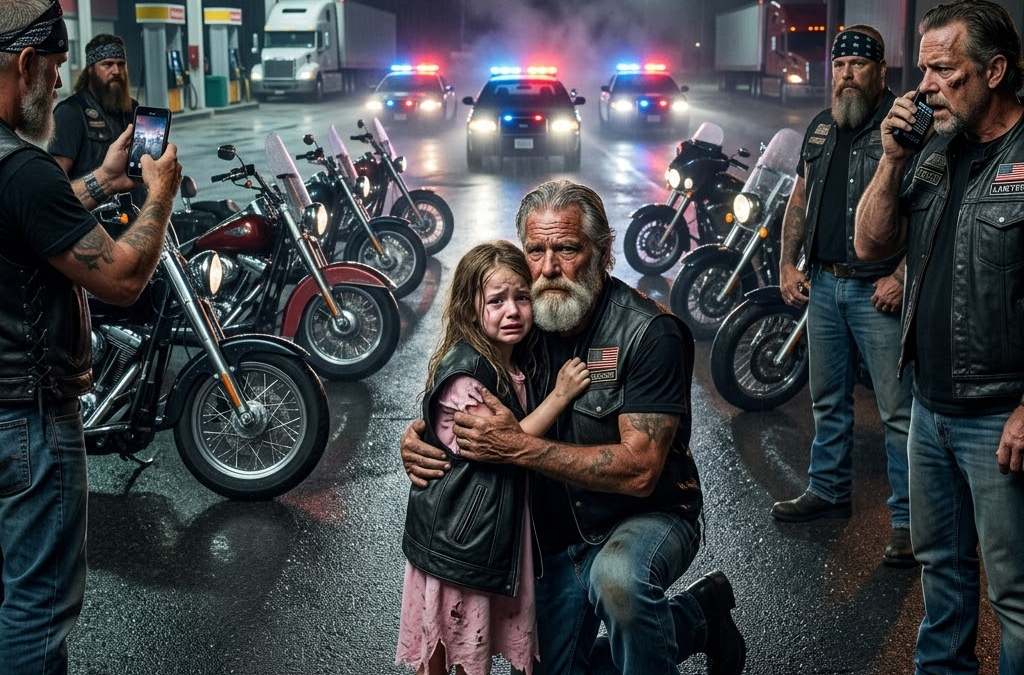
I shrugged off my leather vest and wrapped it around her shoulders. It swallowed her whole.
She flinched when the leather touched her.
Then she gripped the front of it like it was armor.
“What do people call you?” I asked.
Her good eye found mine.
“Sara,” she whispered. “Sara Sanders.”
“Okay, Sara. I’m Bear. That’s Jake. That big ugly one is Tom. Nobody here is going to grab you. Nobody here is going to hurt you. But we need to know who’s coming.”
“The police.”
Three of my brothers looked toward the highway at once.
Sirens were clearer now.
“Why are police coming after you?” Jake asked.
Sara stepped behind my leg so fast she nearly fell.
“They’re gonna make me go back.”
“Back where?”
“The foster house.” Her voice broke on the last word. “But I can’t. I can’t go back. She’ll kill me this time. She said she would.”
Nobody spoke for a moment.
The air around us changed.
Truck stop noise kept going—the engines, the highway, the lights—but inside our circle, everything went cold and still.
Big Tom took one step forward.
Tom was three hundred pounds of ex-welder, church deacon, and restrained violence. He had hands the size of catcher’s mitts and a voice soft enough to calm horses.
“Who hurt you, baby?”
Sara looked at him, then at me, then down at the pavement.
“My foster mom.”
“Name?”
She swallowed.
“Officer Denise Stevens.”
Jake’s face tightened. “Officer?”
Sara nodded quickly. “She’s police. She says everybody believes police. Nobody believes kids like me.”
The sirens were getting closer.
Maybe a mile out now.
Sara saw our faces and panic burst through whatever little strength she had left. She dropped to her knees on the pavement so hard I winced.
“Please,” she said. “Please don’t give me back. I’ll do whatever. I’ll clean your motorcycles. I won’t cry. I won’t make trouble. I know how to be quiet. I know how to be good. Just don’t give me back to her.”
I knelt in front of her despite the pain in both knees.
“Sara.”
“She said foster kids disappear all the time,” Sara rushed on. “She said nobody pays attention. She said if I told again, she’d make it look like I ran away and fell. She said everybody already knows I’m bad.”
“What do you mean, told again?”
Her breath hitched.
“I told the social worker lady. I told her twice. She said Officer Stevens wouldn’t do something like that. She said maybe I was confused. Then Officer Stevens found out.”
The little girl lifted the back of her nightgown.
I wish I could tell you I handled it calmly.
I did not.
I had seen men torn open in war. I had seen wrecks on highways, bar fights, burn scars, bullet wounds, the many ways bodies can be ruined. But nothing in my life prepared me for the sight of that child’s back.
Welts.
Old scars.
Fresh raised marks.
Belt-shaped lines crossing belt-shaped lines.
And worse than that, carved or cut into the healing skin in jagged repetitions, a word.
BAD.
Over and over.
BAD.
BAD.
BAD.
Jake turned away and swore into his hand.
Big Tom made a sound like something inside him had broken loose and barely been caught.
I lowered the nightgown gently.
Sara’s shoulders shook.
“It hurts,” she whispered. “It hurts so much.”
I took off my flannel shirt from under my T-shirt and wrapped it around her legs where the nightgown had torn. My hands were shaking so hard I had trouble with the buttons.
“Sara, listen to me,” I said. “We’re not handing you to anybody who hurt you.”
Her face crumpled.
“But she’s police.”
“I heard you.”
“She has a gun.”
“We noticed.”
“She says bikers go to jail.”
I almost smiled, but there was no room for it.
“Sometimes.”
The sirens were close now.
I looked at Jake.
“Call Luther.”
He was already moving.
Luther Townsend was our attorney. He was also a member of the Iron Saints, though he only rode on weekends and wore custom boots worth more than my first three motorcycles combined. He had a law office downtown, a ponytail, a courtroom voice that could freeze water, and an irritating habit of being right.
Jake put him on speaker while dialing with one hand and recording with the other.
That mattered.
Jake recorded everything. Club meetings, roadside repairs, arguments with hotel managers, Big Tom singing badly. Most of us mocked him for it.
That night, his habit saved a child.
“Luther,” Jake said when the call connected. “Emergency. Truck stop off I-47. Six-year-old foster kid. Severe abuse. Foster mother is police. Officers inbound.”
There was one second of silence.
Then Luther’s voice changed.
“Record everything. Public place?”
“Yes.”
“Good. Do not hide the child. Do not leave the property. Do not obstruct medical treatment. Keep her visible, protected, and away from the alleged abuser. Call 911 yourself now. Ask for state police, CPS emergency response, ambulance, and a supervisor not affiliated with local department.”
Jake nodded to me and started a second call from Tom’s phone.
I looked back at Sara.
“Sara, I need to take pictures of your injuries before anybody touches you. Only if you say yes. Your face, your throat, your back. It helps prove what happened.”
She stared at me.
“Will it make them believe me?”
“Yes.”
That was the best I could promise.
She nodded.
I took photos with hands that did not feel like mine.
Her face.
Her throat.
Her arms.
Her bare feet, cut and bleeding.
Her back.
I kept my voice steady by force.
“You’re doing good. You’re brave. Almost done. You don’t have to look at the camera.”
She whispered, “I tried to be good.”
I nearly dropped the phone.
“You are good,” I said.
She shook her head like she did not believe such things could be decided by strangers.
“I broke a glass.”
“Sara.”
“I dropped it. She said I did it to make work. She said I ruin everything.”
“You dropped a glass.”
“She said I was bad.”
“You dropped a glass.”
Her mouth trembled.
“She locked me in the laundry room.”
“For how long?”
“I don’t know. It was dark. I counted to a hundred a lot.”
I finished the photos and sent them to Luther.
His response came in under ten seconds.
Preserve originals. Do not engage physically unless necessary to protect child from immediate harm. Ambulance first. State police if possible. Keep recording.
By then, three police cruisers had turned into the truck stop.
Lights flashing.
Sirens cutting off one by one.
Sara made a small strangled sound and tried to run.
Her legs gave out.
I caught her before she hit the pavement.
She weighed nothing.
Less than my old toolbox.
Less than a six-year-old should ever weigh.
I lifted her carefully into my arms. She buried her face against my chest and clutched my T-shirt with both fists. Her whole body shook so hard it seemed the tremor came from her bones.
Three officers climbed out.
Two men.
One woman.
I knew which one was Stevens before anyone said her name.
She was in uniform, maybe late thirties, solid build, pale hair pulled tight, eyes hard as gravel. She scanned the lot with the irritated look of someone arriving to clean up an inconvenience. Then she saw Sara in my arms.
And she smiled.
Not relief.
Not worry.
A smile with teeth behind it.
“There’s my little liar.”
Every biker around me shifted.
I felt it more than saw it.
A ring closing.
Officer Stevens walked toward us like she owned the asphalt.
“Appreciate the assist, boys,” she said. “This one likes to make up stories.”
Sara whimpered into my shirt.
I did not move.
“Stories that come with bruises?” I asked.
Stevens stopped six feet away.
Her eyes flicked over me, down my vest, across the patches on the bikes behind us. Men like her know how to measure threat. She saw old bikers. She saw leather. She saw people the town would not automatically trust.
And she relaxed.
That was her mistake.
“She’s emotionally disturbed,” Stevens said. “History of self-harm, lying, attention-seeking. I’m her foster placement and legal guardian. Hand her over.”
Jake stood to my right, phone held low but angled perfectly.
Big Tom moved to my left.
“Funny,” Tom said softly. “She says you beat her.”
Stevens laughed.
Actually laughed.
“Says who? A messed-up foster brat? Against a decorated officer with twelve years on the force?”
One of the male officers, the older one, looked uncomfortable.
The younger one looked at Sara.
Really looked.
That mattered later.
Stevens extended one hand.
“Sara. Come here.”
“No!” Sara screamed, so violently that pain bent her forward. “No! No! Please!”
I tightened my hold instinctively.
Stevens’ face hardened.
“Sir, hand over the child.”
“No.”
Her eyes narrowed.
“You do understand what kidnapping is?”
“I understand a lot of things.”
“You have no legal right to interfere.”
“I have a legal right to prevent immediate harm until proper authorities arrive,” I said, hoping Luther would forgive the phrasing. “And we’ve called for medical assistance and child protective services.”
Her expression flickered.
Just once.
“You did what?”
“Ambulance is on the way,” Jake said.
“And CPS,” Big Tom added.
“And our attorney is listening,” Jake said.
Luther’s voice came from the speaker on Tom’s phone.
“Recording is active. Counsel present by phone. Please identify yourselves for the record.”
Stevens’ face went red.
“Turn that off.”
Luther said, “This is a public place. My clients are lawfully recording an interaction involving alleged child abuse by a public official. Officer, I advise you not to make threats on camera.”
“Who the hell is that?”
“Luther Townsend, attorney at law.”
The older officer stepped forward. “Ma’am, we need to calm this down.”
Stevens snapped, “Stay out of it.”
The younger officer kept staring at Sara’s face.
“What happened to her eye?” he asked.
Stevens shot him a look. “She ran into a door during one of her episodes.”
Sara lifted her head just enough to cry, “No, I didn’t.”
“Quiet,” Stevens barked.
The word cracked across the lot.
Sara went silent instantly.
Not obedient silent.
Terrified silent.
The younger officer saw that too.
He stepped closer to me, slowly, palms visible.
“I need to see the child.”
Stevens said, “Reed.”
He ignored her.
“What’s your name?” I asked him.
“Officer Daniel Reed.”
“You got kids?”
His jaw tightened.
“A daughter. Three.”
“Then look.”
I shifted Sara carefully.
“Baby,” I murmured, “I’m going to show him your back. He’s not going to touch you.”
She shook all over.
But she nodded.
I lifted the back of the nightgown enough for Reed to see.
His face changed.
First confusion.
Then horror.
Then rage, clean and young and dangerous.
“Jesus Christ,” he whispered.
The older officer moved closer and saw too.
His mouth opened.
Stevens’ hand dropped to her baton.
“She does that to herself.”
Reed turned on her.
“She carved words into her own back?”
“She’s disturbed.”
“She’s six.”
Stevens’ eyes went flat.
“Don’t be stupid, Reed. You’ve seen these kids. They lie. They break things. They bring trouble into every house they enter.”
Sara flinched against me.
Luther’s voice came through the phone, calm and sharp.
“Officer Stevens, are you aware you are being recorded?”
“Shut up.”
Reed’s hand went to his radio.
Stevens saw.
“Don’t.”
He stared at her.
“What did you do?”
Her face twisted.
And then, maybe because arrogance is its own kind of blindness, she made her second mistake.
“She killed my daughter.”
The whole truck stop seemed to hold its breath.
Reed froze.
“What?”
“Not with her own hands.” Stevens pointed at Sara. “Girls like her. Foster kids. Broken kids. My daughter tried to help one. Brought her into our home. That little animal pushed my child down a staircase.”
The older officer whispered, “Denise.”
Stevens ignored him.
“My daughter was seventeen. Seventeen. Dead because some foster brat decided rules didn’t apply. So don’t stand there looking at me like you know what these kids are.”
Sara had stopped breathing right.
I felt it.
Her whole body went rigid, little lungs pulling too fast.
I rubbed her back through the shirt, careful not to touch wounds.
“You’re here,” I whispered. “You’re with me. Breathe.”
Stevens kept going.
“I teach them what nobody else will. That there are consequences. That being unwanted doesn’t give you permission to ruin lives.”
Reed lifted his radio.
“Dispatch, this is Unit 23. I need a supervisor and ambulance expedited to Flying J off I-47. Possible child abuse by law enforcement officer. Notify internal affairs and emergency CPS. State police requested.”
Stevens lunged toward him.
Big Tom stepped between them.
Not touching.
Just existing.
At three hundred pounds, existence was enough.
“Move,” Stevens snapped.
Tom looked down at her.
“No.”
She reached for her weapon.
Every man in our circle went still.
The older officer shouted, “Stevens, don’t!”
Reed drew his taser.
“Hands away from your belt!”
For one terrifying second, I thought the night would split open.
Sara buried her face into my chest.
Then the older officer stepped behind Stevens, grabbed her wrist, and forced her hand away from the gun.
“Denise, stop.”
She turned on him, wild-eyed.
“You’re taking their side?”
“I’m looking at a beaten child.”
“She’s lying!”
“She can barely stand.”
“She’s bad!”
The word echoed.
Bad.
Bad.
Bad.
I thought of her back.
The carved word.
The lesson forced into skin.
Two more cruisers pulled in.
Then an ambulance.
Then a state police vehicle minutes later, though those minutes felt longer than most years.
The supervisor, Sergeant Malloy, was a square-built woman with cropped gray hair and the kind of face that did not waste expressions. She stepped out, took one look at Sara in my arms, one look at Stevens being held back, and said very quietly:
“Sweet Jesus. She’s just a baby.”
That was the first official thing anyone said that sounded like truth.
Things moved fast after that.
Stevens was disarmed.
Badge removed.
Cuffed.
She screamed during the arrest. Not apologies. Not denial exactly. Accusations. About foster kids. About betrayal. About how nobody understood what she had lost. The words poured out of her like poison finally uncorked.
All of it recorded.
Reed stood pale and shaking beside his cruiser after giving his statement. He looked about twelve years old in the flashing lights.
I said, “You did right.”
He looked at Sara.
“I should’ve seen sooner.”
“You saw tonight.”
He nodded, but it did not comfort him.
Good.
Some guilt should become a duty.
The paramedics wanted Sara on the stretcher.
She refused to let go of my vest.
“Please,” she whispered. “Don’t leave me.”
I looked at the lead paramedic.
He looked at me.
“You can ride in the ambulance,” he said.
Luther’s voice came from the phone. “Do it. I’ll meet you at the hospital.”
So I climbed into the ambulance with Sara still holding two fistfuls of my shirt, my brothers standing outside under truck stop lights like a wall of leather and fury.
Before the doors closed, Sara lifted her head.
“Will I see them again?”
“Who?”
“The bikers.”
I looked at my brothers.
Jake raised two fingers.
Big Tom wiped his eyes with the heel of his hand and pretended he had not.
“Yeah,” I told her. “You’ll see them again.”
She swallowed.
“Pinky swear?”
I held out my little finger.
Her battered pinky curled around mine.
“Pinky swear.”
At the hospital, the doctors found more injuries than any child should survive.
I will not list them all.
Some details do not make a story more powerful.
They only make the wound public again.
What matters is this: Sara had been hurt for a long time, and every system built to notice her had failed.
The emergency room doctor photographed everything.
A child abuse pediatrician was called.
CPS sent an emergency worker from another county.
State police took formal statements.
Luther arrived in a suit jacket over a motorcycle T-shirt, carrying a legal pad and the expression of a man preparing to destroy someone carefully.
Sara slept only after they gave her pain medicine.
Even then, her fingers stayed hooked around the edge of my vest.
At dawn, a CPS worker named Ms. Elena Hart sat with me in a family room that smelled of coffee and old carpet.
“You understand you are not family,” she said gently.
“I understand.”
“You understand she cannot simply leave with you.”
“I understand.”
“You understand this will be complicated.”
I laughed once.
Not because it was funny.
“Ma’am, I am sixty-seven years old, unmarried, and live above a motorcycle repair shop. Complicated is the only word anybody’s got.”
Her face softened.
“She asked for you every time she woke up.”
I looked through the glass window toward the treatment area.
“She ran to us.”
“Why do you think she did that?”
I thought about Sara’s question in the truck stop lot.
My real mommy told me bikers look out for kids.
“I think somebody she loved told her a story once,” I said. “And when everything went bad, she decided to believe it.”
Ms. Hart nodded slowly.
“Then we need to make sure the story doesn’t fail her now.”
Stevens was charged within forty-eight hours.
The video helped.
The photos helped.
Officer Reed’s radio call helped.
The confession helped most.
But what followed was uglier than I expected.
Stevens had friends.
Not good friends.
Useful friends.
People who had ignored complaints. People who wrote reports with careful omissions. A social worker who had dismissed Sara’s claims because Stevens was “credible.” Two officers who had responded to previous calls and left Sara in the home after speaking only to Stevens. A supervisor who signed off on paperwork without visiting.
Luther called it institutional rot.
Big Tom called it something less polite.
Investigators found two other foster children Stevens had hurt.
One had been moved out years earlier and still had scars.
Another had run away and been labeled troubled.
A third child, a little boy named Mason, had died three years before after what Stevens reported as a fall from a backyard playset.
The case reopened.
The town finally learned what Sara had known all along.
Foster kids can scream the truth, and adults with clean desks can still file it under difficult behavior.
Sara spent six weeks in the hospital and then a therapeutic group home while the courts decided what to do with her.
She called every day.
Every single day.
The first call came from Ms. Hart’s phone.
A tiny voice said, “Bear?”
“I’m here, princess.”
She was quiet for a long moment.
“You still gonna come?”
“Still coming.”
“You promise?”
“Pinky swear means promise.”
“I don’t know if grown-ups remember.”
“I do.”
After that, the calls became routine.
Sometimes she talked.
Sometimes she breathed.
Sometimes she asked what I ate for dinner, as if checking whether I still existed between visits. Sometimes she wanted to know about each bike in the club. Which one was loudest. Which one was fastest. Which one was pink.
“None are pink,” I told her.
“That’s sad.”
“Deeply.”
The Iron Saints made changes.
Immediately.
Jake painted an old Harley tank pink and mounted it on the wall of the clubhouse with a sign that said RESERVED FOR SARA.
Big Tom bought children’s books and pretended they were “for community outreach,” though we caught him reading them first.
Luther began the process that everyone told me was impossible.
Foster certification.
Kinship-style placement exception.
Background checks.
Home inspection.
Character references.
Financial review.
Parenting classes.
Trauma training.
At sixty-seven, I sat in a room with young couples learning about attachment, sensory triggers, medical neglect, court procedures, and how hurt children test safety because their lives have taught them safety is usually a lie.
I took notes like my life depended on it.
Because hers might.
The home inspector stood in my apartment above the motorcycle shop and looked around.
One bedroom.
One bathroom.
Kitchen with old cabinets.
Living room overlooking the alley.
“She needs her own room,” the inspector said.
“She’ll have mine.”
“And you?”
“Couch pulls out.”
“You’re sixty-seven.”
“I’ve slept in worse places.”
She looked at me for a long time.
Then she wrote something down.
The club renovated before approval came through.
Not after.
Before.
“Faith without works is dead,” Big Tom said, hauling lumber up the stairs.
“You quoting Scripture at construction?” Jake asked.
“I contain multitudes.”
We turned my bedroom into Sara’s room.
Purple walls because she said on one call that purple was what princesses wore when pink was being too loud.
A white bed with a quilt.
Shelves.
A night-light shaped like a moon.
A small desk.
A closet full of clothes she had not yet seen.
On the wall, Jake painted a mural of motorcycles riding under stars, but made one of them pink because he had no defense against a six-year-old’s disappointment.
I moved to the pullout couch.
Everyone said I had lost my mind.
My sister called from Arizona to remind me I had no wife, no child-rearing experience beyond being an uncle, a bad back, and cholesterol.
“She needs a family,” my sister said.
“She needs somebody who will come back.”
“That isn’t the same thing.”
“It’s the first thing.”
She went quiet.
Then she sent a box of children’s pajamas and a note that said, I’m scared for you. I’m proud of you. Both can be true.
Three months after the truck stop, Ms. Hart called.
“Are you sitting down?”
I sat so fast I nearly missed the chair.
“The judge approved emergency foster placement with you, pending continued review.”
I could not speak.
“Mr. Mercer?”
I pressed the phone to my forehead.
“She can come home?”
“Yes.”
Home.
The word nearly took me out.
The morning I picked Sara up, all eight brothers rode with me.
Not because we needed eight motorcycles to collect one small girl.
Because promises should arrive loudly when a child has spent her life being taken quietly.
Sara walked out of the group home carrying a plastic grocery bag.
That was all.
One teddy bear.
Two outfits.
A folder of paperwork.
The pink nightgown was gone, kept as evidence.
I looked at the bag.
“That’s everything?”
She shrugged like it did not matter.
“Foster kids don’t get to keep things.”
That sentence changed the financial priorities of eight grown men in under three seconds.
By sunset, Sara owned more socks than a department store.
At my apartment, she stopped in the doorway of her purple room.
Her mouth opened.
Closed.
She took one step inside.
Touched the quilt.
Touched the desk.
Touched the moon night-light.
Saw the motorcycle mural.
Then the pink bike.
Her face crumpled.
“Is this for me?”
“Unless Big Tom wants to move in.”
Tom cleared his throat behind me. “Purple’s not my color.”
Sara walked to the bed but did not sit.
“Am I allowed to touch things?”
My chest hurt.
“Everything in this room is yours.”
She looked at the bookshelf.
“The books too?”
“Yes.”
“The clothes?”
“Yes.”
“The light?”
“Yes.”
“The wall?”
I blinked.
“Yes, the wall.”
She placed one small palm against the purple paint and began to cry.
Not like at the truck stop.
Not terror.
Grief.
Relief.
Something too large for her body.
“Nobody ever let me touch pretty things,” she said.
I knelt beside her.
“You can touch pretty things here.”
She looked at me suspiciously through tears.
“If I break something?”
“Then we clean it up.”
“If I spill?”
“We wipe it.”
“If I’m bad?”
I took a breath.
“You can make mistakes. You can get mad. You can cry. You can have bad days. But you are not bad.”
Her little face twisted.
“You don’t know.”
“Yes,” I said. “I do.”
She moved slowly, as if expecting the air itself to punish her, and leaned into me.
I hugged her carefully.
She was so small.
So alive.
So impossibly brave.
Princess came two weeks later.
Princess was a pit bull mix rescued from a neglect case, all white chest, brown patches, enormous head, and eyes full of gentle stupidity. The rescue warned she needed patience.
Sara took one look at her and said, “She looks scary, but she’s nice.”
I almost laughed.
“Yes.”
“Like bikers.”
“Exactly.”
Princess slept outside Sara’s door the first night.
Inside the room would have been too much.
By the third night, Sara opened the door and whispered, “You can come in if you don’t lick my face.”
Princess licked her face.
Sara laughed so hard she fell backward onto the bed.
That was the first time I heard her laugh like a child.
Not polite.
Not nervous.
Real.
Stevens went to trial nine months later.
Sara testified by video from a protected room.
Luther sat with us. Ms. Hart held Sara’s teddy bear. I sat beside her, close enough that she could touch my sleeve but not so close that she felt trapped.
The prosecutor asked questions gently.
Sara answered.
Sometimes with words.
Sometimes nods.
Sometimes long silences where every adult in the room learned what waiting properly looked like.
Then Stevens’ attorney tried to make her sound confused.
Sara sat up straighter.
“I’m not confused,” she said.
The room went still.
“She hurt me because she was mad at a different kid. But I am not that kid. I was just me.”
I felt Luther’s hand grip my shoulder.
Sara looked into the camera.
“You don’t scare me anymore,” she said. “I’ve got a real daddy now.”
My heart stopped.
She turned toward me after saying it, eyes suddenly wide, like she had only then realized the word had escaped.
“Is it okay?” she whispered. “That I called you that?”
I could barely see her through tears.
“More than okay, princess.”
Stevens was convicted.
Twenty years.
Other charges followed. So did charges against two people who had helped bury complaints. The social worker who dismissed Sara lost her license. Officer Reed testified, left the department six months later, and eventually joined a child advocacy unit with the state. He still sends Sara a birthday card every year.
Not everyone was punished.
That is the truth.
Systems protect themselves.
Paper disappears.
People retire.
Others claim they did not know.
But enough truth came out that nobody could put Sara back into silence.
Four years passed.
Sara turned ten.
She remained small for her age, but not in spirit. She read at a high school level, beat every biker in the club at Scrabble, and developed an alarming interest in anatomy books.
“I’m going to be a doctor,” she told me one morning over pancakes.
“Motorcycle doctor?”
“Kid doctor. For hurt kids.”
I flipped a pancake badly.
She frowned.
“Maybe also pancake doctor because you need help.”
“Cruel.”
“Accurate.”
She still had nightmares.
Some nights she woke screaming.
Some nights she came to the living room and stood silently until I woke, because asking for comfort remained harder than needing it.
At first, she apologized every time.
“I’m sorry.”
“No sorry for nightmares.”
“But I woke you.”
“I wake myself snoring.”
She thought about that.
“You do snore.”
“See? Useful information.”
Over time, she learned she could come close.
Then sit beside the couch.
Then curl under the spare blanket.
Then, eventually, crawl into the old recliner nearby while Princess climbed halfway onto her lap like a weighted blanket with paws.
Healing was not linear.
It was medicine.
Therapy.
Court dates.
School meetings.
Tantrums over bath time because bathrooms had been unsafe once.
Crying over broken crayons.
Panic when someone knocked too hard.
Refusing new shoes because new things could disappear.
Hoarding snacks under the bed.
Asking every night, “You still gonna be here in the morning?”
And every night, I answered:
“Still here.”
The Iron Saints became uncles.
Not formally.
Better.
Jake taught her how to check tire pressure.
Big Tom taught her how to make pancakes properly, humiliating me in my own kitchen.
Luther taught her the word objection, which she abused immediately.
“No broccoli.”
“You need vegetables.”
“Objection.”
“Overruled.”
She called the club members her biker uncles and assigned them all rankings based on snack quality, patience, and whether they could braid hair.
Tom ranked highest because he watched four online tutorials and practiced on Princess before attempting Sara’s hair.
Princess tolerated this because Princess believed all human activity was worship.
The father-daughter dance came in February.
Sara brought the flyer home folded into a tiny square.
She placed it on the kitchen table and watched my face.
“What’s this?”
“School thing.”
I unfolded it.
FATHER-DAUGHTER WINTER DANCE.
My throat tightened.
“Do you want to go?”
She shrugged.
The shrug meant yes.
“It says fathers or father figures,” she said quickly. “So you count if you want.”
“If I want?”
“You don’t have to.”
“Sara.”
She looked down.
“I want.”
Her face stayed carefully neutral for half a second before joy betrayed it.
“Okay.”
Then she frowned.
“Do you dance?”
“I was once banned from three counties for dancing.”
Her eyes widened.
“That is not true.”
“No.”
“Good.”
“I’m worse now.”
She wore a purple dress.
Not fancy by rich people standards, but to her it was royal. Sparkly belt. Soft skirt. Silver shoes. A little cardigan because February had teeth. Big Tom’s sister came over and did her hair in curls while Sara sat stiff as a statue, afraid movement might undo the magic.
I wore clean jeans, boots, a white shirt, and my leather vest.
Sara studied me in the hallway.
“You think kids will laugh because you’re a biker?”
“They might.”
“You think parents will stare?”
“Probably.”
“Do you care?”
I looked at my daughter.
Not by blood.
Not by history.
By choice, court order, night terrors, packed lunches, homework, bike rides, and every morning I stayed.
“No.”
She smiled.
“Me neither. You’re my daddy. You’re my hero.”
I had to look away and pretend my boots required attention.
The gym was decorated with paper snowflakes and blue lights. Fathers in suits. Stepdads in sweaters. Grandfathers. Uncles. One mother in a tie whose daughter looked proud enough to fight anyone who commented.
People did stare when we walked in.
Sara lifted her chin.
I let her.
Halfway through the night, the principal announced a father-daughter king and queen drawing. Names in a bowl. Silly plastic crown. Sparkly tiara. Applause.
They called Sara’s name.
She froze.
Then the room erupted.
Not because of pity.
Because by then, Sara had become known.
The girl who read aloud to younger kids.
The girl with the biker dad.
The girl who corrected teachers gently when they said “real parents” without thinking.
She walked to the front holding my hand.
The principal placed a little tiara on her head.
Someone put a cheap crown on mine.
Sara took the microphone before anyone could stop her.
“My daddy saved me,” she said.
The gym went quiet.
“Him and seven other bikers. So anybody who thinks bikers are scary has it backwards. Sometimes scary-looking people are the safest people.”
I stood behind her wearing a plastic crown and crying in front of three hundred people.
She turned.
“Daddy, dance.”
“Princess, I warned you.”
“I’m brave.”
“Apparently.”
We danced badly.
She laughed.
People clapped until their hands hurt.
That night, after she fell asleep, I found her little prayer notebook open on her desk.
I did not read past the first page.
I am not a snoop.
Not anymore.
But the first page was visible.
Thank you for my daddy and his biker friends. Thank you for making them pull over for coffee that night. Please help all the other kids who are running find their own bikers too.
I sat on the floor beside her bed and cried silently while Princess snored loud enough to vibrate the baseboards.
A week later, Sara asked about her real parents.
She had asked before, but never like that.
We were sitting on the fire escape behind the apartment because she liked the city lights and the sound of motorcycles being worked on below. She leaned against my side with a blanket around her shoulders.
“Daddy?”
“Yes?”
“Do you think my real parents would be proud of me?”
Her parents had died in a house fire when she was two.
That was how she entered the system.
I knew their names from the case file. Amanda and Joseph Sanders. Young. Working-class. Loved their baby, according to everyone who knew them. Gone before Sara could form enough memory to keep them whole.
“I know they would,” I said.
“How come you know?”
“Because you made it. You fought. You asked for help when it counted most. That takes more courage than most grown-ups ever find.”
She stared at the street below.
“I used to dream somebody would rescue me.”
I kept still.
“Every night in that house, I’d dream somebody came. A superhero. A firefighter. My real mom. Sometimes a dog. Sometimes nobody had a face.” She swallowed. “I stopped dreaming it after a while because waking up hurt too bad.”
My arm tightened around her.
“And then?”
“And then I ran.” She looked up at me. “And you were there. You and seven bikers who never met me.”
“We were lucky enough to be there.”
“No,” she said firmly. “I was lucky.”
I started to argue.
She placed one small hand over my mouth.
“Daddy.”
I stopped.
She lowered her hand.
Then she said the words she had never said before.
Not in four years.
Not once.
“I love you to the moon and back.”
Something cracked open in me so wide I thought the night might fall in.
I pulled her close.
“I love you too, princess. To the moon and back.”
She leaned her head against my chest.
For a while, neither of us spoke.
Downstairs, Jake revved an engine he had no reason to rev except that he remained emotionally stunted in very specific ways.
Sara smiled.
“That’s a good loud,” she said.
“Yes.”
“Safe loud.”
I thought of the truck stop.
The sirens.
The engines.
The little girl running barefoot toward strangers because her dead mother had once told her bikers followed rules.
“Yes,” I said. “Safe loud.”
Years later, people still ask why we stopped at that Flying J.
Why that night.
Why that hour.
Why eight bikers pulled in for coffee when a child needed someone to believe her.
I do not have an answer that satisfies anyone.
Maybe Jake’s terrible taste in coffee saved her.
Maybe God works through caffeine and bad timing.
Maybe Sara’s mother whispered from wherever good mothers go and guided her baby toward the loudest men in the parking lot.
I don’t know.
Here is what I do know.
A child ran to us bleeding and barefoot because every official door in her life had closed.
She did not need heroes in capes.
She needed witnesses.
She needed phones recording.
She needed an attorney on speaker.
She needed a young officer brave enough to believe his eyes over a badge.
She needed paramedics, doctors, social workers who finally listened, a judge willing to see past my leather, and seven bikers who stood between her and the woman who had made her believe she was bad.
She needed someone to say:
No.
Not this time.
You don’t get to take her back.
And after the rescue, she needed the harder thing.
Breakfast.
School forms.
Therapy appointments.
Nightmare duty.
Parent-teacher conferences.
Braiding practice.
Court hearings.
New shoes.
Patience when she tested whether love could survive spilled juice, broken lamps, angry words, and silence.
The world loves rescue stories because they end at the ambulance.
Real love begins after.
Real love is staying after the sirens fade.
Sara is older now.
Twelve.
Tall for her age suddenly, as if her body decided it was safe to grow.
She still wants to be a doctor. She reads medical textbooks for fun, which I find suspicious. She volunteers at the shelter on Saturdays because she says scared animals understand scared kids.
Stevens is still in prison.
Good.
The system that failed Sara changed some after her case.
Not enough.
Never enough.
But reporting procedures tightened. Foster placements involving law enforcement now require outside review in our county. Officers receive additional training. CPS got sued, which is sometimes the only language bureaucracies understand. Sara’s testimony became part of a state hearing on foster oversight.
She does not know all those details yet.
She will.
When she is ready.
For now, she knows this:
Her room is hers.
Her body is hers.
Her voice matters.
Mistakes are not danger.
Bad days do not make bad children.
And every night, before bed, she still says a prayer.
Not because I make her.
I don’t.
She kneels beside Princess, who is old now and mostly deaf, and whispers:
“Thank you for my daddy and my biker uncles. Thank you for coffee stops and loud motorcycles. Please help the kids who are running find somebody who believes them. And please tell my first mommy and daddy I’m okay.”
Then she climbs into bed under a purple quilt, moon night-light glowing, Princess snoring by the door, and for the first time in her life, she sleeps in a room where nobody locks her in and nobody calls her bad.
Sometimes, after she falls asleep, I stand in the doorway and look at her.
The little girl from the truck stop.
The daughter I did not know I was waiting for.
And I think about the question she asked that night with blood on her feet and terror in her eyes.
My real mommy told me one time that bikers look out for kids. Is that a real thing?
Yes, princess.
It is.
Or at least it became real the moment you asked.
Because a code is only words until a child runs toward you in the dark.
Then it becomes a choice.
And that night, under fluorescent truck stop lights, while sirens came closer and a little girl shook in my arms, eight old bikers made the only choice any decent person could make.
We believed her.
We stood still.
We kept the camera rolling.
We did not hand her back.
And every good thing in my life since began with that one decision.
To the moon and back.

