A Badly Injured Stray Dragged Himself Into a Vet Clinic Just Before Closing—Weeks Later, the Cat Nobody Wanted Began Doing Something No One There Could Explain.
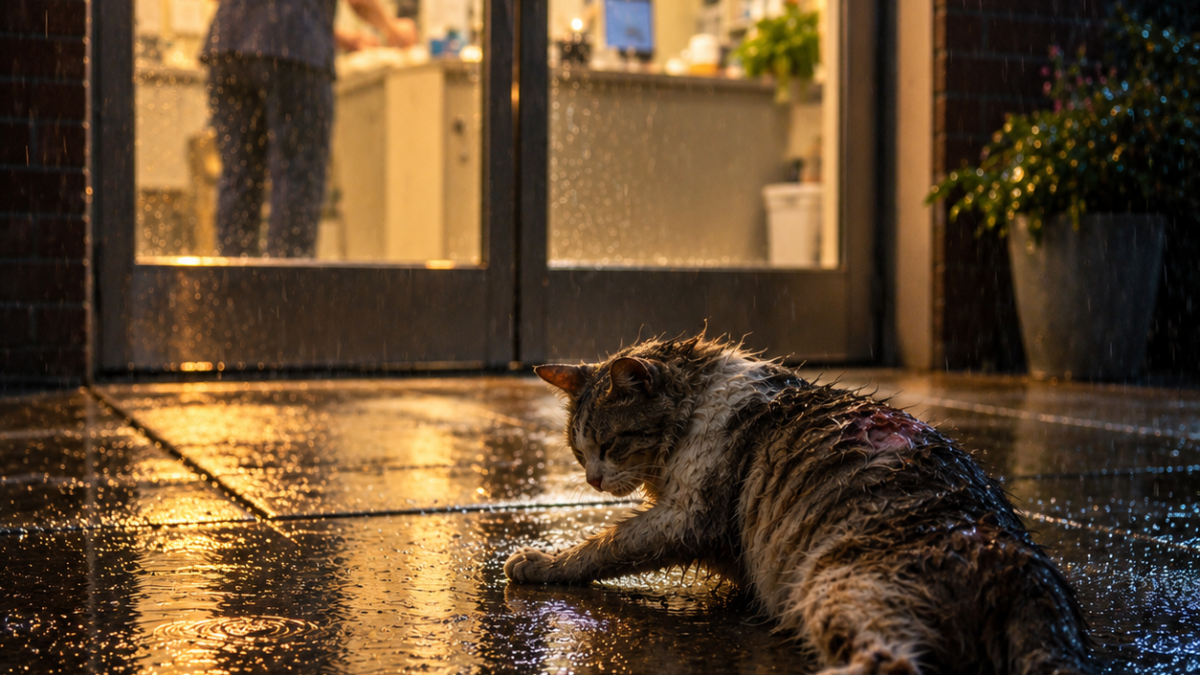
PART3:
Cats in pain usually make some kind of sound. A hiss. A growl. A panicked scream. Something.
This cat just looked at me.
Not begging.
Not trusting.
Not even afraid in the usual way.
He looked exhausted beyond fear, as if the world had already done everything it could think of and he had dragged himself here only because he didn’t know where else to fall.
“Oh, sweetheart,” I whispered.
I unlocked the door.
The second the door opened, he tried to step forward.
His bad paw buckled.
He collapsed onto the mat.
I dropped to my knees so fast the pain shot up both legs.
“Dr. Ortiz!” I shouted. “Lena!”
I scooped him into my arms, and he was so light it made me angry. Not sad yet. Angry. His bones pressed through his wet fur. He smelled like road dirt, infection, garbage, and rain. His body was cold, but not cold enough. Not gone. Not yet.
Dr. Lena Ortiz came out of the back exam room wearing her coat over her scrubs, keys already in her hand. She had been about to leave. She stopped when she saw me.
“Treatment room,” she said immediately.
No questions.
That was one of the reasons I loved her.
We worked for two hours.
We cleaned wounds. Started fluids. Checked his temperature. Treated fleas. Examined the paw. Took X-rays. He had no microchip. No collar. No obvious recent surgery. No name. No one attached to him by paperwork, phone number, or responsibility.
He had an infected bite near his shoulder. A sprained front leg. A torn ear. A cracked tooth. Old scars under the new wounds. He was underweight by several pounds. His gums were pale. His breathing stayed shallow.
“I don’t like his odds,” Lena said quietly while adjusting the fluids.
I looked at the cat on the warm towel.
His good eye was open, watching us.
“Don’t say that where he can hear you.”
Lena glanced at me.
“He’s a cat, Mara.”
“He’s listening.”
She almost smiled, but not quite.
I stayed with him after she left.
Technically, I should have gone home. I had already clocked out. The clinic was quiet except for the machines humming and rain hitting the back door. The overnight kennel dogs shifted in their runs. Somewhere in the boarding room, a beagle snored with impressive commitment.
The orange cat lay under a warming blanket with an IV line taped carefully in place.
Every time I thought his breathing slowed too much, I leaned close.
“Don’t you dare,” I whispered.
His ear twitched once.
That was enough for me to keep talking.
I told him about the clinic. About the coffee maker that tasted like electrical fire. About the printer that only jammed when clients were crying. About Bruce, the golden retriever who ate socks so often we should have given him a loyalty card. About Mrs. Weller’s Chihuahua, who had bitten three staff members and one priest at a Christmas blessing.
I told him my name was Mara Ellis.
I told him I lived alone.
I told him that was not as peaceful as people liked to pretend.
Maybe I told him too much.
But there is something about a creature on the edge of life that makes truth feel less embarrassing.
Around two in the morning, I rested my head on my folded arms beside his cage.
“If you stay,” I murmured, half asleep, “I’ll stay too.”
It was a foolish thing to say to a stray cat.
But at the time, I think I needed someone to hear it.
By morning, he was still alive.
Barely.
But alive.
When Dr. Ortiz came in at 7:15, she found me sitting on the floor with a paper cup of terrible coffee, staring at him like I could hold his body together with attention.
She looked at the cat.
Then at me.
“Well,” she said. “He’s stubborn.”
“Good.”
“Stubborn helps.”
He didn’t have a name, so I named him Patch.
Not because of his fur. Not exactly.
Because that was what he looked like to me.
Like life had torn him open in a dozen places and someone had patched him back together with whatever was left.
Patch.
It fit.
Over the next few weeks, he healed slowly, suspiciously, and without making anybody’s job easy.
He hated medication.
He hated having his wounds cleaned.
He hated the digital thermometer with a fury that felt personal.
He did not hiss often, but when he did, every living creature in the room reconsidered its choices. His front paw improved, but not completely. He would always limp. His ear healed crooked. The scar across his nose turned white. One eye remained a little softer than the other, as if part of him was still watching a place the rest of us could not see.
But he lived.
That should have been enough for the world.
It wasn’t.
Once he was stable, we tried to find him a home.
I took photos of him near the front window because the light there was kind to almost everyone. I brushed his fur. I tucked the bad paw slightly beneath him so it didn’t look so obvious. I wrote a post for the clinic page.
Meet Patch, our brave little survivor. Patch came to us hurt and hungry on a stormy night. Now he’s ready for a quiet home where he can feel safe and loved. He’s gentle, litter-box trained, and happiest with soft blankets and patient people. He deserves his second chance.
I included three heart emojis because apparently that helps.
The post got likes.
Lots of likes.
People commented, Poor baby.
So sweet.
Someone adopt him!
What a fighter!
But nobody filled out an application.
A woman messaged to ask how old he was. When I said probably between six and eight, she stopped replying.
A man asked if his limp would “cost extra later.”
A mother asked if he was good with toddlers. I said I didn’t know and would not recommend overwhelming him. She said they wanted a kitten anyway.
Someone wrote, He looks rough. Do you have any orange kittens?
After three weeks, I stopped checking the messages every five minutes.
After six weeks, I stopped pretending I wasn’t hurt.
After ten weeks, everyone stopped talking about adoption.
Patch became clinic property in the unofficial way all beloved things do.
No meeting.
No vote.
No signed agreement.
One day he was “the stray we’re trying to place,” and then somehow he was “Patch from the clinic.” He slept on a folded towel behind the front desk. He sat in the window every morning, crooked ear backlit by the sun like a flag that had survived battle. He limped down the hall as if inspecting his employees. He learned which drawer held treats and which staff member was easiest to manipulate.
It was Miguel, one of our assistants.
Patch could get anything from Miguel.
“I don’t know how he does it,” Miguel said one afternoon as Patch ate chicken from his palm.
“He looks at you like you’ve disappointed him,” I said.
Miguel nodded. “He has.”
Dr. Ortiz pretended not to be attached.
This lasted four days.
Then I caught her checking the thermostat in the lobby and muttering, “It’s too cold for his joints.”
Patch did not become sweet exactly.
That would be too simple.
He remained a cat with opinions and legal boundaries. He did not like being picked up unless he decided gravity was beneath him. He knocked pens off the desk. He stole the receptionist’s chair. Once, during a staff meeting, he walked across a printed budget proposal and threw up on the section labeled “growth opportunities.”
Dr. Ortiz called that “peer review.”
He was not magical.
He was better than magical.
He was real.
Then one Tuesday morning, a woman came in with a little gray cat named Pearl.
Pearl was terrified from the moment the carrier crossed the threshold. Not nervous. Not cranky. Terrified. She slammed herself against the plastic door so hard I worried she would hurt herself. Her pupils were blown wide. Her breath came fast. Her owner, a young woman with shaking hands and a sweatshirt too thin for the weather, kept saying, “She wasn’t like this at home. I’m sorry. I’m so sorry.”
“You don’t have to apologize,” I said. “She’s scared.”
“I don’t know what to do.”
“We’ll go slow.”
We did go slow.
Pearl did not care.
She growled when I approached. She threw herself backward when Dr. Ortiz entered. We tried dimming the lights. We tried leaving the carrier open. We tried soft voices and time and patience. Nothing helped.
Then Patch appeared in the doorway.
Nobody called him.
Nobody shook a treat bag.
He just came.
He limped into the exam room, crooked ear tilted, bad paw tucked slightly inward. He paused near the wall, looked at the carrier, then sat down.
That was all.
He did not approach. Did not sniff. Did not make a sound.
He simply stayed.
Pearl stopped slamming against the carrier.
The room became so quiet I could hear the clock ticking above the cabinet.
Patch blinked once.
Slowly.
Pearl pressed herself against the side of the carrier closest to him.
The owner’s mouth fell open.
Dr. Ortiz looked at me.
I looked at her.
Nobody said anything because nobody wanted to scare the moment away.
After a few minutes, Pearl’s breathing slowed enough for us to proceed. The exam still took work. She still growled. She still swatted once. But she did not panic the way she had before.
Patch lay on the floor the entire time, calm as a stone warmed by sun.
When we finished, Pearl’s owner wiped her eyes.
“What did he do?” she asked.
I looked at Patch.
He yawned.
“I think he just understood,” I said.
It happened again the next week.
Then again.
And again.
A trembling black kitten from a hoarding case.
A senior Siamese who screamed so loudly in the lobby that a Labrador hid under a chair.
A half-wild barn cat who had sliced through two towels and Miguel’s confidence.
Patch would appear, settle nearby, and somehow the fear in the room would lower one notch.
Not disappear.
This was not a cartoon.
He did not heal trauma by existing.
But he changed the air.
A cat who had been flattened in terror might crouch instead of attack. A shaking carrier might go still. A frantic owner might breathe because Patch was breathing.
Sometimes one notch is everything.
Enough to examine.
Enough to give medicine.
Enough to help.
Soon clients noticed.
“Is the little orange guy here today?”
“My cat did better last time when he sat nearby.”
“Can Patch come in for a minute?”
An older man named Mr. Nolan started bringing pieces of plain cooked chicken in a small container every other Friday. He claimed they were leftovers, but the pieces were always cut too evenly. A teenage girl drew Patch with his torn ear and scarred nose and wrote across the top: HE LOOKS LIKE HE FOUGHT LIFE AND WON.
I taped that drawing inside a cabinet where nobody could spill on it.
On hard days, I opened the cabinet just to look.
And there were hard days.
Always.
People think veterinary medicine is about saving animals. It is. But it is also about watching how money puts a fence around love. It is about explaining treatment plans to people who go pale at the estimate. It is about hearing, “If you really cared, you’d do it for free,” from someone who does not know you have already skipped lunch twice this week and cried in your car because a puppy died despite everything.
It is about staff shortages, ringing phones, bite wounds, compassion fatigue, and the constant pressure to be gentle even when you are running on fumes.
In the middle of all that, there was Patch.
Quiet.
Scarred.
Limping.
Doing work nobody could put on payroll.
That was when I began to understand something that bothered me.
People loved Patch’s story once it became beautiful.
They loved the video of him sitting beside Pearl’s carrier. They loved saying he was “inspiring.” They loved telling their friends our clinic had a “comfort cat.” They loved his crooked ear once the crooked ear had a purpose.
But most of those same people had ignored him when he was simply an injured cat needing a home.
That haunted me.
Because isn’t that what we do?
To animals.
To people.
To everyone carrying visible damage.
We look away when they need help.
Then we applaud when they turn their pain into something useful.
Patch did not know any of that.
He kept showing up.
The trouble started with Madison Crowe and a white carrier.
I knew who she was before she said her name because half the town knew Madison Crowe. She owned a boutique on Sycamore Street that sold candles named after emotions and sweaters that cost more than my monthly grocery budget. Her husband developed luxury condos near the river. She drove a white SUV so clean it looked freshly purchased every morning. She had the kind of blonde hair that seemed less styled than engineered.
She came in on a Saturday morning carrying a white carrier with gold hardware.
Inside was a Persian cat named Duchess.
Duchess looked like she had never experienced weather.
Madison looked around the lobby, saw Patch sitting in the front window, and stopped.
“What is that?”
Not who.
What.
I felt Patch’s tail flick from across the room.
“That’s Patch,” I said. “He lives here.”
“He’s just loose?”
“He’s vaccinated, tested, and monitored. He mostly stays behind the desk or near the window unless he’s invited into a room.”
“Mostly?”
The word came out sharp.
I should have heard the warning in it.
Patch did not move. He was sitting in his sunbeam, scarred nose lifted, one eye half closed.
Madison stared at him with open disgust.
“He looks sick.”
“He isn’t.”
“He looks injured.”
“He was. He healed.”
“That’s unsanitary.”
“Our clinic cat has stricter preventive care than most politicians have ethics.”
Miguel coughed behind the desk.
Madison did not laugh.
Duchess began growling inside the carrier.
Patch opened one eye.
That was all.
Duchess hissed.
Madison recoiled as if Patch had insulted her bloodline.
“Can you remove him?”
“He isn’t near your cat.”
“My cat is upset.”
“She’s in a new environment,” I said carefully. “A lot of cats—”
“I’m asking you to remove the stray.”
The lobby went quiet.
Patch stood then, stretched slowly, and limped behind the front desk as if even he was tired of her.
Madison’s appointment went downhill anyway.
Duchess growled through the exam. Madison blamed Patch. She complained about the smell of disinfectant, the wait time, the price of bloodwork, and the fact that Dr. Ortiz would not diagnose a skin condition based on “vibes,” though Madison did not use that word.
By noon, her review was online.
One star.
Riverside Animal Clinic has a maimed stray cat roaming freely through the lobby and medical areas. I was horrified. My cat was terrified. Staff acted like this was cute instead of unsanitary and unprofessional. If I wanted to expose my pet to traumatized street animals, I’d go to a shelter. Deeply concerning.
By evening, the review had been shared in two neighborhood groups.
By Sunday, people were arguing.
Some defended us.
Patch helped my cat through an exam.
That “maimed stray” has more manners than most humans.
He’s vaccinated and loved. Calm down.
Others were cruel in that bright, casual way people are online when they do not have to watch their words land.
I wouldn’t bring my pet around an ugly cat either.
Stop romanticizing damaged animals.
Clinics are businesses, not emotional support museums.
Why should paying clients have to look at trauma in the lobby?
Ugly cat.
Trauma.
Maimed stray.
I read those words at my kitchen counter Sunday night while Patch slept on my couch because I had brought him home for the weekend. Rain tapped against my apartment window. My frozen dinner turned cold in the microwave.
Patch snored faintly, one paw over his nose.
He did not know strangers were discussing whether his face belonged in public.
I envied him.
Monday morning, Denise called me into her office.
Denise Whitaker was our practice manager, and she was not evil. That matters. Stories like this are easier when there is a clean villain. A cruel manager. A greedy boss. A monster in business casual.
Denise was not a monster.
She was tired.
She had two kids in college, a mother with dementia, a spreadsheet for every disaster, and blood pressure medication in her desk drawer. She cared about the clinic. She cared about the staff. She cared about animals in the careful, structured way of someone who knew love without policy could become chaos.
But fear changes people.
Numbers change people.
Complaints change people fastest of all.
She closed the office door and folded her hands.
“Mara,” she said, “Patch can’t be roaming the clinic anymore.”
I stared at her.
For a second, I thought she meant for the day.
Then I saw her face.
“You’re serious.”
“We’ve had four formal complaints.”
“From one client and three people online who have never set foot here.”
“One says she contacted the county about sanitation.”
I laughed, but it came out wrong. “Patch is cleaner than the staff microwave.”
Denise did not smile.
“This isn’t funny.”
“No. It’s ridiculous.”
“It’s liability.”
There it was.
Liability.
The word people use when they want compassion to put on a leash and sit quietly in the corner.
“He helps,” I said.
“I know he helps.”
“Then why are we acting like he’s the problem?”
“Because help is not the same as policy.”
I looked at her.
She looked back.
Neither of us liked the sentence.
Both of us knew she meant it.
“He’s not some uncertified therapy animal,” she continued. “He’s a clinic cat. We let it become casual. Too casual. And now people are watching.”
“They’re always watching. That’s the sickness now.”
“Mara.”
“No, really. We do one kind thing, and everybody has to decide whether it’s content, negligence, exploitation, inspiration, or a lawsuit.”
“I agree with you more than you think.”
“Then don’t remove him.”
Her face tightened.
“We need him out of the clinic for now.”
For now.
I hated that phrase.
For now usually means until the guilt fades.
“Where is he supposed to go?”
“Maybe one of us could foster him.”
“You mean me.”
“I didn’t say that.”
“But you looked relieved when I reacted, because you knew I would.”
Denise looked away.
That hurt more than if she had been cruel.
Because she was right.
Of course I would take him.
Of course the single woman with the quiet apartment and the history of staying late would absorb the difficult thing. Again.
I nodded once.
“I’ll take him.”
“Mara—”
“No. Don’t soften it. I’ll take him because somebody has to.”
That afternoon, I packed Patch’s life into a cardboard box.
His fish-print fleece blanket from Mrs. Weller.
His stainless-steel bowl.
The stuffed mouse he never played with but slept beside.
The drawing from the teenage girl, folded carefully and tucked into my bag because I could not bear to leave it in the cabinet.
Patch watched me from the towel basket.
Not scared.
Not confused.
Just watchful.
That was what broke me.
He had learned a long time ago that being moved was just another weather system. You did not fight weather. You survived it.
Miguel hugged me in the supply closet and whispered, “This is wrong.”
Dr. Ortiz stood near the back door with her arms crossed so tightly her knuckles were pale.
“We’ll fix this,” she said.
“Will we?”
Her mouth opened.
Closed.
Patch did not fight when I put him in the carrier.
He only looked at me through the metal door.
Rain had started again by the time I carried him to my car.
Cold.
Thin.
Mean.
The same kind of rain as the night he arrived.
I buckled his carrier into the passenger seat like he was a child. Yes, that sounds dramatic. I know. Grief always sounds dramatic to people who are not carrying it.
At my apartment, Patch stepped out slowly, looked around, limped into the living room, jumped onto my thrift-store couch, turned around twice, and lay down like he had lived there for years.
Then he stared at me.
That nearly undid me.
Because I had spent months thinking he needed us.
But suddenly, standing in my lonely apartment with a scarred cat calmly accepting exile, I realized I might have needed him more.
The clinic without Patch felt wrong.
Not quieter exactly.
Emptier.
Like someone had removed a beam from the middle of a house and expected the ceiling not to notice.
On Tuesday, a nervous tabby panicked so badly we had to reschedule.
On Wednesday, a senior cat bit Miguel during a blood draw, and he went into the break room afterward with his hand wrapped and his eyes red.
On Thursday, Pearl came back for a recheck and her owner looked around the lobby.
“Where’s Patch?”
I told her he was staying with me.
Her face fell.
“Oh,” she said. “Pearl did better with him.”
“I know.”
“She’s been calmer since that visit. I thought…” She looked down at the carrier. “I thought maybe he’d be here.”
I had no answer.
Because what could I say?
We removed him because a rich woman found his scars inconvenient.
No.
I said, “We’re figuring some things out.”
People say that when they are not figuring anything out.
That evening, I came home so tired my hands shook.
Patch met me at the door with one raspy meow, then turned and limped toward the kitchen as if late dinner were the real tragedy of the day. I fed him, took off my shoes, and stood at the counter eating crackers over the sink because cooking required hope and I had misplaced mine.
Then I started crying.
Not pretty crying.
Not the kind where one tear falls silently and the camera moves closer.
Ugly crying.
Angry crying.
The kind that makes your breath catch and your face hurt.
I cried because I was tired.
Because the clinic felt broken.
Because people were cruel.
Because Patch had been unwanted, then celebrated, then removed the second celebration became complicated.
Because I understood that pattern too well.
In my marriage, I had been useful until I was not interesting. I kept the bills paid, the fridge stocked, the calendar organized, the thank-you notes written. When my husband, Aaron, told me he was leaving, he said, “You’re a good person, Mara. I just don’t feel alive with you.”
Alive.
As if I had been furniture.
As if stability were a defect.
As if years of quiet loyalty counted only until someone shinier made him feel cinematic.
That night in my kitchen, crying over crackers and a cat, I wondered how many of us were one inconvenience away from being moved aside.
Patch jumped down from the couch.
He limped into the kitchen.
Then he sat on my foot.
That was all.
He did not purr dramatically. Did not climb into my lap. Did not heal my divorce, my exhaustion, or the comment section.
He simply placed his small scarred body against me and stayed.
My breathing slowed.
I looked down at him through tears.
“Oh,” I whispered. “You do this to people too.”
Patch blinked.
Of course he did.
We were only slower learners.
The next day, a man came in with an old orange cat wrapped in a faded blue towel.
His name was Harold Nolan, and his cat’s name was Buddy.
Buddy was nineteen.
Kidneys failing.
Body tired.
Eyes still bright enough to make the decision cruel.
Mr. Nolan wore a brown jacket too light for the weather and held Buddy like the cat was the last warm thing left in the world. His hands trembled. Not from age alone. From the effort of not breaking.
He kept whispering, “I’m sorry, Bud. I’m sorry.”
Not to us.
To the cat.
I brought them into the comfort room, the small one at the end of the hall with the soft lamp and the box of tissues and the door that closed more gently than the others.
Dr. Ortiz examined Buddy with tender hands.
We discussed options.
There are always options until there aren’t.
Fluids. Hospitalization. More bloodwork. Appetite stimulants. A day. Maybe two. Maybe a week.
Mr. Nolan listened.
Then he looked at Buddy.
“He’s tired,” he said.
Dr. Ortiz nodded. “Yes.”
Mr. Nolan closed his eyes.
“He was my wife’s cat first,” he said.
No one had asked, but grief introduces its dead.
“Marjorie brought him home in her coat pocket. Said she found him outside the library. I said we didn’t need a cat.” He laughed once, softly. “He slept on my pillow that night.”
Buddy’s paw moved weakly against the towel.
Mr. Nolan looked around the room.
“Where’s that little beat-up cat?”
I froze.
“What?”
“The one from the window.” His voice was embarrassed now. “My neighbor showed me a video. Said you had an orange cat who sits with the scared ones.”
My throat tightened.
“Patch is staying with me right now.”
“Oh.”
That was all.
Just oh.
But I watched the last small cushion go out from under him.
“I thought maybe…” He looked down at Buddy. “Never mind. Silly thought.”
“It’s not silly.”
He nodded, but I could tell he did not believe me.
When we stepped out to give him time alone with Buddy, I stood in the hallway with my back against the wall and hated every person who had called Patch ugly.
From inside the room, I heard Mr. Nolan speaking softly.
“Your mama’s waiting, Bud. She’ll be mad if I let you hurt too long. You did good. You stayed longer than either of us deserved.”
Then, after a pause:
“I hope somebody sits with me when it’s my turn.”
I had to go into the supply closet and close the door.
Patch should have been there.
Not because he was magic.
Not because grief needs a mascot.
Because some creatures know how to sit beside fear without trying to explain it away.
And we are starving for that.
Absolutely starving.
Buddy passed peacefully.
Mr. Nolan signed the paperwork afterward with trembling hands. He looked toward the empty spot near the window where Patch used to sit.
“Funny world,” he said.
“What do you mean?”
He folded the blue towel slowly.
“We spend most of our lives avoiding anything scarred. Then one day, that’s the only face that looks honest.”
I cried at the front desk.
Not loudly.
Just enough that Miguel silently handed me a tissue and pretended not to see.
That night, I wrote the post.
I wasn’t supposed to.
Nobody explicitly told me not to, which is different from permission and everyone knows it.
I sat on my couch with Patch asleep beside me in his fish blanket. The lamp threw warm light across his scarred face. His bent ear twitched in a dream. His bad paw was tucked under his chin.
I took a picture.
Not a cute one.
A true one.
His scar showed. His ear looked crooked. One eye looked softer than the other. He looked old, tired, patched together, and real.
Then I wrote.
Patch came to us on a rainy night, bleeding and half-starved. We tried to find him a home. Many people called him brave. Many people shared his picture. Almost no one wanted to adopt him.
Then we discovered he had a gift. Patch sits with frightened cats. He does not fix them. He does not perform. He simply stays nearby, and somehow the room becomes less terrifying.
Once Patch became useful, people loved him.
Then one complaint made him inconvenient, and he was removed.
I have been thinking about that all week.
A lot of us do not actually love the broken.
We love what the broken can do for us.
We love the survivor once their survival inspires us. We love the scar once it becomes a story. We love the wounded when they are gentle, productive, comforting, educational, photogenic, or profitable.
But Patch was worthy the first night.
Wet.
Bloody.
Unwanted.
Collapsed on our mat.
He did not become valuable when he started helping others. He was already valuable before anybody knew what he could give.
Maybe this is about a cat.
Maybe it isn’t.
I stared at the screen for a long time before posting it.
Then I hit publish.
By morning, all hell had broken loose.
The post had been shared thousands of times.
Local news pages picked it up. Rescue groups reposted it. Former clients commented. Strangers argued. People sent messages to the clinic. Some beautiful. Some vicious.
You’re right. People only love broken things when they’re useful.
This made me adopt a senior cat today.
As a disabled veteran, I felt this in my bones.
Stop guilt-tripping people for not wanting damaged pets.
Businesses have policies for a reason.
A clinic is not a sanctuary for your emotional baggage.
That cat is more professional than half the humans commenting here.
Someone wrote, This isn’t about cats and everybody knows it.
That line sat in my chest like a bell.
Denise called me at 7:02 a.m.
“Mara.”
“Yes.”
“Did you post about Patch?”
“Yes.”
There was a pause.
“You used the clinic name?”
“No.”
“You didn’t have to.”
“No.”
Another pause.
“I wish you had talked to me first.”
“I wish you had let him stay.”
Silence.
Then she sighed.
“I deserved that.”
I sat up straighter.
Denise did not apologize easily. She had to wrestle herself for every inch of it.
She continued, “Corporate is asking questions.”
“Of course they are.”
“Clients are calling.”
“I know.”
“Some are threatening to leave if Patch doesn’t come back.”
I looked down at Patch. He was awake now, watching me with bored judgment.
“Interesting.”
“Don’t sound pleased.”
“I’m not pleased. I’m furious.”
“That too.”
By noon, the parking lot was full.
Not with protesters.
Not reporters.
Just people.
Ordinary people.
Mr. Nolan came without Buddy, wearing the same brown jacket and carrying a container of chicken. Pearl’s owner came with a handwritten letter. A father came with a little girl holding a jar of coins because she wanted to donate to “the ugly cat who helps scared cats.” A woman brought a three-legged tabby she had just adopted from the shelter and said Patch’s story made her stop waiting for a perfect animal.
Madison Crowe drove past once in her white SUV and did not stop.
That was the wisest choice she made all month.
Denise stood behind the front counter reading the room.
For once, she had no clipboard.
Just her tired face.
Dr. Ortiz stood beside me.
Miguel had printed a sign and taped it inside the staff area. It said: TEAM PATCH, NO NOTES.
At 1:30, Denise called a staff meeting.
No one sat.
We gathered in the treatment area between the exam table and the supply cabinet, where the clinic’s real decisions always seemed to happen.
Denise looked at each of us.
“I made the wrong call,” she said.
Nobody spoke.
She swallowed.
“I thought removing Patch would prevent risk. Instead, I ignored the role he actually plays here. That’s on me.”
Miguel blinked like he had never seen a manager choose accountability in daylight.
Denise continued, “That said, if Patch comes back, we do this responsibly. Clear protocol. Owner consent. No unsupervised exam room access. Updated records. Cleaning logs. A designated resting space. Any client can decline contact.”
Dr. Ortiz nodded. “Reasonable.”
I wanted to be happy.
I wasn’t.
Not yet.
“Why now?” I asked.
Denise looked at me.
“Because now everyone sees he helps?”
Her face tightened, but she did not look away.
“Partly.”
I laughed once.
At least she was honest.
“And partly,” she said, softer, “because Mr. Nolan wrote me an email this morning.”
I stopped.
“He said Buddy’s last appointment was kind, but that the room felt like it was missing someone who understood. He said he didn’t blame us. He just hoped we wouldn’t let fear remove tenderness from the building.”
The room went still.
Denise’s eyes shone, and she looked deeply uncomfortable about it.
“I don’t want to manage a place where tenderness is treated like bad optics,” she said.
That was when I forgave her.
Not completely.
Forgiveness is not a light switch.
But enough to move.
Patch came back the next morning.
No vest.
No badge.
No title.
I refused all of it.
Someone suggested “Clinic Comfort Ambassador,” and I said if anyone called him that, I would resign and take the coffee maker with me.
Patch walked in through the back door at 8:03 a.m., limped past the treatment room, ignored Dr. Ortiz’s outstretched hand, ignored Miguel’s emotional whisper of “my king,” and went straight to the front window.
He jumped up with some effort, turned around twice, and sat facing the parking lot.
Like he had never left.
The staff went soft all at once.
Not loudly.
No cheers.
No applause.
Just a collective loosening.
The beam had been placed back in the house.
His first appointment back was not dramatic.
A young woman named Kayla came in with a skinny tabby she had found behind her apartment dumpster. The cat was terrified, half-feral, and furious. Kayla looked nearly as frightened. Her hair was pulled into a messy bun, her sweatshirt had a bleach stain on one sleeve, and her eyes were red from lack of sleep.
“I found him the week my husband moved out,” she said while filling out paperwork.
She laughed once, embarrassed by her own honesty.
“I don’t know if I’m saving him or he’s saving me, and honestly I’m too tired to care which.”
Patch lifted his head from the window.
Kayla saw him.
“Is that him?”
“Yes.”
“The famous ugly cat?”
I bristled.
Before I could speak, she said, “I mean that lovingly. He looks like he’s been through some things and isn’t pretending otherwise.”
Then she started crying.
Patch got down from the window.
Limped over.
Sat beside the carrier.
The tabby inside stopped throwing himself against the back wall.
Kayla covered her mouth.
Nobody said a word.
That was the whole story, really.
Not that Patch was magic.
Not that suffering makes anyone holy.
Not that every broken thing becomes useful if you wait long enough.
No.
The point was simpler.
The scarred recognize the scarred.
The tired trust the tired.
Sometimes what calms us most is not being fixed.
It is being seen by something that clearly survived too.
Patch stayed.
The clinic changed around him.
Not all at once.
Real change is almost always less cinematic than people want it to be. It looks like forms rewritten, signs posted, staff trained, cleaning schedules updated, conversations repeated. It looks like Denise building a protocol and pretending not to care when people praised it. It looks like Dr. Ortiz presenting at a regional veterinary conference about fear reduction in cats and mentioning Patch only after three slides of research because she refused to let anyone dismiss him as a gimmick.
It looks like Madison Crowe quietly transferring her pets to a clinic across town and leaving us alone.
It looks like Mr. Nolan coming every other Friday with chicken, even after Buddy was gone.
“I don’t have a cat now,” he told me once.
Patch was eating from his hand.
“I noticed.”
Mr. Nolan smiled sadly. “Still had leftovers.”
The little girl with the jar of coins returned six months later. Her name was Ava. She had saved enough money, with help from her father, to adopt a senior black cat from the shelter. The cat had a cloudy eye and a bent tail.
“Why him?” I asked.
Ava looked at me like adults were exhausting.
“Because nobody else was going to pick him.”
Then she added, “And he looked honest.”
Patch, sitting on the counter where he was not allowed, blinked approvingly.
Years passed.
Not many.
Enough.
Patch grew older in the quiet way animals do, then all at once.
His orange fur faded around his face. His limp deepened. He stopped jumping to the window and began using the little carpeted steps Miguel bought him and pretended were “for clinic accessibility research.” He slept more. He still came for the frightened ones, but slower now.
Clients who had known him for years lowered their voices when they saw him.
“Hey, old man.”
“Still working?”
“Good to see you, Patch.”
He accepted admiration with the grace of a celebrity who had never asked for fame and found most of it inconvenient.
My life changed too.
Not in a movie way.
Aaron did not come back begging.
I did not suddenly meet a perfect man who loved scarred cats and fixed my apartment sink.
But I stopped eating dinner over the sink every night.
Sometimes I sat down.
Sometimes Mr. Nolan and I had coffee after his Friday visits. Not dates. Not at first. Just two people who knew what it meant to love an animal past the point where society considered it reasonable.
He told me about Marjorie. I told him about my divorce. We did not rescue each other. That is too much responsibility to place on another person.
But we kept each other company.
There is dignity in that.
One autumn evening, after Patch had been with us nearly six years, a storm rolled into Maple Ridge.
Rain hammered the windows.
The clinic lights flickered twice.
I was closing, wiping the counter like I had on the first night, when I heard a scrape at the glass door.
For one impossible second, time folded.
I looked up expecting to see Patch outside again, young and broken and soaked in rain.
Instead, there was a cardboard box on the mat.
I opened the door.
Inside were three kittens.
Cold.
Crying.
Maybe four weeks old.
Someone had taped a note to the side.
CAN’T KEEP THEM. SORRY.
I stood there in the rain with anger burning through me so hot I barely felt the cold.
“Sorry,” I whispered.
People loved that word when they wanted to leave responsibility on someone else’s doorstep.
We brought the kittens in. Two were loud and furious. One was dangerously quiet. A little gray female with a white chin. Her body was limp, her gums pale.
Dr. Ortiz stayed late.
Of course she did.
We warmed them. Fed them. Checked glucose. Set up a little nest in the treatment area. The gray kitten shivered under the towel, too weak even to protest.
Patch appeared at the doorway.
He had been sleeping behind the desk all evening, old bones tucked beneath him. He stood there for a long moment, watching.
“Not tonight, buddy,” I said softly. “You rest.”
He ignored me.
Naturally.
He limped into the treatment area and lowered himself beside the kitten’s towel.
Not too close.
Just close enough.
The gray kitten turned her tiny face toward him.
Patch blinked slowly.
She stopped shivering quite so hard.
Something in my chest tightened.
“Lena,” I whispered.
Dr. Ortiz looked over.
Her face changed.
We both knew.
Patch was tired.
More tired than usual.
His breathing was shallow. His body had that fragile stillness I had seen too many times in too many rooms.
“Patch?” I said.
He did not look at me.
He kept his eyes on the kitten.
All night, we worked on those babies.
Two stabilized quickly.
The gray one fought.
Patch stayed beside her until dawn.
At 5:12 in the morning, she lifted her head and made the tiniest squeak.
Patch closed his eyes.
I reached for him.
His body leaned into my hand.
He was warm.
So warm.
But leaving.
“No,” I whispered.
Dr. Ortiz knelt beside me.
“Mara.”
“No.”
She didn’t argue.
There are moments when facts are cruel and everyone knows there is no kindness in saying them too soon.
I gathered Patch carefully in my arms. He weighed more than he had that first night, but somehow less than he should have. The gray kitten squeaked again from the towel nest, alive because the world is unfair and generous at the same time.
I carried Patch to the front window.
His window.
The rain had stopped. The pavement outside shone silver under the first light. The street was empty. Maple Ridge was not awake yet. For once, no phones rang. No clients argued. No printer jammed. No one asked how much love would cost.
I sat on the floor beneath the window and held him against my chest.
His bad paw rested on my wrist.
The same paw that had buckled under him the night he arrived.
“You did so good,” I said.
My voice broke on the last word.
Patch’s ear twitched.
“You stubborn, ugly, beautiful old man.”
Dr. Ortiz sat beside me. Miguel stood in the hallway crying openly. Denise came in early because storms made her nervous about leaks, saw us, and stopped with her hand over her mouth.
Patch opened his good eye.
Looked at me.
Not afraid.
Not tired in the old way.
Just ready.
I thought of the first night. The rain. The blood. The scrape at the glass. The way he looked at me like he had no fight left and came in anyway.
I thought of Pearl.
Buddy.
Kayla’s tabby.
Ava’s cloudy-eyed shelter cat.
The kittens in the treatment room.
All the frightened creatures who had breathed easier because a scarred cat sat nearby and asked nothing of them.
I pressed my forehead to his.
“You were worthy before all of this,” I whispered. “Do you hear me? Before the clinic. Before the videos. Before anybody needed you. You were worthy on the mat.”
His purr started.
Faint.
Uneven.
A little broken.
Like an engine that had carried too much for too long and still wanted to make it home.
Then Patch took one more breath.
And left.
No drama.
No big final sound.
Just stillness.
The kind that changes the shape of a room forever.
I held him until my arms ached.
Nobody rushed me.
That was the last gift the clinic gave him.
Time.
By eight o’clock, clients began arriving.
Denise met each one at the door and quietly explained that we were closed for the morning due to an emergency. Some nodded and left. Some cried. Mr. Nolan arrived at nine with chicken in a container, saw my face through the glass, and knew before anyone spoke.
He sat beside me in the lobby while Patch lay wrapped in his fish-print blanket.
For a long time, neither of us said anything.
Finally, Mr. Nolan whispered, “Funny world.”
I nodded.
“Spent years calling him broken,” he said. “Turns out he was the part holding the place together.”
We buried Patch beneath the maple tree outside the clinic, near the bench where clients sat when they needed air after bad news. Not everyone agreed at first. There were rules. Property concerns. Future ownership questions.
Denise handled them.
Firmly.
I loved her for that.
The memorial was not supposed to be big.
It was raining again, soft this time, and I expected staff, maybe Mr. Nolan, maybe Pearl’s owner.
Half the town came.
People stood under umbrellas along the walkway. Children brought drawings. Clients brought flowers. Someone brought a tiny fleece blanket with fish on it, though Patch already had his. Ava came holding her senior black cat in a carrier, because she said he “needed to say thank you.” Kayla came with the tabby she had found after her husband left, now fat, glossy, and deeply unimpressed by public emotion.
The gray kitten from the storm survived.
I named her Matilda.
She was adopted two months later by Dr. Ortiz, who insisted it was temporary for exactly sixteen minutes.
At the memorial, I tried to speak.
I failed.
So Dr. Ortiz read what I had written.
Patch came to us broken, but broken was never the truth of him.
It was only the condition in which we first met him.
He was not valuable because he calmed frightened cats.
He was not worthy because clients loved him.
He did not earn his place by becoming useful.
He had a place from the beginning.
We were simply late to recognize it.
He taught us that gentleness does not have to be pretty.
That scars are not warnings.
That fear lowers when someone stays.
That the lives most people overlook may be the ones holding the rest of us together.
If you loved Patch, honor him by noticing someone before they become inspiring.
Make room before usefulness.
Be gentle before proof.
Open the door.
When she finished, nobody clapped.
Thank God.
Applause would have felt wrong.
Instead, people stood quietly in the rain, and for once, the silence did not feel empty.
It felt full.
A week later, we placed a small stone beneath the maple tree.
PATCH
HE HELPED THE SCARED ONES.
HE WAS ALWAYS WORTHY.
The clinic changed after that.
Not perfectly.
People are still people.
Clients still complain. Bills still hurt. Staff still burn out. The printer still jams when someone is crying. But something of Patch remained in the building like warmth in an old blanket.
Denise created the Patch Fund to help with care for injured strays and fearful cats whose owners needed extra support. Donations came from everywhere. Sometimes five dollars. Sometimes five hundred. Once, a child mailed seventeen quarters and a note that said, For cats who look honest.
We framed that note.
The front window remained Patch’s window.
No cat replaced him there.
That mattered to me.
Matilda visited sometimes, older and rounder, and would sit near the sill for a few minutes before deciding the exam room sink was more interesting. But she was not Patch. No one asked her to be. Love becomes cruel when it demands replacement.
Every March, on the anniversary of the night he arrived, we leave the lobby light on after closing.
Just for one hour.
From 6:47 to 7:47.
Some years, nobody comes.
Some years, a stray appears near the door, and we bring them in.
Most years, it is just rain, glass, light, and memory.
I still work at Riverside.
I am older now. My knees complain when I kneel. My hands ache in cold weather. Miguel runs the front desk with terrifying competence. Denise retired to help with her grandchildren and sends donations to the Patch Fund every Christmas. Dr. Ortiz’s hair has silver in it now, though she claims it is “clinic glitter.”
Mr. Nolan and I still have coffee on Fridays.
Sometimes we talk about Buddy.
Sometimes Patch.
Sometimes nothing important at all.
That is its own kind of mercy.
And every now and then, a new client notices the framed photo near the window.
Patch in his fish blanket.
Scar visible.
Ear bent.
Bad paw tucked under.
His one good eye looking straight at the camera like he had survived the worst and still found us questionable.
They ask, “Who was that?”
I tell them.
Not the short version.
Patch deserves better than the short version.
I tell them about the rainy night. The mat. The torn ear. The weeks nobody wanted him. The first terrified gray cat. The complaint. The exile. The post. The return. The kittens. The last morning beneath the window.
Sometimes they cry.
Sometimes they look uncomfortable.
Good.
Some stories should make us uncomfortable.
Comfort has never been the same thing as truth.
Then I tell them what Patch taught me.
That the world is far too quick to ask damaged things what they can provide.
Can you inspire us?
Can you calm us?
Can you work?
Can you smile?
Can you turn your pain into something useful enough that we no longer feel guilty looking at it?
Patch did all of that without meaning to.
But he should never have had to.
He was worthy before he helped.
Before he became a story.
Before anybody shared his picture.
Before clients requested him.
Before people called him special.
He was worthy when he was wet, bloody, ugly, inconvenient, and collapsed outside a locked glass door.
That is the part I need people to remember.
Not because of cats only.
Because of all of us.
The scarred.
The tired.
The lonely.
The ones eating crackers over sinks.
The ones crying in parking lots before walking into work.
The ones who have learned to be useful because being merely needy felt too dangerous.
The ones sitting outside some bright place tonight, unsure whether anyone inside will open the door unless they can first prove they deserve saving.
Patch never asked to become a lesson.
He just survived long enough for the rest of us to learn.
And maybe that is why, years later, when the rain comes down hard and the clinic lights glow against the glass, I still sometimes hear it.
Scrape.
Pause.
Scrape.
I look up from the counter.
For one impossible second, I expect to see him there again.
Small.
Broken.
Stubborn.
Waiting.
Then I remember.
Patch is not outside anymore.
He is in the window.
In the fund that bears his name.
In the cats who breathe easier because we learned to go slower.
In the people who adopted the old ones, the scarred ones, the inconvenient ones.
In the little girl who chose the cloudy-eyed cat because he looked honest.
In every staff member who now understands that tenderness is not bad policy.
And in me.
Especially in me.
Because on the night Patch came to die, I thought I was opening the door for him.
But the truth is, that broken orange cat dragged himself through the rain, collapsed on our mat, looked up with one tired eye, and opened something in all of us.
We were just late to notice.
The broken ones usually are.
But if we are lucky, and if we are brave, and if we learn to look past the scars before it is too late, we may finally understand the thing Patch knew without ever needing words.
Nobody has to become useful to deserve love.
Nobody has to become beautiful to deserve shelter.
Nobody has to turn pain into purpose before someone opens the door.
The broken ones were always worth saving.
The rest of us were just standing on the warm side of the glass, taking too long to unlock it.

