A 9-Year-Old Told a Biker, “I’ve Been Waiting Here Since Tuesday”—Then One Phone Call Revealed Why His Grandfather Never Came.
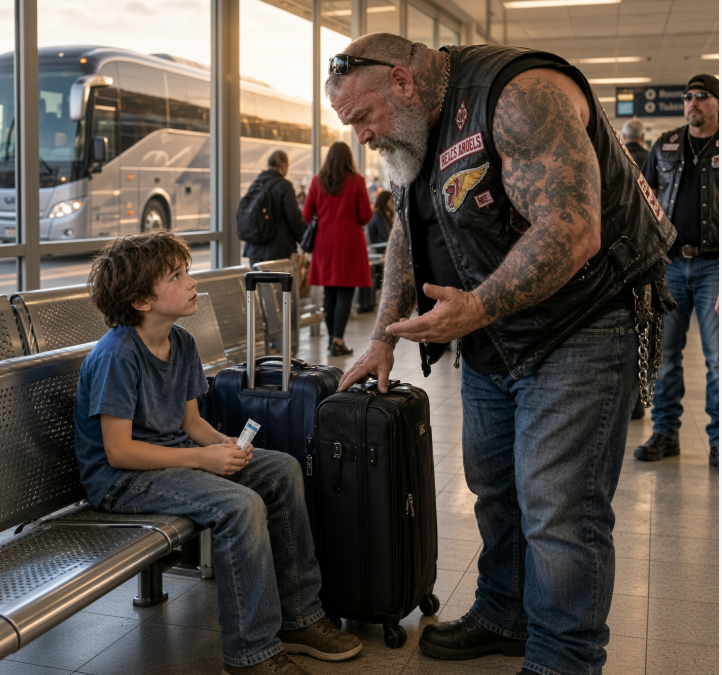
A 9-Year-Old Told a Biker, “I’ve Been Waiting Here Since Tuesday”—Then One Phone Call Revealed Why His Grandfather Never Came.
For four days, nine-year-old Matthew Pruitt sat alone beneath the fluorescent lights of an Amarillo bus station, guarding a dead phone and a blue backpack because his mother had told him not to move until his grandfather came—and dozens of adults decided that meant somebody else was responsible for him.
When a tattooed biker named Scott Whitaker finally sat down beside him and asked his name, strangers reached for their phones, police arrived to question Scott, and the child everyone had ignored was forced to defend the only man who had bothered to notice he was hungry.
Then Matthew opened the hidden pocket of his backpack and revealed the note his mother had told him to show only in a real emergency, and within forty minutes the entire station learned that his grandfather had not abandoned him at all—he had suffered a stroke the night before the bus arrived and had been lying unconscious in a hospital while Matthew waited alone.
The first thing Scott Whitaker noticed about the boy was his shoes.
Not the blue backpack.
Not the oversized coat.
Not even the fact that a child who looked nine years old was sitting alone in an interstate bus terminal at six twenty-two on a Friday evening.
The shoes.
White sneakers.
Cheap ones.
Gray around the edges from dirt.
The right shoe had split near the toe and been wrapped twice with silver duct tape.
Scott had spent enough years around people who had very little money to recognize a repair made because replacement wasn’t possible.
The boy’s feet didn’t touch the floor.
He sat beside a vending machine near the far wall of the station, knees together, backpack held upright against his stomach with both arms.
He wasn’t playing.
Wasn’t looking at a phone.
Wasn’t kicking the chair.
He was watching the front doors.
Constantly.
Every person who entered made his head lift.
Every person who passed made it lower again.
Scott stopped halfway across the waiting room.
The wind outside howled hard enough to rattle the glass.
A cold front was pushing into the Texas Panhandle, dragging red dust down the street in brown sheets.
Scott had ridden through worse.
Forty-six years old.
Twenty-seven years on motorcycles.
Former Marine.
Too many miles to count.
He’d pulled off Interstate 40 mostly because the temperature was dropping and his fingers had begun going numb inside his gloves.
A trucker outside Oklahoma City had told him about the Amarillo station.
“Cheap coffee and a roof.”
That was enough.
Scott was headed west toward Albuquerque for a veterans charity ride raising money for families dealing with medical debt.
He had planned to sleep four hours in a motel, wake before dawn, finish the ride.
Instead he stood in a bus station holding burnt coffee and staring at a child.
He knew immediately what not to do.
Do not walk directly toward the kid.
Do not sit beside him.
Do not ask where his parents are.
PART2:
A six-foot-three man in a battered leather jacket, gray beard, Marine tattoo on one arm and names inked down the other did not approach strange children in public without inviting suspicion.
Scott had learned that lesson long before anyone started carrying high-definition cameras in their pockets.
People did not see him first.
They saw leather.
Ink.
Size.
Motorcycle.
They filled in the rest themselves.
He had a criminal record.
One arrest.
One conviction.
Disorderly conduct from 2003 after a drunken bar fight in San Diego.
Not something he hid.
Not something he was proud of.
He had been twenty-three.
Drunk.
Angry.
Fresh out of a relationship, still carrying more war inside him than he understood.
Nobody was seriously hurt.
He paid the fine.
Went home.
PART3:
Six years ago, after nearly wrecking his Harley on a wet highway outside Flagstaff, he quit drinking.
Hadn’t touched alcohol since.
But databases don’t show growth.
They show events.
Scott knew that too.
He should have taken his coffee to the opposite side of the waiting room.
He almost did.
Then the boy looked toward the door again.
Something in the movement stopped him.
Not hope.
Not exactly.
Habit.
The boy had clearly been doing it for a long time.
Scott had seen that posture before.
Years earlier.
Much earlier.
Before the Marines.
Before motorcycles.
Before the beard.
A hallway in Bakersfield.
Eight-year-old Scott Whitaker sitting on a vinyl chair outside a county office while a caseworker said she’d be back in five minutes.
Six hours later another employee finally asked him why he was still there.
His mother had been arrested.
His father was gone.
Nobody had explained anything.
Scott remembered the humiliation more than fear.
The feeling that adults had places to be and he was an inconvenience between appointments.
The boy near the vending machine had that same look.
Scott crossed the room.
Not directly.
He chose a chair two seats away.
One empty chair between them.
Set his coffee on armrest.
Kept both hands visible.
“Evening.”
The boy turned.
Blue eyes.
Dark circles underneath.
Too tired.
“Hi.”
“You waiting on a bus?”
“No, sir.”
Voice polite.
Almost formal.
Scott nodded.
“Picking somebody up?”
“My grandpa’s picking me up.”
“Okay.”
The boy looked at the doors.
Scott took a sip.
The coffee tasted exactly like burnt cardboard.
“He running late?”
The boy’s hands tightened around one backpack strap.
“A little.”
Scott could feel people watching.
A woman near the doors had moved her purse onto her lap when he walked in.
A man in a feed-store cap glanced over repeatedly.
Ticket clerk behind counter pretended to do a crossword.
Scott ignored all of them.
“How late?”
The boy didn’t answer.
Scott waited.
He had learned another useful thing over the years.
People fill silence if you don’t rush them.
Finally the boy said:
“I’ve been waiting here since Tuesday.”
Scott thought he’d heard wrong.
“What?”
“Tuesday.”
The station clock showed Friday.
October 11.
6:22 p.m.
Scott put the coffee down very carefully.
“Tuesday morning?”
“Yes, sir.”
Three days.
More than three.
Depending on arrival time, nearly four.
Scott looked around.
The ticket counter.
The janitorial cart.
The security camera in one corner.
Passengers.
Employees.
“How old are you?”
“Nine.”
“You’ve been here by yourself since Tuesday?”
The boy nodded.
Scott felt anger begin low in his stomach.
He pushed it down.
“What’s your name?”
The boy looked genuinely surprised.
That hurt more than any answer.
“Matthew.”
“Matthew what?”
“Pruitt.”
“I’m Scott.”
No hand offered.
No touching.
“Scott Whitaker.”
Matthew nodded solemnly.
“Good to meet you.”
Then he said:
“Nobody asked my name yet.”
Scott stared at him.
Not the clerk.
Not maintenance.
Not night staff.
Not passengers.
No one.
“You sure?”
Matthew nodded.
“One lady asked if my mom was in the bathroom.”
“What’d you say?”
“I said no.”
“And then?”
“She said okay.”
Scott looked at the counter.
The gray-haired clerk looked away.
“What happened Tuesday?”
“My mom put me on the bus in Tulsa.”
“By yourself?”
“Yes.”
Scott chose his next words carefully.
“Was that supposed to happen?”
Matthew nodded quickly.
“Mom talked to the driver.”
“She said Grandpa was going to be right here.”
“She said he’d probably have his red cap on.”
Scott glanced around.
“No red cap.”
Matthew looked at the front door.
“He’s just late.”
The sentence sounded memorized.
“What time did your bus get here?”
“Tuesday morning.”
“Do you know what time?”
“Nine something.”
Scott calculated.
Eighty-one hours.
Maybe more.
His jaw tightened.
“Where have you been sleeping?”
Matthew pointed to three connected plastic seats near the vending machine.
“Here.”
“Every night?”
“Yes.”
“Who gave you that coat?”
“It’s Grandpa’s old one.”
“How do you have Grandpa’s coat if you’re waiting for Grandpa?”
“Mom had it.”
“She said he left it last time he visited.”
The coat hung halfway to Matthew’s knees.
Sleeves rolled three times.
Scott looked at the backpack.
“What have you been eating?”
Matthew looked away.
Scott repeated:
“When did you last eat a real meal?”
“Wednesday.”
“What?”
“A lady gave me half a sandwich.”
“Yesterday?”
Matthew shook his head.
“Wednesday.”
“And since then?”
“I’ve got money.”
“How much?”
Matthew dug into one pocket.
Coins.
Crumpled dollar bills.
“Four dollars and eighty-five cents.”
“How much did you start with?”
“Eleven.”
“What’d you buy?”
“Crackers.”
“Water.”
“One candy bar.”
Scott closed his eyes for half a second.
Every adult in the room became guilty in his mind.
Then he stopped himself.
He had walked in thirty minutes ago.
He had almost gone to another chair.
People miss things.
But four days?
That was not one person missing something.
That was a system practicing indifference.
Scott stood.
Matthew stiffened.
Scott immediately said:
“I’m getting food.”
The boy relaxed slightly.
“I’m not going anywhere.”
Scott went to the vending machine.
Bought everything useful.
Peanut-butter crackers.
Pretzels.
Water.
Apple juice.
Then approached small coffee counter.
An older woman with silver glasses and a name tag reading LORETTA was cleaning the coffee pot.
“Hot food?”
“Kitchen closed.”
“Anything microwaveable?”
She looked over his shoulder.
“For you?”
“For the kid.”
Her eyes followed.
Matthew sat exactly where he’d been.
Loretta frowned.
“What kid?”
Scott stared at her.
“That kid.”
“Oh.”
She looked surprised.
Scott’s anger sharpened.
“How long has he been here?”
Loretta frowned harder.
“I’ve seen him.”
“When?”
“Yesterday.”
“Before that?”
“I don’t know.”
Scott said:
“He says Tuesday.”
Color left her face.
“Tuesday?”
“Yes.”
Loretta put coffee pot down.
“Gary.”
Ticket clerk looked up.
“What?”
“That boy.”
Gary glanced.
“What about him?”
“How long has he been sitting there?”
Gary shrugged.
“Couple days.”
Loretta stared at him.
“Couple days?”
“He said somebody was picking him up.”
“So you just let him sit there?”
“What was I supposed to do?”
“Ask?”
Gary bristled.
“He wasn’t causing trouble.”
Scott felt something snap behind his ribs.
“He’s nine.”
Gary looked toward Scott.
“I wasn’t talking to you.”
Scott kept his voice level.
“No.”
“You weren’t talking to him either.”
Wrong sentence.
True.
Still wrong.
Gary’s face hardened.
Loretta looked ashamed.
Then defensive.
“Sir, why exactly are you so interested in that boy?”
Scott looked at her.
It happened quickly.
Guilt searching for somewhere else to go.
He knew the mechanism.
“Because he’s been alone since Tuesday.”
Loretta’s eyes dropped to leather jacket.
Then tattoos.
Then beard.
Scott watched suspicion form.
The same pattern.
“He’s not yours?”
“No.”
“You don’t know him?”
“No.”
Gary stopped pretending to do crossword.
The man in feed-store cap took out his phone.
Scott saw it.
Camera raised.
Of course.
Scott said:
“Two frozen burritos.”
Loretta hesitated.
Then reached into a freezer beneath counter.
“I can microwave them.”
“Please.”
She did.
Scott paid.
Carried food back.
Matthew stared at burrito.
“Eat slow.”
Matthew didn’t touch it.
Scott waited.
“My mom says not to take food from strangers.”
Scott almost smiled.
“She’s right.”
Matthew looked surprised.
“That’s a good rule.”
Scott pushed burrito slightly closer but left it on empty chair.
“Here’s another good rule.”
“If you’re starving in a public building and somebody buys sealed food in front of employees, you can probably bend rule one.”
Matthew considered this.
Scott added:
“You don’t have to eat anything.”
“I’ll just sit.”
The boy picked it up.
Small bites.
Careful.
Too careful.
Halfway through, hands began shaking.
Not fear.
Hunger.
Scott pretended not to notice.
“Got a phone?”
Matthew nodded.
“Mom gave me hers.”
“Can I see it?”
Matthew hesitated.
Scott immediately said:
“Actually, don’t.”
“Just tell me.”
“It died.”
“When?”
“Tuesday night.”
“Charger?”
“At home.”
“Grandpa’s number?”
“In my backpack.”
“Your mom’s?”
“She’s somewhere I can’t call.”
Scott frowned.
“Where?”
“A treatment place.”
He knew enough not to make assumptions.
“For what?”
Matthew lowered his eyes.
“Her sickness.”
Scott waited.
“She takes medicine that makes her sleep.”
“And sometimes she forgets stuff.”
“She said she’s going away thirty days.”
Rehab.
Probably.
“Okay.”
“Grandpa was supposed to take care of you?”
“Yes.”
“He knows you’re coming?”
“Mom said.”
“Do you have an address?”
Matthew’s hand tightened around backpack.
“Yes.”
“Can I see it?”
“No.”
Immediate.
Scott nodded.
“Good.”
Matthew looked surprised.
“Good?”
“Your mom told you not to show people?”
“Unless emergency.”
Scott leaned back.
“Fair.”
Then asked:
“What counts as emergency?”
Matthew stared at burrito.
“I don’t know.”
Scott looked around the station.
“I think we might be close.”
Matthew’s chin trembled.
“I thought I was just waiting.”
That sentence went straight through him.
Scott looked away.
Out at windows.
Dust.
Wind.
His throat tightened.
Just waiting.
A child had been hungry, sleeping under fluorescent lights, guarding a dead phone, and because no one had told him he was in danger, he’d interpreted abandonment as patience.
Loretta approached carrying hot chocolate.
Placed it near Matthew.
Her hands shook.
“I’m sorry, honey.”
Matthew looked up.
“For what?”
Loretta’s face nearly collapsed.
“I should’ve asked.”
Matthew gave her small, polite smile.
“It’s okay.”
No accusation.
Worse.
Scott watched her straighten.
Then noticed her eyes move toward him again.
Still uncertainty.
Still fear.
The room had begun paying attention.
That mattered because once a crowd notices something, it wants a story immediately.
The easiest story available:
Large tattooed biker approaching unattended child.
Not:
Unattended child ignored four days.
Feed-store man had phone aimed directly now.
Woman near door whispered to another passenger.
Gary picked up desk phone.
Scott thought:
Here we go.
Loretta said:
“Sir, could I speak with you?”
Scott nodded.
“To the side.”
He stood.
Before leaving Matthew, he said:
“I’m right over there.”
“I’m not leaving.”
Matthew nodded.
Scott walked toward counter.
Loretta folded arms.
“Why are you doing this?”
Scott stared.
“Doing what?”
“Buying him food.”
“Sitting with him.”
“Helping?”
Her cheeks flushed.
“You know what I mean.”
“I honestly don’t.”
“An adult man who doesn’t know a child.”
Scott looked at Gary.
Then camera phone.
Then purse woman.
Then back.
“Because nobody else was.”
Loretta flinched.
Gary said:
“You need to back away from the kid.”
Scott’s pulse rose.
He kept voice low.
“Did you call police?”
Gary didn’t answer.
Scott nodded.
“Good.”
Gary blinked.
“What?”
“You should have called Tuesday.”
That shut him up.
Forty seconds later, front doors opened hard against wind.
Two Amarillo officers entered.
One older.
Officer Ray Dunham.
Mid-forties.
Broad.
Controlled.
Partner younger.
Greg Hollis.
Dunham’s eyes found Scott immediately.
“Sir.”
Scott lifted hands slightly before being asked.
“I need you to step away from counter.”
Scott did.
“Hands visible.”
“They are.”
“Keep them there.”
Matthew stood.
“He didn’t do anything.”
Everyone turned.
Dunham looked at boy.
“Stay where you are, son.”
“Yes, sir.”
“He bought me food.”
“Okay.”
“He’s the only one who asked my name.”
The station went silent.
Scott saw something change in Dunham’s eyes.
Not enough.
Not yet.
Dunham faced him.
“Name?”
“Scott Whitaker.”
“Identification?”
“Back left pocket.”
Dunham nodded to Hollis.
“Retrieve.”
Scott kept still.
Hollis took wallet.
Ran license.
Scott knew result.
Old arrest.
Old conviction.
Dunham returned holding ID.
“You’ve got a record.”
Scott almost laughed.
Of course.
“2003.”
“Disorderly conduct.”
“Yes.”
“Violent altercation?”
“A shoving match in a bar.”
“Any other arrests?”
“No.”
“Alcohol involved?”
“Yes.”
“You drinking tonight?”
“No.”
“Why not?”
Scott blinked.
“Because I’m sober.”
“How long?”
“Six years.”
He nodded toward jacket.
“Coin in left pocket if that matters.”
Dunham didn’t move.
Scott said:
“Officer, respectfully, you’re looking at wrong person.”
Dunham’s jaw tightened.
“We’ll decide that.”
“There is a nine-year-old kid who has been sitting here since Tuesday.”
That landed.
Scott continued:
“Phone dead.”
“Almost no money.”
“Last real food Wednesday.”
“Mother in treatment.”
“Grandfather never arrived.”
Dunham looked toward Matthew.
Gary interrupted:
“He told us his grandpa was coming.”
Dunham turned.
“And you accepted that for four days?”
Gary’s face went pale.
Before he answered, woman near entrance said loudly:
“I just saw biker sitting next to him.”
She spoke as though presenting evidence.
“A man like that—”
Hollis raised one hand.
“Ma’am.”
“If it was my kid—”
Loretta turned.
“It isn’t your kid.”
Her voice shook.
“But neither was he.”
Woman stopped.
Loretta put both palms on counter.
Her face was blotchy.
“I’ve worked here twelve years.”
“I saw that child yesterday.”
“I brought him nothing.”
“I asked him nothing.”
“Gary saw him Tuesday.”
“Night shift gave him a blanket.”
“And every one of us decided somebody else knew what was going on.”
She pointed toward Scott.
“This man was here less than half an hour.”
“He asked his name.”
“He fed him.”
“I think if you’re asking who’s suspicious, start with rest of us.”
Gary whispered:
“Loretta.”
“No.”
Her voice cracked.
“No, Gary.”
“We failed him.”
Dunham looked at Matthew.
Then Scott.
His posture softened a fraction.
“Mr. Whitaker.”
“Yes, sir.”
“You can sit.”
“Stay in building.”
“Understood.”
Dunham crouched in front of Matthew.
Knees cracked audibly.
Matthew almost smiled.
“I’m Officer Dunham.”
“I need to ask questions.”
Matthew nodded.
“Okay.”
“Your grandfather’s name?”
“Walter Pruitt.”
“Where does he live?”
“Hollis Lane.”
“Number?”
“I don’t know.”
“There’s a water tower.”
Hollis moved to radio.
Dunham asked:
“Your mother?”
“Dana.”
“Dana Pruitt?”
“Yes.”
“Where is she?”
“Treatment in Tulsa.”
“What treatment?”
Matthew whispered:
“Drugs.”
Word hung there.
No one reacted.
Good.
Scott watched.
Dunham’s expression changed from suspicion to professional concern.
“Do you have information for her?”
Matthew touched backpack.
Stopped.
“She said don’t show it.”
“Unless?”
“Emergency.”
“This is emergency.”
Matthew looked at badge.
Then Dunham.
“What if you’re not really police?”
Dunham actually blinked.
Good question.
Scott almost smiled.
Matthew turned toward him.
“I’ll show Mr. Whitaker.”
Dunham said:
“Matthew, I’m police.”
“I know.”
“But he’s the one who stayed.”
Scott felt every eye move.
This was dangerous in a different way.
He did not want custody of secret.
Did not want appearance.
Did not want camera showing tattooed biker receiving child’s hidden documents.
Safest move would be refuse.
Walk outside.
Let professionals handle it.
His Harley sat forty feet away.
Road west.
Albuquerque.
Nobody could blame him.
For three seconds, he considered it.
Then looked at duct-taped shoes.
Sat beside Matthew.
“Okay.”
“But when you hand it to me, I’m giving it directly to Officer Dunham.”
“Deal?”
Matthew nodded.
Opened backpack.
Storm arrived at same moment.
Wind hit building in long roar.
Dust slapped windows.
Lights flickered.
Everyone glanced up except Matthew.
He opened inner zipper.
Pulled folded notebook paper and laminated card.
Hands trembling.
Scott held his own palm out.
Matthew placed items there.
Scott didn’t read.
Immediately extended toward Dunham.
“You look.”
That mattered.
Dunham knew it.
He took papers.
Read.
First page:
WALTER PRUITT
1412 HOLLIS LANE
AMARILLO, TX
phone number
Below, adult handwriting:
Matthew,
I love you.
Be brave.
Grandpa will be waiting when you get off.
Do not leave station with anyone except Grandpa.
If something goes wrong, show this paper to a police officer, nurse, bus employee, or another mother with children.
My treatment center is below.
I will see you before Thanksgiving.
Love you more than the moon.
Mom
Emergency number.
Counselor Patricia Yates.
Dunham read twice.
Then looked at Matthew.
“Buddy.”
“Why didn’t you show this sooner?”
Matthew’s eyes filled.
“Nothing went wrong.”
Dunham frowned.
“What do you mean?”
“Grandpa was late.”
“That isn’t same?”
“I thought emergency meant blood.”
“Or fire.”
“Or somebody trying to hurt me.”
The boy looked around station.
“I was just waiting.”
Dunham pressed lips together.
Matthew added:
“Everyone was busy.”
“I didn’t want to be trouble.”
Scott watched nineteen years of police experience hit Ray Dunham like a fist.
He looked away.
Hollis radioed.
“Welfare check 1412 Hollis.”
“Check hospitals for Walter Pruitt, age approximately seventies.”
Response came fast.
Too fast.
Dispatch:
“Walter James Pruitt, seventy-two.”
“Admitted Northwest Texas Hospital Monday night.”
“Acute ischemic stroke.”
“Neighbor found him Tuesday morning after failing to answer door.”
The room went still.
Matthew stared.
“What?”
Dunham knelt.
“Your grandpa is in hospital.”
Matthew’s face went white.
“He didn’t forget?”
“No.”
“He didn’t forget you.”
Scott spoke before anyone else.
“He couldn’t come.”
Matthew looked at Scott.
“He was coming?”
“Yes.”
The boy’s mouth opened.
Closed.
Then he began crying.
Not loudly.
No wail.
His shoulders simply collapsed.
He covered his face.
Four days of discipline broke.
Scott wanted to hug him.
Didn’t.
He had promised distance.
Instead he moved cocoa closer.
Matthew leaned sideways.
Slowly.
His shoulder touched Scott’s arm.
Scott stayed still.
After several seconds, boy pressed harder.
Scott let him.
Feed-store man lowered phone.
Woman with purse looked at floor.
Gary disappeared into back office.
Loretta turned away and cried.
Dunham called treatment center.
Patricia Yates answered.
Verified Dana Pruitt admitted voluntarily to thirty-day residential substance use treatment program.
Communication limited during intake phase.
She believed Walter had custody arrangement.
She had no idea handoff failed.
“Is Matthew there?”
“Yes.”
“Can I get Dana?”
A pause.
Then footsteps.
Door.
Voices.
And Dana.
“Matty?”
Matthew stood so fast cocoa nearly fell.
“Mom.”
Her cry came through speaker.
“Oh, God.”
“Oh, baby.”
“I waited.”
“You what?”
“I waited like you said.”
“I stayed right here.”
Dana began sobbing.
“Where’s Dad?”
“He’s in hospital.”
“What?”
Dunham explained.
Stroke.
Monday night.
Neighbor found Tuesday.
Silence on line.
Then Dana whispered:
“This is my fault.”
Matthew immediately said:
“No.”
“Yes.”
“No, Mom.”
“I should’ve made sure.”
“Grandpa got sick.”
“But you—”
Scott listened to mother destroy herself in real time.
He leaned slightly toward phone.
“Ms. Pruitt?”
Silence.
“Who is this?”
“My name is Scott Whitaker.”
Matthew said:
“He’s the biker.”
Scott closed eyes.
“Helpful.”
Matthew almost smiled.
Dana’s voice sharpened with fear.
“What biker?”
Scott said:
“I’m a stranger.”
“And I’m going to stay that way legally.”
“There are two police officers here.”
“Station staff.”
“Everybody can see me.”
“Your son is safe right now.”
Dana breathed.
Scott continued:
“I need you to know something.”
“He followed every rule you gave him.”
“He didn’t leave.”
“He didn’t get in anybody’s car.”
“He guarded the information.”
“He stretched eleven dollars for four days.”
“And he kept believing his grandfather was coming.”
Scott’s voice roughened.
“You raised a very brave kid.”
Dana broke.
Matthew started crying again.
Then station doors opened.
CPS investigator Denise Colby arrived.
Gray coat.
ID clipped.
Competent expression.
She surveyed room.
“Officer Dunham?”
“Yes.”
“I’m Denise Colby.”
“Child Protective Services.”
Matthew stiffened immediately.
Scott felt it.
Placement language followed.
Temporary care.
Until grandparent status clarified.
Mother unavailable.
Hospital.
Safety.
All correct.
All terrifying to nine-year-old.
Matthew backed away.
“No.”
Denise softened.
“Matthew.”
“No.”
“You can’t stay here.”
“I’m waiting for Grandpa.”
“He’s in hospital.”
“Then take me there.”
“We have to work through—”
“No.”
His breathing sped.
He bumped into Scott.
Grabbed back of Scott’s jacket.
Leather clenched in both fists.
“I’m not going with her unless Mr. Whitaker comes.”
Denise looked at Scott.
Scott raised hands.
“I’m not asking for anything.”
“I know.”
Dunham said:
“He’s been cooperative.”
Hollis:
“Completely.”
Loretta:
“He’s the only one that kid trusts.”
Denise crouched.
“Matthew.”
“I will not make you disappear.”
“I’m going to tell you every step.”
“You will see your grandfather tonight if hospital allows it.”
Matthew kept gripping Scott’s jacket.
“Can he come?”
Denise looked at Scott again.
Then:
“He can follow.”
“But he cannot ride with us.”
Matthew nodded quickly.
Scott said:
“I’ll follow.”
Denise:
“You have somewhere to be?”
“Albuquerque.”
“When?”
“Yesterday apparently.”
She almost smiled.
“Can charity wait?”
“Yes.”
It had already become irrelevant.
Three hours of calls followed.
Hospital verified Walter conscious but impaired.
Mother remained in treatment voluntarily; counselors and CPS coordinated legal consent.
No immediate family nearby suitable for placement.
A licensed foster couple, Marjorie and Bill Sutton, agreed to emergency short-term care.
Matthew would visit Walter first.
Denise ran Scott’s background herself.
Saw 2003 offense.
Saw no subsequent criminal conduct.
Verified Marine service.
Called Walt Brant, organizer of veterans charity ride.
Walt said:
“If Scott tells you he’s sitting with a kid nobody noticed, believe him.”
Then:
“Tell that idiot I’ll cover his hotel.”
At 9:43 p.m., caravan left station.
Police cruiser first.
CPS sedan second.
Scott on Harley behind.
Storm had broken.
Temperature dropped twenty-eight degrees.
Scott’s hands froze inside gloves.
He didn’t care.
Hospital hallway smelled like antiseptic and stale coffee.
Scott stayed in waiting area as promised.
Dunham sat across.
Hat in hands.
For several minutes neither spoke.
Then Dunham said:
“I walked in already knowing what I’d find.”
Scott looked up.
“What?”
“Call came in as suspicious adult male engaging unattended minor.”
“Description.”
“Leather.”
“Tattoos.”
“Large.”
Dunham rubbed his face.
“Nineteen years.”
“I train rookies about confirmation bias.”
“Then I walked in and did it myself.”
Scott shrugged.
“Everybody does it.”
“Doesn’t make it acceptable.”
“No.”
Dunham looked surprised.
Scott added:
“But realizing fast helps.”
Dunham nodded.
“You could’ve made that ugly.”
“Wouldn’t help kid.”
“No.”
“Still.”
Scott looked at names tattooed on forearm.
“Been on wrong end of men with guns before.”
“I prefer boring.”
Dunham smiled faintly.
A nurse approached.
“Mr. Whitaker?”
Scott stood.
“Matthew wants you.”
Dunham stood too.
They walked down hallway.
Walter Pruitt lay pale beneath hospital blanket.
Oxygen under nose.
Left side of face drooped.
Speech slow.
Matthew sat on edge of bed holding his hand.
Backpack still on.
“Grandpa.”
Walter struggled.
“Sorry.”
Matthew shook head.
“No.”
“I was coming.”
“I know.”
“I tried—”
“You had a stroke.”
Matthew sounded like tiny doctor.
“That’s not your fault.”
Walter cried.
Words slurred.
“I left you.”
“No.”
“You didn’t.”
“You were sick.”
Matthew squeezed his hand.
“I waited.”
“So it’s okay.”
Walter looked at him.
“That’s what waiting is for.”
Scott turned his face away.
His own father vanished when he was seven.
No stroke.
No accident.
Just gone.
For decades Scott had trained himself not to care.
Now watching old man apologize for something he couldn’t control reopened something ugly and tender.
Matthew looked toward doorway.
“Grandpa.”
“This is Mr. Whitaker.”
Walter’s eyes moved.
Scott stepped closer.
The old man lifted right hand.
Scott took it.
Walter gripped weakly.
“Thank you.”
Scott said:
“Sir.”
“No need.”
Walter’s mouth worked.
“Stayed.”
“With my boy.”
Scott swallowed.
“It was easy.”
Not true.
But right thing to say.
Walter shook head.
“No.”
He looked toward Matthew.
Then back.
“Not easy.”
Scott understood.
Staying is often hardest thing.
Especially when leaving protects you.
Denise placed Matthew with Suttons that night.
Retired school teacher and husband.
Warm house.
Guest bedroom.
No pressure.
Matthew cried when Scott prepared to leave.
Scott crouched.
“You’re safe.”
“You’re leaving.”
“For tonight.”
Matthew’s face tightened.
Scott recognized fear.
People always say goodbye casually when they assume another reunion.
Children who’ve been left do not.
Scott said:
“I’ll come tomorrow.”
“Promise?”
He hated promises.
Made one anyway.
“Promise.”
He came.
Next afternoon.
And next.
Albuquerque charity ride happened without him.
Walt texted:
You owe me three hundred miles.
Scott replied:
Put it on tab.
He stayed in Amarillo eleven days.
At first because Matthew needed him.
Later because Scott needed something too, though it took longer to admit.
Each afternoon:
Hospital.
Matthew doing worksheets beside Walter.
Scott in corner.
Sometimes checkers.
Walter recovering speech.
Dunham stopped by twice.
Loretta brought cookies.
Gary resigned from station by end of week.
Officially personal reasons.
Unofficially shame.
The bus company opened an internal review.
Security footage confirmed Matthew had been visible in waiting room for four days.
Night employee had given blanket Wednesday.
One janitor asked if he needed anything; Matthew said no.
Multiple shifts assumed someone else had responsibility.
No policy required staff to verify unattended minors remaining beyond one departure cycle.
That changed.
Within weeks, regional stations adopted mandatory escalation whenever apparently unaccompanied child remained through a shift change.
Loretta testified during review.
Did not protect herself.
“I saw him.”
“I did not ask enough.”
That honesty mattered.
Carl Ostrander—the feed-store cap man—posted his video Saturday morning.
Caption:
SUSPICIOUS BIKER QUESTIONED AFTER APPROACHING CHILD AT BUS TERMINAL.
He thought people would praise vigilance.
Instead video contained more than he understood.
Matthew saying:
“He’s the only one who asked me my name.”
Loretta:
“We all failed him.”
Scott keeping hands visible.
Scott handing documents directly to officer.
Within six hours, clip spread.
Comments reversed.
Carl deleted original.
Too late.
Local reporter found Loretta.
She stood outside station and said:
“The man we were afraid of was the only person acting like that child mattered.”
Scott hated becoming story.
Refused interviews.
One reporter waited outside hospital.
Scott told him:
“Go interview station policy.”
“I’m not interesting.”
Reporter asked:
“You stayed eleven days.”
Scott walked away.
Dana remained in treatment.
That became another story strangers wanted to judge.
Why would a mother put nine-year-old alone on a bus?
Why rehab?
Why limited communication?
Why not verify father?
Reality was harder than cruelty.
Dana had entered residential treatment after nearly dying from fentanyl-contaminated pills.
She arranged for Matthew to stay with her father.
Walter agreed.
He had cared for Matthew before.
Bus company allowed unaccompanied minor service with arrangements she believed were confirmed.
Walter suffered stroke Monday night before handoff.
His phone remained on kitchen floor.
Neighbor didn’t find him until after ambulance call Tuesday morning.
By then Matthew was already arriving.
Every person acted with incomplete information.
Disaster formed in gaps.
Dana nearly left treatment early from guilt.
Patricia Yates convinced her not to.
“If you leave because you feel ashamed, you teach Matthew your recovery matters less than punishing yourself.”
Dana stayed.
Scott spoke to her by phone twice.
Second conversation:
“You think I’m terrible.”
“No.”
“You should.”
“Why?”
“I put my son on bus.”
“You arranged care.”
“I didn’t verify that morning.”
“You were entering rehab.”
“I should’ve—”
Scott interrupted gently.
“Ms. Pruitt.”
“Dana.”
“Dana.”
“Your son needs mother who finishes treatment more than he needs mother who spends thirty days proving she feels guilty.”
Silence.
“Who taught you that?”
Scott smiled without humor.
“Lots of expensive mistakes.”
She laughed through tears.
Matthew adapted slowly to Suttons.
Marjorie did not ask him to call her anything.
Bill let him choose cereal.
Small control mattered.
First night Matthew slept with backpack on bed.
Second under pillow.
Third in closet beside him.
Marjorie never moved it.
Scott noticed.
“She’s good.”
Denise nodded.
“Very.”
“You’re good too.”
Denise looked surprised.
“Why?”
“You listened.”
She shrugged.
“Job.”
“No.”
“Lots of people had jobs Tuesday.”
That stayed with her.
Walter improved.
Speech therapy.
Physical therapy.
Left arm weak.
Could eventually stand with walker.
He blamed himself relentlessly.
Scott challenged him.
“You planning stroke?”
Walter glared.
“No.”
“Then stop acting like betrayal.”
“Boy waited.”
“Because everyone else failed to ask.”
“I should have—”
“You should have magically predicted brain clot?”
Walter looked away.
Scott leaned closer.
“Sir.”
“Matthew doesn’t need your guilt.”
“He needs you to recover.”
Walter hated him briefly.
Then nodded.
They became friends.
Oddly.
Walter had been a diesel mechanic forty years.
Scott knew motorcycles.
Conversations moved from engines to service to fathers.
Walter had served Army National Guard.
Never combat.
Respected Scott without romanticizing.
One afternoon he asked about names tattooed on Scott’s right arm.
Scott said:
“People.”
Walter waited.
Scott did not elaborate.
Walter nodded.
Never asked again.
That was why eventually Scott told him.
Five names.
Marines from his unit.
Two killed overseas.
One suicide.
One overdose.
One motorcycle accident after coming home.
“Why tattoos?”
“So I have somewhere to look when I start feeling too sorry for myself.”
Walter said:
“That sounds unhealthy.”
Scott laughed.
“Probably.”
Walter smiled crookedly.
“Good.”
Thirty days after Matthew arrived in Amarillo, Dana completed residential phase.
Greyhound bus pulled in at 9:40 a.m.
Bright cold morning.
Station had changed.
Same chairs.
Same vending machine.
But employees now wore badges explaining unaccompanied minor procedures.
Loretta stood beside Matthew.
Walter in wheelchair.
Denise nearby.
Dunham by door.
Scott at back near vending machine.
He had ridden to Tulsa day before, not because Dana needed transport, but because she was afraid of getting on bus alone.
He met her outside treatment center.
She looked nothing like he imagined.
Thin.
Short brown hair.
No makeup.
Thirty-two.
Eyes exhausted.
She saw motorcycle.
Then Scott.
“You’re him.”
“Unfortunately.”
She laughed nervously.
“Matthew talks about you like you’re Batman.”
“That’s concerning.”
They rode separately.
Scott followed bus west.
At Amarillo station, door opened.
Dana stepped down.
Matthew froze for one second.
Then ran.
“Mom!”
She dropped suitcase.
Caught him.
Collapsed to knees.
Held him so hard his shoes lifted.
“I’m sorry.”
“No.”
“I’m sorry.”
“You came back.”
“I came back.”
Walter cried in wheelchair.
Loretta cried openly.
Even Dunham looked away.
Scott stayed back.
Some reunions do not need witnesses standing center.
He moved toward exit.
“Mr. Whitaker!”
Matthew ran after him.
Scott stopped.
The boy’s shoes were new.
Marjorie had bought them.
No duct tape.
“Where are you going?”
“Albuquerque.”
“You still haven’t finished?”
“Some charity director is extremely angry.”
“Will you come back?”
Scott crouched.
“After?”
“Yes.”
Scott looked at Dana.
She nodded.
Almost imperceptibly.
“I’ll be back by Thanksgiving.”
Matthew smiled.
Full smile.
First Scott had seen.
“You’re invited.”
“Who decided?”
“Mom.”
Dana called:
“I did.”
Scott laughed.
Matthew hugged him.
Scott hesitated only a second.
Then hugged back.
Over boy’s shoulder, Scott saw waiting room.
Plastic chairs.
Vending machine.
Counter.
Place a child had been invisible for four days.
It looked ordinary.
That was what bothered him.
Neglect rarely looks dramatic while happening.
It looks like assumptions.
Busy people.
Shift changes.
Someone else will handle it.
The system’s biggest failure had no villain.
Gary was careless.
Carl prejudiced.
Passengers indifferent.
Police initially biased.
But nobody tied Matthew to chair.
Nobody intended harm.
That made it more frightening.
A hundred ordinary people believed somebody else was responsible.
Scott rode west that afternoon.
Sun on shoulders.
Wind calmer.
For first time in days, road empty ahead.
He should have felt relieved.
Instead he cried inside helmet outside Vega.
Pulled over.
Sat on shoulder.
Thought about eight-year-old Scott in Bakersfield hallway.
Forgotten six hours.
Not four days.
Still.
He finally understood why Matthew had hooked into him so deeply.
Scott had not only found boy.
He had found old version of himself.
And done for him what no one had done soon enough back then.
Asked his name.
Thanksgiving arrived.
Scott returned.
Walter home from rehab.
Walker.
Speech improved.
Dana living with father and Matthew temporarily while completing outpatient program.
Dinner crowded.
Turkey too dry.
Mashed potatoes excellent.
Loretta came.
Dunham stopped by after shift.
Denise declined because professional boundary but sent pie.
Marjorie and Bill attended.
Scott sat awkwardly at edge.
Matthew dragged chair beside him.
At dinner Walter raised glass.
Apple cider.
“To people who stay.”
Scott looked down.
Dana reached across table.
Touched his hand.
“Thank you.”
He shook head.
“You did hard part.”
She knew he meant treatment.
She nodded.
Months followed.
Scott became unofficial family.
Not father.
Not substitute grandfather.
No label needed.
He visited when routes allowed.
Matthew mailed school drawings.
One showed Harley with flames far too large.
Another titled:
THE MAN WHO ASKED.
Scott framed it.
Dana remained sober.
Not perfectly serene.
Recovery had fights.
Cravings.
Meetings.
One relapse scare where she called sponsor before using.
Walter lost some independence after stroke.
That frustrated him.
Matthew helped with walker but learned not to hover.
Dunham pushed department training around implicit bias and missing minors.
Used his own mistake as example.
“I decided what Scott was before I asked what Matthew needed.”
Officers listened differently when instructor used himself.
Loretta became station manager after Gary left.
She implemented log requiring staff to record any unattended minor and handoff responsibility by name.
No more “somebody knows.”
Carl Ostrander eventually contacted Scott.
Scott ignored first message.
Second:
I owe you an apology.
Ignored.
Third:
I posted that video because I thought I was protecting the kid.
Instead I helped humiliate the only person protecting him.
I’d like to say it to your face if you’ll let me.
Scott met him at diner.
Carl was fifty-eight.
Feed-store manager.
Divorced.
Ordinary.
He looked miserable.
“I saw leather jacket.”
“Tattoo.”
“Kid.”
“I made story.”
Scott drank coffee.
“Yep.”
“I thought filming made me responsible.”
Scott looked at him.
“Did you ever ask Matthew if he needed help?”
Carl’s face dropped.
“No.”
“That’s the point.”
Carl nodded.
“I know.”
Scott let him sit with it.
Then said:
“You want to make it useful?”
“How?”
“Stop posting people before knowing them.”
Carl laughed sadly.
“That’s all?”
“No.”
“Ask names.”
He did.
Two years later Matthew was eleven.
Scott attended school Veterans Day program.
Teacher asked him speak.
He refused.
Matthew tricked him by volunteering his name.
Scott stood before sixty kids.
No leather vest.
Button-down shirt.
Still looked biker.
He told no war stories.
Instead:
“When you see someone alone, you don’t have to solve life.”
“Ask if they’re okay.”
“Tell adult.”
“Stay nearby.”
“Sometimes kindness is not dramatic.”
“Sometimes it’s noticing.”
Matthew sat front row.
Scott caught his eye.
The boy smiled.
At twelve, Matthew asked about Scott’s childhood.
Scott resisted.
Then told him about Bakersfield hallway.
Matthew said:
“How long?”
“Six hours.”
“That’s a lot.”
“Felt like four days.”
Matthew understood.
“Did anyone stay with you?”
“No.”
“That sucks.”
Scott laughed.
“Yes.”
Matthew thought.
“Maybe that’s why you stayed.”
Scott nodded.
“Probably.”
Matthew leaned back.
“Then something good came out of it.”
Scott corrected:
“Be careful with that.”
“What?”
“Bad things don’t have to become good to be survivable.”
Matthew listened.
Scott said:
“What happened to me was bad.”
“What happened to you was bad.”
“We can make good choices afterward.”
“But it doesn’t make original thing necessary.”
Matthew nodded slowly.
That was how Scott talked to him.
Not inspirational nonsense.
Truth.
Dana eventually moved into small apartment.
Matthew went with her.
Walter nearby.
CPS closed case.
Denise wrote final report noting no substantiated neglect by Dana due extraordinary medical failure and communication breakdown, while recommending safeguards.
Dana cried reading that.
“I thought they’d take him.”
Scott said:
“You did what you were supposed to do after everything broke.”
She nodded.
Years passed.
Matthew grew.
Duct-tape shoes became running shoes.
Blue backpack replaced twice.
He kept original.
Dana found it once while cleaning closet.
Inside inner pocket:
copy of note.
She sat on floor and cried.
Matthew, fourteen, found her.
“Mom.”
She held paper.
“I’m sorry.”
He sat beside.
“I know.”
“I almost lost you.”
“No.”
“Yes.”
“You didn’t.”
He said it firmly.
She looked.
“You got sick.”
“Grandpa got sick.”
“Everyone else got dumb.”
Dana laughed through tears.
Matthew added:
“Then Scott showed up.”
That was family version.
Not abandonment.
Chain of failures and repair.
At sixteen, Matthew got first job.
Bus station.
Not same company.
Different terminal after old facility renovated.
Dana objected.
“Why there?”
“Good pay.”
Scott suspected more.
Matthew eventually admitted:
“I want to notice.”
He worked weekends.
One night an elderly woman missed connection.
Confused.
Matthew sat with her.
Called daughter.
Stayed after shift until ride arrived.
Supervisor asked why he clocked overtime.
Matthew said:
“She was waiting.”
No one argued.
At eighteen, he graduated.
Walter attended in wheelchair.
Dana seven years sober.
Scott arrived on motorcycle.
Dunham retired previous month and came too.
Loretta sent card.
Denise, now supervisor, sent flowers.
Matthew walked stage.
Scott cried more than Dana.
Denied it.
After ceremony, Matthew handed him envelope.
Inside photograph.
Bus station security still.
Scott sitting two seats away.
Empty seat between them.
Coffee on armrest.
Matthew with backpack.
Underneath handwritten:
YOU LEFT A SPACE SO I WOULDN’T BE SCARED.
I REMEMBER THAT.
Scott couldn’t speak.
Matthew hugged him.
Scott whispered:
“I almost kept walking.”
“But you didn’t.”
There it was again.
Difference between almost and did.
Walter died two years later.
Second stroke.
Peacefully.
Matthew held hand.
Scott stood doorway.
History echoing.
At funeral Matthew spoke.
He told story of waiting.
But focus was grandfather.
“He didn’t leave me.”
“He got sick.”
“For four days I believed lateness meant maybe I wasn’t important enough.”
“When I found him in hospital, first thing he did was apologize.”
“That taught me something.”
“People can fail to show up without failing to love you.”
Scott looked down.
That sentence healed old Bakersfield wound more than years therapy.
Dana squeezed Scott’s hand.
After college Matthew studied social work.
Everyone joked it was inevitable.
He worked first in youth outreach.
Then emergency family services.
At twenty-six, he entered same kind of county office Scott had once waited in as child.
On his office wall:
No motivational posters.
One framed blue bus ticket.
Tulsa to Amarillo.
And handwritten note:
ASK THEIR NAME FIRST.
New workers asked.
He told story selectively.
Never made Scott saint.
Never made staff monsters.
He said:
“The danger was diffusion of responsibility.”
Then simpler:
“Everybody thought somebody else knew.”
He trained staff to assign names.
Who is responsible right now?
Not department.
Not system.
Person.
One Tuesday evening, Matthew found thirteen-year-old girl sitting alone outside office after foster transport mix-up.
He sat two chairs away.
Left one empty between.
“Hi.”
She glared.
“I’m Matthew.”
No answer.
“You don’t have to talk.”
She stared floor.
He waited.
Finally:
“Are you social worker?”
“Yes.”
“That means you’re lying.”
“Sometimes social workers do.”
She looked up, surprised.
“I try not to.”
She almost smiled.
“What’s your name?”
Something shifted.
Matthew felt bus station return.
Fluorescent lights.
Vending machine.
Leather jacket.
Question.
Name.
The simplest dignity.
Scott aged.
Gray beard white.
Harley eventually traded for touring bike with better suspension.
Then trike after knee surgery.
Matthew mocked him.
“Old man.”
Scott said:
“I’ll run you over.”
Dana remained in recovery.
Fifteen years.
Then twenty.
She became peer counselor.
Her favorite story was not that she got sober.
It was that shame almost made her leave treatment and strangers convinced her to finish.
She told women:
“Your child needs your recovery more than your punishment.”
Scott’s line.
She credited him.
He complained.
At Scott’s sixty-fifth birthday, Matthew organized surprise.
Bus station theme was rejected instantly.
“Absolutely not.”
Instead backyard barbecue.
Loretta, now retired, attended.
Dunham.
Hollis.
Denise.
Marjorie and Bill.
Dana.
Matthew.
Even Carl came.
People who had once occupied same room under suspicion now ate ribs together.
Late evening, Matthew stood.
“I want to say something.”
Scott groaned.
“No speeches.”
“Too late.”
Matthew looked around.
“When I was nine, I thought being good meant not causing trouble.”
“I was hungry.”
“Scared.”
“Alone.”
“But I stayed quiet because adults were busy.”
He looked at Loretta.
She wiped eyes.
Matthew continued:
“Scott taught me asking for help isn’t being trouble.”
“He also taught everybody else something.”
Scott shook head.
Matthew ignored.
“We talk about heroes like they know what to do.”
“He didn’t.”
“He almost walked away.”
“He almost refused to sit beside me because he knew how it looked.”
“He almost handed everything to police and left.”
“But he stayed.”
Matthew looked directly at him.
“My life changed because one person was willing to look suspicious while doing the right thing.”
Scott’s face tightened.
Matthew smiled.
“So happy birthday, you terrifying old bastard.”
Everyone laughed.
Scott hugged him.
Years later, old Amarillo station was demolished.
Matthew traveled back.
Scott came.
Dana.
Loretta.
They stood behind temporary fence.
Excavator tore roof.
Vending machine long gone.
Plastic chairs gone.
No plaque.
Good.
Scott hated monuments.
Matthew held original ticket in wallet.
He asked:
“Do you remember where we sat?”
Scott pointed.
“Over there.”
“You sure?”
“No.”
Matthew laughed.
Then:
“I used to think worst part was waiting.”
Scott looked at him.
“What was?”
“Nobody noticing.”
Scott nodded.
Matthew continued:
“But now I think they noticed.”
“They just didn’t understand noticing was responsibility.”
That was sharper.
Yes.
People had seen him.
Employees knew boy existed.
Passengers observed.
But seeing without acting had become its own form of blindness.
Scott said:
“You should put that in training.”
“I did.”
“Of course.”
They watched building fall.
Dust rose.
Wind carried it east.
For a moment Scott was forty-six again, motorcycle outside, burnt coffee, tired boy watching doors.
He thought of all alternate versions.
What if he sat elsewhere?
What if Matthew refused food?
What if police removed Scott immediately?
What if Walter had died alone?
What if Dana left treatment?
What if note stayed hidden?
Lives pivot on small permissions.
Sit.
Ask.
Stay.
Scott had spent years uncomfortable being called hero because he knew truth.
Heroism made event feel exceptional.
He wanted opposite.
He wanted what he did to feel normal.
Of course you ask nine-year-old alone in bus station how long he’s been there.
Of course you feed hungry child.
Of course you call someone.
Of course you stay until handoff.
That should not be extraordinary.
The disturbing part was that it had been.
Matthew eventually married.
At wedding, Scott sat front row beside Dana.
He cried.
Again denied.
Walter’s empty seat marked with red cap.
During reception Matthew pulled Scott aside.
“Remember what you promised?”
“What?”
“Thanksgiving.”
Scott laughed.
“That was thirty years ago.”
“You said you’d come back.”
“I did.”
Matthew smiled.
“You kept coming back.”
There was no answer to that.
Scott looked across room.
Dana dancing.
Children running.
Friends.
Family assembled from blood and choice and accident.
A life.
All from one decision to sit down two chairs away.
When Scott died at seventy-eight, peacefully after heart failure, Matthew found one object among belongings that destroyed him.
Burnt coffee receipt.
Amarillo bus station.
October 11.
Scott had kept it.
On back, handwritten:
Matthew Pruitt.
Tuesday.
Ask name first.
Matthew sat on floor of Scott’s house and cried like nine-year-old again.
Then he laughed.
Of course Scott made note.
Marine.
Always notes.
At memorial, Matthew did not talk about motorcycles.
Military.
Charity rides.
Record.
Sobriety.
He told bus station.
Not polished viral version.
Whole thing.
Scott’s fear.
Bias.
Police.
Hunger.
Note.
Walter.
Staying.
Then he said:
“The most important thing Scott Whitaker ever did for me wasn’t buying food.”
“It wasn’t defending me.”
“It wasn’t even finding Grandpa.”
“He asked my name before he decided who I was.”
Matthew paused.
“When you’re a child people have failed, you start believing you’re a problem adults are passing between each other.”
“Scott looked at me like I was a person.”
“He left empty chair between us because he didn’t want to scare me.”
“He didn’t touch my backpack.”
“He didn’t touch me.”
“He let me choose.”
“And after everybody in that station decided who he was based on what he looked like, he still refused to treat me that way.”
No one moved.
Matthew continued:
“I’ve spent my career trying to understand what happened in those four days.”
“I used to think I was abandoned.”
“I wasn’t.”
“My mother loved me.”
“My grandfather loved me.”
“Both were trapped in circumstances neither could control.”
“The station staff weren’t monsters.”
“The passengers weren’t monsters.”
“The police weren’t monsters.”
“They were ordinary people making ordinary assumptions.”
“And that is why the story matters.”
He looked at Scott’s photograph.
Leather jacket.
Gray beard.
Slight smile.
“The world usually isn’t saved from evil by superheroes.”
“It’s saved from indifference by somebody deciding a stranger is worth one question.”
After memorial, a young caseworker approached.
“I’ve heard your bus station story in training.”
Matthew smiled.
“Sorry.”
“No.”
“She said it changed how she works.”
“How?”
“I ask names.”
Matthew looked away.
That would have pleased Scott more than every speech.
Years later, Matthew himself grew gray.
One autumn evening he traveled through Amarillo.
New transportation center.
Clean.
Bright.
Security.
Digital boards.
He sat near vending machines.
Bought terrible coffee.
Some traditions survive modernization.
A little boy waited nearby with mother.
Perfectly safe.
Matthew watched them laugh.
He felt old memory settle around him without pain.
He no longer saw those four days only as trauma.
They were part of him.
Not definition.
Not wound controlling everything.
A point where many people failed.
Then many people repaired.
Loretta changed policy.
Dunham changed training.
Dana changed life.
Walter recovered enough to be grandfather for years.
Denise protected him.
Marjorie gave temporary home.
Scott stayed.
Repair matters.
We talk often about accountability as punishment.
Sometimes accountability is transformation.
Loretta could not undo walking past Matthew.
She could make sure another child wasn’t ignored.
Dunham could not undo suspicion.
He could teach younger officers to notice it.
Dana could not undo bus ride.
She could remain sober.
Matthew could not undo waiting.
He could become person who never let another kid sit invisible in his office.
And Scott could not undo being forgotten in Bakersfield.
But he could sit beside one boy in Amarillo.
That was healing.
Not erasure.
Translation.
Pain becoming attention.
Matthew finished coffee.
It was awful.
He smiled.
Outside, Texas wind moved dust across parking lot.
He imagined Harley somewhere beyond glass.
Scott leaning against vending machine.
Leather.
Tattoo.
Gray beard.
The man everyone feared.
The only one who asked.
Matthew sometimes wondered what would have happened if Scott had chosen safety.
If he had looked at child and thought:
Not my business.
Someone must know.
Staff will handle it.
Police eventually.
Parents somewhere.
All rational thoughts.
All socially safe.
Scott had record.
Knew optics.
Every incentive told him keep walking.
He didn’t.
That was why years later, when young social workers asked Matthew what his most important professional rule was, he never quoted policy manual.
He said:
“If somebody looks like they’ve been waiting too long, ask what they’re waiting for.”
Then:
“Ask their name.”
Because neglect does not always look like cruelty.
Sometimes it looks like a room full of decent people assuming someone else has already asked.
Sometimes injustice is not one terrible person.
It’s twenty ordinary people being five minutes too busy.
And sometimes the person who changes everything is the one everybody else mistrusts on sight.
A leather jacket.
Old record.
Motorcycle outside.
Tattooed hands wrapped around a bad cup of coffee.
Scott Whitaker entered that station looking for warmth.
He found a child the building had learned not to see.
Matthew Pruitt thought he had been waiting four days for his grandfather.
In truth, he had been waiting four days for somebody to ask the right question.
Scott did.
And once he did, everything started moving.
Police.
Hospital.
Mother.
Grandfather.
CPS.
Truth.
Home.
Thirty years later, Matthew still remembered the exact sound of Scott’s voice before he remembered anything else.
Not deep.
Not threatening.
Just quiet.
“What’s your name, buddy?”
Such a small question.
But when the whole world has treated you like part of the furniture, hearing someone ask who you are can feel a lot like being found.


