A 9-Year-Old Handed the Town’s Accused Biker a Dollar He’d Saved for a Year—Then the Boy Led Him to a Ledger That Exposed the Real Arsonist.
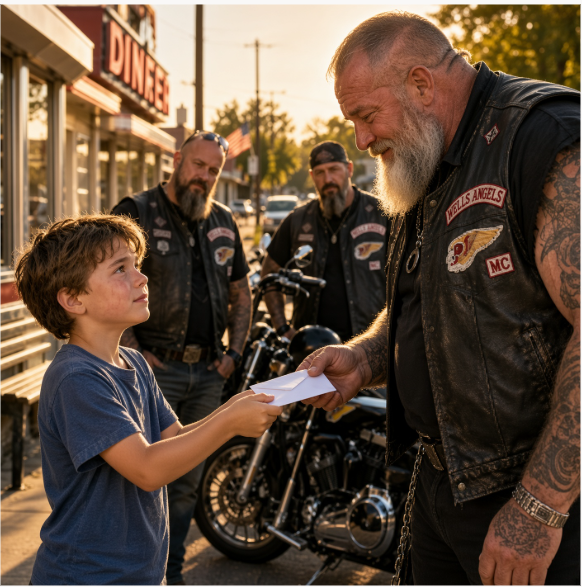
A 9-Year-Old Handed the Town’s Accused Biker a Dollar He’d Saved for a Year—Then the Boy Led Him to a Ledger That Exposed the Real Arsonist.
The entire diner had spent nine months treating Gregory Hale like a convicted criminal, but one rainy evening a nine-year-old boy crossed the room everyone else was afraid to cross and placed a single folded dollar beside his untouched coffee.
Gregory thought the child’s kindness was the last good thing he would take with him before losing his garage and leaving Marietta forever—until the boy revealed that an eighty-one-year-old railroad man had written down exactly what happened on the night of the warehouse fire.
Four days later, the most respected businessman in town was sitting beneath courthouse lights while an old ledger, a frightened witness, and one child’s refusal to believe a lie began tearing apart the story that had destroyed Gregory’s life.
The whole diner went quiet when Nathan Brooks opened the door.
Not gradually.
Not in the way a room settles when somebody important arrives.
Conversation simply stopped.
Forks paused.
Coffee cups hovered.
The old neon sign over the window buzzed loud enough to hear.
Rainwater dripped from the boy’s gray jacket onto the black rubber mat.
His sneakers squeaked once.
Then again.
Nathan was nine years old, small for his age, with brown hair flattened by rain and sleeves rolled several times because the jacket had belonged to somebody bigger.
He stood under the yellow lights of Pruitt’s Diner and looked across the room.
Twenty people looked back.
Every face said the same thing.
Don’t.
Don’t go over there.
Don’t sit beside him.
Don’t make yourself part of this.
Nathan went anyway.
At the far end of the counter sat Gregory Hale.
Forty-six.
Six-foot-three.
Broad through the shoulders.
Gray already appearing in his beard.
Both forearms covered in faded tattoos from years that had belonged to different versions of himself.
A leather vest hung from the hook beside him, dark with rain.
A cup of black coffee sat untouched.
The stools on either side were empty.
They had been empty for nine months.
Even when the diner filled completely on Friday nights, people preferred to stand rather than sit beside Gregory.
That was the power of accusation in a small town.
You did not need a conviction.
You barely needed evidence.
Sometimes all you needed was the right photograph beneath the right headline.
Nathan crossed the tile.
One booth.
Then another.
He passed the pie display.
Passed three men who had known Gregory for years.
PART2:
Passed a woman who used to bring her minivan to Hale’s Garage every spring and had stopped making eye contact after January.
He reached the counter.
Gregory saw him.
Something cold dropped through his chest.
“Nathan.”
The boy climbed onto the stool beside him.
Gregory lowered his voice.
“You shouldn’t be here.”
Nathan unzipped the chest pocket of his jacket.
His fingers trembled.
Gregory noticed.
“What are you doing?”
Nathan reached inside.
Pulled out something small.
A dollar bill.
Folded once.
Twice.
Again.
Again.
Until it was a hard little square softened at the creases from being opened and refolded too many times.
Nathan placed it beside Gregory’s coffee.
“I saved this for you.”
Gregory stared.
PART3:
The boy pushed it across the counter with one finger.
“I saved it since last year.”
Gregory’s hands went still.
Then they began to shake.
He pressed both palms flat against the Formica.
Across the diner, Dolores Pruitt froze with a coffee pot in her hand.
Floyd Mercer stopped chewing.
Gregory looked at the bill.
Then Nathan.
“What?”
“Mrs. Pruitt said the bank is taking your garage.”
Dolores closed her eyes.
Nathan continued before anyone could stop him.
“She said you need a lot of money.”
Gregory looked toward Dolores.
She gave him an apologetic expression.
Nathan swallowed.
“I know one dollar isn’t a lot.”
“Nathan—”
“But you told me to put it toward something good.”
The boy’s voice was small.
Still somehow it carried through every corner of the diner.
“This is the best thing I could think of.”
Gregory forgot how to breathe.
One year earlier, Nathan had been eight.
Late October.
Cold drizzle.
Gregory had been closing Hale’s Garage when he saw a kid pushing a bicycle down the sidewalk.
Back tire dragging.
Chain hanging.
Boy trying very hard not to cry.
Gregory had called him over.
“What happened?”
Nathan had wiped his face with his sleeve.
“It broke.”
Gregory lifted the bike onto the workbench.
Chain had snapped at the master link.
Easy job.
Ten minutes.
Nathan watched every movement.
Gregory repaired it.
Lubed the chain.
Adjusted the brake while he was there.
Set the bicycle down.
Nathan dug through his pockets.
Came out with a crumpled one-dollar bill.
“That’s all I have.”
Gregory had looked at him.
“For what?”
“For fixing it.”
“Keep it.”
“My mom says people should get paid.”
“Your mom sounds smart.”
“She is.”
“Keep it anyway.”
Nathan had held out the bill stubbornly.
Gregory folded the child’s fingers closed around it.
“Put it toward something good.”
Nathan had thought about that with a seriousness only children can give to simple sentences.
Then said:
“I’ll save it.”
Gregory laughed.
“For what?”
“For when you need it.”
Ten minutes.
That was all.
Gregory forgot by dinner.
Nathan did not.
Now the same dollar sat between them.
And Gregory had to turn his face toward the window because the room had begun blurring.
At the corner booth, Floyd Mercer reached into his jacket.
His phone appeared beneath the table.
He typed quickly.
Sent something.
Put the phone away.
Gregory saw.
So did Dolores.
Neither knew who the message went to.
Nathan leaned closer.
“Are you really leaving?”
Gregory looked at him.
“Who told you that?”
“People.”
“People say lots of things.”
“So you’re not?”
Gregory could not lie to him.
The bank deadline was Monday.
Thirty-one thousand four hundred dollars due.
Business had collapsed.
Savings gone.
Tools already being sorted.
He had a buyer interested in the property.
A man he hated.
A man who had made an offer designed to feel like mercy.
“I don’t know.”
Nathan looked down.
“You fixed my bike.”
“That doesn’t mean I can fix everything.”
“No.”
The boy looked back at him.
“But you didn’t burn that warehouse.”
Somebody dropped a fork.
Gregory’s jaw tightened.
“Nathan.”
“You didn’t.”
“Nathan.”
“My mom says I’m not supposed to talk about it.”
“That’s one thing your mom and I agree on.”
“But everybody keeps saying it.”
Gregory picked up the folded dollar.
It felt ridiculous in his hand.
Paper.
One gram maybe.
It weighed more than anything in the room.
Then the diner door opened so hard the bell struck twice.
Cassandra Voss entered wearing hospital scrubs beneath a gray coat.
Dark hair coming loose from its clip.
Hospital badge still around her neck.
Thirty-four years old.
Emergency-department nurse.
Single mother.
Exhausted.
Terrified.
She saw Nathan.
Her face changed.
“Nathan Elliott Brooks.”
The boy closed his eyes.
“Mom.”
Cassandra crossed the diner.
Took him by both shoulders.
Checked his face.
Arms.
Hands.
“Do you have any idea how scared I was?”
“I left a note.”
“A note?”
“Mrs. Ames called me at work because you were supposed to be at Walter’s and you weren’t there.”
“I’m sorry.”
“You walked here in the rain?”
“Yes.”
“Why?”
Nathan looked toward Gregory.
Cassandra followed his eyes.
Saw the folded dollar in Gregory’s hand.
Her anger shifted.
Not away.
Just into something more complicated.
She stood.
“Get your coat zipped.”
“Mom—”
“Now.”
Nathan obeyed.
Gregory rose from the stool.
Old habit.
Courtesy.
Respect.
Cassandra noticed.
She hated that she noticed.
She took Nathan’s hand.
“We’re leaving.”
Gregory followed them only as far as the entrance.
Rain fell from the awning like a curtain.
Cassandra stopped on the sidewalk.
Turned.
“Mr. Hale.”
“Ma’am.”
“I want to say this clearly.”
Gregory already knew.
“Please stay away from my son.”
Nathan pulled at her hand.
“Mom.”
“Not now.”
Gregory nodded.
“All right.”
Cassandra looked almost surprised by how quickly he agreed.
“I’m not trying to be cruel.”
“I know.”
“You may not.”
“I do.”
She glanced toward the diner windows.
Half the town was pretending not to watch.
“By tomorrow, everybody at the hospital will know he came here.”
Gregory said nothing.
“I have a job.”
“A mortgage.”
“A child.”
“Nobody else.”
“My ex sends support when he remembers.”
“People in this town talk.”
“I cannot have Nathan dragged into whatever this is.”
Gregory’s voice stayed calm.
“I understand.”
Cassandra’s expression hardened.
“That’s easy to say.”
“No.”
He looked at Nathan.
“It’s not.”
Nathan’s eyes were wet.
Gregory continued:
“He’s a good kid.”
Cassandra exhaled.
“He’s too good.”
She lowered her voice.
“He thinks people are better than they are.”
Gregory looked back toward the diner.
“At least some of them.”
Cassandra’s face changed.
Not agreement.
Not yet.
Something uncertain.
Then she led Nathan into the rain.
At the corner, the boy twisted around.
Raised one hand.
Gregory did not wave.
He only stood beneath the awning until they disappeared.
When he came back inside, nobody spoke.
Dolores placed a plate of meatloaf on the counter.
“Sit.”
“Not hungry.”
“I didn’t ask.”
Gregory sat.
Dolores leaned closer.
“I’m going to say something I should’ve said months ago.”
Gregory looked at her.
She had run the diner for thirty-one years.
Fed Gregory after his late shifts.
Called him when her old Ford would not start.
Trusted him with a key to the back door when her freezer motor failed one Christmas morning.
Then January happened.
She had never stopped serving him.
But she had never publicly defended him either.
Dolores whispered:
“I never believed you burned that warehouse.”
Gregory looked at the meatloaf.
“Didn’t stop you from letting people leave two stools empty.”
The words hurt her.
He regretted them instantly.
Not because they were false.
Because they were true.
Dolores swallowed.
“I know.”
Gregory rubbed one thumb over the dollar in his pocket.
“I’m tired, Dolores.”
“I know.”
“No.”
He looked at her.
“I mean tired.”
Not sleepy.
Not overworked.
Tired in the marrow.
Nine months earlier, Decker Freight and Supply had burned in the middle of a freezing January night.
Thirty thousand square feet.
Building.
Inventory.
Office.
Loading bays.
Everything.
Floyd Mercer, the warehouse manager, told Sheriff Raymond Tillman that he had seen a large man wearing leather near the railroad tracks.
Tattooed arms.
Motorcycle nearby.
Gregory’s garage sat eight blocks away.
Gregory had once argued with Harlan Decker over an unpaid fleet-repair bill.
That became motive.
Gregory rode motorcycles.
That became identity.
He had army tattoos.
That became character evidence in the minds of people who had never served a day.
The sheriff arrested him.
Marietta Times printed his mug shot.
BIKER HELD IN DECKER WAREHOUSE ARSON.
Eleven days in jail.
His attorney eventually tore the prosecution apart.
No accelerant on his clothes.
No surveillance placing him there.
No physical evidence.
No credible timeline.
Charges dropped.
Page six.
Two paragraphs.
PROSECUTOR DISMISSES CASE FOR LACK OF EVIDENCE.
But the front-page photograph had already done its work.
Customers vanished.
People crossed the street.
Parents stopped bringing teenagers by to ask about summer jobs.
Church members became busy.
Gregory’s December toy drive committee quietly removed his name from the email chain.
Nobody said:
We think you’re guilty.
They didn’t need to.
They stopped showing up.
Silence can accuse louder than words.
His lawyer cost almost everything he had saved.
Then the bank called his note.
Thirty-one thousand four hundred dollars due by November first.
Monday.
Four days away.
Gregory ate half the meatloaf because Dolores kept watching.
The folded dollar stayed in his shirt pocket.
At eight-thirty, Floyd Mercer left the diner without saying goodbye.
He paused at the door.
Looked back at Gregory.
Then went into the rain.
Friday morning, Sheriff Tillman came to Hale’s Garage.
Gregory was beneath the hood of a ten-year-old Chevrolet pickup.
The only job on the schedule.
He heard the cruiser.
Straightened.
Raymond Tillman entered without his hat on.
That meant the visit was unofficial.
They had known each other twenty years.
Gregory once repaired the sheriff’s daughter’s first car for cost.
Tillman had attended Gregory’s mother’s funeral.
They had shared beer after Memorial Day ceremonies.
Nine months changed the weight of history.
“Greg.”
“Ray.”
“I heard about last night.”
Gregory wiped his hands.
“The kid came into the diner.”
“I never called him.”
“I know.”
“Do you?”
Tillman looked away.
“Harlan Decker called me.”
“Of course he did.”
“He’s concerned.”
Gregory laughed once.
“About?”
“He says you’re using the boy.”
Gregory stopped smiling.
“For what?”
“Public sympathy.”
“I fixed his bicycle a year ago.”
“I know.”
“Then say what you came to say.”
Tillman rotated his hat in both hands.
“Stay away from Nathan.”
“Already agreed.”
“And Decker’s people.”
“I don’t go near Decker’s people.”
“Keep your head down until the garage situation is resolved.”
Gregory stared.
“Resolved.”
“You know what I mean.”
“Sold.”
Tillman said nothing.
Gregory stepped closer.
“You’ve known me twenty years.”
“I knew the man I thought you were.”
The sentence came out before Tillman could stop it.
Both men froze.
Gregory’s face changed.
Not anger.
Worse.
Tillman lowered his eyes.
“Greg—”
“No.”
Gregory stepped back.
“Leave.”
“I didn’t mean—”
“You did.”
Tillman put on his hat.
Walked toward the door.
Gregory called after him.
“Ray.”
The sheriff turned.
“When they dropped the case, did you ever go back through what you thought you knew?”
Tillman did not answer.
That was the answer.
He left.
Gregory stood alone beneath the fluorescent lights.
Outside, the cruiser pulled away.
Inside, something final settled.
He was done.
That afternoon, Nathan was cornered by Brandon Pike near the school swings.
Brandon was ten and large enough to know it.
“My dad says your biker friend burned down the warehouse.”
“He didn’t.”
“My dad says he did.”
“Your dad wasn’t there.”
“He says everyone knows.”
Nathan looked at him.
“If everyone knows, why did the judge let him go?”
Brandon shoved him.
“Because criminals get away with stuff.”
Nathan stumbled.
Recovered.
Brandon added:
“My dad says you’re lucky Hale didn’t burn your house down too.”
Nathan punched him.
Poorly.
Brandon punched back better.
A teacher separated them.
Cassandra got the call at work.
By the time she picked Nathan up, she was furious.
Not only at him.
At herself.
At Gregory.
At Marietta.
At the fact that her child was now fighting over a grown man’s reputation.
“You do not hit people.”
“He shoved me first.”
“You walk away.”
“He called Mr. Hale a criminal.”
“That is not your battle.”
Nathan stared out the car window.
“Why?”
“Because you are nine.”
“That doesn’t make him guilty.”
Cassandra gripped the wheel.
“I didn’t say it did.”
“You act like it.”
That hurt.
Nathan knew.
They drove in silence.
Cassandra worked a double shift that night.
Nathan stayed with Walter Ames next door.
Walter was eighty-one.
Retired railroad dispatcher.
White mustache.
Blue cardigan.
Hands knotted by arthritis.
He had lived behind the Decker warehouse lot for forty-two years.
He watched Nathan after school whenever Cassandra worked late.
Four years earlier, Walter’s wife Evelyn died.
Nathan slowly filled part of the silence she left.
They did homework.
Played checkers.
Watched baseball.
Walter taught Nathan how to identify freight cars by markings.
Nathan taught Walter how to use streaming television.
That evening, Walter noticed the bruise on Nathan’s cheek.
“What happened?”
“Nothing.”
“Boy.”
Nathan sighed.
“Fight.”
“Win?”
“No.”
Walter nodded.
“Then definitely don’t call it nothing.”
Nathan told him.
Diner.
Dollar.
Gregory.
Sheriff.
Brandon.
Everything.
Walter listened.
At the end Nathan said:
“Everybody says he did it.”
Walter looked toward the dark window.
“But I know he didn’t.”
“How?”
“He fixed my bike.”
Walter almost smiled.
“That is not evidence.”
Nathan folded his arms.
“A person who burns warehouses can still fix bicycles.”
Nathan’s face fell.
Walter continued:
“But that doesn’t mean Mr. Hale burned anything.”
Nathan looked up.
Walter’s eyes had drifted toward the vacant warehouse lot.
“Mr. Ames?”
Walter did not answer.
“Mr. Ames?”
The old man stood.
Slowly.
Walked to his oak desk.
Unlocked the bottom drawer.
Nathan had seen him use that drawer only twice.
Inside were ledgers.
Dozens.
Cloth-bound.
Dates written on spines.
Walter had spent thirty-eight years dispatching trains.
His entire career had been built on observation and time.
Track clear.
Train passed.
Switch changed.
Signal failed.
He recorded everything.
Retirement did not stop the habit.
Every night before bed, Walter wrote down the day.
Weather.
Visitors.
Odd trucks.
Power outages.
Things neighbors might consider meaningless.
Walter considered memory unreliable.
Ink was better.
He removed one ledger.
January.
Opened to a marked page.
His hand trembled.
Nathan watched.
“What is it?”
Walter sat.
“I should have told your mother.”
“Told her what?”
“I should have told everybody.”
Nathan moved closer.
Walter looked at him.
“I saw the trucks.”
“What trucks?”
“Decker’s.”
The old man’s voice became barely audible.
“Before the fire.”
Nathan stared.
Walter turned the ledger.
10:12 P.M. — Decker truck 14 reverse to dock 3.
10:20 — Decker truck 22 dock 4.
10:23–10:49 — men loading pallets OUT.
10:51 — both trucks depart east, loaded heavy.
11:46 — smoke north roof.
11:48 — called 911.
11:50–12:06 — no vehicle on rail service road except fire response.
Nathan read slowly.
“What does ‘out’ mean?”
“They were removing inventory.”
“Before the fire.”
“Yes.”
“Did you tell police?”
Walter closed his eyes.
“Yes.”
“What happened?”
Walter’s throat worked.
“Nothing.”
“Why?”
The old man stared at the ledger.
“Because adults can be cowards too.”
Saturday morning, Harlan Decker came to Hale’s Garage.
Black sedan.
Camel overcoat.
Polished shoes.
Fifty-eight.
Silver hair.
A face people trusted because it had spent years practicing trustworthiness.
He owned Decker Freight and Supply.
Sat on the board of Ohio Valley Savings.
Sponsored youth baseball.
Donated to the sheriff’s benevolent fund.
Paid for new stained glass at St. Mark’s Church.
People confused generosity with goodness because sometimes they arrive dressed similarly.
Decker entered.
Gregory looked up from a transmission case.
“Mr. Hale.”
“Harlan.”
Decker held out a hand.
Gregory looked at it.
Decker withdrew it smoothly.
“I understand the bank deadline is Monday.”
Gregory’s expression sharpened.
“That private?”
Decker smiled.
“I sit on a board.”
“Not my bank’s loan committee.”
“Small towns.”
Decker removed an envelope.
Placed it on the workbench.
Cashier’s check.
Eighteen thousand dollars.
Gregory stared.
“For?”
“Property.”
“Lot.”
“Building.”
“Equipment?”
“Some.”
Gregory laughed.
“The lift alone is worth six.”
“You need certainty more than market value.”
Gregory looked at him.
Decker continued softly:
“I also believe the remaining note could be handled.”
“By who?”
“Friends.”
“How generous.”
“I’m trying to give you a clean exit.”
“I didn’t ask.”
“No.”
Decker looked around.
“Twenty years here, isn’t it?”
“Twenty-one.”
“Long time.”
His gaze passed the photo of Gregory’s army unit.
Passed the toy-drive flyer still pinned near the office.
Passed shelves of tools.
“It must be difficult watching a place stop trusting you.”
Gregory’s jaw tightened.
Decker said:
“Texas might be good.”
“Montana.”
“Somewhere nobody knows January.”
“There is no January.”
“Excuse me?”
“The case was dropped.”
“Of course.”
“No.”
Gregory stepped closer.
“Say it correctly.”
Decker’s smile thinned.
“The charges were dropped.”
“There.”
Gregory nodded.
“Better.”
Decker slipped gloves from one hand.
“I am not your enemy.”
“What are you?”
“Practical.”
He tapped the check.
“You could leave Monday.”
“No foreclosure.”
“No public sale.”
“No humiliation.”
“You keep your motorcycle.”
“Your tools.”
“Your dignity.”
Gregory laughed quietly.
“You offering dignity now?”
Decker’s eyes hardened for half a second.
Then warm again.
“I’m offering peace.”
“Why do you care?”
“I care about this town.”
“You care about this lot?”
“Maybe eventually.”
“Riverfront redevelopment is coming.”
Gregory studied him.
“You’re buying property eight blocks from your burned warehouse while sitting on the bank board.”
“Careful.”
“There.”
Gregory smiled without humor.
“There you are.”
Decker’s voice lowered.
“Take the offer.”
“Why?”
“Because fighting facts is expensive.”
“I learned.”
Decker turned to leave.
Then paused.
“Even Walter Ames has begun confusing things lately.”
Gregory froze.
“What?”
Decker adjusted his gloves.
“Poor man.”
“Age comes for everyone.”
“Why are you talking about Walter?”
Decker looked over his shoulder.
“Small town.”
“Everyone knows everyone.”
The smile returned.
“Monday morning.”
Then he left.
Gregory stared after him.
Walter Ames.
Why Walter?
The name remained in his head all afternoon.
Sunday, Gregory packed.
Two saddlebags.
One duffel.
He sold an extra compressor to a mechanic in Parkersburg.
Gave the old shop dog bed to Dolores for her brother’s beagle.
Put his army photo in a cardboard box.
He had not decided whether he would take Decker’s money.
But he had decided he was leaving.
That distinction helped him sleep exactly zero hours.
At 2:00 A.M., he sat on the shop floor.
At 4:00, he drank coffee.
At 5:30, he strapped saddlebags onto the motorcycle.
At 6:30 Monday morning, knocking came at the garage door.
Gregory assumed bank.
He opened it.
Nathan stood outside.
Soaked.
Backpack.
Bicycle lying in wet grass.
Breathing hard.
Gregory stared.
“What are you doing?”
“You can’t leave.”
“Nathan.”
“You can’t.”
“Where’s your mother?”
“Work.”
“Walter?”
“Asleep.”
“Does anyone know you’re here?”
“I left a note.”
Gregory closed his eyes.
“Kid.”
“Please.”
“You need to go home.”
“Mr. Ames saw it.”
Gregory opened his eyes.
“Saw what?”
“The fire.”
The garage became very still.
Nathan spoke fast.
“He has a book.”
“He writes everything down.”
“He saw Decker trucks loading stuff before the warehouse burned.”
“He said he told Sheriff Tillman.”
Gregory’s face changed.
Nathan continued:
“He said they told everybody he was confused.”
“He got scared because Danny works for Decker.”
“He cried.”
Gregory took one step backward.
“What trucks?”
“Fourteen and twenty-two.”
“When?”
“Ten something.”
“Fire was almost midnight.”
“I know.”
Gregory heard Decker’s voice.
Even Walter Ames has started confusing things.
A car came onto the gravel too fast.
Brakes.
Door.
Cassandra appeared.
Still in scrubs.
Face pale.
“Nathan Elliott Brooks!”
Nathan turned.
“Mom.”
She reached him.
Pulled him into her arms.
Then pushed him back just enough to inspect him.
“Do you understand what that note did to me?”
“I’m sorry.”
“I thought you’d been taken.”
“I’m sorry.”
Cassandra looked at Gregory.
Rage.
Fear.
“You.”
“He got here five minutes ago.”
“I told you—”
“I know.”
“I did not call him.”
Nathan pushed between them.
“Mom, listen.”
“Not now.”
“Mr. Ames knows.”
Cassandra stopped.
“Knows what?”
“The fire.”
Nathan explained.
Trucks.
Ledger.
Statement.
Sheriff.
Cassandra’s anger drained by degrees.
She looked at Gregory.
Then at saddlebags.
Then at the cashier’s-check envelope on the bench.
“You were leaving.”
Gregory said nothing.
“That Decker offer?”
“How do you know about that?”
“Everybody knows everything, apparently.”
Gregory almost smiled.
Cassandra looked at Nathan.
“Walter said all this?”
“Yes.”
“He showed you?”
“Yes.”
“He cried.”
That mattered.
Walter Ames had been a second grandfather to Nathan.
Cassandra trusted him.
She also knew his cognition.
She was a nurse.
She saw dementia.
Delirium.
Medication effects.
Walter had none.
Cassandra took one long breath.
Then looked at Gregory.
“Take the bags off the bike.”
He blinked.
“What?”
“We’re going to Walter’s.”
Walter’s kitchen smelled like burned toast.
Dolores arrived ten minutes later after Cassandra called her.
Nobody wanted to involve half the town.
Dolores was not half the town.
She was institutional memory.
Walter sat at the table.
Ledger open.
His grandson Danny Ames arrived midway through.
Thirty-two.
Warehouse forklift operator.
Unemployed since the fire.
Walter kept both hands around a mug.
“I’m sorry.”
Gregory stood by the counter.
“For what?”
Walter looked at him.
“For being afraid.”
Cassandra sat across.
“Start at the beginning.”
Walter did.
January fourteenth.
He had been reading in the back room.
Window overlooked service road.
At 10:12, Decker Freight truck 14 arrived.
Unusual because warehouse usually stopped outbound loading by nine.
Truck backed dock three.
Second at 10:20.
Men began moving shrink-wrapped pallets out.
Walter noticed because forklift backup alarms carried across the empty lot.
He logged it.
At 10:51, both trucks departed loaded.
At 11:46, smoke appeared.
11:48, Walter called 911.
He watched service road until emergency vehicles blocked view.
No motorcycle.
No running man.
No tattooed biker.
The next morning, he gave Sheriff Tillman the account.
Tillman wrote notes.
Two days later, returned with a deputy.
Asked about medication.
Eyesight.
Sleep.
Walter felt insulted.
Then Danny received a private meeting at Decker Freight.
Danny spoke from kitchen doorway.
“Harlan never threatened me.”
Walter looked down.
Danny continued:
“He didn’t have to.”
“What did he say?” Cassandra asked.
Danny swallowed.
“He said Grandpa was getting old.”
“He said these investigations become ugly.”
“He said he’d hate for confusion to cause layoffs.”
“My wife was pregnant.”
“I told Grandpa maybe he should stay out of it.”
Walter’s eyes filled.
Danny’s voice broke.
“I’m sorry, Grandpa.”
Walter whispered:
“No.”
“I let you make me afraid.”
Gregory looked at the ledger.
“Did anyone take a copy?”
Walter shook his head.
“Tillman had notes.”
“Not this.”
“No.”
Dolores whispered:
“Insurance claim.”
Everyone looked.
“What?” Cassandra asked.
Dolores knew more town gossip than any person alive.
“Decker claimed total inventory loss.”
“How much?” Gregory asked.
“People said millions.”
Danny frowned.
“Those trucks were full.”
Gregory leaned over ledger.
“What was stored in docks three and four?”
Danny thought.
“Electronics.”
“Industrial control units.”
“Imported bearings.”
“High value.”
The room quieted.
Cassandra said:
“If inventory left before fire and was included in claim…”
“Insurance fraud,” Gregory said.
Walter whispered:
“That’s why he needed a criminal.”
No one spoke.
Gregory thought of Floyd.
Tattooed arms.
Leather vest.
Railroad tracks.
A description vague enough to point directly at the man town already found easy to suspect.
He felt no triumph.
Only nausea.
Nine months.
Eleven days in jail.
Customers gone.
Garage nearly lost.
All because someone needed a story.
Cassandra looked at Walter.
“Would you testify?”
Walter’s hands trembled.
“Yes.”
“Publicly?”
He stared at Nathan.
The boy waited.
Walter said:
“I already hid once.”
“No more.”
They considered state police.
Fire marshal.
Attorney.
Gregory’s old defense lawyer.
All.
But timing mattered.
Thursday night, Washington County commissioners were scheduled to vote on a riverfront logistics contract.
Decker Freight’s replacement operation was frontrunner.
Harlan would be there.
Cameras.
Press.
Public comment.
Cassandra said:
“We don’t accuse him without documents.”
“We present Walter’s observations.”
“We ask questions.”
Gregory looked at her.
“You’ve done this before?”
“No.”
“You sound like it.”
“I work emergency medicine.”
“People lie to me while bleeding.”
Dolores almost laughed.
Gregory did not.
Tuesday afternoon, Sheriff Tillman came to Walter’s house.
Walter called Cassandra first.
She called Gregory.
Dolores arrived because nobody had invited her but she found out anyway.
Tillman entered.
Saw all three.
Stopped.
“This a party?”
Walter said:
“You wanted to talk.”
Tillman glanced at the ledger.
His face changed.
Barely.
Enough.
“I wanted to check on you.”
Cassandra leaned forward.
“Why?”
“You’re eighty-one.”
“Yes.”
“I’m concerned about stress.”
Cassandra smiled without warmth.
“His blood pressure is controlled.”
Tillman looked at her.
“You’re not his clinician.”
“No.”
“But I recognize condescension.”
Gregory stayed silent.
Tillman said:
“Walter, these old recollections—”
Walter placed his hand on the ledger.
“I wrote them that night.”
“Memory changes.”
“Ink didn’t.”
Tillman’s jaw tightened.
Gregory finally said:
“You knew.”
Tillman turned.
“Greg.”
“You knew there was a witness who didn’t see me.”
“That isn’t the same as proving you weren’t there.”
“You buried it.”
“We assessed credibility.”
“Because?”
Tillman looked at Walter.
No answer.
Cassandra said:
“Because Decker’s lawyer told you he was confused?”
Tillman looked toward the door.
That was enough.
He left quickly.
Wednesday night, Cassandra finished her shift at eleven.
Walked into hospital parking lot.
Both front tires slashed.
Not flattened by accident.
Knife.
Clean.
She stood under the lights.
Called Gregory before police.
That fact bothered her.
He arrived in twelve minutes with tools.
Cassandra watched him jack the car.
“You don’t have to.”
“Yes.”
“I can get roadside.”
“I’m already here.”
He replaced one tire with spare.
Temporary patched other enough for shop.
Nathan sat in hospital lobby with Walter.
Cassandra crossed her arms against the cold.
“I owe you something.”
Gregory kept working.
“No.”
“Yes.”
“No.”
“I told you to stay away from my son.”
“You were protecting him.”
“I believed people.”
“So did everyone.”
“That doesn’t make it right.”
Gregory tightened lug nuts.
Cassandra said:
“I looked at your mug shot and thought maybe.”
His hands paused.
“There.”
She swallowed.
“That’s the truth.”
Gregory resumed.
“I had a mortgage.”
“A kid.”
“A nursing license.”
“I thought if there was even a chance…”
Gregory stood.
“You didn’t put me in jail.”
“No.”
“But I left you there in my head.”
Rain began lightly.
Cassandra wiped her cheek.
Could have been rain.
“Sorry.”
Gregory looked at her.
“You were scared.”
“So was Walter.”
“So was Floyd.”
“Fear doesn’t make everything okay.”
“No.”
“But it explains some things.”
She nodded.
Gregory added:
“Apology accepted.”
Cassandra looked surprised.
“That easy?”
“No.”
He placed the wrench back in toolbox.
“But simple.”
At the garage that same night, someone spray-painted ARSONIST across the bay door.
Gregory arrived Thursday before sunrise.
Stood staring.
Then opened a can of gray primer.
Covered it.
No photograph.
No social-media post.
No complaint.
Nathan arrived with Cassandra at seven.
Saw wet paint.
“What happened?”
“Nothing.”
Nathan read enough letters showing through to know.
His face hardened.
Gregory handed him a broom.
“Sweep.”
Nathan stared.
“What?”
“You want to help?”
“Yes.”
“Sweep.”
Nathan began.
That was Gregory’s way of keeping the boy from carrying something bigger than his age.
Thursday evening, courthouse packed.
Decker’s riverfront contract had drawn reporters already.
The fire story had made him sympathetic.
Local business rebuilds.
Jobs.
Resilience.
A man whose warehouse had burned rising again.
People loved redemption stories even when built on somebody else’s ruin.
Harlan sat front row.
Charcoal suit.
Attorney.
Smile.
Floyd Mercer sat nearby.
Pale.
Sheriff Tillman stood at rear.
Gregory chose last row.
Dolores left.
Nathan beside him.
Cassandra near Walter.
Walter had ledger under arm.
Nathan kept touching Gregory’s sleeve.
Not speaking.
He had promised his mother.
The commissioners voted.
Four to one.
Preliminary approval.
Applause.
Harlan stood.
Shook hands.
Then Commissioner Linda Garrett adjusted microphone.
“We have one public commenter registered.”
She checked sheet.
“Walter Ames.”
Murmur.
Walter rose.
His knees shook.
Cassandra offered arm.
He accepted.
Walked to microphone.
The room watched an old man.
Some dismissively.
Some curiously.
Harlan’s attorney whispered to him.
Harlan did not turn around.
Walter opened ledger.
“My name is Walter Ames.”
“I worked railroad dispatch thirty-eight years.”
“My job was time.”
“Write what happened.”
“When it happened.”
“Exactly.”
He looked at page.
“On January fourteenth, night of Decker warehouse fire, I was home.”
“I could see loading bays.”
“10:12 P.M., Decker truck number fourteen arrived dock three.”
Harlan’s head turned.
Walter continued.
“10:20, truck twenty-two dock four.”
“From approximately 10:23 to 10:49, I watched pallets loaded out.”
“Both trucks left at 10:51.”
“Loaded heavy.”
“Smoke from north roof at 11:46.”
“Called 911 11:48.”
The room went still.
“I watched railroad service road.”
“I did not see a motorcycle.”
“I did not see Gregory Hale.”
“I did not see any man running from building.”
Harlan’s attorney stood.
“Commissioner, this is—”
Linda Garrett looked over glasses.
“Sit.”
He stayed standing.
“This man’s medical—”
“Sit down.”
He sat.
Walter raised the book.
“I told Sheriff Tillman next morning.”
Every head turned.
Tillman’s face emptied.
Commissioner Garrett asked:
“Sheriff?”
Tillman did not move.
“Did Mr. Ames provide a statement?”
Silence.
“Sheriff Tillman.”
He swallowed.
“Yes.”
The room shifted.
“When?”
“January fifteenth.”
“Was it included in investigative file?”
Another pause.
“No.”
Noise rose.
Garrett struck gavel.
“Why?”
Tillman looked toward Harlan.
Then Gregory.
“I determined…”
His voice failed.
“I determined his recollection might be unreliable.”
Cassandra stood.
“I’d like to speak.”
Garrett looked.
“Name.”
“Cassandra Voss.”
“Registered nurse, Marietta Memorial.”
“I’ve known Walter six years.”
“I’ve helped manage his medications after surgery.”
“He takes blood-pressure medication.”
“He does not have a dementia diagnosis.”
“He does not have documented cognitive impairment.”
“His handwriting records were contemporaneous.”
Harlan’s attorney objected loudly.
Garrett ignored him.
Cassandra looked at Gregory.
“And I owe someone in this room an apology.”
Gregory’s chest tightened.
He did not want this.
Not publicly.
She continued:
“I believed suspicion because suspicion was easier than uncertainty.”
“I told my son to stay away from a man who had never once harmed him.”
“I did it because the town had decided a headline was evidence.”
“I was wrong.”
Now people were looking at Gregory.
He wished they wouldn’t.
Garrett said:
“Mr. Hale?”
He stayed seated.
Then Nathan touched his sleeve.
Gregory stood.
Walked toward front.
No leather vest.
He had left it at garage deliberately.
He wore an old flannel shirt.
Not to look harmless.
Because he was tired of clothing becoming evidence.
At microphone, Gregory looked around.
Faces he knew.
Mechanic customers.
Church members.
Teachers.
People who had once invited him to cookouts.
Some couldn’t meet his eyes.
“I’m not here asking anybody to like me.”
His voice was steady.
“I’m not even asking for an apology.”
He looked at Harlan.
“I’m asking one question.”
“Why were two Decker trucks removing inventory almost an hour before Decker Freight burned?”
Harlan stood.
“This is absurd.”
Gregory continued.
“Insurance claim listed total inventory loss.”
Harlan’s attorney grabbed his arm.
“Do not answer.”
Gregory nodded.
“Fine.”
“Then somebody should.”
A chair fell.
Floyd Mercer stood.
His face gray.
Hands shaking.
“Harlan.”
Everyone turned.
Floyd looked at him.
Harlan’s expression changed.
Not fear.
Command.
One sharp look.
Sit down.
Floyd did not.
“I can’t.”
Harlan whispered:
“Floyd.”
“I can’t do this anymore.”
Then Floyd walked out.
Deputy Colt Whitaker followed.
Twenty-eight years old.
New enough not to understand which truths were supposed to remain quiet.
In the hallway, Floyd sat on a bench.
Head in hands.
Whitaker stopped several feet away.
“You all right?”
Floyd laughed.
Then began crying.
“Harlan told me what to say.”
Whitaker did not move.
“What?”
“The biker.”
“He told me to tell Tillman I saw a big biker by tracks.”
“I saw nobody.”
Whitaker’s face hardened.
“Mr. Mercer, before you say another word, I need to advise you—”
“I don’t care.”
Floyd looked up.
“He said insurance company would pay.”
“Inventory would be moved.”
“Fire would clear debt.”
“He said nobody would get hurt.”
“I didn’t know they’d arrest Greg.”
“I thought they’d question him.”
“I swear.”
“He was supposed to be noise.”
“A distraction.”
Floyd covered his face.
“I’ve been sick for nine months.”
Whitaker called state fire marshal before he called Sheriff Tillman.
That decision mattered.
By midnight, Walter’s ledger was sealed as evidence.
Floyd gave preliminary statement.
Next morning, investigators from Columbus arrived.
Not locals.
Truck records subpoenaed.
GPS logs.
Fuel receipts.
Insurance records.
Bank transfers.
Warehouse inventory manifests.
Phone records.
The case expanded.
Truck 14 and 22 had driven to a leased storage facility across state line.
Inventory was recovered.
Some sold.
Some still there.
Financial investigators discovered Decker Freight had been near insolvency.
Harlan had increased insurance coverage six months before fire.
Accelerant evidence originally described as inconclusive was reviewed.
A subcontractor admitted buying fuel containers using cash from a Decker manager.
Floyd’s statement grew to eleven pages.
Then seventeen.
Sheriff Tillman resigned before investigators could decide whether he had committed a crime or catastrophic negligence.
He denied taking bribes.
No direct payment was found.
What investigators found was worse in another way.
Habit.
Deference.
Calls from Harlan.
Donations.
Friendship.
Pressure.
Tillman wanted the powerful man’s story to be true because accepting it made his job easier.
He sent Gregory a three-page letter.
Gregory read it alone.
Ray wrote about twenty years of friendship.
About certainty.
About shame.
At end:
I am sorry.
Gregory folded letter.
Put it in desk.
Did not forgive immediately.
Did not destroy it.
Two weeks later, Harlan Decker was arrested at his lake house.
Arson.
Insurance fraud.
Conspiracy.
Filing false reports.
Evidence tampering.
Additional financial charges later.
Television crews filmed him leaving in handcuffs.
Gregory did not watch.
Nathan did.
Then called Gregory.
“They got him.”
Gregory was under an old Ford.
“I heard.”
“Aren’t you happy?”
Gregory slid out.
Thought.
“No.”
Nathan sounded confused.
“Why not?”
“Because getting justice doesn’t give nine months back.”
Silence.
Then:
“But I’m glad truth showed up.”
Nathan said:
“Walter says truth is always late because lies take shortcuts.”
Gregory smiled.
“Walter’s full of sayings.”
“He says that too.”
The riverfront contract froze.
Bank investigated conflict involving Harlan’s board relationships.
Gregory’s loan call was reviewed.
It turned out Harlan had pushed privately for aggressive action through a banking contact.
The bank president called Gregory.
Embarrassed.
Formal.
“We’d like to restructure the note.”
Gregory listened.
Fair rate.
Normal payment schedule.
No immediate payoff.
When call ended, Gregory sat on an overturned bucket in middle of garage.
He stared at concrete.
Then covered his face.
For the first time since January, he let himself cry without trying to stop.
Not because everything was fixed.
Because one thing finally was.
He could stay.
The Marietta Times printed correction.
Front page.
Above fold.
Editor wrote that newspaper had treated suspicion as guilt.
Named Gregory.
Acknowledged harm.
Gregory read it.
Folded it.
Put it beside Tillman’s letter.
Paper could damage.
Paper could apologize.
Neither restored time.
Walter came to garage the following week.
Danny with him.
Walter carried no ledger now.
State had it.
He seemed smaller without it.
“Mr. Hale.”
“Gregory.”
Walter nodded.
“Gregory.”
He struggled.
“I’m sorry.”
Gregory wiped hands.
“You already said.”
“Not enough.”
Walter’s voice shook.
“You sat in jail eleven days.”
“I slept next door knowing what I saw.”
“I was afraid for Danny’s job.”
“I told myself police knew better.”
“I told myself one old man’s observation didn’t matter.”
Gregory looked at Danny.
Danny said quietly:
“I helped him stay quiet.”
“No.”
Walter turned.
“Yes, you did.”
Gregory interrupted.
“You both stood up.”
Walter looked at him.
“Late.”
“Still counts.”
“Does it?”
Gregory thought about Nathan’s dollar.
“Yeah.”
“Late is not the same as never.”
Walter’s eyes filled.
Gregory held out his hand.
Walter took it.
The town did not transform overnight.
That would have been dishonest.
Some people apologized.
Some avoided him because apology required admitting cowardice.
Some acted as though nothing happened.
That angered Gregory more than open hostility.
A man who had called him “that arson biker” at hardware store returned one morning asking for brake job.
No apology.
Gregory looked at him.
“Morning.”
“Morning.”
“Brakes grinding.”
“I heard.”
“You can fix?”
“Yes.”
The man shifted.
Then finally:
“I said things.”
“Yes.”
“I was wrong.”
“Yes.”
“I’m sorry.”
Gregory opened bay door.
“Bring it in.”
By noon, six vehicles waited.
Word spread.
Not charity.
Not pity entirely.
People remembered he was a good mechanic.
Some came because they felt guilty.
Gregory took their money anyway.
Guilt pays same hourly rate.
Dolores delivered casserole.
Church committee asked him back for toy drive.
He declined first year.
Not ready.
Second year, he returned.
On Sunday afternoon, Cassandra and Nathan came to garage.
She stood at bay entrance.
Gregory was rebuilding a carburetor on an old motorcycle.
Nathan nearly vibrated with excitement.
Cassandra said:
“I owe you another apology.”
Gregory looked up.
“I thought we handled that.”
“I told you to stay away from my son.”
“You had reasons.”
“Bad ones.”
“Fearful ones.”
“Still mine.”
Gregory set tool down.
Cassandra continued:
“I believed the town because it was easier than standing alone.”
“I’m sorry.”
Gregory looked at her for long time.
Then:
“You were protecting him.”
“That doesn’t make everything protection.”
“No.”
She almost smiled.
“Nathan has been talking about engines nonstop.”
Gregory glanced at boy.
“I noticed.”
“He wants to spend Saturdays here.”
“I can sweep.”
Nathan said quickly.
“I can organize tools.”
“I don’t need money.”
Gregory laughed.
A real laugh.
It surprised him.
“You already got a dollar saved?”
Nathan grinned.
“Not anymore.”
Gregory reached into his wallet.
The folded bill had been there since diner.
He held it up.
“You want this back?”
Nathan’s face went serious.
“No.”
“I gave it to you.”
Gregory crouched.
“That dollar was never about money.”
Nathan listened.
“You walked into a room full of adults who had decided I wasn’t worth sitting beside.”
“You sat down.”
“You looked at me.”
“That mattered.”
Nathan’s eyes filled.
Gregory continued:
“You paid me back for that bicycle a long time before you put this on counter.”
“Understand?”
Nathan nodded.
“So can I work Saturdays?”
Gregory smiled.
“Persistent.”
“My mom says that.”
Cassandra said:
“I say exhausting.”
Gregory stood.
“You can come Saturdays.”
Nathan brightened.
“But I pay you.”
“I don’t need—”
“Yes.”
“Work gets paid.”
Nathan looked at Cassandra.
She smiled.
“That’s what I taught you.”
Saturday became routine.
Nathan swept.
Sorted sockets.
Learned metric from SAE.
Learned never to place tools on battery terminals.
Learned oil does not come out of good jeans.
Cassandra began bringing coffee.
Sometimes stayed.
Gregory and Cassandra became friends slowly.
People gossiped immediately.
They ignored it.
Both had learned cost of letting town narration outrun reality.
No dramatic romance was required.
Trust itself was enough.
Though two years later, when Gregory finally asked Cassandra to dinner, Nathan announced:
“About time.”
Cassandra grounded him from talking for ten minutes.
It did not work.
Floyd Mercer pled guilty to lesser charges in exchange for testimony.
He lost job.
Reputation.
Some friends.
He also cooperated fully.
Gregory saw him once outside courthouse.
Floyd stopped.
“I don’t expect forgiveness.”
Gregory said nothing.
“I told myself it was just insurance.”
“I told myself nobody was actually hurt.”
“Then you went to jail.”
“I still kept quiet.”
Gregory looked at him.
“Why?”
Floyd’s face collapsed.
“Because once you lie that big, telling truth means admitting who you became.”
Gregory considered that.
Then said:
“Tell truth anyway.”
Floyd nodded.
“That’s what I’m trying.”
Harlan Decker eventually accepted plea agreement after state produced financial records, truck logs, witness statements, and recovered inventory.
Prison.
Restitution.
Asset forfeiture.
No dramatic courtroom confession.
Men like Harlan often preserve dignity to final inch.
He blamed accountants.
Floyd.
Pressure.
Economy.
Everybody but himself.
At sentencing, judge said:
“You did not merely burn a building.”
“You selected an innocent man because you believed his appearance made him disposable.”
Gregory was there.
That sentence stayed.
Disposable.
That was exactly it.
Harlan did not hate Gregory personally.
Hatred might have required seeing him.
He simply calculated that Marietta would believe a story about tattoos, leather, motorcycles, and anger.
He was right.
That was the wound town had to own.
Not that one powerful man lied.
That everyone found lie believable enough.
Sheriff Tillman faced no criminal charges related to fire investigation, though state review found serious failures.
He moved away after resignation.
Months later Gregory finally answered his letter.
One page.
Ray,
I accept that you are sorry.
I don’t know yet whether I forgive you.
Those aren’t the same thing.
You were supposed to be the man in town who waited for evidence when everybody else wanted a story.
You didn’t.
I hope wherever you go next, you remember that.
Greg
He mailed it.
Felt no better.
Also no worse.
Sometimes closure is not feeling good.
Sometimes it is simply choosing where to put the period.
The garage recovered.
Slowly.
The new sign went up in spring.
HALE’S GARAGE
HONEST WORK SINCE 2005
Dark green.
White lettering.
Dolores paid for paint.
Gregory protested.
Lost.
Above register hung a small wooden frame.
Inside:
one dollar bill.
Folded.
Creases nearly worn through.
Beneath, a brass plate:
RECEIVED WITH THANKS.
PAID IN FULL.
Customers asked.
Gregory sometimes explained.
Sometimes not.
Nathan came every Saturday.
At ten, he could identify most common socket sizes by sight.
At eleven, Gregory let him change oil under supervision.
At twelve, brakes.
At thirteen, Nathan rebuilt a small lawnmower engine.
Cassandra objected to gasoline in their garage.
Nathan blamed Gregory.
Gregory denied everything.
Walter lived long enough to see Nathan start high school.
His health declined physically, not cognitively.
He kept writing ledgers.
The fire ledger eventually returned after trial.
Walter gave it to Nathan.
“I don’t want it.”
Nathan said.
“Yes, you do.”
“Why?”
“Because memory matters.”
Nathan looked at cloth cover.
“It almost ruined everything.”
“No.”
Walter said.
“Silence almost ruined everything.”
“The book helped.”
Walter died at eighty-five.
At funeral, Nathan spoke.
He said:
“Mr. Ames taught me adults can be afraid.”
“Then he taught me being afraid and staying quiet forever are different choices.”
Gregory sat beside Cassandra.
Held her hand.
Nathan was thirteen.
Voice shook.
He finished anyway.
Years passed.
Marietta changed in ordinary ways.
New businesses.
Old businesses closed.
Bridge repairs.
High school teams.
Elections.
People stopped mentioning warehouse fire every day.
Then every week.
Eventually new residents arrived who did not know.
Gregory liked them.
They treated him like mechanic.
Nothing more.
Somewhere around Nathan’s fifteenth birthday, a stranger on touring motorcycle pulled into garage.
Needed oil change.
While waiting, he saw framed dollar.
“What’s that?”
Gregory looked across bay.
Nathan, now tall and awkward, was replacing brake pads under supervision.
“That?”
“Yeah.”
“The best payment I ever got.”
“For what?”
“Ten minutes of work.”
Stranger laughed.
“That doesn’t add up.”
Gregory smiled.
“No.”
“Most important things don’t.”
The man studied bill.
Then asked:
“So what happened?”
Gregory wiped hands.
“A kid reminded me that being believed by one person can keep you standing long enough for truth to catch up.”
Across shop Nathan held up a wrench.
“This nine-sixteenths?”
Gregory looked.
“That’s five-eighths.”
Nathan frowned.
“I knew that.”
“No, you didn’t.”
“I was testing you.”
“Sure.”
The stranger laughed.
Gregory returned to engine.
There were still moments when memory ambushed him.
An empty stool.
A police cruiser.
A newspaper headline.
Someone lowering voice when saying his name.
For years, he could not walk past old Decker lot without feeling eleven jail nights return.
Therapy helped.
Cassandra encouraged it.
Gregory resisted because veterans of his generation had learned to call silence strength.
Then Nathan, sixteen by then, said:
“You tell me engines need maintenance even if they’re running.”
Gregory stared.
“That’s manipulative.”
“Did it work?”
“Yes.”
He went.
In therapy, he learned that humiliation changes the body.
Even after danger ends, the nervous system keeps waiting for room to go silent.
He learned anger can coexist with forgiveness.
He learned being vindicated does not instantly restore belonging.
Belonging has to be rebuilt.
Marietta rebuilt some.
Gregory built rest himself.
He joined toy drive again.
Returned to diner more often.
First time after everything, he sat same stool at far end.
Dolores poured coffee.
Then sat on stool beside him.
The one that had remained empty.
No speech.
Just sat.
Then another regular took opposite stool.
Over weeks, emptiness disappeared.
That mattered.
Years later, Dolores retired.
Pruitt’s Diner passed to niece.
On last night, Gregory came early.
Nathan, now eighteen, joined.
Dolores placed three coffees.
“Nathan gets decaf.”
Nathan protested.
Dolores ignored him.
She looked at Gregory.
“I was a coward.”
Gregory groaned.
“Not this again.”
“I need to say it once more.”
“You’ve said it.”
“I kept serving you.”
“You did.”
“But I didn’t defend you.”
“No.”
“I told myself staying neutral was kind.”
Gregory nodded.
“That’s what everybody calls it when they don’t want risk.”
Dolores smiled sadly.
“Exactly.”
He reached across counter.
Held her hand.
“You sat beside me afterward.”
“Late.”
“Walter said that too.”
“What did you tell him?”
“Late isn’t never.”
Dolores squeezed his hand.
Nathan looked between them.
“You old people are depressing.”
Dolores slapped counter towel at him.
Life moved.
Nathan graduated high school.
He chose community college automotive program.
Cassandra wanted nursing.
Nathan wanted engines.
Gregory refused to take sides.
Cassandra accused him of corruption.
Gregory said:
“I never told him mechanics make money.”
Nathan apprenticed at Hale’s Garage formally.
Not charity.
Payroll.
Taxes.
Attendance.
Gregory was harder on him than anyone.
Especially because he loved him.
When Nathan made mistakes, Gregory did not rescue him from embarrassment.
He taught correction.
At twenty-two, Nathan became certified.
At twenty-four, he asked to buy minority share in garage.
Gregory laughed.
“You got one dollar?”
Nathan pulled from wallet a crisp dollar.
“I’ve been saving.”
Gregory stared.
Then laughed until he had to sit down.
They framed the new dollar beside old one.
Second plaque:
DOWN PAYMENT.
Cassandra called them idiots.
She took photograph anyway.
By then Gregory and Cassandra had been married six years.
No grand ceremony.
Courthouse.
Dolores as witness.
Nathan stood beside Gregory.
Walter too, before his death.
When officiant asked who gave Cassandra, she said:
“No one.”
“I came myself.”
Gregory loved that answer.
The old leather vest still hung in garage.
He rarely wore it.
Not because town had shamed him out.
Because he had gotten older.
His knee hurt on long rides.
Motorcycle remained.
So did tattoos.
He never covered them to make anyone comfortable again.
One summer, Marietta Historical Society approached about fire ledger and folded dollar for exhibit on town history.
Gregory declined.
Walter’s family donated copy of ledger pages.
Nathan refused original.
The dollar stayed over garage register.
“It belongs here,” he said.
Gregory agreed.
A reporter wrote anniversary piece ten years after fire.
This time article focused on wrongful accusation and institutional failure.
Reporter asked Gregory:
“What hurt most?”
He thought they expected jail.
Bank.
Business.
He answered:
“How easy it was.”
“What do you mean?”
“How easy it was for people to decide.”
“They knew me twenty years.”
“I fixed their cars.”
Helped at church.
Ran toy drives.
Served in army.
“Then one sentence said a man in leather ran from fire and suddenly everything else weighed nothing.”
Reporter asked:
“What made the difference?”
Gregory looked at frame.
“One kid didn’t care what everybody had decided.”
“That saved you?”
“No.”
“Evidence saved me.”
“Walter’s ledger.”
“Floyd telling truth.”
“Investigators doing their jobs.”
“But that kid’s dollar kept me from leaving before evidence had chance.”
He paused.
“Sometimes one person believing you isn’t proof.”
“It’s just enough oxygen to keep you from drowning.”
That quote ran.
Nathan hated it.
“Too dramatic.”
Gregory said:
“You cried over a bicycle.”
“I was eight.”
“Still.”
At thirty, Nathan took over daily operations.
Gregory reduced hours.
Still came every morning.
Coffee.
Paperwork.
Unrequested advice.
Cassandra continued hospital work, then became nurse educator.
Her life grew around choices she once feared.
People still asked if she regretted telling Nathan to avoid Gregory.
She answered:
“Yes.”
Then:
“And no.”
They looked confused.
She explained:
“I regret judging him.”
“I don’t regret wanting to protect my son.”
“My mistake was believing protection and prejudice were the same thing.”
That distinction mattered.
Gregory agreed.
Nathan eventually married.
His son was named Walter.
Middle name Gregory.
Gregory pretended not to care.
Failed.
When baby Walter was six, Gregory gave him a bicycle.
Cassandra laughed.
“Full circle?”
Gregory said:
“Don’t be sentimental.”
Then taught child how to oil chain.
Years after Harlan Decker left prison, he returned briefly to region.
Older.
Thinner.
No company.
No board memberships.
No black sedan.
Gregory saw him once at grocery store.
Aisle seven.
Soup.
Neither could avoid.
Harlan stopped.
Gregory stopped.
For moment, twenty years disappeared.
Harlan said:
“Gregory.”
“Harlan.”
“I heard garage did well.”
“Yes.”
Harlan looked at floor.
“I was going to write.”
“You didn’t.”
“No.”
“What would you have said?”
Harlan’s mouth tightened.
“I don’t know.”
Gregory waited.
Harlan finally whispered:
“I was desperate.”
Gregory nodded.
“That explains why you burned your warehouse.”
Harlan looked up.
“It doesn’t explain why you chose me.”
Harlan said nothing.
Gregory continued:
“You knew people would believe it.”
“Yes.”
No excuse.
Just yes.
Gregory felt strange relief.
Truth plain.
He said:
“That was worst thing you did.”
Harlan’s eyes filled.
“I know.”
Gregory walked away.
No forgiveness scene.
No handshake.
No speech.
He did not owe one.
Justice does not require victims to make offenders feel redeemed.
Years later, when Gregory was sixty-eight, he still opened garage some mornings.
Nathan usually arrived first.
The original folded dollar remained above register.
Faded.
Creases fragile.
Protected behind UV glass now because Nathan insisted.
One rainy evening, almost exactly twenty-two years after diner, the bell above garage office door rang.
A boy came in pushing bicycle.
Chain off.
Maybe ten.
Soaked.
Nathan looked up from computer.
Gregory sat in old chair.
The boy said:
“Can you fix this?”
Nathan smiled.
“Yeah.”
He lifted bike.
Ten-minute job.
Boy dug into pocket.
Pulled out two dollars.
Nathan looked at Gregory.
Gregory said nothing.
Nathan crouched.
Folded child’s fingers over money.
“Keep it.”
Boy frowned.
“My mom says—”
“Put it toward something good.”
Gregory laughed from chair.
Nathan looked over.
“What?”
“Nothing.”
Boy asked:
“What should I save it for?”
Nathan looked at folded dollar on wall.
Then at Gregory.
“You’ll know when you see it.”
The boy left.
Gregory sat quietly.
Nathan returned to bench.
Rain tapped roof.
For a moment, Gregory could hear Pruitt’s Diner again.
The silence.
Squeaking sneakers.
A tiny dollar pushed across Formica.
At the time he had thought Nathan was giving him money.
Years taught him otherwise.
The dollar was witness.
Not legal witness.
Human one.
I see you.
That was what boy had given.
A town had reduced Gregory to headline.
Biker.
Arsonist.
Suspect.
Nathan remembered mechanic who fixed chain.
One small truth.
Not enough to clear criminal case.
Enough to make one child refuse the larger lie.
That refusal reached Walter.
Walter reached ledger.
Ledger reached courthouse.
Courthouse reached investigators.
Truth moved through people because one boy asked why adults were so certain.
That was why Gregory never called Nathan brave in the glamorous way people liked.
Nathan had not fought anyone.
Had not uncovered conspiracy through genius.
He did something simpler and harder.
He refused to borrow other people’s prejudice.
Children do that sometimes before adults teach them how convenient assumptions can be.
Walter’s courage mattered too.
Late courage.
Imperfect.
Still courage.
Floyd’s confession mattered.
Cassandra’s apology.
Dolores sitting beside Gregory.
Even Tillman’s letter mattered, though not enough to erase his failure.
The story became less about good people and bad people as Gregory aged.
Harlan committed deliberate evil.
That remained clear.
But surrounding him were ordinary people making smaller choices.
Look away.
Stay quiet.
Believe rumor.
Protect job.
Avoid awkwardness.
Move one stool farther.
Each choice looked harmless alone.
Together they nearly destroyed a man.
The reverse also happened.
One dollar.
One ledger.
One public comment.
One confession.
One nurse standing up.
One deputy making a phone call outside chain of command.
One newspaper printing correction.
One bank undoing pressure.
One customer returning.
One apology.
Small choices rebuilt what small choices had helped break.
That was the lesson Gregory carried.
Not that truth always wins.
Sometimes it doesn’t.
Not that good people are rewarded.
Often they aren’t.
Not that kindness automatically defeats power.
It needs evidence.
Persistence.
Courage.
But one person refusing to participate in cruelty can matter more than they know.
Especially when cruelty depends on everybody participating a little.
Gregory had once believed Marietta turned on him in one night.
Eventually he understood it happened seat by seat.
Conversation by conversation.
Customer by customer.
And it came back the same way.
Seat by seat.
Conversation by conversation.
Customer by customer.
There was no magical restoration.
Only people choosing differently.
That made the restoration more valuable.
On Gregory’s seventieth birthday, Nathan closed garage early.
Against orders.
Dolores’s niece catered diner food.
Cassandra organized surprise.
Walter’s grandson Danny came.
Even Deputy Colt Whitaker, now sheriff, showed.
Gregory hated parties.
He arrived.
Saw everyone.
Turned toward door.
Nathan blocked.
“You’re not leaving.”
“Watch me.”
Cassandra stood behind Nathan.
“No.”
Gregory sighed.
“Mutiny.”
During toast, Nathan took framed dollar off wall.
Gregory’s face sharpened.
“Careful.”
Nathan held it up.
“This is one dollar.”
People laughed.
Nathan continued.
“My mom used to say I was stubborn.”
“She was right.”
Cassandra shouted:
“Still am.”
More laughter.
Nathan looked at Gregory.
“When I was eight, this man fixed my bike for free.”
“When I was nine, I gave him this because I thought he needed money.”
“I was wrong.”
Gregory looked down.
“He needed somebody not to move away from him.”
Room quieted.
Nathan swallowed.
“I didn’t know anything about evidence.”
“Arson.”
Insurance.”
“Bank boards.”
“I just knew the man everybody called dangerous had been kind to me when nobody was watching.”
“That wasn’t enough to prove he was innocent.”
“But it was enough to make me ask why everybody was so sure.”
Nathan placed frame back.
“Questions matter.”
“So does showing up.”
Gregory’s eyes burned.
Nathan smiled.
“And for record, he still owes me interest.”
Laughter broke tension.
Gregory stood.
Walked to Nathan.
Hugged him.
No words.
Didn’t need.
Later that night after everyone left, Gregory sat alone at workbench.
Cassandra came beside him.
“You okay?”
“Yeah.”
“You crying?”
“No.”
“You are.”
“Shop dust.”
“At midnight.”
“Old building.”
She leaned against him.
He looked at dollar.
“Funny.”
“What?”
“That was almost last thing I took with me.”
“What do you mean?”
“The night before Walter…”
“I’d packed.”
“I was leaving.”
Cassandra knew.
Still hearing it years later hurt.
Gregory continued:
“I had saddlebags loaded.”
“If Nathan showed up one hour later…”
“You’d have been gone.”
“Probably.”
She took his hand.
“Would you have come back?”
“I don’t know.”
She rested her head on his shoulder.
Rain started outside.
Same kind.
Cold.
Steady.
Gregory listened.
“Kid had terrible timing.”
Cassandra smiled.
“Best timing of your life.”
Maybe.
The framed dollar stayed over register long after Gregory finally retired.
When Nathan replaced old counter, he removed every object.
Cleaned wall.
Rehung dollar first.
Below original plate, he added another smaller one.
ONE PERSON LOOKED RIGHT AT HIM WHEN EVERYONE ELSE LOOKED AWAY.
Gregory objected.
“Too many words.”
Nathan ignored.
Visitors still asked.
Nathan still told story sometimes.
But he always corrected one misconception.
“People say I saved Gregory.”
“No.”
“Walter’s evidence saved him.”
“The fire investigators saved him.”
“Floyd’s confession saved him.”
“Gregory saved himself by surviving long enough to let truth catch up.”
“I was a kid with a dollar.”
Then he smiled.
“But sometimes a dollar is enough to make a man wait one more morning.”
That was closer.
Because Gregory never forgot Sunday night.
Packed garage.
Dark bay.
Motorcycle ready.
A town behind him.
Nothing ahead.
Then paper rectangle under shop light.
Creased.
Dirty.
Saved for year by boy who had no reason to understand what hope cost.
Gregory had carried that dollar three days.
It had no legal value beyond one hundred cents.
No lawyer could enter it as proof.
No judge could clear his name with it.
No bank would restructure thirty-one thousand dollars because of it.
Yet it changed something.
It reminded him the town was not unanimous.
One person still saw him.
Sometimes being seen is enough to delay surrender.
And sometimes delaying surrender is all truth needs.
By time Gregory died many years later, Hale’s Garage belonged fully to Nathan.
Cassandra found Gregory one winter morning at home.
Peaceful.
Chair near window.
Coffee beside him.
Seventy-eight.
Heart simply stopped.
At funeral, garage closed for three days.
Marietta showed up.
Too many people.
Nathan stood near casket.
On top lay Gregory’s army photograph.
A wrench.
Leather vest.
And framed dollar.
After service, Cassandra asked:
“Are you burying it?”
Nathan looked horrified.
“No.”
“Good.”
Gregory would have hated sentimentality wasted on bad decisions.
The dollar returned to garage.
Where it belonged.
Years later, Nathan’s son Walter asked:
“Why is that money in a frame?”
Nathan lifted boy onto stool.
Same question.
Different generation.
He explained bicycle.
Fire.
Lie.
Ledger.
Courthouse.
Gregory.
The child listened.
Then asked:
“Why didn’t people believe him?”
Nathan looked around shop.
That was the hardest question.
“Because sometimes people decide what someone is before they know what happened.”
“Why?”
“It feels easier.”
Walter frowned.
“That’s dumb.”
Nathan smiled sadly.
“Yes.”
“Did Grandpa Greg get mad?”
“Very.”
“Did he forgive them?”
“Some.”
“Not all?”
“No.”
“Is that bad?”
Nathan shook head.
“No.”
“Forgiveness isn’t a bill you owe.”
Walter considered that.
Then pointed to dollar.
“So you gave him money?”
Nathan laughed.
“That’s what I thought.”
“What did you really give him?”
Nathan looked at frame.
“Time.”
“How?”
“One more day.”
The boy did not understand.
He would later.
We all do eventually.
There are days when one more day is enormous.
One more morning before selling garage.
One more conversation before leaving town.
One more chance for frightened old man to speak.
One more chance for liar to crack.
One more chance for truth to find door.
Gregory Hale’s name was eventually cleared in every official way a name can be cleared.
Charges gone.
Records corrected.
Newspaper apology.
Bank apology.
Town contracts.
Court files.
But official correction came after human damage.
That was why Gregory never became entirely comfortable with phrase “justice was served.”
Justice was served eventually.
After eleven days in jail.
After nine months alone.
After business nearly died.
After mother told child to fear him.
After sheriff who knew him twenty years looked away.
Justice can arrive late and still be justice.
But lateness leaves scars.
Gregory wore his.
He also kept living.
That mattered more than perfect ending.
Garage stayed open.
Nathan grew.
Cassandra trusted him.
Walter spoke.
Dolores sat beside him.
Cars returned.
Coffee got warm.
The empty stools filled.
And every morning, above the register, a little piece of worn paper reminded anyone who bothered to ask that Gregory’s life did not turn because a rich man fell.
It turned because a child crossed a room.
Everyone else had spent months deciding where not to sit.
Nathan chose the empty stool.
He chose to look at Gregory instead of at Gregory’s reputation.
He chose to return a dollar nobody else would have remembered.
And that dollar carried no evidence of innocence.
It carried something more fragile.
Faith before proof.
Not blind faith.
Personal memory.
You were kind to me when you did not have to be.
That was Nathan’s evidence.
It could not acquit a man.
But it could keep a man from disappearing.
Sometimes that is where justice begins.
Not with a judge.
Not with police.
Not with courtroom.
With one person refusing to turn away.
On a rainy evening in Marietta, Ohio, that person happened to be nine years old.
And he had exactly one dollar.


