A 9-Year-Old Girl Ran Back Into a Burning House for Her Cat—Firefighters Found Her Unconscious on the Floor With Her Coat Zipped Shut Around Something Still Breathing.
PART3:
The living room was filled with smoke. The Christmas cards still taped around the doorway had curled from the heat. Orange light flickered behind the kitchen wall. The air was so hot it felt alive.
Emily remembered something from school.
Fire safety week.
A firefighter named Captain Harris had visited her class and knelt on the floor in full gear. He had told them that smoke rises, and if they ever had to move through a smoky room, they should stay low.
“Crawl,” he had said. “The cleanest air is near the floor.”
Emily had liked Captain Harris because he had let the kids try on his helmet.
She had not known she was listening closely enough to save her own life.
Now, coughing and crying, she dropped to her hands and knees.
“Milo!” she called, but her voice broke into a cough.
She heard him again.
A weak cry.
Under the couch.
Emily crawled toward the sound. Her eyes burned so badly she could barely see. Her hands pressed into warm ash and broken bits of something that had fallen from a shelf. She reached under the couch and felt fur.
Milo hissed.
“It’s me,” she whispered. “It’s me, Milo.”
He was shaking violently. His claws caught on the carpet as she pulled him out. The room cracked and groaned around them. Upstairs, her mother was screaming her name.
“Emily!”
But Emily did not answer.
She had Milo in her arms now.
He tried to climb onto her shoulder, terrified, but she held him against her chest. Then she did the one thing that would later make the firefighters stand silently in the hospital hallway, unable to speak for several seconds.
She opened her coat.
She tucked Milo inside.
Then she carefully pulled the zipper up until only a small pocket of air remained near her collar.
“Milo, stay,” she whispered. “Please stay.”
The cat stopped struggling.
Emily pressed one hand over the outside of the coat and began crawling back toward the stairs.
She made it only a few feet.
The smoke was thicker now. Every breath hurt. The heat touched her arms and legs like invisible hands. She kept one elbow over her face. She kept the other arm wrapped around Milo.
The front door seemed impossibly far away.
She tried to crawl toward the sound of her mother.
She tried to call out.
No sound came.
Her body became heavy.
The floor tilted.
The last thing Emily remembered was Milo’s tiny heartbeat against hers.
Then the world went black.
Outside, her parents were screaming.
Emily’s father had carried Noah out through the back door. Her mother had followed, coughing and barefoot in the snow. At first, they thought Emily was behind them. Then her mother turned and saw only smoke pouring from the doorway.
“Emily!”
Her father tried to run back inside.
A neighbor grabbed him.
Then another.
He fought them so hard two men had to hold him.
“My daughter is in there!” he shouted. “My daughter is in there!”
The first fire engine arrived four minutes later.
To Emily’s mother, it felt like an hour.
Captain Harris was on that truck.
The same firefighter who had spoken at Emily’s school.
He did not know, as he pulled on his mask and ran toward the house, that the little girl inside was one of the students who had asked if cats knew what firefighters were.
Smoke rolled out when the front door was forced open.
The crew went in low.
The heat was brutal.
They moved through the living room on their knees, sweeping the floor with gloved hands, calling out.
“Fire department! Call out!”
No answer.
Captain Harris saw the corner of a blue sleeve near the base of the stairs.
“Child!” he shouted.
He reached her first.
Emily was lying on her side, unconscious, curled protectively around something inside her coat. Her face was streaked with soot. Her small hands were burned and still pressed against her chest.
At first, Captain Harris thought she was clutching a toy.
Then the coat moved.
He unzipped it carefully.
A gray tabby cat stared back at him, alive, wide-eyed, and completely unharmed.
For one second, even in the middle of the fire, Captain Harris froze.
The girl had used her own body as a shield.
“All right, sweetheart,” he said, though Emily could not hear him. “We’ve got you both.”
He lifted her into his arms.
Another firefighter took Milo, still wrapped in part of the coat.
They carried them out into the snow.
Emily’s mother collapsed when she saw her daughter.
Paramedics rushed in.
Oxygen mask.
Stretcher.
Blankets.
Voices.
Commands.
The cat was placed in the arms of a firefighter standing beside the ambulance. Milo did not run. He did not scratch. He only stared at Emily as the paramedics worked over her.
“Is he alive?” Emily’s mother cried.
The firefighter looked down at the cat.
“Yes,” he said, his voice thick. “She saved him.”
Emily had burns on her arms and legs. Her lungs were filled with smoke. By the time the ambulance reached the hospital, doctors were already preparing a ventilator.
Her parents were told the next twenty-four hours would matter most.
Then the next forty-eight.
Then the next week.
Emily remained unconscious.
Milo went home with Emily’s mother’s sister for the first night, but he refused to settle. He hid under a chair. He would not eat. He would not drink. He cried at the door until Emily’s mother came to see him the next morning.
The moment Milo heard her voice, he ran to her.
She knelt and picked him up.
He pressed his face into her coat.
The coat smelled like smoke.
And Emily.
After that, Emily’s mother began bringing Milo to the hospital parking lot every day.
Pets were not allowed inside the intensive care unit. The rules were clear. Emily was too fragile, too vulnerable, too connected to machines and tubes and sterile routines.
So Milo waited outside.
Every morning, Emily’s mother placed him in the passenger seat of the car with a blanket. She parked where the hospital windows faced the lot. Milo would sit upright, looking toward the building as if he knew exactly where Emily was.
Six hours.
Every day.
For four weeks.
Nurses began to notice.
Then doctors.
Then families coming and going.
There was something heartbreaking about the little gray cat in the passenger seat, sitting perfectly still beneath the winter sky, waiting for a girl who had nearly died saving him.
Emily’s mother said that on the worst days, when Emily’s oxygen levels dropped or her fever rose, Milo refused to eat.
On the days Emily improved, even slightly, he would take a few bites from the small bowl she placed near the gearshift.
No one could explain it.
No one tried very hard.
Some bonds do not ask for explanation.
They simply exist.
Inside the hospital, Emily fought.
There were days when her parents sat on either side of her bed and listened to the ventilator breathe for her. There were nights when her father walked the hallway because sitting still felt impossible. There were moments when her mother laid her forehead against Emily’s bandaged hand and whispered stories about home.
“The snow melted today.”
“Noah drew you a picture.”
“Milo is waiting outside.”
Every time she said his name, she hoped some part of Emily could hear her.
On the twenty-eighth day, the doctors removed the breathing tube.
The room filled with careful hope.
Emily’s parents stood beside the bed. A nurse adjusted the monitor. Captain Harris, who had visited twice but always stayed in the hallway, stood just outside the door.
Everyone waited.
Emily’s eyes fluttered.
Her lips moved.
Her mother leaned close, tears already falling.
“Sweetheart?”
Emily’s voice was barely a breath.
Not “Mom.”
Not “Dad.”
Not “Where am I?”
She whispered one word.
“Milo.”
Her mother covered her mouth with both hands.
Her father turned away and cried.
The nurse wiped her eyes with the back of her wrist.
Rules are important in hospitals.
But sometimes love walks through a door before anyone can stop it.
That afternoon, Emily’s mother brought Milo inside hidden beneath her coat. A nurse saw her, looked at the carrier, then looked down the hall.
“I didn’t see anything,” the nurse whispered.
Milo was carried into the room.
The moment the carrier door opened, he stepped out slowly.
For the first time in four weeks, he did not look frightened.
He jumped onto the hospital bed with careful paws, as if he understood Emily was breakable. He walked up her side, turned once, and settled exactly where he had been the night of the fire.
Against her chest.
His head tucked beneath her chin.
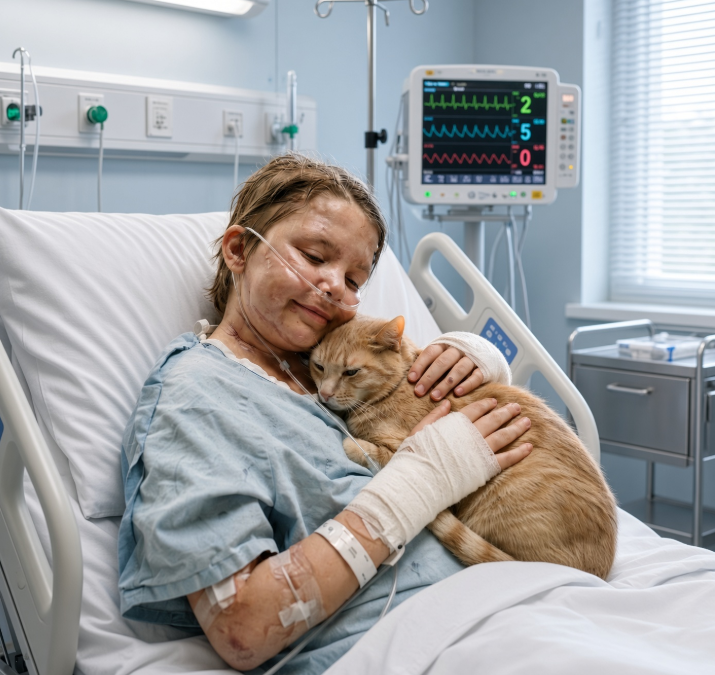
Emily lifted both bandaged hands and placed them gently on his back.
Her eyes closed.
Milo began to purr.
The sound was soft at first.
Then steady.
The monitor beside the bed beeped in rhythm.
An ICU nurse standing near the doorway raised her phone and took a photograph.
She did not post it.
She did not share it.
She simply knew that some moments should be saved because the world is not always cruel, even when it burns.
In the photograph, Emily is pale and small beneath the hospital blankets. Her arms are wrapped in white bandages. Her face still carries shadows of smoke and pain.
But Milo is there.
Curled against her heart.
Alive because she had refused to leave him.
And Emily is smiling.
Not much.
Just enough.
Enough to tell everyone in that room that she had found her way back.
Recovery was slow.
Emily had to learn how to breathe deeply again without pain. She had to change bandages. She had to sit through therapy sessions that made her cry from exhaustion. Her legs trembled the first time she stood. Her hands ached when she tried to hold a pencil.
But every morning, Milo climbed onto her lap.
Every evening, he slept beside her.
When she finally left the hospital, nurses lined the hallway to say goodbye. Captain Harris came too. He knelt in front of her wheelchair and handed her a small fire department patch.
“You remembered what I taught your class,” he said.
Emily looked down shyly.
“I just wanted to find Milo.”
Captain Harris smiled, but his eyes were wet.
“That’s what brave people say after doing brave things.”
Outside, the air was cold.
Emily wore the same coat.
It had been cleaned, repaired, and carefully stitched where the fire had damaged it. Her mother had offered to buy her a new one, but Emily refused.
Milo rode on her lap inside that coat.
Just like before.
Only this time, they were going home together.
Their house was gone.
The fire had taken the living room, the kitchen, the stairs, Emily’s bedroom, Noah’s toys, family photographs, school papers, furniture, dishes, blankets, and almost everything ordinary.
But neighbors had saved what they could.
A photo album from the garage.
A box of Christmas ornaments.
A small wooden stool Emily’s grandfather had made.
The family moved into a rental house while theirs was rebuilt.
For weeks, Emily woke from nightmares smelling smoke that was not there. Milo woke too. Every time, he climbed onto her chest and pressed his body beneath her chin until her breathing slowed.
When Emily returned to school, she wore long sleeves over her healing scars. Some children stared. Some asked questions. One boy asked if the fire hurt.
Emily said, “Yes.”
Then he asked if she would do it again.
The teacher started to interrupt, but Emily answered first.
“For Milo?”
She looked down at the gray cat keychain clipped to her backpack.
“Yes.”
The classroom went quiet.
Months passed.
Then a year.
Emily turned ten.
Her scars faded but did not disappear. Thin pale marks remained on her arms and legs, reminders of heat, smoke, and the price of love. She no longer hid them as much.
Milo grew rounder.
Older.
More spoiled.
He still hated vacuum cleaners. He still knocked pencils off Emily’s desk. He still sat on her homework and looked offended when moved.
But he never stopped following her.
Every winter morning, while Emily waited for the school bus, Milo tucked himself inside that repaired coat against her chest. Her mother would stand at the window, watching her daughter with the cat pressed close to her heart, and think about how close she had come to losing them both.
Sometimes people asked Emily why she had gone back.
Adults especially.
They wanted a lesson.
A sentence.
Something clear enough to share.
Emily never had the answer they expected.
She did not say she was brave.
She did not say she was a hero.
She did not say she had known what she was doing.
She only said, “He was scared.”
As if that explained everything.
Maybe it did.
Because at nine years old, Emily had already understood something many people spend their whole lives missing.
Love is not measured by what is easy to save.
It is measured by what you reach for when everything is falling apart.
That night, a little girl crawled through smoke for a frightened cat hiding under a couch.
She wrapped him in her coat.
She used her body as a shield.
She lost consciousness with his heartbeat pressed against hers.
And somehow, through fire, smoke, fear, and four long weeks of waiting, both of them survived.
People called it a miracle.
Her parents called it a second chance.
The firefighters called it the bravest thing they had ever seen from a child.
But Emily never needed a big word for it.
To her, it was simple.
Milo was family.
And family does not get left behind.
Years later, when winter comes and the air smells like snow, Emily still wears that coat.
It is too small now.
The sleeves stop above her wrists.
The zipper has been replaced twice.
The fabric near the chest is worn soft from years of Milo curling into the same place.
Her mother keeps offering to put it away in a memory box.
Emily always says no.
Some things are not meant to be stored.
Some things are meant to be carried.
And every time Milo presses his head beneath her chin, Emily feels the same truth she learned before she had words big enough to explain it.
What we choose to save says everything about who we are.
And sometimes love does not save one life.
Sometimes it saves two.

