A 78-Year-Old Widow Found Four Chained Bikers Trapped Inside a Burning Truck and Told Them, “Don’t Be Afraid, I’ll Save You”—By Dawn, the Entire Desert Was Shaking.
PART3:
She kept Arthur’s tools oiled. She kept his spare fuel cans filled. She kept the root cellar stocked with canned peaches, beans, flour, medical supplies, bottled water, kerosene, batteries, and ammunition for the shotgun she had not fired in years but cleaned every September.
Not because she expected trouble.
Because Arthur’s voice still lived in the back of her mind.
The desert punishes the unprepared, Maggie.
On the night of October 14, the desert came alive like something angry had woken beneath it.
The storm rolled in after sundown.
Margaret felt it before she heard it. A pressure change in her knees. A strange stillness in the air. The smell of dust lifting before rain. She stood on the porch around six-thirty with her cardigan wrapped around her shoulders, watching black clouds pile over the western ridge.
“Going to be ugly,” she told the empty porch.
Arthur would have agreed.
By eight, the wind began.
By nine, the power flickered twice.
By ten, the world outside had vanished behind sheets of rain.
The storm did not fall from the sky. It attacked sideways. Rain struck the windows hard enough to rattle the frames. Wind shoved against the farmhouse walls. Thunder rolled across the mountains with a deep, animal sound.
The power went out at 10:17.
Margaret knew the time because the kitchen clock stopped then, its hands frozen as if even time had decided not to continue in that weather.
She lit the kerosene lamp and set it on the table beside Arthur’s chair.
The house became small around the flame.
She made tea on the gas stove, wrapped a blanket over her lap, and tried to knit.
The scarf was supposed to be for a church charity box, though she had missed church four Sundays in a row. Her fingers moved from memory. Knit two. Purl two. Pause when the thunder shook the glass. Knit two. Purl two. Listen to the roof complain.
The old farmhouse knew storms.
It groaned, but it held.
At 11:43, Margaret heard the sound.
It did not belong to thunder.
It began as a high, tearing shriek that rose above the wind, metallic and sharp, the sound of something enormous being ripped open by force. Then came a heavy crash that traveled through the ground and up into her bones.
The teacups in the kitchen cupboard rattled.
Margaret froze, knitting needles suspended in the air.
For several seconds, she heard only rain.
Then came another sound.
Faint.
Distant.
Rhythmic.
Bang.
Bang.
Bang.
Not wind.
Not branches.
Not thunder.
Something was striking metal.
Margaret stood slowly, her knees popping.
“Lord,” she whispered.
The sensible part of her wanted to stay inside. In a storm like that, accidents multiplied. Flash floods cut roads in minutes. Loose power lines killed. Drivers missed curves. Old women slipped in mud and broke hips and were found too late by men who said, “She should have called someone.”
But the banging came again.
Bang.
Bang.
Bang.
Desperate.
Margaret went to the mudroom.
She took Arthur’s yellow raincoat from the hook. It swallowed her small frame, but it was waterproof and familiar. She shoved her feet into rubber boots, grabbed the heavy Maglite flashlight from the shelf, and hesitated only once before taking the ring of keys from the nail beside the door.
The wind nearly knocked her backward when she opened it.
Cold rain hit her face so hard it felt like needles. She bowed her head and stepped onto the porch, pulling the hood tight around her chin.
The world was chaos.
Rain and sand whipped across the yard. The porch swing slammed against its chains. Beyond the weak beam of her flashlight, the desert existed only in flashes of lightning.
She swept the beam across the property line, past the water tank, past the mesquite, toward the highway.
At first she saw nothing.
Then lightning fractured the sky, purple-white and violent.
For one bright second, the road appeared.
Two hundred yards east, where the highway curved above the ravine, the guardrail was gone.
Margaret’s breath caught.
Her flashlight found the tracks next. Deep, black scars in the mud. Tire marks leaving the asphalt, ripping through scrub, and disappearing down the embankment.
The banging came from below.
Margaret moved.
She did not run because seventy-eight-year-old knees do not appreciate drama. But she went as fast as she could, one hand holding the raincoat closed, the other gripping the flashlight.
At the edge of the ravine, she saw the wreck.
A massive black cargo truck lay on its side below, half buried in mud and desert rock. It had plowed through the guardrail, tumbled down the embankment, and come to rest against jagged stones near the wash. Smoke and steam hissed from the crushed cab. One front wheel spun slowly in the rain like a thing still trying to escape.
It was no ordinary truck.
Even from above, Margaret could see the armored panels. The reinforced windows. The matte black cargo box with no company markings, no license numbers visible from where she stood, no reflective safety labels.
A vehicle made not to deliver.
A vehicle made to hide.
Another lightning flash showed orange flames licking beneath the engine.
The banging grew louder.
Bang.
Bang.
Bang.
Margaret started down the slope.
Mud sucked at her boots. Rain blinded her. Twice she slipped and caught herself on rocks sharp enough to cut through her gloves. Her shoulder struck a cactus paddle, and pain shot down her arm, but she kept going.
The heat from the engine reached her face before she reached the truck.
“Hello?” she shouted.
The storm swallowed her voice.
Bang.
Bang.
Bang.
She followed the sound to the rear cargo doors.
They were twisted from the crash, one hinge bent, one heavy latch half torn loose. A padlock the size of her fist hung shattered, probably broken in the roll. The door itself was buckled but not open.
Margaret placed the flashlight under her arm, grabbed the steel handle with both hands, braced one boot against the muddy tire, and pulled.
Nothing.
She pulled again.
Her shoulders screamed.
“Come on,” she hissed.
Inside, someone struck the wall.
A voice roared, muffled by metal.
“Back! Get back!”
Margaret did not get back.
She wedged both hands around the handle, set her feet, and pulled with every ounce of old muscle grief had not eaten.
The door groaned.
Metal screamed.
Then it dropped open with such force Margaret stumbled backward and nearly fell into the mud.
She lifted the flashlight.
The beam entered the cargo box.
And Margaret Higgins saw hell.
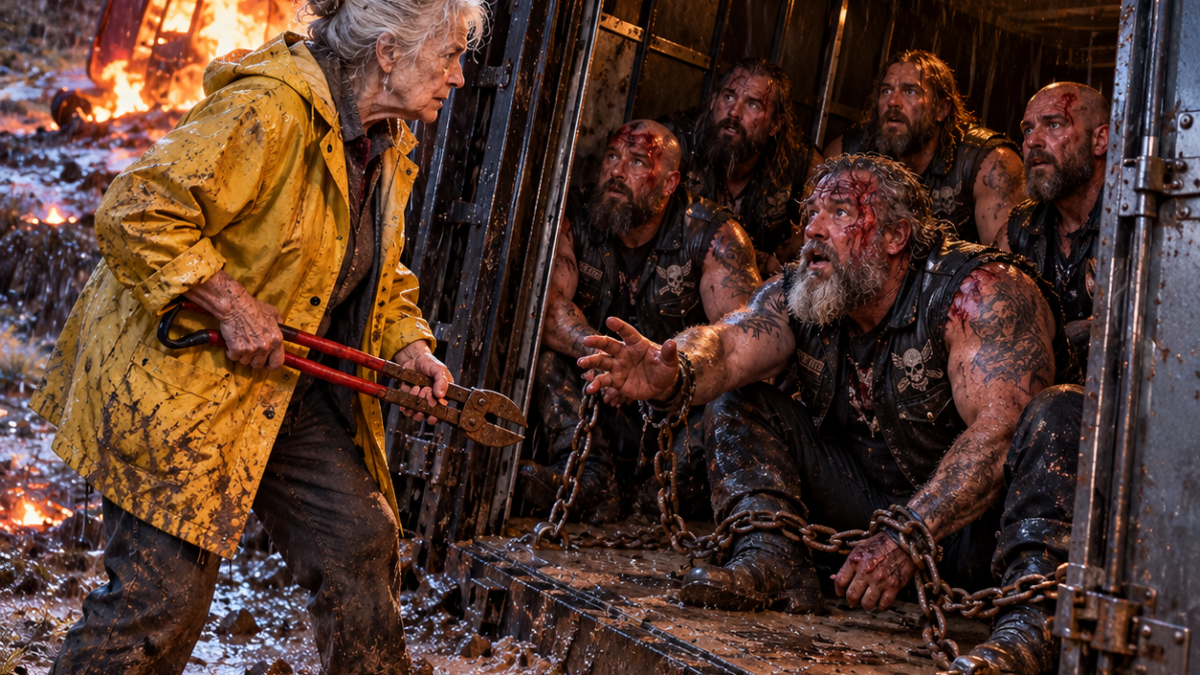
The inside of the truck was lined with steel plates and soundproofing foam. Bolted to the floor were heavy logging chains thick enough to drag trees. Four men were chained inside, thrown together against the slanted wall by the crash.
They were enormous.
Even injured, even bloodied, even trapped, they filled the space with a dangerous gravity.
Their wrists and ankles were cuffed in steel. Chains ran from those cuffs to welded floor brackets. Their clothes were torn. Their faces were bruised. Blood streaked the floor beneath them.
The man nearest the door raised his head.
He was a giant, gray-bearded, broad as a doorframe, with a torn leather vest hanging from one shoulder. His face was battered, one eye nearly swollen shut, but his gaze was clear when the flashlight struck him.
Then Margaret saw the patch on his vest.
The winged death head.
The red and white rockers.
HELL’S ANGELS.
CALIFORNIA.
A cold instinct moved through her body.
She knew that patch.
Everyone knew that patch.
People whispered stories about men like these. Fights. Guns. Prison. Brotherhood. Violence. Loyalty. Things decent people were supposed to avoid.
Her hand tightened around the flashlight.
For a heartbeat, fear told her to climb back up the hill, lock the farmhouse door, and pretend she had seen nothing.
Then the giant spoke.
“Get out of here!” he roared, voice raw with pain. “Lady, run! They’re coming back!”
Margaret stared at him.
Another man spat blood onto the steel floor. He was younger, muscular, shaved-headed, with a gash above his left eye and anger blazing through his exhaustion.
“You deaf, Grandma?” he shouted. “Get the hell out! This rig’s leaking fuel!”
A third man, pale and bleeding badly from his shoulder, barely lifted his head.
The fourth was little more than a boy. Early twenties, maybe. He had wide frightened eyes, muddy blond hair stuck to his forehead, and lips trembling as he tried not to cry.
Four chained men.
Four dangerous men.
Four helpless men.
The flames beneath the cab grew brighter.
Rain hissed against hot metal.
Margaret took one step into the cargo box.
The gray-bearded giant strained against his chains.
“I said run!” he shouted. “They’re cops! Dirty cops! You help us, they’ll kill you too!”
That stopped her.
“Cops?” she said.
His face twisted with urgency.
“Sheriff Boyd Miller. His deputies. Cartel bought the whole damn county. They ran us off the road near the border. Locked us in here to take us out to the desert and put us in holes.”
Margaret knew Boyd Miller.
Everyone in Mojave County knew Sheriff Miller.
He came to senior luncheons with polished boots and a smile like a church deacon. He shook hands at county fairs. He put his face on billboards promising LAW, ORDER, PROTECTION. He called Margaret “Mrs. Higgins” whenever he saw her in town and once carried groceries to her truck in front of a photographer during reelection season.
Arthur had never trusted him.
“That man smiles with only half his face,” he had muttered once.
Margaret looked at the chains.
Then at the fire.
Then at the young prospect in the back, who was shaking so hard the links rattled.
The giant saw her hesitate.
“Please,” he said, and that word from a man his size cut through the storm harder than thunder. “Don’t die for us.”
Margaret thought of Arthur.
Not as he had been at the end, pale on the kitchen floor while she screamed into a phone.
She thought of him young, standing in the half-built farmhouse, rain leaking through unfinished roof beams, saying, “Character is what you do when nobody decent is watching.”
She clicked off the flashlight to save battery and shoved it into her raincoat pocket.
“What’s your name?” she asked the giant.
He blinked. “What?”
“Your name.”
“Jim. Big Jim Garrison.”
“Mr. Garrison,” Margaret said, stepping closer, “I am going to get tools. You are going to stop shouting at me unless you want to waste the air you’ve got left.”
The shaved-head man stared. “Lady, are you crazy?”
Margaret looked at him.
“My husband asked me that for fifty-one years. It never changed the answer.”
She turned and climbed out of the truck.
“Mama!” Big Jim yelled.
Margaret paused at the door.
He looked at her with panic in his bruised eyes, not for himself but for her.
“They’re coming back.”
Margaret met his gaze.
“Then I better hurry.”
She climbed the ravine like the storm had become a living thing trying to drag her down. Mud coated her boots. Her breath burned. Her bad hip sent pain through her side with every step.
Halfway up, she slipped, landing hard on both knees.
For a second, she stayed there in the rain, palms sunk in mud, chest heaving.
She was old.
That fact came to her not as an insult, but as a problem.
Her body was not the one that had hauled lumber with Arthur, or climbed ladders, or run across fields barefoot when summer storms rolled in. Her hands ached. Her knees were swollen. Her lungs hated the cold.
But she was still alive.
And alive meant responsible.
Margaret pushed herself up.
By the time she reached the tool shed, she was soaked beneath the raincoat. The shed door stuck in the frame, swollen from moisture. She kicked it once, twice, then slammed her shoulder into it.
The door burst open.
The smell of old oil, cedar, rust, and dust hit her like memory.
Arthur’s tools hung along the wall in perfect order because Margaret had kept them that way. Wrenches by size. Saws oiled. Hammers in a row. His heavy-duty bolt cutters leaned in the corner beneath a tarp, three feet long, commercial grade, bought decades earlier when Arthur had cleared fencing after a flood.
Margaret grabbed them.
They were heavier than she remembered.
Nearly fifteen pounds.
Too heavy, said the sensible part of her.
“Shut up,” she told it.
She took a crowbar too, because Arthur believed one tool was preparedness and two tools were wisdom.
When she returned to the ravine, the fire had spread.
The cab was burning hard now, flames crawling along the chassis toward the cargo box despite the rain. The air smelled of gasoline and hot metal. The truck hissed like a furious animal.
Margaret slid down the embankment half on her feet, half on her backside, clutching the bolt cutters to her chest.
When she appeared at the open cargo door, all four bikers fell silent.
The young one in the back whispered, “No way.”
Margaret stepped inside.
“Mr. Garrison,” she said. “Hold the chain tight.”
Big Jim stared at the bolt cutters, then at her.
“You came back.”
“I said I would.”
“Lady—”
“Hold it.”
He obeyed.
That surprised the others more than anything.
Big Jim pulled the chain taut against the floor bracket. Margaret opened the jaws of the bolt cutters and placed them around a link.
She squeezed.
Nothing.
Pain shot through her wrists.
She squeezed harder.
The metal did not dent.
The shaved-head man—Tommy, someone had called him—swore softly.
“Quarter-inch steel,” Big Jim said, voice gentler now. “You don’t have the grip.”
Margaret glared at him. “Then I’ll use gravity.”
She braced the bottom handle against the floor, placed both hands on the top handle, positioned one boot carefully, and threw her entire weight down.
The bolt cutters shifted.
The link held.
She nearly fell.
“Again,” she muttered.
Big Jim’s eyes filled with something like awe.
“Margaret,” he said, though she had not told him her name.
She ignored him.
She climbed onto the handle with both feet this time, gripping a side bracket to steady herself. Her whole body trembled. Rainwater ran down her face. Heat pressed against her back.
“Arthur,” she whispered, “if you are watching, now would be a fine time to make yourself useful.”
She dropped her weight.
Crack.
The sound snapped through the cargo box like a gunshot.
The chain broke.
For one frozen second, everyone stared at the severed link.
Then Billy, the young prospect, breathed, “Holy hell.”
Big Jim’s wrists were still cuffed together, his ankles still bound, but he was no longer chained to the floor.
Margaret sagged against the wall.
Big Jim moved fast.
“Give me those.”
He took the bolt cutters carefully from her hands, as if receiving something sacred, then turned to Tommy’s chains.
With his strength, one link snapped.
Then another.
Tommy took the cutters next and freed the bleeding man, Preacher, while Jim broke Billy loose.
“Move!” Jim roared. “Now!”
Preacher collapsed the moment his chain released.
Margaret reached for him instinctively.
The man was massive, dead weight, blood soaking through his shirt and leather vest.
“You can’t carry him,” Tommy said.
“I’m not carrying him,” Margaret snapped. “I’m making sure you don’t drop him.”
Together they hauled him out.
The heat had become unbearable. Flames licked beneath the cargo box. Something popped under the hood. The smell of gasoline thickened.
“Up the hill!” Margaret screamed over the storm. “My house!”
They climbed.
Jim half carried Billy, who was limping and crying openly now. Tommy took most of Preacher’s weight. Margaret wedged herself under Preacher’s other arm, her small body bent nearly double beneath him.
Every step felt impossible.
Mud sucked at their boots. Rain blinded them. Behind them, the truck groaned and burned.
They were ten yards from the top when the world exploded.
The fuel tank detonated.
A roar tore open the night.
Heat slammed into Margaret’s back like a giant hand. The shock wave lifted her off her feet and threw her forward onto the asphalt.
Strong arms caught her before her face hit the road.
Big Jim pulled her against his chest, turning his back toward the blast as flaming debris rained into the ravine.
For several seconds, there was only firelight and thunder.
Then Jim looked down at her.
“You okay, Mama?”
Margaret gasped, rainwater and smoke in her lungs.
“I hate being called Mama.”
His mouth twitched.
“Yes, ma’am.”
Then his face changed.
He looked beyond her, down the highway.
Margaret turned.
Through rain and smoke, two pairs of headlights raced toward the wreck.
Jim’s voice dropped into something dangerous.
“They’re here.”
Margaret pushed herself upright.
“Can you walk?”
“I can fight.”
“That is not what I asked.”
Jim looked at Preacher, who was barely conscious, then at Billy, who had gone pale with terror.
“I can walk.”
“Then move.”
The farmhouse looked small and impossibly far away through the storm.
Margaret led them across the road and through the gate, around the side yard, up the porch steps, and into the house.
The men entered like a disaster.
Blood on the floor.
Mud on the rug.
Smoke in the air.
Leather, rain, gasoline, fear.
Her living room, which had smelled of cinnamon, old books, lavender, and kerosene an hour earlier, now looked like a battlefield had crawled inside.
Tommy slammed the door and threw the deadbolt.
Billy staggered to the window and lifted the lace curtain.
“Headlights,” he stammered. “They’re at the ravine.”
Margaret did not panic.
Panic wasted time.
“Kitchen,” she said, pointing at Billy. “Under the sink. Bleach, rags, mop. Get the mud from the entry.”
Billy stared at her.
“He’s a prospect,” Tommy said weakly. “Not a maid.”
Margaret turned on him.
“Then tonight he learns range.”
Billy ran to the kitchen.
Margaret looked at Jim and Tommy.
“Bring him.”
She led them down the hallway to the root cellar door. The old wooden door sat beneath a narrow pantry arch, half hidden behind a tall antique dresser Arthur had restored in 1984. Most people never noticed the cellar existed.
Margaret yanked the door open.
Cold air rose from below.
“Down there,” she said. “Blankets on the shelf. Medical kit in the red tin. Hunting supplies in the back. Do not touch the canned peaches unless you want to answer to me after we survive.”
Jim stared at her.
In the lamplight, he truly saw her for the first time.
A tiny woman with white hair plastered to her head. Mud on her cardigan. Blood on her sleeves. Knees bruised. Hands shaking from exhaustion, not fear.
“Margaret,” he said softly. “You don’t know who Miller is.”
“I know enough.”
“No. You don’t.” His voice lowered. “He runs this county. Judges look away. Deputies do what he says. People disappear in washes out here and everybody calls it bad luck. If he finds us in your house, he won’t arrest you. He’ll kill you and burn this place with your body in it.”
Margaret’s face hardened.
“I have lived in this desert for fifty-two years, Mr. Garrison. I have killed rattlesnakes with a garden hoe, fought off coyotes with a broom, driven through flash floods with three inches of water coming through the doors, and buried the only man I ever loved under a mesquite tree because the ambulance got lost on a road your sheriff promised to repair.”
Jim went still.
“A dirty cop with a badge does not impress me,” she said. “Get in the cellar.”
For a moment, the giant looked like a boy.
Then he nodded.
“Yes, ma’am.”
They carried Preacher down.
Billy finished wiping the entry and followed, trembling.
Margaret closed the cellar door, slid the antique dresser over it, and looked at the floor.
A smear of blood.
She wiped it once with her sleeve.
Not perfect.
No time.
She went to the bathroom, washed mud and blood from her hands, threw the yellow raincoat into the washer without starting it, put on a dry cardigan, and returned to Arthur’s chair.
She picked up her knitting.
Her hands were shaking too badly to make a stitch.
She held the needles anyway.
Ten minutes later, red and blue lights painted the living room walls.
Footsteps crunched on gravel.
The porch boards creaked.
Then came the knock.
Not a knock.
A warning in the shape of one.
Margaret set down the knitting, adjusted her glasses, and walked to the door.
She opened it with the chain still attached.
Sheriff Boyd Miller stood on her porch.
He was tall, broad-shouldered, soaked through, his tan uniform darkened by rain. His hat dripped onto the porch boards. His face was sharp, handsome in a hard way, with pale eyes that did not change when he smiled.
Behind him stood Deputy Carl Wexler, young, nervous, gripping an AR-15 across his chest.
“Evening, Mrs. Higgins,” Miller said.
His voice carried fake warmth, the same tone he used at county breakfasts and veterans’ parades.
“Sheriff?” Margaret widened her eyes. “Mercy, you scared me half to death.”
“Sorry to bother you at this hour. Nasty accident down the road.”
“A crash? I thought that was thunder.”
“Yes, ma’am. Prison transport went into the ravine.”
“Good heavens. Is everyone all right?”
Miller’s smile did not reach his eyes.
“That’s the thing. Four dangerous prisoners seem to have gotten loose.”
“Loose?”
“Yes, ma’am. Killers. Violent men. We tracked footprints up from the wreck in this general direction.”
Margaret pressed one hand to her chest.
“You think they came here?”
“That’s what we’re checking.” Miller leaned closer. “You seen or heard anything unusual?”
“Only the storm. I’ve been in that chair since the lights went out. Arthur always told me not to stand near windows during lightning.”
Miller’s eyes flicked past her into the house.
“Mind if we come in and take a quick look?”
Margaret hesitated perfectly.
“Oh, Sheriff, my house is such a mess.”
“It’s for your safety.”
He did not wait for permission.
He pushed past the door, breaking the chain with one hard shove.
The snap echoed in the hall.
Margaret stumbled back with a gasp that required no acting.
Miller entered.
Deputy Wexler followed.
Below their feet, in the root cellar, Big Jim held one hand over Preacher’s mouth to quiet his ragged breathing. Tommy gripped a cast-iron pipe he had found on a shelf. Billy sat frozen against a crate of peaches, tears streaking his dirty face.
Above them, Miller walked slowly through the living room.
He looked at the lamp.
The knitting.
The wet floor near the entry.
The kitchen.
The hallway.
Margaret followed, wringing her hands like the frightened old woman he expected.
“You live alone out here?” Miller asked.
“Since my Arthur passed.”
“Must be frightening.”
“Sometimes,” Margaret said. “But the Lord watches over widows.”
Miller smiled slightly.
“Does He?”
Margaret met his eyes.
“When men don’t.”
For a second, the mask slipped.
Then Deputy Wexler said, “Sheriff.”
He was staring at the floor near the antique dresser.
Margaret’s heart stopped.
A single drop of blood stained the edge of the floral rug.
Dark.
Fresh.
Wet.
Miller saw it.
He slowly knelt.
Touched it with one gloved finger.
It smeared.
When he stood, the fake warmth was gone.
His hand moved to his holster.
“You cut yourself knitting, Mrs. Higgins?”
Below the floorboards, Jim heard the leather strap of the holster snap open.
He looked at Tommy.
Tommy nodded.
If that door opened, they would rush.
Chained, bruised, exhausted, almost weaponless.
But they would rush.
Upstairs, Margaret stared at the blood.
Then at Miller’s hand.
She knew, with perfect clarity, that this was the line between life and death.
Not only hers.
All of theirs.
A predator strikes when it smells fear.
Arthur had said that once after a coyote took one of their hens.
Margaret did not let fear rise to her face.
Instead, she took one clumsy step backward.
Her heel caught the edge of the rug because she made sure it did.
She gasped and fell sideways into the wall.
As she fell, she dragged her right palm down hard across the jagged exposed nail on the back of Arthur’s old picture frame.
Pain ripped through her hand.
The cut opened deep.
Blood ran instantly.
Margaret cried out, collapsing onto the floor.
“Oh! Oh, dear Lord!”
Deputy Wexler startled, raising his rifle before lowering it again.
Miller stepped back.
Margaret clutched her bleeding hand and held it up toward the lamp.
“My skin,” she whimpered. “It’s like paper these days. Doctor says my blood is too thin. Oh, Arthur would fuss at me something terrible.”
Blood dripped from her palm onto the rug.
Near the first drop.
Beside it.
Over it.
Miller stared.
His mind worked visibly behind his eyes.
Too convenient.
Too messy.
Too old.
Too weak.
Too much trouble.
Then his radio crackled.
“Unit One, copy?”
Miller snatched the mic from Wexler’s shoulder.
“Go.”
“Thermal sensor tripped near old Copper Quarry. Four heat signatures moving south into the canyon.”
Miller’s head snapped up.
The Copper Quarry was three miles away, full of abandoned shafts and caves. If men disappeared there before dawn, even Miller’s dogs might not find them.
He looked once more at Margaret.
She kept her head bowed, wrapping her bleeding hand in a lace handkerchief with shaking fingers.
“Stay inside, Mrs. Higgins,” he said coldly. “Lock your doors. Do not open them for anyone.”
“Yes, Sheriff.”
“We’ll be back when the sun comes up.”
“I’ll put coffee on,” she whispered.
His eyes narrowed.
Then he turned and stormed out.
The cruiser engines roared away into the rain.
Margaret stayed on the floor until the sound faded completely.
Then she counted to one hundred.
Twice.
Only then did she stand.
Her hand throbbed. Blood soaked the handkerchief. Her knees trembled so violently she had to grip the wall.
But she moved the dresser.
Opened the cellar.
“It’s clear,” she hissed. “Come up.”
Big Jim emerged first.
He looked at her bleeding hand and went pale under the bruises.
“You cut yourself.”
“I noticed.”
“You did that on purpose.”
“I also noticed.”
He stared at her in silence.
Then, very softly, he said, “I know men with medals who wouldn’t have done what you just did.”
Margaret turned away because she did not know what to do with that.
“Bring Preacher up.”
Preacher was worse.
His skin had gone gray. Sweat covered his face. Blood seeped from the wound in his shoulder, dark and steady. Infection had already begun before the crash. The ambush had happened hours earlier. The chains had prevented proper pressure. The shock was setting in.
Margaret spread towels on the living room rug.
“Lay him down.”
Tommy knelt beside him, hands shaking.
“He’s not going to make it,” he said, and for the first time his voice lost all anger. “Damn it, Preach, stay with me.”
Billy stood by the wall, looking useless and terrified.
Margaret went to the kitchen.
She returned with whiskey, clean towels, duct tape, boiled water from the kettle, and Arthur’s hunting medical kit.
Jim looked at the whiskey.
“For the wound?”
“For your nerves if you get in my way.”
He almost smiled.
Margaret cut away Preacher’s shirt.
The wound was ugly.
She had seen gun wounds only once before, when Arthur’s cousin shot himself cleaning a revolver. This was worse. Torn flesh. Blood. Swelling. Heat.
“We need a hospital,” Tommy said.
“If we call an ambulance, Miller hears it,” Jim replied.
“If we drive, he’ll have roadblocks.”
Billy’s voice cracked. “Then what do we do?”
Margaret pressed a towel hard against Preacher’s shoulder.
“We call someone who won’t use a county radio.”
Jim looked at her.
“What?”
“Arthur had a ham radio upstairs. Military grade. Backup battery. Big antenna.”
Jim’s eyes sharpened.
“You know how to use it?”
“No.”
“I do.”
Within two minutes, Margaret led him to the attic.
The space smelled of dust and cedar. Rain hammered the roof overhead. The radio sat on a sturdy desk beneath a plastic cover, exactly where Arthur had left it.
Jim pulled off the cover and sat.
His huge cuffed hands moved over the dials with surprising precision. He checked the power, adjusted frequency, tuned through static.
Margaret held the lamp.
The radio hummed to life.
Jim lifted the microphone.
“This is Big Jim, California charter, priority zero, code red. Any brother on channel, respond.”
Static.
Rain.
Thunder.
Jim tried again.
“Priority zero. Code red. Ambushed by corrupt law enforcement in Mojave County. Brother bleeding out. White farmhouse, Miller’s Ridge, fourteen miles east of county line. Need all hands.”
Nothing.
His jaw tightened.
“Come on,” he whispered. “Come on.”
Margaret thought of Arthur sitting in that same chair, speaking to strangers across deserts and mountains, laughing at voices from states he had not visited in years.
She touched the back of the chair.
“Arthur,” she whispered, “if this thing ever loved you, make it talk.”
Jim pressed the mic again.
“This is Big Jim Garrison. Hell’s Angels California. Priority zero. We have a brother down. Dirty sheriff. Cartel ties. Need medical. Need backup. Need all hands.”
Static swallowed him.
Then a voice broke through.
Faint.
Distorted.
But human.
“Big Jim, this is Oakland. Say again.”
Jim closed his eyes.
The relief on his face was so raw Margaret looked away.
“Oakland, we need all hands. Repeat, all hands. Preacher’s hit. Tommy, Billy, and me alive. Civilian saved us. Sheriff Boyd Miller inbound with dirty deputies. Coordinates following.”
He gave the coordinates.
The voice from Oakland changed.
No longer faint with uncertainty.
Hard now.
Certain.
“Copy, Big Jim. Hold your ground, brother.”
A pause.
Then the voice added, low and terrible:
“Hell is coming.”
The storm broke just before dawn.
The rain faded to a cold drizzle. The sky over the desert turned bruised purple, then gray. Steam rose from the wreck in the ravine. Smoke drifted low across the highway.
Inside the farmhouse, time stretched thin.
Preacher slipped in and out of consciousness. Tommy stayed beside him, pressing towels against the wound. Billy sat near the window, chewing his nails bloody. Jim paced as much as his injured body allowed, checking doors, windows, sight lines.
Margaret sat in Arthur’s chair with her hand bandaged.
She had finally stopped shaking.
That worried her a little.
Sometimes, after great fear, the body becomes too quiet.
“Do you have family?” Billy asked suddenly.
Margaret looked at him.
He seemed embarrassed by the question.
“I mean… kids?”
“No.”
“Oh.”
“You?”
“My mom,” he said. “In Fresno. She thinks I’m working construction.”
Margaret studied him.
“You are too young to be this close to dying.”
He swallowed.
“I know.”
Jim stopped pacing.
“You’re not dying today.”
Billy looked at him with desperate faith.
Margaret understood then that Jim was more than their leader. He was their wall. Their shelter. Their dangerous, scarred proof that someone would stand in front when bullets came.
She wondered who had stood in front of Jim when he was young.
At 6:07 a.m., engines approached.
Not motorcycles.
Cruisers.
Billy looked out the window and turned white.
“They’re back.”
Six Mojave County sheriff’s vehicles roared up the gravel drive, followed by two unmarked tactical trucks. Fifteen deputies spilled out in body armor, rifles raised. Sheriff Miller stepped from the lead cruiser, fury carved into every line of his face.
He knew.
The quarry had been a false trail.
The old woman had played him.
Margaret stood.
Jim grabbed her arm gently.
“Stay low.”
“I’m in my own house.”
“Mama.”
She glared at him.
He corrected himself instantly.
“Mrs. Higgins.”
Miller’s voice boomed through a megaphone.
“Margaret Higgins! This is Sheriff Boyd Miller. We know you are harboring fugitives. Send them out now.”
Margaret walked toward the window.
A bullet shattered the glass before she reached it.
Jim tackled her to the floor as shards sprayed across the room.
“Are you insane?” he roared.
“I was going to answer him!”
“He just answered you!”
Outside, Miller continued.
“You have five minutes to surrender those men, or we will assume you are a hostage and breach with lethal force.”
Tommy laughed bitterly from the floor.
“Hostage. That’s rich.”
Preacher groaned.
Billy started praying under his breath.
Jim looked at Tommy.
They did not need to speak.
Both men understood.
They were unarmed, wounded, exhausted, and outnumbered. But if the deputies breached, Jim and Tommy would rush them. Maybe they would buy Margaret time. Maybe Billy. Maybe Preacher. Maybe no one.
Margaret saw the decision pass between them.
“No,” she said.
Jim turned.
“When they come in,” he said, “you stay down. Cover your head. You hear me? You already did enough.”
“I did not drag you out of a burning truck so you could die on my rug.”
“Mrs. Higgins—”
“No.”
His face softened.
It was the tenderness that broke her, not the fear.
“Maggie,” he said, as if he had known her all his life, “sometimes people come too late.”
Arthur’s face flashed in her mind.
The kitchen floor.
The ambulance lost at the wrong turn.
Her hands pressing his chest.
Come on, Arthur. Come on. Don’t you leave me.
Sometimes people come too late.
Margaret’s eyes filled.
“Not this time,” she whispered.
Outside, two deputies lifted a battering ram and started toward the porch.
Jim stood.
Tommy stood with him.
Billy rose too, shaking but determined.
Miller shouted, “Time’s up!”
The deputies reached the steps.
Then the floor began to vibrate.
At first Margaret thought it was thunder.
But thunder rolls.
This trembled.
Steady.
Growing.
Mechanical.
The teacups in the kitchen rattled against their saucers.
The lamp flame shivered.
Jim’s head snapped toward the west.
The sound grew louder.
A deep, rhythmic roar that entered the bones before the ears understood it.
Engines.
Not one.
Not ten.
Hundreds.
Thousands.
Outside, the deputies froze.
Miller lowered the megaphone.
“What the hell is that?”
Over the western ridge, headlights appeared.
A line of them.
Then another.
Then the line became a river.
Motorcycles poured over the highway ridge, chrome flashing in the gray dawn, headlights cutting through mist and smoke. They came in tight formation, wave after wave after wave, filling the two-lane road, spilling onto the shoulders, then into the desert scrub.
The roar became apocalyptic.
The ground shook.
Dust and mist rose beneath tires.
Margaret crawled to the broken window and looked out.
She had never seen anything like it.
Riders in leather. Patches from Oakland, Los Angeles, Las Vegas, Phoenix, San Diego, Fresno, Sacramento, Tucson. Men and women on Harleys, Indians, custom bikes, touring bikes, choppers that looked built from thunder and steel.
They came not like a mob.
Like an army.
Two thousand riders.
The deputies turned, rifles half raised, half lowered, overwhelmed by the sheer impossibility of what was arriving.
Miller shouted orders no one could hear.
The riders surrounded the property.
They circled the cruisers, the tactical trucks, the farmhouse, engines revving in a deafening wall of sound. Dust blotted the sunrise. Headlights blinded the deputies. The circle tightened until the sheriff’s men stood trapped in the yard they had come to control.
Then, all at once, the engines cut.
Silence fell.
Not peace.
Threat.
A silence so complete Margaret could hear rain dripping from the porch roof.
The crowd parted.
A man stepped forward.
He was enormous, even by biker standards, with a white beard braided at the end, dark sunglasses despite the gray light, and a leather vest heavy with patches. He carried no visible weapon.
He did not need one.
Jim exhaled.
“West Coast president,” he said. “Ray Mercer.”
Ray Mercer walked toward Sheriff Miller as if the rifles pointed in his direction were decorations.
Miller tried to recover authority.
“This is an active law enforcement operation!”
Ray stopped ten feet away.
His voice was low, but the silence carried it.
“Drop it.”
Miller’s face twisted.
“You have no idea what you’re interfering with.”
Ray looked at the cruisers, the deputies, the shattered farmhouse window, then the old woman visible behind it.
“I know enough.”
Miller drew his pistol.
Two thousand riders shifted.
Not forward.
Just shifted.
Leather creaked. Boots settled. Hands lowered near belts, not drawing, not yet.
Miller’s hand began to shake.
He looked at his deputies.
They were surrounded by men who looked ready to tear the world apart with their teeth if asked.
One deputy lowered his rifle.
Then another.
Then another.
Metal hit gravel.
The sound spread.
Rifles dropped one by one.
Deputy Wexler was the last before Miller. He looked young, terrified, and relieved when his weapon left his hands.
Miller stared at him with betrayal.
Then he looked back at Ray Mercer.
Ray said nothing.
Miller lowered his pistol.
Dropped it into the mud.
Inside the farmhouse, Billy began to sob.
Jim opened the front door.
The porch was splintered near the frame. Rain and dust blew in.
He stepped out first.
A cheer rose from the riders, deep and thunderous.
Tommy came behind him.
Then Billy.
Two riders rushed past them into the house with trauma kits, going straight to Preacher. One had paramedic patches on his jacket. Another spoke into a satellite phone, calling in coordinates for a medevac helicopter.
Margaret stood in the doorway.
Small.
White-haired.
Cardigan stained with blood.
Bandaged hand against her chest.
Mud still on her hem.
The entire yard seemed to turn toward her.
Ray Mercer climbed the porch steps.
He looked at Jim.
“This the woman?”
Jim’s bruised face changed.
Not into a smile.
Into reverence.
“She didn’t hide us,” he said. “She broke our chains. She dragged Preacher up a ravine. She lied to Miller with his gun half drawn. She stood between us and hell.”
Ray turned to Margaret.
She suddenly felt embarrassed.
“I only did what needed doing,” she said.
Ray removed his sunglasses.
His eyes were dark and wet.
“My mother used to say that’s what courage always calls itself.”
Before Margaret could answer, Ray took off his leather cut.
The vest was heavy, black, worn by years and miles. He stepped forward, then lowered himself to one knee in the mud at Margaret’s feet.
A murmur passed through the crowd.
Ray draped the cut over her shoulders.
It nearly swallowed her.
Margaret stood frozen beneath its weight.
Then two thousand riders raised their right fists.
No one cheered.
No engines.
No shouting.
Just fists lifted in silent salute to a seventy-eight-year-old widow on a broken porch in the Mojave desert.
Margaret tried to speak.
Nothing came out.
Big Jim stepped beside her, gently touching her elbow, as if she might fall.
For the first time since Arthur died, Margaret did not feel alone in the house he built.
Three days later, federal agents raided the Mojave County Sheriff’s Department.
By then, the story had already cracked open.
Not all of it reached the public at once. Official language rarely knows how to say shame plainly. News anchors spoke of alleged corruption, suspected cartel ties, possible abuse of authority, and an ongoing federal investigation.
But by the end of the week, Sheriff Boyd Miller and seven deputies were in custody.
The armored truck was traced to a shell company tied to the Desert Scorpions cartel network.
The false prisoner transport paperwork led investigators to county computers.
The Copper Quarry thermal alert that saved Margaret’s lie turned out to have been triggered by a rancher’s loose cattle, a detail Margaret laughed about for ten minutes when Jim told her.
Preacher survived surgery.
Barely.
The bullet had missed an artery by less than an inch. Infection nearly took him anyway. For two days, Jim sat outside the ICU waiting room like a guard dog nobody dared ask to move.
Tommy came to Margaret’s farmhouse the morning after the arrests with a new front door.
He brought three men, two toolboxes, and an expression of deep guilt.
“You don’t have to fix everything,” Margaret told him.
“Yes, ma’am,” Tommy said. “I do.”
They replaced the shattered door, repaired the broken window, cleaned mud from the carpet, patched the porch rail, hauled away wreck debris from her roadside, and fixed a leak in the roof Margaret had been ignoring for six months.
Billy came too.
He brought flowers.
Not fancy ones. Grocery store daisies wrapped in plastic, clutched in both hands like an apology.
“I didn’t know what kind you liked,” he said.
Margaret took them.
“I like the kind brought by boys who are still breathing.”
His face crumpled.
She let him cry in her kitchen.
By Sunday morning, four motorcycles rolled into Margaret’s driveway.
She watched from the porch with a cup of coffee.
Big Jim, Tommy, Billy, and Ray Mercer dismounted.
Jim carried groceries.
Tommy carried a sack of dog food, though Margaret did not own a dog.
“What is that?” she asked.
Tommy looked at the bag.
“Wrong list.”
Ray sighed.
Billy said, “We can return it.”
Margaret looked at the four terrifying men standing in her yard like schoolboys caught stealing apples.
Then she laughed.
It startled them.
It startled her too.
The sound came from deep inside, from a room in her heart she thought had been sealed after Arthur died.
“Well,” she said, “bring it in. Maybe the coyotes can read labels.”
That became the first Sunday.
Then another.
Then every Sunday.
A rotation of riders came out to Miller’s Ridge—not because she needed guarding, they said, though they guarded her anyway; not because they owed her, though they did; not because she asked, because she never would.
They chopped firewood.
They repaired fencing.
They filled water tanks.
They drove her into town for doctor appointments.
They installed a generator Arthur would have admired and Margaret pretended was unnecessary until the next outage, when she made coffee and smiled privately into the mug.
They brought groceries and argued about brands.
They mowed desert weeds that did not require mowing.
They checked the road after storms.
At first, Margaret resisted.
“This is too much.”
Jim would answer, “No, ma’am.”
That was all.
No argument.
Just no.
The town noticed.
Of course it did.
In Mojave County, three motorcycles at a widow’s house caused more conversation than federal indictments.
At the grocery store, people stared.
At church, women whispered.
Pastor Glenn asked gently whether Margaret felt safe.
She looked him dead in the eye.
“Safer than I ever felt with Boyd Miller running things.”
That ended that.
Some people disapproved.
They said the bikers were criminals.
They said Margaret should not associate with men like that.
They said gratitude was one thing, but Sunday visits were another.
Margaret listened politely, then asked each person where they had been the night her porch window was shot out.
No one had much to say after that.
The trial took nearly a year.
Miller’s lawyers tried to paint the bikers as violent gang members, the sheriff as a hardworking lawman under pressure, the incident as a tragic misunderstanding involving dangerous fugitives.
Then the recordings came out.
Deputy communications.
GPS logs.
Ballistics.
Financial transfers.
Cartel stash house coordinates delivered anonymously to the FBI by “a man on a Harley,” though everyone in Margaret’s kitchen knew exactly which man it was and never said.
The strongest testimony came from someone no one expected.
Deputy Carl Wexler.
The young deputy who had stood on Margaret’s porch with the AR-15 took the stand under a plea agreement. His face was pale. His voice shook. He admitted Miller ordered the ambush. He admitted the men were never officially arrested. He admitted the plan was to execute them in the desert and blame cartel retaliation.
Then the prosecutor asked, “Why did you lower your weapon outside Margaret Higgins’s farmhouse?”
Wexler swallowed.
“Because I realized we weren’t law enforcement anymore,” he said. “We were the thing people needed protecting from.”
Margaret sat in the back row between Jim and Billy.
Jim’s massive hand rested on the bench in front of him, not touching her, but close enough that she felt the protection in it.
Miller never looked at her.
Not once.
When the guilty verdict came, Margaret did not cheer.
She closed her eyes.
She thought of Arthur.
She thought of the county roads, the people who had disappeared into convenient explanations, the fear everyone had mistaken for order.
Justice did not bring back what corruption had taken.
But it did stop the theft from continuing.
That mattered.
On Margaret’s seventy-ninth birthday, she woke to thunder.
For one terrible second, she was back in the storm.
Then she heard engines.
Not threatening.
Familiar.
She went to the porch in her robe and slippers.
Five hundred motorcycles lined the road.
Not two thousand. Ray said that would be “overkill for a birthday,” which was perhaps the strangest sentence anyone had ever said in her kitchen.
Jim stood at the front gate holding a helmet.
“No,” Margaret said immediately.
“You don’t know what I’m asking.”
“I have known men long enough to recognize foolishness before it speaks.”
He grinned.
“Steak dinner in Vegas.”
“No.”
“Best in the state.”
“No.”
“Arthur ever take you?”
Margaret paused.
That was unfair.
Arthur had promised once, years earlier, that they would go to Las Vegas and order steaks too expensive to make sense. Then the truck needed repairs. Then the roof. Then life. They never went.
Jim saw the pause.
His grin softened.
“We’ll ride slow.”
“I am seventy-nine years old.”
“Yes, ma’am.”
“My hip hurts.”
“We brought a trike.”
“My hair will look ridiculous.”
“With respect, ma’am, nobody in this driveway has sensible hair.”
Margaret looked at the line of bikers.
Men and women in leather waited silently, smiling, holding helmets, pretending not to watch her decide.
On the porch rail hung Arthur’s old denim jacket.
For a moment, she could almost hear him.
Maggie, if you say no to this, I’m haunting you.
Margaret sighed.
“If I die on that thing, I will be furious.”
Jim handed her the helmet.
“Yes, ma’am.”
She went to Las Vegas.
She ate the greatest steak of her life.
She drank half a glass of wine and told Ray Mercer that his beard made him look like a Civil War general who had misplaced the war.
Ray laughed so hard he nearly spilled his coffee.
On the ride home, the desert sunset burned red and gold across the sky. Margaret sat on the back of the trike, helmet secure, Jim riding beside her like an escort from some wild, unlikely kingdom.
For the first time in years, the horizon did not look empty.
It looked open.
Months became years.
The scar on Margaret’s palm healed into a thin white line.
She traced it sometimes while knitting.
Not because she enjoyed remembering fear, but because the scar reminded her that she had not imagined her own courage. It was there, written into her skin.
Preacher recovered slowly and came to visit with his arm in a sling. He stood awkwardly on the porch, looking at the ground.
“I don’t know how to thank you,” he said.
Margaret handed him a basket of laundry.
“Fold those.”
He blinked.
She went back inside.
He folded them terribly, but she appreciated the effort.
Billy left the club life two years later.
Not because he betrayed anyone. Because almost dying in chains at twenty-three had made him reconsider the shape of his future. Ray helped him find work as a mechanic. Jim said little, but Margaret saw the pride in his face when Billy arrived one Sunday wearing a clean work shirt with his name stitched over the pocket.
“You look handsome,” Margaret told him.
Billy blushed like a child.
Tommy remained Tommy: loud, loyal, impossible, always fixing something, often breaking something else in the process.
Ray visited less often because presidents carried burdens, but every Christmas, a package arrived: coffee, wool socks, a new paperback western, and a handwritten note.
Big Jim came most often.
At first, Margaret thought he came from duty.
Then she realized he came because he was lonely too.
He never said much about his past. She learned pieces slowly. A father who hit. A mother who left. A brother dead from drugs. Prison at nineteen. The club becoming family because family had failed first.
One evening, he sat on her porch while rain fell gently beyond the roof.
Not a violent storm.
A soft one.
Margaret brought coffee.
Jim stared into the cup.
“You ever regret it?” he asked.
“What?”
“Opening that truck.”
Margaret settled into the chair beside him.
“Do you ever regret telling me to run?”
He smiled faintly.
“No.”
“There’s your answer.”
He nodded.
After a while, he said, “I killed men before.”
Margaret did not move.
“In war?” she asked.
He shook his head.
“Other ways.”
The rain whispered against the porch.
Margaret looked at him—not at the patch, not at the scars, not at the stories others told, but at the man who brought groceries every Sunday, carried peaches from her cellar, sat with Preacher in a hospital, and cried once when Billy left to build a different life.
“Have you saved any?” she asked.
His jaw worked.
“A few.”
“Then you are not one thing.”
He closed his eyes.
Some words reach people years before they can answer them.
That was one of them.
Margaret lived three more years in the farmhouse.
Good years.
Hard years.
Full years.
The house filled with life again, not the same life she had lost, but life all the same. Boots on the porch. Laughter in the kitchen. Engines in the drive. Men arguing about pie. Women riders helping plant tomatoes. Billy bringing his fiancée to meet her. Ray installing a better ramp after Margaret pretended she did not need one and then used it every day.
When Margaret turned eighty-two, her hands shook too much to knit evenly.
Tommy bought her larger needles.
She called him a sentimental fool.
He kissed her forehead and told her not to ruin his reputation.
One winter morning, Margaret did not answer the door.
Jim knew before he opened it.
He had known death enough to recognize its silence.
She was in Arthur’s chair, wrapped in a quilt, a paperback open in her lap, the kerosene lamp unlit beside her. Her face was peaceful. One hand rested on the arm of the chair, scar visible in the morning light.
Jim stood in the doorway for a long time.
Then he removed his hat.
The funeral was held under the mesquite tree beside Arthur’s grave.
Half the county came.
So did more than a thousand riders.
They parked along the highway in respectful rows, engines silent. No roaring. No spectacle. Just presence.
Pastor Glenn spoke.
Claire Donnelly from church read a psalm.
Billy, now married, cried openly.
Tommy held himself rigid until Preacher put a hand on his shoulder.
Ray Mercer stood at the back, sunglasses on, face unreadable.
Big Jim spoke last.
He walked to the front holding a folded piece of paper but did not look at it.
“Margaret Higgins saved my life,” he said.
His voice carried over the desert.
“But that’s not the whole truth. She saved the part of me that thought men like me only deserved loyalty from men like me. She was seventy-eight years old, standing in a storm, looking at four chained bikers who probably scared the hell out of her, and she chose to see human beings.”
He paused.
“She broke our chains with bolt cutters. Then she broke a few more with kindness.”
Tommy wiped his face.
Jim continued.
“She hated being called Mama,

