A 76-Year-Old Farmer Saw 79 Bikers Racing Toward His House With a Tornado Behind Them—Then He Shouted “Basement!” and Made a Choice 300 Riders Would Never Forget.
PART3:
The old red barn his grandfather had raised from oak and sweat. It also took three horses Walter had failed to get inside in time.
He still heard them sometimes.
Not in dreams.
Worse.
In quiet moments.
When wind pushed at the house just right.
Walter turned toward the cellar doors on the side of the porch.
“Biscuit,” he said sharply.
The dog moved immediately.
Old, but obedient.
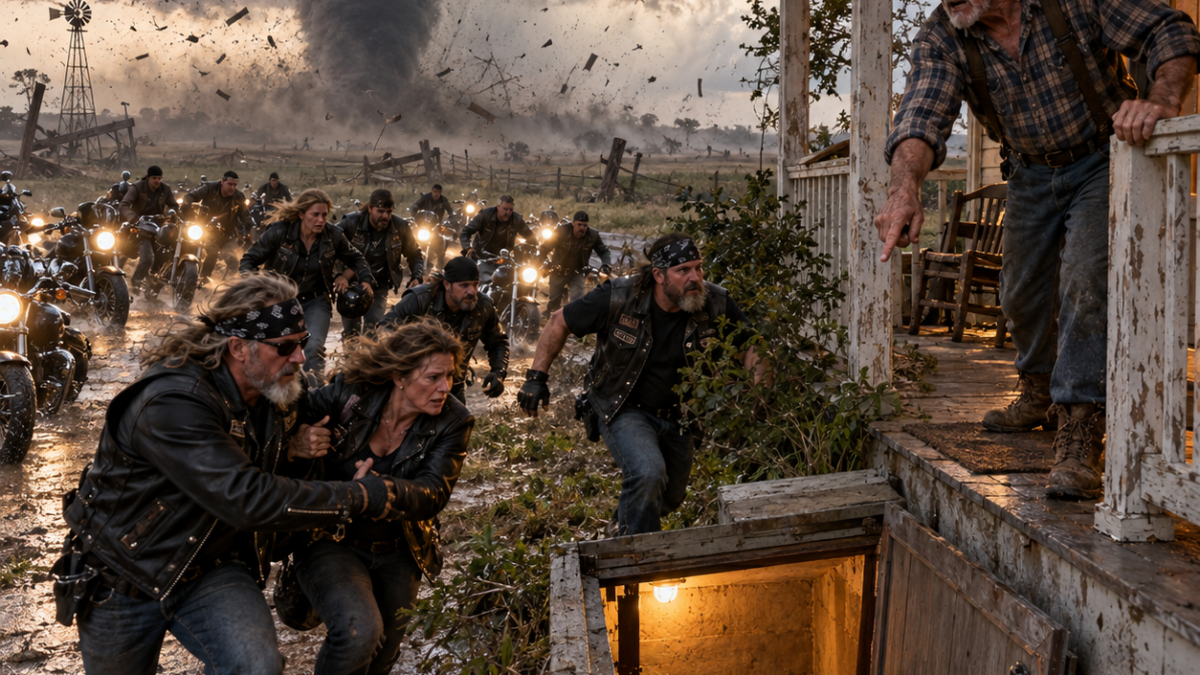
Walter had one hand on the porch rail and one foot already shifting toward the storm shelter when another sound cut through the coming roar.
Engines.
Not one.
Not two.
Dozens.
Walter turned toward the county road.
At first, all he saw was dust rising beyond the bend. Then headlights broke through it. One after another after another. Motorcycles poured down the cracked asphalt like black beads spilled across the land, moving fast, desperate, with the storm climbing behind them.
Walter stared.
“Lord above.”
The lead bike swerved hard into his gravel drive, tires spitting stones. Behind it, more followed. Big touring bikes. Choppers. Cruisers. Some carried flags. Some had saddlebags. Some had chrome flashing under the sickly light.
Men and women in leather.
Patch-covered vests.
Tattoos.
Bandanas.
Helmets.
Beards.
Hard faces made suddenly human by fear.
The leader had his boots in the gravel before his bike had fully stopped.
He was a broad man in his fifties with a gray-streaked beard, a leather vest, and eyes that had seen the sky behind him.
“Sir!” he shouted over the wind. “We need help! Storm’s coming right through here! There’s nowhere else!”
Walter looked past him.
There were too many to count quickly.
Bikes were still turning into the drive. Some riders were looking over their shoulders. One woman was pointing at the sky. A younger man dropped his bike in the gravel and barely stopped to lift it before running toward the house.
Walter did not ask who they were.
He did not ask what the patches meant.
He did not ask why seventy-nine bikers had ended up on his road.
He saw the storm.
He saw the fear.
He saw human beings caught in the open by something that did not care what they wore.
He threw one arm toward the side of the house.
“Basement!” he shouted. “Tornado! Move now!”
The leader did not waste a second.
“You heard him!” he roared. “Inside! Move!”
The riders began pouring toward the cellar entrance.
Walter yanked the old storm door open.
It screamed on its hinges.
The basement beneath the house had been dug decades before modern storm shelters, tornado ratings, reinforced steel, or emergency codes. It was stone-walled, low-ceilinged, cool, and dark. It had held canned peaches, potatoes, spare tools, old tack, Christmas boxes, and every secret fear the Hayes family had carried through Oklahoma storm seasons.
It had never held seventy-nine bikers.
“Down!” Walter barked. “All the way down! Back wall! Keep moving!”
They obeyed.
That surprised him.
Big men with braided beards and skull patches moved quickly but carefully, holding the rail for those behind them. Women helped older riders down the stairs. A man with one bad knee was supported by two others. A young rider no older than twenty-two shook so hard he nearly missed the first step.
Walter grabbed his elbow.
“Easy, son. Feet under you.”
The young man nodded, face pale.
“Everybody in!” Walter shouted.
The leader stood beside him, counting riders.
“Marcus!” someone yelled.
“Here!”
“Sarah?”
“Got three behind me!”
“Frank?”
“Coming!”
Walter shoved Biscuit through the door.
The dog went reluctantly, growling at the sky.
The roar grew louder.
The porch boards vibrated beneath Walter’s boots.
A woman rushed past carrying a helmet under one arm and dragging a rider by the sleeve with the other.
The final biker, an older man with a white beard, limped through the door just as the first hard blast of wind slammed dust across the yard.
Walter looked once at the sky.
The tornado was there.
A dark wedge chewing through the land.
Coming straight across his field.
He pulled the cellar door shut.
“Brace!”
The storm hit before the latch fully caught.
The farmhouse groaned above them like something alive being twisted.
The lights flickered once.
Twice.
Then died.
Darkness swallowed the basement.
For one second, nobody made a sound.
Then the house screamed.
Glass shattered upstairs.
The kitchen windows, Walter guessed.
Dorothy’s curtains.
Something heavy crashed across the floor above them. Chairs maybe. The hutch. The table. Debris hammered the walls in uneven bursts. Dust sifted down through the floorboards.
Flashlights snapped on.
One.
Then another.
Then six more, pulled from saddlebags and pockets.
The beams cut through the crowded darkness, catching leather, pale faces, wide eyes, tattoos, shaking hands, Biscuit’s frightened body pressed against Walter’s boot.
Seventy-nine people packed into a space meant for four.
“Back wall!” Walter ordered. “Heads down!”
His voice cut through fear.
Even he was surprised by how steady it sounded.
Maybe because there was no time for anything else.
Panic wastes oxygen.
Walter moved through the basement as best he could, squeezing between bodies, checking faces the way he once checked cattle during a storm. Quick. Thorough. No wasted motion.
“You hurt?”
“No.”
“You bleeding?”
“Just my hand.”
“Hold that cloth on it.”
“You, sit down before you fall.”
A big man with a shaved head and tattooed arms crouched near the stairs, one arm around a crying woman’s shoulders.
“You okay?” Walter asked.
The man nodded.
“She’s scared.”
“So am I,” Walter said.
The woman looked up.
That seemed to help more than pretending would have.
Near the root cellar shelves, an older rider sat with his teeth clenched, one arm held against his chest at an unnatural angle.
Walter crouched.
“Name?”
“Frank.”
“You break that coming down?”
Frank nodded.
“Stupid stair.”
“Stair’s been trying to kill people since 1948.”
That got the ghost of a smile.
Walter pulled down an old horse blanket from a shelf, tore a strip with more force than his fingers wanted to give, and fashioned a makeshift sling.
“You a doctor?” Frank asked through gritted teeth.
“No. Farmer.”
“Same thing out here?”
“Sometimes.”
Walter tied the knot.
“You’ll live.”
Frank breathed hard.
“Storm won’t?”
Walter looked up as the house groaned again.
“We’ll discuss that later.”
A few feet away, the young rider from the stairs sat folded against the wall, both hands locked around his knees. His breathing had turned quick and shallow. Panic attack. Walter recognized it. Dorothy had suffered one once in the cellar during the storm that took the barn.
Walter lowered himself in front of him, old knees protesting.
“Look at me.”
The young man’s eyes were glassy.
“Not at the walls. Not at the stairs. At me.”
The rider forced his gaze up.
“What’s your name?”
“Dean.”
“You got a mama, Dean?”
The young man nodded.
“She worrying about you?”
Another nod.
“Then you’re going to breathe with me because I intend on you calling her tonight and telling her you’re fine.”
Dean swallowed.
Walter raised one hand.
“In.”
He inhaled slowly.
Dean tried to match him.
“Out.”
They breathed together.
In.
Out.
In.
Out.
Around them, the world tried to come apart.
But Dean’s breathing slowed.
A woman nearby watched through tears. She was in her forties, hard-eyed but shaken, with a patch on her vest and a braid down her back.
Later, Walter would learn her name was Sarah.
“What made you open the door?” she asked.
Walter looked at her.
“What?”
“You don’t know us.”
“Didn’t need to.”
The basement shook.
Walter braced one hand on the wall.
“My daddy taught me you don’t ask a man’s history before giving him shelter. Storm doesn’t check your patches before it takes your roof.”
Sarah wiped her cheek quickly, as if annoyed by her own tears.
Above them, something tore loose with a sound like the sky ripping.
Then came the impact.
An ancient oak tree, one that had stood on the northeast corner of Walter’s property for more than a hundred years, slammed into the farmhouse directly above the basement entrance.
The whole structure lurched.
The old cellar doorframe shifted violently.
Cold wind shrieked through a widening gap.
Dust, leaves, rain, and splinters blasted down the stairwell.
Someone screamed.
The crowd surged backward, bodies pressing toward the far wall.
“Stop!” Walter shouted. “Don’t crush each other!”
The big man near the stairs surged to his feet.
“Door!”
Walter moved before thinking.
So did the big man.
They threw themselves against the cellar door frame, shoulders braced against wood already bowing inward.
The wind hit like a living thing.
Walter’s boots slid.
The big man planted one massive arm beside him.
“Name?” Walter shouted.
“Marcus!”
“Big Marcus,” someone yelled from the dark.
“Good,” Walter grunted. “Be big, Marcus!”
Marcus barked out one terrified laugh and pushed harder.
Sarah joined them next.
Then a quiet man named Eli.
Four bodies against the failing door.
Seventy-five lives behind them.
“Hold!” Walter shouted.
The wind screamed through the gap, ripping at clothes, forcing dust into their eyes. The pressure felt impossible, like the storm had placed both hands against the other side of the door and was trying to reach through them.
Walter’s shoulder burned.
His bad hip screamed.
His ribs ached.
He could feel age in every joint, feel the betrayal of a body that had once carried feed sacks, fence posts, sick calves, hay bales, Dorothy through the front door on their wedding night, and a hundred winters’ worth of firewood.
“Walter!” Marcus shouted. “Frame’s moving!”
“It’ll hold!”
Walter did not know that.
But some lies are not lies when spoken to keep people alive.
“It’ll hold!” he roared again.
For nearly ten minutes, though it felt like the rest of their lives, they held the door.
The tornado peaked.
The farmhouse above them screamed.
Wood split somewhere overhead. Metal shrieked. Something enormous dragged across the roof. The floorboards flexed. A jar of canned peaches exploded off a shelf, glass bursting against stone.
People prayed.
Some out loud.
Some silently.
Some clung to strangers.
Some wept.
Biscuit howled once, then went quiet under Dean’s hand.
Walter thought of Dorothy.
Not as she had been at the end, thin and tired in the hospital bed, but as she had been on summer evenings, standing barefoot in the kitchen, laughing because Walter had tracked mud onto her clean floor.
He thought of the horses.
The barn.
His parents’ house.
Everything storms had taken.
Not this, he thought.
Not them too.
Not while I can still stand.
Beside him, Sarah pressed both palms against the frame, jaw clenched.
Marcus’s breath came like a bellows.
Eli said nothing at all, but he did not let go.
The roar began to shift.
Not stop.
Shift.
It moved past them, still violent but less direct. The pressure eased by inches. The shriek became a moan. The moan became a long, ragged howl. Then, slowly, the storm began to leave.
No one moved.
Not at first.
Silence after a tornado is almost worse than the sound.
It feels like a trick.
“Is it over?” Dean whispered.
Walter stayed braced against the door, listening.
Rain.
Dripping water.
Distant thunder.
Groans from damaged wood.
But not the freight-train roar.
He exhaled.
“It’s over.”
The words moved through the basement like warmth.
Somebody sobbed.
Somebody laughed.
Somebody whispered, “Thank God.”
Marcus lowered his shoulder from the door and turned toward Walter.
The big man’s eyes were wet.
He did not hide it.
“You saved us,” he said.
Walter shook his head.
“We held the door.”
Marcus looked at Sarah.
Then Eli.
Then back at Walter.
“Yeah,” he said quietly. “We did.”
When they finally climbed the stairs into the gray early-evening light, the damage took their breath.
The farmhouse roof was gone in three places.
The kitchen windows had shattered inward. Glass covered the floor Dorothy had once kept spotless. The curtains were gone. The old oak tree lay across the northeast corner of the house, roots torn from the earth like exposed bones.
The barn had collapsed completely.
Walter’s truck sat crushed beneath roofing metal from somewhere that might not even have belonged to him.
Fence lines were down.
The pasture was littered with boards, branches, insulation, and things that had once belonged to other homes, other farms, other lives.
But every person who went into that basement came out alive.
Seventy-nine bikers stood in Walter’s ruined yard staring at the house that had taken the storm for them.
Frank’s arm was broken.
Several riders had cuts and bruises.
One woman had twisted her ankle.
Dean’s face was still pale, but he was breathing.
Alive.
All of them.
The road captain, the man who had first pulled into Walter’s driveway, approached with his helmet tucked under one arm. His name was Ron Mercer, though everyone called him Road King. He led the Iron Sentinel MC on charity rides across the country. This trip had been for a children’s hospital fund in Tulsa, until the weather turned and left the convoy exposed on open road.
He held out one hand.
“Mr. Hayes,” he said, voice rough, “there’s no way to thank you for what you did in there.”
Walter looked at the hand.
Then shook it.
“Just did what needed doing.”
“No,” Ron said. “You opened your door to seventy-nine strangers.”
Walter glanced at the damaged house.
“Door’s seen better days.”
Ron tried to smile.
Failed.
Behind him, riders moved through the yard, checking bikes, helping the injured, pulling branches aside. Some of the motorcycles had been knocked over by wind. Others were scratched, dented, or half-buried in debris. One had a fence post through the windshield.
Still, most started.
One by one, before they left, the bikers came to Walter.
A handshake.
A hug.
A nod.
A word.
Some could not speak.
Sarah hugged him so hard his ribs complained.
“Dorothy would’ve liked you,” Walter said before he could stop himself.
Sarah pulled back.
“Who’s Dorothy?”
“My wife.”
Sarah’s expression softened.
“Then I would’ve liked her too.”
Big Marcus clasped Walter’s hand between both of his.
“You ever need anything,” Marcus said, “you call Iron Sentinel.”
Walter almost laughed.
“I don’t even know how to call Iron Sentinel.”
“You will.”
Dean came last.
The young rider’s hands had stopped shaking.
Mostly.
“I called my mama,” he said.
Walter nodded.
“Told her I was alive because of a man named Walter Hayes.”
“Good.”
“She cried.”
“Mamas do that.”
Dean swallowed.
“Can I hug you?”
Walter looked at him for one second.
Then opened his arms.
Dean hugged him longer than the others.
When the riders finally left, their engines rolled down the road like distant thunder. Walter stood in the yard with Biscuit beside him and watched seventy-nine motorcycles disappear into the damaged evening.
He did not expect to see them again.
He went back to what remained of his house.
There was work to do.
The next three days were a blur of exhaustion.
Emergency crews came.
Then utility workers.
Then an insurance adjuster with clean boots and a clipboard, which told Walter everything he needed to know about how useful he would be.
The adjuster took photographs, made sympathetic noises, and used phrases like “structural compromise,” “partial loss,” and “coverage limitations.”
Walter stood in the kitchen with a broom in his hand and said very little.
The house was not destroyed.
But it was wounded.
Badly.
The roof needed major repairs. The northeast corner was unsafe. The cellar entrance had to be rebuilt. The barn was gone. The truck was useless. Insurance would cover some, delay most, deny enough.
His son called three times.
“I can drive down,” he said.
“You’ve got work.”
“Dad.”
“I’m fine.”
“You’re not fine.”
Walter looked around at the broken kitchen.
“No,” he admitted. “But I’m standing.”
That had always been his answer to everything.
On the third morning after the tornado, Walter woke in the guest room because his bedroom ceiling leaked. He made coffee on a camping stove because the kitchen power was still unreliable. Biscuit limped to the porch beside him.
The world after a tornado looks indecently calm.
Birds return too quickly.
Sunlight touches wreckage like it does not understand grief.
Walter sat on the porch step, coffee cooling in his hand, and looked at the empty place where the barn had been.
Dorothy had once painted that barn door red because she said the old color looked “too sad to hold hay.”
Walter smiled faintly at the memory.
Then he heard it.
Engines.
At first, he thought his tired mind had folded memory into morning.
But the sound grew.
Low.
Heavy.
Rolling.
Dozens of engines.
No.
Hundreds.
Biscuit lifted his head.
Walter stood slowly.
Far down the county road, beyond the bend, black dots appeared.
Then chrome.
Then headlights.
Then flags.
Motorcycles.
A river of them.
Walter stepped off the porch.
“What in God’s name…”
They came in formation.
Not seventy-nine this time.
Three hundred.
Harleys stretched down the road farther than Walter could see, engines rumbling like controlled thunder. Some carried American flags. Some carried Iron Sentinel patches. Some bore patches from clubs Walter had never heard of and would never fully understand. Veterans’ clubs. Women’s riding groups. Old-school MCs. Independent riders. Riders who had heard what happened in Walter Hayes’s basement and decided gratitude should make noise.
At the front rode Ron Mercer.
Road King.
Beside him rode Sarah.
Behind them, Big Marcus.
Dean.
Frank, with his broken arm in a sling.
All seventy-nine survivors had returned.
And they had brought everyone they could.
Walter stood in the yard with his mouth slightly open as the first bikes turned into his driveway, then continued into the pasture, parking in long disciplined rows.
Engines shut off one by one.
The sudden silence after three hundred Harleys was almost as powerful as the sound.
Ron removed his helmet.
“Morning, Mr. Hayes.”
Walter looked from him to the rows of riders.
“You get lost again?”
That broke the tension.
Ron laughed.
Then half the pasture laughed with him.
“No, sir,” Ron said. “This time we came on purpose.”
Walter swallowed.
Sarah walked forward carrying a clipboard.
Marcus carried two tool belts.
Dean carried a cardboard box.
Behind them, trucks began turning into the drive.
Pickup trucks.
Flatbeds.
Trailers.
A roofing crew.
A lumber delivery.
A mobile kitchen.
Portable generators.
A skid steer.
Three men in electricians’ shirts.
Two plumbers.
A woman who introduced herself as a structural engineer.
Another who said she handled insurance disputes for a living and had already reviewed Walter’s policy because Ron was “annoyingly persuasive.”
Walter stared.
“I didn’t ask for all this.”
“No,” Sarah said. “You didn’t.”
Ron stepped closer.
“That’s why we came.”
Walter shook his head.
“I can’t pay—”
Marcus interrupted him gently.
“You already did.”
Walter looked at the big man.
Marcus pointed toward the farmhouse.
“You paid in that basement.”
For once, Walter had no answer.
A rider near the back shouted, “Where do you want the lumber?”
Another yelled, “Who’s in charge of roof assessment?”
The structural engineer raised her hand.
“I am. Nobody touches the roof until I look.”
A white-haired biker with a tool belt said, “I’ve been framing houses forty years.”
She turned.
“Then you know to wait.”
He grinned.
“Yes, ma’am.”
The pasture erupted into organized chaos.
Not careless chaos.
Purposeful.
Within an hour, Walter’s yard became a worksite.
Bikers cleared debris from the pasture.
A crew removed the fallen oak in sections, saving two large pieces after Walter quietly mentioned Dorothy had loved that tree. Someone said they knew a woodworker who could make a bench.
Roofers climbed ladders.
Electricians checked wiring.
Plumbers inspected cracked lines.
The mobile kitchen served breakfast burritos, coffee, and later chili big enough to feed an army.
A group of women sorted salvaged household items into boxes labeled KEEP, CLEAN, REPAIR, and ASK WALTER.
No one threw away Dorothy’s curtains.
They found what remained tangled beneath broken glass, carefully bagged them, and brought them to Walter.
Sarah held the bag out.
“Thought you might want to decide.”
Walter took it with both hands.
His throat closed.
“Thank you.”
She nodded.
No pity.
That helped.
Dean spent the morning with Biscuit, feeding him pieces of sausage until Walter said, “That dog’s going to start riding with you if you keep that up.”
Dean looked delighted.
Biscuit looked willing.
By noon, local news vans appeared at the end of the drive.
Walter groaned.
Ron saw his face and walked over.
“You want them gone?”
“Can you do that?”
Ron looked at Marcus.
Marcus looked at the news vans.
Three hundred bikers turned almost casually toward the road.
The reporters decided the county highway offered a better filming location.
Walter sipped coffee from a paper cup and said, “Useful crowd.”
Ron smiled.
“You have no idea.”
By late afternoon, temporary repairs covered the worst of the roof. The cellar entrance had new framing. The old broken door was removed and replaced with a reinforced steel storm door donated by a construction company owned by a rider from Oklahoma City.
A generator hummed near the porch.
The kitchen windows were boarded safely.
The debris field around the house had been cleared enough to walk without stepping on nails.
Walter watched all of it in disbelief.
He had spent six years learning how to need less because needing people hurt too much.
Now the yard was full of strangers refusing to let him need alone.
That evening, as the sun lowered over the battered fields, Ron called everyone together.
Three hundred riders gathered in Walter’s front yard.
Walter stood on the porch, uncomfortable with the attention, one hand resting on Biscuit’s head.
Ron stepped forward.
“Walter Hayes,” he said, voice carrying across the yard, “three days ago, seventy-nine riders came down this road with death behind them.”
No one spoke.
“You didn’t ask who we were. You didn’t ask what clubs we rode with. You didn’t ask if we were worth saving.”
Walter looked down.
Ron continued.
“You opened your door.”
Sarah’s eyes shone.
Marcus stood with arms crossed, jaw tight.
Dean wiped his face openly.
Ron turned slightly toward the riders.
“Every person who went into that basement came out alive. Because of him.”
The yard erupted.
Not applause exactly.
Something deeper.
Boots stomping.
Hands clapping.
Voices cheering.
Engines revving once, then stopping.
Walter’s eyes burned.
He wanted Dorothy.
The thought came so suddenly and sharply he almost stepped backward.
He wanted her there beside him.
He wanted her to squeeze his arm and say, “Take the kindness, Walter. Don’t be stubborn just because you’re good at it.”
Ron climbed the porch steps and handed Walter a folded leather vest.
Walter frowned.
“I’m not wearing biker clothes.”
Laughter rippled through the crowd.
Ron grinned.
“Just look at it.”
Walter unfolded it.
It was not a club cut.
No rockers.
No claim.
No outlaw patch.
On the back, stitched carefully, was a custom patch.
WALTER HAYES
BLACK CREEK, OKLAHOMA
HELD THE DOOR
Below it, smaller:
IRON SENTINEL FAMILY
Walter stared at the words until they blurred.
“I’m not part of your club,” he said, but his voice came out weak.
Sarah stepped forward.
“No, sir. You’re part of the reason we still have one.”
Walter pressed one hand over the patch.
For several seconds, nobody moved.
Then he looked over the crowd.
“You people eat?”
The yard exploded with laughter.
Ron wiped his eyes.
“Sir, there are three hundred bikers on your property. We always eat.”
That night, under temporary lights strung from trucks and porch beams, Walter’s ruined yard became something like a reunion, something like a wake, something like church.
Bikers ate chili from paper bowls.
They told stories.
They introduced themselves properly this time.
Walter learned that Iron Sentinel had been riding for a children’s hospital fund because Ron’s granddaughter had survived leukemia. Sarah had once been a trauma nurse. Marcus ran a garage that hired veterans and ex-convicts. Dean was a mechanic apprentice who called his mother every night now because Walter had told him he would.
Frank complained constantly about his arm.
Everyone ignored him lovingly.
Walter told them about Dorothy.
Not all at once.
In pieces.
How she made blackberry cobbler.
How she cursed at weather reports.
How she painted the barn door red.
How she once chased a raccoon out of the pantry with a broom while Walter laughed too hard to help and paid for it by sleeping on the couch.
They listened.
That was the thing that undid him.
They listened like Dorothy mattered.
Like the house mattered.
Like the empty chair at the dinner table had a story worth knowing.
Later, after most riders had left and only the original seventy-nine remained to camp in the pasture or sleep in trucks, Walter sat on the porch with Ron, Sarah, Marcus, and Dean.
The night was calm.
Stars were visible through a sky that had tried to kill them days earlier.
“You ever get lonely out here?” Dean asked.
The others went still.
Dean immediately looked embarrassed.
“Sorry. That was stupid.”
Walter looked across the field.
“No,” he said. “It wasn’t.”
Biscuit slept near his feet.
Walter rubbed one thumb along the edge of the leather vest in his lap.
“Yes,” he said finally. “I get lonely.”
No one rushed to fill the silence.
That was kindness too.
“I got used to it,” Walter continued. “Thought maybe that was the same thing as being fine.”
Sarah nodded.
“It’s not.”
“No,” Walter said. “I’m learning that.”
Marcus leaned back in his chair.
“You got three hundred people with your number now. You may regret that.”
Walter snorted.
“I already regret Dean feeding my dog sausage.”
Dean grinned.
“Biscuit and I have an understanding.”
“Biscuit would trade me for bacon.”
“Most of us would,” Marcus said.
Walter laughed.
It surprised him.
Not because he had forgotten how.
Because he had forgotten how it felt when laughter had somewhere to go.
Over the next month, the bikers returned in waves.
Not three hundred every time.
Sometimes ten.
Sometimes twenty.
Sometimes just Marcus with parts in his truck, or Sarah with paperwork, or Dean with dog treats and a guilty expression.
The farmhouse repairs became more than temporary.
A new roof went on.
Windows replaced.
The cellar reinforced.
The barn site cleared.
A smaller, sturdier barn framed.
Walter argued about cost until the insurance advocate showed him numbers proving most of the work was covered, donated, discounted, or already “handled.”
He distrusted the word handled.
But the work kept getting done.
One Saturday, a flatbed arrived carrying something wrapped in canvas.
Walter came out to see Marcus, Ron, and a gray-bearded woodworker named Pete unloading a bench.
Made from the fallen oak.
Dorothy’s oak.
The seat was smooth, the grain golden and dark. On the backrest, burned into the wood, were the words:
SHELTER OFFERED FREELY
SAVES MORE THAN LIVES
Walter ran his hand over the letters.
No one spoke.
Finally, he said, “She would’ve put flowers beside it.”
Sarah smiled.
“Then we brought those too.”
And they had.
By spring, the farm looked wounded but alive.
Like Walter.
The new barn stood smaller but strong. The house had fresh shingles. The cellar door shone steel-gray against the old foundation. Dorothy’s curtains, cleaned and mended by Sarah’s mother, hung again in the kitchen window.
Walter began hosting Sunday coffee on the porch.
At first, only Dean came.
Then Dean and Marcus.
Then Sarah.
Then Ron.
Then whoever happened to be riding through Black Creek and wanted to pay respects to the old man who held the door.
Walter pretended to be annoyed.
He bought more coffee.
He repaired extra chairs.
He started keeping sausage biscuits in the freezer because riders arrived hungry and Biscuit had expectations.
His son visited in May.
He stepped out of his car, looked at the repaired house, the motorcycles in the drive, the leather vest hanging by the door, and his father sitting on the oak bench with a tattooed man named Marcus discussing tomato plants.
His son stared.
“Dad?”
Walter looked up.
“Hey.”
“Do I want to know?”
Walter thought about it.
“Yes,” he said. “You do.”
They talked longer that weekend than they had in years.
Not perfectly.
Not magically.
Families do not repair like roofs.
But they began.
On the anniversary of the tornado, the Iron Sentinel ride came through Black Creek again.
This time, planned.
This time, under clear skies.
Seventy-nine riders led the front.
Behind them came hundreds more.
They stopped at Walter’s farm not because of danger, but because some places become sacred after they save you.
Walter stood by the reinforced cellar door as engines quieted across his property.
Ron brought him a new patch for the vest.
One year later.
Walter shook his head.
“You people are determined to make me sentimental.”
Sarah said, “You were sentimental before us.”
“I was private about it.”
“Not anymore.”
Dean, now steadier and less boyish, hugged him.
“My mama wants you to come for Thanksgiving.”
Walter blinked.
“What?”
“She said any man who kept me alive gets pie.”
Marcus nodded solemnly.
“You don’t turn down that woman’s pie.”
Walter looked at the riders.
At the house.
At the cellar door.
At the oak bench.
At the road that had once delivered seventy-nine strangers chased by death and later returned three hundred friends.
He thought of the silence before the storm.
He thought of Dorothy.
He thought of the old life he had mistaken for all that remained.
Then he smiled.
“Well,” he said, “I do respect pie.”
The riders cheered.
And somewhere in that sound, beneath the rumble of engines and laughter, Walter heard something else.
Not the roar of a tornado.
Not the grief of old losses.
Something warmer.
Something alive.
A farmhouse once known for silence had become a place people came back to.
Because one old man had opened a door before asking questions.
Because seventy-nine strangers had held the line beside him.
Because kindness, offered without condition, had returned louder than thunder.
The world will always have storms.
Some come from the sky.
Some from grief.
Some from loneliness.
Some from the way people look at one another and decide too quickly who is worth saving.
Walter Hayes could not stop the tornado.
He could not bring back the barn, or the horses, or his parents’ house, or Dorothy.
But when seventy-nine bikers came racing down his road with death behind them, he did the only thing a decent man could do.
He opened the basement.
He held the door.
And days later, when three hundred Harleys returned to his broken farm, Walter learned something he had not believed in a long time.
A life can be rebuilt by the very strangers you let inside.

