A 74-Year-Old Woman Fed Stray Cats at Exactly 6 P.M. Every Night for 22 Years—Then One Evening, the Door Never Opened and 17 Cats Did Something No Neighbor Could Forget.
PART3:
“You and me is still a family,” he told her one night when she cried into a dish towel because her younger sister had announced her fourth pregnancy at Thanksgiving.
Eleanor had looked at him through tears. “Is it enough?”
Henry had taken her hand.
“It’s us,” he said. “So it better be.”
And for decades, it was.
Then Henry was gone.
The spring after his funeral, Eleanor found two cats behind the garden shed.
They were half-starved and wild-eyed, a gray male and a tortoiseshell female, both thin enough that their shoulders moved like blades under their fur. The female was the braver of the two. She stood at the edge of the grass and stared at Eleanor with yellow-green eyes.
Eleanor had been carrying a bag of potting soil.
She stopped.
The cat did not run.
The gray male hissed from behind the shed, but the female only stared.
Eleanor remembered thinking that the animal looked the way grief felt.
Hungry.
Suspicious.
Too tired to ask properly.
She went inside and came back with a saucer of tuna.
The cats waited until she closed the door before they approached.
By morning, the saucer was clean.
The next evening, Eleanor put out another dish.
They came back.
That was how it began.
Not with a mission.
Not with a plan.
Just one lonely widow placing food outside because something hungry had looked at her and not looked away.
For years, nobody paid much attention.
Miller Road had always been the kind of place where people minded each other’s business while claiming not to. Everyone knew who drank too much, whose son had been arrested, whose roof needed replacing, whose marriage had gone quiet. But Eleanor’s cats were treated like one of her oddities, no more important than her wind chimes or her habit of sweeping the porch at sunrise.
Some neighbors were kind.
Some were indifferent.
Some rolled their eyes.
The loudest was Brad Colson.
Brad owned the largest property on Miller Road, a renovated farmhouse with black shutters, a paved driveway, and a sign near the road that said COLSON FAMILY FARMS even though Brad rented most of his land to another farmer and spent more time yelling into his phone than touching soil. He had inherited the place from his father and believed inheritance was the same as accomplishment.
Brad disliked anything that did not serve a purpose he recognized.
Stray cats did not serve a purpose.
Old women with opinions did not serve a purpose.
Quiet charity did not serve a purpose unless someone took a picture of it for the county paper.
“You’re bringing vermin around,” he told Eleanor one summer evening when she was seventy-one.
She had been carrying a bag of cat food from the delivery pallet by her garage to the back porch. By then she no longer drove. Arthritis had bent two fingers on her right hand and made her cautious on steps, but she still moved with the stubborn balance of someone who had carried grief longer than most people carried groceries.
Brad had pulled his truck into her driveway without asking.
He climbed out wearing clean boots and a frown.
“Evening, Brad,” Eleanor said.
“Don’t evening me. I saw five of them behind your shed yesterday.”
“Only five?”
He narrowed his eyes. “You think this is funny?”
“No. I think if you saw five, you missed several.”
His face reddened. “They’re strays.”
“Yes.”
“They carry disease.”
“Some people do too, but I don’t stop feeding them at church suppers.”
Brad stared at her.
Eleanor picked up the bag again.
“You need to stop,” he said.
She turned toward the porch. “No.”
“They’re not your responsibility.”
“That’s where you’re wrong.”
“You can’t save everything.”
Eleanor paused then.
She did not look back right away.
When she did, her eyes were clear and tired.
“I know that better than you think,” she said. “But feeding something hungry is not the same as trying to save the world.”
Brad scoffed. “You’re going to be the crazy cat lady of Miller Road if you keep this up.”
Eleanor smiled a little.
“Bradley,” she said, using the name his mother had shouted from the porch when he was a boy, “if being called crazy is the price of keeping something alive, I can afford it.”
That was the first time Brad filed a complaint with the county.
It was not the last.
Animal control came twice.
Both times, Eleanor answered the door with receipts, vaccination records when she had them, and a folder of paperwork from a small rescue organization thirty miles away. The officer who visited, a patient woman named Denise Bailey, quickly learned that Eleanor was not hoarding animals. She was managing a feral colony more responsibly than most towns managed their budgets.
The cats were trapped twice a year.
They were spayed, neutered, vaccinated, ear-tipped, and returned if they were too wild to adopt. Kittens, when found early enough, went to foster homes. Sick cats were treated. Elderly cats were monitored. Eleanor paid in cash because she did not like checks sitting in files.
“Why don’t you tell people?” Denise once asked, standing in Eleanor’s kitchen with a cup of coffee while three humane traps sat covered in blankets in the back of her county van.
Eleanor stirred sugar into her mug.
“People who don’t want to understand will only use more details against you.”
Denise looked toward the back window where two cats moved like shadows under the porch.
“You’re doing more than most people would.”
“I’m doing what I can.”
“That matters.”
Eleanor’s mouth softened.
“Yes,” she said quietly. “I think it does.”
There was one neighbor who understood better than the rest.
Her name was Claire Bennett.
Claire was a home health nurse, forty-six years old, divorced, with a teenage son away at college and a habit of checking on people who pretended they did not need checking. She lived two houses down from Eleanor in a small brick ranch she could barely afford after the divorce but refused to sell because her son had learned to ride his bike in that driveway.
Claire first met Eleanor professionally.
After Eleanor fell on her front steps at seventy-two and fractured her wrist, her doctor ordered home visits twice a week for three months. Eleanor insisted she did not need them. Her doctor insisted harder. Claire arrived the following Monday with a blood pressure cuff, wound supplies, and the cheerful caution of a nurse entering the home of a woman determined to be fine.
Eleanor answered the door before Claire knocked.
“I don’t need fussing,” she said.
Claire smiled. “Good. I’m expensive if you want fussing. Basic care is covered by insurance.”
Eleanor gave her a look, then stepped aside.
They became friends slowly, because Eleanor did everything slowly except feed the cats.
Claire noticed the back porch bowls on the first visit.
She did not comment.
On the second visit, she saw a forty-pound bag of cat food in the mudroom.
She did not comment.
On the fourth visit, she saw Eleanor wince while lifting the scoop.
That time, Claire commented.
“You need help with that bag.”
“I manage.”
“You manage badly.”
Eleanor looked offended.
Claire folded her arms. “I can be polite or useful. Pick one.”
Eleanor stared at her for a long moment.
Then she laughed.
It was a small laugh, rusty from underuse, but real.
After that, Claire started staying an extra ten minutes on visit days to help fill the bucket. When the official home health visits ended, she still stopped by when she could. Sometimes she brought groceries. Sometimes she checked Eleanor’s blood pressure. Sometimes they sat at the kitchen table and drank coffee while Eleanor pretended she had not made fresh biscuits because she knew Claire liked them.
Eleanor never asked for help feeding the cats.
Claire never forced it.
There was dignity in letting a person keep the rituals that held them together.
But Claire watched.
She watched Eleanor’s careful timing. Five fifty-five, porch light. Five fifty-eight, bowls arranged. Six o’clock, door opened. Food poured. Door closed. No touching. No coaxing. No performance.
“You ever miss a night?” Claire asked once.
Eleanor was washing her hands at the sink.
“No.”
“Never?”
“Not in twenty-two years.”
“What about when you had pneumonia?”
“I fed them before the ambulance came.”
Claire stared. “Eleanor.”
“They were already waiting.”
“You had a fever of one hundred and three.”
“Cats can’t read thermometers.”
Claire wanted to argue, but Eleanor looked out the back window with such quiet certainty that the argument dissolved.
It was not stubbornness.
Not only stubbornness.
It was a promise.
Some people made promises at altars. Some made them beside hospital beds. Eleanor had made hers on a spring evening behind a garden shed, to two starving animals and to the part of herself that had almost stopped wanting to wake up after Henry died.
She had kept it ever since.
On a Tuesday near the end of March, Eleanor did not answer Claire’s call.
That was not alarming at first.
Eleanor often ignored the phone if she was reading, napping, baking, sorting coupons, or simply unwilling to be reached by the modern world. She said voicemail was one of civilization’s few useful inventions.
Claire left a message.
“Hi, Eleanor. It’s me. I’m stopping by Thursday morning after my first patient unless you call and tell me not to. And even if you tell me not to, I might still come because you’re out of orange marmalade and I know you won’t buy it yourself. Love you. Bye.”
She said love you because, after two years, she had stopped pretending Eleanor was only a former patient.
Eleanor did not call back.
Wednesday passed.
Claire thought of her twice and almost drove over, but work swallowed the day. A diabetic wound infection. A Parkinson’s patient whose daughter was overwhelmed. A long argument with an insurance representative who used phrases like “care optimization” while denying basic supplies. By the time Claire got home, it was after eight, dark and raining.
She looked toward Miller Road from her kitchen window.
Eleanor’s house was too far to see clearly.
She told herself the porch light was probably on.
She told herself Eleanor was probably asleep.
She told herself she would check in the morning.
People forgive themselves with the word probably until something teaches them not to.
Thursday morning was cold and pale.
The kind of early spring morning that looked gentle through glass but bit hard once you opened the door. Claire bought orange marmalade, eggs, and a small bag of lemon drops because Eleanor kept them in a dish by the phone even though she claimed not to like candy.
When Claire pulled into Eleanor’s driveway, the first thing she noticed was the newspaper.
Two of them.
One from Wednesday.
One from Thursday.
Both lay near the front walk, darkened by rain.
Claire’s stomach tightened.
She turned off the engine and sat for half a second, hand on the keys.
Nurses develop a terrible instinct.
They know when a house is wrong.
It is not always dramatic. It is not always a broken window or a scream. Sometimes it is two newspapers. A curtain at the wrong angle. A dog barking too long. A silence with weight.
Claire got out.
“Eleanor?” she called as she approached the front door.
No answer.
She knocked.
“Eleanor, it’s Claire.”
Nothing.
The curtains were half drawn.
Normal.
The porch was swept.
Normal.
The lemon wreath Eleanor hung every spring was on the door.
Normal.
But the house felt sealed.
Claire tried the knob.
Locked.
She had a key. Eleanor had given it to her six months earlier after Claire threatened to climb through a window if she ever fell again.
“For emergencies only,” Eleanor had said.
“Your definition of emergency is suspiciously narrow,” Claire replied.
Now, with the key in her hand, Claire whispered, “Please be mad at me for using this.”
She opened the door.
The house smelled like old wood, lavender soap, and something cooling on the stove.
“Eleanor?”
No answer.
Claire stepped inside.
The living room was neat. A crocheted blanket folded over the chair. A book open facedown on the side table. Reading glasses beside it. The television remote placed precisely in the ceramic dish shaped like a leaf.
In the kitchen, a tea kettle sat on the stove. A mug waited beside it with a teabag still dry inside.
Claire’s throat tightened.
“Eleanor?”
She moved down the hallway.
The bedroom door was partly open.
Eleanor Whitaker lay in bed on her left side, one hand tucked beneath her cheek, the quilt pulled neatly to her chest.
For one impossible second, Claire thought she was sleeping.
Then the nurse in her saw what the friend in her refused.
The stillness was complete.
Claire stopped in the doorway.
“Oh, Eleanor,” she whispered.
There are deaths that look violent.
There are deaths that look confused.
And then there are deaths that look like someone simply set down the burden of breathing and did not pick it up again.
Eleanor’s face was peaceful.
That almost made it worse.
Claire moved because training moved her. She checked for a pulse she knew she would not find. She called 911. She spoke clearly to the dispatcher. She gave the address. She said the words deceased, no signs of trauma, likely natural causes. She did everything properly.
Then she sat on the edge of the bed and held Eleanor’s cold hand.
“You should have called me,” she said.
It was unfair.
She knew it was unfair.
The dead cannot call.
But grief is not fair when it first enters the room.
“I was coming,” Claire whispered, tears falling now. “I brought marmalade, you stubborn woman.”
Outside, a faint sound brushed the silence.
Not a meow.
A rustle.
Claire lifted her head.
At first she thought it was wind.
Then she remembered the cats.
The bowls.
The porch.
The promise.
She looked at the clock on Eleanor’s bedside table.
10:47 a.m.
If Eleanor had died Tuesday night, the cats had missed two feedings.
Claire wiped her face, stood, and walked through the house to the back door.
The mudroom smelled faintly of cat food. The bucket sat beside the door, half full. A scoop lay on top. Eleanor’s boots were lined neatly on the mat. Her old barn coat hung from a hook.
Claire opened the back door.
And stopped.
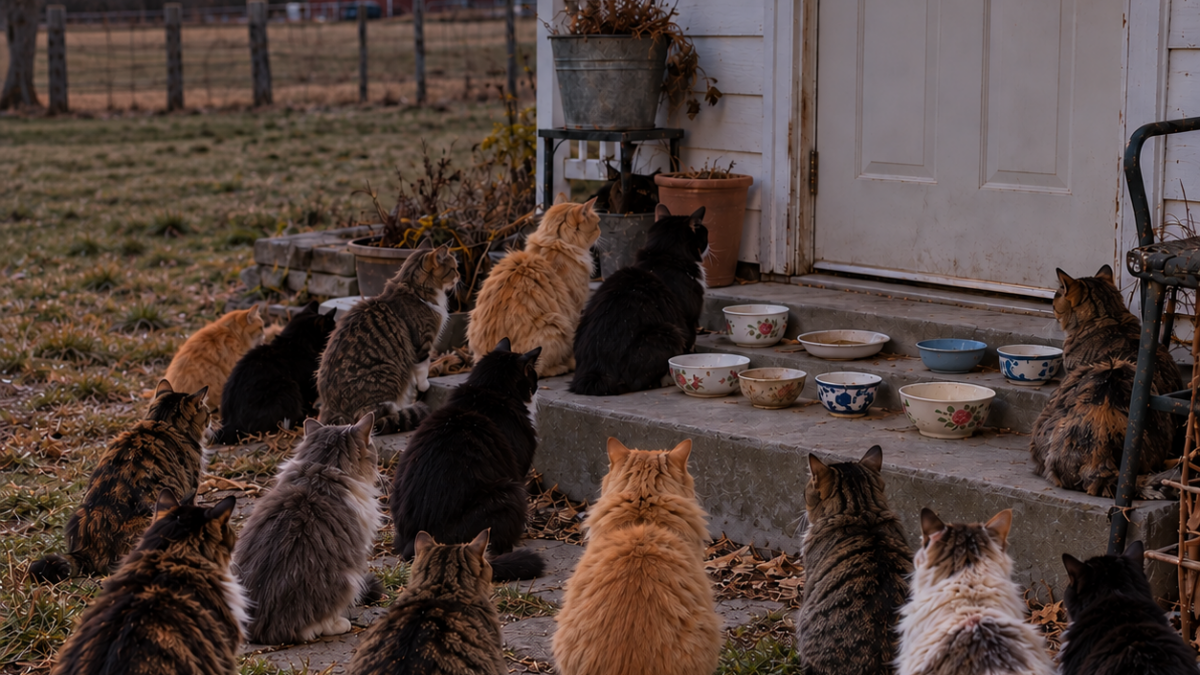
Seventeen cats were sitting on the porch and in the yard below it.
They were not swarming.
They were not fighting.
They were not crying.
They were perfectly still.
A semicircle of bodies faced the closed door.
Some sat on the porch boards. Others lined the bottom step. A few waited in the grass beyond, tails wrapped around paws. A black cat with a torn ear sat beside a brown tabby whose eyes were clouded with age. A thin orange cat stood near the railing. A gray-and-white cat crouched under the bench. Several tortoiseshells blended with the shadows.
All of them stared at the door.
Not at Claire.
At the door.
The ceramic bowls at the bottom step were empty and dry.
Claire stood there with one hand on the doorframe, unable to move.
She had seen animals hungry. She had seen dogs panic after owners died, cats hide under beds, horses refuse to leave gates, old farm dogs wait by driveways. But this was different.
This did not look like hunger.
It looked like a vigil.
A gathering.
A silent attendance.
Like they had come not because food was late, but because the rhythm of their world had broken and they did not know where else to place themselves except in front of the door that had always opened.
One of the cats blinked slowly.
A small tortoiseshell female sat closest to the bottom step.
She was thin, rough-coated, with an ear tipped cleanly on the left side. Her face was split in colors—black over one eye, orange over the other, cream beneath her chin. She looked older than some, younger than others. Her body held the careful tension of a feral cat who had survived by trusting almost nothing.
But she did not run.
Claire crouched slowly.
The tortoiseshell watched her.
“Hi,” Claire whispered.
The cat looked past her into the house.
Claire’s chest hurt.
“She’s gone,” she said, though she did not know why she said it to a cat.
The tortoiseshell’s ear twitched.
Behind Claire, sirens sounded faintly in the distance.
The cats did not move.
Claire fed them that morning with shaking hands.
She filled every bowl from the bucket, then stepped back inside and closed the door because that was how Eleanor had always done it.
Only then did the cats approach.
They ate quietly.
No fighting.
No chaos.
As if even hunger had manners at a funeral.
When the paramedics arrived, the cats scattered to the edges of the yard, but not far. When the sheriff’s deputy came, the orange one vanished under the shed. When the funeral home van pulled into the driveway, the tortoiseshell stayed under the lilac bush and watched every movement.
Claire stood on the back porch while Eleanor’s body was carried out through the front door.
It seemed wrong that the cats could not understand.
It seemed worse that maybe they did.
The deputy asked for next of kin.
Claire gave the only name she knew.
Martin Whitaker.
Eleanor’s nephew.
She had mentioned him rarely and never warmly.
“He lives in Columbus,” Eleanor once said.
“Are you close?” Claire asked.
“No.”
That was the whole conversation.
Now Claire found his number in Eleanor’s address book, written in careful blue ink beside the word nephew and an old Christmas card address.
Martin answered on the fourth ring.
“Yeah?”
“Mr. Whitaker? My name is Claire Bennett. I’m a nurse and a neighbor of your aunt Eleanor.”
A pause.
“What happened?”
Claire closed her eyes.
“I’m sorry. She passed away at home. It appears peaceful. Likely in her sleep. I’m very sorry.”
Silence.
Then a sigh.
“Damn.”
Claire waited.
“She leave any paperwork?” he asked.
The question struck her like a slap.
“Paperwork?”
“Will, house stuff, bank accounts. I haven’t talked to her much. My mom’s gone, so I guess I’m the closest family.”
Claire looked through the kitchen window toward the backyard, where the cats had returned to the porch after the vehicles left.
“She just died,” Claire said carefully.
“Yeah, I get that. I’m asking practical questions.”
Practical.
Claire had come to hate that word from people who used it to step over tenderness.
“I don’t know,” she said. “You’ll need to contact the county and perhaps her attorney if she had one.”
“Fine. I’ll drive down tomorrow.”
“There are also animals on the property.”
Another pause.
“What animals?”
“Feral cats she cared for. Seventeen were here this morning.”
“Seventeen?”
His voice sharpened.
“They’ll need continued feeding until arrangements can be made with a rescue.”
“I’m not paying for a bunch of stray cats.”
“No one asked you to pay today.”
“Listen, I don’t want them damaging the property. If the house is mine, they need to be gone.”
Claire looked down at Eleanor’s bucket.
“Your aunt fed them every night for twenty-two years.”
“Well,” Martin said, “apparently that problem ends now.”
Claire hung up before she said something that would have made Eleanor proud but complicated everything else.
The next days became a blur of arrangements, discoveries, and small betrayals.
Martin arrived Friday afternoon in a silver SUV that looked too clean for Miller Road. He was in his late fifties, broad through the middle, with a trimmed beard, expensive sunglasses, and the brisk manner of a man who believed volume could replace authority. His wife, Dana, came with him. She wore perfume too strong for Eleanor’s quiet house and walked through the rooms like she was assessing hotel damage.
“This place is smaller than I remember,” Martin said, standing in the living room.
Claire had stayed because somebody needed to speak for Eleanor until legal matters were clear.
“It suited her,” Claire said.
Martin glanced at her. “You were what, her nurse?”
“And her friend.”
He gave a polite smile that did not honor the word. “Right.”
Dana picked up a framed photograph from the mantel. It showed Eleanor and Henry at a county fair decades earlier. Henry wore a plaid shirt and held a ribbon beside a prize pumpkin. Eleanor was laughing, head tilted back, younger than Claire had ever known her.
“Do we need to keep this?” Dana asked.
Martin shrugged. “Box it for now.”
Claire’s jaw tightened.
“They were married forty-six years,” she said.
Dana blinked. “I didn’t say throw it away.”
“No,” Claire said. “You just held it like clutter.”
Martin turned. “Look, Miss—”
“Bennett.”
“Miss Bennett, I appreciate whatever you did for my aunt, but this is a family matter.”
Claire looked around the room.
The afghan Eleanor crocheted.
The lemon drops in the dish.
The slippers beside the chair.
The grocery list on the counter.
The back door that had opened every night.
“Family is a word,” Claire said. “Showing up is the proof.”
Martin’s face reddened.
Before he could answer, a cat meowed outside.
Everyone froze.
It was the first loud meow Claire had heard from the colony.
Martin strode to the back door and yanked the curtain aside.
Several cats scattered from the porch.
“Jesus,” he snapped. “They’re everywhere.”
“They’re hungry,” Claire said.
“They’re pests.”
“They’re living animals.”
“They’re property damage waiting to happen.” He turned on her. “I’m calling animal control.”
“Good. Ask for Denise Bailey.”
Martin narrowed his eyes. “You already called them?”
“I called a rescue too.”
“On whose authority?”
Claire stepped closer.
“On the authority of having a conscience.”
Dana made a small offended sound.
Martin pointed toward the door. “Those cats are not my problem.”
“No,” Claire said. “They were Eleanor’s promise. And for now, because she is gone and you are here, they are your responsibility whether you like it or not.”
Martin laughed once, harshly. “You people are unbelievable. She wasted money feeding wild cats for twenty years and now you want me to continue the insanity?”
Claire felt her grief sharpen into anger.
“Do not call her kindness insanity in her house.”
“It’s my house now.”
“No,” Claire said. “It was hers this morning. And until the law says otherwise, you might try acting like a guest.”
For a moment, neither moved.
Then Martin smiled.
It was not a pleasant smile.
“Careful,” he said. “I don’t know what kind of hold you had over my aunt, but if money is missing—”
Claire stared at him.
Dana looked away.
There it was.
The accusation.
Not direct enough to be challenged cleanly, but ugly enough to stain the air.
“What did you say?”
“I said I’m going to review everything. Old ladies get lonely. People take advantage.”
Claire’s hands curled into fists at her sides.
Eleanor had been dead two days, and already the world was trying to rewrite her.
Crazy.
Lonely.
Taken advantage of.
Wasteful.
A problem.
Claire understood then what Eleanor had meant about explanations becoming weapons.
She turned to the kitchen counter, picked up Eleanor’s cat feeding folder, and tucked it beneath her arm.
Martin stepped forward. “What’s that?”
“Records.”
“Those belong with the house.”
“These are copies of public rescue and veterinary documents related to living animals currently on the property.”
“You can’t take her things.”
Claire looked him dead in the eye.
“Call the sheriff.”
He did not.
That evening, at six o’clock, Claire returned to Eleanor’s back porch.
Martin’s SUV was gone. He and Dana had driven to a hotel after declaring the house “musty” and “not secure.” Claire suspected they did not want to sleep in a dead woman’s home.
She brought two bags of food from the feed store and filled the bowls.
At first, no cats came.
The porch was too quiet.
Claire stood inside the back door, just as Eleanor had, and waited.
Slowly, the shadows moved.
One by one, they emerged.
The black cat with the torn ear.
The old brown tabby.
The orange.
The gray-and-white.
And finally, the small tortoiseshell female with the tipped left ear.
She came from the trees, crossed the yard, and stopped at the bottom step.
Claire watched her through the glass.
The cat lifted her face toward the door.
For one second, Claire felt like an intruder standing in someone else’s sacred place.
“I’m sorry,” she whispered.
Then she stepped back.
The tortoiseshell approached the bowl.
Over the next two weeks, Claire’s life rearranged itself around six o’clock.
She worked her nursing route during the day, argued with pharmacies, changed bandages, documented blood pressures, and smiled at patients who asked whether she had eaten lunch. Then, no matter how tired she was, she drove to Eleanor’s house before evening and fed the cats.
Some neighbors noticed.
Mrs. Donnelly, who had lived across the road for thirty years and knew every family tragedy within five miles, brought Claire a thermos of coffee one evening.
“I wondered who’d do it,” she said.
Claire poured kibble into the bowls. “I guess I am.”
“Eleanor would’ve liked that.”
Claire looked at her. “Did you know about all of them?”
Mrs. Donnelly nodded toward the yard. “Enough.”
“Why didn’t anyone help her?”
The question came out sharper than Claire intended.
Mrs. Donnelly did not flinch.
“Some of us did, in small ways. I took her to the feed store after she stopped driving, before she started delivery. My grandson fixed her porch light. Denise helped with the trapping. But Eleanor didn’t like people standing too close to what mattered to her.”
Claire looked through the window at the bowls.
“She was lonely.”
“Yes,” Mrs. Donnelly said. “But not helpless.”
That mattered.
Claire held onto it.
The rescue organization Eleanor had used was called Open Fields Cat Network. It was small, underfunded, and run by a woman named Marla Jensen, who had the energy of three people and the sleep schedule of a haunted raccoon. Marla arrived with traps, vaccine records, and a binder that shocked even Claire.
Inside were fifteen years of handwritten notes.
Dates.
Descriptions.
Trap locations.
Surgeries.
Medical treatments.
Food purchases.
Every dollar Eleanor had paid in cash, recorded by Marla because Eleanor insisted on proper receipts even for secret kindness.
“She never wanted attention,” Marla said, sitting at Eleanor’s kitchen table with Claire, Denise from animal control, and Mrs. Donnelly. “She’d meet me behind the house twice a year. Always had coffee in a thermos and exact cash in an envelope. Said if she wrote checks, someone might ask questions.”
Denise flipped through the binder. “Most of this colony is fixed.”
“Because of her,” Marla said. “People complain about cats multiplying, but they don’t support the one old woman preventing it.”
Claire touched one page.
A line read: Tortie female, likely descendant of original Patch. Trapped, spayed, vaccinated. Returned due to feral temperament. Left ear tipped. Approx. age 3 at surgery.
Date: eight years earlier.
“That’s the small tortoiseshell,” Claire said.
Marla leaned over. “The one still coming closest?”
“Yes.”
“Eleanor called her Little Patch.”
Claire looked up. “She said she didn’t name them.”
Marla smiled sadly. “She lied.”
Something in Claire’s chest warmed and broke at once.
Little Patch.
Of course Eleanor had named her.
Of course she had pretended not to.
The plan was humane and practical.
Trap the cats.
Assess them.
Relocate those suited for barn homes.
Adopt out the few sociable enough to live indoors.
Return only the elderly feral cats who would not survive relocation, with neighbor support if possible.
It would take time.
It would take patience.
It would take cooperation from the property owner.
That was where everything went wrong.
Martin Whitaker discovered that Eleanor’s house, though modest, sat on twelve acres at the edge of a county road scheduled for future widening. A developer had already approached him within a week of the obituary posting. Suddenly, the little white house he had called musty became valuable.
The cats became an obstacle.
He arrived one evening while Marla and Claire were setting traps near the shed.
“What the hell are these cages doing on my property?” he demanded.
Marla stood slowly. She was small, gray-haired, and had handled enough feral cats to be unimpressed by angry men.
“These are humane traps.”
“I didn’t authorize traps.”
Claire straightened. “We discussed this.”
“No,” Martin said. “You told me what you wanted. I didn’t agree.”
Denise, who was there in uniform, stepped forward. “Mr. Whitaker, as the current estate representative, you are required to address the animals humanely. Abandonment or harm could expose you to violations.”
“Then take them.”
“We’re trying,” Denise said. “That’s what the traps are for.”
“I want them gone tonight.”
“That’s not how feral colony management works,” Marla said.
Martin pointed at her. “I don’t care how cat ladies manage anything. I’ve got a buyer coming next week.”
Claire felt the insult land, but Marla only smiled.
“Sir, I’ve been called worse by tomcats with abscesses.”
“This is trespassing.”
“You allowed us yesterday,” Claire said.
“I changed my mind.”
Denise’s voice hardened. “Interfering with humane capture after creating a dependency issue may complicate your position.”
Martin laughed. “Dependency? They’re wild animals. My aunt fed them because she had nothing better to do.”
Claire stepped toward him before she could stop herself.
“Don’t.”
He looked at her. “Don’t what?”
“Don’t reduce twenty-two years of compassion to boredom because you can’t understand devotion.”
For a second, something flickered in his face.
Not guilt.
Something more defensive.
Then it vanished.
“You’ve got one hour,” he said. “Then I’m removing anything left on this porch, including bowls, traps, and whatever else she used to attract them.”
“You remove active traps and you may injure an animal,” Denise warned.
“I said one hour.”
He walked away.
That night, they trapped four cats.
A black male.
A young tabby.
A gray female with an old scar along her side.
And an orange cat who screamed so dramatically from under the trap cover that Marla named him Opera.
Little Patch did not go near the traps.
She sat under the lilac bush and watched.
The next evening, when Claire arrived at five fifty, the bowls were gone.
All of them.
The blue flowers.
The chipped rim.
The orange Thanksgiving dish.
The cracked white dish.
The entire mismatched row Eleanor had used for twenty-two years had vanished from the porch.
Claire stood at the bottom step, staring at the empty space.
It felt like walking into a church and finding the altar ripped out.
Mrs. Donnelly came from across the road, moving as fast as her knees allowed.
“He took them,” she said breathlessly.
Claire turned. “Martin?”
“This afternoon. Threw them in the back of his SUV. I hollered at him, but he said they were trash.”
Claire closed her eyes.
Trash.
Always that word.
For living creatures.
For old women’s rituals.
For anything inconvenient to people who preferred clean surfaces over moral responsibility.
Claire set down the bag of food she had brought and went to her car. She found two shallow baking pans, a plastic container lid, and the water dish she kept for emergencies. It was not enough, but it would do.
She placed them exactly where Eleanor’s bowls had been.
At six o’clock, she filled them.
The cats came slowly, confused by the changed shapes, disturbed by the missing ritual.
Little Patch stopped at the bottom step.
She stared at the pans.
Then at the door.
Then at Claire.
“I know,” Claire whispered. “I’m sorry.”
Little Patch did not eat.
She sat facing the door for ten minutes, then turned and disappeared into the trees.
That night, Claire drove to Martin’s hotel.
She found his SUV in the parking lot.
Through the rear window, she could see a box.
Inside it, stacked carelessly, were Eleanor’s bowls.
Claire stood in the cold parking lot with her fists clenched.
For one reckless moment, she considered breaking the window.
Instead, she took photographs.
Then she called Denise.
Then she called Marla.
Then she called the only attorney she knew, a retired patient named Frank Adler who had once told her that if she ever needed legal advice, she should call before doing something “morally satisfying but legally expensive.”
Frank answered on the second ring.
“Claire? You okay?”
“No.”
“That sounds honest.”
She explained everything.
Frank listened.
Then he said, “Did Eleanor have a will?”
“I don’t know.”
“Find out.”
“How?”
“Old people with secrets usually have paperwork. Check with local attorneys. Check her safe if there is one. Check her Bible.”
“Her Bible?”
“I practiced law forty years in a farming county. Half the important documents I saw were in Bibles, cookie tins, or freezer bags.”
Claire almost laughed.
“Frank, Martin is going to sell the property.”
“Maybe. Maybe not.”
“What does that mean?”
“It means widows who quietly pay cash for cat surgeries for fifteen years may also quietly plan for what happens when they die.”
Claire looked toward the hotel window.
“You think she made arrangements?”
“I think a woman who never missed a six o’clock feeding in twenty-two years understood continuity.”
The next morning, Claire searched the house with permission from Denise and the county estate clerk, who had begun to dislike Martin after he called her three times before noon demanding “fast paperwork.”
Claire did not snoop.
She moved respectfully, touching as little as possible.
Desk drawers.
A file cabinet.
The tin box above the refrigerator.
Nothing.
Then she went to Eleanor’s bedroom.
The room still smelled faintly like lavender. Claire paused in the doorway, grief rising again. It felt wrong to search through the belongings of someone who had trusted her.
“I’m sorry,” she whispered.
On the nightstand was Eleanor’s Bible, its leather cover worn soft.
Claire opened it carefully.
Inside were pressed flowers, a funeral card for Henry, and a photograph of two young people in wedding clothes standing in sunlight.
No will.
She checked between pages.
Nothing.
Then, as she closed it, a small key slipped from the back cover and fell onto the quilt.
Claire stared.
The key was brass, taped once to the inside of the cover but loosened with age.
It had a tiny label.
CEDAR CHEST.
The cedar chest sat at the foot of Eleanor’s bed beneath a folded quilt.
Claire unlocked it.
Inside were blankets, letters tied with ribbon, Henry’s military discharge papers, a small velvet box containing his wedding ring, and at the bottom, a sealed manila envelope.
On the envelope, in Eleanor’s careful handwriting, were the words:
For after I’m gone, if anyone cares enough to look.
Claire sat back on her heels.
For a long moment, she could not open it.
Then she did.
Inside was a will.
A signed, notarized will dated three years earlier.
There was also a handwritten letter.
Claire read the first line and had to stop.
If you are reading this, then I have missed a feeding.
She covered her mouth.
The will was simple but devastating to Martin’s plans.
Eleanor left the house and twelve acres not to her nephew, but to Open Fields Cat Network, with instructions that the property be used as a managed barn-cat sanctuary, senior cat refuge, or sold only if the proceeds supported long-term feral cat care in Brookhaven County. Martin was left ten thousand dollars and Henry’s pocket watch, “if he wants either.”
The letter explained why.
I do not do this to punish Martin. I do not know him well enough to punish him. I leave him money because he is blood. But blood is not the same as stewardship. This land fed me, sheltered me, and gave me a place to keep a promise I made when grief nearly swallowed me. If any cats remain after my death, please do not let them be treated as a nuisance. They were my evening congregation. I did not own them. I simply kept the door opening.
Claire cried so hard she had to put the letter down.
When she called Marla, she could barely speak.
By noon, everything changed.
Martin’s claim to the house collapsed under the will.
His attorney advised him to stop removing property immediately.
The bowls, after several tense phone calls, were returned in a cardboard box and placed back on the porch by Denise herself.
Martin did not apologize.
Men like Martin often viewed being wrong as something that happened to them, not because of them.
But he could not sell the house.
He could not throw away the bowls.
He could not erase Eleanor.
The local paper covered the story first.
Widow Leaves Home To Cat Rescue After Secretly Caring For Feral Colony For 22 Years.
Then the state paper picked it up.
Then a reporter from a regional television station came to Miller Road and filmed the back porch at sunset, the row of mismatched bowls, and Claire standing beside Marla while the cats emerged from the trees.
Claire hated being on camera, but she did it for Eleanor.
The reporter asked, “Why do you think she kept this secret?”
Claire looked toward the porch.
“Because she knew some people only respect kindness after it becomes a headline,” she said.
That quote spread.
So did Eleanor’s letter.
Not the whole thing.
Just parts Marla and Claire agreed to release.
I simply kept the door opening.
People donated.
At first, small amounts.
Five dollars.
Twenty-two dollars in honor of twenty-two years.
Six dollars with a note: For the six o’clock cats.
Then larger donations came. A local contractor offered to repair the barn behind the property. A feed store donated food. A fencing company volunteered materials for safe acclimation enclosures. A retired veterinarian offered monthly wellness visits. Teenagers from the high school agriculture program came on Saturdays to clear brush.
Open Fields Cat Network, which had operated for years out of Marla’s garage and the backs of volunteers’ cars, suddenly had land, attention, and more responsibility than it knew how to carry.
The little white house became Whitaker House.
The back porch stayed exactly as it was.
The sanctuary did not become fancy.
Eleanor would have hated fancy.
It became practical.
Outdoor shelters were built along the tree line. Feeding stations were added. A heated shed was converted for senior ferals who needed monitoring. The old garden shed where Smoke and Patch first appeared was repaired but not replaced. Marla said some things earned the right to stay weathered.
Fourteen of the seventeen cats were eventually trapped.
Most were already fixed, just as Eleanor’s records had shown.
Eleven were relocated to barn homes after proper acclimation, placed with families who understood that working cats were not decorations but living beings deserving food, shelter, and veterinary care.
Three were social enough for adoption.
One of them, a black-and-white cat missing half a tail, shocked everyone by turning into a lap cat the moment he was brought indoors. Mrs. Donnelly adopted him and named him Bishop because he sat in judgment on her kitchen table.
Three cats remained too old, too wild, or too bonded to the land to relocate safely.
An old brown tabby.
A scarred gray male.
And Little Patch.
The brown tabby lasted only until late summer.
He began sleeping more, eating less, moving slowly beneath the lilac bush. Marla trapped him when she could and took him to the vet. Kidney failure. Advanced. No cure.
Claire went with her.
She held the edge of the towel while the vet gave the injection. The old tabby did not know her. He did not want her touch. But she stayed anyway, because Eleanor would have wanted someone there.
When it was over, Marla said, “He had a better life because of her.”
Claire nodded through tears.
The gray male vanished during the first frost.
They searched for him for a week.
No one found him.
Marla said sometimes old ferals choose their own endings. Claire hated that answer because it was probably true.
That left Little Patch.
She would not enter traps.
She would not use the new shelters if anyone was watching.
She would not approach volunteers.
But every evening, just before six, she came out of the trees.
She crossed the yard.
She stepped onto the back porch.
And she sat facing the door.
At first, Claire thought she came for food.
But after the feeding stations moved farther from the porch, Little Patch still came to the door first. Even when food was already available near the shed, she kept the appointment.
Five fifty-seven.
Five fifty-eight.
Six o’clock.
She sat for ten minutes.
Sometimes twenty.
Then she left.
The first time the new volunteers saw it, they whispered and took pictures.
Marla told them to put their phones away.
“That’s not content,” she said. “That’s grief.”
Claire watched from the kitchen window, just as Eleanor must have watched so many times.
Little Patch sat in the last light of evening, thin body still, tipped ear angled toward the closed door.
It was almost unbearable.
Not because the cat looked desperate.
She did not.
She looked patient.
As if she had learned that love came through that door at six o’clock, and the disappearance of love did not immediately cancel the habit of faith.
Weeks became months.
The sanctuary took shape.
Eleanor’s story became known across the county. People who had once called her strange now spoke of her with reverence. Some exaggerated their closeness. Some claimed they had always admired her. Some who had mocked her cats quietly sent donations without names.
Brad Colson never donated.
But one cold evening in November, Claire saw his truck slow near the driveway.
He did not pull in.
He sat for a moment, looking toward the back of the property.
Then he drove away.
The next morning, Marla found two forty-pound bags of cat food stacked near the barn.
No note.
Claire suspected.
She did not tell anyone.
Some apologies come too small and too late, but if they feed the hungry, they still count for something.
Martin Whitaker challenged the will.
Of course he did.
He claimed Eleanor had been manipulated.
He claimed Claire had influenced her.
He claimed Marla had taken advantage of a lonely old woman.
In court, those accusations died under the weight of dates.
The will had been drafted before Claire became Eleanor’s nurse. The attorney who prepared it testified that Eleanor was “sharp, specific, and more organized than most clients half her age.” Bank records showed consistent payments to the rescue long before anyone had reason to expect property. Marla’s receipts matched Eleanor’s handwritten notes.
Then Frank Adler, the retired attorney Claire had called, found something else in Eleanor’s files.
A journal.
Not a diary full of feelings.
Eleanor was too private for that.
It was a ledger of evenings.
Weather.
Cat counts.
Food used.
Medical notes.
And sometimes, rarely, sentences.
April 16. Seven cats. Rain. Patch’s granddaughter came close. Henry would have liked her nerve.
June 2. Brad complained again. I suppose hunger offends him more when it has fur.
October 9. Paid for four surgeries. Worth every dollar. No one asks what loneliness costs, but they have opinions about cat food.
December 24. Snow. Eleven cats came. Sang “Silent Night” after feeding. Felt foolish. Did it anyway.
March 3. Claire brought marmalade. She thinks I don’t know she worries. Good heart. Tired eyes.
The judge read the documents privately.
Martin’s challenge failed.
The will stood.
Outside the courthouse, Martin confronted Claire.
“You happy?” he snapped.
Claire was exhausted.
The hearing had taken hours. Marla was crying from relief. Frank stood nearby with his cane, pretending not to listen while absolutely listening.
“No,” Claire said. “I’m not happy. Your aunt is still dead.”
Martin looked away.
“You people act like she was some saint,” he muttered.
Claire studied him.
For the first time, she saw not only greed but injury. Martin had known Eleanor as a distant aunt who sent birthday cards with ten-dollar bills until he was eighteen. He had not known the woman who fed cats in the rain, who kept careful records, who wrote lonely sentences in a ledger.
He had inherited blood but not intimacy.
Maybe that hurt.
Maybe he covered hurt with contempt because contempt felt stronger.
“She wasn’t a saint,” Claire said. “She was stubborn. Private. Judgmental about instant coffee. She lied about naming the cats. She could make you feel like a fool with one look.”
Frank snorted softly.
Claire continued. “But she showed up. Every night. That means something.”
Martin’s face shifted.
For once, he had no answer.
He left without another word.
In December, the sanctuary held its first open house.
Not a festive open house exactly, because feral cats do not appreciate crowds, carols, or children shrieking near feeding stations. But Marla organized a quiet afternoon with tours, donation bins, hot cider, and a small table displaying Eleanor’s ledger, photographs, and one of the ceramic bowls.
The blue flowered one.
Claire stood near the porch most of the day, answering questions.
Yes, Eleanor fed them for twenty-two years.
No, she did not let them inside.
Yes, most were fixed.
Yes, the tipped ear meant they had been spayed or neutered.
No, feral cats were not the same as social pets.
Yes, barn homes needed to feed and care for them.
No, you could not just “drop off” a cat here.
The last question came too often.
Kindness, Claire learned, required boundaries as much as softness.
At 5:45, Marla gently moved visitors away from the back porch.
“Something happens at six,” she explained quietly. “We don’t crowd her.”
Only a small group remained inside the kitchen: Claire, Marla, Mrs. Donnelly, Denise, Frank, and a local reporter named Amelia Grant who had followed the legal case with unusual care.
Amelia had asked permission to observe but promised not to photograph unless Claire agreed.
At 5:56, Little Patch appeared at the edge of the trees.
The kitchen fell silent.
The cat moved slowly across the yard.
Winter had thinned her coat, but she looked stronger than she had in spring. She had learned to eat from the new feeding station. She used the shelter behind the shed during storms. She tolerated Marla’s presence at a distance of fifteen feet, which Marla considered a deep personal relationship.
Little Patch reached the porch steps.
She climbed them.
She sat facing the back door.
Six o’clock.
No one moved.
For ten minutes, the small tortoiseshell held her place.
Her breath made faint clouds in the cold.
The porch light glowed above her, the same warm yellow that had fallen over Eleanor’s hands for years.
Claire felt tears slide down her face.
Mrs. Donnelly pressed a tissue into her hand without looking away.
Amelia whispered, “She still thinks Eleanor is coming?”
Claire shook her head slowly.
“I don’t know,” she said. “Maybe she knows she isn’t. Maybe the waiting is the only way she has to remember.”
Frank, who had been quiet, murmured, “Ritual is memory with a clock.”
No one answered.
After seventeen minutes, Little Patch stood, stretched, and stepped down into the yard.
Before she left, she turned back once toward the door.
Then she disappeared into the trees.
The article Amelia wrote was not sensational.
That was why Claire liked it.
The headline read:
The Cat Who Still Keeps The 6 O’Clock Appointment.
The story focused not on shock but devotion. Eleanor’s twenty-two years of consistency. The hidden records. The colony. The will. The porch. Little Patch’s nightly return.
People responded in a way Claire did not expect.
They sent letters.
Not just donations.
Letters.
A widower in Kansas wrote that he still set two coffee cups on the table every morning though his wife had been gone three years.
A mother in Oregon wrote that her autistic son watched the same window every afternoon for a school bus driver who had retired, because kindness had a schedule and he trusted schedules.
A retired mail carrier wrote that he had fed a dog on his route for twelve years and cried when the dog stopped coming.
A nurse from Ohio wrote, I think we all have a door we keep facing after it stops opening.
Claire taped that one inside the pantry.
Winter settled over Miller Road.
Snow came in soft layers. The fields went white. The sanctuary volunteers rotated shifts, checking heated water bowls, clearing paths, refilling shelters with straw.
Little Patch still came at six.
Even in snow.
Even in bitter wind.
Sometimes she stayed only five minutes before retreating to shelter.
Sometimes she sat long enough for snow to dust her back.
Claire worried constantly.
“She’s fourteen,” Marla reminded her gently. “Maybe older. Feral. Tough. We support her, but we can’t make her be safe in the way we want.”
“I hate that.”
“I know.”
“She sits there like she’s waiting for a ghost.”
“Maybe she is.”
One evening in January, Claire arrived late.
A patient had fallen. Then traffic backed up behind a tractor-trailer accident. By the time she reached Whitaker House, it was 6:23.
She rushed through the back door, heart pounding with guilt that made no logical sense.
Little Patch was on the porch.
Still facing the door.
Claire froze.
The cat turned her head.
Their eyes met through the glass.
For months, Claire had been careful to keep distance. Feral cats did not want human emotion poured over them like syrup. Eleanor had understood that. Respect meant not forcing closeness.
But that night, guilt overrode caution.
Claire opened the door slowly.
Little Patch tensed but did not bolt.
“I’m sorry,” Claire whispered.
The cat’s eyes widened.
Claire crouched inside the doorway, keeping the storm door between them.
“I’m sorry I was late.”
Little Patch stared at her.
“I know I’m not her.”
The words broke something loose.
Claire had not realized until she said them how deeply she had been carrying that truth.
She was not Eleanor.
She was not the woman who had kept the promise for twenty-two years. She was not the one the cats trusted, not the one Henry loved, not the one who had turned grief into ritual and ritual into shelter. She was only the woman who arrived after the door stopped opening, trying to keep pieces from scattering.
“I’m trying,” Claire said, voice shaking. “But I’m not her.”
Little Patch looked past her into the warm kitchen.
For a long moment, nothing happened.
Then the cat blinked.
Slowly.
Once.
It was the kind of blink cats give when they are not afraid.
Then she stood, stepped down from the porch, and walked toward the feeding station.
Claire sat on the kitchen floor and cried until her knees hurt.
In spring, on the anniversary of Eleanor’s death, the sanctuary placed a bench under the maple tree near the back porch.
The plaque read:
In memory of Eleanor Whitaker, who kept the door opening.
At the dedication, Claire read from Eleanor’s letter.
Not all of it.
Just enough.
This land fed me, sheltered me, and gave me a place to keep a promise I made when grief nearly swallowed me.
Her voice caught there.
She continued.
If any cats remain after my death, please do not let them be treated as a nuisance. They were my evening congregation. I did not own them. I simply kept the door opening.
People stood quietly in the yard.
Even Brad Colson came, standing at the back with his cap in his hands.
Afterward, he approached Claire.
“I said things to her I shouldn’t have,” he said.
Claire waited.
Brad swallowed. “About the cats. About her.”
“She knew.”
His face tightened.
“I figured.”
Claire could have comforted him.
She chose truth instead.
“She also knew you were more than the worst thing you said.”
Brad looked toward the porch.
“How do you know that?”
“She accepted the cat food you left.”
He blinked.
Then looked away.
“I didn’t sign my name.”
“No,” Claire said. “But you bought the expensive kind she used.”
For the first time, Brad smiled sadly.
“She always did say cheap feed was false economy.”
“Yes,” Claire said. “She did.”
He nodded once and walked away.
Little Patch did not appear during the dedication.
Too many people.
Too much noise.
But at 5:58, after most cars had gone and the yard had settled into evening, she emerged from the trees.
Claire was sitting on Eleanor’s bench.
She did not move.
Little Patch crossed the yard, climbed the porch, and faced the door.
The old bowls were no longer used for daily feeding, to avoid drawing raccoons and wildlife too close to the house, but one bowl remained on the porch each evening, empty and clean.
The blue flowered one.
A symbol.
A place marker.
A promise translated into ceramic.
Little Patch sat beside it.
Six o’clock.
The porch light came on automatically.
Claire had set the timer that way.
Warm yellow light spread across the boards.
For a second, with the evening soft and the maple leaves just beginning to open, Claire could almost imagine Eleanor standing in the doorway, scoop in hand, saying nothing because love did not always need language.
Little Patch stayed fifteen minutes.
Then she walked down the steps and, instead of going straight to the trees, paused near the bench.
Claire held her breath.
The cat stood eight feet away.
Then six.
Then five.
She sniffed the air.
Claire did not reach.
Every instinct in her wanted to offer a hand, to touch, to complete something that maybe did not need completion. But Eleanor’s lesson held her still.
Love is not possession.
Love is showing up in the form the other life can bear.
Little Patch sat in the grass.
Not beside Claire.
Not on her lap.
Just near.
For ten full minutes, they watched the porch together.
After that, the cat left.
And Claire understood something then that she had been too grief-struck to see.
Little Patch was not waiting for Eleanor to return.
Not exactly.
She was honoring the place where Eleanor had never failed her.
There is a difference.
One is denial.
The other is memory.
Years would pass.
Whitaker House would become known far beyond Miller Road. Not famous in a shiny way, but beloved in the quiet network of rescuers, farmers, widows, nurses, teachers, and lonely people who understood that small acts repeated faithfully could become a kind of architecture.
The sanctuary would save hundreds of cats.
Some would become barn cats.
Some would become house cats.
Some would live out rough old lives in warm shelters, fed and watched but never touched.
Children would come on volunteer days and learn that kindness was not the same as cuddling, that wild things deserved respect, that not every rescue ended with an animal in your arms, and that sometimes love meant filling a bowl and stepping away.
Claire would eventually leave home health nursing and become the sanctuary’s director after Marla retired. She would still keep a nurse’s bag in her car because old habits and emergencies never fully retire.
Martin would send one check, years later, after his wife died suddenly from a stroke. It came with no letter. Just a donation in Eleanor’s name. Claire deposited it without comment and wrote him a receipt.
Brad would become one of the winter volunteers, though he claimed he only came because “somebody has to shovel properly.”
Mrs. Donnelly would outlive everyone’s expectations and continue giving sanctuary tours with wildly embellished stories until Marla banned her from saying a cat had “served in Korea.”
The blue flowered bowl would remain on the porch.
The timer would keep the light coming on at six.
And Little Patch would keep the appointment longer than anyone thought possible.
She grew thinner.
Her steps slowed.
Her coat roughened.
Some evenings, she arrived at 5:59 and stayed only a few minutes. Other evenings, she appeared early and rested beneath the bench before climbing the steps.
During her final winter, she allowed Claire to sit on the porch while she kept her vigil.
Not close.
But closer.
Three feet between them.
Then two.
Then one snowy evening in February, Little Patch came up the steps, looked at the door, looked at Claire, and sat beside her boot.
Claire did not move.
She barely breathed.
The cat’s shoulder touched the rubber edge of Claire’s shoe.
Nothing more.
It lasted maybe thirty seconds.
Then Little Patch moved away.
But Claire cried afterward as if she had been given a medal.
In late March, almost exactly three years after Eleanor’s death, Little Patch did not come at six.
Claire waited.
The porch light glowed.
The blue bowl sat clean and empty.
The yard darkened.
No tortoiseshell emerged from the trees.
Marla came over at seven.
They searched with flashlights, quietly, carefully, calling nothing because Little Patch had never answered to human voices. They checked shelters, the shed, the tree line, the old lilac bush.
They found her the next morning behind the garden shed.
The same place where Smoke and Patch had first appeared twenty-five years earlier.
Little Patch lay curled in straw inside a shelter she had rarely used when anyone watched. She looked asleep. Her body was cold, but peaceful. No signs of struggle. No fear.
Claire knelt in the damp grass.
For a moment, she was back in Eleanor’s bedroom, standing in the doorway, seeing stillness and understanding loss before accepting it.
Marla put a hand on her shoulder.
“She chose home,” Marla whispered.
Claire nodded, crying silently.
They buried Little Patch beneath the maple tree near Eleanor’s bench.
Not because feral cats usually got ceremonies.
Because this one had kept a promise longer than most people knew how.
Claire placed the blue flowered bowl beside the small grave for one evening only.
At six o’clock, the porch light came on.
For the first time in twenty-five years, no cat sat facing the door.
The absence was enormous.
But it was not empty.
Not really.
Because some appointments do end.
Some doors do stop opening.
Some faithful creatures finally lay down the burden of waiting.
And what remains is not the waiting itself, but what the waiting proved.
That love can become a place.
That kindness can outlive the hands that offered it.
That a quiet woman in a small white house can change the fate of more lives than anyone bothered to count.
Years later, when visitors came to Whitaker House and asked why the porch light turned on at exactly six, Claire would tell them Eleanor’s story.
She would tell them about the widow who began with two hungry cats behind a shed.
About the twenty-two years of food bought quietly, surgeries paid in cash, records kept in careful handwriting.
About the night the door did not open.
About the seventeen cats sitting in silence around the porch, not crying, not fighting, just facing the place where kindness had always appeared.
And then Claire would lead them to the maple tree.
There, beneath the bench, a small plaque had been added under Eleanor’s.
It read:
For Little Patch, who kept the appointment.
People always grew quiet when they read it.
Some understood because they had lost someone.
Some understood because they had waited at a door that never opened again.
Some understood because, deep down, everyone wants to believe that being faithful in small things matters.
Claire believed it did.
Eleanor had believed it too.
And every evening, when the porch light warmed the empty boards and the blue flowered bowl sat in its place by the door, the whole sanctuary seemed to breathe around that belief.
The woman was gone.
The original bowls were mostly retired.
The cats she fed had scattered, aged, healed, vanished, or found safer places.
But the promise had not ended.
It had simply changed hands.
And somewhere in the hush of six o’clock, with the fields dimming and the woods dark beyond the yard, it still felt as if Eleanor Whitaker had only just stepped inside after filling the bowls, leaving behind enough quiet love to feed the world a little longer.

