A 7-Year-Old Boy Was Found Sitting Beside His Father’s Grave at 2:17 A.M.—Then One Biker Learned Why He Had Been Coming Back Alone Night After Night.
PART3:
He crossed the road carefully, boots crunching on frozen gravel. At the cemetery fence, he found the side gate unlatched. It groaned when he pushed it open, and the humming stopped again.
“Hello?” he called softly.
No answer.
His breath fogged in the beam of the flashlight.
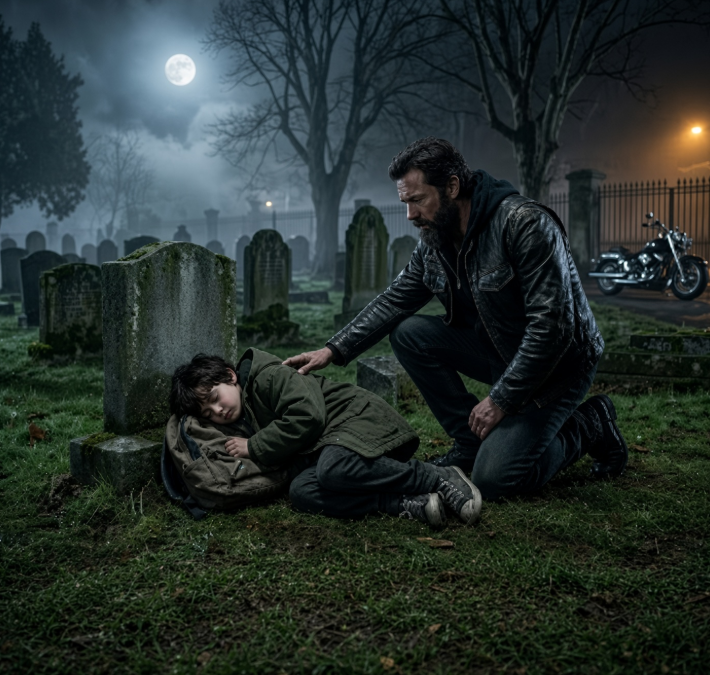
Pine Ridge Cemetery was small, old, and modest. No marble angels. No grand mausoleums. Just rows of headstones, some polished, some weathered, some leaning slightly from decades of frost heave and settling earth. The grass was stiff with cold. A thin moon hung behind clouds.
Mason moved slowly between the graves.
He had seen enough frightened people to know charging in only made fear run faster.
The humming started again, closer now.
He followed it past a granite marker with faded flowers, past a flag planted beside a veteran’s stone, past a young maple tree stripped almost bare by autumn.
Then his flashlight found the boy.
He was small.
No older than seven.
He sat cross-legged beside a modest gravestone, wearing a brown work jacket several sizes too big for him. The cuffs swallowed his hands. A backpack was clutched against his chest like it was the only solid thing left in his world. His cheeks were red from cold, his hair flattened on one side, and his sneakers were damp with frost.
He was not crying.
That was what stopped Mason more than anything.
He was not panicked, not wandering, not calling for help.
He sat beside the grave with solemn patience, as if this was exactly where he was supposed to be.
Mason lowered the flashlight beam so it would not blind him.
“Hey, buddy,” he said gently. “It’s really late. What are you doing out here all by yourself?”
The boy lifted his face.
His eyes were steady and dark and much older than they should have been.
“You knew my dad,” he said.
Mason felt something cold move through him that had nothing to do with the weather.
“I’m sorry, kid. I don’t think we’ve met.”
“My name is Ethan,” the boy said. “Ethan Hayes.”
Mason’s grip tightened around the flashlight.
The name mattered before the boy said anything else.
“My dad was Ryan Hayes,” Ethan continued. “He fixed motorcycles at the shop on Miller Road.”
The cemetery seemed to go quieter.
Mason looked at the headstone beside the boy.
RYAN MICHAEL HAYES
1986–2025
HE NEVER LEFT ANYONE STRANDED
Mason exhaled slowly.
Ryan Hayes.
Of course.
Everyone who rode in Deschutes County knew Ryan Hayes.
Not because he wore a patch. He never had. Not because he rode with one club or another. Ryan belonged to everybody and nobody, the way good mechanics sometimes did. His little shop on Miller Road had been half garage, half emergency shelter for anyone with two wheels and a problem.
Flat tire after midnight.
Frozen fuel line in December.
Blown gasket on the Cascade Lakes Highway.
Battery dead outside a bar at closing time.
Ryan came.
He charged less than he should have and apologized if he took too long. He kept a coffee pot going in his office and a stack of old blankets on a shelf because, as he once told Mason, “A stranded rider lies about how cold he is right up until he can’t talk.”
Mason had met him only a handful of times.
But he owed him.
Most riders did.
Seven years earlier, Mason’s bike had thrown a chain outside Sisters in the middle of sleet. Ryan had shown up at nearly midnight in an old green tow truck, grinning like bad weather was a private joke.
“You Mason?” Ryan had called.
“Yeah.”
“Good. I hate rescuing the wrong guy.”
He fixed enough on the roadside to get the bike loaded, then refused extra cash.
“Pass it on,” he said.
Mason meant to.
Men always meant to repay kindness later.
Later had a way of becoming a grave.
Mason crouched down in front of Ethan, far enough not to crowd him.
“I knew your dad,” he said quietly. “He helped me once. A long time ago. He was a good man.”
Ethan nodded, but his face did not brighten.
“He’s not here anymore.”
“No,” Mason said, throat tightening. “I’m sorry.”
“I come see him.”
“At night?”
Ethan looked down at the backpack.
“I told him I would.”
Mason glanced around the cemetery.
The cold was no joke. The boy’s lips had a faint blue tinge. His hands were buried inside the sleeves of the jacket, but he was trembling now that Mason knew to look.
“Does your mom know you’re here?”
“My mom died when I was four.”
The answer was so calm it hurt worse.
Mason closed his eyes briefly.
“Who takes care of you?”
“My grandma.”
“Does she know you’re here?”
Ethan did not answer.
There it was.
Mason sat back on his heels.
He could have called the police. Maybe should have. A seven-year-old alone in a cemetery at two in the morning was exactly the sort of thing that required official help. But Mason had lived long enough to know official help sometimes came wearing a clipboard instead of compassion.
So he asked one more question.
“Ethan, how often do you come here?”
The boy’s fingers tightened around the backpack.
“Only when I need to.”
That was not an answer.
It was worse.
Mason sat down on the frosted grass beside him, ignoring the cold that bit through his jeans.
Ethan looked surprised.
“You don’t have to sit.”
“I know.”
“It’s cold.”
“Yep.”
“You’ll get wet.”
“Probably.”
Ethan studied him.
Adults rarely chose discomfort without a reason.
Mason looked at the grave.
“What do you talk to him about?”
Ethan’s face changed at the question.
Not happier.
Softer.
“Stuff.”
“What kind of stuff?”
“School. Grandma’s cough. The neighbor’s dog. How I got a B on spelling even though I practiced.” He paused. “Sometimes I tell him I forgot what his voice sounds like, and then I try really hard to remember.”
Mason stared at the headstone because looking at Ethan directly suddenly felt impossible.
“My dad used to whistle in the shop,” Ethan said. “Not songs. Just little pieces. Grandma says it drove her crazy. But I liked it.”
Mason nodded.
“Yeah. I remember that.”
That was a lie, but not a cruel one.
Maybe Ryan had whistled when Mason was there. Maybe not. But Ethan needed the memory shared, not verified.
For almost twenty minutes, Mason sat with him.
The boy talked the way grieving children do, in uneven circles. Pancakes on Sundays. A blue lunchbox. The smell of motor oil. How his father would draw tiny motorcycles on napkins. How Ryan promised to teach him the difference between a socket wrench and an open-end wrench when he was “big enough not to drop one on his foot.”
Then Ethan grew quiet.
Mason noticed the shivering getting worse.
“Okay, buddy,” he said gently. “We need to get you warm.”
Ethan hugged the backpack tighter.
“I can’t leave yet.”
“Why not?”
“I haven’t stayed long enough.”
“Long enough for what?”
The boy’s eyes filled for the first time.
“So he knows I came.”
Mason’s heart broke in a clean, terrible way.
He had buried friends. Buried brothers from the road. Buried men who drank too much, rode too fast, loved too hard, and left behind wives who did not know what to do with their jackets.
But this was different.
A child had turned grief into a job.
A shift.
A duty.
Something he had to complete correctly or risk failing the dead.
Mason lowered his voice.
“Ethan, your dad knows.”
The boy looked at him sharply.
“You don’t know that.”
No, Mason thought. I don’t.
So he chose the truth he could stand on.
“I know your dad loved you.”
Ethan’s face twisted.
Mason continued before the boy could retreat.
“And I know a man who loves his kid doesn’t want him freezing beside a grave at two in the morning.”
The tears spilled then.
Silent at first.
Then with a small sound Ethan tried to swallow.
Mason looked away until the boy could breathe again. Pride mattered, even to seven-year-olds.
When Ethan finally nodded, Mason stood and held out a hand.
The boy hesitated.
Then he took it.
His fingers were ice cold.
Mason walked him out of the cemetery, across the road, past the dead motorcycle, and toward the direction Ethan pointed. The boy’s grandmother’s house was nearly two miles away in a small neighborhood on the edge of town.
“You walked all that?” Mason asked.
Ethan nodded.
“In the dark?”
“I have a flashlight.”
“Where is it?”
“Battery died.”
Mason swallowed what he wanted to say.
They walked in silence for a while.
Then Ethan looked up.
“Are you mad?”
“At you?”
“Yes.”
“No.”
“Grandma will cry.”
“Probably.”
“I don’t like when she cries.”
“Me neither.”
“She thinks she’s bad at taking care of me.”
Mason looked down at him.
“She say that?”
“No. But I hear her in the bathroom sometimes.”
The words entered Mason like a blade.
The house was small, pale yellow, with a porch light that snapped on before they reached the driveway.
The front door opened.
A woman stood there in a robe, one hand pressed to her chest.
Margaret Hayes was in her early sixties but looked older in that doorway, not because of age, but because fear had drained the blood from her face. Her gray hair was loose around her shoulders. Her feet were bare. Her eyes went first to Ethan, then to Mason’s leather vest, then back to Ethan.
“Oh, thank God.”
Ethan lowered his head.
“Hi, Grandma.”
Margaret crossed the yard faster than Mason expected and pulled the boy against her. She held him hard, too hard maybe, but Ethan did not resist. He buried his face in her robe.
“I woke up and you were gone,” she whispered. “I checked your bed and you were gone.”
“I’m sorry.”
“I thought—”
Her voice broke.
Mason stepped back, giving them room.
Margaret looked at him over Ethan’s head.
“Where was he?”
Mason did not answer immediately.
Ethan did.
“Dad’s grave.”
Margaret closed her eyes.
Not shocked.
Exhausted.
The look told Mason this had happened before.
Inside, after Ethan had been warmed, changed, and tucked into bed, Margaret sat at the kitchen table with Mason while the kettle whispered on the stove.
The house was full of Ryan.
Photographs on the refrigerator. A pair of work boots near the back door. A framed picture of Ryan holding Ethan on his shoulders when the boy was maybe four, both of them laughing in sunlight. On the counter sat a ceramic mug that read WORLD’S OKAYEST MECHANIC.
Margaret’s hands trembled around her tea.
“He does this,” she said quietly. “Not every night. But often enough now that I barely sleep. I lock the door. I check the windows. I check on him before I go to bed, and somehow he still gets out.”
Mason listened.
“I don’t know how to stop him without breaking something in him that’s already so broken.”
“You called anyone?”
She gave him a tired look.
“And say what? My grandson sneaks out to sleep beside his father’s grave because he made a promise? They’ll take him.”
“Who?”
“The state. Child services. School already called.”
Mason’s jaw tightened.
Margaret wiped her eyes angrily.
“I know how it looks. I know. A sixty-three-year-old widow on a pension raising a grieving little boy who doesn’t sleep. His teacher says he falls asleep at his desk. He can’t focus. He barely eats some mornings. Two days ago a caseworker came.”
“What’s her name?”
“Diane Foss.”
“Was she cruel?”
“No,” Margaret said. “That’s the hard part. She was professional. Concerned. Asked reasonable questions I didn’t have reasonable answers for.” Her voice thinned. “Is the home stable? Is he supervised? Does he receive counseling? Does he have a support system?”
Mason looked down at his scarred hands.
“And does he?”
Margaret’s face crumpled.
“He has me.”
The words were full of love.
And not enough.
She knew it.
That was what was killing her.
“He’s not unsafe here,” Mason said.
“You don’t know that.”
“I found him in the cemetery. That doesn’t mean you don’t love him.”
“Love isn’t always enough.”
“No,” Mason said. “But neither is taking a child from the only person he has left.”
Margaret covered her mouth.
For a long moment, only the kettle spoke.
Then Mason said the thing that felt truest.
“He’s carrying something too heavy for a kid to carry alone. That’s not your failure, ma’am. That’s grief looking for somewhere to go.”
Margaret wept then.
Quietly.
A tired grandmother’s cry, not dramatic, not asking for pity, just the sound of a woman who had held up the ceiling too long and finally found someone willing to stand under it with her.
Mason did not leave until sunrise.
A tow truck picked up his bike at six-thirty. He rode home with the driver in silence, but his mind stayed at the yellow house. At the grave. With the boy who said, You knew my dad, as if that was the beginning of a contract.
Mason tried to go about his day.
He failed.
At the garage where he worked, he changed oil on a Subaru, replaced brake pads on a pickup, argued with a parts supplier, and forgot twice what tool he was holding.
At lunch, he searched Ryan Hayes’s name on his phone.
Obituary.
Photos.
Comments from riders.
Dozens of them.
Ryan got me home in a snowstorm.
Ryan fixed my bike and refused payment.
Ryan opened his shop at 1 a.m. when my brother broke down.
Ryan never left anyone stranded.
Mason read until his throat hurt.
Then he made the first call.
Big Walt answered on the third ring.
Walt was sixty-two, six foot six, shaped like a refrigerator, and had once been rescued by Ryan Hayes during a snowstorm on Route 20 after his bike died and his hands went numb.
“What?” Walt barked.
“You busy?”
“Always.”
“It’s about Ryan Hayes’s boy.”
Silence.
“What about him?”
Mason told him.
All of it.
The cemetery.
The grave.
Margaret.
The caseworker.
The exhaustion.
The silence on the line changed from listening to decision.
“What do you need?” Walt asked.
“I don’t know yet.”
“Then we start by showing up.”
Mason’s next call was to Sarah “Doc” Ramirez, a former Army combat medic who ran her own repair shop and had trained under Ryan years earlier. Ryan had given her a job when other shops laughed at the idea of a woman mechanic. She owed him and knew it.
When Mason told her, she cursed once, softly.
Then said, “I’ll be there tonight.”
One by one, the calls went out.
Not a blast.
Not a social media post.
Personal calls.
Men and women who had known Ryan. Riders who owed him. Veterans. Mechanics. Club brothers. A retired firefighter with a Harley. A nurse who rode a black Indian Scout. A school bus driver who used to bring Ryan homemade cookies after he fixed her van for free.
They did not arrive with drama.
They arrived with casseroles, tools, groceries, old stories, and the awkward tenderness of adults trying not to frighten a grieving child.
Mason returned the next afternoon with a small toy motorcycle he had found in a drawer at home. It had belonged to his nephew years ago, a little black die-cast Harley with worn paint.
Ethan took it with solemn care.
“Is it mine?”
“Yeah.”
The boy turned it over in his hands.
“My dad used to let me sit on the workbench and watch him fix things.”
“I bet he did.”
“He said bikers are loyal because they don’t leave anybody stranded.”
Mason felt the words lodge in his chest.
“Your dad was right.”
That evening, Big Walt fixed Margaret’s loose porch step without asking. Doc Ramirez checked the locks, not because Margaret was failing, but because Ethan was clever and grief had made him determined. She installed simple alarms that chimed gently when doors opened at night, not police alarms, not prison alarms, just enough to wake a grandmother without making a child feel trapped.
On Saturday, Mason took Ethan to Ryan’s old shop on Miller Road.
Margaret came too.
She had avoided the place for months.
The sign still read HAYES MOTOR WORKS, though the paint had begun to fade. The garage door was closed. Dust lined the windows. A notice from the landlord was taped inside the glass because no one had known what to do with the business after Ryan died.
Margaret stopped on the sidewalk.
“I don’t know if I can go in.”
Mason stood beside her.
“We don’t have to.”
Ethan looked up at her, worried.
Margaret saw that worry and straightened.
“No,” she whispered. “We do.”
She unlocked the door with a key she had not touched since the funeral.
The shop smelled exactly as Ethan remembered.
Motor oil.
Rubber.
Cold coffee.
Metal.
Dust.
The boy stepped inside like entering a church.
He walked to the workbench and placed both hands on the edge.
“Dad stood here.”
Margaret made a sound behind him.
Mason looked away to give her privacy.
Doc Ramirez, who had come along quietly, ran her hand along a shelf of labeled parts.
“He taught me to rebuild a carburetor right there,” she said. “I was twenty-three and angry at every man who told me I didn’t belong in a shop. Ryan handed me a wrench and said, ‘Engines don’t care who fixes them. They care if you listen.’”
Ethan turned toward her.
“He said that?”
“All the time.”
The boy absorbed the sentence like medicine.
Over the next weeks, the shop became a place of healing.
Not officially.
Not yet.
Just Saturday mornings.
Mason would pick up Ethan after breakfast. Margaret would pack snacks. Doc, Walt, and others took turns meeting them there. Ethan learned small tasks suited to his age. Sorting bolts. Wiping tools. Identifying wrenches. Checking tire pressure. Holding a flashlight properly.
He was not there to work.
He was there to remember without freezing.
Mason noticed the cemetery visits slowed.
Not stopped.
But slowed.
When Ethan did go, he went during daylight with Margaret or Mason beside him. He brought drawings. Once he brought the toy motorcycle and left it on the grave for ten minutes before taking it home because, as he said, “Dad knows I still need it.”
Things began to steady.
Then Diane Foss returned.
She arrived at Margaret’s house on a gray Tuesday afternoon wearing a navy coat, practical shoes, and the expression of someone who had seen too many families in crisis to be easily reassured.
Mason happened to be there repairing a cabinet hinge. Doc was helping Ethan with homework at the kitchen table. Big Walt was outside cleaning the gutters.
Diane paused at the sight of Mason’s leather vest draped over a chair.
Then at Doc’s tattooed arms.
Then at Walt visible through the window, enormous and bearded and covered in leaves.
Margaret stood nervously.
“Ms. Foss.”
“Mrs. Hayes.”
Diane entered with a clipboard.
Ethan looked down at his math worksheet.
Doc whispered, “Keep going. Six times seven doesn’t care about caseworkers.”
Ethan almost smiled.
Diane asked questions.
Not cruel ones.
Hard ones.
Was Ethan sleeping?
Was he attending school consistently?
Had he received grief counseling?
Who were the adults currently involved in his life?
Were any of them living in the home?
Did they have criminal records?
Mason understood the questions, even when he hated them.
Children needed protection. Sometimes the danger wore familiar faces. Diane’s job existed because too many adults failed too many children.
But he also saw Margaret shrink with every question, as if love itself were being audited.
Finally, Diane asked, “What happens if Ethan tries to leave the house at night again?”
Margaret opened her mouth, but fear tangled the answer.
Mason set down the screwdriver.
“Then one of us comes.”
Diane turned to him.
“And you are?”
“Mason Cole.”
“Relationship to the family?”
“Friend of Ryan’s.”
“That doesn’t answer my question.”
“No,” Mason said. “It answers the important part.”
Diane’s eyes sharpened.
Doc looked up, warning in her face.
Mason continued, carefully this time.
“Ryan Hayes spent years being the call every rider made when they were stranded, broke down, cold, scared, or too proud to admit they needed help. A lot of us owed him and never paid it back because we thought there’d be time.”
He looked at Ethan.
“There wasn’t.”
The room went still.
“So now we’re here,” Mason said. “Not to replace Mrs. Hayes. Not to take over. To stand around them so one grandmother doesn’t have to become an entire village by herself.”
Diane looked at Doc.
Doc lifted her chin.
“I’m Sarah Ramirez. Former Army medic. Licensed mechanic. I stop by twice a week.”
“Background check?”
“Clean enough for military contracting and ugly enough to be interesting.”
Diane blinked.
Walt opened the back door, ducking to fit through the frame.
“Walt Becker,” he said. “Retired fire captain. I fix whatever’s falling apart.”
Diane stared at him.
Leaves clung to his beard.
Ethan whispered, “There’s one on your face.”
Walt plucked it off.
“Thank you, sir.”
Diane looked back at her clipboard.
Her expression softened slightly, but not enough to be permission.
“I appreciate community support,” she said. “But I need continued stability. Ethan cannot keep wandering at night. If there is another incident, I will have to consider whether this placement is meeting his needs.”
Margaret’s face went pale.
Ethan’s pencil stopped moving.
Mason felt anger rise but forced it down.
Diane was not the enemy.
The enemy was grief, exhaustion, poverty, and the brutal fact that good intentions did not always keep children safe.
“We understand,” he said.
Diane closed her folder.
“I hope you do.”
After she left, Margaret sat at the table and cried into both hands.
Ethan climbed into her lap even though he was almost too big.
“I’m sorry,” he whispered.
“No,” Margaret said fiercely, holding him. “No, sweetheart. You do not apologize for missing your father.”
Mason stepped outside because his own eyes had gone hot.
Doc followed him.
“We need more than Saturdays,” she said.
“I know.”
“We need proof. Schedule. Support. Counseling. Transportation. Meals. School communication. Diane needs to see structure.”
Mason nodded.
“You sound like you’ve done this before.”
Doc looked toward the mountains.
“After Iraq, my brother’s kids lived with me for eight months while he got sober. Systems don’t trust love unless you put it on paper.”
“So we put it on paper.”
Doc nodded.
“And we find out why Ryan’s accident still feels wrong.”
Mason looked at her.
She hesitated.
“Margaret said something. She’s been blaming herself. Blaming him too, maybe. Wondering why Ryan drove that road so tired, in the rain, with his truck in bad shape. She thinks maybe he was careless.”
“Ryan wasn’t careless.”
“No,” Doc said. “He was overworked. There’s a difference. And I want to know what he was carrying before he died.”
The discovery came two days later.
They were sorting boxes at Ryan’s shop, trying to organize old invoices, parts receipts, and customer records so Margaret could decide whether to sell, reopen, or keep the place in limbo forever.
Ethan sat on a stool with a juice box, labeling small bins under Doc’s supervision.
Mason found the notebook in a cardboard box beneath the workbench.
It was a cheap spiral notebook, black cover, oil-stained, corners curled.
RYAN PERSONAL was written across the front in silver marker.
Mason almost set it aside for Margaret.
Then a loose receipt slipped out.
Route 20 towing fuel.
Date: the night Ryan died.
Mason opened the notebook.
The first pages were ordinary.
Parts to order.
Names.
Amounts owed.
Reminders.
Call Mrs. Donnelly about mower.
Walt owes me nothing, stop letting him pay in jerky.
Mason smiled despite himself.
Then the entries changed near the end.
Truck headlights flickering again. Fix this weekend. Stop putting it off.
Alternator weak? Check after Peterson job.
Ethan school lunch note tomorrow: draw rocket bike.
Margaret’s faucet.
Doc asked about apprenticeship program. Think about reopening second bay.
Too many late calls this week. Need sleep.
Then, the final entry.
Rain tonight. Got call from stranded trucker near Route 20. Headlights still acting up. Should say no. Won’t. Nobody else going.
Mason stopped breathing for a moment.
Doc came over.
“What?”
He handed her the notebook.
She read silently.
Her mouth tightened.
Margaret was called.
She arrived in twenty minutes, hair windblown, fear already in her eyes.
Mason did not summarize. He let her read.
When she reached the final entry, she sat slowly on Ryan’s old shop stool.
“He knew,” she whispered.
No one spoke.
“He knew the headlights were bad.”
Doc knelt in front of her.
“Margaret—”
“I told him to fix that truck.” Her voice cracked. “I told him a hundred times. He said he would. He was always fixing everybody else’s trouble first.”
Mason said gently, “That’s not your fault.”
She shook her head.
“I was angry at him.”
Her eyes filled.
“After he died. God forgive me, I was angry. I thought, how could you be careless? How could you leave your son? How could you leave me to do this alone?”
Ethan slid off the stool.
“Grandma?”
Margaret pulled him close.
“I’m sorry,” she sobbed into his hair. “I’m so sorry.”
Ethan looked frightened.
Doc moved beside them.
“Margaret, listen to me. Ryan made a choice that night because someone needed help. That doesn’t make his death right. It doesn’t make it fair. But it means he died the same way he lived—trying not to leave somebody stranded.”
Ethan looked up.
“Dad was helping someone?”
Mason crouched.
“Yes, buddy.”
“Who?”
Mason looked at the notebook again.
“Doesn’t say.”
But Ryan’s invoices did.
Three more calls, two visits, and one social media post later, they found him.
His name was Alan Pierce, a trucker from Salem. He had been stranded in heavy rain the night Ryan died, alternator dead, phone almost dead, no roadside service willing to come fast. Ryan had driven out, fixed enough to get him moving, followed him until the truck was safe near town, then turned back toward Bend.
Alan had never known Ryan crashed afterward.
When Mason told him, the man went silent on the phone.
Then he cried.
“I paid him eighty dollars,” Alan whispered. “He was soaked through. Smiling. Said he had to get home because his boy had school in the morning.”
The truth spread through the riding community fast.
Ryan Hayes had not died because he was reckless.
He had died because he had spent himself down to nothing taking care of everyone else.
That truth did not erase grief.
But it gave it shape.
And shape mattered.
Mason called a meeting at the Iron Sentinel clubhouse.
Fifteen riders came.
Then thirty.
Then sixty.
Doc brought the notebook.
Walt brought Ryan’s old shop sign.
Margaret came with Ethan, though she almost changed her mind three times in the parking lot.
Inside, men and women stood when they entered.
Not out of politeness.
Out of respect.
Ethan gripped Margaret’s hand.
Mason stepped forward.
“We all know why we’re here.”
The room was silent.
“Ryan Hayes never wore our patch. Never asked to. Never needed one. But if you rode through this county in the last fifteen years, odds are Ryan saved you, fixed you, towed you, warmed you up, undercharged you, or sent you back on the road safer than he found you.”
Heads nodded.
“He died eight months ago after answering one more call in the rain. And while we were all busy saying what a good man he was, his mother and his son were drowning in the part of grief nobody sees.”
Mason looked toward Ethan.
“This boy has been walking two miles at night to sleep beside his father’s grave because he made a promise. He thought keeping that promise meant going alone.”
Margaret covered her mouth.
Mason’s voice deepened.
“He was wrong.”
Walt stepped forward.
“Ryan never left anyone stranded.”
Doc added, “So we don’t leave his family stranded.”
The vote was not official.
No one needed one.
They created a plan.
A real one.
Doc built a support schedule. Homework. Meals. Check-ins. Counseling rides. Shop Saturdays. Emergency contact list. Night alarms. School coordination. Respite care for Margaret.
Walt organized repairs to the house.
Mason took responsibility for Saturdays and cemetery visits.
The club treasurer set up a fund for Ethan’s counseling and future education, not a flashy charity, just a quiet account controlled through legal channels so no one could accuse Margaret of misusing anything.
And then someone said, “We should do a ride.”
Mason nodded.
“A memorial ride.”
“Not small,” Walt said.
“No,” Doc agreed. “Not small.”
They called it the Ryan Hayes Never Stranded Ride.
At first, Mason expected maybe two hundred riders.
Then the story traveled.
A man from Idaho posted about Ryan fixing his clutch in a snowstorm.
A woman from Nevada wrote that Ryan once drove four hours to bring her brother a tire after a crash.
A veteran group remembered how Ryan refused payment for escort bikes after a funeral.
A delivery rider from Portland said Ryan lent him gloves and never asked for them back.
The list grew.
So did the ride.
On a cold Saturday morning in November, Ethan stood outside Ryan’s old shop wearing his father’s work jacket, the cuffs rolled three times.
Margaret stood beside him.
Mason knelt in front of the boy.
“You ready?”
Ethan looked nervous.
“How many are coming?”
Mason glanced down the road.
The sound had already started.
A low rumble beyond the trees.
“More than a few.”
The rumble grew.
Ethan’s eyes widened.
Motorcycles appeared over the hill.
Not fifteen.
Not fifty.
Hundreds.
Then more.
They came in long disciplined lines, headlights shining beneath the gray Oregon sky. Harleys, Indians, Triumphs, old Hondas, custom choppers, touring bikes with flags, veterans’ bikes, club bikes, solo riders, patched riders, unpatched riders, men and women from Oregon, Washington, Idaho, Nevada, California.
The line seemed endless.
By the time the last riders arrived, nearly 1,000 motorcycles filled the road, the gravel lots, the overflow field, and every shoulder leading to Miller Road.
Nobody revved unnecessarily.
Nobody shouted.
The usual biker thunder settled into something solemn.
Ethan stared.
“All for Dad?”
Mason’s throat tightened.
“Yeah, buddy.”
Margaret began to cry.
Walt pretended to inspect his gloves.
Doc wiped her eyes openly and dared anyone to comment.
The riders gathered around the shop.
Mason lifted Ethan onto the seat of his motorcycle, not to ride yet, just high enough to see.
A plaque sat covered beneath a black cloth in the shop window.
Mason nodded to Ethan.
“You do it.”
Ethan looked scared.
Margaret squeezed his shoulder.
The boy climbed down, walked to the window, and pulled the cloth.
The plaque was simple.
RYAN HAYES
HE NEVER LEFT ANYONE STRANDED
SO WE WILL NOT LEAVE HIS FAMILY BEHIND
The silence that followed was deeper than applause.
Then, one by one, riders placed something at the base of the window.
A wrench.
A patch.
A keychain.
A photo.
A folded note.
A pair of gloves.
A coffee mug.
Small things from people who had been helped by a man who never kept score.
Then Alan Pierce, the trucker Ryan had helped on his final night, stepped forward.
He was a big man, red-eyed, holding a worn baseball cap in both hands.
He knelt in front of Ethan.
“I’m the man your dad helped that night,” he said.
Ethan looked at him with solemn attention.
Alan’s voice broke.
“I’m sorry.”
Ethan asked, “Did he fix your truck?”
Alan nodded, tears spilling now.
“Yes. He did.”
“Then he did what he was supposed to do,” Ethan said.
The words hit the crowd like a bell.
Alan covered his face.
Ethan, small and serious in the oversized jacket, reached out and patted the man’s shoulder the way adults had been patting his for months.
“It’s okay,” he said. “Dad liked helping.”
That was when the bikers broke.
Not loudly.
Not all at once.
But across the crowd, men turned away, women wiped their faces, old riders stared at the sky, and 1,000 people understood the truth.
Ryan Hayes had not just fixed machines.
He had kept people moving.
And his son had been trying, all alone, to keep him from disappearing.
The ride ended at Pine Ridge Cemetery.
The motorcycles entered slowly, one line at a time, engines low, respectful. The sound rolled over the graves like distant thunder and then faded as each bike shut off.
Ethan walked between Mason and Margaret to his father’s grave.
For the first time, he did not carry his backpack like a shield.
He carried a drawing.
In it, Ryan stood beside a motorcycle shop under a yellow sun. Around him were hundreds of tiny motorcycles, all different colors, and at the bottom Ethan had written:
DAD, THEY CAME.
He placed it against the headstone.
Mason stood behind him.
The crowd waited.
Ethan looked at the grave for a long time.
Then he whispered, “I kept my promise.”
Margaret bent and kissed the top of his head.
Mason crouched beside him.
“You did,” he said. “And now we’ll help you keep it safely.”
Ethan leaned against him.
It was the first time the boy had done that.
Mason froze for half a second, then put an arm gently around his shoulders.
Diane Foss stood at the edge of the cemetery.
She had come quietly, at Mason’s invitation, not as a threat, but as a witness.
She watched Margaret surrounded by riders, watched Ethan speak openly, watched a community form where isolation had nearly swallowed a family.
Her final report, filed two weeks later, was clear.
Ethan Hayes was to remain with his grandmother.
The home was stable.
The support network was genuine, consistent, and documented.
The child was grieving, but no longer alone.
When Margaret read the letter, she sat at the kitchen table and cried so hard Doc had to make tea.
Ethan asked, “Does this mean I stay?”
Margaret pulled him into her arms.
“Yes,” she whispered. “You stay.”
That winter was still hard.
Healing did not arrive like a parade and stay.
Some nights, Ethan cried for his father. Some mornings, Margaret woke exhausted from dreams of Ryan as a little boy. Sometimes Mason sat in his truck outside Ryan’s shop after Saturday lessons and wondered why it had taken a child in a cemetery to teach grown men how unpaid debts become responsibilities.
But things changed.
Ethan slept more.
He did better in school.
He went to counseling every Wednesday, driven by Doc, who always let him choose a snack afterward. Big Walt fixed the roof, then the porch rail, then claimed he was “out of repairs” and immediately found three more. Mason opened the shop every Saturday morning and slowly began cleaning the second bay.
By spring, Hayes Motor Works reopened.
Not as it had been.
Ryan was gone.
No one pretended otherwise.
But Doc ran the mechanical side three days a week. Mason handled weekend emergency calls. Walt drank coffee and criticized everyone’s technique. A framed photo of Ryan hung above the counter.
Beside it was the plaque.
Ethan had his own small workbench in the corner, with child-sized safety glasses, a set of practice tools, and a handwritten sign that said:
APPRENTICE. DO NOT BOTHER UNLESS YOU BROUGHT SNACKS.
The cemetery visits continued.
But now they happened on Sunday afternoons.
Margaret brought flowers sometimes. Ethan brought drawings. Mason came when invited, never assuming. Some weeks Ethan talked. Some weeks he sat quietly. Some weeks he told his father about school, about learning multiplication, about how Walt snored in the shop chair, about how Doc said “measure twice, cuss once.”
He never slept there again.
He did not need to.
On the anniversary of Ryan’s death, 1,000 riders did not come back.
That would have been too much.
Instead, twelve came.
Mason, Doc, Walt, and a few others who had become family in the practical, inconvenient, life-saving sense of the word.
They gathered at the grave near sunset.
Ethan stood in front of the headstone, now eight years old, taller, steadier, wearing a jacket that almost fit.
He placed a small toy motorcycle on the grave.
The same one Mason had given him.
“You can keep it for tonight,” he whispered. “But I still need it tomorrow.”
Margaret smiled through tears.
Mason looked at the headstone.
Ryan Michael Hayes.
He never left anyone stranded.
For months, Mason had thought those words belonged to Ryan alone.
Now he understood they had become instructions.
Years later, people would still tell the story of the boy in the cemetery.
Some versions made it bigger than life.
Some said Mason found him during a blizzard, though it had only been frost.
Some said 2,000 bikers came, then 5,000, because stories grow when people need them to.
Some said Ethan slept at the grave every night for a year, which was not true.
The truth was quieter.
He had gone often enough to scare his grandmother.
Often enough to exhaust himself.
Often enough that grief nearly convinced the world he was unsafe when what he truly was had been loyal beyond his years.
The truth was that a dead mechanic had spent his life helping riders and never knew how deeply he was loved.
The truth was that the men and women he helped waited too long to repay him.
The truth was that his little boy became the bill.
And when the bill finally came due, they paid it in presence.
In schedules.
In repaired steps.
In counseling appointments.
In warm meals.
In Saturday mornings at the shop.
In daylight visits to the grave.
In the thunder of 1,000 motorcycles riding not for spectacle, but for a promise.
Ethan grew up around engines, stories, and people who showed love by showing up.
He never became exactly like his father.
No child should have to become the dead in order to honor them.
He became himself.
Patient. Quiet. Good with tools. Serious in the way children touched by grief often are, but with a laugh that returned slowly and then brightly.
On his sixteenth birthday, Mason gave him Ryan’s old work jacket, properly tailored now, the sleeves no longer swallowing his hands.
Margaret gave him Ryan’s notebook.
Doc gave him a torque wrench.
Walt gave him a terrible speech and a worse cake.
At sunset, Ethan rode—not alone, not far, not fast—on the back of Mason’s bike to Pine Ridge Cemetery.
He stood at his father’s grave holding the notebook.
“I’m okay,” he said.
The wind moved through the trees.
Mason waited near the path.
Ethan looked back once, then down at the stone.
“They helped me,” he whispered. “Like you helped them.”
He stayed ten minutes.
Not twenty.
Not all night.
Then he walked back on his own.
Mason handed him a helmet.
“You ready?”
Ethan looked toward the road.
“Yeah.”
They rode back to town under a sky full of stars, past the cemetery gate, past the place Mason’s bike had died years earlier, past the dark road where one stranded man heard a child humming and finally understood that nobody gets left on the road also meant nobody gets left in grief.
And at Hayes Motor Works, the light over the garage door stayed on.
Not because someone was broken down.
Not because a child was missing.
But because some promises, once made safely, become a home.

