A 7-Year-Old Boy Walked Four Miles Barefoot at 4 A.M. and Knocked on Every Biker’s Door—When the Seventh Finally Opened, Five Words Brought 200 Riders to Tears.
PART2:
Too young to understand why his father’s voice shook at the edges when he said them.
Now Cade was seven.
Barefoot.
Hungry.
Cold.
And his mother was lying on the kitchen floor back home on Clover Fork Road, breathing but not waking up.
The first door on Ridgeline Road had been painted green, though in the dark Cade could barely tell.
He knocked three times.
Even and steady.
Not timid.
Not angry.
A knock his father had taught him.
A knock that said, I am here, and I need you to open this door.
No answer.
Cade waited the way he had been taught to wait.
Long enough.
Not forever.
Then he stepped back down onto the gravel.
The cold stones bit into his bare feet.
He kept going.
Ridgeline Road stretched ahead of him, a dead-end street running along the eastern edge of Harlan, Kentucky, where the mountains pressed close and the hollows filled with fog before dawn. The houses sat back from the road behind trucks, trailers, woodpiles, tool sheds, and motorcycles parked beneath carports and lean-tos.
His father had talked about this street the way other fathers talked about church.
A place of belonging.
A place of safety.
A place where men rode through fire for one another and for anyone under their protection.
The second house had a Harley in the driveway.
Chrome pipes caught the faintest touch of moonlight through the clouds. The porch was cracked concrete, and the screen door rattled when Cade opened it.
He knocked three times.
Waited.
Nothing.
The third house had a dog.
The barking started before Cade reached the steps, a deep sound rolling through the silent street. A light came on in a back room. Cade stood straighter, hope rising.
No one came.
The light went off.
At the fourth house, every window was dark.
At the fifth, a curtain moved.
Cade saw a face-shaped shadow.
He lifted his chin like his father used to do when meeting someone important.
The curtain dropped.
The light went out.
Cade kept walking.
By the sixth house, his feet were hurting badly.
The four miles from his home had taken him an hour and forty minutes. He had followed Route 421 by the white line on the shoulder, then cut through the Family Dollar parking lot, down the hill past the old rail yard, and onto the road his father had drawn on the map.
The map was in his pocket.
Folded into a square the size of a playing card.
Soft from handling.
The black marker line was nearly worn away at the creases.
At the bottom, in his father’s handwriting, were four words.
KNOCK ON EVERY DOOR.
Cade had.
Six doors.
No angels yet.
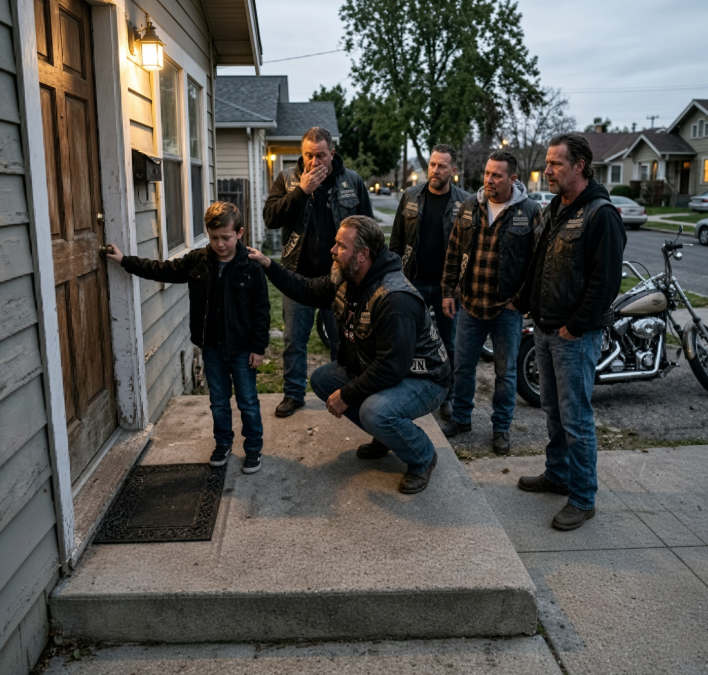
At the seventh house, the porch light was on.
Cade climbed three wooden steps. Beside the door hung a metal sign that read:
RIDGELINE BROTHERHOOD MC
EST. 1987
A row of boots sat on a rubber mat below it.
The air smelled faintly of coffee that had been brewed hours ago and left on the warmer.
Cade raised his hand.
Knocked three times.
Even and steady.
Twenty seconds passed.
Then the deadbolt turned.
The door opened.
Boon Callaway filled the frame.
He was enormous.
Six foot four, built like a man who had spent his life lifting things not designed to be lifted: engine blocks, fallen timber, motorcycles, wounded friends, and the weight of promises men made too easily and remembered too late.
His beard was dark in the center and gray at the edges. His arms, bare beneath a black T-shirt, were covered in old tattoos layered so deeply they looked like a second skin. His eyes were brown, deep-set, and lined by fifty-four years of squinting into sun, wind, smoke, and bad news.
He looked down at the boy on his porch.
For one long second, he did not understand what he was seeing.
A child.
Barefoot.
Pajamas.
Oversized sweatshirt.
Pale face.
Scraped hands.
No tears.
Cade looked up.
He did not flinch.
He held Boon’s gaze with the same steady purpose he had brought to every door on the street.
Then he said the words his father had made him memorize.
“My name is Cade Hollister. My daddy was Travis Hollister. He said you were angels. My mama won’t wake up.”
Boon Callaway had not heard the name Travis Hollister spoken aloud in fourteen months.
He felt it land in his chest like a stone dropped into deep water.
Travis Hollister.
Road name Hawk.
Road captain.
Chapter Seven.
The man who could spot a pothole at seventy miles an hour and a lie from ten feet away.
The man who laughed like thunder, rode like weather, and once pulled Boon out of a ditch after an ice storm while cursing him the whole time for being “too heavy to rescue with dignity.”
The man who died on Route 421 two years ago when a logging truck drifted over the center line and turned a Tuesday afternoon into a funeral.
Boon looked at the boy again.
The eyes did it.
Pale blue.
Winter sky.
Travis’s eyes.
“Come inside,” Boon said.
Cade stepped through the door with the careful precision of a child who had learned to move gently in a world that kept breaking around him.
Not sneaking.
Not timid.
Just deliberate.
As if floors might not hold unless you respected them.
Boon noticed everything at once.
The bare feet.
The pajama bottoms.
The too-large sweatshirt.
The scraped knuckles.
The small hands held too still.
The way the boy did not look around like a scared child entering a stranger’s house. He looked like a messenger who had delivered his sentence and now waited to see if adults would do what they had promised.
“Sit down, son.”
Boon pulled out a kitchen chair.
Cade sat.
“When did you eat last?”
“Yesterday lunch.”
Boon opened the refrigerator.
“What’d you have?”
“Peanut butter.”
Boon pulled out bread, strawberry jam, and milk.
“No bread?”
“The bread was green.”
Boon stopped moving for half a second.
Then kept going.
He made a sandwich, poured milk into a glass, and set both in front of Cade without ceremony. Ceremony was not what this child needed.
This child needed food.
And someone who would listen.
Cade ate the sandwich in six bites. He drank half the milk in one long pull, then set the glass down carefully and wiped his mouth with the back of his hand.
Boon sat across from him.
“Tell me about your mama.”
Cade told the story the way children tell terrible things when they have been the only responsible person in a house for too long.
Flat.
Precise.
No dramatic words because he did not yet know which parts should frighten adults most.
Jesse Hollister had collapsed at 7:15 the night before.
She had been standing at the kitchen sink washing the three dishes they had used for dinner: one plate, one bowl, and one fork.
“She made a sound,” Cade said. “Like she forgot how to breathe.”
Then she folded.
Not fell.
Folded.
Her knees buckled, her back slid down the cabinet, and her head came to rest against the baseboard at an angle that made Cade’s stomach hurt to remember.
He had tried to wake her.
He shook her shoulder.
“Mama.”
Then louder.
“Mama.”
Then louder still.
But never screaming, because screaming frightened her when she was well, and he did not want to frighten her now.
She was breathing.
He checked the way she had taught him.
Two fingers under the nose.
Feel the warm air.
Slow and shallow, but breathing.
Her skin was hot.
Not warm.
Hot like the stove after a burner had been on.
They had no working phone.
The landline had been disconnected four months earlier. Jesse’s cell phone had stopped working in August after the screen cracked and the battery swelled. It sat on the dresser like a promise that had expired.
Cade had gone first to Mr. Combs down the road, but the truck was gone and the house was dark. Then he thought about Mrs. Patterson, half a mile in the other direction, but she was eighty-three and did not answer her door after six.
So Cade did what his father told him to do.
He went to the bedroom.
Opened the bottom drawer of the dresser where his mother kept important things.
Birth certificates.
Insurance papers that had run out.
A photo of Travis on his motorcycle, grinning at the camera.
And the map.
The hand-drawn map with the black marker line from Clover Fork Road to Ridgeline Road.
He put on his father’s sweatshirt.
He could not find his shoes.
They were under his mother’s bed, but she was lying against the cabinets near the kitchen, and he did not want to move her. He filled a cup of water from the tap and set it by her head in case she woke up thirsty. Then he covered her with a blanket because the house was cold and the furnace had stopped working in September.
Then he walked out the front door.
Pulled it shut behind him.
And started walking.
Four miles.
In the dark.
Barefoot.
Seven years old.
Boon sat across from him and felt something collapse inside his chest.
Not loudly.
Not dramatically.
The way a wall collapses when the final supporting beam gives way quietly and completely.
He pulled out his phone.
Called Earl Dunlap.
Earl answered on the fifth ring, voice thick with sleep.
“Boon, it’s four-thirty in the—”
“Get up.”
“What?”
“Travis Hollister’s boy is sitting in my kitchen barefoot. Walked here from Clover Fork.”
Silence.
Then Earl’s breathing changed.
“Jesse?”
“On the floor. Unconscious. I need you to call Donna Beckett. Call every brother on this road. I need you at my house in ten minutes.”
Another silence.
Then Earl said the thing both men were already thinking.
“We said we’d look after them.”
Boon closed his eyes.
“I know.”
“We said it at the funeral.”
“I know.”
“We rode away.”
Boon looked at Cade sitting at the table, hands folded, face calm in the unbearable way of children who have learned adults may not come.
“I know, Earl.”
A shorter silence.
“Ten minutes.”
Boon ended the call.
Cade looked at him.
“We’re going to help your mama,” Boon said. “I need you to understand that.”
Cade nodded.
His blue eyes held Boon’s without wavering.
“My daddy said you would.”
The words hit Boon harder than any fist ever had.
They reached the Hollister house at 5:23 in the morning.
Boon’s truck led.
Earl’s truck followed.
Donna Beckett’s SUV came third.
Donna had ridden with Ridgeline for years before age and a bad knee made her trade longer rides for clinic shifts and emergency calls. She had spent fifteen years as an EMT, and when Earl told her Jesse Hollister was unconscious, she arrived with a medical bag before she arrived with questions.
The Hollister house sat at the end of a gravel drive off Clover Fork Road.
It had been white once.
Now it was the color of exhaustion.
Gray boards.
Peeling paint.
A porch sagging on the left where a rotten support post had been replaced by a stack of cinder blocks leaning at an angle that suggested they might hold for another month.
Maybe two.
The yard was dirt.
Not neglected grass.
Dirt.
Hard-packed, bare, and tired.
A single plastic chair sat near the front steps as if someone had placed it there to rest and never returned.
Cade led them inside.
He walked ahead of three adults, each more than twice his size, opened the front door, and held it for them.
Because his mother had taught him to hold doors.
And no circumstance—not fear, not exhaustion, not the collapse of the world he knew—would make him forget.
Jesse Hollister lay on the kitchen floor.
The blanket Cade had placed over her was still tucked around her shoulders.
The cup of water remained untouched beside her head.
She was thirty-one years old and looked forty-five. Her brown hair was matted. Her face was gaunt. Her skin stretched tight across cheekbones that stood out like ridgelines. Her breathing was shallow and fast, effort instead of reflex.
Donna knelt beside her.
Two fingers to the throat.
Palm near the forehead.
Eyes on the chest.
Her face shifted three times in two seconds.
Assessment.
Alarm.
Control.
“She’s burning up,” Donna said. “One-oh-three, maybe higher. Pulse is fast and thready. Severe dehydration.”
Earl already had his phone out.
“We need an ambulance now,” Donna said.
Boon stood in the kitchen doorway and looked around.
The kitchen was clean.
That was what broke him.
Not the poverty.
Not the peeling cabinets.
Not the nearly empty refrigerator he would open in a few minutes and never forget.
The kitchen was clean.
Dishes washed.
Counter wiped.
Floor swept.
But it was not the cleanliness of a comfortable household maintaining routine.
It was the cleanliness of a seven-year-old boy doing everything in his power to hold a collapsing world together.
The refrigerator contained a jar of peanut butter, a half-empty bottle of ketchup, one egg in a carton meant for twelve, and a gallon of milk with two inches left at the bottom.
The cabinets held a box of saltines, three cans of green beans, and a bag of rice with less than a cup inside.
On the counter sat a bottle of aspirin, a thermometer, a box of Band-Aids, and a handwritten list in Cade’s careful printing.
Check Mama’s head.
Give her water.
Make her eat something.
Keep the house clean.
Don’t cry where she can see.
Boon turned away so Cade would not see his face.
He walked down the hallway to the bedroom.
A mattress lay on the floor with one sheet and one thin blanket. A dresser stood against the wall, bottom drawer open from where Cade had taken the map. On top of it sat the photograph of Travis Hollister on his Harley.
Beside it was a folded letter.
Travis’s handwriting.
Boon should not have read it.
It was not his.
But something in him needed to see what Travis had left behind.
The letter was addressed to Cade.
Little Hawk,
If you’re reading this, something happened to me, and you’re old enough now to need the truth. I wrote this because the road is unpredictable, and a man who rides should leave instructions.
Your mama is the strongest person I’ve ever known, but strong people break too. If she breaks, here is what you do.
The map I drew shows you how to get to Ridgeline Road.
Those men are my brothers.
I rode with them for twelve years. They stood beside me at our wedding. They were at the hospital when you were born. They swore to me—and I mean swore, Little Hawk, the kind of promise that doesn’t have an expiration date—that if anything happened to me, they would take care of you and your mama.
Go to them.
Knock on every door until someone answers.
Tell them who you are.
Tell them I sent you.
They will come.
I believe that with everything I am.
I love you more than the road. And the road is the thing I love most in this world after you and your mama.
Be brave.
Be kind.
Hold doors for people.
And remember, the angels are on Ridgeline Road.
Love,
Daddy
Boon set the letter down.
He placed both palms flat on the dresser and stood there for thirty seconds, breathing through his nose, staring at Travis’s grin in the photo.
He thought about the funeral.
Two hundred riders lined Route 421 that day with engines rumbling low. The sound rolled through the valley so deep that people came out of stores and houses just to watch. Boon remembered standing beside Jesse Hollister at the graveside. She had been holding Cade, then five years old, against her hip.
Boon took Jesse’s hand and said, “We’re family. Anything you need, anytime, you call us.”
He meant it.
Every man there meant it.
Then Jesse never called.
And Boon never checked.
The ambulance arrived at 5:41.
Paramedics loaded Jesse onto a stretcher.
Cade stood beside her and held her hand, telling her quietly that the angels had come and everything was going to be okay.
Donna rode in the ambulance.
Earl followed in his truck.
Boon stayed.
He stood in the kitchen of the Hollister house, looked at the list on the counter—Don’t cry where she can see—and made a phone call.
Not to one man.
Not to ten.
He called the number that activated the Ridgeline Brotherhood’s emergency chain.
The one used for funerals.
House fires.
Hospital runs.
Disasters.
And the rare moments when the entire club needed to move as one body.
His message was simple.
“This is Boon. Ridgeline Road. My house. Seven o’clock. Every brother, every prospect, every friend of the club. Travis Hollister’s family needs us, and we are two years late.”
They came the way they always came.
In waves of sound and chrome.
By 6:30, there were twenty motorcycles in Boon’s driveway.
By 7:00, sixty.
By 8:00, after the October sun burned through the fog and painted Black Mountain pale gold, more than two hundred motorcycles lined both sides of Ridgeline Road.
Men and women stood in Boon Callaway’s yard holding coffee cups, helmets, and the particular silence of people who know they have been called to account.
Cade sat on the front porch wrapped in a blanket, wearing a pair of wool socks that belonged to Boon’s wife Margaret and were comically large on his feet.
He watched the riders arrive with an expression Boon could not read.
Not wonder.
Not fear.
Something quieter.
Recognition, maybe.
As if the boy were seeing something his father had described so many times that witnessing it felt not like surprise, but confirmation.
Boon stood on the porch steps and looked at his brothers.
Earl Dunlap, silent since the Hollister house.
Ray Sutton.
Dale Pruitt.
Jim McKinnon.
Donna’s husband, Lee.
Old patch holders.
Prospects.
Friends of the club.
Men who had ridden behind Travis Hollister on a hundred mountain roads.
Women who had cooked for benefit runs, organized toy drives, patched wounds, and buried men beside them.
They all waited.
Boon did not raise his voice.
He did not need to.
Two hundred people can be silent enough to hear a man speak softly when what he is saying matters.
“Most of you knew Travis Hollister.”
A few heads lowered.
“Road name Hawk. Road captain. Chapter Seven. Died two years ago on Route 421 when a logging truck crossed the line. We buried him on a Thursday. Two hundred of us rode that funeral. Loudest sound this valley heard since the mines closed.”
He paused.
Looked back at Cade.
The boy watched him with Travis’s eyes.
“At that funeral, I stood next to his wife, took her hand, and told her we were family. Every man here heard me say it, or said something like it himself.”
The yard was still.
“We meant it.”
Boon swallowed.
“Then we rode home and we forgot.”
No one moved.
“Last night, Jesse Hollister collapsed on her kitchen floor. She’s been sick for months. No phone. No family nearby. No one checking on her. Furnace broken. Roof leaking. Refrigerator has peanut butter, one egg, and almost nothing else.”
Someone made a sound low in the crowd.
Boon kept going.
“Their boy, Cade, seven years old, has been taking care of her. Cooking what food there is. Cleaning the house. Writing himself a list of instructions because there is no adult in that house capable of giving him any.”
Boon reached into his back pocket.
He pulled out the map.
Unfolded it carefully because the paper was soft as cloth.
He held it up so they could see the black marker line from Clover Fork Road to Ridgeline Road.
“Travis drew this map.”
The silence deepened.
“He told his boy that if anything ever happened, he should follow this line and knock on every door until someone answered.”
Boon’s voice caught.
“He told his boy the men on Ridgeline Road were angels.”
The word hurt coming out.
He forced himself to continue.
“That boy walked four miles in the dark last night. Barefoot. He followed this map and knocked on every door.”
Boon looked at the street.
“Six doors.”
He turned back to them.
“Nobody answered.”
The sound that moved through the crowd was not a gasp.
It was lower.
Heavier.
The sound of two hundred people absorbing a truth that landed in the body before the mind could soften it.
“I was the seventh.”
Earl turned away, fist pressed against his mouth.
Ray Sutton stared at the ground, jaw clenched.
Donna wiped her eyes.
Boon pointed toward Cade.
“He stood on my porch at four in the morning and said, ‘My daddy said you were angels. My mama won’t wake up.’”
No one spoke.
“Travis Hollister believed in us,” Boon said. “Believed in us enough to write a map for his boy. Believed in us enough to stake his son’s life on our doors opening.”
He set the map on the railing.
“Six of those doors stayed shut. I’m not going to stand here and pretend that doesn’t mean something. It means we made a promise and broke it. And a seven-year-old boy paid for it with four miles of broken road in the dark.”
Boon swept his eyes over the yard.
“I am not asking for volunteers.”
He let that settle.
“I am telling you what we’re going to do.”
A few men straightened.
“We are going to fix that house. We are going to fill that refrigerator. Repair that furnace. Patch that roof. Make sure that woman and that boy never wonder if anyone is coming again.”
His voice grew rough.
“Because Travis believed we would. And that boy walked four miles on his father’s faith.”
The answer moved through the crowd before anyone spoke.
Phones came out.
Men turned to one another.
Women started lists.
Ray Sutton, who owned a construction company, was already calling his foreman.
Jim McKinnon, who owned the appliance store on Main, said, “I’ve got a refrigerator on the floor.”
Dale Pruitt, father of four, said, “Somebody get real groceries. Not just canned stuff. Kid groceries.”
“Cereal,” his wife Linda said. “The kind with cartoons.”
“Shoes,” Margaret Callaway said, looking at Cade’s socked feet. “That boy needs shoes.”
“Furnace,” Bobby Greer said. “I’ll handle it.”
“Roof,” Ray said.
“Porch,” Earl said.
“Food,” Donna said.
“Hospital,” Boon said. “Updates from Jesse first, then work.”
Within thirty minutes, a convoy formed.
Trucks loaded with lumber and tools.
A flatbed for the refrigerator and washing machine.
Groceries.
Blankets.
Sheets.
Cleaning supplies.
Toolboxes.
Generators.
A crew.
A brotherhood, finally moving like it should have moved two years earlier.
Before they left, Boon crouched in front of Cade.
Eye level.
Man to boy.
“Your daddy was right about us,” Boon said. “We just needed reminding.”
Cade looked at him.
For the first time since he had walked out of his house in the dark, the composure cracked.
His chin trembled.
His eyes filled.
One tear ran down his left cheek.
He wiped it away with the back of his hand, quick and almost irritated, the way Travis used to wipe sweat from his face.
“He said you’d come,” Cade whispered. “I knocked and knocked, and nobody came, and I thought maybe he was wrong.”
Boon’s chest hurt.
“But he wasn’t wrong.”
“No,” Boon said. “He was never wrong about the things that mattered.”
The convoy that rolled down Clover Fork Road at 9:15 that Saturday morning was the largest Harlan, Kentucky had seen since the old coal company parades.
Two hundred fourteen motorcycles.
Thirty-one trucks.
A flatbed carrying a refrigerator, a washing machine, and enough lumber to rebuild the porch.
They stretched for a quarter mile along Route 421, engines rumbling in one continuous thunder that brought people out of houses, stores, and gas stations to watch.
The sound reached the Hollister house two minutes before the first bike turned into the gravel drive.
Cade rode in Boon’s truck, wearing the too-large wool socks and his father’s sweatshirt.
When the house appeared, small and gray and sagging at the end of the drive, he sat forward.
“That’s it,” he said. “That’s home.”
The riders dismounted.
They stood in the yard, in the driveway, along the road, and looked at the house where Travis Hollister’s family had been surviving.
Not living.
Surviving.
No one spoke.
They did not need to speak.
They needed to work.
Ray Sutton organized the construction crew.
The porch came first.
Rotten post out.
New treated lumber in.
Sagging boards pulled.
Fresh boards laid.
The roof crew climbed next.
Dale Pruitt and six men stripped failing shingles and laid new ones that could hold through Kentucky winters.
Bobby Greer inspected the furnace and came back upstairs with a face like stone.
“Cracked heat exchanger,” he told Boon quietly. “Thing’s been leaking carbon monoxide.”
Boon closed his eyes.
“How long?”
“Months, maybe.”
He installed a new unit from his own inventory.
No one mentioned cost.
Cost was not a concept that existed on Clover Fork Road that day.
Inside, the women of the Ridgeline Brotherhood cleaned the house from ceiling to floor. They scrubbed walls, washed windows, washed clothes, made beds with fresh sheets and thick blankets.
Margaret organized the kitchen.
The old refrigerator went out.
The new one came in.
Within an hour, it was full.
Not charity full.
Family full.
Milk.
Juice.
Eggs.
Cheese.
Chicken.
Fresh fruit.
Bread.
Vegetables.
Soup Donna had made that morning.
Cartoon cereal.
Cookies.
Yogurt cups.
A little boy’s idea of proof that someone was staying.
By noon, more than two hundred people had done work that should have been done two years before.
Steadily.
Without fanfare.
Because a man they loved had died.
They had forgotten the family he left behind.
And now they were remembering.
At one o’clock, Cade walked through the house.
Slowly.
The way a person walks through a place they are seeing for the first time, even if they have lived there their whole life.
He opened the refrigerator.
Stood in front of it.
Shelves full.
Something on every level.
He touched the milk.
Then the apples.
Then closed the door carefully.
In his room, there was now a bed.
A real bed with a frame.
A mattress that did not lie directly on the floor.
A comforter with stars on it because Boon had said, “Something with stars. Travis called him Little Hawk. They used to look at the sky.”
Cade sat on the edge of the bed.
Pressed both palms into the mattress.
Felt it hold.
Boon found him there.
“Your mom’s going to be okay,” Boon said.
Cade looked up.
“Donna says they’re giving her fluids and antibiotics. She’s sick, but they got to her in time. She’ll be home in a few days.”
Cade nodded.
He was holding Travis’s letter, pressed to his chest with both hands.
“Mr. Callaway?”
“Yeah, son.”
“How come nobody opened the other doors?”
Boon sat beside him.
The mattress dipped under his weight.
The frame creaked.
Held.
He thought before answering.
Because Cade deserved truth.
“Because people get comfortable,” Boon said. “They make promises and they mean them. Then time passes. The promise gets quiet, and their own life gets loud.”
Cade listened.
“It doesn’t make them bad people,” Boon continued. “It makes them human. But human isn’t good enough when a child is knocking on your door at four in the morning.”
Cade looked down at the letter.
“Are you going to forget again?”
“No.”
“How do you know?”
Boon looked at the small hands holding Travis’s last instructions.
“Because I’m going to remember your feet on my porch every single day for the rest of my life.”
At three o’clock, the riders gathered in the yard.
Two hundred fourteen men and women stood in the October sun on dirt that had been newly seeded with grass. Dark soil turned, raked, watered, ready for a spring that would come.
Boon stood on the new porch with Cade beside him.
The boy wore new shoes.
That had been the only argument of the day.
Four riders had gone to Walmart in Middlesboro and returned with four different wrong sizes before Linda Greer finally measured Cade’s foot and went herself.
Now the shoes fit.
Boon placed one hand on Cade’s shoulder.
“Travis Hollister left a letter for his son.”
The yard went silent.
“In that letter, he called us angels.”
No one smiled.
“We’re not angels,” Boon said. “We’re men and women who ride motorcycles. We make promises. Sometimes we break them. But Travis believed we were more than that. He believed it enough to stake his son’s life on it.”
Cade stood straight.
Travis’s posture.
Travis’s eyes.
“He drew a map,” Boon said. “He wrote, Knock on every door. And his boy followed that map in the dark because his daddy told him the angels were on Ridgeline Road.”
Boon’s fingers tightened gently on Cade’s shoulder.
“From this day forward, no door on Ridgeline Road stays shut when someone knocks. No family of a fallen brother goes unchecked. No child walks four miles in the dark because we got comfortable.”
He looked over the crowd.
“That is not a promise. That is the price of calling ourselves a brotherhood.”
Earl Dunlap stepped forward.
In his hands was a small leather vest.
Black.
Sized for a child.
On the back was a single patch: the Ridgeline Brotherhood circle of mountains and road.
Below it, in silver thread:
HONORARY ANGEL
Earl held it open.
Cade looked up at Boon.
Boon nodded.
Cade slipped his arms through.
The vest settled on his small shoulders.
Two hundred riders watched a seven-year-old boy become something he had already been since four in the morning.
Proof that the distance between a closed door and an open one is not measured in inches.
It is measured in faith.
Engines started.
Not all at once.
One.
Then five.
Then twenty.
Then all of them, in a rolling wave that grew into a wall of thunder. The repaired windows shook. The sound rose into the foothills of Black Mountain like the heartbeat of something vast and alive.
Cade stood on the porch with his father’s letter pressed to his ribs.
He closed his eyes.
For one moment, the thunder of two hundred engines sounded exactly like his father’s motorcycle pulling into the driveway after a long ride.
The way it used to.
The way it always would in memory.
Loud.
Certain.
Coming home.
Three weeks later, Jesse Hollister stood on the porch of a house she barely recognized, holding Cade’s hand.
She was thinner than before.
Still recovering.
Still tired.
But standing.
Behind her, the refrigerator was full.
The furnace was running.
The roof did not leak.
The porch did not sag.
On the kitchen counter sat a framed photograph of Travis Hollister on his Harley, grinning at the camera.
Every month, without exception, the Ridgeline Brotherhood rode down Clover Fork Road for a check-in.
Not a charity visit.
Not a guilt visit.
A family visit.
Boon came.
Earl came.
Donna came.
Sometimes twenty riders.
Sometimes fifty.
Sometimes only three trucks in bad weather.
But someone always came.
Because Cade’s walk had changed Ridgeline Road forever.
No brother’s family went unchecked again.
No widow was left to disappear behind pride.
No child had to carry a house alone.
On the first check-in ride after Jesse came home, Cade stood beside his mother and watched the motorcycles rumble down the road.
He wore his small leather vest over his father’s sweatshirt.
Jesse squeezed his hand.
“Your daddy would be proud of you,” she whispered.
Cade looked at the riders.
Then at the photo in the kitchen window.
Then at the repaired porch beneath his feet.
That night, after everyone left, he took a piece of paper and wrote five words in careful seven-year-old handwriting.
He placed it beneath the framed photograph of Travis.
Daddy was right about angels.

