A 6-Year-Old Boy Fell Asleep Against a Biker’s Motorcycle, Barefoot and Clutching a Crumpled Photo—Then 300 Riders Learned Why He Had Chosen That Bike
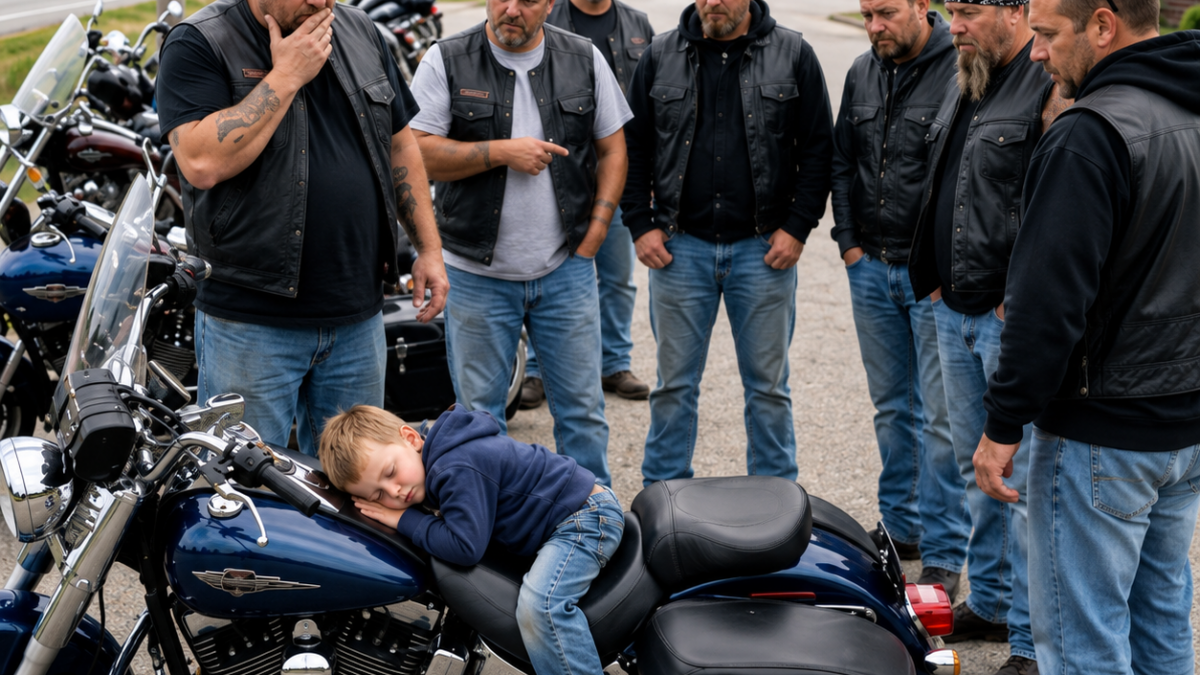
A 6-Year-Old Boy Fell Asleep Against a Biker’s Motorcycle, Barefoot and Clutching a Crumpled Photo—Then 300 Riders Learned Why He Had Chosen That Bike
I found a six-year-old boy asleep against the rear tire of my Harley, barefoot on scorching Oklahoma gravel, clutching a crumpled photograph like it was the last thing in the world that belonged to him.
Three hundred motorcycles had just thundered into town, yet somehow that exhausted little boy had slept through every engine—and when I saw how thin he was, I knew hunger wasn’t the worst thing he had survived.
Then he looked at my motorcycle, whispered something about angels, and I realized he had not wandered into our parking lot by accident.
My name is Marcus Caldwell.
For twelve years, I rode at the front of the Iron Angels Motorcycle Club.
That July, nearly three hundred of us were crossing Oklahoma on our annual charity ride, raising money for children’s hospitals, burn units, and families buried under medical bills.
Broken Bow was supposed to be nothing more than a thirty-minute lunch stop.
Coffee.
Food.
Fuel.
Then ninety more miles toward Tulsa.
I parked my Road King near the edge of Savannah’s Griddle, beneath a line of red oaks where the shade barely touched the gravel.
Most of the riders headed inside.
I stayed behind because I’d forgotten my phone in the saddlebag.
That tiny mistake changed everything.
I opened the bag, grabbed my phone, and was about to walk away when I noticed something beside the rear wheel.
At first, I thought somebody had dropped a jacket.
Then it moved.
A child was curled against my motorcycle.
He couldn’t have been more than six.
His sandy blond hair was dirty and tangled. His faded blue T-shirt was several sizes too big. There were scratches on his ankle and dust ground into the bottoms of his bare feet.
No shoes.
In July.
On Oklahoma gravel hot enough to burn skin.
But it was what he held against his chest that stopped me.
A photograph.
Even asleep, his fist was wrapped tightly around it.
I knelt slowly.
“Hey, buddy.”
Nothing.
“Hey. You okay?”
His eyes opened.
Pale blue.
Terrified.
He pushed himself backward against my tire and stared at me the way frightened children look at adults when experience has taught them not to assume kindness.
I stayed where I was.
“My name’s Marcus,” I said softly. “Nobody here is going to hurt you.”
For several seconds, he said nothing.
Then I asked his name.
“Ethan.”
His voice was barely more than air.
I asked where his parents were.
That was when his face changed.
He looked down at the photograph.
Then he held it toward me.
The picture showed a young couple sitting on a picnic blanket with a laughing baby between them. The man had sandy hair like Ethan’s. The woman had dark hair blowing across her face.
They looked happy.
Ordinary.
Alive.
“They went to heaven,” Ethan whispered.
Something inside me locked.
Eight years earlier, I had buried my own son.
Caleb was nine.
Leukemia.
I knew what it was to stand in a room and discover that love could not bargain with death.
But Ethan wasn’t remembering his parents from a safe home filled with family photographs.
He was sleeping beside a stranger’s motorcycle.
Barefoot.
Hungry.
Alone.
“Who takes care of you now?” I asked.
“Uncle Hank.”
“Where is he?”
Ethan shook his head.
“When did you last eat?”
He thought about it.
Not like a kid deciding between breakfast and lunch.
Like he genuinely couldn’t remember.
I took off my leather vest and wrapped it around his shoulders.
The vest nearly swallowed him.
Then he looked up at me and asked a question I still hear sometimes when I close my eyes.
“Can I sleep here?”
I had to turn my face away for half a second.
“Not on the gravel,” I told him. “Not anymore.”
When I lifted him, the boy weighed almost nothing.
I carried him through the door of Savannah’s Griddle.
Three hundred bikers went silent.
Men who had buried friends.
Veterans who had been shot at overseas.
Women who could rebuild an engine from bare metal.
Every one of them stared at the little barefoot boy wrapped inside my vest.
Savannah took one look at him and disappeared into the kitchen.
Minutes later, she brought eggs, biscuits, bacon, peaches, and a cold glass of milk.
Ethan stared at the plate.
Then at me.
“It’s yours,” I said.
He started eating.
Not the way a hungry kid eats after missing lunch.
He ate like someone afraid the food might disappear if he slowed down.
Nobody talked.
Nobody joked.
Three hundred riders simply watched.
Then Savannah brought him another plate.
Ethan froze.
“Do I have to pay?”
“No, baby,” she said.
“I don’t have money.”
“I know.”
His eyes dropped.
PART2:
“Uncle Hank says people don’t give things for free.”
That sentence changed the atmosphere in the diner.
One of my riders, Cody, sat beside him and began asking gentle questions.
Where did he live?
When had he last seen his uncle?
Was there food at home?
Why had he left?
Ethan answered each question quietly.
And with every answer, the room became more still.
Then Cody asked how Ethan had ended up at our motorcycles.
For the first time, the boy’s expression changed.
A tiny spark appeared behind those exhausted blue eyes.
“I heard them,” he whispered.
“The motorcycles?”
He nodded.
Then Ethan told us what his mother used to say whenever she heard something enormous and loud coming down the road.
And when he explained why a starving six-year-old had crawled toward three hundred strangers in leather instead of running away from them, grown men around that diner started looking at the floor.
A few minutes later, Ethan’s eyelids began to close.
His body finally seemed to understand that, for the moment, nobody was sending him anywhere.
He leaned sideways in the booth, still holding that photograph.
And just before he fell asleep, he whispered three words.
Three words that took me straight back to the hospital room where I had lost my son.
Three words that made three hundred Iron Angels abandon the rest of our route.
Because once we learned what had really been happening to Ethan inside that house outside Broken Bow, Oklahoma, leaving town was no longer an option…

