A 58-Year-Old Biker Was Holding His Screaming Autistic Nephew When a Stranger Called the Police—Then the Officer Saw the Child’s Face and Turned White
PART2:
His brain is wired for a different frequency than most of us live on. When the world gets too loud on that frequency, his whole system crashes. Lights hurt. Sounds hit like fists. Unexpected touch can send him into terror. Dogs are complicated. Sirens are worse. Dental offices are a battlefield disguised with cartoon stickers.
But motorcycles?
Motorcycles are magic.
Or at least, my motorcycle is.
I ride a black 2003 Harley Road King with enough miles on it to qualify as family. She leaks just enough to remind me she is alive, grumbles on cold mornings, and has carried me through thunderstorms, desert wind, funeral processions, charity runs, and three states of bad decisions.
For reasons no doctor has been able to explain, Mason loves that bike.
The low steady rumble calms something in him nothing else can reach.
Not music.
Not white noise.
Not the weighted blanket Jessica paid too much money for.
The bike.
When the weather is good on Sunday afternoons, I ride Mason around the county roads. Not fast. Not far. Never on highways. He sits in front of me in a special harness Jessica made after arguing with three specialists, two online forums, and me for six weeks. He wears a little matte-black helmet with a dinosaur sticker on the side. His hands rest over mine on the tank. His cheek presses against my chest, and the whole world narrows down to engine vibration, wind, trees, and that boy’s body going loose with peace.
Jessica says it reminds him of Danny.
I do not know if that is true.
Danny Vail was Mason’s father.
He was also my best friend before he was my brother-in-law.
That matters.
This story does not make sense unless you understand Danny.
Danny was the kind of man who made people less guarded without trying. Not loud. Not polished. Not one of those guys who needed a room to know he had entered it. He was steady. He had work boots by the door, a laugh that started slow and ended big, and the rare gift of listening like he had nowhere else to be.
We met on a roofing crew when we were both twenty-six and dumb enough to think a safety harness was optional if you had good balance. I was already riding then. Danny wasn’t. He said motorcycles were “beautiful death machines,” which meant, naturally, that two months later he was asking to borrow my old helmet and telling me not to say anything to Jessica.
I introduced them at a backyard cookout.
She was twenty-four, fierce, and irritated that I had invited “another sweaty construction guy” into her orbit. Danny brought her a paper plate with a burger and asked if she wanted pickles before assuming.
That was it.
That was the beginning.
Some love stories start with fireworks.
The good ones sometimes start with pickles.
They married three years later.
Mason came five years after that, after enough doctor appointments and disappointment to make everyone in the family stop asking questions. Danny cried the first time he held him. Not a quick tear either. Full crying. Red face. Shoulders shaking. Jessica laughed and cried with him, and I stood in the hospital doorway pretending my allergies were acting up because I was still young enough to lie badly about love.
For three years, Danny was a father with his whole body.
He learned Mason’s sounds before any of us did. He could tell hunger from tired from too much light. He knew that Mason liked pressure on his feet but not on his shoulders. He knew that certain cartoons were okay if the volume was low and that the sound of a blender meant someone needed to take Mason outside.
He was patient in a way that made me feel ashamed of every time I had mistaken toughness for volume.
Then Route Nine happened.
October fourth.
Four years ago.
Black ice on a bridge.
A semi jackknifed sideways.
Danny was driving home from a job site in a rented blue Corolla because his truck was in the shop. Mason was in the back seat, three years old, still in a car seat, clutching a stuffed shark Jessica had bought at an aquarium gift shop.
The Corolla went under the trailer.
Danny died on impact.
Mason did not have a scratch on him.
That is the kind of mercy that does not feel like mercy at first.
It feels like a question no one can answer.
The officer who pulled Mason from the wreckage sat with him on the shoulder of Route Nine for forty minutes before EMS could get through. The bridge was blocked both ways. Ambulance access had to come from the wrong side. Snow blew sideways. Drivers stood outside their cars in shock. Somewhere under all that twisted metal, my best friend was already gone.
And Mason sat on a police officer’s lap wrapped in a department jacket while that officer hummed to him.
Two notes.
Low, then high.
Over and over.
Until Jessica arrived and fell apart so completely that two firefighters had to hold her up.
I was not there.
I got there after.
I have hated myself for that more times than I can count.
I was forty minutes away replacing a water heater for a widow who paid me in cash and banana bread. My phone had been in the truck. By the time I saw the missed calls, Danny was dead, Mason was in an ambulance, and Jessica had aged ten years in one afternoon.
At Danny’s funeral, I stood beside his casket with my leather cut zipped up under my chin because the wind was mean that day, and I made my sister a promise while Mason sat on her hip staring at the ground.
I promised Danny, Jessica, and maybe God, though I have never been sure how much attention God pays to men like me, that Mason would always have a man in his corner.
I did not promise I would know what I was doing.
That would have been dishonest.
I promised I would be there.
That I could do.
So I learned.
I learned about weighted pressure and sensory overload. I learned not to grab Mason from behind. I learned that if he handed me something, it meant he trusted me to put it exactly where it belonged. I learned that silence is not absence. I learned that eye contact is not proof of listening, and words are not proof of understanding.
I learned that Mason liked my beard.
Not pulling it.
Just pressing his fingers into it sometimes, like it was a texture that helped him think.
I learned that when he was too far gone, when lights and sound and fear tangled inside him, there were only three sentences that mattered.
You’re okay, bud.
I got you.
You’re okay.
Jessica taught me those.
I said them like prayer.
The day it happened was a Tuesday.
Not a riding day.
A dentist day.
Dentist days were the worst days.
Jessica had booked Mason at a pediatric dentist on the north side of town, one of those bright, cheerful places designed by people who think children are comforted by murals of smiling animals with toothbrushes. To Mason, it was a nightmare in primary colors. The waiting room had a television. The television had sound. The fish tank bubbled too loudly. The fluorescent lights hummed. Somewhere in the back, drills whined behind closed doors.
Jessica had been working doubles that week at the hospital cafeteria because one of the other supervisors had quit without notice. She looked like she had been sleeping in pieces. Her hair was pulled into a messy knot, her scrubs had a coffee stain near the pocket, and she kept apologizing for things that were not her fault.
“I forgot the intake packet,” she said when we pulled into the parking lot.
I parked my truck near the side of the building. “So?”
“So they need it before they’ll take him back. I asked if they could print it again. They said yes, but I have to go inside.”
“I’ll sit with him.”
She looked at Mason in the back seat.
He had his weighted plush shark under one arm and a pack of fruit snacks in the other hand. He was rocking a little, but not bad. His eyes were on the line of parked cars, not panicked, just alert.
“You sure?” she asked.
“Jess.”
“I know. I know.” She rubbed her forehead. “Ten minutes.”
“Go.”
She opened the back door and signed to Mason. Not formal sign language. Just their language. Mom inside. Uncle Wade here. Wait.
Mason touched the shark to his chin.
That meant okay.
She kissed the top of his helmet hair, though he leaned away from the sudden touch. She winced.
“Sorry, baby.”
Then she hurried across the lot and disappeared into the dentist office.
Ten minutes.
That was all it was supposed to be.
I leaned against the tailgate of my truck with Mason beside me. He stood close enough that his shoulder brushed my jeans but not so close that I touched him. He liked being near me. He did not always want contact. There is a difference, and if you love someone like Mason, you learn it or you become part of the noise.
A red-tailed hawk sat on top of the light pole across the lot.
I pointed with two fingers, slow.
“See that, bud? Big bird. Watching everybody like he owns the place.”
Mason followed my hand.
The smallest smile touched his mouth.
That smile could fix things in me no medicine had ever reached.
Then the dog barked.
It was a German shepherd in the back of an SUV three spaces over. Big dog. Deep bark. The kind that hits your ribs. The window was cracked, and the dog had seen something outside—a squirrel maybe, or us, or the world itself—and decided to announce war.
Mason loves dogs from a distance.
Cartoon dogs. Plush dogs. Dogs on TV with the volume low.
Real dogs are different.
Real dogs move wrong. Bark suddenly. Lunge. Sniff. Demand responses. Real dogs do not understand Mason’s rules.
The shepherd barked again and slammed its front paws against the SUV’s back window.
Mason stopped rocking.
His whole body went stiff.
“Mase,” I said softly.
He dropped the shark.
He dropped the fruit snacks.
Then he bolted.
He did not run away from the dog.
That is the part people do not understand about kids like Mason. Panic does not always choose the logical direction. His feet were pointed toward the road, so toward the road he went.
There was no thought in me.
Only movement.
I have never moved faster in my life.
My boots hit asphalt. My bad knee shouted. A car horn blew somewhere. Mason was small and fast and silent now, which was worse than screaming. He passed the front of a parked minivan, cut between two cars, and headed straight for the curb beyond the lot.
The road beside that clinic was four lanes.
The light was green.
A delivery truck was coming through it.
I caught Mason about four feet from the curb.
I grabbed him around the middle, scooped him off his feet, spun my back to the road, and felt the wind of that truck slap my cut as it roared past.
Then Mason exploded.
His body went rigid.
Then he screamed.
Not a normal scream.
If you have never heard a nonverbal autistic child in full meltdown, I will not try to decorate it for you. It is not a tantrum. It is not bad behavior. It is not manipulation. It is the sound of a small human whose nervous system has caught fire and cannot find the door.
He started hitting my face with the flat of his palms.
Left. Right. Left.
Not hard enough to injure badly, but enough to sting. His nails caught my cheek. His heel drove into my thigh. His back arched so sharply I almost lost my grip.
He was not trying to hurt me.
He was trying to make the world stop.
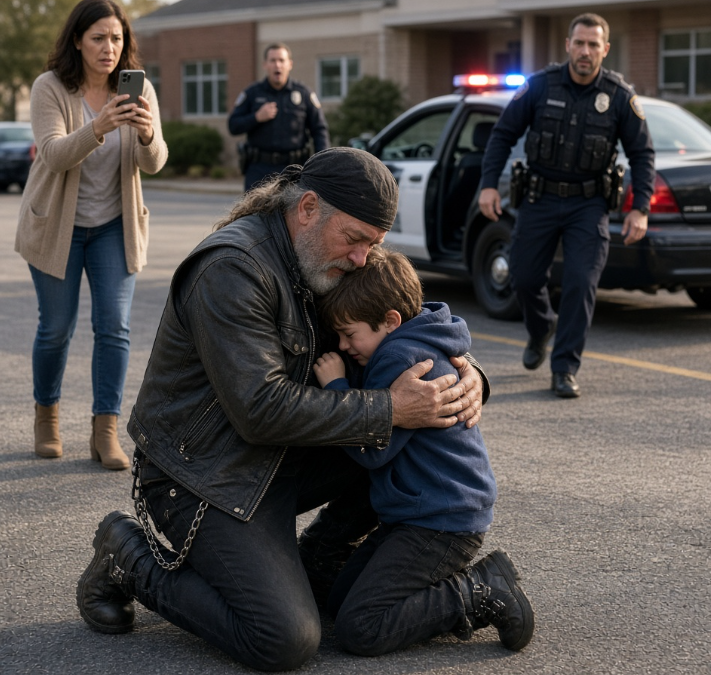
I got down on the ground with him right there near the edge of the parking lot. I sat with my back against the concrete curb and put him in my lap, facing inward, his head against my chest. I locked my arms all the way around him.
Tight.
Tight enough that if you did not know, you would think I was hurting him.
But that is the pressure Mason needs.
Deep pressure.
All the way around.
So his body remembers where it ends.
His occupational therapist calls it grounding.
Jessica calls it being an anchor.
I just call it holding him.
I put my mouth close to his hair and said the three sentences.
Low.
Slow.
Over and over.
“You’re okay, bud. I got you. You’re okay.”
He screamed.
“You’re okay, bud. I got you.”
He hit my cheek again.
“You’re okay.”
His little hands beat against my collarbone. His body shook. I could feel his heart hammering against my ribs like a trapped bird.
But after a minute, maybe two, I felt the first change.
Not quiet.
Not peace.
Softening.
That is how you know it is working. The screaming keeps going for a while after the panic starts to break because his voice has to catch up with his brain.
His hands slowed.
His spine relaxed half an inch.
I kept going.
“You’re okay, bud. I got you.”
That was when I noticed the woman filming.
She stood about ten feet away with her phone held up in both hands, framing us.
Middle-aged. Nice sweater. Expensive sunglasses pushed up into her hair. The kind of woman you would ask to watch your bag at a coffee shop. The kind of woman who probably volunteered somewhere and used reusable grocery bags and had no idea she was about to become a villain in a story she believed she was saving someone from.
“I’ve called the police,” she said loudly over Mason’s screams. “You put that child down right now.”
I kept my voice level.
I did not stop holding him.
You never stop in the middle.
“Ma’am,” I said, “he’s my nephew. He’s autistic. He just ran for the road. His mother is inside, third door down. Her name is Jessica Vail. Please go get her.”
“You’re hurting him. Look at him. He’s terrified of you.”
“He’s not terrified of me. He’s in a meltdown. If I let him go, he will run. Please. Go get his mother. She’s right inside.”
She did not move.
She kept filming.
“I’m not going anywhere near you,” she said. “The police are on their way.”
Another woman had stopped about twenty feet off with her hand over her mouth. A guy in a work truck rolled down his window. A man in scrubs stood near the dentist office door, frozen. People began arranging themselves around us in a semicircle of phones and stares.
Nobody went to get Jessica.
That is the part I still think about.
Not the woman calling police.
I can understand fear.
I can understand misunderstanding.
But there were fifteen people close enough to hear me say his mother’s name, and not one of them walked thirty yards to get her.
They watched.
People love to watch trouble when they think it has nothing to do with them.
Mason’s scream tore through the lot. My cheek was bleeding. My knees were grinding into asphalt. Sweat ran down the back of my neck under my leather. The German shepherd was still barking from the SUV, and every bark sent another tremor through Mason’s body.
I kept talking into his hair.
“You’re okay, bud. I got you.”
The cruiser came in under three minutes.
Lights.
No siren.
City police.
Two officers.
I saw them step out, both with hands near their belts, which is exactly what they are trained to do and exactly what I would have done in their boots.
A call comes in: large biker restraining screaming child in parking lot.
You come ready.
I understood that.
Understanding it did not make the moment less dangerous.
I moved my right hand slowly out where they could see it, palm open. My left arm stayed locked around Mason.
“Officers,” I called. “I am unarmed. This is my nephew. He is autistic. He is in a meltdown. If I let him go, he will run. His mother is inside the building right behind me.”
The first officer to reach us was younger.
Maybe thirty.
He had a good face. The kind of face that pays attention before it decides. He looked at me, looked at Mason, looked at the woman still filming, then took a breath.
“Sir, what’s your name?”
“Wade Vail. Everybody calls me Wade.”
“And the boy?”
“Mason Vail. He’s seven. His mother is Jessica Vail. She’s in the pediatric dentist office right there. She went in for paperwork.”
“Do you have ID?”
“Back pocket.”
“Go ahead and get it slow.”
I shifted carefully. Mason whimpered and dug his fingers into my cut. I got my wallet out with one hand and flipped it open to my license. The officer took it, looked at the license, looked at me, then looked back at Mason.
I watched his shoulders come down half an inch.
He knew what I was.
And it was not what the woman with the phone had told him I was.
“Sir, is the boy hurt?”
“No. He was about to be. There was a dog. He ran for the road. I caught him. Now he’s in a meltdown, and I have to hold him until it passes.”
The younger officer nodded once and turned to the woman.
“Ma’am, please step back. I need you to stop recording and step back.”
She raised the phone higher.
“He grabbed him,” she said. “I saw him grab that child.”
“Ma’am. Please. Step. Back.”
She stepped back.
Not far.
But back.
That was when the second officer got out of the car.
He had been on the passenger side, speaking into the radio. He was older than the first one, maybe mid-forties, with a jaw like a shovel and gray coming into his temples. He walked around the front of the cruiser slowly, and I remember thinking he moved like a man who had already worked a long day before this call came in.
He did not rush.
That was the first thing I noticed.
The second thing was that he crouched down maybe eight feet away, so he wasn’t looming over Mason.
Good instinct.
Then he took off his sunglasses.
I felt Mason’s whole body change in my arms.
He stopped screaming.
Not eased down.
Not tapered off.
Stopped.
The way a record stops when the needle comes off.
His hands froze against my chest. His breath hitched. His whole body went completely still in my lap, and the only sound was the broken hiccup of air trying to settle in his throat.
Then he did something he had never done in seven years of me knowing him.
He turned his head.
He looked at that officer.
And he made a sound.
It was not a word.
It was a hum.
Two notes.
Low, then high.
The way you might hum the first two notes of a lullaby you barely remember.
The officer’s face went white.
I mean white.
Under the tan and the stubble, the blood went straight out of his cheeks. His sunglasses slipped in his hand. He lowered one knee to the asphalt hard enough that I heard it hit.
He looked at Mason for a long five seconds without breathing.
Then he looked at me.
“Sir,” he said very slowly, “how long have you had that boy? Because I know exactly who he is.”
I felt the parking lot go sideways.
“He’s my nephew,” I said carefully. “I’ve known him his whole life. He’s Mason Vail. His mother is my sister.”
The officer swallowed.
“Vail.”
“Yes.”
“Danny Vail’s boy.”
Everything in me went cold.
The name came out of him like a ghost had put it there.
I stared.
“Yes.”
His eyes shone.
“Route Nine,” he said. “October fourth. Four years ago. Two-vehicle. Semi jackknifed on the ice. Blue Corolla underneath.”
I nodded because my voice was gone.
The younger officer looked from him to me, confused now.
The woman with the phone had lowered it slightly.
The whole parking lot seemed to be holding its breath.
The older officer put one hand against the asphalt to steady himself.
“Sir,” he said, and now his voice shook, “I was the first officer on that scene.”
For a second, I did not understand him.
Not because the words were complicated.
Because the world had folded in half.
Route Nine.
October fourth.
Snow sideways in the headlights.
Danny gone before anyone could say goodbye.
Mason, three years old, strapped in a car seat, screaming in the wreckage.
A police officer climbing through broken glass and twisted metal, cutting straps, lifting a living child out of a dead man’s car.
A department jacket wrapped around a little boy.
Two notes hummed on repeat against the wind.
We knew the officer’s name from the report.
It was in the newspaper.
Jessica had kept every clipping in a folder she rarely opened but never threw away. She had tried to write him a letter once. I found three unfinished drafts in her kitchen drawer when I was fixing a sink.
Dear Officer Rourke…
I don’t know if you remember us…
Thank you is too small…
She never sent them.
She said she did not know what words belonged in a letter to the man who had handed her son back to her after the worst moment of her life.
His name, in the report, was Officer Michael Rourke.
I looked at the name tag on the man kneeling in front of me.
M. ROURKE.
“Oh my God,” I said.
He nodded once.
He couldn’t speak for a second.
Mason hummed again.
Low, then high.
Rourke flinched like the sound had gone through his ribs.
Then he did something I will remember for the rest of my life.
He shuffled forward on his knees, closing the space between us until he was maybe two feet from Mason. He did not reach out. He knew better than that. He just got low, so his eyes were the same height as Mason’s eyes.
Then he started humming.
Two notes.
Low, then high.
The same two notes Mason had just made.
The sound was barely there at first, rough and uneven, like it had been locked inside him for four years and the key had just turned.
Mason unlocked from my chest.
He did not jump into the officer’s arms.
It was not a movie.
He just sat up straighter in my lap.
He looked at Officer Rourke.
Then he lifted one hand and placed it flat against the officer’s shoulder.
Rourke closed his eyes.
“Hey, buddy,” he whispered.
His voice was completely gone.
“You remember me?”
Mason hummed the two notes again.
I have never in my life wanted to leave two people alone in a parking lot more than I did in that moment.
But I couldn’t move.
Mason was still in my lap.
The younger officer was standing there with my license in his hand, trying to figure out whether this call had become a police matter, a family reunion, or something too holy to interrupt.
The woman with the phone was still ten feet away, her hand lowered now, her face unreadable.
And then Jessica came out of the dentist office.
She had the paperwork in one hand and her purse half open on her shoulder. She stepped through the door already frowning because she saw the cruiser first. Then she saw me on the ground. Then she saw Mason in my lap. Then she saw an officer on his knees in front of her son.
The papers fell from her hand.
“Mason!”
She came across that lot at a run.
“Mase. Baby. It’s Mommy. I’m here.”
Mason looked at her.
Then he looked back at Rourke.
Then he did something else he had never done.
He reached both arms up toward the officer.
The way small children do when they want to be picked up.
Rourke looked at Jessica for permission.
Jessica did not understand yet.
Her face was pale with terror.
She looked at me.
“Wade?”
I could barely get the words out.
“Jess. Look at his name tag.”
She looked.
M. ROURKE.
I watched my sister put together in four seconds what had taken me two minutes.
Her hand flew to her mouth.
Her knees buckled.
The younger officer caught her elbow.
“You,” she whispered.
Rourke nodded.
He couldn’t do more than that.
“It’s you,” she said.
“Ma’am,” he said, and his voice cracked, “yes.”
Jessica sank down onto the asphalt like her bones had gone.
“I wrote you a letter,” she said. “I never finished it. I didn’t know how to say thank you.”
Rourke looked at Mason.
“You never had to,” he whispered. “I have thought about that boy every single day for four years.”
That broke her.
Not the loud kind of breaking.
The quiet kind.
The kind that folds a mother forward over the place where grief lives and makes everyone around her look away because some pain is too private for a parking lot.
She reached for Mason.
“Mase,” she said. “Come here, baby.”
Mason let me loosen my arms.
His body was soft now, exhausted from the meltdown, sweat damp in his hair. He shifted into Jessica’s lap. She wrapped herself around him the way only she could, one hand at the back of his head, one arm around his ribs.
But Mason kept his eyes on Rourke.
Then he reached one hand out again.
Rourke looked at Jessica.
She nodded through tears.
Slowly, carefully, Rourke touched two fingers to Mason’s palm.
Mason closed his little hand around them.
The parking lot was silent.
No dog barking now.
No phones ringing.
No engines.
Just a mother crying on the asphalt, a biker with blood on his cheek, two police officers on their knees, and a child who could not speak humming the only memory his body had kept from the worst day of his life.
The woman with the phone disappeared.
I do not know when.
I honestly do not remember seeing her leave. At some point between the humming and Jessica falling to the ground, she must have looked at what she was actually filming. She must have understood that she had captured something that was not hers to keep. She must have walked back to her car and driven away.
I hope she deleted it.
Or maybe she kept it and never showed anyone, which is almost the same thing if shame taught her silence.
The younger officer’s name was Ellis.
Officer Daniel Ellis.
He gave me back my license and apologized twice while Rourke sat with Jessica and Mason on the curb.
He didn’t have to.
He was doing his job.
I told him that.
“For what it’s worth, sir,” Ellis said quietly, “I knew it was a bad call the second we pulled up.”
I wiped the blood from my cheek with the back of my hand.
“How would you know?”
He looked toward Mason.
“The way you were holding him. That’s not how a bad guy holds a kid.”
I stared at him.
He shrugged.
“My little brother is on the spectrum. My mother used to hold him just like that in the cereal aisle at Kroger.”
For the first time that day, I laughed.
Not because anything was funny.
Because the world had become too much and laughter was the only valve left.
“I could’ve used you ten minutes earlier,” I said.
“Yes, sir,” Ellis said. “I think maybe a lot of people could’ve.”
He looked toward the dentist office, where several employees had gathered at the windows.
“Do you want me to speak with the caller?”
I looked around.
“She’s gone.”
He nodded slowly.
“Probably best.”
“Maybe.”
“You angry at her?”
I thought about that.
My cheek hurt. My knees hurt. My back was screaming. My nephew had been filmed during one of the most vulnerable moments of his life by a stranger who saw my leather before she saw his fear.
“Yes,” I said. “But not as much as I want to be.”
Ellis waited.
“She thought she was protecting him,” I said. “She just couldn’t imagine someone like me might be doing the same thing.”
Ellis looked at my cut, my beard, my boots.
“No, sir,” he said quietly. “She couldn’t.”
Rourke sat with Jessica and Mason for maybe twenty minutes.
I do not know all of what they said.
I gave them space.
I stood by the truck and watched the sky.
Gray clouds moved over the parking lot. The German shepherd’s owner finally returned and drove away without understanding the damage a bark had done. Someone from the dentist office gathered Jessica’s dropped paperwork and placed it gently on the hood of my truck. The delivery truck that nearly took Mason’s life was long gone, its driver probably never knowing how close he came to becoming part of a tragedy.
I thought about Danny.
I thought about the promise I made over his grave.
I thought about how the man who had sat with Danny’s boy on the shoulder of Route Nine four years ago was now sitting with him again on a curb outside a dentist office.
The whole world is either a machine of random cruelty or it is not.
I have decided in my old age to believe it is not.
Before Rourke left, he gave Jessica his personal cell number.
Not a card.
His number.
Written by hand on the back of a receipt because none of us had paper, and Jessica’s dentist forms were scattered across my hood.
“If Mason ever needs anything,” he said, “day or night, you call me.”
Jessica held the paper like it might tear.
“You don’t have to do that.”
“Yes, ma’am,” Rourke said. “I do.”
He said it like a man swearing an oath.
Then he stood and shook my hand.
His grip was strong.
Not performative.
Not police strong.
Human strong.
He looked at my leather cut. Looked at my beard. Looked at the dried blood on my cheek.
“Sir,” he said, “I owe you an apology for how we came out of that car.”
“You don’t owe me anything.”
“The world owes men like you a lot of apologies, actually.” He swallowed. “But I’ll settle for that one.”
I did not know what to do with that.
So I nodded.
That is what men like me do when words get too close.
We put Mason in Jessica’s car.
The dentist appointment never happened.
Nobody had the heart.
Jessica drove him home, and I followed on my bike.
Usually, when Mason hears my bike start, he looks for it. That day he was too drained. His head leaned against the car window. His shark was back under his arm. Jessica had found it near the truck, damp with parking lot grit, and wiped it off with her sleeve like it was holy.
At a red light, I looked through her back window.
Mason’s hand lifted.
Two fingers.
A tiny motion.
Not a wave exactly.
Enough.
I lifted mine from the handlebar and tapped my chest twice.
I got you.
That night, after Mason finally fell asleep, Jessica and I sat at her kitchen table.
No lights except the one over the stove.
Her house looked the way houses look after crisis. Shoes in the wrong place. A half-empty cup of water on the counter. Mason’s therapy cards scattered near the sink. The paperwork from the dentist bent and useless beside her purse.
She had not cried since we left the parking lot.
That worried me.
Jessica cried in small, private ways. In bathrooms. In her car. While chopping onions she did not need. She rarely cried in front of me anymore because grief had made her protective of everyone else’s feelings, which was one of the ways grief can turn unfair.
I made coffee.
She did not drink it.
“He remembered him,” she said.
“Yes.”
“How?”
I sat across from her.
“I don’t know.”
“He was three.”
“I know.”
“He doesn’t remember his birthday party last year. He doesn’t remember places we go every week. But he remembered him.”
I stared at the table.
“Maybe his mouth didn’t. Maybe his body did.”
She looked at me then.
Her eyes filled.
“The humming,” she whispered. “I used to wonder where he got that.”
I nodded.
“Danny never hummed?”
“No. Danny whistled. Badly.”
Despite everything, we both smiled.
Then she broke.
She folded forward, elbows on the table, both hands over her face, and cried so hard her shoulders shook.
“I never thanked him,” she sobbed. “Wade, that man sat with my baby after Danny died, and I never thanked him.”
I moved around the table and put one hand on her back.
She leaned into me.
“You were trying to survive,” I said.
“That’s not enough.”
“Sometimes it has to be.”
She cried harder.
“I don’t remember half that year.”
“I know.”
“I remember the funeral. I remember Mason screaming at night. I remember finding Danny’s work gloves in the garage and throwing up in the driveway. I remember people bringing casseroles and looking at me like I was made of glass. I don’t remember how I got through it.”
“You got through because you had to.”
She lifted her face.
Her eyes were red and furious.
“I hate when people say that.”
“Fair.”
“I didn’t want to be strong.”
“I know.”
“I wanted my husband.”
The words filled the kitchen.
Nothing I could say would make them smaller.
So I said nothing.
Sometimes being in someone’s corner means shutting up.
The next Sunday, Rourke came to dinner.
Not because we planned it that way exactly. Jessica called him two days after the parking lot incident, intending to say thank you properly. The call lasted an hour. Then he asked, awkwardly, if he could maybe stop by sometime and see Mason when things were calm, not in uniform, not as an officer, just as Michael.
Jessica said yes.
Then she called me in a panic because apparently saying yes and surviving the yes are two different tasks.
“He’s coming Sunday,” she said.
“Okay.”
“What do I cook?”
“Food.”
“Wade.”
“Lasagna.”
“What if that’s too much?”
“For who? Him or you?”
She exhaled sharply.
“I don’t know how to do this.”
“Then don’t do anything fancy. He sat on a frozen highway with your son. I doubt he’s coming for table settings.”
Rourke arrived at five with his wife, Katie, and their little girl, Poppy.
Katie was a first-grade teacher with kind eyes and the strong calm of a woman who had managed classrooms full of children who all needed different things at once. Poppy was four, curly-haired, and wearing rain boots with ladybugs on them though there was no rain.
Rourke was nervous.
That surprised me.
He stood on Jessica’s porch holding a pie from the grocery store like it might explode.
I opened the door.
He looked at me.
“Too early?”
“By two minutes. We’ll forgive it.”
He almost smiled.
Katie touched his arm.
“Michael, breathe.”
“I am breathing.”
“You are performing breathing.”
Poppy looked up at me.
“Are you the motorcycle uncle?”
“Yes, ma’am.”
“Do you have a motorcycle?”
“That’s usually part of it.”
“Can I see it?”
“After dinner.”
She considered that, then nodded.
“You’re big.”
“Poppy,” Katie said.
“What? He is.”
“She’s not wrong,” I said.
Mason was in the living room, sitting on the rug with his shark pressed to his chin. He had been calm all afternoon, but when Rourke stepped inside, his body changed.
Not fear.
Stillness.
Recognition again.
Rourke stopped in the entryway.
He was not in uniform. Jeans. Dark sweater. Ordinary shoes. Without the badge, he looked less like the man from Route Nine and more like someone carrying a story he had never been able to set down.
Mason hummed.
Two notes.
Low, then high.
Poppy looked around.
“Who made that song?”
No one answered at first.
Then Katie knelt beside her.
“Mason did.”
“It’s pretty.”
Jessica made a sound near the kitchen sink and turned away.
Rourke slowly lowered himself to sit on the floor near the wall.
Not too close.
Not reaching.
Just there.
Mason crawled toward him.
He moved slowly, shark tucked beneath one arm.
When he reached Rourke, he sat beside him—not touching, just close enough that their shoulders almost met.
Poppy came over too, completely unconcerned with the emotional weight in the room, and sat on Rourke’s other side.
“Do you like dinosaurs?” she asked Mason.
Mason did not answer.
Poppy pulled a small plastic triceratops from her sweater pocket.
“This one is Gerald.”
Mason looked at Gerald.
Then at Poppy.
Then, carefully, he touched the dinosaur’s horn with one finger.
Poppy beamed.
The adults all looked away because some moments are too tender to stare at directly.
Dinner was awkward for the first ten minutes and family by the end.
Katie helped Jessica in the kitchen even though Jessica told her not to. Poppy announced that my motorcycle smelled “like loud.” Rourke and I stood on the back porch while Jessica got Mason settled after dinner.
For a while, neither of us spoke.
The sun had gone down. The porch light buzzed softly above us.
Finally, Rourke said, “I kept a picture.”
I looked at him.
“From the accident.”
Something in me tightened.
He stared out into the yard.
“Not for any official reason. One of the firefighters took it. Mason being handed to the paramedic. Me in the background. Snow everywhere. I don’t know why I kept it.”
I did not interrupt.
“I told myself it was because I wanted to remember that something survived that day. But really, I think I kept it because I couldn’t stop wondering what happened to him.”
“He survived,” I said.
Rourke nodded.
“I know that now.”
“He doesn’t talk.”
“I know.”
“But he knows things.”
Rourke swallowed.
“Yes,” he said. “He does.”
I leaned against the railing.
“You married?”
“Fourteen years.”
“Katie seems good.”
“She is.”
“Does she know?”
“About Route Nine?” He looked down. “She knows enough.”
“That means no.”
He let out a tired laugh.
“You always this direct?”
“Yes.”
He was quiet.
Then he said, “I had nightmares for a long time after that call. The sound of him crying. The car. Danny. The snow. I can still smell the radiator fluid sometimes.”
I closed my eyes.
“Me too.”
“You weren’t there.”
“No. But grief has imagination.”
Rourke nodded slowly.
“I thought about quitting.”
That surprised me.
“Police?”
“Yes.”
“Why didn’t you?”
He looked toward the kitchen window where Mason’s shadow moved past the curtain.
“Because once in a while, somebody needs you before they know your name.”
I felt that one.
Right in the chest.
Rourke started coming once a month after that.
At first, it was just Sunday dinner.
Then sometimes he came by alone after shift and sat on the porch with me while Jessica put Mason to bed. Sometimes Katie came with Poppy. Sometimes Poppy and Mason sat on the living room rug for an hour not really playing together, but occupying the same peace.
Mason let Rourke hold his hand by the third visit.
That does not sound big unless you know Mason.
Mason had let exactly three people hold his hand in his life: Jessica, me, and his speech therapist Mrs. Nolan on very good days.
Rourke became the fourth.
Jessica cried in the laundry room for eight minutes after it happened.
She thought no one heard.
I heard.
I did not go in.
Some crying needs privacy.
A month after the parking lot incident, the woman with the phone came back into the story.
Her name was Karen Bell.
I know because she wrote Jessica a letter.
Not a message online.
Not a comment.
A real letter.
Handwritten, three pages, mailed to the dentist office because she did not know Jessica’s address and asked them to forward it if they felt it was appropriate.
Jessica read it at my kitchen table because she said she couldn’t read it alone.
Dear Mrs. Vail,
You do not know me, but I was the woman in the parking lot on the day your son became overwhelmed outside the pediatric dentist. I am the woman who called the police.
I have tried to write this letter many times and failed because every sentence sounds like an excuse. I do not want to excuse myself. I want to apologize.
I saw a large man in leather holding a screaming child. I saw the child hitting him and crying, and I believed I was seeing danger. I acted from fear. But I did not listen. Your brother told me who he was. He told me your son was autistic. He asked me to get you. I did not.
That is the part I cannot stop thinking about.
I thought I was helping a child, but I ignored the person who knew him.
I filmed a moment that should have been private. I have deleted the video. I did not share it with anyone, and I never will.
I am sorry for frightening your family. I am sorry for treating your brother like a threat before I understood. I am sorry for making your son’s hardest moment harder.
There is more, but Jessica stopped reading there because her hands were shaking.
“She deleted it,” she said.
“Good.”
“She says she’s sorry.”
“I heard.”
“Are you still angry?”
“Yes.”
She nodded.
“Me too.”
Then she kept reading.
Karen wrote that she had a nephew with severe epilepsy. That years earlier, a stranger had intervened when he collapsed in a store, and that memory had shaped her instinct to call for help. She wrote that her fear did not excuse her assumptions. She wrote that she had contacted a local autism support organization to ask how to better recognize and respond to meltdowns in public. She wrote that if Jessica wished, she would apologize in person, but she would not ask for that because forgiveness was not owed.
At the end, she wrote:
I thought being decent meant acting quickly. I am learning it also means listening carefully.
Jessica folded the letter and sat silently.
“What are you going to do?” I asked.
“I don’t know.”
“You don’t have to do anything.”
“I know.”
“She said forgiveness isn’t owed.”
“She’s right.”
We sat with that.
Then Jessica said, “But maybe education is.”
Two weeks later, Karen Bell sat in Jessica’s living room with both hands wrapped around a cup of coffee she did not drink.
She was smaller without the phone.
That is what struck me.
In my memory, she had been ten feet tall, standing over us with accusation in her hand. In Jessica’s living room, she was just a woman in a blue cardigan with tired eyes and a mouth that trembled when Mason walked into the room.
Mason did not look at her.
He went straight to the couch, sat with his shark, and began rocking gently.
Karen’s eyes filled.
“I am so sorry,” she said.
Jessica sat across from her.
Not soft.
Not cruel.
Just steady.
“You should have gotten me.”
Karen nodded.
“I know.”
“He could have been more scared because of you.”
“I know.”
“My brother could have been hurt.”
Karen looked at me.
“I know.”
I stood near the kitchen doorway with my arms crossed because I did not trust myself sitting. I had agreed to be there because Jessica asked. That did not mean I had agreed to be warm.
Karen looked at my cheek, though the scratch had long healed.
“I saw the leather first,” she said quietly.
“Yes,” I said.
“I saw your size.”
“Yes.”
“I saw him screaming.”
“Yes.”
“And I decided I understood.”
“That was your mistake.”
She took that without flinching.
“Yes.”
Mason hummed from the couch.
Not the two notes.
A different hum.
His everyday hum.
Jessica looked at him, then back at Karen.
“I need you to know something,” she said. “People like you scare me.”
Karen’s face crumpled.
Jessica kept going.
“Not because you’re bad. Because you think you’re good. Bad people are easier. They announce themselves eventually. Good people with assumptions can do damage and call it help.”
Karen cried silently.
I looked at my sister and thought Danny would have been proud of her.
Not because she was being kind.
Because she was being true.
Karen started volunteering later with a local program that trained businesses on autism awareness. She did not become part of our family. This is not that kind of story. She did not earn some dramatic redemption just because she felt bad.
But she did the work.
Sometimes that is what apology should become.
Not forgiveness.
Work.
The bigger change came in our town.
Officer Ellis told his captain about what happened. Rourke did too. Not the emotional parts at first, I think. The procedural ones. Dispatch report. Misread situation. Autistic child. Caregiver restraint mistaken for assault. Crowd filming instead of assisting.
Two months later, the department hosted a training night for officers, first responders, and community volunteers on autism, sensory overload, and public meltdowns.
Jessica spoke.
I did not expect her to.
She stood at a podium in a room full of uniforms and talked about Mason.
She talked about how he does not always respond to his name when overwhelmed. How touch can hurt unless it is the right kind. How running does not mean defiance. How screaming does not mean danger from the person holding him. How mothers of disabled children learn to read rooms before rooms read their children.
Then she looked at the officers and said, “Please do not assume the loudest person is the problem. Sometimes the person making the least sense is the one most afraid.”
Officer Rourke sat in the front row.
He did not look away from her once.
Then I spoke.
I had planned to say no.
Public speaking is for preachers, politicians, and people who enjoy microphones, which tells you enough about all three.
But Jessica asked.
So I stood there in my leather cut in front of thirty cops, three EMTs, four firefighters, and Karen Bell sitting near the back with a notebook in her lap.
“I know how I look,” I said.
That got some uncomfortable shifting.
Good.
“I know what a call sounds like when somebody says biker restraining child. I know you have to come ready. I’m not asking you not to do your jobs.”
I looked at Ellis.
He nodded once.
“I’m asking you to do the part before force. The part where you look. The part where you listen. The part where you ask one more question before deciding the story.”
I told them how Mason ran.
How I held him.
How the crowd watched.
How one person calling for help became fifteen people assuming help had already been handled.
Then I said, “If you ever roll up and see a big ugly man holding a screaming child, maybe he’s the threat. Or maybe he’s the only thing between that child and traffic. Figure out which before you make both their lives worse.”
No one clapped.
It was not that kind of room.
But nobody looked bored.
That was enough.
Rourke spoke last.
He told the Route Nine story publicly for the first time.
Not all of it.
Some things still belonged to Danny, to Jessica, to Mason, to the snow.
But he told them enough.
He told them about holding a three-year-old boy on the shoulder of a highway while his father was gone five yards away and traffic backed up for miles. He told them about humming because words did not help. He told them that four years later, the boy remembered.
Then he said, “We are trained to control scenes. Sometimes we forget we’re also entering the worst moment of somebody’s life. Control matters. So does reverence.”
Reverence.
That word stayed in the room.
After the training, a firefighter with tattooed hands came up to me and said his daughter was autistic and he had never told the department because he did not want people treating him differently.
“Maybe I should,” he said.
“Maybe,” I said.
An EMT asked Jessica if she would help review their sensory response kits.
Karen Bell apologized to me again.
I said, “Use it.”
She frowned.
“Use what?”
“The shame. Don’t sit in it. Use it.”
She nodded.
Rourke stood near the coffee table alone for a minute after everyone left.
I walked over.
“You okay?”
“No.”
“Fair.”
He looked at the empty room.
“I used to think that call was the worst day of my career.”
“Wasn’t it?”
He thought about that.
“It was the worst thing I ever saw. But maybe not the worst thing that ever came from it.”
That sounded like something Danny would have understood.
Almost a year has passed now.
Mason never did make it into the dentist chair that day.
Nobody had the heart.
He did go back later.
Different appointment. Better plan. Noise-canceling headphones. Rourke off-duty in the waiting room, not in uniform, sitting quietly beside the fish tank because apparently Mason decided his presence was part of the new dental protocol.
Mason still does not speak.
Not with words.
But he communicates.
He hums the two notes when a cruiser passes.
He taps my gas tank twice before Sunday rides.
He places his shark in Rourke’s lap sometimes, which Jessica says is basically Mason handing over the keys to the kingdom.
Once, after dinner, Poppy fell asleep on the rug beside him while a cartoon played low on the TV. Mason did not move for twenty-three minutes because her hand was resting on his sleeve and he did not want to disturb her.
Katie cried in the kitchen.
Jessica cried in the pantry.
Rourke and I pretended we had not noticed either one because men are cowards about women’s tears unless directly assigned a task.
Rourke keeps a photograph on his desk at the station now.
It is the photograph from Route Nine: a three-year-old boy in a car seat on the shoulder of a frozen highway, being handed to a paramedic by a younger Officer Michael Rourke with a wet face.
He kept it in a drawer for four years.
He took it out the week after that day in the parking lot.
He told me it stopped feeling like his worst call and started feeling like his best one.
I still ride Mason on Sundays when the weather is good.
We go slow.
Back roads only.
The same route most times because surprise is not always kind. Past the Miller farm. Past the water tower. Past the old church with the leaning steeple. Around the bend where the trees make a tunnel of green in summer and fire in October.
Mason sits in front of me with his little helmet and harness, cheek pressed against my chest, hands over mine.
When the engine settles into that low steady rumble, I feel his body loosen.
I feel him breathe.
Sometimes, when we pass the cemetery where Danny is buried, I slow down.
Not stop.
Mason does not like stopping unexpectedly.
But I slow.
I lift two fingers from the grip.
Danny is on the hill beneath a maple tree.
Jessica chose the spot because in autumn it looks like the whole tree is burning gold.
I tell myself Danny can hear the bike.
I do not know if that is true.
But I have decided to believe some things without demanding proof.
On the first anniversary of the parking lot day, Jessica asked Rourke to come with us to Danny’s grave.
He almost said no.
I could see it in his face.
Not because he did not care.
Because some places feel too sacred to enter if you were only there for the worst part.
Jessica touched his arm.
“You brought my son back to me,” she said. “You’re allowed to stand where we remember his father.”
So he came.
Rourke, Katie, Poppy, Jessica, Mason, and me.
It was a clear October afternoon.
Wind in the maple leaves.
Mason held his shark under one arm and Rourke’s hand with the other.
We stood at Danny’s grave, and nobody said much at first.
What do you say to a stone?
Everything.
Nothing.
Jessica placed a small toy motorcycle beside the headstone because Mason had chosen it at the store. Poppy placed a dandelion, though it was mostly stem. Katie fixed the little flag near the plot because it had tipped in the wind.
Rourke stood back a little.
I saw his jaw working.
“You okay?” I asked.
He shook his head.
“Not really.”
“Good.”
He looked at me.
“Good?”
“Means you’re paying attention.”
He let out a breath that was almost a laugh.
Mason tugged his hand.
Rourke knelt.
Mason looked at Danny’s stone.
Then at Rourke.
Then at me.
Then he hummed.
Two notes.
Low, then high.
The wind moved through the maple tree.
Jessica made a sound I will never forget.
Not quite a sob.
Not quite a laugh.
Something between grief and gratitude, which is where most of us live if we are honest long enough.
Then Mason did something he had never done before.
He placed one palm against Danny’s headstone.
And with his other hand, he reached back until he found my leather cut.
He held both.
Stone and leather.
Gone and here.
Father and promise.
Jessica sank to the grass.
I went down beside her.
Rourke turned away, but not fast enough to hide his tears.
Mason hummed again.
The same two notes.
The lullaby from the highway.
The sound that had survived trauma, silence, time, fear, and a parking lot full of strangers.
I used to think Mason lost his father and kept nothing from that day except terror.
I was wrong.
Somewhere inside him, beneath language, beneath memory as most of us define it, he kept one kindness.
One officer’s arms.
One hum against the snow.
One body saying, I will not let go until your mother comes.
Maybe that is what saves us.
Not the whole rescue.
Not the grand miracle.
One kindness that gets lodged so deep even grief cannot reach it.
I still think about the woman with the phone.
Wherever she is, I hope she is okay.
I mean that.
I hope she learned without being destroyed by what she learned. I hope she tells people the story correctly if she tells it at all. I hope she understands now that fear is not the same thing as wisdom, and speed is not the same thing as help.
She saw a big man in leather holding a screaming child, and she did what she thought a decent person does.
That is not nothing.
She just did not know that decency without listening can become harm.
She did not know that some children scream hardest in the arms of the people they trust most because trust is where the body finally lets go.
She did not know that a gray beard and a leather cut can be a shelter.
She did not know that my mean-looking hands had learned exactly how to hold one fragile boy so he would not disappear into the fire inside his own nervous system.
She did not know that the officer she called would turn out to be the man who had once held the same child on the shoulder of a frozen highway after his father died.
She did not know that a little boy who cannot speak can still hum a lullaby he heard once, four years ago, from a stranger who never forgot him.
But now, I hope, she does.
As for me, I still look the way I look.
Leather.
Beard.
Boots.
Scars.
A face strangers sometimes decide against before I open my mouth.
Most days, I still do not care.
But when Mason runs toward me on Sunday afternoons, helmet in both hands, shark tucked under one arm, making that small happy sound only Jessica and I understand, I care about exactly one thing.
I care that he knows me in a crowd.
I care that when the world gets too loud, he looks for the rumble of my bike.
I care that when he presses his cheek against my chest, he hears not danger, not noise, not fear, but promise.
The promise I made over Danny’s grave.
The promise Rourke made without knowing it on Route Nine.
The promise Jessica keeps every morning she gets out of bed and chooses another hard day because love is not always gentle work, but it is sacred work.
Mason may never say my name.
He may never say Danny’s.
He may never say Rourke’s.
But sometimes, when the ride is over and the engine ticks itself quiet in Jessica’s driveway, Mason leaves his small hand on the gas tank until the last vibration fades.
Then he turns, presses two fingers to my leather cut, and hums.
Low.
Then high.
And every time he does, I hear what he cannot say.
I remember.
I’m safe.
Don’t let go yet.
So I don’t.
I hold steady.
That is what men in corners are for.

