A 5-Year-Old Asked the Shelter for “the Cat Nobody Wants” for Christmas—Then She Met a 15-Year-Old Missing Half His Face and Simply Said, “Hello.”
PART3:
“Buddy is seventeen and barely acknowledges his own existence.”
“He’ll notice a cat.”
“Maybe.”
Mark put the screwdriver down.
“Do you actually want another pet?”
Claire considered.
“I don’t know.”
That was the truth.
Their life was already full.
Mark worked for the county water department.
Claire taught fourth grade.
Emma had just started kindergarten.
Their old Labrador, Buddy, required medication twice a day and assistance getting up the back steps.
The idea of adding a cat three days before Christmas was not especially appealing.
But the next morning Emma said it again.
And the next.
Her grandmother asked what she wanted for Christmas.
“The cat nobody wants.”
Her uncle asked.
“The cat nobody wants.”
A neighbor asked whether she wanted a dollhouse.
“No. I want the cat nobody wants.”
By the second week, Mark stopped laughing.
One evening after Emma went to bed, he looked at Claire across the kitchen table.
“Maybe we should call the shelter.”
Claire raised an eyebrow.
“You’re serious?”
“She is.”
“She’s five.”
“You keep saying that.”
“Because she is.”
Mark smiled.
“She’s also been saying the exact same thing for twelve days.”
Claire folded her arms.
“You think we should just let her pick some random cat?”
“No.”
He thought.
“I think we should go look.”
Claire exhaled.
“If this is a Christmas lesson that ends with us bringing home a feral animal with six diseases, I’m blaming you.”
“Fair.”
“And no kittens.”
“I thought that was the point.”
“Exactly.”
“No expensive medical emergency we can’t afford.”
Mark nodded.
“Agreed.”
“No cat who hates children.”
“Definitely.”
Claire looked toward the hallway.
“And if there isn’t some mythical ‘cat nobody wants’?”
Mark smiled.
“Then maybe she picks one she likes.”
That was the plan.
On December 22, snow had begun falling just before noon.
Not enough to stick to the roads.
Enough to soften the roofs and make the town look temporarily more generous than it was.
Pine County Animal Shelter sat behind the municipal maintenance yard in a low brick building that had once been a county storage facility.
A faded plastic wreath hung on the front door.
Someone had wrapped red ribbon around a mailbox outside.
Emma wore her red winter coat.
She held Mark’s hand so tightly he kept flexing his fingers to restore circulation.
Claire opened the door.
Warm air hit them.
Then barking.
Lots of barking.
Emma’s eyes widened.
A woman behind the reception desk smiled.
“Hi there.”
She was in her late forties, with short brown hair threaded with silver and a sweatshirt covered in cat hair.
“My name’s Laura. What can I help you with?”
Claire smiled awkwardly.
“We’re here to look at cats.”
Laura glanced at Emma.
“Wonderful. Looking for a kitten?”
Emma answered before her mother could.
“No.”
Laura smiled.
“All right. Adult cat?”
Emma shook her head.
“I want the cat nobody wants.”
The shelter lobby became strangely quiet.
Not actually quiet.
Dogs still barked in the back.
A dryer hummed somewhere down the hallway.
A phone rang.
But Claire felt Laura’s attention sharpen.
Laura looked at the parents.
Mark shrugged helplessly.
Claire gave a small laugh.
“She’s been saying that for two weeks.”
Laura looked at Emma.
“What do you mean by that, sweetheart?”
Emma seemed surprised the adult needed clarification.
“The cat people don’t pick.”
Laura’s expression changed.
Not dramatically.
Just enough.
“Why?”
Emma thought.
“Because the other cats get people.”
Laura looked at Claire.
Claire swallowed.
“She came up with this herself.”
Laura crouched behind the counter so she was closer to Emma’s height.
“If I show you a cat who has had a very hard life, you might think he looks a little different.”
Emma nodded.
“Okay.”
“He’s old.”
“Okay.”
“He needs special food.”
“Okay.”
“And he doesn’t look like other cats.”
Emma frowned.
“You already said different.”
Mark covered a smile.
Laura almost laughed.
“Right.”
She stood.
“Give me a minute.”
Claire watched her disappear through a door behind the desk.
She turned to Mark.
“What exactly do you think she’s bringing out?”
“I have no idea.”
Claire lowered her voice.
“I suddenly feel like we should have asked more questions.”
“Too late.”
Emma bounced once on her heels.
A few minutes later, Laura returned carrying a hard-sided gray carrier.
She held it carefully.
Not because the cat inside was aggressive.
Because he was old.
Emma stared.
Laura led them into a small meeting room.
There were two plastic chairs.
A bench.
A scratching post.
A cat tree beside the window.
A basket of toys.
Someone had taped paper snowflakes to the wall.
Laura placed the carrier on the floor.
Before opening it, she looked at Mark and Claire.
“His name is Dutch.”
Claire nodded.
“He’s fifteen?”
“Best estimate.”
“How long has he been here?”
Laura hesitated.
“Eleven months.”
Mark frowned.
“That long?”
Laura nodded.
“Three hundred and eighteen cats have been adopted since he arrived.”
Claire looked at the carrier.
“And nobody wanted him?”
Laura didn’t answer directly.
“People have considered him.”
“That doesn’t sound good.”
“One family filled out paperwork, then changed their mind after meeting him.”
“Why?”
Laura looked toward Emma.
Then back at Claire.
“He has facial trauma.”
Claire’s stomach tightened.
“How bad?”
Laura spoke gently.
“The left eye is gone.”
Claire nodded.
“He lost most of the ear on that side too.”
Another nod.
“And there was significant damage to the jaw.”
Mark glanced at Emma.
She was sitting cross-legged on the floor directly in front of the carrier.
Waiting.
Laura continued quietly.
“The injury happened years before he came here.”
“What caused it?”
“We don’t know for sure.”
“Car?”
“Possibly.”
She hesitated.
“Our veterinarian thinks either severe blunt trauma or an untreated attack.”
Claire felt suddenly guilty for every condition she had laid down at the kitchen table.
No medical emergencies.
Nothing complicated.
Nothing expensive.
Laura added, “He eats normally, but only wet food. He drools a little because the left side of his mouth doesn’t close completely.”
Mark asked, “Pain?”
“Not ongoing, as far as we can tell. He has arthritis. Typical for his age.”
“And temperament?”
Laura’s face softened.
“Ridiculously gentle.”
Emma looked up.
“Can I see him now?”
Laura smiled.
“Yes.”
She unlatched the carrier.
For several seconds nothing happened.
Then one orange paw appeared.
Then another.
Dutch stepped out.
Claire had spent years teaching children not to stare at people who looked different.
Her first instinct was still to stare.
The right side of Dutch’s face looked almost ordinary.
Faded orange tabby stripes.
White around the chin.
One green-gold eye.
Long whiskers.
The left side was something else entirely.
The eye socket had healed closed.
The ear was gone except for a small folded edge.
Scar tissue pulled the fur unevenly around his cheek.
The jaw beneath it sagged slightly.
His mouth tilted.
One canine tooth protruded strangely.
He looked as if someone had erased half a cat and left the rest trying to continue without it.
Claire’s heart broke.
Then she looked at Emma.
The little girl did not move away.
Dutch did not move toward her immediately either.
He stood outside the carrier and sniffed.
Emma waited.
Laura said quietly, “You can put your hand out if you want.”
Emma didn’t.
Instead she leaned forward.
Dutch took one step.
Then another.
His back legs were stiff with age.
He stopped in front of her.
Emma looked directly at his face.
At the missing eye.
At the scar.
At the crooked mouth.
Nobody spoke.
Claire felt her own breath become shallow.
She was waiting for a reaction.
A question.
What happened to him?
Why does he look like that?
Is he sick?
Is that scary?
None came.
Emma lifted both hands.
Laura tensed slightly.
“Gentle.”
Emma placed her palms on either side of Dutch’s face.
One hand on the normal cheek.
One against the scarred side.
Dutch closed his remaining eye.
Emma said:
“Hello.”
That was all.
Laura turned away so quickly she nearly hit the door frame.
Claire covered her mouth.
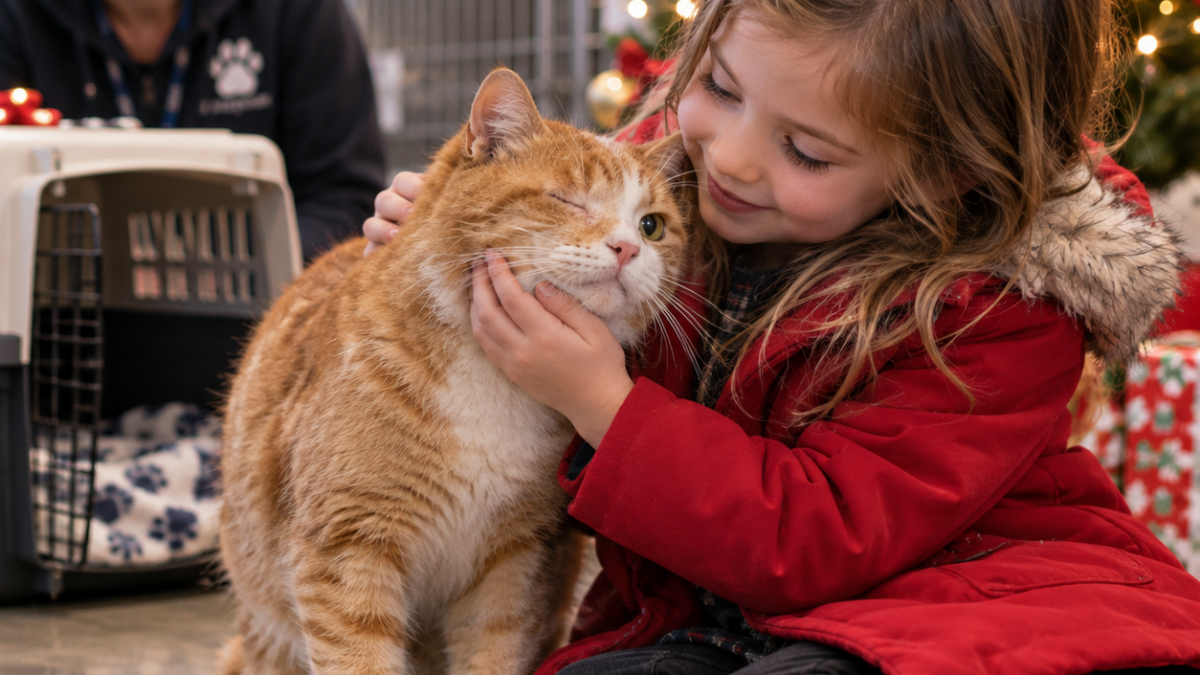
Mark pulled out his phone without thinking.
He took one photograph.
Emma holding Dutch’s face.
Dutch leaning into her.
Snow visible through the small window behind them.
Claire’s eyes filled.
Emma looked back.
“Mommy?”
Claire wiped her face.
“Yes?”
“Why are you crying?”
“I’m okay.”
Emma frowned.
“People say that when they’re not.”
Mark made a strangled sound that was almost laughter.
Claire knelt beside her.
“I’m happy.”
Emma looked at Dutch.
“Can he come home?”
Claire glanced at Mark.
They had talked about rules.
Vet records.
Compatibility.
Finances.
Practicality.
But all of it suddenly seemed like a conversation that belonged to people who had not yet met this cat.
Mark looked at Laura.
“What do we need to know?”
Laura came back into the room wiping beneath one eye.
“We’ve already done senior bloodwork.”
“How is it?”
“Kidney values are mildly elevated but stable.”
“Medication?”
“Joint supplement. Pain medication as needed.”
“Vaccines?”
“Current.”
“Behavior around dogs?”
“We tested him with an older calm dog. He mostly ignored him.”
Mark nodded.
“Buddy mostly ignores gravity.”
Claire almost laughed.
Laura continued.
“He’ll need a raised bowl. Soft food. He drools.”
Emma was stroking Dutch’s head.
Claire asked, “How much is the adoption fee?”
Laura shook her head.
“Nothing.”
“Nothing?”
“We waived it months ago.”
Mark frowned.
“Why?”
Laura smiled sadly.
“Because we decided whoever eventually chose him had already paid enough by choosing him.”
Mark looked down at Dutch.
“Okay.”
Claire stared at him.
“Okay?”
He smiled.
“Merry Christmas.”
Emma screamed.
Dutch barely reacted.
Laura laughed through tears.
The paperwork took forty minutes.
Emma spent thirty-eight of those minutes sitting beside Dutch.
At one point he climbed into her lap.
His body was lighter than Claire expected.
Thin beneath the fur.
Emma wrapped both arms around him.
Claire said, “Not too tight.”
Emma loosened immediately.
Dutch rested his chin on her forearm.
A small line of drool appeared on the sleeve of her red coat.
Claire saw it.
So did Mark.
Emma did not care.
When they finally left, Laura carried the gray carrier into the lobby.
Emma stopped her.
“I want to carry him.”
“It’s heavy.”
“I can do it.”
Mark took one side.
Emma took the handle.
Together they carried Dutch through the shelter.
As they passed the front desk, a young volunteer whispered, “Is Dutch leaving?”
Laura nodded.
The volunteer’s mouth fell open.
Another worker emerged from the dog corridor.
“What?”
“Dutch got adopted.”
“Today?”
Laura pointed toward Emma.
The worker looked at the child.
Then the carrier.
He smiled.
“About time, old man.”
Dutch said nothing.
He simply sat inside the carrier as the front door opened.
Cold December air blew in.
After eleven months, he left Pine County Animal Shelter.
The snow was still falling.
Emma insisted the carrier sit next to her in the back seat.
Claire allowed it after checking the seat belt twice.
Emma kept one hand pressed against the ventilation holes.
“You okay?”
Dutch sniffed her fingers.
“We have a dog.”
Mark looked in the mirror.
“Maybe lead with something less threatening.”
Emma ignored him.
“His name is Buddy. He’s very old.”
Claire smiled.
“So tactful.”
“He sleeps a lot.”
Dutch blinked.
“He smells weird.”
“Emma.”
“What?”
“Buddy does not smell weird.”
Mark coughed.
Claire glared at him.
Emma continued talking to Dutch the entire drive.
She explained the Christmas tree.
Her bedroom.
Her school.
Her stuffed rabbit named Mr. Pancake.
The fact that she did not like peas.
The fact that her father sometimes burned toast.
The fact that Santa came through the chimney even though theirs had a glass fireplace door, which Emma admitted was a “problem we have not solved yet.”
Dutch listened.
Or slept.
It was hard to tell.
At home, Buddy lifted his gray head from his bed.
The Labrador was seventeen.
His hips were weak.
His hearing worse.
His entire worldview seemed to consist of eating, sleeping, and determining whether something might eventually become food.
Mark brought Dutch inside.
Buddy sniffed.
Dutch remained in the carrier.
Emma whispered, “That’s Buddy.”
Buddy sneezed.
Dutch blinked.
Emma said, “See? Friends.”
Claire laughed.
“Let’s not rush negotiations.”
They set the carrier beneath the Christmas tree.
Emma had insisted.
“I want him to come out by the presents.”
Mark opened the carrier.
Dutch stayed inside.
Everyone waited.
Five minutes.
Ten.
Emma sat cross-legged several feet away.
Buddy fell asleep again.
Finally Dutch stepped out.
He moved slowly beneath the tree.
Colored lights reflected in his one eye.
Wrapped presents surrounded him.
A red bow from one package brushed his back.
He sniffed the lowest branch.
Then circled twice.
And lay down.
Emma whispered, “He knows.”
Claire sat on the sofa.
“Knows what?”
“That he’s the present.”
Mark looked at Claire.
Neither corrected her.
That night Dutch refused the expensive orthopedic pet bed Claire had ordered on the drive home.
Instead he slept on Emma’s blanket.
Not in her bed.
Beside it.
Claire checked on them at midnight.
Emma was asleep.
One arm hung off the mattress.
Dutch lay below with his head directly beneath her hand.
Claire stood in the doorway for a long time.
When she returned to the bedroom, Mark was awake.
“You took a while.”
She climbed into bed.
“He’s sleeping beside her.”
“Already?”
“Yes.”
Mark smiled.
“Guess we’ve been replaced.”
Claire turned off the lamp.
After a moment she whispered, “Do you think we’re crazy?”
“Yes.”
“Helpful.”
“You asked.”
“He’s fifteen.”
“I know.”
“We might have him six months.”
“I know.”
“Maybe less.”
Mark turned toward her.
“I know.”
Claire swallowed.
“She’s five.”
“I know.”
“She could lose him almost immediately.”
“Yes.”
“Then why does this feel right?”
Mark thought for a long moment.
“Because maybe loving something isn’t only worth doing if you get to keep it for a long time.”
Claire stared into the darkness.
“Where did that come from?”
“I’ve been married to a teacher twelve years.”
She laughed quietly.
“Makes you sound smarter than you are.”
“Exactly.”
Christmas Eve morning began at 5:47 because Emma woke and remembered there was a cat in her room.
She ran into her parents’ bedroom.
“Dutch is still here!”
Mark opened one eye.
“That was the plan.”
“He didn’t go back!”
Claire sat up.
The sentence landed differently.
“No.”
She pulled Emma closer.
“He didn’t go back.”
Emma smiled.
“Good.”
Christmas Day brought the first test.
Claire’s mother, Margaret Ellis, arrived just before ten.
She was sixty-eight, neatly dressed, deeply loving, and possessed the unfortunate habit of reacting honestly with her entire face before her manners caught up.
She entered carrying three shopping bags and a casserole.
“Merry Christmas!”
Emma ran to her.
“Grandma! Dutch is under the tree.”
Margaret frowned.
“Who’s Dutch?”
“My cat.”
Margaret looked at Claire.
“Your what?”
Claire mouthed, Later.
Emma dragged her toward the living room.
Dutch was sitting beneath the Christmas tree washing one front paw.
Margaret saw him.
Her expression changed before she could stop it.
Her eyes widened.
Her mouth opened slightly.
It lasted maybe one second.
Emma saw.
“Grandma.”
Margaret recovered.
“Yes?”
“It’s okay.”
“What is?”
“He’s just different.”
Margaret looked at her granddaughter.
Then at Dutch.
Claire held her breath.
Margaret set down the casserole.
She sat slowly on the floor.
Dutch watched.
Margaret extended one hand.
“Hello, Dutch.”
The cat approached.
He sniffed her.
Margaret scratched gently behind his remaining ear.
Dutch leaned so hard into the touch that his back leg slid.
Margaret caught him.
“Oh!”
Emma laughed.
“He does that.”
Margaret kept scratching.
Dutch’s eye closed.
After a moment Margaret whispered, “He’s a sweet old thing.”
Emma nodded.
“That’s why nobody wanted him.”
Margaret looked confused.
“That doesn’t make any sense.”
Emma shrugged.
“I know.”
Claire turned away before anyone saw her crying.
After Christmas, Dutch settled into the house as if he had spent fifteen years preparing for that exact life.
He learned Emma’s morning routine.
At 6:30 she woke.
At 6:35 he climbed onto her bed.
At 6:40 she brushed her teeth.
Dutch waited outside the bathroom because the tile floor was too slippery for his arthritic legs.
At breakfast he sat beside her chair.
Not begging.
Observing.
When Emma left for school, Dutch sat by the front window.
That surprised Claire.
She had assumed the old cat would sleep most of the day.
Instead he waited.
At 3:18 the school bus stopped.
At 3:19 Emma ran up the driveway.
By 3:20 Dutch was at the door.
Every day.
Claire noticed he never waited there for Mark.
Or her.
Only Emma.
“He knows the bus,” Claire said.
Mark shook his head.
“He knows her.”
Dutch needed accommodations.
A raised bowl because of his jaw.
Soft food.
A mat beneath the bowl because he dropped half of every meal down the left side of his face.
Medication hidden in pâté.
A step stool to reach Emma’s bed.
A night-light because depth perception with one eye was difficult in darkness.
Emma became obsessive about helping.
Too obsessive, sometimes.
“I can do it.”
She insisted on preparing his food.
“I can carry his bowl.”
“I can wipe his face.”
“I can give his medicine.”
Claire corrected her gently.
“You can help.”
Emma frowned.
“I am helping.”
“Yes. But grown-ups handle medicine.”
Dutch drooled occasionally.
Especially when deeply relaxed.
The first time it happened on Emma’s pajama sleeve, Claire said, “Hold still. I’ll get a towel.”
Emma wiped it with her sleeve.
Claire stared.
“Emma.”
“What?”
“That is disgusting.”
Emma looked at Dutch.
“He can’t help it.”
Claire opened her mouth.
Closed it.
“You’re right.”
Emma resumed petting him.
Mark witnessed the exchange from the kitchen.
Later he whispered to Claire, “She is going to be unbearable as a teenager.”
“Why?”
“Because she keeps being morally correct.”
Claire laughed.
The shelter posted Dutch’s adoption story two days after Christmas.
Laura called first.
“I want permission.”
“For what?”
“We have a picture.”
Claire knew which one.
Mark had sent it to Laura.
Emma sitting on the meeting-room floor.
Both hands on Dutch’s face.
His missing eye clearly visible.
His scarred jaw against her palm.
Emma looking completely calm.
“What are you going to say?”
Laura answered.
“Just what she said.”
The post read:
“I WANT THE CAT NOBODY WANTS.”
Five-year-old Emma came to our shelter asking for the cat everyone else had passed over.
This is the moment she met Dutch.
That was almost all.
The post exploded.
By morning it had been shared thousands of times.
Then tens of thousands.
Local news called.
A national animal website reposted it.
People wrote essays in the comments.
Some said they were crying.
Some posted photographs of senior animals they had adopted.
Others admitted they had always chosen puppies and kittens and now planned to consider older pets.
One comment said:
That child saw a cat.
The rest of us saw damage first.
Another:
Children aren’t born afraid of scars. We teach them what to look away from.
Claire stopped reading after that.
Not because it was wrong.
Because the internet was beginning to turn Emma into something she wasn’t.
An angel.
A saint.
A miraculous child.
She was five.
She left socks under the couch.
She once lied about drawing on the wall while still holding the marker.
She occasionally refused to eat dinner because broccoli had “touched” her chicken.
Claire didn’t want strangers making a symbol out of her.
When a television producer requested an interview, Claire declined.
When another offered to fly them to New York, Mark said no before she finished the sentence.
Laura respected it.
The shelter kept Dutch’s story focused on adoption.
But attention brought something unexpected.
Applications increased.
Not for kittens.
For old cats.
A twelve-year-old tortoiseshell named Mabel had spent seven months at Pine County.
She went home three days after Dutch’s post.
A nearly blind black cat named Sinatra was adopted the following week.
An orange cat with diabetes found a retired nurse willing to manage insulin injections.
Then people began asking for “the ones who’ve been there longest.”
Laura called Claire in January.
“You know what your daughter did?”
Claire smiled.
“She adopted one cat.”
“No.”
Laura’s voice broke slightly.
“She changed the question people ask when they come in.”
“What question?”
“They used to ask, ‘Which cats are cutest?’”
Laura paused.
“Now people ask, ‘Who has been here longest?’”
Claire looked across the room.
Emma was lying on the carpet reading Dutch a book she did not actually know how to read.
She had memorized most of it.
Dutch appeared interested anyway.
Claire whispered, “Don’t tell her.”
“Why?”
“Because she’ll become impossible.”
Laura laughed.
That spring Dutch developed a problem.
He stopped eating.
Not entirely.
Enough to frighten Claire.
They took him to Dr. Avery Coleman, the veterinarian who had treated him during his shelter stay.
Bloodwork showed his kidney disease had progressed.
Dr. Coleman spoke carefully.
“He’s old.”
Emma sat between her parents holding Dutch’s carrier.
Claire asked, “What does that mean?”
“Fluids may help.”
“Medication?”
“Yes.”
“Diet?”
“Definitely.”
“Will he get better?”
The veterinarian hesitated.
Emma noticed.
“Is Dutch going to die?”
Every adult in the room went still.
Claire looked at her daughter.
“We all die someday.”
Emma frowned.
“That isn’t my question.”
Dr. Coleman looked at Claire.
Claire nodded.
He rolled his chair closer to Emma.
“Dutch is very old.”
Emma held the carrier tighter.
“How old?”
“About fifteen.”
“I know.”
“For a cat, that’s elderly.”
“Like Grandma?”
Claire coughed.
Dr. Coleman smiled.
“Don’t tell your grandmother I said that.”
Emma waited.
He continued.
“His kidneys aren’t working as well as they used to.”
“Can you fix them?”
“No.”
Emma’s lower lip moved.
“Can you make him not die?”
“No.”
Claire’s eyes filled.
Dr. Coleman spoke gently.
“But we can help him feel good for as long as possible.”
Emma stared at Dutch.
The cat was sleeping.
“How long?”
“We don’t know.”
“That’s not fair.”
“No.”
Emma looked up sharply.
Adults so often told children that things were okay when they were not.
Dr. Coleman didn’t.
She seemed to respect him for it.
“No,” he repeated. “It isn’t fair.”
Emma began crying.
Dutch woke.
He pushed his nose against the carrier door.
Emma opened it.
Before anyone could stop her, he climbed into her lap.
His crooked jaw rested against her stomach.
Emma bent over him.
“I just got you.”
Claire covered her mouth.
That night Emma refused to sleep.
She sat in bed holding Dutch.
Claire finally joined her.
“Sweetheart.”
“He can’t die.”
“I know you don’t want him to.”
“We picked him.”
“Yes.”
“So he can’t.”
Claire stroked Emma’s hair.
“Choosing someone doesn’t make them stay forever.”
Emma cried harder.
“Then what’s the point?”
Claire’s heart broke.
She considered easy answers.
The kind adults gave because children were small and because adults could not bear their pain.
Instead she remembered Mark’s words from the night Dutch arrived.
Maybe loving something isn’t only worth doing if you get to keep it for a long time.
Claire said, “Do you think Dutch was happy at the shelter?”
Emma shook her head.
“Is he happy here?”
Emma looked at the cat.
Dutch was purring.
“Yes.”
“Then that’s the point.”
“But I want him forever.”
“So do I.”
“Forever is better.”
“Yes.”
Claire kissed her daughter’s head.
“But sometimes we get now.”
Emma looked at her.
“Now?”
“Tonight.”
Claire scratched Dutch beneath his ear.
“Breakfast tomorrow.”
“After school.”
“Saturday morning.”
Emma considered.
“That’s not enough.”
“No.”
Claire smiled sadly.
“But we keep adding them.”
The family learned kidney care.
Subcutaneous fluids every few days.
Special food.
Regular blood tests.
Dutch hated treatment.
Emma sat in front of him during fluids and sang.
She made up songs.
Bad songs.
Songs about Dutch being handsome.
Dutch having one ear.
Dutch stealing chicken.
Dutch being “the king of all the cats.”
Dr. Coleman once asked whether they could choose a quieter method.
Emma said no.
Dutch’s numbers improved slightly.
Spring became summer.
Dutch turned sixteen, approximately.
They celebrated anyway.
Emma made a paper crown.
It sat crooked because one ear was missing.
The photograph became Mark’s phone background.
Summer brought another change.
Buddy died.
The old Labrador had been declining for months.
One July morning he could no longer stand.
The family gathered around him at the veterinary clinic.
Emma held his paw.
Dutch was at home.
Buddy died peacefully.
Emma cried for three days.
Dutch stayed beside her.
He had never been especially attached to Buddy.
The two animals had mostly shared space with the solemn tolerance of elderly men assigned adjacent seats at a bus station.
But after Buddy did not return, Dutch searched.
Kitchen.
Living room.
Back door.
Buddy’s bed.
Then he stopped.
That night he slept beside Emma’s face.
Claire watched from the doorway.
The cat nobody wanted had somehow become the creature absorbing every grief in the house.
In August, Emma started first grade.
On the first day, she had to complete a worksheet.
MY FAMILY.
She drew Mark.
Claire.
Herself.
Dutch.
And Buddy.
Her teacher, Mrs. Owens, pointed at Dutch’s drawing.
“What’s that?”
“My cat.”
“Why does he only have half a face?”
Emma looked offended.
“Because that’s how many faces he has.”
Mrs. Owens laughed.
“No, I mean what happened?”
“Nobody knows.”
Emma continued coloring.
“People didn’t want him.”
“Why?”
Emma shrugged.
“They were weird.”
The teacher did not argue.
Eight months after Dutch’s adoption, the family had settled into a routine so ordinary it almost made Claire forget how unlikely it was.
Wet food at six.
Medicine at seven.
Emma wiping drool without noticing.
Dutch sleeping against her legs.
Vet visits.
School.
Laundry.
Bills.
Saturday cartoons.
One afternoon Claire found Emma and Dutch asleep on the sofa.
Dutch’s scarred side faced upward.
Emma had one palm spread gently across it.
Claire took a photograph.
Then sat nearby.
For months, strangers had praised Emma for seeing past Dutch’s face.
Claire was beginning to think that was the wrong description.
Emma had not seen past anything.
She saw it.
The missing eye.
The ear.
The jaw.
The scars.
She simply did not believe those things canceled the rest of him.
Adults talked about not judging books by covers.
Children sometimes understood the lesson before they learned the metaphor.
That fall, Pine County Animal Shelter invited the family to its annual fundraiser.
Claire almost declined.
Emma wanted to go.
“Dutch too?”
Laura said yes.
So Dutch returned to the building he had once spent eleven months waiting to leave.
The moment they entered, three shelter workers began crying.
“Look at him.”
“He’s fat.”
“He is not fat,” Emma said.
Laura knelt.
“Hi, Dutch.”
Dutch sniffed her.
Then leaned into her hand.
Laura closed her eyes.
“Hey, old man.”
The adoption floor looked different.
Several cages were empty.
A sign near the entrance read:
ASK US WHO HAS BEEN WAITING THE LONGEST.
Claire stared at it.
Laura noticed.
“That’s because of him.”
Emma frowned.
“Because of Dutch?”
Laura nodded.
“And you.”
Emma shook her head.
“I didn’t make the sign.”
Laura smiled.
“No.”
The fundraiser included a short presentation.
Laura did not ask Emma to speak.
She asked Claire.
Claire hated the idea.
Mark offered to do it instead.
Emma said, “Mommy is the teacher.”
Traitor.
Claire stood at the microphone with Dutch in a carrier beside the stage.
Emma sat in the front row.
Claire had prepared notes.
She didn’t use most of them.
“When our daughter told us she wanted the cat nobody wanted, I thought she was being sweet.”
Claire glanced at Emma.
“I also thought she’d forget about it.”
People laughed.
“She didn’t.”
Claire looked around the room.
“What surprised me most wasn’t that she chose Dutch.”
She paused.
“It was how quickly the rest of us began seeing him differently because she did.”
The room quieted.
“I’d like to say I walked into that meeting room and saw a beautiful old cat.”
Claire shook her head.
“I didn’t.”
She swallowed.
“I saw his injury first.”
Her voice became softer.
“I saw the missing eye.”
“The ear.”
“The jaw.”
“I calculated cost.”
“Time.”
“Medical care.”
“How long he might live.”
She looked at Emma.
“My five-year-old sat down and said hello.”
A few people wiped their eyes.
“That moment taught me something uncomfortable.”
Claire looked toward Dutch.
“Adults are very good at turning love into an assessment.”
Can I handle this?
How difficult will this be?
How much will it cost?
Will this hurt me later?
Will other people stare?
“What will I get back?”
Claire paused.
“Sometimes those are responsible questions.”
She nodded.
“We should ask them.”
“But they should not be the only questions.”
She looked at Emma.
“My daughter asked something much simpler.”
“Does he have anybody?”
Silence.
“That was enough for her.”
Claire smiled.
“And eventually it became enough for us.”
The fundraiser raised twice what it had the previous year.
The shelter established a senior-cat medical fund.
They named it Dutch’s Second Chance Fund.
Mark objected to the name.
“Technically this is like his fourth chance.”
Laura smiled.
“Marketing.”
The fund paid for dental work.
Kidney medication.
Diabetic supplies.
Tumor removals.
Blood tests.
Things that often kept old animals from being adopted.
People donated in Dutch’s name.
Some never met him.
Emma sometimes colored thank-you cards for donors.
Every card included a drawing of Dutch.
Every drawing gave him one eye.
Claire once asked, “Do you want help making his face?”
Emma shook her head.
“I know his face.”
That winter, Dutch had a seizure.
It happened at 2:13 in the morning.
Claire woke to Emma screaming.
She ran into the room.
Dutch was on his side.
Body rigid.
Legs jerking.
Emma stood on the bed crying.
“Mommy!”
Mark called the emergency veterinary clinic.
The seizure stopped in less than a minute.
It felt like an hour.
Dutch lay confused afterward.
Emma tried to pick him up.
Claire stopped her.
“Give him space.”
“He needs me.”
“He might be scared.”
“He knows me.”
“Emma.”
Dutch turned toward the child’s voice.
Slowly.
Then crawled closer.
Emma lowered herself.
Dutch pressed against her.
Claire’s argument died.
The emergency vet suspected hypertension related to kidney disease.
Medication helped.
But after that night, something changed in Emma.
She had understood intellectually that Dutch was old.
Now she had seen it.
Mortality had become physical.
A body shaking.
A mother calling a doctor.
A father driving too fast down dark roads.
Emma began asking questions.
“Will he have another seizure?”
“Maybe.”
“Can it kill him?”
“Possibly.”
“Will he know he’s dying?”
“I don’t know.”
“Will he be scared?”
Claire hated that one.
She told the truth.
“Maybe.”
Emma looked at Dutch.
“Then I’ll be there.”
That answer scared Claire too.
By the following Christmas, Dutch had been with them one full year.
Seventeen, approximately.
His kidneys were worse.
His arthritis more pronounced.
He no longer climbed the stairs without help.
Mark built a ramp to Emma’s bed.
Emma decorated it with stickers.
One said BEST CAT EVER.
Another said HANDSOME BOY.
One was a glitter unicorn.
Dutch had no opinion.
On Christmas morning, Grandma Margaret arrived.
She entered and immediately asked, “Where’s my boyfriend?”
Emma yelled, “Dutch!”
The old cat walked slowly from the hallway.
Margaret dropped to her knees.
“There he is.”
Emma grinned.
The woman who once recoiled now kissed the top of his scarred head.
Nobody mentioned it.
They didn’t need to.
After dinner, Margaret sat with Emma near the tree.
“You remember last Christmas?”
Emma nodded.
“You told me he was just different.”
“He is.”
Margaret stroked Dutch.
“I was afraid to touch him.”
Emma looked shocked.
“Why?”
Margaret thought.
“Because I wasn’t used to seeing a cat who looked like him.”
Emma frowned.
“That doesn’t make sense.”
“I know.”
Margaret smiled.
“That’s why I remember it.”
“What?”
“You knew something I didn’t.”
Emma leaned against her grandmother.
Dutch slept between them.
“What?”
Margaret kissed Emma’s hair.
“That different and scary aren’t the same thing.”
The next spring, a reporter contacted the family again.
Not because of Dutch’s original adoption.
Because the shelter’s senior-animal adoption rate had changed dramatically.
Before Dutch, older animals had routinely stayed months.
Some more than a year.
After the viral story and creation of the medical fund, those stays decreased.
Families began intentionally requesting seniors.
The reporter wanted to interview Emma.
She was seven now.
Claire finally agreed under strict conditions.
No sensationalizing.
No asking Emma about death repeatedly.
No filming inside her school.
The reporter sat in the Reed living room.
Dutch slept beside Emma.
She asked, “Why did you want the cat nobody wanted?”
Emma answered immediately.
“Because then he’d have somebody.”
“Did you think he looked scary?”
“No.”
“Were you surprised by his face?”
Emma looked at the reporter as if the question were odd.
“He only has one eye.”
“I know.”
“And one ear.”
“Yes.”
“And his mouth is crooked.”
“Yes.”
The reporter waited.
Emma shrugged.
“So?”
The reporter smiled.
“What do you like most about him?”
Emma thought.
“He sleeps on my feet.”
“Anything else?”
“He knows when I’m sad.”
“How?”
“He sits on me.”
The reporter laughed.
“Anything else?”
Emma leaned toward Dutch.
“He doesn’t leave.”
Claire had to look away.
The reporter caught that.
She lowered her voice.
“He was left at the shelter for a long time.”
Emma nodded.
“Does that make you sad?”
“Yes.”
“Do you think Dutch remembers it?”
Emma stroked his head.
“Maybe.”
“What do you think he’d say if he could talk?”
Emma thought for several seconds.
Then she smiled.
“He’d say, ‘Took you long enough.’”
Everyone laughed.
The story aired.
But one part did not.
After the camera stopped, the reporter asked Claire quietly whether she regretted adopting a medically fragile senior cat because Emma would almost certainly experience loss young.
Claire looked toward her daughter.
“No.”
“Even knowing how hard it’ll be?”
“Yes.”
The reporter waited.
Claire continued.
“If we decided love was only worth giving when grief could be avoided, we’d never love anything.”
Dutch reached eighteen.
Then nineteen.
Nobody had expected that.
Dr. Coleman joked that spite was keeping him alive.
Emma insisted it was chicken.
Dutch lost weight.
His fur thinned.
He sometimes became confused at night and cried in the hallway.
Emma would wake.
Sit beside him.
“I’m here.”
Dutch calmed.
The sentence became a ritual.
During thunderstorms.
After vet visits.
When Dutch woke disoriented.
“I’m here.”
Sometimes Claire heard Emma saying it at three in the morning.
She thought about eleven months in a shelter.
How often had Dutch awakened surrounded by barking, metal, disinfectant, strangers?
Now one voice always answered.
I’m here.
When Emma turned nine, Dutch’s kidney disease entered the final stage.
Dr. Coleman explained options.
More fluids.
More medication.
More tests.
Possible hospitalization.
Claire asked the question she had dreaded for years.
“Would that help him live?”
“Yes.”
“Would it help him live well?”
Silence.
That was the answer.
Emma sat beside Dutch on the exam table.
She was old enough now to understand more.
Young enough that adults still desperately wanted to protect her from it.
Claire didn’t.
Not completely.
She included her.
“We can keep treating him.”
Emma nodded.
“But some treatments might make him feel worse.”
Emma looked at Dr. Coleman.
“Would he have to stay here?”
“Possibly.”
“Without me?”
“Yes.”
Emma immediately shook her head.
“No.”
Claire said gently, “Emma.”
“No.”
Her voice broke.
“He hates cages.”
Dr. Coleman looked down.
Emma started crying.
“He already did that.”
Claire pulled her close.
Emma buried her face against her mother.
“He waited eleven months.”
Dutch lifted his head.
Emma touched him.
“No cages.”
Claire looked at Mark.
Mark’s eyes were red.
Dr. Coleman spoke softly.
“We can focus on comfort at home.”
Emma nodded without looking up.
“Home.”
Dutch returned home.
For six weeks, the family reorganized life around him.
Claire reduced work hours.
Mark came home for lunch.
Emma slept on a mattress on the floor because Dutch could no longer climb her bed even with the ramp.
They stopped asking him to move unnecessarily.
Food appeared wherever he was.
Water bowls multiplied around the house.
His favorite heated blanket moved room to room.
Grandma Margaret visited almost every afternoon.
Laura from the shelter came once.
She sat on the floor.
Dutch walked toward her.
Slowly.
Very slowly.
Laura cried before he even reached her.
“Hey, old man.”
Dutch rubbed against her hand.
Laura looked at Emma.
“He remembers me.”
Emma nodded.
“He remembers everybody.”
Laura smiled through tears.
“He wasn’t always this brave.”
Emma frowned.
“Dutch is brave.”
“Yes.”
Laura stroked his cheek.
“But when he first came to us, he hid for almost three weeks.”
Emma looked surprised.
“Really?”
“He wouldn’t let anyone touch the bad side of his face.”
Emma’s eyes moved toward Dutch.
She had touched that side first.
Without knowing.
Laura seemed to realize it too.
She swallowed.
“You know something?”
“What?”
“I think maybe that’s why he chose you so quickly.”
Emma shook her head.
“I chose him.”
Laura smiled.
“Maybe both.”
Dutch’s final day arrived in October.
Not Christmas.
Not dramatically.
Not during a snowstorm.
A warm Tuesday.
Leaves yellow outside the living-room window.
He had stopped eating two days earlier.
Then stopped drinking.
That morning he tried to stand and couldn’t.
Emma stayed home from school.
Nobody argued.
Dr. Coleman came to the house in the afternoon.
Dutch lay on Emma’s lap beneath the same red blanket she had owned when she was five.
The family sat on the floor around them.
Mark.
Claire.
Grandma Margaret.
Laura from Pine County.
Even Dr. Coleman cried a little.
Emma didn’t.
Not yet.
She stroked Dutch’s head.
His remaining eye was half closed.
“Is he scared?”
Dr. Coleman said, “I don’t think so.”
Emma looked at him.
“You said that last time you didn’t know.”
He nodded.
“You’re right.”
Everyone waited.
He corrected himself.
“I don’t know exactly what he feels.”
Emma appreciated that.
She looked down.
“I think he knows we’re here.”
Claire held her daughter’s shoulder.
“Yes.”
Emma whispered to Dutch, “I’m here.”
His tail moved once.
The first injection made him sleepy.
Emma held him.
His crooked mouth relaxed.
A little drool wet her sleeve.
Without thinking, she wiped it with the sleeve itself.
Exactly as she had done when she was five.
Claire saw.
Her face collapsed.
Mark put an arm around her.
Emma bent over Dutch.
“You’re okay.”
His breathing slowed.
“You don’t have to stay because of me.”
Claire cried harder.
Emma’s voice trembled.
“I wanted you forever.”
She pressed her forehead to his.
“But Mommy says sometimes you only get now.”
Claire covered her mouth.
Emma continued.
“We got lots of nows.”
Dutch breathed.
Once.
Again.
Emma kissed the scar where his left eye used to be.
“Goodbye.”
The final injection went in.
His heart stopped with Emma’s hands on both sides of his face.
The same way they had met.
For several seconds nobody moved.
Then Emma whispered:
“Hello was better.”
That broke everyone.
She cried so hard Claire thought her small body might fold in half.
She held Dutch after he was gone.
Not for five minutes.
Not ten.
Almost an hour.
No one rushed her.
Eventually Emma said, “He looks different.”
Claire sat beside her.
“How?”
“Empty.”
Claire nodded.
“That happens.”
Emma stroked his ear.
“I don’t like it.”
“I know.”
“Can we keep him?”
The question nearly destroyed Mark.
Claire answered gently.
“Not like this.”
Emma looked furious.
Then devastated.
Then small.
Finally she handed Dutch to Dr. Coleman.
But before letting go, she said:
“He wasn’t the cat nobody wanted.”
Laura began crying again.
Emma looked toward her.
“He was just waiting for us.”
Pine County Animal Shelter held a small memorial.
Nothing public at first.
Just staff.
The Reeds.
A few longtime volunteers.
Laura placed Dutch’s old intake card inside a frame.
NAME: DUTCH
AGE: APPROX. 14
CONDITION: SENIOR / FACIAL TRAUMA
LENGTH OF STAY: 11 MONTHS
Beside it was the photograph Mark had taken the day Emma met him.
Five-year-old Emma.
Red coat.
Hands around Dutch’s face.
Dutch’s one eye closed.
Underneath, Laura placed six words.
I WANT THE CAT NOBODY WANTS.
They had been the words that made the post famous.
But Emma asked them to add something else.
Laura handed her a marker.
Emma was nine now.
Her handwriting had improved but still tilted wildly.
She wrote:
HE WAS WANTED HERE.
That became the real memorial.
The shelter announced Dutch’s death two days later.
The response overwhelmed them.
Photographs poured in again.
Senior cats adopted because of him.
One-eyed cats.
Three-legged cats.
Cats with FIV.
Cats with scars.
Animals people said they had chosen specifically after seeing the photograph of Emma and Dutch years earlier.
A woman wrote:
I adopted a thirteen-year-old cat after reading about Dutch. She lived eleven months. They were some of the best eleven months of my life.
Another wrote:
My son was born with a facial difference. Your daughter holding Dutch’s face changed something in me I didn’t know needed changing.
A veteran posted a photograph of himself with a scarred rescue cat.
He wrote:
We both look different now. Neither of us is finished.
One message came from a woman whose daughter had been badly burned in an accident.
She wrote privately to Claire:
My child saw Emma’s picture when she was seven and asked why nobody wanted Dutch. I told her people sometimes get frightened by faces that have been hurt.
My daughter touched her own scars and said, “Then maybe I need a cat like him.”
We adopted one the next month.
Claire read the message three times.
Then showed Emma.
Emma cried.
Not because she thought she had done something heroic.
Because there had been another kid somewhere who had thought scars might make someone unwanted.
Emma wrote back herself.
Dutch didn’t care what anybody looked like.
I hope your cat is nice.
The shelter’s senior medical fund grew.
Years later, it had paid for treatment for hundreds of animals.
The policy changed too.
No animal was labeled “unadoptable” because of appearance alone.
Long-term residents received professional photographs.
Senior cats got featured adoption days.
Staff were trained not to apologize for scars when introducing animals.
Laura had noticed how often volunteers used to say things like:
“I know he looks rough, but…”
“She’s actually sweet even though…”
“Don’t worry about the eye…”
After Dutch, they stopped.
They learned something from Emma.
Introduce the cat.
Not the damage.
This is Walter.
He loves laps.
This is Pearl.
She likes sunny windows.
This is JoJo.
He steals socks.
Yes, Walter has one eye.
Yes, Pearl has three legs.
Yes, JoJo’s face is scarred.
Those facts mattered medically.
They did not need to be the first sentence.
Emma grew up.
At twelve, she began volunteering at Pine County.
At first she cleaned litter boxes.
She hated it.
Laura reminded her that heroism smelled worse than television made it seem.
At fourteen, Emma became especially good with frightened cats.
She never reached immediately.
Never cornered.
Never stared.
She sat on the floor.
Waited.
Sometimes read aloud.
She still had Dutch’s old red blanket.
She brought it for the oldest cats.
At sixteen, a scarred gray tom arrived after being caught behind an abandoned warehouse.
He had no left eye.
Everyone at the shelter looked at Emma.
She rolled her eyes.
“I know what you’re doing.”
Laura smiled.
“No idea what you mean.”
The gray tom hissed at everyone.
Emma sat beside his enclosure for two hours.
He finally sniffed her fingers.
She smiled.
“Hello.”
Laura heard.
She had to leave the room.
Again.
Emma eventually went to college.
Veterinary medicine, to nobody’s surprise.
Not because Dutch had magically determined her destiny.
Life was more complicated than that.
She considered teaching.
Social work.
Nursing.
But the shelter remained the place she returned whenever everything else felt noisy.
Animals didn’t ask people to explain why they looked different.
They reacted to safety.
Pain.
Patience.
Consistency.
Emma understood those things.
She became a veterinarian.
Years later, after Laura retired, Emma returned to Pine County for the dedication of a renovated senior-animal wing.
She was twenty-eight.
Her parents sat in the front row.
Claire’s hair was gray now.
Mark wore reading glasses he hated.
Grandma Margaret had died several years earlier.
Buddy had been gone even longer.
The shelter itself barely resembled the building Emma remembered.
Larger windows.
Better ventilation.
Comfort rooms.
Quiet spaces for elderly animals.
No endless rows of metal cages in the senior wing.
Above the entrance hung a photograph.
Not the viral one.
Emma had chosen another.
Dutch beneath the Reed family Christmas tree.
Surrounded by wrapped gifts.
Half his face visible.
One eye closed.
Completely at peace.
Under it were the words:
THE DUTCH ROOM
FOR THE ONES STILL WAITING.
Emma stood at a microphone.
She had spoken professionally hundreds of times by then.
Conferences.
Veterinary panels.
Community events.
She still hated speeches.
“My mother tells people this story began when I was five.”
She looked at Claire.
“That isn’t entirely true.”
Claire raised an eyebrow.
Emma smiled.
“It began years earlier.”
She looked toward Dutch’s photograph.
“When somebody found an injured orange cat and decided he was worth keeping alive.”
The room quieted.
“Then somebody else did.”
“And somebody else.”
“A veterinarian treated him.”
“A shelter fed him.”
“Volunteers cleaned his cage.”
“People donated food.”
“For eleven months, he wasn’t chosen.”
Emma paused.
“But he also wasn’t abandoned again.”
She looked at Laura, sitting near the front.
“That’s important.”
Laura wiped her eyes.
Emma continued.
“People like the story where a five-year-old walks in and magically sees what every adult missed.”
A soft laugh moved through the crowd.
“It’s a good story.”
“But it lets adults off too easily.”
The room became still.
“Dutch was alive because adults kept caring for him before I ever arrived.”
Emma nodded toward the staff.
“The tragedy wasn’t that nobody cared.”
“It was that so many people believed caring wasn’t the same as choosing.”
She took a breath.
“Sometimes an animal doesn’t need admiration.”
“He needs a prescription.”
“A clean bed.”
“Kidney food.”
“An adoption fee paid.”
“A person willing to wipe drool off a sleeve without making a face.”
A few people smiled.
Emma’s voice softened.
“I was five.”
“I didn’t understand medical costs.”
“Grief.”
“Senior care.”
“Kidney disease.”
“I didn’t understand that when we adopted Dutch, we were almost guaranteed to lose him sooner than if we’d chosen a kitten.”
She glanced at Claire.
“My parents understood.”
“They said yes anyway.”
Claire began crying.
Emma continued.
“I’ve spent most of my adult life working with animals now.”
“One thing I know for certain is that children are not naturally wiser than adults.”
Some laughter.
“They lick playground equipment.”
More laughter.
“But children sometimes ask simpler questions.”
Emma looked at the photograph.
“My question was never, ‘How long will he live?’”
“‘How expensive will he be?’”
“‘What will strangers think when they see his face?’”
She paused.
“My question was, ‘Does he have somebody?’”
Silence.
“For the last years of his life, the answer was yes.”
Emma swallowed.
“And that’s still how I think about rescue.”
“Not can I fix everything?”
“Not can I guarantee a perfect ending?”
“Just…”
She looked around the new wing.
“Does this one have somebody?”
The room stood.
Emma hated standing ovations.
Dutch would have hated them more.
He disliked loud noises.
She imagined him leaving.
The thought made her laugh through tears.
After the ceremony, a shelter employee approached.
“Dr. Reed?”
“Yes?”
“We have something you might want to see.”
Emma followed her to intake.
Inside a carrier sat a sixteen-year-old calico.
Thin.
One eye cloudy.
Diabetic.
Her owner had died.
The family couldn’t keep her.
The shelter employee said, “She’s been here four months.”
Emma stared.
The woman smiled.
“Everyone else keeps choosing younger cats.”
Emma gave her a look.
“Laura put you up to this?”
“No.”
From behind them came an elderly voice.
“Yes.”
Emma turned.
Laura, now in her seventies, stood in the doorway looking very pleased with herself.
“You are impossible.”
“I’ve been waiting twenty-three years for this.”
“You’re not subtle.”
“Never claimed to be.”
Emma crouched beside the carrier.
The calico watched her.
Laura said, “Her name is Rosemary.”
Emma put two fingers near the carrier door.
Rosemary sniffed them.
“She needs insulin twice daily.”
“I heard.”
“Special diet.”
“Yes.”
“Dental work.”
Emma looked back.
“Laura.”
“What?”
“I am literally a veterinarian.”
“Just checking.”
Emma opened the carrier.
Rosemary stepped out.
Slowly.
She sniffed Emma’s knee.
Then rubbed against her.
Emma closed her eyes.
Laura whispered, “Well?”
Emma scratched beneath Rosemary’s chin.
“I have two cats.”
“Now you have three.”
“I have not agreed to anything.”
Laura smiled.
“What kind of cat did you say you wanted for Christmas?”
Emma groaned.
“Do not weaponize my childhood against me.”
“You started this.”
Emma looked at Rosemary.
The old cat climbed awkwardly into her lap.
Laura grinned.
Emma whispered, “This is emotional manipulation.”
“Is it working?”
Rosemary began to purr.
Emma sighed.
“Yes.”
She adopted Rosemary that afternoon.
Claire laughed so hard when she found out that Mark had to sit down.
“Full circle.”
Emma pointed at her mother.
“No one says full circle.”
Mark said, “Full circle.”
“You too.”
Rosemary lived eighteen months.
Not long.
Long enough.
She slept in Emma’s office.
Hated one particular veterinary technician.
Loved rotisserie chicken.
Required insulin.
Demanded heated blankets.
Died peacefully at almost eighteen with Emma holding her.
Emma cried for days.
And never once regretted taking her home.
That was Dutch’s real inheritance.
Not internet fame.
Not the photograph.
Not thousands of shares.
A willingness to choose something even while knowing grief was attached.
A belief that short love was not failed love.
That old did not mean too late.
That damaged did not mean less.
That a scar could be visible without becoming a definition.
Claire kept the original photograph of Emma and Dutch framed in the Reed living room.
Years passed.
The red coat became impossibly small.
Emma grew up.
The furniture changed.
Claire retired.
Mark did too.
But the photograph stayed.
Sometimes visitors saw it and recognized the story.
“That’s the famous cat?”
Claire always corrected them.
“That’s Dutch.”
If they said, “The one missing half his face?”
Claire smiled.
“The one who slept on my daughter’s bed.”
If they said, “The cat nobody wanted?”
Mark sometimes answered from the next room.
“Only for eleven months.”
Because after that, Dutch was wanted aggressively.
Annoyingly.
Completely.
Wanted at breakfast.
Wanted at bedtime.
Wanted during car rides.
Wanted at the veterinarian.
Wanted under the Christmas tree.
Wanted even when his food fell from the crooked side of his mouth.
Wanted when he drooled.
Wanted when medicine was expensive.
Wanted when his kidneys failed.
Wanted when he woke confused.
Wanted when love became work.
Wanted when work became grief.
Wanted until his heart stopped.
And after.
Years after Dutch died, a little girl visiting the shelter stood beneath his photograph.
She was maybe six.
Her father read the plaque aloud.
FOR THE ONES STILL WAITING.
The child frowned.
“What does waiting mean?”
Emma happened to be nearby.
She crouched.
“It means they don’t have a family yet.”
The girl looked through the glass into the senior-cat room.
“Why?”
Emma smiled sadly.
“Different reasons.”
“Are they bad?”
“No.”
“Mean?”
“Some are grumpy.”
The girl laughed.
“Old?”
“Some.”
“Sick?”
“Some.”
The child pointed toward Dutch’s photograph.
“What was wrong with him?”
Emma looked up.
For decades, people had answered that question with a list.
Missing eye.
Missing ear.
Broken jaw.
Scars.
Kidney disease.
Age.
This time Emma shook her head.
“Nothing was wrong with him.”
The father looked slightly surprised.
Emma continued.
“He was hurt.”
The distinction mattered.
The girl stared at the photograph.
“Did it hurt?”
“Probably.”
“Did he get better?”
Emma thought about that.
His face never returned.
His jaw remained crooked.
His kidney disease never disappeared.
His eye never grew back.
His ear stayed gone.
But he slept under a Christmas tree.
Waited at a school-bus window.
Comforted a child after her dog died.
Made a grandmother rethink fear.
Changed how a shelter introduced scarred animals.
Helped fund medical care for hundreds more.
Lived years in a house where no one looked away.
Emma smiled.
“Yes.”
The girl nodded.
Then pointed through the glass toward an elderly cat sleeping alone.
“What about that one?”
Emma followed her finger.
“That’s Marvin.”
“Does he have somebody?”
“Not yet.”
The child looked at her father.
Her father looked nervous.
Emma recognized the expression immediately.
Practicality assembling itself behind an adult’s eyes.
Rent.
Vet bills.
Travel.
Furniture.
Time.
Responsibility.
All important.
All real.
Then the little girl asked:
“Can we say hello?”
Her father exhaled.
“Just hello.”
Emma hid a smile.
She opened Marvin’s enclosure.
The child sat on the floor.
Marvin came forward.
Slowly.
Old cats always knew how to make people wait.
The little girl extended her hand.
Marvin sniffed it.
Then rubbed his cheek against her fingers.
Emma stood back.
She thought of December 22.
Snow.
A red coat.
A gray carrier.
An old orange cat stepping into a room after three hundred others had been chosen before him.
She remembered nothing directly, of course.
Five-year-old memories blur.
What she remembered most came from photographs.
Her parents’ stories.
The feeling of Dutch’s fur.
The rough scar beneath her palm.
The weight of him sleeping on her legs.
His smell.
His purr.
The last day.
Hello.
Goodbye.
Everything between.
The father asked, “How old is Marvin?”
“Twelve.”
“Medical issues?”
“Thyroid medication.”
The adult questions began.
Emma answered every one.
Because love did not require ignorance.
Compassion did not mean pretending difficulty wasn’t real.
The difference was that now, while the father calculated, the little girl kept petting Marvin.
The cat nobody wanted had taught Emma both sides.
See the scar.
Know the cost.
Understand the risk.
And still be capable of saying hello.
The father finally sighed.
“My wife is going to kill me.”
The little girl gasped.
“Can we get him?”
“I said she’s going to kill me.”
“Is that yes?”
“It is apparently yes.”
The child hugged him.
Marvin startled.
Emma gently showed her how to hold him more carefully.
Twenty minutes later paperwork appeared.
Food instructions.
Medication schedule.
Vet records.
A carrier.
The ordinary machinery of adoption.
Emma returned to Dutch’s photograph.
For most of her life, strangers had told her the story was beautiful because she had chosen the cat nobody wanted.
She no longer believed that was exactly right.
Dutch had been wanted.
By shelter workers.
By volunteers.
Eventually by her parents.
By Grandma.
By thousands of people who learned about him later.
The problem was not that nobody could love a cat who looked like Dutch.
The problem was that too many people were waiting for somebody else to do it first.
A five-year-old did not understand that kind of hesitation.
She heard one sentence.
Eleven months.
Nobody has taken him home.
And she answered the only way that made sense to her.
Then he can come with us.
It was not extraordinary logic.
That was why it remained powerful.
Many years after Dutch’s last Christmas, Emma still kept one thing from him in her desk drawer.
His collar.
Orange.
Faded.
The small tag scratched almost smooth.
DUTCH REED.
On the back was Mark’s phone number.
She occasionally held it before hard cases.
Animals with cancer.
Animals surrendered at seventeen.
Animals whose medical needs frightened adopters.
Animals injured so badly their appearance changed forever.
Not because every story ended happily.
Emma knew better than that.
Some died.
Some never found homes.
Some treatments failed.
Some adopters changed their minds.
Love did not guarantee outcomes.
Dutch had never taught her that.
He taught her something harder.
An imperfect ending could still contain a beautiful life.
A short home was still a home.
A damaged body could still experience joy.
And choosing someone late was infinitely better than never choosing them at all.
Every December 22, Emma put Dutch’s photograph somewhere visible in the clinic.
Staff eventually began expecting it.
One year, a new intern asked:
“What’s special about December twenty-second?”
Emma looked at the photograph.
Five-year-old girl.
Scarred old cat.
Two hands.
One word.
“That was the day I got my first Christmas present.”
The intern smiled.
“The cat?”
Emma shook her head.
“The lesson.”
“What lesson?”
Emma looked toward the clinic lobby.
An old three-legged cat was waiting with a foster volunteer.
A family had come to meet him.
Their teenage son looked uncertain.
His mother looked worried.
His younger sister was already sitting on the floor.
Emma smiled.
“That nobody should have to become perfect before they’re worth choosing.”
She went to meet them.
Behind her, Dutch’s photograph remained on the desk.
One eye gone.
One ear gone.
Jaw crooked.
Face scarred.
Completely recognizable.
Completely himself.
Completely loved.
And beneath the photograph, in a child’s handwriting preserved from decades earlier, were the words that had eventually replaced the phrase strangers remembered most.
Not:
I want the cat nobody wants.
But the sentence Emma had written after Dutch died.
The sentence Claire still considered the truest description of his life.
HE WAS WANTED HERE.

