A 300-Pound Hells Angel Saw a Bruised 16-Year-Old Alone in a Roadside Diner and Asked, “Who Hurt You?”—Her Two-Word Answer Made His Entire Club Go Silent.
PART3:
Lucy had screamed once, and one of them had covered her mouth so hard she tasted blood. Then headlights swept into the unfinished driveway. A gardener’s truck. The men cursed and scattered before anyone saw their faces.
Lucy ran again.
Shoeless.
Bleeding.
Half blind.
She made it to a gas station, stole a pair of flip-flops from a lost-and-found box, and begged a ride from a woman driving north who asked too many questions. Lucy got out near Highway 99 before the woman could call anyone.
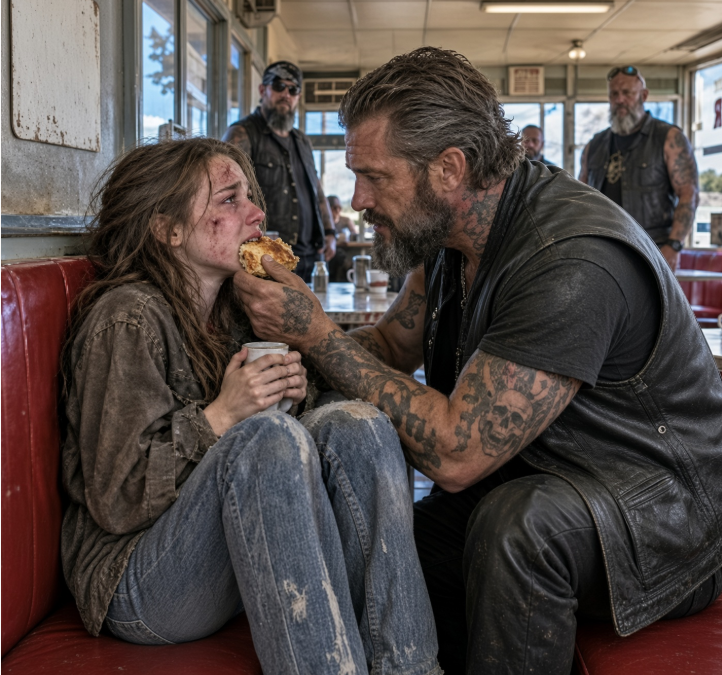
By afternoon, she ended up at Rusty’s Diner because it had a bathroom, a back door, and a booth hidden in the corner.
She told herself she would sit there ten minutes.
Then she would decide.
Police were impossible.
Her father owned judges, prosecutors, and half the men who wore badges in Kern County. Teachers were impossible. Social workers were impossible. Friends were impossible because she no longer had friends, not real ones. Richard Jenkins had made sure of that. Private school, private tutors, private drivers, private everything. A beautiful cage with locked gates and security cameras.
She had been raised like someone precious.
Only recently had she begun to understand she had actually been raised like evidence.
Betty approached for the third time, coffee pot in hand even though Lucy had not ordered coffee.
“Honey,” Betty said softly, “can I get you something besides water?”
Lucy shook her head.
“You sure? Toast? Soup? We got pie.”
“I’m okay.”
Her voice was rough.
Betty’s eyes fell to the bruise on Lucy’s neck, then flicked away because kind people often knew shame did not like being stared at.
“You waiting for someone?”
Lucy’s fingers tightened around the glass.
“No.”
“Need me to call someone?”
“No.”
The answer came too fast.
Betty heard it.
The waitress was in her late fifties, with dyed red hair pinned up badly, a pencil behind one ear, and a heart life had bruised but not hardened. She had seen runaways before. She had seen women come in after bad nights and men come in after worse choices. She knew when fear sat in a booth.
She lowered her voice.
“Sweetheart, if somebody hurt you—”
The sound hit before Lucy could answer.
A low rumble.
Deep.
Mechanical.
It rolled through the floorboards, climbed the legs of the tables, trembled in the water glass beneath Lucy’s hands.
Betty stopped.
The trucker at the counter looked toward the windows.
The rumble grew louder.
Then louder.
Then it became a roar.
Outside, fifteen Harley-Davidsons rolled into the gravel lot in disciplined formation, tires throwing dust into the white July sunlight. Chrome flashed. Engines thundered. The bikes parked in a line as if every rider had rehearsed the movement a hundred times.
Lucy sank back into the booth.
She knew who they were.
Everyone in Bakersfield knew.
The Hells Angels.
Not rumors from television. Not Halloween costumes. Not harmless weekend riders who bought leather vests online. These were the real men, the local charter that people whispered about in courtrooms, bars, police stations, and repair shops.
Her father hated them.
That alone should have comforted her.
It did not.
The diner door chimed.
Everything changed.
The trucker at the counter dropped a five-dollar bill beside his untouched coffee and headed straight for the back exit. Betty froze behind the register. The cook peered through the kitchen window, saw the patches, and disappeared.
The first man through the door filled the frame.
He was enormous.
Six foot four at least, close to three hundred pounds, built like a man carved from old oak and bad decisions. His beard was thick, gray running through black. His forearms were covered in faded prison ink, scars, and grease. A leather cut hung over his broad shoulders, the winged death head patch unmistakable across his back.
ARTHUR SULLIVAN was stitched over one chest pocket.
But nobody called him Arthur.
They called him Grizzly.
Behind him came Tommy “Wrench” Gallagher, wiry and sharp-eyed, with a scar through his eyebrow and mechanic’s hands that never looked clean. Beside Wrench was Bobby “Irish” O’Connor, the charter enforcer, heavy-jawed, red-bearded, and quiet in a way that made silence feel like a weapon.
The rest of the bikers spread out with the ease of men who knew every room became theirs once they entered it.
Grizzly stopped near the counter.
“Coffee, Betty,” he rumbled. “Whole pots. Whatever pie you got left.”
Betty swallowed.
“Sure, Grizz. Right away.”
Lucy stared at the table.
Do not look.
Do not move.
Do not be noticed.
She had learned that at home.
Men like her father noticed defiance first. Men like the ones who attacked her noticed weakness. Lucy had survived by becoming invisible whenever possible.
Grizzly walked toward the back hallway, probably the restroom.
To get there, he had to pass her booth.
Lucy held her breath.
He took two steps past her.
Then stopped.
She closed her good eye.
For one second, the diner was silent except for the old refrigerator humming and the fry oil popping faintly in the kitchen.
Grizzly turned.
His boots scuffed the linoleum.
Lucy felt his shadow fall across the table.
“Kid.”
She flinched.
Grizzly’s voice was lower this time.
Not soft exactly.
Men like him did not become soft easily.
But it was not the voice he had used to order coffee.
“Look at me.”
Lucy did not.
The booth creaked as he lowered himself onto the seat across from her.
She pulled the jacket tighter.
A chair scraped behind him.
Irish stepped closer.
“Everything good, Grizz?”
Grizzly raised one massive hand without taking his eyes off Lucy.
Irish stopped.
Lucy forced herself to lift her face.
She saw him see everything.
The eye.
The lip.
The neck.
The way she leaned away automatically.
The way her hands shook.
Something changed in his expression.
It was not pity.
Pity would have made her look down.
It was recognition.
As if he had seen a language written on her skin and understood every word.
Grizzly leaned forward, resting his forearms on the table. His hands were huge, scarred, oil dark beneath the nails. Lucy noticed he kept them flat where she could see them.
“I ain’t going to hurt you,” he said.
She did not believe him.
But she wanted to.
That frightened her most of all.
Grizzly’s jaw tightened.
“Somebody did, though.”
Lucy swallowed.
The whole diner seemed to tilt around her.
He studied her with eyes bluer and sharper than she expected.
“Who hurt you?”
There it was.
The question everyone had been circling.
Betty behind the counter.
The trucker before he ran.
The teachers who looked at Lucy’s long sleeves.
The school counselor who once asked if everything at home was okay and accepted the first lie because Lucy smiled well.
Who hurt you?
The truth rose in her throat like blood.
Her father’s voice came with it.
If you ever embarrass me, I will make sure no one believes a word you say.
Lucy looked at the biker across from her.
A monster, people said.
A criminal.
A dangerous man.
Maybe she needed a monster.
Maybe the thing chasing her was too powerful for ordinary kindness.
A tear slipped down her bruised cheek.
“My dad,” she whispered.
Grizzly did not move.
The temperature in the diner seemed to drop.
“What’s your dad’s name?”
Lucy’s hands tightened around the water glass.
“Richard,” she said.
Grizzly’s eyes narrowed.
“Richard what?”
She almost stopped.
Then she saw Betty watching with one hand pressed to her mouth.
She saw Wrench at the counter, suddenly still.
She saw Irish’s hand drop toward the knife at his belt.
“Richard Jenkins,” Lucy said. “Judge Richard Jenkins.”
The coffee mug slipped from Wrench’s hand and shattered on the floor.
Nobody bent to clean it up.
Grizzly stared at Lucy.
“You sure about that?”
She nodded quickly, panic rising.
“Please don’t tell him I’m here. Please. He’ll kill me.”
Grizzly’s face became unreadable.
When he finally stood, the booth seemed to breathe again.
“Wrench.”
Wrench stepped forward, eyes dark.
“Yeah?”
“Bring the van around.”
Lucy recoiled. “No. No, I can’t—”
Grizzly turned back to her.
“You got somewhere safe to go?”
She opened her mouth.
Nothing came out.
He nodded once, as if her silence had answered.
“I’m not taking you anywhere you don’t choose,” he said. “But if you walk out of here alone, whatever did that to your face gets another chance.”
Betty came around the counter, trembling but determined.
“I’m going with her,” she said.
Every biker looked at her.
Betty lifted her chin.
“She’s a minor. She needs a woman with her. And if any of you disagree, you can go to hell before dessert.”
For the first time, the corner of Grizzly’s mouth moved.
Not quite a smile.
Respect.
“Fair enough.”
Lucy looked from Betty to Grizzly.
Her breath shook.
“Where would you take me?”
“My clubhouse.”
Her fear must have shown because he added, “It’s ugly, loud, and full of men who don’t know how to use coasters. But nobody gets through the gate without permission.”
“My father can.”
Grizzly’s eyes hardened.
“Your father can try.”
That should not have comforted her.
It did.
Lucy picked up her backpack.
She left the diner between a waitress with shaking hands and a Hells Angel the size of a wall.
The Bakersfield Hells Angels clubhouse sat in the industrial outskirts of the city, behind a high chain-link fence topped with razor wire and years of reputation. The building itself was cinder block and steel, surrounded by motorcycles, old trucks, shipping containers, and enough cameras to make it clear visitors were rarely accidental.
Lucy had expected chaos.
There was some.
Men shouted across the yard. Engines revved. A dog barked from somewhere behind the repair bays. Music thumped inside the main room. The whole place smelled like oil, leather, beer, smoke, and sun-baked asphalt.
But underneath the roughness was order.
The gate opened only after Wrench spoke into a radio. Riders parked in lines. Men watched the street, rooftops, corners. Every movement was noticed.
Lucy stepped out of the van and nearly stumbled.
Grizzly did not touch her.
Betty did.
The waitress took Lucy’s elbow gently.
“You’re okay,” Betty whispered, though her voice said she was not entirely sure.
Inside, the clubhouse main room looked like the kind of place respectable people warned their daughters about. A long bar. Pool tables. Framed photos. Flags. Road signs. Old helmets. Memorial patches under glass. A wall of names Lucy did not understand but knew better than to ask about.
The men inside went silent when they saw her.
Not the silence from the diner.
This one felt different.
Protective, maybe.
Or dangerous in a direction not pointed at her.
A woman with silver hair and tattooed arms emerged from a back office.
Her name was Jo Mercer, and she was not a biker exactly, not patched, but everyone moved when she spoke. Grizzly introduced her as the club’s office manager, which did not explain why three full-grown men made room for her like she outranked them.
Jo took one look at Lucy and said, “Bathroom. First aid. Clean clothes. Food when she can handle it.”
Grizzly nodded.
Lucy followed because Jo’s voice left no room for collapse.
In the bathroom, under bright fluorescent lights, Lucy saw herself properly for the first time.
She nearly threw up.
Jo stood behind her, face controlled.
“Did he do all this?” she asked.
Lucy gripped the sink.
“No.”
Jo’s eyes met hers in the mirror.
Lucy froze.
The truth had slipped.
Jo heard it.
But she did not push.
Instead, she opened a medical kit and cleaned Lucy’s split lip with hands surprisingly gentle for a woman whose knuckles said she had broken noses before.
Betty stayed by the door, arms folded, daring anyone to enter.
Lucy changed into soft sweatpants and a black T-shirt that smelled like detergent and smoke. Jo gave her a heavy wool blanket and led her to a sofa in the corner of the main room where she could see every entrance.
“Sit,” Jo said.
Lucy sat.
Someone brought soup.
Someone else brought orange juice.
A younger biker with kind eyes placed a phone charger on the table and backed away without speaking, as if approaching wounded animals was something he understood.
Lucy could not eat.
She held the bowl anyway because the warmth helped her hands stop shaking.
Behind a heavy oak door at the back of the clubhouse, men began to argue.
The door was thick.
Not thick enough.
Lucy heard her father’s name.
She heard “kidnapping.”
She heard “judge.”
She heard Grizzly’s voice, low and furious, cutting through every other sound.
Inside the room they called church, the officers sat around a scarred oak table under yellow light.
Irish slammed one fist down.
“Are you out of your mind? You know who Richard Jenkins is?”
Grizzly stood at the head of the table, hands planted on the wood.
“I know exactly who he is.”
“He’s a superior court judge. He signed warrants on three of our shops last year. He has friends in Sacramento, friends in the federal building, friends in every police department from here to Fresno.”
Wrench sat forward, scarred eyebrow twitching.
“Grizz, Irish ain’t wrong. If Jenkins says we took his daughter, every cop in California comes through that gate.”
“I didn’t take her,” Grizzly said. “She got in the van because she was terrified to stay where she was.”
“That won’t matter.”
“It matters to me.”
Irish leaned back, anger and fear fighting on his face.
“Think about the club.”
“I am.”
“No, you’re thinking about Emily.”
The room went dead.
Grizzly’s eyes lifted slowly.
Even Irish seemed to regret the words the second they left him.
Emily Sullivan had been Grizzly’s daughter.
She had died at thirteen from leukemia five years earlier, after seventeen months of hospital rooms, chemo, bone pain, hope, relapse, and a funeral where men who had faced bullets could not look at a small white coffin without breaking.
Grizzly had never been the same.
He had become quieter.
More controlled.
More dangerous in the way grief can make a person when it burns cold instead of hot.
Irish lowered his voice.
“I’m sorry.”
Grizzly did not answer immediately.
When he did, his voice was calm enough to scare every man in the room.
“That girl out there is not Emily.”
“I know.”
“But she is a child with bruises on her throat. And some man made her believe no one would protect her.” Grizzly looked around the table. “If this patch means we only protect our own, it doesn’t mean much.”
Wrench rubbed both hands over his face.
“There’s more.”
Every eye turned to him.
He reached into his saddlebag and pulled out a thick manila folder.
Grizzly stared at it.
“What is that?”
“Something I should’ve brought you months ago.”
Wrench slid it across the table.
“You told me to look into Jenkins after the raid. I had a guy at county records pull old filings, campaign finance stuff, sealed dockets if he could get them. Mostly smoke. Then I found something weird.”
Grizzly opened the folder.
Birth certificate.
Adoption petition.
Hospital records.
Property deeds.
Old court orders.
Wrench pointed.
“Lucy Jenkins. Born to Richard and Margaret Jenkins, according to the official record. But Margaret Jenkins had a hysterectomy five years before that birth date. Medical records confirm it. They couldn’t have biological kids.”
Irish frowned.
“Illegal adoption?”
“Worse,” Wrench said. “The adoption file was sealed by Jenkins himself after the fact. He used a dependency court contact, falsified guardianship records, and buried the original birth certificate.”
Grizzly’s jaw tightened.
“Whose kid is she?”
Wrench hesitated.
That hesitation made Grizzly’s face change.
“Say it.”
“Her real name was Sarah Cortez.”
The room seemed to hold its breath.
“Mother was Maria Cortez,” Wrench continued. “Died of an overdose when the girl was almost two.”
Grizzly stared at him.
Wrench’s voice dropped.
“Maria was with Liam before he got locked up.”
Grizzly’s hand closed slowly around the paper.
His brother Liam had been dead twelve years.
Liam, who laughed too loud and fought too fast.
Liam, who once carried Grizzly home after a bar fight even though Grizzly was older and bigger.
Liam, who stood before Judge Richard Jenkins for possession with intent because an ambitious prosecutor wanted biker headlines and Jenkins wanted reelection photos.
Maximum sentence.
Ten years.
Liam survived two.
Then came the call from Pelican Bay.
Stabbed in the yard.
Dead before medics reached him.
Grizzly had buried his younger brother on a gray morning and promised their mother, already dying of emphysema, that he would not start a war over it.
He had kept that promise.
Barely.
Now Wrench sat across from him saying Jenkins had not only helped send Liam to prison.
He had stolen Liam’s daughter.
Grizzly’s voice came out hollow.
“You’re telling me that girl out there is my niece.”
Wrench nodded once.
“And Jenkins knew.”
“Yes.”
The paper crumpled in Grizzly’s fist.
For a moment, the man at the head of the table vanished, and something older, darker, and more animal took his place.
Irish saw it and stood.
“Grizz.”
No answer.
“Grizz, listen to me. If you go to Jenkins with rage in your head, we lose her.”
That reached him.
Barely.
Grizzly looked at the closed door.
Outside, somewhere beyond it, a sixteen-year-old girl sat wrapped in a blanket, believing she had no family in the world.
His niece.
Liam’s kid.
Blood he never knew had survived.
“What did Jenkins want with her?” he asked.
Wrench looked grim.
“I don’t know yet.”
Grizzly opened his fist and smoothed the paper with shaking hands.
“Then we find out.”
He reached for the door.
Irish stepped in front of him.
“Not like this.”
“Move.”
“No.”
The room tensed.
Irish was one of the few men alive who would stand between Grizzly and vengeance.
“That girl needs protection more than revenge,” Irish said. “If Jenkins is dirty enough to steal a child through sealed court records, he’s dirty enough to have traps waiting. We don’t kick his door in blind.”
Grizzly breathed hard.
“You got a better idea?”
Irish looked at Wrench.
Wrench looked at the folder.
Then at the ceiling, listening to distant traffic, engines, life moving outside the bunker of their world.
“We talk to her,” Wrench said. “Careful. We find out what she knows. Then we decide who bleeds.”
Grizzly stared at both of them.
Then he nodded once.
Not because he was calm.
Because he had found a reason not to explode.
Yet.
Lucy looked up when the oak door opened.
Grizzly came out first, but he stopped several feet away from her sofa. Irish and Wrench remained behind him. Jo leaned against the bar, arms crossed, eyes sharp.
Betty sat beside Lucy, holding a mug of coffee she had not touched.
Grizzly lowered himself into a chair across from the sofa.
It creaked under him.
“Lucy,” he said.
The name felt wrong now.
He saw it land on her face like something borrowed.
“Is that what you want us to call you?”
Her good eye narrowed slightly.
“What do you mean?”
He looked down at the folder in his hands.
“Do you know another name?”
All color drained from her face.
The soup bowl slipped in her hands.
Betty caught it before it spilled.
Lucy stood suddenly.
“I should go.”
Grizzly did not move.
“Nobody’s stopping you.”
That made her freeze.
“Nobody here is locking a door on you,” he said. “But if you know something, you need to tell me. Because whatever you’re running from followed you before. It may follow you here.”
Lucy looked toward the exit.
Two bikers stood near it, not blocking it exactly, but present.
Jo snapped her fingers at them.
“Move.”
They moved.
Lucy saw the path open.
It scared her more than a locked door.
Choice can be terrifying when control is all you’ve known.
She sat back down slowly.
Grizzly placed the folder on the table between them.
“I know Richard Jenkins isn’t your biological father.”
Lucy stared at the folder.
Her lips parted.
“You know?”
“I know your real name may be Sarah.”
She flinched.
Betty whispered, “Oh, honey.”
Lucy gripped the blanket.
“He told me my birth mother was an addict,” she said. “He said nobody wanted me. He said he saved me from the system.”
Her voice shook.
“But I found papers. In his safe. My name. My real name. Sarah Cortez. A woman named Maria. A man named Liam Sullivan.”
She looked at Grizzly then.
Really looked.
His face had gone still.
“You know that name,” she whispered.
Grizzly’s throat worked.
“Liam was my brother.”
The room seemed to disappear around her.
Lucy stared at the huge biker as if he had become something impossible.
“My…”
She could not say uncle.
Not yet.
Grizzly did not force it.
“He died when you were little,” he said. “I never knew about you.”
Tears gathered in her uninjured eye.
“He told me my family was trash.”
Grizzly’s jaw tightened.
Lucy kept talking because if she stopped, she might never start again.
“He said my mother chose drugs over me. He said Liam was a criminal and I should be grateful Richard gave me his name. But then I found adoption papers that didn’t make sense. Bank records. Court files. And something else.”
Her hand moved toward the backpack.
Every biker in the room watched.
She unzipped a side pocket, reached inside, and pulled out a small silver flash drive.
The room changed.
Wrench stepped forward.
Lucy clutched it tighter.
“No.”
Grizzly lifted a hand.
Everyone stopped.
Lucy looked at him.
“I don’t know everything on it,” she said. “But I saw names. Accounts. Payments. My father—Richard—he’s been taking money from someone. Not just campaign donations. Real money. Hidden money. There were trucking routes, court cases, police names.”
Irish swore softly.
Lucy continued.
“I thought if I had it, I could make him let me go. Emancipation, money, a bus ticket, anything. I left him a note saying I copied the drive and if he came after me, I’d send it to the press.”
Wrench closed his eyes.
“That’s why they hit you.”
Lucy nodded.
“Men grabbed me before I got out of the neighborhood. They weren’t his men. Not exactly. They kept asking where the ledger was. I didn’t tell them.”
Grizzly’s voice was dangerously soft.
“Did Richard hit you?”
Lucy looked down.
“Yes.”
The word was small.
“He didn’t do all of this,” she said. “But he’s hurt me before. When I embarrassed him. When I asked questions. When I said I wanted to know about my real parents. He slapped me. Shoved me. Locked me in my room. Told me I was ungrateful.”
She swallowed.
“The men who did this wanted the drive. But he made my life a prison long before them.”
Nobody spoke.
Grizzly looked at the flash drive in her hand.
“What you have there may be enough to bring down men much bigger than Jenkins.”
“I know.”
“Do they know you came here?”
Lucy’s face crumpled.
“I don’t know.”
The answer arrived five minutes later.
A biker at the security monitors shouted from the front room.
“Black SUVs at the gate!”
Everyone moved.
Not panicked.
Prepared.
Jo took Lucy by the shoulders.
“Basement. Now.”
Lucy froze.
Grizzly crouched slightly, bringing his face closer to hers.
“Sarah.”
The name hit like a match in a dark room.
She stared at him.
“They came for that drive,” he said. “Not for you. Not really. You understand? They want what you took. That means you are not helpless. You are holding the thing they fear.”
Her breathing slowed just enough to hear him.
“I need you to go with Jo. Stay low. Stay quiet. And if anyone but me, Jo, Betty, Irish, or Wrench opens that door, you hide behind the water heater and you do not make a sound.”
Betty stood.
“I’m going with her.”
Jo nodded.
Grizzly looked at Lucy one last time.
“Can you trust me for ten minutes?”
She looked at the man who had asked who hurt her and listened to the answer like it mattered.
“Yes,” she whispered.
“Good.”
Jo took her hand and led her through the back hallway.
Behind them, the gate exploded inward.
The attack on the clubhouse did not look like movies.
Movies made violence clean.
This was noise, smoke, screaming metal, alarms, barking dogs, men shouting over each other, glass bursting, engines revving, the sharp cracks of gunfire from outside the compound and the heavier answering blasts from behind reinforced walls.
Lucy huddled in the basement storage room between Betty and Jo, hands over her ears, the flash drive hidden inside her sock.
Betty prayed.
Jo held a pistol pointed at the door with both hands, her face pale but steady.
Lucy expected anger when Grizzly returned.
She expected blame.
You brought this here.
You got people hurt.
You should have stayed gone.
That was what Richard would have said.
That was what every abuser taught their victim to expect: that survival itself was an inconvenience to others.
Upstairs, the fight lasted seventeen minutes.
It felt like a lifetime.
When the basement door finally opened, Lucy nearly screamed.
Grizzly stood there, bleeding from a shallow cut across one cheek, shotgun hanging loose at his side.
His eyes found her immediately.
“It’s over,” he said.
She stared at him.
“They’re gone?”
“For now.”
“Did anybody—”
“No brothers dead.”
She burst into tears.
“I’m sorry,” she sobbed. “I’m so sorry. I didn’t know they would follow me. I didn’t—”
Grizzly crossed the room in three steps, then stopped himself, as if remembering she might fear sudden movement.
He lowered himself to one knee on the concrete.
“You listen to me,” he said. “They chose to come here. Not you.”
“But I brought—”
“You brought truth.”
She cried harder.
He held out one hand, palm open.
She hesitated, then placed the flash drive in it.
Her fingers were shaking.
“I didn’t tell them,” she whispered. “Even when they hit me. I didn’t tell them where it was.”
Grizzly looked at the tiny piece of metal in his scarred palm.
Then he closed her hand back over it.
“You kept it safe this long,” he said. “You hold it until we put it where it can do the most damage.”
“Where?”
His expression darkened.
“Somewhere even Jenkins can’t bury it.”
At dawn, the clubhouse looked like a wounded animal that had survived the night.
The gate was twisted open. Two motorcycles were burned near the fence. Windows were boarded with plywood. Bullet marks scarred the cinder block walls. The air smelled of smoke, gasoline, and burnt coffee because Betty, somehow, had decided people in crisis still required caffeine.
Grizzly sat in the office with Wrench, Irish, Jo, and a laptop older than some prospects.
Lucy sat on the couch nearby, wrapped in a blanket and fighting sleep.
Betty refused to leave her side.
On the screen, Wrench opened the drive.
At first, it was folders.
Then spreadsheets.
Then names.
So many names the room went quiet.
Bank accounts.
Offshore transfers.
Campaign contributions.
Property companies.
Trucking routes.
Drug case dismissals.
Sealed warrants.
Judges.
Deputies.
City council members.
Federal agents.
Prosecutors.
The Navaro cartel had not merely paid people.
It had bought infrastructure.
And Judge Richard Jenkins sat near the center of it, laundering money through development projects, protecting transport routes, punishing rivals through court orders, and using his reputation as a tough-on-crime judge to hide the fact that he had sold justice piece by piece.
Irish leaned back.
“We can’t keep this.”
“No,” Grizzly said.
“If we do, they’ll keep coming.”
“Yes.”
“If we destroy it, they’ll still keep coming.”
“Yes.”
Wrench looked at him.
“You got a plan?”
Grizzly stared at the screen.
For twelve years, he had hated the federal agent who tried to put him away.
Special Agent David Reed of the DEA had raided club properties, flipped informants, frozen accounts, and once told Grizzly across an interrogation table, “Men like you always confuse loyalty with immunity.”
Grizzly had smiled then and said nothing.
He had despised Reed because Reed was relentless.
Now he needed relentless.
Grizzly pulled a burner phone from his vest.
Irish frowned.
“Who are you calling?”
“Someone who hates me.”
Wrench nodded slowly.
“Reed.”
Grizzly dialed.
The phone rang four times.
A tired, sharp voice answered.
“Special Agent Reed.”
“David.”
Silence.
Then, coldly, “Sullivan.”
“Miss me?”
“I’m hanging up.”
“I have the Navaro cartel’s master ledger.”
Another silence.
Longer.
“Repeat that.”
“You heard me.”
“If this is a joke—”
“It lists money routes, judges, deputies, prosecutors, drop points, shell companies, and federal leaks. I have a sixteen-year-old witness they nearly beat to death trying to get it back.”
Reed’s voice changed.
“What do you want?”
“Protection for the girl. Witness custody that Jenkins can’t touch. Federal medical evaluation. Immunity consideration for my people for anything tied to last night’s defensive action at the clubhouse.”
“You asking me to believe the Hells Angels were victims?”
“I’m asking you to read the sample I’m sending in thirty seconds and decide if you want to be the man who passed on the biggest cartel case in California because you didn’t like the package it came in.”
Reed said nothing.
Wrench sent one encrypted page.
On the phone, Reed inhaled sharply.
“Where did you get this?”
“From the bravest kid in Bakersfield.”
Lucy looked up.
Grizzly did not look away from Reed’s name on the burner screen.
“Where do we meet?” Reed asked.
“No police station. No courthouse. No local agents. Jenkins owns too much.”
“You don’t dictate federal procedure.”
“Then I send this drive to every newspaper from here to New York and let your director explain why the DEA ignored it.”
A pause.
“You always were a charming man.”
“Abandoned airstrip off Route 58. Noon.”
“I’m not coming alone.”
“Neither am I.”
“Bring the girl.”
“No.”
“She’s the witness.”
“She’s a child who hasn’t slept, has a swollen eye, and just survived a hit team. You get the drive first. You earn the witness.”
Reed was quiet.
Then he said, “Noon.”
The meeting at the airstrip burned into Lucy’s memory even though she was not there.
She heard the story later in pieces, from Betty, Wrench, Irish, and finally Grizzly, each leaving out details they thought would scare her and each failing because the truth lived between their omissions.
The abandoned Mojave airstrip shimmered under noon heat.
Grizzly arrived on his Harley with Irish and Wrench behind him, the flash drive sealed inside a metal case beneath Grizzly’s vest.
Agent David Reed came in an armored federal SUV with two agents and a medic, despite the “come light” agreement. Grizzly expected that. Men like Reed did not survive by trusting outlaws.
But Grizzly had arranged one more arrival.
Judge Richard Jenkins.
Not kidnapped this time.
Exposed.
Wrench had spent the morning doing what Wrench did best: digging through systems people thought were clean. He found Jenkins’s emergency communication with a cartel contact after Lucy disappeared. He found the judge begging for protection. He found instructions to meet “H.R.” at the airstrip with payment and a promise that the girl would be recovered.
So when Jenkins’s silver Mercedes rolled up from the east, Reed’s agents were already recording.
Jenkins stepped out in sunglasses and a linen suit, looking irritated until he saw Grizzly standing beside the federal SUV.
Then he stopped.
The cartel lieutenant beside him reached for his weapon.
Federal rifles lifted.
The moment broke open.
Wrench tossed a tablet to Agent Reed.
“Live messages,” he said. “Judge arranged the meet.”
Jenkins looked at Reed.
Then at Grizzly.
Then at the metal case.
His entire face seemed to collapse inward.
“You don’t understand,” Jenkins said.
Grizzly almost laughed.
Those were always the first words of men caught under the weight of their own choices.
You don’t understand.
No.
Everyone understood now.
Reed opened the case.
The flash drive lay inside.
Tiny.
Silver.
Enough to bury empires.
Grizzly looked at Jenkins.
“You stole my brother’s daughter.”
Jenkins swallowed.
“I saved her from addicts and criminals.”
“You raised her in a house full of lies.”
“I gave her education. Money. A name.”
“You gave her bruises.”
Jenkins’s face twitched.
“I never meant—”
Grizzly stepped closer.
Reed tensed, but did not stop him.
Grizzly lowered his voice.
“I’m not going to kill you, Richard.”
Jenkins stared at him, disbelieving.
Grizzly smiled without warmth.
“That would be too quick. You’re going to live long enough to hear her real name spoken in court. You’re going to sit at a defense table while every secret you buried gets read into the record. And when you look around for the men you bought, they’ll be too busy saving themselves to save you.”
Jenkins’s mouth opened.
No sound came out.
Reed signaled.
Federal agents cuffed Judge Richard Jenkins on the tarmac.
The cartel lieutenant went down too.
Not in a blaze of glory.
Not like a movie villain.
He simply realized the ledger had made everyone around him evidence, and even armed men hesitate when prison becomes more certain than pride.
By sunset, federal warrants hit Bakersfield like thunder.
Homes.
Offices.
Warehouses.
Law firms.
Shell companies.
The courthouse.
The sheriff’s administration building.
News helicopters circled downtown. Reporters stood outside the courthouse where Judge Jenkins had once entered through the front doors like a man born to decide other people’s fates.
This time, he entered through a side door in cuffs.
Lucy watched it on television from the clubhouse sofa.
No.
Sarah.
The name still felt strange.
Sarah Cortez Sullivan.
Maria’s daughter.
Liam’s daughter.
Grizzly’s niece.
Betty sat on one side of her. Jo on the other.
Grizzly stood behind the couch with his arms crossed, pretending he did not need to sit down.
When the news showed Jenkins being led into federal custody, Sarah expected to feel victory.
She did not.
She felt sick.
Then light.
Then empty.
Then angry.
Then guilty for feeling anything at all.
“Is it over?” she asked.
Grizzly looked at the screen.
“No.”
Her heart sank.
“But the running part is.”
That was true.
The next months were not simple.
Stories like hers never ended at rescue.
Rescue was only the first door.
After that came doctors, investigators, statements, protective custody meetings, DNA tests, trauma counselors, court advocates, lawyers, and paperwork so thick it seemed impossible that a human life could fit inside folders.
Sarah learned that her mother, Maria Cortez, had been nineteen when Sarah was born.
Maria had loved Liam Sullivan, according to two people who remembered them from those days. They were reckless, poor, and doomed by forces bigger than young love, but real. Liam went to prison before he ever knew Maria was pregnant. Maria spiraled after his sentencing. When she died, Richard Jenkins used his position to take the child quietly.
Why?
Insurance, prosecutors said.
Leverage, others suggested.
Cruelty, Grizzly believed.
Maybe all three.
Jenkins had known Liam’s club connections. He had known a Sullivan child could be valuable if he ever needed pressure, protection, or a hidden card against men he feared. But over time, the leverage became possession. Possession became control. Control became rage whenever Sarah grew old enough to question him.
The DNA test confirmed what Wrench’s records already proved.
Sarah was Liam Sullivan’s biological daughter.
Grizzly received the result in silence.
Then he walked outside behind the clubhouse and stayed there for an hour.
Sarah found him standing near the fence, looking out at the industrial yards.
“You okay?” she asked.
He wiped his face before turning, but not fast enough.
“No,” he said honestly. “But I’m steady.”
She stood beside him.
For a while, neither spoke.
Then she asked, “Was he like you?”
“Liam?”
She nodded.
Grizzly smiled faintly.
“Worse.”
That startled a laugh out of her.
“He was smaller than me but louder. Thought every room needed his opinion. Could fix anything with an engine but couldn’t keep his own life from falling apart. Loved too hard. Fought too fast.”
Sarah looked down.
“Would he have wanted me?”
The question broke Grizzly in a place violence never had.
He turned fully toward her.
“Sarah, listen to me.”
She did.
“He would have torn the world apart to get to you.”
Tears slipped down her face.
“So why didn’t anyone know?”
“Because bad men hide children better than good men find them sometimes.”
She cried then.
Not the panicked sobs from the basement.
Not the frightened tears from the diner.
These were grief tears.
For a father she never knew.
For a mother reduced to court records.
For a childhood stolen by a man who called captivity love.
Grizzly did not hug her until she stepped into his arms herself.
When she did, he held her like something sacred.
Not fragile.
Sacred.
The trial of Richard Jenkins became the biggest corruption case Kern County had ever seen.
He was charged federally with money laundering, conspiracy, obstruction, child endangerment, fraud, and multiple counts tied to cartel cooperation. State charges followed. Others fell with him. Deputies. Attorneys. Campaign staff. A city councilman. A retired police captain. Two prosecutors resigned before indictment and were indicted anyway.
The press loved the headline version.
Judge Raised Cartel Witness As His Daughter.
Hells Angel Saves Niece From Corrupt Judge.
Cartel Ledger Hidden By Teen Brings Down County Power Network.
But headlines could not capture what it felt like for Sarah to testify.
She wore a navy dress Jo helped choose. Betty fixed her hair. Grizzly drove her to court in a black SUV because the federal witness team allowed it after much argument and because Agent Reed finally admitted out loud that Sarah was calmer when her uncle was nearby.
Before she entered the courtroom, Sarah stood in the hallway trembling.
“I can’t do this.”
Grizzly crouched in front of her, enormous even on one knee.
“Yes, you can.”
“What if they don’t believe me?”
“They will.”
“What if I mess up?”
“Then you breathe and answer again.”
“What if I look at him and I freeze?”
Grizzly’s voice softened.
“Then look at me.”
She did.
He tapped two fingers against the patch on his vest.
“You are not his secret anymore.”
Sarah testified for four hours.
She told the truth.
Not perfectly.
Truth from trauma rarely comes out clean. It stops. Shakes. Doubles back. Forgets dates. Remembers smells. Apologizes for needing water. But it came.
She told them about the safe.
The records.
The drive.
The men who attacked her.
The years of control inside the Jenkins home.
The false name.
The threats.
The slap that split her lip when she said she wanted to find her birth family.
Jenkins sat at the defense table in a gray suit.
He did not look powerful anymore.
That surprised Sarah.
She had expected the courtroom to restore him, to give him back his robe, his height, his voice.
But without the bench, without the seal behind him, without officers moving when he spoke, he was just a man.
An aging, frightened man who had mistaken authority for innocence.
At one point, his attorney asked, “Isn’t it true, Miss Jenkins, that you were angry at my client because he gave you rules?”
Sarah looked at the attorney.
Then at Jenkins.
Then at Grizzly in the back row.
“My name is Sarah Sullivan,” she said. “And no. I was angry because he gave me a cage and called it a home.”
The courtroom went still.
Even the judge presiding over the case paused before instructing the attorney to continue.
Grizzly lowered his head.
Irish later claimed he had dust in both eyes.
Jenkins was convicted on most major counts.
The sentencing hearing came months later.
Sarah chose to speak.
She stood at the podium, hands shaking but voice clear.
“You told me no one would ever believe me,” she said, looking directly at Jenkins. “You told me my real family was trash. You told me I should be grateful because you fed me, educated me, and gave me your name. But love is not ownership. Protection is not control. And a name built on lies is not a gift.”
Jenkins stared at the table.
“You stole my past,” she continued. “You don’t get my future.”
The judge sentenced him to decades in federal prison.
Not forever.
But long enough.
Sarah did not smile.
Justice, she learned, was not happiness.
It was a door locking behind the person who used to hold the keys.
Afterward, outside the courthouse, reporters shouted questions.
Sarah ignored them.
Grizzly walked beside her, one hand hovering near her back without touching unless she needed him.
Agent Reed stood near the steps.
For a long moment, he and Grizzly looked at each other.
Old enemies.
Temporary allies.
Reed extended a hand.
Grizzly stared at it.
Then shook it.
“Don’t make me regret this,” Reed said.
Grizzly snorted. “That’s usually my line.”
Reed looked at Sarah.
“You did something brave.”
Sarah glanced at Grizzly.
“I had backup.”
Reed nodded.
“Good. Everyone should.”
Three months after the sentencing, Rusty’s Diner looked the same and completely different.
Same cracked red booths.
Same bad coffee.
Same flickering sign.
Same Betty behind the counter, though now she had a framed newspaper clipping near the register and yelled at anyone who stared at it too long.
Sarah sat in the corner booth with a vanilla milkshake, her favorite thing she had never been allowed to order as Lucy because Richard said sugar made girls soft and discipline made them worthy.
She wore a denim jacket that fit properly.
On the inside lining, where only she could see it, Jo had stitched a small patch:
SARAH SULLIVAN
FOUND, NOT OWNED.
Her bruises had healed.
Some scars remained.
Not all visible.
She was living in a protected foster placement arranged through federal victim services, but the truth was more complicated and more human than any paperwork suggested. She spent weekends at the clubhouse when permitted. Betty became her emergency contact. Jo took her shopping for clothes and school supplies. Wrench taught her basic mechanics. Irish taught her how to spot exits in any room and then, more importantly, how to stop needing to.
Grizzly was still learning how to be an uncle.
He was terrible at many parts.
He bought too many things.
He glared at teenage boys who did not exist yet.
He once packed her school lunch with three protein bars, beef jerky, and a pocketknife because he misunderstood “balanced meal.”
But he showed up.
Every time.
And to Sarah, that was the part that mattered most.
The diner door chimed.
Grizzly walked in, filling the doorway just as he had that first day.
Only this time, Sarah did not shrink back.
Betty called, “Coffee?”
“Whole pot,” Grizzly said. “And pie.”
“You always say that like I’m hiding pie from you.”
“You are.”
“Only from men who don’t tip.”
He grinned and slid into the booth across from Sarah.
“You ready?”
She narrowed her eyes.
“For what?”
“Wrench finished the bike.”
Her eyes widened.
“No way.”
“Small one. Eight-eighty-three Sportster. Used. Low seat. Nothing stupid.”
“You’re going to teach me?”
“Jo is going to teach you.”
Sarah frowned. “Why Jo?”
“Because I enjoy being alive, and Jo said if I teach you first, she’ll remove my beard with pliers.”
Sarah laughed.
The sound came easier now.
Not always.
But more often.
Grizzly watched her, and for a second, grief and gratitude moved across his face together.
“You look like him when you laugh,” he said.
Sarah’s smile softened.
“My dad?”
Grizzly nodded.
Not Richard.
Never Richard.
Liam.
She reached across the table and placed her hand over his scarred fist.
“Tell me about him again.”
Grizzly leaned back.
Outside, engines waited.
Not as a threat.
Not as thunder chasing her.
As something steady.
Something that could carry her forward.
“He once tried to rebuild a carburetor in your grandmother’s kitchen,” Grizzly said. “Got grease on the curtains. My mother chased him out with a wooden spoon.”
Sarah laughed again.
Grizzly continued.
He told her about Liam’s crooked smile. Maria’s singing voice. The first bike Liam wrecked. The way her father loved chili too spicy and music too loud. The mistakes. The goodness. The humanity Richard Jenkins had tried to erase.
Sarah listened like someone gathering pieces of herself from the floor and realizing not all of them were broken.
When they finally stood to leave, Betty came around the counter and hugged her.
“You come back tomorrow,” Betty said.
Sarah smiled. “You say that every time.”
“And you keep needing to hear it.”
That was true.
Outside, the California sun was blinding.
Wrench stood beside a black Sportster with polished chrome and a small helmet hanging from the handlebar. Jo leaned against the bike, arms crossed.
“You drop it, you pick it up,” Jo said.
Sarah grinned.
“Yes, ma’am.”
Irish stood nearby pretending not to care.
Several bikers watched from their machines.
Grizzly handed Sarah the helmet.
She took it.
For a moment, the weight of it made her think of all the things that had happened since the diner booth.
The question.
Who hurt you?
The answer.
My dad.
But that had not been the full truth.
The fuller truth was messier and stronger.
Her false father hurt her.
Cartel men hurt her.
Systems failed her.
A judge stole her.
A dead man had loved her without knowing she existed.
An outlaw uncle found her in a diner and decided her life was worth more than his safety.
And she, Sarah Sullivan, had survived long enough to learn that family was not always the people who raised you.
Sometimes family was the person who heard your whisper in a room full of noise and chose to believe it.
She put on the helmet.
Grizzly’s voice rumbled beside her.
“You scared?”
Sarah looked at the bike.
Then at the road.
Then at the men and women waiting for her, patched, scarred, imperfect, loyal.
“A little,” she said.
Grizzly nodded.
“Good. Fear keeps you honest.”
Jo swung one leg over the bike and patted the seat behind her for the first slow lesson around the empty side lot.
Sarah climbed on.
The engine started beneath her.
The vibration moved through her body, not like the terrifying roar outside Rusty’s that first day, but like a heartbeat she was finally allowed to claim.
As the bike rolled forward, Sarah looked back once.
Grizzly stood in the sun, arms crossed, watching like a guardian carved from leather and grief.
For the first time in her life, she was not being watched to be controlled.
She was being watched because someone wanted to make sure she made it safely into the future.
And as the Sportster moved into the light, Sarah Sullivan did not feel like a runaway anymore.
She felt like a girl going home.

