A 3-Year-Old Orange Cat Saw Moving Boxes Appear in His Apartment and Refused to Let His Human Pack—But That Night, He Realized the Boxes Weren’t the Real Reason She Was Falling Apart.
PART3:
Ava said “it’s fine” the way other humans say “the building is on fire but maybe the flames are decorative.”
The rent had gone up before. I knew because she had said many things to the empty apartment, including “Are they kidding me?” and “This place has mice, and I don’t mean Meatball’s emotional support mice.” That offended me slightly because my toy mice were hardworking citizens.
This time was different.
This time, after opening the envelope, Ava sat on the kitchen floor with her back against the cabinet and looked at the wall for a long time.
I approached.
She reached out and rested one hand on my head.
“I don’t know, buddy,” she whispered.
Buddy.
Not Meatball.
Not sir.
Buddy.
That was serious.
The second warning came two weeks later when the heater failed.
A cold snap rolled through the city, sharp and gray, the kind of cold that crawled under doors and made the windows sweat. The radiator in the living room clanked twice, gave one dramatic sigh, then refused further participation.
Ava called the office.
“Yes, hi, this is apartment 3C again,” she said, pacing in wool socks. “The heat is still not working.”
She listened.
“No, space heaters aren’t enough. It’s thirty-eight degrees outside.”
She listened longer.
Her jaw tightened.
“I understand maintenance is busy, but I put in the request three days ago.”
I sat on the couch under a blanket, offended by the climate and by the entire concept of property management.
Then Ava said a name I already disliked.
“Please just have Mr. Crane call me back.”
Victor Crane.
The landlord.
He owned Maple Ridge Court and two other buildings on our block. I had seen him many times through the window or from the crack beneath our door when he walked the halls.
Victor Crane was tall and silver-haired, with polished shoes, a wool coat, and a voice that always sounded warmest when other people were watching. He called elderly tenants “sweetheart” and young tenants “kiddo” and service workers “my friend,” but he said all those things in a way that made them feel smaller, not seen.
He did not like cats.
This was enough information for me to condemn him.
Once, when he came to inspect a leak under the kitchen sink, I stood in the middle of the floor and looked directly at him.
He looked at Ava and said, “You sure that thing is allowed?”
That thing.
I have remembered every syllable.
Ava had straightened.
“Yes,” she said. “Meatball is on the lease.”
Victor smiled like a man pretending to be reasonable. “Just checking. Pets can cause damage.”
I knocked a refrigerator magnet onto the floor without breaking eye contact.
Damage can be arranged.
The heat did not get fixed for five more days.
During that time, Ava worked wrapped in two blankets. I slept on her lap more than usual, not because I was concerned, but because she was warm and mine. Once, she woke up at 2:00 a.m., found me curled against her chest, and whispered, “You’re a good boy.”
I pretended to be asleep.
Praise is best received without encouraging emotional dependency.
By November, the apartment was full of paper.
Bills on the table. Notes beside her laptop. Envelopes on the counter. A yellow legal pad where Ava wrote numbers and crossed them out and wrote them again smaller, as if smaller numbers were less dangerous.
Her freelance clients had slowed down. One company delayed payment. Another disappeared completely after asking for three revisions and saying they would “circle back.” Humans who say “circle back” are usually running away in straight lines.
Ava applied for part-time jobs. She updated her portfolio. She called her bank. She called her credit card company. She called someone named Denise who owed her $1,400 and used the word “processing” six times.
At night, she ate crackers for dinner and told me she was not hungry.
I knew she was lying.
She fed me properly.
That made it worse.
A human who neglects herself but opens chicken pâté on schedule is not irresponsible.
She is drowning politely.
The morning the moving boxes arrived, I had just finished my second breakfast and was cleaning my stomach area with the dignity of a monarch when Ava came through the door carrying two flat cardboard boxes from the lobby.
I froze.
She froze.
We looked at each other.
“Don’t start,” she said.
That told me everything.
Humans only say “don’t start” when there is already something to start.
The boxes hit the floor near the kitchen table.
Flat.
Brown.
Threatening.
I stood and approached cautiously.
They smelled like dust, shipping tape, the building lobby, and betrayal.
Ava rubbed both hands over her face. She wore black leggings, an oversized gray sweater, and the expression of a person who had been awake for too many hours even though the sun was barely up.
She sank onto the floor beside the boxes and opened her phone.
For several minutes, she scrolled in silence.
Then she whispered, “I don’t know if I can keep doing this.”
I am not an expert in human language.
They use too many words when three strong meows would solve most problems.
But I understood enough.
My apartment was under threat.
My human was considering relocation.
This was unacceptable.
I launched Operation Stay Put.
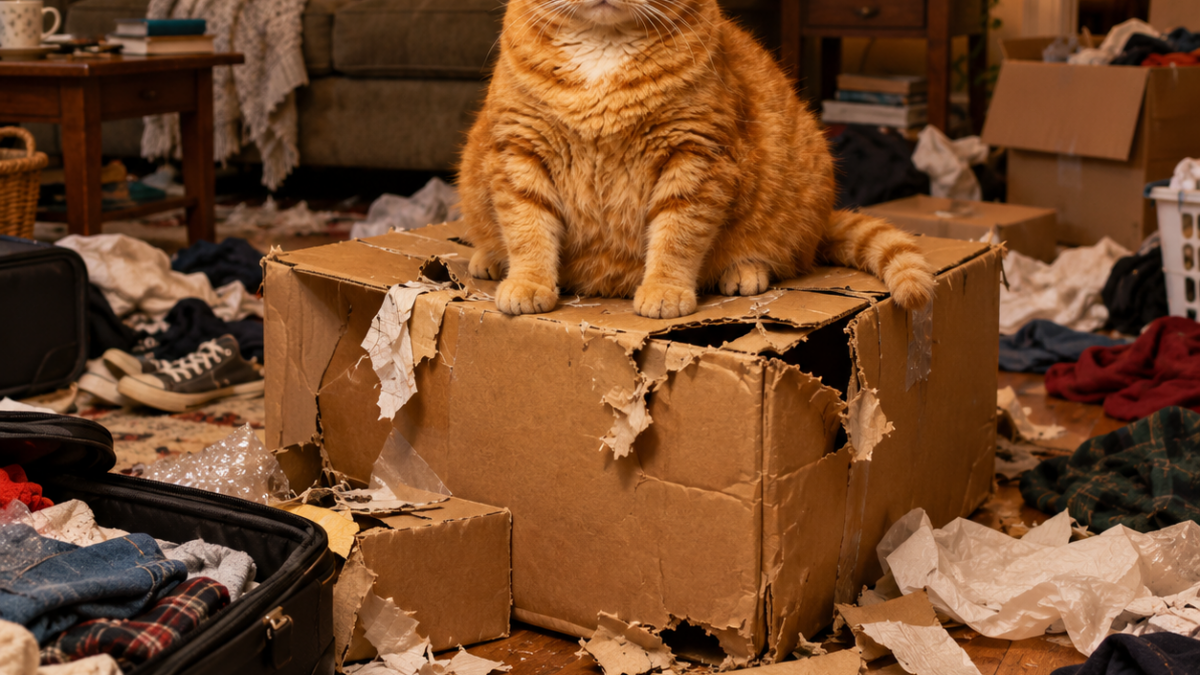
First, I sat on the boxes.
Ava looked at me. “Really?”
I widened my body.
This is a technique orange cats learn naturally. We become furniture. We become landscape. We become law.
She sighed and nudged one corner.
I did not move.
“Meatball.”
I tucked my paws underneath myself, transforming into a loaf of resistance.
She actually laughed a little.
Just one laugh.
Small.
Tired.
But real.
A win.
Next, she unfolded one box.
I immediately climbed inside.
“Of course,” she said.
I lay down and spread myself so wide she could not fold the flaps.
“Those are for packing.”
I blinked slowly.
Incorrect.
Boxes are for cats, and sometimes for humans to place things around cats.
She shook her head, but the corner of her mouth lifted.
By ten o’clock, she had managed to assemble two boxes only because she tricked me with a treat near the hallway. I accepted the treat, then returned to find she had taped the bottom of one box. Betrayal within betrayal.
She carried it into the bedroom.
I followed.
On the bed lay a half-open suitcase.
My stomach dropped.
There are objects a cat understands without explanation.
A suitcase means absence.
A suitcase means someone leaves and returns smelling like airplane, strangers, and guilt.
A suitcase means routines break.
I jumped into it immediately and threw my body across the clothes inside like a brave orange sandbag.
“No,” Ava said.
Yes.
She reached for a sweater beneath me.
I sank my claws into it gently enough to preserve fabric but firmly enough to communicate legal ownership.
“Meatball, come on.”
I looked up at her with the face I use when I want forgiveness without changing my behavior.
She sat beside the suitcase.
Her hand rested on my back.
At first, she was smiling.
Then the smile disappeared.
She stared into the suitcase like it contained a future she could not bear to enter.
“I don’t want to go,” she whispered.
That confused me.
If she did not want to go, why boxes?
Why suitcase?
Why betrayal squares?
I pushed my head under her wrist.
She scratched behind my ear automatically, but her eyes stayed far away.
“I just can’t afford this place anymore.”
Afford.
I knew that word.
It belonged to tense phone calls, smaller grocery bags, and the way Ava hesitated before buying the good litter.
“I thought I had more time,” she said.
Then her phone buzzed.
She flinched before she even looked at it.
That is how I knew the phone had teeth.
She read the message.
Her face went pale.
I climbed out of the suitcase and stepped onto her lap, but she barely noticed. Her thumb hovered over the screen.
“No,” she whispered. “No, no, no.”
The air changed.
I smelled fear.
Not ordinary human worry.
Fear.
Deep and metallic.
Ava stood too fast, nearly knocking me off. She hurried to the kitchen table and started searching through papers. Bills slid to the floor. Envelopes scattered. She checked the mail basket, the counter, beneath a notebook, inside her tote bag.
“What?” she said to herself. “Where is it?”
I followed and sat beside the chair.
She dropped to her knees and looked under the couch.
I looked too.
Dust.
A pen cap.
A hair tie.
My missing green mouse, whom I had abandoned for personal reasons.
And a white envelope I had pushed there earlier that morning.
I remembered now.
It had been on the desk, stiff and official. I disliked its scent. Paper, printer ink, lobby dust, and Victor Crane’s office. During my keyboard patrol, I had swatted it down. Then, because leadership requires follow-through, I pushed it under the couch.
Ava saw it.
She went still.
Very slowly, she reached beneath the couch and pulled it out.
The envelope was torn at one corner from where I had tested it with my teeth.
Across the front were her name, our apartment number, and red letters that seemed to shout even without sound.
FINAL NOTICE.
Ava opened it.
I watched her read.
Humans often read bad news in stages.
First, their eyes move fast.
Then their face rejects the meaning.
Then they read again more slowly, hoping they misunderstood.
Then the body knows.
Ava sat back on her heels.
The paper trembled in her hands.
I stepped closer and sniffed it.
It smelled like danger.
“No,” she whispered. “This isn’t right.”
She read aloud in pieces.
“Failure to pay balance… violation of payment agreement… surrender possession within seven days…”
Seven days.
I did not know numbers well, except meal-related numbers.
But I knew seven was small.
Seven was one week of mornings.
Seven was too soon to dismantle a kingdom.
Ava grabbed her phone and called the office.
No answer.
She called again.
No answer.
She emailed.
She texted the maintenance line.
Then she called someone named Marcus.
“Hi,” she said, voice shaking. “I got a notice. It says final notice, but I never got the first one. I made the partial payment last week, and Victor said—”
She stopped.
Listened.
Her face changed again.
“What do you mean there’s no record?”
Listened.
“I paid it through the portal.”
Listened.
“I have the confirmation email.”
Listened.
“No, I am not refusing to vacate. I am saying something is wrong.”
Her voice broke on the last word.
I hated that.
Ava was many things.
A supplier of food.
A warm sleeping surface.
An inefficient hunter.
A woman who apologized to furniture after bumping into it.
But she did not deserve to sound small.
By noon, she had knocked on the office door downstairs three times.
Victor was not there.
The assistant, Kendra, sat behind the glass partition filing her nails and wearing lipstick the color of emergency signs. She told Ava Mr. Crane was unavailable.
Ava asked when he would be available.
Kendra said she did not know.
Ava asked for a ledger.
Kendra said she could not provide one without Mr. Crane.
Ava asked why the payment was missing.
Kendra smiled with all her teeth and said, “You’ll have to take that up with Mr. Crane.”
I know this because Ava came back and told the apartment.
Humans do that when alone.
They repeat conversations after they end, making better arguments for walls, cats, and ghosts.
“I should have said I’m not leaving without a ledger,” she muttered, pacing. “I should have recorded her. I should have—”
She stopped.
She looked down at me.
“You don’t care.”
False.
I cared deeply.
I just did not care in English.
That afternoon, a notice appeared on our door.
Not slid politely underneath.
Taped flat across the center, where everyone in the hallway could see.
NOTICE TO VACATE.
Ava opened the door and found Mrs. Alvarez from 3B standing there with a laundry basket. Mrs. Alvarez was in her sixties, with silver hair, strong arms, and a talent for knowing things before anyone told her. She looked at the paper, then at Ava.
“Oh, honey,” she said.
Ava’s face flushed so fast I smelled the heat in her skin.
“I’m handling it,” she said.
Mrs. Alvarez lowered her voice. “You don’t have to be embarrassed.”
“I’m not.”
She was.
Shame has a scent.
Hot and sharp and lonely.
The elevator dinged at the end of the hall.
Two young men from 3F stepped out carrying gym bags. They saw the notice. One looked away quickly. The other stared too long.
Ava ripped the paper off the door, crumpling the tape in shaking hands.
I stood behind her, tail high, prepared to fight gym bags, elevator, paper, and possibly capitalism.
Then Victor Crane came up the stairs.
His timing was not accidental.
He wore a dark overcoat and carried a leather folder. His silver hair was perfect. His shoes shone. Behind him came Kendra with a clipboard, looking pleased in the way people look pleased when cruelty comes with paperwork.
“Ava,” Victor said warmly, as if greeting her at a charity brunch. “I was hoping we could talk.”
Her shoulders stiffened.
“Now?” she asked.
He glanced at the crumpled notice in her hand, then at Mrs. Alvarez, then at the two men lingering near 3F.
Public.
He wanted public.
That was his first mistake.
“I think it’s best to be transparent,” he said.
Transparent.
A word villains use when preparing fog.
Ava stepped into the hallway and pulled our door partly closed behind her.
I did not allow this.
I squeezed through the gap and sat beside her feet.
Victor looked down at me.
His mouth tightened.
“Pet violations are part of the issue as well,” he said.
Ava blinked. “What?”
“You were notified.”
“No, I wasn’t.”
Kendra looked at her clipboard. “Excessive noise. Odor complaints. Damage risk.”
“Odor?” Ava repeated.
I sniffed the hall.
The only odor problem was Mr. Patterson’s boiled cabbage in 3A.
Victor sighed, performing regret for the audience.
“Ava, I know this is difficult, but you’ve been given multiple chances. Missed payments, complaints, unauthorized disruption—”
“I have not missed multiple payments,” Ava said.
Her voice trembled, but she did not lower it.
Victor’s eyes sharpened.
“You are behind by $2,860.”
“That’s not possible.”
“I understand numbers can be stressful.”
Mrs. Alvarez made a small sound.
A dangerous sound.
Victor continued. “We offered a payment agreement. You failed to comply.”
“I paid last week.”
“There’s no record of that.”
“I have the confirmation email.”
“Confirmation emails can be generated before funds clear.”
“I checked my bank.”
“Then bring that documentation to housing court.”
Housing court.
The words landed like a dropped pan.
The two men from 3F disappeared into their apartment.
Doors cracked open along the hallway.
People listening.
Of course they were listening.
Humans pretend not to watch disaster, then build entire social systems around watching disaster.
Ava looked around and saw the eyes, the doors, the pity.
Her humiliation filled the hallway.
I hated every person who smelled it and did nothing.
Victor lowered his voice just enough to seem kind to witnesses.
“You have seven days. If you surrender the unit voluntarily, I may be able to waive some fees. Otherwise, we proceed formally.”
Ava swallowed.
Kendra added, “And if the cat has caused damage, that will come out of your deposit.”
My tail puffed.
Damage?
I had created art.
Ava bent and picked me up, which I allowed only because her hands were shaking.
“Don’t threaten my cat,” she said.
Victor smiled.
There was the cruelty.
There, beneath the polish.
“Nobody is threatening anyone,” he said. “But hard choices are easier when we stop pretending pets are people.”
Ava’s grip tightened around me.
I felt her heart pounding against my side.
Mrs. Alvarez stepped forward. “Victor.”
He turned.
She held his gaze. “That’s enough.”
For one second, his warm mask cracked.
Then he smiled at her too.
“Of course, Mrs. Alvarez.”
He walked away down the hall, Kendra following.
The doors slowly closed.
Ava carried me inside.
Then she shut the door, locked it, leaned back against it, and slid down until she was sitting on the floor.
For a long time, she did not cry.
That was worse.
Her eyes stayed open.
Her breathing stayed shallow.
She held me like a life raft, but she did not make a sound.
I pressed my face against her chin.
She whispered, “I can’t fight this.”
I disagreed.
But no one had taught me how to say lawsuit.
That evening, the apartment got too quiet.
No music.
No typing.
No TV murmuring in the background.
Just the hum of the fridge, the traffic below, and Ava sitting on the kitchen floor in the dark.
Her phone rang.
She looked at it for a long time before answering.
“Hi, Mom.”
I stayed hidden by the table leg because cats understand privacy, especially when sadness is in the room.
“I’m okay,” Ava said first.
That meant she was not okay at all.
Then came the truth in pieces.
Rent went up again.
Her freelance work had slowed down.
She was behind on bills.
She had not told anyone because she was embarrassed.
Victor had said he would apply her partial payment and give her until the end of the month.
Now he claimed there was no record.
There was a notice on the door.
Everyone saw.
She did not know where she would go.
No, she had not been sleeping much.
Yes, she was eating.
That was a lie.
No, she did not want to come home to Ohio because home was complicated.
That was not a lie, but it had old pain wrapped around it.
Her mother’s voice came through the phone, tiny and tinny, but I caught fragments.
“Why didn’t you tell us?”
Ava closed her eyes.
“Because I’m thirty-two,” she whispered. “Because I’m supposed to have my life together.”
The voice answered.
Ava shook her head.
“No, Mom. Please don’t do that.”
The voice rose.
Ava flinched.
“I know Dad thinks I made stupid choices.”
A pause.
“No. I know he does.”
Another pause.
“I can’t talk if you’re going to cry.”
But Ava was crying too.
Quietly.
The kind humans do when they have been holding it in so long the tears seem ashamed of themselves.
I stepped out then.
No speech.
No joke.
No dramatic entrance.
I walked straight across the kitchen and climbed into her lap.
Ava made a sound like the breath had been punched out of her. Then she wrapped both arms around me and bent over like I was the only solid thing left in the room.
For a while, I let her cry into my neck fur.
That is real love, by the way.
Not the cute kind.
The expensive kind.
The kind that leaves your fur damp and your dignity compromised but must be allowed because your human is breaking.
Then, because I am still myself, I shifted my weight, kicked backward, and ripped one of the moving boxes with my back foot.
It made a loud, stupid tearing sound.
Ava looked at it.
Then she laughed.
Not the polite little laugh from earlier.
A real one.
Wet face, messy hair, laughing in the dark with a fat orange cat sitting on unpaid problems.
“I can’t even move,” she said. “You’d never fit in a carrier without filing a complaint.”
True.
I would file several.
She wiped her face with her sleeve and took a breath.
“Mom,” she said into the phone, voice shaking but steadier, “I need help. Not a lecture. Help.”
I sat taller.
This was leadership.
Her mother went quiet.
Then softer.
Ava listened.
Her shoulders lowered slightly.
“I can send you everything,” she said. “The notices, the bank records, the emails. I think he’s lying, but I don’t know what to do.”
A pause.
“Uncle Ray still works for Legal Aid?”
Another pause.
“I don’t want charity.”
Her mother said something sharp enough that even through the phone, I approved.
Ava gave a broken little laugh.
“Okay,” she whispered. “Okay. I’ll call him tomorrow.”
The next morning, there were no new boxes.
Ava made toast.
She fed me on time.
She opened the blinds wide like she wanted light in the place again.
Nothing magical had happened.
The notice was still real.
The bills were still real.
The apartment was still too expensive.
But she had stopped trying to carry the whole world alone.
That matters.
I know because cats carry nothing alone except grudges.
At 9:02, Ava called Uncle Ray.
I sat on the desk because legal matters require supervision.
Uncle Ray’s voice was deep and scratchy, the kind of voice that sounded like it had smoked cigarettes in the 1980s and regretted nothing.
“Send me everything,” he said after Ava explained.
“I don’t want to make a big deal if I’m wrong,” Ava said.
He snorted. “Eviction is already a big deal, kid.”
I liked him.
She sent the documents.
The rent notices.
The portal confirmation.
Screenshots of messages.
A photo of the public notice on the door.
A copy of the pet addendum proving I was authorized personnel.
While she gathered papers, I contributed by sitting on the ones she needed most.
“Meatball, please.”
I refused.
Ava sighed, then slid one paper out from under my stomach.
Uncle Ray called back two hours later.
“First thing,” he said, “do not move out voluntarily.”
Ava’s hand froze on my back.
“What?”
“Do not surrender the apartment unless a court orders it or you choose to leave after getting advice. Landlords love scaring tenants into leaving because it’s faster than doing things legally.”
“But the notice says—”
“I know what the notice says. A notice is not a judge.”
Ava closed her eyes.
A breath left her body.
Not relief exactly.
Something smaller.
Space.
“Second,” Uncle Ray continued, “your payment confirmation matters. Your bank statement matters. His ledger matters. We request it in writing today.”
“Will he give it to me?”
“Probably not.”
“That’s bad, right?”
“That’s useful.”
Ava looked confused.
Uncle Ray said, “Bad landlords get sloppy when they think tenants are too ashamed to fight.”
I turned my head toward the hallway.
Victor Crane.
Sloppy.
I enjoyed that.
“Third,” Uncle Ray said, “I want you to talk to your neighbors. Quietly. Ask if anyone else has gotten sudden notices, missing payments, fees they don’t understand, repair problems, anything.”
“I don’t really know them.”
“Start with the woman who told him enough.”
“Mrs. Alvarez.”
“Start there.”
Ava hesitated. “I’m embarrassed.”
“Be embarrassed later.”
I gave a short meow.
Ava looked at me.
Uncle Ray said, “Was that the cat?”
“Yes.”
“Sounds like he agrees with me.”
Finally, a human with judgment.
That afternoon, Ava knocked on Mrs. Alvarez’s door.
I waited inside our apartment, deeply unhappy about being excluded from fieldwork.
Ava was gone for forty-three minutes.
When she came back, she was holding a folder and her face had changed.
Not fixed.
Not happy.
But awake.
Mrs. Alvarez had received unexplained late fees twice.
Mr. Patterson in 3A had paid cash once when the portal “glitched,” and that payment never appeared.
The two young men in 3F had been charged for a pet they did not own.
A single mother on the second floor had moved out in September after receiving a notice claiming she owed three months of rent, though Mrs. Alvarez said she had seen the woman crying in the laundry room with money order receipts in her hand.
Ava spread the notes on the floor.
“I’m not the only one,” she whispered.
I walked across the papers.
This was my method of blessing the investigation.
Over the next three days, our apartment became something new.
Not a place of hiding.
A headquarters.
Mrs. Alvarez came over with a grocery bag full of receipts and a casserole Ava pretended not to need. Mr. Patterson arrived wearing slippers and carrying a shoebox of old notices. The 3F gym bag men, whose names were Tyler and Jonah, brought screenshots of portal fees and admitted they had been afraid to complain because Victor had threatened not to renew their lease.
A college student from 2D said her security deposit from the last unit never came back.
An older man from 1B said his broken bathroom ceiling had been “scheduled for repair” for nine months.
One by one, stories entered our apartment.
Different voices.
Same pattern.
Missing payments.
Sudden fees.
Public notices.
Threats.
Shame.
Victor Crane had been using embarrassment like a leash.
Most humans would rather suffer quietly than let neighbors see the papers taped to their doors.
He knew that.
He counted on it.
I began attending every meeting from the center of the rug.
Mrs. Alvarez called me “the chairman.”
Correct.
Ava built a spreadsheet.
This impressed everyone, including me, though I did try to bite the corner of her laptop once when attention drifted.
Uncle Ray connected her with a tenant attorney named Naomi Brooks, who came over on a rainy Friday evening wearing black boots, a red scarf, and the calm expression of someone who had frightened landlords professionally for years.
Naomi sat on our couch.
I sat beside her and sniffed her purse.
“Hello, Meatball,” she said.
I approved of her knowing my name.
“I understand you discovered the notice.”
Ava smiled faintly. “He hid it under the couch.”
Naomi looked at me. “Good work.”
I allowed her to scratch my head once.
Then business began.
Naomi explained things slowly.
The notice might be defective.
The missing ledger was suspicious.
Retaliatory eviction was possible if Ava had repair complaints.
Improper pet fees could matter.
If multiple tenants had similar records, the pattern could become much bigger than one apartment.
Ava listened with both hands wrapped around a mug of tea.
“What if I lose?” she asked.
Naomi did not lie.
“That can happen. But right now, Victor is counting on you leaving before anyone asks him real questions.”
Ava looked down at me.
I blinked.
Ask questions.
Scratch furniture.
Same energy.
The first court date came nine days later.
Ava wore a navy dress she had not worn since a client presentation two years earlier. She brushed lint from the skirt three times. Her hands shook when she clipped her hair back.
“You have to stay here,” she told me.
Absolutely not.
She placed me gently on the couch.
I followed her to the door.
She pointed. “No.”
I meowed.
She opened the door a crack.
I attempted legal entry into the hallway.
She blocked me with her leg.
“Meatball, I swear.”
Mrs. Alvarez appeared in the hall wearing a red coat.
“He wants to testify,” she said.
“He wants to cause a scene.”
“Same thing sometimes.”
Ava bent and kissed my head.
This was not usual.
We did not do dramatic goodbye kisses unless she was leaving overnight or emotionally unstable.
“I’ll be back,” she whispered.
I watched her leave.
Then I did what any responsible chairman would do.
I yowled for twenty minutes until Mr. Patterson knocked through the wall and yelled, “Heard you, counselor!”
Court was not dramatic in the way television suggests.
There were no sudden confessions.
No gasps.
No judge slamming a gavel while thunder crashed.
Ava told me later that housing court was mostly tired people sitting on benches, clutching folders, waiting for their lives to be discussed in language that made homes sound like units and fear sound like noncompliance.
Victor arrived in a charcoal suit with Kendra behind him and a lawyer who smelled, according to Ava, like expensive soap and impatience.
He smiled when he saw her.
Not kindly.
Confidently.
That smile wobbled when Naomi Brooks walked up beside Ava and introduced herself.
At first, Victor claimed Ava owed the full amount.
Naomi requested the ledger.
Victor’s lawyer produced a ledger.
Naomi compared it to Ava’s bank records.
A payment was missing.
Then another tenant’s late fee appeared under Ava’s account.
Then a pet violation charge had been added two days after the notice was taped to her door but backdated a week.
Naomi asked for a continuance and formal discovery.
Victor’s lawyer objected.
The judge looked at the paperwork.
Then at Victor.
Then granted it.
Ava did not win that day.
But she did not lose.
That mattered.
When she came home, I punished her absence by ignoring her for eleven minutes.
Then she sat on the floor and said, “We’re still here.”
I abandoned the punishment and climbed into her lap.
That night, she cooked pasta with actual vegetables.
This suggested hope.
The investigation grew teeth after court.
Naomi filed requests.
Uncle Ray found a local reporter named Dana Whitcomb who had covered tenant issues before. Ava did not want publicity at first.
“I don’t want my face everywhere,” she said.
Naomi nodded. “You don’t have to.”
Mrs. Alvarez said, “Use mine.”
Everyone looked at her.
She lifted her chin. “I am seventy-one years old. My children are grown. My husband is dead. Victor Crane cannot embarrass me more than menopause already did.”
I liked Mrs. Alvarez enormously.
Dana came to the building with a small camera crew.
Victor tried to stop them in the lobby.
“This is private property,” he said.
Dana smiled politely. “We’re on the public sidewalk.”
“You’re harassing my tenants.”
Mrs. Alvarez stepped beside Dana in her red coat and said, “No, Victor. You’re harassing your tenants.”
Ava watched from upstairs through the peephole, heart racing. She had agreed to provide documents but not appear on camera. I sat by her feet, tail twitching.
The story aired two nights later.
Local Landlord Accused of Questionable Eviction Practices.
The segment showed Maple Ridge Court from outside. It showed Mrs. Alvarez holding notices. It showed redacted documents. It showed Dana asking Victor whether his company had misplaced tenant payments.
Victor denied everything.
“These are unfortunate misunderstandings being exaggerated by a small group of disgruntled tenants,” he said.
Disgruntled.
A word powerful humans use when the people they hurt organize.
Then Dana said, “We asked Crane Residential for complete ledgers and records of disputed payments. They declined to provide them.”
Ava watched in silence.
When Victor’s face appeared on screen, I hissed.
Ava looked down. “Same.”
After the segment aired, more tenants came forward.
Not just from Maple Ridge Court.
From his other buildings.
A retired nurse who had lost half her deposit for “wall damage” after living in the same unit for eighteen years.
A young couple charged $900 for “administrative pet review” even though they had no pet.
A delivery driver whose online rent payment vanished and reappeared only after he threatened small claims court.
A widow who moved out because Victor taped notices to her door every Friday until she could not bear neighbors seeing anymore.
Patterns are quiet until enough people speak.
Then they become thunder.
Victor did not enjoy thunder.
He sent letters accusing Ava of defamation.
Naomi sent letters back that made Ava laugh for the first time in days.
“Can lawyers legally write ‘nice try’?” Ava asked.
Naomi smiled. “In more words.”
The city opened an inspection after tenants reported repairs Victor had ignored.
The inspector found problems.
Many problems.
Water damage in 2B.
Electrical hazards in the laundry room.
A leaking boiler pipe.
Mold behind a wall in the first-floor hallway.
Improperly installed smoke detectors.
I listened from inside our apartment while tenants gathered in the hall, voices rising with anger and relief.
Proof again.
Humans need proof.
Cats need one sniff, but I understand systems move slower than noses.
Then came the night everything changed.
Ava had been working late at her desk. It was near midnight, snow tapping the windows in tiny dry clicks. The apartment glowed with one lamp. I was on the windowsill performing surveillance on a suspicious plastic bag blowing around the parking lot.
Ava’s email dinged.
She opened it.
Her face went still.
“What the…” she whispered.
I jumped down.
She clicked something.
A folder opened.
Dozens of files.
Scanned ledgers.
Internal emails.
Photos of notices.
A spreadsheet titled DELINQUENCY STRATEGY.
Ava did not move.
Then she called Naomi.
Naomi answered groggily, then became instantly awake.
“Forward it to me,” she said. “Do not reply. Do not delete anything.”
The email had come from an anonymous address.
No message except one line:
He has done this to people for years.
Ava forwarded everything.
Then she sat back and covered her mouth.
I climbed onto the desk.
There, on the screen, in an email from Kendra to Victor, were words even I understood from Ava reading them aloud with horror.
Public notice works. She’s embarrassed. Give her until Friday and she’ll leave.
Victor’s reply:
Good. Unit 3C can be renovated and relisted at +600. Cat woman has no money for court.
Cat woman.
Ava stared at that phrase for a long time.
Then she laughed.
Not because it was funny.
Because sometimes pain becomes too sharp and the body reaches for any other sound.
“Cat woman,” she said.
I stood on the keyboard.
The screen filled with jjjjjjjjjjjjjjjjj.
“Yes,” Ava whispered, stroking my back. “Exactly.”
The anonymous files revealed the machine.
Victor had targeted tenants in older leases with lower rents. He used sudden fees, missing payment records, public notices, and fear to push them out. Once they left, he made cheap cosmetic changes and relisted units for hundreds more.
He called it “turnover acceleration.”
Kendra called it “pressure sequencing.”
I called it hunting the vulnerable.
One email mentioned Ava specifically.
Freelancer, no roommate, family out of state, emotional attachment to pet. Likely to self-vacate if pet liability raised.
Emotional attachment to pet.
Ava read that line, then looked at me.
Her eyes filled with tears.
“He thought you were leverage,” she whispered.
I pressed my head into her hand.
No.
I was not leverage.
I was witness.
The files went to Naomi.
Then to the city attorney.
Then to the reporter.
Then, eventually, to a larger investigation that involved words Ava had to explain to me while brushing her teeth: fraud, harassment, retaliation, unlawful fees, falsified records.
Kendra disappeared from the office two days later.
Victor claimed the emails were fabricated.
Then the metadata said otherwise.
I do not know what metadata is, but it sounds like something a cat would knock off a shelf.
The second court date was crowded.
Ava did not go alone.
Mrs. Alvarez went.
Mr. Patterson went.
Tyler and Jonah went.
The retired nurse from Victor’s other building went.
So did the young mother who had moved out in September, holding a folder of money order receipts and the hand of her four-year-old daughter.
Ava wore the navy dress again.
This time, she did not shake as much.
Victor did not smile when he saw her.
Naomi presented the records.
Victor’s lawyer asked for time.
The judge looked displeased in the restrained way judges do, which Ava said was more frightening than yelling.
The eviction case against Ava was dismissed.
The alleged balance was frozen pending investigation.
The backdated pet violation was struck.
Victor was ordered to produce full accounting records.
Ava walked out of the courthouse into cold sunlight and cried on the steps.
Reporters were there.
Dana Whitcomb asked, “How do you feel?”
Ava wiped her face.
For a second, she looked like she might run.
Then Mrs. Alvarez touched her shoulder.
Ava took a breath.
“I feel like shame kept a lot of us quiet,” she said. “And I feel like he counted on that. But people started talking to each other. That changed everything.”
Dana asked, “What made you fight?”
Ava gave a small laugh.
“My cat hid the notice under the couch.”
The clip went viral locally first.
Then wider.
CAT HIDES EVICTION NOTICE, ACCIDENTALLY HELPS EXPOSE LANDLORD.
Accidentally.
Unfair.
My work was strategic.
But fame is rarely accurate.
Suddenly, people knew my name.
Meatball.
A photo of me sitting on Ava’s moving box circulated online. In it, I looked large, orange, and morally certain.
People made comments.
Protect Meatball at all costs.
That cat knew.
Orange cats contain one brain cell and this one used it for justice.
I objected to the brain cell comment.
Ava laughed until she cried reading them, so I permitted it.
Packages arrived.
Cat toys.
Treats.
A tiny tie “for court.”
A cardboard gavel.
A plush judge’s bench.
Someone mailed a custom food bowl that said CHAIRMAN MEATBALL.
Finally, respect.
But public attention is a strange thing.
It warms and burns.
Some people praised Ava.
Others accused her of trying to get out of paying rent.
Some said tenants always lie.
Some said pets should not be allowed in apartments.
Victor’s supporters called her dramatic, irresponsible, manipulative.
One anonymous account wrote:
Maybe if she spent less money feeding that fat cat she could pay bills.
Ava stared at the comment.
I watched the hurt cross her face.
Then she closed the laptop.
“People are awful,” she whispered.
I climbed onto her lap.
Yes.
Some are.
But not all.
The tenants formed an association.
They met every Thursday in the community room after the city forced Victor to unlock it, since apparently tenants had been paying for it as an amenity while being told it was “under maintenance” for two years.
At first, Ava sat near the back.
Then people asked her questions because she had the spreadsheet.
Soon she was explaining timelines, documents, portal confirmations, and how to request records. Her voice grew steadier each week.
She started eating dinner again.
Real dinner.
Sometimes with vegetables.
Sometimes with Mrs. Alvarez.
Sometimes with Naomi, who claimed she only came over to discuss the case but always ended up feeding me small pieces of turkey from her sandwich when Ava was not looking.
I remember one Thursday in December.
Snow was falling outside, thick and soft, turning the parking lot into a white blur. The community room smelled like coffee and wet coats. Folding chairs scraped the floor. Tenants passed around copies of a petition demanding repairs, transparent ledgers, and an end to public notice harassment.
Ava stood at the front with a marker in her hand.
“The important thing,” she said, “is we document everything. Dates, times, photos, receipts. Don’t assume you’ll remember later. Write it down. Send follow-up emails. And please—please—do not be embarrassed to tell someone what’s happening.”
Her voice caught slightly.
The room went quiet.
She continued.
“That’s what kept me silent. I thought struggling meant I had failed. I thought asking for help meant I was less of an adult. But struggling alone is exactly what people like Victor count on.”
Mrs. Alvarez started clapping.
Then everyone did.
Ava looked down, embarrassed, but she was smiling.
I was not there because apparently cats are “not allowed in the community room due to food safety regulations,” which is nonsense. I heard about the applause later and accepted it as indirect tribute.
By January, Victor Crane was no longer managing Maple Ridge Court.
The city had filed civil action.
The state attorney general’s office opened an inquiry after Dana’s follow-up story connected multiple buildings and dozens of complaints.
Victor sold one property under pressure.
His company’s accounts were audited.
Kendra accepted immunity or a deal or whatever humans call it when one rat bites another rat to escape a sinking ship. She admitted the notices had been used strategically to pressure tenants into leaving.
Ava received a corrected ledger showing she did not owe the amount Victor claimed.
More than that, she was owed money.
Improper fees.
Pet charges.
Late fees attached to missing payments.
When the letter arrived confirming the credit, Ava read it three times, then sat down on the floor.
I approached carefully.
This time, she was not crying from fear.
She laughed.
A deep, stunned laugh.
“He owed me,” she said. “Meatball, he owed me.”
Of course he did.
I had known Victor was in debt to my household since the moment he called me “that thing.”
The building changed after that.
Not all at once.
Buildings, like humans, heal slowly when neglected.
The heat was fixed properly. The laundry room got new machines. The hallway carpet was replaced, although the new one still did not meet my standards. Notices stopped being taped publicly to doors. Repairs were logged. Tenants shared phone numbers. Mrs. Alvarez created a group chat called Maple Ridge Neighbors, which quickly became half urgent notices and half photos of Mr. Patterson’s terrible attempts at baking.
Ava stopped packing.
The moving boxes stayed in the corner for weeks, wounded and unused.
One night, she looked at them and said, “I should recycle those.”
I climbed into the largest one.
She smiled.
“Fine. One stays.”
That box became my office.
From there, I supervised the next season of our lives.
Ava’s work improved.
Maybe because the economy shifted.
Maybe because her portfolio got attention after the news story.
Maybe because she no longer spent every waking hour fighting panic alone.
She picked up two steady clients, then a contract with a nonprofit tenant advocacy group that wanted new branding.
“Imagine that,” she told me. “My trauma has a color palette.”
I placed one paw on her sketchbook.
Make it orange.
In March, she drove to Ohio to see her parents.
I disapproved of the suitcase but accepted Mrs. Alvarez as substitute staff. Ava returned smelling like highway, laundry detergent, and complicated family love. She brought back a knitted blanket from her mother and a wooden toy her father had made for me after pretending for years that he was “not a cat guy.”
It was a small ramp.
For the couch.
“A ramp?” Ava said when she unpacked it. “Dad thinks you’re old.”
I was only eight.
In my prime.
I ignored the ramp for six days, then used it secretly at night.
By spring, the maple tree outside the building—there was one, it turned out, thin and struggling near the parking lot—began to leaf out.
Ava bought herbs for the windowsill.
Basil.
Mint.
Something called cilantro, which smelled suspicious.
She painted one wall of the apartment a warm yellow after asking me repeatedly whether it was “too much.”
It was not enough.
But humans must grow slowly.
One afternoon, she received a letter from Victor’s attorney.
Naomi read it first, then called.
The civil case was settling.
Tenants would receive compensation.
Victor would pay penalties and agree to independent management oversight for remaining properties.
There would be no admission of wrongdoing in that document because rich cowards enjoy grammar.
But there would be money.
There would be records corrected.
There would be court orders.
There would be headlines he could not smile away.
Ava sat by the window after the call, the yellow wall glowing behind her, sunlight in her hair.
“We won,” she said softly.
I jumped onto the sill beside her.
Below, a moving truck idled near the entrance.
Not ours.
Someone else’s.
Ava watched it.
Her hand rested on my back.
“I wanted to leave so badly,” she whispered. “Not because I didn’t love this place. Because I thought I had ruined everything.”
I leaned into her hand.
She swallowed.
“You didn’t let me disappear.”
This was technically true.
I had destroyed boxes, hidden notices, disrupted meetings, and screamed at dawn with moral consistency.
Still, the credit belonged to many.
Mrs. Alvarez.
Uncle Ray.
Naomi.
Dana.
Every tenant who stopped being ashamed long enough to tell the truth.
But I accepted the compliment.
Cats are generous that way.
That summer was the best summer of our life together.
I say that now with full knowledge of what came after, which makes every warm memory shine and hurt at the same time.
Ava worked in the mornings with the windows open. Music played again. She bought peaches from the farmers market and let me sniff them even though I found them useless. She hosted tenant meetings that turned into dinners. People came by with paperwork, gossip, soup, and once a kitten from the alley that Mrs. Alvarez insisted was “just temporary.”
The kitten’s name became Pickle.
Pickle was gray, rude, and built entirely of elbows.
I hated him immediately.
He spent one night in our bathroom while Ava looked for a foster placement. He stuck one tiny paw under the door and squeaked.
I sat outside and hissed.
Ava said, “Meatball, be nice.”
I was nice.
I did not flatten him.
Pickle was adopted by Tyler and Jonah in 3F, who became the kind of men who baby-talked a cat in the hallway while carrying protein powder.
The world is surprising.
In August, Ava spoke at a city council meeting.
She wore a green blazer and the necklace her mother gave her. Her hands shook before she left, so she picked me up and pressed her face into my fur.
“Don’t shed on me,” she said.
I shed on her.
Representation matters.
Her speech was printed later in the local paper.
She talked about housing insecurity, public shaming, hidden fees, and the way unstable housing makes people feel like they are one bad month away from becoming invisible.
She did not mention every detail.
She did not need to.
When she came home, she placed the printed copy beside my food bowl.
“For the chairman’s review,” she said.
I sat on it.
Approved.
Then came October.
The same month the first bad envelope had arrived the year before.
The air turned sharp again. Leaves collected near the curb. The radiator clanked to life properly this time, startling me so badly I knocked over a water glass and blamed physics.
Ava was doing better.
The building was doing better.
I, however, was not.
At first, I hid it.
Cats are excellent at hiding weakness because nature is rude and because dignity matters.
I stopped jumping onto the desk in one leap. I told myself the floor required more investigation.
I left food in my bowl. I claimed the recipe had declined.
I slept more. I called it strategic energy conservation.
Ava noticed anyway.
Of course she did.
Humans who have almost lost everything become better at noticing small changes.
She watched me one morning as I walked away from breakfast after only a few bites.
“Meatball?”
I flicked my tail.
Do not interfere.
She interfered.
The vet smelled like disinfectant, nervous dogs, and betrayal. I objected in the carrier all the way there. Ava apologized at every red light.
Dr. Coleman was a gentle woman with silver glasses and cat treats in her pocket. She called me handsome, which was accurate, then touched my stomach, listened to my heart, examined my mouth, and used needles without proper consent.
Ava sat in the chair, twisting the strap of her purse.
“Is he just getting older?” she asked.
Dr. Coleman did not answer too quickly.
That was when I knew.
Tests came back.
Kidney disease.
Advanced, but manageable for a while with fluids, medication, special food.
For a while.
Humans use those words when they are trying to soften a cliff.
Ava nodded carefully as Dr. Coleman explained.
She asked questions.
She wrote things down.
She stayed calm until we got home.
Then she placed the carrier on the living room floor, opened the door, and sat beside it.
I walked out slowly.
She covered her face and cried.
Not like the kitchen floor night.
Different.
Quieter.
Older.
“Oh, buddy,” she whispered. “Not you too.”
I went to her.
Of course I did.
I had trained her through eviction, humiliation, court documents, and moving boxes. I could not leave her unsupervised with grief.
The next months became a new routine.
Fluids under the skin twice a week.
Tiny pills hidden in treats I pretended not to detect.
Special food that tasted like legal punishment.
More blankets.
More naps.
A ramp I now used openly because only fools reject infrastructure.
Ava adjusted her work schedule around my care. She learned to warm the fluid bag. She sang badly while holding me still. She apologized every time the needle went in.
“I know,” she whispered. “I’m sorry. I’m sorry.”
I forgave her before she asked.
This is the secret cats keep from humans: we forgive more than our faces admit.
Winter returned.
Snow gathered on the balcony rail.
The building smelled of heat, soup, wet boots, and holiday candles. Mrs. Alvarez brought tamales. Mr. Patterson brought cookies shaped like stars but tasting like cardboard. Tyler and Jonah brought Pickle wearing a sweater, which was an attack on both fashion and dignity.
Ava decorated a small tree.
I did not climb it.
This alarmed her.
“Meatball,” she said softly, watching me watch the tree from the couch. “You okay?”
I blinked.
No.
But also yes.
That is the difficulty with love near the end.
The body says no.
The heart says stay.
On Christmas Eve, Ava fell asleep on the couch with one hand resting on my side.
Snow fell outside. The tree lights blurred in the window. Somewhere downstairs, someone laughed. Somewhere in the hall, Pickle meowed like a fool.
Ava murmured in her sleep, “Don’t go.”
I stayed.
Spring came late.
My good days became smaller islands.
A morning in the sun.
Half a bowl eaten.
A slow walk to the window.
A purr when Ava scratched under my chin.
The bad days grew around them like water.
More vet visits.
More numbers.
More careful conversations.
Ava tried to be brave.
I respected the effort.
But bravery smells different when it is breaking.
One afternoon in April, Naomi came over with papers from the final settlement distribution. Ava’s compensation had arrived. Not life-changing money, she said. But enough to clear debt. Enough to breathe. Enough to stay.
She sat on the floor and opened the envelope.
Then she looked at me.
“Meatball,” she said, voice thick, “we did it.”
We.
Correct.
She placed the check on the floor in front of me.
I sniffed it.
Money has no flavor.
But peace does.
Peace smells like Ava exhaling without fear.
It smells like toast at midnight because she feels like eating.
It smells like boxes used for cats, not escape.
It smells like a home no longer waiting to be taken.
That night, I did not eat.
Ava tried three foods.
Then tuna.
Then chicken.
Then a little warm broth on her finger.
I licked it because she needed me to.
Not because I wanted it.
She slept on the floor beside me that night.
The next morning, she called Dr. Coleman.
Her voice did not shake until she said, “I think he’s tired.”
Dr. Coleman came to the apartment because some humans understand that the end should happen where love lived.
Before she arrived, Ava opened the blinds.
Sunlight filled the room, warm and gold.
She placed my favorite torn moving box near the window, the one from the day she almost left. It was soft at the edges now, one side collapsed, the bottom lined with an old towel. I had slept in expensive beds, laundry baskets, shoeboxes, and once a salad bowl, but that box was my office, my throne, my first successful act of resistance.
Ava lifted me carefully into it.
I settled down.
My body hurt.
But the sunlight was good.
Mrs. Alvarez came first.
She cried immediately and pretended she was not crying, which fooled no one.
“Oh, Chairman,” she whispered, kneeling beside me. “You gave them hell.”
Yes.
Mr. Patterson came with a can of tuna, which was thoughtful but late.
Tyler and Jonah came with Pickle in a carrier. Pickle reached one gray paw through the bars toward me. I did not hiss.
This was my final gift to him.
Naomi came wearing no lawyer face at all. Just tears.
Uncle Ray called on speaker from Ohio and said, “That cat had better legal instincts than half the attorneys I know.”
Ava laughed and cried at the same time.
Her mother and father drove in that morning, too late to have known me well, but not too late to understand what I meant. Her father stood awkwardly near the doorway, eyes red, holding the little couch ramp he had built like he did not know where to put his hands.
Finally, Dr. Coleman arrived.
The room became quiet.
Ava sat beside my box and placed one hand gently on my back.
Her palm was warm.
Familiar.
Mine.
“I need to tell you something,” she whispered.
I looked at her.
Her face was wet. Her hair was messy. She looked older than the morning with the boxes and younger than the night on the kitchen floor. Humans are strange that way. Grief makes them every age at once.
“I thought I saved you,” she said. “When I brought you home from the shelter. I thought I was being generous because you were this ridiculous orange cat nobody wanted because you were loud and bossy and stole food from the volunteer cart.”
That sounded like me.
“But you saved me,” she whispered. “You made this apartment a home. You made me laugh when I forgot how. You hid the notice. You sat on the boxes. You made me call for help. You were here every time I wanted to disappear.”
Her voice broke.
“I don’t know how to do this without you.”
I wanted to tell her.
You do it because I trained you.
You eat breakfast.
You open blinds.
You ask for help.
You keep records.
You let people love you.
You stay.
But my body was so tired, and human language remained unreasonable.
So I did what I could.
I purred.
It was not loud.
Not my old engine purr that shook the couch and interrupted meetings.
It was small.
Rough.
Almost gone.
But Ava heard it.
She bent over me, her forehead touching mine.
“My good boy,” she whispered. “My Meatball. My emperor.”
Finally.
The first injection softened the pain.
The room blurred.
Sunlight widened.
Ava’s hand stayed on me.
People think cats do not understand endings.
We do.
We understand warm places.
We understand voices.
We understand when a body has become a door we are ready to walk through.
Before the second injection, Ava whispered, “You can rest now. I’ll stay.”
That was all I needed.
Because staying had always been the point.
I did not feel myself leave.
I only remember the warmth.
The smell of Ava.
The sound of her saying my name like it was not silly at all.
Afterward, the apartment changed.
I know because some part of love remains to supervise.
Not like a ghost in the way humans fear ghosts.
More like sunlight.
More like fur that never fully leaves a sweater.
More like a routine shaped by absence.
Ava did not get rid of my box.
For weeks, it stayed by the window.
Sometimes she sat beside it with coffee and touched the torn edge where my back foot had ripped it that first night.
The settlement money cleared.
Her debt shrank.
Her work grew.
The tenant association became permanent.
The city passed new rules about public eviction notices and fee disclosures after months of pressure from tenants, attorneys, and one very persistent reporter. Dana Whitcomb wrote another article about Maple Ridge Court and called it “the building that fought back.”
In the photo, Ava stood beside Mrs. Alvarez in front of the building.
She looked nervous.
She also looked strong.
Around her neck, on a thin chain, she wore a tiny silver charm shaped like a cat.
Orange would have been more accurate, but humans do their best.
Victor Crane lost his company.
Not all at once.
Men like him rarely fall in one clean motion.
They appeal. They deny. They blame assistants. They use words like misunderstanding and administrative error and tenant confusion. But the records held. The tenants held. The story held.
He sold Maple Ridge Court under court-approved conditions. A nonprofit housing group bought it the following year.
The new manager allowed cats.
This was wise.
Ava stayed in apartment 3C.
Not because she had no choice anymore.
Because she chose it.
That mattered.
She painted the door blue.
She bought a real bookshelf.
She kept herbs in the window and managed not to kill most of them.
She hosted dinners where tenants became friends, then family of a kind.
She still cried sometimes.
Especially at dawn.
Especially when she opened a can of tuna and remembered there was no orange body screaming beneath her feet.
Grief is not a failure to heal.
It is proof something mattered.
One rainy evening, nearly a year after I left, Ava went to the shelter.
She said she was only dropping off donated food.
Humans lie adorably to themselves.
The shelter smelled like fear, bleach, barking, and hope. Ava walked past the cages slowly, keeping her hands in her coat pockets like touching one animal might open a locked room in her chest.
Then she heard a scream.
Not a meow.
A scream.
Loud.
Demanding.
Legally persuasive.
A gray kitten with white paws stood inside a cage, yelling at the world with the confidence of someone who had never paid rent but held strong opinions about management.
The volunteer winced. “That’s Pickles.”
Ava blinked. “I know a Pickle.”
“This one is Pickles with an s. Very important distinction. She’s… a lot.”
The kitten shoved one paw through the cage bars and hooked Ava’s sleeve.
Ava looked down.
The kitten yelled again.
Ava started crying.
The volunteer panicked. “Oh, I’m sorry. She’s friendly, just intense.”
Ava laughed through tears.
“No,” she said. “I know the type.”
She did not adopt Pickles that day.
She went home.
Sat beside my box.
Talked out loud for a long time.
“I’m not replacing you,” she said.
Correct.
No one replaces a cat.
Another cat does not fill the same space.
It creates a new impossible space beside the old one.
A week later, she returned to the shelter.
Pickles screamed at her again.
Ava signed the papers.
When she brought the kitten home, she placed the carrier in the living room and opened the door.
Pickles stepped out, sniffed the air, walked straight to my old box, and climbed inside.
Ava froze.
For a second, I felt the ache in her.
Then the kitten turned around three times, sat down, and sneezed.
Ava laughed.
A real laugh.
Wet with memory, bright with something new.
“Okay,” she whispered. “You can use it.”
Good.
Boxes are meant to hold what saves us next.
Years from now, people will tell the story differently.
That always happens.
Some will say a cat stopped an eviction.
Some will say a woman fought a landlord and won.
Some will say a building organized.
Some will say shame lost power when neighbors started knocking on each other’s doors.
All of these are true.
But I know the private version.
I know about Ava sitting on the kitchen floor in the dark, thinking being tired meant being weak.
I know about moving boxes that looked like surrender.
I know about an envelope under the couch.
I know about the first phone call when her voice changed from apology to help me.
I know about the night she laughed through tears while I ripped cardboard with my back foot.
I know about the way one human hand can rest on one orange cat as if the whole world might stay together through touch alone.
I was Meatball.
A ridiculous name.
A magnificent cat.
Chairman of apartment 3C.
Enemy of Victor Crane.
Destroyer of moving boxes.
Finder of notices.
Keeper of mornings.
And if there is one thing I learned from the woman who paid rent in my kingdom, it is this:
Sometimes survival does not begin with courage.
Sometimes it begins with embarrassment, unpaid bills, a phone call you do not want to make, and one stubborn creature sitting on the thing you were going to use to run away.
Ava thought she was losing her home.
She was really finding her people.
She thought asking for help meant she had failed.
It meant she was finally opening the door.
And me?
I thought the boxes meant betrayal.
But they became proof.
Proof that a life can almost collapse and still be rebuilt.
Proof that public shame can turn into public truth.
Proof that a tired woman can become strong without becoming hard.
Proof that even after the best cat in America is gone, love can remain in the sunlight, in the records, in the laughter, in the blue door, in the next small paw reaching out from behind bars.
On quiet mornings, Ava still opens the blinds at 6:15.
Pickles jumps onto the desk and screams for reasons even I would consider excessive.
Ava says, “You are not Meatball.”
Then she smiles and adds, “But he would’ve respected the drama.”
She keeps my silver charm around her neck.
She keeps my torn box near the window until it finally softens so much it cannot stand. When that day comes, she does not throw it away. She cuts one square from the side my back foot ripped and frames it beside the first eviction notice, the dismissed court filing, and a photo of me looking enormous and unimpressed.
Beneath them, on a small brass plate, she writes:
MEATBALL
HE MADE ME STAY.
And every time someone new comes into apartment 3C and asks about the frame, Ava tells the story.
Not with shame.
Not anymore.
She tells them about the boxes.
The notice.
The hallway.
The neighbors.
The court.
The settlement.
The cat who did not understand rent but understood despair.
And when she reaches the end, her voice always softens.
“He was just a cat,” she says.
Then she looks toward the sunny window, where dust floats like golden fur in the light.
“No,” she corrects herself. “He was never just a cat.”
The apartment stays warm.
The door stays blue.
The people knock when they need help.
And somewhere, in the place where all good orange cats become sunlight, I remain exactly what I always was.
In charge.

