A 2-Year-Old Mother Cat Woke Up From Surgery and Found All Three of Her Kittens Gone—For Six Hours, She Searched Every Cage Before Doing Something That Broke the Shelter’s Heart.
PART3:
A gray tabby boy with a crooked white stripe down his nose.
A black-and-white girl with one tiny black spot beneath her chin.
An orange boy so round and loud that Maya laughed the first time she held him.
Three babies.
Five weeks old.
Still nursing for comfort.
Still clumsy when they ran.
Still young enough to look for their mother when frightened.
The mother cat had slept wrapped around them all night.
And now the cage contained only the towel.
The little nest was still there.
The same towel.
The same smell.
The same shallow depression where three kitten bodies had curled against their mother before surgery.
But no kittens.
The mother reached the nest on unsteady legs and pushed her face into the blanket.
She sniffed.
Then she began digging.
Not violently at first.
Carefully.
Urgently.
She lifted one edge of the towel with her teeth and looked beneath it.
Nothing.
She turned in a circle.
Sniffed again.
Pushed her nose into the fold where the orange kitten had slept.
Nothing.
She pawed the blanket.
Flipped it.
Checked beneath.
Then repeated the same motion again.
And again.
And again.
Maya gripped the cage door.
“No,” she breathed. “Where are they?”
Behind her, someone dropped a metal bowl in the main cat room.
The mother cat’s head snapped up.
“Mrrrp?”
No answer came.
She pushed toward the cage door.
Maya instinctively held the latch.
“You can’t come out yet, sweetheart. You just had surgery.”
The cat pressed harder.
“Mrrrp?”
Maya turned toward the hall.
“Carla?”
No answer.
“Carla!”
A voice called back from intake. “What?”
“Where are Mama’s kittens?”
For a moment, the shelter went quiet in that strange way workplaces go quiet when everyone hears a question but nobody wants to be the person who answers it.
Then Carla appeared in the doorway with a clipboard under one arm.
Carla Jennings was the adoption coordinator at Harbor Light. She was thirty-nine, sharp-faced, efficient, and always moving like the building might collapse if she slowed down. She had worked in shelters for sixteen years. People either admired her or feared her, and sometimes Maya thought Carla preferred the second because admiration required warmth.
“What kittens?” Carla asked.
Maya stared at her.
“Mama’s kittens. The three from the laundromat.”
Carla glanced at the cage.
“Oh. They were cleared for adoption this morning.”
Maya felt the sentence hit her physically.
“What do you mean cleared?”
“They were five weeks, eating on their own, good weights. We had approved applications waiting for kittens. We moved them.”
The mother cat made the call again.
This time it was louder.
“Mrrrp?”
Maya turned back to the cage.
“She just woke up.”
“I can see that.”
“She’s looking for them.”
Carla shifted the clipboard against her hip.
“She’ll settle.”
“She’s still lactating.”
“Her milk will dry up.”
“She had surgery this morning.”
“And she is recovering.”
“Carla, where are the kittens?”
“Adopted.”
The word landed like a door closing.
Maya looked at her.
“All three?”
“Yes.”
“Already?”
“We had families lined up. We needed the space.”
Maya could not speak for a moment.
Harbor Light was full. Everyone knew that. Full was not even the right word anymore. Full sounded like a cabinet packed tightly. Harbor Light was beyond full. It was crates in the hallway, kitten litters in the office, laundry baskets holding donated blankets because the shelves had been converted to emergency cages. It was volunteers fostering animals in bathrooms and staff buying litter with their own money. It was every phone call beginning with I know you’re full, but.
The shelter was licensed for eighty animals.
That week, they had one hundred thirty-six.
Twenty-two were kittens.
Fifteen were nursing.
Nine were medical holds.
The math was cruel.
Maya knew that.
But she also knew the cat in front of her was tearing apart an empty towel with shaking paws, searching for babies who had been handed to strangers while she was unconscious.
“She didn’t even get to say goodbye,” Maya whispered.
Carla’s face tightened.
“We do not humanize animals here.”
Maya turned slowly.
“What?”
“We care for them. We do not project human grief onto every behavior.”
“She’s searching for her kittens.”
“She is responding to scent and hormonal cues.”
“That doesn’t make it less real.”
“It makes it manageable.”
The mother cat pressed her face to the cage door.
“Mrrrp?”
Maya looked at Carla.
“Call the adopters.”
“No.”
The answer came too fast.
Maya blinked.
“Just call them. Tell them there’s been a mistake. Tell them the kittens need to come back for a few days while she recovers.”
“There was no mistake.”
“She woke up alone.”
“The kittens were legally adopted.”
“They were still nursing.”
“They were eating independently.”
“That’s not the same thing.”
Carla’s jaw tightened.
“Maya, you are a volunteer. You do not make placement decisions.”
“No, but I can see what’s happening.”
“What is happening is a shelter doing its job under impossible conditions. Three kittens left cages today. That means three open spaces. That means three animals in intake don’t die because we had no room.”
The words were true enough to hurt.
That was what made them dangerous.
Carla continued, lower now.
“Do you think I enjoy this? Do you think I wake up excited to separate families? Every day I have to decide which animal gets space, which adopter gets called, which intake gets delayed, which medical case we can afford. The public wants us to save everything. They want no euthanasia, no surrender refusals, no waitlists, no hard choices, and they donate half a bag of expired kibble twice a year.”
Maya swallowed.
“I know it’s hard.”
“No, you don’t. You come here three afternoons a week and cry over towels. I live here.”
The sentence cut more deeply than Carla perhaps intended.
Maya stepped back.
In the cage, the mother cat had begun to pant.
Her body shook. She was still weak from surgery, but distress had pushed her beyond caution. She pawed at the latch. The cage door had not been fully secured after the last medication check. One hard push from her shoulder opened it two inches.
Maya reached for it.
Too late.
The cat slipped out.
“Mama, wait—”
She hit the floor awkwardly, hind legs splaying. For one terrible second, Maya thought she had torn her incision. But the cat was already moving, low and fast, weaving past Maya’s ankles into the recovery room.
“Mrrrp!”
The call echoed against tile.
Carla cursed under her breath.
“Maya, close the door.”
Maya shut the hallway door just before the cat could reach it.
The mother turned and searched.
She went to the first cage.
Inside was a sedated tomcat recovering from a dental cleaning. She stood on her hind legs, front paws against the bars, sniffing urgently.
Not them.
She dropped down and moved to the next cage.
A little black cat recovering from spay surgery lifted her head.
Not them.
The mother crossed to the supply cabinet. She sniffed the gap beneath it. Then she pushed her paw underneath as far as it would go.
Nothing.
She ran to the rolling cart.
Nothing.
She squeezed under the sink.
Nothing.
She climbed into a low shelf full of folded blankets and began pulling them out with frantic paws.
White towels spilled across the floor.
Maya crouched.
“Sweetheart, please. You’re going to hurt yourself.”
The cat ignored her.
“Mrrrp! Mrrrp!”
The sound sharpened.
It was no longer hopeful.
It was panic.
Carla reached for a towel.
“We need to catch her.”
“Wait,” Maya said.
“For what?”
“She’s looking.”
“She is post-op and loose in a recovery ward.”
“She needs to know they aren’t here.”
Carla gave her a look of disbelief.
“Do you hear yourself?”
Maya did.
She heard herself sounding foolish, emotional, untrained, too soft for the world she had entered.
But she also heard the mother cat.
And the cat did not sound like a reflex.
She sounded like a question being asked over and over because no one had the decency to answer.
For six hours, the mother searched.
They tried twice to return her to the cage. Both times she dragged herself back to the door and cried until her breathing turned rough. Dr. Patel, the shelter veterinarian on duty, checked her incision, checked her gums, checked her heart rate, and frowned.
“She’s stressed,” he said.
Carla folded her arms.
“She’s hormonal.”
“Stress and hormones are not enemies, Carla.”
“She needs rest.”
“Yes. And apparently she needs her kittens.”
“They’re adopted.”
Dr. Patel looked at her.
“How long ago?”
“This morning.”
“All three?”
“Yes.”
“Were adopters told they were separated from a nursing mother under anesthesia?”
Carla’s eyes narrowed.
“That is not standard disclosure.”
“It should have been.”
“Do you want to run adoptions now too?”
“No,” he said quietly. “I want us not to pretend this is ideal.”
Carla looked away.
By noon, everyone in the building knew.
The front desk whispered.
The kennel techs glanced through the recovery door.
A teenage volunteer cried in the bathroom.
Marlene, the oldest cat socializer, sat on the floor outside the recovery ward and prayed under her breath, though nobody knew whether she believed in anything.
The mother cat searched until exhaustion took over.
She opened every lower cage she could reach if the latch was loose enough. She nosed beneath the exam table. She climbed behind a cabinet and had to be coaxed out. She overturned a small bin of washcloths. She knocked over a stack of clean towels, then burrowed into them so desperately that Maya had to step into the hallway to keep from sobbing in front of staff.
Every few minutes, the call came.
“Mrrrp?”
No answer.
Never an answer.
At 2:17 p.m., the mother cat stopped.
She stood in the middle of the recovery room, swaying on her feet.
Her belly incision was still intact.
Her shaved skin looked pale and vulnerable beneath the fluorescent light.
Her teats were swollen with milk.
Her eyes had changed.
That was the detail Maya would remember years later.
Not that the cat was crying. Cats do not cry the way people do.
Not that she understood adoption or loss in human terms.
No.
It was her eyes.
Something searching had gone out of them.
The mother turned slowly toward her cage.
She stepped inside.
She walked to the empty nest.
The towel still held the shape of what had been taken.
She sniffed it once.
Then she lay down on her side.
Exactly the way she had lain the night before, when three kittens had pressed against her belly.
Belly exposed.
Front paws folded.
Back legs slightly bent.
Space left open.
Enough room for three small bodies.
Then she became still.
Maya stood at the cage door, one hand covering her mouth.
Carla said nothing.
Dr. Patel looked at the medical chart and wrote one word in the notes.
Depressed.
The mother cat did not eat that evening.
She drank only when Maya dipped a finger in water and touched it to her mouth.
At closing, Carla told Maya to go home.
Maya refused.
“You’re off shift.”
“I’m a volunteer.”
“That means you are definitely off shift.”
“I’ll sit with her.”
“She needs quiet.”
“She has quiet.”
Carla’s expression hardened.
“Maya, do not make this into a protest.”
Maya looked at the cat lying motionless in the nest.
“It already is.”
She expected Carla to snap back.
Instead, the adoption coordinator looked suddenly tired.
Older.
For half a second, Maya saw the person beneath the efficiency. A woman who had probably loved animals before policies taught her to keep count. A woman who had perhaps made one hard choice too many and now defended all of them because admitting one mistake might open a door she could never close again.
Carla turned and left.
Maya stayed until midnight.
She sat on the floor beside the cage, reading aloud from an old paperback she kept in her bag. She did not know if the cat cared about the words. She did not know if the cat heard anything beyond the silence where her kittens should have been.
But Maya read anyway.
Once every hour, the mother lifted her head and made the call.
Quieter each time.
“Mrrrp?”
Nothing answered.
The next morning, she had still barely moved.
Maya arrived early with coffee she forgot to drink. Dr. Patel had already checked the incision and noted dehydration risk. The cat had eaten three bites overnight. Her water bowl remained almost full.
Carla stood at the medication counter, eyes rimmed red, though she would have denied it if asked.
“I called one adopter,” she said without turning around.
Maya froze.
“What?”
“The orange kitten’s family.”
“What did they say?”
“They’re attached already.”
“It has been one day.”
“They have children. The children named him Pumpkin.”
Maya closed her eyes.
“Did you ask them to bring him back temporarily?”
“Yes.”
“And?”
“They said no.”
The mother cat stared at the empty towel.
“What about the other two?”
Carla’s jaw worked.
“One is with an elderly couple who adopted him after losing their cat last month. The other went to a family two counties away. They signed final paperwork.”
“So that’s it?”
Carla slammed a medication drawer shut harder than necessary.
“What do you want me to do, Maya? Drive house to house and steal kittens from families?”
“I want you to admit she mattered in the decision.”
Carla turned.
Her face was pale.
“Fine. She mattered. She should have mattered more. Is that what you need?”
Maya stared at her.
Carla’s voice cracked on the next sentence.
“Because I can’t put them back.”
The anger drained out of the room.
For the first time since the kittens disappeared, Maya understood that Carla was not only defensive because she thought she was right.
She was defensive because she knew some part of it was wrong, and the wrong could not be undone.
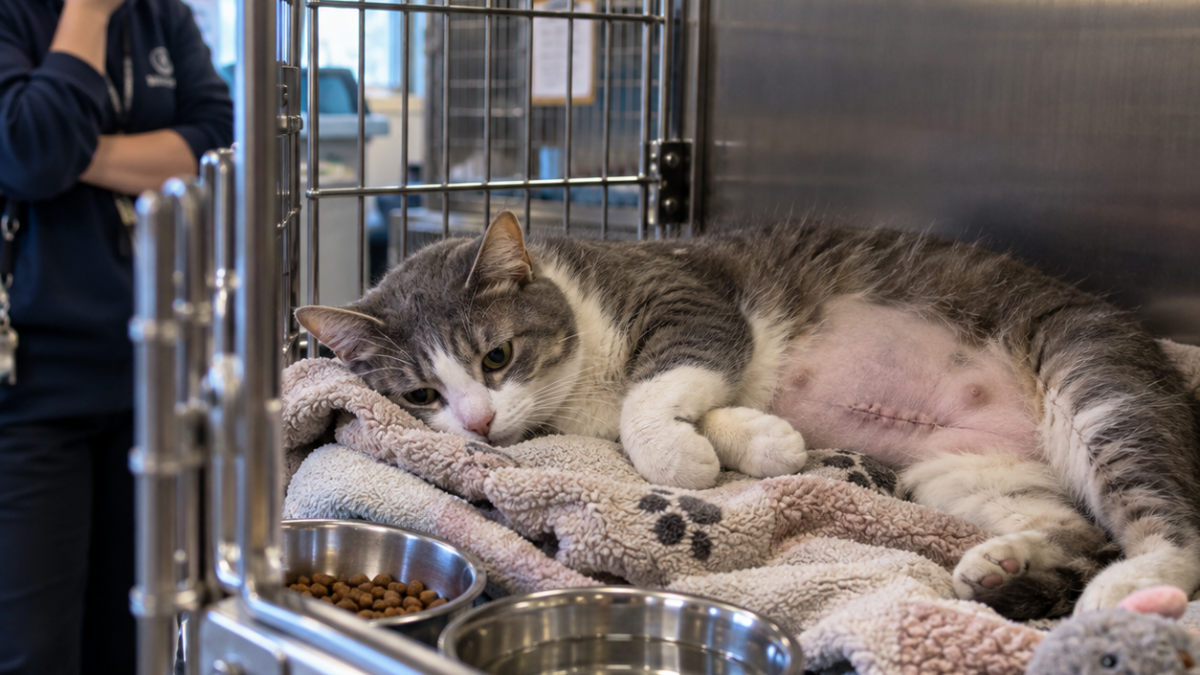
The second day was when Maya took the photograph.
She did not plan to.
She had come into recovery with fresh bedding and a small dish of warmed food. The mother cat lay exactly where she had lain the day before, on her side, belly exposed, paws curled, eyes open but focused on nothing.
Around her was the emptiness.
Not dramatic emptiness.
That would have been easier.
It was the ordinary kind. A towel. A metal cage. A water bowl. A food dish. A small fleece mouse someone had added too late. The space beside her belly shaped by absence.
Maya stood there for a long time.
Then she lifted her phone.
She took one picture.
No filter.
No staging.
No close-up designed to manipulate.
Just the mother cat in the empty nest.
She posted it that evening on her personal page.
Not the shelter page.
Not a campaign.
Not a fundraiser.
Just a photograph and the truth.
She was spayed while her kittens were adopted. She woke up and they were gone. It has been two days. She is still waiting.
Maya did not expect more than a few friends to comment.
By midnight, the post had been shared eight hundred times.
By morning, it had been shared thirty-two thousand times.
By lunch, local news had called the shelter.
By three o’clock, the shelter phone system crashed.
The comments were overwhelming.
Some were furious.
How could they do this?
Name the shelter.
Who approved that?
This is cruelty.
Some were heartbroken.
I never thought about mother cats grieving.
She left space for them.
That picture destroyed me.
Some were practical.
Why are shelters separating nursing moms?
What are the guidelines?
Are kittens safe at five weeks?
Veterinarians began weighing in.
Behaviorists.
Foster coordinators.
Rescue directors.
Shelter workers.
People argued about spay timing, kitten independence, shelter overcrowding, foster shortages, maternal bonding, post-operative stress, and whether animal welfare organizations were doing too much with too little while the public judged from comfortable distance.
The photograph traveled faster than anyone could control.
By noon, reporters were outside Harbor Light.
Carla stood in the hallway with her arms crossed and her face like stone.
Luke Harmon, the shelter director, called an emergency staff meeting.
Luke was not cruel. He was tired. That was different, though the two could look similar from a distance. He had spent twelve years running Harbor Light through budget cuts, outbreak scares, hoarding cases, owner surrenders, volunteer drama, social media storms, and the never-ending public belief that compassion required infinite space.
He stood at the front of the break room holding a printed copy of Maya’s post.
No one spoke.
Finally, Luke said, “Is it accurate?”
Maya’s stomach dropped.
Carla looked at the floor.
Dr. Patel said, “Yes.”
Luke looked at him.
“The kittens were adopted while she was under anesthesia?”
“Yes.”
“She woke up without them?”
“Yes.”
“She has been searching and refusing food?”
“Yes.”
Luke closed his eyes.
“Were existing protocols followed?”
Carla answered, “Yes.”
The word hung there.
That was the problem.
Luke opened his eyes.
“Then the protocol is wrong.”
Carla’s head lifted sharply.
“We are beyond capacity.”
“I know.”
“We had adopters.”
“I know.”
“The kittens were eating independently.”
“I know.”
“If we hold every litter until the mother emotionally adjusts, we will lose placements.”
Luke’s voice stayed quiet.
“If a policy creates this and calls it acceptable, then the policy is incomplete.”
Carla stared at him.
“You are saying that now because the internet is watching.”
“No,” Luke said. “The internet is watching because we failed in a way people could finally see.”
The room went silent.
Maya looked down at her hands.
She had expected anger.
Discipline.
Maybe removal from volunteer shifts.
Instead, Luke looked at her.
“Did you take the photograph?”
“Yes.”
“Did you post it?”
“Yes.”
“Why?”
Maya swallowed.
“Because everyone kept explaining why it happened, and nobody was saying what happened.”
Carla flinched.
Luke nodded once.
“Do not speak to media without authorization.”
Maya lowered her eyes.
“Okay.”
“Also,” he added, “thank you for not letting us look away.”
The mother cat’s photograph changed her name.
Online, people began calling her Mercy.
Nobody knew who started it.
Maybe because she looked like she needed mercy.
Maybe because she had shown people the cost of acting without it.
Within forty-eight hours, the name had stuck.
Maya wrote it on a blank card and taped it to the cage.
Mercy.
Gray/white female. Young mother. Recovering.
Under special notes, she wrote:
Needs quiet. Needs time.
On the fourth day, Mercy ate half a dish of wet food.
Maya cried in the supply room after seeing the empty dish.
On the fifth day, Mercy sat up when Maya entered.
On the sixth, she allowed herself to be stroked behind one ear.
On the seventh, she made the call once.
Just once.
Then she stopped.
That hurt more than the searching.
For the first time, Maya wondered whether healing sometimes began not with hope, but with the body understanding that hope had become too painful to repeat.
Harbor Light changed its policy that same week.
No lactating mother would be separated from her kittens during surgical recovery unless there was an urgent medical reason.
No kittens under eight weeks would be adopted directly from a nursing mother without a documented transition plan.
Post-operative mothers would recover with their litters when medically safe.
If separation was necessary, scent items would be exchanged, timing would be staged, and staff would monitor distress.
Every adoption file involving a nursing mother and litter would require sign-off from medical, behavior, and placement staff.
Carla called it impractical.
Luke called it necessary.
Both were partly right.
The policy slowed kitten adoptions at first. It complicated scheduling. It required more foster space. It forced staff to have harder conversations with adopters who wanted kittens immediately.
Some adopters were understanding.
Some were not.
One woman, told she would need to wait two weeks for a kitten to remain with its mother, said, “It’s just a cat.”
Maya watched Carla’s face when the woman said it.
A year earlier, Carla might have smiled tightly and processed the adoption.
Now she closed the folder.
“Then this is not the right kitten for you.”
The woman left angry.
Carla looked at Maya across the desk.
“Do not say anything.”
Maya raised both hands.
“I didn’t.”
“You wanted to.”
“Yes.”
Carla almost smiled.
Almost.
The global story became larger than Harbor Light.
The photograph appeared in veterinary forums, rescue newsletters, shelter conferences, behavior webinars, and training presentations. People debated whether animals grieve like humans, whether the word grief should be reserved for human loss, whether maternal distress was being sentimentalized, whether shelters were being unfairly blamed for public abandonment problems.
But whatever experts called it, the image remained.
Mercy on her side.
Fresh surgical scar visible.
Belly exposed.
Paws folded.
Three spaces empty.
Some photographs argue better than people.
Harbor Light began receiving emails from other shelters.
We updated our post-op nursing protocol.
We added a required recovery period.
We are reviewing our early-weaning practices.
We used Mercy’s photo in staff training.
We made a mistake like this once too. We never talked about it until now.
Months later, an animal welfare coalition requested permission to include Mercy’s story in a national best-practices guide. Luke asked Maya. Maya asked herself whether the photo still belonged to her after the world had taken it.
Then she stood in front of Mercy’s cage and asked the cat, “Do you want to be policy?”
Mercy blinked.
Maya decided that meant yes.
Carla would later claim the cat had simply blinked because she was a cat.
Maya would say that was exactly the kind of narrow thinking that caused problems.
By then, Mercy had changed too.
She no longer searched cages.
She no longer called in the night.
She ate well.
Her incision healed.
Her milk dried.
Her body became her own again, though motherhood lingered in strange ways.
She collected soft toys and carried them to her bed.
Not all of them.
Only small ones.
She would pick up a stuffed mouse or a rolled sock, place it carefully on her towel, lie down beside it, and curl her body around it for a few minutes. Then she would get up and walk away as if embarrassed by her own instinct.
Maya watched without interrupting.
Carla watched once from the doorway.
“She’s redirecting maternal behavior,” Carla said.
Maya glanced at her.
“She misses them.”
Carla did not argue.
That was progress.
Adoption inquiries came by the hundreds after the photo went viral.
Most wanted Mercy immediately.
Not because they knew her.
Because they knew her sadness.
Luke refused to rush.
“We are not adopting out a wound,” he said.
Applications were reviewed carefully. Mercy needed a quiet home. No young kittens. No chaotic household. No adopters chasing internet attention. No one who described her as “famous.”
One woman showed up wearing a T-shirt with Mercy’s photo printed on it.
Carla rejected her before Maya could even speak.
Another applicant asked whether Mercy would “do the empty nest pose” for videos.
Maya walked into the laundry room and screamed into a towel.
After that, Luke added a question to the application.
What do you understand about Mercy’s needs beyond her story?
Most answers failed.
Then six weeks after the photograph, Maya stopped avoiding what everyone else had already begun to suspect.
She wanted Mercy.
Not as a symbol.
Not as a project.
Not because of guilt.
Because every night after her volunteer shift, she went home to a quiet apartment and thought about the cat lying alone in the cage. She thought about how Mercy lifted her head when Maya entered. She thought about the way Mercy had begun placing one paw on Maya’s wrist during feeding, not grabbing, just resting there, as if testing whether this person remained.
Maya had not planned to adopt.
Her apartment allowed cats, but her life was small. She worked as an elementary school art teacher. She graded papers at the kitchen table. She had student loans, a leaky bathroom sink, and a habit of forgetting dinner until nine. Her last cat, Juniper, had died two years earlier at eighteen, and Maya had told herself she was not ready.
But love rarely asks whether the timing is tidy.
It simply begins taking up space.
On a Thursday evening, after closing, Maya found Mercy sitting at the front of her cage.
Not hiding.
Not sleeping.
Watching the door.
Maya laughed softly and started crying at the same time.
“Oh, that is unfair,” she whispered.
Mercy blinked.
The next morning, Maya submitted an adoption application.
Carla processed it.
Slowly.
Thoroughly.
With visible annoyance that looked suspiciously like approval.
“You understand she may always show nesting behavior?” Carla asked.
“Yes.”
“You understand she may be sensitive to kitten sounds?”
“Yes.”
“You understand her story has drawn attention and you may receive unwanted messages if people find out?”
“Yes.”
“You understand she is not an emotional support prop for your guilt?”
Maya looked up.
“Yes.”
Carla held her gaze.
Then she stamped the application approved.
“She goes home tonight.”
Maya’s eyes filled.
Carla slid a tissue box across the desk without comment.
Mercy did not resist the carrier.
At 6:12 p.m., Maya carried her out the side door, away from reporters and visitors and anyone who might turn the moment into content. Rain had fallen earlier, leaving the parking lot dark and shining under the lights.
Maya placed the carrier in the passenger seat.
Mercy looked out through the mesh.
“You don’t know this yet,” Maya said, fastening the seat belt around the carrier, “but my apartment has a terrible heater, two sunny windows, and no cages.”
Mercy blinked.
“And I promise,” Maya whispered, “nobody disappears while you’re sleeping.”
The first night, Mercy walked every room.
She sniffed the corners.
Checked beneath the couch.
Looked behind the curtains.
Entered the bathroom.
Entered the bedroom.
Returned to the living room.
Then did the entire inspection again.
Maya followed at a distance.
On the third circuit, Mercy found the basket of clean laundry and pulled out a small white towel.
She dragged it awkwardly across the floor to the corner of the bedroom.
Maya watched, heart aching.
Mercy positioned the towel carefully.
Not random.
Carefully.
She pawed the edges until it lay flat.
Then she lowered herself onto her side.
Belly up.
Paws curled.
Space left open.
Maya stood in the doorway.
“No, sweetheart,” she whispered.
Mercy remained there twenty-one minutes.
Then she rose, walked to the water bowl, drank, and climbed onto the couch.
The next night, she did it again.
And the next.
And the next.
Always near dusk.
Always with a small towel.
Always in the same position.
Always leaving space.
At first, Maya tried to stop it.
Not physically. She would never take the towel away. But she tried to distract Mercy with treats, toys, brushing, soft music, lap time.
Mercy accepted the affection.
Then, when finished, she picked up the towel and returned to the corner.
After two weeks, Maya stopped trying.
She bought a stack of small soft towels.
She placed them in a low basket.
Every evening, Mercy chose one.
Sometimes white.
Sometimes pale blue.
Once, inexplicably, a yellow dishcloth Maya had dropped near the sink.
She carried it to the bedroom corner, arranged it, lay down, and waited.
Maya began calling it the vigil.
Carla said the term was dramatic.
Dr. Patel said repetitive post-maternal nesting could persist after traumatic separation.
Maya said names mattered less than respect.
So every evening, she let Mercy keep the space.
Twenty minutes.
Sometimes eighteen.
Sometimes twenty-five.
Then Mercy rose and returned to the rest of her life.
That was the part people often missed when Maya eventually told the story.
Mercy was not trapped in grief every hour.
She ate.
She played.
She chased dust in sunbeams.
She slept beside Maya’s hip.
She learned that the sound of the refrigerator meant dinner and the sound of the printer meant paper to sit on.
She developed opinions about jazz.
She hated the vacuum.
She liked Maya’s students when they came by to drop off art projects, provided they moved slowly and did not squeal.
She became affectionate, bossy, funny, and deeply committed to knocking paintbrushes off the table.
But every evening, she kept a place.
At first, Maya did not photograph the ritual.
She had taken one photo that changed Mercy’s life without Mercy’s permission. She would not turn every private ache into proof.
Then, four months after the adoption, Harbor Light received an email from a shelter in Oregon.
A nursing mother had been scheduled for surgery. Her kittens had adoption holds. Staff had planned to separate them after the procedure. A new technician had remembered Mercy’s photo from training and asked them to wait.
They waited.
The mother recovered with her kittens pressed against her side.
The email included a picture.
Not for posting.
Just for Maya.
A black mother cat nursing four kittens on a clean blanket, eyes half-closed, safe.
Maya sat at her kitchen table and cried.
That evening, Mercy carried a blue towel to the corner.
Maya sat on the floor six feet away.
“You did that,” she told her.
Mercy blinked slowly.
“You never got them back,” Maya said. “But somewhere else, somebody did not lose hers.”
Mercy lowered her head onto the towel.
Maya began to understand then that justice did not always look like restoration.
Sometimes the original wound remained.
The kittens did not return.
The moment could not be repaired.
But the harm could become a boundary others refused to cross.
Mercy’s three kittens grew up in three different homes.
Maya knew because Luke tracked the adoptions quietly, without disturbing anyone. All three were safe. All three were loved. The orange boy, Pumpkin, slept in a bunk bed with twins. The black-and-white girl, renamed Dot, lived with a nurse who sent monthly updates. The gray tabby, Oliver, belonged to an elderly couple who brushed him every night and called him “our little professor.”
They were not suffering.
That made the story both easier and harder.
No villain had taken them to harm them.
No evil family had stolen them.
They had been placed in good homes by people trying to save lives under pressure.
Mercy’s babies were safe.
Mercy was safe.
And still, something terrible had happened.
Maya struggled with that truth because it offered no clean place to put anger.
Carla struggled with it too.
For months, she and Maya circled each other in the shelter with the wary truce of people connected by the same wound from different sides.
Then, one Friday in spring, a young calico mother arrived with five kittens. The mother was feverish. One kitten was weak. The foster coordinator was unavailable. Intake was full. The medical room had one open kennel. A family in the lobby wanted to adopt two kittens immediately, and they were exactly the kind of adopters shelters prayed for: patient, kind, prepared, experienced.
Old Carla would have separated them.
New Carla stood in intake with the paperwork in her hand and looked at Maya.
“What do we do?”
Maya was surprised she asked.
Dr. Patel examined the mother.
“She needs treatment. Kittens stay with her if medically safe. The weak one needs supplementation.”
The family in the lobby was disappointed.
Carla went to explain.
Maya watched through the doorway.
The father said, “But we came today.”
Carla nodded.
“I understand.”
“We already bought supplies.”
“That’s good. They’ll still need supplies in a few weeks.”
The mother asked, “Can’t the kittens leave now? They look old enough.”
Carla’s hand tightened slightly around the clipboard.
“They still need their mother.”
The words were simple.
They cost her something.
Maya saw it.
The family agreed to wait.
After they left, Carla stood in the hall for a moment, eyes closed.
Maya walked over.
“That was good.”
Carla opened her eyes.
“I hate when you sound like my conscience.”
“Your conscience is improving.”
Carla gave her a tired look.
Then she said something Maya did not expect.
“I still dream about Mercy searching.”
Maya’s smile faded.
“So do I.”
“I thought I was making space.”
“You were.”
Carla looked at her.
“That’s the part that keeps me awake.”
Maya understood.
Cruelty done for selfish reasons is easier to condemn. Harm done under pressure by exhausted people trying to help is harder. It demands more than outrage. It demands change.
Carla swallowed.
“I am sorry.”
Maya did not say it was okay.
It was not okay.
Instead, she said, “I know.”
That became enough.
Years later, when Harbor Light’s new protocols were cited in a national shelter medicine conference, Carla stood on stage beside Luke, Dr. Patel, and Maya. She looked deeply uncomfortable under the lights. The presentation slide behind them showed no graphic image at first, only data.
Reduced maternal distress.
Improved kitten weight retention.
Lower post-op complications.
Higher foster compliance.
Delayed but not reduced kitten adoption rates.
Then the moderator asked how the policy began.
The room held nearly four hundred shelter professionals.
Carla could have given a clean answer.
She could have said, “A case review revealed opportunities for improvement.”
She could have hidden inside language.
She did not.
She looked at the audience and said, “We separated a mother cat from her three kittens while she was under anesthesia. When she woke up, she searched for six hours. Then she lay in the nursing position in an empty nest for four days. A volunteer took a photo. The world reacted. We changed because we should have changed before anyone had to shame us.”
The room went silent.
Maya looked at her.
Carla’s voice shook once, then steadied.
“Policies are often written to manage space, staff time, and outcomes. They must also be written to protect the emotional reality of the animals inside them. If we ignore that reality because it complicates workflow, we are not being professional. We are being numb.”
Afterward, people lined up to speak to them.
Some thanked them.
Some confessed similar mistakes.
Some asked practical questions.
One shelter director said, “We can’t afford to hold litters longer.”
Carla looked at her and said, “Then tell the public what it costs not to.”
Maya nearly hugged her.
She did not.
Carla would have hated that.
Instead, she bought her coffee.
Mercy aged into softness.
Her gray patches silvered. Her face rounded. The shaved belly fur grew back slightly uneven, a pale area still visible when she rolled onto her side. Her eyes became calm, though sometimes kitten sounds on Maya’s phone made her lift her head and look toward rooms that held nothing.
The evening ritual remained.
Every night.
A towel.
A corner.
The nursing position.
Space.
Twenty minutes.
Then life.
Maya never fully understood whether Mercy remembered the kittens as individuals or whether her body remembered a shape. She did not know whether the ritual was grief, habit, instinct, comfort, or all of them woven together into something too old for human categories.
She stopped needing to define it.
Love did not become less real because science could describe part of it.
Grief did not become less real because hormones shaped its edges.
A mother’s body did not forget simply because people found the remembering inconvenient.
On the anniversary of the photograph, Maya received a message from one of the kitten adopters.
It was from the family with the orange kitten.
Pumpkin.
The message was long, apologetic, and hesitant.
The mother wrote that they had not understood at the time. They had been excited. The children had fallen in love immediately. When Carla called that first day asking whether they could bring Pumpkin back temporarily, they panicked. They thought the shelter might take him away forever. They said no. Later, when Mercy’s photo went viral, they recognized the story and felt ashamed.
They had never stopped feeling ashamed.
Maya read the message twice.
At the end was a photo.
Pumpkin, grown now, enormous and bright orange, lying upside down on a child’s bed with one paw over his face.
The mother wrote:
He is loved. I know that does not fix what happened to Mercy. But if you ever think she should know one of them is safe, please tell her somehow.
Maya placed the phone on the floor near Mercy that evening.
She did not expect anything.
Pumpkin’s photo filled the screen.
Mercy sniffed it once.
Then she walked to the towel basket, selected a white towel, carried it to the corner, and lay down.
Maya sat nearby.
“One is safe,” she whispered.
Mercy closed her eyes.
The next week, Dot’s adopter sent a photo.
Then Oliver’s.
Three grown cats.
Three safe lives.
Three homes that would never know the exact shape of the absence they had left behind.
Maya printed the photos and placed them in a small envelope.
She did not hang them.
She did not show them to Mercy again.
Some truths help once.
Repeated too often, they become another wound.
The envelope stayed in a drawer with Mercy’s adoption papers and the original photograph Maya had taken but never printed large.
When Mercy was six, three years after adoption, Maya moved to a small house with a screened porch. It was not fancy. The kitchen floor slanted. The guest room had bad wallpaper. The backyard fence needed work. But the porch faced west, and afternoon light came through the screen in wide warm rectangles.
Mercy approved.
The evening ritual moved from the bedroom corner to the porch during warm months. Mercy carried her towel out, placed it in the same spot near the screen, and lay down while sunset filled the yard.
Maya often sat behind her with tea.
Neighbors eventually noticed.
One little girl next door, Ava, asked, “Why does your cat lie like that every night?”
Maya considered the answer.
“She used to be a mother.”
“Where are her babies?”
“They grew up somewhere else.”
“Does she miss them?”
“Yes.”
“Every night?”
Maya watched Mercy breathe.
“Maybe not all day. But every night, she saves them a place.”
Ava accepted this with the seriousness children bring to sacred things.
The next evening, she left a tiny crocheted blanket on Maya’s porch with a note written in purple marker.
For the babies’ place.
Maya cried harder than the gift probably required.
Mercy sniffed the blanket, carried it to her towel, and placed one paw on it.
From then on, the purple blanket became part of the ritual.
Years passed.
Maya’s students knew Mercy as the cat who changed shelter rules. Maya never showed them the empty-nest photo without permission from their parents and a careful conversation first. When she did, she did not use it for shock. She used it to talk about empathy, responsibility, and the difference between intention and impact.
“Did the shelter people mean to hurt her?” a student asked once.
“No,” Maya said.
“Then why did they?”
“Because they were solving one problem and forgot to look at another.”
The student thought about that.
“My mom says that happens a lot.”
“Your mom is right.”
Mercy became part of the classroom in small ways. Students painted portraits of her. They made clay cats with three kittens beside them. One child wrote a story in which Mercy became queen of a kingdom where no one was allowed to leave while someone was sleeping.
Maya sent that one to Carla.
Carla replied: This is legally sound.
Maya laughed for five minutes.
When Mercy was nine, her kidneys began to fail.
Not suddenly.
Gently at first.
More water.
Less appetite.
Weight slipping away beneath fur.
Dr. Patel had retired by then, but he still saw Mercy because some patients do not transfer cleanly from one chapter of a life to another. He examined her in Maya’s living room, where Mercy sat on the purple blanket and glared at him with calm disapproval.
“She’s comfortable for now,” he said.
Maya nodded.
“How long?”
He sighed.
“You know better than to ask me that.”
“I know. I’m asking anyway.”
“Months, maybe. Less if she stops eating. More if she responds well.”
Maya looked at Mercy.
“I don’t want her to suffer.”
“I know.”
“I don’t want to wait too long.”
“I know.”
“I don’t want to lose her.”
Dr. Patel’s face softened.
“I know that too.”
Mercy responded well for a while.
Fluids.
Medication.
Special food.
Warm beds.
Sunshine.
The ritual continued, though it shortened.
Twenty minutes became fifteen.
Then ten.
Some nights, Mercy carried the towel only halfway and looked at Maya.
Maya would carry it the rest of the way.
“You started it,” she told her softly. “I can help finish.”
One winter evening, Mercy did not rise from the couch at ritual time.
The towel basket sat untouched.
Maya looked at it.
Then at Mercy.
The cat’s breathing was slow.
Her eyes were open but tired.
Maya knew.
Knowing did not make it easier.
She called Dr. Patel.
Then she carried the purple blanket and a small white towel to the couch. She placed them beside Mercy, arranged them gently, and helped her lie on her side in the position her body had remembered for years.
Belly turned slightly upward.
Paws folded.
Space left open.
Maya lay on the floor beside the couch.
“You kept it for them every night,” she whispered. “You don’t have to tonight if you’re tired.”
Mercy lifted one paw.
Not far.
Just enough to touch Maya’s wrist.
Maya broke.
Dr. Patel arrived after dark.
Carla came too.
She did not ask. She simply stood on the porch holding a paper bag from the shelter.
Inside were three tiny stuffed kittens.
One gray tabby.
One black-and-white.
One orange.
Maya stared at them.
Carla’s eyes shone.
“I know it’s sentimental,” she said, defensive even in grief.
Maya took the bag.
“It’s perfect.”
They placed the three little toys in the open space near Mercy’s belly.
Mercy sniffed once.
Her eyes closed.
For the first time in years, the space was not empty.
Maya held her as she left.
Carla stood behind her and cried without hiding it.
Dr. Patel whispered, “She was loved.”
Maya pressed her face into Mercy’s fur.
“She was believed.”
After Mercy died, Maya did not post immediately.
For three days, the world did not know.
The shelter knew.
Harbor Light lowered the little flag outside Captain’s Corner, where Mercy’s photo had long ago inspired a second room called Mama’s Rest, designed for nursing mothers and litters recovering together. Volunteers brought flowers, towels, handwritten notes, and cans of the expensive food Mercy had once loved and then rejected because cats enjoy humbling people.
Carla placed a laminated copy of the new maternal recovery policy beneath Mercy’s photo.
Maya stood in front of it for a long time.
The policy had become ordinary by then.
New staff treated it like common sense.
That was the victory.
When a reform becomes boring, it has finally entered the bones of a place.
On the fourth day, Maya posted Mercy’s final story.
Not the viral photo.
Not at first.
She posted a picture of the purple blanket on the couch with three tiny stuffed kittens resting beside it.
Then she wrote:
Mercy is gone. Years ago, she woke from surgery and searched for three kittens who had been adopted while she was under anesthesia. The photo of her lying in an empty nest changed policies in shelters far beyond ours. But Mercy was more than the worst thing we allowed to happen to her. She was funny, stubborn, gentle, bossy, sun-loving, towel-stealing, and deeply loved. Every night, she saved a place for the babies she never saw again. Tonight, we saved one for her.
The post spread again.
More gently this time.
Not with outrage.
With remembrance.
Shelters shared photos of mother cats recovering with their litters.
Veterinarians shared updated protocols.
Fosters shared stories of difficult waits that had mattered.
People posted pictures of old towels, nursing boxes, quiet rooms, and mothers allowed to wake up beside the babies their bodies expected to find.
One comment came from Pumpkin’s family.
Thank you for telling us the truth even when it hurt. He is still with us. We will tell him about his mother tonight.
Dot’s adopter wrote:
She sleeps with a stuffed mouse every night. Now I wonder what she remembers.
Oliver’s family wrote:
He is safe. He is loved. We are sorry she had to lose him for us to find him.
Maya read the comments until tears blurred the screen.
Then she closed the laptop.
Some stories belong to the world.
Grief still belongs to the one who carries it home.
Maya kept Mercy’s towel basket.
For weeks, she could not move it.
Every evening, her body expected the ritual.
Dusk would come.
The floor would turn gold.
The corner would wait.
No soft paws crossed the room.
No towel dragged behind her.
No small body lay down leaving space for ghosts.
The absence became its own ritual.
Then, one night in early spring, Maya took the white towel Mercy had chosen most often and folded it carefully. She placed it in a shadow box with the purple blanket, Mercy’s name tag, and a copy of the policy that had changed because of her.
At the bottom, she added one sentence.
A mother’s body remembers the shape of love.
The shadow box went to Harbor Light.
Not in the lobby where cameras could find it.
Not in the fundraising hall.
It hung in Mama’s Rest, where recovering mother cats lay with their kittens in low warm enclosures designed after the world learned from Mercy.
New volunteers asked about it.
Senior staff told them.
Not dramatically.
Not to create guilt.
To create attention.
They would point to the towel and say, “This is why we do not separate them during recovery.”
And that was enough.
Years later, when Maya became Harbor Light’s foster coordinator, the shelter looked different. Not perfect. Never perfect. But different.
Mothers and litters had quiet rooms.
Adoption timing followed developmental milestones, not convenience alone.
Medical recovery plans included behavior notes.
Volunteers were trained to notice distress that did not look loud.
And every new staff member received the same lesson during orientation.
Carla taught it after Luke retired.
She would stand in Mama’s Rest with her clipboard, older now, softer around the eyes, still terrifying to anyone who mislabeled a medication syringe.
She would tell the story plainly.
“We made a decision that was efficient, legal, and consistent with our policy at the time. It was also wrong. You will make decisions here under pressure. Space pressure. Money pressure. Public pressure. Emotional pressure. When you do, remember that an animal can survive a decision and still be harmed by it. Our job is not only to keep bodies alive. It is to reduce suffering where we can see it and where we are tempted not to.”
Then she would look at the new volunteers.
“If you notice something wrong, speak. If someone tells you it is just emotion, speak anyway. This room exists because someone did.”
Maya never got used to hearing that.
She would stand in the hallway pretending to check supply shelves while Carla gave the speech. Every time, when Carla reached the line about someone speaking, Maya felt the same ache she had felt when she first heard the empty call from recovery.
“Mrrrp?”
A question.
A search.
A sound that had become policy.
One rainy evening, a young mother cat arrived with four kittens barely three weeks old. She was black with a white chest and terrified eyes. Animal control had found her beneath a porch after homeowners threatened to trap and remove the litter themselves.
The intake team settled them into Mama’s Rest.
The mother counted each kitten with quick touches of her nose.
One.
Two.
Three.
Four.
Then she lay down around them.
A new volunteer named Sophie watched through the glass.
“She keeps checking them,” Sophie whispered.
Maya nodded.
“Yes.”
“Like she thinks they might disappear.”
Maya looked at the black mother cat, then at the shadow box on the wall.
“Then we make sure they don’t.”
The mother cat lowered her head.
The kittens nursed.
Rain tapped against the shelter windows.
The room was warm.
No one rushed.
No one opened a cage and took what a mother expected to find when she woke.
And somewhere inside that ordinary mercy was the echo of a gray-and-white cat who had once searched for six hours, then lay down in an empty nest and changed the world because one volunteer refused to let her grief remain invisible.
Mercy never saw her three kittens again.
That truth did not soften with time.
They were safe.
They were loved.
They grew into adult cats with windows, beds, toys, names, and people who adored them.
But Mercy did not know their homes.
She did not see them grow.
She did not feel them climb over her paws or bite her ears or tumble against her belly in sleep.
All she had was the place they had occupied.
So every evening, she kept it.
Just in case.
A towel on the floor.
A body curved around absence.
A small open space where three lives once fit.
To some people, it was instinct.
To some, grief.
To some, trauma.
To some, proof that animals remember more than we are comfortable admitting.
Maya stopped trying to choose one explanation.
The ritual was Mercy’s.
That was enough.
Because the body of a mother does not ask permission to remember.
It does not care whether the paperwork says adopted.
It does not understand that each kitten has a new home, a new blanket, a new bowl, a new name.
It knows warmth.
Weight.
Milk.
Breath.
The pressure of small bodies pressing close.
The sound of babies answering when called.
And when those things vanish all at once, the body keeps the shape.
Even after healing.
Even after safety.
Even after years in a loving home.
Even after the world changes its rules and calls the change progress.
Somewhere, in the quietest corner of the evening, love still lays down and leaves room.
That was Mercy’s legacy.
Not outrage.
Not a viral photograph.
Not the debate that followed.
Not the policies printed in binders.
Those mattered.
They saved others.
But Mercy’s deepest lesson was smaller and harder.
Do not measure suffering only by whether the body survives.
Do not mistake silence for acceptance.
Do not call something humane simply because it is efficient.
Do not let the needs of a system erase the heart of a living creature inside it.
And when you realize harm has been done, do not waste all your strength pretending it was necessary.
Change.
Make a new rule.
Build a quieter room.
Wait a few more days.
Call the adopter and explain.
Let the mother wake up beside her babies.
Let love finish what fear interrupted.
Mercy’s first photograph showed what humans had failed to see.
Her final towel showed what she never forgot.
And in shelters across the world, because of one gray-and-white mother cat lying beside an empty space, thousands of kittens stayed a little longer beside the bodies that had carried them into life.
Mercy did not get that gift.
So every night, she gave it back in the only way she could.
She chose a towel.
She laid it down.
She curled her paws.
She turned her belly toward the sky.
And she saved three places.
Just in case they came home.




