A 10-Year-Old Told a Hells Angel, “My Stepdad Took My Dog and Said I’d Never See Him Again”—Then the Biker Walked Into Traffic for Him
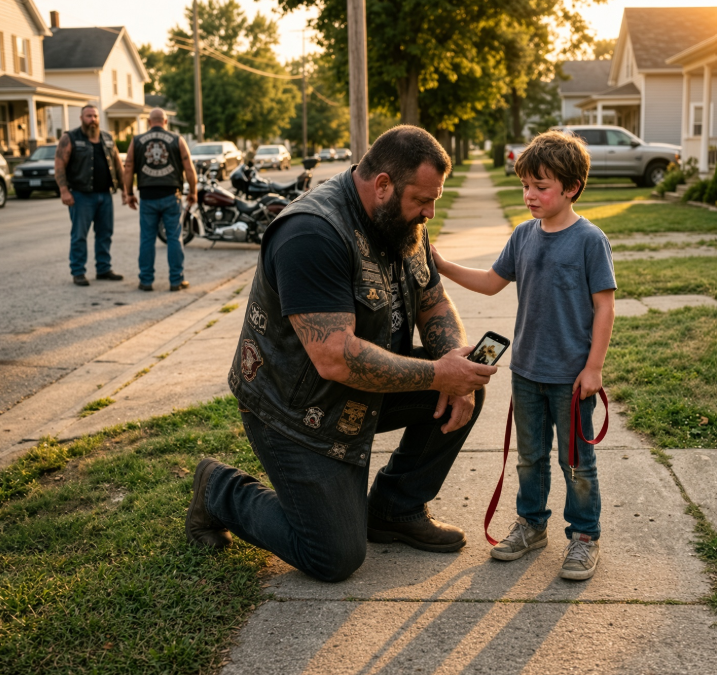
A 10-Year-Old Told a Hells Angel, “My Stepdad Took My Dog and Said I’d Never See Him Again”—Then the Biker Walked Into Traffic for Him.
Ten-year-old Aaron Hayes had spent the entire school day trying not to cry after his mother’s boyfriend took Biscuit—the beagle mix who had slept at the foot of Aaron’s bed for four years—and told him, “Don’t bother looking. You’re never going to see him again.”
When Aaron finally begged the biggest, most feared-looking biker outside Willow Creek Elementary for help, frightened parents locked their car doors, the principal threatened to stop the biker club’s food deliveries, and the neighborhood decided the man in the leather vest was the danger before anyone asked what had actually happened.
Then Biscuit appeared in a wire crate at a gas station that night, the man trying to sell him panicked and fled, and when the terrified dog bolted into four lanes of traffic, Steven Walker stepped off the curb and raised one scarred hand against the headlights while Aaron screamed his dog’s name behind him.
Aaron knew Biscuit was gone before Curtis said a word.
The back door was open.
That was wrong.
At 7:40 on Friday morning, the Sacramento heat had not settled over the neighborhood yet, and cool air moved through the kitchen carrying the smell of damp grass from the backyard.
Aaron stood in the hallway holding a toothbrush.
Foam still at the corner of his mouth.
He looked at the open door.
Then at the hook beside it.
Empty.
Biscuit’s red leash always hung there.
Always.
“Biscuit?”
No nails clicking across linoleum.
No collar tags jingling.
No one floppy ear appearing around the corner.
Aaron stepped outside.
The yard was empty.
Water bowl full.
Blue rubber ball beside the fence.
One shallow hole Biscuit had been digging beneath the lemon tree despite being told repeatedly that lemon trees did not need tunnels.
“Biscuit?”
Louder.
Nothing.
Aaron ran back inside.
Curtis Mason stood at the kitchen counter in work boots and a stained gray T-shirt.
Coffee in one hand.
Phone in the other.
Curtis had moved in six months earlier.
At first Aaron had liked him.
Or tried.
His mother had been happy.
That counted for something.
Laura Hayes worked as a certified nursing assistant at a residential care facility across town.
Double shifts.
Overtime.
Weekends.
Her shoulders hurt constantly.
There were months when bills sat on the kitchen counter arranged by which company would shut something off first.
Curtis had arrived during one of those months with groceries and jokes and a willingness to fix the leaking bathroom faucet.
He drove a delivery truck.
Made decent money.
Bought Laura flowers twice.
PART2:
Took Aaron to a River Cats baseball game.
For a while, he seemed like the kind of grown man Aaron had always believed other families got.
Then small things changed.
Curtis complained when Biscuit shed on the couch.
Complained about dog food.
Complained about barking.
Once Biscuit stole a hamburger bun from the counter, and Curtis grabbed the dog’s collar so hard that Biscuit yelped.
Laura had shouted at him.
Curtis apologized.
Never did it again in front of her.
But Aaron noticed Biscuit leaving rooms whenever Curtis entered.
Kids notice things adults call imagination.
Aaron walked into the kitchen.
“Where’s Biscuit?”
Curtis scrolled.
“Morning to you too.”
“Where is he?”
Curtis lifted coffee.
“Taken care of.”
Aaron felt cold despite morning sun.
“What does that mean?”
“That dog was tearing up the yard.”
“He wasn’t.”
“Chewing stuff.”
PART3:
“He doesn’t.”
“Your mom works too hard to deal with it.”
Aaron’s toothbrush slipped from his hand.
“Where is he?”
Curtis looked at him at last.
Flat expression.
No guilt.
“Somewhere else.”
Aaron stared.
“What somewhere?”
“Doesn’t matter.”
“Where?”
“Aaron.”
“Where is my dog?”
Curtis set coffee down.
“He’s gone.”
The kitchen became very quiet.
Aaron thought maybe there was still a misunderstanding.
Maybe shelter.
Maybe friend.
Maybe dog daycare.
“Gone where?”
Curtis’s mouth tightened.
“Bud, you’re ten.”
“Sometimes adults make decisions.”
“Your mom wasn’t here.”
“She trusts me.”
Aaron’s eyes burned.
“Did Mom say you could?”
Curtis didn’t answer.
That was answer.
“I’m calling her.”
“She’s working.”
“I don’t care.”
Aaron reached for kitchen phone.
Curtis caught his wrist.
Not hard enough to leave a mark.
Hard enough.
“No.”
Aaron stopped.
Curtis released him.
“You are not calling your mother at work over a dog.”
“He’s not a dog.”
Curtis laughed once.
“What is he, then?”
Aaron could not answer without crying.
Biscuit was birthdays.
Biscuit was thunder.
Biscuit was the warm weight against his feet after Laura worked late.
Biscuit was the only living thing who never told Aaron he was too sensitive, too quiet, too young, too much trouble.
Biscuit was Biscuit.
Curtis picked up coffee.
“He’s gone, bud.”
“Don’t bother looking.”
Aaron’s throat closed.
Then Curtis said it.
The sentence Aaron would remember for the rest of his life.
“You’re never going to see him again.”
He said it casually.
That was worst part.
Not angry.
Not threatening.
Like telling a child a store had closed.
Aaron went to school.
He did not remember walking there.
Willow Creek Elementary was six blocks away.
He knew he sat through morning announcements.
He knew Mrs. Fenner asked him to open his math workbook.
He knew he wrote his name at the top.
Then nothing stayed.
At 9:15 he wrote:
BISCUIT
in the margin.
At 9:27:
BISCUIT
again.
At 10:03 Mrs. Fenner touched his desk.
“You okay?”
He nodded.
He was not.
At lunch he didn’t eat.
At 12:18 he asked to call his mother.
School secretary let him use office phone.
Care facility answered.
Laura was assisting with an emergency and unavailable.
Aaron left message.
“Mom, call me.”
He wanted to say more.
Secretary was nearby.
He felt ashamed.
“It’s important.”
That was all.
Laura didn’t call.
Not because she ignored him.
She wouldn’t see message until after four.
But Aaron didn’t know that.
By afternoon, fear hardened into something else.
He decided he was not going home.
He had eight dollars in backpack.
A sweatshirt.
One granola bar.
Maybe he could find Biscuit first.
He didn’t know where to begin.
That frightened him more than Curtis.
Bell rang at 3:15.
Children poured out.
Pickup line filled.
Parents waited in air-conditioned cars.
Aaron sat at far curb, backpack between knees.
Mrs. Fenner noticed.
“Aaron?”
“My mom’s late.”
That wasn’t unusual.
Laura’s schedule changed.
Mrs. Fenner said:
“You can wait in office.”
“I’m okay.”
She hesitated.
Then another parent asked her something.
And Aaron became part of background.
He watched vehicles leave.
Then heard motorcycle.
Deep.
Heavy.
Not one of little sport bikes older brothers rode.
This sounded like thunder with machinery inside it.
Heads turned.
A black Harley rolled onto service lane near cafeteria loading dock.
Rider wore black leather vest.
Gray beard to chest.
Scar through left eyebrow.
Broad enough that Aaron thought of wrestlers.
Across back of vest, club insignia.
Winged skull.
Red-and-white lettering.
Parents reacted instantly.
Locks clicked.
A woman in white SUV whispered loudly:
“Is that a Hells Angel?”
Someone answered:
“At an elementary school?”
Aaron watched.
The biker ignored them.
Walked to white pickup near loading dock where thin man with ponytail lowered tailgate.
They unloaded cardboard crates.
Aaron could read stencil.
WILLOW CREEK WEEKEND BACKPACK PROGRAM.
He froze.
Last winter Laura’s hours had been cut.
Fridge almost empty.
Every Friday a brown bag appeared in Aaron’s cubby.
Soup.
Oatmeal.
Peanut butter crackers.
Macaroni cups.
Sometimes applesauce.
Mrs. Fenner never explained.
Aaron never asked.
Asking might make it stop.
He looked from crates to biker.
One thought came.
Everybody is scared of him.
Then another.
Maybe Curtis is too.
Aaron stood.
His legs felt loose.
He walked toward loading dock.
The biker lifted two crates at once.
Set them down.
Turned.
Saw Aaron three feet away.
Stopped.
“Afternoon.”
Voice low.
Not mean.
“You lost, son?”
Aaron stared at vest.
“Are you a Hell’s Angel?”
A few parents audibly gasped.
The biker glanced toward them.
Then back.
“I’m a member of the club.”
“Everybody says you’re scary.”
One corner of man’s mouth moved.
“Some people do.”
“What do you say?”
The biker thought.
“I say they’re allowed to think what they want.”
Aaron swallowed.
“You bring the food.”
“What food?”
“The backpack food.”
He pointed.
“I get it Fridays.”
Something changed in biker’s face.
“Do you?”
Aaron nodded.
“Last winter.”
The man’s eyes softened.
“I’m glad it helped.”
Aaron’s chin began trembling.
He hated that.
Pressed lips.
The words escaped anyway.
“My stepdad took my dog.”
The biker went still.
Aaron kept talking because if he stopped he’d cry.
“This morning.”
“I was brushing my teeth.”
“His leash was gone.”
“His name’s Biscuit.”
“He’s brown and white and one ear sticks up and one doesn’t and he sleeps in my room and Curtis said—”
Voice broke.
The biker waited.
Aaron forced it.
“He said I’d never see him again.”
Silence.
The ponytailed man stopped unloading.
Parents kept watching.
Aaron whispered:
“Everybody’s scared of you.”
“So I thought…”
He looked down.
“Maybe you wouldn’t be scared of him.”
The biker’s face changed completely.
Not softness.
Something deeper.
Pain.
He lowered himself.
His knees popped loudly.
Now eye level.
“What’s your name?”
“Aaron.”
“Aaron what?”
“Hayes.”
“I’m Steven Walker.”
He pointed one thick finger toward ground between them.
“Aaron Hayes, I want you to hear me.”
“I’m taking you seriously.”
“Every word.”
Aaron’s eyes filled.
Nobody had said that all day.
Then school doors slammed.
Principal Gordon Pratt hurried out.
Tie flapping.
Secretary behind with phone.
“Mr. Walker.”
“Step away from that child.”
Steven stood slowly.
Hands visible.
“I haven’t touched him.”
“He walked over.”
Pratt stopped several feet away.
His eyes went to vest.
Then parents.
Phones out.
School reputation doing calculations behind his face.
“Agreement was deliveries after dismissal.”
“Truck got held up.”
Steven nodded.
“That’s on me.”
“Won’t happen again.”
“But this boy needs an adult to make some calls.”
Pratt looked at Aaron.
“What happened?”
“My stepdad took Biscuit.”
Steven spoke.
“He says dog was removed without his mother’s knowledge.”
Pratt frowned.
“Aaron?”
“Mom didn’t say.”
“She wouldn’t.”
Steven crouched slightly again.
“Here’s what happens now.”
He spoke to Aaron, not principal.
“I am not taking you anywhere.”
“I am not putting you on my motorcycle.”
“I am not going somewhere alone with you.”
“We do this in front of school.”
“We call your mother.”
“We call police so somebody official writes down what happened.”
“Okay?”
Aaron whispered:
“Cops don’t listen to kids.”
Steven nodded.
“Some don’t.”
“Some do.”
Then looked at Pratt.
“Call non-emergency line.”
Pratt hesitated.
Why?
Not because call unreasonable.
Because he had just been publicly instructed by biker.
Pride is strange.
Then he looked at boy.
Nodded.
Inside office, Aaron told story again.
Open door.
Leash missing.
Curtis.
Words.
Principal listened.
Secretary Mrs. Tilly left urgent message at Laura’s workplace.
Through front window Aaron could see Steven outside.
He did exactly what he promised.
Waited.
Near flagpole.
Arms folded.
Visible.
Parents drove slowly past filming.
Aaron felt ashamed on his behalf.
Then wondered why.
Steven hadn’t done anything wrong.
Officer Ray Dunning arrived twenty-five minutes later.
He spotted Steven.
Stopped.
“Walker.”
Steven looked over.
“Dunning.”
“You again.”
“Disappointed?”
“Depends.”
Steven nodded toward office.
“Boy’s dog.”
Dunning looked.
“Not yours?”
“No.”
“That’s refreshing.”
Steven almost smiled.
They knew each other.
Years earlier Dunning had found Steven on roadside changing flat tire for family.
Another time club helped after wildfire.
Dunning didn’t consider Steven harmless.
Nobody with fifty years alive is harmless in every context.
But he knew enough not to mistake vest for evidence.
Inside, he crouched before Aaron.
Notebook.
“Start with dog.”
“Name?”
“Biscuit.”
“Breed?”
“Beagle mix.”
“Color?”
“Brown and white.”
“Tags?”
“Yes.”
“Chip?”
“Yes.”
“Who’s registered owner?”
“My mom.”
Good.
That mattered.
“Where’s stepdad?”
“Curtis.”
“Last name?”
“Mason.”
Aaron explained.
Dunning wrote.
Then sighed.
“Okay.”
“I believe you.”
Aaron blinked.
“You do?”
“Yes.”
“But I need your mom.”
“Why?”
“Because legally dog belongs to her.”
“If she says Curtis had no permission, that gives us clearer path.”
“Until then, this can get treated like property dispute.”
Aaron’s face crumpled.
“So you can’t find him?”
“I didn’t say that.”
“I said I need more.”
Knock.
Mrs. Edith Collins stood doorway.
Aaron knew neighbor.
Seventy-something.
Lavender cardigan.
Her grandson attended Willow Creek.
“I may have seen something.”
Dunning stood.
“When?”
“About eight this morning.”
“Curtis’s truck.”
“Biscuit in passenger seat.”
“He was whining.”
“I thought they were going to vet.”
“Direction?”
“Highway Fifty east.”
Aaron whispered:
“He hates trucks.”
Mrs. Collins looked devastated.
“I’m sorry, honey.”
“I would have stopped him.”
Aaron nodded like he needed to comfort her.
“It’s okay.”
Steven watched through doorway.
He saw same thing he’d seen in kids at veterans family events.
Children taking care of adults because adults looked sad.
It angered him.
At 4:20 Laura Hayes came running in wearing teal scrubs.
Hair escaping clip.
Keys in fist.
She saw officer.
Principal.
Aaron.
Then Steven outside.
First reaction was fear.
“Aaron!”
She rushed.
“What happened?”
“What did you do?”
Aaron recoiled.
“Nothing.”
“Mom, Biscuit—”
Laura looked at window.
“Who is that?”
Steven remained outside.
Aaron said:
“Mr. Walker.”
“Why is he here?”
“He brings backpack food.”
Laura stopped.
“The Friday bags?”
Aaron nodded.
Steven heard and looked down.
Embarrassment moved across Laura.
Months she’d accepted assistance without knowing source.
Now source wore a vest she’d been taught to fear.
Pratt opened door.
Steven stayed outside threshold.
“Ma’am.”
“My club helps sponsor program.”
“I mostly carry boxes.”
“I’m sorry if I frightened you.”
Laura studied him.
Then:
“Thank you.”
Stiff.
“For food.”
Steven nodded.
“Kids shouldn’t be hungry.”
Then Laura turned to Aaron.
He told her.
All.
Curtis.
Biscuit.
Gone.
Never see him again.
Laura’s face shifted from confusion to horror to rage.
“He did what?”
She called Curtis.
Voicemail.
Again.
Again.
Text arrived.
DOG’S HANDLED. IT’S DONE. DON’T MAKE A SCENE OVER A DOG.
Laura read aloud.
Aaron’s shoulders folded.
Steven’s jaw tightened.
Dunning said:
“Save that.”
“Screenshot.”
“Email to yourself.”
Laura looked at him.
“Can we get Biscuit back?”
“We’re going to try.”
Steven said quietly:
“Chip registry.”
Everyone turned.
“If Biscuit’s chipped in her name, registry logs transfer requests.”
“Anyone trying to sell or re-register may trigger notice.”
Dunning nodded.
“Good point.”
Steven shrugged.
“Club does lost-dog search sometimes.”
Laura stared.
Another stereotype cracking.
They drove home.
Laura and Aaron first.
Dunning behind.
Steven followed two houses back.
Did not pull into driveway.
He understood optics better than people gave him credit for.
Curtis was on porch.
Soda.
Arms folded.
Truck in driveway.
He saw cruiser.
Then motorcycle.
Smile turned contemptuous.
“Where’s Biscuit?”
Laura asked.
Curtis sighed.
“Really?”
“Where is he?”
“I gave him to somebody.”
“Who?”
“Guy with land.”
“What guy?”
“Farm.”
“Name?”
Curtis looked at Dunning.
“Am I detained?”
“No.”
“Then I don’t have to answer.”
Laura stepped forward.
“This is my dog.”
“Our house.”
“My son.”
“You don’t get to—”
Curtis laughed.
“Your son?”
“Every decision revolves around your son.”
“There it is.”
Laura went still.
Curtis continued.
“Dog tears up yard.”
“Kid cries.”
“You work doubles.”
“I deal with everything.”
“And I’m bad guy.”
Aaron stood behind screen door.
He heard all of it.
Steven saw his face.
Wanted to walk up porch.
Didn’t.
Dunning said:
“Mr. Mason, did owner authorize disposal or transfer of animal?”
Curtis looked at Laura.
“She knew I hated dog.”
“That wasn’t question.”
Curtis’s jaw tightened.
“I’m done.”
He grabbed keys.
Saw Steven.
“You brought motorcycle gang to my house?”
Laura’s voice stopped him.
“It’s not your house.”
He turned.
“And he’s not the man who stole from my child.”
That landed.
Curtis left.
By 6:00, neighborhood Facebook group contained photos of Steven.
Caption:
MOTORCYCLE GANG MEMBER SEEN AT ELEMENTARY SCHOOL AND DELMAR STREET. POLICE INVOLVED. KEEP CHILDREN INSIDE.
Steven saw screenshot in garage.
Rick Thompson called.
“Forty guys ready.”
“No.”
“What?”
“Absolutely not.”
“Why?”
“Because forty bikes rolling into residential street proves every idiot’s point.”
“Steve—”
“One bike.”
“One man.”
“That’s all.”
He sat under work light.
Above bench, photo of late wife Ruth laughing at beach.
She’d died from pancreatic cancer four years earlier.
Ruth had been the person who told Steven:
You don’t get to complain people judge vest if you refuse to give them anything else to judge.
She forced club into food drives.
Backpack program.
Toy drives.
Veterans housing repairs.
She said reputation changed one contact at a time.
Now school had emailed.
Out of abundance of caution, backpack deliveries paused.
Steven stared.
Sixty children.
Program endangered because of him.
He almost walked away.
Then childhood memory returned.
Nine-year-old Steven.
Fresno.
Dog named Rusty.
His father’s pickup.
Brown face in rear window.
“He’s gone, boy.”
“Don’t ask.”
“You’ll never see him again.”
Steven had obeyed.
Forty-five years wondering.
What happened to Rusty?
Farm?
Shelter?
Road?
He never knew.
He couldn’t undo that.
But Aaron had walked toward him because everyone else scared him less than loss.
Steven stood.
Keys.
“One man.”
“One bike.”
Laura sat kitchen with Aaron asleep against her thigh.
Phone buzzed.
Microchip registry.
TRANSFER REQUEST RECEIVED.
Her hands shook.
She opened.
Biscuit.
Chip ending 4471.
Transfer initiated.
Contact immediately if unauthorized.
There was phone number.
Galt area code.
She searched.
Online classified.
BEAGLE MIX
4 YRS
GOOD WITH KIDS
HOUSE TRAINED
$200 CASH
MUST GO TONIGHT
Photo.
Biscuit.
One ear up.
One down.
Red collar removed.
Aaron’s dog.
Laura made sound like she’d been punched.
Called Dunning.
He answered despite off shift approaching.
“Do not call seller.”
“Send me link.”
“We’ll set controlled contact.”
“Text as buyer.”
“Public place.”
“You don’t go alone.”
Reply arrived four minutes later.
Shell station Elk Grove Boulevard.
8 p.m.
Cash only.
A knock.
Laura checked window.
Steven.
Three steps back from door.
Gloves in one hand.
Motorcycle curb.
Karen Whitfield across street filming again.
Laura opened.
Steven spoke first.
“I won’t come in.”
“I came to say if you want me out of this, I’m out.”
“Neighborhood’s made opinions clear.”
“I don’t want my presence costing your son more.”
Laura stared.
He added:
“They may be half right about vest.”
“Wrong about rest.”
“Your call.”
Behind Laura, quilt moved.
Aaron sat up.
“Mr. Walker?”
Laura turned.
“We found Biscuit.”
Aaron was instantly awake.
“Where?”
“Elk Grove.”
“Tonight.”
His face transformed.
Hope is dangerous when child has been hurt.
Steven saw it.
Laura said:
“Officer Dunning will be there.”
“Aaron stays in car.”
Steven nodded.
“Right.”
Laura hesitated.
“Would you follow us?”
Steven put gloves on.
“Yes, ma’am.”
At 7:52, rusted pickup entered Shell station.
Wire crate in bed.
Tarp.
Aaron sat locked in Corolla.
Laura beside ice machine.
Dunning behind taco truck.
Officer Hollis across street.
Steven in shadows by car wash.
The pickup parked.
A whine.
Aaron froze.
“Biscuit.”
Laura whispered:
“Stay.”
She got out.
Seller Gary Sloan.
Thirty-eight.
Warehouse worker.
Sunburned neck.
Wanted cash.
He lifted tarp.
Biscuit stood in crate.
Thin already from stress.
Eyes huge.
When scent reached him, he howled.
Not bark.
Howl.
He slammed against crate door.
Laura’s knees almost gave.
“That’s my dog.”
Gary froze.
Dunning stepped out.
“Sir.”
“Step away.”
Gary raised hands.
“I didn’t steal anything.”
“Curtis said she knew.”
Laura whispered:
“Curtis?”
Gary talked fast.
Poker debt.
Four hundred.
Curtis brought dog as payment collateral.
Told Gary sell for two hundred.
Claimed Laura wanted animal gone.
Suddenly missing money made sense.
Joint account.
Bank “errors.”
Late nights.
Cash advances.
Credit-card mail Curtis collected first.
Laura felt sick.
“He sold my son’s dog for a gambling debt.”
Gary saw police closing.
Panicked.
Ran to truck.
Dunning shouted.
Hollis sprinted.
Engine started.
Pickup jerked backward.
Crate slid.
Latch snapped.
Door opened.
Biscuit tumbled onto pavement.
For second lay stunned.
Then ran.
Across gas station.
Toward boulevard.
Aaron saw.
Forgot everything.
Unlocked door.
Laura screamed:
“No!”
Aaron ran.
Steven was closer.
He caught back of Aaron’s shirt.
“Stay.”
One word.
Aaron fought.
“Biscuit!”
Steven kept grip.
“Stay.”
Then released him and walked into road.
Headlights.
Four lanes.
Friday traffic.
Biscuit stood frozen in left lane.
Horn.
Truck bearing down.
Steven raised one arm.
Walked.
Not ran.
Running makes drivers uncertain.
A large upright human with palm out is visible.
The truck braked.
Tires screamed.
Stopped three feet away.
Cars stacked behind.
Steven kept hand up.
Turned toward Biscuit.
Dropped to one knee.
“Hey.”
Dog trembled.
“Biscuit.”
One ear twitched.
“Buddy.”
“Come here.”
Biscuit looked toward Aaron.
Then Steven.
Took one step.
Another.
Crawled.
Pressed into black vest.
Steven scooped him.
Only after he stood did his legs begin shaking.
He carried Biscuit off road.
Aaron ran forward.
Steven put dog into his arms.
Aaron collapsed to knees.
Biscuit licked everything.
Face.
Hands.
Tears.
Whining like he’d been holding voice all day.
Laura dropped beside them.
Wrapped both.
Steven stepped back.
Aaron looked up.
“You weren’t scared.”
Steven laughed once, breathless.
“Son.”
“I was terrified.”
“You walked into traffic.”
“Scared and moving.”
He looked at boy.
“That’s most of bravery.”
Police arrested Gary initially for reckless flight-related conduct and investigated theft handling; later charges depended on evidence.
Curtis’s role became clearer through texts and financial records.
He had taken property registered to Laura without permission and transferred it to satisfy debt.
Not romantic.
Not complicated.
Cruel.
Saturday morning Curtis returned for belongings.
Laura had packed everything.
Three duffels.
Boxes.
Boots.
Mail she’d finally opened.
Casino notices.
Credit card.
Loan.
Debt.
Gambling.
A year of secrets.
Dunning stood on lawn.
Not threatening.
Present.
Curtis arrived.
Saw boxes.
“Laura.”
“No.”
“Can we talk?”
“You can take your things.”
“It was a dog.”
She went still.
“Say that again.”
Curtis realized too late.
“I mean—”
“No.”
She stepped closer.
“It wasn’t ‘a dog.’”
“He was Aaron’s.”
“He slept at his feet every night.”
“You stood in my kitchen and told my ten-year-old he would never see him again.”
“I was going to fix it.”
“How?”
No answer.
“After stranger paid you?”
No answer.
“After your debt cleared?”
Curtis looked at Dunning.
“This is private.”
Laura said:
“No.”
“This is over.”
She held key.
“I changed locks.”
Curtis’s face hardened.
“You think you can just throw me out?”
“Lease is mine.”
“You’re not on it.”
“Officer explained.”
Dunning nodded.
Curtis looked toward house.
Aaron stood behind screen with hand buried in Biscuit’s fur.
For one second something like shame crossed Curtis’s face.
Then resentment replaced it.
He loaded truck.
Left.
Aaron asked:
“Is he coming back?”
Laura crouched.
“No.”
Aaron thought.
Then softly:
“Good.”
Biscuit licked hand.
Neighborhood page changed.
Dashcam video from driver captured Steven in boulevard.
Huge silhouette.
Arm raised.
Stopped traffic.
Carried dog back.
Someone posted.
Comments reversed with speed only internet can manage.
Karen Whitfield deleted warning post.
Wrote apology.
She had judged.
Been wrong.
Principal Pratt emailed Steven.
First line:
We want you back.
Friday following, club delivery truck arrived ten minutes after bell.
Steven on bike.
Nobody locked doors.
White-SUV woman approached with coffee.
“Mr. Walker?”
He turned.
“I said something last week.”
“I’d like to take it back.”
She held cup.
“Black.”
“I guessed.”
Steven accepted.
“Black’s good.”
“Thank you.”
Parents came.
Slowly.
Not sainthood.
Awkward repair.
Mrs. Collins brought casserole.
Child asked touch motorcycle.
Rick grinned.
Then Aaron appeared.
Biscuit on leash.
Principal allowed ten minutes.
Dog saw Steven and launched.
Steven crouched.
“Easy.”
Biscuit shoved nose in beard.
Aaron held folded drawing.
Three figures under sun.
Large biker.
Small boy.
Beagle.
Across top:
THE BEST PERSON I KNOW.
Steven stared.
Eyes wet.
“Aaron.”
“Can I tell you something?”
“Okay.”
“When I was nine, my father gave away my dog.”
Aaron’s face changed.
“Really?”
“Big brown mutt named Rusty.”
“He told me same thing Curtis told you.”
“You’ll never see him again.”
“I believed him.”
“Never looked.”
“Never asked.”
“Forty-five years.”
Steven touched drawing.
“You did what I didn’t.”
“You asked for help.”
Aaron whispered:
“Because you looked scary.”
Steven laughed through tears.
“Whatever works.”
Then voice roughened.
“Because of you, you got Biscuit back.”
“And because of you…”
He swallowed.
“I stopped believing grown men when they say it’s too late.”
Aaron hugged him.
Biscuit squeezed between.
December toy drive brought forty motorcycles to school.
Chrome.
Engines.
Kids.
Parents.
No locked doors.
Aaron stood beside Steven handing gifts.
Little girl stared at vest.
“Are you scared of him?”
Aaron looked up.
Winged skull.
Gray beard.
Scar.
Then Biscuit sitting at Steven’s boot.
“No.”
“Why?”
Aaron thought.
“That’s just what he’s wearing.”
Then repeated lesson he’d learned.
“You have to watch what people do.”
Steven heard.
Said nothing.
That sentence mattered more than apology posts.
But story did not end in December.
Real endings take longer.
Laura dealt with fallout.
Financial.
Emotional.
Curtis had opened credit card using shared address, though not necessarily fraudulently in her name; some debts hers indirectly through joint expenses, some his.
She spent months sorting accounts.
Extra shifts.
Counseling through employee program.
Aaron started therapy too.
At first he refused to discuss Curtis.
Therapist asked about Biscuit.
That worked.
“Why did it hurt so much?”
“Because he took him.”
“Why was Biscuit important?”
“Because Biscuit stays.”
That sentence broke Laura when therapist later repeated it with Aaron’s permission.
Biscuit stays.
Children reduce emotional truth to verbs.
Laura realized Aaron had spent years adjusting to adults leaving.
His biological father visited inconsistently.
Grandmother moved.
Daycares changed.
Laura’s shifts changed.
Curtis arrived then betrayed.
Biscuit stayed.
No wonder removal felt like world ending.
Laura adjusted work.
Could not afford fewer hours, but neighbor Mrs. Collins helped with after-school care.
Steven’s club quietly expanded weekend food support.
No publicity.
Steven refused.
Principal Pratt learned too.
He had almost suspended a program feeding sixty children because adults feared appearance.
At district meeting, he admitted it.
“I made institutional decision based partly on optics and prejudice.”
That honesty embarrassed him.
Also changed him.
School formalized vendor check-in so no volunteer group, biker or otherwise, depended on informal assumptions.
The Hells Angels affiliation remained controversial for some parents.
Fairly.
Clubs carry histories.
People had legitimate reasons for caution.
Steven never demanded trust based on one rescue.
He said:
“You don’t owe me trust because I helped one kid.”
“Judge what I do repeatedly.”
That maturity surprised critics.
Some never changed minds.
He accepted.
Laura and Steven became friends carefully.
No romance.
People tried to invent one.
They were wrong.
Steven was still grieving Ruth.
Laura needed stability, not another man.
Their connection centered Aaron, Biscuit, food program.
Once a month Steven came by with Rick to repair something.
Loose fence.
Broken porch step.
Never entered without invitation.
Always texted first.
Aaron sometimes visited club charity garage with Laura present.
Learned motorcycles.
Tools.
How to change oil.
How to check tire pressure.
Steven taught:
“Machines don’t care if you’re confident.”
“Only if you’re correct.”
Aaron liked that.
At eleven, Aaron asked:
“Were you bad?”
Steven looked up from carburetor.
“What?”
“People say club does bad things.”
Steven wiped hands.
“Some people in motorcycle clubs have done very bad things.”
“Have you?”
Long silence.
“I’ve done things I’m ashamed of.”
Aaron watched.
“Like what?”
“Fights.”
“Drinking.”
“Running with men I should’ve walked away from sooner.”
“Did you hurt somebody?”
“Yes.”
Aaron’s eyes widened.
Steven did not soften truth.
“Long time ago.”
“I apologized where I could.”
“Paid what law required when law was involved.”
“Got sober.”
“Try to live different.”
Aaron asked:
“So are you good now?”
Steven smiled sadly.
“People aren’t weather reports.”
“What?”
“Not sunny or stormy forever.”
“You decide each day.”
Aaron frowned.
“That’s annoying.”
“Truth usually is.”
That conversation mattered.
Steven refused hero pedestal.
Aaron needed adults who could admit failure.
Curtis eventually faced consequences.
Not dramatic prison sentence.
Reality rarely gives satisfying cinematic punishment.
He was charged related to unlawful taking/disposition of property and financial misconduct associated with gambling investigation; plea resulted in probation, restitution, counseling requirements, and no-contact provisions for a period.
He lost Laura.
Lost house.
Lost trust.
That was consequence enough for Aaron.
Months later Curtis wrote apology letter through attorney.
Laura showed therapist first.
Then Aaron.
Letter said:
I was angry at dog because it represented responsibility I didn’t want.
I was gambling more than anyone knew.
I convinced myself selling Biscuit solved two problems.
I knew it would hurt you.
I did it anyway.
That is the part I am most ashamed of.
Aaron read twice.
Asked:
“Do I have to forgive?”
Laura said:
“No.”
Therapist said:
“No.”
Steven said:
“Absolutely not.”
Aaron looked at him.
“You don’t forgive people?”
Steven thought.
“Forgiveness isn’t parole board.”
“You can forgive someday and still never trust.”
“You can not forgive and still move on.”
“You can change mind.”
“Nobody gets to order it.”
Aaron kept letter.
Years later he did forgive Curtis privately.
Never resumed relationship.
Both were true.
Biscuit aged.
At twelve, muzzle gray.
Arthritis.
Steven built ramp for Aaron’s bed because Biscuit could no longer jump.
At thirteen, heart murmur.
Medication.
At fourteen, Aaron was twenty.
College community program nearby.
Still living home.
Biscuit slept at foot of bed, as always, though more on ramp landing.
One January morning Biscuit did not eat.
Vet.
Tests.
Heart failure advanced.
Aaron called Steven.
He arrived without vest.
Just flannel.
Biscuit lifted head when he heard voice.
Tail thumped.
Steven sat floor.
“Hey, buddy.”
Aaron cried.
“I can’t do it.”
Steven knew what he meant.
Vet had said quality of life failing.
Breathing difficult.
Fluid.
Time.
Steven’s face folded.
“You remember boulevard?”
Aaron nodded.
“I went into traffic because he couldn’t get himself out.”
Aaron sobbed.
Steven continued:
“You may have to do same thing now.”
“What?”
“Step into scary place because he can’t.”
“That doesn’t mean quitting.”
“It means carrying him through.”
Aaron hated him for five minutes.
Then understood.
Biscuit died at home two days later.
Laura.
Aaron.
Steven.
His head in Aaron’s lap.
Steven’s hand on shoulder.
The dog who stayed had finally reached place staying hurt too much.
Aaron buried his face in Biscuit’s fur one last time.
“I found you.”
Steven whispered:
“You did.”
Not:
I saved him.
Aaron had.
He had walked toward feared stranger and asked.
After Biscuit’s death, Steven gave Aaron framed copy of childhood drawing.
Original had been in vest pocket for ten years.
Creased.
Faded.
Aaron stared.
“You kept this?”
“Every ride.”
“You’re kidding.”
“No.”
Across top:
THE BEST PERSON I KNOW.
Aaron laughed through tears.
“That is embarrassing.”
“For both of us.”
Steven’s own health declined years later.
Lung disease.
Not cancer.
COPD from decades smoking before quitting.
At sixty-eight, oxygen sometimes.
Still attended food drives.
No longer rode long distance.
Aaron, twenty-four, drove him.
Roles reversed.
One afternoon they passed Willow Creek.
Kids spilling out.
Steven looked at loading dock.
“Remember?”
Aaron smiled.
“Everybody locking doors?”
Steven chuckled.
“Yeah.”
“You terrified them.”
“Still do.”
Aaron looked.
Gray beard white.
Scar same.
Vest worn.
“Not me.”
Steven nodded.
“You were smarter than adults.”
“No.”
“I was desperate.”
“That can make people smart.”
They stopped.
Principal Pratt retired years earlier.
New principal knew story.
Food program now district-wide, several donors, not dependent one club.
Steven liked that.
Systems stronger when no one hero indispensable.
Aaron became veterinary technician.
Everyone assumed because Biscuit.
Correct.
He specialized shelter medicine eventually.
Why?
Because he remembered what it meant when animal belonged to child without power.
He wanted to help reunite.
Microchips.
Lost pets.
Surrender prevention.
Domestic violence safety planning involving pets.
He learned something startling:
Pets often become tools in abusive relationships.
Threaten dog to control partner.
Hide cat.
Sell animal.
Harming attachment to harm person.
Curtis’s action fit pattern.
Aaron built local program helping families temporarily foster pets during crisis so children didn’t lose them.
Named it not Biscuit.
Steven asked why.
“Because it should be bigger than one dog.”
Steven smiled.
“Good answer.”
But logo had one floppy ear and one upright.
Quiet tribute.
At opening fundraiser, Aaron told story.
Not dramatic traffic scene first.
Kitchen.
“Taken care of.”
“You’ll never see him again.”
Then school.
Walking toward Steven.
“I chose the man everybody else avoided because I believed fear could fight fear.”
Audience quiet.
“But Steven didn’t fight Curtis.”
“He made phone calls.”
“He waited in public.”
“He involved police.”
“He followed my mother’s lead.”
“He did it right.”
Aaron looked at Steven in back.
“That mattered more than looking scary.”
Steven wiped eye.
Aaron continued:
“And when Biscuit ran into traffic, he did something reckless enough that I still yell at him about it.”
Laughter.
Steven raised hand.
“Fair.”
Aaron smiled.
Then:
“The lesson wasn’t bikers are secretly saints.”
“Some aren’t.”
Steven laughed.
“The lesson was appearance gives incomplete information.”
“And children deserve adults who listen before deciding what story they’re in.”
After event, little boy came with mother.
Their cat missing due abusive ex-partner.
Aaron helped.
Program found temporary foster.
Police report.
Safe handoff.
Weeks later cat returned to boy.
Aaron watched reunion.
Felt ten again.
Steven’s legacy became not rescue but method.
Listen.
Do not take child away.
Do not promise impossible.
Use proper channels.
Stay visible.
Keep moving even scared.
When Steven died at seventy-three, club funeral loud.
Motorcycles.
Engines.
Vest displayed.
Aaron spoke.
He brought no grand rhetoric.
Held drawing.
“This man scared me the first time I saw him.”
Club members laughed.
“That’s why I picked him.”
More laughter.
Then Aaron’s voice broke.
“I told him someone took my dog.”
“He could’ve said not my business.”
“He could’ve intimidated Curtis.”
“He could’ve gathered forty bikes.”
“He didn’t.”
“He got on one knee and said, ‘I’m taking you seriously.’”
Aaron paused.
“That sentence changed my life before he ever found Biscuit.”
Silence.
“Kids know when adults are performing concern.”
“Steven wasn’t.”
“He didn’t promise he’d get my dog back.”
“He promised he’d take me seriously.”
“He kept that promise.”
Aaron looked at vest.
“For rest of his life.”
Club members lowered heads.
After funeral, Aaron inherited one item.
Steven’s motorcycle.
He didn’t ride immediately.
Too emotional.
Months later got licensed.
First ride alone went to Willow Creek Elementary.
Parked near loading dock.
School empty Sunday.
He sat on curb.
Remembered ten-year-old self.
Faded blue backpack.
Trembling chin.
Everybody scared of biker.
“So I thought maybe you wouldn’t be scared of him.”
Aaron laughed softly.
How ridiculous.
How perfect.
Then rode to old gas station.
Renovated now.
Different sign.
Traffic even heavier.
He stood on sidewalk.
Remembered Steven stepping out.
One arm up.
“Stay.”
At ten, Aaron thought Steven fearless.
Later learned better.
Steven had been terrified.
That made act bigger.
Courage without fear is instinct.
Courage with fear is choice.
Aaron returned home.
Hung Steven’s vest in closet, not display.
Why?
Because of what he had told little girl decades earlier.
That’s just what he’s wearing.
Watch what he does.
Vest mattered.
Brotherhood.
Identity.
History.
But not whole man.
Just like Curtis’s work boots didn’t prove responsibility.
Laura’s scrubs didn’t prove she never made mistakes.
Officer badge didn’t guarantee understanding.
Child’s age didn’t mean he didn’t know truth.
Dog was legally property but emotionally family.
Labels help organize world.
They also tempt us to stop looking.
Aaron spent career looking.
Years later, at forty, he stood in school parking lot teaching humane education.
A student pointed to old photo projected.
Steven in boulevard holding Biscuit.
“Was he a bad guy?”
Aaron smiled.
“What makes you ask?”
“His vest.”
Other kids laughed.
Aaron said:
“He was complicated.”
“Like most adults.”
“Did he ever do bad things?”
“Yes.”
“Did he do good things?”
“Yes.”
“So was he good?”
Aaron thought.
“He chose good when I needed him.”
“That’s what I can tell you.”
A girl asked:
“Why did your stepdad take dog?”
“Because he was selfish and in trouble and decided something I loved could be used to solve his problem.”
“Did you forgive him?”
“Eventually.”
“Did you see him again?”
“Once.”
That got attention.
Aaron had seen Curtis at thirty-two.
Grocery store.
Neither planned.
Curtis older.
Thin.
Gray.
He recognized Aaron.
“Aaron?”
Aaron stopped.
Curtis swallowed.
“I heard about your animal program.”
“How?”
“News.”
Pause.
“Looks good.”
“Thanks.”
Curtis looked at floor.
“I’m sorry.”
“I know.”
“Your mom okay?”
“Yes.”
“Biscuit?”
“Died years ago.”
Curtis flinched.
“I’m sorry.”
Aaron believed him.
That surprised him.
They stood beside cereal aisle.
Curtis said:
“I was sick back then.”
“Gambling.”
“Angry.”
“Doesn’t excuse.”
“No.”
“I know.”
Aaron nodded.
Curtis asked:
“Do you hate me?”
Aaron looked at him.
“No.”
Not forgiveness speech.
Just fact.
He didn’t hate.
Also did not invite coffee.
He said goodbye.
Walked away.
Healing often looks less cinematic than revenge.
No confrontation.
No public humiliation.
Just old wound no longer controlling pulse.
Laura eventually remarried.
Not until Aaron graduated college.
Man named Ben.
School librarian.
Quiet.
Loved dogs.
Asked Aaron permission not because required but respectful.
Aaron said:
“Don’t ask me. Ask Mom.”
Good boundary.
Ben laughed.
Laura married him.
They adopted senior hound.
Aaron approved.
At wedding, Steven wore suit instead of vest.
Everyone stared.
Aaron said:
“You look weird.”
Steven replied:
“Go to hell.”
Laura laughed so hard makeup ran.
These were ordinary happy things.
The kind trauma threatens to steal by convincing you life will always be emergency.
It didn’t.
Biscuit’s story became family legend.
Not because dog stolen.
Because recovered.
Not because biker scary.
Because careful.
Not because Curtis punished.
Because Aaron spoke.
That remained core.
A ten-year-old child could have stayed silent.
He had already tried adult channels.
Called mother.
Waited.
Teacher busy.
Then saw man everyone feared.
Walked over.
Asked.
Steven always insisted Aaron was brave one.
Aaron always insisted Steven was.
Both were right.
One chose to ask.
One chose to listen.
That’s how rescue started.
Not traffic.
Not police sting.
Conversation.
Years later Aaron kept Steven’s drawing in office of pet-safety nonprofit.
Original.
Faded pencil.
Tall biker too big.
Dog too small.
Yellow sun.
Words still legible:
THE BEST PERSON I KNOW.
Visitors sometimes asked:
“Who drew that?”
Aaron said:
“I did.”
“Who’s biker?”
“A friend.”
Then if they cared enough:
“The first adult who believed me.”
That was how Aaron remembered Steven Walker in end.
Not Hells Angel.
Not scar.
Not boulevard.
Not winged skull.
The adult who believed him.
Because when a child says someone took what he loves, adults can hear exaggeration.
Drama.
Custody issue.
Just dog.
Steven heard loss.
When frightened neighborhood saw vest, they saw threat.
Aaron saw possibility.
When Steven saw Aaron, he saw his own nine-year-old self watching Rusty disappear.
People think empathy comes from kindness.
Sometimes it comes from old pain finding a place to be useful.
Steven couldn’t save Rusty.
Could save Biscuit.
Could not undo his father’s words.
Could answer Curtis’s with actions.
Could not erase forty-five years wondering.
Could make sure Aaron didn’t wonder even one night longer than necessary.
That is why the story lasted.
Not because biker walked into traffic.
Because he walked toward a wound he recognized.
And when Aaron asked years later what Steven would have done if Biscuit had never been found, Steven answered without hesitation.
“I’d have kept looking.”
“How long?”
“As long as you needed me to.”
Aaron believed him.
That was the real rescue.
A dog came home.
A boy learned his voice mattered.
A mother learned love sometimes means changing locks.
A neighborhood learned fear should be evidence-based.
A principal learned optics are not ethics.
A police officer learned partnership can arrive in leather.
And an old biker finally made peace with a dog named Rusty by refusing to let another little boy hear “you’ll never see him again” and believe that meant the story was over.
Because sometimes it isn’t over.
Sometimes the person everyone expects to be dangerous is the one who kneels down and says:
I’m taking you seriously.
Sometimes bravery is a terrified child walking toward a stranger.
Sometimes it’s a terrified man walking into headlights.
And sometimes all it takes to change a life is one adult deciding that when a child says, “He took my dog,” the next words should never be:
It’s just a dog.
They should be:
Tell me everything.


