7 Doctors Couldn’t Stabilize 2 Navy K9s After a Mystery Exposure—Then the Quiet Nurse Shut Off One Air Unit and Used a Military Recovery Technique No One Knew She Had.
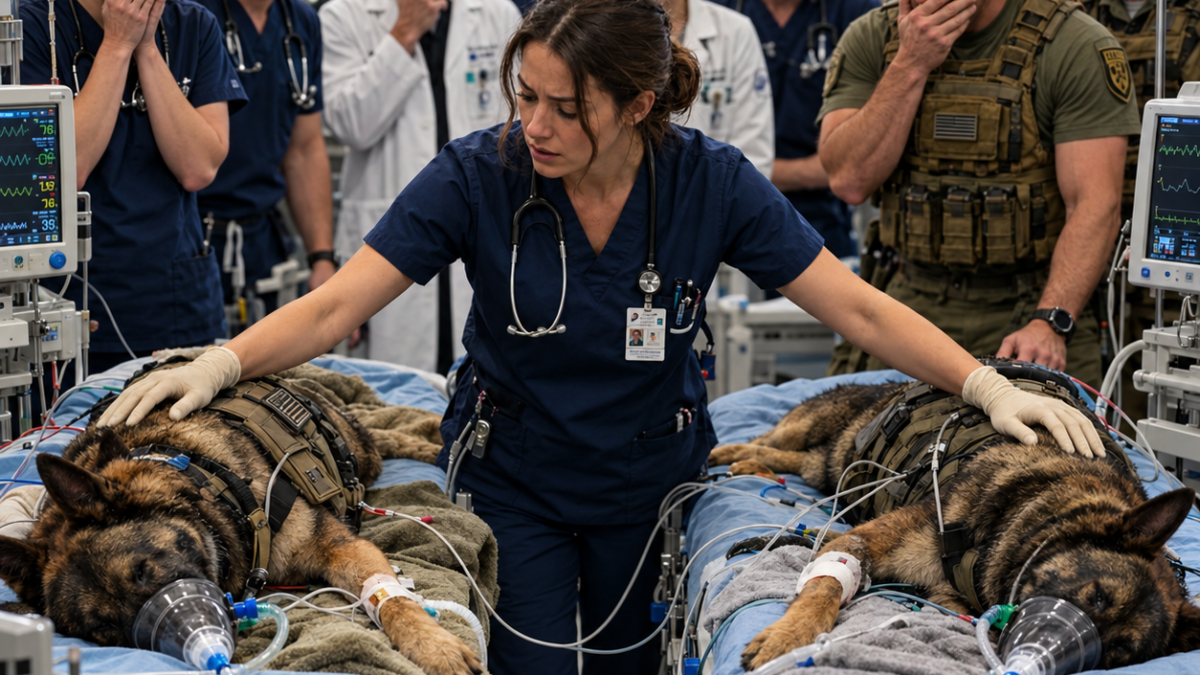
7 Doctors Couldn’t Stabilize 2 Navy K9s After a Mystery Exposure—Then the Quiet Nurse Shut Off One Air Unit and Used a Military Recovery Technique No One Knew She Had.
Seven specialists had spent nearly an hour fighting to save two of the Navy’s most valuable working dogs when a quiet nurse everyone had ignored noticed one detail that made the entire room go silent.
The senior administrator publicly ordered her away from the K9s, never realizing she knew exactly what had happened to them—or that his own signature was buried inside the secret that had nearly killed them.
And when the dying dogs finally responded to a technique Leah Mercer had not used since the worst mistake of her military career, the truth that surfaced would destroy one man’s career and force Leah to confront the failure she had been running from for years.
At 6:41 on a wet Thursday evening, the emergency doors at Cedar Point Naval Medical Center flew open hard enough to strike the rubber stops behind them.
Two military handlers came through first.
Neither was walking.
They were running.
Behind them, corpsmen pushed two canine stretchers so fast that one wheel bounced over the threshold.
On the first stretcher lay Rook, a dark sable Dutch Shepherd with a black face and a body built like a spring under tension.
Except there was no tension now.
His head rested sideways against the padded stretcher.
His eyes were half open.
His tongue showed slightly between his teeth.
His chest rose three times in quick shallow breaths, paused, then rose again.
On the second stretcher lay Lyra, a smaller black-and-tan Dutch Shepherd whose ears normally stood sharp enough to look carved from stone.
Now one ear had folded sideways.
Her body barely moved.
Twenty-three minutes earlier, both dogs had been standing under their own power at a naval training complex less than six miles away.
Now seven physicians and veterinary specialists would eventually crowd around them, and not one of them would understand why two highly conditioned military working dogs had suddenly begun failing at almost exactly the same time.
“Trauma?”
“No.”
“Heat exposure?”
“Not enough.”
“Ingestion?”
“Unknown.”
“Environmental?”
“Possible.”
“Move, move, move.”
Dr. Amelia Grant came through the swinging doors already pulling on gloves.
PART2:
She was fifty-two, silver beginning at her temples, calm in the way only people who had spent decades standing between panic and death could be calm.
“Rook goes left. Lyra goes right. Same workup on both. I want blood chemistry, tox screen, arterial gases, temperature, cardiac monitoring, respiratory support. Find me something.”
Chief Petty Officer Marcus Hale stayed beside Rook.
Petty Officer First Class Jonah Pierce went with Lyra.
Neither man asked permission.
Nobody told them to leave.
Everybody at Cedar Point knew better than to separate a working-dog handler from his partner during an emergency unless there was absolutely no choice.
Marcus had worked with Rook for four years.
They had slept in the same dirt, ridden the same aircraft, crossed the same deserts, and once spent nine hours behind a wall in a place Marcus still refused to name while gunfire came and went beyond it.
Jonah had trained Lyra from the time she was barely eighteen months old.
He knew the sound of every kind of bark she made.
The warning bark.
The frustration bark.
The I-smell-something-you-don’t bark.
The irritated little huff she gave him when he took too long clipping her lead.
He also knew what her face looked like when she was scared.
He had never seen this face.
“Lyra.”
Her eye moved.
Barely.
Jonah bent closer.
“Hey, girl. Look at me.”
Nothing.
PART3:
His jaw tightened.
Dr. Samuel Ortega reached around him to check the monitor.
“Sir, give us half a step.”
“I’m not leaving.”
“I didn’t ask you to leave.”
Jonah shifted six inches.
“That enough?”
“It’ll do.”
Across the hall, Marcus pressed two fingers into the fur behind Rook’s ear.
“Come on, brother.”
Rook did not react.
Marcus looked up.
“Dr. Grant.”
“I see him.”
“He always responds to my voice.”
“I know.”
“No. You don’t understand. Always.”
Grant looked directly at him.
“I understand.”
“Then tell me what’s happening.”
“I can’t yet.”
Marcus stared at her.
That answer frightened him more than anything else.
At the far end of the corridor, a nurse carrying a tray of IV supplies stopped walking.
Her name was Leah Mercer.
Thirty-six years old.
Dark brown hair pulled into a low ponytail.
Hazel eyes.
Navy-blue scrubs.
Plain white hospital badge.
Black stethoscope.
No rank.
No impressive title.
No reason anyone in the veterinary emergency wing should have been looking at her.
Leah had worked at Cedar Point for almost four years.
People trusted her.
They just didn’t know much about her.
She covered shifts nobody wanted.
She remembered which elderly patients hated ice in their water.
She knew which young corpsmen became nauseated around blood and quietly reassigned them before anyone could embarrass them.
She stayed late.
Arrived early.
Never talked about herself unless someone asked.
And because very few people did, almost nobody knew what she had done before nursing.
Leah watched Rook through the glass.
Three shallow breaths.
Pause.
One deeper breath.
Swallow.
Three shallow breaths again.
Her fingers tightened around the IV tray.
Then she looked across the corridor at Lyra.
Two shallow breaths.
Pause.
Swallow.
Head shift.
Three more breaths.
Something cold moved through Leah’s stomach.
She had seen a pattern like that before.
A long time ago.
A young corpsman named Emily stood beside her.
“You okay?”
Leah didn’t answer.
Emily followed her gaze.
“Those dogs?”
“Yeah.”
“They’re in bad shape.”
Leah’s eyes never left Rook.
“How long have they been here?”
“Maybe ten minutes.”
“What happened?”
“Nobody knows.”
Leah slowly set the tray down.
Inside Rook’s room, someone increased oxygen.
Inside Lyra’s room, a technician called out numbers.
Leah heard Dr. Grant say, “Again.”
A monitor alarm sounded.
Marcus turned pale.
The old part of Leah’s mind began waking up.
Not the nurse.
The other woman.
The one she had buried.
She watched Rook’s ears.
They twitched.
Not toward Marcus.
Not toward Grant.
Toward the back wall.
A portable air-scrubbing unit had just clicked on.
The machine made almost no sound to a human ear.
A low mechanical hum.
Air moved through a flexible duct.
Rook’s nostrils flared.
His tongue moved.
Then he swallowed.
Across the hall, Lyra did the same thing.
Leah’s heartbeat changed.
The machine cycled off.
Rook’s breathing eased slightly.
Twenty seconds later, it restarted.
Lyra’s body stiffened.
Leah stepped toward the glass.
“Dr. Grant.”
Grant did not hear her.
Leah raised her voice.
“Dr. Grant.”
This time Grant looked.
“Yes?”
“Can you turn off that portable air unit?”
Several heads turned.
Grant frowned.
“Why?”
“I want to see something.”
A man standing near the doorway laughed once under his breath.
Leah recognized him.
Dr. Victor Kline.
Deputy director of clinical operations.
Civilian.
Former veterinary research administrator.
Expensive suit under a disposable medical gown because Victor Kline somehow managed to look as if even emergencies should have respected his dress code.
He was not one of the treating veterinarians, but he had arrived five minutes earlier after hearing that two Special Warfare K9s were crashing in his facility.
Kline looked Leah up and down.
“You want to shut down environmental support because you want to see something?”
Leah kept her eyes on Grant.
“Thirty seconds.”
Kline stepped closer.
“Nurse, we have seven physicians in this wing.”
“I know.”
“And two critically ill military animals.”
“I know that too.”
“So let the medical team work.”
Leah finally looked at him.
“I’m asking for thirty seconds.”
Kline gave a short smile that contained no humor.
“You’re assigned to human inpatient care.”
“Tonight I’m float support.”
“Then support.”
Emily’s face tightened beside Leah.
Dr. Grant watched the exchange.
Leah could have stepped back.
For most of the last four years, she would have.
But Rook swallowed again.
Then Lyra did.
Same timing.
Same reaction.
Leah pointed.
“They both react when that machine comes on.”
The room quieted a little.
Kline sighed.
“Dogs react to sound.”
“It isn’t the sound.”
“How would you know?”
Leah hesitated.
That was the question she had spent years avoiding.
Before she could answer, Grant turned to the technician.
“Switch it off.”
Kline stared at her.
“Amelia.”
“Thirty seconds won’t kill them.”
The machine stopped.
Leah looked at Rook.
One breath.
Two.
Three.
His chest slowed.
Lyra’s jaw loosened.
Grant’s eyes narrowed.
“Turn it on.”
The technician did.
Rook’s breathing became uneven almost immediately.
Lyra lifted her head and dropped it again.
Jonah looked from his dog to the machine.
“What the hell?”
“Off,” Grant said.
The unit stopped.
The dogs settled slightly.
Kline’s expression changed.
Only for a fraction of a second.
But Leah saw it.
Not surprise.
Recognition.
Then it disappeared.
Grant stepped toward the portable unit.
“Where did this come from?”
“Facilities,” a technician said.
“Which facilities inventory?”
“I’d have to check.”
Kline interrupted.
“It’s a standard HEPA scrubber. We use dozens.”
Leah crouched near the intake without touching it.
There was a faint odor in the exhaust.
Sharp.
Clean.
Sweet underneath.
Her chest tightened.
“What cleaning product was used where these dogs trained today?”
Marcus looked at her.
“What?”
“Before they got sick. Were they indoors?”
“Part of the time.”
“In a vehicle?”
Marcus frowned.
“Transport enclosure.”
“Both of them?”
“Yes.”
“Same vehicle?”
“Same compartment, separate cages.”
“How long?”
“Maybe twenty minutes.”
Leah looked at Jonah.
“Did either dog lick his lips? Swallow? Rub his face?”
Jonah froze.
“Lyra kept swallowing.”
Marcus turned.
“Rook too.”
Grant looked at Leah.
“What are you thinking?”
Leah smelled the air again.
“Aerosolized irritant. Maybe residue.”
Kline shook his head.
“Based on what?”
“Based on two dogs developing the same symptoms after sharing the same environment.”
“That narrows it to several hundred possibilities.”
“Yes.”
Kline spread his hands.
“Which is why professionals use diagnostics instead of guessing.”
Leah felt every person in the room hear the insult.
For a moment, she was twenty-eight again.
Concrete floor.
Fluorescent lights.
A Belgian Malinois named Mako refusing to enter a kennel.
Her own voice getting sharper.
Again.
Heel.
Mako, heel.
Again.
Again.
Again.
Then another voice behind her.
Stop.
Chief Warrant Officer Warren Maddox.
Gray mustache.
Scar across one knuckle.
Eyes that missed nothing.
You’re trying to make him obey because you’re afraid of what it means if he doesn’t.
Leah had hated him for saying it.
Because he had been right.
Now she looked at Kline.
“I’m not asking you to guess.”
She pointed to Rook and Lyra.
“I’m asking you to observe.”
Grant spoke before Kline could respond.
“Marcus, call the training site. Find out exactly what was used in that transport bay today.”
Marcus already had his phone out.
Jonah stayed beside Lyra.
Kline stepped toward Grant.
“A word.”
“Not now.”
“It concerns procedure.”
“So do two crashing dogs.”
Something in Grant’s tone made him stop.
Leah watched him walk away.
He did not look irritated anymore.
He looked worried.
At 7:07 p.m., the first lab results came back.
Nothing explained the severity.
At 7:12, Rook’s temperature climbed.
At 7:15, Lyra began trembling.
At 7:18, Marcus got an answer from the training complex.
“They used a new disinfectant.”
Grant looked up.
“What?”
“New product. First day.”
“Name?”
Marcus listened to the voice on the phone.
“ClearShield Nine.”
Leah went still.
Kline’s head snapped toward him.
Too fast.
Grant noticed.
“You know it?”
Kline recovered.
“It’s on the approved supply list.”
Leah looked at him.
“For what?”
“General decontamination.”
“Enclosed transport kennels?”
“The manufacturer certifies it for institutional surfaces.”
“That isn’t what I asked.”
Kline’s eyes narrowed.
“Excuse me?”
“Was it approved for enclosed canine transport spaces?”
Silence.
Marcus lowered his phone.
Grant said, “Victor?”
Kline removed his glasses.
“We don’t know that the product has anything to do with this.”
“That wasn’t my question either.”
His jaw shifted.
“It was cleared through facilities procurement.”
“By whom?”
Kline put his glasses back on.
“This is not the time.”
Leah stared at him.
Which meant it was exactly the time.
Grant held out her hand.
“Product sheet.”
A technician pulled it up on a tablet.
They read.
Concentrated vapor could irritate respiratory tissue.
Use with adequate ventilation.
Allow treated enclosed areas to dry fully before occupation.
Avoid aerosol exposure.
Marcus’s face hardened.
“How long is fully?”
“Depends on concentration,” Grant said.
Marcus looked at Kline.
“Were my dog and Lyra put inside before it dried?”
“We don’t know.”
Marcus took one step toward him.
“Find out.”
Kline’s expression cooled.
“Chief, I understand you’re emotional.”
The room changed.
Marcus became absolutely still.
Jonah looked up from Lyra.
Leah felt Emily beside her whisper, “Oh, no.”
Marcus said quietly, “Don’t ever use that word like an insult while my partner is lying there.”
Kline lifted both hands.
“I’m saying we need facts.”
Leah spoke.
“Then stop avoiding them.”
His face turned toward her.
“You’ve contributed your observation, Nurse Mercer.”
“I’m not finished.”
“You are if I say you are.”
Grant stepped between them.
“No, Victor.”
He stared at her.
Grant’s voice stayed level.
“She noticed the only repeatable environmental trigger we’ve found. She stays.”
Kline’s eyes moved around the room.
Seven doctors.
Two handlers.
Technicians.
Nurses.
Everyone had heard him challenged.
His humiliation lasted less than five seconds.
It would cost everyone else much more.
“Fine,” he said.
Then he walked out.
Leah watched him go.
Something was wrong.
Not only with the dogs.
With him.
At 7:26, Lyra lifted her head when Jonah said her name.
“Lyra.”
Her ear moved.
Jonah almost laughed.
“That’s it. Come on.”
She tried to focus on him.
Then the portable air unit clicked on again.
The technician had restarted it automatically after a warning light.
Lyra gagged.
Rook’s monitor alarmed.
“Turn it off!” Leah shouted.
The unit died.
Grant pointed at two corpsmen.
“Get that machine out of here.”
They unplugged it.
As they rolled it toward the door, Leah smelled that sweet chemical edge again.
Stronger near the back filter housing.
“Stop.”
The corpsmen stopped.
Leah crouched.
“Open the filter compartment.”
A facilities technician removed the panel.
Inside, the filter was newer than the machine.
Bright white except along one lower corner.
A faint blue residue stained the fibers.
Grant leaned closer.
“What is that?”
Nobody answered.
Kline appeared in the doorway.
His face lost color.
Leah saw it.
So did Marcus.
Marcus pointed.
“You know what that is.”
Kline said nothing.
Grant straightened.
“Where was this unit before it came here?”
The facilities technician looked at his tablet.
“Equipment transfer record says Training Annex Four.”
Jonah slowly stood.
“The K9 facility.”
“Yes, sir.”
Leah looked through the glass at Lyra.
Then at Rook.
The same dogs.
The same chemical.
The same circulating unit.
They had been exposed at the training complex.
Then the contaminated scrubber had followed them to the hospital.
The thing meant to clean their air had been feeding traces of the same irritant back into the room.
Grant’s voice became very quiet.
“Victor.”
Kline crossed his arms.
“We do not know that residue is ClearShield.”
“We’re testing it.”
“You’re making assumptions.”
Leah looked at him.
“Were you at Annex Four today?”
His eyes found hers.
“Why?”
“Because you recognized the product name.”
“I oversee clinical operations. I recognize many products.”
“And you recognized the filter.”
“I did no such thing.”
Marcus took another step forward.
Grant lifted one hand.
“Marcus.”
He stopped.
Barely.
Grant turned to the technician.
“Bag the filter. Chain of custody. Nobody touches the unit.”
Kline gave a humorless laugh.
“Chain of custody? Amelia, this is a medical event, not a criminal investigation.”
“No,” a new voice said from the hallway.
Everyone turned.
Commander Elias Grant stood at the entrance.
He was not related to Amelia Grant despite the shared last name, a fact the staff had joked about exactly once before discovering neither Grant found it funny.
Elias was forty-eight, broad-shouldered, close-cropped gray at the sides, and carried himself with the contained stillness of a man who had learned long ago that raising his voice was rarely necessary.
He looked at the two treatment rooms.
Then at Marcus.
Then Jonah.
Then Kline.
“If someone exposed two Special Warfare K9s to an unapproved chemical and continued that exposure inside a naval medical facility,” Elias said, “it may become one.”
Kline’s mouth tightened.
“Commander, we don’t have evidence of wrongdoing.”
“Then you should be comfortable with us finding out.”
No one spoke.
Elias stepped toward the glass.
“How bad?”
Grant answered.
“Still critical, but we found a likely exposure path.”
“Will they survive?”
“I can’t promise that.”
Marcus turned away.
Jonah closed his eyes.
Elias nodded once.
“Do what you need.”
Grant looked at Leah.
“We removed the source.”
Leah didn’t answer.
She was watching Rook.
The chemical irritation explained part of what she saw.
Not all of it.
His respiratory pattern was beginning to improve.
His temperature had stopped climbing as fast.
But his pupils remained wide.
His muscles were tight.
Every time a cart rattled past the hallway, his body flinched.
Lyra was doing the same.
Leah knew that look.
The immediate danger might have been fading.
The dogs did not know it.
Their bodies were still trapped inside the threat.
Grant saw her face.
“What?”
“They’re medically stabilizing.”
“Barely.”
“I know.”
“What are you seeing?”
Leah swallowed.
“Fear.”
One of the veterinary specialists, Dr. Hannah Lee, looked over.
“They’re working dogs.”
“So?”
“They’re trained under stress.”
“Training doesn’t erase the nervous system.”
Lee studied her.
Leah continued.
“They were trapped in an enclosed compartment while something hurt them and they couldn’t escape it.”
Marcus’s eyes shifted to Rook.
Leah pointed gently.
“Now every unfamiliar mechanical sound is giving them the same message.”
Jonah looked at Lyra.
“So what do we do?”
Leah knew the answer.
She had known it for fifteen minutes.
She also knew what answering would require her to admit.
Grant said, “Leah?”
Leah looked at the floor.
For four years, she had worn scrubs and allowed people to believe nursing was the beginning of her professional life.
It wasn’t.
It was the second beginning.
The first had ended on a concrete floor with a dog named Mako refusing to look at her.
She had not spoken about him in years.
Not to coworkers.
Not to friends.
Not even to the man she had nearly married.
Because some failures were easier to survive when nobody knew they belonged to you.
Rook shifted his head.
His eye found Leah.
For half a second, he stared directly at her.
She saw confusion.
Exhaustion.
Fear.
And something inside her stopped hiding.
“I worked with military working dogs.”
Silence.
Marcus turned.
Jonah turned.
Elias looked at her carefully.
Grant lowered her clipboard.
Kline, still standing near the doorway, actually laughed.
“You what?”
Leah ignored him.
Grant asked, “As a veterinarian?”
“No.”
“Handler?”
“No.”
“Then what?”
“Behavioral recovery.”
Elias’s expression changed.
“With who?”
Leah hesitated.
“Joint expeditionary canine support teams.”
Marcus stared at her.
“For how long?”
“Six years.”
Kline shook his head.
“This is absurd.”
Leah finally looked at him.
“I don’t need you to believe me.”
“You expect a naval medical team to hand two critical K9s to a bedside nurse because she claims she worked with dogs years ago?”
“No.”
Leah pointed toward the monitors.
“I expect the medical team to keep treating them.”
Then she looked at Marcus and Jonah.
“And I think I can help their bodies understand the threat is over.”
Grant asked, “How?”
Leah rolled her sleeves to her elbows.
“With something I swore I’d never use again.”
Marcus stepped closer.
“Why?”
Leah looked at Rook.
“Because the last time I used it, I learned it wrong.”
“What does that mean?”
“It means I hurt a dog I was trying to help.”
Nobody spoke.
Kline gave her a thin smile.
“And this is the person we want experimenting?”
Leah flinched.
Only slightly.
But Marcus saw it.
He looked at Kline.
“Get out.”
Kline stared.
“Excuse me?”
“You heard me.”
“You don’t control this facility.”
“No.”
Marcus’s voice dropped.
“But if you say one more thing to the woman trying to help my dog while you stand there defending the chemical that put him here, you’re going to discover exactly how little I care about your job title.”
Elias said, “Marcus.”
Marcus did not move.
Elias looked at Kline.
“Dr. Kline, give the treatment team space.”
Kline’s face darkened.
“You’re making a mistake.”
Elias replied, “Then it will be mine.”
Kline walked out.
This time nobody watched him leave.
Every eye went to Leah.
She wished they wouldn’t.
She preferred corners.
Corners let you observe.
Centers expected you to be certain.
Leah wasn’t certain.
She was terrified.
But she remembered something Chief Maddox had told her when she was twenty-nine.
Courage around a frightened animal doesn’t mean you’re not afraid.
It means you refuse to make your fear the animal’s problem.
Leah breathed slowly.
“First, dim the lights.”
Grant nodded.
“Do it.”
“Reduce foot traffic outside both rooms. No overhead announcements in this corridor if you can avoid it.”
A nurse reached for the phone.
“Done.”
“No sharp commands unless medically necessary.”
Marcus frowned.
“He’s trained to commands.”
“Not right now.”
Rook’s ear twitched at a metal tray.
Leah pointed.
“Right now every command is another thing his brain has to process.”
Jonah asked, “What do you want us to do?”
“Sit down.”
“Where?”
“On the floor.”
Jonah blinked.
“Seriously?”
“Seriously.”
Marcus was already lowering himself beside Rook’s stretcher.
Leah stopped him.
“Not that close.”
Marcus frowned.
“He needs me.”
“Yes.”
She softened her voice.
“But he needs the choice more.”
Marcus looked at Rook.
Then he moved two feet back and sat cross-legged on the floor.
Jonah did the same near Lyra.
Grant asked, “And you?”
“I wait.”
“For what?”
“For them to notice nothing bad is happening.”
Leah crouched several feet from Rook.
She did not stare at him.
Predators stared.
Commands stared.
People who wanted things stared.
Instead, she angled her body sideways.
Relaxed her hands.
Lowered her shoulders.
Then she began to breathe.
Slow inhale.
Pause.
Long exhale.
Pause.
Again.
Marcus watched.
“That’s the secret technique?”
“No.”
“What is it?”
“The first part.”
Rook’s chest rose quickly.
Leah slowed her own breathing.
Again.
And again.
A minute passed.
Nobody spoke.
The hospital seemed unnaturally quiet.
Grant watched the monitor.
Rook’s respiratory rate dropped by two.
Then another two.
Dr. Lee leaned closer.
“It’s changing.”
“Don’t react,” Leah whispered.
Another minute.
Rook’s eyes opened more fully.
His gaze moved toward Marcus.
Marcus’s face tightened.
Leah said softly, “Now talk.”
“What do I say?”
“Something ordinary.”
Marcus looked almost offended.
“My dog might die and you want ordinary?”
“Yes.”
He swallowed.
Then he looked at Rook.
“Remember the blue tunnel?”
Rook’s ear moved.
Marcus laughed quietly despite himself.
“You hated that stupid tunnel.”
Rook blinked.
“You’d clear a room full speed, jump out of a helicopter, climb a ladder like a lunatic, but put one blue training tunnel in front of you and suddenly you needed to review the terms of your contract.”
Dr. Grant looked down to hide a smile.
Marcus’s eyes filled.
“You made me crawl halfway through it the first time.”
Rook’s nose twitched.
“That’s right.”
Marcus leaned forward slightly.
“You remember.”
Leah raised one hand.
“Stay where you are.”
Marcus nodded.
Across the room, Jonah looked at Lyra.
“What do I tell her?”
“You know her.”
Jonah breathed shakily.
“Okay.”
He sat back.
“Remember Coronado?”
Lyra’s eyelids shifted.
“That beach you tried to eat?”
One of the technicians smiled.
Jonah continued.
“You swallowed enough sand to build your own island.”
Lyra’s ear lifted.
Jonah’s voice broke.
“You scared me then too, girl.”
Her head turned two inches.
Toward him.
Jonah stopped breathing.
Leah whispered, “Keep going.”
“Yeah.”
Jonah wiped one eye.
“Same idiot. Same voice.”
Lyra looked at him.
“I’m still here.”
Her tail moved.
Once.
The smallest tap against the pad.
Jonah covered his mouth.
Dr. Ortega turned away for a second.
Leah looked down.
Because hope could be dangerous when it arrived too fast.
At 8:03 p.m., the dogs’ temperatures began falling.
At 8:09, Rook responded normally to Marcus’s voice three times in a row.
At 8:12, Lyra lifted her head and held it there.
The medical team continued fluids, respiratory monitoring and supportive treatment.
Leah never pretended her technique was curing chemical exposure.
It wasn’t.
Medicine was treating their bodies.
She was trying to stop their nervous systems from fighting a threat that had already left the room.
Grant understood the distinction immediately.
Kline would later pretend he did.
At 8:16, Rook tried to rise.
Marcus instinctively moved.
Leah caught his wrist.
“Wait.”
Marcus looked at her like she had lost her mind.
“He’s trying to stand.”
“I know.”
“He’ll fall.”
“Maybe.”
“You want me to watch?”
“I want him to learn his body belongs to him again.”
Rook planted one paw.
Then another.
His front legs shook.
Marcus’s hand hovered six inches away.
“Come on, buddy.”
Rook rose.
For two seconds.
Three.
His back legs trembled.
Then he lowered himself.
Marcus exhaled.
Leah released his wrist.
“Now touch him.”
Marcus placed one hand on the floor.
Palm up.
He did not reach.
Rook looked at it.
The room became still.
Slowly, Rook stretched his nose forward.
One inch.
Another.
His nose touched Marcus’s palm.
Marcus closed his eyes.
“There you are.”
Rook leaned his muzzle into him.
Marcus bent his head.
“I’ve got you.”
Across the room, Lyra made the same choice with Jonah.
For the first time that night, the monitors were not the loudest thing in the room.
Two grown men crying quietly beside their dogs were.
Leah stepped back.
Dr. Grant followed her into the hall.
“You’ve done that before.”
Leah stared through the glass.
“Yes.”
“With deployed dogs?”
“Yes.”
Grant waited.
Leah knew the question.
She answered before Grant asked.
“Mako.”
“Who was Mako?”
Leah folded her arms.
“A Belgian Malinois.”
“Yours?”
“No.”
She gave a sad smile.
“That might have been part of the problem. I treated him like he was mine to fix.”
Grant said nothing.
Leah continued.
“He came back from deployment with a sound trigger. We didn’t know what it was at first. Certain ventilation tones. Metal-on-metal noise. Anything that reminded him of an enclosure he’d been trapped in during an attack.”
Grant looked back at Rook.
“What did you do?”
“Everything wrong.”
“You were trained.”
“I was arrogant.”
Grant’s eyes returned to Leah.
Leah swallowed.
“He stopped responding to commands, so I gave him more commands. He became avoidant, so I shortened the lead. He hesitated at the kennel door, so I repeated the cue harder.”
Her voice thinned.
“I thought structure would make him feel safe.”
“It didn’t.”
“No.”
“What happened?”
“One day he shut down.”
Leah looked at her hands.
“Wouldn’t look at me. Wouldn’t take food. Wouldn’t engage. Nothing.”
Grant waited.
“Chief Maddox watched me for about five minutes. Then he asked why I was angry.”
“Were you?”
“I told him no.”
Leah laughed bitterly.
“I was furious.”
“At the dog?”
“At myself.”
She leaned against the wall.
“Maddox said, ‘You keep trying to make him obey because his fear makes you feel incompetent.’”
Grant winced.
“He sounds gentle.”
“He wasn’t.”
“Was he right?”
“Completely.”
Leah looked through the glass.
“He taught me the recovery protocol after that.”
“The one you used tonight?”
“A version of it.”
“Why did you leave?”
Leah was quiet.
Then she said, “Because knowing why you failed doesn’t erase that you failed.”
Grant studied her.
“Did Mako die?”
“No.”
“Was he retired?”
“No.”
“Was he injured because of you?”
“No.”
“Then what happened?”
Leah looked away.
“He was transferred to another specialist.”
“And recovered?”
“Eventually.”
Grant crossed her arms.
“Leah.”
“What?”
“You’re describing a mistake.”
“I lost his trust.”
“And then?”
“Someone better rebuilt it.”
Grant shook her head.
“You became a nurse because of one dog?”
“No.”
Leah looked into the treatment room.
“I became a nurse because of what he taught me.”
Grant waited.
“People shut down too.”
Leah’s voice softened.
“Patients get scared. They stop answering. They become angry. They refuse care. Sometimes everyone around them starts asking why they’re being difficult.”
She looked at Grant.
“Mako taught me to ask what they’re afraid of.”
Grant smiled faintly.
“That sounds like a pretty good reason to become a nurse.”
Leah did not answer.
A voice behind them did.
“She’s not telling you everything.”
Leah turned.
Victor Kline stood at the end of the hall.
He held a thin personnel folder.
Her personnel folder.
Grant’s expression hardened.
“What are you doing with that?”
Kline walked closer.
“I asked HR to verify Nurse Mercer’s claims.”
Leah felt cold.
Elias appeared from the opposite corridor.
Kline continued.
“And I found something interesting.”
Marcus stepped out of Rook’s room.
“What?”
Kline opened the folder.
“Nurse Mercer did work in military canine behavioral support.”
Leah said nothing.
“Until she was removed from direct K9 duties after a documented handling incident.”
Grant looked at Leah.
Kline smiled.
“There it is.”
Marcus’s face changed.
Leah felt the old shame return so fast she nearly lost her balance.
Kline read.
“Behavioral intervention resulted in loss of canine engagement and required reassignment to an alternate recovery specialist.”
He closed the folder.
“Perhaps we should stop pretending tonight’s hero has a spotless history.”
Leah stared at him.
The corridor was full.
Doctors.
Technicians.
Nurses.
Handlers.
Every person who had begun looking at her differently now heard the sentence she had spent years avoiding.
Removed from direct duties.
Handling incident.
Reassignment.
Her throat tightened.
Kline stepped closer.
“You withheld material professional history.”
“No,” Leah said.
“You never disclosed this expertise.”
“It wasn’t relevant to my nursing position.”
“Until you inserted yourself into veterinary care.”
Grant said, “Victor, enough.”
“No. We’re discussing patient safety.”
Marcus laughed once.
A dangerous sound.
“My dog is breathing because she inserted herself.”
“Your dog is breathing because seven medical professionals treated him.”
Leah spoke quietly.
“They did.”
Kline looked surprised.
Leah nodded toward Grant.
“Dr. Grant’s team saved them medically.”
Then she looked through the glass.
“I helped with the part I understood.”
Kline stared at her.
Leah forced herself not to look down.
“Yes. I mishandled Mako’s recovery years ago.”
Grant said nothing.
Leah continued.
“I pushed a frightened dog when I should have listened.”
Her voice shook now.
She let it.
“I was so afraid of failing him that I made his fear about me.”
Kline’s smile returned.
“Thank you.”
He turned toward Elias.
“That is precisely my concern.”
Leah interrupted.
“But that isn’t why you’re here.”
Kline stopped.
She looked directly at him.
“You don’t care what happened to Mako.”
His smile disappeared.
“You care what happens when somebody asks who approved ClearShield Nine.”
The hallway went silent.
Grant looked at him.
Elias’s eyes narrowed.
Kline said, “Be very careful.”
Leah’s heart hammered.
“Were you at Annex Four this afternoon?”
No answer.
“Did you authorize that product for same-day use?”
Kline took one step toward her.
“I said be careful.”
Elias moved between them without appearing to move quickly.
“Answer the question.”
Kline looked at him.
“This has become ridiculous.”
“Then clear it up.”
“I oversee hundreds of procurement decisions.”
“Was that one of them?”
Kline adjusted his cuffs.
“ClearShield was approved through standard channels.”
Grant asked, “For enclosed canine transport?”
“It was an emergency substitution.”
Marcus said, “There it is.”
Kline turned.
“The usual product was back-ordered. Training operations could not stop because one cleaning agent was unavailable.”
Jonah stepped out of Lyra’s room.
“You put a replacement chemical in our transport cages without canine clearance?”
“It was rated for veterinary environments.”
Leah asked, “Who signed the temporary-use waiver?”
Kline looked at her.
Nobody spoke.
Then a young facilities corpsman standing near the wall began crying.
Everyone turned.
Her name was Elena Ruiz.
Twenty-two years old.
She had been at Cedar Point eight months.
She stared at the floor.
“I did.”
Kline’s face changed.
Elias looked at her.
“What did you do?”
Elena wiped her face.
“I signed the cleaning log.”
Kline said sharply, “Corpsman.”
She flinched.
Leah saw it.
The exact same thing she had seen in frightened patients.
The same thing she had seen in Mako.
Not guilt.
Fear.
Leah walked toward her slowly.
“Elena.”
The young woman looked up.
Leah lowered her voice.
“What are you afraid will happen if you tell us?”
Kline snapped, “This is not appropriate.”
Elias did not look away from Elena.
“Answer Nurse Mercer.”
Elena started crying harder.
“I was told to change the time.”
Kline went still.
Grant whispered, “What?”
Elena looked at Elias.
“The transport compartment was cleaned at 5:38.”
Marcus’s eyes widened.
“We loaded the dogs at 5:52.”
Elena nodded miserably.
“The product instructions said wait until completely dry and ventilate.”
Jonah’s hands clenched.
“It wasn’t dry.”
“No.”
“Who told you to release the vehicle?”
Elena looked at Kline.
Nobody moved.
Kline’s face turned gray.
“She is confused.”
Elena shook her head.
“No, sir.”
“Elena.”
“You told me the training schedule had already been delayed twice.”
Kline’s voice sharpened.
“I told you to follow operational requirements.”
“You told me to enter 4:45 on the log.”
Elias stepped closer.
“Did he?”
Elena nodded.
“Yes, sir.”
Kline exploded.
“This is absurd. She’s a junior enlisted facilities assistant trying to protect herself after failing to follow procedure.”
Elena flinched again.
Leah’s anger rose.
Not hot.
Cold.
Precise.
She had spent years around frightened people.
She knew what shame looked like when someone carried their own mistake.
And she knew what it looked like when someone had been forced to carry somebody else’s.
Leah turned to Kline.
“You’re doing it again.”
He stared.
“What?”
“You’re finding the smallest person in the room and putting your fear on them.”
His face twisted.
“You have no idea what you’re talking about.”
“I think I do.”
“You are a nurse.”
“Yes.”
“You are not an investigator.”
“No.”
“You are not an administrator.”
“No.”
“You washed out of the exact specialty you’re pretending makes you an expert.”
The words hit.
Leah’s chest hurt.
But this time she did not shrink.
She looked at Elena.
Then at Rook.
Then Lyra.
“No,” Leah said.
“I made a mistake in that specialty.”
She faced Kline.
“And I spent eight years learning not to make it again.”
Elias held out his hand to Elena.
“Give me the original log.”
“I don’t have it.”
Kline exhaled sharply.
Elias looked at her.
“Does an electronic copy exist?”
Elena hesitated.
Then nodded.
“Building automation backs up workstation entries every hour.”
Kline’s eyes closed.
Only for a second.
But that was enough.
Elias said, “Secure the server.”
A communications officer standing nearby immediately pulled out his phone.
Kline stepped toward the elevators.
Elias said, “Dr. Kline.”
He stopped.
“You are not to access any clinical, procurement, facilities or training records until command review is complete.”
“You don’t have authority to suspend my access.”
“Maybe not.”
Elias nodded toward the security officer approaching from the far hall.
“But Rear Admiral Sutter does, and he approved the restriction two minutes ago.”
Kline’s face emptied.
The elevator doors opened.
He did not move.
Elias said, “Someone will escort you.”
Kline looked at Leah.
For the first time all night, the arrogance was gone.
What remained underneath looked smaller.
Afraid.
Leah almost pitied him.
Almost.
Then Rook’s monitor alarmed.
Every person in the corridor turned.
Marcus ran.
“Rook!”
Leah forgot Victor Kline existed.
Rook was convulsing.
Grant moved instantly.
“Clear.”
Marcus stumbled backward.
“His pressure is dropping.”
“Medication.”
“Ready.”
“Now.”
Leah stood frozen at the door.
The medical team moved around Rook.
Fast.
Controlled.
Seven doctors who had been accused by a viral headline of giving up were doing exactly the opposite.
They fought.
Grant called numbers.
Ortega adjusted support.
Lee checked pupils.
Marcus stood against the wall with both hands on his head.
“Come on.”
Rook’s legs jerked.
“Come on, buddy.”
Leah’s stomach twisted.
Chemical exposure could come in waves.
Stress could spike.
They were not safe yet.
Rook’s body went still.
The monitor steadied.
Grant exhaled.
“Okay.”
Marcus looked at her.
“Okay what?”
“We have him.”
“Is he—”
“We have him.”
Marcus bent forward with his hands on his knees.
Leah touched his shoulder.
He grabbed her wrist.
Not hard.
Like a drowning man finding a railing.
“I thought he was gone.”
“So did I.”
He looked at her.
“You?”
“Yes.”
“You always look calm.”
Leah shook her head.
“I’m scared.”
Marcus stared.
“Then how are you doing this?”
She looked at Rook.
“Because he’s scared enough for both of us.”
Marcus’s face crumpled.
He nodded.
At 8:44 p.m., Rook stabilized again.
At 8:51, Lyra stood without assistance.
Jonah laughed so loudly that three people jumped.
“You’re up.”
Lyra’s legs shook.
Her tail moved.
Jonah crouched.
“That’s my girl.”
She took one unsteady step.
Then another.
Leah’s eyes filled.
Grant touched her elbow.
“You did good.”
Leah shook her head.
“We’re not done.”
“No.”
Grant smiled.
“But you did good.”
By 9:20 p.m., preliminary testing confirmed that the blue residue in the portable air unit was chemically consistent with ClearShield Nine.
At 9:37, the electronic backup from Annex Four arrived.
The original cleaning log showed 5:38 p.m.
The altered version showed 4:45.
At 9:51, command investigators discovered something worse.
Victor Kline had received a safety advisory from the manufacturer six days earlier.
The advisory specifically warned against placing animals in enclosed spaces until surfaces treated with concentrated ClearShield had fully dried and the area had been ventilated.
He had forwarded the message to procurement.
Then written one sentence beneath it.
Operational necessity outweighs theoretical low-level exposure risk. Continue temporary use pending replacement stock.
The email carried his digital signature.
Marcus read it twice.
Then handed the tablet to Jonah.
Jonah’s face went white.
“They knew.”
Elias shook his head.
“He knew there was a warning.”
“That means he knew.”
“It means there will be an investigation.”
Marcus looked toward the room where Rook slept.
“If that dog dies, an investigation isn’t enough.”
Elias stepped closer.
“He’s not dead.”
Marcus’s jaw trembled.
“Don’t tell me to calm down.”
“I wasn’t going to.”
Elias looked through the glass too.
“I was going to tell you we make decisions about justice after we know the truth, not while we’re afraid.”
Marcus looked at him.
Then at Leah.
“That something she taught everybody tonight?”
Elias almost smiled.
“Apparently.”
Near midnight, the hospital quieted.
Leah should have gone home.
Her shift had ended.
Nobody expected her to stay.
She stayed anyway.
She sat in a plastic chair outside the two treatment rooms with a cup of coffee she never drank.
Marcus slept sitting upright for seventeen minutes before waking suddenly and looking through the glass.
Jonah refused to sleep at all.
At 12:23 a.m., Lyra ate three bites of boiled chicken.
Jonah announced it like she had won a medal.
At 12:41, Rook drank water.
Marcus cried again.
He stopped pretending he wasn’t.
At 1:10, Elias sat beside Leah.
For a while, neither spoke.
Then he said, “Maddox.”
Leah looked at him.
“What?”
“Chief Warrant Officer Warren Maddox.”
Her body went rigid.
“You know him?”
“I knew of him.”
Elias leaned back.
“He trained half the behavioral-recovery specialists my generation trusted.”
Leah stared at the floor.
“He trained me.”
“I gathered that.”
“From my file?”
“No.”
“Then how?”
Elias looked at her.
“You breathe exactly like he taught handlers to breathe.”
Leah laughed softly.
“He called it anchor breathing.”
“Three anchors.”
She looked up.
He remembered.
Elias counted on his fingers.
“Predictable rhythm. Familiar presence. Voluntary contact.”
Leah nodded.
“Most people thought it was ridiculous.”
“Most people didn’t understand the point.”
“What did you think?”
“I thought if Maddox said it worked, I’d listen.”
Leah smiled.
“That already makes you smarter than I was at twenty-eight.”
Elias studied her.
“You really believe you failed Mako.”
“I did.”
“Maybe.”
She looked at him.
“That’s generous.”
“No.”
He folded his arms.
“Failure can be an event without becoming an identity.”
Leah’s smile disappeared.
Elias continued.
“You made a bad call.”
“Yes.”
“You learned from it.”
“After hurting him.”
“You didn’t injure him.”
“I broke trust.”
“Then somebody helped rebuild it.”
Leah looked through the glass.
“That doesn’t make what I did okay.”
“No.”
Elias nodded.
“It makes what you did next matter.”
She was silent.
He looked at the two dogs.
“Tonight two K9s are alive because you remembered a lesson you paid dearly to learn.”
Leah’s eyes burned.
Elias stood.
“That isn’t redemption.”
He paused.
“That’s responsibility.”
Then he walked away.
Leah sat alone.
At 2:03 a.m., Rook opened his eyes.
He looked toward the hallway.
Toward her.
Leah stood.
Marcus was asleep.
She entered quietly and sat five feet away.
Rook watched.
She breathed once.
Slow.
He blinked.
She said, “You scared everybody.”
His ear moved.
“You have no idea.”
His nose twitched.
Leah smiled.
“I knew another dog like you.”
Rook stared.
“Actually, he was more stubborn.”
His eyes stayed on hers.
“His name was Mako.”
Leah’s smile faded.
“I thought I had to be the person who fixed him.”
She looked at her hands.
“I didn’t understand that helping someone isn’t the same as controlling what recovery looks like.”
Rook shifted.
His head lifted slightly.
Leah placed her hand on the floor.
Palm up.
She did not move it.
“He taught me that.”
Rook looked at her hand.
Then at her.
For several seconds, nothing happened.
Finally he stretched his neck forward.
His nose touched her palm.
Leah stopped breathing.
Rook rested his chin in her hand.
A tear ran down Leah’s face.
She whispered, “I’m sorry, Mako.”
Marcus’s voice came from behind her.
“Wrong dog.”
Leah laughed through tears.
She turned.
He was awake.
“I know.”
Marcus walked closer and sat beside her.
Rook kept his chin on Leah’s hand.
Marcus looked at him.
“He doesn’t do that.”
“Do what?”
“That.”
“He’s tired.”
“No.”
Marcus smiled.
“He likes you.”
Leah shook her head.
“He trusts the quiet.”
Marcus looked at her.
“Maybe you are the quiet.”
She didn’t know how to answer.
At 6:30 the next morning, Cedar Point Naval Medical Center was pretending to be normal.
Phones rang.
Shift changes happened.
Coffee appeared.
Someone complained about parking.
A printer jammed.
People laughed in a break room.
And in the veterinary wing, Rook sat upright for the first time.
Lyra stood beside Jonah.
Both dogs were exhausted.
Both were weak.
Both were alive.
Leah stood at the observation window holding fresh coffee.
Dr. Grant walked up beside her.
“You’re still here.”
“So are you.”
“I’m old and make poor choices.”
Leah smiled.
“What’s my excuse?”
Grant handed her a folder.
“Maybe this.”
Leah opened it.
Military Working Dog Emergency Environmental Assessment Protocol.
Draft.
Below the title were five names.
Amelia Grant, DVM.
Samuel Ortega, DVM.
Hannah Lee, DVM.
Marcus Hale, Handler Representative.
Leah Mercer, RN, Behavioral Recovery Consultant.
Leah stared at the last line.
“No.”
Grant blinked.
“No?”
“Take my name off.”
“Why?”
“I don’t work in veterinary.”
“Apparently you do occasionally.”
“Amelia.”
Grant’s expression softened.
“You saw what all of us missed.”
“You were looking for internal causes.”
“Yes.”
“I happened to recognize behavior.”
“Yes.”
“That doesn’t make me a consultant.”
Grant crossed her arms.
“It does if I’m consulting you.”
Leah looked at the folder again.
“I don’t want this to become some story where one nurse knew more than seven doctors.”
“Good.”
Grant pointed toward the treatment room.
“Because that isn’t what happened.”
Leah looked up.
Grant continued.
“Seven doctors had pieces.”
She tapped the folder.
“You had another piece.”
Then she pointed at Marcus.
“He had another.”
At Jonah.
“Another.”
At Elena Ruiz sitting quietly with an investigator farther down the hall.
“Another.”
Grant looked at Leah.
“Medicine fails when ego makes us pretend one person is supposed to have the entire picture.”
Leah closed the folder.
“What happens to Elena?”
“Protected pending investigation.”
“She followed an improper order.”
“She also falsified a log.”
Leah’s face fell.
Grant nodded.
“There will be accountability.”
“She was scared.”
“I know.”
“Victor threatened her evaluation.”
“I know that too.”
Leah looked surprised.
Grant sighed.
“They found messages.”
“What kind?”
“Enough.”
By 8:00 a.m., investigators had found twenty-three text messages between Kline and facilities supervisors over the previous month.
He had been under pressure to reduce delays at the expanding training center.
Training cancellations cost money.
Contractor idle time cost money.
Missed readiness targets appeared in quarterly reviews.
Victor Kline had built his career on making those numbers look good.
ClearShield Nine was cheaper than the product it replaced.
It dried more slowly.
It required stricter ventilation.
But changing training schedules would have made the substitution visible.
So he did what people often did when the consequences belonged to someone else.
He called the risk minimal.
Then he buried the warnings beneath words like efficiency, readiness and operational necessity.
The dogs could not read the emails.
They simply breathed what adults with authority put into their air.
At 9:15, Elena asked to speak to Leah.
They sat in an empty consultation room.
The young woman stared at her hands.
“They’re going to discharge me.”
“You don’t know that.”
“I lied on an official log.”
“Yes.”
Elena looked up, surprised by Leah’s directness.
Leah continued.
“You did something wrong.”
Tears formed.
“I thought you were going to tell me it wasn’t my fault.”
“No.”
Elena’s chin trembled.
Leah leaned forward.
“Because if I tell you none of it was your responsibility, I take away the part you can learn from.”
Elena cried silently.
“But I’m also not going to let you carry his part.”
The young woman looked at her.
“You were ordered by a superior administrator who controlled your evaluation. He pressured you. You were afraid. That matters.”
“I should’ve refused.”
“Yes.”
“I didn’t.”
“No.”
Elena wiped her cheeks.
“What if Rook had died?”
Leah’s own face changed.
“Then you would still have to live with what you did.”
Elena started crying harder.
Leah moved her chair closer.
“And you would still deserve a chance to become someone who would refuse next time.”
Elena covered her face.
Leah waited.
After a minute, Elena whispered, “How do you live with a mistake like that?”
Leah thought of Mako.
“You stop trying to make the mistake disappear.”
Elena looked up.
“You let it teach you.”
At 10:40, Marcus took Rook outside for a three-minute supervised walk.
The dog moved slowly.
His legs still trembled.
But he walked.
Leah watched from the doorway.
Halfway down the path, Rook stopped.
He looked back at her.
Marcus followed his gaze.
“You coming?”
Leah laughed.
“He’s checking the environment.”
“He’s checking you.”
“Don’t start.”
Rook waited.
Leah stepped outside.
Only then did he continue.
Twenty minutes later, Jonah brought Lyra out.
She walked directly to Leah.
No hesitation.
She pressed her nose against Leah’s hip.
Jonah grinned.
“That’s weird.”
“What?”
“She doesn’t like strangers.”
Leah crouched.
“We’re not strangers.”
Jonah raised an eyebrow.
“You met her sixteen hours ago.”
Leah touched the floor beside her.
Lyra rested one paw near Leah’s shoe.
“She remembers who was in the room when it stopped hurting.”
Jonah’s smile faded.
“That might be the saddest thing I’ve heard today.”
Leah looked at Lyra.
“Or the best.”
That afternoon, Cedar Point held an emergency review.
Not a ceremony.
Not a press conference.
A real review.
The kind where people sat beneath fluorescent lights with bad coffee and worse questions.
Seven doctors attended.
The handlers attended.
Facilities staff attended.
Commander Elias attended.
Leah sat at the end of the table because she preferred it there.
Victor Kline did not attend.
His access badge had been suspended.
An investigator read the verified timeline.
5:38 p.m. — transport compartment sanitized with ClearShield Nine.
5:41 — ventilation equipment activated.
5:46 — facilities employee warned enclosure remained damp.
5:48 — Kline instructed staff to release vehicle to avoid training delay.
5:52 — Rook and Lyra loaded.
6:17 — dogs began showing abnormal swallowing, respiratory distress and disorientation.
6:21 — transport diverted to Cedar Point Naval Medical Center.
6:41 — arrival.
6:53 — portable scrubber previously used at Annex Four activated in K9 treatment corridor.
7:26 — nurse Leah Mercer identified repeated behavioral response linked to scrubber cycling.
7:31 — contaminated unit removed.
The investigator looked around.
“Any corrections?”
Silence.
Then Leah raised her hand.
“Yes?”
“6:53 makes it sound like activating the scrubber caused the medical crisis.”
The investigator looked at his notes.
“It worsened continued exposure.”
“Yes.”
Leah nodded.
“But the dogs were already sick.”
“Correct.”
“I think that distinction matters.”
“Why?”
“Because the hospital team shouldn’t be blamed for the original event.”
Grant looked at Leah.
Leah continued.
“The unit was placed there because staff believed they were protecting respiratory patients.”
The investigator made a note.
“Understood.”
Kline would have searched for someone to blame.
Leah searched for what was true.
Grant noticed.
So did everyone else.
Then the investigator asked the question Leah had feared.
“Nurse Mercer, explain the behavioral intervention.”
Every face turned toward her.
She hated it.
Leah took a breath.
“It’s not a cure.”
She looked around the table.
“I want that stated clearly.”
The investigator nodded.
“Go ahead.”
“The dogs received appropriate medical treatment for suspected inhalational irritant exposure.”
Grant nodded.
Leah continued.
“Once the environmental source was removed, they still showed intense stress responses to sensory cues associated with the event.”
“What intervention did you use?”
“A recovery framework taught to some military working-dog teams.”
“Classified?”
“No.”
“Secret?”
Leah almost smiled.
“Only in the sense that almost nobody in this room knew it.”
A few people smiled.
She continued.
“We reduced unpredictable stimulation. Used familiar handler voices. Matched a slow breathing rhythm. Avoided unnecessary commands. Allowed the dogs to initiate physical contact.”
One physician asked, “Why does that work?”
Leah thought.
“Because control is not the same as safety.”
The room became quiet.
She went on.
“A frightened working dog may obey while still terrified. If all you measure is compliance, you can miss the nervous system underneath it.”
Grant wrote the sentence down.
Leah noticed.
“What?”
“Nothing.”
“You wrote that.”
“It’s good.”
Leah sighed.
The physician asked, “Is there evidence behind it?”
“Some. There are related principles in fear recovery, conditioning, handler-based regulation and low-stress veterinary practice.”
She looked at Grant.
“But I’m not claiming magic.”
Grant nodded.
“It supported medical stabilization. It did not replace it.”
“Exactly.”
Elias leaned back.
“Then we build both into protocol.”
Nobody objected.
Two days later, investigators formally suspended Victor Kline from administrative duties pending findings involving record falsification, safety-policy violations, improper procurement authorization and retaliation against junior personnel.
A week later, an external review expanded the case.
Three facilities employees produced emails showing Kline had repeatedly pressured them to alter timestamps whenever sanitation delays threatened readiness metrics.
A contractor revealed that Kline had personally pushed for ClearShield because it reduced quarterly cleaning costs by nearly eighteen percent.
The amount sounded small on a spreadsheet.
The consequence had lain gasping on two stretchers.
Kline’s attorney later argued that no one could have predicted the severity of the dogs’ reaction.
That was probably true.
But the investigation was not about predicting the exact outcome.
It was about hiding a known risk.
It was about changing records.
It was about threatening people beneath him.
It was about deciding that efficiency mattered more because he assumed someone else would pay the price if he was wrong.
The Navy terminated his civilian appointment before the administrative investigation ended.
The contractor lost the sanitation agreement.
ClearShield Nine was removed from all enclosed K9 transport applications pending formal review.
Elena Ruiz received disciplinary action for falsifying a record.
She also retained her position.
Commander Elias personally recommended remedial ethics training instead of separation, citing documented coercion and her cooperation in the investigation.
Six months later, Elena would become the person most likely to stop a vehicle and say, “No. It isn’t cleared yet.”
People complained about her.
She did not care.
Three days after the emergency, Rook and Lyra were cleared to leave the hospital.
Marcus arrived wearing a clean uniform for the first time since Thursday.
Jonah carried Lyra’s harness.
Rook stood impatiently while Grant performed one final check.
“You know,” Marcus said, “he’s been medically cleared for nine minutes.”
Grant did not look up.
“And he will survive another thirty seconds.”
Rook looked at the door.
Marcus whispered, “I agree with you.”
Grant heard him.
“I can extend his observation.”
Marcus immediately straightened.
“Take your time, ma’am.”
Leah laughed from the doorway.
Rook’s head turned.
His ears lifted.
Marcus sighed.
“Here we go.”
Leah walked inside.
Rook came toward her.
His gait was almost normal.
He stopped directly in front of her.
Leah crouched.
“Going home?”
Rook touched his nose to her hand.
Marcus pointed.
“That.”
“What?”
“He does that every time you come in.”
“He’s polite.”
“He has never been polite in his life.”
Rook leaned his head against Leah’s shoulder.
Everyone became quiet.
Leah closed her eyes.
For one second she smelled concrete.
Dust.
Dog shampoo.
A military training facility years ago.
Mako refusing her hand.
Then the memory disappeared.
She put one hand against Rook’s neck.
“Go home, buddy.”
He stayed.
Marcus laughed.
“Unbelievable.”
Leah pulled back.
“Your handler is jealous.”
Rook looked at Marcus.
Marcus opened his arms.
“Don’t look at me. Apparently I’m just transportation now.”
Across the room, Lyra walked straight to Leah too.
Jonah shook his head.
“Traitor.”
Lyra ignored him.
She leaned against Leah’s leg.
Leah laughed.
For the first time in three days, the room sounded like a place where nobody was dying.
Before the handlers left, Elias approached Leah.
“I have something for you.”
“No.”
“You don’t even know what it is.”
“I know that sentence.”
Marcus stepped forward holding a small velvet pouch.
Leah looked suspiciously at him.
“What did you do?”
“Nothing.”
“That face means something.”
Marcus removed a challenge coin.
Matte black.
Silver edge.
The insignia of their K9 unit on one side.
On the other, three words had been engraved.
NOTICE. LISTEN. STAY.
Leah stared.
“No.”
Marcus held it out.
“Yes.”
“I can’t take that.”
“Why?”
“I didn’t serve in your unit.”
Rook sat beside him.
Marcus looked down at his dog.
“You protected one of us.”
Leah’s eyes filled.
“Marcus.”
“Take the coin.”
She hesitated.
Then accepted it.
The metal felt heavy in her palm.
Jonah said, “There’s another reason.”
Leah looked at him.
“What?”
“We found Maddox.”
Her whole body went still.
“What?”
Elias stepped closer.
“Chief Maddox retired years ago.”
“I know.”
“He lives in Montana.”
Leah stared.
“You called him?”
“Yesterday.”
Her heart began pounding.
“Why?”
“We were verifying training history.”
Leah looked away.
“He told you about Mako.”
“Yes.”
She closed her hand around the coin.
“Then you know.”
Elias’s voice softened.
“We know more than you do.”
Leah slowly looked back.
“What does that mean?”
Elias held out an envelope.
Old-fashioned.
Paper.
Her name written on the front.
LEAH MERCER.
The handwriting stopped her.
She recognized it immediately.
Block letters.
Chief Maddox.
Her hands shook as she opened it.
Inside was one sheet of paper.
Leah,
Elias Grant called me.
You’re probably angry about that.
You can be angry after you read this.
You have spent too many years telling the Mako story wrong.
Yes, you pushed him too hard.
Yes, I removed you from direct recovery work for six weeks.
Yes, another specialist became his primary.
All true.
Here is the part you apparently never learned.
The recovery protocol we used with Mako began with your observation.
You were the first person who noticed he reacted to ventilation noise before he shut down.
You were the first person who wrote that his behavior changed before commands were given.
You were the first one who said, “I think he’s afraid, not disobedient.”
You were right before you were wrong.
Then you got scared, became impatient and stopped trusting what you saw.
That was your mistake.
Not caring too little.
Caring so much you tried to force an answer.
Mako recovered.
He worked two more years.
He retired with his handler.
He slept on that man’s couch until he was thirteen.
And every version of the Three Anchors protocol I taught after that included something I learned from watching you fail, listen and change.
That is how this work goes.
If you are waiting for the day your mistakes stop belonging to you, it will never come.
If you are waiting for the day they become useful, apparently it arrived Thursday night.
Stop running.
— Maddox
Leah could not see the bottom of the page.
Tears blurred everything.
Marcus looked away.
Jonah rubbed Lyra’s ears.
Elias stood quietly.
Leah read one line again.
Mako recovered.
He worked two more years.
Retired.
Thirteen.
For eight years she had imagined him as the dog she had broken.
She had never asked what came after because she had been too ashamed to reopen the story.
“Why didn’t he tell me?”
Elias answered.
“He said you disappeared.”
Leah laughed through tears.
“I changed numbers.”
“He noticed.”
She covered her mouth.
Rook rose.
He walked toward her.
Without being called.
Without being commanded.
He pressed his head against her hip.
Leah dropped to her knees.
She wrapped both arms loosely around him.
Rook stayed.
Marcus’s voice broke.
“You okay?”
Leah nodded against the dog’s neck.
“No.”
Then she laughed.
“Yes.”
She pulled back.
“I don’t know.”
Marcus smiled.
“Sounds normal.”
Three weeks later, Cedar Point installed a new laminated protocol outside the veterinary emergency wing.
It did not say LEAH MERCER SAVED TWO K9S.
Leah would never have allowed that.
It said:
MILITARY WORKING DOG EMERGENCY RESPONSE
Assess the patient.
Assess the environment.
Preserve handler partnership.
Reduce unnecessary sensory stress.
Treat medical injury.
Recognize behavioral distress.
Observe before commanding.
At the bottom were the names of doctors, handlers, nurses, technicians and facilities personnel who had contributed.
Leah’s name was one of them.
So was Elena Ruiz’s.
When Leah saw that, she smiled.
Grant stood beside her.
“You approve?”
“Mostly.”
“Mostly?”
Leah pointed.
“You used a semicolon where a period would be cleaner.”
Grant stared at her.
“Get out of my hospital.”
“It’s my hospital too.”
“Unfortunately.”
They both laughed.
Leah did not return to military K9 work.
That surprised people.
Elias offered her a formal consulting role with the unit.
She accepted a limited version.
Two training sessions each month.
Emergency availability when requested.
Nothing more.
“You could do this full time,” Elias told her.
“I know.”
“Why don’t you?”
Leah looked across the hospital floor.
An elderly man was arguing with a nurse about taking medication.
A frightened nineteen-year-old sailor sat alone outside imaging.
A mother held her husband’s hand in the oncology corridor.
Leah smiled.
“Because Mako taught me how to be good at this too.”
Elias nodded.
“Fair enough.”
Months passed.
Rook and Lyra returned gradually to conditioning.
Neither was rushed back to full duty.
Marcus sent Leah pictures.
Rook standing on a training platform.
Lyra carrying a rubber tug.
Rook asleep upside down in a vehicle.
Lyra staring judgmentally at Jonah’s sandwich.
Under one photo Marcus wrote:
He still hates the blue tunnel.
Leah answered:
Smart dog.
Then, six months after the emergency, two familiar sets of nails clicked down the Cedar Point corridor.
Leah was charting at the nurses’ station when every person around her suddenly started smiling.
She looked up.
Rook stood twenty feet away.
Healthy.
Alert.
Harnessed.
Marcus had his lead.
Lyra stood beside Jonah.
Neither handler said anything.
Rook stared at Leah.
She slowly stood.
“Hey.”
His tail moved.
Once.
Then harder.
Marcus unclipped the lead.
“Go ahead.”
Rook crossed the corridor.
Not running.
Not dramatic.
Certain.
Leah crouched.
He put his head against her shoulder.
Lyra arrived one second later and pressed into her other side.
Leah laughed.
“You two are ruining my reputation.”
Marcus folded his arms.
“What reputation?”
“Quiet professional.”
Jonah grinned.
“Too late.”
Dr. Grant came around the corner.
She stopped.
“Oh, absolutely not.”
Marcus looked concerned.
“What?”
Grant pointed.
“No dogs on my human floor.”
Rook sat.
Lyra sat.
Both stared at her.
Grant stared back.
Five seconds passed.
“Fine.”
Everyone laughed.
Marcus leaned against the desk.
“They’re different.”
Leah looked at him.
“How?”
“Unfamiliar places.”
He nodded toward Rook.
“He doesn’t tense the way he used to.”
Jonah added, “Lyra checks me first.”
Leah smiled.
“That’s good.”
Marcus shook his head.
“It’s more than good.”
He looked down at his dog.
“They learned something.”
“What?”
Marcus thought about it.
“That unfamiliar doesn’t always mean unsafe.”
Leah looked at Rook.
His eyes were relaxed.
His breathing slow.
No trapped animal remained behind them.
Only a dog standing beside people he trusted.
Leah touched his shoulder.
“That’s a lesson worth learning.”
Marcus looked at her.
“Sounds like you learned it too.”
Leah smiled.
Maybe she had.
For years, she had believed one mistake had divided her life into before and after.
Before Mako, she had been capable.
After Mako, she had been someone who left.
That story had been easier than the truth.
The truth was messier.
She had failed.
She had learned.
She had changed professions.
She had carried the lesson with her.
She had become the nurse who noticed when frightened patients needed quiet instead of another question.
The nurse who sat beside angry veterans without taking their anger personally.
The nurse who lowered her voice around confused patients.
The nurse who asked families what scared them before telling them what to do.
Mako had been inside every one of those moments.
She simply had not known it.
And when Rook and Lyra came through the doors fighting for breath, everything Leah thought she had abandoned returned exactly when it was needed.
Seven doctors had not truly given up on those dogs.
The handlers had not failed them.
Leah had not performed a miracle.
That was never the real story.
The real story was that highly skilled people had been looking intensely in one direction while a quiet person at the edge of the room happened to be looking somewhere else.
The doctors saw failing organs.
The handlers saw beloved partners.
Leah saw fear.
Elena saw the falsified time.
Grant saw a pattern worth listening to.
Elias saw a system that needed accountability.
And once all of them stopped protecting their pride and started sharing what they knew, the truth became visible.
Victor Kline had believed authority meant never admitting uncertainty.
Leah had learned the opposite.
Sometimes strength was saying, “I don’t know.”
Sometimes courage was saying, “I was wrong.”
Sometimes leadership was letting the quietest person in the room finish her sentence.
And sometimes saving a life did not begin with being the smartest person in the building.
It began with noticing.
Listening.
And staying long enough to understand what fear was trying to say.

