200 Bikers Stormed a Children’s Hospital Carrying Toys—But One Terrifying Grandfather Asked for a Single Room. What He Pulled From His Vest Had Been Waiting Three Years for a Door to Open.
PART3:
Boots splashed through puddles.
They parked anyway.
Inside, sixteen-year-old leukemia patients who considered themselves far too mature for stuffed animals suddenly had their phones out recording.
Four-year-olds pressed noses to the glass.
And Noah Bennett, the little boy in Room 4B who had barely spoken in nearly two weeks, dragged his IV pole all the way to his window by himself.
I noticed that.
I noticed everything Noah did because lately he hadn’t been doing much.
He was six.
Acute lymphoblastic leukemia.
Diagnosed three months earlier.
Small boy.
Freckles across his nose.
Huge brown eyes.
He had lost most of his sandy hair after the first round of treatment, so his mother had shaved the rest.
He loved dinosaurs.
Specifically carnivores.
If you called a pterodactyl a dinosaur, he would correct you even if he was half asleep.
Technically, he informed me once, pterosaurs were flying reptiles.
That was Noah.
Or had been.
The last week had been hard.
Fever.
Mouth sores.
Nausea.
A blood transfusion.
A medication adjustment.
He had stopped drawing.
Then he had stopped talking unless absolutely necessary.
His mother, Rachel, tried everything.
Books.
Movies.
Dinosaurs.
Bribes.
Threats.
Chocolate milk.
Nothing.
But that morning, Noah stood at the window gripping his IV pole and watched two hundred bikers roll into the parking lot.
I walked into his room.
“Pretty loud, huh?”
He nodded.
One motorcycle revved below.
The sound rolled against the windows.
Noah’s mouth twitched.
Not quite a smile.
But close.
Rachel noticed too.
Rachel Bennett was thirty-one.
She had the exhausted face of a parent who had spent three months measuring life in lab results.
She slept on the pullout chair beside Noah.
Showered in the family bathroom.
Worked remotely when she could.
Cried in stairwells when she thought nobody was looking.
She was polite even on bad days, which always worried me.
Angry parents will tell you when they’re drowning.
Polite parents sometimes sink quietly.
She stood behind Noah and rested her hand lightly on his shoulder.
“You like those?”
Noah whispered, “The black one.”
It was the first spontaneous thing I’d heard him say in days.
Rachel looked at me.
I smiled.
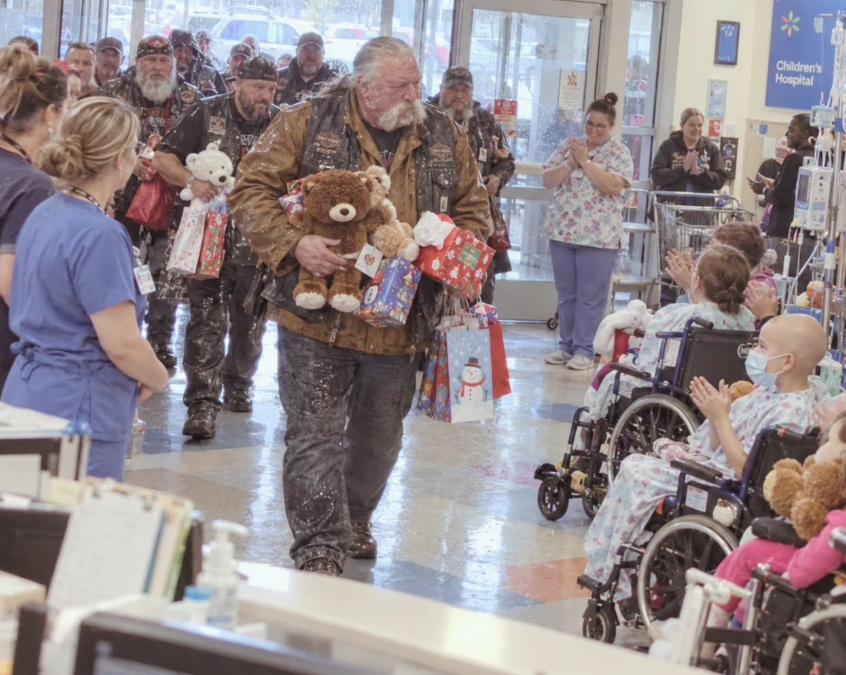
The riders entered the hospital around ten.
Security had cleared the route.
Administration had learned years ago that trying to make two hundred bikers whisper through a lobby was pointless, so we embraced the chaos.
The elevators filled with leather vests.
The smell of rain, coffee, aftershave, and cold air followed them upstairs.
They looked exactly like the kind of people half the world crosses the street to avoid.
Big men.
Bigger beards.
Tattoos.
Skulls.
Eagles.
Military patches.
Bandanas.
Women in black leather with silver hair braided down their backs.
One biker had a scar from his temple to his jaw.
Another wore an eyepatch.
A third had NO BAD DAYS tattooed across his fingers, which I found optimistic.
And they walked into pediatric oncology carrying teddy bears.
That is a sight that fixes something in you.
A biker named Tiny, who was at least three hundred pounds, spent fifteen minutes having his fingernails painted pink by a five-year-old with lymphoma.
Another man with a shaved head and tattoos covering both arms handed a remote-controlled car to a boy recovering from bone cancer and then crawled under a chair when the boy decided to test-drive it between his boots.
On the third floor, a six-foot-four man with skull tattoos on both forearms knelt beside a four-year-old girl named Lily.
He handed her a stuffed rabbit.
She immediately grabbed his beard.
Hard.
I expected him to wince.
Instead he laughed.
Then Lily said, “You have Santa hair.”
The biker burst into tears.
Right there.
Knees on the hospital floor.
He tried to hide it.
Lily looked confused.
“Why you crying?”
He wiped his face.
“Because you’re funny, sweetheart.”
She nodded as though that made perfect sense.
Then she hugged his neck.
I turned away for a second.
That is the thing about pediatric oncology.
You develop professional skills for pain.
You learn how to walk into rooms after terrible scans.
You learn how to hold pressure after procedures.
You learn which tissues are softest.
You learn how to stand still when a parent asks if their child is going to die.
What you never develop is immunity to kindness.
Around noon, I was near the nurses’ station checking medication orders when someone said, “Ma’am?”
I looked up.
A man stood on the other side of the desk.
He was older than most of the riders.
Sixty, maybe.
Tall.
Broad shoulders.
Gray beard hanging halfway down his chest.
Weathered face.
Blue eyes.
His leather vest was old enough that the black had faded around the seams.
Patches covered the front.
Marine Corps.
Vietnam-era tribute patch, though he was too young to have served then.
POW/MIA.
American Legion Riders.
And a smaller patch over his heart.
IRON SAINTS MC.
His hands were large.
Scarred.
Grease permanently darkened the lines around his fingernails.
But what I noticed most was that they were shaking.
“Can I help you?”
He glanced down the hallway.
“Room 4B.”
Every nurse develops instincts.
Mine tightened immediately.
“Are you looking for someone?”
“Yes, ma’am.”
“Who?”
He swallowed.
“Noah Bennett.”
I straightened.
Family privacy matters.
Especially in oncology.
“May I ask who you are?”
The man looked toward 4B again.
Then back at me.
“My name’s Frank Dolan.”
The name meant nothing to me.
“I’d like to give him something.”
I expected him to lift a stuffed animal.
Instead he reached inside his vest.
Slowly.
He pulled out a dark wooden box.
It fit between both hands.
Hand-carved.
Old.
Scratches along the edges.
Two initials were cut into the top.
F.D.
R.D.
Frank held the box like it contained something breakable.
“That’s my grandson in there.”
I thought I had misheard him.
“I’m sorry?”
His jaw tightened.
“Noah.”
He nodded toward 4B.
“He’s my grandson.”
I knew Rachel’s history only in pieces.
Single mother.
Noah’s father absent.
Emergency contact was her sister in Ohio.
No grandfather had ever been mentioned.
Frank looked at the floor.
“He doesn’t know I exist.”
I felt something inside my chest shift.
“How old is Noah?”
“Six.”
He answered immediately.
“When’s his birthday?”
“March ninth.”
Favorite dinosaur?”
That surprised him.
Then a tiny smile.
“Used to be T. rex.”
“Used to be?”
“Rachel’s friend told me he changed to something called a…”
Frank frowned deeply.
“Spinosaurus?”
I stared.
“Apparently it swims.”
Despite myself, I smiled.
“He’ll argue with you about that.”
Frank’s smile disappeared.
“I’d like him to.”
Then his eyes filled.
He looked away.
“I haven’t seen my daughter in five years.”
I didn’t say anything.
“She doesn’t want me in her life.”
There was no accusation in his voice.
No bitterness.
Just fact.
“But that boy is my blood.”
He tightened his grip on the box.
“And somebody told me he was sick.”
“Who?”
“Friend of a friend.”
“Does Rachel know you know?”
“No.”
That was a problem.
A big one.
Hospital rooms are not neutral territory.
When families are under pressure, old wounds don’t become smaller.
They become radioactive.
“I can’t let you walk into that room without her permission.”
“I know.”
His answer came immediately.
“I wouldn’t.”
That surprised me.
Most people argue when told no.
Frank nodded toward the box.
“If she says no, she says no.”
He swallowed.
“Just…”
His voice caught.
“Could you ask?”
I looked at him for a long moment.
“What’s in the box?”
He lowered his eyes.
Then opened it.
Inside was faded red velvet.
Three little motorcycles.
Not toys from a store.
Hand-carved wood.
The first was dark with age.
Tiny handlebars.
Tiny seat.
Wheels worn smooth from being touched.
The second was lighter.
Smaller.
Delicate.
The third looked new.
Fresh maple.
Detailed down to the exhaust pipes.
Frank picked up the oldest.
“My father made this when I was born.”
He turned it over.
On the bottom, barely visible, were initials.
F.D.
“My old man rode motorcycles his whole life.”
Frank smiled.
“Drove my mother insane.”
He set it down.
Then picked up the second.
“I made this one when Rachel was born.”
My throat tightened.
“She had one?”
Frank’s expression changed.
“No.”
“Why?”
He looked away.
“That’s complicated.”
He placed it back in the box.
Then picked up the third.
“This one’s Noah’s.”
The wood was pale.
Almost golden.
“I carved it when I found out Rachel had a son.”
“When was that?”
“Three years ago.”
I looked at him.
“You’ve had it for three years?”
Frank nodded.
“Carry it every November.”
A chill ran up my arms.
“Why November?”
He looked toward the crowded hallway.
“This is my third toy run here.”
I stared.
“I’ve been here twice before.”
“You knew Noah was a patient?”
“Last year.”
He corrected himself.
“Not patient then.”
He swallowed.
“I knew he came here for treatment this year.”
Something about that sentence didn’t make sense.
Then I realized.
“This isn’t his first time here when you’ve been here.”
Frank’s eyes watered.
“Last November he was visiting another clinic with Rachel. Routine thing. I saw them in the lobby.”
He smiled weakly.
“Walked past them.”
“What did you do?”
“Nothing.”
“Nothing?”
“I stood by the elevators pretending I was looking for somebody.”
He rubbed his thumb across the wooden motorcycle.
“She had no idea.”
“And this year?”
He nodded toward 4B.
“I came in with the club three weeks after somebody told me about the leukemia.”
“You’ve seen him?”
“Through the door.”
“How many times?”
Frank’s jaw flexed.
“Twice.”
“You came to the hospital?”
He nodded.
“Never crossed the threshold.”
“Why?”
“Because Rachel said she wanted me gone.”
“Five years ago.”
“Still counts.”
I studied him.
“Then why today?”
Frank looked toward the box.
“I might not get another chance.”
He tried to say something else.
Nothing came.
He cleared his throat.
“The cancer.”
His fingers closed around the wooden motorcycle.
“If something happens to that boy and he never knows I—”
His voice broke completely.
He looked down.
I waited.
I have learned that silence is a tool in hospitals.
People will fill it when they are ready.
Finally he whispered, “I don’t need him to love me.”
He closed the box.
“I just don’t want him leaving this world thinking he didn’t have a grandfather who loved him.”
That sentence hit me somewhere professional training doesn’t reach.
Still, I had a job.
“Wait here.”
Frank nodded.
“No problem.”
I found Rachel sitting beside Noah.
He was asleep after anti-nausea medication.
A stuffed triceratops from the toy run lay beside his pillow.
Rachel was answering an email on her laptop.
“Can I talk to you?”
She looked up.
“Did his labs come back?”
“No. Nothing medical.”
Her face relaxed a little.
“Okay.”
“Can we step into the hall?”
That brought the worry back.
Parents hate hallway conversations.
“Is something wrong?”
“Noah’s okay.”
“Then what?”
I hesitated.
There is no elegant way to introduce a family ghost.
“There’s a man at the nurses’ station.”
Rachel waited.
“He came with the toy run.”
“So?”
“He asked for Noah specifically.”
Her expression changed.
“What man?”
“His name is Frank Dolan.”
Every bit of color left her face.
It happened so fast I almost reached for her.
“No.”
She whispered it.
Then louder.
“No.”
“He says—”
“I know what he says.”
Rachel stood.
Her chair scraped.
“No.”
Noah moved in bed.
She lowered her voice.
“Absolutely not.”
“Rachel—”
“He does not get to do this.”
Her hands started shaking.
“Not here.”
Bikers moved past the open door carrying bags.
Rachel saw them.
Her face tightened further.
“Of course.”
“What?”
“Of course he’d do it like this.”
“He hasn’t come near the room.”
“I don’t care.”
“He asked permission.”
“Because you’re standing between him and the door.”
I could hear anger rising.
I touched her elbow.
“Come with me.”
We went into the family consultation room.
I closed the door.
Rachel turned immediately.
“My father is not a good person.”
I stayed quiet.
“He’s going to tell you he’s some misunderstood old biker.”
“He hasn’t told me much.”
“Good.”
She folded both arms.
“He’ll talk about loyalty.”
“He hasn’t.”
“Brotherhood.”
“No.”
“Family.”
Her laugh was bitter.
“That’s their favorite word.”
She began pacing.
“My whole childhood was motorcycles.”
“Okay.”
“Bike nights.”
“Club meetings.”
“Trips.”
“Rallies.”
“He’d be gone for days.”
Rachel pointed toward the wall like Frank was standing behind it.
“My mother would sit at the kitchen table crying because he promised he’d be home Sunday and come back Tuesday.”
That was different from the story his appearance invited people to invent.
Not violent.
Not monstrous.
Just absent.
“He missed birthdays,” Rachel continued.
“School things.”
“Parent conferences.”
“When my appendix came out, he was in Tennessee.”
She wiped under one eye angrily.
“He showed up the next day with a stuffed bear and thought that made it fine.”
“What did your mother do?”
“She got tired.”
Rachel looked down.
“She left when I was fourteen.”
“Did you go with her?”
“Yes.”
“Did he fight for custody?”
A pause.
“No.”
That one hurt.
Rachel sat down.
“He says Mom kept me from him.”
“Did she?”
“She didn’t have to.”
Her voice cracked.
“He had every other weekend.”
“Sometimes he came.”
“Sometimes he called Friday night and said the bike needed work.”
“Sometimes somebody in the club needed him.”
“He always had a reason.”
I listened.
“When he did show up, he came on that stupid Harley.”
She shook her head.
“You know what it’s like being fourteen and getting picked up from a private school by a man in a leather vest with pipes loud enough to wake a cemetery?”
Despite the pain, I almost smiled.
Rachel saw it.
“It wasn’t funny.”
“I know.”
“The girls laughed.”
“I understand.”
“No, you don’t.”
She looked at me sharply.
“They called him an outlaw.”
“Somebody told people he had been in prison.”
“He hadn’t.”
“Didn’t matter.”
Her voice dropped.
“I begged him to use the truck.”
“Just once.”
“He said if people didn’t like him, they could go to hell.”
Rachel’s eyes filled.
“He never understood I was the one who had to go back to school after he left.”
I said nothing.
“At twenty-three, I met Evan.”
Noah’s father.
I knew the name from the chart.
Evan Whitmore.
“He was everything Dad wasn’t.”
Rachel gave a humorless smile.
“Pressed shirts.”
“Corporate job.”
“BMW.”
“Family with money.”
“His father played golf with judges.”
“His mother chaired charity committees.”
“They lived in a house where nobody ever raised their voice.”
She stared at the carpet.
“I thought that meant they were good people.”
The way she said it told me what came next.
“They hated my father.”
“Why?”
“Look at him.”
I thought of Frank at the desk.
Leather.
Beard.
Tattoos.
Then I thought of the shaking hands holding the wooden box.
“Evan’s mother asked if Dad was in a gang.”
Rachel laughed bitterly.
“She called his club friends criminals.”
“Evan joked about hiding the silverware when Dad came over.”
“Did your father know?”
“Of course.”
“What did he do?”
“What he always did.”
Her jaw tightened.
“He got louder.”
More defensive.
More Frank.
“At the rehearsal dinner, he wore the vest.”
Rachel looked at me.
“I begged him not to.”
“He said it was who he was.”
“He said anybody ashamed of him could kiss his ass.”
I could imagine it.
“And the wedding?”
“I asked him not to come.”
I blinked.
“He came anyway.”
“Did he cause trouble?”
“No.”
The answer was quiet.
“He sat in the back row.”
Her face softened against her will.
“By himself.”
No club.
No motorcycle.
“Truck?”
She nodded.
“He even wore a suit.”
I waited.
“Evan’s parents whispered the entire ceremony.”
“His mother asked security who had let him in.”
Rachel shut her eyes.
“I saw Dad hear her.”
“What happened?”
“Nothing.”
“He stayed until we left the church.”
“Reception?”
“He didn’t come.”
“Did you invite him?”
Rachel opened her eyes.
“No.”
There it was.
The wound between humiliation and regret.
“When did you stop speaking?”
“After the wedding.”
“Completely?”
“Pretty much.”
“He called.”
“I didn’t answer.”
“He sent Christmas cards.”
“I returned some.”
“Then Noah was born.”
“Did Frank know?”
“Eventually.”
“How?”
“My aunt told him.”
“And the motorcycle?”
Rachel frowned.
“What motorcycle?”
I watched her face.
I realized Frank had been telling the truth.
“You really don’t know?”
“Know what?”
I told her about the box.
Three motorcycles.
One from Frank’s father.
One Frank carved for her when she was born.
One carved for Noah.
Rachel stared at me.
“He made one for me?”
I nodded.
“No.”
Her hand went over her mouth.
“He never gave me anything like that.”
“He said it’s been in the box.”
“For thirty-one years?”
“I think so.”
Tears spilled down her face.
She didn’t wipe them.
“That’s so like him.”
I wasn’t sure what she meant.
“To make something that matters and then never figure out how to give it.”
She laughed through tears.
“God.”
I sat beside her.
“There’s something else.”
She looked exhausted.
“He’s been here before.”
“What?”
“Three toy runs.”
Rachel stared.
“He saw Noah through the door.”
“When?”
“Apparently twice.”
Her face hardened immediately.
“That’s creepy.”
“He never entered.”
“He was watching my son.”
“He was standing in a hallway.”
“He had no right.”
“No.”
I agreed.
That surprised her.
“No, he didn’t.”
She looked at me.
“But he also didn’t cross the line you drew.”
Rachel looked away.
“He wants to now.”
“He asked.”
“Same thing.”
“No.”
I said it gently.
“It isn’t.”
She went quiet.
“He said he might never get another chance.”
Rachel’s face changed.
“That’s not fair.”
“I know.”
“He cannot use Noah’s cancer to guilt me.”
“I don’t think he’s trying to.”
“Then why now?”
“Because he’s scared.”
“So am I.”
Her voice broke.
That ended every argument.
“So am I.”
I reached for her hand.
She let me take it.
For several minutes, she cried.
Not about Frank.
Not only about Frank.
About everything.
The diagnosis.
The husband who left.
The father she cut off.
The son sleeping behind a wall after chemotherapy.
All the years she had tried to build a clean life where nobody embarrassed her.
All the things cleanliness had failed to protect her from.
Finally she asked, “What does he want?”
“Five minutes.”
“With Noah?”
“Yes.”
“Awake?”
“He said whatever you allow.”
She stared at the closed door.
“What if I say no?”
“He leaves.”
“You believe that?”
“Yes.”
“Why?”
“Because he already did it twice.”
That landed.
Rachel sat for another minute.
Then whispered, “I want to see the box.”
I stepped into the hallway.
Frank was exactly where I left him.
Same chair.
Box on his knees.
He stood when he saw me.
“What’d she say?”
“Not yet.”
His face fell.
“She wants to see the box.”
He swallowed.
“Okay.”
I held out my hands.
He gave it to me.
Then caught himself.
“Wait.”
He opened his vest pocket.
Pulled out the newest motorcycle.
He had been carrying it separately.
“Put this in too.”
“Why wasn’t it already in there?”
He smiled sadly.
“Because I keep it close.”
I carried the box into the consultation room.
Rachel opened it.
She did not touch anything at first.
She stared.
Then picked up the middle motorcycle.
Hers.
It had tiny initials carved beneath it.
R.D.
She turned it over.
A date.
The day she was born.
Rachel covered her mouth.
There was no dramatic revelation.
Just a daughter looking at proof that the father she remembered as absent had once sat somewhere with a knife and a block of wood and carved her something with his hands.
That does not erase absence.
Love does not cancel damage.
People can love you and fail you.
That is one of the hardest truths adults ever learn.
Rachel set the motorcycle back.
“How long is five minutes?”
“As long as you decide.”
“If Noah’s asleep, Dad doesn’t wake him.”
“Okay.”
“I stay in the room.”
“Of course.”
“He doesn’t tell Noah stories about why we don’t speak.”
“He won’t.”
“You don’t know that.”
“You’re right.”
I corrected myself.
“I’ll tell him.”
Rachel wiped her face.
“And this does not fix anything.”
“No.”
I stood.
She grabbed my wrist.
“Claire.”
That’s my name.
“Don’t make this some beautiful story.”
Her eyes were fierce.
“My father hurt me.”
“I know.”
“He wasn’t there.”
“I know.”
“People see old men cry and suddenly everything they did becomes sad instead of wrong.”
I nodded.
“You’re right.”
Rachel released my wrist.
“Five minutes.”
Frank closed his eyes when I told him.
Not relief exactly.
Something deeper.
Fear.
He stood outside Room 4B.
I gave him the rules.
He nodded after each one.
“No waking him.”
“Yes.”
“No discussing the estrangement.”
“Of course.”
“Rachel decides when it ends.”
“Understood.”
“And Frank?”
He looked at me.
“Do not make her comfort you.”
His jaw tightened.
Then he nodded.
“Fair.”
He entered.
Rachel stood beside the window.
Arms folded.
Noah slept.
Dinosaur drawings covered the walls.
A stegosaurus wearing a nurse cap.
A velociraptor driving an ambulance.
One truly disturbing T. rex labeled DR. BITEY.
Frank saw the drawings first.
Then his eyes found Noah.
He stopped.
Everything about him changed.
I had watched parents see children after surgery.
Grandparents after accidents.
Brothers after transplants.
There are moments when the human face becomes completely defenseless.
Frank’s did.
He gripped the doorframe.
His knuckles turned white.
Noah’s bald head rested against a dinosaur pillow.
His arms looked too thin.
An IV line disappeared beneath tape on his hand.
Frank whispered, “Oh, God.”
Rachel looked away.
He stood there almost thirty seconds.
Then finally said, “Hi, Rachel.”
She did not look at him.
“Hi, Dad.”
Two words.
You could feel five years inside them.
Frank swallowed.
“He looks like you.”
Rachel said nothing.
“When you were little.”
Still nothing.
Frank pulled the chair beside the bed.
He sat.
Placed the wooden box on his lap.
Then rested one hand on the mattress.
Near Noah’s hand.
Not touching.
Just close.
“Hey, buddy.”
His voice barely existed.
“I’m your grandpa.”
Rachel’s shoulders tightened.
“I know you don’t know me.”
Frank stared at the sleeping child.
“But I’ve known about you since the day you were born.”
Rachel turned slightly.
That was news to her.
Frank continued.
“I’m sorry I’m late.”
His voice cracked.
“But I’m here now.”
Rachel’s face folded.
She turned toward the window.
Frank opened the box.
One motorcycle.
Then another.
Then the new one.
He lined all three on Noah’s bedside table.
“Your great-grandpa made this first one for me.”
He touched it.
“I made this one for your mama.”
Rachel shut her eyes.
“And this one’s yours.”
Frank lifted the newest motorcycle.
He placed it beside Noah’s pillow.
“When you wake up, it’ll be here.”
His beard trembled.
“So you know somebody was thinking about you.”
Then Noah opened his eyes.
Barely.
Frank froze.
Rachel turned.
Noah looked at the wooden motorcycle.
Then at Frank.
Then back to the motorcycle.
His small hand moved.
He picked it up.
“Cool.”
His voice was raspy.
Frank started laughing.
One surprised breath.
Like the sound escaped before he could stop it.
“You made it?” Noah asked.
Frank nodded.
“Carved it myself.”
Noah spun one wooden wheel.
“Is it a Harley?”
Frank stared.
“How’d you know?”
Noah pointed weakly toward the window.
“The bikers.”
A pause.
“We watch them.”
His eyelids drooped.
“I like the loud ones.”
Frank laughed again.
This time tears came with it.
“Those are usually Harleys.”
“Mom says they’re obnoxious.”
Rachel made a sound halfway between a laugh and a cry.
Frank looked at her.
“She’s right.”
Noah studied his tattoos.
“Are you a biker?”
“Yes.”
“Is that why you have skulls?”
“Partly.”
Noah examined him with the serious curiosity children reserve for unusual adults.
“Are you somebody’s grandpa?”
The room went completely still.
Frank’s mouth opened.
No sound came.
Then he managed, “Yeah.”
His voice shattered.
“I’m somebody’s grandpa.”
Noah smiled.
“Cool.”
He pulled the tiny motorcycle against his chest.
Thirty seconds later he was asleep again.
Frank sat frozen.
Rachel crossed the room.
I held my breath.
She stood behind him.
Then slowly placed one hand on his shoulder.
Frank closed his eyes.
He lifted his own hand.
Covered hers.
Nobody spoke.
Five minutes became twenty.
That did not mean everything was fixed.
I want to be clear about that.
Real reconciliation is not a hospital commercial.
Rachel did not suddenly forgive thirty years of disappointment because her father cried over her sick son.
She did not run into his arms.
She did not invite him home for Thanksgiving.
When Frank left that afternoon, she followed me to the hall.
“He doesn’t come back without asking.”
“Okay.”
“I mean it.”
“I know.”
“And I don’t want the club thinking this means they all have access to Noah.”
“They won’t.”
“And if he talks about me to them—”
“Rachel.”
She stopped.
“You need to tell him those things.”
Her expression hardened.
“Why?”
“Because I’m not going to become the bridge forever.”
She stared at me.
“You opened the door.”
“Yes.”
“You don’t get to stand in it.”
That made her angry.
Then thoughtful.
Later that afternoon she asked for Frank’s number.
The first call happened two days later.
Seven minutes.
The second lasted twelve.
Then nothing for a week.
Frank didn’t show up.
He didn’t call me.
He didn’t sneak onto the floor.
He waited.
That mattered.
The next Tuesday, Rachel added his name to the approved visitor list.
He arrived at four.
Not on the motorcycle.
In an old Ford pickup.
I raised my eyebrows.
He shrugged.
“Didn’t want to wake anybody.”
“Who are you and what did you do with Frank?”
He almost smiled.
“Rachel always hated the pipes.”
He carried a sheet of paper.
No toy.
No elaborate gift.
A drawing.
Supposedly a tyrannosaurus.
It looked like a lizard wearing orthopedic shoes.
Noah loved it.
“You made this?”
“Yep.”
“It looks weird.”
“I know.”
“Dinosaurs didn’t have ears like that.”
“I didn’t give it ears.”
Noah pointed.
“Those.”
“Horns.”
“T. rex didn’t have horns.”
Frank stared at the drawing.
“Damn.”
Rachel looked up sharply.
“Language.”
Frank immediately said, “Sorry.”
That surprised her more than the curse.
Noah laughed.
A real laugh.
The first I had heard in days.
From then on Frank came Tuesdays and Thursdays.
Always after asking.
Always on time.
Sometimes he sat twenty minutes.
Sometimes two hours.
He learned chemotherapy schedules.
He learned not to visit when his own throat felt scratchy.
He learned how to sanitize his hands correctly, which took three corrections because he kept missing his thumbs.
He learned platelet counts.
He learned neutropenic precautions.
He learned that when Noah had mouth sores, orange juice hurt.
He learned that steroids could make a six-year-old furious over the wrong color socks.
Mostly, he learned to sit.
Frank had not been good at sitting when Rachel was young.
Now he became excellent at it.
He sat beside Noah during infusions.
Sat when Noah slept.
Sat when Rachel cried.
Sat when there was nothing to fix.
That was the repair.
Not speeches.
Presence.
Three weeks after the toy run, I passed Room 4B and heard motorcycle noises.
Not real ones.
Frank.
“BRRRAAAP-BRAP-BRAP.”
I stepped inside.
The wooden Harley was racing across Noah’s blanket.
A stuffed triceratops blocked the road.
Frank made the motorcycle leap over it.
Noah laughed so hard his IV pump alarmed because he bent his arm.
Rachel was in the chair across from them.
Smiling.
Not crying.
Not tense.
Just smiling.
On the windowsill sat the old wooden box.
Open.
Three motorcycles lined up inside.
For a moment, the room looked almost normal.
Then reality returned.
It usually does.
Noah developed a fever the following week.
His white blood cell count dropped dangerously low.
He was moved to closer monitoring.
Rachel did not leave the room for thirty-six hours.
Frank slept in a waiting-room chair.
At three in the morning, I found him staring at a vending machine.
“You need something?”
“No.”
“Coffee?”
“No.”
“Then why are you standing here?”
He pointed at the vending machine.
“Pretzels.”
“Buy them.”
“I don’t want pretzels.”
I stared at him.
He rubbed his face.
“I don’t know what to do.”
There it was.
“I can’t fix this.”
“No.”
“I can’t fight it.”
“No.”
“I can’t even go in there because they’ve got him on precautions.”
“For tonight.”
His eyes filled.
“I spent half my life thinking every problem needed action.”
I leaned against the wall.
“What if the action is staying?”
He laughed bitterly.
“That’s the one thing I was never good at.”
“Then practice.”
He looked at me.
“Sit down.”
He did.
At five-fifteen Rachel came out.
Frank stood instantly.
She looked exhausted.
“They think the antibiotics are working.”
Frank exhaled.
Rachel rubbed her arms.
Then said, “I need coffee.”
“I’ll get it.”
“No.”
She looked at him.
“Come with me.”
It was the first time she had invited him anywhere.
They walked to the cafeteria together.
Two days later Noah improved.
That should have been the hardest part.
It wasn’t.
The hardest part came from people who believed they had the right to decide what a family should look like.
Evan Whitmore arrived on a Thursday.
Noah’s father.
I had never met him.
He walked onto the unit wearing a charcoal overcoat and carrying a laptop bag.
Tall.
Clean-cut.
Expensive shoes.
The kind of person who looked exactly like somebody you’d trust with a mortgage application.
Security called first because his name was not on the approved visitor list.
Rachel came into the hallway.
When she saw him, every part of her body stiffened.
“What are you doing here?”
Evan opened his arms slightly.
“I came to see my son.”
Rachel laughed.
Not kindly.
“You haven’t called in six weeks.”
“I’ve been traveling.”
“He has leukemia.”
“I know.”
“You were traveling.”
His jaw tightened.
“Rachel, can we not do this in the hallway?”
“Where would you like to do it?”
Nurses tried not to stare.
We were terrible at it.
Evan lowered his voice.
“My mother saw a picture.”
Rachel went still.
“What picture?”
“The hospital posted the toy drive.”
Oh.
Public relations had uploaded photographs from the event.
None featured Noah directly, because his mother hadn’t signed publicity consent.
But one background image had shown Frank outside Room 4B.
His back patch visible.
Someone had recognized him.
Evan’s mother.
“What about it?”
“She told me your father is here.”
Rachel folded her arms.
“He is.”
“With Noah?”
“Yes.”
Evan laughed once.
“Absolutely not.”
Something in Rachel changed.
It was subtle.
But I watched it happen.
For years, perhaps, men had delivered decisions to her as statements.
Her father.
Her husband.
Maybe even doctors.
That day she stopped accepting the grammar.
“Excuse me?”
“I don’t want those people around my son.”
Frank was around the corner.
He heard it.
I saw him stop.
Rachel saw him too.
Evan followed her gaze.
His face changed.
“Jesus.”
Frank did not approach.
Evan stared at the leather vest.
“You brought him here?”
Rachel said, “He came with the toy run.”
“Of course he did.”
“What does that mean?”
“You know exactly what it means.”
Frank’s jaw tightened.
Still, he said nothing.
Evan looked at Rachel.
“My parents were right about him.”
That sentence was a match thrown into gasoline.
Rachel stepped closer.
“Your parents?”
“Don’t start.”
“No.”
Her voice became very quiet.
“Let’s start.”
Evan glanced around.
“This isn’t the place.”
“My son has lived here for three months.”
Rachel pointed at the floor.
“This is exactly the place.”
Evan lowered his voice further.
“I don’t think a motorcycle gang should have access to Noah.”
Frank spoke for the first time.
“I’m not in a gang.”
Evan turned.
“Nobody asked you.”
Frank’s face hardened.
I moved closer.
So did security.
Frank noticed.
He stepped backward.
That mattered too.
Rachel looked at Evan.
“You want to talk about access?”
“Rachel.”
“Fine.”
She started counting on her fingers.
“Diagnosis day?”
Evan’s face tightened.
“I was in Denver.”
“First bone marrow biopsy?”
“You know I couldn’t get a flight.”
“Port surgery?”
Silence.
“First chemo admission?”
“Rachel—”
“His sixth birthday?”
Evan looked away.
“You sent a gift card.”
Several people in the hallway had stopped pretending not to listen.
Rachel’s voice broke.
“You sent your son a gift card while he was getting chemotherapy.”
Evan’s cheeks reddened.
“I have been paying support.”
“After my lawyer threatened contempt.”
His jaw clenched.
“This isn’t about me.”
“No.”
Rachel pointed toward Frank.
“You’re right.”
“This is about the man you said would embarrass our family.”
Frank looked down.
“He has been here every Tuesday and Thursday.”
“He sat outside intensive care all night.”
“He knows Noah’s medications.”
“He knows which dinosaur Noah hates.”
“Triceratops,” Frank muttered.
Noah loved triceratops.
Rachel looked at him.
“Stegosaurus.”
Frank nodded.
“Right.”
Despite everything, I nearly laughed.
Rachel faced Evan again.
“My father has made mistakes.”
Frank looked at her.
“Big ones.”
His face fell slightly.
“And he is finally doing something you never learned how to do.”
Evan stared.
“What?”
“Showing up.”
Silence.
Complete silence.
Then a woman’s voice came from behind us.
“This is inappropriate.”
Everyone turned.
Vivian Whitmore.
Evan’s mother.
I recognized her from a hospital fundraising event months earlier.
Pearl earrings.
Perfect silver hair.
Camel coat.
The kind of woman who could make a compliment sound like a summons.
She looked at Frank as though she had found mud on the carpet.
“Rachel.”
Rachel closed her eyes.
“You brought your mother?”
“She drove separately,” Evan said.
Vivian stepped closer.
“We heard Noah was having complications.”
“Three weeks ago.”
Vivian ignored that.
She looked at Frank.
“I cannot believe the hospital allows this.”
I spoke.
“Allows what?”
She looked at my badge.
“These people wandering around pediatric floors.”
Frank’s face went blank.
I had seen that expression in combat veterans.
Not anger.
Containment.
I said, “They are invited volunteers.”
Vivian’s eyebrows rose.
“With children?”
Rachel laughed.
“Mommy, stop,” Evan whispered.
Vivian ignored him.
“I spent years on charity boards. There are standards.”
That was when Frank finally looked directly at her.
“Ma’am.”
His voice was calm.
“I brought a wooden motorcycle.”
Vivian’s lips tightened.
“I remember you.”
Frank nodded.
“Wedding.”
“You caused quite a scene.”
Rachel turned.
“What scene?”
Vivian hesitated.
Frank said nothing.
“Mom?”
Evan looked uncomfortable.
“It was a long time ago.”
Rachel’s eyes moved between them.
“What happened?”
Vivian sighed.
“Your father’s friends arrived outside the reception venue.”
Frank shook his head.
“Wrong.”
Vivian stared.
“Three of them rode me to the church.”
“And remained outside.”
“Because they weren’t invited.”
Frank’s voice remained level.
“They left after the ceremony.”
Rachel looked at Vivian.
“You told me he caused trouble.”
Vivian’s face tightened.
“I said his presence was disruptive.”
“What did he do?”
“Rachel—”
“What did my father do?”
Vivian glanced at Frank.
“People were uncomfortable.”
Rachel stared.
“Because he wore a vest?”
“Because there is a time and place.”
“He wore a suit.”
Frank spoke quietly.
Rachel looked at him.
“What?”
“I wore a suit.”
He almost smiled.
“First one I’d owned since the Marines.”
Vivian flushed.
“The jacket was inappropriate.”
Frank shook his head.
“I took the vest off before I went inside.”
Rachel’s eyes widened.
That contradicted the story she had carried for eight years.
“You did?”
Frank nodded.
“Put it in the truck.”
“Why?”
He looked confused.
“You asked me to.”
Rachel stared at him.
“Evan told me you refused.”
Everyone looked at Evan.
He said nothing.
Rachel’s face changed slowly.
“You told me my father came into the church wearing his club colors.”
“I don’t remember exactly.”
“I do.”
Her voice sharpened.
“You said he wanted everyone staring at him.”
Evan rubbed his jaw.
“It was stressful.”
Frank went very still.
Rachel turned to Vivian.
“You told me security had to speak to him.”
Vivian said nothing.
“Did they?”
“No.”
The word was almost inaudible.
Rachel looked like someone had struck her.
All those years.
A story.
Repeated until it became memory.
Frank stared at the floor.
Evan said, “This doesn’t change everything.”
Rachel turned toward him.
“No.”
Tears filled her eyes.
“It changes enough.”
Evan stepped forward.
“I was protecting you.”
“From what?”
He gestured toward Frank.
“This.”
Frank looked at himself.
Leather vest.
Gray beard.
Tattoos.
Rachel followed the gesture.
Then something in her expression became almost peaceful.
“You know what?”
She looked at her former husband.
“I spent half my life being ashamed of the wrong people.”
Nobody spoke.
Vivian’s face hardened.
“That is unfair.”
Rachel laughed through tears.
“No.”
She looked toward Room 4B.
“My six-year-old has cancer.”
Her voice cracked.
“Unfair is watching your child vomit until there’s nothing left.”
“Unfair is holding him down while somebody accesses his port because he’s scared.”
“Unfair is knowing the medicine saving his life is also making him sick.”
She pointed at Frank.
“My father missed things when I was young.”
“He hurt me.”
“He knows it.”
Frank looked away.
“But he is standing here.”
Then she looked at Evan.
“You had every chance.”
He flinched.
“You left when Noah was three because parenting was ‘too much conflict.’”
“You moved to Chicago.”
“You missed his kindergarten graduation.”
“You missed his diagnosis.”
“You missed his birthday.”
“And today you finally came because your mother saw a biker in a photograph.”
No one said anything.
Evan’s face had gone pale.
Rachel wiped her cheeks.
“You do not get to walk into this hospital after months of silence and decide who looks respectable enough to love my son.”
I saw Frank’s eyes fill.
Rachel faced security.
“Evan can visit when Noah wants him.”
Then she looked at Vivian.
“You need to leave.”
Vivian stiffened.
“Rachel.”
“Now.”
The older woman stared at her.
Then at Frank.
Then turned.
Her heels clicked down the hallway.
Evan remained.
His voice changed.
Quieter.
“Can I see him?”
Rachel’s anger softened slightly.
“He’s sleeping.”
“I’ll wait.”
She studied him.
“Don’t make promises you aren’t going to keep.”
He nodded.
It wasn’t redemption.
Not yet.
But it was the first honest thing between them that day.
Later, Rachel found Frank in the family waiting room.
He was sitting alone.
Vest folded beside him.
She stood in the doorway.
“You really wore the suit?”
Frank looked up.
“Yeah.”
“And took the vest off?”
“Yeah.”
“Why didn’t you tell me?”
“When?”
“All these years.”
He laughed sadly.
“You weren’t talking to me.”
She sat across from him.
“You could have written.”
“I did.”
“You never said that.”
Frank looked at his hands.
“I didn’t want to sound like I was calling your husband a liar.”
“He was my husband.”
“Exactly.”
Rachel stared.
“So you let me believe you humiliated me.”
He thought about it.
“I’d humiliated you plenty before.”
Her expression tightened.
“That’s not an answer.”
“No.”
He inhaled.
“I thought maybe if you needed me to be the bad guy, that was the price.”
Rachel’s eyes filled.
“That is the stupidest thing I’ve ever heard.”
“Probably.”
“You don’t get points for noble suffering.”
“Wasn’t asking.”
“You should have fought for me.”
The words came out like a child.
Frank froze.
There it was.
Not the wedding.
Not the vest.
Not Evan.
Fourteen-year-old Rachel waiting at a window every other Friday.
“You should have fought for me.”
Frank leaned forward.
“I know.”
“No.”
She shook her head.
“You always say that.”
“You knew Mom was hurting.”
“I know.”
“You knew I wanted you home.”
“I know.”
“You knew I hated that club sometimes.”
Frank flinched.
“And you picked it anyway.”
Silence.
He did not defend himself.
That was important.
“I thought providing money meant I was doing my job.”
Rachel laughed bitterly.
“You barely paid support on time.”
“I know.”
“You missed my appendix surgery.”
“I know.”
“Why?”
Frank looked at her.
Not away.
Not toward the floor.
At her.
“Because I was selfish.”
Rachel’s face went still.
“I could give you excuses.”
“Tennessee ride.”
“Your mother and I fighting.”
“Work.”
“Club responsibilities.”
He shook his head.
“But the truth is I thought there’d always be another weekend.”
His voice cracked.
“I thought kids waited.”
Rachel started crying.
Frank continued.
“I thought you’d grow up and understand me.”
He rubbed his beard.
“Instead I should’ve grown up and understood you.”
Rachel put both hands over her face.
“I was fourteen.”
“I know.”
“I wanted my dad.”
“I know.”
Frank’s eyes overflowed.
“And I am sorry.”
No “but.”
No defense.
No motorcycle culture.
No pride.
Just sorry.
Rachel stood abruptly.
Frank didn’t move.
For a second, I thought she would leave.
Instead she walked around the table.
She stopped beside him.
Frank looked up.
Rachel bent forward.
And hugged her father.
Not the polite shoulder touch from the hospital room.
Not cautious.
She wrapped both arms around his neck and cried into his vest.
Frank stayed completely still for one second.
Then held her.
His entire body shook.
I was standing at the far end of the hall.
I walked away.
Some moments don’t need witnesses.
Noah’s treatment continued.
Life did not become easy because adults finally told the truth.
Cancer does not respect emotional breakthroughs.
There were more fevers.
More blood draws.
More nights when numbers dropped.
One medication caused neuropathy in Noah’s legs.
He needed physical therapy.
He screamed the first day.
Frank sat outside because Rachel asked him to.
Afterward Noah told him, “It sucked.”
Frank nodded solemnly.
“Sounds like it.”
“Don’t tell Mom I said sucked.”
“Deal.”
Rachel, standing behind them, said, “I heard you.”
Noah groaned.
Frank whispered, “Never trust hospital walls.”
Over time, Noah began asking questions.
“Why didn’t I know you?”
Frank looked at Rachel.
She froze.
They had discussed this day in family therapy.
Frank answered carefully.
“Your mom and I weren’t getting along.”
“Why?”
“Because I made some bad choices when she was little.”
“What choices?”
Rachel spoke.
“He wasn’t around enough.”
Noah frowned at Frank.
“Why?”
Frank nodded.
Fair question.
“Because I thought other things were more important than they were.”
“Like motorcycles?”
Frank winced.
“Sometimes.”
Noah stared.
“That’s dumb.”
Rachel snorted.
Frank nodded.
“Extremely.”
“Did you say sorry?”
“Yes.”
“Did Mom forgive you?”
Both adults went quiet.
Noah looked between them.
Rachel said, “We’re working on it.”
He considered this.
“Okay.”
Then returned to his dinosaur coloring book.
Children sometimes understand boundaries better than adults.
Frank never asked Noah to call him Grandpa.
Noah did it on his own.
Six weeks after the toy run.
Frank had brought another awful dinosaur drawing.
Noah held it up.
“This is terrible, Grandpa.”
Frank stopped breathing.
Rachel looked toward the window.
I saw her smile.
Frank cleared his throat.
“Constructive criticism, kid.”
“The arms are too long.”
“Maybe he’s special.”
“He’s scientifically wrong.”
Frank took the drawing.
“I’ll do better.”
“You always say that.”
Rachel looked at her father.
For a second, old pain passed between them.
Then Frank nodded.
“You’re right.”
The next drawing was better.
Not much.
But better.
By January, Noah’s counts improved.
Cautiously optimistic.
That phrase doctors use when hope feels dangerous.
Frank began building something in his garage.
He mentioned it during one visit.
Rachel narrowed her eyes.
“What?”
“Nothing.”
“Dad.”
“Project.”
“What project?”
“For Noah.”
She crossed her arms.
“Is it loud?”
“No.”
“Does it have wheels?”
Frank hesitated.
Rachel closed her eyes.
“Dad.”
“Electric.”
“No.”
“Five miles an hour.”
“No.”
“Three.”
“He has neuropathy.”
“For when he’s better.”
Rachel stared.
Frank added quickly, “Helmet.”
She almost smiled.
“You ask me before giving it to him.”
“Absolutely.”
“I mean it.”
“I know.”
Later I asked Frank how the build was going.
He grinned.
“She said when he’s better.”
“You heard yes.”
“I heard not yet.”
“That isn’t yes.”
“Close enough.”
“No.”
“Fine.”
He was insufferable.
Then came the fundraiser.
Every spring, St. Catherine held a gala.
I hate hospital galas.
I understand why they exist.
Research and family assistance need money.
Still, there is something surreal about watching people drink wine in tuxedos while a slideshow of sick children plays behind dessert.
That year, the hospital wanted to recognize the Iron Saints for twenty years of toy runs.
Frank refused.
The club president, Tiny—the giant biker whose beard Lily had grabbed—accepted on everyone’s behalf.
Rachel was invited.
So was Noah, though he was too immunocompromised to attend.
Rachel went alone.
Frank had no intention of going.
Then she called him.
“I need a date.”
Frank laughed.
“That’s disturbing.”
“Dad.”
“I know.”
She paused.
“Wear the suit.”
Frank went silent.
“The vest?”
Rachel thought.
Then said, “Bring it.”
He arrived wearing a dark suit.
No tie.
Leather vest folded over one arm.
When Rachel saw him, she smiled.
“You clean up okay.”
“Don’t spread that around.”
Halfway through dinner, Vivian Whitmore appeared.
Of course she did.
Her family foundation was a donor.
She saw Rachel.
Then Frank.
Her expression froze.
Rachel’s spine tightened.
Frank leaned toward her.
“I can leave.”
“No.”
The answer was immediate.
Vivian approached.
“Rachel.”
“Vivian.”
“I heard Noah is improving.”
“He is.”
“Wonderful.”
She looked at Frank.
“Mr. Dolan.”
“Mrs. Whitmore.”
Cold civility.
Then the emcee stepped onto the stage.
He spoke about volunteer organizations.
Community.
Twenty years of giving.
Then called the Iron Saints forward.
Tiny went.
So did twenty other riders seated across the back tables.
Frank remained.
Rachel touched his hand.
“Go.”
“No.”
“Dad.”
“Tiny’s got it.”
“Go.”
Frank looked uncomfortable.
“That isn’t why we do it.”
“I know.”
“Then why?”
Rachel looked toward the stage.
“Because sometimes people need to see who keeps showing up.”
Frank followed her gaze.
Then stood.
He put the vest on over the suit.
Walked toward the stage.
The room applauded.
Not polite applause.
Real applause.
The hospital displayed photographs.
Bikers carrying toys.
Holding babies.
Standing with nurses.
A photograph appeared of Tiny crying while Lily pulled his beard.
The room laughed.
Then another.
Frank kneeling beside Noah.
Not showing Noah’s face.
Just the wooden motorcycle between them.
Rachel covered her mouth.
Vivian stared.
The emcee said, “These riders have delivered more than thirty thousand toys in twenty years and raised over seven hundred thousand dollars for family assistance.”
Frank looked almost angry to be onstage.
Tiny pushed him toward the microphone.
Frank shook his head.
The audience laughed.
Finally he spoke.
“I don’t do speeches.”
More laughter.
“So I’ll say this.”
He looked toward Rachel.
“A sick child does not care what you drive.”
Silence.
“They don’t care about your job.”
“Your clothes.”
“Your tattoos.”
“How much your house costs.”
His voice thickened.
“They care if you’re there.”
Rachel began crying.
Frank continued.
“Sometimes adults could stand to learn the same thing.”
He handed back the microphone.
That was his entire speech.
It received the longest applause of the night.
Vivian left before dessert.
I won’t pretend that was justice.
Real justice is not embarrassing somebody at a banquet.
But there was something fitting about the same leather vest people once treated like evidence of failure being honored in a room full of people wearing ten-thousand-dollar watches.
Not because bikers are better than wealthy people.
They aren’t.
People are people.
But appearances had ruled Rachel’s life for years.
That night, appearances lost.
Evan improved slowly.
That surprised me too.
After the hallway confrontation, he began visiting.
Awkwardly.
Irregularly at first.
But he came.
He didn’t become a perfect father.
He didn’t suddenly move home.
He and Rachel did not reconcile romantically.
Some damage doesn’t need that ending.
But he began therapy.
Started calling Noah every night.
Worked with his employer to reduce travel.
Paid overdue support.
When Noah told him he was mad, Evan stayed in the conversation.
That mattered.
Vivian took longer.
Almost four months.
Then one afternoon, she arrived carrying a dinosaur encyclopedia.
No pearls.
No charity committee smile.
Just an older woman holding a book.
Rachel met her in the hallway.
“You can’t come in unless Noah says yes.”
Vivian nodded.
“I understand.”
That was new.
“Why are you here?”
Vivian took a breath.
“To apologize.”
Rachel said nothing.
“I was cruel about your father.”
Frank happened to be inside Noah’s room.
They could hear his ridiculous dinosaur noises through the door.
Vivian almost smiled.
“I thought I knew what kind of man he was because I knew what kind of man he looked like.”
Rachel folded her arms.
“You also lied about the wedding.”
Vivian lowered her eyes.
“Yes.”
“Why?”
“Because I didn’t want Evan marrying into…”
She stopped.
“Into what?”
Vivian looked ashamed.
“A family I considered beneath ours.”
There it was.
Ugly.
Clean.
True.
Rachel stared.
“And then your son abandoned mine.”
Vivian closed her eyes.
“Yes.”
“My tattooed father stayed.”
“Yes.”
Rachel’s expression softened only slightly.
“That doesn’t make Dad’s mistakes disappear.”
“No.”
“But it makes yours look pretty stupid.”
Vivian nodded.
“Yes.”
Rachel studied her for a long moment.
Then knocked on 4B.
“Noah?”
A voice answered.
“What?”
“Someone wants to see you.”
“Who?”
“Grandma Vivian.”
Silence.
Then, “Does she have anything?”
Rachel looked at the book.
“A dinosaur encyclopedia.”
Another pause.
“Okay.”
Vivian laughed through tears.
Rachel opened the door.
That family did not become perfect either.
But people stopped pretending perfection was the requirement.
By March, Noah finished the most brutal phase of treatment.
The day his central line came out temporarily, Frank brought the electric motorcycle.
Rachel almost killed him.
It was red.
Kid-sized.
Battery powered.
Top speed limited to four miles an hour.
Tiny leather-look saddlebags.
Training wheels hidden near the rear tire.
And painted on the side in white letters:
NOAH’S RIDE.
Rachel stared.
“Absolutely not inside the hospital.”
Frank looked offended.
“Obviously.”
Noah sat in a wheelchair.
His eyes were huge.
“Is that mine?”
Frank grinned.
“Pending maternal regulatory approval.”
Noah looked at Rachel.
“Mom.”
“No.”
“Mom.”
“No.”
“Mom.”
Frank whispered, “Persistence is genetic.”
Rachel glared.
Frank immediately looked away.
Eventually she agreed Noah could ride it in Frank’s driveway after his oncologist and physical therapist cleared him.
That clearance took seven weeks.
Frank waited.
I think that waiting meant almost as much as the motorcycle.
The first Saturday Noah rode it, I went.
So did half the Iron Saints.
Rachel made them park real motorcycles two houses away because Noah was still sensitive to noise.
Two hundred-pound bikers obeyed a thirty-one-year-old woman without argument.
Noah wore a helmet almost bigger than his chest.
Frank knelt beside him.
“Throttle here.”
“I know.”
“Brake here.”
“I know.”
“No sharp turns.”
“Grandpa.”
Frank stopped.
“What?”
“You’re annoying.”
Rachel laughed.
“That is also genetic.”
Noah twisted the throttle.
The tiny motorcycle moved forward at walking speed.
Thirty bikers cheered like he had won the Indianapolis 500.
Noah rode twenty feet.
Turned.
Came back.
His legs were still weak.
His face was pale.
But he was laughing.
Frank stood in the driveway with both hands on his hips.
Crying openly.
Nobody teased him.
By the next November, Noah was outpatient.
Still undergoing treatment.
Still careful.
Still tired sometimes.
But alive.
Growing hair again.
The toy run returned.
Two hundred and fourteen bikes.
I counted.
Noah came to the hospital that morning for labs.
Rachel arranged it intentionally.
At nine-fifty, they stood beside me near the entrance.
Frank was outside with the riders.
Noah bounced on his heels.
“What time?”
“Any second.”
“Where’s Grandpa?”
“Outside.”
“With his club?”
“Yes.”
“Can I go?”
“No.”
“Why?”
“Because it’s raining.”
“So?”
Rachel gave him the look.
He stopped.
Then the sound came.
The rumble.
Noah’s whole face lit up.
Bikes filled the lot.
Riders waved toward the hospital windows.
Children appeared against every pane.
Just like the year before.
Except this time Noah wasn’t watching from Room 4B.
He stood beside the lobby doors.
The first riders entered.
Tiny.
The woman with the silver braid.
The skull-tattoo biker.
Then Frank.
He carried no gift bag.
Just the old wooden box.
Noah ran toward him.
Actually ran.
“Grandpa!”
Frank dropped to one knee.
Noah hit him full force.
Arms around his neck.
Frank closed his eyes.
Held him.
Rachel stood beside me.
Crying.
“You okay?”
She laughed.
“No.”
Then nodded.
“Yeah.”
Frank opened the box.
Three motorcycles.
His father’s.
Rachel’s.
Noah’s.
He had restored the velvet.
Rachel walked over.
“What are you doing with that here?”
Frank shrugged.
“Tradition.”
Noah pointed.
“Which one’s Mom’s?”
Frank showed him.
Noah picked it up.
“Why didn’t she get it?”
Adults went silent.
Kids are brutal archivists.
Frank answered.
“Because I should’ve given it to her and didn’t.”
Noah frowned.
“That’s dumb.”
“Yes.”
Rachel smiled.
“Very.”
Frank looked at her.
Then took the little wooden motorcycle from Noah.
He held it toward his daughter.
Thirty-one years late.
“For you.”
Rachel stared.
She had seen it dozens of times by then.
Touched it.
Held it.
But he had never actually given it.
That mattered.
She accepted it.
“Thanks, Dad.”
Simple.
No grand speech.
Frank nodded.
“You’re welcome.”
Then Noah grabbed Frank’s hand.
“Come on.”
“Where?”
“Kids upstairs.”
“What about them?”
“We have toys.”
Frank looked at Rachel.
She shrugged.
“He’s been planning this for a week.”
Noah pulled his grandfather toward the elevators.
Frank let himself be pulled.
That morning, Noah helped hand out stuffed animals.
He gave a dinosaur to a five-year-old girl recovering from surgery.
A truck to a boy with sickle cell disease.
A stuffed shark to a teenager who claimed he didn’t want one and then held it for the rest of the afternoon.
At Room 4B, Noah stopped.
A new child was inside.
Four-year-old boy.
Bald.
Scared.
Mother sitting beside him.
Noah looked at me.
“That was my room.”
“Yes.”
Frank stood behind him.
Noah took a stuffed T. rex from the bag.
Walked in.
The boy stared.
Noah placed it on the bed.
“I had this room too.”
The little boy said nothing.
Noah pointed at Frank.
“He’s loud.”
Frank frowned.
“Excuse me?”
Noah smiled.
“But he’s okay.”
The boy looked at Frank.
“Are you a biker?”
Frank nodded.
The boy pointed to his tattoo.
“Does that hurt?”
“Not anymore.”
The mother laughed softly.
Noah looked around the room.
At the IV pump.
The window.
The place where his wooden motorcycle had rested beside his pillow.
Then he told the child, “The bikes come every year.”
The boy whispered, “Why?”
Noah thought.
Then shrugged.
“Because they know we’re here.”
I had to leave the room.
I made it to the supply closet before I cried.
Eleven years in pediatric oncology and that is still how it happens.
Not always when someone dies.
Not during the bad scan.
Not when parents collapse.
Sometimes you cry because a seven-year-old boy says something true.
Because they know we’re here.
That is what the toy run was always about.
Not teddy bears.
Not motorcycles.
Not publicity photographs.
Not leather.
Not charity.
Recognition.
We know you’re here.
We know this place is frightening.
We know your child is sick.
We know you’re tired.
We know some people disappeared when life became hard.
We came anyway.
Frank still comes every Tuesday and Thursday.
Not because Noah remains hospitalized.
He doesn’t.
Frank comes because the oncology floor became part of his life.
He visits children whose families agree.
He brings wooden toys now.
Not motorcycles only.
Dinosaurs.
Cars.
Terrible little animals no biologist could identify.
Noah helps design them.
Rachel runs quality control.
She is ruthless.
Frank and Rachel still argue.
A lot.
She still carries things from childhood.
He still gets defensive sometimes.
Then catches himself.
They go to therapy together once a month.
Last Thanksgiving, Rachel invited him for dinner.
He arrived forty minutes early.
She opened the door.
“You’re early.”
Frank looked nervous.
“I know.”
“You’ve never been early for anything in your life.”
“I am now.”
Rachel stared at him.
Then stepped aside.
“Come in.”
He did.
That might be the entire story in two words.
Come in.
People ask me whether Rachel forgave him.
I don’t know.
I think forgiveness is too small a word for what some families have to do.
She remembers.
He owns what he did.
She sets boundaries.
He respects them.
He shows up.
She allows him to.
Maybe that is forgiveness.
Maybe it is something harder.
Maybe it doesn’t need a name.
Noah’s numbers remain good.
Cautiously optimistic.
I still hate that phrase.
But I also love it.
Because optimism, cautious or otherwise, is something.
His hair came back darker.
He is seven now.
Still obsessed with dinosaurs.
Still thinks motorcycles are cooler than Rachel wants him to think.
Frank claims victory.
Rachel says she can still sell the electric bike while he sleeps.
Frank knows she won’t.
The old wooden box sits on a shelf in Rachel’s living room.
Frank’s motorcycle is inside.
Noah’s comes out constantly.
Rachel’s stays on her desk.
I asked her once why.
She ran her thumb across the tiny carved handlebars.
“My father made this the week I was born.”
I nodded.
“He was twenty-nine.”
She smiled faintly.
“He was probably scared to death.”
“Probably.”
She looked at the motorcycle.
“I spent years thinking he never cared enough.”
Her eyes filled.
“Turns out caring wasn’t his problem.”
“What was?”
“He didn’t know how to make love look like being there.”
That sentence stayed with me.
Because a lot of people confuse loving someone with doing right by them.
They are not the same thing.
Frank loved Rachel.
And failed her.
Rachel loved Frank.
And shut him out.
Evan loved his son, probably.
And ran when parenting became difficult.
Vivian loved her family.
And let status make her cruel.
Everyone had love.
Love wasn’t the scarce resource.
Courage was.
Humility.
Consistency.
Showing up after you’re ashamed of how long you stayed away.
Admitting you were wrong without demanding immediate forgiveness.
Sitting beside a hospital bed when there is nothing you can fix.
Coming back Tuesday.
Then Thursday.
Then Tuesday again.
Every November, the bikers still come.
Some nurses complain about the noise.
Administration worries about traffic.
Security plans for weeks.
Parents take pictures.
Children press their faces to windows.
Two hundred motorcycles shake the building.
And every year somebody looks at all that leather, all those tattoos, all those scarred hands, and learns the same lesson I did.
The people who look frightening are not always the people you need to fear.
The people in expensive coats are not always safe.
And family is not proved by blood, money, reputation, clothes, or what people say at weddings.
It is proved in hallways.
Waiting rooms.
Three-in-the-morning cafeterias.
Tuesday visits.
Thursday visits.
Years when somebody keeps coming back even though the door may never open.
Frank Dolan spent three Novembers walking past his grandson’s room.
He carried a tiny wooden motorcycle in his vest every single time.
The first year he was afraid Rachel would throw him out.
The second year he convinced himself Noah didn’t need him.
The third year, cancer took away the luxury of believing there would always be more time.
So he asked.
That was all.
He asked.
And Rachel said five minutes.
Five minutes became twenty.
Twenty became Tuesdays and Thursdays.
Tuesdays and Thursdays became hospital nights, terrible dinosaur drawings, hard apologies, therapy appointments, arguments, birthdays, Thanksgiving dinner, and a little red electric motorcycle going four miles an hour down a driveway while thirty grown bikers cheered.
People love dramatic moments.
The hug.
The apology.
The reveal.
But those are not what rebuild families.
The rebuilding happens afterward.
When nobody is clapping.
When you keep your promise.
When you arrive on time.
When you don’t raise your voice.
When you respect a no.
When you come back after an uncomfortable conversation instead of disappearing.
When you let somebody be angry about who you were while still doing the work to become somebody better.
That is why I remember Frank.
Not because he was a biker.
Not because of his beard.
Not because two hundred motorcycles shook the hospital windows.
I remember him because the first day I met him, he held a wooden box in shaking hands and said, “I might never get another chance.”
Most people say that after it is too late.
Frank said it while there was still a door in front of him.
And then, for once in his life, he waited for permission before walking through.
Three weeks after that first visit, I passed Room 4B and saw Rachel standing behind her father’s chair with one hand on his shoulder.
Three months later, I saw Noah ride a tiny motorcycle across a driveway.
A year later, I saw him run through the hospital lobby yelling, “Grandpa!”
And last November, I watched him walk into the room where he once lay frightened and sick and hand another child a stuffed dinosaur.
Outside, rain hammered the windows.
Two hundred bikers stood in the parking lot.
Inside, children clapped.
Some cried.
Parents cried.
Nurses cried.
Frank cried, because Frank cries more than he wants anyone to know.
And in the middle of all that noise and pain and laughter, Noah leaned against his grandfather’s leather vest like he had been doing it his whole life.
Maybe someday he won’t remember chemotherapy clearly.
I hope he doesn’t.
Maybe he won’t remember Room 4B.
Maybe the IV poles, masks, blood counts, medicine cups, and long nights will blur.
But I think he’ll remember the motorcycles.
I think he’ll remember the wooden box.
I think he’ll remember that when he was sick, hundreds of strangers came through the rain carrying toys because they wanted children they had never met to know they mattered.
And I know he will remember Frank.
Not as the grandfather who was missing.
As the grandfather who finally arrived.
Hospitals teach you that time is cruel.
They also teach you something else.
As long as somebody is still here, there is sometimes time to choose differently.
Not enough time to erase the past.
Never that.
But enough to make the next phone call.
Enough to carve the third motorcycle.
Enough to ask permission.
Enough to say, “I was wrong.”
Enough to sit beside the bed.
Enough to come back Tuesday.
And sometimes, if you’re very lucky, enough for a six-year-old boy to look at an old biker covered in tattoos and ask the simplest question in the world.
“Are you somebody’s grandpa?”
And enough for a broken man to finally answer yes.

