PART2:We Took Our Old Dog to the Ocean for One Last Day—After He Fell Asleep in Dad’s Arms, Dad Told Me Who Had Really Been Rescued
PART2
The first time Bruno entered our house, it was raining.
Hard.
I was a kid then.
Old enough to understand that my father was sad.
Too young to understand what sadness can turn into when a grown man decides he has no permission to show it.
My mother was gone by then.
That is the simplest way I know how to say it.
Her absence changed the temperature of the house.
Dad still worked.
Still cooked dinner.
Still made sure I had clean clothes and money for school lunches.
Still asked whether homework was finished.
From the outside, we were functioning.
Inside, something had gone quiet.
Dad stopped laughing.
Not completely.
But enough that I noticed.
He worked long hours.
Came home.
Ate.
Cleaned something that did not need cleaning.
Watched television without really watching.
Went to bed.
Then repeated it.
We did not talk much about my mother.
Not because we did not miss her.
Because neither of us knew how.
Grief sometimes makes people silent for the same reason pain makes animals hide.
Words feel dangerous.
One sentence might open everything.
So we leave the door closed.
The night Bruno arrived, rain hammered the roof so loudly it woke me.
I heard something downstairs.
A cabinet.
Dad’s voice.
Then another sound.
Small.
A whimper.
I got out of bed and walked toward the kitchen.
Dad stood near the sink wearing a soaked work jacket.
Water dripped from his sleeves onto the tile.
And in his arms was a dog.
A small one.
Thin.
Black fur soaked almost flat against his body.
He was trembling so hard his legs shook.
I stopped in the doorway.
“What is that?”
Dad looked at me.
There was guilt in his face.
The kind parents wear when they know they are about to make a decision they have already decided is temporary.
“Dog.”
“I know it’s a dog.”
He looked down at the little animal.
“Found him near the road.”
“Where?”
“Doesn’t matter.”
“Is he ours?”
“No.”
He answered too quickly.
I smiled.
Dad pointed at me.
“Don’t.”
“What?”
“One day.”
“What?”
“We keep him tonight.”
I looked at the shivering dog.
Dad continued:
“Tomorrow I’ll call around. Shelter, rescue, whatever.”
“So one day.”
“One day, Elias.”
I remember that sentence because Dad said it with absolute confidence.
Bruno stayed with us for the rest of his life.
He did not have the name Bruno yet.
At first, he barely had a personality we could see.
Fear covered everything.
If Dad raised his voice—even at the television—the dog disappeared behind the couch.
If someone moved too quickly, he flinched.
If I reached toward his head, he lowered himself.
Door slamming?
Gone.
Vacuum?
Terrifying.
Broom falling?
End of civilization.
The first night, Dad made a bed from old towels near the kitchen.
The dog would not use it.
He wedged himself behind the couch instead.
Dad put food nearby.
Waited.
Nothing.
We went upstairs.
In the morning, the bowl was empty.
Dad looked behind the couch.
Two brown eyes looked back.
“Well,” he said.
“Guess you’re hungry.”
No movement.
Dad went to work.
Before leaving, he pointed toward the dog.
“One day.”
I said:
“Sure.”
At school, I could not stop thinking about him.
I came home.
He was still behind the couch.
I sat on the floor with homework.
Not close.
Just close enough that he could see me.
I worked through math problems.
Then reading.
Then I started talking.
“Mrs. Carter gave us a stupid assignment.”
His ears moved.
“I don’t think dogs care about social studies.”
Nothing.
“Probably smart.”
I kept talking.
Every afternoon.
He remained behind the couch for the first few days.
Dad kept saying:
“I’m making calls.”
I kept asking:
“To who?”
“People.”
“What people?”
“People who deal with dogs.”
“Have they called back?”
“Eat your dinner.”
One day became three.
Three became five.
By the end of the first week, the dog came out while I did homework.
He stayed near the wall.
If I looked directly at him, he froze.
So I pretended not to.
The next day, he came closer.
On day nine, he sat three feet from me.
On day ten, Dad came home from work and found the dog beside my chair.
Dad stopped in the doorway.
The dog stood.
For one second, I expected him to run.
Instead, he waited.
Dad crouched.
“Hey.”
The dog looked at him.
Dad held out a hand.
Nothing.
He waited.
The dog took one step.
Sniffed.
Dad’s expression changed.
Small.
Barely there.
Then the dog licked his fingers.
Dad smiled.
I remember it because it was the first real smile I had seen on his face since my mother had been gone.
Not a polite smile.
Not a smile for me.
Not something manufactured because a parent knows his kid is watching.
It surprised him.
He looked at me afterward.
I looked at him.
Neither of us said anything.
The dog did not know he had just done something important.
He simply sat.
Dad scratched behind one ear.
That night, I asked:
“So when are we taking him to the shelter?”
Dad opened the refrigerator.
“We need a name first.”
I grinned.
“One day?”
“Shut up.”
That was how Bruno became ours.
The name came from nowhere important.
I wish I had a beautiful story.
We tried five or six.
Max.
Buddy.
Charlie.
Bear.
None felt right.
Dad said Bruno while looking at him one morning.
The dog lifted his head.
I said:
“That one.”
Dad shrugged.
“Bruno.”
Tail moved.
Done.
He learned our routine slowly.
Breakfast.
Dad leaves.
I go to school.
I come home.
Homework.
Dad returns.
Dinner.
Television.
Sleep.
Predictability changed him.
When he understood that voices did not always mean danger, he stopped hiding.
When he learned Dad came home every evening, he began waiting near the door.
At first, several feet away.
Then beside it.
Eventually, he recognized the sound of Dad’s truck before I did.
Engine in the driveway.
Bruno stood.
Tail moving.
Keys at the door.
Tail faster.
Door opened.
Bruno became pure joy.
Dad would pretend to complain.
“Move.”
Bruno leaned against his legs.
“I can’t walk when you do that.”
More leaning.
“I was gone nine hours, not nine years.”
Bruno disagreed.
Dad always bent down.
Both hands on the dog’s face.
“Yeah, yeah. I missed you too.”
It became their ritual.
I watched my father come back to life through repetition.
Not dramatically.
He did not wake one morning cured of grief.
He still had bad days.
There were still nights when he sat alone in the kitchen after he thought I had gone to bed.
But now Bruno sat with him.
That mattered.
The first time Bruno climbed into the passenger seat happened by accident.
Dad was loading something into the truck.
Door open.
Bruno jumped in.
Not the back.
Passenger side.
He sat.
Dad stared.
I stood behind him.
“You letting him?”
“He got in.”
“So?”
“So what?”
“That’s my seat.”
Dad looked at me.
Then at Bruno.
Bruno looked straight ahead.
Dad shut the passenger door.
“You can sit in back.”
“What?”
“Dog has chosen.”
“This is discrimination.”
“File a complaint.”
I climbed into the back.
Bruno turned his head.
Looked at me.
I swear there was satisfaction in his face.
From then on, that seat belonged to him.
Dad drove to work?
Bruno sometimes came.
Hardware store?
Passenger seat.
Veterinarian?
Passenger seat.
Weekend ride?
Passenger seat.
If I opened the passenger door first, Bruno would stare at me until I moved.
The truck became part of his identity.
Head near the window.
Ears lifting in the wind.
Brown eyes following everything.
Dad drove with one hand on the wheel.
The other often rested on Bruno’s back.
Sometimes I watched them from behind.
Two creatures who had both been afraid of being alone and somehow had never discussed it.
When I was eleven, school became difficult.
Children can find the exact thing that hurts and touch it repeatedly just to see what happens.
A group of boys learned that my mother was not around.
They started small.
Questions.
Then jokes.
Then comments.
One afternoon, one of them said something about me not having a real family.
I hit him.
Not hard enough to cause serious harm.
Hard enough to get sent to the office.
Dad picked me up.
He was furious.
Not at the other kid.
At me.
“You do not hit people because they say something you don’t like.”
“You don’t know what he said.”
“Doesn’t matter.”
“It does.”
“No.”
I hated him for that for almost an hour.
In the truck, Bruno sat in the passenger seat.
Of course.
I was behind him.
I stared out the window.
Dad said:
“We’ll talk at home.”
“I don’t want to.”
“Too bad.”
We got home.
I went straight to my room.
Door slammed.
Dad shouted:
“Elias.”
I ignored him.
Ten minutes later, my door moved.
Not Dad.
Bruno.
He pushed through the opening.
Walked in.
Sat beside the bed.
I had been crying.
I did not want Dad to know.
Bruno knew.
I sat on the floor.
He came closer.
Put his head on my knees.
That was all.
No advice.
No lecture.
No:
You should have walked away.
No:
Your father is trying his best.
No:
The other boys are insecure.
He just stayed.
I cried into his fur.
Eventually Dad appeared in the doorway.
He looked at me.
Then Bruno.
His anger disappeared.
He sat on the opposite side of the room.
For a while, none of us spoke.
Then Dad said:
“I’m sorry.”
I looked up.
“For what?”
“I should’ve asked what happened before I started talking.”
I wiped my face.
“He said Mom left because she didn’t want us.”
Dad went still.
Bruno’s head remained on my knees.
Dad stared at the floor.
Then:
“That isn’t true.”
“I know.”
“Do you?”
I nodded.
Dad moved closer.
“You still don’t hit him.”
“I know.”
“But I understand why you wanted to.”
That was enough.
Bruno stayed between us.
It is strange to say a dog taught two people how to have a difficult conversation.
But he did.
His presence lowered the temperature.
He made silence feel safe enough for words to arrive.
Dad began talking to Bruno more than he talked to anyone.
At first, I found it funny.
I would come downstairs and hear:
“Boss changed the schedule again.”
Bruno listening.
“Guy doesn’t know what he’s doing.”
Bruno still listening.
Another night:
“Truck needs brakes.”
Bruno.
“Don’t look at me like that. You’re not paying.”
Then the conversations changed.
I would hear my mother’s name.
Quietly.
Sometimes Dad sat on the floor beside Bruno.
One hand on his back.
He talked.
About missing her.
About being angry.
About not knowing whether he was doing enough for me.
About being afraid he would fail as a father.
I was not supposed to hear those things.
I would stop on the stairs.
Listen for a moment.
Then go back up.
Bruno never answered.
That was why Dad could say it.
Dogs do not fix your sentence while you are still speaking.
They do not tell you how you should feel.
They do not become frightened by the size of grief.
They stay.
For my father, that was enough.
Years passed.
School.
Birthdays.
Holidays.
Bruno changed with us.
The frightened dog who once hid behind furniture became the dog everybody in the neighborhood knew.
He greeted delivery drivers.
Sat beside Dad while he worked in the garage.
Slept outside my bedroom door when I was sick.
Watched movies with us.
By watched, I mean slept through them.
He hated thunderstorms at first.
Would squeeze himself beneath Dad’s desk.
Eventually, storms became less frightening.
Dad would say:
“You survived worse than rain.”
Bruno never confirmed.
When I started high school, he was already slowing slightly.
Not old.
Just mature.
Less frantic.
More certain.
He had developed habits.
Morning inspection of the kitchen.
Passenger-seat duty.
Three circles before sleeping.
Refusal to eat one particular brand of dog food Dad bought exactly once.
An irrational hatred of bicycles with plastic baskets.
Love for children.
Love for cheese.
Especially cheese.
Dad would pretend not to give him any.
Then I would see Bruno chewing.
“You gave him cheese.”
“No.”
“He’s eating cheese.”
“Coincidence.”
“He can’t generate cheddar.”
“Do your homework.”
Bruno was there for my first girlfriend.
He liked her.
That should have warned me she would break my heart.
She dumped me after six months.
I came home trying to act indifferent.
Dad asked:
“You okay?”
“Fine.”
Bruno followed me to my room.
Head on my lap.
Again.
Always the same medicine.
Presence.
I said:
“You’re predictable.”
Tail.
“Thank you.”
When I learned to drive, Dad took me to an empty parking lot.
Bruno came.
Passenger seat.
I said:
“How am I supposed to drive if he’s there?”
Dad looked at Bruno.
Then at me.
“He’ll sit in back.”
Bruno did not.
Dad opened the rear door.
“Come on.”
Bruno stared forward.
“Bruno.”
Nothing.
I laughed.
Dad eventually bribed him with cheese.
Bruno got into the back with me.
I started the truck.
Nearly stalled.
Bruno looked offended.
Dad said:
“He has standards.”
For weeks, Bruno endured my driving lessons from the back seat.
The day I passed my test, Dad handed me the keys.
I opened the driver’s door.
Bruno jumped into passenger.
Full circle.
I drove him around the block.
Just us.
I remember saying:
“You better not tell Dad.”
Bruno looked out the window.
Confidentiality guaranteed.
When I left for college, leaving Bruno hurt almost as much as leaving Dad.
Maybe more.
Dad could use a phone.
Bruno could not understand why my bedroom stayed empty.
The first weekend I came home, Dad opened the door and Bruno hit me with enough force to nearly put me on the floor.
He barked.
Whined.
Circled.
Jumped.
Dad stood behind him.
“Very dignified.”
I hugged Bruno.
“You missed me?”
Dad said:
“He slept on your bed for three days after you left.”
“Seriously?”
“No.”
I looked at him.
He smiled.
“Yes.”
Leaving again Sunday was worse.
Bruno followed me to the car.
I knelt.
“I’ll be back.”
He did not understand the calendar.
Maybe dogs understand promises through patterns.
I returned.
Again and again.
Eventually he learned.
College meant Elias disappears.
Then Elias comes back.
Dad changed too.
The grief that had once covered him became something he could carry.
He laughed more.
Made friends again.
Still did not talk easily about emotion with people.
But Bruno knew everything.
Dad would sit with him in the truck after work before coming inside.
Sometimes ten minutes.
Sometimes twenty.
I once asked:
“What do you do in there?”
“Nothing.”
“You sit in the driveway with the dog.”
“He’s good company.”
“I’m good company.”
“You ask too many questions.”
Fair.
Bruno aged quietly.
The first gray hairs appeared around his muzzle.
Then more.
His jumps into the truck became calculated.
Front paws.
Pause.
Push.
Dad began keeping a folding step.
Bruno acted insulted.
Refused it for two weeks.
Then one morning he used it while pretending it had been his idea.
His hearing softened.
Not enough to stop recognizing Dad’s truck.
Never that.
His naps grew longer.
Walks shorter.
But the passenger seat remained his.
Always.
Even as I became an adult.
Even after moving out.
Whenever I rode with Dad, Bruno was up front.
I sat behind them like I had when I was a kid.
It became funny.
Then precious.
You do not recognize tradition while it is forming.
You only recognize it when you realize one day it will stop.
There was no single moment when Dad told me Bruno was nearing the end.
We both saw it.
His legs weakened.
Appetite changed.
Some mornings he looked tired before the day had begun.
Veterinary visits increased.
Dad followed every instruction.
Medication.
Food.
Rest.
Whatever Bruno needed.
But there comes a time when care changes purpose.
You are no longer trying to restore what was.
You are trying to protect what remains.
One evening, I came home and found Dad sitting beside Bruno’s bed.
The room was quiet.
Bruno slept.
Dad’s hand rested on his side.
“You okay?”
Dad nodded.
Then shook his head.
“I don’t know.”
I sat.
Bruno opened one eye.
Tail moved once.
Dad smiled.
“He still does that.”
“What?”
“Checks whether I’m here.”
I said:
“You always are.”
Dad looked at me.
“That’s the deal.”
The deal.
Maybe that was love in Dad’s language.
Stay.
The morning we decided on the ocean, Bruno barely ate.
Dad took him outside.
Bruno stood in sunlight for a long time.
Then lay down.
Dad called me.
No panic.
“Come over.”
I knew from his voice.
When I arrived, Bruno raised his head.
Tail moved.
Still him.
Always him.
Dad sat on the porch step.
“I was thinking about the beach.”
I nodded.
“He likes the car.”
“Always.”
“And the water.”
“Yeah.”
Dad looked at Bruno.
“I don’t want his last day to be a room.”
So we went.
No ceremony.
No announcement.
Just the three of us.
Exactly the way it should have been.
At the beach, Dad told stories I had forgotten.
The first time Bruno stole a hamburger from the grill.
The Christmas morning he shredded wrapping paper but ignored the gifts.
The time he chased a sprinkler until he was too dizzy to stand straight.
The night he stayed beside me when I had pneumonia.
The day Dad found him near the road.
I asked:
“What actually happened that night?”
Dad was quiet.
Then:
“He was under an overpass.”
“Alone?”
“Yes.”
“Collar?”
“No.”
“Why did you stop?”
Dad looked toward the water.
“I almost didn’t.”
That surprised me.
“I was tired.”
He continued.
“It was pouring. I saw him near the shoulder.”
“You could’ve kept driving.”
“I did.”
“What?”
“Maybe fifty yards.”
He smiled faintly.
“Then I backed up.”
I laughed.
“That sounds safe.”
“It wasn’t.”
Bruno slept between us.
Dad scratched his ear.
“I told myself I’d take him somewhere dry. One night.”
“You lied.”
“I believed it.”
“Worse.”
Dad smiled.
Then his face changed.
“I think I needed a reason to come home that night.”
I said nothing.
He looked at Bruno.
“House was hard after your mom.”
“I know.”
“I didn’t know what to say to you.”
“I know.”
“I didn’t know what to say to myself.”
The ocean moved.
Dad continued.
“Then this thing needed me.”
Bruno opened his eyes.
Dad’s voice broke slightly.
“I could do food. Water. Blanket. Vet. Those were things I could fix.”
He looked at me.
“I couldn’t fix us.”
I swallowed.
“But he could?”
Dad looked back toward the sea.
“No.”
Then:
“He just stayed long enough for us to fix ourselves.”
That was the closest my father had ever come to explaining Bruno.
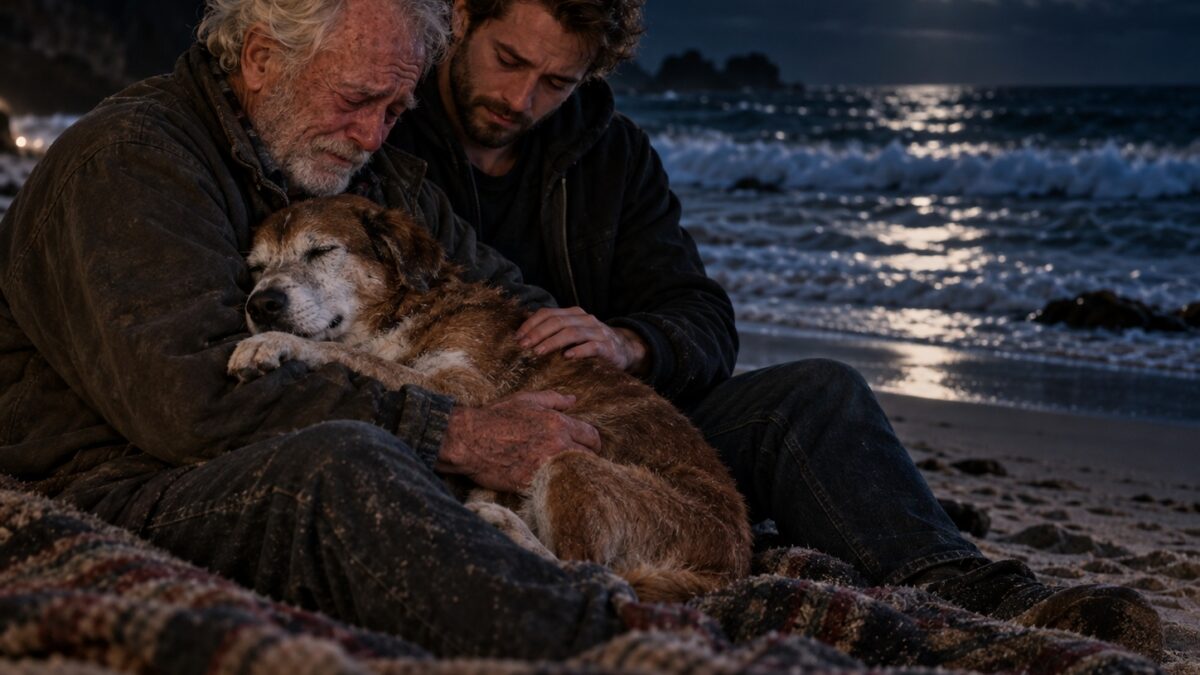
Hours later, Bruno died in his arms.
Afterward, Dad stayed seated on the sand.
Bruno across his lap.
My hand still on Bruno’s back.
The fur felt the same.
That was the cruelty.
Everything looked almost normal.
Only movement was gone.
Dad did not cry loudly.
Tears ran down his face.
He did not wipe them.
Neither did I.
The moon appeared between clouds.
Silver on water.
Stars came and disappeared.
No one told us to leave.
We were not ready.
Finally, Dad whispered:
“We should go.”
He stood slowly.
Carried Bruno.
We wrapped him in the old blanket.
Dad placed him on the back seat.
That felt wrong.
Because Bruno belonged in front.
But the passenger seat stayed empty.
Dad stood beside the driver’s door looking at it.
I knew what he was seeing.
Every morning.
Every errand.
Every ride.
Bruno’s head near the window.
Ears moving in the wind.
Brown eyes.
One paw near the console.
Dad got behind the wheel.
I sat beside him this time.
Passenger seat.
For once, I hated it.
The seat felt occupied by absence.
Dad started the engine.
Neither of us spoke.
We drove home under a dark sky.
Occasionally stars appeared between clouds.
I looked out the window and remembered the rain the night Bruno arrived.
Dad holding a trembling dog.
“One day, Elias.”
I remembered homework beside the couch.
The first tail wag.
The first passenger-seat ride.
School.
College.
Heartbreak.
Dad talking to Bruno late at night.
All the years that had seemed ordinary while they were happening.
That is another cruelty of life.
You rarely know which ordinary moments you will someday beg to revisit.
When we reached home, Dad pulled into the garage.
Turned off the engine.
Silence.
Neither of us opened a door.
Bruno lay behind us beneath the blanket.
The passenger seat was empty.
Dad stared at it.
Minutes passed.
Then he said:
“I thought I was saving him.”
I looked at him.
He did not turn.
“That night.”
His fingers remained on the steering wheel.
“I thought I was doing one decent thing.”
He swallowed.
“Bring a scared dog in out of the rain.”
Finally he looked at me.
“But he saved us.”
I said nothing.
Dad continued.
“He saved me from that house.”
“What do you mean?”
“From coming home and feeling like there was no reason to be there.”
His eyes filled.
“He gave you something to hold when I didn’t know how to comfort you.”
I looked down.
“He gave me somebody to talk to when I couldn’t say things to anyone else.”
He looked toward the back seat.
“He made this a family again.”
I leaned toward him.
Rested my head against his shoulder.
I had not done that since I was small.
Dad put one arm around me.
We sat in the garage.
Beside an empty passenger seat.
Beside the dog who had filled our house for most of my life.
Outside, the night was completely still.
The next morning was worse in a different way.
Grief is sometimes loud the first night.
The next morning, it becomes logistical.
You wake.
Then remember.
There is no sound of nails on the floor.
No bowl.
No dog waiting.
The space where routine lived becomes visible.
Dad made coffee.
I sat at the kitchen table.
His eyes were swollen.
Mine probably were too.
No one said Bruno’s name for several minutes.
Then Dad put down the coffee pot.
“I think we should save another one.”
I stared at him.
“What?”
“Another dog.”
I genuinely thought I had misheard.
“Today?”
He shook his head.
“Not replace him.”
I said nothing.
“You can’t.”
“I know.”
His voice was steady.
“That’s not what I mean.”
He sat across from me.
“There’s a dog somewhere scared like he was.”
I thought of the night Bruno arrived.
Behind the couch.
Trembling.
Dad continued:
“Bruno got all those years because somebody stopped.”
He looked at his coffee.
“I think he’d want us to stop again.”
I knew that was human projection.
Bruno had not written a will.
Dogs do not leave instructions about grief.
Still, something about it felt right.
Not replacing.
Continuing.
I said:
“Yes.”
Dad looked up.
“I think we should.”
For the first time since the beach, he smiled.
Small.
Tired.
But real.
Same kind of smile I remembered from the first time Bruno licked his hand.
Hope, maybe.
We went to the shelter.
Not because we expected another Bruno.
That would have been unfair.
To every dog there.
To Bruno.
To us.
The shelter was louder than I expected.
Barking.
Metal doors.
Nails on concrete.
Some dogs ran to the front of their kennels.
Tails moving.
Pick me.
Pick me.
Others stayed back.
Dad walked slowly.
Looked at every one.
A shepherd mix pressed against the gate.
A young hound bounced so hard he could barely keep four paws on the floor.
An older brown dog sat quietly.
Then I saw the one in the corner.
Small.
Thin.
Curled as tightly as possible against the wall.
Trembling.
He did not bark.
Did not come forward.
His eyes followed us.
And I stopped walking.
Dad almost bumped into me.
“What?”
I pointed.
Dad looked.
The expression on his face collapsed.
Not because the dog looked exactly like Bruno.
He did not.
Different coat.
Different size.
Different face.
But the eyes.
Fear.
That old, exhausted sadness.
The look of an animal who has been alone long enough to stop assuming footsteps mean help.
Dad whispered:
“Same eyes.”
I nodded.
“Yeah.”
We asked to meet him.
A staff member led us into a quiet room.
The dog stayed near the wall.
I sat on the floor.
Did not reach immediately.
I remembered Bruno.
Homework.
Distance.
Patience.
I extended one hand.
Palm low.
The dog watched.
Dad stood behind me.
I could hear his breathing.
The dog took one step.
Stopped.
Another.
Sniffed.
Then, slowly, licked my hand.
Once.
Behind me, Dad made a sound.
I turned.
He was crying.
Smiling through it.
“He has the same eyes.”
I said:
“He does.”
We adopted him that day.
We called him Olivier.
The name took longer than Bruno’s had.
On the ride home, Olivier trembled on the back seat.
I sat beside him.
One hand lightly on his back.
Dad drove.
He did not talk much.
Every few minutes, I saw him look into the mirror.
Not comparing.
I hope not.
Remembering.
There is a difference.
Olivier stayed curled beside me.
When we reached home, Dad parked.
Turned off the engine.
I opened the rear door.
Before I could lift him, Olivier stood.
Crawled forward between the seats.
Then climbed onto the passenger seat.
Bruno’s seat.
He sat.
Looked at Dad.
Then me.
Then Dad again.
For a moment, nobody breathed.
Olivier’s tail moved.
Tiny.
One uncertain sweep.
Then another.
Dad laughed and cried at the same time.
I put a hand on the back of the seat.
The seat was not Bruno’s because Bruno had physically occupied it.
It was Bruno’s because of everything that had happened there.
All the rides.
Dad’s hand on his back.
Wind.
Years.
Memory.
Olivier sitting there did not erase any of it.
Somehow it proved that love had left room.
Dad whispered:
“Okay.”
I said:
“What?”
He wiped his face.
“Nothing.”
Then he started the engine again.
We drove once around the block.
Olivier sat in front.
Dad’s right hand rested on his back.
Exactly as it had with Bruno.
Not exactly.
Never exactly.
That mattered too.
Olivier’s first weeks resembled Bruno’s in ways that hurt and healed us.
He hid.
Not behind the couch.
Under the dining table.
Sudden movement frightened him.
Men’s voices especially.
Dad learned to announce himself when entering a room.
“Hey, buddy.”
No grabbing.
No pressure.
Food.
Water.
Routine.
Time.
I watched Dad repeat the same patience he had once given Bruno without knowing he was doing it.
Morning:
Coffee.
Food.
Quiet.
Afternoon:
Short walk.
Evening:
Same chair.
Olivier slowly expanded.
Under table.
Beside table.
Middle of room.
Then one evening, Dad came home.
Olivier stood near the doorway.
Tail moved.
Dad froze.
“Hey.”
Olivier took two steps toward him.
Dad crouched.
The dog approached.
Dad put both hands carefully around his face.
“Yeah.”
His voice cracked.
“I missed you too.”
I turned away.
Some moments belong partly to the past and partly to the present.
Watching too directly feels like intrusion.
Olivier began sleeping at the foot of my bed.
Exactly where Bruno used to.
The first morning I woke and saw him there, grief struck so hard I had to sit still.
For half a second, in the blur before full waking, I thought:
Bruno.
Then Olivier lifted his head.
Different ears.
Different face.
Different dog.
I whispered:
“Good morning.”
Tail.
The pain changed.
Not gone.
Changed.
I began to understand something.
Love after loss does not arrive in the empty shape left behind.
It creates its own shape beside it.
Olivier did not move into Bruno’s place.
He moved into our lives.
Those are different things.
Dad took Olivier to work occasionally.
Passenger seat.
One hand on wheel.
One hand resting on the dog’s back.
I watched them leave one morning.
Sunlight through windshield.
For a moment, memory overlaid reality.
Bruno’s gray muzzle.
Head near the window.
Then Olivier turned toward me.
Tail moving.
Two images.
Neither canceled the other.
I smiled.
Dad rolled down the window.
“What?”
“Nothing.”
“You’re staring.”
“Drive.”
He looked suspicious.
Then left.
Weeks became months.
Olivier played in the yard.
At first, only when nobody watched closely.
Then openly.
He discovered tennis balls.
Different relationship from Bruno.
Bruno retrieved.
Olivier stole.
If you threw the ball, he got it.
Then ran away.
Dad chased.
“You’re supposed to bring it back.”
Olivier disagreed.
I laughed from the porch.
“You trained him.”
“This is not training.”
“You’re running.”
“He has my ball.”
“His ball.”
Dad stopped.
Looked at me.
“I liked Bruno better.”
Olivier ran past.
Dad laughed.
Not true.
But funny.
One evening, Dad and I sat on the front steps.
Olivier lay at our feet.
Sun going down.
Sky orange.
A scene so peaceful it almost felt arranged.
I said:
“Dad?”
“Yeah?”
“When you brought Bruno home, you said one day.”
“I remember.”
“What would’ve happened if you hadn’t stopped?”
Dad looked toward the road.
Long silence.
“I don’t know.”
He scratched Olivier’s back.
“I know what I was like then.”
I waited.
“I was functioning.”
He said the word carefully.
“Going to work. Taking care of you.”
“You did.”
“I wasn’t living much.”
I looked at him.
He continued.
“Bruno needed me.”
Olivier lifted his head.
Dad smiled.
“That forced me to show up.”
“For him?”
“For everything.”
He looked at me.
“I thought I was rescuing a dog.”
His eyes grew wet.
“He saved me from loneliness.”
Then:
“He saved you from thinking you were alone in your sadness.”
I swallowed.
“He gave us a reason to laugh in that house again.”
Olivier moved closer to Dad’s leg.
Dad rested his hand on him.
“And now?”
I asked.
Dad looked down.
“Now Bruno is doing it again.”
I frowned.
“He’s gone.”
“I know.”
Dad tapped Olivier gently.
“But because we loved him, we knew what to do when we saw this one.”
That sentence changed the way I thought about death.
Maybe what we receive from someone does not end when their body does.
Maybe it becomes skill.
Patience.
Courage.
A habit of opening doors.
Bruno had taught Dad how to rescue.
Then taught us how to survive being rescued.
Then, after he was gone, taught us how to make room again.
People sometimes asked whether adopting Olivier so quickly had been a mistake.
Too soon.
As though grief has a waiting period.
As though there is a respectful number of empty mornings required before love becomes legal again.
I understand the concern.
Some people adopt because they cannot tolerate silence.
Then expect the new animal to erase the old one.
That is unfair.
We did not expect Olivier to be Bruno.
Sometimes Dad accidentally called him Bruno in the first month.
The first time, he went pale.
“I’m sorry.”
Olivier wagged his tail.
He did not care.
I said:
“You don’t owe him an apology.”
Dad looked at me.
“I know.”
But he still did.
Grief is strange.
You can feel disloyal to the dead and unfair to the living at the same time.
Eventually, Dad stopped making the mistake.
Olivier became completely Olivier.
Thief of socks.
Enemy of garden hoses.
Passenger-seat specialist.
Sleeps upside down.
Does not retrieve.
Loves carrots.
Hates bananas.
Bruno had never cared about bananas.
Different dog.
Same love?
No.
Different love.
Same heart.
The first anniversary of Bruno’s death, Dad and I went back to the sea.
Olivier came.
Of course.
Passenger seat.
At the beach, he ran toward the water.
Then discovered waves move.
He retreated so fast I almost fell over laughing.
Dad laughed too.
Olivier barked at the ocean.
The ocean remained unimpressed.
We walked to the place where Bruno had spent his last evening.
Not exact.
Beaches move.
Tides change.
Sand remembers nothing permanently.
But we knew.
Dad stood there.
Olivier beside him.
I expected grief to flatten us.
It did not.
It came.
Quiet.
Heavy.
But there was gratitude mixed inside.
Dad said:
“He would’ve hated this idiot barking at waves.”
“Bruno hated the vacuum.”
“Fair.”
Olivier charged another wave.
Retreated.
Dad shook his head.
Then smiled.
We sat in the sand.
Olivier eventually lay between us.
Sunset.
Same ocean.
Different year.
Different dog.
Bruno absent.
Bruno everywhere.
That paradox stopped hurting as much once I stopped trying to solve it.
I used to think memory was about preserving details perfectly.
Now I think it is about what details continue changing you.
I cannot remember every walk with Bruno.
Every meal.
Every time Dad scratched his ears.
But I remember what those years did to us.
Dad became softer.
I became less afraid of being alone.
Our house became noisy again.
We learned that grief and love could occupy the same room without one destroying the other.
Those are Bruno’s fingerprints, even if dogs do not have fingerprints.
Paw prints, then.
You understand.
Olivier has grown into himself now.
He no longer trembles in the back seat.
Mostly because he is never in the back seat.
That phase lasted approximately one ride.
Passenger seat.
Always.
Dad starts the truck.
Olivier jumps up.
One paw near the console.
Dad puts one hand on the wheel.
One on Olivier’s back.
They leave.
Sometimes I watch from the doorway.
If you looked quickly, you might think nothing changed.
But everything did.
The important things survived anyway.
Dad still keeps Bruno’s old blanket.
Washed.
Folded.
In a cabinet.
At first, I thought he should throw it away.
Not because I wanted to forget.
Because it hurt to see.
Then I stopped.
People are allowed artifacts.
I kept Bruno’s collar.
It sits in my desk drawer.
Sometimes when I open it, the tags make a small metallic sound.
Instant memory.
Kitchen.
Truck.
Walks.
Home.
I do not open the drawer on purpose anymore.
I do not need to.
Bruno is not contained in the collar.
Years earlier, when the boys at school made me cry because I did not have my mother, Bruno taught me a lesson I could not name.
Presence can be enough.
When Dad was drowning in grief, Bruno taught him the same.
When Bruno died, we thought presence had ended.
Then we discovered the things presence teaches can remain.
The next frightened dog benefited from every patient minute Bruno once required.
That is inheritance.
Not money.
Not objects.
The way love trains us for future love.
One morning, Olivier woke Dad before sunrise.
Needed outside.
Dad complained loudly enough to wake me.
“Bruno used to sleep until six.”
Olivier scratched the door.
“Bruno had manners.”
Scratch.
“Bruno respected working people.”
I opened my bedroom door.
“Bruno stole an entire roast.”
Dad looked at me.
“We are not discussing his youth.”
Olivier scratched again.
Dad sighed.
Opened the door.
I laughed.
That laughter is Bruno’s inheritance too.
The phrase Dad said in the garage became something we returned to.
I thought I rescued him, but he rescued us.
It sounds sentimental.
Maybe it is.
But I understand it differently now.
Bruno did not solve our problems.
He did not bring my mother back.
He did not remove Dad’s grief.
He did not stop kids from being cruel.
He did not make life fair.
He created connection.
That gave us enough strength to survive the things he could not change.
Sometimes rescue is not carrying someone out of danger.
Sometimes it is staying beside them until they remember they are more than what happened.
Bruno did that.
Without words.
Dad once told me he had considered giving Bruno up during the first month.
I was shocked.
“When?”
“He destroyed the kitchen trash.”
“He was a puppy.”
“He destroyed one of my work boots.”
“Okay.”
“He peed on the couch.”
“Reasonable.”
“Reasonable?”
“For a dog.”
Dad stared.
Then:
“I thought I couldn’t handle one more thing.”
That sentence hit me.
Because Dad had already been handling too much.
Work.
Child.
Grief.
House.
Money.
Then frightened dog.
“Why didn’t you?”
He thought.
“You loved him.”
“That’s it?”
“And he waited for me at the door.”
Dad smiled.
“No matter how bad the day was, that dog acted like me coming home was the greatest event in recorded history.”
He looked at Olivier sleeping nearby.
“Hard to walk away from somebody that happy to see you.”
Love does not always enter because we are ready.
Sometimes it makes itself useful until we cannot imagine the room without it.
I am older now than Dad was the night he found Bruno.
That realization bothered me.
When I was a child, Dad seemed fully formed.
Adult.
Certain.
Now I understand he was improvising.
He was grieving.
Scared.
Trying to raise a son.
Trying to pay bills.
Trying not to collapse.
Then he saw a frightened dog by a road and made one impulsive choice.
Back up.
Open door.
Pick him up.
That single decision shaped decades.
You rarely know which small choice is carrying the rest of your life inside it.
We never learned Bruno’s life before us.
Where he came from.
Who had frightened him.
Why raised voices made him hide.
Why reaching too quickly toward his head caused him to duck.
At first, I wanted answers.
Eventually, they stopped mattering.
Not because the past was irrelevant.
Because Bruno became more than what had happened before we met him.
Olivier too.
The shelter could tell us pieces.
Not everything.
Maybe that is mercy.
You do not need a complete history to offer a safe future.
Dad became involved with the shelter after adopting Olivier.
Not formally at first.
Donations.
Food.
Blankets.
Then volunteer transport.
He would pick up dogs moving to foster homes.
I teased him.
“One day, Dad?”
“Shut up.”
He started carrying extra leashes in the truck.
Olivier supervised from the passenger seat.
Sometimes another dog rode in back.
Dad told me:
“Bruno started this.”
I said:
“He’d demand royalties.”
“He’d demand cheese.”
True.
One transport involved a terrified senior dog.
Would not leave the crate.
Dad sat beside it for forty minutes.
No forcing.
No pulling.
Just waited.
I watched from across the room.
He used the same posture he had used with Bruno all those years earlier.
Sideways.
Hand low.
Soft voice.
Eventually the dog came out.
I thought:
This is what Bruno left.
Not merely our memories.
Competence in kindness.
My father had become someone who knew how to wait.
I used to think Dad saved Bruno because he was kind.
Now I think Bruno also made Dad kinder.
Not because Dad had been cruel.
Because love practiced repeatedly expands capacity.
Feeding.
Walking.
Waiting.
Forgiving accidents.
Learning fear signals.
Showing up.
Care is a muscle.
Bruno exercised it in us for years.
Olivier inherited the stronger version.
There are still nights when Dad misses Bruno sharply.
Grief does not retire because a new dog arrives.
Once, I found him in the garage.
Sitting inside the parked truck.
Olivier in the passenger seat.
Engine off.
Dad’s hand resting on him.
“What are you doing?”
“Nothing.”
Same answer as years ago.
I leaned against the door.
Dad said:
“Sometimes I can still see him here.”
“Me too.”
Olivier looked between us.
Dad scratched his back.
“I hope that doesn’t make this guy second.”
“It doesn’t.”
“How do you know?”
“Because Bruno taught us there’s room.”
Dad nodded.
That seemed to help.
Maybe we all need permission sometimes.
Even from people who cannot give it anymore.
The ocean became part of our family mythology.
Not only because Bruno died there.
Because it taught me something about endings.
The waves did not stop.
That night, I was almost angry at them.
How dare they continue?
Now I understand continuity differently.
The sea came in.
Went out.
Came in again.
Not repetition exactly.
No wave is the same wave.
Maybe love is like that.
Shape returns.
Water changes.
Bruno.
Olivier.
My father loving a frightened dog.
Me learning from him.
Olivier one day teaching someone else.
Not replacement.
Continuation.
One evening on the porch, I asked Dad:
“Do you think Bruno knew?”
“Knew what?”
“That he was dying.”
Dad looked at Olivier.
“I don’t know.”
“Do you think he knew we took him to say goodbye?”
“I don’t know.”
I waited.
Dad said:
“I think he knew we were there.”
That was enough.
Presence again.
Always presence.
He knew Dad’s arms.
My hand on his back.
Sea air.
No fear.
If that was all he knew, it was enough for me.
I had nightmares after Bruno died.
Not dramatic ones.
Sometimes I dreamed we had forgotten him somewhere.
A parking lot.
A roadside.
A room.
I would wake with guilt.
Then remember.
We did not forget him.
We stayed.
To the end.
That matters.
There is a particular peace in knowing the last thing someone you love experienced was not abandonment.
Bruno had once been the frightened dog nobody seemed to claim.
He died held by the man who had stopped in the rain.
That is a full circle I can live with.
Olivier’s first birthday with us was intentionally simple.
Dad bought him a ridiculous amount of dog treats.
I bought a new leash.
We took him to the park.
He ran.
Dad sat on a bench.
I watched them.
Eventually Olivier came back.
Jumped partly onto Dad.
Dad complained.
“You’re heavy.”
Tail.
“Personal space.”
More tail.
Dad laughed.
I took a photograph.
Later, when I looked at it, I saw something I had missed.
Dad’s hand.
Resting on Olivier’s back.
Same gesture.
Always.
That was Dad’s way of saying:
I’m here.
Maybe Bruno had taught him that too.
Sometimes strangers ask whether Bruno and Olivier were the same breed.
No.
Same temperament?
Not really.
Same story?
No.
What does “same eyes” mean, then?
I have thought about that.
It was not color.
Bruno’s were deep brown.
Olivier’s lighter.
It was the question inside them.
Are you safe?
Will you stay?
Am I allowed to trust this?
We recognized that question because Bruno had taught us how to answer.
That was what Dad meant.
Same eyes.
Same question.
Different dog.
And because of Bruno, this time we knew the answer before Olivier even asked.
Yes.
You can stay.
The passenger seat is still symbolic in our family.
It makes no sense.
It is vinyl and foam.
But objects accumulate meaning from repetition.
Bruno made it his.
Then his absence made it sacred for a while.
Olivier sitting there transformed it again.
Now it represents something larger.
The seat is not evidence that one dog replaced another.
It is evidence that love did not require the space to remain empty in order to prove the first love mattered.
That lesson took us time.
A lot of people need it.
A widow who feels guilty laughing again.
A parent whose child moves away.
A family after losing an animal.
We confuse emptiness with loyalty.
Sometimes keeping a chair empty feels like honoring who sat there.
Sometimes honoring them means remembering what the chair was for.
Companionship.
Then allowing companionship to return.
Dad eventually told me something about the morning after Bruno died.
Before suggesting the shelter, he had gone into the garage alone.
Opened the passenger door.
Sat there.
The seat still had Bruno’s hair on it.
Dad said:
“I thought, I cannot do this again.”
“Lose another dog?”
“Yes.”
“So why did you?”
He looked at me.
“Because the alternative was never loving another one.”
He shook his head.
“That seemed worse.”
I understood.
Pain is the cost of attachment.
You cannot protect yourself from grief without also protecting yourself from love.
That bargain becomes less attractive once you have known what love gives before taking its price.
Olivier will leave us someday.
I hate writing that sentence.
But it is true.
He will age.
So will Dad.
So will I.
Love cannot defeat mortality.
That is not what it means when people say love continues.
It means death does not retroactively cancel what happened.
Bruno died.
Still saved us.
My mother was gone.
Still shaped us.
One day Olivier will be gone.
Still mattered.
Love survives as consequence.
Who you become.
What you do next.
The door you open because someone once opened one for you.
Today, as I write this, Olivier is lying at my feet.
Dad is in the kitchen making coffee.
Some things apparently never change.
Sunlight comes through the window.
Olivier’s paws move in his sleep.
Chasing something.
Maybe a squirrel.
Probably food.
Dad says:
“You want coffee?”
“Yes.”
“For once, make it yourself.”
“You’re already standing there.”
“I raised you.”
“Debatable quality.”
Olivier lifts his head.
Dad says:
“See? Even he agrees.”
Tail.
Life.
Ordinary.
That is what Bruno gave us.
Not permanent happiness.
The ability to return to ordinary life after grief.
Again.
And again.
Every morning, Dad leaves for work or errands and Olivier climbs into the passenger seat.
Dad’s left hand on the wheel.
Right hand eventually resting on Olivier’s back.
They pull away.
Sometimes Olivier puts his head near the open window.
Ears moving.
When I see it, Bruno appears in memory.
Not painfully every time anymore.
Sometimes memory simply joins us.
For one second, I can see both dogs occupying the same stream of love across different years.
Then the truck turns.
Olivier is Olivier.
Bruno is Bruno.
Both are ours.
When Dad and I talk about the beach now, we remember the quiet.
Not death first.
Quiet.
Bruno comfortable.
Sea air.
Stars.
Dad holding him.
No fear.
No struggle.
He simply slept.
There are worse endings.
There are worse gifts.
Bruno had spent his early life frightened enough to hide from voices.
His final moment happened in arms he trusted completely.
Whatever happened before Dad found him, that is how his story ended.
Loved.
Held.
Home.
A while ago, the shelter posted a photograph of another frightened dog online.
Corner of a kennel.
Head lowered.
I sent it to Dad.
No text.
He called.
“No.”
I laughed.
“What?”
“We already have one.”
“I didn’t say anything.”
“You sent me the picture.”
“Maybe I thought it was cute.”
“You’re manipulative.”
“Learned from you.”
Silence.
Then:
“What’s his name?”
I smiled.
Bruno’s story is apparently still continuing.
If you had asked me as a child what Bruno did for us, I would have said:
He played with me.
He slept near me.
He rode with Dad.
If you had asked me as a teenager:
He listened.
If you had asked Dad back then, he probably would have said:
“He’s a good dog.”
That was Dad’s emotional vocabulary.
Now I understand the larger answer.
Bruno entered a house where grief had made two people strangers to each other.
A father who did not know how to speak.
A son who did not know how to ask.
Bruno demanded nothing sophisticated.
Feed me.
Sit near me.
Come back.
Walk with me.
Touch me gently.
Be predictable.
Those simple duties created rhythm.
Rhythm became trust.
Trust became conversation.
Conversation became laughter.
Laughter became family again.
That is how a dog can save people.
Not magic.
Routine.
Presence.
Love practiced until people remember how to live.
The night at the ocean will always hurt.
I hope it does.
Not because I want suffering.
Because pain is evidence that something mattered.
But pain is no longer the only thing I feel when I remember Bruno.
I remember Dad’s first smile.
I remember homework beside the couch.
Bruno stealing Dad’s seat before it officially became his.
I remember him comforting me after school.
Dad talking to him in the kitchen.
Wind through the truck window.
Gray muzzle.
Tail.
Brown eyes.
Cheese.
Always cheese.
Death is one night.
A life is everything before it.
I refuse to let the final page become the entire book.
Dad once said something else on that porch with Olivier at our feet.
I asked:
“Do you think Bruno would like him?”
Dad looked at Olivier, who was chewing something he absolutely should not have had.
“No.”
I laughed.
“Seriously?”
“Bruno had standards.”
Olivier looked proud.
Dad waited.
Then smiled.
“Yeah.”
He scratched Olivier’s head.
“He would.”
I think so too.
Not because dogs hold philosophical beliefs about legacy.
Because Bruno loved us.
And Olivier brought life back into the rooms Bruno once filled.
That seems compatible with everything Bruno ever gave.
If Bruno taught me one thing without ever speaking, it is that love does not end.
I do not mean it in some easy, sentimental way.
Love changes form.
At first it is a dog trembling behind a couch.
Then a boy doing homework beside him.
Then a father coming home to a tail wag.
Then a passenger seat.
Then a hand on black fur.
Then memories.
Then the courage to walk into a shelter.
Then another trembling dog licking your hand.
Then a different tail moving in the same passenger seat.
Then a father smiling through tears.
One thing becomes another.
Not erased.
Transformed.
That is how love survives events bodies cannot.
I still sometimes see Bruno when I look at the passenger seat.
Not literally.
Memory.
His head near the glass.
Big brown eyes.
Slow breathing as he grew older.
Ears catching the wind when he was young.
I smile now.
Most of the time.
Because I understand something I could not understand on that beach.
The seat was never truly empty.
It held every ride.
Every conversation Dad had with Bruno when nobody else was listening.
Every time I sat in the back complaining about “dog privilege.”
Every quiet hand Dad placed on his back.
Memory occupied the space before Olivier ever climbed into it.
And when Olivier did climb in, he did not displace Bruno.
He joined the story.
There is a sentence people use after losing someone:
“They’ll always be with you.”
When I was younger, I thought it was something adults said because they could not say:
They are gone.
Now I think I understand it better.
Being with you does not mean ghostly presence.
It means influence.
Bruno is with Dad every time Dad waits patiently for a frightened dog.
He is with me every time I sit beside someone without trying to fix them.
He is with Olivier in the safe home that exists partly because Bruno taught us how to build one.
He is with the shelter dogs Dad transports.
He is with every animal we have helped because after Bruno, walking past became harder.
That is real.
Concrete.
Love translated into behavior.
The morning after we adopted Olivier, I woke early.
Walked into the kitchen.
Dad was already there.
Coffee.
Olivier sat beside him.
Not hiding.
Not entirely comfortable.
But present.
Dad looked down.
“Morning.”
Olivier’s tail moved.
Small.
Dad looked at me.
Same smile.
The one I remembered from childhood.
The one Bruno first pulled out of him.
I realized then that hope has expressions.
Dad’s looked like that.
A slight upward movement.
Eyes softer.
Almost embarrassed to exist.
Bruno had given it back once.
Olivier had found it again.
Today, Dad is older than the man who carried Bruno out of the rain.
Hair whiter.
Lines deeper.
Hands slower.
But when Olivier jumps into the passenger seat, Dad becomes recognizable to me as every version of himself at once.
The grieving father.
The man learning to laugh.
The dog owner complaining about fur.
The person talking to Bruno in the kitchen.
The man holding him at the sea.
The man walking into the shelter the next morning because pain had not convinced him to close his heart.
That might be the bravest thing my father ever did.
Not the rescue.
The second rescue.
The one after he knew exactly what loving a dog would eventually cost.
One day, I asked him:
“If you could go back to that rainy night knowing how Bruno’s story ends, would you still stop?”
Dad did not hesitate.
“Yes.”
“Even the beach?”
“Yes.”
“Even losing him?”
“Yes.”
He looked at me as if the question was almost ridiculous.
“I’d stop sooner.”
That answer stays with me.
Maybe that is the measure.
Not whether love prevents pain.
Whether, knowing the pain, you would still choose the love.
Dad would.
So would I.
Bruno came to us frightened.
He left peaceful.
Between those two moments, he changed an entire family.
Olivier came frightened too.
Now he races to the door when Dad comes home.
He sleeps at my feet.
He steals tennis balls and refuses to return them.
He rides in the passenger seat.
He has learned that raised hands can mean affection.
That footsteps can mean somebody you love is coming home.
That a car can take you somewhere good.
That a house can be permanent.
Those are not small things to teach a fearful animal.
Bruno taught us how.
The ocean still exists.
Of course.
Somewhere, waves are reaching the same shore where Bruno took his last breath.
The sand we sat on is gone or moved.
The stars we saw are somewhere above tonight’s clouds.
Time keeps changing the physical world.
But I can close my eyes and be there.
Dad’s arms around Bruno.
My hand on his back.
His breath.
Then stillness.
I used to wish for one more breath.
One more minute.
One more ride.
Now, if I could return to that moment, I think I would simply tell him:
You did enough.
You can rest.
We know what to do now.
Maybe that is what he needed all along.
Permission to stop carrying us.
We would carry what he taught.
My father once believed Bruno needed him.
He was right.
Bruno needed shelter.
Food.
Patience.
Safety.
But my father needed Bruno too.
I needed Bruno.
Years later, Olivier needed us.
And because Bruno had once needed us first, we knew how to respond.
That is how love moves.
Back and forth.
No one remains rescuer forever.
No one remains rescued forever.
We take turns.
Sometimes, late at night, Olivier sleeps in the passenger seat while Dad sits in the parked truck listening to the radio.
I see them from the window.
It looks familiar.
Dad’s profile.
Dog beside him.
Soft dashboard light.
I no longer feel as though I am watching a replacement scene.
I am watching continuity.
Bruno’s story did not end when his heart stopped.
The part of his story that was his body ended.
The rest became ours to carry.
I used to think an empty seat meant somebody was missing.
Now I think empty spaces can also be invitations.
Not to replace.
To continue.
The morning after Bruno died, that passenger seat felt unbearable.
The day Olivier climbed into it and moved his tail once, it became something else.
Hope sat there.
Memory sat there.
Grief sat there too.
All three can share space.
Human hearts are strange that way.
Maybe dogs understand it better.
Dad still says Bruno saved us.
I agree.
But I think the full truth is more complicated.
Dad saved Bruno from the rain.
Bruno saved Dad from silence.
Bruno saved me from feeling alone.
Years later, Bruno’s memory led us to Olivier.
Olivier gave Dad somewhere for all that love to go after grief had nowhere to put it.
And now Dad helps other dogs.
They save parts of him too.
No one rescue.
A chain.
That may be what family is.
If you ask me where Bruno is now, I will not pretend to know what happens after death.
I have beliefs.
Questions.
Hope.
But I know where part of him is.
In the old collar in my desk.
In Dad’s habit of resting his hand on a dog’s back while driving.
In the shelter where another frightened animal gets extra patience because we remember Bruno hiding behind the couch.
In the way I sit beside people who are hurting without immediately telling them how to fix it.
In Olivier’s safe sleep.
In our laughter.
In the passenger seat.
That is enough certainty for me.
This morning, Olivier was already waiting by the truck.
Dad opened the door.
Olivier jumped into his seat.
Passenger side.
Of course.
Dad climbed behind the wheel.
He placed one hand on it.
Then the other on Olivier’s back.
I stood on the porch.
For a second, sunlight caught the windshield and I could barely see them.
Then Dad rolled down the window.
“You need anything?”
“No.”
“You sure?”
“Yeah.”
He nodded.
Olivier looked at me.
Tail moved.
The truck pulled away.
I watched until it turned at the end of the road.
And I thought about another drive.
Dark sky.
Bruno wrapped in his old blanket.
Passenger seat empty.
Dad saying:
“I thought I was saving him.”
That night, the seat looked like proof of everything we had lost.
Today, it looks like proof of something else.
Love does not stay in one body.
It does not remain trapped in one chapter.
It changes shape.
Becomes memory.
Then courage.
Then another open door.
Another dog.
Another chance.
Bruno came into our lives because my father stopped his truck on a rainy night and decided that one frightened animal should not have to be alone.
Years later, after Bruno died peacefully beside the ocean, that same act of mercy led us into a shelter.
There we found Olivier.
Shaking.
Alone.
Waiting.
We brought him home.
And the first time he climbed into Bruno’s old passenger seat and gave one tiny uncertain wag, my father and I understood something neither of us could have understood on the beach.
The seat had never really become empty.
It was filled with everything Bruno had left behind.
Patience.
Loyalty.
Memory.
Hope.
The courage to love again.
That is Bruno’s legacy.
Not that he never left us.
He did.
Not that losing him did not hurt.
It still does.
His legacy is that after he was gone, the love he taught us was still alive enough to save somebody else.
Dad once carried Bruno out of the rain believing he was rescuing a dog.
Bruno spent the rest of his life proving that rescue can run both directions.
And now, every morning, Olivier climbs into that passenger seat, Dad rests a hand on his back, and they drive away together.
Not exactly like before.
Nothing truly is.
But with the same heart.
The same hope.
The same love continuing forward.
Exactly as it should.




