PART2:The Labrador Wouldn’t Leave Our Dumpster—Then Security Footage Showed Why She Had Run Miles to Get There
PART2
The security room was hardly a room.
More like an oversized closet.
Two monitors.
A desk.
A rolling chair with one wheel that always squeaked.
A wall covered in old incident reports.
Marcus sat.
I stood behind him.
He pulled up the rear service camera.
Time stamp:
4:00 a.m.
Empty pavement.
Dumpster.
Darkness.
He sped forward.
4:30.
Nothing.
5:02.
A delivery van passed.
5:18.
Then headlights.
Marcus slowed the footage.
A dark sedan entered from the service road.
Not one of our regular deliveries.
It did not park.
It stopped beside the dumpsters.
Driver’s door opened.
A man got out.
Baseball cap.
Dark shirt.
He went around to the rear.
Opened the trunk.
Marcus leaned toward the screen.
“What’s he carrying?”
A cardboard box.
Medium-sized.
Taped shut.
The man looked around once.
Then lifted the dumpster lid.
Dropped the box inside.
Not placed.
Dropped.
I felt my stomach tighten.
The lid came down.
The man got into the car.
Drove away.
Marcus paused the video.
Neither of us spoke.
I said:
“Go forward.”
He did.
The sedan turned toward the highway.
For twenty-three seconds, the frame was empty.
Then something came from the same direction.
Fast.
The Labrador.
Running.
Not trotting.
Running hard.
She entered the camera frame at full speed.
Stopped near the dumpster.
Circled.
Sniffed.
Jumped against the metal side.
Dropped back down.
Jumped again.
Again.
She could smell something inside.
Marcus rewound.
We watched her arrive again.
Then he changed cameras.
One camera faced the service road and a small stretch toward the highway.
There she was.
Running down the shoulder.
Dust behind her.
The sedan already farther ahead.
She was following it.
Marcus moved to the next camera.
The car turned into our lot.
The dog appeared maybe thirty seconds later.
She had not been in the car.
She had chased it.
I gripped the back of Marcus’s chair.
“Go back farther.”
“We only cover the property.”
“I know.”
He rewound until the sedan first entered.
The dog was visible for one second far behind.
A yellow shape on the road.
Running after it.
I stared.
The man had brought the box.
The dog had followed.
Then she had stayed by the dumpster.
The dog outside was not looking for the man.
She was looking for whatever he had thrown away.
Marcus was the first to say it.
“We need to open that box.”
I nodded.
Could not speak.
My throat had closed.
We ran outside.
The Labrador stood when she saw us.
This time, she did not retreat.
She looked between us and the dumpster.
As if she understood that we had finally caught up with what she had been trying to say.
Marcus lifted the lid.
The smell was worse now that we knew what we were looking for.
He climbed onto the edge.
Moved a torn garbage bag.
Then wet cardboard.
“See it?”
“Not yet.”
The Labrador paced.
Whined.
I had never seen an animal’s entire body look like urgency before.
Marcus moved another bag.
“There.”
A box.
Brown.
Partly crushed between trash bags.
One corner damp.
Tape across the top.
He reached.
Pulled.
The box shifted.
The Labrador made a sound so sharp it almost became a bark.
“Easy.”
Marcus lifted the box out.
It was light.
Too light.
He set it on the pavement.
The Labrador rushed forward.
Sniffed every side.
Then looked at me.
I knelt.
My hands were shaking so badly I could barely get under the tape.
“Knife?”
Marcus handed me his utility knife.
I cut carefully.
One strip.
Then another.
I pulled the cardboard apart.
At first, I saw only darkness.
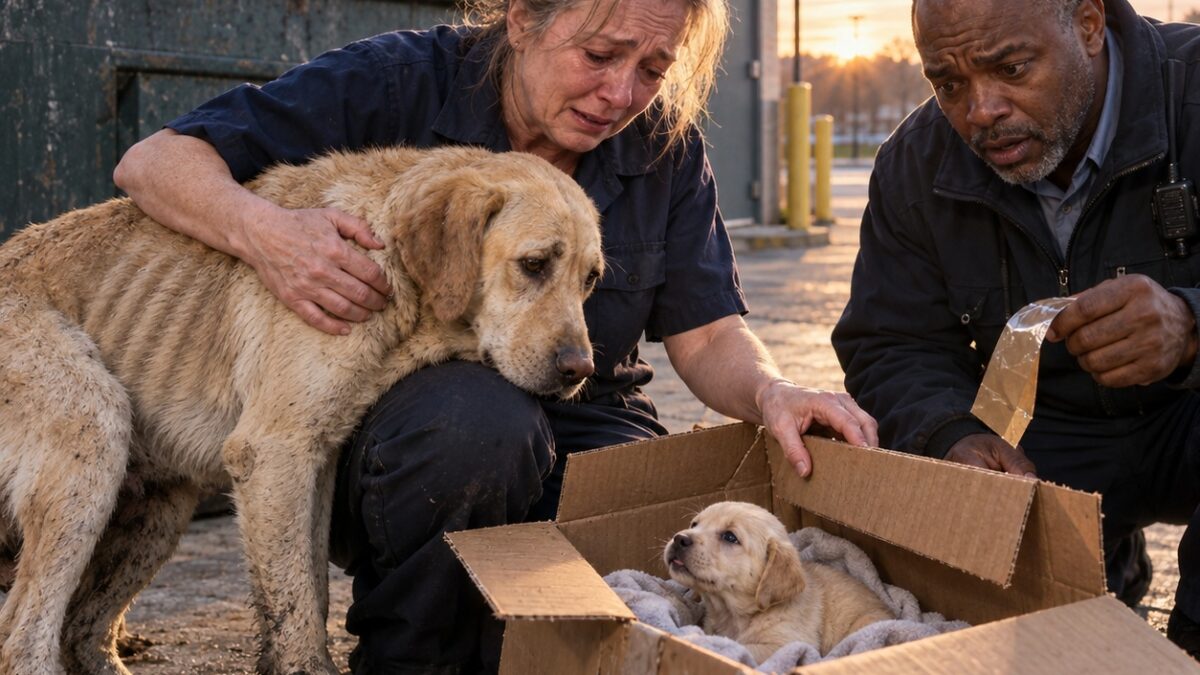
Then something moved.
A tiny yellow head.
A puppy.
Maybe three months old.
Curled into himself.
His coat pale gold.
Eyes half open.
Weak.
Silent.
But alive.
“Oh my God.”
I reached in.
He barely weighed anything.
I lifted him with both hands.
The puppy trembled.
His heart beat frantically against my palms.
I sat right there on the pavement because my knees stopped cooperating.
I held him against my chest.
Then came another sound.
A low whine.
The mother.
She approached slowly.
Not afraid of me now.
Not of Marcus.
Not of anything.
Her nose went straight to the puppy.
She sniffed his face.
His ears.
His belly.
The puppy stirred.
Made one tiny sound.
The mother’s entire expression changed.
There are people who will tell you not to assign human emotion to animals.
Fair.
We should be careful.
But I know what I saw.
Her body released.
Tail moved.
Not wildly.
Slowly.
She licked the puppy’s face.
Again.
Again.
Then looked at me.
Those amber eyes.
The same eyes that had begged me to look inside the dumpster.
I started crying.
“You knew.”
My voice broke.
“You knew he was there.”
She leaned closer.
The puppy pressed toward her.
Marcus stood beside us.
He was a large man.
Former military.
Not emotional in public.
His eyes were wet.
He looked away.
“Call the shelter.”
I did.
The local rescue arrived within forty minutes.
A young woman named Harper came with another worker.
They brought medical supplies.
Carrier.
Blankets.
Scanner.
The puppy was dehydrated.
Weak.
But conscious.
No obvious major injury.
Harper looked at the box.
Then the mother.
Then us.
“You saw who did this?”
“Camera.”
Marcus nodded toward the building.
“We have video.”
Harper’s face changed.
Not surprise.
The tired anger of someone who has seen enough cruelty to recognize another version immediately.
“We’ll need copies.”
“You’ll get everything.”
They scanned both dogs.
The mother had a microchip.
That gave them a starting point.
The puppy did not.
Or at least the scanner found none.
Hope—that name came later—refused to let the rescue workers take Willow without her.
When Harper lifted the puppy, the mother stood immediately.
Followed.
Harper stopped.
“Okay.”
She lowered the puppy near the carrier.
The mother sniffed inside.
Then entered first.
Only then did they place the puppy beside her.
I sat on the concrete steps behind the center while Marcus prepared copies of the security recordings.
I should have gone back to work.
There were floors.
Trash.
A broken light in unit six.
I could not.
I kept seeing the video.
The box falling.
Car driving.
Then the mother running.
Imagine that for a moment.
Your baby disappears into a car.
You do not understand roads.
You do not understand distance.
You do not know where the car is going.
All you know is scent.
Sound.
Movement.
So you run.
Maybe the car disappears.
Maybe you lose sight.
But you continue.
The rescue later pieced together enough information to understand that the mother had apparently escaped from the property where both dogs had been kept.
How?
Under a fence.
Through a gap.
No one could say with certainty.
But she followed.
Along the highway.
Through dust.
Toward the car.
Until eventually she reached our service lot.
The car was gone by then.
The puppy was not.
She could smell him.
That was why she stayed.
That was why she ignored most of the food.
That was why she kept looking at the dumpster.
She had already done the impossible part.
She found him.
She just needed someone with hands.
Before Harper left, she crouched near me.
“You okay?”
“No.”
Fair answer.
She nodded.
“Neither am I.”
I looked at the carrier.
The mother was lying beside the puppy.
Her head positioned over him.
Watching.
“Will he make it?”
“I think he has a good chance.”
Not a promise.
I appreciated that.
“And her?”
“She’s exhausted.”
“From running?”
“Probably.”
Harper looked at the mother’s paws.
Pads worn.
Some raw areas.
“She came a long way.”
I swallowed.
“Can I call?”
“Of course.”
They left.
The mother watched me through the carrier door until the vehicle turned out of the lot.
I stayed on those steps for almost an hour afterward.
Something had changed in me.
I did not have language for it yet.
The shelter used the microchip and footage to investigate.
What they later told us was ugly but straightforward.
The man on the video lived several miles from the highway.
He had two Labradors.
The adult female.
And her puppy.
The puppy was about three months old.
For reasons that ultimately mattered less to me than what he did about them, he had decided he did not want to keep both.
He could have contacted a shelter.
A rescue.
Asked for help.
He did not.
He placed the puppy in a cardboard box.
Drove away.
Dumped him.
The mother witnessed her puppy being taken.
Then escaped.
The shelter handled the case.
Marcus supplied copies of the footage.
I gave my statement.
I will not add punishments that were not part of what I personally knew.
No invented courtroom.
No dramatic arrest.
The facts were terrible enough.
A puppy was put inside a box and discarded.
His mother followed.
That is what happened.
For the next week, I thought about them constantly.
Every morning, I walked behind the shopping center.
Same dumpster.
Same pavement.
Empty now.
I could almost see the mother standing there.
Looking.
Waiting for me to understand.
I started wondering how many things I had passed in life because I assumed I knew what I was seeing.
A stray dog.
A tired coworker.
Someone sitting alone.
A person saying:
“I’m fine.”
We are quick to classify.
Food.
Problem.
Not mine.
Then move on.
Hope had forced me to look twice.
Seven days later, I called.
Harper answered.
“This is Beth.”
“I know.”
That made me smile.
“How are they?”
“They’re doing well.”
I closed my eyes.
“The puppy?”
“Rehydrated. Eating. Gaining.”
I exhaled.
“And the mother?”
“Calmer.”
“Still with him?”
Harper laughed softly.
“She barely lets him out of sight.”
I imagined that.
“Can I visit?”
“Absolutely.”
Saturday could not arrive fast enough.
The shelter sat outside town on a green hill.
Not fancy.
Clean.
Quiet compared with some shelters I had seen.
Harper met me at reception.
“You ready?”
I nodded.
She led me to a smaller recovery room.
Blankets covered the floor.
A water bowl.
Food.
A few toys.
The mother lay in one corner.
The puppy between her front paws.
He looked different already.
Eyes brighter.
Coat cleaner.
Body less folded into itself.
When I entered, the mother raised her head.
I stopped.
Did not expect her to remember me.
She stared.
Then stood.
Walked toward me.
Not rushed.
Certain.
I crouched.
She reached me.
Pressed her head against my knees.
That was all.
I cried again.
I had apparently become someone who cried around Labradors.
Fine.
I wrapped my arms around her.
“You remember.”
Her tail moved.
The puppy waddled over.
Big paws.
Round belly now.
He sniffed my fingers.
Tried chewing one.
Good.
Puppies who attempt to eat you are usually feeling better.
Harper smiled.
“We named him Willow.”
“He’s a boy?”
“Yes.”
“Willow?”
“She liked it.”
Harper pointed toward another worker.
“Don’t argue.”
“I’m not.”
Then I looked at the mother.
“And her?”
“We’ve been calling her Hope.”
Hope.
I looked at the dog who had run down a highway after her puppy.
“Of course you have.”
No other name would have been right.
I visited every week.
At first, I told myself I was checking on them.
That was technically true.
Then it became a routine.
Saturday.
Coffee.
Drive to shelter.
Hope.
Willow.
Willow grew fast.
Puppies do.
Week one, he stumbled more than he walked.
Week three, he discovered speed.
Week four, he discovered that speed without steering leads into furniture.
He played.
Chewed blankets.
Climbed onto things.
Fell off things.
Stole one of Harper’s shoelaces.
Hope watched every second.
If Willow moved too far, her head came up.
If he disappeared behind furniture, she stood.
If he squeaked sharply, she was there before any human.
She had already lost him once.
Safety did not erase memory immediately.
That interested me.
People often talk about rescue as if safety changes the nervous system overnight.
It does not.
Safety needs repetition.
Willow walks away.
Willow comes back.
Again.
Again.
Again.
Eventually Hope began letting him play farther away.
Her head still followed.
But her body remained resting.
Trust returning by degrees.
Hope changed too.
At the shelter, she gained weight.
Her paws healed.
Coat became glossy.
She stopped keeping herself between Willow and every unfamiliar person.
The first few visits, she watched my hands when I touched him.
Later, she slept while I played with him.
That felt like an honor.
One Saturday, Willow climbed onto the sofa.
Hope lay in the sunlight.
Eyes closed.
Fully asleep.
Harper whispered:
“Look.”
I knew what she meant.
This dog had run miles because she could not let her puppy disappear.
Now she could close her eyes while he played ten feet away.
That was recovery.
Not forgetting.
Believing, for one minute, that nothing terrible would happen if she stopped watching.
I started thinking about adoption before I admitted it.
First thought:
Someone should keep them together.
Second:
I hope the shelter requires that.
Third:
What kind of home could take two Labradors?
Fourth:
My apartment technically allows dogs.
That was the dangerous one.
I lived in a small apartment with a balcony.
Not huge.
I worked full time.
I had never owned two Labradors.
Marcus laughed when I mentioned it.
“You’re adopting them.”
“I did not say that.”
“You didn’t have to.”
“I’m thinking.”
“You bought dog beds yesterday.”
“They were on sale.”
“Beth.”
“Shut up.”
He smiled.
“Both?”
“I don’t know.”
“Yes, you do.”
I did.
There were practical questions.
Important ones.
Could I afford food?
Veterinary care?
Training?
Pet deposit?
Could my schedule work?
Could two dogs live comfortably in my space?
Hope was calm.
Willow was a puppy with the energy of a small natural disaster.
Harper did not make it easy on me.
Good.
People think shelters should be grateful anyone wants an animal.
Responsible shelters ask whether wanting will become staying.
We discussed exercise.
Dog walker.
Training classes.
My work hours.
Backup care.
Marcus volunteered before I asked.
“My wife loves dogs.”
“That means you love dogs?”
“It means I’ve lost the argument already.”
My sister lived nearby too.
She agreed to help.
I talked to my landlord.
Pet deposit painful.
Allowed.
I measured the apartment as though planning military logistics.
Beds.
Bowls.
Crate.
Balcony safety.
Storage.
Harper watched me do all of this and smiled.
“What?”
“Nothing.”
“You think I’m crazy.”
“No.”
Pause.
“Maybe.”
Fair.
One evening, I came home after visiting and sat alone on the balcony.
My apartment was quiet.
Always had been.
I was fifty-three.
Divorced many years.
No children living with me.
Work had become the structure of my days.
Morning.
Shopping center.
Maintenance.
Home.
Television.
Sleep.
Repeat.
I had friends.
Coworkers.
Family.
I was not miserable.
But Hope and Willow had made me notice the shape of the quiet.
That bothered me.
Was I adopting because I was lonely?
Maybe partly.
Was that wrong?
I thought about the mother pressing her head against my knees every Saturday.
Willow attacking my shoelaces.
Need can run both directions.
The question was not whether I needed them.
It was whether I could responsibly meet what they needed.
I could.
That settled it.
Two months after the dumpster, I signed the papers.
Both dogs.
Hope and Willow.
Harper cried.
I cried.
Marcus came because apparently he had appointed himself witness to my emotional collapse.
Hope sensed something.
She stayed close.
Willow had no idea.
He was busy trying to eat a pen.
Harper reviewed everything.
Medical records.
Vaccinations.
Training.
Diet.
Microchip updates.
Then handed me the leashes.
“You ready?”
“No.”
“Good answer.”
We walked outside.
My car was packed absurdly.
Blankets.
Water.
Crate.
Treats.
Toys.
First-aid kit.
Two dog beds even though the apartment already had two more.
Hope hesitated at the car.
I remembered the security footage.
A car had once meant her puppy disappearing.
I did not pull.
I opened the rear door.
Waited.
Willow tried jumping immediately and failed spectacularly.
I lifted him in.
Hope watched.
Willow remained visible.
Safe.
Hope stepped closer.
One paw.
Then another.
She climbed inside.
I sat beside them for a minute before closing the door.
“Everybody together.”
Hope looked at Willow.
Then at me.
I closed the door.
Drove home slowly.
The first night was chaos.
Willow investigated everything.
Shoes.
Table legs.
Curtains.
A cardboard box that apparently triggered no traumatic association for him because he destroyed it happily.
Hope walked room to room.
Balcony.
Bedroom.
Kitchen.
Back to Willow.
Every few minutes.
Checking.
I showed her the bed beside mine.
She sniffed.
Ignored it.
Willow collapsed there eventually.
Hope lay beside him.
Their bodies touching.
At two in the morning, I woke.
Moonlight through curtains.
Hope awake.
Watching Willow sleep.
I whispered:
“He’s here.”
Her ears moved.
“You’re both here.”
Eventually her eyes closed.
The next morning, I woke before the alarm.
Hope lay beside the bed.
Willow curled against her.
Safe.
Home.
I stared at them for several minutes.
Two months earlier, I had been carrying trash toward a dumpster.
That was supposed to be an ordinary morning.
Now there were two Labradors breathing beside my bed.
Life can turn with almost insulting speed.
Willow adjusted faster.
Young animals often do.
Within days, he acted as though he owned the apartment.
Hope took longer.
Door sounds made her alert.
Car engines outside.
Especially dark sedans.
Maybe I imagined that connection.
I did not force the interpretation.
But she watched vehicles from the balcony.
For weeks.
Sometimes Willow joined.
Then got bored.
Hope kept looking.
I started closing the curtains during heavy traffic hours.
Not to hide the world forever.
Just to give her nervous system rest.
Training helped.
Routine helped more.
Morning walk.
Breakfast.
I leave.
Dog walker midday.
I return.
Evening walk.
Dinner.
Balcony.
Bed.
Again.
Predictability.
Hope began relaxing.
The first time she slept in another room from Willow felt enormous.
I was reading on the sofa.
Willow asleep near the kitchen.
Hope walked into the bedroom.
Turned twice.
Lay down.
Alone.
She did not check him for nearly twenty minutes.
I did not move.
Afraid to break the moment.
Then Willow woke.
Ran into the bedroom.
Jumped onto her.
Hope looked annoyed.
Good.
Annoyance is healthier than terror.
Willow grew.
And grew.
And grew.
His legs seemed to lengthen overnight.
His puppy softness became the body of a young Labrador.
Still mentally ridiculous.
He discovered fetch.
Hope did not understand why anyone would voluntarily chase something that had already been thrown away.
Willow believed retrieving tennis balls was a sacred calling.
Hope preferred the balcony.
Sunlight.
Quiet.
Me.
She became my shadow.
Not anxiously eventually.
Companionably.
Kitchen.
She came.
Balcony.
She came.
Bathroom.
I drew boundaries.
She waited outside.
Mostly.
Marcus visited one Saturday.
Hope barked once.
Then recognized him.
Tail.
He crouched.
“Hey, hero.”
Hope leaned against him.
Marcus looked away.
His eyes went wet.
“You’re crying.”
“Dust.”
“Inside?”
“Very dusty apartment.”
Willow stole his hat.
Conversation ended.
Sometimes people asked what happened to the man.
I told them only what I knew.
The shelter investigated using the footage and ownership information.
The evidence was turned over appropriately.
I did not turn our story into a fantasy about punishment.
Hope and Willow’s future mattered more to me than imagining someone else’s suffering.
Would I like everyone who abandons an animal in danger to face real accountability?
Yes.
But I will not invent what I did not witness.
The camera gave us enough truth.
A man carried a box.
Dropped it.
Drove away.
A mother dog ran after him.
That is the record.
The footage stayed with me.
Marcus kept an official copy.
I saw it again once months later during paperwork.
I regretted watching.
Hope running.
Head forward.
Body low.
Car ahead.
I paused the video before the box was dropped.
Something about the chase hurt more after knowing her.
Before, she was a dog in a video.
Now I knew she hated baths.
Loved banana slices.
Snored lightly.
Did not like squeaky toys.
Slept with one paw touching Willow.
Personality makes suffering harder to abstract.
Maybe that is good.
Abstract suffering is easy to ignore.
Willow’s first birthday happened at my apartment.
Approximate date.
Harper came.
Marcus and his wife.
My sister.
Too many people.
Too much food.
Hope lay beneath the table.
Willow wore a bandanna for three minutes before trying to eat it.
We took photographs.
One showed Hope watching Willow with her head resting on my foot.
That became my favorite.
Not because of the puppy.
Because Hope looked relaxed.
No vigilance.
No fear.
Just a mother watching her son be ridiculous.
She had earned ordinary.
Hope became more independent as Willow matured.
That surprised me emotionally.
For months, their bond defined the story.
Mother runs after puppy.
Mother finds puppy.
Mother refuses to lose him.
Then Willow became an adult.
He did not need constant supervision.
Hope seemed to understand before I did.
She stopped following every movement.
Slept alone sometimes.
Went on separate walks with me.
The first time I took Hope alone, Willow barked from inside.
Hope paused at the building door.
Looked back.
Then followed me.
We walked around the block.
Just us.
Her pace steady.
She sniffed trees.
Looked at passing cars.
Then returned.
Willow greeted her as though she had been deployed overseas.
Hope ignored him.
Motherhood has limits.
That separate walk became ours.
Willow had energetic exercise with a dog walker.
Hope and I walked evenings.
Slowly.
I told her about work.
Complained about broken plumbing.
Customers leaving trash where trash cans existed three feet away.
Marcus’s terrible coffee.
She listened.
I began to understand why people talk to dogs.
No fixing.
No comparison.
No:
“At least…”
Just presence.
Maybe Hope had once needed me to listen to what she was showing.
Now she listened to me.
Fair exchange.
One evening, we passed a dumpster behind another building.
Hope stopped.
Body stiff.
I felt the leash change before I saw why.
Metal.
Large.
Similar.
Her head lowered.
I did not pull.
We stood.
I said:
“You don’t have to.”
Hope stared.
Then looked at me.
I stepped backward.
We crossed the street.
Went around.
For weeks afterward, I avoided that route.
Eventually, with training and distance, she could pass similar dumpsters without freezing.
Not because I needed her to conquer something symbolically.
Because the world contains dumpsters.
I wanted her world to be larger than fear.
But we went at her pace.
Willow had no obvious memory of the box.
Or if he did, it did not control him.
He loved cardboard.
Destroyed shipping boxes with enthusiasm.
The first time, I almost stopped him.
Then realized:
Why?
Let cardboard become a toy.
Let the object mean something new.
I gave him an empty delivery box.
He ripped it apart.
Hope watched.
Then joined for exactly six seconds.
I laughed until my stomach hurt.
Maybe recovery sometimes looks like destroying the shape that once contained your fear.
Or maybe Labradors just love cardboard.
Both interpretations were acceptable.
Harper remained part of our lives.
We visited the shelter.
Hope always recognized the building.
At first, I worried she would think I was returning her.
She walked close to me.
I kept the leash loose.
We visited Harper.
Then left together.
Again.
Another visit.
Leave together.
Eventually, Hope entered with tail moving.
The shelter stopped meaning uncertainty.
It meant Harper.
Treats.
Then home again.
Repetition rewrites expectation.
One Saturday, a mother dog arrived at the shelter with four puppies.
Hope saw them from a distance.
She stood still.
Watched.
One puppy cried.
Hope’s ears rose.
She pulled slightly.
Harper looked at me.
“Want to see?”
We approached carefully.
Hope sniffed through the barrier.
The mother dog sniffed back.
No drama.
Willow bounced around behind us like an idiot.
Hope looked at him.
Then the puppies.
Then me.
Something in my chest tightened.
She had become safe enough to encounter another mother’s fear without being swallowed by her own.
That felt important.
People often describe maternal love as instinct.
It is.
Biology matters.
But the word instinct can sound too simple.
As if calling something instinctive makes it less extraordinary.
Breathing is instinctive too.
Still necessary.
Hope’s body told her:
Follow.
Find.
Stay.
She obeyed that command beyond exhaustion.
The car was faster.
She still ran.
The puppy was hidden.
She still found him.
She could not open metal or cardboard.
So she found people.
Or waited until people found her.
Instinct does not make devotion less meaningful.
Maybe it makes it older than meaning.
I became more observant after Hope.
At work, I noticed animals differently.
A cat behind a loading bay.
A pigeon caught in netting.
A dog wandering near traffic.
Not every situation was an emergency.
Some were.
I started keeping spare water bowls in the maintenance closet.
Slip leads.
A contact list for rescues.
Marcus added an animal incident section to security procedures.
He claimed that was practical.
I knew better.
Hope changed him too.
One morning, I found him feeding a stray cat.
“You hate cats.”
“I hate this cat.”
“You bought tuna.”
“Operational necessity.”
Sure.
The shopping center staff began calling the dumpster:
Hope’s Corner.
I hated it at first.
“Do not romanticize the place.”
Marcus said:
“We’re not.”
Eventually they put a small animal-water station near the rear fence.
Not beside trash.
Shade.
Clean.
A sign with rescue contact information.
That I liked.
Not a memorial to suffering.
A practical response.
Something useful because something had happened.
That is the kind of legacy I prefer.
Two years after adoption, Hope began going gray around the muzzle.
Willow was enormous.
Happy.
Healthy.
Still convinced he was lap-sized.
I sat on the balcony one morning.
Hope at my feet.
Willow partly on my feet and partly everywhere else.
Sunrise.
Traffic distant.
Nothing dramatic.
I thought:
This is the real ending.
Not the dumpster.
Not the footage.
Not the box.
Breakfast.
Morning light.
Two dogs.
My coffee.
Peace.
Tragedy grabs attention.
Recovery deserves more time.
I still think about the first look Hope gave me.
Before I knew.
Desperate.
Focused.
Not:
Feed me.
Not:
Take me home.
Look again.
That is what the look meant in my memory.
Maybe not literally.
But functionally.
Look again.
There is more here.
That instruction has followed me far beyond dogs.
People too.
Someone angry may be scared.
Someone quiet may be hurting.
Someone inconvenient may be asking badly for help.
You cannot solve everything by looking twice.
But you miss less.
That matters.
One night, thunderstorms woke us.
Willow jumped onto my bed.
All seventy pounds.
Hope came too.
I found myself trapped beneath two Labradors.
Lightning.
Thunder.
Hope trembled slightly.
I put my hand on her side.
Willow rested his head across her back.
She calmed.
I thought about the first time she had probably slept after reaching the dumpster.
Maybe she had not.
Maybe she stayed awake until we arrived.
Now she could be afraid and still rest.
Because fear no longer meant being alone.
That is one definition of home.
Not a place where nothing frightening happens.
A place where fear has company.
Hope eventually stopped checking Willow every time he left the room.
I noticed one afternoon.
Willow went onto the balcony.
Hope remained asleep.
Ten minutes.
No movement.
I stared.
Then laughed quietly.
“Finally.”
She opened one eye.
Closed it again.
Mother released from duty.
At least temporarily.
Willow never knew what his mother had done.
Not in the human-story sense.
He could not understand:
She ran miles.
She waited beside a dumpster.
She got help.
He simply grew up with Hope always there.
Maybe that was the best reward.
Children, human or animal, should not have to carry the full history of what protected them.
Sometimes love does the work quietly and lets the next generation live lightly.
Willow got to be ridiculous because Hope had been brave.
There is something beautiful in that.
As Hope aged, I became increasingly aware that she had spent part of her life protecting Willow.
I wanted the rest of hers to include being protected.
Regular vet care.
Good food.
Soft bed.
No more litters.
No more running highways.
No more desperate searching.
She did not need to prove anything else.
I told her that sometimes.
“You’re retired.”
Tail.
“No more hero work.”
She would look toward Willow doing something stupid.
I corrected myself.
“Minimal hero work.”
One evening Willow knocked over a plant.
Hope looked at me.
I looked at Hope.
Willow stood in dirt.
I said:
“Your son.”
Hope walked away.
I respected that boundary.
I eventually learned to stop introducing them as:
“The mother who ran after her puppy.”
That is a great story.
But Hope became more.
She loved sun.
Preferred chicken to beef.
Disliked baths.
Snored only when deeply asleep.
Liked women faster than men.
Trusted Marcus completely after several months.
Had a strange habit of carrying one sock from my bedroom into the living room but never chewing it.
Willow became more than:
“The puppy in the box.”
He loved water.
Feared vacuum cleaners.
Could retrieve almost anything except the object you actually wanted.
Made children laugh.
Slept upside down.
A rescue story should not trap an animal forever inside the worst thing that happened.
Survival deserves identity afterward.
People would occasionally recognize them from shelter posts.
“Is that Hope?”
I would say yes.
Then:
“The dog who chased the car?”
“Yes.”
They would crouch.
Tell her:
“You’re amazing.”
Hope usually checked whether they had treats.
Correct priority.
Heroism does not pay in biscuits unless humans cooperate.
My work changed less dramatically than my home.
I still cleaned.
Fixed things.
Took out trash.
The same dumpster remained.
Metal got replaced once.
Same location.
For a long time, I hated walking near it.
Then eventually it became ordinary again.
That was good.
Ordinary means the event no longer owns the place.
Sometimes healing is allowing a location to stop being sacred or terrible.
A dumpster becomes a dumpster.
A road becomes a road.
The past remains true.
The present expands around it.
Marcus retired a few years later.
At his farewell lunch, someone gave him a framed still from the security footage.
Not the box.
Not the man.
Hope arriving.
Running into frame.
Marcus stared at it.
“You people are terrible.”
“You love it.”
“No.”
He took it home.
His wife later sent me a picture.
Hung in his garage.
Underneath, he had written:
PAY ATTENTION.
That was perfect.
Harper once asked me:
“If the camera hadn’t been there, would you have opened the dumpster?”
I hated that question.
“I don’t know.”
Hope had been trying.
Maybe eventually.
Maybe I would have assumed rats.
Food.
Trash.
Maybe not.
The camera translated what the dog could not.
That fact still unsettles me.
Technology did something profoundly human that morning.
It made us witness sequence.
Man.
Box.
Car.
Dog running.
Without sequence, Hope’s behavior looked strange.
With sequence, it became language.
Context is powerful.
The case changed shelter procedures too.
When animals are found repeatedly circling or fixating on a location, staff now ask:
What are they pointing us toward?
Not literally every time.
But enough to investigate.
Harper called it:
“The Hope Rule.”
Unofficial.
I liked it.
Again:
Look twice.
Several years passed.
Willow matured.
Hope slowed a little.
Her amber eyes remained the same.
When she looked at me, I still sometimes remembered the parking lot.
But more often I saw home.
That shift took time.
The first memory did not disappear.
It simply lost priority.
One morning, I woke and found Hope at the foot of my bed.
Willow asleep beside her.
Sun through curtains.
I took a photograph.
Almost identical to one I had taken months after adoption.
Then another years later.
Same arrangement.
Mother.
Son.
Safe.
I printed all three.
Put them together.
Harper laughed when she saw.
“You’re becoming one of those dog people.”
“I am not.”
“You have framed sleeping-dog timelines.”
“Documentation.”
“Sure.”
Eventually, Hope’s body showed age.
Arthritis.
Slower stairs.
More naps.
Willow adjusted instinctively.
He stopped crashing into her during play.
Waited on stairs.
Sometimes returned to check her.
There was a reversal there.
The puppy she had once guarded began watching the mother.
One evening, I saw Willow pause at the balcony door because Hope was behind him.
He waited until she passed.
Then followed.
I cried.
Of course.
Apparently that never stopped.
Love changing direction.
Mother protects son.
Son grows.
Son waits for mother.
Nature completes loops quietly.
Hope’s final years were peaceful.
No more crisis.
That is important.
Not every story needs another dramatic ending.
She had enough drama for one lifetime.
We had medical issues.
Normal aging.
Vet visits.
Medication.
But her life became gloriously uneventful.
Walk.
Food.
Balcony.
Willow.
Me.
Sleep.
That is what I wanted for her.
When people asked why I adopted both instead of letting Willow go to another family, the answer was simple.
At first:
I could not separate them after what Hope had done.
Later:
I could not imagine separating myself from either.
Those are different reasons.
Both true.
Would another good home have worked?
Maybe.
But ours did.
Sometimes you do not need to optimize every possible future.
You make one good commitment and live it.
I learned something else from Hope.
Courage is often described as moving toward danger.
Sometimes courage is running after what is leaving you.
Without map.
Without guarantee.
Without knowing whether you can catch it.
Hope lost the car.
She did not lose the purpose.
She followed scent.
Road.
Instinct.
Whatever she had.
That image has stayed with me whenever life feels uncertain.
You do not always need the whole route.
Sometimes you need enough love to take the next step.
Then the next.
I am older now than I was that morning.
Fifty-three felt old then.
It does not anymore.
Age has a way of moving the definition.
I eventually cut back my maintenance hours.
More time at home.
Hope appreciated that.
Willow considered it a major improvement in management.
The balcony became my favorite place.
Two dogs at my feet.
Coffee.
Morning.
I used to think a small apartment meant a small life.
I was wrong.
Size is not fullness.
One evening, Hope rested her head on my knee.
Willow slept beside her.
The sun dropped behind buildings.
I thought about the man’s car.
That highway.
The box.
How easily the story could have ended there.
Then I looked at the dogs.
Years.
Home.
Safety.
All because Hope refused to stop.
There is something almost unbearable about realizing a good life can depend on one creature’s refusal to accept what someone else decided.
The man decided the puppy was disposable.
Hope disagreed.
Her body became the appeal.
She ran.
Found.
Waited.
Won.
Not through force.
Persistence.
I do not say love always wins.
That phrase can be cruel to people whose stories end badly.
Love does not guarantee rescue.
It does not stop every loss.
Hope could have arrived too late.
We could have missed the box.
Willow could have been more injured.
That is real.
What I can say is:
Love sometimes refuses to stop moving.
And sometimes, when another person notices in time, that movement finds a door.
Our door happened to be a security room.
Then a dumpster lid.
Then a shelter.
Then my apartment.
One open thing leading to another.
Harper once said:
“Hope saved Willow.”
I said:
“Yes.”
Then she looked at me.
“And Willow led Hope to you.”
I laughed.
“You’re sentimental.”
“True.”
She was right anyway.
Without Willow, Hope would never have stood beside our dumpster.
Without Hope, I would never have looked inside.
Without that morning, my apartment would have remained quiet.
No muddy paw prints.
No chewed shoes.
No two warm bodies beside my bed.
Rescue runs in circles.
Who saved whom becomes impossible to answer cleanly.
That is probably a sign the relationship is real.
Years after the event, I sat on my balcony writing down the story because people kept asking.
Hope was asleep beside me.
Willow’s head rested across her paws.
I looked at them.
The beginning felt almost impossible compared with the present.
Then Hope opened her eyes.
Amber.
Calm.
No desperation.
She looked at me.
Tail moved once.
I thought:
There you are.
Not the dog by the dumpster.
Not only.
Hope.
My dog.
Willow’s mother.
A survivor.
A professional napper.
A thief of socks.
Home.
The most important image in the story is not the security footage.
It is not the box.
Not even Hope running.
It is what came after.
Hope learning to sleep without watching Willow.
Hope lying in sunlight.
Willow playing too far away and returning.
Hope deciding returning was normal.
Safety.
Again.
Again.
Again.
That is what transformed them.
Rescue is not one opening of one box.
It is every ordinary day afterward proving the box was not the end.
Willow eventually became larger than Hope.
Much larger.
Still tried curling against her like a puppy.
She tolerated this with diminishing enthusiasm.
One night, he practically lay across her.
Hope looked at me.
I said:
“Raise your children better.”
She stood.
Willow fell over.
Problem solved.
I laughed so hard I frightened both dogs.
My apartment smelled like dogs after a while.
I stopped noticing.
Visitors noticed.
Worth it.
There was fur everywhere.
Especially on black clothing, somehow.
Food bags.
Leashes.
Vet paperwork.
Toys.
Life.
I had spent years valuing neatness.
Hope taught me clutter can be evidence of belonging.
On difficult mornings, I sometimes remembered the mother beside the dumpster.
Whenever work became exhausting.
Whenever money felt tight.
Whenever I thought:
I cannot handle one more thing.
Then Hope would look at me.
This animal ran down a highway after a car because her puppy was inside.
I could probably handle a plumbing bill.
Perspective.
Not comparison.
But perspective.
The day Hope first trusted a stranger completely happened at the vet.
A technician she had never met knelt.
Hope approached.
Accepted touch.
No watching Willow.
No retreat.
I saw it.
Almost missed it.
Recovery can be so quiet.
A dog allows a hand.
That is all.
But behind that hand are months of safe hands.
Accumulation.
Trust built like brickwork.
One piece at a time.
Willow grew into a deeply affectionate adult.
People joked he was spoiled.
Correct.
He had survived a box.
I allowed certain privileges.
Not all.
He still had rules.
No counter surfing.
He disagreed.
No eating socks.
Ongoing litigation.
No jumping on guests.
Mixed compliance.
Hope was better behaved.
Mothers usually are.
One day, Marcus visited after retirement.
He sat on the balcony.
Hope rested her head on his shoe.
Willow tried to fit into his lap.
Marcus said:
“This is your fault.”
“My fault?”
“You called me to the dumpster.”
“You checked the cameras.”
“You opened the box.”
“You pulled it out.”
He scratched Hope.
“Team effort.”
Exactly.
Good things often are.
Hope ran.
I noticed.
Marcus checked.
Camera recorded.
Rescue came.
Harper cared.
I adopted.
No hero.
Chain.
That matters.
People like single heroes.
Real rescue is often a relay.
Each person does one thing.
Hope started the race.
When Hope became elderly, I sometimes wondered whether she remembered that first morning.
Science cannot answer her specific memory.
I stopped needing to know.
Whatever she carried, it no longer dominated her.
That was enough.
Her life had more mornings than that morning.
More beds than boxes.
More hands that helped than one that harmed.
More safe car rides than dangerous ones.
More doors opening than closing.
That is the balance I wanted for her.
Not erasure.
Outnumbering.
Let good memories become the majority.
I wish I could tell every frightened animal:
This moment is not the whole life.
Sometimes I can.
Not with words.
With what happens next.
Food.
Safety.
Routine.
Home.
That is what we gave Hope.
What she gave Willow first.
One spring morning, Hope was too stiff for our usual walk.
I sat beside her on the balcony.
Willow paced, impatient.
I took him separately later.
Hope stayed.
Just us.
I stroked her head.
“You ran enough.”
She looked at me.
“You never have to run again.”
That sentence made me cry before I finished it.
Because that was the promise underneath everything.
No more chasing.
No more searching.
No more proving.
Stay.
Rest.
We know where Willow is.
He is right here.
You are right here.
Home.
The phrase “maternal instinct” still feels insufficient when I think of her.
Accurate.
But insufficient.
It describes the mechanism.
Not the experience.
What I saw was a mother who refused to accept distance as an answer.
Maybe that is instinct.
Fine.
It was still magnificent.
If you ever watch the footage, the most painful part is not the box entering the dumpster.
It is the twenty-three seconds after the car leaves.
Empty frame.
Then Hope appears.
Running.
Those seconds contain the whole story.
The human decision disappears.
Love arrives after it.
Late.
Tired.
Still moving.
I think about that often.
Harm can be quick.
Repair usually runs behind.
But behind does not always mean too late.
I eventually stopped watching the footage.
There was no need.
Hope’s life was in front of me.
That became another lesson.
Evidence matters.
But once truth has done its job, you do not have to keep reopening the wound to prove it happened.
Hope did not need to remain forever the dog chasing the car.
She became the dog sleeping at my feet.
I chose to look at that.
Today, when I sit on my balcony, I think of the first morning differently.
At first I believed Hope came to us because she needed help.
True.
Then I thought Willow needed help.
True.
Then I thought I had helped both.
Also true.
But years later, I understand another layer.
I had spent most of my adult life taking care of things no one noticed.
Floors.
Trash.
Broken hinges.
Leaks.
Work that matters because somebody must see what others overlook.
Hope fit into that life strangely well.
She asked me to do what I had always done.
Notice.
Look closer.
Take care of what somebody else discarded.
Maybe that is why she found me.
Not fate.
I do not know if I believe in that.
But the alignment still moves me.
My name is Elizabeth Crawford.
Beth.
I was fifty-three when a Labrador stood beside a dumpster and stared at me until I finally realized hunger was not the thing she was asking me to solve.
She had run behind a car carrying her three-month-old puppy away.
She had followed as far as she could.
Lost sight.
Kept going.
Found the dumpster.
Smelled her baby.
Waited.
Then two humans finally understood.
Marcus lifted the lid.
We found the box.
I opened it.
Willow was alive.
Hope came to him.
The rest became a life.
Not merely a rescue.
A life.
Willow grew.
Hope healed.
I visited.
Then I signed papers.
Then they came home.
Years of mornings followed.
Breakfast.
Walks.
Vet visits.
Chewed cardboard.
Sunlight.
Balcony naps.
Storms.
Trust.
Home.
Sometimes people ask what that morning taught me.
I used to answer:
Never ignore a desperate animal.
True.
Now I think the lesson is wider.
When something keeps asking for your attention in a way you do not understand, do not always assume the problem is the first thing you see.
The dog may not want food.
The person may not want advice.
The strange behavior may be a message.
Look again.
Hope taught me that.
She looked at the dumpster.
Then at me.
Again.
Again.
Until I followed her eyes.
And inside a place designed for things people had decided to throw away, we found a living puppy whose mother had never once agreed that he was disposable.
Years later, Hope still sleeps near my bed.
Willow still sleeps beside her whenever he can fit.
Sometimes I wake before dawn and see them touching.
One paw.
One shoulder.
One head across the other.
Safe.
Together.
I lie there for a moment and remember a security camera showing a yellow dog running beside a road in the early morning light.
Then I look at the dogs beside me.
And the distance between those two images feels almost impossible.
Hope no longer runs after anything she might lose.
She does not have to.
Willow is here.
I am here.
The door is locked.
The water bowls are full.
Breakfast is coming.
The world is quiet.
And for the first time in her story, quiet does not mean something has been taken away.
It means everyone she loves is exactly where they are supposed to be.
That morning beside the dumpster did not prove that love always wins.
Life is not that simple.
It proved something more honest.
Love can be exhausted.
Outrun.
Confused.
Terrified.
It can lose sight of what it is chasing.
And still keep going.
Sometimes all the way down a highway.
Sometimes all the way to a dumpster.
Sometimes all the way to the one person who finally looks closely enough to understand.
Hope ran until she found help.
Then, somehow, she and Willow found me.
And what began beside a pile of trash ended years later on a small apartment balcony, with two Labradors asleep at my feet and more love in that little home than I had ever imagined could fit inside it.
Hope had spent that terrible morning trying to bring her baby home.
She did.
She just had no way of knowing that she was running toward a home for herself too.




