PART2:The Doberman Refused to Rest on the Mountain Trail—Then We Found a Folded Note Hidden Inside His Collar
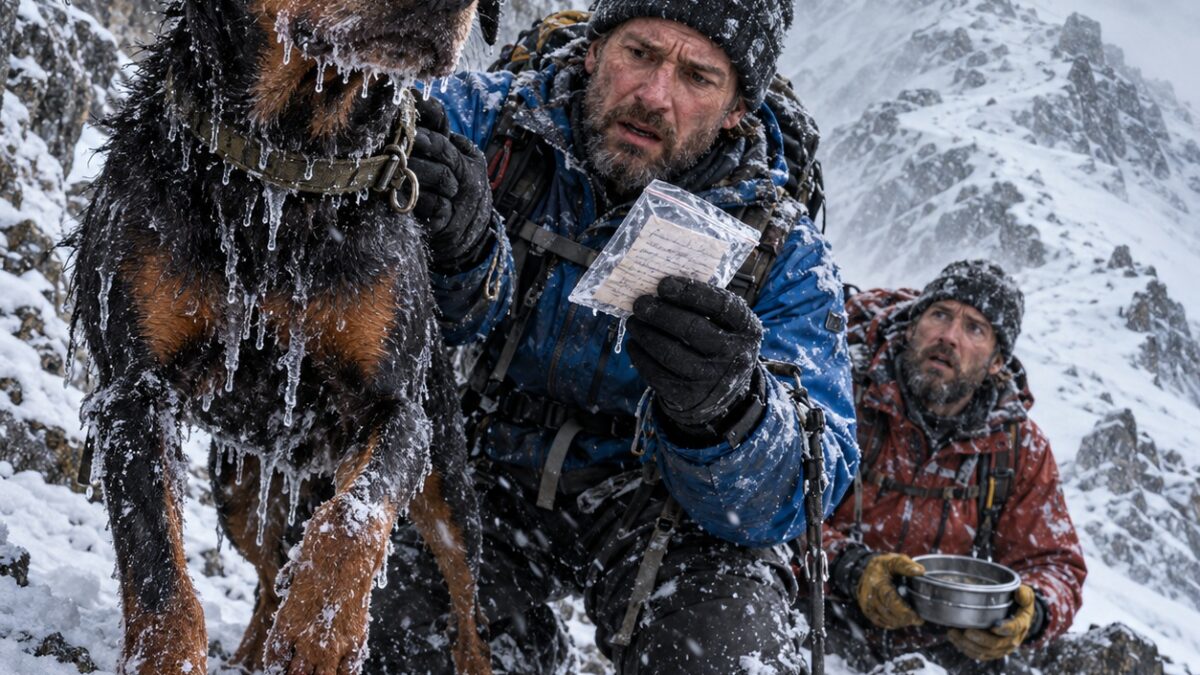
PART2
James reached for the satellite phone before I finished folding the letter.
Our regular phones had become mostly useless higher up.
The satellite unit was not perfect either.
Signal drifted.
Wind interfered.
But eventually the emergency line connected.
James turned away from the gusts and spoke with the clipped precision climbers use when emotion becomes dangerous.
“Injured climber. Male. Name Henry Whitfield.”
He looked at the note.
“Probable broken leg. East slope. Rocky terrain. We have his dog. Dog knows exact location.”
Pause.
“Storm intensifying.”
Another pause.
“No, we don’t have coordinates yet.”
He looked at me.
I was checking Rocky’s paws.
Cuts.
Raw pads.
One split nail.
“How far might he have traveled?” the voice asked through the speaker.
James looked at the Doberman.
“No way to know.”
Rocky’s breathing was still hard.
I offered food again.
He refused.
Water again.
This time he took a few laps.
Then raised his head.
Up the slope.
Always the slope.
I put one hand on his neck.
“Rocky.”
His ears moved.
Good.
Name recognized.
“Can you take us back?”
I felt foolish saying it.
Then Rocky stood.
He had been half-collapsed beside my pack.
Getting up required visible effort.
His hind legs shook.
For several seconds, he simply remained there gathering himself.
Then he turned uphill.
Took three steps.
Looked back.
James ended the emergency call.
“They’re sending ground rescue. Helicopter too if the wind allows it.”
“How long?”
“Unknown.”
Rocky took another step.
Looked back again.
I put the note in a waterproof pouch.
“All right.”
James stared uphill.
“You know what this means.”
“Yes.”
We had been descending because the storm was worsening.
Now we were going back into it.
Not because of summit fever.
Not because of ego.
Because somewhere above us a man with a broken leg had trusted a dog to become his distress signal.
That made the decision easy.
We turned around.
Rocky led.
The first ten minutes were manageable.
The route climbed steeply, but visibility remained good enough to track the trail.
Rocky did not move like a dog exploring.
No unnecessary sniffing.
No wandering.
No chasing scents.
He moved with purpose.
Then stopped.
Checked us.
Moved again.
At first, James and I stayed perhaps five yards behind.
As the grade increased, Rocky slowed.
His paws were hurting.
I could see it.
Sometimes he favored the injured front foot.
Then compensated.
His breathing became harsher.
“Rocky.”
He stopped.
I caught up.
“Rest.”
He looked toward the slope.
I knelt.
“You found us. We’re coming.”
He would not sit.
Would not lie down.
James handed me a strip of energy bar.
“Try this.”
Rocky sniffed.
Nothing.
“He won’t eat.”
“He thinks stopping is losing time.”
I looked at the dog.
Maybe.
We cannot know exactly what animals think.
But behavior can be unmistakable.
Rocky’s entire body said one thing.
Back.
Back to Henry.
I wrapped one paw quickly with gauze from my emergency kit.
Rocky tolerated it.
Then pulled away as soon as I finished.
He started uphill again.
James shook his head.
“That dog is going to walk until he drops.”
“Then we make sure Henry is found before he does.”
The storm thickened.
Snow started moving sideways.
Not falling.
Flying.
Wind struck exposed skin like handfuls of sand.
The trail disappeared under fresh accumulation.
My goggles iced around the edges.
James became a dark shape two yards ahead of me.
Rocky’s black body was sometimes easier to see against the white.
Other times he vanished completely behind curtains of blowing snow.
Every time that happened, my stomach tightened.
Then he reappeared.
Waiting.
Watching.
Making sure we followed.
The route was not one I would have chosen in deteriorating conditions.
Rocky cut away from the main trail.
Across a shallow ravine.
Then through a stand of wind-bent pines.
He stopped often to smell the snow.
Not the random exploratory sniffing of a pet.
Short.
Focused.
Then direction.
Left.
Right.
Forward.
At one point, James shouted:
“We sure he knows?”
Before I could answer, Rocky turned toward us.
Barked once.
The first sound he had made.
Then continued.
James laughed despite everything.
“I’ll take that as yes.”
We climbed.
My legs began burning.
Wind erased our footprints almost as soon as we made them.
That worried me.
Getting Henry out would be harder than getting in.
Then we heard something.
At first, I thought it was wind against rock.
Low.
Mechanical.
James stopped.
“Helicopter.”
I listened.
There.
Faint.
A rescue aircraft somewhere beyond the clouds.
We could not see it.
The sound came and went.
Radio traffic crackled through James’s unit.
The helicopter could not safely land in the gusts.
Ground teams were approaching from another side.
We were told to continue only if safe.
I looked at Rocky.
He had already continued.
“Safe is relative now,” I said.
James nodded.
We followed.
Rocky had lived with Henry for eight years.
I learned that later.
At the time, I knew nothing except the dog’s name and the man’s handwriting.
But there are relationships you can see without biography.
This was not a dog escaping a mountain.
He had escaped nothing.
He was returning.
That distinction stayed with me.
Rocky had run down through snow and ice until he found us.
His mission could have ended there.
He had delivered the note.
Humans had called rescue.
He could have collapsed.
Instead, when I said Henry’s name, Rocky stood.
Turned.
Climbed back into the storm.
He was not running away from danger.
He was returning to the person waiting inside it.
And he was bringing us.
About forty minutes into the ascent, lights appeared through the blowing snow.
At first, faint yellow points.
Then movement.
Three.
Four.
Five.
Headlamps.
Ground rescue.
They were climbing from the opposite approach.
James raised an arm.
“Here!”
One light turned.
Then the team reached us.
Four rescuers.
Heavy winter gear.
Medical pack.
Ropes.
Collapsible stretcher.
The lead rescuer was a thick-bearded man named Colin.
He saw Rocky first.
“That’s the dog?”
“Yes.”
“We got your call.”
He crouched briefly.
Rocky barely acknowledged him.
Colin looked at me.
“Location?”
“We don’t know. He does.”
Colin’s eyes went from me to Rocky.
“You’re serious?”
I handed him the note.
He read quickly.
Looked toward the dog again.
“Okay.”
Then:
“Helicopter can’t land yet. Wind’s too strong.”
Rocky stepped uphill.
Colin folded the note.
“Well.”
He looked at his team.
“Follow the dog.”
There are sentences you never expect to hear in a mountain rescue.
That was one.
But nobody laughed.
Rocky had already proved more reliable than our coordinates.
The terrain worsened.
Rocks pushed through deep snow.
Hidden gaps opened between them.
Every step required testing.
The rescuers moved efficiently.
Rocky moved slower.
Much slower.
His body was running out of reserve.
Sometimes he took ten steps.
Stopped.
Looked back.
Then ten more.
One of the rescuers offered to carry him.
The moment the man approached, Rocky moved forward.
“He won’t let us.”
“Not while Henry’s still up there.”
We tried giving him another small drink.
He took it.
No food.
Colin inspected the wrapped paw.
“He did all this twice?”
“Once down.”
“Now back.”
He stared at the dog.
“Unbelievable.”
Snow deepened near our knees in places.
The wind pushed hard enough that we leaned into it.
Visibility dropped again.
Rocky vanished behind one boulder.
We followed.
He stood on the other side.
Nose raised.
He sniffed the air.
Then changed direction sharply to the left.
The rescuers followed without question.
Rocky stopped again.
Whined.
Low.
Deep.
The same kind of sound I have heard dogs make at hospital doors.
James moved beside me.
“He smells him.”
Maybe.
Or heard him.
Or recognized the terrain.
Whatever the mechanism, something changed in Rocky.
His exhaustion remained.
But urgency sharpened.
He moved faster.
Thirty yards.
Then twenty.
Then stopped beside a rock wall.
We rounded it.
And there he was.
Henry Whitfield lay beneath a massive overhanging slab.
Exactly as the note described.
Eastern slope.
Rock shelter.
Wind weaker beneath it.
His back rested against stone.
One leg stretched at an unnatural angle beneath his pack and spare clothing.
Snow had blown partly over his boots.
He looked motionless.
“Henry!”
No response.
Rocky ran the final yards.
Not fast by healthy-dog standards.
But with everything he had left.
He pressed his nose against Henry’s cheek.
Whined.
Licked once.
Henry’s eyelids moved.
Then opened.
Barely.
His lips parted.
“Good dog.”
Those were the first words I heard Henry Whitfield say.
His voice was almost nothing.
“Good dog, Rocky.”
Rocky climbed close against him.
His whole body trembled.
Not from the storm anymore.
Relief.
At least that is what it looked like.
The rescue team moved immediately.
Colin knelt.
“Henry, my name’s Colin. Mountain rescue. Can you hear me?”
Henry’s eyes shifted.
“Yes.”
“How long have you been here?”
Henry tried to answer.
Could not immediately.
The rescuers checked him.
Pulse.
Breathing.
Temperature.
Circulation.
The broken leg.
Possible hypothermia.
One rescuer opened a medical blanket.
Another began warming measures.
They immobilized the leg carefully.
Henry groaned.
Rocky stood.
Moved toward them.
Colin said:
“It’s okay, buddy.”
Rocky sniffed each rescuer.
Then returned to Henry.
He lay down against his side.
Head on Henry’s chest.
Henry’s hand moved weakly.
Found the dog’s neck.
“Rocky okay?”
That was his first full question.
Not:
How bad is my leg?
Not:
How long was I here?
Not:
Am I going to die?
“Rocky okay?”
I knelt near him.
“He’s exhausted.”
Henry looked frightened.
“But he made it.”
I put my hand on Rocky’s back.
“He found us.”
Henry’s eyes filled.
“He came down?”
“Yes.”
“With the note?”
“Yes.”
His face crumpled.
Rocky raised his head.
Henry touched him.
“I knew you would.”
It was one of the quietest things anyone said that day.
And somehow one of the strongest.
The rescue team contacted command.
Patient located.
Alive.
Stable enough for controlled evacuation.
Suspected fractured leg.
Moderate hypothermia.
Helicopter still unable to land.
The overhang gave us temporary protection.
Wind screamed above the rock, but underneath it felt almost peaceful compared with the exposed slope.
Henry was wrapped in insulated covers.
Warm packs.
Oxygen.
His leg splinted.
We waited.
That was the strange part.
After all the urgency, waiting.
Rocky lay beside Henry.
Would not move.
A rescuer tried examining his paw.
Rocky resisted until Henry whispered:
“It’s okay.”
Then he allowed it.
Cuts.
Ice abrasion.
Exhaustion.
Nothing obviously broken.
The rescuer wrapped two more pads.
Offered food.
This time Rocky ate.
Only after Henry had been found.
I noticed.
So did James.
Neither of us said anything.
Sometimes behavior makes its own argument.
Henry eventually told us what happened.
In pieces.
Between warming checks.
He and Rocky had been climbing a familiar route.
Not attempting a summit push.
Just a mountain day.
They reached a rocky traverse.
A section gave way under Henry.
He fell.
Not far enough to kill him.
Far enough to destroy his leg.
When he stopped sliding, pain was immediate.
His phone had cracked.
The satellite communicator disappeared somewhere during the fall.
Radio damaged.
Henry tried standing once.
Could not.
The storm began building.
He dragged himself toward the overhang.
Rocky stayed.
For hours.
Henry said he first believed someone might pass.
Nobody did.
Weather worsened.
Temperature dropped.
Eventually, he understood.
“I couldn’t get out.”
He looked at Rocky.
“So I wrote.”
“How?”
“Notebook.”
His gloved fingers had been shaking.
That explained the handwriting.
“I put it under his collar.”
Henry swallowed.
“I told him to go.”
Rocky lifted his head at the sound of Henry’s voice.
“He wouldn’t.”
“What did you do?”
“Kept telling him.”
Henry smiled faintly.
“Pointed downhill.”
“How long?”
“I don’t know.”
Then:
“He finally left.”
I asked the question that had been bothering me.
“How did you know he’d find anyone?”
Henry looked at me.
“I didn’t.”
Silence.
“I knew if he stayed, we might both die.”
That sentence stripped away any romantic version.
Henry had not possessed certainty.
He had desperation.
A dog.
A piece of paper.
Hope.
That was all.
The wind did not weaken quickly.
We stayed beneath that rock longer than anyone wanted.
Rescuers monitored Henry.
Rocky slept in bursts.
Every time Henry shifted or groaned, the dog woke.
One eye.
Then both.
Check.
Settle.
James sat beside me.
“You ever seen anything like this?”
“No.”
“Me neither.”
I looked at Rocky.
“He came down through that.”
James followed my gaze toward the white wall outside.
“Then came back.”
“Yes.”
James shook his head.
“What makes a dog do that?”
I could have said training.
Bond.
Instinct.
Eight years together.
All true.
Instead:
“Henry.”
That was the answer.
Rocky did it because Henry was up there.
Sometimes the object of love explains the impossible action better than any technical term.
Hours later, radio traffic changed.
Wind dropping slightly.
Helicopter attempting closer approach.
Not a landing.
Hoist extraction near a more open section below.
That meant we still had to move Henry.
Rescuers secured him into the stretcher.
Rocky stood.
Henry reached for him.
“Come on, buddy.”
No leash.
No command needed.
The stretcher moved.
Rocky walked beside it.
Sometimes ahead.
Sometimes near Henry’s shoulder.
When terrain became difficult, one rescuer finally picked Rocky up.
This time he allowed it.
Maybe because Henry was visibly moving with us.
Maybe because his body had finally reached its limit.
The rescuer carried him twenty yards.
Rocky watched the stretcher constantly.
Then demanded to be put down by squirming.
Back beside Henry.
We descended.
Slow.
Methodical.
The helicopter’s sound grew louder.
Lights through snow.
Wind from rotors mixed with the storm.
A safe hoist zone had been identified.
Henry was prepared.
Rocky began whining again when rescuers moved the stretcher toward the aircraft team.
One medic said:
“The dog goes too.”
No debate.
They secured Rocky.
Henry reached out.
His hand rested against the dog’s head.
The stretcher rose.
Rocky beside him.
For one second, both hung against the white mountain.
Then disappeared toward the helicopter.
James and I watched.
The aircraft turned.
Vanished through cloud.
The mountain became suddenly quiet again.
Not truly quiet.
Wind still moved.
Snow still fell.
But the mission had left with them.
I felt ten pounds lighter.
Maybe twenty.
James exhaled.
“Well.”
I said:
“That happened.”
He laughed.
Then we started the long descent with the ground team.
I expected exhaustion to hit immediately.
It did not.
Adrenaline remained.
My legs hurt.
Shoulders hurt.
Hands numb.
But the feeling overriding all of it was relief.
Henry alive.
Rocky alive.
That seemed enough to carry us down.
One rescuer named Mara walked beside me.
“How did you find the note?”
“Under his collar.”
“He approached you?”
“Yes.”
“Directly?”
“Pretty much.”
“Then led you back?”
“Yes.”
She shook her head.
“I’ve worked search for fourteen years.”
“And?”
“Never had the victim send a dog with written instructions.”
I laughed.
“Efficient system.”
“Apparently.”
Then she became serious.
“You probably saved him.”
“Rocky did.”
“You called.”
“Rocky found us.”
“You followed.”
“He insisted.”
Mara smiled.
“Fine.”
She looked uphill.
“Team effort.”
That answer felt right.
Hero stories are usually cleaner than reality.
Rocky did the extraordinary part.
Henry made the decision to send him.
James had the satellite phone.
Rescue moved fast.
Helicopter crew risk-assessed correctly.
We followed.
A chain.
Break any link and the ending changes.
By the time we reached shelter below, the storm had started easing.
The mountain looked almost innocent again.
That annoyed me.
It always does.
Bad weather can turn terrain murderous.
Then an hour later sunlight arrives and everything looks picturesque enough for a postcard.
James checked his phone.
No normal signal yet.
Later that evening, once we were lower, the message came.
Henry stable.
Leg fracture serious but repairable.
No life-threatening hypothermia.
Rocky being treated for paw injuries and exhaustion.
The note from rescue ended:
Dog refusing separation from patient.
I laughed.
James looked at me.
“What?”
I showed him.
He read.
“Of course.”
Of course.
After everything Rocky had done to return to Henry, nobody was going to explain visitation policy to him.
The next morning, James messaged me before seven.
Henry stable. Surgery planned. Rocky beside bed.
Underneath:
Apparently hospital staff lost the argument.
I smiled for ten minutes.
Then I read Henry’s note again.
I had kept a photograph of it before giving the original to rescue.
The handwriting looked worse now that I knew how cold he had been.
One line stayed with me.
Rocky is my only hope.
People use that phrase casually.
Henry had meant it literally.
His entire survival plan had four legs.
Three weeks later, James and I visited.
Henry had undergone surgery.
Metal hardware.
Long recovery ahead.
He was sitting upright when we entered.
Leg elevated.
Rocky beside the bed.
Not lying on the floor.
Sitting.
As if still on duty.
He looked healthier.
Paws healed.
Coat clean.
Energy back.
When he saw us, his ears lifted.
Then his tail moved.
The first truly relaxed wag I had seen from him.
“Rocky.”
He stood.
Walked over.
Sniffed me.
Then James.
Accepted attention.
But after maybe twenty seconds, he returned to Henry.
Obviously.
Henry laughed.
“He appreciates you.”
“From a distance.”
“He has priorities.”
“I noticed.”
We sat.
Henry looked thinner than I expected.
But alive.
That was enough.
“I don’t know how to thank you.”
“You don’t.”
“I mean it.”
“So do I.”
I pointed toward Rocky.
“He did the work.”
Henry looked at his dog.
“He always has.”
We asked about Rocky.
How long together?
“Eight years.”
Henry had gotten him young.
Not as a formal service dog.
Not a mountain rescue dog.
Companion.
Hiking partner.
Everything partner.
They trained together extensively.
Recall.
Trail discipline.
Off-leash control.
Rocky knew Henry’s routines.
Knew his gear.
Knew the mountain.
“But he’d never done anything like this,” Henry said.
“Carry a note?”
“No.”
“Find people?”
“No.”
James asked:
“Then why were you so sure?”
Henry smiled.
“I wasn’t sure he’d understand the whole plan.”
He scratched Rocky’s chest.
“I was sure he wouldn’t stop trying.”
That answer stayed with me.
Henry did not believe Rocky understood rescue protocols.
He believed Rocky understood one thing.
Henry needed him.
Sometimes enough intelligence emerges from loyalty to bridge the rest.
Henry described the moment he sent Rocky.
It took three attempts.
First, Henry attached the note.
Pointed downhill.
“Go.”
Rocky stayed.
Henry shouted.
Rocky stayed.
Henry threw one of his gloves down the slope.
Rocky moved to retrieve it and came back.
Finally Henry crawled as far as he could from the rock.
Pointed toward the lower trail.
Used the command Rocky knew for returning to a trailhead.
“Car.”
That did it.
Rocky left.
Henry watched until snow swallowed him.
“What was that like?” I asked.
Henry’s face changed.
“Worst moment.”
“Why?”
“Because until he left, I wasn’t alone.”
Silence.
“But if I kept him there, I was choosing comfort over his chance to save us.”
He looked down.
“So I made him go.”
That was one of the hardest parts of the story.
Rocky’s loyalty required leaving.
Henry’s love required sending him away.
Both acted against what they wanted in order to give the other a chance.
Henry said he did not know how long Rocky was gone.
Cold distorts time.
Pain worse.
Sometimes he thought ten minutes had passed.
Sometimes hours.
He drifted in and out.
He remembered talking to himself.
Then to Rocky even though Rocky was no longer there.
“Good boy.”
“Find someone.”
“Go.”
At one point Henry believed the dog might not come back.
That thought terrified him.
Not because it meant no rescue.
Because he imagined Rocky lost in the storm.
“I regretted sending him.”
Henry’s voice broke slightly.
“Then I thought, if he gets down, at least he lives.”
He swallowed.
“That became enough.”
Then Rocky came back.
Not alone.
With us.
“When I heard him,” Henry said, “I thought I was hallucinating.”
“The whine?”
“Yes.”
“Then he touched my face.”
Henry looked at me.
“I knew.”
He did not need to finish.
Knew he had succeeded.
Knew Rocky had.
Knew he was no longer alone.
James asked:
“What was the first thing you remember clearly?”
Henry smiled.
“His nose was freezing.”
We laughed.
“Right on my cheek.”
Rocky looked unconcerned.
Then Henry said:
“And voices.”
“Ours?”
“I don’t know whose.”
“Rescue?”
“Maybe.”
He stared at Rocky.
“But I knew if he was back, somebody had followed.”
That was the trust between them.
Not blind trust.
History.
Eight years of repetition.
Henry calls.
Rocky comes.
Rocky watches.
Henry responds.
Trails.
Meals.
Home.
Thousands of ordinary interactions becoming enough evidence for one extraordinary gamble.
Trust is rarely built during the crisis.
Crisis only reveals how much was built beforehand.
Henry’s recovery took months.
We stayed in contact.
Not constantly.
Enough.
Photos arrived.
Rocky beside physical therapy equipment.
Rocky lying beneath Henry’s walker.
Rocky in the passenger seat.
Rocky apparently supervising medication.
One message:
He hates the walker. Thinks it’s trying to attack me.
Another:
First outdoor walk today. Fifty yards. Rocky behaved like we summited Everest.
I liked that.
Recovery is its own mountain.
Different terrain.
Same patience.
Henry did not return to serious climbing immediately.
Obviously.
When he eventually did, it started small.
Flat trails.
Then hills.
Rocky came.
Always.
But Henry changed his systems.
Redundant communication.
Emergency beacon physically tethered to him.
Backup locator.
Different risk limits in unstable weather.
No solo rocky traverse in questionable conditions.
He told me:
“I already used up my miracle.”
Fair.
About a year later, the four of us—Henry, Rocky, James, and I—returned to a lower section of the same mountain.
Not the accident site.
Henry was not ready for that.
Maybe never.
We stopped at an overlook.
Clear weather.
Blue sky.
Rocky stood near Henry.
Healthy.
Alert.
No snow packed into wounds.
No note under the collar.
I looked at the dog.
“You look better.”
Henry said:
“He prefers this weather.”
“Smart.”
James pulled out a folded sheet of paper.
“What’s that?”
“A note.”
Henry stared.
James read dramatically:
“If you are reading this, Daniel forgot lunch.”
I threw snow at him.
There was almost none.
Rocky tried catching it.
Henry laughed.
That laugh felt important.
Trauma does not disappear because the ending was good.
Returning gently gives memory another layer.
Now the mountain held more than the accident.
It held recovery too.
People later called Rocky heroic.
I understand why.
I use the word too.
But sometimes heroic stories flatten the animal into one act.
Rocky was more than the dog who carried a note.
Henry told us that he hated baths.
Loved scrambled eggs.
Refused to sleep anywhere except within five feet of Henry.
Barked at vacuum cleaners.
Was suspicious of umbrellas.
Could distinguish Henry’s truck from every similar engine.
Stole socks but never damaged them.
Ordinary traits.
That mattered to me.
Heroism is more moving when it belongs to an ordinary life.
Rocky was not born waiting for one dramatic rescue.
He was a dog who spent eight years becoming attached to one person.
Then, when one terrible day demanded everything that bond had built, he gave everything.
I was asked once whether Rocky “understood the note.”
No.
Probably not.
That is not the miracle.
He did not need literacy.
Henry used the note for humans.
Rocky’s job was simpler and harder.
Get down.
Find someone.
Return.
The paper bridged species.
Rocky delivered the human message.
His behavior delivered the rest.
He refused food.
Looked uphill.
Stood despite exhaustion.
Led.
Checked.
Returned.
No translation required.
The rescue service eventually used the story in one of its safety talks.
Not as:
Send your dog for help.
Absolutely not.
As a reminder about communication redundancy.
Tell people your route.
Carry backup location equipment.
Do not rely on luck.
Henry agreed.
He never romanticized his own decisions.
“I made mistakes.”
That impressed me.
It is easy to turn survival into proof that everything you did was reasonable.
Henry did not.
He said:
“I got lucky.”
Then looked at Rocky.
“Very lucky.”
The mountain changed me too.
Before Rocky, I thought of hope as something internal.
A mental state.
A feeling that things might improve.
Afterward, I started thinking of hope as behavior.
Sometimes hope is writing a note with shaking hands.
Sometimes it is attaching that note to a collar.
Sometimes it is telling the creature you most want beside you to leave.
Sometimes it is a dog running downhill into a storm.
Sometimes it is two climbers deciding to turn back uphill.
Hope is often motion before certainty.
That is what Rocky showed me.
There was one part of the rescue I dreamed about afterward.
Not Henry.
Rocky.
I dreamed I was standing on the mountain.
Rocky farther uphill.
He looked back.
I could not move.
Snow between us.
Then he disappeared.
I would wake tense.
It took me a while to understand why.
The entire rescue depended on following.
What if we had decided the storm was too dangerous?
What if we assumed Rocky was simply lost?
What if I never felt under the collar?
What if the note got wet?
The chain was fragile.
That scared me.
Eventually, fear became gratitude instead.
We did notice.
We did check.
The phone worked.
Rescue responded.
Rocky remembered.
Henry survived.
Sometimes the correct response to a near miss is not endless horror at what could have happened.
It is respect for what did.
James and I still climb together.
Our routines changed.
We check equipment almost annoyingly.
Satellite phone.
Beacon.
Backup battery.
Route plan.
Weather.
Someone on the ground knows where we are.
James once said:
“Rocky made you paranoid.”
I said:
“Rocky made me educated.”
He laughed.
Probably both.
Years later, I visited Henry again.
Not hospital.
His house.
Rocky was older.
Gray beginning around his muzzle.
Still greeted me.
Still returned immediately to Henry.
They had a framed copy of the note on the wall.
I was surprised.
“You framed it?”
Henry nodded.
“Original?”
“No. Rescue kept the original for records. Copy.”
I read it again.
Same uneven letters.
Same final plea.
He will lead you to me.
I looked at Henry.
“You really believed that.”
“Yes.”
“Why?”
He thought.
Then:
“Because every day for eight years, when I needed him to come back, he came back.”
There it was again.
Extraordinary trust built from ordinary repetition.
Rocky became slower in his later years.
Henry adjusted.
Shorter walks.
No difficult climbs.
Warm bed.
Joint supplements.
Veterinary visits.
The mountain dog became a porch dog.
I once asked if Henry missed the old adventures.
He said:
“Not really.”
Rocky slept nearby.
“We’ve done enough.”
I understood.
There comes a time when love stops asking a body to prove what it once could do.
Rocky had nothing left to prove.
Henry kept the collar.
Same one.
The one that carried the note.
He changed the hardware.
Added identification.
But kept it.
Sometimes people asked why he did not retire it.
Henry said:
“Because he likes it.”
Maybe.
I think Henry liked seeing it.
A reminder.
Not of the accident exactly.
Of the impossible message that reached someone.
Rocky eventually died years later.
Old age.
At home.
Henry told me by phone.
I was silent a long time.
“What happened?”
“He slept.”
That was enough.
“Were you there?”
“Of course.”
Of course.
Henry’s voice broke.
“He spent his whole life making sure I wasn’t alone.”
I swallowed.
“And you made sure he wasn’t.”
Silence.
Then Henry said:
“Good dog.”
Same words he had whispered under the rock.
The first words after rescue.
The final words before goodbye.
Some relationships find their sentence and keep it.
After Rocky died, Henry donated to the mountain rescue team in his name.
Not a giant public gesture.
Equipment fund.
Emergency beacons for volunteer teams.
A small plaque in the station.
ROCKY — HE KNEW THE WAY HOME.
I saw it once.
Had to step outside afterward.
Not because the plaque was sad.
Because I remembered the dog half-collapsed in snow refusing food.
Staring uphill.
Waiting for us to understand.
Henry and I stayed friends.
James too.
Every year around the anniversary, one of us sends a message.
Usually short.
James once wrote:
Still following dogs?
I replied:
Only the ones carrying paperwork.
Henry sent a laughing emoji.
Life continuing.
That matters.
A survival story should contain life after survival.
Otherwise the accident becomes bigger than everything that followed.
Henry recovered.
Walked.
Laughed.
Aged.
Loved Rocky for years after.
That is the real success.
I still climb.
Not as fast as I once did.
Age has opinions.
Knees too.
But whenever I move into bad weather, Rocky comes back to me.
Not literally.
Memory.
A black shape against white snow.
Pausing.
Looking over his shoulder.
Asking:
Are you still there?
Yes.
Keep going.
Sometimes memory becomes instruction.
I have met dogs on trails since.
Friendly ones.
Lost ones.
Working dogs.
None made me panic.
But I always look at collars now.
James laughs about that.
“Check for mail?”
“Absolutely.”
Because one folded note changed everything.
People ask what the most incredible part was.
The note?
Yes.
The distance Rocky traveled?
Yes.
Finding us in weather?
Yes.
Returning?
Maybe.
But the part I think about most is that he refused to eat.
He was exhausted.
Bleeding paws.
Cold.
Hungry.
Food directly in front of him.
And he looked uphill.
That behavior told the story before we read the paper.
His body had one priority.
Henry.
Everything else could wait.
That level of focus is almost frightening.
Beautiful too.
I do not believe dogs are morally superior beings.
That kind of romanticizing does them no favors.
Dogs have instincts.
Needs.
Fear.
Behavior.
Training.
But humans have spent thousands of years building lives beside them.
That history matters.
Rocky knew Henry’s voice.
Scent.
Movements.
Commands.
Routine.
Henry knew Rocky’s signals.
The rescue was not magic appearing from nowhere.
It was relationship expressed under extreme pressure.
And perhaps that is more impressive than magic.
Magic asks nothing of us.
Relationships are built.
Day after day.
One afternoon, Henry told me something I had never known.
The night before the climb, Rocky had refused to settle.
Paced.
Henry joked that maybe the dog knew weather was coming.
“Do you think he did?” I asked.
Henry shrugged.
“Probably heard wind.”
“Why go then?”
“Forecast wasn’t bad.”
He looked embarrassed.
“Then it changed.”
Mountains again.
Indifferent to forecasts.
Henry said:
“I wish I had listened.”
“To Rocky?”
“To caution.”
That distinction mattered.
We often turn survival stories into intuition myths.
The practical lesson was simpler.
Conditions change.
Turn around earlier.
Carry backups.
Do not assume experience controls environment.
Rocky saved him after the accident.
Better decisions might have prevented the need.
Both truths can coexist.
The first time I told the story publicly, I made a mistake.
I said Rocky “knew rescuers would understand the note.”
Afterward, it bothered me.
We do not know that.
He knew Henry sent him.
He knew how to return.
Maybe that was all.
So I tell it more carefully now.
The beauty does not require mind-reading.
Facts are enough.
Henry wrote.
Attached.
Commanded Rocky downhill.
Rocky found us.
We found the note.
Rocky led us back.
Rescue found Henry.
Fact.
Sometimes reality already contains enough wonder.
No need to decorate it.
That has become a broader principle in my life.
When something is extraordinary, do not make it less credible by exaggerating.
Rocky does not need me to say he understood every word.
He did something remarkable as a dog.
That is enough.
Henry does not need to be a perfect climber.
He made errors.
That makes survival more useful as a lesson.
We do not need a villain.
The mountain was enough.
Weather was enough.
Chance was enough.
The heroism came from response.
One winter, years after Rocky, James and I climbed a lower route during light snow.
Not dangerous.
Beautiful.
At a rest point, a family passed with a Doberman.
Young.
Energetic.
The dog looked at us.
James said:
“Don’t.”
“What?”
“Do not search his collar.”
I laughed.
The owner looked confused.
We explained briefly.
He had heard the story.
“Rocky?”
“Yes.”
He smiled.
“Mountain rescue dog?”
“Not officially.”
“Better story that way.”
Maybe.
Rocky never needed a title.
He had Henry.
That was enough job description.
Henry eventually stopped climbing altogether.
Age.
Leg never fully the same.
He said he did not resent it.
“I got the bonus years.”
That phrase stayed.
Bonus years.
Everything after the mountain could have been absent.
Instead:
Recovery.
Rocky aging.
Friends.
Walks.
Meals.
Sun.
Ordinary mornings.
That is what rescue creates.
Not just survival in the dramatic moment.
Access to ordinary time.
I visited Henry once after Rocky was gone.
The house felt different.
Dog bed still in the corner.
Empty.
Henry had not moved it.
I did not comment.
We drank coffee.
He showed me photographs.
Rocky young.
Rocky on first hike.
Rocky asleep in a tent.
Rocky beside his hospital bed.
Rocky gray.
Rocky sleeping in sun.
Henry said:
“Everyone wants the storm picture.”
“Do you have one?”
“No.”
“Good.”
He pointed to Rocky asleep on the porch.
“That’s my favorite.”
“Why?”
“Because nothing was happening.”
Exactly.
The best outcome of rescue is often boring life afterward.
Eventually Henry adopted another dog.
Not a Doberman.
Senior mixed breed.
Shelter dog.
Name Sam.
Henry wrote:
Rocky would have hated him.
I replied:
Then it’s perfect.
Sam was lazy.
Hated hiking.
Loved couches.
Henry adapted.
Different dog.
Different chapter.
No replacement.
That concept matters.
Love after loss does not have to imitate.
Rocky’s legacy was not another Rocky.
It was Henry remaining open enough to care again.
I think often about the phrase:
He knows the way.
Henry wrote it about geography.
Rocky knew how to return to the overhang.
But over time, those words gained another meaning for me.
Dogs know certain paths humans complicate.
Toward the person.
Stay near.
Leave if help is needed.
Return.
Do not waste energy asking whether love is efficient.
Move.
There is wisdom in simplicity.
Not complete wisdom.
But some.
The mountain itself became symbolic to people who heard the story.
I resist that.
It was a mountain.
Rock.
Snow.
Wind.
It did not test Henry intentionally.
Storms do not “lose.”
Mountains do not punish.
Nature is not a moral character.
That matters because people often say:
“Rocky defeated the mountain.”
No.
Rocky survived conditions.
Rescuers worked within them.
The helicopter waited because wind mattered.
Humility kept people alive.
That is a better story.
What Rocky defeated, if anything, was isolation.
Henry was alone.
Injured.
No communication.
Rocky transformed isolation into connection.
A note reached us.
A call reached rescue.
Rescue reached Henry.
That chain is the opposite of isolation.
Maybe that is why the story moves people.
Fear becomes survivable the moment someone else knows where you are.
Rocky made someone know.
I still have my copy of Henry’s letter.
Protected.
Folded inside my climbing journal.
I do not take it on every trip.
But I know where it is.
Sometimes I read it.
The handwriting.
The desperation.
The confidence in Rocky.
I always stop at:
He will lead you to me.
Not:
He might.
He will.
Henry had one certainty inside a world that had become uncertain.
His dog would try.
Maybe certainty does not need guaranteed success.
Maybe it only needs trust in effort.
On difficult climbs, when fatigue makes the summit or descent feel farther than it is, I remember Rocky’s pauses.
Five steps.
Stop.
Look back.
Ten steps.
Stop.
Look back.
He did not move fast.
He moved enough.
That is often what endurance is.
Not heroic speed.
Continuing while exhausted.
I am still a climber.
I still love high places.
I still respect fear.
More now.
Whenever wind changes sharply, I listen.
Whenever weather turns, I ask the boring question:
Do we need to go back?
Boring questions save lives.
Rocky taught me that courage does not mean refusing retreat.
Henry survived partly because Rocky retreated from him to get help.
Direction alone does not define bravery.
Purpose does.
The story people tell is:
A Doberman appeared.
A note was found.
A man was rescued.
True.
But inside that simple version are dozens of acts.
Henry writing while injured.
Henry sending Rocky away.
Rocky descending.
Rocky finding us.
Us checking the collar.
James making the call.
Rocky returning.
Rescue climbing.
Helicopter waiting for safer wind instead of forcing a landing.
Medical care.
Every link humble.
Necessary.
When people want a single hero, I say:
Rocky.
Fine.
He earned it.
But Rocky’s greatest gift may have been creating a team out of strangers.
I once asked Colin, the bearded rescuer, what he remembered most.
He answered immediately.
“The dog wouldn’t stop looking at the stretcher.”
Not weather.
Not broken leg.
Not helicopter.
Rocky watching Henry.
Colin said:
“I’ve worked a lot of rescues. Family members panic. Friends panic. That dog just stayed locked in.”
“He tried getting into the ambulance equivalent.”
“Of course.”
Colin smiled.
“Good dog.”
Again.
Always those words.
There is something perfect about the fact that Henry’s first words after we found him were not a speech.
Not:
You saved me.
Not:
Thank God.
Just:
“Good dog.”
That was their relationship reduced to its essential language.
Rocky did the impossible.
Henry praised him the same way he probably had after a thousand ordinary recalls.
Good dog.
Consistency.
Love hidden inside familiar words.
When Rocky died, Henry told me he said the same thing.
I cannot improve on that.
The story began before I met them.
Ended long after the mountain.
My part was short.
Follow.
Call.
Witness.
Sometimes you enter another person’s story only for one chapter.
It can still change you.
Today, when I climb, I carry redundant communication.
Emergency beacon.
Satellite device.
Paper route plan.
And, because James will never stop making jokes, he once gave me a dog collar with a tiny waterproof note pouch.
I do not own a dog.
I kept it anyway.
Inside, James had written:
If found, Daniel is probably making poor choices.
I laughed for a week.
Then placed it in my gear room.
Humor is one way memory becomes bearable.
There are storms I have climbed through since that day.
None felt the same.
Maybe because no dark shape appeared in the snow asking me to follow.
But every storm carries Rocky’s outline somewhere in my mind.
Black coat.
White snow.
Blood on paw.
Turning uphill.
He had already done the hardest thing.
Found us.
Then, despite exhaustion, he did not rest.
Because Henry was still waiting.
That is what I will remember when everything else fades.
Not the helicopter.
Not even the letter.
The moment after I said:
“Lead us.”
Rocky stood.
His legs shook.
Snow covered his back.
He looked toward the mountain.
Then at me.
Then began walking.
No hesitation left.
No question about whether the path was difficult.
No calculation about what he had already endured.
His person was up there.
That was enough.
If hope has a shape in my memory, it is not bright.
It is black and rust.
Thin with exhaustion.
Snow frozen to its chest.
One paw bleeding.
A folded note under its collar.
Hope does not always arrive strong.
Sometimes it arrives barely able to stand.
That does not make it less powerful.
Sometimes the thing that saves you is exhausted too.
It simply keeps moving.
Years later, when Henry and I talked about the mountain one last time before his health began failing with age, I asked:
“What did you think when Rocky disappeared?”
Henry said:
“That I had sent my best friend into a storm.”
“And when he came back?”
Henry smiled.
“That he brought the world with him.”
I have never heard a better description.
Rocky came back with two climbers.
Then rescuers.
Then an aircraft.
Medical care.
Life.
The whole human system Henry could not reach by himself.
A dog carried the thread from one isolated man to everyone else.
Brought the world with him.
That is why I still tell this story.
Not because I want people to take dogs into dangerous places as emergency equipment.
Do not.
Not because I think loyalty makes preparation unnecessary.
It does not.
Prepare better.
Carry backups.
Respect weather.
Turn around.
Tell people your route.
I tell it because sometimes we need reminders of what commitment looks like when comfort disappears.
Rocky was tired.
He moved.
Henry was terrified.
He sent Rocky anyway.
James and I were descending.
We turned around.
Rescuers could not land.
They climbed.
Every person and animal in that chain did the next necessary thing.
That is how Henry survived.
My name is Daniel Carter.
I am still a climber.
I still look at weather differently after Rocky.
I still check collars when I see a lone dog farther up a trail than expected.
James still makes fun of me.
Henry walked again.
Not perfectly.
Enough.
Rocky spent years beside him afterward.
He grew old.
He died at home.
Loved.
The note is now part of mountain rescue history.
But that is not the ending I hold closest.
The ending I love happened three weeks after the storm.
Hospital room.
Henry sitting up.
Rocky beside the bed.
No snow.
No blood.
No wind.
Nothing dramatic.
I walked in.
Rocky lifted his head.
Tail wagged.
Then he looked back at Henry.
Exactly where he wanted to be.
Henry reached down.
Rested a hand on his dog.
And smiled.
That was the whole rescue reduced to one ordinary image.
A man alive.
A dog beside him.
Time returned.
Everything else was just the path that got them there.
Sometimes hope arrives in a helicopter.
Sometimes it comes through a radio.
And sometimes it appears out of a whiteout on four bleeding paws, carrying a handwritten message beneath its collar and refusing to rest until someone agrees to follow.
Rocky did not know whether the storm was too strong.
He did not know whether we were experienced climbers.
He did not know whether the helicopter could fly.
He did not know what a rescue team was.
He knew Henry was waiting.
So he kept going.
Down the mountain.
Until he found us.
Then back up.
Until we found Henry.
And all these years later, whenever the wind rises around me and the trail disappears into snow, I still see that Doberman turning his head to make sure we were behind him.
Still leading.
Still refusing to quit.
Still carrying one man’s hope through a storm that almost buried it.
And I remember the lesson no climbing manual ever taught me:
Sometimes survival begins with one exhausted heart believing that someone, somewhere, will understand the message.
Rocky believed.
We followed.
Henry lived.
And that is the story I will carry for the rest of my life.




