PART2:She Was 12, Her Joints Hurt, and Everyone Passed Her By—Then an Old Widower Stopped and Said, “So Do Mine”
PART2
He did not approach immediately.
That was the first thing I noticed.
Most people who are interested in a dog close the distance quickly.
They kneel.
Call.
Snap fingers.
Offer a hand.
This man simply stood there.
His shoulders were slightly rounded beneath his jacket.
His hands rested in his pockets.
He looked at Bella.
Bella looked back.
Neither seemed interested in performing for the other.
I stood.
“Hi.”
He nodded.
“Hello.”
“Are you looking to adopt?”
He glanced toward the other dogs.
“I think so.”
That answer was unusual.
People usually say yes.
Or no.
Not:
I think so.
He looked at Bella again.
“How old?”
“Twelve.”
He nodded.
No surprise.
No immediate disappointment.
I continued because I had learned never to let emotion hide practical truth.
“She has arthritis.”
“Where?”
“Both hips. One front leg bothers her sometimes.”
He took one slow step closer.
“She walks?”
“Yes.”
“How far?”
“Depends on the day.”
He nodded again.
“She needs medication. Probably long term.”
No reaction.
“She’ll need regular vet monitoring.”
Still listening.
“She should avoid lots of stairs.”
He looked at Bella.
“If you’re hoping for hiking, jogging, fetch in the park…”
I let the sentence finish itself.
The man gave a faint smile.
“I’m not much of a runner.”
“I want to make sure you understand.”
“I do.”
“She may need help getting into a car.”
He nodded.
“Okay.”
“She sleeps a lot.”
“So do I.”
That made me smile.
Bella still had not moved.
I said:
“She’s sweet, but she’s been through a lot.”
The man slowly lowered himself into a crouch.
I heard his knees crack.
Loudly.
He winced.
Then laughed quietly.
“There.”
He looked at Bella.
“I walk slowly too.”
Something tightened in my throat.
It was such a simple sentence.
Not:
I don’t mind.
Not:
I can handle it.
He had placed himself beside her instead of above her.
I walk slowly too.
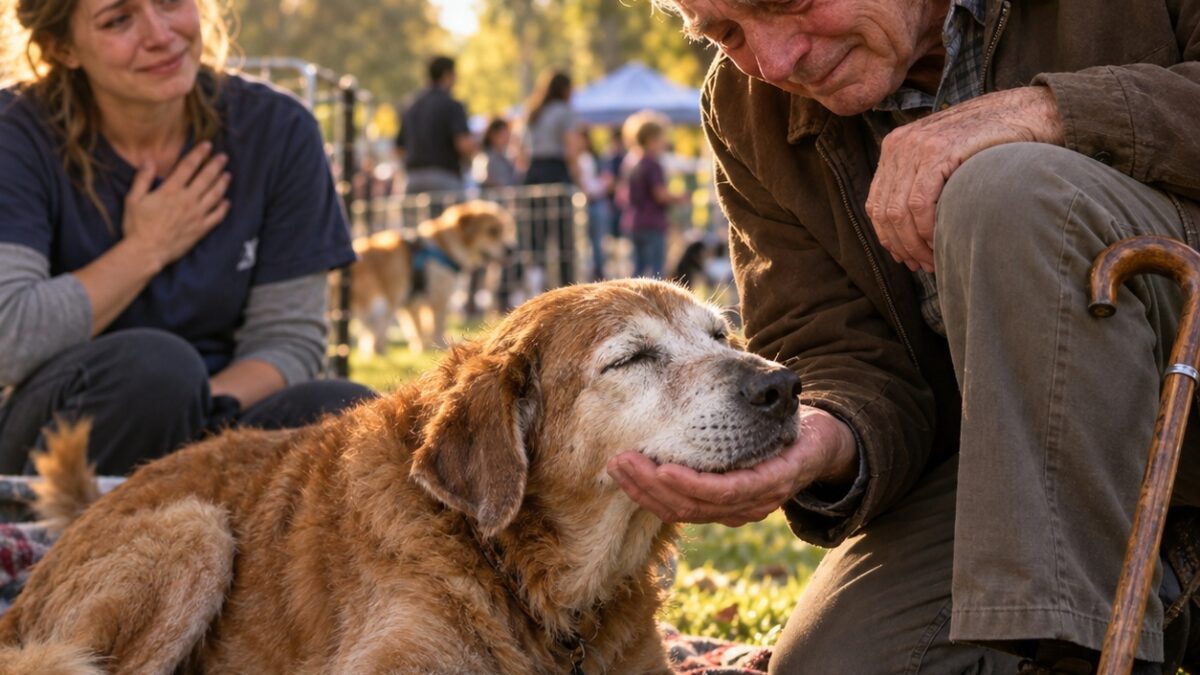
He extended one hand.
Palm open.
Low.
Bella watched.
Did not move.
He waited.
Ten seconds.
Twenty.
He did not call her.
Did not lean closer.
Just waited.
Finally Bella lifted her head.
Her front legs shifted.
She pushed herself into a sitting position.
Slow.
Painfully slow.
The man kept his hand where it was.
Bella sniffed from a distance.
Then took one step.
Stopped.
Another.
Her gray muzzle touched his fingers.
The man breathed in sharply.
I heard it.
Bella sniffed.
Then did something I had never seen her do at an adoption event.
She closed her eyes.
And leaned.
Not hard.
Not dramatically.
She simply lowered her head until the side of her face rested inside his palm.
The man froze.
His other hand came out of his pocket.
He touched her gently behind one ear.
Bella leaned farther.
Her tail moved.
One small sweep across the grass.
Then another.
That tail had been still all day.
I looked away for a second because my eyes were filling.
The man kept his hand against Bella’s head.
“My wife wanted a dog.”
His voice had changed.
Quieter.
I waited.
“We always said later.”
He continued petting Bella.
“Work was busy.”
Another small tail movement.
“We traveled.”
He smiled sadly.
“There was always something.”
Bella opened her eyes.
The man looked at her.
“We would say, ‘One day.’”
His hand stopped moving.
“Then one day wasn’t available anymore.”
I understood.
Not everything.
Enough.
“I’m sorry.”
He nodded.
“My wife died eleven months ago.”
Bella shifted closer.
The man seemed surprised by it.
He continued.
“This morning I woke up and the house was…”
He searched.
“Too quiet.”
I knew that phrase.
People use it often after loss.
Too quiet.
Not simply silent.
A silence with weight.
He said:
“I thought I should get a dog.”
I smiled.
“That’s why you came?”
“Yes.”
“What kind were you thinking?”
His laugh was almost embarrassed.
“Young.”
I glanced toward the puppies.
“Of course.”
“Something energetic.”
“Of course.”
“To force me out of the house.”
He looked back at Bella.
“Something to fill it with noise.”
Bella’s eyes were half closed beneath his hand.
The man whispered:
“But I think I was looking for the wrong thing.”
I said nothing.
He continued.
“I don’t need something to make the house loud.”
He scratched gently beneath Bella’s chin.
“I think I need somebody who understands quiet.”
That was when I knew.
Not because I believed every emotional adoption should happen.
Sometimes emotion is exactly why an adoption should not happen.
Grief can make people impulsive.
Loneliness can make people promise more than they can provide.
I still needed to ask questions.
Home.
Schedule.
Financial capacity.
Veterinary care.
Backup plans.
But something important had happened before any paperwork.
Recognition.
The man was not looking at Bella and seeing an old dog he was willing to tolerate.
He was seeing a life that moved at his speed.
A life that did not require him to become the person he had been before his wife died.
Bella was looking at him with something I had not seen all day.
Hope.
Small.
Cautious.
Almost frightened of itself.
The man looked at me.
“What’s her name?”
“Bella.”
He repeated it.
“Bella.”
His face changed.
“My wife liked that name.”
I smiled.
“Really?”
“She used to say it sounded like music.”
He turned toward Bella.
“Bella.”
Her tail moved.
The man swallowed.
Then stood slowly.
Painfully.
Bella watched him.
He said:
“I want to take her home.”
His name was Arthur Collins.
Seventy-one years old.
Retired civil engineer.
Widower.
Owned his home.
One level except for two steps at the front entrance.
Fenced backyard.
No other pets.
Adult daughter lived forty minutes away.
His wife’s name had been Margaret.
They had been married forty-six years.
I learned all of that at the folding adoption table.
Arthur filled out the application in careful handwriting.
Not rushed.
Every answer considered.
I asked:
“Who will care for Bella if you become ill?”
“My daughter.”
“Have you asked her?”
“No.”
“That’s important.”
He immediately took out his phone.
Called.
I could hear only his side.
“Hi, sweetheart.”
Pause.
“No, I’m fine.”
Pause.
“I’m at the animal shelter event.”
Longer pause.
His daughter apparently had questions.
Arthur looked at me.
“How much does Bella weigh?”
I told him.
He repeated it.
“She’s twelve.”
Another pause.
“Yes, I know that’s old.”
He smiled.
“No, I did not get a puppy.”
He looked down at Bella.
“Changed my mind.”
He listened.
Then his face softened.
“Would you take her if something happened to me?”
Silence.
His eyes filled slightly.
“Thank you.”
He ended the call.
“She said yes.”
I nodded.
“Good.”
Then medication.
Vet estimates.
Food.
Possible mobility support later.
Arthur asked questions.
Good ones.
“What signs mean the medication needs adjustment?”
“How do I know whether a walk is too long?”
“Should I put rugs on hardwood?”
“Yes.”
“Ramp for the car?”
Probably useful.
“What kind of bed?”
I showed him.
He wrote everything down.
Most adopters ask what a dog already knows.
Sit?
Stay?
House-trained?
Arthur asked:
“What hurts her?”
That was different.
I told him Bella sometimes struggled after lying down for hours.
“She may need a minute before walking.”
“So I give her a minute.”
“She might have accidents if pain makes it hard to get outside quickly.”
“So I clean them.”
“She may become less mobile over time.”
“I’m becoming less mobile over time.”
I looked at him.
He shrugged.
“Seems fair.”
Then I said the hardest part.
“You understand that with a twelve-year-old dog…”
Arthur looked at me.
“I may lose her.”
“Yes.”
“Sooner than I’d like.”
“Yes.”
He looked at Bella.
She was lying beside his chair now.
Head nearly touching his shoe.
Arthur was quiet for a long time.
Then:
“I lost Margaret after forty-six years.”
I did not interrupt.
“If you’re asking whether I know that loving something does not guarantee enough time…”
His eyes met mine.
“I know.”
That answer ended the question.
Not the risk.
The question.
He understood.
The paperwork took nearly an hour.
Bella remained beside him.
When I walked away to copy something, she watched me.
Then looked at Arthur.
When I came back, Arthur was telling her about his house.
Not joking.
Actually describing it.
“There’s a window in the living room that gets sun in the afternoon.”
Bella listened.
“Margaret used to sit there.”
He paused.
“You can have that spot if you want.”
Bella’s tail moved.
I pretended to organize papers.
Arthur continued.
“Backyard’s not exciting.”
Tail.
“Couple squirrels.”
More tail.
“Very disrespectful squirrels.”
I laughed.
Arthur looked up.
“What?”
“Nothing.”
“Bella needs to know.”
“Of course.”
When everything was complete, I handed him the leash.
That is always the moment.
Paper becomes reality.
The dog is no longer ours.
The adopter becomes responsible for the next chapter.
Arthur took the leash.
Then looked at Bella.
“So, Bella.”
Her ears moved.
“You ready to go home?”
Bella pushed herself up.
It was difficult.
Her back legs had stiffened after sitting so long.
Arthur did not pull.
He waited.
Bella stood.
One step.
Stopped.
She looked at me.
I crouched.
My throat tightened again.
“Go on.”
Bella stayed.
“You waited long enough.”
I touched her head.
“Go home.”
Bella turned toward Arthur.
He began walking.
Slowly.
Exactly her pace.
That mattered.
He did not shorten the leash and ask her body to match his.
He shortened his steps and matched hers.
Two old creatures leaving together.
No hurry.
No performance.
Just a walk across grass.
I watched them reach the parking lot.
Arthur opened the passenger door.
Bella stopped.
Too high.
Arthur immediately understood.
He placed the leash down.
Bent carefully.
One arm beneath her chest.
One beneath her hindquarters.
He lifted.
His face showed effort.
Bella went stiff for half a second.
Then relaxed.
Arthur placed her on the seat as though putting down something fragile.
He adjusted the blanket.
Closed the door.
Walked around.
Before getting in, he looked back at me.
Raised one hand.
I waved.
The car left.
I stood in the parking lot after it disappeared.
All day, people had passed Bella.
Children.
Couples.
Families.
Young adults.
People who wanted years.
Energy.
Adventure.
Then a seventy-one-year-old widower had arrived expecting to adopt the exact opposite of her.
And somehow Bella had been exactly what he needed.
The next morning, my phone buzzed before eight.
Unknown number.
Photo message.
Bella.
She was lying on an old green sofa.
A wool blanket covered the cushions.
Her head rested on a pillow.
Eyes closed.
One front paw stretched out.
Her body looked loose.
Relaxed.
Not the curled shelter sleep.
Not the sleep of a dog keeping part of herself alert.
Real sleep.
Under the photograph, Arthur had written:
First night. She wouldn’t sleep alone. Neither would I.
I sat at my desk.
Read it again.
Then cried.
Not because it was sad.
Not exactly.
Because sometimes a sentence reaches the center of a story better than pages can.
She would not sleep alone.
Neither would I.
Two needs.
One sofa.
I printed the picture.
Put it in my desk drawer.
That drawer contains dozens of adoption photos.
Dogs in cars.
Dogs with children.
Dogs on beds.
Dogs in ridiculous sweaters.
Updates from families.
Birthdays.
First Christmases.
Final goodbyes.
Bella’s photograph stayed near the top.
Arthur messaged every few days.
Not excessively.
Enough.
Bella ate breakfast.
Bella likes scrambled egg. Is a little okay?
I asked the vet.
A little plain egg was fine.
Bella hates the rain.
Noted.
Bella discovered my bed at 3:14 a.m.
I replied:
That sounds like Bella.
It did not.
We had never seen her seek a bed like that.
But I liked saying it.
A week later:
Bought rugs. She walks better on them.
Photo.
His hardwood floors now had mismatched runners everywhere.
Hallway.
Kitchen.
Living room.
Different colors.
Different patterns.
Nothing coordinated.
I laughed.
Margaret might have hated them.
Or loved the reason.
Arthur wrote:
House looks ridiculous. She approves.
Then another photograph.
Bella standing near a low foam ramp beside his car.
Arthur had built it himself.
Civil engineer.
Of course.
Prototype 1. She refuses.
Two days later:
Prototype 2 accepted after bribery. Cheese may have compromised test integrity.
I showed everyone at the shelter.
Bella had become our favorite update.
About a month after adoption, Arthur returned.
I saw him through the office window.
Walking through the gate.
Slowly.
Bella beside him.
Also slowly.
But something was different.
Not speed.
Posture.
Bella’s head was higher.
Her tail did not drag.
She stopped to smell grass.
Pulled Arthur two inches toward a flower bed.
He laughed.
“Easy.”
I went outside.
“Bella.”
She looked.
Tail moved.
Not the tiny cautious sweep from adoption day.
A full wag.
I crouched.
She came to me.
Leaned against my leg.
Then returned to Arthur.
That return mattered.
She remembered me.
She chose him.
Arthur smiled.
“She knows this place.”
“She does.”
“She was nervous in the parking lot.”
“I’m not surprised.”
“I told her we weren’t giving her back.”
I looked at him.
He shrugged.
“I know she doesn’t understand.”
“Maybe she understands more than we think.”
We walked toward the park.
Bella found a patch of sun.
Lowered herself carefully into the grass.
Arthur sat beside me on a bench.
I noticed immediately that he looked different too.
Same gray hair.
Same jacket.
But his shoulders were straighter.
His face had more color.
Something in his eyes had returned.
“How are you doing?”
He looked at Bella.
“Better.”
“Bella?”
“Better too.”
“That’s obvious.”
He smiled.
Then became quiet.
“You know, I really thought I needed a young dog.”
“I remember.”
“I thought energy would fix me.”
I waited.
He watched Bella sniff a flower.
“After Margaret died, everyone wanted me to stay busy.”
I knew that advice.
Friends give it because they are afraid of silence.
“Travel.”
He counted on his fingers.
“Volunteer.”
Another.
“Join a club.”
Another.
“Exercise.”
He laughed.
“My daughter suggested pickleball.”
“That serious?”
“Nearly disowned her.”
I laughed.
Arthur continued.
“I thought they were right.”
He watched Bella.
“I thought if I moved enough, the grief couldn’t catch me.”
“What changed?”
He pointed toward Bella.
“She moves like a government office.”
I laughed again.
Bella ignored us.
Arthur smiled.
“She doesn’t let me rush.”
Then his face became serious.
“She taught me something.”
“What?”
“That living doesn’t require running.”
Bella lowered her head onto her paws.
“Sometimes you walk.”
His voice softened.
“Sometimes you sit.”
He looked at me.
“Sometimes you listen to someone breathe.”
I swallowed.
Arthur looked toward the trees.
“For years, I was afraid of silence.”
“Because of Margaret?”
“After she died.”
He nodded.
“Silence used to mean she wasn’t there.”
Bella sighed in the grass.
Arthur smiled.
“Now the house is still quiet.”
Pause.
“But it isn’t empty.”
That sentence joined the photograph in my drawer.
Arthur began visiting every Tuesday.
Not because Bella needed the shelter.
He said she liked the park.
I suspected he liked talking.
So did I.
Sometimes we sat for twenty minutes.
Sometimes an hour.
Bella wandered as far as her leash allowed.
Sniffed flowers.
Watched birds.
Eventually settled in the sun.
Arthur told me about Margaret.
They met at twenty-two.
He proposed after eight months.
She said yes but made him wait another year because, according to her, “If you still like me after one more Minnesota winter, you can keep me.”
They had moved three times.
Raised one daughter.
Lost a pregnancy they rarely spoke about.
Built a life around small rituals.
Saturday breakfast.
Sunday newspaper.
Travel every September.
They had talked about getting a dog for years.
Why did they not?
Work.
Then their daughter’s college expenses.
Then travel.
Then Margaret’s mother became ill.
Then Arthur had knee surgery.
Then one thing after another.
“One day.”
Always one day.
Then Margaret became sick.
Cancer.
Seven months from diagnosis to death.
Arthur said:
“She told me from the hospital, ‘When I’m gone, get the dog.’”
I looked at him.
“You never told me that.”
“I hadn’t told anyone.”
Bella’s ears moved when he said dog.
Arthur smiled.
“Margaret knew me.”
“What do you mean?”
“She knew I would come home and disappear into that house.”
He looked at his hands.
“She said, ‘You need something that will need breakfast.’”
That broke me.
Sometimes the practical details of grief are the most devastating.
Not:
You need love.
Not:
You need purpose.
You need something that will need breakfast.
A reason to stand.
Fill a bowl.
Open a door.
Step outside.
Arthur had waited eleven months.
Then one morning, the silence had become too large.
He came looking for a puppy.
Found Bella.
Bella developed routines.
Arthur described them with the seriousness of weather reports.
6:10 a.m.
Wake up.
Not because Bella wanted to.
Because arthritis medication worked better on schedule.
6:30.
Breakfast.
7:15.
Slow walk to the corner.
If the weather was cold, shorter.
Around ten, Bella moved to Margaret’s former reading spot beside the living room window.
Arthur had put an orthopedic bed there.
He kept Margaret’s old chair.
Bella slept beside it.
At noon, backyard.
Three o’clock, another slow walk.
Evening, sofa.
Arthur had originally planned for Bella to sleep in a dog bed at night.
That lasted one evening.
She would stand in the bedroom doorway.
Not entering.
Not leaving.
Eventually Arthur invited her.
She slept on the rug beside his bed.
Then, after a thunderstorm, somehow migrated onto the mattress.
Arthur told me:
“I’ve lost control.”
“You never had it.”
“True.”
One Tuesday, Bella did not come.
Arthur arrived alone.
I felt fear immediately.
“Where is she?”
“Vet.”
My stomach dropped.
“What happened?”
“Nothing dramatic.”
I exhaled.
“Lead with that.”
“Sorry.”
Her arthritis had worsened slightly.
Medication adjustment.
Arthur looked worried.
“I knew this.”
“What?”
“That she was old.”
He sat on the bench.
“I knew when I signed.”
“Yes.”
“Knowing doesn’t make it easier.”
“No.”
He stared at the grass.
“Every stiff morning scares me.”
I sat beside him.
“Have you talked to the vet about what to watch?”
“Yes.”
“Pain signs?”
“Yes.”
“Quality of life?”
His eyes filled.
“Yes.”
I let the silence remain.
Arthur said:
“Sometimes I think I was selfish.”
“Why?”
“Adopting her.”
That surprised me.
“Why would that be selfish?”
“I needed her.”
“So?”
“What if I only took her because I was lonely?”
“Arthur.”
He looked at me.
“Every adopter needs something.”
He frowned.
“Companionship.”
I continued.
“Activity.”
“Family.”
“Comfort.”
“Love.”
“Purpose.”
“Dogs need things too.”
I looked toward the empty grass where Bella usually lay.
“Food.”
“Safety.”
“Medical care.”
“Patience.”
“Someone who stays.”
I leaned closer.
“Need doesn’t make love selfish when both lives are being cared for.”
His face softened.
I said:
“You did not take Bella so she could fix you.”
He was quiet.
“You saw what she needed and chose to provide it.”
“That matters.”
He nodded.
Bella returned the next week.
New medication.
Moving better.
Arthur smiled like a man who had recovered the moon.
Winter was hardest.
Cold tightened Bella’s joints.
Arthur shortened walks.
Bought a heated orthopedic pad approved by the vet.
Installed another ramp at the back steps.
Placed nonslip mats everywhere.
The house became an obstacle course designed entirely around one elderly dog.
His daughter teased him.
“You didn’t renovate this much when Mom was alive.”
Arthur replied:
“Your mother could use stairs.”
Fair.
Bella gained no miraculous youth.
That mattered.
This was not one of those stories where love erased arthritis.
She remained twelve.
Then thirteen.
She still had bad days.
Still needed medication.
Still sometimes paused before standing.
The transformation was not physical perfection.
It was the look on her face while living inside limitation.
At the shelter, Bella had moved like she was trying not to take up space.
At Arthur’s house, she expected comfort.
If her bed was not placed correctly, she stared at him.
If dinner was late, she appeared in the kitchen.
If Arthur tried reading the newspaper without touching her, she pushed her head under his hand.
Expectation.
That is what home gives an animal.
The right to assume someone will respond.
Arthur changed too.
He started walking every day.
Not far.
Exactly Bella’s distance.
His doctor approved.
His knees actually improved.
He lost a little weight.
Slept better.
His daughter told me during one visit:
“Dad talks again.”
“What do you mean?”
“He used to answer questions.”
She smiled.
“Now he tells stories.”
Arthur overheard.
“I always told stories.”
“You complained about traffic.”
“That’s storytelling.”
Bella leaned against his leg.
His daughter looked at me.
“Thank you.”
I shook my head.
“Thank Bella.”
Arthur said:
“I do.”
Every morning.
The first anniversary of Margaret’s death arrived.
Arthur had dreaded it for weeks.
Bella stayed close that day.
Maybe because she sensed his mood.
Maybe because Arthur sat still more than usual.
He later told me he took out old photo albums.
Sat on the floor.
Bella beside him.
He cried for the first time in months.
Not the controlled tears he had allowed around people.
Full grief.
The kind that bends your body.
Bella placed her head in his lap.
Stayed.
Arthur said:
“I realized I had spent eleven months trying not to fall apart.”
I asked:
“And?”
“I fell apart.”
He smiled.
“Nothing terrible happened.”
Bella remained.
The house remained.
Morning came.
Sometimes people need proof that grief can be entered without becoming permanent.
Bella gave him that.
A few months later, Arthur brought Margaret’s old blanket to the park.
Bella was wearing it draped loosely across her back because the morning was cold.
I recognized it from the first sofa picture.
Green wool.
“Isn’t that Margaret’s?”
“Yes.”
“You gave it to Bella?”
Arthur looked down.
“She claimed it.”
Of course.
He rubbed Bella’s shoulder.
“For a while, I kept everything exactly where Margaret left it.”
“Everything?”
“Everything.”
Her slippers.
Books.
Coat.
Arthur looked embarrassed.
“I thought moving anything meant…”
He stopped.
I knew.
“Letting go?”
“Yes.”
Bella sat against his leg.
Arthur smiled.
“Then Bella started sleeping on the blanket.”
He shrugged.
“And the world didn’t end.”
That became another theme in their life.
Bella did not replace Margaret.
She brought movement into rooms Arthur had frozen around grief.
One object at a time.
Blanket becomes dog blanket.
Chair remains Margaret’s chair.
Photographs remain.
Life continues around them.
Grief learning flexibility.
Bella became famous among volunteers.
Not publicly.
Within our little world.
New staff heard:
“That’s Bella.”
“The senior?”
“The widower dog.”
I hated that label.
“She has her own identity.”
They laughed.
Still, everyone loved seeing her.
She represented something shelters struggle to communicate.
Old dogs are not charity projects.
They are relationships waiting to happen.
People assume senior adoption means giving.
Often, adopters receive something very specific in return.
Calm.
Routine.
Gratitude, though I use that word carefully.
A dog who does not need constant novelty.
A companion who is content simply sharing a room.
For Arthur, those qualities were not less valuable than puppy energy.
They were exactly right.
One Tuesday, a younger couple approached while Bella rested near the bench.
They had come looking for a dog.
The woman crouched.
“How old?”
“Thirteen now,” Arthur said.
The man looked surprised.
“You adopted her at twelve?”
“Yes.”
“Why?”
Arthur looked genuinely confused by the question.
Then understood.
He said:
“Because she needed adopting.”
Simple.
The couple laughed.
Arthur continued:
“And because I needed Bella.”
The woman asked:
“Wasn’t it scary adopting an old dog?”
“Yes.”
“Because you might lose her soon?”
“Yes.”
“Then why do it?”
Arthur looked down at Bella.
She was asleep in the grass.
He said:
“Time being limited doesn’t make time worthless.”
The couple became quiet.
A week later, they adopted a nine-year-old spaniel.
I never told Arthur.
He would have pretended not to care.
Bella’s thirteenth birthday was approximate.
We did not know the exact day.
Arthur chose her adoption date.
He brought her to the shelter wearing a ridiculous blue bandanna.
A volunteer made a small dog-safe cake.
Bella ate it with enough enthusiasm to suggest joint pain had no effect on appetite.
Arthur brought photographs.
The sofa.
The window bed.
Bella in the backyard.
Bella in the car.
Bella asleep with her head on Arthur’s shoe.
Then a photograph of Arthur on the sofa, asleep.
Bella’s head on his chest.
I laughed.
“Who took this?”
“My daughter.”
“You look dead.”
“I was resting.”
Bella looked peaceful.
Arthur touched the photograph.
“She sleeps better touching somebody.”
I remembered his first message.
She wouldn’t sleep alone. Neither would I.
A year later, neither did.
Bella’s health declined gradually after that.
Not immediately.
There were good months.
Then more difficult ones.
Her eyesight softened.
Hearing decreased.
Arthritis increased.
Arthur adjusted.
Night-light in the hallway.
Ramps.
Medication.
Shorter walks.
He began carrying her down the two front steps on very bad mornings.
“I’m not supposed to lift much,” he told me.
“So use the ramp.”
“She doesn’t like it when it’s wet.”
“Arthur.”
“I’m careful.”
He had become exactly the kind of stubborn senior dog owner I expected.
Bella had trained him well.
One afternoon, Arthur called me instead of messaging.
His voice was different.
“Can I come by?”
“Of course.”
Without Bella.
Again.
This time I knew before asking.
“What happened?”
“She’s okay.”
I exhaled.
“For now.”
There it was.
The vet had found changes in her kidneys.
Early disease.
Manageable for a while.
Diet.
Monitoring.
Medication adjustments.
Arthur sat on the same bench where we had talked about his loneliness.
He looked older than the week before.
“I knew she was twelve.”
“Yes.”
“I keep saying that.”
“I know.”
“As though I can make this hurt less by proving I was informed.”
I did not answer.
He stared at his hands.
“Margaret used to say I tried to engineer emotion.”
“She sounds smart.”
“She was irritating.”
I smiled.
Arthur’s eyes filled.
“I’m not ready.”
“No.”
“Is that selfish?”
“No.”
“I should be grateful.”
“You can be grateful and not ready.”
He nodded.
We sat.
The park was almost empty.
Arthur said:
“I used to be afraid of silence because it reminded me Margaret was gone.”
He looked toward the grass where Bella usually rested.
“Now I’m afraid of the silence that’s coming next.”
I felt tears rise.
I said:
“Do not live in that silence before it arrives.”
Arthur looked at me.
I was not sure where the sentence came from.
Maybe years of watching people grieve animals before they were gone.
“Bella is home right now.”
I continued.
“She ate breakfast?”
“Yes.”
“Walked?”
“Yes.”
“Probably sleeping on your sofa?”
“Yes.”
“Then today she is alive.”
Arthur nodded.
“Go home.”
He stood.
Slowly.
“Thank you.”
“Go listen to her breathe.”
His face broke.
He hugged me.
Then left.
For several more months, Bella was stable.
Arthur stopped counting what might be left.
At least he tried.
He sent pictures.
Bella asleep.
Bella eating.
Bella watching snow.
Bella wearing a raincoat she hated.
One message:
She walked three whole blocks today. Don’t tell the vet I bragged.
Another:
She stole half my sandwich. Kidney diet apparently flexible when turkey is involved.
I responded:
She is a criminal.
Arthur:
No jury would convict.
Probably true.
Then came the day Bella could not stand.
Arthur called early.
I drove to his house.
Not shelter policy.
Friendship.
He opened the door.
Bella lay on the green wool blanket near the sofa.
Eyes open.
Tail moved when she saw me.
One sweep.
Then still.
I sat beside her.
Touched the gray fur on her head.
“Hi, beautiful.”
Arthur sat on the floor.
His back against the couch.
“She ate yesterday.”
“I know.”
“She walked outside.”
“I know.”
“Then this morning…”
He stopped.
The vet came to the house later.
Examined Bella gently.
Pain.
Weakness.
Kidneys worsening.
There were treatments that might buy time.
Possibly days.
Maybe weeks.
But likely with stress and limited comfort.
Arthur asked every question.
Just as he had on adoption day.
What hurts?
What can help?
What does this mean?
The vet answered honestly.
Then Arthur asked the question nobody wants to ask.
“If she were yours?”
The vet sat quietly.
Then:
“I would let her go while she still feels safe.”
Arthur closed his eyes.
Bella’s head rested against his leg.
He placed one hand on her.
For nearly two years, he had been preparing intellectually for this moment.
It did not help.
Nothing could.
He cried.
Not ashamed.
Not restrained.
He told Bella about Margaret.
About the first day at the park.
About the sofa.
About every slow walk.
About the squirrels.
About how she had saved him.
Dogs do not need speeches.
People sometimes do.
Bella looked at him.
Then closed her eyes.
Arthur said:
“I’m here.”
That was the most important sentence.
Not:
Don’t leave.
Not:
I’m not ready.
I’m here.
The same gift Bella had given him for two years.
Presence.
He gave it back.
The veterinarian helped Bella go peacefully.
Arthur’s hand under her head.
My hand on her shoulder.
Her green blanket around her.
She breathed slowly.
Then stopped.
The room became quiet.
Arthur remained on the floor.
His hand still against her face.
After a while, he whispered:
“The silence is empty again.”
I sat beside him.
“No.”
He looked at me.
I pointed around the room.
The rugs.
Ramp.
Photographs.
Medication box.
Bella’s bed near Margaret’s chair.
“Not the same kind.”
Arthur cried harder.
Because he understood.
The silence hurt.
But it was full of evidence.
Bella had been there.
That is different from emptiness.
Arthur did not return to the shelter for almost two months.
I did not push.
Grief needs room.
He messaged sometimes.
Short.
Hard morning.
I replied:
I’m here.
Another:
Found her tennis ball under the sofa.
I replied:
Keep it if you want.
He did.
Then one Tuesday, I looked toward the gate.
Arthur walked in.
Alone.
Slow.
Same brown jacket.
Same careful steps.
For one second, I saw the man from Bella’s adoption day.
Then he got closer.
He was not the same.
Grief again, yes.
But not collapsed.
He sat beside me.
We did not speak immediately.
Finally:
“I miss her.”
“I know.”
“I still wake up at six.”
“Of course.”
“No breakfast to make.”
I nodded.
He looked toward the adoption area.
“I thought about getting another dog.”
I said nothing.
“Not yet.”
“Okay.”
“Maybe someday.”
“Okay.”
He looked at me.
“I’m not afraid of the house the way I was before Bella.”
That surprised me.
“Really?”
He nodded.
“Quiet hurts.”
Pause.
“But Bella taught me that silence and loneliness aren’t the same thing.”
He looked toward the trees.
“I know how to sit with it now.”
That was her final gift.
Not preventing grief.
Teaching him how to inhabit quiet without disappearing inside it.
Arthur began volunteering.
Not daily.
Once a week.
Senior-dog room.
Of course.
He walked dogs who could not walk far.
Sat with those too stiff for long exercise.
Read books beside dogs who were afraid of attention.
He became the person I assigned when an old animal needed somebody who understood that companionship did not require activity.
One afternoon, I found him sitting beside a fourteen-year-old beagle.
The dog was asleep.
Arthur was reading.
I whispered:
“Productive?”
He looked up.
“Extremely.”
The beagle snored.
Arthur smiled.
He had learned Bella’s lesson completely.
Sometimes living is not running.
Sometimes it is sitting beside someone and listening to them breathe.
People still came looking for puppies.
That never changed.
There is nothing wrong with puppies.
They need homes too.
But occasionally, Arthur would be nearby when someone paused near a senior kennel.
He never pressured.
Never told Bella’s story unless asked.
He simply answered questions.
“Yes, medications can cost money.”
“Yes, you may have less time.”
“Yes, stairs can become difficult.”
Then:
“No, less time doesn’t mean less love.”
That sentence helped more than any poster we ever designed.
A year after Bella died, Arthur brought me something.
A framed photograph.
The first-night picture.
Bella on the green sofa.
Head on a pillow.
Eyes closed.
Underneath, instead of the original message, Arthur had added:
She wouldn’t sleep alone. Neither would I.
Then below that:
We both learned how.
I cried.
Arthur pretended not to notice.
We hung the frame in the senior adoption room.
Not as emotional manipulation.
Not:
Look how sad old dogs are.
As possibility.
A twelve-year-old dog ignored for eight hours.
A seventy-one-year-old widower who came looking for energy.
Two years together.
That matters.
Two years can contain a life.
People often ask me whether senior adoption is harder.
The answer is yes.
And no.
It is harder because time is visible.
With puppies, mortality hides behind imagination.
With an old dog, you know.
Gray muzzle.
Stiff legs.
Medication.
The ending is closer.
But the knowledge can also clarify love.
You stop assuming there will always be another walk.
Another morning.
Another photograph.
You notice.
Bella taught Arthur to notice.
Sun.
Birds.
Breathing.
A quiet room.
A slow walk.
Things he had rushed past for years.
Maybe old dogs understand urgency differently.
They do not need speed.
They need presence.
I keep Bella’s original shelter intake photograph.
She is sitting in the kennel.
Head low.
Eyes tired.
Compare it to the sofa photo.
Same dog.
The change is not dramatic if you measure body shape.
Still old.
Still gray.
Still arthritic.
But the face.
In the first picture, Bella looks like she is waiting for something to be taken.
In the second, she is asleep deeply enough to assume nothing will.
That is home.
Not the absence of age.
Not perfect health.
The expectation of safety.
Arthur once told me something I still repeat to adopters.
“I thought rescuing Bella meant giving her whatever time she had left.”
Then:
“I didn’t understand she would give that time to me too.”
That is senior adoption.
People imagine they are donating years.
Often the dog returns them.
Not by extending your life.
By making the days inside it more inhabited.
A woman came to the shelter one winter.
Sixty-eight.
Recently divorced.
She wanted a puppy.
Arthur happened to be volunteering.
They talked.
An hour later, she met an eleven-year-old terrier.
She adopted him the next day.
A month later, she sent a photograph.
Terrier in her bed.
Caption:
He snores like machinery. I haven’t slept this well in years.
Arthur showed me.
Proud.
“That’s Bella.”
I understood.
Not literally.
Bella’s influence.
Love becoming behavior.
One old dog creating room for another old dog to be seen.
That is why I still talk to senior dogs when the adoption floor gets quiet.
I know they do not understand the sentences.
Maybe they understand tone.
Maybe I am speaking to myself.
I crouch beside a kennel.
“Wait.”
Old eyes watch.
“Your person may be late.”
Sometimes they are.
“But late isn’t never.”
I cannot promise every dog will be adopted.
I wish I could.
Some wait too long.
Some leave us before a person comes.
That is the hardest truth.
But I refuse to let age become invisibility.
Not after Bella.
I remember every part of the day Arthur found her.
The puppies jumping.
Children laughing.
Volunteers answering questions.
Bella sitting on the blanket.
Hours passing.
Her tail slowly giving up.
Then Arthur.
Two steps away.
Looking.
Not shopping.
Recognizing.
“I walk slowly too.”
I have heard thousands of adoption conversations.
That sentence remains my favorite.
Because it contained everything.
He did not ask Bella to become younger.
He did not promise to make her different.
He met her where she already was.
There are humans who spend their whole lives waiting for someone to do that for them.
Maybe that is why Arthur understood immediately.
The adoption table from that event is still in storage.
Cheap folding table.
Scratches.
One bent leg.
I saw it recently while looking for supplies.
For a second, I remembered Arthur signing.
Slowly.
Carefully.
Each page.
Then Bella struggling to stand.
Arthur refusing to pull.
Two old bodies making their way across grass.
There was no dramatic music.
No crowd cheering.
Most people did not notice.
That is true of many important moments.
They happen quietly while everyone else is busy.
A dog goes home.
A man decides not to spend another night alone.
The world continues.
Yet two lives change completely.
Bella never learned to fetch.
Arthur confirmed this repeatedly.
He tried once.
Rolled a soft ball.
Bella watched it roll.
Then looked at him.
He said:
“She thinks I should get it.”
“She’s correct.”
“She’s lazy.”
“She’s twelve.”
Another attempt.
Same result.
Arthur retrieved the ball himself.
Bella wagged.
Training successful.
Arthur eventually stopped trying.
Instead they developed a game called “find the biscuit,” which mostly consisted of Arthur placing a treat three feet away and Bella finding it immediately.
They were both very proud.
Not every dog needs impressive skills.
Sometimes companionship is the skill.
Bella was exceptional at it.
One afternoon, Arthur told me about his first morning after adopting her.
He woke before sunrise.
Habit after decades of work.
For eleven months after Margaret died, he said, those mornings had been the worst.
Dark house.
No sound.
No reason to leave the bedroom.
That first morning with Bella, he heard something.
A soft scrape.
Then another.
He opened his eyes.
Bella stood at the bedroom doorway.
Stiff.
Waiting.
Arthur sat up.
She walked slowly toward him.
Rested her head against the edge of the mattress.
He touched her ears.
Then got out of bed.
Not because he wanted breakfast.
Because Bella did.
That was Margaret’s prophecy.
You need something that will need breakfast.
Arthur smiled when he told me.
“She knew.”
“Yes.”
“Margaret.”
“Yes.”
He looked at Bella.
“I wish she’d met her.”
I said:
“Maybe she knew exactly which dog you needed.”
Arthur laughed.
“You’re becoming sentimental.”
“Occupational hazard.”
Bella’s presence also changed Arthur’s relationship with his daughter.
Before, she called every day because she worried.
“Did you eat?”
“Yes.”
“Did you go outside?”
“Yes.”
“Are you seeing people?”
“Yes.”
Mostly lies by omission.
After Bella, the questions changed.
“How is Bella?”
“Bossy.”
“Did you walk?”
“She walked me.”
“Send picture.”
Arthur started sending pictures.
Then phone calls became conversations rather than wellness checks.
His daughter visited more because she loved Bella.
Then stayed longer.
Arthur said:
“The dog tricked my family into visiting.”
Bella accepted credit.
That was another kind of healing.
Grief can make loved ones treat a surviving person like a fragile object.
Bella gave them something ordinary to talk about.
Medicine.
Food.
Muddy paws.
Squirrel incidents.
Ordinary conversation can save relationships from becoming entirely about loss.
By the time Bella died, Arthur was no longer the man who had walked into the park searching for something loud enough to drown silence.
He could sit in silence.
That is not small.
His wife had been gone.
Then Bella came.
Bella was gone.
Yet Arthur remained capable of connection.
He volunteered.
Talked.
Remembered.
Laughed.
Grieved without disappearing.
That is why I never say Bella merely found a home.
She changed the definition of home for the person who gave it to her.
I have sometimes wondered what Bella would have done if Arthur had not arrived.
Would another person have stopped?
Maybe.
Would she have stayed with us?
Probably.
We would have cared for her.
Medication.
Bed.
Food.
Safety.
Shelter staff love deeply.
But institutional care is not the same as belonging to someone.
Bella knew the difference.
I saw it in the way she leaned against Arthur.
In the first-night photograph.
In the way she returned to his side after greeting me.
A shelter can keep a body safe.
A home gives a life somewhere specific to be expected.
Bella became expected.
Arthur woke expecting her.
She woke expecting him.
That reciprocal expectation is one of the simplest forms of love.
I think people fear senior dogs partly because they know goodbye is closer.
But goodbye is always somewhere.
We simply see it more clearly with gray muzzles.
Young dogs die too.
People do too.
Nothing we love comes with a guaranteed minimum duration.
If certainty were required before attachment, nobody would love anyone.
Arthur understood that because Margaret had taught him the hardest version.
Forty-six years did not feel like enough.
Two years with Bella did not feel like enough either.
Enough is not a quantity love recognizes.
The question becomes:
Was the time worth having?
Arthur never hesitated.
Yes.
Every time.
One afternoon, years after Bella, I asked Arthur if he regretted not adopting a young dog.
He stared at me.
“Absolutely.”
I laughed.
“What?”
“I could’ve spent those years getting dragged down sidewalks and replacing furniture.”
“Sounds terrible.”
“Instead, I had a dog who wanted naps.”
“Tragic.”
“She respected afternoon tea.”
“Bella was refined.”
He smiled.
Then grew serious.
“No.”
“No regret?”
“None.”
“If you could change one thing?”
Arthur looked toward Bella’s photograph on the wall.
“I’d have stopped sooner.”
Not made her younger.
Not given himself more time by altering reality.
He wished only that he had noticed her earlier.
There is something beautiful about that answer.
Arthur eventually adopted again.
Not immediately.
Three years after Bella.
He was seventy-six.
A ten-year-old mixed-breed male named Henry.
Gray face.
Bad hearing.
One eye cloudy.
I did not suggest him.
Arthur found him.
Of course.
He stood outside Henry’s kennel.
The dog did not come forward.
Arthur crouched.
Knees cracked.
I laughed from behind him.
He looked back.
“Do not.”
I covered my mouth.
Arthur extended his hand.
Henry sniffed.
Arthur said:
“I walk slowly too.”
I cried before the dog even touched him.
Life loves repetition when it has something to teach.
Henry went home with Arthur.
Arthur sent me the first-night photo.
Different sofa now.
Same green blanket.
Henry asleep.
Arthur’s caption:
This one snores. Bella had better manners.
I replied:
Bella would disagree.
Then Arthur sent another:
The house is full again.
Not loud.
Full.
That distinction remained.
Bella’s story lives in our shelter now.
Not on a giant poster.
Not as marketing.
In people.
Volunteers remember.
Arthur remembers.
I remember.
The couple who adopted the old spaniel remembers.
The divorced woman with the snoring terrier remembers.
Henry benefits.
Maybe someday another senior dog will too.
That is how one adoption can exceed its own lifetime.
There are days when the shelter is difficult.
A dog returned.
An animal too sick to save.
A kennel still occupied after months.
People walking past old dogs.
On those days, I open my desk drawer.
Bella on the green sofa.
Head on pillow.
Eyes closed.
She wouldn’t sleep alone. Neither would I.
Then I remember the park.
Eight hours.
Nobody.
Then one man.
You do not need everyone to stop.
You need the right person to.
Sometimes that person is late.
Sometimes they arrive with the wrong plan.
Arthur did.
He came for youth.
Energy.
Noise.
He left with Bella.
Slow.
Old.
Quiet.
Exactly right.
The last time I saw Bella alive, she was thirteen.
Maybe almost fourteen.
Arthur brought her on a mild spring morning.
She walked from the parking lot slowly.
More slowly than before.
Arthur beside her.
He had one hand resting lightly against her back.
Not guiding.
Just contact.
They reached the bench.
Bella lay in the grass.
Sun on her face.
Arthur sat.
We talked about nothing important.
Weather.
Medication.
A bakery Arthur liked.
Bella’s latest refusal to use the expensive ramp because she preferred being lifted “like royalty.”
At one point, conversation stopped.
Birds.
Wind.
Bella’s breathing.
Arthur looked at me.
He smiled.
No words.
I knew.
The silence was full.
That image is how I choose to remember them.
Not Bella’s final morning.
Not Arthur’s grief afterward.
The bench.
Sunlight.
Two aging bodies.
No hurry.
No need to become anything else.
Simply together.
People ask what adoption means.
I used to have professional answers.
Commitment.
Responsible placement.
Matching needs.
Lifetime care.
All true.
Bella added another.
Adoption means being willing to stop.
The world tells us to keep moving.
Faster.
Next dog.
Next kennel.
Next opportunity.
Next version of life.
Arthur stopped.
He looked.
Long enough to see something everyone else had walked past.
Bella had spent the day being evaluated for what she could not do.
Could not run.
Could not jump.
Could not fetch.
Could not promise ten more years.
Arthur saw what she could do.
Sit beside him.
Walk beside him.
Breathe beside him.
Be there.
Sometimes the things an animal cannot do are irrelevant once you understand what you actually need.
Bella never filled Arthur’s silence with noise.
She changed what silence meant.
Before Bella, quiet meant Margaret was missing.
After Bella, quiet could mean an old dog asleep nearby.
A breathing body.
A warm room.
Company without conversation.
Then after Bella died, silence contained memory.
Still painful.
But not barren.
That is a profound transformation.
I have watched puppies change families through joy.
Bella changed one through stillness.
The line I remember most from Arthur is not:
I want to take her home.
Not:
I walk slowly too.
Not even:
The silence is full.
It was something he said months later.
“She gave me something I didn’t know I was looking for.”
Then:
“And I gave her what she had been waiting for.”
I asked:
“What?”
Arthur looked at Bella.
“A person who finally didn’t walk past.”
That is it.
Bella had not needed everyone.
She needed one person to stop.
Arthur had not needed the whole world to become bright again.
He needed one living thing willing to move through the darkness at his pace.
They met in the middle.
I still talk to old dogs.
Every one.
Sometimes I sit beside them after closing.
The shelter becomes quieter.
Lights lower.
Barking settles.
An old dog looks at me.
I say:
“I know.”
Maybe they do not.
“Being slow is not the same as being finished.”
Tail maybe.
Maybe not.
“Someone might need slow.”
I think of Arthur.
“Someone might be tired too.”
I scratch behind an ear.
“Wait.”
I know promises are dangerous.
Still:
“Your person may be late.”
I smile.
“But late isn’t never.”
Arthur once told me that before Bella, he had thought starting again required becoming younger somehow.
More active.
More social.
Travel again.
Join groups.
Exercise.
He had imagined healing as acceleration.
Bella taught him healing can happen at walking speed.
That may be the deepest truth in their story.
Not everyone needs to run toward a new life.
Some people need permission to approach it slowly.
One careful step.
Pause.
Another.
Exactly the way Bella stood on adoption day.
Exactly the way Arthur crossed the park toward her.
Neither rushed.
Still arrived.
I think about the moment Bella leaned into his palm.
She had been touched by volunteers all day.
Loved.
Fed.
Cared for.
Yet that touch was different.
Why?
Maybe timing.
Maybe Bella sensed his gentleness.
Maybe we humans impose meaning afterward.
I do not know.
What I know is her eyes closed.
Her head settled.
Her body released tension.
Arthur looked like someone had placed something sacred in his hand.
For a few seconds, the park disappeared around them.
No puppies.
No families.
No shelter.
Just an old dog and an old man realizing:
Here you are.
That is the kind of moment people spend years trying to manufacture and usually cannot.
Recognition cannot be scheduled.
It happens.
If Bella could have spoken, I doubt she would have given us profound wisdom.
She probably would have asked for cheese.
A softer bed.
Shorter walks in rain.
Longer naps.
Dogs make philosophy look easier because they reduce life to what is immediate.
Are you here?
Am I safe?
Can I rest?
Will you come back?
Bella received yes to those questions.
Arthur did too.
That may be why they healed each other.
Years later, the green blanket is still with Arthur.
Henry uses it now.
At first, Arthur hesitated.
Then laughed at himself.
“Bella didn’t care about blankets.”
She probably cared very much about that one.
Still, objects serve life best when they continue being used.
Henry sleeps on it.
Arthur says sometimes he looks at Henry and remembers Bella.
No guilt.
No confusion.
Love layered.
That is healthy grief.
Not erasure.
Accumulation.
I sometimes wonder whether Margaret would have loved Bella.
I think yes.
Not because Bella was extraordinary in obvious ways.
Because Arthur became visibly more himself after adopting her.
Anyone who loves someone wants that.
Margaret had told him:
Get the dog.
She could not have known which dog.
Maybe if she had seen Arthur walking slowly beside Bella, she would have understood immediately.
Maybe she would have said:
Of course.
That one.
The one who does not make him outrun his grief.
The one who teaches him to sit down inside life again.
Today, Arthur is older.
Still volunteers.
Henry is older too.
They make an impressive pair.
Both slightly deaf.
Both stubborn.
Arthur calls Henry.
Henry does not respond.
Arthur complains.
I remind him:
“He can’t hear you.”
Arthur says:
“Selective.”
Maybe.
They still walk slowly through the park.
Sometimes visitors pass them.
Sometimes someone stops.
Arthur always smiles.
Because he knows what stopping can do.
Bella’s photograph remains in my drawer even though another copy hangs on the wall.
I like having the original print close.
Some days, I open the drawer without thinking.
There she is.
Old sofa.
Green blanket.
Pillow.
Peace.
Underneath:
First night. She wouldn’t sleep alone. Neither would I.
That sentence has become almost a prayer to me.
Not about dogs.
About companionship.
Humans spend so much time pretending independence is strength.
Sometimes strength is saying:
I do not want to sleep alone either.
I need company.
I need a breathing body nearby.
I need something that will need breakfast.
We are social creatures.
So are dogs.
There is no shame in needing each other.
Bella was twelve years old.
Her joints were bad.
She moved slowly.
She needed medication.
She never learned to fetch.
She did not run through fields.
She did not give Arthur a decade.
She gave him less than two years.
And those years changed the rest of his life.
Measure that however you want.
By calendar, short.
By consequence, enormous.
That is why I push back when people say:
“I could never adopt a senior. It would hurt too much.”
I understand.
It does hurt.
But loving less is not the only way to hurt less.
Sometimes you accept the grief because the life before it deserves to exist.
Arthur would do it again.
He did.
If you are imagining Bella’s ending as tragic, I understand.
She died.
Old dogs do.
But that is not the tragedy of her story.
The tragedy would have been if nobody stopped.
If her final years were spent in a kennel being overlooked because people wanted a longer guarantee.
Instead, her last chapter had a green sofa.
An orthopedic bed by a sunny window.
Scrambled egg.
Mismatched rugs.
Slow walks.
Margaret’s blanket.
A man who said her name like music.
And when Bella could no longer walk into another day comfortably, that man was on the floor beside her saying:
“I’m here.”
That is not a tragic ending.
That is a completed promise.
Arthur’s grief after Bella was real.
Important.
But unlike the grief after Margaret, it did not trap him completely.
Bella had changed his relationship with loss.
He knew now that losing someone did not mean all meaning disappeared with them.
You could grieve.
Then volunteer.
Then love Henry.
Then laugh.
Then remember Bella while loving another dog.
Memory and future were allowed to coexist.
That may be Bella’s greatest gift.
She did not teach him not to grieve.
She taught him grief was survivable.
At the shelter, when someone tells me:
“I want a young dog because I need motivation,”
I say:
“That makes sense.”
Then I ask:
“What kind of motivation?”
Sometimes they want running.
Adventure.
Training.
A puppy may be right.
But sometimes, after talking, what they really want is companionship.
Routine.
A reason to get up.
A reason to walk around the block.
A warm body in the house.
Then I introduce them to seniors too.
Not because senior dogs are better.
Because people sometimes come searching for the wrong solution to the right need.
Arthur did.
Bella corrected him.
Very gently.
One of our volunteers once said:
“Bella was lucky.”
Yes.
Arthur was too.
That is the problem with rescue language.
We like one direction.
Rescuer.
Rescued.
Giver.
Receiver.
Reality is rarely that clean.
Arthur gave Bella a home.
Bella gave Arthur mornings.
Arthur paid for medicine.
Bella made him walk.
Arthur provided a bed.
Bella changed silence.
Arthur stayed through her death.
Bella taught him how to stay through grief.
Who saved whom?
Wrong question.
They met.
That is enough.
I remember Arthur’s first day almost every time an older person enters the park.
Gray hair.
Careful steps.
Maybe a cane.
Maybe a widow.
Maybe someone who has simply reached an age where the house feels too quiet.
I watch.
Not because I assume they should adopt a senior dog.
Age alone does not make a match.
But sometimes I see it happen.
A person slows near an old dog.
The old dog looks up.
Neither performs.
Something passes.
Recognition.
And I wonder:
Is this another Bella moment?
Sometimes yes.
Sometimes no.
You cannot force it.
You can only make sure both are visible to each other.
This morning, a thirteen-year-old shepherd mix arrived.
Owner entered hospice.
Dog confused.
Gray.
Slow.
I watched him settle into the senior area.
For a while, he stood facing the door.
Then lay down.
I thought of Bella.
I crouched.
“Hey.”
One eye lifted.
“I know.”
No tail.
“That’s okay.”
I scratched his shoulder.
“Someone may come.”
Dangerous promise.
I softened it.
“We’ll make sure they can see you.”
That is the part we can control.
Visibility.
Care.
Opportunity.
Sometimes love arrives late.
Our job is to keep the door open long enough for it to find the right kennel.
Arthur came in around noon with Henry.
Henry waddled toward the new shepherd.
Sniffed.
The shepherd lifted his head.
Arthur watched.
“How old?”
“Thirteen.”
“Joints?”
“Some.”
Arthur nodded knowingly.
“Good age.”
I laughed.
“You’re biased.”
“Experience.”
He crouched.
Knees cracked.
Always.
The shepherd looked at him.
Arthur extended a hand.
No pressure.
Waited.
For a moment, history seemed to fold over itself.
Not repeat.
Echo.
Bella beneath the tree in the park.
Arthur’s hand.
One small tail movement.
Now another old dog.
Another hand.
The shepherd sniffed.
Arthur smiled.
“Take your time.”
That is what Bella taught all of us.
Take your time.
Life does not always need to be chased.
Sometimes it needs to be allowed.
Bella waited twelve years to meet Arthur.
Arthur waited seventy-one years to adopt his first dog.
He and Margaret spent decades saying:
One day.
Then one day ran out for them.
But not for Arthur.
Not yet.
He came to the park.
He stopped.
He opened his hand.
Bella leaned into it.
That was the beginning.
A late beginning is still a beginning.
Maybe that is why senior adoption moves me so much.
It rejects the idea that beginnings belong only to the young.
Bella began again at twelve.
Arthur began again at seventy-one.
Neither had enough time for another whole lifetime.
They had enough time for a life-changing chapter.
Sometimes that is all any of us get.
When I tell new volunteers Bella’s story, I end with the bench.
Arthur and Bella in the park.
Not the first adoption.
Not the death.
A month in.
Bella in sunlight.
Arthur beside me.
He says:
“I thought I needed energy.”
Then looks at her.
“She taught me I don’t have to run to live.”
That is the center.
Bella was not valuable despite moving slowly.
Her slowness became part of what Arthur needed.
The trait most people saw as limitation became connection.
That is worth remembering about animals.
And people.
Not everything that makes someone less convenient makes them less worthy.
Sometimes the limitation creates the exact pace where two lives can finally meet.
I still hear Arthur’s voice when he first said her name.
“Bella.”
Soft.
Almost testing how it felt.
She looked up.
Then again.
“Bella.”
Margaret had liked that name.
Said it sounded like music.
For the next two years, Arthur said it thousands of times.
Breakfast.
Bella.
Walk.
Bella.
Come here.
Bella.
Good girl.
Bella.
You okay?
Bella.
Stay with me.
Bella.
Names become music because love repeats them.
Margaret was right.
If Bella had gone home with a family earlier that day, Arthur might have adopted a puppy.
Maybe he would have loved it.
Maybe the energy would have helped.
Life contains many paths.
But I am grateful for the one that happened.
For every family who passed.
I do not blame them.
They found dogs right for them.
Their passing left Bella available when Arthur finally arrived.
Sometimes being overlooked is not destiny.
Sometimes it is timing.
Still painful.
Still unfair-feeling.
But occasionally the person who stops late is the person who should have been there all along.
Arthur once asked me whether Bella knew she had been passed over all day.
I said:
“I don’t know.”
He looked sad.
I added:
“But she knew when you stopped.”
That is what matters.
Animals may not count rejection the way humans do.
They know attention.
Touch.
Presence.
Bella knew Arthur’s hand was for her.
After eight hours of people moving past, one person crouched and stayed.
She leaned into him.
Maybe that was the whole world in that moment.
Someone stayed.
Years from now, when Arthur is gone too, Bella’s story will still remain.
Henry’s.
Margaret’s.
The green blanket.
The sofa photograph.
The senior room.
Volunteers who learned to slow down.
Dogs adopted because Arthur told someone:
“Less time doesn’t mean less love.”
Influence survives bodies.
Bella, who once sat nearly invisible at a park, became visible in dozens of decisions she never knew happened.
That is a kind of legacy.
At the end of every long adoption day, I walk through the senior kennels last.
Puppies usually sleep after chaos.
Older dogs watch.
Some come to the front.
Some stay back.
I talk quietly.
“You did good.”
Even if they did nothing.
Especially then.
“You don’t have to perform.”
That is another thing Bella taught me.
Shelter dogs often get rewarded for selling themselves.
Wag.
Jump.
Play.
Show personality.
Old dogs sometimes cannot.
Pain.
Fatigue.
Fear.
They sit.
People interpret stillness as absence.
It is not.
There may be an entire life inside that quiet.
You have to slow down enough to see it.
Arthur did.
Bella was not chosen because she became more exciting.
She was chosen because Arthur finally understood excitement was not what he needed.
That is why their story stays with me.
So much of life is spent asking:
What can this person give me?
What can this dog do?
How much time?
How much energy?
How much usefulness?
Bella’s answer was simple.
She could be there.
Arthur could be there too.
Sometimes that is everything.
If you had told me that morning that the last adoption of the day would be the one I remembered most years later, I would not have believed you.
It looked unlikely.
Old dog.
Joint pain.
Low energy.
No one stopping.
Then Arthur entered.
Walked slowly.
Stopped two steps away.
And said:
“I walk slowly too.”
A whole future fit inside that sentence.
Slow walks.
Slow mornings.
Slow healing.
Two lives no longer in a hurry to become something else.
Bella is gone now.
But when I close my eyes, I can still see her walking toward the parking lot.
Stiff back legs.
Arthur beside her.
No leash pulling.
No urgency.
His hand occasionally touching her head.
Two aging bodies moving toward a car.
Everyone else walking faster.
They did not care.
At the door, Bella stopped.
Arthur lifted her.
Carefully.
As if she were breakable.
Maybe both of them were.
That is okay.
Fragile things are not worthless.
They simply ask us to carry them differently.
Arthur did.
Bella did too.
The world tells us it is never too late.
People say it so often the words become decoration.
Bella made me believe it concretely.
Twelve is not too late for a home.
Seventy-one is not too late for a first dog.
Eleven months into widowhood is not too late to decide loneliness will not become your permanent identity.
After loss, it is not too late to laugh.
After abandonment, it is not too late to expect someone to stay.
After years of saying “one day,” it is not too late to make one day today.
Not always.
But sometimes.
And sometimes is enough to keep trying.
Arthur’s house never became loud.
That is the funny part.
No puppy chaos.
No chewed furniture.
No barking at three in the morning.
Bella mostly slept.
Walked.
Ate.
Leaned.
Breathed.
Yet Arthur said the house felt full.
That is the distinction I carry with me.
We confuse fullness with noise.
Activity.
People.
Movement.
Sometimes fullness is one old dog breathing beside a chair.
One bowl in the kitchen.
One leash by the door.
One reason to wake.
One life expecting yours to continue tomorrow.
Bella gave Arthur no spectacular adventures.
No mountain hikes.
No running on beaches.
No frisbee videos.
Their great adventures were three blocks.
A park bench.
A sunny window.
A sofa.
A rainstorm watched from indoors.
A trip to the vet.
A slow walk among flowers.
And still, when Arthur speaks about her, he sounds like someone who traveled somewhere enormous.
Maybe companionship changes distance.
A few blocks with the right soul can be more important than a thousand miles alone.
I think Margaret would understand.
I imagine her seeing Arthur in that park.
The man she loved walking slowly beside Bella.
Maybe she would laugh at the mismatched rugs.
Maybe she would complain that Bella stole her blanket.
Maybe she would sit beside them.
I do not know what comes after death.
I do know what she asked before she died.
Get the dog.
Arthur eventually listened.
He just chose a dog neither of them had imagined.
That feels right.
Life often answers requests differently than expected.
Today Bella’s framed photograph hangs inside our senior room.
People pause.
Some read the caption.
Some do not.
A few ask:
“What happened to her?”
I tell them.
Adopted at twelve.
Loved.
Walked slowly.
Slept on a sofa.
Had nearly two good years.
Died peacefully at home with her person.
Some people say:
“That’s sad.”
I say:
“Yes.”
Because it is.
Then:
“And beautiful.”
Both.
Mature love can hold both.
One elderly man recently stood in front of the photograph for a long time.
Then asked:
“Do you have any dogs like her?”
I smiled.
“Yes.”
He adopted an eleven-year-old lab mix that afternoon.
No miracle.
No guarantee.
Just another person stopping.
Another dog being seen.
I sent Arthur the photograph.
He responded:
Bella is still causing trouble.
Exactly.
That is why, when I think of Bella, I do not think first about age.
I think about timing.
Eight hours ignored.
Then Arthur.
Eleven months alone.
Then Bella.
Two lives arriving at the exact moment each could understand the other.
Not because either was ready in some perfect way.
Because both were tired of pretending they did not need anyone.
There is courage in admitting need.
Animals rarely feel shame about it.
Humans do.
Bella helped Arthur stop.
She was twelve.
Her joints hurt.
She walked slowly.
She needed medicine.
She sometimes struggled to stand.
And for almost an entire day, no one stopped.
Then one man did.
He knelt despite his own painful knees.
Held out his hand.
Waited.
Bella leaned into it.
That was all it took to begin.
Not youth.
Not energy.
Not a perfect future.
Recognition.
Patience.
Presence.
Arthur gave Bella the home she had been waiting for.
Bella gave Arthur something he thought had disappeared with Margaret.
A reason to wake into the quiet and hear life inside it.
They changed each other.
Not by becoming younger.
By allowing each other to be exactly as old, tired, grieving, and hopeful as they already were.
And every time I see an old dog sitting quietly while people pass, I remember Bella.
I crouch.
I touch the gray head if the dog allows it.
And I whisper:
“Wait.”
Not because I can promise.
Because hope deserves a little company too.
“Your person might be late.”
I think of Arthur walking through the park gate.
“But sometimes late is exactly on time.”
Bella waited most of the day for somebody to stop.
Arthur had waited nearly a year for a reason to begin living inside his house again.
Then they found each other.
They did not run.
They did not need to.
They simply began walking slowly in the same direction.
And for both of them, that was enough to lead home.




