PART2:Pregnant Dog Waited Outside Her Owner’s Locked Gate for a Week—Days Before Giving Birth, She Hid in a Rain-Soaked Abandoned House
PART2
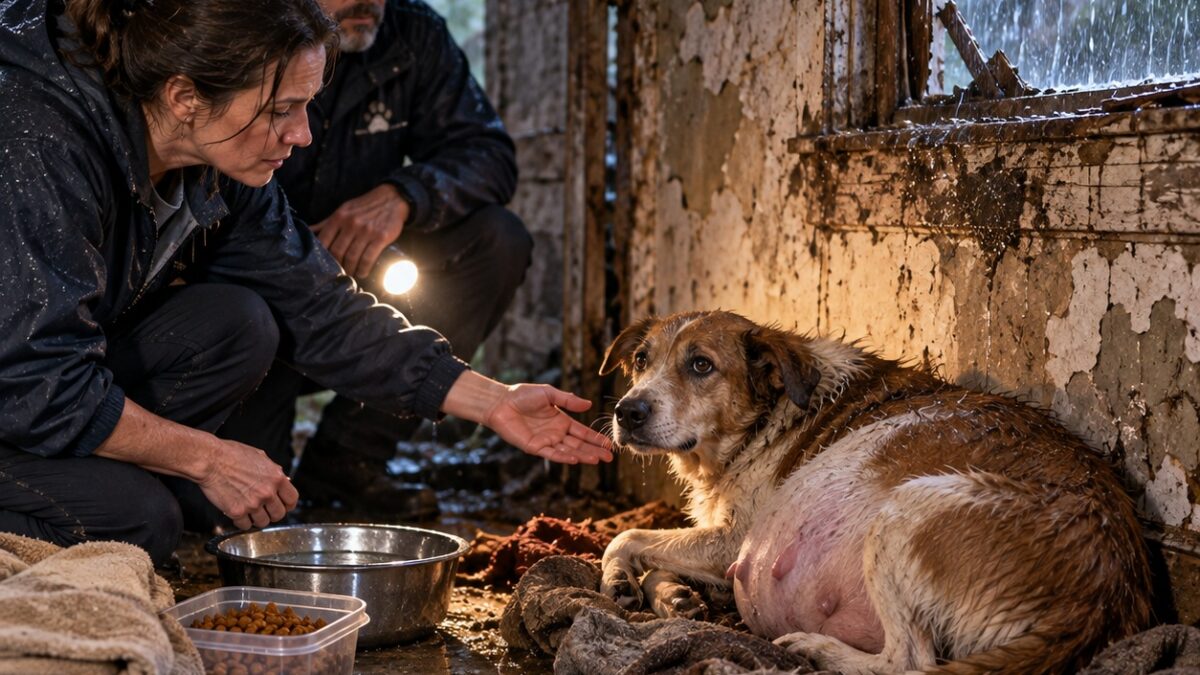
It took nearly forty minutes to gain enough trust to move her.
No rushing.
No grabbing.
Every time she tensed, we stopped.
I kept thinking about labor.
Stress.
Her condition.
The possibility that moving her could trigger something we were not prepared to handle in a ruined building during a storm.
Eventually, she let one of us touch the side of her neck.
She flinched.
Then stayed.
I touched her shoulder.
Her whole body trembled.
Not violently.
A fine, constant vibration under wet fur.
“Good girl.”
She lowered her head.
When we brought the blanket forward, she watched it suspiciously.
We spread it near her instead of over her.
She sniffed.
Then stepped one paw onto it.
That was enough.
With two people supporting her carefully, we guided her toward the doorway.
She walked slowly.
Her back legs seemed tired.
Her abdomen hung low.
Outside, rain hit her face.
She stopped.
For one terrifying second, I thought she was going to run.
Then she looked back toward the room she had been hiding in.
A flooded corner.
Broken plaster.
Darkness.
Then toward us.
She stepped forward.
We got her into the vehicle.
I sat beside her in the back.
She curled against the blanket almost immediately.
Not relaxed.
Exhausted.
There is a difference.
Her breathing was shallow but steady.
Every few minutes, her abdomen tightened.
I watched.
Timed it.
Then again.
I called the clinic.
“We’re bringing in a heavily pregnant stray.”
“How close?”
“Very.”
“Contractions?”
“Possibly.”
“How many puppies?”
“No idea.”
“Any bleeding?”
“Not that I can see.”
“Get here.”
We drove through rain.
Streetlights blurred through water on the glass.
I kept one hand close to her without forcing contact.
After several minutes, she rested her chin against my wrist.
That small gesture felt enormous.
She did not know me.
She did not know where we were going.
She only knew the wet house was behind us.
When we arrived, clinic staff were waiting.
They brought a larger stretcher.
She tried to stand on her own.
Her legs shook.
A technician whispered:
“It’s okay, sweetheart.”
The dog looked from one face to another.
Then allowed herself to be carried inside.
Warm fluorescent light.
Clean floor.
Dry blankets.
The smell of disinfectant.
Voices.
Hands that moved carefully.
For a dog who had spent days outside and at least one night hiding alone, the amount of attention must have been overwhelming.
Yet she never snapped.
Never tried to bite.
She watched.
Trembled.
Allowed examination.
Temperature.
Heart rate.
Abdomen.
Hydration.
An ultrasound confirmed what her body had already told us.
Multiple puppies.
A lot of them.
The veterinarian looked at the screen.
Then at us.
“This could be a big litter.”
“How big?”
“Hard to count perfectly this late.”
She moved the probe.
“Eight.”
Pause.
“Maybe nine.”
Another.
“I wouldn’t be surprised by ten.”
I stared at the mother dog.
Ten.
She had been carrying ten puppies while sleeping outside a locked gate.
Ten puppies while rain approached.
Ten puppies while looking for shelter in an abandoned house.
The veterinarian checked her again.
“She’s close.”
“How close?”
“She may deliver tonight.”
That changed everything.
We had brought her in thinking we were preventing a dangerous birth.
Now the birth might begin before anyone had time to fully settle her.
The staff prepared a quiet room.
Clean bedding.
Heating support for puppies.
Towels.
Emergency equipment.
Everything the abandoned house did not have.
She stood in the center of the bed for a long time.
Turned once.
Twice.
Three times.
Then lowered herself.
For the first time since we had found her, her body seemed to soften.
I sat outside the enclosure.
“Better?”
Her eyes stayed on me.
I do not know if dogs understand gratitude the way humans define it.
I do know they understand relief.
And there was relief in the way she finally let her head rest.
We thought we might have hours.
We barely had that.
The first signs of active labor became obvious roughly two hours after admission.
Restlessness.
Panting.
Nesting.
She stood.
Turned.
Lay down.
Stood again.
The veterinarian checked her.
“First stage labor.”
One technician asked:
“Do you think she can do this naturally?”
“She’s tired, but she’s stable.”
“What do we watch?”
“Everything.”
That was not comforting.
Large litters can be difficult.
A tired mother.
Unknown nutrition.
Unknown prenatal care.
Unknown history.
We had no idea whether this was her first litter.
No idea how old she was with certainty.
No idea if any puppy was positioned badly.
No idea whether she had eaten properly during the last week.
What we did know was that she was no longer alone.
That mattered.
About four hours after arriving at the clinic, her first puppy came.
I remember the room becoming completely quiet.
Not because anyone had been told to be quiet.
Because everyone instinctively stopped.
The mother strained.
Then there was a tiny body.
Wet.
Small.
Motionless for one frightening second.
Then movement.
The mother turned immediately.
Instinct took over.
She cleaned the puppy.
The technician checked quickly.
Breathing.
Good.
“Healthy.”
One word.
The whole room exhaled.
The puppy was placed close to her belly.
Tiny mouth searching.
Then latching.
The mother looked confused at first.
Then down at the life beside her.
First puppy.
Safe.
I thought:
If we had arrived four hours later, this would be happening on that wet floor.
No warming blanket.
No vet.
No towels.
No one checking whether the puppy breathed.
Then contractions began again.
Second puppy.
Healthy.
Third.
Another healthy cry.
Fourth.
The pace was not perfectly regular.
Nothing about birth is.
Minutes stretched.
Then contractions.
Then waiting.
Every pause became nerve-racking.
“Is that too long?”
“She’s okay.”
“Should we intervene?”
“Not yet.”
The veterinarian monitored.
The mother drank a little water between deliveries.
Accepted food.
Then another contraction.
Fifth puppy.
Healthy.
By then, the bed had changed completely.
The frightened dog we had found alone in a ruined house was surrounded by tiny bodies.
Brown.
White.
Black markings.
Small noses.
Tiny legs pushing against one another.
They made the faint squeaking sounds newborn puppies make.
Not really cries.
More like little declarations:
I’m here.
I’m here too.
Do not lose me.
Six.
Seven.
The mother was exhausted.
Her head dropped between contractions.
A technician stroked her neck.
“You’re doing so good.”
She opened her eyes.
Then another contraction tightened her whole body.
Eight.
Healthy.
Nine.
Healthy.
At some point, someone whispered:
“Maybe that’s all.”
The veterinarian palpated gently.
Waited.
“No.”
One more.
The room went tense again.
The last puppy took longer.
The mother was tired.
Really tired.
Her breathing became heavier.
We watched every movement.
The vet remained close.
Prepared if intervention became necessary.
Then one final series of contractions.
A tenth puppy appeared.
For one second, nobody spoke.
Then the technician laughed softly.
“Ten.”
The veterinarian checked the puppy.
“Healthy.”
Ten puppies.
All alive.
All breathing.
All moving.
The mother lay back.
Completely spent.
Around her, ten newborns pressed toward warmth.
Nearly two hours of delivery.
Four hours after arriving at the clinic, the first had come.
Now the last was here.
Just hours earlier, she had been lying in a deserted house while rain soaked the floor around her.
Now she had ten puppies beside her on clean bedding.
Warm.
Monitored.
Safe.
I thought that would be the end of the emergency.
It was not.
Birth was only the first hurdle.
The first problem appeared quickly.
Milk.
Not enough.
With ten puppies, “not enough” becomes serious very fast.
Newborn puppies cannot wait while a mother’s body catches up.
They need warmth.
Nutrition.
Frequent feeding.
Ten mouths.
One exhausted mother.
We watched each puppy try to nurse.
Some latched.
Some searched.
Some became frustrated.
The smallest two struggled more than the others.
The veterinarian checked the mother.
“Her milk supply may improve.”
“How long?”
“It can take time.”
“How much time do we have?”
“We support them until then.”
That meant rotation.
Supplementation.
Monitoring weights.
Keeping puppies warm while making sure the mother still bonded with them.
Care became constant.
The staff weighed each puppy.
Wrote the numbers down.
Marked them carefully so nobody got confused.
Ten puppies begin to look very similar at three in the morning when you have not slept.
We created a feeding schedule.
Puppy one.
Puppy two.
All the way through ten.
The mother watched every time someone lifted one.
At first, she became anxious.
She would raise her head.
Follow the puppy with her eyes.
One time she tried to stand.
I put my hand near her shoulder.
“It’s okay.”
The technician returned the puppy immediately after checking.
Over time, she learned.
These hands brought her babies back.
These people did not take them away.
Trust is not usually one moment.
It is repetition.
Lift puppy.
Return puppy.
Bring food.
Do not hurt.
Change bedding.
Do not hurt.
Touch belly.
Do not hurt.
Help baby.
Return baby.
Again.
Again.
Eventually, when a technician picked up a puppy to weigh it, the mother would watch but no longer panic.
That was progress.
The first night after birth, I went home for less than three hours.
I lay in bed and could still hear newborn squeaks in my head.
Rain continued outside.
I thought about the abandoned house.
The wet corner.
The place she had chosen.
I imagined ten newborns there.
One rolling into cold water.
One unable to nurse.
The mother too exhausted to move.
I stopped.
There is no value in torturing yourself with alternate endings after you have changed one.
She was safe.
They were safe.
That was what mattered.
At six the next morning, I returned.
The mother was awake.
Ten puppies piled against her.
A technician whispered:
“Her milk is starting.”
“How much?”
“Not enough yet.”
“But better?”
“Yes.”
I crouched.
“Good girl.”
Her tail moved once against the blanket.
The first time I had seen it wag.
It was barely a movement.
Still counted.
Those first days became a blur of numbers.
Weights.
Feeding times.
Temperature.
Nursing.
Sleep.
The smallest puppy lost a little weight the first day.
We worried.
Supplemented carefully.
By the next weigh-in, the number stabilized.
Then improved.
Another puppy seemed less aggressive at the nipple.
We rotated positions.
Made sure stronger siblings did not always push the weaker ones aside.
Ten puppies are not peaceful.
Even blind and almost helpless, they compete.
Tiny legs crawling over brothers and sisters.
Small heads searching.
One would find a good spot and another would climb directly over its face.
The mother handled it with remarkable patience.
She was still recovering.
Still thin.
Still tired.
Yet every time one squeaked sharply, her head lifted.
We increased her food.
High-calorie meals.
Fresh water always available.
Nutritional support.
Her appetite returned first.
That was a good sign.
She ate like a dog whose body had suddenly been reminded it was responsible for eleven lives including its own.
Then her milk improved.
Not overnight.
Gradually.
One day we still supplemented most of the litter.
A few days later, fewer.
Then fewer again.
Eventually, most puppies could nurse adequately with support only when needed.
The day we realized she was producing enough to let all ten settle after feeding, one of the technicians nearly cried.
“Look.”
I looked.
Ten round little bodies.
Quiet.
Not frantic.
Full.
Sleeping.
Their mother lay on her side.
Eyes half closed.
Peace.
It was the first peaceful image I had of her.
Not waiting.
Not hiding.
Not laboring.
Just resting.
The first week remained difficult.
People see photographs of newborn puppies and think softness.
Tiny paws.
Pink bellies.
Warm blankets.
They do not see how much work it takes to keep a large litter thriving.
Laundry.
Endless laundry.
Bedding changed constantly.
Mother cleaned.
Puppies checked.
Meals prepared.
Weights recorded.
Health monitored.
The mother needed to go outside.
At first, she refused to leave the puppies.
We would open the door.
She would stand.
Look outside.
Then back at the bed.
“You can go.”
She did not move.
We tried a leash.
Gentle.
No pulling.
Eventually she stepped out.
Relieved herself quickly.
Then turned immediately toward the door.
She wanted back.
Every time.
The abandoned dog who had spent a week unable to get inside one gate now panicked at the idea of being separated from the room where her puppies waited.
I understood.
She had lost one home.
She was not going to risk losing another.
So we built routine.
Outside.
Back.
Puppies still there.
Next time:
Outside.
Back.
Puppies still there.
Her anxiety decreased.
By the end of the first week, she would walk a little farther.
Sniff the grass.
Take a breath.
Then return.
Each ordinary behavior felt like recovery.
We never knew exactly what she thought during that week outside her former home.
Dogs do not testify.
We had neighbor accounts.
They said she had belonged there.
They said she had been chased away.
They said she continued returning.
I am careful with that because I did not witness the moment she was first refused.
But I witnessed what came after.
A dog waiting where she believed she should be.
A gate remaining closed.
A pregnant body growing heavier.
Then an abandoned house.
And rain.
Those facts were enough.
We did not need to invent cruelty beyond what we could see.
Sometimes neglect is quiet.
A door that never opens.
A bowl that is not put down.
A dog learning the difference between where she wants to be and where she is allowed.
By the end of the first week, the puppies had changed.
Not dramatically.
But enough that we noticed.
Their movements became stronger.
They could push themselves more deliberately.
Some began sleeping sprawled away from the pile for a few minutes at a time.
The mother became more relaxed when people entered.
She started greeting certain caregivers with small tail wags.
One afternoon, I entered carrying food.
She lifted her head.
Tail thump.
Once.
Twice.
I laughed.
“Now you like me?”
She watched the bowl.
Right.
Maybe not me.
Still progress.
She had also discovered that blankets could be rearranged.
At least once a day she decided our carefully made bed was wrong and used her nose to push everything into a pile.
One technician said:
“She has opinions now.”
Good.
Fear had been taking up all her energy before.
Opinions meant she had room for personality again.
Around the time the puppies began opening their eyes, the entire room changed.
At first, tiny slits.
One puppy opened one eye before the other and looked permanently skeptical for nearly a day.
Another seemed offended by light.
They had spent their whole lives navigating by warmth, smell, touch.
Now blurry shapes existed.
Their mother.
Siblings.
Walls.
Hands.
Us.
I sat near the bed watching one puppy attempt to focus on my fingers.
Its head moved too far one direction.
Then too far the other.
Finally it bumped into its brother and fell over.
There are moments in rescue when laughter becomes part of healing.
Not laughing at suffering.
Laughing because suffering is no longer the only thing happening.
The puppies did not know they had almost been born in a wet abandoned house.
They knew warm bedding.
Milk.
Their mother.
Human hands.
Sleep.
That was their entire world.
I loved that for them.
Their mother watched every new stage.
When they began crawling farther, she would sometimes use her nose to push one back toward the group.
When they started playing, she looked confused.
Ten puppies suddenly discovering each other as toys is chaos.
One bit another’s ear.
Another attacked a blanket fold.
One discovered its own tail.
Two attempted to climb over their mother’s back.
She gave us a look that seemed to ask:
Did you people know they would become like this?
Yes.
Sorry.
As their legs strengthened, their bed expanded into a larger pen.
Soft flooring.
Safe toys.
Low barriers.
The first time we opened the smaller bed area and let them explore, most stayed close to the mother.
One did not.
There is always one.
A little puppy with a white patch on its chest marched directly toward the far side.
Three steps.
Fall.
Stand.
Three more.
Fall.
The mother watched.
Then stood.
Walked over.
Nudged it.
The puppy turned around.
Immediately followed her.
That was the entire lesson.
The mother gained weight.
Slowly.
Her coat improved.
The hollow look around her face softened.
She slept deeper.
At first, any door sound woke her.
Any unfamiliar voice.
Any metal noise.
Eventually, she could sleep while people moved around.
That might sound small.
It is not.
Real rest requires safety.
Animals cannot fully relax when they believe danger may enter at any moment.
The first time I watched her sleep on her side while a technician cleaned the opposite end of the room, I thought about the abandoned house.
She had probably slept there lightly.
If she slept at all.
Rain.
Wind.
Strange sounds.
No door protecting her.
Now a metal tray could fall in the hallway and she barely lifted her head.
Safety had become believable.
People began asking about adoption almost immediately after the puppies were born.
Everyone loves newborns.
Photos traveled.
Ten puppies.
Rescued mother.
Rain.
Abandoned house.
People messaged.
“I want the brown one.”
“Can I reserve number four?”
“I’ve always wanted a puppy.”
We slowed everything down.
They were not products.
They were not ready.
The mother needed recovery.
The puppies needed weeks.
Vaccinations.
Health checks.
Development.
Socialization.
We also wanted homes prepared for what puppies actually are.
Not just photographs.
Noise.
Chewing.
Accidents.
Training.
Veterinary costs.
Commitment.
And the mother needed a home too.
That part matters.
Puppies attract attention.
Mothers often become background.
I refused to let that happen.
She had carried them.
Protected them.
Fed them when her own body was depleted.
She deserved more than being remembered as the container the puppies arrived in.
When inquiries came, we always added:
“The mother will need a home too.”
Some people asked about her.
Most asked about puppies.
We kept asking for her.
One afternoon, a woman visited.
Not to adopt yet.
Just to meet them.
She sat outside the pen.
The mother watched cautiously.
The woman did not reach.
Good.
She simply sat.
After a while, the mother approached.
Sniffed her hand.
The woman whispered:
“You waited all that time?”
The dog obviously did not answer.
Then she lay down near the woman’s feet.
That was when the woman cried.
Not dramatically.
Quiet tears.
She said:
“I can’t adopt right now.”
“That’s okay.”
“I wish I could.”
She donated food instead.
Sometimes helping does not mean taking an animal home.
Sometimes it means making sure whoever does take them home starts with a full bag of food.
By the third week, the puppies were little machines powered by milk and bad decisions.
Sleeping.
Waking.
Eating.
Walking into things.
Wrestling.
Sleeping again.
The quiet newborn room was gone.
We would open the door and hear tiny feet.
One puppy barked for the first time and scared itself.
Another learned that the side of the pen could be climbed approximately four inches before gravity became involved.
Their mother had entered a new phase too.
Nursing still.
Cleaning.
Watching.
But also setting boundaries.
A puppy bit too hard.
She moved away.
Another climbed on her face while she tried to sleep.
She repositioned.
Natural lessons.
The caregivers supported without replacing her.
She was doing her job.
Better every day.
We gave the litter temporary identification names for medical records.
Nothing dramatic.
Simple names.
But I still thought of the mother as Mama more often than anything else.
One morning, someone asked:
“Do you think she remembers the gate?”
I looked at her.
“What do you mean?”
“Her old house.”
I did not know.
Dogs remember places.
Smells.
People.
Experiences.
But memory is not a human movie playing in their heads.
I said:
“I hope whatever she remembers matters less every day.”
That became my answer.
Not forgetting.
Outgrowing.
There is a difference.
Heavy rain came again about a month after we rescued her.
I was at the facility when it started.
The sound hit the roof suddenly.
Hard.
Almost identical to the night we found her.
The mother lifted her head.
Her ears moved.
For a moment, her body became still.
I noticed.
I sat down near the pen.
“It’s okay.”
Rain intensified.
She looked toward the window.
Then toward her puppies.
They were wrestling over a rope toy.
One fell backward.
Another climbed on top.
No one cared about the storm.
The mother watched them.
Then lowered her head again.
That moment stayed with me.
Same rain.
Different world.
The first storm had found her in an abandoned house with wet flooring beneath her.
This storm found her inside.
Dry.
Fed.
Surrounded by ten growing puppies.
Safe enough to sleep through thunder.
That is what rescue should mean.
Not just moving an animal from one location to another.
Changing what a familiar sound predicts.
Rain no longer meant:
Find shelter.
It meant:
Rain.
Nothing more.
As the puppies grew, so did the work.
Vaccinations began.
Deworming.
Health checks.
Nail trimming.
Socialization.
Different surfaces.
Human voices.
Gentle handling.
Household sounds.
We introduced experiences slowly.
A towel.
A rubber mat.
A low plastic platform.
A cardboard box.
Everything is new when you are a puppy.
One discovered the cardboard box and decided it was a fortress.
Another ate the corner.
Different interpretation.
Their mother tolerated the circus.
Sometimes she joined.
The first time she played with a toy herself, I nearly missed it.
A soft ball rolled toward her.
She sniffed.
Pushed it with her nose.
It rolled away.
She followed.
Pushed again.
A puppy chased.
Then another.
Suddenly she was playing.
Not mothering.
Not surviving.
Playing.
That was one of the clearest signs we had gotten her back from whatever fear had swallowed her.
Her physical recovery continued.
Milk production stabilized.
Weight improved.
The veterinarian monitored her closely.
No major postpartum complications.
We gradually adjusted nutrition as the puppies began transitioning toward food.
The first solid-food experience was a disaster.
Ten puppies.
One shallow dish.
Food everywhere except where it belonged.
Faces.
Paws.
Floor.
One puppy walked directly through the middle and then attempted to climb on its mother.
She looked horrified.
We laughed until we had to sit down.
The puppies eventually learned.
Sort of.
Mealtime remained messy.
But the shift mattered.
Every bite of food they ate independently meant less demand on the mother.
Her body could finally begin becoming hers again.
We also learned more about her personality.
She loved quiet people.
Did not like sudden movement near her back.
Preferred women at first, though she warmed to everyone patient.
She leaned when being scratched behind one ear.
Not metaphorically.
Her entire body would slowly tilt until you either supported her or lost balance.
She had a habit of checking doors.
Every room.
Any open gate or doorway, she would look through.
That made sense.
We never forced her past one.
Choice was part of recovery.
When she walked through voluntarily, we praised.
Over time, doors became less important.
One day we took her for a walk away from the puppy room.
Not far.
Just enough for fresh air.
She moved slowly beside me.
The weather was clear.
No rain.
We reached the end of the yard where a metal gate separated the property from the road.
She stopped.
My whole body noticed before my brain did.
Gate.
Closed.
She stared through it.
Cars moved beyond.
I did not pull.
We stood there.
Thirty seconds.
Maybe more.
Then she looked up at me.
Turned around.
Walked back toward the building.
I followed.
She had chosen.
That felt important.
The first gate in her story had represented rejection.
This one did not need to.
It was simply a boundary.
And on the side she chose to return to were ten puppies, warm bedding, food, and people waiting for her.
Adoption screening became more serious as the puppies approached appropriate age.
Applications.
Home environments.
Experience.
Schedules.
Other pets.
Children.
Fencing.
Veterinary references where applicable.
People sometimes complained.
“You rescued them. Shouldn’t you just be happy someone wants them?”
No.
Wanting is easy.
Commitment is the requirement.
The mother had already learned what happens when a home stops being a home.
We were not going to rush the next one.
The same applied to her.
Especially her.
She needed someone patient.
Someone who understood that fear might return in unfamiliar situations.
Someone who would not expect instant gratitude.
Someone who would let trust happen.
The puppies developed distinct personalities.
The adventurous white-chested one remained fearless.
Another preferred sitting near people instead of wrestling.
One slept through almost anything.
One seemed born convinced every meal had been specifically prepared for him alone.
The smallest puppy, the one we worried about in the first days, became surprisingly assertive.
Watching it push a much larger sibling away from a toy felt like witnessing a tiny personal victory.
The mother corrected them gently.
She was never rough.
A look.
A repositioning.
A quiet sound.
They understood.
Mostly.
There was a morning when all ten puppies were asleep in a pile.
The mother was beside them.
Sun came through the window.
Nothing happened.
No emergency.
No feeding struggle.
No rain.
No labor.
No health scare.
I stood in the doorway longer than necessary.
A caregiver asked:
“What?”
“Nothing.”
“You’re staring.”
“I know.”
That scene would have seemed impossible the night we found her.
The whole point of rescue is eventually reaching moments too boring to photograph.
Animals sleeping safely.
That is success.
We continued hearing pieces of the story from neighbors near the original property.
Someone said the owner had been overwhelmed.
Another said the dog had escaped before being refused entry.
Someone insisted she had been deliberately thrown out.
We never obtained a reliable complete account.
I stopped trying to turn rumors into certainty.
What mattered was what we could support.
She had spent days outside the property.
Neighbors had fed her.
The gate remained closed.
She later sheltered in the abandoned house.
Those facts were enough to explain the danger without inventing more.
The dog did not need a villain for her rescue to matter.
She needed a future.
Eventually, the puppies no longer fit around their mother the way they once had.
Ten growing bodies.
Longer legs.
Bigger paws.
When they all tried to nurse at once, the scene looked absurd.
The mother would sometimes stand and simply walk away.
I could not blame her.
Weaning progressed.
Food increased.
Nursing decreased.
Her independence returned.
She began spending periods outside the puppy pen by choice.
Sleeping on her own bed nearby.
Still watching.
Still responding to cries.
But no longer physically attached to every moment.
That was healthy.
Motherhood had taken almost everything from her body.
Now she was getting pieces back.
The first puppy adoption match was emotional.
Not the departure yet.
Just the approval.
A family had applied early.
They visited twice.
Asked good questions.
Understood training.
Had an older dog with a stable temperament.
When we told them they were approved, the mother was lying beside the puppies.
They crouched near her.
The woman said:
“We’ll take care of him.”
Again, the dog could not understand the sentence.
But I wanted someone to say it anyway.
Maybe for us.
Maybe for the universe.
Promise matters even before the animal can verify it.
The mother received serious applications too.
One came from a couple with a quiet home.
No other dogs.
Fenced yard.
One person worked from home.
They had previously adopted an adult rescue who had passed away from old age.
They were not looking for a perfect dog.
They were looking for a relationship.
That distinction showed in every question.
“Does she startle around gates?”
“Sometimes.”
“How does she handle being left alone?”
“We’re still evaluating.”
“Does she like car rides?”
“She tolerates them now.”
“What makes her comfortable?”
“Routine.”
“What scares her?”
“Sudden unfamiliar pressure.”
They listened.
No:
“Will she love us immediately?”
No:
“Is she house-trained perfectly?”
No:
“Can you guarantee she won’t have issues?”
People who understand rescue know guarantees are usually signs someone is selling fantasy.
We began gradual introductions.
She liked them.
Not instantly.
That made me trust the process more.
The first visit, she sniffed and stayed near me.
Second, she approached.
Third, she leaned against the woman’s leg.
That famous full-body lean.
The woman looked at me with tears in her eyes.
“I’m not moving.”
“Good idea.”
The dog stayed.
Meanwhile, the puppies prepared for departure one by one.
Veterinary clearance.
Vaccinations appropriate for age.
Adoption packets.
Food transition instructions.
Training guidance.
Emergency contacts.
The first puppy left.
We expected the mother to panic.
She noticed.
Searched briefly.
Then settled with the remaining nine.
Another left days later.
Then another.
We staggered departures where possible.
Eight.
Seven.
Six.
Five.
The room grew quieter.
That was bittersweet.
Every departure meant success.
Also absence.
The mother adjusted.
She had been carrying ten before we even knew her.
Then caring for ten.
Now the weight of responsibility was leaving one family at a time.
The smallest puppy left with a family who had followed its progress from the first week.
The woman held it carefully.
“You were the little one?”
The puppy bit her shoelace.
Not little anymore.
The family laughed.
I watched them walk out.
Remembered weighing that same puppy at two in the morning, worried about every gram.
Now it was leaving under its own power.
That is why the hard nights matter.
Eventually, only two puppies remained.
Then one.
The last puppy had been the calm one.
Liked people.
Often slept beside the mother instead of joining the wildest play.
Its adopter arrived on a clear morning.
The puppy climbed into her lap immediately.
No hesitation.
The mother watched.
The adopter knelt afterward and stroked the mother’s shoulder.
“Thank you.”
I looked away.
Could not help it.
The puppy left.
The room became quiet.
The mother walked around the pen.
Sniffed the bedding.
Looked toward the door.
I sat down beside her.
For the first time since giving birth, there were no puppies around her.
She came over.
Leaned against me.
Hard.
Full weight.
I held her.
“You did it.”
Her tail moved.
Once.
Twice.
“You did all ten.”
She had.
Not alone.
But she had done the hardest part.
Carried them.
Delivered them.
Fed them.
Watched them grow.
Let them leave.
Her own adoption happened after that.
We could have sent her earlier.
We did not.
She deserved time between motherhood and another major transition.
Time to sleep.
Time to eat without ten puppies climbing over her.
Time to remember she was a dog independent of the litter.
Her future family visited again.
Walked her.
Sat with her.
No rushing.
On the final day, we packed her things.
Blanket.
Food.
Medical records.
A toy she had chosen.
I hated packing.
Every item felt like a goodbye.
She sensed something.
Dogs always do.
She followed us.
Watched the bag.
Then we walked toward the vehicle.
She stopped.
For one second.
The first car ride with us had begun in heavy rain after we pulled her from a deserted house.
She had climbed in frightened and exhausted, belly full of puppies.
This time the sky was clear.
She was healthy.
Her body belonged to her again.
The woman from her new family opened the back door.
Did not pull.
Waited.
The dog looked at me.
Then at her.
Then jumped in.
On her own.
That mattered to me more than I can explain.
Choice.
She chose forward.
I leaned through the open door.
Scratched behind her ear.
She tilted into my hand.
That ridiculous lean.
“Good girl.”
Her new family drove away.
I watched until the vehicle disappeared.
Then I stood in the empty parking area and cried harder than I had during the birth.
Rescue is unfair that way.
You work toward goodbye.
Then goodbye feels like loss.
But it is not.
It is completion.
We received updates.
The first night, she slept near the bedroom door.
Second night, on her own bed.
By the end of the week, she had claimed a sunny place near the window.
She followed the woman from room to room.
Discovered a yard.
Learned the sound of the refrigerator.
Barked once at a vacuum cleaner.
Progress.
The family sent a photo of her sleeping on a couch.
On her back.
Legs loose.
Belly exposed.
A vulnerable position.
A dog does not sleep like that if she thinks she needs to run.
I saved the picture.
Compared it mentally to the first time we found her.
Curled tightly on wet flooring.
Eyes watching every move.
Same dog.
Different expectation of the world.
That is the transformation.
The puppies’ updates came too.
Growing.
Chewing furniture.
Learning names.
First walks.
First destroyed shoes.
One sleeping beside a child.
Another becoming best friends with an older Labrador.
The adventurous white-chested puppy apparently remained adventurous enough to require a baby gate upgrade.
No surprise.
The smallest puppy grew into one of the biggest.
Of course.
Ten homes.
Ten stories moving outward from one abandoned house.
Sometimes people ask which moment was the rescue.
Was it when we entered the abandoned building?
When she stepped onto the blanket?
When she got into the car?
When the vet confirmed ten puppies?
When the first puppy breathed?
When her milk came in?
When the puppies opened their eyes?
When the last one was adopted?
When she jumped willingly into her new family’s vehicle?
I do not think rescue is one moment.
It is a chain.
Any link can fail.
A neighbor notices.
Someone calls.
Someone drives.
A clinic stays open.
A veterinarian watches through labor.
A caregiver feeds at three in the morning.
A donor buys food.
An adopter waits until the animal is ready.
A dog decides to trust again.
All of it.
I drove past the abandoned house months later.
Not intentionally.
I happened to be in the area.
The building looked even worse.
One window boarded.
Weeds taller.
The room where she had hidden was dark.
It had rained the night before.
I parked for a minute.
Not long.
I could see the doorway we had carried her through.
I remembered her belly.
The wet floor.
The way she looked back before stepping into the rain with us.
Then I thought about the couch photo.
Her lying upside down.
Safe.
I drove away.
The house did not need to become a monument.
It was just the place where we found her.
The important part was that she was no longer there.
The gate at her former home remained too.
I saw it once from the road.
Closed.
No dog waiting outside.
That image gave me more peace than anger.
Because whatever had happened before, she no longer needed that gate to open.
That is one of the hardest things about abandonment.
The animal often keeps returning to the person who failed them.
Not because they are foolish.
Because attachment does not disappear simply because it becomes painful.
For a week, she waited.
Then survival finally pulled her somewhere else.
An abandoned house was the best alternative she could find.
Then people found her.
Then she learned another possibility.
Doors could open.
Hands could help.
A car could take you somewhere safer instead of away.
A gate could be closed without meaning you were unwanted.
A human could lift your puppy and bring it back.
A home could actually stay a home.
That is what she learned.
Or at least, that is what I hope her life taught her afterward.
If you look only at the beginning, the story is cruel.
Pregnant dog.
Locked gate.
Rain.
Abandoned building.
If you look only at the birth, it is dramatic.
Ten puppies.
Two hours.
Warm towels.
People watching.
If you look only at the ending, it becomes cute.
Growing puppies.
Open eyes.
Playing.
Adoptions.
But the real story is everything between those images.
The hours nobody photographs.
The mother too tired to produce enough milk.
The feeding schedules.
The smallest puppy being weighed again.
The bedding changed in the middle of the night.
The mother refusing to step away from her litter.
The first walk outside.
The first tail wag.
The first toy.
The first storm she slept through.
The first door she walked through because she chose to.
That is where recovery actually lives.
Not in one miracle.
In repetition.
Safety.
Again.
Food.
Again.
Kindness.
Again.
Return the puppy.
Again.
Open the door.
Again.
Come back.
Again.
Eventually the body learns.
Maybe the world has changed.
Months after her adoption, her family sent one final photograph that I keep near my desk.
She is standing in a yard.
Healthy.
Coat shining.
No puppies around her.
No rain.
No abandoned walls.
Behind her is a house with an open back door.
She is not staring at it.
Not waiting.
Not begging to be let in.
She is looking toward the person holding the camera.
Tail raised.
Relaxed.
The door is open because nobody expects her to earn her way through it.
That is the difference between shelter and home.
Shelter keeps rain off you.
Home is where you no longer have to wonder whether the gate will open.
For one week, she waited outside a place she thought was home.
Then she found a wet abandoned room because her puppies could not wait forever.
We found her before they arrived.
Four hours later, the first puppy was born.
Almost two hours after that, there were ten.
All healthy.
Her milk was slow to come.
People helped.
Her body recovered.
The puppies grew.
Their eyes opened.
They played.
They learned.
One by one, they left for homes of their own.
Then, finally, so did she.
The dog we first saw curled on a wet floor had carried ten lives through rejection, rain, hunger, fear, labor, and exhaustion.
She did not need to keep waiting outside that locked gate.
She never did again.
And neither did her puppies.




