PART2:People Chased Him Away Because Tumors Covered His Body—309 Days Later, a Family Finally Came to Take Polito Home
PART2
The rescuers stayed.
That may be the first truly important thing anyone needs to understand about Polito’s recovery.
They stayed.
A frightened dog hiding beneath a drain does not understand rescue.
He does not understand that the voices outside belong to people who have seen his suffering and decided to help.
He does not know that a veterinary clinic is waiting.
He does not know that treatment exists.
He does not know that his tumors have a name.
He does not know that somewhere beyond the concrete darkness there may be people willing to feed him even if he cannot eat.
All he knows is what experience has already taught him.
Stay hidden.
Stay small.
Do not make it easier for anyone to reach you.
The people outside could have become impatient.
They could have looked at the darkness beneath the drain and decided Polito was too frightened.
Too difficult.
Too far inside.
They could have said they would try another day.
They did not.
Minutes became longer stretches of waiting.
Those stretches became hours.
The rescue itself became an act of patience.
No dramatic understanding passed between Polito and the people outside.
There was no moment when he suddenly realized:
They are here for me.
Instead, human beings stayed near the entrance to the place he had chosen as protection until, eventually, they were able to bring him out.
The first great change in Polito’s life was not that he trusted anyone.
He did not.
It was that for once, when he hid from people, the people did not simply leave.
They waited long enough to take him somewhere safer.
Outside the drain, the world was still the world.
Noise.
Hands.
Movement.
Uncertainty.
But Polito was no longer walking away alone.
The next stop was the veterinary clinic.
For rescuers, arriving there meant progress.
For Polito, it probably felt like another frightening place full of strangers.
New smells.
New voices.
Doors.
Surfaces.
Hands reaching toward painful parts of his body.
People moving around him while he could not understand what they wanted.
He trembled.
That detail says more about his condition than any dramatic description could.
Polito trembled.
He avoided the people trying to care for him.
When they reached toward him, he did not respond like a dog relieved to finally be safe.
Safety is not something an animal believes because humans announce it.
Safety has to be experienced.
Again.
And again.
And again.
Polito had barely begun.
The examinations revealed the first medical truth.
He had transmissible venereal tumors.
TVT.
The tumors everyone could see were not simply scars or harmless growths that time would resolve.
They required treatment.
Then came another problem.
Severe anemia.
Polito was already weakened.
The dog who had wandered the streets searching for food was carrying a body that had less and less reserve left to draw from.
And there was more.
Painful injuries to his hip and back leg.
Beneath the obvious suffering were injuries people on the street had not known about.
Every step he had taken behind police patrols.
Every walk from one food stand to another.
Every time he had moved away when somebody chased him.
He had been doing it with pain nobody could see simply by looking at the tumors.
That is one of the saddest things about neglected animals.
What is visible can become so shocking that people forget there may be suffering underneath it too.
Polito’s tumors had announced his illness to the world.
His hip and back leg had suffered more quietly.
Now the clinic had the full picture.
TVT.
Severe anemia.
Pain.
Fear.
A dog who needed a long hospital stay.
A dog who needed chemotherapy.
A dog who had survived long enough to reach help but was still a long way from being well.
Then came the problem that frightened his caregivers in an entirely different way.
Polito would not eat.
They offered food.
Nothing.
They tried different foods.
Still nothing.
A dog who had spent his life searching food stands for something—anything—to fill his stomach now had food placed in front of him and turned away.
That is heartbreaking in a way hunger alone is not.
Because on the street, the problem had been scarcity.
At the hospital, food was finally available.
But something inside Polito had become too frightened, too weak, too overwhelmed, or too shut down to take it.
Caregivers could not explain:
You need this.
You are safe here.
Nobody is taking the bowl away.
You will not be chased from this room.
There will be food tomorrow too.
You can eat.
Polito did not understand those promises.
He only knew he did not want the food.
They offered something else.
No.
Another attempt.
Nothing.
His body needed strength for treatment.
Severe anemia had already weakened him.
Chemotherapy was beginning.
Waiting for appetite to return whenever it felt ready was not enough.
So his caregivers began feeding him special food through a syringe.
Slowly.
Carefully.
A little at a time.
There is nothing glamorous about syringe feeding a frightened dog.
No triumphant music.
No instant recovery.
It is patient work.
Repeated work.
Food entering a body that is not yet willing to seek it.
Polito hid his face.
That image may be the most painful part of his hospital story.
The tumors were visible.
The anemia could be identified medically.
The injuries could be found during examination.
But when Polito hid his face, the damage was not just physical anymore.
A dog hiding his face from the people feeding him is telling you something about what he expects from closeness.
He had spent too much time being unwanted.
Too many approaches had ended with rejection.
Too many humans had looked at his tumors and decided distance was better.
And now, when hands came toward him, his first instinct was not:
Help.
It was:
Hide.
Yet the people around him kept returning.
They came back even when he would not eat.
They came back when he turned his face away.
They came back when he trembled.
They came back when his response to kindness was not affection but avoidance.
That is important because rescue is sometimes romanticized as a single dramatic act.
The rescuer reaches out.
The dog accepts.
Life changes.
For Polito, rescue was repetition.
Someone came back.
Then came back again.
A caregiver offered food.
Polito refused.
They returned.
Someone tried to touch him gently.
Polito hid.
They returned.
Treatment day came.
They stayed.
Another day.
Another visit.
Another attempt.
Nobody demanded that Polito become grateful quickly.
Nobody required him to wag his tail to prove he deserved the effort.
Nobody looked at his fear and said:
He does not appreciate us.
They simply kept caring for him.
That is what allowed the next part of his story to happen.
One day, Polito ate.
He ate.
On his own.
The action itself was ordinary.
A dog taking food.
But after days of refusal and syringe feeding, it was not ordinary at all.
Imagine being one of the people who had watched him turn away.
Imagine preparing yourself for another refusal.
Another attempt.
Another syringe.
And then Polito lowered his head.
Took food.
Swallowed.
Wanted more.
The people around him encouraged him.
He ate again.
Then several times.
Something had changed.
Maybe his body finally had enough strength to ask for what it needed.
Maybe the hospital had become familiar enough that fear loosened.
Maybe food had appeared so many times without being followed by harm that Polito finally believed the bowl was his.
No one needed to know exactly why.
He ate.
That was enough.
A dog who had once wandered from stall to stall hoping a stranger might throw him a scrap was now eating with people standing beside him, encouraging him to continue.
No one chased him away when he finished.
No one told him he had stayed too long.
No one recoiled from his tumors.
He ate.
And the people stayed.
That could have been the emotional ending of a shorter story.
It was only the beginning.
Soon, caregivers noticed something else.
Polito’s tail moved when they came to see him.
A wag.
Maybe small at first.
Maybe only a few movements.
But unmistakable.
A tail wag is one of the simplest things a dog can do.
Nobody celebrates every wag from a healthy, happy family dog.
They happen all day.
At the door.
Before meals.
When someone says the dog’s name.
When a leash appears.
But Polito’s first wags inside that hospital meant something different.
The same humans he once tried to avoid had become humans he was happy to see.
That is enormous.
His body had not forgotten pain.
Treatment was not over.
The tumors had not magically vanished overnight.
But his expectation was changing.
People arrive.
Something good might happen.
People touch me.
I might like it.
People sit nearby.
I do not have to disappear.
He began accepting affection.
Then enjoying it.
Neck rubs became something he wanted.
He leaned into touch he once avoided.
He allowed hands closer to the face he had tried to hide.
Then Polito began giving kisses.
Think about the distance between those two images.
A frightened dog turning his face away.
A dog moving his face closer to a human because affection now feels safe.
The physical distance may have been a few inches.
Emotionally, it was almost the entire journey.
The people caring for Polito had not only kept his body alive long enough for treatment to work.
They had changed what human presence meant to him.
While chemotherapy worked on his tumors, repeated kindness worked on the part of Polito that had learned rejection.
The treatments continued.
Week after week.
There was no shortcut.
Eight chemotherapy treatments.
One after another.
His tumors slowly shrank.
The visible evidence of sickness became less overwhelming.
His appetite grew.
He gained more interest in food.
His body began using those meals to rebuild.
There were still the injuries.
Still weakness.
Still the reality that Polito had arrived carrying several kinds of suffering at once.
But progress accumulated.
One treatment.
Then another.
One meal.
Then another.
One wag.
Then another.
One moment of accepting touch.
Then another.
Recovery does not always arrive like sunrise.
Sometimes it arrives like drops filling a container.
So slowly that no single moment feels like enough.
Then one day you look and realize the container is no longer empty.
Polito was no longer empty.
He had appetite.
He had recognition.
He had people.
He had the beginning of trust.
More than two months passed with him in the hospital.
More than two months.
It is easy to write that in one sentence.
Harder to feel what it means.
Days of waking in the same medical environment.
Days of treatment.
Monitoring.
Feeding.
Resting.
People entering.
People leaving.
People returning.
The street life did not vanish from his memory in those two months.
But something new competed with it.
Routine.
Polito began learning that tomorrow could resemble today in a good way.
The people who fed him today might feed him tomorrow.
The person who rubbed his neck today might return.
Food could arrive before desperation.
A bed could remain his through the night.
Nobody would tell him to get away because his tumors were unpleasant to look at.
What had once caused rejection now caused people to pay closer attention.
That reversal may have saved more than Polito’s life.
It may have saved his ability to believe in people.
Treatment number eight came.
After eight chemotherapy treatments and more than two months in the hospital, rescuers reported the news they had been hoping for.
Polito was free of TVT.
Free.
The tumors that had controlled so much of his life no longer controlled his medical future.
The tumors that had made people chase him away on the street had shrunk under treatment until the disease was gone.
The dog who had entered the clinic trembling had survived.
The dog who would not eat had survived.
The dog who had needed syringe feeding had survived.
The dog who hid his face had survived.
And now he could leave the hospital.
That departure carried its own kind of fear.
Hospitals are not homes.
But after more than two months, the hospital was familiar.
The people there were familiar.
The routines were familiar.
Leaving meant another transition.
Another place.
Another set of smells.
Another environment Polito had not chosen.
But he was not the dog rescuers had pulled from beneath the drain anymore.
He had learned something crucial.
New did not always mean dangerous.
He went to the rescue foundation.
There, Polito met another dog named Nube.
And the two became close.
That fact is simple.
Its meaning is not.
Polito had spent so much of his life alone.
He had followed police patrols because walking near someone was better than always walking by himself.
Now another dog chose proximity.
Nube stayed beside him.
They settled into the new environment together.
There are some forms of comfort humans cannot fully give a dog.
Another dog resting nearby.
Another body that understands dog language.
Another animal who does not care what happened on the streets or how frightening chemotherapy had been.
Nube simply stayed close.
For Polito, that companionship became part of the next stage.
Hospital behind him.
Foundation around him.
Nube beside him.
Meals appearing.
Body rebuilding.
He gained weight.
Slowly, the outline of the starving, sick dog changed.
His body had enough nutrition to hold onto.
There were no food stands to search.
No need to move from smell to smell hoping a stranger would give him something.
Meals belonged to the routine now.
Food was no longer an emergency.
Imagine what that means to an animal who has known hunger.
The bowl arrives.
He eats.
And there is a tomorrow.
Another bowl.
Then another tomorrow.
The nervous system begins learning abundance not as luxury but as predictability.
Polito became stronger.
He had survived the most dangerous medical part of the story.
But rescue still had one unanswered question.
Who would take him home?
This is the part of rescue stories people sometimes skip.
They begin with suffering.
Move into treatment.
Then jump immediately to adoption.
For some animals, that happens quickly.
For others, the waiting becomes its own chapter.
Polito waited.
He was safe.
That mattered.
He had food.
He had Nube.
He had people caring for him.
But safety inside a rescue is not the same as permanence.
The foundation was holding him between two lives.
The one he survived.
And the one everyone hoped someone would give him.
Visitors could come.
People could notice him.
Someone might touch his head.
Someone might ask about him.
Then leave.
Polito could not understand why.
Dogs do not know adoption systems.
They do not know applications.
They do not understand why one person chooses the dog beside them.
Or why a family leaves after saying goodbye.
They do not count weeks on calendars.
They only know whether they are still in the same place when morning comes.
Polito kept waking there.
Safe.
Fed.
Cared for.
But still waiting.
Thirty days.
Then more.
Sixty.
Ninety.
The number grew.
One hundred.
Another hundred.
The world continued around him.
Polito kept becoming healthier.
His body became stronger.
His relationship with people became easier.
He had learned neck rubs.
Kisses.
Tail wags.
He had learned that approaching a human could end with affection instead of rejection.
Still no family had made the final choice.
There is something especially painful about a dog being medically ready and emotionally ready but still waiting.
Because there is no medicine for that.
You cannot prescribe a home.
You cannot perform a procedure that creates a family.
You can only care for the dog while hoping the right person eventually walks through the door.
Polito did not know everyone was hoping.
He simply lived his days.
Nube nearby.
Caregivers nearby.
Meals.
Rest.
Strength.
Routine.
Perhaps that routine was enough for him in the moment.
Dogs are better at inhabiting the present than people.
But the rescuers knew.
Polito deserved a permanent place.
The days kept accumulating.
Two hundred.
More.
There is a particular kind of heartbreak in knowing an animal has already fought so hard and still has one last thing he cannot earn through effort.
Polito had endured the street.
He had endured hunger.
He had endured tumors.
He had endured anemia.
He had lived with painful injuries.
He had survived chemotherapy.
He had learned to eat again.
He had learned to trust.
None of that could make a family appear sooner.
All he could do was wait.
And perhaps that is the part of his story that hurts the most.
Not because Polito was unsafe.
He was not.
He was cared for.
But after everything, he still depended on somebody he had never met deciding:
Him.
I choose him.
Three hundred days approached.
Imagine looking at Polito then and remembering the dog beneath the drain.
The contrast would have been almost impossible.
Before:
Tumors.
Fear.
Hunger.
Dark concrete.
Avoiding hands.
Now:
More weight.
More strength.
No TVT.
People he trusted.
Nube beside him.
A tail capable of greeting familiar faces.
Kisses.
But still waiting.
Day 301.
The numbers mattered only to humans.
Polito had no calendar.
Perhaps someone brushed past him that day.
Perhaps someone fed him.
Perhaps Nube settled nearby.
Ordinary rescue life.
Then day 309.
A family came.
A family chose Polito.
That sentence deserves to stand alone in anyone’s heart for a moment.
A family chose Polito.
The dog people had chased away because of his tumors.
The dog who wandered food stalls.
The dog who followed police officers because he needed somewhere near safety.
The dog who hid beneath a drain.
The dog who trembled at the clinic.
The dog who would not eat.
The dog who had to be fed through a syringe.
The dog who hid his face.
The dog whose first wag had felt like a miracle.
The dog who endured eight chemotherapy treatments.
The dog who spent more than two months in the hospital.
The dog who recovered.
The dog who found companionship in Nube.
The dog who waited 309 days.
Someone finally looked at Polito and did not think:
Get him away from me.
They thought:
Come home with us.
There is no way to know what Polito understood in that moment.
Humans understand paperwork.
Adoption.
Finality.
Dogs understand movement.
Tone.
Hands.
Familiarity.
Doors.
Cars.
The people around them.
Maybe Polito only knew something was different.
Maybe he recognized the emotion of his caregivers.
Maybe his tail moved.
Maybe the day felt like another transition until the pattern became clear.
What matters is where it ended.
Not under a drain.
Not in a veterinary hospital.
Not in temporary rescue care.
Home.
The family took him.
For the first time in Polito’s story, safety was not borrowed.
Not borrowed from police officers walking through San Martin.
Not borrowed from a food vendor willing to let him stand nearby.
Not borrowed from rescuers staying outside the drain.
Not borrowed from hospital staff.
Not borrowed from the foundation.
It belonged to his life now.
The dog who once followed patrols had people of his own to follow through a front door.
The dog who searched food stands had a place where meals could be expected.
The dog who once disappeared beneath concrete had somewhere soft to rest where hiding was no longer survival.
The dog who had been chased away because people could not see past his tumors had finally been chosen after those tumors were gone.
But the most beautiful part is that Polito had become worth choosing long before he became healthy.
He was worth choosing under the drain.
He was worth choosing while covered in tumors.
He was worth choosing when he was trembling.
He was worth choosing when he refused food.
He was worth choosing before the first tail wag.
The treatment did not create his value.
The adoption did not prove it.
The people who stayed simply recognized something the streets had failed to recognize.
His suffering was not a reason to send him away.
It was a reason to come closer.
That is what changed Polito’s life.
On the streets, every visible problem created distance.
At rescue, every problem created care.
Tumors?
Treatment.
Anemia?
Support.
Painful hip and back-leg injuries?
Attention.
Would not eat?
Try another food.
Still would not eat?
Syringe feed him.
Hides his face?
Sit nearby.
Come back.
Fearful of touch?
Move slowly.
Come back.
Chemotherapy takes weeks?
Stay through the weeks.
Hospital stay takes more than two months?
Stay through the months.
No adopter after one hundred days?
Keep caring.
No adopter after two hundred?
Keep caring.
Three hundred?
Keep caring.
Day 309?
Someone finally came to stay forever.
Polito’s recovery was not one person performing one heroic act.
It was persistence.
Again.
Again.
Again.
That may be why his story cuts so deeply.
The world had taught him repetition too.
He had repeatedly been hungry.
Repeatedly searched for food.
Repeatedly approached people.
Repeatedly been driven away.
Repeatedly slept without knowing what tomorrow would bring.
Then rescue replaced one repetition with another.
Repeated meals.
Repeated gentle hands.
Repeated visits.
Repeated treatment.
Repeated safety.
Repeated affection.
Eventually the new pattern became stronger than the old one.
That is healing.
Not forgetting.
Learning something new often enough that fear no longer owns every response.
The first time Polito hid his face, caregivers were looking at a dog shaped by his past.
The first time he wagged his tail for them, they were watching his future begin.
What a small movement.
A tail.
Back and forth.
But to the people who had seen him tremble, it must have felt enormous.
He knew them.
More than that.
He was glad they were there.
That means their presence had crossed an invisible line.
From tolerated.
To trusted.
From feared.
To wanted.
There are no medical charts for that transformation.
No laboratory values.
No scan.
No test declaring:
This dog believes people can be kind again.
You see it in behavior.
A dog remains when he could move away.
A dog raises his head.
A body relaxes.
A tail moves.
A face comes closer.
A kiss.
Those became Polito’s emotional test results.
Improving.
Day by day.
The chemotherapy did its work too.
Eight treatments.
Imagine how different the eighth must have felt compared with the beginning.
At the beginning, Polito would not eat.
At the beginning, every hand may have felt suspicious.
At the beginning, the tumors were large enough to make strangers reject him.
By the end, the disease was gone.
The hospital had become associated not only with discomfort but with familiar people.
Polito had changed while treatment changed him.
Then came discharge.
A word humans celebrate.
For animals, another unknown.
He left a place where he had finally learned the people were safe.
That could have been frightening.
But at the foundation, Nube helped create the next bridge.
That relationship deserves its own place in the story.
Nube did not cure anything.
Did not administer medicine.
Did not understand Polito’s medical records.
Nube simply stayed beside him.
Sometimes companionship is exactly that.
Presence.
One life close to another.
No explanations.
Polito and Nube became close as they adjusted.
After everything Polito had endured, he did not have to navigate the new environment completely alone.
Another dog was there.
A familiar body.
A smell.
A rhythm.
Someone to settle beside.
People often speak about rescued animals as if humans are their entire world after recovery.
Sometimes another animal becomes part of the healing too.
Nube gave Polito something only Nube could give.
Dog companionship.
A reason the new place might feel less strange.
The two stayed near each other.
And while they did, Polito gained weight.
Weight is a simple measurement.
But in his case, every bit gained carried a story.
It meant food had entered his body often enough to remain.
It meant his system no longer lived only in deficit.
It meant one meal had been followed by another.
And another.
A stray dog cannot build strength from promises.
He needs calories.
Consistency.
Time.
Polito finally had all three.
His body began to look like a body being cared for.
Stronger.
More stable.
That strength eventually made the contrast with his street life even sharper.
Once, he had begged for a bite.
Now people watched to make sure he ate enough.
Once, nobody knew whether his hip hurt.
Now his caregivers knew the injury existed.
Once, the tumors made people move him away.
Now treatment had been organized around removing them.
Once, he had no reliable place to sleep.
Now his day had structure.
That is what rescue gave him before adoption ever arrived.
A life where his needs were noticed.
Perhaps that is the deepest definition of home too.
Not walls.
Not ownership.
Being noticed.
When you do not eat, someone knows.
When you hurt, someone knows.
When you are frightened, someone adjusts.
When your tail finally wags, somebody sees.
When you have waited 309 days, somebody remembers the number.
The streets had not remembered Polito.
Rescue did.
That is why the final adoption is so powerful.
It took everything rescue had begun and made it permanent.
Not temporary care.
Not a hospital stay.
Not a foundation waiting for an adopter.
Family.
The beginning of Polito’s story had been defined by movement.
He wandered.
Followed.
Searched.
Moved away.
Moved toward food.
Moved away from people.
Followed patrols.
Moved to another stand.
Another corner.
Another place.
Even the drain was a final movement downward into darkness.
The ending was movement too.
But different.
He was going somewhere instead of searching for somewhere.
That distinction can make anyone cry if they really sit with it.
For most of his life, Polito moved because he did not have a place.
On day 309, he moved because he finally did.
Home was no longer something he had to look for.
Someone had come to take him there.
If Polito could have understood every part of his own story, perhaps the strangest thing would have been discovering that the body people rejected was the same body other people fought to save.
Nothing about his worth had changed between the food stand and the clinic.
Only the humans changed.
The people on the street saw tumors and discomfort.
The rescuers saw urgency.
The caregivers saw a patient.
The people who visited saw progress.
The family eventually saw Polito.
That is what compassion does.
It changes what suffering means.
To someone unwilling to help, suffering can look like inconvenience.
To someone willing to help, suffering becomes a reason to act.
Polito encountered both kinds of people.
His life turned when the second kind found him.
The person who sent the video may never understand the full chain they helped begin.
A recording.
A message.
Rescuers arriving.
Hours beneath the drain.
Veterinary care.
Diagnosis.
Chemotherapy.
Syringe feeding.
First meal.
First wag.
Kisses.
Eight treatments.
TVT-free.
Foundation.
Nube.
Weight gain.
309 days.
Adoption.
One act of noticing can travel farther than anyone expects.
That is another reason Polito’s story matters.
People may see an animal suffering and think:
Someone else will help.
Someone else will call.
Someone else has probably noticed.
Maybe.
But Polito’s rescue began because someone made sure the suffering reached people who could act.
The video was not treatment.
It did not pull him from the drain.
It did not cure TVT.
But it opened the first door.
Then other people opened the next.
That is how rescue works.
A chain.
One person cannot always do everything.
But one person can refuse to look away.
Then somebody else takes the next step.
Polito’s story is built from those steps.
He was not magically saved.
He was carried through a sequence of people choosing not to abandon the problem to someone else.
Perhaps the hardest moment for his caregivers was not the diagnosis.
At least diagnosis creates a plan.
TVT.
Chemotherapy.
Anemia.
Support.
Injuries.
Care.
The hardest moment may have been watching him refuse food.
Because a treatment plan means little if the patient has no strength left to continue.
They could offer food but not force Polito to want it.
That is why the syringe mattered.
It was not pretty.
It was a bridge.
Enough nutrition to get him through the days until appetite could become his again.
Then, suddenly, the bridge was no longer the only way across.
Polito ate.
That moment is worth returning to because it contains so much.
He had spent his street life chasing food.
At the hospital, food waited for him.
Yet he could not take it.
Then one day, he did.
It was as if his body finally said:
Stay.
Not in words.
In appetite.
Eat because there may be a next day worth reaching.
Then his tail said something similar.
Stay near these people.
They are becoming yours.
The kisses said more.
I trust your face close to mine.
That is extraordinary for a dog who once hid his own.
And then adoption said the final thing.
You do not have to keep waiting here.
Come with us.
Those are the emotional milestones of Polito’s life.
Hunger.
Food.
Fear.
Touch.
Hiding.
Trust.
Illness.
Treatment.
Waiting.
Home.
There is no need to invent anything larger.
The truth already carries enough pain.
People saw him and drove him away.
That happened.
A dog with tumors had to keep searching for food among humans who sometimes wanted him nowhere near them.
That happened.
He followed police for some temporary sense of security.
That happened.
He hid beneath a drain because darkness and concrete seemed safer than the world outside.
That happened.
It took hours to bring him out.
At the clinic, he trembled.
He would not eat.
He had to be syringe fed.
Those facts do not need decoration.
Imagine them slowly.
A dog so hungry on the street that he begs between food stands.
Then so frightened and sick in safety that he cannot eat.
That is enough to break a heart.
And yet the story refused to end there.
That is what makes it bearable.
Polito began eating.
His tail wagged.
He accepted neck rubs.
He gave kisses.
There is joy in those details because the pain before them was real.
People who cared for him earned those moments with patience.
Polito earned nothing.
He did not need to.
Love is not payment for good behavior.
He deserved care while frightened just as much as he deserved affection while wagging.
The wag was not proof he had become a good dog.
It was proof he had begun feeling good enough to show what had always been inside him.
That matters.
Rescue animals are sometimes described as transformed from broken into loving.
Often they were loving all along.
Fear simply had the door closed.
Polito had affection inside him while he hid his face.
He just did not yet have a reason to let it out.
The caregivers gave him reasons.
Again.
And again.
Then Nube gave him another.
Then a family gave him the biggest one.
A permanent tomorrow.
The 309-day wait feels especially cruel after everything else because humans instinctively want recovery to be rewarded quickly.
He survived chemotherapy.
Surely a family should appear immediately.
He became affectionate.
Surely someone would choose him.
He gained weight.
Surely now.
But life does not arrange itself according to emotional fairness.
Sometimes a dog survives the impossible and still waits.
Polito waited.
That waiting does not make the ending weaker.
It makes it deeper.
Because when adoption finally came, it was not rescue workers celebrating a quick happy ending.
It was people who had watched Polito through almost a year of change finally seeing the door open.
Three hundred and nine days is enough time to know a dog’s routines.
His preferences.
His expressions.
Which touch he likes.
How he reacts when someone he knows approaches.
Enough time for caregivers to become attached.
Adoption therefore carries two emotions at once.
Joy because he is leaving for the reason everyone hoped.
Pain because goodbye is still goodbye.
Polito does not need to know that contradiction.
Humans do.
The people who helped him could love him deeply and still want him to leave.
That is rescue.
Care for an animal until losing him to a family becomes the best possible result.
Imagine day 309 from that perspective.
The dog who had once needed them for everything was strong enough to go.
The dog whose future had depended on their persistence now had another set of people ready to continue that future.
Every syringe.
Every treatment.
Every visit.
Every moment sitting near a frightened dog who would not show affection.
Every tail wag.
Every pound gained.
All of it led toward a goodbye they had wanted from the beginning.
That kind of goodbye hurts beautifully.
Because the alternative is the dog never leaving.
Polito left.
He had a family.
He had a destination.
There is something else worth remembering.
Being adopted did not mean Nube had been unimportant.
Temporary relationships can still be real.
Nube had been beside Polito during an important chapter.
Dogs do not need forever to matter to each other.
They need presence while presence is needed.
Nube gave that.
The hospital caregivers did too.
The rescuers beneath the drain did too.
Police patrols, unknowingly, may even have given Polito moments of safety before rescue.
His life was shaped by many temporary presences.
The final family simply became the one that did not end.
That is what home means in this story.
The place where leaving stops.
Polito had spent years being the one who moved on.
Chased from one place.
Moving to another.
Searching.
Following.
Hiding.
Then rescue moved him through stages.
Drain to clinic.
Clinic to foundation.
Foundation to family.
Each movement brought him closer to permanence.
Finally, movement stopped being exile.
It became arrival.
That is perhaps the strongest image to end on.
Not Polito being carried from beneath a drain.
Not the tumors shrinking.
Not even the first tail wag.
Polito going home.
Because home answers every question the street could not.
Where will he sleep?
Home.
Where will he eat?
Home.
Who will notice if he is afraid?
Family.
Who will know when he is happy?
Family.
Who will recognize his tail wag as simply Polito being Polito rather than a medical miracle?
Family.
Who will choose him tomorrow?
The same people who chose him today.
That is the promise hidden inside adoption.
Continuity.
He had never had that.
A street dog lives in immediate time.
Get through today.
Find food now.
Avoid danger now.
Find shelter before night.
A family creates future tense.
Tomorrow’s breakfast.
Next week.
Next month.
A place beside the same people.
A dog bed that remains in the same room.
A voice calling his name again and again over years.
Polito had survived without future certainty.
Now he could finally have it.
The painful truth is that nobody can give back the days he spent hungry.
No family can erase the people who chased him from food stands.
No chemotherapy can erase the memory of sickness.
No affectionate hand can travel backward to the drain and make him less frightened during those hours.
Healing does not rewrite history.
It prevents history from becoming the only story.
That is what happened to Polito.
His suffering stayed true.
So did his rescue.
So did his recovery.
So did day 309.
All of them belong to him.
It is tempting to say that everything happened for a reason.
That would be unfair.
Polito did not need tumors in order to deserve love.
He did not need hunger to appreciate food.
He did not need rejection to deserve a family.
Pain does not become good because something beautiful comes afterward.
The beautiful part is that people answered pain with care instead of letting pain have the final word.
That is enough.
Polito’s tumors were not gifts.
His homelessness was not a lesson he needed.
His fear was not necessary.
The rescue mattered because those things were wrong and people decided to intervene.
The happy ending does not justify the beginning.
It defeats it.
That distinction matters when telling stories about animals.
We should not romanticize suffering.
We should be moved by the fact that suffering can be interrupted.
Polito’s suffering was interrupted.
By a video.
By rescuers.
By veterinary care.
By syringe feeding.
By chemotherapy.
By repeated affection.
By a dog named Nube.
By people who kept him safe through 309 days.
By a family.
Each interruption moved him farther away from the life he had known.
Toward the life waiting at the end.
There is one image that stays above the others.
Polito beneath the drain.
Darkness around him.
Rescuers outside.
Hours passing.
He had no way to know what came after that moment.
If you could have shown him the future, he would not have understood.
A veterinary clinic.
Eight chemotherapy treatments.
People cheering because he ate.
A tail wag making humans emotional.
Neck rubs.
Kisses.
Nube.
A stronger body.
A home.
To Polito beneath the drain, the future was invisible.
All he could see was the space immediately around him.
That is how despair works even for humans.
The future exists.
You simply cannot see it from where you are hiding.
The rescuers saw enough for both of them.
They stayed.
That is why he reached the next chapter.
And when Polito eventually became the dog giving kisses, perhaps somewhere inside him was still the frightened dog under concrete.
Healing does not murder the old self.
It carries him forward.
The scared Polito and the affectionate Polito were the same dog.
One had not yet received enough evidence that the world could be kind.
The other had.
That is the difference care makes.
Evidence.
Not promises.
Food placed down again.
Hands returning gently.
Pain treated.
Tumors shrinking.
People remembering him.
Nube staying near.
Days passing without abandonment.
Eventually a family arriving.
Polito learned kindness the same way he had learned fear.
Through repetition.
That is why he could trust again.
And perhaps somewhere in his new home, long after adoption day became another date in the past, Polito could sleep deeply enough that nobody had to celebrate it.
That is what I hope for every rescued dog.
Not a life made entirely of dramatic milestones.
Ordinary life.
A meal nobody photographs.
A nap nobody posts online.
A hand rubbing his neck because that is what happens every evening.
A tail wag nobody calls miraculous because it happens all the time now.
Safety so normal that nobody needs to mention it.
Polito had lived too long as a dog people noticed only because something was wrong.
Tumors.
Hunger.
Homelessness.
Fear.
One day, he deserved to become a dog noticed simply because he was loved.
That is what adoption made possible.
A family could learn the shape of his ordinary happiness.
Which place he chose to rest.
How he looked when he wanted affection.
What happened when someone rubbed his neck.
How quickly his tail moved when familiar footsteps approached.
The details rescuers had slowly discovered could become family knowledge.
No medical chart required.
Just living together.
The streets had never given Polito that intimacy.
Strangers knew his tumors.
Family could know him.
There is a difference.
A huge one.
Tumors were what people saw.
Polito was who he was.
Rescue finally separated the two.
When the disease disappeared, what remained?
A dog who liked affection.
A dog capable of trust.
A dog who gave kisses.
A dog who formed a friendship with Nube.
A dog who wanted people near him.
That is the dog who had always existed beneath the illness.
The tumors had never been his identity.
They had merely hidden him from people unwilling to look longer.
His rescuers looked longer.
His adopters did too.
That is why day 309 matters.
Someone finally saw Polito after the crisis was over and still wanted him.
Not because he was a dramatic rescue.
Because he was Polito.
That is the deepest kind of rescue success.
When sympathy becomes relationship.
When the animal is no longer being saved.
He is simply being loved.
At the beginning, Polito followed police patrols.
I keep returning to that because it says something heartbreaking about him.
He wanted proximity.
Even before rescue.
He was not a dog trying to escape all human beings forever.
He followed people when following felt safe.
He searched food stands because he still believed there might be kindness somewhere.
Underneath his fear was hope stubborn enough to keep approaching.
The world disappointed that hope many times.
But Polito never completely stopped trying.
Eventually the right people answered.
First by waiting outside the drain.
Then by treating him.
Then by staying through his refusal to eat.
Then by recognizing his first signs of trust.
Then by caring for him after the disease was gone.
Then by keeping him safe through the long adoption wait.
Then a family answered for good.
If you want to understand why Polito’s ending can make people cry, it is because the dog who spent his life asking for tiny temporary things finally received something permanent.
A bite.
That was all he once hoped for outside a food stand.
A few safe footsteps behind a patrol.
A dark place beneath a drain.
Temporary things.
Then suddenly:
A family.
Not one meal.
Meals.
Not one safe hour.
Years of safety.
Not one neck rub from a caregiver passing through the ward.
Hands belonging to people who would know him every day.
Not one place to sleep tonight.
Home.
The scale of that change is almost impossible.
From begging for fragments to receiving continuity.
That is the emotional distance between street Polito and adopted Polito.
Three hundred and nine days measures only the rescue portion.
His actual journey was longer.
It began before anyone recorded him.
Before rescuers arrived.
Before anyone knew his name.
There were days no camera captured.
Meals he did not find.
Places he slept.
Times he hurt.
Moments he followed police.
People who waved him away.
We cannot know every detail.
We should not invent them.
What we know is enough.
He wandered.
He searched.
He was chased away because of the tumors.
Then somebody finally asked for help.
That is where the record becomes brighter.
Not easy.
Brighter.
The rescue had hours of waiting.
The hospital had fear.
The treatment had chemotherapy.
The feeding had syringes.
The recovery had time.
The adoption had 309 days.
Nothing about the path was effortless.
That is exactly why the ending feels earned even though Polito never needed to earn love.
Humans had to earn his trust.
That is what was earned.
Not his right to care.
Our right to see him wag.
Every gentle visit purchased a little trust with patience.
Every meal proved consistency.
Every touch that stopped when he was frightened taught him that closeness could respect him.
Every return visit taught him:
People can leave and come back.
That may be one of the hardest lessons for abandoned animals.
A person walking away does not always mean gone forever.
At the hospital, caregivers left the room.
Then returned.
At the foundation, people finished shifts.
Then came back another day.
Polito’s world stopped being made only of disappearances.
Eventually a family left the rescue building with him.
But that leaving was different.
This time, Polito was not the one left behind.
He went too.
That may be the single most painful and beautiful way to describe his adoption.
For 309 days, people came and went while Polito remained.
On day 309, someone left.
And Polito left with them.
He was not the dog watching the door close anymore.
He was on the other side of it.
Going home.
That is the climax.
Not a ceremony.
Not a dramatic speech.
A change in who leaves and who stays.
Polito finally became part of the leaving.
Imagine Nube remaining behind as Polito moved into his next chapter.
That part carries its own tenderness.
They had been close.
Nube had helped him settle.
But rescue friendships sometimes end because one dog gets exactly what everyone wants for him.
A home.
The friendship still mattered.
Its purpose was never to keep Polito from leaving.
It was to make the waiting less lonely.
That is beautiful in a different way.
Nube was part of the bridge.
Polito crossed.
If his new family ever heard every detail of the story, they would know that the dog coming home with them had been loved by many people before he became theirs.
Love in rescue is cumulative.
One person notices.
Another transports.
Another examines.
Another feeds.
Another cleans.
Another gives medicine.
Another rubs a neck.
Another celebrates a wag.
Another waits through a chemotherapy session.
Another sits near a frightened dog.
Another watches him become stronger.
Another cares for Nube too.
Then family takes over.
No single person owns the miracle.
The dog is carried forward by many hands.
Polito’s story belongs to that chain.
That is why telling it only as “sick dog adopted” would miss almost everything.
He had to rediscover appetite.
He had to rediscover touch.
He had to rediscover companionship.
He had to discover permanence for the first time.
Those are separate miracles.
The first meal after refusing food matters.
The first wag matters.
The first affectionate kiss matters.
The TVT-free report matters.
The friendship with Nube matters.
Day 309 matters.
Each one tells a different part of what was healing.
Body.
Mind.
Relationship.
Future.
Together, they make a life.
There is a reason fans of rescue stories cry hardest when an animal finally does something ordinary.
Eat.
Sleep.
Play.
Wag.
Why?
Because suffering had stolen ordinary behavior.
When ordinary returns, it feels sacred.
Polito eating was sacred because hunger and fear had taken appetite away.
His wag was sacred because fear had made people something to avoid.
His kiss was sacred because he had once hidden his face.
His adoption was sacred because he had once had nowhere to belong.
The emotional power comes from contrast.
Rescue gives ordinary things back.
That is all.
And it is everything.
One can imagine the first night in a permanent home without inventing details.
Not exactly where he slept.
Not what room.
Not what kind of bed.
We do not know.
But we know something fundamental had changed.
For the first time in this story, Polito’s location was defined by family rather than survival or treatment.
That alone is enough.
No drain.
No street.
No clinic.
No rescue waiting room.
Home.
If he woke uncertain, there were people there who had chosen him.
If he hesitated before food, there was time.
If old fear surfaced when someone moved too quickly, there was tomorrow to try again.
Adoption does not magically erase trauma on the drive home.
It gives healing a permanent address.
That is what Polito needed.
He had already shown he could heal when given time.
The family gave him more.
That is the final generosity.
Not saving him from TVT.
Others had done that.
Giving him the future after the emergency was over.
That is where many rescue animals need us most.
Everyone feels urgency when wounds are visible.
Fewer people remain emotionally engaged when the dog is medically stable but still waiting.
Polito waited 309 days.
His family came after the dramatic medical part.
They chose the dog who needed a life, not only the patient who needed saving.
That deserves to be remembered.
Polito had been reduced by strangers to the tumors on his body.
His adopters chose the whole dog after the tumors were gone.
What did they receive?
A survivor.
Yes.
But survivors are more than what they survived.
They received Polito.
The affectionate dog.
The dog who had discovered neck rubs.
The dog capable of kisses.
The dog who could bond with Nube.
The dog who had learned people can be safe.
The dog who had gained strength.
That is who went home.
Not a tragedy.
A dog.
The tragedy was behind him.
The family was ahead.
There is no need to create another dramatic event after adoption.
The source gives us the perfect ending already.
They took him home.
Sometimes writers feel compelled to continue.
First birthday.
Beach trip.
Years later.
We do not need any of that.
The emotional truth is complete at the moment permanence begins.
The door opens.
Polito leaves with family.
End.
Because everything before that moment asks one question.
Will anyone choose him?
The answer is finally yes.
Three hundred and nine days after rescue.
Yes.
After the drain.
Yes.
After the tumors.
Yes.
After chemotherapy.
Yes.
After refusing food.
Yes.
After syringe feeding.
Yes.
After the first wag.
Yes.
After the kisses.
Yes.
After Nube.
Yes.
Somebody chose him.
There is something almost unbearable about imagining Polito’s caregivers watching that happen.
They knew the beginning.
The adoptive family met a stronger Polito.
The rescuers remembered the drain.
The veterinary team remembered the trembling dog.
The caregivers remembered the syringe.
They knew what the new family could not fully feel.
How close he had once been to having nothing.
They had watched him climb back one behavior at a time.
Perhaps that is why rescue adoptions make caregivers cry even when they are happy.
They are not only seeing a dog leave.
They are seeing every previous version of that dog leave with him.
The frightened one.
The sick one.
The hungry one.
The one who would not eat.
The one whose tail did not move.
All of those versions are contained inside the healthy dog walking away.
They survived too.
A family is not taking only the final result.
They are taking the entire history and promising to carry it gently.
That is a beautiful responsibility.
Polito may never understand how many people fought for his future.
Dogs do not need to understand gratitude the way humans do.
He did not owe anybody a thank-you.
His life was enough.
His appetite returning was enough.
His tail wagging was enough.
His kisses were a gift but not payment.
Going home was enough.
The best rescue does not make an animal indebted.
It makes him free.
Free from the street.
Free from TVT.
Free from needing to beg.
Free from hiding beneath a drain.
Free from proving he deserves another day.
That is what Polito received.
Freedom to simply be a dog.
Finally.
When you look back to the very beginning, the cruelty of the contrast is sharp.
People chased him away because he looked sick.
That is the same sickness that should have made people realize he desperately needed help.
The more visibly Polito needed compassion, the more some people distanced themselves.
Then rescuers arrived and reversed the equation.
The worse he looked, the more urgent care became.
That reversal saved him.
It is one of the simplest moral lessons in animal rescue.
Need should bring us closer, not push us away.
Polito’s tumors were frightening to see.
Imagine how frightening they were to live with.
He did not choose them.
He could not treat them.
He could not explain them.
He could only carry them while searching for food.
Once people understood that, the correct response became obvious.
Help.
Not rejection.
The video finally connected Polito with people who gave that response.
Everything after flowed from it.
Sometimes I think the most heartbreaking sentence in the entire source is not that he had tumors.
Not that he was anemic.
Not even that he needed chemotherapy.
It is that people chased him away because of the tumors.
Because those words describe loneliness added to illness.
Pain is one thing.
Pain while being rejected because you look painful is another.
Polito had both.
That is why the later neck rubs matter so deeply.
The same body people avoided became a body people touched gently.
The same dog people sent away began receiving visits from people who were happy to see him.
The same face he hid became the face giving kisses.
That is justice on a small, intimate scale.
Not punishment for the people who rejected him.
A different experience replacing rejection.
No revenge required.
Polito did not need to confront anyone from the streets.
He needed enough kindness that those people no longer defined his world.
He got it.
That is a much better ending.
By the time he was adopted, the street had become only one part of his history.
Not his whole reality.
This is what rescue can do when it is allowed enough time.
It cannot erase.
It can expand.
Polito’s world grew.
Street.
Then drain.
Then clinic.
Then caregivers.
Then food.
Then trust.
Then Nube.
Then family.
Each stage added something until the life that once contained mostly survival could hold relationship.
That expansion is the miracle.
A dog’s world can become larger after fear tried to make it smaller.
Polito’s did.
And perhaps the last thing anyone should remember is this:
He never stopped being the same Polito.
The dog beneath the drain was not less worthy than the dog adopted on day 309.
The trembling dog was not a worse version.
The dog who refused food was not failing.
The dog who hid his face was not ungrateful.
Those were survival responses.
The affectionate, stronger Polito did not replace him.
He emerged because people gave the frightened Polito enough safety to change his mind about what life might be.
That is why patience matters.
You cannot demand that a rescued animal become happy on your timetable.
You can only create conditions where happiness becomes possible.
Food.
Treatment.
Safety.
Gentleness.
Time.
Polito used all of them.
Then he gave people the wag.
The kisses.
The trust.
Not because they demanded them.
Because he finally felt them.
And then, after 309 days, someone gave him the one thing the rescue foundation could not provide forever.
A permanent place.
A family.
The dog who once followed police patrols because he wanted a little safety no longer needed to walk behind strangers.
The dog who once moved from one food stand to another no longer needed to wait beneath a counter hoping for a bite.
The dog who once hid beneath a drain no longer needed darkness to protect him.
The dog who once trembled beneath human hands now knew what a neck rub felt like.
The dog who once refused food had learned appetite again.
The dog who once hid his face had learned kisses.
The dog who once carried tumors across the streets of San Martin had completed eight chemotherapy treatments and was free of TVT.
The dog who once wandered alone had known companionship beside Nube.
The dog who waited 309 days was finally the dog somebody came to get.
They did not come to examine him.
They did not come to feed him through a syringe.
They did not come to give chemotherapy.
They did not come to rescue him from a drain.
Those parts had already been done.
They came for Polito.
And this time, when people walked away, Polito was not left behind.
He went with them.
The streets stayed behind.
The food stands stayed behind.
The drain stayed behind.
The hospital stayed behind.
The waiting stayed behind.
Polito went forward.
With family.
Home.
For the first time in his life, he was not following people because he hoped they might keep him safe.
They were leading him somewhere because they had already decided he belonged with them.
After 309 days, Polito finally stopped searching for a place where he would be allowed to stay.
Someone had chosen one for him.
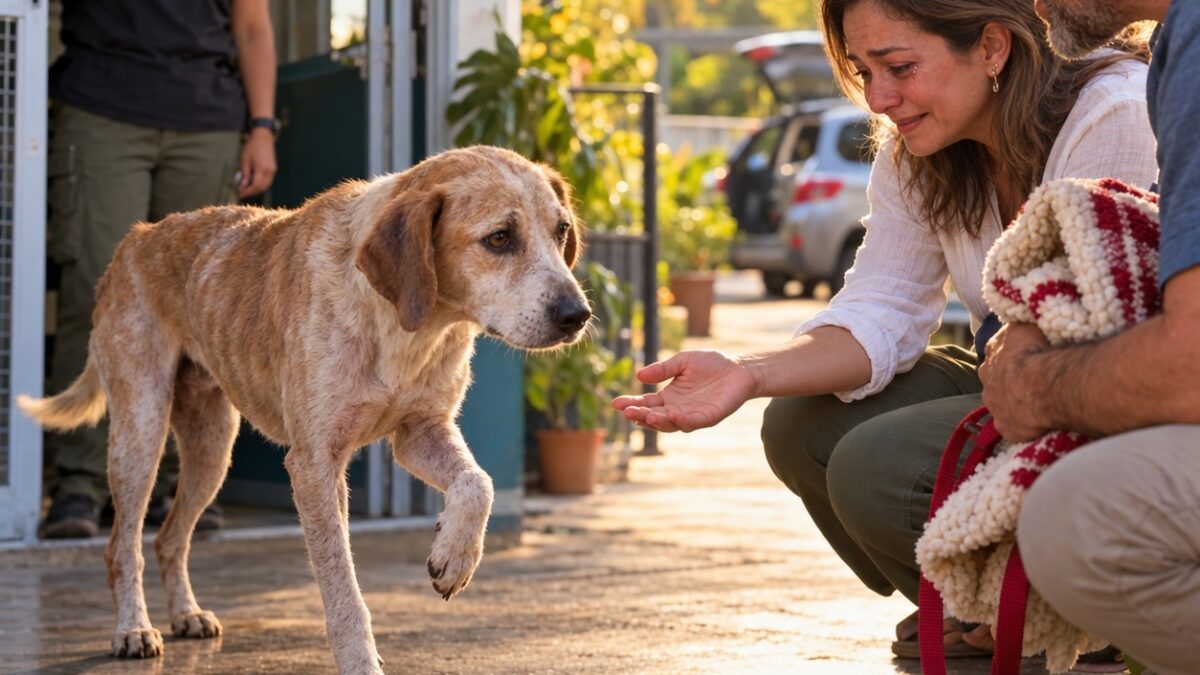
And he was going home.




