PART2:My Husband Made Me Choose Between Him and Our Rottweiler—Four Months Later, I Learned Rocky Had Never Been the Real Problem
PART2
Those three weeks were some of the quietest weeks of my life.
Not peaceful.
Quiet.
There is a difference.
Peace gives you room to breathe.
That house felt as if someone had removed the air.
Rocky’s bowls were gone.
His leash was gone.
His sleeping place was empty.
The yard looked wrong.
I kept hearing sounds that were not there.
The faint movement of paws across the floor.
The collar tag I had grown used to hearing when he changed position.
A breath near my chair.
Once, I opened the back door automatically and stood there waiting before remembering there was no dog to let outside.
I cried after that.
Not dramatically.
I simply stood beside the door with one hand still on the knob and felt ashamed.
Ashamed that Rocky had trusted me.
Ashamed that I had once brought him out of a shelter and somehow delivered him back to one.
Ashamed that I had been the person responsible for proving to him that home was temporary.
Jason did not seem affected.
That hurt too.
At first I told myself he was giving me space.
Then I realized he was simply relieved.
The house was the way he wanted it.
No dog.
No hair.
No leash by the door.
No large body stretched across the floor.
No Rocky.
I tried to adjust.
I worked.
I cooked.
I slept badly.
I told myself marriages required compromise.
That word became almost poisonous to me.
Compromise.
It sounds fair.
Balanced.
Adult.
But compromise only works when both people surrender something.
Jason still had his home.
His routine.
His comfort.
What had he lost?
Nothing.
I had lost Rocky.
And Rocky had lost everything.
Again.
During the second week, I went to see him.
I told myself I only wanted to make sure he was okay.
The shelter was louder than I remembered.
Dogs barking.
Metal doors.
Voices.
Footsteps.
Rocky recognized me.
That is the moment that broke whatever argument I had been using against myself.
He came forward.
Not wildly.
Not angrily.
He simply came to the barrier and looked at me.
Then he raised his paw.
Just as he had the first time.
I put my fingers against the metal.
He pressed closer.
I could not explain to him why I had left him there.
There is no language for that between a person and a dog.
I could not tell him marriage was complicated.
I could not explain that seven years with someone felt too important to abandon over one terrible demand.
I could not tell him I was afraid of starting over.
Rocky knew none of that.
He knew I was there.
Then he knew I was leaving.
Again.
That night, I barely spoke to Jason.
He noticed.
“What’s wrong?”
I looked at him.
“You know what’s wrong.”
He sighed.
“This again?”
This again.
As if grief had an expiration date.
As if three weeks was excessive.
As if Rocky had become an inconvenient topic rather than a living animal who had shared our home for seven months.
I asked Jason whether we could reconsider.
“No.”
“Why are you so absolute about this?”
“Because I’ve made my decision.”
“What if I haven’t?”
He looked at me.
“It’s done.”
That word stayed with me.
Done.
Jason had begun speaking about our life as though he were issuing orders to someone who did not understand that negotiation had ended.
Something changed inside me during the third week.
I stopped asking myself whether choosing Rocky would make me a bad wife.
I started asking why loving my husband required me to become someone I did not respect.
I had promised Rocky safety.
That mattered.
Maybe not in law.
Maybe not to Jason.
It mattered to me.
And more importantly, I started realizing that I did not recognize the woman I had become in those three weeks.
I was constantly anxious.
Careful.
Apologetic.
I measured my words.
I avoided saying Rocky’s name too often because Jason’s face hardened every time.
I started trying to make myself easier to live with.
Quieter.
Less emotional.
Less demanding.
I was grieving a dog I could still save while pretending I had no choice.
Then one evening, I drove past the shelter instead of going home.
I parked.
Did not go inside.
I sat in my car.
For almost an hour.
The answer was already there.
I simply had not admitted it yet.
At the end of the third week, I came home.
Jason was in the kitchen.
I stood near the table.
My hands were shaking.
Not because I did not know what I wanted.
Because I finally did.
“I can’t live like this.”
He looked at me.
“What do you mean?”
“I want Rocky back.”
“No.”
That quickly.
No discussion.
No pause.
“No?”
“He’s not coming back.”
I took a breath.
“Then I’m leaving.”
Jason laughed.
He actually laughed.
That sound changed everything.
There was no shock.
No fear.
No immediate:
Wait.
What are you saying?
No attempt to slow the moment down.
He laughed.
And inside that laugh I heard something I had never clearly heard from him before.
Contempt.
Coldness.
Indifference.
Not simply toward Rocky.
Toward me.
Toward what this decision was costing me.
I stood there and waited for him to say something else.
Anything.
Seven years.
Surely seven years deserved one sentence.
Instead, he looked at me as if I had confirmed something.
That was the strange part.
The expression was not:
My wife is leaving me.
It was closer to:
So this is how it ends.
At the time, I could not explain why that disturbed me.
Four months later, I would.
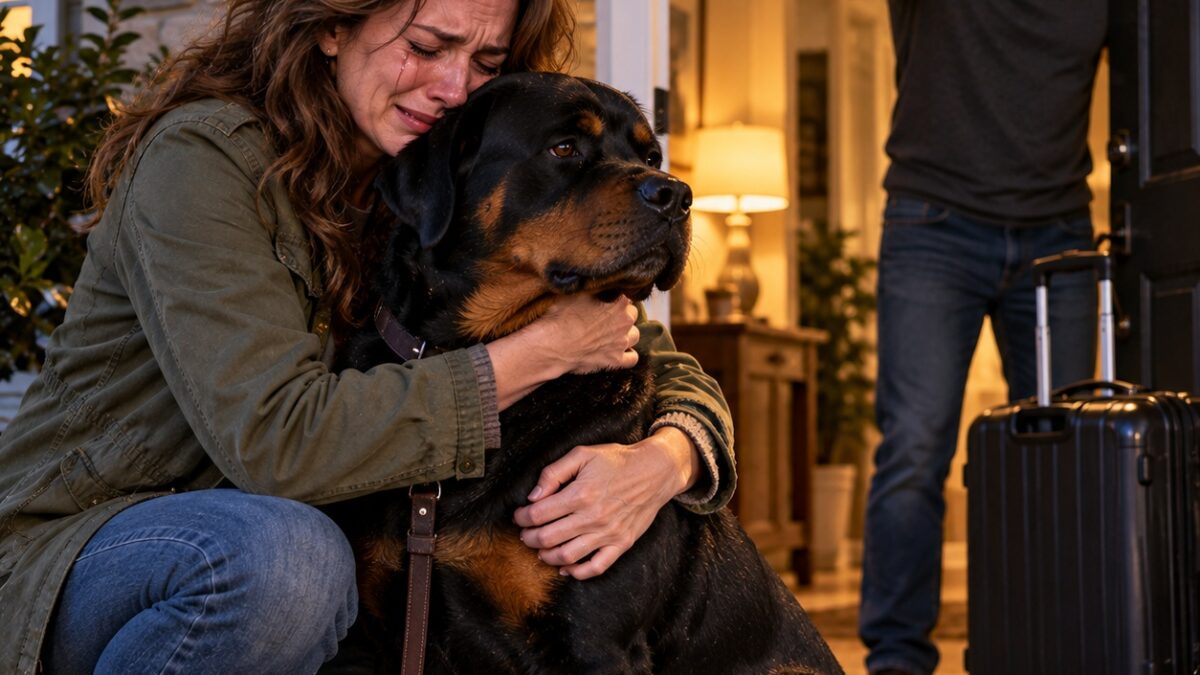
That night, I packed.
Not everything.
You do not compress seven years into a few bags neatly.
Clothes.
Documents.
Things I needed immediately.
The rest could be sorted later.
I cried while I packed.
Of course I did.
Leaving Jason did not suddenly make me stop loving the life I thought we had.
There were birthdays in that house.
Ordinary breakfasts.
Arguments we had survived.
Sunday mornings.
Illness.
Laughter.
Plans.
Photographs.
Furniture selected together.
Seven years does not vanish because one person becomes cruel.
The marriage I believed in was still real to me, even if I had begun realizing it might not have been equally real to him.
That is why leaving hurt.
People sometimes talk about walking away as though clarity eliminates pain.
It does not.
Sometimes clarity makes pain sharper because you finally understand exactly what you are losing.
I was losing my husband.
My house.
My routine.
The future I had assumed was waiting.
But one thing was different.
I was not leaving Rocky.
The next time I stood at the shelter, I was not there to visit.
I was there to bring him back.
Rocky did not ask why it had taken me three weeks.
He did not punish me.
He did not turn away to make a point.
Dogs do not build justice systems around our mistakes.
He recognized me.
He came close.
And when he was finally with me again, I cried into his fur.
Not because everything was fixed.
Nothing was fixed.
I had nowhere permanent to call home.
My marriage was ending.
My life had split open.
But Rocky was not behind the barrier anymore.
That was the first decision I made entirely for myself in a long time.
The first few weeks after leaving Jason were not empowering.
That is another lie people sometimes tell about freedom.
They describe it as immediate lightness.
I felt terrified.
There were practical problems.
Housing.
Money.
Schedules.
Work.
Separation.
Possessions.
People asking what happened.
And then the humiliation of explaining.
Sometimes I said:
“We separated.”
If they pressed:
“Jason didn’t want Rocky.”
Then came the expression.
That tiny pause.
The question people were too polite to ask.
You left your husband over a dog?
I could feel the story forming around me.
The woman who chose a Rottweiler over a seven-year marriage.
It sounded absurd when reduced to one sentence.
Maybe that was why Jason had laughed.
Maybe he knew exactly how it would sound.
At that point, I still thought the separation was exactly what it appeared to be.
A terrible ultimatum.
A marriage breaking because one person refused to tolerate the other person’s dog.
I did not know the deeper truth.
So I carried shame with me.
Maybe I had overreacted.
Maybe another wife would have stayed.
Maybe mature people make harder compromises.
Maybe I had destroyed something permanent because I could not let go.
Whenever those thoughts became too loud, Rocky would come sit beside me.
He did not know he had become evidence in a case I kept arguing against myself.
He was simply there.
That helped.
I found a small place.
Nothing like the house.
Less space.
Fewer rooms.
But Rocky was allowed.
That was enough at first.
We developed routines.
Morning walks.
Work.
Food.
Evenings.
Rocky followed me through the small space like he wanted to make sure I did not disappear.
Perhaps I imagined that.
Perhaps not.
I never wanted him to understand abandonment again.
I promised myself he would not.
The weeks passed.
I began sleeping better.
Work helped.
Friends helped.
Rocky helped most simply by being ordinary.
There is something healing about responsibility when the responsibility is uncomplicated.
Rocky needed food.
Walks.
Attention.
Exercise.
A safe place.
He did not ask me to interpret his silences.
He did not punish me because I loved something he did not.
He did not make me prove loyalty by betraying something else.
He existed honestly.
If he wanted affection, he came close.
If he wanted to rest, he rested.
If he was happy to see me, his whole body admitted it.
There were no strategies.
No emotional puzzles.
I had forgotten how peaceful direct affection could feel.
Four months passed.
By then, I had begun reorganizing my life.
Not completely.
But enough.
I worked.
Cared for Rocky.
Started smiling without forcing it.
I thought less about Jason.
Or maybe I thought about him and refused to let the thoughts stay long enough to hurt.
Then one afternoon, I met a friend at a café.
Ordinary day.
Ordinary conversation.
We talked about work.
People we knew.
Small things.
Then she looked at me differently.
There is a particular expression people wear when they know something about your life that they are not sure they should tell you.
I recognized it immediately.
“What?”
She hesitated.
“I heard Jason has started a new life.”
I took a sip of coffee.
Pretended the sentence did not matter.
“That’s not my concern anymore.”
She looked down.
Then back at me.
“He’s living with a woman.”
My hand stopped.
I did not put the cup down immediately.
I just held it.
“He’s with someone?”
“Yes.”
“How long?”
Another hesitation.
“They’ve been together for several months.”
Everything inside me went still.
“Several?”
She nodded.
Several months.
I began counting automatically.
Not because I wanted to.
Because your mind does that when the number threatens something fundamental.
Four months since I left.
If they had already been together for several months…
Then the beginning reached backward.
Into my marriage.
Into Rocky’s seven months in our house.
Into the weeks before Jason gave me the ultimatum.
I barely heard the rest of what my friend said.
I went home.
Rocky greeted me.
I sat on the floor.
He came beside me.
I put one hand on his neck.
And started thinking.
Really thinking.
Not about whether Jason had moved on quickly.
That would have hurt.
This was different.
I started reconstructing the sequence.
Jason had never loved Rocky.
True.
But he had never hated him either.
For seven months, he had been indifferent.
Sometimes played with him.
Sometimes touched him.
Sometimes smiled.
An indifferent person does not suddenly turn a dog into the defining crisis of a marriage without a reason.
An indifferent person does not wait seven months, then abruptly say:
He goes.
An indifferent person does not say:
“If you love that dog so much, you can live with him separately.”
I remembered the tone Jason had used that night.
At the time, I had heard anger.
Now I listened to the memory differently.
It had not sounded angry.
It had sounded decided.
The voice of someone who had already thought through the ending.
I remembered standing in the kitchen three weeks later.
“I want Rocky back.”
“That’s not happening.”
“Then I’ll leave.”
Then the laugh.
No panic.
No surprise.
No attempt to stop me.
Because what if my leaving had not been the consequence Jason feared?
What if it had been the result he wanted?
The thought made me physically cold.
Rocky rested his head on my lap.
I stared at the wall.
Then the entire structure began collapsing into place.
Jason knew exactly how much I loved Rocky.
He knew I would never be able to live comfortably after returning Rocky to the shelter.
He had watched the bond form.
Seven months.
Long enough for Rocky to become part of my daily life.
Long enough for me to love him enough that losing him would hurt.
Then Jason created an impossible choice.
Dog.
Or husband.
He knew how the story would sound if I left.
She chose the dog over me.
Perfect.
He would not be the husband who left his wife.
He would not have to say there was another woman.
He would not have to admit the marriage was already over for him.
He only had to create a condition he knew I could not accept.
Then wait.
That thought broke something in me that the separation itself had not.
Because an ultimatum given in anger is cruel.
An ultimatum designed as an exit strategy is something else.
It means Jason had turned my love for a living creature into a mechanism.
Rocky was not simply inconvenient.
He had been useful.
Useful because I loved him.
Useful because Jason knew I would eventually choose him.
Useful because my choice would give Jason a clean narrative.
I left.
Jason stayed.
He could tell people:
“She left me because of a dog.”
And somewhere behind that sentence, another woman could enter his life without him ever having to admit what he had actually chosen.
I was furious.
Not the explosive kind of anger that makes you throw things.
The kind that sits behind your ribs and makes every old memory feel contaminated.
Seven years.
Had I lived seven years with a man capable of planning something like that?
How long had he been emotionally gone?
When had he met her?
Had he been seeing her while he played with Rocky in the yard?
While I cooked dinner?
While I believed our marriage was simply going through a tense period?
Had he smiled at Rocky while already thinking:
You may solve my problem for me?
I did not know.
The source of my pain was precisely that I could not know every detail.
I knew only what the timeline now suggested.
Jason was living with another woman.
They had been together for months.
Long enough that their relationship appeared to have begun before mine had fully ended.
That was enough.
I thought about calling him.
My phone was beside me.
I picked it up.
Then put it down.
What would I ask?
“Did you use Rocky to make me leave?”
Would he admit it?
Probably not.
Would denial change the timeline?
No.
Would hearing his voice give me peace?
No.
I looked down at Rocky.
He was asleep.
Head across my legs.
Completely unaware that he had just become the missing piece in the story of my marriage.
For a while, I was angry at him too.
Not Rocky.
Jason.
Angry that he had manipulated the thing I loved most purely because he knew it would work.
Angry that I had spent four months wondering if I had destroyed my marriage over a dog while Jason apparently moved directly into the life he had already prepared.
Angry that he had allowed me to become the villain in my own memory.
The unreasonable wife.
The woman who walked out.
The one who chose an animal over a man.
But then another thought came.
Slowly.
If Jason had wanted to leave and had simply told me the truth, what would I have done?
Would I have gone?
Maybe.
Would I have begged him to stay?
Maybe.
Would I have fought for the marriage?
Almost certainly.
That realization hurt.
Because I knew myself.
I had been afraid of life without him.
Seven years creates inertia.
Even unhappy familiarity can feel safer than unfamiliar freedom.
I might have stayed much longer than I should have.
I might have accepted emotional distance.
Coldness.
Half-love.
A husband whose heart had already gone somewhere else.
I might have spent months or years trying to repair something Jason had no interest in repairing.
But Rocky made staying impossible.
Not intentionally.
Rocky did nothing except exist and be loved by me.
Jason used that love against me.
Yet the result was that I left.
I got Rocky back.
I built another life.
I was beginning to smile again.
That realization did not make what Jason did acceptable.
Manipulation does not become kindness because the victim eventually benefits.
But the outcome belonged to me now.
Jason may have wanted me gone.
Fine.
I was gone.
What he had not controlled was what I became afterward.
I put my hand on Rocky’s head.
For the first time since my friend told me about the other woman, I stopped thinking about Jason.
I thought about myself.
Who had I been during the marriage?
When had I started making myself smaller?
Had the dog truly been the first time Jason demanded that I sacrifice something important to make his life easier?
Or merely the first time the sacrifice was so clear I could not pretend it was compromise?
Memories began changing shape.
Comments I had dismissed.
Moments when my preferences became inconvenient.
Times I apologized simply to end tension.
Ways I had learned to read Jason’s moods before expressing my own needs.
Nothing as dramatic as the Rocky ultimatum.
That was why I had missed the pattern.
You do not always notice yourself disappearing when it happens a millimeter at a time.
Rocky forced the distance to become measurable.
Stay and lose him.
Leave and keep him.
For once, there was no gray.
Maybe that was why Jason chose Rocky.
He knew gray had kept me there.
He needed black and white.
And he knew exactly which side I would eventually choose.
That night, I sat beside the window.
Rain slid down the glass.
Rocky lay at my feet.
I could not sleep.
I thought about him at the shelter.
His paw against the barrier.
The way he had waited.
I thought about the first time I brought him home.
Seven months of ordinary life.
Jason occasionally throwing a toy.
Sometimes touching him.
Once smiling as Rocky ran through the yard.
At first those memories had reassured me.
Jason had not always hated him.
Now they became disturbing for another reason.
If Jason had already begun wanting out of the marriage, how difficult was it to play normal?
Was he waiting?
Waiting for Rocky to become important enough?
Waiting until he knew the ultimatum would work?
I could not prove every thought.
I knew that.
Pain can turn suspicion into certainty if you let it.
So I kept returning to what I actually knew.
Jason had been indifferent to Rocky for months.
Then suddenly demanded he leave.
He explicitly told me I could live separately with the dog.
When I finally said I would leave, he laughed instead of trying to stop me.
Four months later, he was living with another woman whom my friend said he had been with for several months.
Those facts were enough.
Whatever exact conversation Jason had with himself before the ultimatum, the marriage I thought I was protecting during those three weeks had not been what I believed.
That realization hurt more than leaving.
Because separation takes away a future.
Betrayal rewrites the past.
I began questioning memories that had once felt safe.
Was he distracted because of work?
Or her?
Was that late night really late work?
Did he stop touching me because he was tired?
Or because emotionally he had already left?
Did he insist Rocky was the issue because the dog actually bothered him?
Or because Rocky was the only pressure point he knew would force action?
There is no peace in endless reconstruction.
I learned that quickly.
You can spend all night reopening old memories and never reach certainty.
Eventually I looked at Rocky and understood something.
Jason had already taken seven years.
I was not going to give him every memory after leaving too.
The truth I needed was simpler.
He had not been honest.
He had chosen manipulation over truth.
Whatever else remained unknowable, that was enough.
I did not call him.
Not that night.
Not the next morning.
I did not need a confession to begin healing from what I understood.
Over the following weeks, anger changed.
At first it felt like fire.
Then like grief.
Then something closer to clarity.
I stopped saying:
I left my husband because of a dog.
That sentence was never true.
I left because my husband demanded that I betray something I loved in order to remain acceptable to him.
I left because when I told him I could not live that way, he showed no interest in finding another way.
I left because the marriage had already become a place where my love could be weaponized against me.
Rocky was not the cause.
Rocky was the line Jason chose to cross.
That distinction changed everything.
I began forgiving myself.
Not Jason.
Myself.
For taking three weeks.
For leaving Rocky at the shelter.
That guilt had been the hardest thing to carry.
Every time I remembered his paw against the bars, I hated myself a little.
But I was beginning to understand why I had hesitated.
I had been trying to save seven years.
People do not walk away from seven years easily when they still believe both people are inside the marriage.
I did not know Jason had apparently already started building something elsewhere.
I had made the best decision I could with incomplete truth.
Then, when I could no longer live with that decision, I corrected it.
Rocky came home.
I left.
That mattered.
Maybe Rocky had forgiven me the second I returned.
I was the one who took longer.
One afternoon, I was sitting on the floor with him when he placed his paw on my leg.
The exact gesture reminded me of the shelter.
I cried.
Rocky looked concerned.
Then moved closer.
I buried my face against his neck.
“I’m sorry.”
He did not understand the words.
That was fine.
I needed to say them.
“I’m sorry I left you there.”
Rocky stayed beside me.
No judgment.
No calculation.
No punishment.
I thought about how different love felt with him.
People romanticize dogs because they say dogs love unconditionally.
I do not know whether love is truly unconditional.
Dogs have needs.
Fears.
Preferences.
But Rocky’s affection was honest.
That was what mattered.
If he was happy to see me, I knew.
If he wanted distance, I knew.
If he was frightened, I knew.
There was no secret plan hidden inside a wagging tail.
No emotional chess.
No sentence designed to make me choose one pain over another.
With Rocky, relationship was direct.
I had forgotten how valuable that was.
Months continued passing.
The small place I had first moved into started feeling like mine.
I bought things for it.
Not expensive things.
Things I chose without imagining whether Jason would like them.
A lamp.
A chair.
Curtains.
Plants.
Rocky claimed an area near the window.
I began calling it his spot.
Work improved.
Maybe because I could concentrate again.
I found myself laughing with coworkers.
Friends began inviting me places without watching me carefully for signs I was going to break down.
The first time I went an entire day without thinking about Jason, I did not realize it until the next morning.
That felt monumental.
Then two days.
Then a week where thoughts of him appeared only briefly.
Healing is strange.
You expect a ceremony.
Instead, one day you realize a person who once occupied nearly every thought has been reduced to a few minutes.
Four months after the café conversation, I could think about Jason and the other woman without feeling physically sick.
I still did not know her name.
That became symbolic to me.
For a while, I wanted to know everything.
Who was she?
Where had they met?
When exactly had it started?
Had she known he was married?
Did she know about Rocky?
Did she know what Jason had done?
Then I realized her name would not change anything.
She was not the person who had promised honesty to me.
Jason was.
I refused to build a new obsession around a woman I had never met.
Sometimes I wondered what he told her.
Maybe:
“My wife left me because of her dog.”
That version probably made him sound wounded.
Maybe he believed it himself.
People are remarkably good at editing their own behavior until they can remain innocent in their memory.
Perhaps he told her Rocky was dangerous.
Or impossible.
Or that I valued the dog more than the marriage.
Maybe he omitted the weeks of pressure.
Maybe he omitted the laughter.
Maybe he omitted the fact that he was apparently already moving toward her before I left.
I could not control his story.
For seven years, I had spent too much time worrying about how Jason interpreted me.
I was not going to keep doing it after separation.
My story was mine.
I loved Rocky.
Jason demanded he leave.
I tried to stay.
I could not.
I left.
Then I discovered the marriage had likely been ending behind my back before the ultimatum ever arrived.
Those were my facts.
Enough.
Eventually I learned Jason and the woman were still together.
Someone mentioned it casually.
I surprised myself with my reaction.
Almost nothing.
No jealousy.
No urge to compare.
I hoped he was happy.
I genuinely did.
Not because I had become saintly.
Because his happiness no longer threatened mine.
That is a form of freedom nobody warns you about.
At first, you think freedom means getting away from the person.
Later, you realize freedom means their life stops determining your emotional weather.
Jason could be happy.
Unhappy.
Married again.
Single.
I could not build my peace around any of it.
Sometimes I thought about the woman.
Not with hatred.
With concern.
Did she know?
Did she understand how Jason handled relationships when he wanted out?
Did she know he had apparently preferred engineering an ultimatum over telling his wife the truth?
I wondered whether one day she would find herself in a similar position.
Not involving a dog.
Something else.
A friendship.
A job.
A family member.
Some part of herself Jason knew she could not surrender.
Would he use that too?
I hoped not.
I did not wish my pain on her.
That surprised some people.
A friend once said:
“You’re nicer than me. I’d hope he does the same thing to her.”
I shook my head.
“Why?”
“So she understands.”
“She doesn’t need to suffer for me to be right.”
That sentence came out before I had thought about it.
But it was true.
I did not need another woman to be hurt to validate what happened to me.
If she knew everything and accepted it, that was her choice.
If she knew nothing, I hoped she saw sooner than I had.
Either way, my responsibility ended with my own life.
A year passed.
One whole year.
By then, I lived in a small apartment filled with light.
Morning sunlight came through the windows in a way the old house never allowed.
The place was smaller.
Much smaller.
I loved it.
Rocky loved it too.
Or at least he loved the routines that happened inside it.
I had a job I genuinely enjoyed.
Friends who valued me.
My own decisions.
My own schedule.
Rocky.
He had become family in every sense that mattered.
My home.
My heart.
Not because I needed him to replace Jason.
Rocky was not a substitute husband.
He was the creature whose presence had accidentally forced me to see what kind of life I had been accepting.
That was different.
Sometimes people heard the story and said:
“Rocky saved you.”
I understood what they meant.
But Rocky had not planned anything.
He did not rescue me deliberately.
He simply existed honestly enough that Jason’s dishonesty became impossible to ignore.
That was Rocky’s gift.
He gave me a boundary I could finally recognize.
I could tolerate being underappreciated myself for a long time.
I could make excuses.
Compromise.
Wait.
Hope.
But when somebody demanded that I abandon a creature depending on me, I could see the cruelty more clearly.
Maybe because Rocky could not rationalize it for me.
He could not tell me:
Jason is stressed.
Jason has needs too.
Marriage takes sacrifice.
Rocky simply waited behind metal bars.
That image stripped away every excuse.
I realized love cannot mean tolerating everything another person asks of you.
Love does not mean sacrificing whichever parts of yourself become inconvenient.
Love does not mean proving loyalty through pain.
Love does not require becoming smaller so somebody else can remain comfortable.
Those lessons came slowly.
Rocky did not teach them by doing anything extraordinary.
He stayed.
That was enough.
Jason had shown me another lesson too.
A harder one.
Some people do not leave honestly.
They create conditions that force you to leave for them.
Then they tell themselves they were abandoned.
They do it because being direct requires admitting:
I no longer want this.
I want someone else.
I have changed.
I am hurting you because I am choosing myself.
That truth makes them the actor.
Manipulation allows them to remain the victim.
Jason could point toward Rocky.
“She chose the dog.”
So clean.
So convenient.
It took me months to understand that the person presenting the ultimatum had made the first choice.
Jason chose manipulation.
I chose what to do in response.
Those are different decisions.
That realization erased the last piece of shame.
I had not destroyed the marriage.
By the time I left, whatever marriage I believed I was protecting had already been hollowed out by truths Jason was not sharing.
Rocky simply gave me a reason to walk through the opening.
One rainy night, almost exactly a year after everything began, I sat beside my apartment window.
The scene reminded me of the night I first learned about Jason’s new relationship.
Rain sliding down glass.
Rocky at my feet.
But I was different.
That first night, I had replayed every memory looking for betrayal.
Now I watched the rain and felt quiet.
Real quiet.
Peace.
I looked around.
This apartment had none of the furniture from my old married life except a few things I had chosen to keep.
No room carried seven years of tension.
Nothing belonged to a version of me trying to save something alone.
This space had been assembled after.
By me.
I could look at every corner and remember making a choice.
Where Rocky slept.
Which curtains.
Which table.
Which pictures.
Small things.
Freedom becomes real through small things.
The freedom to arrange a room without negotiating.
To come home late without explaining.
To spend Saturday walking with Rocky.
To say no.
To say yes.
To change my mind.
To miss Jason without calling him.
To remember him without wanting him back.
To love the past without returning to it.
That was freedom.
Not running.
Living.
I began understanding something I had not understood while married.
Home is not the building where your marriage happens.
It is not the address printed beside both names.
Home is the place where you are not required to betray yourself to remain welcome.
That old house had stopped being home before I physically left.
I simply had not known.
My apartment was smaller.
Rocky took up an unreasonable amount of floor.
There were days his toys seemed to multiply overnight.
I tripped over them.
Complained to him.
He ignored me.
Home.
That morning, a year after the separation, we went walking.
The sky was clear after rain.
Sunlight everywhere.
Birds loud in the trees.
Grass wet.
Rocky ran ahead when it was safe to do so.
Tail high.
Eyes bright.
Alive in the uncomplicated way dogs are alive when the moment is good.
I watched him.
And smiled.
Not because I had defeated Jason.
There was no competition left.
Not because I had proven the marriage meaningless.
It had mattered.
Seven years mattered because I had lived them.
I smiled because I finally understood something I wanted never to forget.
Sometimes the hardest decision is the right one.
Sometimes the separation that feels like your life collapsing is the opening through which your actual life begins.
Sometimes the creature someone tells you is destroying your home is the one who reveals the place was no longer home at all.
Rocky stopped.
Turned toward me.
That expression dogs have.
Mouth slightly open.
Eyes fixed on the person they recognize as theirs.
I thought about the shelter.
His paw against the metal.
Waiting.
The first time.
Then the second.
I thought about my three weeks without him.
I would probably always regret those weeks.
But regret did not have to become self-punishment.
I went back.
That mattered.
Rocky had been waiting.
I chose him.
Then I learned something I did not expect.
In choosing Rocky, I had finally chosen myself too.
Not against Jason.
For myself.
For a life in which love did not come with traps.
For a home where nobody laughed when I said I was hurting.
For a future where another person’s secret plans did not define my choices.
Jason had believed he knew exactly what I would do.
He had been right.
He knew I would choose Rocky.
What he could not know was what that choice would eventually give me.
A new life.
Friends.
Work I loved.
A bright apartment.
Peace.
Freedom.
Myself.
I sometimes wonder whether Jason ever understood that.
Probably not.
Maybe he still tells the story the same way.
My wife chose a dog over me.
If he does, let him.
I no longer need to correct him.
People who know me know the rest.
I know the rest.
Rocky certainly does not care.
Truth does not always require the person who hurt you to agree with it.
That may be one of the final lessons.
Jason can believe whatever protects him.
I am still free.
Sometimes I think about the woman he lives with.
I hope she is happy.
I mean that.
I hope Jason is honest with her in ways he was not with me.
I hope she never has to discover that the conflict she thought was about one thing was actually somebody else’s exit strategy.
I hope she sees the person in front of her clearly.
And if she does not, I hope she finds her own Rocky.
Not necessarily a dog.
A person.
A friendship.
A dream.
A piece of herself she refuses to abandon.
Something that makes the line visible.
Something that teaches her what real love does not ask us to destroy.
Because Rocky was never only a dog in the story of my marriage.
He became the thing that revealed the truth.
Jason knew I loved Rocky enough to leave.
What neither of us understood was that I needed something I loved enough to remind me I was allowed to leave.
That is why, if I could go back, I would not change the ending.
I would change the three weeks.
I would spare Rocky the shelter.
I would spare myself that guilt.
But I would still walk away from Jason.
I would still take Rocky.
I would still choose the unknown life over the familiar one that required me to abandon him.
I know that now.
Freedom does not mean escaping everything painful.
It means no longer allowing fear to decide where you stay.
For years, fear had been invisible in my marriage.
Fear of starting over.
Fear of being alone.
Fear of admitting seven years had not become what I hoped.
Fear of people judging me.
Fear of being the woman who failed at marriage.
When Jason created the Rocky ultimatum, those fears became weaker than one stronger truth.
I could not leave Rocky there.
That was enough.
One clear truth can sometimes pull you through years of confusion.
Rocky was mine.
I had promised him home.
If keeping that promise cost me a husband who could laugh while I packed, then maybe the marriage had already cost too much.
It took me a year to say that without crying.
Now I can.
Sometimes Rocky sleeps with his head against my leg while I work.
Sometimes I stop and look at him.
He is older than the dog I first saw behind shelter bars.
So am I.
There is something comforting about that.
We survived the same turning point differently.
Rocky lost a home briefly and got it back.
I lost what I thought was home and learned how to create one.
He taught me the difference without knowing any of it.
Dogs do not give lectures.
They do not explain philosophy.
They live truthfully enough that sometimes we see ourselves more clearly beside them.
Rocky wanted safety.
Affection.
Food.
My presence.
Nothing hidden.
Jason had wanted freedom but apparently did not want to accept responsibility for choosing it.
So he manufactured a choice for me.
Maybe that is why Rocky’s simplicity became so powerful afterward.
One relationship had been full of hidden motives.
The other had none.
Rocky looked at me because he loved being near me.
That was it.
No strategy.
No exit plan.
No need to win the story afterward.
I began valuing directness differently.
If friends hurt me, I spoke.
If I did not want something, I said no.
If I needed help, I asked.
I stopped believing honesty was cruel.
Jason had shown me the cruelty of avoiding honesty.
A truthful ending can hurt.
A manipulated ending hurts twice.
First because the relationship ends.
Then because you realize you were maneuvered into carrying responsibility for someone else’s choice.
I would rather hear:
I do not love you anymore.
I met someone else.
I want to leave.
Those sentences would have devastated me.
But they would have respected my reality.
Instead, Jason hid behind Rocky.
That was what I could never fully excuse.
Not that he stopped loving me.
People change.
Not even that there was another woman.
Betrayal hurts, but human beings fail.
What stayed with me was that he used my compassion as the weapon.
He knew I could not abandon Rocky permanently.
He built the exit around the best part of me.
That was cruel.
But he did not get to own the result.
That compassion became the thing that saved me.
Maybe that is why I no longer feel bitterness.
Jason used something good in me badly.
He did not make it bad.
I still love deeply.
I still trust.
I still believe commitments matter.
Rocky did not teach me to become hard.
He taught me boundaries.
There is a difference.
Hardness says:
Nobody gets close.
Boundaries say:
You can come close, but you cannot require me to disappear.
I wish I had understood that seven years earlier.
But life rarely gives lessons before we need them.
It gives them while we are bleeding.
Then asks whether we will use them.
I did.
My life now is not spectacular.
That may be my favorite thing about it.
I work.
I come home.
I see friends.
I walk Rocky.
Sometimes we sit near the window.
Sometimes I read.
Sometimes the apartment is messy.
Sometimes I worry about money.
Sometimes I miss things from my old life.
Healing did not turn me into someone who never feels sadness.
I can miss the woman I used to be.
I can even miss parts of Jason.
The man who laughed with me on certain mornings.
The man I believed would grow old beside me.
Memory does not have to become all good or all bad.
I can acknowledge that some moments were real to me.
And still know I would never go back.
That is maturity I did not have during the separation.
At first, I needed Jason to become entirely monstrous so leaving would feel justified.
Then I learned I did not need that.
He could have good qualities.
We could have had real happiness.
He could still have treated me in a way I should not accept.
Both can be true.
The marriage did not need to have been seven years of lies for the ending to be unacceptable.
I only needed the truth of what happened.
That gave me enough.
Rocky, meanwhile, never cared about any of these philosophical distinctions.
He cared whether we were going outside.
That helped.
There is nothing like a Rottweiler staring at you with absolute expectation to interrupt emotional overanalysis.
I could be sitting there thinking about betrayal, manipulation, identity, and healing.
Rocky would stand near the door.
Walk.
Fine.
Life continues.
That may be another reason dogs help people survive loss.
They keep time differently.
You can grieve yesterday.
The dog still needs today.
A walk.
Water.
Food.
Touch.
Today leads to tomorrow.
Eventually you realize you arrived there too.
One day after a walk, I sat on a bench while Rocky rested near me.
A woman passed.
She smiled at him.
“He’s beautiful.”
“Thank you.”
“Friendly?”
“Yes.”
She asked if she could pet him.
I said yes.
Rocky accepted the attention like a celebrity who had expected fans.
I laughed.
Then I remembered how close I had come to allowing Jason to erase Rocky from my life permanently.
The thought still hurt.
But now it also made me grateful.
Not for Jason’s ultimatum.
For my eventual answer.
“No.”
It had taken me three weeks to say it.
I wished it had taken three seconds.
But I said it.
That is what mattered.
People who have survived manipulative relationships often punish themselves for not leaving sooner.
I understand why.
Looking backward gives you knowledge your earlier self did not possess.
Everything seems obvious afterward.
Why did I stay?
Why did I return Rocky to the shelter?
Why did I beg Jason to reconsider?
Why did I not understand the laugh?
Because I did not know what I know now.
That woman deserved compassion too.
She was trying to protect her marriage.
She thought the man beside her was participating honestly.
She was wrong.
Being wrong is not the same as being stupid.
I wish I could tell her that.
Maybe I do every time I forgive myself.
Rocky forgave without needing the explanation.
That still moves me.
The first nights after I brought him back, I sometimes woke and checked that he was there.
Ridiculous.
He was huge.
Not easy to misplace.
But I would look anyway.
Sleeping.
Home.
The sight calmed me.
Perhaps I needed reassurance as much as he did.
I had chosen something permanent.
Not the apartment.
Not yet.
The promise.
Rocky would not be returned again.
Whatever happened next, we would figure it out together.
That promise became the foundation of my new life.
Not because every person needs a dog.
Because everyone needs one commitment to themselves that does not move every time someone else becomes unhappy.
Mine happened to have four paws.
A year after leaving Jason, I understood why the word home had changed for me.
Before, home had been shared property.
Marriage.
Familiar objects.
Our routines.
Now home was a condition.
A place where I did not have to earn my right to stay by surrendering someone I loved.
A place where disagreements did not turn into emotional traps.
A place where my needs existed without apology.
A place where Rocky could sleep without somebody resenting his presence.
A place where I could breathe.
That small apartment became more home than the larger house ever had.
Not because it was prettier.
Because it was mine in the deeper sense.
I created the life happening inside it.
I chose who entered.
I chose what stayed.
That is freedom.
Not being free from Jason.
Being free to choose.
Free to love.
Free to make a mistake.
Free to correct it.
Free to build a life nobody else had secretly planned for me.
One morning, Rocky and I walked through wet grass after an overnight rain.
Sunlight was coming through the trees.
Birds everywhere.
Rocky ran ahead.
Stopped.
Looked back.
Tail high.
For one second, I saw every version of him at once.
Rocky behind shelter bars.
Paw against the metal.
Rocky in our old yard.
Rocky gone.
Rocky waiting three weeks.
Rocky coming back with me.
Rocky in the first small place after I left.
Rocky beside me when I learned the truth.
Rocky now.
Happy.
Safe.
Home.
I smiled.
Rocky looked at me the way dogs do when they have absolutely no idea why their human has suddenly become emotional.
Then he continued running.
I laughed.
And that was when I finally understood the ending of the story.
I had spent months believing the important choice was:
Jason or Rocky.
It never was.
The real choice had been:
Continue living inside a relationship where somebody else could decide which parts of me were acceptable.
Or leave and discover who I was when I stopped negotiating myself away.
Rocky was simply where the truth became visible.
Jason may have known I would choose him.
Maybe that was the plan.
But Jason misunderstood what would happen after.
He thought I would walk away as the woman who chose a dog over her husband.
Instead I became a woman who learned that love without respect is not enough.
I learned that loyalty does not require self-betrayal.
I learned that a person who loves you does not deliberately create pain so they can avoid responsibility.
I learned that honesty, even painful honesty, is kinder than manipulation.
I learned that leaving can hurt and still be correct.
I learned that home can be rebuilt.
I learned that freedom can have a dog sleeping on the floor.
I stopped walking.
Rocky turned again.
I looked at him.
He looked at me.
That simple exchange.
No hidden meaning.
No manipulation.
No demand.
I remembered something I had thought during that rainy night months earlier.
Rocky would never use me.
He would never create a trap and call it a choice.
He would never pretend to love something simply because it served an exit plan.
He would love in the way he knew how.
Directly.
Fully.
Without strategy.
That was what I deserved from the human relationships in my life too.
Not dog-like obedience.
Honesty.
Respect.
Presence.
I had spent seven years confusing endurance with commitment.
Now I knew better.
Sometimes commitment means staying.
Sometimes commitment to yourself means leaving.
Sometimes choosing the dog is not really choosing the dog.
Sometimes it is choosing the part of yourself another person hoped you would abandon.
I walked toward Rocky.
He came back to meet me halfway.
I put my hand on his head.
“Come on.”
We went home.
Our home.
The small bright apartment.
The place where his toys covered too much floor.
The place where I worked and laughed and sometimes still cried.
The place no one could make Rocky leave.
The place no one could make me leave myself behind either.
Jason had wanted freedom badly enough to manipulate me into giving it to him.
In the end, he gave me freedom too.
Not intentionally.
Not kindly.
But I took it.
Made it mine.
And I would never give it back.
If Jason had not been there, perhaps I never would have learned how much of myself I was willing to sacrifice to preserve a familiar life.
If Rocky had not been there, perhaps I never would have found the line I could not cross.
I would not change the ending.
I would not trade this life for the old one.
I would not trade Rocky for the marriage.
I would not go back to the woman who mistook staying for proof that love was working.
I hope Jason found whatever he was looking for.
I hope the woman beside him never has to learn his patterns the way I did.
I hope she sees clearly.
I hope she is treated honestly.
And if she is ever forced into a false choice, I hope she finds the courage to choose herself.
I no longer need Jason to regret losing me.
That may be the greatest freedom of all.
His regret would not improve my mornings.
His apology would not make Rocky more loved.
His loneliness would not make my apartment brighter.
His guilt would not give me back seven years.
My happiness cannot depend on his suffering.
So I let him go.
Really let him go.
Not only physically.
From the argument inside my head.
He does not get another hearing.
No closing statement.
No verdict.
The case is over.
I have Rocky.
I have my work.
I have friends.
I have my small home.
I have myself.
That is more than enough.
Rocky and I reached the apartment after our walk.
I opened the door.
He went inside first.
Of course.
He turned once in the living room, found his place, and settled down like the apartment had been built around him.
I stood in the doorway for a moment.
Sunlight stretched across the floor.
Rocky looked up.
And suddenly I remembered the shelter one final time.
Metal barrier.
His paw.
Waiting.
Back then, I thought I was rescuing him.
I understand now that rescue is rarely one-directional.
Rocky never planned to save me.
He never knew my marriage needed saving from itself.
He never knew Jason’s ultimatum would become the decision that changed my life.
Rocky simply needed someone to keep a promise.
Keeping that promise forced me to keep another one I had not realized I had broken.
The promise to myself that love should never require me to disappear.
I stepped inside.
Closed the door.
Rocky’s tail moved against the floor.
Home.
Finally.
Not the home Jason and I had built.
Not the house I once thought losing would destroy me.
The home I created after everything broke.
The home where I was free.
The home where I was loved.
The home where Rocky belonged.
The home where I belonged too.
And that was enough.
More than enough.
It was everything.




