PART2:My Brother Disappeared After Leaving the Airport—His Dog Waited at Those Doors for Three Months Until One Call Changed Everything
PART2
At first, I thought Charlie would eventually give up.
I do not mean that cruelly.
I hoped he would.
I hoped some instinct would tell him the airport was not home.
That hunger, exhaustion, weather, routine—anything—would loosen the invisible thread tying him to those glass doors.
But Charlie did not think of the airport as home.
That was the part I failed to understand.
He thought of it as the place where the story had not finished.
My brother had walked through those doors.
Therefore, Charlie waited for him to walk back.
It made perfect sense in the language of a dog.
People tried to help.
The security guard learned Charlie’s name.
The woman from the café started setting aside scraps she thought he might eat.
A man from the night shift checked on him during the hours when almost nobody else was around.
Airport employees who had once stepped around him began stopping.
“Still here?”
“Yes.”
“How long now?”
“Twenty-three days.”
Then thirty-one.
Then forty.
The number became painful.
I stopped counting aloud.
Charlie did not count at all.
Every morning was simply another morning my brother had not returned yet.
Every evening was another evening in which return remained possible.
I envied that simplicity.
Humans make absence complicated.
We create theories.
We imagine worst cases.
We replay conversations.
We search for signs we missed.
We ask whether somebody left willingly.
Whether they are safe.
Whether they think about us.
Whether there was anything we could have done differently.
Charlie had one question.
Is he coming through the door?
If the answer was no, he kept waiting.
There were days I tried to take him farther away.
Not because I wanted to separate him from my brother.
Because watching him slowly organize his entire existence around a set of automatic glass doors was breaking something inside me.
I could get him to walk.
A little.
He would eat if I stayed near him.
He drank.
He rested.
But whenever we moved too far from the terminal entrance, he became uneasy.
He turned back.
Pulled toward the building.
Looked over his shoulder.
The first time I tried to take him home for the night, he resisted so strongly that I stopped.
Not violent resistance.
No growling.
No snapping.
Something worse.
Panic.
His body lowered.
His paws seemed to root themselves to the ground.
His eyes stayed on the terminal.
I realized what I was asking him to do.
Leave the last place my brother existed.
What if my brother returned while Charlie was gone?
What if those doors opened and the person he had waited for stepped outside and Charlie was not there?
Dogs do not understand that humans can leave messages.
That employees could call me.
That I could return him later.
For Charlie, presence was the message.
So he stayed.
I adapted instead.
We made the space around him safer.
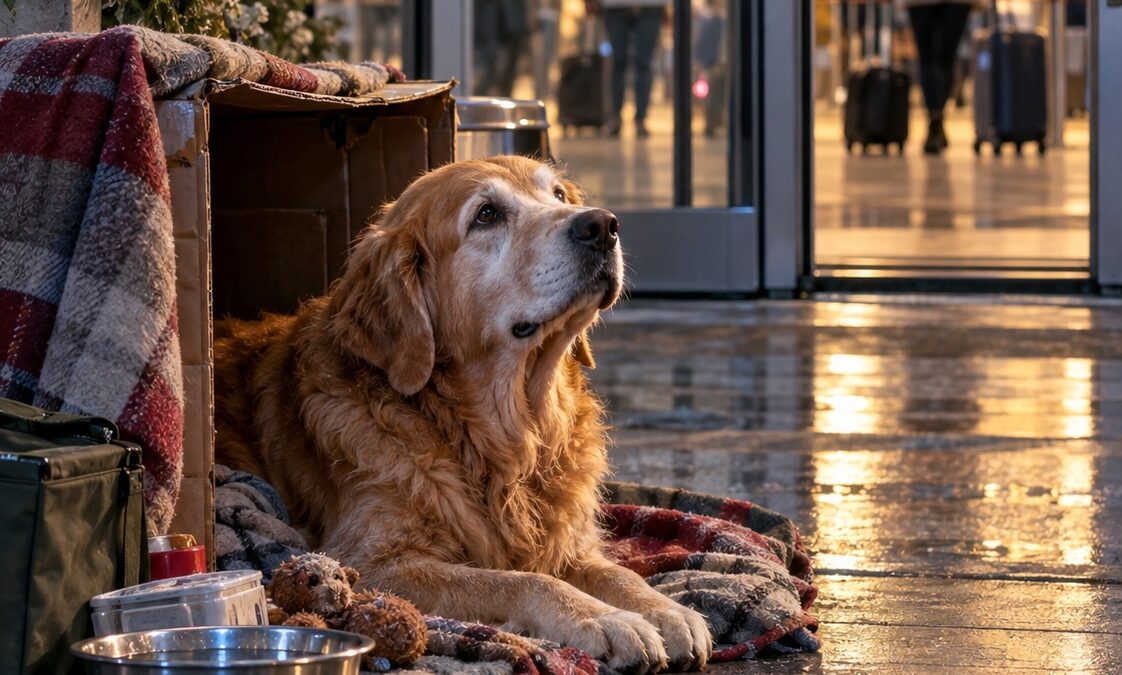
The cardboard shelter was reinforced.
Blankets changed.
Food brought regularly.
Water kept clean.
Airport employees watched.
I visited constantly.
The parking lot became part of my life.
I learned which flights arrived at which times without trying.
I learned the rhythm of airport doors.
The surge of people after a large arrival.
The quiet gaps.
The taxis.
The buses.
The rolling suitcases.
The sound of announcements drifting through whenever the doors opened.
And always Charlie.
Sometimes sleeping.
Sometimes curled tightly inside his shelter.
Sometimes lying with his head between his paws.
But if the atmosphere changed, he knew before I did.
A cluster of passengers approaching.
A certain sound.
The door sliding open.
Charlie’s head came up.
He watched.
I started watching too.
That was the strangest part.
I knew logically that my brother could not simply appear without anyone telling us.
I knew there would probably be a call.
A message.
Some warning.
But Charlie’s hope became contagious.
Every time he stood, part of me stood emotionally with him.
Maybe.
Maybe this time.
Then strangers came through.
Charlie lowered himself again.
I would look away.
There are only so many times a person can watch hope rise and collapse before it starts hurting physically.
Charlie seemed able to endure it.
Or maybe I was wrong.
Maybe his silence was not endurance.
Maybe dogs break quietly.
That thought kept me awake.
At home, everything reminded me of my brother.
His things.
Photographs.
Old messages.
His chair.
The places where conversations had once happened without anyone realizing they would become memories.
But the airport hurt differently.
Home contained the person he had been.
The airport contained possibility.
That was why I kept returning.
I told myself it was for Charlie.
Partly true.
But Charlie gave me permission to keep believing something I was afraid to believe on my own.
He still waited.
So maybe I could too.
People began asking questions.
Friends.
Relatives.
“What are you going to do about the dog?”
I hated that phrasing.
As if Charlie were a problem that needed solving.
“I’m taking care of him.”
“You can’t let him stay at the airport forever.”
“I know.”
“Then take him home.”
“I’ve tried.”
“He’ll adjust.”
Maybe.
But forcing Charlie away felt like asking him to accept a conclusion I had not accepted myself.
My brother was still gone.
There was no body.
No goodbye.
No certainty.
Only absence.
How could I tell Charlie to stop waiting when some part of me was doing exactly the same thing?
So days passed.
I brought him things.
Sat beside him.
Sometimes talked.
I did not know whether he understood my words.
I told him about my brother anyway.
“Remember when he tried to teach you not to steal socks?”
Charlie looked toward the doors.
“He failed.”
Nothing.
“You were terrible.”
Maybe an ear moved.
I laughed.
Then cried.
That became normal.
Laughter and tears arriving too close together.
I told Charlie:
“He loved you.”
That sentence always felt dangerous because past tense sounded like surrender.
So I corrected myself.
“He loves you.”
Charlie’s eyes stayed on the entrance.
“Yes,” I whispered. “Me too.”
Some airport employees began treating Charlie as part of the building.
Not officially.
Nobody gave him a badge.
But people knew him.
Travelers noticed too.
Some asked why a dog was always there.
Staff told the story carefully.
“He’s waiting for someone.”
That was usually enough.
Occasionally strangers left food.
Some wanted photographs.
I discouraged that.
Charlie was not an attraction.
He was living inside a kind of grief none of us could explain to him.
The security guard understood.
He kept people from crowding Charlie.
“Give him space.”
I appreciated that.
The woman from the café started bringing coffee to me when she saw my car.
At first I paid.
Eventually she stopped letting me.
“You look terrible,” she said once.
“Thank you.”
“I mean tired.”
“That’s better.”
She sat beside me for a few minutes.
Charlie was ten yards away.
Watching the doors.
“How long?”
“Almost two months.”
She looked at him.
“Do you think he knows something?”
I almost laughed.
Instead I said:
“I don’t know.”
She kept watching him.
“Sometimes I think animals know before we do.”
People say that when they need the world to contain mysteries kinder than facts.
At the time, I wanted to believe her.
There were days when Charlie behaved differently.
Restless.
Alert.
He would stand before a door opened.
Look toward a particular cluster of people.
Once he started walking toward a man from behind.
Same height as my brother.
Similar jacket.
My heart stopped.
Charlie moved faster.
The man turned.
Wrong face.
Charlie froze.
The man smiled.
“Hey, buddy.”
Charlie stared.
Then slowly walked back.
I had to go to my car afterward because I did not want anyone seeing me cry.
That was the cruelest moment before the phone call.
Hope had briefly taken a human shape.
Then turned around wearing someone else’s face.
Charlie returned to his shelter.
Lay down.
Head on his paws.
I sat in my car gripping the steering wheel.
I whispered:
“I’m sorry.”
I did not know whether I was apologizing to Charlie, my brother, or myself.
Maybe all three.
The third month was the hardest.
People around me began changing their language.
Not cruelly.
Carefully.
They stopped saying:
“When he comes back.”
Started saying:
“If we hear something.”
Started suggesting longer-term plans for Charlie.
A proper foster arrangement.
A home.
Somewhere away from the airport.
They were thinking responsibly.
I knew that.
But every practical sentence felt like someone laying another brick over a door I was not ready to close.
I considered taking Charlie home again.
This time permanently.
I even prepared a space.
Bought a bed.
Moved furniture.
Thought about routines.
Then I went to the airport.
Charlie was asleep near his shelter.
A flight arrived.
Doors opened.
He woke instantly.
Stood.
Watched.
I knew I could not do it that day.
Maybe tomorrow.
The airport staff never mocked me.
That mattered.
They could have.
A grown woman organizing part of her life around a dog who refused to leave a terminal.
Instead, they understood something.
Charlie’s waiting had become bigger than Charlie.
The security guard checked the doors differently.
The café woman asked every few days whether there was news.
The night worker sometimes sent me messages.
He ate.
He’s sleeping.
No change.
A tiny community had formed around one stubborn dog and one absent man.
Charlie taught an airport how to wait.
Airports are designed for movement.
Arrivals.
Departures.
Connections.
Nobody is supposed to remain.
You pass through.
Charlie refused the architecture.
He turned a place built for leaving into a place of staying.
That thought struck me one afternoon.
Hundreds of people crossed those doors every day.
Goodbyes.
Reunions.
People rushing.
People crying.
People checking watches.
Charlie did none of that.
He remained.
One fixed point in a building devoted to transit.
Maybe that was why employees grew attached.
He represented the opposite of everything around him.
Patience.
Loyalty.
Stillness.
Three months passed.
Then came Thursday.
Late afternoon.
I was sitting in my car in the airport parking lot.
By then, the car had become another room in my life.
Coffee cups.
Blanket.
Dog treats.
Phone charger.
A notebook.
Things I had brought so often they simply stayed.
Charlie was lying beside his cardboard shelter.
Usually he slept around that hour.
That day he was awake.
His head was raised.
His eyes fixed on the doors.
Something about his posture made me watch.
He was not restless.
He was alert in a different way.
Ears forward.
Body still.
I remember thinking:
What do you know?
Then my phone vibrated.
Unknown number.
I almost ignored it.
I had received enough calls from people asking questions, offering theories, repeating things I already knew.
But something made me answer.
“Hello?”
Silence.
Only a second.
Maybe less.
Then a voice.
A voice I had replayed from old messages for three months.
My brother.
For one terrible instant, my mind refused to accept it.
The sound was familiar enough to hurt.
“Hello?”
My voice came out smaller.
He said my name.
Then:
“I’m coming home.”
I stopped breathing.
My hand tightened around the phone.
“Tomorrow.”
I could hear something underneath his voice.
Exhaustion.
Relief.
Something broken.
Something alive.
“I’m free,” he said.
“I’m finally free.”
Those words told me one thing clearly.
Whatever had happened, it was over enough for him to return.
I did not ask everything.
Not then.
There would be time.
Or I hoped there would.
My hands began shaking.
The phone almost slipped.
Tears came before language.
I tried to speak.
Nothing.
My brother said:
“Are you there?”
“Yes.”
The word cracked.
“I’m here.”
Charlie stood.
Across the parking area, he looked toward my car.
Then toward the doors.
I stared at him through the windshield.
My brother was still speaking.
Flight details.
Tomorrow.
Arrival.
I heard fragments.
One thought filled everything.
Charlie.
I looked at the dog who had waited three months.
And thought:
He knew.
Not logically.
Maybe not supernaturally.
I do not know what dogs know.
But Charlie had never stopped believing.
Every person around him had begun adjusting to uncertainty.
Charlie had not.
My brother was coming back.
The impossible sentence was true.
When the call ended, I sat in the car crying so hard I could not move.
The woman from the café saw me through the window.
She came outside.
At first, her face changed with concern.
She thought the news was bad.
I opened the car door.
“He’s coming home.”
She stared.
“My brother.”
Her hand flew to her mouth.
“Tomorrow.”
She started crying.
Then laughing.
Then crying again.
The security guard came over.
“What happened?”
“He’s coming home.”
The words moved through the airport staff faster than any official announcement.
He is coming home.
Charlie watched us.
People hugged me.
Somebody crouched beside him.
“You hear that?”
Charlie’s tail moved slightly.
I looked at him.
“Tomorrow,” I said.
“You were right.”
He stared toward the glass doors.
That night, I could not sleep.
I lay in bed looking at the ceiling.
My brother was alive.
Coming home.
I repeated those words until they stopped sounding like language.
Alive.
Coming home.
Then another thought.
How do you explain tomorrow to a dog?
Charlie had waited through ninety tomorrows.
He had no calendar.
No concept of 9:47 a.m.
I almost laughed at myself.
Dogs do not need flight information.
They understand presence when it arrives.
Still, I wanted to tell him.
I wanted him to know he had only one more night.
One more dark stretch.
One more series of doors opening without the right person.
I drove back later than usual.
Charlie was awake.
The night worker said:
“He hasn’t really settled.”
Neither had I.
I sat beside him.
“He’s coming.”
Charlie looked at me.
“Tomorrow.”
His ears lifted.
“I’m not lying.”
My voice broke.
“I swear.”
He turned toward the entrance.
I sat there for a long time.
Charlie did not sleep much.
Neither did I.
The next morning, I arrived earlier than necessary.
Far earlier.
The sky was barely light.
Air cool.
The airport not yet fully awake.
Charlie walked beside me.
Something about him had changed.
His ears were up.
Tail higher than I had seen in months.
Not wagging wildly.
Held with purpose.
His entire body seemed to contain anticipation.
I told myself not to assign human meaning.
Then gave up.
It was Charlie.
He knew something was different.
Airport employees were already gathering.
The security guard.
Café woman.
Night-shift man who should have gone home but stayed.
Others.
Somebody had told them.
Maybe I had.
I cannot remember.
That morning lives in my memory as fragments.
Coffee I could not drink.
My hands constantly checking my phone.
Charlie staring.
The arrival board.
People walking past us without understanding why a small group had gathered near the entrance with one golden dog.
9:20.
My heart was beating too fast.
9:32.
No sign.
9:41.
Doors opened.
Passengers.
Not him.
Charlie did not move.
9:45.
Another group.
I held the leash loosely.
My hands were sweating.
Then 9:47.
The glass doors slid apart.
Passengers began emerging.
Suitcases rolling.
Phones in hands.
People scanning for rides.
Charlie stood completely still.
Not pulling.
Not barking.
Every muscle aimed toward that opening.
Then I saw him.
My brother.
For a second, I almost did not recognize him.
Thinner.
More tired.
His posture different.
As if the last three months had removed something physical from him.
But it was him.
He stepped into sunlight.
Stopped.
Blinking.
Looked around.
His face searched.
Then his eyes landed on Charlie.
The entire airport disappeared.
At least for me.
There were still people.
Cars.
Voices.
Rolling bags.
Announcements.
But all I saw was my brother and his dog separated by a few yards.
Charlie did not move.
That surprised me.
I had imagined an immediate explosion.
Instead, Charlie stared.
Maybe even dogs need proof.
Three months of doors.
Three months of wrong faces.
Three months of hope being disappointed.
Perhaps one part of him had learned caution after all.
He looked at my brother as if blinking might make him disappear.
My brother took one step.
Stopped.
Another.
I saw his face.
There was an expression I had never seen on him.
Longing.
Not ordinary missing.
Something enormous.
Devastating.
Like the distance between them had been physically inside him for three months and suddenly there it was, standing outside his body in the shape of a golden dog.
“Charlie.”
He barely spoke the name.
A whisper.
That was enough.
Charlie ran.
I had never seen him move like that.
Not once during those three months.
His paws seemed barely to touch the ground.
The leash slipped through my hand because holding it would have been cruel.
He crossed the space in seconds.
My brother dropped what he was carrying.
Charlie jumped.
Front paws against him.
Licking his face.
His ears.
His hair.
Barking.
Whining.
Sounds I had not heard from him in months.
His tail moved so violently his whole body swung with it.
My brother fell to his knees.
Wrapped both arms around Charlie.
Buried his face in golden fur.
His shoulders shook.
He was crying.
Charlie kept trying to get closer even though there was no closer left.
I was crying.
The café woman cried.
The security guard turned his face away.
The night worker wiped his eyes.
A few travelers stopped.
Nobody had to explain.
Some reunions contain their own language.
My brother held Charlie.
“Tu m’as attendu.”
Then in English, almost as though he needed to say it again:
“You waited.”
His voice disappeared into Charlie’s fur.
“You waited for me.”
Charlie backed away just enough to look at him.
Then turned toward me.
For one moment, he looked directly into my eyes.
I know what people say.
Dogs do not speak.
Humans project.
Maybe.
I do not care.
That look said everything.
See?
I knew.
Then Charlie turned back to my brother and sat at his feet.
Head on his knees.
Exactly where he had wanted to be for three months.
He did not look at the doors.
Not once.
That detail destroyed me.
For ninety days, the doors had been the center of Charlie’s world.
Now the person he had waited for was outside them.
The doors became irrelevant.
My brother kept one hand on him as if afraid someone might separate them again.
We stayed there longer than necessary.
Nobody rushed us.
Airport staff who had protected Charlie’s waiting now protected the reunion.
People moved around us.
Life continued.
Our world had stopped.
Three months collapsed into a few minutes of touch.
Eventually, we went to the car.
My brother sat in the passenger seat.
Charlie climbed across him before I could arrange anything.
He lay partly on my brother’s lap, muzzle pressed against his chest.
My brother laughed softly.
The sound startled me.
I had not heard him laugh since returning.
Not really.
His hand moved behind Charlie’s ears.
Slowly.
Over and over.
Charlie closed his eyes.
His tail still tapped against the seat.
Steady.
Rhythmic.
Like a heartbeat.
I drove.
Every few minutes I looked over.
My brother stared out the window sometimes.
Other times down at Charlie.
He looked older.
Not in years.
In weight carried.
I wanted to ask everything.
Where had he been?
What happened?
Why had we heard nothing?
What did “free” mean?
But the questions felt violent inside the car.
He had just come home.
Charlie had just gotten him back.
So I drove.
Let the silence remain.
There would be time for whatever truth my brother could tell.
Charlie had waited three months without explanation.
I could wait another day.
At home, Charlie refused to leave my brother’s side.
Bathroom door?
Charlie waited outside.
Kitchen?
Followed.
Porch?
Beside him.
If my brother stood, Charlie stood.
My brother seemed to understand.
He never pushed him away.
The first night, Charlie slept so close to him that I worried neither would be comfortable.
Neither cared.
My brother woke several times.
I heard movement.
Once I walked past the room.
He was sitting on the edge of the bed.
Charlie’s head in his lap.
No words.
I went back to my room.
Some reunions need privacy after the cameras are gone.
The first few days were strange.
My brother was home physically.
Emotionally, parts of him were still somewhere else.
He spoke slowly.
Sometimes stopped mid-sentence.
Silence became common.
He startled at things that would not have bothered him before.
I noticed.
Did not ask every time.
Charlie handled it better than any human could.
He did not demand my brother explain himself.
Did not ask:
Why are you quiet?
Why do you look different?
Why don’t you laugh?
Charlie simply remained.
Morning.
He was there.
Afternoon.
Still there.
Night.
Head on my brother’s feet.
The same loyalty that had kept him outside the airport now followed my brother through recovery.
Maybe that was what my brother needed most.
Someone who did not need the old version of him back immediately.
Humans are terrible about that.
We say:
You’re home now.
You’re safe now.
Why aren’t you yourself?
Charlie never asked.
He accepted the person who returned.
Thinner.
Quieter.
Tired.
Different.
Still his.
That was enough.
Every morning, they walked.
At first, short distances.
Charlie matched my brother’s pace.
No pulling.
No rushing.
They would leave together and return together.
Sometimes my brother seemed lighter afterward.
Every evening, they sat on the porch.
Charlie stretched beside his feet.
Head resting across them.
My brother watched the street.
I wondered whether he understood the irony.
Charlie had spent months watching airport doors.
Now my brother sometimes watched the road.
Maybe both were learning the same lesson in reverse.
The person you love can disappear.
And sometimes return.
That knowledge leaves a mark even when the ending is happy.
My brother began laughing again.
Rarely at first.
The first real laugh came because Charlie tried to climb into a chair clearly too small for him.
He failed spectacularly.
My brother laughed.
Not polite laughter.
Not forced.
A short burst.
Then another.
I froze in the kitchen.
He caught me staring.
“What?”
“Nothing.”
He knew.
I knew.
Charlie had no idea.
He continued struggling with the chair.
My brother laughed harder.
That sound became another reunion.
Not as dramatic as the airport.
Maybe just as important.
Pieces of him were returning.
Not because Charlie cured anything.
Dogs are not medicine in that simplistic way.
My brother still had things to carry.
But Charlie gave him company while carrying them.
There is a difference.
Weeks passed.
The airport gradually stopped being the center of our lives.
That mattered.
For three months, everything had revolved around that building.
Now Charlie no longer needed it.
A few weeks after the reunion, I drove there alone.
I wanted to thank the people who had looked after him.
The security guard recognized me.
“Where’s Charlie?”
“At home.”
His face changed.
Softened.
“With your brother?”
“Yes.”
He smiled.
“That’s good.”
Then he looked toward the place where Charlie’s shelter had been.
“It was never right seeing him here.”
“No.”
“But I’m glad we got to be here for him.”
I thanked him.
The woman from the café hugged me.
Asked about my brother.
I told her he was adjusting.
Charlie was glued to him.
She laughed through tears.
“Of course.”
The cardboard shelter was gone by then.
That hit me unexpectedly.
For months it had been an ugly little landmark.
Proof of how long a dog could wait.
Now only empty pavement remained.
I stood looking at the spot.
I expected sadness.
Instead, relief.
Charlie did not need it anymore.
Some things should disappear when their purpose is finished.
I went home.
Charlie was lying on the living-room rug.
My brother sat on the couch reading.
The distance between them was only a few feet.
But the room felt full.
That is the best way I can describe it.
Not noise.
Not conversation.
Something else.
Trust.
Peace.
Recognition.
Charlie looked up when I entered.
His eyes were different.
I know that sounds sentimental.
They were.
At the airport, his eyes had always held motion.
Even when his body was still.
Constant searching.
Door.
Person.
Sound.
Possibility.
Now he looked at me.
Then put his head back down.
No urgency.
No question.
The person he had been waiting for was in the room.
He no longer needed to monitor the world for his return.
That evening, I sat beside my brother.
Charlie shifted.
Positioned himself so part of his body touched my brother and part touched me.
All three of us connected.
My brother kept one hand on his head.
We sat quietly.
Outside, traffic passed.
A dog barked somewhere.
The world continued.
Inside, time seemed slower.
Then my brother said:
“Thank you.”
I looked over.
“For what?”
“For not giving up.”
His voice was low.
“For taking care of him.”
I started to say something.
He continued.
“For letting him wait.”
That one hurt.
Because there had been days when I almost did not.
Days when taking Charlie away seemed kinder.
Days when everyone else’s logic sounded stronger than his hope.
I shook my head.
“I didn’t do anything.”
He gave me a look that said he did not believe me.
So I tried again.
“He chose.”
“What?”
“The airport.”
“The waiting.”
I looked at Charlie.
“I just stopped trying to convince him he was wrong.”
My brother’s face tightened.
He looked away.
I realized perhaps I had said too much.
Then he whispered:
“He wasn’t wrong.”
“No.”
Charlie sighed.
Pressed closer.
I rested my hand on his back.
“I think he taught all of us something.”
My brother smiled.
A small smile.
Tired.
Real.
“What?”
I thought about the airport.
The cardboard.
The security guard.
The café worker.
Ninety days of doors.
“Waiting can be a kind of love.”
My brother’s eyes filled.
I almost wished I had said something lighter.
Then he looked at Charlie.
“So can coming back.”
That sentence stayed with me.
Because waiting alone is not the whole story.
People romanticize loyalty easily.
They tell stories about dogs waiting forever.
There is something beautiful in it.
Also something painful.
Love should not always require endless waiting.
Charlie’s story became beautiful because the waiting ended.
The person came back.
He did not remain a monument outside an airport forever.
He got to go home.
He got the answer.
That is important.
Months later, my brother returned to work.
Not immediately.
Slowly.
He began making plans again.
Small ones.
Then larger.
Dinner next week.
A project next month.
A trip someday.
Future tense came back into his vocabulary.
That was how I knew he was healing.
People who have been through something overwhelming often lose future tense.
Everything becomes today.
Get through tonight.
Handle tomorrow when it comes.
Plans require belief that you will still be yourself when the date arrives.
My brother started believing again.
Charlie helped anchor him in routine.
Walk.
Breakfast.
Work.
Home.
Porch.
Sleep.
Again.
Dogs make calendars out of needs.
There is comfort in that.
Whatever terrible thing happened yesterday, Charlie still needs his walk today.
My brother responded.
And little by little, routine became life.
Charlie changed too.
He never stared at doors the same way again.
That was the most obvious difference.
If my brother left for work, Charlie watched him.
Of course.
Sometimes waited near the window.
But not with the airport panic.
Not with that absolute, frozen attention.
He had new evidence.
My brother leaves.
My brother returns.
A healthier pattern.
The first time my brother went out alone for several hours, I worried about Charlie more than he did.
I stayed nearby.
Charlie paced once.
Then settled.
When my brother returned, Charlie exploded into joy.
But afterward, he relaxed again.
I realized:
He knows.
The airport had taught Charlie that departure might become disappearance.
Home was teaching him departure could be temporary.
Trust had been damaged by three months of absence.
Return repaired it through repetition.
Not one reunion.
Hundreds of smaller reunions after.
Door opens.
He comes home.
Again.
Again.
Again.
That may be what true healing looked like for Charlie.
Not the famous sprint across airport pavement.
That was the beginning.
Healing was every boring evening afterward when my brother came through an ordinary door.
No staff crying.
No strangers watching.
Just Charlie’s tail.
My brother’s hand.
Home.
I started thinking differently about loyalty.
Before Charlie, I thought loyalty was a trait.
Something someone possessed.
You were loyal or not.
Charlie made it look like a place.
A place you remain when everything around you suggests moving on.
But there is danger in that idea if you apply it blindly.
Waiting forever can destroy people.
What made Charlie’s waiting powerful was not stubborn suffering alone.
It was relationship.
History.
Recognition.
He had known my brother’s love.
He had reason, in whatever way dogs hold reason, to believe that absence contradicted something fundamental.
My brother had not intentionally abandoned him.
Charlie did not know why.
But some part of him held the bond as more real than the disappearance.
That is faith.
Not faith without history.
Faith built from history.
Maybe that was why his waiting never felt foolish.
Painful.
Not foolish.
He remembered.
My brother remembered too.
Even while gone.
I know that now.
Much later, he told me there were moments when thinking about Charlie helped him endure.
He did not tell me details.
I did not ask.
He only said:
“I kept seeing him at the airport.”
I stared.
“You knew?”
“I knew he’d been there with me.”
“No, I mean—you thought he might still be waiting?”
He looked down.
“I hoped someone took him home.”
Pause.
“Then I hated the idea he might think I left him.”
His voice broke.
I understood then that Charlie had not been the only one waiting in some emotional sense.
My brother had been carrying the fear of being remembered incorrectly.
Abandonment can happen by circumstance too.
You can disappear without wanting to leave.
The person left behind experiences absence.
The person gone experiences helplessness.
That reunion healed something for both.
Charlie learned:
He came back.
My brother learned:
You did not think I stopped loving you.
Maybe that was why his first words to Charlie were:
“You waited.”
Not:
I’m sorry.
Not:
I missed you.
He needed to know the bond had survived his absence.
Charlie answered by climbing all over him.
Good answer.
Dogs save us from speeches.
Years passed.
The story became family mythology.
People told it more cleanly than it happened.
“My brother disappeared for three months and his dog waited at the airport until he came back.”
One sentence.
Easy.
They did not see the wet cardboard.
The days Charlie barely ate unless someone sat nearby.
My car full of dog supplies.
The false alarms.
The man in the similar jacket.
The airport workers quietly checking on him during the night.
The moment my phone rang.
Stories become smoother in retelling.
Real waiting is repetitive.
That is why it hurts.
Nothing happens.
Then nothing happens again.
Hope has to survive boredom as much as fear.
Charlie did that.
Every door opening was a question.
Most answers were no.
Until one was yes.
9:47.
I will remember that time forever.
9:47.
If I see those numbers on a clock, I think of glass doors sliding open.
My brother standing in sunlight.
Charlie frozen.
That whisper.
“Charlie.”
Then movement.
Sometimes life changes in a second after months of refusing to change.
Three months of waiting.
One word.
Run.
That contrast stays with me.
The employees who watched the reunion stayed part of our lives in small ways.
Occasional messages.
A holiday card once.
The café woman asked for a photograph of Charlie at home.
I sent one.
Charlie asleep against my brother’s feet.
She replied:
That’s the picture I wanted.
Not the reunion.
The after.
I understood.
Public moments are beautiful.
Ordinary peace is better.
The airport photograph—if there had been one—would show drama.
The home photograph showed success.
Charlie did not need to wait anymore.
My brother did not need to be found anymore.
That was the point.
One evening, months after his return, I noticed Charlie sleeping while my brother stood up and left the room.
Charlie did not wake.
I almost cried.
Such a ridiculous thing.
A dog did not wake when someone left a room.
But I remembered airport Charlie.
That dog would have heard a footstep through three walls.
He would have stood.
Watched.
Tracked the departure.
Now?
Sleep.
Trust.
The body finally believed what the mind—or whatever part of dogs holds expectation—had learned.
He comes back.
Sleep.
That was perhaps the quietest miracle of all.
My brother noticed my expression when he returned.
“What?”
I pointed at Charlie.
“What?”
“He didn’t wake up.”
My brother stared.
Then understood.
He sat down slowly.
Looked at Charlie.
His eyes filled.
Neither of us spoke.
Charlie snored.
Perfect.
I think that moment meant as much as 9:47.
One was reunion.
The other was recovery.
There is a difference.
Reunion happens once.
Recovery is when the reunion becomes believable enough that fear stops organizing every minute afterward.
Charlie recovered.
My brother did too.
Slowly.
They mirrored each other.
At first, my brother rarely went anywhere without Charlie.
Then he began trusting the world again.
Charlie began trusting absence again.
My brother went to work.
Returned.
Charlie stayed home.
Waited, but not desperately.
Both learning separation could be survived.
Both learning not every goodbye was a disappearance.
Sometimes I wondered whether my brother felt guilty seeing how Charlie had spent those months.
He did.
Too much.
I told him:
“You didn’t leave him.”
He said:
“He doesn’t know that.”
“He does now.”
That mattered.
We cannot always explain the past to those we hurt unintentionally.
Sometimes we can only behave differently in the present.
My brother returned.
Then kept returning.
That was his apology in a language Charlie understood.
Presence.
People sometimes asked me whether Charlie truly “knew” my brother was coming back on that Thursday.
I always answer the same way.
“I don’t know.”
He was awake when he usually slept.
Alert before the phone rang.
Maybe coincidence.
Maybe smell.
Maybe my own memory making the moment more mystical than it was.
Does it matter?
Charlie had believed for three months.
Whether he sensed the exact return one day early changes nothing.
He waited.
My brother came back.
That is enough wonder for one story.
I do not need magic.
Loyalty itself was extraordinary enough.
The airport taught me something about strangers too.
Most people want to help when suffering is visible and understandable.
Charlie made grief simple enough for strangers to recognize.
Dog waiting.
Person missing.
No explanation needed.
Security guards.
Café workers.
Night crew.
Passengers.
People who might otherwise never speak became part of his survival.
No one person owned the rescue.
That community held the waiting with us.
The shelter.
The food.
Protection from people crowding him.
Messages at night.
Coffee.
Company.
They did not bring my brother home.
They made sure Charlie was not completely alone while he waited.
Sometimes that is the only help available.
Not solving.
Accompanying.
That matters more than we admit.
There were days when no one could give me good news.
The café woman could still hand me coffee.
The guard could still say:
“He was okay overnight.”
Small kindness does not become meaningless because the big problem remains unsolved.
It keeps people alive around the edges.
Charlie received that.
So did I.
When my brother thanked me, I should have thanked them too.
Eventually I did.
The airport remained an airport.
That also struck me.
After everything, people still hurried through those doors.
Suitcases.
Phones.
Flights.
The building did not know it had become sacred ground to one family.
Places are like that.
A parking lot can be meaningless to thousands and life-changing to one person.
Whenever I pass that airport now, I still glance toward the entrance.
The cardboard shelter is long gone.
Different guards.
Different café employees, probably.
Nothing visible remains.
But I see Charlie.
Golden body.
Head up.
Waiting.
Then I see him running.
Same place.
Two versions of one dog.
That is memory.
It layers moments.
One image never fully erases another.
I am glad.
I do not want the waiting forgotten just because the ending was happy.
The reunion means more because the waiting was real.
At home, Charlie became older.
Slowly.
Gray around his face.
Less explosive running.
More sleeping.
My brother adjusted walks.
Slower.
Shorter.
Still together.
I used to watch them and think how much their relationship had survived.
Time before the disappearance.
Three months apart.
Reunion.
Recovery.
Ordinary years.
A bond does not become strong because it is never interrupted.
Sometimes you discover its strength when interruption fails to erase it.
That was Charlie and my brother.
They had been physically separated.
Emotionally?
Charlie had stayed in the last place connecting them.
My brother had carried Charlie in memory.
Perhaps the line between them stretched.
It did not break.
That is the part I meant when I eventually wrote that they had never truly been separated.
Not literally.
They had.
Painfully.
But the relationship survived in both directions.
Charlie waited.
My brother remembered.
Then the world finally allowed them to occupy the same space again.
Love had remained present in absence.
That sounds poetic.
It also describes what happened.
The first Christmas after my brother’s return, someone gave Charlie a new bed.
Expensive.
Thick.
Beautiful.
Charlie slept beside my brother’s chair instead.
We laughed.
Some habits are stronger than orthopedic foam.
My brother rested his foot against Charlie’s side.
Charlie sighed.
I took a picture.
Nothing dramatic.
That became my favorite photograph.
Not the airport reunion, which lives only in memory.
This picture showed two creatures not worried about losing each other.
That is what the whole story had been trying to reach.
Not ecstasy.
Security.
Love that can relax.
People celebrate passion.
Security is underrated.
Charlie had spent three months unable to relax because the world had violated his expectation that my brother returns.
Afterward, security had to be rebuilt.
When it was, Charlie slept.
Deeply.
Near him.
That sleep was worth every tear.
My brother slowly began telling me parts of what those three months had done to him.
Never everything at once.
Fragments.
I learned not to press.
Sometimes he would speak on the porch with Charlie nearby.
Perhaps having the dog there helped.
Charlie never reacted to details.
Never looked shocked.
Never offered advice.
Good qualities in a listener.
My brother would speak.
Pause.
Rest his hand on Charlie.
Continue.
I watched healing happen through ordinary conversation.
No single breakthrough.
Just truth becoming speakable.
He told me once:
“When I called you, I was scared.”
“Of coming home?”
He nodded.
“Why?”
He looked at Charlie.
“What if everything had changed?”
It had.
Of course.
Three months changes people.
Yet Charlie answered that fear immediately.
Run.
Jump.
Lick his face.
No interrogation.
No condition.
You are back.
That was all.
My brother needed that simplicity.
Humans may need explanations.
Dogs often need presence first.
Perhaps that is why the reunion helped my brother as much as it helped Charlie.
Before facing questions, he received love.
Uncomplicated.
Immediate.
Physical.
A golden dog knocking into him with three months of stored joy.
That may have been the gentlest possible welcome.
I am grateful Charlie got there before any of us found words.
Words can be clumsy.
Charlie was clear.
You came back.
You are mine.
I am here.
Everything else could wait.
Later, when my brother struggled, Charlie stayed close.
But there was a subtle shift.
At the airport, Charlie needed my brother to return.
Afterward, my brother sometimes needed Charlie to remain.
Loyalty reversed direction.
One animal’s waiting became one man’s anchor.
That is why I resist saying only that Charlie waited for my brother.
Yes.
But later my brother leaned on Charlie too.
Relationships are not heroic in one direction forever.
Sometimes the rescued one becomes the rescuer.
Sometimes the one who waited becomes the place another person rests.
Charlie did not know.
He did not need to.
He was simply himself.
My brother got what he needed from that.
Years after the event, someone asked him:
“How did you get through coming home?”
He looked at Charlie.
Then said:
“He didn’t ask me to be who I was before.”
I almost cried.
That sentence explained everything.
Charlie recognized him.
That was enough.
Thinner.
Quieter.
Changed.
Still my brother.
Still Charlie’s person.
Love that requires us to return unchanged is not love.
Charlie’s did not.
He met the person who came through the doors.
That is powerful.
I think humans struggle with that.
We wait for someone.
They return.
Then we want the version who left.
But absence changes people.
Trauma changes people.
Time changes people.
Charlie did not compare.
He smelled him.
He heard his voice.
He knew.
Then loved the person in front of him.
Perhaps that was what let my brother become more himself again.
No performance required.
The airport workers became part of the family story even though most eventually disappeared from our lives.
The security guard’s turned face.
The café woman’s hand over her mouth.
The night worker who stayed past his shift.
I remember each.
Strangers witnessing love can become guardians of memory.
If one day I forget a detail, somewhere there may be another person who remembers the golden dog running.
That comforts me.
Some moments deserve more than one witness.
9:47 had many.
The world stopped for us.
Then restarted.
That is how life works.
The extraordinary happens inside the ordinary.
A reunion at an airport while someone ten feet away complains about baggage.
A family crying while taxis honk.
Love does not require the world to become quiet.
It creates its own silence.
That morning, I heard Charlie.
My brother.
My own heartbeat.
Everything else faded.
Perhaps that is why memory preserves it so clearly.
The glass doors.
Sunlight.
My brother’s thinner face.
Charlie frozen.
“Charlie.”
Run.
No amount of time has blurred that sequence.
One day, when Charlie was older, we returned to the airport.
Not because he insisted.
Not because he was waiting.
My brother had a short trip.
We debated whether bringing Charlie was wise.
Then decided to.
I watched him carefully.
The entrance appeared.
Charlie looked.
Paused.
I felt fear.
Would the old behavior return?
Would he plant himself there?
Would some part of him remember?
Charlie sniffed the air.
Looked at my brother.
My brother crouched.
“I’m coming back.”
Of course Charlie did not understand the sentence.
But he understood the hand.
The voice.
The pattern built over years.
My brother walked inside.
Charlie watched the doors close.
For a moment, he stood.
Then turned toward me.
Ready to leave.
I almost collapsed.
That was the final proof.
He no longer believed an airport door meant forever.
We went home.
My brother returned later.
Charlie greeted him wildly.
Then slept.
Normal.
The old wound had become memory rather than prophecy.
I thought:
This is what healing is.
Not never encountering the trigger again.
Encountering it and discovering the ending can be different.
Charlie had learned a new story for doors.
My brother leaves.
My brother returns.
The airport lost its power.
We never needed to test it again.
That one time was enough.
I began applying that lesson to my own fears.
The world repeats shapes.
A phone call.
A silence.
A goodbye.
Your body thinks:
I know this story.
But sometimes the ending changes.
Not always.
Enough that hope remains rational.
Charlie had lived that.
Maybe that was why his waiting no longer seemed like blind faith to me.
It had been memory insisting the relationship was real even when evidence disappeared.
Then evidence returned.
My brother.
9:47.
I still do not think everyone should wait forever for every absent person.
Humans need boundaries.
Charlie was a dog inside a specific bond.
But I understand why his story moves people.
Because every person has waited for something.
A call.
A diagnosis.
A loved one.
An apology.
News.
A door.
And everyone knows the terrible stretch when nothing happens.
Charlie turned that feeling into a visible act.
He lay by the entrance.
He waited for all of us.
When my brother returned, perhaps that was why strangers cried.
They were not only seeing Charlie’s waiting rewarded.
They were seeing the fantasy every waiting heart carries.
What if the door finally opens?
What if the person really does come back?
For once, it happened.
That is powerful.
The story could have ended badly.
We all knew that.
That is why the good ending felt almost unbearable.
People were not foolish for fearing the worst.
Three months is long.
Silence is cruel.
The fact that hope won does not mean fear had been unreasonable.
Both existed.
Charlie simply gave hope a body.
Golden.
Stubborn.
Waiting.
Today, when I think about loyalty, I do not imagine grand speeches.
I imagine cardboard.
Airport pavement.
A dog refusing to move too far from a door.
Airport employees leaving water.
A woman sitting in a car watching.
A man returning thinner than before.
A whisper.
A dog running.
Then years of ordinary evenings.
That is loyalty.
Not one dramatic act.
Continuity.
Waiting when necessary.
Returning when possible.
Staying afterward.
My brother once said:
“I don’t know how to repay him.”
I answered:
“You don’t.”
He looked at me.
“Just keep coming home.”
He smiled.
That became a kind of family joke.
If he was late:
“Charlie’s keeping score.”
He always hurried.
But beneath the humor was truth.
Charlie did not need repayment.
He needed presence.
That was the only currency he understood.
My brother paid it faithfully.
Day after day.
Years.
The airport story became less painful.
We could tell it without crying every time.
Not always.
Sometimes a detail caught.
9:47.
The first whisper.
The guard turning away.
Then tears.
But mostly the memory became warm.
That surprised me.
I had assumed something rooted in fear would always hurt.
Maybe happy endings change the emotional color of the beginning.
The waiting remained sad.
But no longer hopeless.
We knew what Charlie did not know then.
The doors eventually open.
That knowledge reaches backward in memory.
It does not erase pain.
It holds it differently.
When Charlie grew older, sleeping became more important than doors.
He liked the rug near my brother’s chair.
In winter, the warm patch near the heater.
Sometimes the bed.
Sometimes anywhere inconvenient enough to trip us.
We joked.
My brother became himself in ways I had once feared he never would.
Not the exact old version.
Something deeper.
He laughed.
Worked.
Planned.
Carried scars I could not see.
Loved Charlie with a tenderness that had changed too.
Before disappearance, Charlie was his dog.
After, Charlie was almost a witness.
The one living creature who had held his place in the world.
That matters.
When someone vanishes, there is a fear beyond danger.
The fear life will continue without you.
Rooms change.
People adapt.
Roles close.
Charlie had kept one role open.
My person belongs here.
When my brother returned, Charlie gave it back immediately.
No application.
No probation.
His place remained.
Maybe that saved something in him.
I believe so.
My brother once admitted:
“Seeing him there made me feel like I still existed.”
I had no answer.
What could I say?
Charlie rested at his feet.
Existing.
Proof.
Sometimes animals do more than comfort.
They confirm continuity.
You were loved before.
You are loved now.
The gap did not erase you.
My brother needed that.
So did I.
During those three months, uncertainty had threatened to turn him into a story about disappearance.
Charlie resisted that.
To Charlie, my brother remained a person expected through the door.
Present tense in absence.
Maybe that kept him present for me too.
I did not realize until later.
Every time I visited Charlie, I participated in the same grammar.
Not:
He was.
But:
When he comes back.
Hope kept the sentence unfinished.
Then one Thursday, the phone rang.
Finish.
“I’m coming home.”
There are sentences that divide life.
That was one.
Everything before it was waiting.
Everything after it was return.
I sometimes dream about that call.
Unknown number.
My brother’s voice.
I wake with the same rush.
Then hear Charlie—or later, remember Charlie—breathing nearby.
Safe.
Returned.
People ask whether I regret letting Charlie remain at the airport for so long.
That is complicated.
Part of me does.
The pavement.
Weather.
Stress.
He deserved comfort.
But every attempt to remove him completely caused distress.
We made the waiting as safe as possible.
I do not romanticize it.
If circumstances had been different, perhaps stronger intervention would have been necessary.
But the people around him cared.
He ate.
Rested.
Had shelter.
Was watched.
And his need to remain there was respected.
When my brother returned, I understood why that mattered emotionally even if Charlie could not explain it.
He had been allowed to keep the promise he had made without words.
I will be here when you come back.
And he was.
Maybe that is why my brother thanked me for letting him wait.
Not because suffering was good.
Because interrupting Charlie’s choice might have taken away the one thing he could control.
My brother had disappeared.
Charlie could not search the world.
Could not make calls.
Could not understand explanations.
He could remain.
That was his action.
His agency.
His love expressed in the only way available.
Stay.
So we let him.
And one morning, staying worked.
I think about the security guard’s words often.
“He never should’ve had to be there. But I’m glad we could be there for him.”
Perfect.
Waiting should not have been necessary.
But once it was, accompaniment mattered.
That applies to people too.
We cannot always prevent someone’s hard season.
We can sit nearby.
Bring coffee.
Check overnight.
Protect them from being overwhelmed.
Say:
Still here.
That is sometimes enough to carry a person until the door opens.
Charlie received that from an airport full of almost-strangers.
I received it too.
Community formed around our inability to fix the central problem.
That taught me humility.
Help is not always solving.
Sometimes help is keeping the light on while someone waits.
The café woman did that.
The guard.
The night staff.
I did.
Charlie did it for my brother from a distance.
Then my brother came home and did it for Charlie through years of returning.
Cycles of care.
No hero.
Just people—and one remarkable dog—staying where they could.
The ending I once thought was the airport reunion changed over time.
At first, yes.
That was the climax.
Charlie running.
My brother crying.
But later I realized the deeper ending happened at home.
My brother reading on the couch.
Charlie on the rug.
Me entering.
Charlie looking up.
Then putting his head down.
No panic.
No searching.
My brother present.
Door irrelevant.
That was the actual resolution.
The waiting was over enough that Charlie could stop being a dog who waited.
He could simply be a dog.
Sleep.
Walk.
Demand food.
Take up space.
Follow my brother sometimes.
Ignore him other times.
Normal.
That is the greatest gift a happy ending can give.
Ordinariness.
No more symbolic airports.
No more cardboard shelters.
Just a rug.
A couch.
A man reading.
A dog sleeping.
Home.
My brother thanked me again once years later.
I told him not to.
He insisted.
“You kept him safe.”
“A lot of people did.”
“You kept going.”
“So did he.”
He looked at Charlie.
Older now.
“You think he really knew?”
“That you’d return?”
“Yes.”
I thought about Thursday.
Charlie awake when he usually slept.
Eyes on the doors.
“I think he knew you.”
That was different.
Maybe better.
He knew the person.
Knew the bond.
Whether he predicted the future did not matter.
His waiting came from knowing who my brother had been to him.
Love builds expectation.
That expectation survived.
My brother nodded.
Placed his hand on Charlie.
“I knew him too.”
There it was.
Mutual recognition.
The thing absence could not erase.
I think that is why I no longer describe Charlie’s waiting only as loyalty.
Loyalty can sound one-sided.
A dog faithful to a human.
This was relationship.
Charlie waited because my brother had given him a history worth waiting from.
My brother returned and immediately recognized what Charlie had done.
Then honored it.
The story belonged to both.
And maybe to me too.
Because I changed.
Before those months, I thought faith required evidence.
Reason.
Signs.
Charlie made me uncomfortable with that certainty.
There are times when evidence is unavailable.
We still choose how to live.
Hope is not always prediction.
Sometimes hope is simply refusing to let absence become the only truth.
Charlie did that.
Was it rational?
Dogs do not care.
Was it emotionally costly?
Yes.
Did it keep love alive?
Absolutely.
I am more careful now about what I call foolish hope.
Sometimes waiting is denial.
Sometimes it is devotion.
The difference can be difficult to see from outside.
All I know is that Charlie’s waiting had an object grounded in real love.
And one morning, that love walked back through the door.
Today, when I imagine the airport, I no longer see only him lying beside cardboard.
I see 9:47.
Glass sliding apart.
Sunlight.
My brother.
Charlie.
The distance.
Then no distance.
That is how memory healed.
The painful image remained.
A stronger one joined it.
If I could speak to the version of myself sitting in the car on day forty, I would not tell her:
Do not worry.
Everything works out.
That would be too simple.
I would say:
Keep him safe today.
That is enough.
Tomorrow will arrive whether you understand it or not.
Maybe that is what Charlie knew instinctively.
He never waited for three months at once.
He waited one door opening at a time.
One day.
Then another.
That is the only way any of us survive long uncertainty.
We imagine we have to carry all ninety days.
We do not.
We carry today.
Then morning.
Then one more.
Until sometimes a phone rings.
Charlie taught me endurance without ever moving very far.
Amazing.
The dog who stayed in one place took all of us through the longest journey of our lives.
From absence to return.
From fear to peace.
From staring at doors to sleeping through them.
From cardboard shelter to home.
My brother changed too.
He learned to appreciate ordinary arrival.
That sounds strange.
But after disappearing, coming home became sacred.
He never entered the house casually again for a long time.
He would open the door.
Charlie would greet him.
My brother always stopped.
Touched him.
Acknowledged.
No walking past.
Maybe because he remembered one enormous return every time he made a small one.
Charlie certainly did.
Their daily reunions became ritual.
I watched.
Never tired of it.
One evening, my brother was late.
Traffic.
Nothing serious.
Charlie waited by the window.
I felt anxiety rise.
Old memory.
Airport.
Then headlights.
Car.
Door.
My brother entered.
Charlie celebrated.
I realized I had been the one frightened this time.
Charlie recovered faster than I did.
I laughed at myself.
My brother asked why.
“Nothing.”
He looked suspicious.
Charlie wagged.
Life went on.
Recovery is not synchronized.
One person may heal an old trigger before another.
That is okay.
We kept going.
I stopped treating fear as prophecy.
Another thing Charlie taught me.
Fear says:
This happened once.
Therefore it will happen again.
Trust says:
Maybe.
But there is new evidence.
My brother came back.
Then came back again.
And again.
That is how both Charlie and I learned.
Evidence accumulated.
Return became ordinary.
Eventually, absence lost its absolute power.
My brother could go to work without turning the day into a crisis.
Charlie could nap.
I could breathe.
That was success.
If you had told me during those three months that one day Charlie would sleep while my brother was gone, I might not have believed you.
But healing often ends in boring scenes nobody imagines during crisis.
A dog napping.
A person at work.
A sister making dinner.
No one watching airport doors.
Beautiful.
Charlie’s cardboard shelter may have been thrown away long ago.
Good.
I do not want it preserved like a monument.
The real monument is the relationship that survived.
My brother’s hand on an older dog’s head.
That is enough.
Pain does not need museums.
Sometimes throwing away the cardboard is part of healing.
Years later, when Charlie became slower, my brother carried more responsibility.
Help into the car.
Shorter walks.
Medicine when needed.
Time had reversed their roles again.
Charlie had once spent months protecting my brother’s place through waiting.
My brother protected Charlie’s old age through care.
That felt right.
Loyalty returned.
Not debt.
Reciprocity.
Life.
I watched them and thought:
This is what all that waiting became.
Not merely one spectacular reunion.
Years.
A relationship extended.
That is why I refuse to treat the airport scene as a standalone miracle.
The miracle would be incomplete if my brother had returned and then taken Charlie for granted.
He did not.
He understood the gift.
Every ordinary day after was part of the answer.
“You waited.”
And then:
“I’m here.”
Repeated for years.
That is love.
Not intensity once.
Presence repeatedly.
Charlie died in none of the source you gave me, so I will not invent that ending.
His story ends where it should.
Alive.
Home.
At my brother’s feet.
Peaceful.
No longer watching doors.
That matters.
We do not need to push a story toward tragedy simply because love eventually faces loss.
The source gives us something better.
A completed wait.
A dog who receives the person he expected.
Let him remain there.
Golden.
Older someday perhaps.
But home.
My brother working again.
Laughing again.
Planning.
Charlie beside him.
The three of us together.
That is enough.
When I write these words, Charlie is sleeping near my brother.
His breathing calm.
Deep.
No restless head lifting at every movement.
No cardboard.
No terminal announcements.
No travelers.
No door opening onto strangers.
My brother is nearby.
That is the entire universe Charlie needed restored.
Sometimes someone leaves the room.
Charlie does not panic.
He knows.
They return.
That knowledge is peace.
I once believed peace meant nothing bad had happened.
Now I know better.
Peace can come after terrible uncertainty.
It is not innocence.
It is trust rebuilt with evidence.
Charlie has that.
My brother has some of it too.
So do I.
At night, Charlie sometimes shifts in his sleep.
Moves closer to my brother’s bed.
No urgency.
Just preference.
My brother reaches down without waking fully.
Finds his head.
Touches him.
Both settle.
There are no glass doors in that room.
No one counting arrivals.
No one watching a clock.
That is where the story ends for me.
Not at 9:47.
Not exactly.
9:47 was the moment waiting became reunion.
Home was the moment reunion became life again.
The security guard once told me Charlie should never have had to wait there.
He was right.
No dog should.
No family should disappear without answers.
No sister should measure time by an airport entrance.
But impossible things happen.
When they do, perhaps all we can decide is what kind of presence we offer one another inside them.
Charlie offered faith.
The airport workers offered care.
I offered return visits.
My brother, when he finally could, offered return itself.
Together, somehow, it was enough.
If Charlie had language, I sometimes wonder what he would say about those months.
Probably nothing profound.
Dogs are kinder than writers.
Maybe only:
He left.
I waited.
He came back.
That simple.
Everything we humans layered around it—fear, symbolism, loyalty, grief, faith—belongs to us.
Charlie lived the truth directly.
Love had gone through a door.
So he waited at the door.
Love returned.
So he went home.
Maybe we complicate too much.
Today, Charlie does not look at airport doors.
He looks at my brother.
If my brother stands, sometimes Charlie follows.
Sometimes he stays asleep.
That second possibility may be the most beautiful.
He is no longer afraid love disappears if he closes his eyes.
Imagine that.
Three months of refusing to stop watching.
Then, eventually, permission to sleep.
That is what return gave him.
My brother sometimes says Charlie saved him after he came home.
I tell him Charlie would argue he was simply collecting on three months of unpaid attention.
My brother laughs.
Charlie’s tail moves.
Normal.
I treasure normal now.
Normal is underrated until you lose it.
A dog sleeping.
A brother working.
A phone that rings without terror.
An airport that is simply a place people travel through.
A door that is just a door.
Those are luxuries.
Charlie taught me.
The story began with disappearance.
It ends with ordinary presence.
That is the best transformation I know.
There are still things I do not understand about those three months.
There are questions I may never ask my brother.
Details he may never share.
That is his right.
A story does not need every missing fact to possess truth.
The truth I witnessed is enough.
He vanished.
Charlie waited.
Airport workers cared.
I kept coming.
The call came on Thursday.
My brother said:
“I’m free.”
The next morning, at 9:47, the doors opened.
Charlie saw him.
My brother said his name.
Charlie ran.
Everything after grew from that.
Sometimes the world gives you no proof for months.
Then gives you all of it at once.
A voice.
A body.
A dog in motion.
I will remember until I cannot remember anything else.
And if one day my memory fades, I hope the feeling remains.
The feeling of watching love recognize itself after absence.
No hesitation once the voice arrived.
No resentment.
No punishment.
Only movement.
That is what I carry.
Charlie looked back at me once after reaching my brother.
Just once.
I still see that look.
Maybe I imagined the message.
Maybe not.
But in my heart, Charlie said:
You see?
I told you.
He came back.
And I answered without words.
Yes.
You were right.
Then Charlie put his head on my brother’s knees and stopped watching the doors.
He had reached the only place he had ever been trying to return to.
Not the airport.
Not the cardboard shelter.
Not any building.
My brother.
Home.
And from that day forward, every time my brother left and came back, Charlie learned the same truth again.
Love can disappear from sight without disappearing completely.
Return is possible.
Trust can survive uncertainty.
A door can open onto the person you have waited for.
And sometimes, after months of believing when nobody else knows what to believe, the one you love really does walk through.
Charlie waited three months for that moment.
When it finally came, he ran.
And after that, he never had to wait at the airport again.




