PART2:He Spent Years Chained to the Same Tree—When I Finally Cut Him Free, He Didn’t Run. He Put His Head Against My Chest.
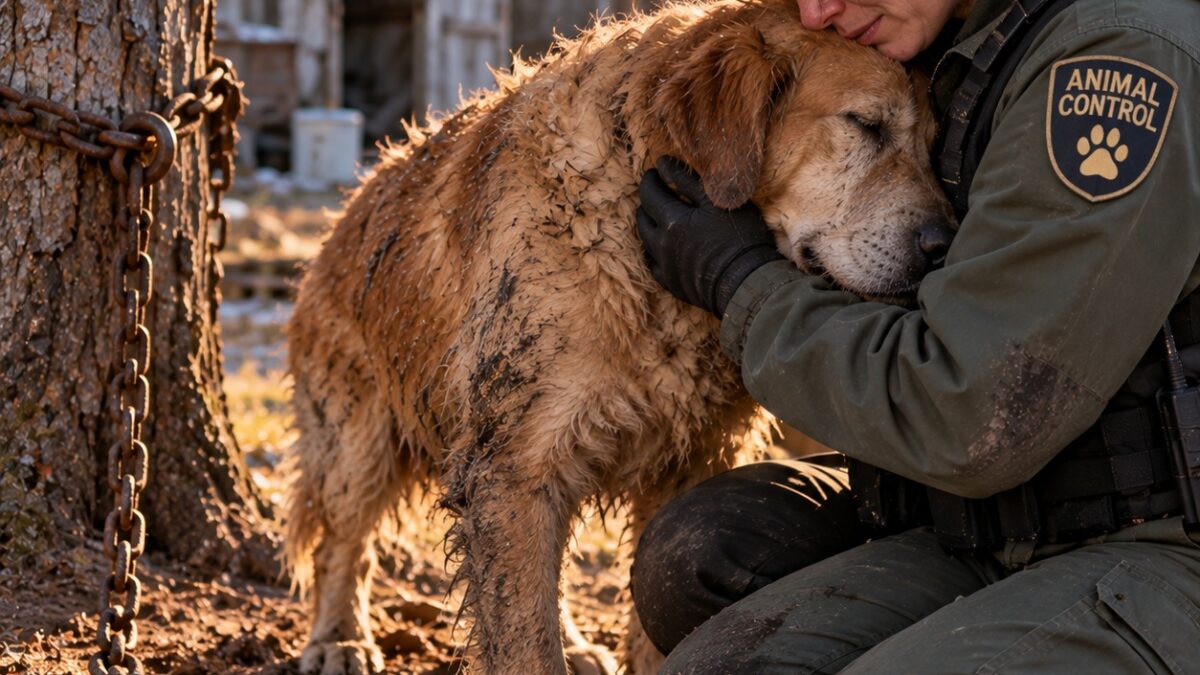
PART2
I froze.
I did not want to frighten him.
His head was heavy against me despite how light the rest of his body felt.
Dirty fur brushed my uniform.
I could smell dust.
Outside air.
The faint, stale scent of a dog who had lived too long without ordinary care.
My hands hovered for a second because I suddenly did not know what to do with them.
Touch him?
Wait?
Would touch be too much?
Willow answered by leaning harder.
Not dramatically.
Barely.
But enough.
I wrapped one arm around him.
Then the other.
And everything Margaret had taught me about staying solid until the work was done disappeared.
Tears came before I could stop them.
Quietly.
No sobbing.
No collapse.
They simply ran down my face and landed in Willow’s fur.
I remember thinking how strange it was.
For years, dust had probably settled on him.
Rain.
Leaves.
Heat.
Cold.
Whatever each season brought.
Now tears from a stranger were landing on the same coat.
Willow did not move.
I could feel his breathing.
Slow.
Uncertain.
His body seemed to soften a little at a time.
Perhaps I imagined it.
But I felt as though he was releasing something too.
Not crying.
Dogs do not need to imitate us to grieve.
His release was physical.
A little less tension.
A little more weight against me.
As if holding himself upright emotionally had required effort for years, and suddenly there was another body there strong enough to lean on.
I do not know how long we stayed like that.
Five minutes.
Ten.
Time changes inside moments like that.
Someone behind me whispered:
“I’ve never seen anything like it.”
A neighbor.
Maybe speaking to another.
I did not turn around.
Neither had I.
Eventually I leaned back enough to see Willow’s face.
The eyes were different.
Still exhausted.
Still cautious.
But no longer empty.
There was something there.
Not joy.
Joy would come much later.
Not hope exactly.
Hope felt too large for that first moment.
It looked like a question.
Now what?
The chain was gone.
The tree was behind him.
The invisible boundary that had defined his life had disappeared.
Freedom had arrived without instructions.
I touched the side of his face.
“Now you come with me.”
My voice shook.
The words did not.
That was when I called him Willow.
I cannot explain why.
The name simply appeared while I was getting him into the back seat of my truck.
Maybe I needed something softer than the life he had known.
Maybe the name belonged to the way he bent without breaking.
Maybe I just looked at him and thought:
Willow.
I had no better explanation.
He was so light when I lifted him.
That shocked me.
A dog his size should have felt substantial.
Instead, I barely felt his weight.
He did not resist.
That unsettled me too.
Most animals make some decision about being lifted.
Tension.
Struggle.
Adjustment.
Willow simply surrendered his body into my arms.
Not trust, exactly.
More like acceptance.
If someone had finally arrived, perhaps he had decided there was no point fighting whatever happened next.
I placed him carefully in the truck.
He lay down.
Did not look out the window.
Did not explore.
He curled into himself and stayed quiet.
I shut the door.
For a second, I stood outside with one hand on the handle.
The broken chain remained near the tree.
I looked at it.
A few minutes earlier, it had been the boundary of Willow’s entire world.
Now it was scrap metal lying in dirt.
I should have felt triumphant.
I did not.
Because cutting a chain takes seconds.
Undoing what years on that chain had taught him would take far longer.
At the shelter, Margaret was waiting.
She had seen me come back from difficult calls before.
Bloody uniforms.
Mud.
Angry owners.
Frightened animals.
That day, when I opened the truck door and she saw Willow, her expression changed.
Respect.
And sadness.
I had never seen that exact combination on her face.
“Emma.”
Just my name.
Then she looked at him again.
Willow did not lift his head much.
Margaret came closer slowly.
No grabbing.
No exaggerated soothing voice.
Experienced people know frightened animals do not need humans performing emotion around them.
She studied him.
Then me.
“This dog has waited a long time.”
“I know.”
“You understand this isn’t over.”
“I know.”
“You just gave him the first thing he’s had since he became free.”
I looked at her.
“What?”
“Someone to lean on.”
That nearly made me cry again.
Margaret noticed.
“Not yet.”
She gave me the smallest smile.
“Get him settled first.”
Right.
Work first.
Feel later.
We prepared the infirmary.
Small room.
Old mattress.
Soft blankets.
Water.
Food.
Enough warmth and quiet to let his body stop bracing.
Willow walked inside reluctantly.
Not because he wanted to return to the tree.
He simply did not know what any new place meant.
I sat down.
He stood near the wall.
Looked at me.
Looked at the doorway.
Then eventually lowered himself onto the floor.
Not the mattress.
The floor.
Muzzle resting on his paws.
I moved the mattress closer.
Nothing.
I tried a blanket.
Nothing.
So I stopped trying to arrange him into comfort the way I imagined comfort should look.
That is one of the first lessons Willow taught me.
Safety cannot be forced into someone’s body.
You can prepare it.
Offer it.
Remain near it.
But the other person—or animal—has to discover it for themselves.
That first night, I slept on the floor beside him.
Margaret told me I did not have to.
Technically, she was right.
Willow was safe.
Doors locked.
Staff nearby.
No tree.
No chain.
I could have gone home.
I did not.
A dog who had spent years anchored to one place had been moved across an entire world in one afternoon.
Leaving him alone that first night felt wrong.
We put an old mattress down.
I lay on it.
Willow remained beside it on the floor.
He looked at me for a long time.
I looked back.
There was no conversation in the human sense.
But silence can hold a kind of language when words are unnecessary.
I am here.
That was what I wanted my body to say.
Not:
I fixed everything.
Not:
You will never be afraid again.
Not promises I could not guarantee.
Only:
I am here tonight.
Willow’s eyes stayed open.
Then slowly closed.
For a few minutes.
Opened again.
Checked.
I was still there.
Closed.
That rhythm continued.
Sleep.
Wake.
Check.
Sleep.
I understood.
He had spent years in a world where nothing changed for the better.
Now everything had changed at once.
Trusting change would take time.
The next morning, Dr. Ellison arrived.
She was in her fifties.
Calm hands.
Quiet face.
The kind of veterinarian who seemed to understand the emotional temperature of a room before saying anything.
She examined Willow for more than an hour.
Paws.
Legs.
Joints.
Teeth.
Skin.
Muscle.
Every part of him.
Willow tolerated it.
Not enthusiastically.
But he did not resist.
I stayed close.
At one point, Dr. Ellison glanced toward me.
“He watches you.”
I looked at Willow.
His eyes were on my position.
Every time I shifted, he noticed.
The examination continued.
When she finished, she made notes.
Then stood.
“He’s exhausted.”
I had known that.
Hearing a veterinarian say it made the word heavier.
“His muscles are weak.”
She ran one hand gently along his side.
“His skin has taken damage.”
I swallowed.
“But his heart…”
She paused.
“What?”
“His heart is surprisingly stable.”
“What does that mean?”
Dr. Ellison looked at Willow for a moment before answering.
“It means, physically, he has held on better than I would have expected.”
Then softer:
“He didn’t give up.”
Those words followed me all day.
I filled forms.
Cleaned equipment.
Answered calls.
Called Mrs. Kellerman.
Willow’s story had started changing, but my regular job had not stopped.
Animals still needed help elsewhere.
The world does not pause because one rescue becomes personal.
When Mrs. Kellerman answered, her voice was nervous.
“The dog?”
“He’s safe.”
Silence.
Then I heard her exhale.
A long breath.
“I knew I had to call.”
“You did the right thing.”
“I just didn’t know who would come.”
“I came.”
The words left my mouth before I thought about them.
She became quiet.
So did I.
“I came,” I repeated, softer.
After we hung up, I stood in the office holding the phone.
Something about that sentence frightened me.
Because coming once was easy compared with what happened next.
Rescue calls end.
Reports close.
Animals move through systems.
Professionals are supposed to care deeply without confusing care with ownership.
Margaret had warned me about that from the beginning.
“You cannot take every one home.”
I knew.
Of course.
If animal officers adopted every animal that broke their hearts, we would become useless by the end of the month.
Still, Willow had placed his head against my chest less than twenty-four hours after years of having almost nothing but a tree and a chain.
He had made a choice.
I did not yet understand what that meant.
The first days were slow.
Willow barely ate.
Food interested him only if I sat beside him.
At first, I thought something was medically wrong.
Dr. Ellison checked.
Margaret watched.
Then Margaret said:
“Sit down.”
“What?”
“Beside the bowl.”
I did.
Willow looked at me.
I rested my hand lightly against his back.
He waited.
Then moved toward the food.
One bite.
Another.
Slowly.
He ate.
The next meal was similar.
If I placed food and walked away, he often ignored it.
If I stayed, he tried.
Margaret called it trust.
“He’s using you as a safety point.”
That scared me.
“What if I’m not here?”
“He’ll learn.”
“But right now?”
“Right now, you are.”
There was that word again.
Here.
Apparently that was my job.
Not to make Willow strong immediately.
Be here.
I started going to him first every morning.
Before coffee sometimes.
Before checking messages.
I opened the infirmary door.
Willow lifted his head.
No tail wag.
Not yet.
But his eyes changed.
Recognition.
I sat on the floor.
He came closer.
At first, only enough to lie within reach.
Then beside my leg.
I talked to him.
Everything.
Nothing.
The calls I had gone on.
Animals that scared me.
People who made me angry.
Moments when I wondered if I was suited for the work.
I told him about Margaret.
He already knew Margaret, of course.
But I told him who she was to me.
The person who had taught me that patience was not inactivity.
That remaining calm could be a form of protection.
That kindness did not mean weakness.
Then I told him about my grandmother.
She had raised me.
Whenever I doubted myself, I still heard her.
“Emma, kindness is a strength, not a weakness.”
As a child, I thought it was just something grandmothers said.
As an adult, I discovered kindness can be exhausting.
It asks you to notice.
To respond.
To stay emotionally available in places where numbness would be easier.
Willow listened.
Or seemed to.
Whenever my voice changed, sometimes his head lifted.
Those eyes that had looked empty on the first day were different now.
Not animated yet.
Present.
That was the word.
Willow was becoming present.
For years, perhaps part of him had survived by withdrawing.
Now he occupied the room more fully.
He noticed.
He responded.
He watched me.
A dog returning to himself one small behavior at a time.
One evening, I sat beside the window.
The shelter was quieter.
Most of the day staff had left.
Willow lay near me.
I was tired.
Not dramatic tired.
The deep fatigue that comes when compassion has been stretched across too many things in one week.
I stopped talking.
We sat.
Then Willow moved.
He lifted his head.
Placed it on my knee.
Simple.
No ceremony.
My chest filled so quickly it almost hurt.
The first time, beneath the tree, his head against me had felt like a question.
Now the gesture felt chosen.
Familiar.
I rested my palm between his ears.
Closed my eyes.
“Thank you.”
I whispered it before asking myself who I meant.
Willow?
Mrs. Kellerman?
Margaret?
My grandmother?
Myself for walking toward the tree instead of allowing fear of failure to hold me back?
Maybe all of them.
Willow sighed.
Kept his head there.
Weeks moved forward.
His coat changed first.
Not immediately into something beautiful.
Recovery is rarely a before-and-after photograph in real life.
There are awkward middle stages.
Still dull.
Then patches healthier.
Then gradually more shine when light hit.
His movement improved.
At first, his legs looked unsure of distance.
Years of a limited circle had taught his body a particular geography.
Outside the shelter yard, the world contained too much space.
We introduced the leash slowly.
The first time I led him toward the main gate, he stopped.
The gate was open.
Road beyond.
Freedom.
Again.
Willow stared.
His body tightened.
That moment reminded me of the tree.
People assume freedom is always attractive.
Not when confinement is the only structure you know.
The chain had been cruel.
But predictable.
You knew exactly how far you could go.
Freedom offers possibility.
Possibility also means uncertainty.
Willow stood at the threshold.
I did not pull.
“We can go.”
Nothing.
I loosened the leash.
“We can go anywhere you want.”
He looked at the road.
Then at me.
For a long time.
I waited.
Eventually, one paw crossed.
Then another.
He walked.
Slowly.
Carefully.
But without turning back.
The farther we went, the more emotional I became.
I kept remembering the worn circle around the tree.
The first time I saw him, his entire physical life had been reduced to that radius.
Now the road stretched ahead.
No chain pulling tight.
No metal scraping dirt.
Willow stopped often.
Smelled things.
Looked.
A patch of grass.
A tree he was not tied to.
A car passing.
The ordinary world was extraordinary because he had never been allowed to move through it normally.
I watched him investigate a patch of weeds for almost a minute.
A month earlier, I might have thought:
It is just weeds.
Now:
Take all the time you need.
Freedom should be allowed to be boring.
That is when it becomes real.
Not the dramatic moment the chain falls.
The ordinary afternoon when a dog can stop because something smells interesting and nobody tells him his radius has ended.
That evening, Margaret was waiting near my office.
Arms crossed.
The expression.
I knew that expression.
Something was coming.
“What?”
She waited until I sat.
“Emma, we need to start thinking about Willow’s home.”
I had known.
Obviously.
That was shelter work.
Rescue.
Stabilize.
Rehabilitate.
Then placement.
Home.
Yet the word struck me like an accusation.
“He has a place here.”
“That’s not what I said.”
“He’s still recovering.”
“Yes.”
“He trusts me.”
Margaret’s face softened.
“I know.”
“I can’t just give him to someone.”
“I didn’t say you should.”
I stopped.
“What are you saying?”
Margaret looked toward the window.
Willow was outside.
Lying in the yard.
Sun low.
His coat caught the light and looked almost golden in a way I had forgotten it could.
Head on his paws.
Calm.
Peaceful.
“You’ve already chosen,” Margaret said.
I looked at her.
“You just haven’t admitted it.”
My first reaction was fear.
Not joy.
Fear.
What if I took him home and failed him?
What if he depended on me too much?
What if my schedule was wrong?
What if he needed more space?
What if the professional bond I had built became something I could not sustain?
Margaret listened.
Then said:
“Those are reasonable questions.”
“That doesn’t help.”
She smiled.
“You expected me to tell you love solves logistics?”
“Maybe.”
“It doesn’t.”
I laughed despite myself.
“Very inspirational.”
“Good homes are built with love and logistics.”
Then she leaned forward.
“The question isn’t whether you’re afraid.”
“What is it?”
“Can you give him consistency?”
I looked through the window.
Willow shifted.
Raised his head.
Found me through the glass.
His body relaxed again.
“Yes.”
I knew before I said it.
“I’ll take him.”
Margaret smiled.
Not triumphant.
As though she had simply watched me arrive at the answer she already knew.
“I’ll take Willow.”
The words made everything frightening and right at once.
I brought him home on a Friday evening.
My apartment was small.
Bright.
I had spent far too much money preparing.
Soft bed.
Bowls.
Toys.
A blanket.
I bought several toys even though I had never seen Willow play.
Hope makes us shop strangely.
He stepped inside.
Stopped.
Looked around.
I expected sniffing.
Maybe pacing.
Instead, he walked through the living room toward the window.
Stood there.
Looked outside.
Street.
Trees.
Sky.
People passing.
For a long time.
I let him.
Then he turned.
Walked back to me.
Sat at my feet.
I knelt.
“This is home.”
Willow placed his head on my knee.
Same gesture.
Different meaning.
At the tree:
What happens now?
At the shelter:
I trust this place when you are here.
In my apartment:
I am staying here with you.
Maybe I was projecting.
I know.
But relationships are partly built from interpretation.
Humans read each other imperfectly too.
What mattered was what happened afterward.
Willow did stay.
The first nights were not easy.
He did not immediately use the bed I had bought.
Of course.
Why would anything I paid too much money for be appreciated?
He preferred the floor.
Sometimes beside my bed.
Sometimes near the door.
He slept lightly.
If I moved, he noticed.
If I got up, his head rose.
I started speaking whenever I walked into another room.
“Kitchen.”
Ridiculous.
“Bathroom.”
More ridiculous.
“I am literally ten feet away.”
Willow followed anyway.
The apartment was small enough that he could confirm my existence almost constantly.
Maybe that helped.
Morning routines formed.
Water.
Food.
Walk.
I went to work.
That part worried me most.
The first morning I left him home, I sat in my truck for five minutes after closing the apartment door.
Could not start the engine.
What if he thought I had abandoned him?
Then another voice in my head.
Margaret.
Consistency.
You cannot teach someone you return if you never leave.
I drove to work.
Longest shift of my life.
When I came home, Willow was there.
He stood when the key entered the lock.
When I opened the door, he watched me.
No explosion of joy.
Not yet.
He simply looked.
And I realized what I needed to do.
Again tomorrow.
Leave.
Return.
Again.
Again.
Trust is not created by one promise.
It is accumulated evidence.
Willow learned.
I left.
Returned.
Work.
Returned.
Groceries.
Returned.
Laundry downstairs.
Returned.
Each absence became smaller because it had an ending.
Eventually, when I came home, his tail moved.
A little.
Then more.
Weeks became months.
The bed became acceptable.
Then my bed became superior.
I woke one night with Willow pressed against my back.
Warm.
Heavy.
I smiled into the pillow.
“Traitor.”
The expensive dog bed sat unused across the room.
Willow breathed.
Did not care.
We walked to the park in the evenings.
At first, he stayed close.
Then curiosity grew.
He smelled trees.
Grass.
Benches.
Other dogs from a cautious distance.
He learned the world could contain things that did not hurt him.
Rain was complicated.
The first storm after he moved home made him uneasy.
He watched the window.
I wondered what years outside had made rain mean to him.
Cold?
Mud?
Another night with no shelter beyond the tree?
I closed the curtains.
Sat beside him.
Rain hit the glass.
Nothing else happened.
Roof stayed above us.
Floor stayed dry.
I stayed.
Storm ended.
The next one bothered him less.
Months later, he slept through rain.
That made me cry.
I know.
Everything made me cry that year.
But think about it.
Rain once belonged to the outside life.
Exposure.
No escape from weather.
Now rain was simply a sound on a window while he slept against a bed.
That is what home does.
It turns threats into background noise.
Willow also became my measure of difficult days.
Animal protection work does something to your faith in people if you are not careful.
Some calls came home with me mentally.
I would enter the apartment carrying anger.
Helplessness.
Questions.
Could I really do this for decades like Margaret?
Would I become numb?
Would numbness be the only way to survive?
Willow usually knew before I said anything.
He came closer.
Head against my chest.
That gesture again.
Full circle.
At the tree, I thought he needed me.
At home, sometimes I needed him.
He did not solve my problems.
Dogs are not therapists simply because they are loyal.
But his presence interrupted spirals.
Breathe.
Hand on fur.
Another heartbeat.
Here.
Now.
My grandmother’s words became clearer.
Kindness is strength.
Not because kindness always wins.
Not because good people never break.
Kindness is strength because it asks you to remain open despite evidence that closing yourself would hurt less.
Mrs. Kellerman was kind when she called.
Margaret was kind when she trained me not to confuse emotion with action.
Dr. Ellison was kind in the calmness of her hands.
I was kind when I cut the chain.
Willow was kind every time he trusted again despite having every reason to stay emotionally distant.
Kindness was everywhere in his recovery.
Not softness.
Courage.
I eventually visited Mrs. Kellerman.
I wanted her to see him.
When we arrived, Willow was hesitant.
Different neighborhood.
Different smells.
I told myself not to build too much meaning around it.
Mrs. Kellerman opened the door.
Her hand covered her mouth.
“Oh.”
Willow looked at her.
She cried immediately.
Not loud.
Just tears.
“He looks…”
She stopped.
Could not find the word.
“Like himself?”
I suggested.
She nodded.
“Maybe.”
Then:
“I never knew what himself looked like.”
That sentence stayed with me.
Neither had I.
The dog tied to the tree was not Willow in full.
He was Willow surviving.
There is a difference.
Survival behaviors can be mistaken for personality.
Quiet.
Passive.
Emotionless.
Then safety arrives.
You discover curiosity.
Attachment.
Preference.
Humor, even.
Willow became stubborn.
That delighted me.
At the tree, he had shown almost no preference.
At home, he could refuse to go a direction on walks because a better smell existed elsewhere.
He could look at food and decide the quality was beneath him.
He could occupy the most inconvenient part of the bed.
I celebrated every irritating behavior.
Preference meant agency.
Agency meant life.
One afternoon, I offered him one of the toys I had bought before adoption.
He stared at it.
I moved it.
Nothing.
I rolled it.
Nothing.
“Please do something. This cost twenty dollars.”
Willow blinked.
I laughed.
Days later, I found the toy moved.
That was all.
Maybe he had touched it.
Maybe I kicked it accidentally.
Then one evening he picked it up.
Held it.
Looked at me.
My heart almost exploded.
I did not scream.
I had learned not to turn his firsts into performances.
I sat on the floor.
Held out my hand.
Willow walked closer.
Dropped the toy near me.
That was the beginning.
He never became an obsessive fetch dog.
Fine.
He had already spent enough of his life returning to the same place.
He could choose his own games.
The shelter remained part of our world.
I still worked there.
Willow visited sometimes.
Margaret behaved as if she had predicted everything.
Because she had.
“You look smug.”
“I am smug.”
“You’re supposed to be my mentor.”
“I taught you excellent judgment.”
“You told me I had already chosen.”
“And?”
“And apparently I had.”
“Excellent judgment.”
Dr. Ellison would check him.
Each time, the difference felt impossible.
Stronger.
Healthier skin.
More muscle.
Better movement.
But the most important change was not medical.
He approached people.
Cautiously.
But he initiated.
A staff member entered.
Willow might sniff.
A hand extended.
He might accept.
The dog who had once simply tolerated whatever came now participated.
Choice again.
Everything came back to choice.
The chain had removed it.
Recovery restored it.
Go left.
Go right.
Lie here.
Follow.
Stay.
Eat now.
Wait.
Approach.
Retreat.
The world became full of decisions.
Maybe freedom is not open space.
Maybe freedom is having meaningful choices.
Willow taught me that.
One evening, months after adoption, I drove past the area where I had first found him.
I had not planned to stop.
Something made me.
The tree was still there.
Of course.
Trees do not carry guilt for what humans tie to them.
I parked.
Willow was with me.
I hesitated.
Was bringing him back cruel?
Would he recognize it?
I almost drove away.
Then I looked at him.
Calm.
Watching me.
I opened the door.
“We can leave whenever you want.”
We approached slowly.
Willow stopped.
I felt my stomach tighten.
The tree ahead.
The ground different now.
No chain.
Nothing attached.
Willow looked.
I watched his body.
No dramatic trembling.
No collapse.
He simply stared.
Maybe he remembered.
Maybe smell connected something.
Maybe I was the one assigning history to an ordinary tree.
Then Willow looked at me.
Walked closer.
Pressed his shoulder against my leg.
I put my hand on his back.
We stood.
For the first time, the place looked small to me.
When I first arrived, it had seemed enormous because it contained years of Willow’s life.
Now it was one patch of ground in a much larger world.
A world he had walked through.
A shelter.
A road.
A park.
My apartment.
Rain behind windows.
Beds.
Toys.
Mrs. Kellerman’s house.
So many places beyond that circle.
I looked at the worn area and tried to imagine years inside it.
Could not.
Maybe that was good.
Willow sniffed the ground.
Then started walking away.
No pull from me.
His choice.
I followed.
That moment became more important to me than cutting the chain.
The first time, I had freed his body.
This time, Willow left the place under his own power.
No one carrying him.
No one leading him.
He simply decided there was somewhere else he would rather be.
Home.
We drove back.
Willow slept in the passenger area.
I cried quietly.
Again.
Some habits never improve.
At home, he went directly to my bed.
His bed remained decorative.
Rain started that night.
I lay beside him listening.
He did not lift his head.
I thought about the tree.
Years exposed.
Weather arriving without choice.
Now rain on glass.
Roof.
Warmth.
My hand near his paw.
The distance between those two lives was enormous.
And yet the dog was the same dog.
That matters.
We like rescue stories where the animal becomes somebody new.
Maybe that is not quite right.
Willow did not become worthy.
He did not become lovable.
He did not become a “good dog” because I rescued him.
Those things were already there.
Captivity had buried expression.
Safety gave it room.
The dog who leaned into me immediately after the chain fell had already contained the capacity for attachment.
That still amazes me.
After years of being failed by people, his first act of freedom was not to move away from a human.
It was to move toward one.
Not because all dogs would do that.
They would not.
Not because traumatized animals owe us trust.
They do not.
Willow simply chose.
I cannot make the choice less extraordinary by explaining it.
He chose closeness.
Then spent months learning that closeness could remain safe.
That became the heart of our relationship.
People often asked:
“Did he know you rescued him?”
I never liked the question.
Know in what sense?
Dogs do not narrate events the way we do.
He knew the chain stopped.
He knew I was present.
He knew food came when I sat near him.
He knew my voice.
He knew I returned after work.
He knew my bed was comfortable.
He knew rain no longer reached him.
He knew my body was a place he could lean.
That was enough.
Maybe more meaningful than the abstract idea of rescue.
Rescue is a human word.
Willow understood pattern.
Pain.
Then safety.
Alone.
Then company.
Restricted.
Then movement.
Uncertainty.
Then return.
That was his story.
Years passed in smaller ways.
Routine replaced recovery.
That is one of the best things that can happen to a rescue story.
It becomes boring.
Morning walk.
Breakfast.
Work.
Evening park.
Rain.
Sun.
Sleep.
No one taking photographs of milestones anymore because milestones stopped being necessary.
Willow became a dog living a life.
Not a case.
Not the chained dog.
Not the rescue everybody remembered.
Willow.
That was the outcome I wanted most.
Sometimes people who met him later had no idea.
They would say:
“He’s so calm.”
I would smile.
“Yes.”
“He’s always been like that?”
That question hurt and pleased me at the same time.
“No.”
Then sometimes I told the story.
Sometimes not.
Willow did not need his trauma introduced before his name every time.
There is a strange risk in rescue narratives.
We can freeze animals at their worst moment.
The dog from the tree.
The dog from the dumpster.
The dog who was starved.
The dog who was beaten.
Those histories matter.
But they are not identities.
Willow was not forever the chained dog.
He liked the left side of my bed.
He disliked one particular brand of food.
He preferred slow evening walks.
He rested his head on me when I was sad.
He learned the sound of my truck.
He became impatient if I worked late.
He was more than what happened to him.
I tried to honor that.
Margaret once asked me:
“What did he teach you?”
We were cleaning after a long day.
I answered too quickly.
“Patience.”
“Everybody says patience.”
“Fine. Trust.”
“Everybody says that too.”
“You’re impossible.”
She smiled.
“Think.”
I did.
Then I said:
“He taught me freedom isn’t enough.”
Margaret stopped moving.
I continued.
“You can cut the chain and still leave the animal without anything to move toward.”
She nodded.
“So?”
“So our job isn’t only removing what hurts.”
I thought about Willow pressing his head into my chest.
“It’s helping build what comes after.”
Margaret smiled.
“There you go.”
That became the sentence I carried into future calls.
What comes after?
Remove the chain.
Then what?
Take the animal out.
Then what?
Medical care.
Then what?
Safety.
Then what?
Routine.
Trust.
A home, if possible.
Rescue is not a single act.
The dramatic act is often the easiest to describe.
Bolt cutters.
Open gate.
Truck ride.
Before-and-after picture.
The harder work is repetitive.
Feeding.
Sitting.
Walking.
Returning.
Learning triggers.
Respecting distance.
Building ordinary life.
Willow made that impossible for me to forget.
Every new case changed after him.
I became slower.
Not inefficient.
More attentive.
A frightened animal refusing to move no longer frustrated me.
I thought:
Maybe the world has only ever punished movement.
Wait.
An animal refusing food?
Maybe safety has not arrived inside the body yet.
Sit.
An animal avoiding soft bedding?
Maybe the floor is the only familiar thing.
Offer.
Do not force.
Willow became part of my professional education in ways no formal training had.
Margaret knew.
She had probably been waiting for me to encounter one animal who broke the clean distance between job and life.
Everyone in this field does eventually.
The challenge is not allowing that bond to destroy professional judgment.
Willow did the opposite.
He improved mine.
He made compassion more precise.
Not less.
My grandmother would have liked that.
Kindness as strength.
Not emotion without discipline.
Kindness that stays useful.
Mrs. Kellerman visited the shelter later for another reason.
She found me.
Asked about Willow.
“He’s home.”
“With you?”
“Yes.”
Her eyes filled.
“I hoped.”
“You started everything.”
She shook her head.
“I made a phone call.”
“Exactly.”
People underestimate phone calls.
Reports.
Looking out windows.
Refusing to mind your own business when “mind your own business” means allowing suffering to continue unnoticed.
Mrs. Kellerman did not need to know the whole solution before acting.
That became another lesson.
People sometimes see cruelty and freeze because they cannot personally fix it.
You do not have to know how to cut the chain.
Call someone who does.
You do not need a spare room.
You do not need medical expertise.
Notice.
Report.
That may be enough to begin everything else.
Willow’s entire new life began because a woman decided silence was no longer acceptable.
I told her that.
She cried.
So did I.
Naturally.
Margaret passed by.
Looked at us.
“Both of you done?”
“No.”
“Excellent.”
She kept walking.
That woman had become immune to my tears.
Or maybe she understood they no longer interfered with the work.
There is a difference between being controlled by emotion and allowing emotion to remain human.
Margaret taught me both.
Willow softened something in her too.
I saw it.
She would sit beside him when she thought I was busy.
Talk quietly.
Never admit how much she loved him.
Twenty-seven years in animal rescue had not made her cold.
It had simply made her careful about which parts she showed.
One evening I caught her rubbing Willow’s ears.
“You like him.”
“I tolerate him.”
“You love him.”
“Go finish your paperwork.”
Willow leaned into her hand.
Traitor again.
The older I became in the job, the more I understood Margaret.
You cannot cry at every call forever.
Not because suffering becomes less terrible.
Because the nervous system creates places to put it.
Ritual.
Humor.
Professional focus.
But occasionally an animal reaches through all those compartments.
Willow reached through mine immediately.
Maybe because he did not run.
That is still the image.
Broken chain on dirt.
Open space.
Me expecting flight.
Willow moving toward me.
Had he run, I would have understood.
Escape.
Instinct.
Freedom.
Instead he chose connection.
I spent years trying to understand why that moment mattered so much.
I think I know now.
The chain controlled his distance from the tree.
It could not control where his heart went when distance became possible.
That choice was his.
After years of someone else deciding where he could stand, his first free decision was:
Here.
With you.
No wonder I cried.
That first choice became a pattern.
Willow chose me repeatedly.
Not because he had no alternatives.
After recovery, he did.
He could interact with staff.
Visitors.
Other environments.
Still, he returned to my side.
At home, he could sleep anywhere.
My bed.
Naturally.
At the park, he could wander within the safe length of the leash.
He often checked where I was.
Not fear eventually.
Relationship.
There is a beautiful difference between a dog who follows because he is terrified of losing you and a dog who comes back because he prefers your company.
Willow moved from the first to the second.
I watched that transition.
At the beginning, if I left a room, he tracked me.
Months later, I could walk to the kitchen and he stayed sleeping.
That was progress.
Trust is not constant proximity.
Sometimes trust is believing someone can leave the room and still belong to your life.
That lesson applied to me too.
Rescue work comes with separation.
Animals leave.
Foster homes.
Adopters.
Sometimes you love them and still let them go.
Willow was the exception who stayed.
He did not teach me to keep every animal.
He taught me to trust the process enough to let different bonds become different things.
Some animals need me for one hour.
Some one week.
Some never remember me.
That is okay.
Willow needed something different.
So did I.
By the time I had more years of experience, younger officers sometimes asked me how I knew when attachment had crossed a professional line.
I laughed.
“I adopted mine.”
Not useful.
Then I told them:
“Ask whether what you want is about the animal’s needs or your fear of losing the animal.”
With Willow, I had been afraid of both.
Margaret forced me to think.
Could I give him a stable home?
Yes.
Was adoption best for him?
We believed yes.
Was I taking him because I needed to rescue myself from saying goodbye?
Maybe partly.
Humans are mixed creatures.
That does not automatically make the outcome wrong.
We evaluated.
Then chose.
That was important.
Emotion plus thought.
Kindness plus structure.
Again, Margaret’s lesson.
Willow eventually learned the park route so well that he anticipated turns.
The first time he pulled slightly toward a preferred path, I laughed.
This dog who had once existed inside a forced circle now had opinions about routes.
“Fine.”
We went his way.
It led nowhere special.
A longer loop.
A patch of grass.
Two trees.
Willow sniffed.
Happy.
I thought:
This is freedom.
Not running into the horizon.
Choosing the longer path because you feel like it.
The simple dignity of preference.
That became one of my favorite memories.
No camera.
No dramatic rescue.
Willow making me walk farther because his world had become large enough for favorite places.
What a transformation.
Sometimes neighbors who knew his story would see us.
“How’s the rescue dog?”
I would answer:
“Willow is fine.”
I gently stopped using the label.
He had already been rescued.
Now he was living.
One elderly man once said:
“He looks like he owns you.”
“Correct.”
Willow wagged.
Small jokes.
Normal life.
Exactly what I wanted.
The chain remained somewhere in evidence for a time.
I hated knowing it existed.
Not because metal held supernatural power.
Because objects can carry memories.
Eventually it was no longer relevant.
I did not keep a piece.
Some rescuers might.
A symbol.
Before and after.
I did not want it in my home.
Willow did not need a trophy made from captivity.
The absence of the chain was enough.
His collar was enough.
A leash that connected us without imprisoning him.
Interesting difference.
Both are restraints technically.
One allows relationship and safety while moving through the world.
One erased the world.
Tools are not defined only by material.
Purpose matters.
Choice matters.
Context.
I thought about that on walks.
The leash loose in my hand.
Willow choosing direction within safety.
No metal scraping behind him.
I never took that sound for granted.
One stormy evening, power flickered.
Rain heavy.
Willow woke.
Looked toward the window.
Then at me.
I lit a candle.
Sat.
The room darkened.
For one second, I worried the unusual environment would frighten him.
Instead, Willow walked over.
Lay down beside my chair.
Head on my foot.
Outside, rain hammered the glass.
Inside, he slept.
I looked at him and realized the house itself had become part of his trust.
Not only me.
Roof.
Walls.
Bed.
Routine.
Home had entered his nervous system.
That is a beautiful phrase to me.
Home is not merely where you live.
Home is when your body no longer expects exposure every time weather changes.
Willow knew.
The next morning, sun.
We walked.
He stopped beside a puddle.
Stepped directly into it.
Splash.
Mud.
I groaned.
A dog who had spent years in dirt was now voluntarily getting dirty after I had spent money on grooming.
Life has a sense of humor.
He looked happy.
I let him.
There is clean dirt and captive dirt.
I knew the difference now.
One is evidence of play.
The other of confinement.
Willow came home muddy.
I washed him.
He tolerated the indignity.
Then stole my bed.
Normal.
I wrote notes sometimes.
Not public stories at first.
Just reminders.
First walk beyond gate.
First time eating without needing my hand on his back.
First toy.
First night in bed.
First storm slept through.
Not because progress needed to be quantified.
Because early rescue days distort memory.
You remember pain clearly and improvement vaguely.
I wanted evidence.
Months later, I read the list.
Could not believe some things had once been milestones.
Ate while I stood across the room.
Ordinary now.
Stayed asleep when I went to kitchen.
Ordinary.
Walked through gate without stopping.
Ordinary.
That is how healing hides itself.
It turns miracles into habits.
The things you once cried about become so normal you forget they were ever difficult.
I think that is success.
Eventually I stopped recording firsts.
There were too many ordinary days to count.
Willow no longer needed to be monitored for recovery.
He had a life.
So did I.
Years later, I returned mentally to that first moment often.
Not because I wanted to remain inside trauma.
Because it reminded me what the job was.
Cutting the chain mattered.
But the chain had been visible.
Easy target.
What came after was less visible.
A dog who had never learned comfort.
A body unfamiliar with movement.
A relationship to food shaped by insecurity.
A nervous system that watched departures.
Those chains do not fall with bolt cutters.
You remove them through repetition.
Food.
Safety.
Touch.
Time.
Return.
Choice.
That is why I tell new officers:
“The visible problem is not always the whole problem.”
They nod.
Most do not understand yet.
I did not when Margaret told me.
Experience will teach them.
I hope gently.
Probably not.
This work rarely teaches gently.
But maybe remembering Willow makes me teach more gently than I was taught.
Margaret was never cruel.
Firm.
Different.
She knew softness without boundaries burns people out.
She gave me boundaries.
Willow gave me reason to stay inside them without becoming hard.
Between the two, I learned the job.
One day Margaret retired.
That was emotional in a way none of us admitted until the cake came out.
She had trained generations of staff.
Twenty-seven years became more before she finally left.
Willow came to the gathering.
Naturally.
Margaret sat beside him.
I said:
“You know he likes you.”
“He has poor judgment.”
Willow placed his head on her knee.
The room laughed.
Margaret looked down.
Her eyes filled.
I pretended not to notice.
She looked at me.
“You notice everything now.”
“You taught me.”
“Terrible mistake.”
Later, before she left, she hugged me.
“Remember what comes after.”
I knew exactly what she meant.
“I will.”
Willow stood beside us.
The dog had become shorthand between us for an entire philosophy of care.
What comes after.
That question followed me everywhere.
Years later, if I saw a chained dog on a call, my body remembered Willow before my mind did.
The metal sound.
The dirt circle.
I stayed professional.
But something inside whispered:
There may be another life under this.
Do not only break the chain.
Make room for what comes next.
Sometimes the animal recovered quickly.
Sometimes slowly.
Sometimes never in the ways people hoped.
Not every story becomes Willow’s.
That matters.
Rescue stories can become unfair when they promise that love fixes everything.
It does not.
Trauma can remain.
Medical damage can remain.
Fear can remain.
Some animals need specialized homes.
Some may never enjoy strangers.
Some may carry behaviors forever.
Their lives can still have value.
Willow’s recovery was Willow’s.
Not a template.
The lesson was patience, not expectation.
Offer safety without demanding transformation.
That is harder than inspirational stories make it sound.
People want the wagging tail.
The before-and-after.
The dog sleeping on the bed.
We need to care equally about the animal who never becomes photogenic evidence of rescue.
Margaret taught me that too.
Willow simply made me feel it.
His head on my chest had been powerful because it was freely given.
If he had never done it again, he still deserved everything.
That is important.
Love cannot be the price of care.
Willow owed me nothing for cutting the chain.
Nothing.
His affection was not repayment.
Adoption was not a transaction.
I chose responsibility.
He chose relationship over time.
Those are separate gifts.
Keeping them separate made the bond healthier.
When people said:
“He knows you saved him.”
I sometimes answered:
“I hope he knows he’s safe.”
That mattered more.
Gratitude is a human need.
Safety is his.
I wanted his.
The years softened the sharpest parts of the story.
I could think about the tree without immediate anger.
Not because what happened became acceptable.
Because Willow’s life grew larger around it.
One terrible chapter becomes smaller when hundreds of good pages follow.
Still true.
Still there.
Not everything.
That is what I wanted for him.
And for myself.
Animal work had exposed me to things I could not unknow.
If I let every act of cruelty become proof the world was cruel, I would not last.
Willow became counterevidence.
One person chained him.
Another person called.
Another examined.
Another mentored.
Another adopted.
The world was not one thing.
Human beings could cause suffering.
Human beings could interrupt it.
Both true.
My work existed in the space between.
That understanding kept me from becoming cynical.
Not naive.
Never naive.
But open enough to answer the next call.
Kindness as strength.
Grandma again.
She was right.
I wish I could tell her how often those words saved me.
Maybe she knew I would need them.
Or maybe every child needs them eventually.
Willow became older.
His face changed.
More gray.
Movement slower.
I adjusted.
Shorter walks.
Longer rests.
He still preferred my bed.
Naturally.
The head-on-chest gesture remained.
Whenever I was sad, he somehow found the position.
I once joked:
“You started this.”
Willow sighed.
No accountability.
One night, I lay awake listening to rain.
Willow beside me.
His paw touched my hand.
Exactly like the ending of the story I would later write.
I thought about years.
Tree.
Shelter.
Apartment.
Park.
Work.
Storms.
Ordinary days.
The chain had once seemed like the central object in his life.
Now it felt tiny compared with everything after.
That may be the greatest defeat of cruelty.
Not punishment.
Scale.
Build so much life beyond the harm that the harm becomes only one part.
Never erased.
Outgrown.
Willow outgrew that circle around the tree.
Physically first.
Then emotionally.
I did too.
At seven months on the job, that call felt like something that might break me.
It did change me.
But not by making me weaker.
It gave structure to my empathy.
I learned crying does not make you unprofessional if you still do the work.
I learned distance is useful but not sacred.
I learned sometimes an animal crosses the professional boundary into family and that can be handled honestly.
I learned rescue does not end when suffering stops.
I learned how much ordinary life matters.
I learned one phone call can begin everything.
I learned trust is not a feeling you demand.
It is evidence you accumulate.
I learned freedom is not only absence of restraint.
It is presence of safe choice.
I learned home is not only shelter from weather.
It is a place where the body expects tomorrow.
Willow taught me all of that without saying a word.
Sometimes I wonder what he thought of me on the first day.
Probably nothing as poetic as I imagine.
Stranger.
Close.
Hands.
Chain falls.
Warm body.
Maybe that simple.
Maybe his head on my chest was exhaustion.
Maybe relief.
Maybe trust.
Maybe all three.
I no longer need to know exactly.
Meaning can be real even when interpretation is uncertain.
The moment changed both of us.
That is enough.
Mrs. Kellerman once asked whether Willow remembered the tree.
“I don’t know.”
“Would you want him to forget?”
I thought about that.
“No.”
She looked surprised.
Then I explained.
“I want it to stop hurting him. That’s different.”
Forgetting is not the only form of healing.
Sometimes memory stays but loses authority.
The tree could exist.
The chain could have happened.
Willow could still sleep through rain.
He did not need his past deleted.
He needed a present strong enough to stop the past from predicting everything.
That became another lesson.
For people too.
I had experiences I wanted to erase.
Most of us do.
Maybe the goal is not erasure.
Maybe it is building enough evidence of safety afterward.
Willow had that.
Every morning.
Every return.
Every meal.
Every open gate.
Every night beside me.
Evidence.
Eventually, evidence outweighed fear.
Not perfectly.
Enough.
The rain outside became one of my favorite sounds.
Not because I loved storms.
Because every time Willow slept through one, I remembered the dog who had once had no roof.
Rain became proof.
Roof here.
Dog here.
Home here.
It is funny what objects become sacred after rescue.
A water bowl.
A bed.
A window.
A leash.
Things millions of pets take for granted.
Willow made me notice them.
There is privilege in ordinary pet life.
A dog expecting breakfast.
A dog annoyed by rain because walk time changed.
A dog stealing a pillow.
A dog with opinions about treats.
That is what I wanted for every animal.
Not gratitude.
Entitlement to normal care.
Willow eventually developed exactly that.
If dinner was late, he noticed.
Good.
Let him.
A dog who once accepted almost nothing now expected me to honor schedule.
That was progress.
He trusted enough to have expectations.
People laugh when I say that.
I mean it.
Trauma can shrink expectation to zero.
Whatever happens, happens.
No protest.
No request.
Recovery expands it.
I deserve food now.
Walk now.
Your side of bed is actually mine.
Excellent.
Be demanding, Willow.
You waited long enough.
The final time I visited the old property with him, years after the first return, we barely stopped.
Willow sniffed.
Moved on.
I did not cry.
That felt significant.
The place no longer needed ceremony.
We had already taken everything from it we needed.
History.
Perspective.
Then leave.
We walked farther down the road.
Willow chose the route.
I followed.
That was the correct ending.
Not me leading him away from the tree forever.
Willow leading me somewhere else.
Freedom matured.
The dog who once could not choose distance now choosing direction.
I remember smiling.
“Okay.”
We went his way.
When we returned home, he drank water.
Climbed onto my bed.
Slept.
No symbolism required.
Just home.
That is where I want to leave Willow in memory.
Not beside the tree.
Not thin in my arms.
Not lying on the infirmary floor.
Those scenes matter.
But the final image should be ordinary.
Rain outside.
Willow beside me.
Calm breathing.
Paw against my hand.
A roof above us.
The chain nowhere.
Not hidden.
Gone.
I sometimes touch the spot on my chest where his head first rested.
Nothing physically remains, obviously.
No scar.
Still, my body remembers.
The weight.
The warmth.
My own tears.
I had walked toward a chained dog believing the job was to remove metal.
Willow placed his head against me and quietly changed the assignment.
Stay.
Not forever in that yard.
Stay emotionally.
Follow through.
Do not treat freedom like a finished task.
That was the lesson.
And I did.
Not perfectly.
But enough.
Tonight, while I write this, Willow is lying beside me.
His breathing is deep.
Outside, rain hits the window.
He does not lift his head.
Years ago, weather reached him wherever he stood because a chain gave him no other place.
Now rain belongs outside.
He knows the roof remains.
He knows the room remains.
He knows I remain.
I think about Mrs. Kellerman looking through her window.
She could have looked away.
Did not.
I think about Margaret.
Twenty-seven years of experience when she began teaching me.
Her insistence that kindness could survive discipline.
I think about Dr. Ellison’s quiet hands.
His stable heart.
The words:
“He didn’t give up.”
And I think about Willow.
A dog who waited for years.
Then, when freedom arrived, did not use it to run away.
He used it to choose.
Me.
Later a road.
A gate.
A park.
A bed.
A toy.
The longer route.
Home.
Freedom became thousands of choices.
That is what makes me emotional even now.
The chain had reduced his world to one circle.
Life afterward expanded choice until no circle defined him.
That is rescue.
Not one cut.
Expansion.
And somewhere inside that expansion, I was rescued too.
Not from some dramatic danger.
From the fear that caring too deeply would make me bad at the work.
Willow taught me the opposite.
Caring deeply can make you better if you learn how to turn emotion into responsibility.
Tears did not save him.
Action did.
But tears reminded me why action mattered.
Kindness is not weakness.
Grandma again.
Margaret again.
Willow again.
Same lesson from different lives.
When rain stops, the apartment becomes very quiet.
Tonight it did.
Drops slowed.
Then silence.
I looked toward the window.
Clouds beginning to break.
A few stars visible.
Willow shifted in his sleep.
His paw found my hand.
Rested there.
No tension.
No question.
The first time his head touched my chest, his eyes had seemed to ask:
Now what?
Years later, I finally know the complete answer.
Now we build.
A routine.
Trust.
Health.
Movement.
Choice.
Home.
A life large enough that the tree becomes small.
I rest my hand over his paw.
Willow does not wake.
He knows I am here.
I know he is here.
And after years of being chained to the same place, perhaps that is the greatest freedom he ever found.
Not that he could finally run anywhere.
That he finally had somewhere he wanted to stay.
The chain fell.
The years kept moving.
The rain stayed outside.
And everything, finally, was all right.




