PART2:For 26 Days, the Black Lab Waited Beside the Mailbox for the Family Who Abandoned Him—Then a Truck Finally Came Back
PART2
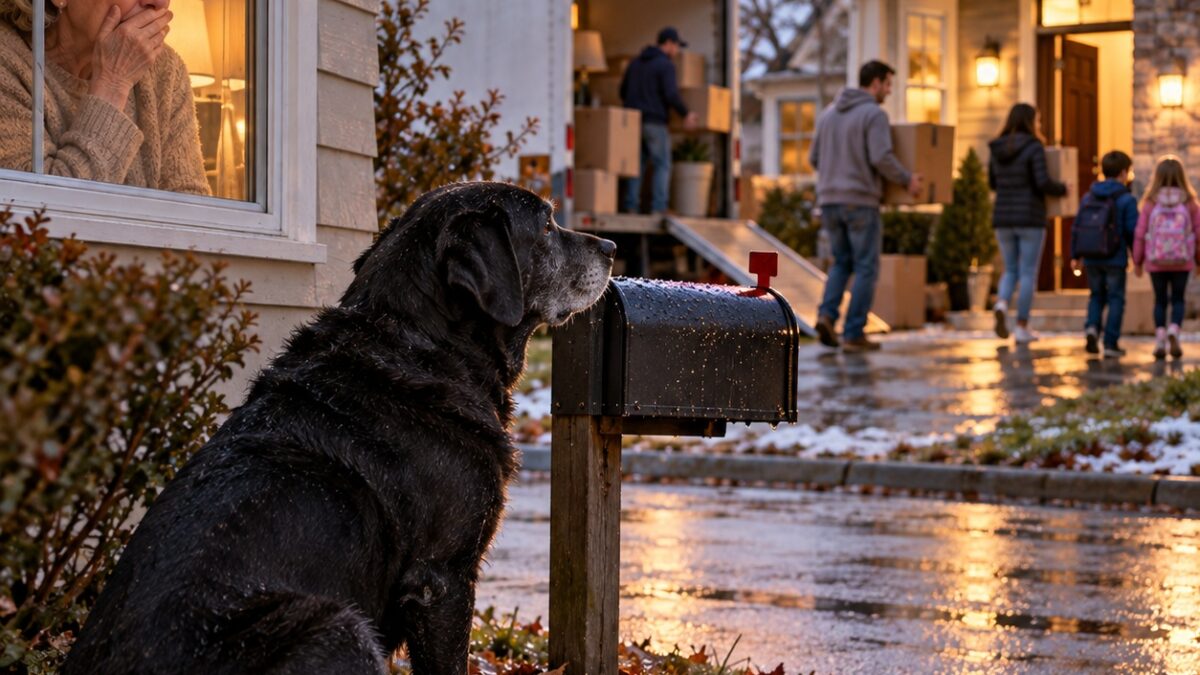
I began measuring my mornings by whether he was still there.
Coffee.
Curtain.
Mailbox.
Dog.
Every day.
Sometimes he moved into the shade during the hottest part of the afternoon.
Sometimes he slept beneath the hedge.
But he always returned to the mailbox.
It was the point from which he could see the road best.
The place where he had watched his family disappear.
That became his post.
His promise.
His mistake.
I started bringing food twice a day.
At first, I placed it and walked away.
He would wait until I crossed the street before eating.
By the end of the first week, I could stay on the sidewalk.
He still would not come to me.
I spoke anyway.
“You know, sweetheart, they should have taken you.”
His ears moved.
“That wasn’t your fault.”
He stared down the street.
I hated saying things he could not understand.
Maybe I was saying them for myself.
Neighbors noticed.
Some knew the family.
Different stories circulated.
They had moved for work.
They had downsized.
The landlord would not allow pets.
They had planned for someone to take the dog.
Someone had failed.
Someone had not.
I stopped asking.
Whatever explanation existed, the result sat beside the mailbox.
That was the only fact Benny cared about.
I did not know his real name.
No tag.
No one had left records with me.
In my mind, I began calling him Benny.
My late husband had been Benny to me, and there was something about the dog’s stubborn loyalty that reminded me of him.
Both of them had known how to wait.
How to stay.
How to remain devoted long past the point when other people would have protected themselves by walking away.
I did not say the name aloud at first.
It felt too personal.
Too soon.
On day eight, rain came.
Cold rain.
The kind that begins before dawn and keeps everything gray until evening.
I expected Benny to seek shelter.
He moved beneath the eave for a while.
Then went back to the mailbox.
I watched his black coat darken with water.
He shook.
Sat again.
I crossed over carrying an umbrella and an old quilt.
“Come on.”
He backed away.
I placed the quilt beneath the hedge.
He waited until I left.
That night, I checked the window three times.
He curled on the quilt.
But his head remained pointed toward the road.
At two in the morning, I woke and checked again.
Still there.
I whispered:
“You’re going to break your own heart.”
I knew something about that.
Animal control came on day nine.
I had called because I was worried about the weather and because I did not know what else to do.
Two officers arrived.
Kind people.
Patient.
They approached slowly.
Benny stood.
Moved away.
Not running.
Just keeping distance.
One officer crouched.
“Hey, buddy.”
Benny watched.
The officer offered treats.
Nothing.
They tried approaching from another angle.
Benny moved behind the mailbox.
No growling.
No snapping.
No aggression.
Only refusal.
Finally one officer walked over to me.
“He’s not dangerous.”
“No.”
“He’s in decent condition.”
“For now.”
“You’ve been feeding him?”
“Yes.”
He nodded.
Then explained that under the circumstances they could not simply force him into a vehicle as though he were an aggressive animal creating an immediate danger.
They would monitor.
Try again if his condition changed.
Check for owner information.
I looked across the street.
“So he just stays?”
“For now.”
“He’s waiting for people who left him.”
The officer followed my gaze.
“I know.”
“What if they don’t come back?”
His expression softened.
“Eventually he may decide to leave that spot.”
That sentence stayed with me.
He may decide.
Nobody could explain abandonment to him.
Nobody could order grief to finish.
He had to reach the end of his own waiting.
I understood that too well.
After my husband died, people told me to stay busy.
Travel.
Join groups.
Volunteer.
Move closer to my daughter.
They meant well.
But grief does not respond to instructions.
For months, I had kept his shoes near the door.
His jacket on the hook.
His mug beside mine.
Not because I believed he would return.
Because moving them felt like betraying the fact that he had once been there.
Eventually, I put the shoes away.
Then the jacket.
The mug stayed.
Still does.
Maybe Benny’s mailbox was my husband’s coffee mug.
A place where love remained attached to hope long after hope had stopped making sense.
Day eleven.
A delivery van turned onto the street.
Benny stood.
Tail lifting.
The van slowed near the house.
He took three quick steps.
Then it continued.
His tail dropped.
He sat.
Day thirteen.
A dark SUV.
Same reaction.
Day fifteen.
A pickup.
For a moment, Benny ran toward it.
The truck passed.
He stopped.
Returned.
Every vehicle hurt to watch.
I began hating engines.
That was irrational.
But every time tires turned onto our street, Benny’s whole body became expectation.
He would rise.
Ears forward.
Tail moving.
Sometimes run several yards.
Then realize.
Not them.
Again.
Not them.
Again.
Waiting can become a form of injury when every hope is renewed just enough to break again.
Around day sixteen, he let me stand beside him.
Not touch.
Just stand.
I brought his food.
Set it down.
Instead of retreating across the street, I remained three feet away.
He looked at me.
Then toward the bowl.
Then the road.
Finally ate.
Slowly.
I stood quietly.
When he finished, I said:
“Good boy.”
His ear moved.
I almost said Benny.
Stopped myself.
The name still belonged to another life.
That evening, I sat on my porch instead of inside.
He sat at the mailbox.
We faced each other across the street.
Two old creatures waiting for people who were not coming back.
I wondered whether he knew I was lonely.
Probably not.
Dogs do not need our stories to understand our bodies.
Maybe he noticed I lived alone.
Maybe he noticed that every night only one light came on.
Maybe he noticed that nobody else stepped onto my porch.
Or maybe I was giving him too much human meaning.
Maybe he simply knew:
The old woman brings food.
She does not grab me.
She does not chase me.
She leaves.
Then she comes back.
Trust often begins with predictable things.
On day nineteen, a hard wind came through.
Leaves blew across lawns.
Garbage lids rolled.
Benny startled at every crash.
I opened my front door.
“Come inside.”
He looked toward me.
I stepped back.
Left the door open.
Nothing.
For twenty minutes, I waited.
He remained beside the mailbox.
I eventually closed the door because cold air was filling the house.
I was disappointed.
Then ashamed of being disappointed.
He did not owe me trust because I had fed him.
Kindness is not a transaction.
You cannot say:
I helped you, therefore love me.
That would make kindness another form of pressure.
So I kept feeding him.
No expectations.
Day twenty-one.
I finally said his name aloud.
“Benny.”
He looked at me.
That startled both of us.
I laughed softly.
“All right.”
His tail moved.
Very small.
Maybe coincidence.
I did it again the next morning.
“Morning, Benny.”
He looked.
By day twenty-three, he seemed to know it.
Not his old name.
I never learned that one.
But names become real because somebody uses them with consistency.
Benny.
Food.
Benny.
Water.
Benny.
I’m here.
He began taking food while I sat on the curb.
Still no touching.
Still watching the road.
But I was allowed into the edge of his waiting.
I considered that an honor.
The twenty-sixth day began like every other.
Coffee.
Window.
Mailbox.
Benny.
Clear sky.
Cool morning.
I was washing dishes around ten when I heard an engine.
Not a delivery van.
Bigger.
A moving truck.
For half a second, I froze.
Then looked out.
A truck was turning into the driveway across the street.
Benny stood.
Everything changed.
He did not hesitate.
He ran.
Not the cautious trot I had seen when other vehicles appeared.
He sprinted.
All eight years of him seemed to become young again.
His ears flew behind him.
His tail moved so hard his entire body curved with it.
He barked.
I had almost never heard him bark before.
Now the sound came again and again.
Joy.
Pure.
Unprotected.
He ran beside the truck as it entered.
Circled once.
Stopped near the driver’s door.
Jumped.
Barked.
Ran to the passenger side.
Back again.
I gripped the edge of my sink.
“Oh, Benny.”
I started crying.
Because I thought they had come back.
Maybe the family had realized.
Maybe somebody had arranged to retrieve him.
Maybe they had been unable to take him immediately.
Maybe the story had an explanation after all.
The driver’s door opened.
A man stepped down.
Benny almost climbed into him.
The man recoiled slightly.
“Whoa.”
Benny’s tail kept moving.
Passenger door opened.
A woman.
Then the back doors.
Two children.
Benny ran between them.
Sniffing.
Looking.
Waiting.
The family looked confused.
The woman said something to her husband.
The children watched the dog.
Benny stopped.
His tail slowed.
He looked at the man.
Then the woman.
Then toward the house.
Back at them.
One child reached out halfway.
The mother gently pulled the child closer.
Not cruelly.
Cautiously.
They did not know him.
I understood before Benny did.
These were not the people who had left.
They were the people who had bought the house.
The new owners.
They began unloading bags.
Benny followed.
The man carried a box toward the door.
Benny walked beside him.
The woman unlocked the house.
Benny stood at the threshold.
Waiting.
I watched from my kitchen window with both hands against the counter.
The family entered.
Benny remained outside.
The door closed.
His tail stopped.
Completely.
He stared at the door.
I have seen grief.
Human grief.
Hospital grief.
Funeral grief.
The moment a doctor says there is nothing else.
The moment a wife realizes she is going home alone.
But I had never seen an animal’s hope collapse so visibly.
Benny looked at the door.
Then the mailbox.
Then the road.
As though checking every piece of the world that had made sense to him for twenty-six days.
Door.
Mailbox.
Road.
Nothing answered.
He stood there for a long time.
Then slowly turned.
He looked across the street.
At my house.
At me.
For twenty-six days, I had crossed the street toward him.
That morning, for the first time, he stepped toward me.
One step.
Then another.
He crossed the driveway.
The road.
Walked to my curb.
I opened the front door before he reached the porch.
I did not call.
Did not coax.
I simply stood in the doorway.
He came up the steps.
Stopped in front of me.
Looked into my face.
His eyes were tired.
Not physically.
Something deeper.
I stepped aside.
Benny walked into my house.
No leash.
No food lure.
No hand on his collar.
His decision.
He crossed the living room.
Turned once.
Sat on the rug.
Then released a long breath.
A sigh.
Not the relaxed sigh dogs make when settling for sleep.
This sounded emptied out.
Exhaustion.
Surrender.
The sound of a creature finally reaching the end of an expectation that had kept him alive and hurt him at the same time.
I closed the door.
Sat on the floor beside him.
Neither of us moved.
After twenty-six days, Benny had stopped waiting for the people who left.
I did not understand yet that he had come to a house where another person had been waiting too.
The first day inside, he would not eat.
I put down the food he had eaten across the street every morning.
He looked.
Turned away.
I tried chicken.
Nothing.
Water.
A little.
Mostly, he lay in the corner of my living room with his chin on his paws.
Eyes open.
Not watching anything.
The dog who had been alert to every engine now barely reacted when cars passed.
I called the veterinarian.
Explained.
They checked him physically.
No obvious serious illness.
He was dehydrated.
Tired.
Stressed.
We arranged follow-up.
“Give him time.”
Everyone kept saying that.
Time.
Humans use that word when we have no control over what comes next.
The second day, he refused food again.
Third day, almost nothing.
I became frightened.
I sat beside him.
“Benny.”
His eyes moved toward me.
“That’s enough waiting.”
No reaction.
“You don’t have to wait here.”
Nothing.
“I’m staying.”
His ear moved.
That became my promise.
Not:
You’ll be happy.
Not:
You’ll forget them.
Not:
Everything is okay.
Only:
I’m staying.
Because that was the one promise I could actually keep.
Every morning, I made coffee.
Then sat on the floor beside him.
At eighty years old, getting onto a floor is an act of commitment.
Getting back up is an engineering problem.
The first morning, my knees complained for twenty minutes afterward.
Still, I sat.
Sometimes I placed my hand lightly on his back.
If he tensed, I removed it.
Sometimes I ran my fingers through the fur behind his shoulders.
Sometimes I did nothing.
We breathed in the same room.
I told myself he needed to choose life.
That sounds dramatic.
Maybe it was.
But animals can withdraw.
Stop eating.
Stop engaging.
Disappear inward.
I could provide food.
Water.
Medical care.
A bed.
I could not force him to care that tomorrow existed.
So I showed him tomorrow.
Morning one.
I’m here.
Morning two.
I’m here.
Morning three.
Still here.
Maybe reliability is simply time made visible.
The new family across the street eventually learned his story.
The woman came over on the fourth day.
Her name was Rachel.
She looked upset.
“We had no idea.”
“I know.”
“We thought he was a neighborhood dog.”
“I know.”
“He kept trying to come inside.”
“I saw.”
She looked toward the floor where Benny lay.
“Was that his house?”
“Yes.”
“Oh my God.”
She covered her mouth.
“I feel awful.”
“You didn’t do anything.”
“We closed the door on him.”
“You didn’t know.”
Her eyes filled.
“Is he okay?”
“Not yet.”
Rachel asked if there was anything they could do.
I said:
“Give him space.”
She nodded.
Before leaving, she said:
“If you need anything…”
“Thank you.”
I appreciated her.
It would have been easy to turn the new family into another villain.
They were not.
They had bought a house.
They arrived.
A strange dog ran at them.
They acted cautiously.
Benny’s heartbreak was real.
Their ignorance was also real.
Both things can exist at once.
At the end of the first week, Benny ate.
Not much.
Three bites.
Then stopped.
I nearly celebrated like he had won a championship.
I did not show it.
No pressure.
I sat on the couch.
Pretended not to watch.
He returned to the bowl.
Another bite.
Then another.
That night he drank more water.
The next morning he ate half.
His body was choosing something.
Not joy yet.
But continuation.
I called the vet.
“He ate.”
“How much?”
“Half the bowl.”
“Good.”
“Should I bring him in?”
“Keep the appointment, but that’s encouraging.”
Encouraging.
I held onto the word.
At the start of the second week, he stood and walked around the living room.
Until then, most of his movement had been between his bed, water, and door.
That morning, he walked to the hallway.
Stopped.
Looked into the kitchen.
Then the dining room.
He sniffed my husband’s old chair.
Walked to the stairs.
Returned.
No tail wag.
No play.
He seemed to be inspecting the place.
Testing it.
Where are the exits?
Where do sounds come from?
Does this room change when I leave it?
Is the old woman still here?
I followed at a distance.
When he looked back, I pretended to be interested in a lamp.
He walked into the kitchen.
Sniffed the cabinet.
Then returned to his corner.
But the next day, he explored farther.
By the end of the second week, he did something I had waited for without admitting I was waiting.
I was in my chair reading.
He got up.
Crossed the room.
Sat at my feet.
I froze.
He lowered his head.
Slowly placed it on my knees.
My book slipped from my hand.
I started crying.
Quietly.
I had not planned to.
I did not want to turn his small act of trust into an emotional burden.
But grief ignores etiquette.
Tears came.
Benny lifted his head.
Looked at my face.
Then licked my hand.
Once.
Just once.
Then put his head back on my lap.
That was the first time I touched him without wondering if he wished I would stop.
I placed both hands gently around his head.
“You’re all right.”
Maybe I was talking to him.
Maybe to myself.
We stayed like that until sunset.
My husband had died three years earlier.
Cancer.
Slow enough that we had time to say goodbye.
Fast enough that goodbye still felt impossible.
The last six months of our marriage were measured in appointments.
Medication times.
Good days.
Bad nights.
After he died, everyone praised me for being strong.
I hated that word.
Strong sometimes means:
She did not inconvenience us with her grief.
I stayed in the house.
Paid bills.
Went to church occasionally.
Answered my daughter’s calls.
Ate.
Slept.
Functioned.
But there was a part of me still sitting beside an invisible mailbox.
Waiting.
Not because I believed he would return.
Because I had not decided what my life was supposed to be if he did not.
Watching Benny forced me to see that.
Twenty-six days he stared down the road.
Three years I had stared backward in other ways.
His waiting was obvious.
Mine looked respectable.
That did not make it less real.
At the beginning of week three, Benny wagged his tail.
Barely.
I was making toast.
He came into the kitchen.
I looked down.
“Morning.”
The tail moved.
One small sweep.
I stopped breathing.
Then continued buttering toast like nothing had happened.
I had learned not to react too strongly to his progress.
I did not want every new behavior to feel like a test he needed to repeat.
So I smiled.
That was all.
Later that day, he followed me to the laundry room.
Then back.
The next morning, another tail movement.
Larger.
By the end of the week, when I came downstairs, he was standing instead of lying down.
Not running to me.
But waiting.
That word again.
Except this waiting was different.
He was not staring at the road hoping for someone who might never return.
He had seen me go upstairs.
Now he expected me to come back.
And I did.
That difference changed everything.
At the beginning of the fourth week, I found an old tennis ball in a closet.
It had belonged to my grandson years ago.
Faded green.
One side worn almost smooth.
I set it on the floor.
Did not throw it.
Benny sniffed.
Walked away.
Two days later, I noticed the ball had moved.
Maybe I kicked it accidentally.
Then I found it beside his bed.
The following afternoon, Benny picked it up.
I was sitting in my chair.
He stood across the room holding the ball.
I lowered my book.
He looked at me.
I looked at him.
Neither moved.
Then he walked over.
Dropped the ball at my feet.
I laughed.
Not quietly.
A real laugh.
The first one that had surprised me in a long time.
“You want this?”
His tail moved.
I picked up the ball.
Threw it gently across the room.
Benny ran.
Not the desperate run toward the moving truck.
Not the panicked run after disappearing cars.
This run was different.
Loose.
Playful.
He caught the ball.
Turned.
Came back.
Tail moving.
Really moving.
He dropped it again.
I threw.
Again.
By the fifth throw, I was laughing hard enough that I had to wipe my eyes.
He did not know why.
He did not care.
He brought the ball back.
That night, he came to my chair without being called.
Turned twice.
Lay at my feet.
I put my hand on his head.
He sighed.
The same long exhale I had heard his first night inside.
But this one was not surrender.
It was peace.
Trust.
Maybe home.
At the beginning of week five, I decided to take him for a walk.
Until then, he had only gone into my backyard.
The front door was harder.
The front door faced the road.
The mailbox.
The house across the street.
I clipped on the leash.
Opened the door.
Benny stopped.
His whole body tightened.
He looked at the mailbox.
Then the old house.
Rachel’s children had bicycles in the driveway now.
Curtains hung in the windows.
A different car sat where his family’s car had been.
Benny stared.
I did not pull.
Not once.
We stood.
One minute.
Two.
Three.
I could feel the leash resting loose in my hand.
“Whenever you’re ready.”
He looked up at me.
Then forward.
He took one step.
Another.
We walked past my mailbox.
Then to the corner.
I expected him to look back.
He did not.
At the park, he discovered a hundred new smells.
Grass.
Other dogs.
Children.
Squirrels.
A discarded sandwich wrapper I prevented him from eating.
The world was apparently still full of things worth investigating.
On the way home, he walked beside me.
We reached my driveway.
He turned in.
No hesitation.
That was the first day I thought:
He knows.
This is his house now.
Week six gave me his first joyful bark.
A squirrel ran across the yard.
Benny had been lying in the sun.
He stood so quickly he almost tripped.
The squirrel climbed the maple.
Benny barked.
Once.
Then again.
Tail high.
He looked at me as though I had somehow arranged this entertainment specifically for him.
I laughed.
“You tell him.”
Benny barked again.
The squirrel was unimpressed.
For the first time in six weeks, I laughed loudly enough that the neighbor heard and waved.
Benny turned toward me.
There was something new in his eyes.
Interest.
Life.
Not merely watching.
Participating.
That afternoon, he carried his tennis ball outside.
Dropped it near my feet.
I threw it.
He ran through the grass.
The mailbox across the street remained visible.
He never looked at it.
By week seven, I realized he no longer slept in the corner.
I had not noticed exactly when that stopped.
One day the corner simply became empty.
He slept near my chair.
Beside the couch.
At the foot of my bed if I left the bedroom door open.
He followed me from room to room.
If I went to the kitchen, he came.
Laundry.
He came.
Porch.
He came.
Bathroom.
“Benny, boundaries.”
He waited outside.
Mostly.
He ate like a Labrador.
Which means as though every meal was the first food he had seen in several decades.
He played.
He greeted me in the morning.
If I reached for my coat, he positioned himself near the door.
The message was obvious.
Where are we going?
Eventually, I started taking him almost everywhere I could.
Morning coffee on the porch.
Together.
Midday walk.
Together.
Garden.
Together.
Evenings in the chair.
Together.
I spoke to him constantly.
I told him about groceries.
My daughter.
The weather.
Neighbors.
My husband.
Especially my husband.
“You know why I called you Benny?”
He would rest his head on my knees.
“He was stubborn too.”
Tail.
“He waited for me after work every day.”
Benny watched.
“He used to leave his shoes directly where I would trip over them.”
No response.
“You’re neater.”
That was true.
Then sometimes I told Benny things I had not told anyone.
“I’m afraid of getting old alone.”
His head stayed on my lap.
“I know I’m already old.”
Tail thump.
“Rude.”
He licked my hand.
I would laugh.
And slowly I understood something.
Benny was not the only one who had needed another life to choose him.
There is loneliness that comes from having no one.
Then there is loneliness that comes from remembering exactly what companionship felt like.
The second can be worse.
I had lived forty years in that house.
Most of them with my husband.
After he died, every room became shaped around absence.
His side of the bed.
His chair.
The hook by the door.
The garage workbench.
The spot at the dining table.
I had not understood how much of my day was structured around avoiding those empty places.
Then Benny entered.
Suddenly rooms had new sounds.
Nails clicking on hardwood.
Collar tag.
Drinking water.
A heavy Labrador turning around three unnecessary times before lying down.
Snores.
Enormous snores.
The house stopped sounding like a memory.
It sounded inhabited.
At first I told myself I was saving him.
By week seven, that story had become embarrassingly incomplete.
One evening, I sat on the terrace while the sun went down.
Benny lay at my feet.
Sky orange.
Warm air.
A few children playing somewhere down the street.
The house across from mine glowed with the lights of its new family.
Rachel had planted flowers near the mailbox.
The same mailbox.
I looked at it.
Then at Benny.
He was not looking across the street.
He was watching me.
I said:
“Benny, you’re my home now.”
I felt silly immediately.
An eighty-year-old woman speaking dramatic sentences to a Labrador.
Then Benny stood.
He was too big for laps.
He apparently disagreed.
He pushed himself against my legs.
Then, with complete disregard for physics, attempted to climb partly onto me.
“Benny.”
He leaned farther.
I laughed.
He rested his head against my chest.
Closed his eyes.
I wrapped my arms around him.
His body was warm.
Heavy.
Alive.
We stayed there until the sky became dark.
Two different lives.
Two different forms of waiting.
Somehow ending in the same chair.
I began understanding loyalty differently because of Benny.
Before him, I thought loyalty meant staying.
You remain.
You wait.
You do not give up.
There is something noble in that.
But Benny showed me the danger too.
Loyalty without reciprocity can become a prison.
For twenty-six days, he believed love meant staying beside the mailbox.
If he waited long enough, perhaps he could prove he deserved to be taken back.
Humans do that too.
We stay emotionally outside locked doors.
Old relationships.
Old grief.
Old versions of ourselves.
We call it loyalty.
Sometimes it is fear of choosing another life.
Benny did not betray his first family when he crossed the street toward me.
He survived them.
That distinction helped me understand my own grief.
Living again did not betray my husband.
Laughing did not mean I loved him less.
Making room for Benny did not replace him.
Love does not work like furniture.
You do not remove one thing to fit another.
Sometimes the heart builds an extra room.
A year passed.
Benny became almost unrecognizable from the dog beside the mailbox.
Still black.
Still gray around the muzzle.
Still eight years old becoming nine.
But his body language changed.
Tail up.
Shoulders loose.
Eyes bright.
He barked at squirrels with unnecessary confidence.
He ran at the park.
Made friends with a golden retriever named Charlie.
Disliked one particular trash truck for reasons I never understood.
Greeted neighbors.
Especially children.
Rachel’s children across the street became some of his favorites.
The first time they asked to pet him, I watched carefully.
Benny walked over.
Sniffed.
Then leaned against the little boy.
The boy nearly fell.
Everyone laughed.
Rachel looked at me.
“I’m glad he has you.”
I answered:
“I’m glad he has all of us.”
Because that was true too.
The street that had once watched him wait now watched him live.
The mailbox never moved.
Same post.
Same little metal box.
Sometimes I caught myself looking at it.
Not Benny.
Me.
I wondered about the family that left.
Why?
I never received an answer.
Maybe circumstances were worse than anyone knew.
Maybe they believed someone else would take him.
Maybe they made a selfish choice.
Maybe all of it.
I stopped needing the explanation.
That surprised me.
At first, I thought understanding why would make the story hurt less.
Eventually I realized Benny did not need their reason to heal.
Neither did I.
Sometimes the past does not provide closure.
Sometimes the future has to.
One morning, I opened the front door before sunrise.
Benny ran into the yard.
Cold grass.
Pale light.
He stopped in a patch of early sun.
Lifted his head.
Closed his eyes.
Breathed.
No leash pulling him.
No mailbox holding him.
No road demanding his attention.
Free.
Home.
I stood in the doorway wearing slippers and a sweater.
Watching.
And I suddenly understood:
I was home too.
Not because the house had changed.
I had.
For years, I had lived surrounded by memories.
Now I was creating new ones.
Benny in the kitchen.
Benny stealing half a sandwich.
Benny barking at squirrels.
Benny snoring.
Benny waiting at the foot of my bed—not because he feared abandonment, but because he knew morning always came with me in it.
There is a difference between waiting for someone who left and waiting for someone you trust to return.
Benny had learned it.
So had I.
The twenty-six days still matter.
I do not romanticize them.
People sometimes say:
“It all happened for a reason.”
I am careful with that.
I do not know whether pain happens for reasons.
I know what people and animals can do with what happens.
Benny should not have been left.
He should not have spent twenty-six days beside a mailbox.
He should not have run joyfully toward strangers believing they were the people he loved.
There is nothing beautiful about that part.
The beauty came afterward.
When he turned.
When he crossed the street.
When he entered my house.
When he ate.
When he placed his head on my knees.
When his tail moved.
When he brought me the tennis ball.
When we walked past the mailbox.
When he stopped looking backward.
Those things did not justify what happened.
They transformed what came next.
That is enough.
I am eighty years old.
People my age become familiar with endings.
Friends move.
Bodies change.
Spouses die.
Children build lives in other cities.
You learn that many things you thought permanent were only long.
That can make you cautious about beginning anything.
A new dog?
At eighty?
What if he outlives me?
What if I get sick?
What if caring for him becomes hard?
Those were sensible questions.
My daughter asked them.
We made plans.
Veterinary care.
Backup family.
Legal arrangements.
People who would take Benny if I could not.
Love is not pretending practical concerns do not exist.
Love is planning because they do.
But underneath all the sensible questions was one dangerous thought:
Maybe I’m too old to start loving something new.
Benny answered that without words.
Love does not ask whether the timing is convenient.
He arrived because his life had fallen apart.
I opened the door because mine had become too quiet.
Neither of us was prepared.
That may be why it worked.
On the anniversary of the day he crossed the street, I bought him a new tennis ball.
Bright green.
The old one had finally split.
I placed it on the floor.
Benny sniffed.
Picked it up.
Brought it to me.
Exactly like the first time.
I threw.
He ran.
Slower now.
Age.
Still joyful.
He returned.
Dropped it.
Again.
I threw.
Again.
At the third throw, I looked across the street.
Rachel was collecting mail.
She waved.
I waved.
Benny did not look at the old mailbox.
Not once.
That was all the anniversary I needed.
Sometimes he still waits for me.
If I go upstairs, he lies at the bottom.
If I shower, he waits outside the bathroom.
When I go to the store, my daughter says he sometimes watches the front door.
But it is not the old waiting.
No trembling.
No refusal to eat.
No staring down the road for days.
He knows the pattern now.
I leave.
I return.
Goodbye means:
See you later.
The certainty changes everything.
Maybe that is what home really is.
Not walls.
Not deed.
Not address.
Home is the place where absence has an ending.
Where the person who walks out has taught you, through repetition, that they come back.
I tell Benny goodbye every time I leave.
My daughter thinks that is ridiculous.
“He doesn’t know the word.”
“He knows the routine.”
“You explain where you’re going.”
“He worries.”
“You told him yesterday you were buying toothpaste.”
“Important information.”
She laughs.
But I do it anyway.
“Benny, I’m going to the store. I’ll be back.”
Tail.
He watches.
When I return, he greets me as though I survived an ocean crossing.
That joy never gets old.
Especially because I know what it replaced.
The first family never returned.
Not for him.
Not to ask.
Not that I know of.
For a long time, that angered me.
Now, mostly, it saddens me.
They missed the dog he became.
The tennis ball.
The park.
The ridiculous squirrel barking.
The way he leans against someone he trusts.
The way his eyes soften before he falls asleep.
They left before the story became good again.
That is their loss.
One afternoon, Rachel’s daughter asked:
“Was Benny sad when we moved here?”
Children always ask directly.
“Yes.”
“Because he thought we were his old family?”
“Yes.”
She looked at him.
Benny was sleeping in the grass between us.
“Did he hate us?”
“No.”
“Why?”
“Because you didn’t leave him.”
She considered this.
Then:
“But we closed the door.”
“You didn’t know him.”
She touched his ear.
“Now we do.”
Benny opened one eye.
She smiled.
Maybe communities heal too.
My husband’s old mug remains in the kitchen cabinet.
I still use it sometimes.
The first year after Benny arrived, I caught myself telling him stories about my husband as if they had known each other.
“He would’ve liked you.”
Benny listened.
“He would have complained about your hair on the couch.”
Tail.
“He secretly let every dog on the couch.”
Benny climbed onto the couch.
“See? Bad influence.”
I laughed.
For years, saying my husband’s name had brought pain first.
Then memory.
Then maybe warmth.
Benny helped shift the order.
Now sometimes warmth comes first.
That is not forgetting.
That is healing.
There was one rainy morning that made me realize how far Benny had come.
Heavy rain.
Wind.
Almost identical to those early days by the mailbox.
I expected him to hesitate going outside.
Instead, he ran into the yard.
Did what he needed.
Ran back.
Shook water all over my entryway.
I yelled:
“Benny!”
He looked delighted.
I grabbed a towel.
He turned the entire experience into a game.
Minutes later, he was asleep beside the radiator.
Rain against the windows.
Safe.
That old version of him—wet beside the mailbox, staring down the street—felt like another dog.
But I knew he was still inside Benny somewhere.
Healing does not erase.
It adds.
Now rain had other meanings.
Warm towels.
Home.
Nap.
Me complaining about the floor.
That is how new memory softens old memory.
Not deletion.
Competition.
Eventually, good memories become numerous enough that the painful one is no longer alone.
At eighty, I do not make many long-term promises casually.
But I promised Benny something.
One night, he lay at my feet.
I said:
“You will never wait outside my door wondering if you belong.”
He lifted his head.
I continued:
“If I’m here, you’re here.”
Tail.
“And if something happens to me, people are already arranged.”
He yawned.
“Very moving.”
He went back to sleep.
Dogs are excellent audiences because they do not let your speeches become too important.
My daughter eventually admitted she had worried the dog would be too much for me.
“I thought he’d knock you over.”
“He nearly has.”
“I thought walks would be difficult.”
“They are good for me.”
“I thought you’d get too attached.”
I looked at her.
“That was definitely correct.”
She smiled.
Then:
“I haven’t heard you laugh this much since Dad.”
That silenced me.
She was right.
I had not noticed.
Maybe because laughter returns gradually.
Like Benny’s tail.
First almost invisible.
Then one day you realize it has become normal again.
We celebrated Benny’s approximate tenth birthday at the park.
I did not know his actual birth date.
So we chose the day he walked into my house.
Rachel’s family came.
My daughter.
Grandchildren.
Charlie the golden retriever.
Benny wore a ridiculous blue bandanna.
He hated the hat we tried.
Fair.
Someone brought dog-safe treats.
Benny ate his in approximately one second.
Then attempted negotiations for everyone else’s.
I looked around.
People laughing.
Benny moving from person to person.
No one would have guessed he had once refused food for three days.
I took a photograph.
Later, I printed it.
Placed it beside a photo of my husband.
Different chapters.
Same house.
The mailbox across the street rusted eventually.
Rachel’s husband replaced it.
I watched from the kitchen.
For a moment, emotion surprised me.
The old box came off the post.
The one Benny had sat beside.
Twenty-six days.
Then it was carried away.
I almost wanted to ask them to keep it.
Then realized how absurd that was.
Benny did not need a monument to waiting.
Neither did I.
The new mailbox went up.
Black.
Simple.
By afternoon, it looked like it had always been there.
I watched Benny in my yard.
He did not notice.
Perfect.
If I had to explain what he taught me in one sentence, it would be this:
Loyalty is not measured by how long you remain where you are unwanted.
That lesson took me eighty years.
Benny learned it in twenty-six days and seven weeks.
Love can be loyal and still move.
Grief can be faithful and still change.
You can honor what was lost without living forever at the place where it disappeared.
Home is not the doorway you keep staring at.
Home is the doorway that opens.
One evening last spring, I fell asleep in my chair.
When I woke, the room was dark except for the lamp.
Benny’s head rested on my foot.
I moved.
He opened his eyes.
Tail thump.
I looked down.
“Still here?”
Another thump.
“So am I.”
That was enough.
People who hear our story often focus on the truck.
Of course they do.
The moment he ran.
The joy.
The strangers.
The closed door.
It is the sharpest moment.
But when I think of Benny now, that is not the image I see first.
I see him in sunlight.
Head lifted.
Eyes closed.
Breathing.
I see him carrying a tennis ball.
I see him sleeping with his belly exposed.
I see him waiting at the bottom of my stairs because he knows I am coming down.
Those images won.
That is the ending.
Not that he stopped loving the people who left.
I cannot know what remained of that love.
The ending is that their leaving stopped controlling his future.
This morning, I woke and found Benny sitting at the foot of my bed.
He does that often.
Just sits.
Watching.
Waiting for me to open my eyes.
I looked at him.
“Good morning.”
Tail.
I sat up.
He stood immediately.
Walked toward the door.
“Coffee first.”
He disagreed.
We went downstairs.
I made coffee.
He ate breakfast.
Then I opened the back door.
Benny ran outside.
Morning sun across the grass.
He stopped.
Lifted his face.
Closed his eyes.
Breathed.
For a second, the light showed the gray around his muzzle.
He is older.
So am I.
Nothing stays.
I know that better than most.
But home was never a promise that nothing changes.
Home is the place where change does not automatically mean abandonment.
I stood in the doorway.
He looked back.
Saw me.
Tail moved.
Then he returned.
Not because he was afraid I would disappear.
Because he wanted to be near me.
There is an entire world of difference between those two things.
I understand that now.
My name is Elizabeth.
I am eighty years old.
I have lived in this house for forty years.
For a long time after my husband died, I thought that meant I knew exactly what home was.
I was wrong.
A black Labrador taught me.
Home is not where you keep waiting for someone who chose not to return.
It is not the mailbox beside a road.
Not the closed door.
Not the memory you refuse to leave because moving forward feels disloyal.
Home is where someone notices you.
Where they feed you.
Sit beside you.
Come back tomorrow.
And the day after that.
Home is where goodbye means:
I’ll return.
Home is where you are not required to prove how long you can wait.
Benny waited twenty-six days for the wrong door to open.
Then one morning, after the most painful disappointment of his life, he finally turned around and saw mine.
He crossed the street.
I opened it.
He walked in.
And somehow, without either of us knowing what we were doing, we both stopped waiting.
A year later, he is happy.
He plays.
He runs in the park.
He barks at squirrels as if our property depends on it.
He greets neighbors.
He sleeps beside my chair.
He knows when I leave, I return.
And I know that when I wake tomorrow morning, there will probably be a black dog sitting at the foot of my bed, waiting—not for someone who abandoned him, but for the person who stayed.
For twenty-six days, Benny thought home was the house across the street.
He was wrong.
So was I.
Home was never the place where we waited.
Home was the place where, at last, neither of us had to.




