PART2:An Emaciated Stray Came to My Fence Carrying One Work Glove—Then He Led Me 200 Yards Into the Woods
PART2
The trail behind my property had existed longer than my house.
Hunters used it.
Farm workers used it.
Teenagers occasionally used it when they thought nobody could see cigarette smoke through trees.
I walked it often enough to know every major turn.
But the dog did not stay on the main trail.
About seventy yards in, he left it.
He slipped through brush on the right.
I stopped.
“That’s not a trail.”
He turned.
Waited.
There are moments when your sensible mind tells you to go back.
Get a phone.
Call someone.
Bring proper shoes.
Then there are moments when another living thing looks at you with such absolute purpose that logic becomes harder to obey.
I followed.
Wet branches brushed my jacket.
The ground became softer.
Roots crossed everywhere.
Morning dew soaked my jeans below the knees.
The dog stayed ahead.
Ten yards.
Sometimes five.
Always close enough to see.
Every time I slowed, he slowed.
Every time I stopped, he stopped.
Not impatient.
Just watching.
Making sure I was still there.
I started talking because that is what people do when nervous.
“You’d better not be taking me to a dead deer.”
No reaction.
“I’m too old for this.”
He looked back.
“Exactly.”
We continued.
Maybe two hundred yards from my fence, the trees thickened.
A large oak stood ahead.
One heavy branch had split and fallen.
The dog stopped there.
Completely.
He did not look at me first.
He looked toward the ground.
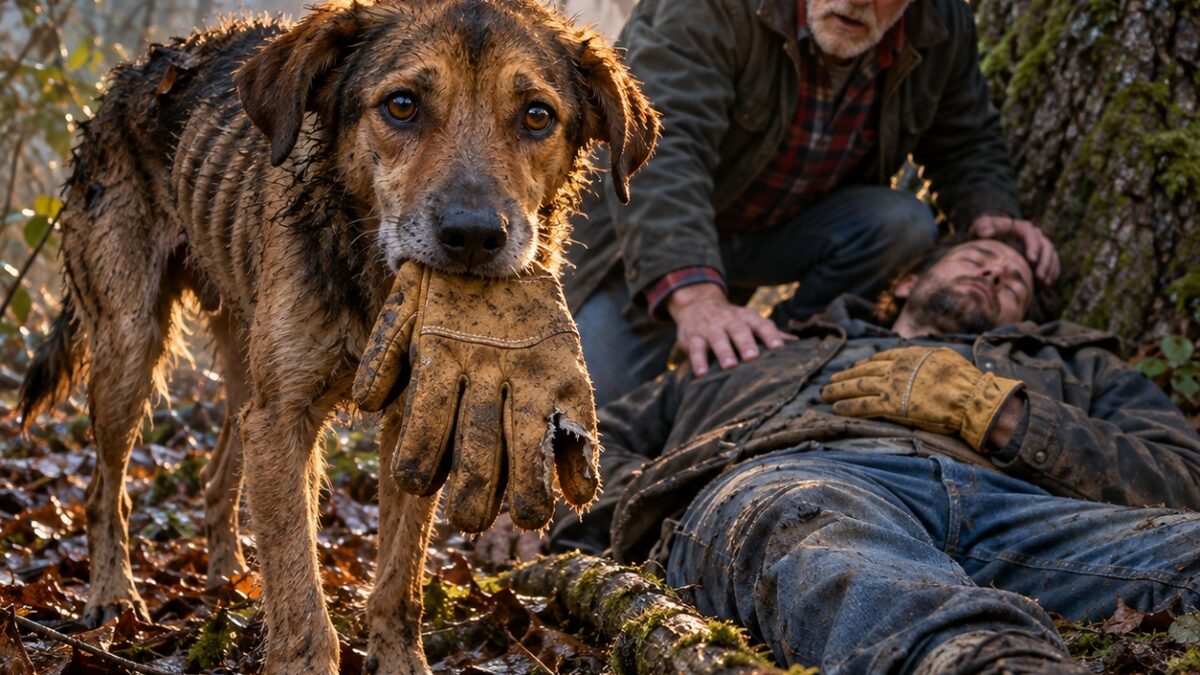
Then I saw the boot.
Brown work boot.
Partly hidden by leaves.
My heart tightened.
I moved faster.
A man lay on his side beneath the tree.
Late fifties, maybe early sixties.
Work pants.
Heavy shirt.
Boots.
One glove still on his left hand.
His right hand was bare.
The matching glove was in the dog’s mouth.
For several seconds, every confusing detail from my yard rearranged itself into one terrible answer.
The glove.
The dog refusing to eat.
The repeated looks toward the forest.
The way he came back when I did not follow.
He had not been bringing me a toy.
He had brought proof.
Something that smelled like the man.
Something he could carry.
Something he hoped a human would understand.
“Oh, God.”
I knelt.
The dog dropped the glove near the man’s shoulder.
Then moved close to his head.
Sniffed his face.
The man did not respond.
I checked breathing.
Slow.
But there.
Pulse.
I found one.
Thank God.
“Sir?”
Nothing.
I touched his shoulder gently.
“Can you hear me?”
No movement.
There was dirt along one side of his face.
A scrape near the temple.
No obvious major bleeding.
I looked up.
Several branches above had been cut.
One fresh break.
He had been pruning.
Or trimming.
Maybe the branch failed.
Maybe he slipped.
Whatever happened, he had fallen hard enough to lose consciousness.
I looked for climbing equipment.
A rope.
A pruning saw.
Tool bag.
Not far away.
No phone.
No second person.
Just the dog.
The dog pressed his nose against the man’s cheek.
Whined.
First sound I had heard him make.
That sound changed me.
It was not fear for himself.
It was a question.
Why isn’t he waking up?
I checked the man again.
Breathing steady enough.
No obvious spinal deformity.
But I knew enough to understand moving an unconscious fall victim could be dangerous.
I also knew where we were.
No phone.
No one nearby.
No signal even if I had remembered mine.
I could run home.
Maybe fifteen minutes each way if I moved carefully.
Call for help.
Bring responders back.
But what if his airway changed?
What if breathing stopped?
What if he had internal bleeding?
I looked at the dog.
He looked at me.
Sixty-three is not ancient.
But it is old enough that your body has begun negotiating every stupid decision with you.
My lower back had been complaining for years.
One shoulder never fully recovered from construction work when I was younger.
My knees made stairs personal.
Still, in that moment, none of that seemed relevant.
I needed to get him out.
I did what I would later learn emergency professionals generally do not recommend without proper stabilization after a significant fall.
But I was alone.
I made the best decision I could with what I had.
I eased him partly upright.
He groaned.
That was the best sound I had heard all morning.
“Sir?”
Nothing else.
But he was not completely unresponsive to movement.
I got one arm behind his back.
One under his knees.
Tried lifting.
Immediately realized this would not work.
He weighed at least one hundred eighty pounds.
Probably more.
I lowered him carefully.
My heart was hammering.
The dog paced two circles.
Whined again.
“Give me a minute.”
I looked around.
Found one of the man’s heavy canvas straps near his tools.
I looped it to help support his upper body.
Then used a dragging carry for the first section, keeping his head supported as best I could.
Every root became a problem.
Every branch.
Every patch of mud.
I moved him ten feet.
Stopped.
Checked breathing.
Dog stopped.
I moved again.
The dog moved.
That became our rhythm.
Ten feet.
Rest.
Check.
Ten more.
Rest.
Somewhere during the first fifty yards, my back started screaming.
Not metaphorically.
Sharp pain down one side.
I stopped.
Bent forward.
Hands on knees.
Sweat already under my jacket despite the cold.
The dog stood beside the man.
Then came toward me.
For the first time, he touched me.
His nose against my wrist.
Just once.
Then returned to the injured man.
I laughed breathlessly.
“Yeah. I know.”
We continued.
When terrain improved, I managed to get the man higher against my body.
Half carry.
Half drag.
At one point, I tried lifting him across my shoulders.
Made it maybe fifteen yards.
Set him down.
My vision pulsed at the edges.
I sat in wet leaves.
The dog sat too.
Exactly beside us.
Not wandering.
Not sniffing.
Watching the man.
That is when the full weight of what he had done began sinking in.
This dog was thin enough that he had probably been hungry for days.
Maybe weeks.
No collar.
No tag.
No owner anyone knew.
Yet he had remained with an unconscious stranger.
When waiting did not work, he had apparently looked for help.
He had chosen one object.
The missing glove.
Carried it through the forest.
Found my fence.
Sat there.
Waited.
Then convinced a stubborn sixty-three-year-old man to follow.
People say animals do not reason like we do.
I am sure that is true.
But I also know what happened.
He faced a problem.
His person would not wake.
He could not solve it.
So he found someone who might.
Call it instinct.
Call it intelligence.
Call it loyalty.
I call it one of the clearest acts of devotion I have ever witnessed.
The path felt ten times longer returning.
On the way in, I had barely noticed roots.
Now each one could make me fall while carrying an unconscious man.
I spoke constantly.
To the injured man.
To the dog.
To myself.
“Almost there.”
Probably a lie.
“Stay with me.”
I did not know whether the man heard.
“Good boy.”
That one was for the dog.
He would move ahead.
Then stop at turns.
Look back.
Like a guide.
At one point, I started following the wrong opening between trees.
The dog stepped across my path.
I tried going around.
He moved again.
“What?”
He turned toward the left.
I looked.
There.
A faint track.
He remembered the route better than I did.
“You’re kidding.”
He walked left.
I followed.
He was right.
That saved us several minutes.
Maybe more.
The sun had climbed higher by the time I recognized the lighter patch of trees near my property.
I wanted to cry.
My arms were numb.
Back on fire.
Shirt soaked.
The injured man had shown a few signs of response.
A groan.
Slight movement.
Never consciousness.
The dog stayed with us.
When we finally broke through the last line of brush and I saw my fence, I nearly collapsed from relief.
My house looked absurdly close.
Maybe two hundred yards from where Walter had fallen.
Might as well have been twenty miles.
I checked my watch.
A little over twenty minutes from finding him to reaching the property.
It felt like hours.
I got him to the driveway.
My car was parked outside the garage.
I opened the rear door.
With one last effort, I lifted and slid him onto the back seat.
He groaned.
Good.
Still breathing.
The dog jumped forward.
Stopped beside the door.
Looked inside.
I said:
“Stay.”
Ridiculous.
He had never heard a command from me in his life.
But he stayed.
I ran into the house.
Grabbed my phone.
Dialed emergency services.
My hands were shaking so badly I had trouble giving the address.
“Unconscious adult male. Fall from height. Breathing.”
“How long unconscious?”
“Unknown.”
“Age?”
“Late fifties, maybe sixty.”
“Any severe bleeding?”
“No visible severe bleeding.”
“Do not move him further.”
“I already had to move him.”
Pause.
“Okay. Responders are on the way.”
I ran back outside.
The dog was sitting beside the rear passenger door.
Exactly where I had left him.
His nose near the glass.
Watching.
I sat on the ground beside him.
My legs no longer trusted me.
I put a hand carefully on his head.
This time, he did not move away.
But he did not look at me either.
His eyes remained on the man inside the car.
“You did it.”
No reaction.
“You found somebody.”
His body trembled slightly.
Not fear.
Exhaustion.
I realized he had still barely eaten.
I brought water.
He drank without taking his eyes far from the car.
When the ambulance siren finally reached us, the dog stood.
Paramedics arrived.
Then a fire unit.
They moved quickly.
Questions.
Mechanism of injury.
Location.
Time.
I explained.
One paramedic stared at the woods.
“You carried him from there?”
“Dragged more than carried.”
He looked at my age.
Then my back.
“Sit down before we get a second patient.”
Fair.
They stabilized the man.
Neck support.
Vitals.
Oxygen.
Loaded him onto the stretcher.
The dog stayed close enough to watch but never interfered.
One responder reached toward him.
The dog backed away.
Then returned to the stretcher side.
When they rolled the man toward the ambulance, the dog followed.
He tried stepping up into the vehicle.
I caught him gently around the chest.
For the first time, he resisted me.
Not biting.
Not growling.
Pulling toward the ambulance.
“Hey.”
He strained.
“Hey, buddy.”
The injured man disappeared inside.
The dog whined.
The ambulance doors began closing.
He lunged once.
I held him.
“Now he’s safe.”
Of course he did not understand those words.
Still, I kept saying them.
“He’s safe.”
Doors shut.
The ambulance pulled away.
The dog stood at the end of my driveway watching until it disappeared.
Then he sat.
Just sat.
As though his job had ended and he had no idea what came next.
I did.
“You’re coming with me.”
Getting him into my house was easier than expected.
Maybe because he was exhausted.
Maybe because after the ambulance left, I was the only remaining connection to the man.
I opened the door.
He hesitated.
Then followed.
My kitchen seemed to confuse him.
He sniffed everything cautiously.
I put food down.
This time, he ate.
Not fast.
But steadily.
Then drank almost an entire bowl of water.
When he finished, he turned three times near the back door and lay down.
Within minutes, he was asleep.
Deep sleep.
The kind where paws twitch.
I sat at the kitchen table staring at him.
My back had stiffened enough that standing became questionable.
I should have taken pain medicine.
Called my doctor.
Done several sensible things.
Instead, I looked at the glove.
I had brought it back.
It lay on the counter.
Mud drying on the leather.
I turned it over.
Initials written inside the cuff.
W.R.
That was all I knew about the man.
W.R.
And a dog nobody had named.
I called the hospital.
Could not get much information.
Understandable.
Later that afternoon, a deputy stopped by.
The man had been identified as Walter Reed.
Sixty-one.
Worked part-time at a farm a few miles away.
Often did tree trimming and fence work.
Lived alone.
No close family immediately located.
“How is he?”
“Stable last I heard.”
“Conscious?”
“Not yet.”
I looked at the sleeping dog.
“Is this his?”
The deputy shook his head.
“Boss at the farm says Walter didn’t own a dog.”
That surprised me.
“You sure?”
“Says he lives alone and never had one.”
I stared.
The dog lifted his head.
“So whose dog is he?”
“No idea.”
That question would become important later.
At the time, it made what happened even stranger.
This animal had not saved a lifelong owner.
As far as anyone knew, he had saved a man he had simply decided not to abandon.
That night, the dog slept near my kitchen.
I tried making him a bed from an old blanket.
He moved off it.
Preferred the floor near the door.
Every time headlights passed on the road, his head lifted.
I assumed he was waiting for Walter.
I called the hospital twice the next day.
No major update.
Concussion.
Several broken ribs.
Shoulder injury.
No spinal cord damage.
No catastrophic brain bleed.
Lucky.
Very lucky.
The doctors believed he might regain consciousness soon.
The dog stayed.
I began calling him Buddy because a nameless animal felt wrong.
He ignored it completely.
I tried Scout.
Nothing.
Jack.
Nothing.
So I stopped.
Names could wait.
He had already done enough without one.
The second day, he let me brush some burrs from his coat.
He was much thinner than I had realized.
Under tangled fur, ribs.
Hip bones.
Old scars.
No microchip when the veterinarian checked.
No collar indentation.
No obvious clue where he had come from.
The vet estimated maybe four years old.
Could be five.
Healthy enough aside from malnutrition and parasites.
We treated those.
When the veterinary assistant brought out a bag of food, he ate like hunger had finally been given permission.
I asked:
“How long do you think he’s been stray?”
“Impossible to know.”
“Weeks?”
“Maybe.”
“Months?”
“Possible.”
I thought about him spending that time surviving alone.
Then choosing to spend what energy he had trying to save Walter.
It made no sense in the selfish way we often assume survival should.
But animals do many things humans dismiss because we cannot explain them neatly.
Walter woke on the third day.
I know because the hospital called me.
The nurse said:
“Mr. Reed asked about the dog.”
Not his injuries.
Not how long he had been unconscious.
Not his tools.
The dog.
I drove to the hospital that afternoon.
Walter looked terrible.
Bruising.
Shoulder immobilized.
Bandage near his temple.
But awake.
Very awake.
He watched me enter.
“You’re the man who found me?”
“Technically, the dog found you.”
His eyes filled immediately.
“Where is he?”
“At my house.”
“Okay?”
“Better than you.”
Walter laughed.
Then winced at his ribs.
“Don’t do that.”
“Apparently.”
I sat beside the bed.
He asked:
“What happened?”
“What do you remember?”
He closed his eyes.
“Tree.”
“Branch broke?”
“I think so.”
“Were you climbing?”
“About fifteen feet.”
That was higher than I thought.
He swallowed.
“Then nothing.”
I told him.
Not dramatically.
The dog at my fence.
The glove.
The way he refused food.
The walk into the forest.
The matching glove.
Walter listened without interrupting.
When I said the dog had gone ahead and stopped at turns, Walter started crying.
Quietly.
He turned his face away.
I waited.
Then he said:
“I met him that morning.”
I stared.
“What?”
“He wasn’t mine.”
“I know that now.”
“He’d been hanging around the farm.”
“How long?”
“Couple days.”
“Did you feed him?”
Walter nodded.
“Yesterday morning—well, that morning—I gave him some biscuit and sausage.”
He laughed weakly.
“He followed me.”
“Into the forest?”
“Yes.”
“I told him to go back.”
“Clearly, he doesn’t listen.”
Walter smiled through tears.
“No.”
Then he looked at me.
“He stayed while I worked?”
“I assume.”
His face broke again.
“That dog knew me for maybe three days.”
Three days.
Maybe less.
That made the story harder to understand and easier to love at the same time.
Walter had shown kindness.
Food.
Maybe a scratch behind the ears.
A little company.
For that, the dog had decided:
You are mine now.
At least enough to refuse to leave him under a tree.
Walter whispered:
“He came for help.”
“Yes.”
“With my glove.”
“Yes.”
“How?”
“I don’t know.”
He covered his eyes.
I looked away because some grief should be given privacy, even when it is grateful grief.
A sixty-one-year-old man in a hospital bed crying over a stray dog he had known only days.
I was crying too.
No dignity anywhere.
Good.
Some moments do not require it.
Walter told me more about his life.
He had worked farms most of his adulthood.
Never married.
No children.
Parents gone.
A brother in another state he had not seen in years.
He lived alone in a small rented place near the farm.
“I’m used to it.”
People say that about loneliness.
I’m used to it.
As if familiarity makes something healthy.
I asked why he never had a dog.
“Couldn’t keep one where I rent.”
“Landlord?”
“Small place. No yard. I’m gone too much.”
He looked toward the window.
“Never seemed fair.”
Then:
“But that dog…”
He did not finish.
He did not need to.
I understood.
“He chose you.”
Walter laughed softly.
“Poor judgment.”
“Possibly.”
Then his eyes filled again.
I said:
“He’s staying with me until you get out.”
Walter nodded.
“Thank you.”
“You can visit him.”
He looked embarrassed.
“I’d like that.”
“He’ll probably insist.”
When I returned home, the dog was waiting at the porch before I opened my car door.
He had learned the sound of my vehicle already.
I crouched carefully.
My back still hurt.
“I saw Walter.”
The dog stared.
“Your man.”
Tail moved.
First time.
Tiny.
“You know that name?”
Another movement.
Maybe coincidence.
I said:
“Walter.”
Tail.
There.
No coincidence.
The man who claimed not to own a dog had already been adopted.
I laughed.
“Okay.”
The dog pressed his nose against my sleeve.
I wish I could say I knew exactly what he understood.
I did not.
But that evening, he slept more peacefully.
Walter spent six days in the hospital.
Broken ribs.
Concussion.
Separated shoulder.
A fractured wrist.
Doctors said he was lucky.
The fall could have killed him.
The time unconscious could have been worse if his breathing had changed.
He asked about the dog every day.
I began visiting with photographs.
One of the dog sleeping on my porch.
One eating.
One standing near my truck.
Walter saved every photo on his phone.
The day before discharge, he said:
“I need to name him.”
“Finally.”
“What do you call him?”
“Nothing successfully.”
Walter thought.
Then:
“Guardian.”
I looked at him.
“Guardian?”
“He guarded me.”
Fair.
“And the glove.”
Walter nodded.
“That stupid glove.”
“Was not stupid to him.”
Walter stared at his bandaged hand.
“No.”
Then:
“Guardian.”
The name fit.
When I went home, I tested it.
“Guardian.”
The dog looked up.
Tail.
That was that.
The morning Walter left the hospital, I drove to get him.
Guardian stayed at my house because I wanted the reunion there.
Walter struggled into the passenger seat.
Every movement hurt.
“You sure?”
“Take me.”
“We can go tomorrow.”
“No.”
“Walter.”
“I have been in that hospital six days.”
“Which is not very long.”
“Long enough.”
I laughed.
We drove.
When my house came into view, Guardian was on the porch.
He stood.
His whole body changed.
Ears forward.
Tail.
Walter leaned toward the windshield.
“There he is.”
I parked.
Before I could walk around to help, Walter had opened the door.
“Easy.”
Guardian ran.
I had seen him move through the forest with purpose.
I had seen him wait beside the ambulance.
I had never seen joy.
He sprinted toward Walter.
Then seemed to remember the man was injured at the last second.
He stopped inches away.
Whined.
Circled.
Licked Walter’s hands.
Tail moving so violently his hips went with it.
Walter tried kneeling.
I said:
“Bad idea.”
He ignored me.
Of course.
He lowered himself carefully.
Guardian pressed into him.
Walter wrapped one good arm around the dog.
For a full minute, neither moved.
No talking.
No dramatic speech.
Just a man and a stray dog who had known each other for days and somehow behaved like something ancient had been restored.
I stood near the car pretending to inspect the hood because I was crying.
Again.
Too much crying in this story.
But there it is.
Finally Walter said into Guardian’s fur:
“You stupid, beautiful dog.”
Guardian licked his face.
Walter laughed.
Winced.
“Ribs.”
Guardian did not care.
We quickly discovered a practical problem.
Walter could not take Guardian home.
His rental agreement did not allow dogs.
The house was tiny.
No fenced yard.
And Walter was going to need weeks before returning to normal work.
He looked ashamed when he explained.
“I don’t want him thinking I’m leaving him.”
“He doesn’t.”
“How do you know?”
“Because you’re coming back tomorrow.”
Walter looked at me.
“I am?”
“Yes.”
That was how it started.
At first, he came twice a week.
Then every other day.
Then daily.
Rehabilitation gave him limited work.
He had time.
I had property.
Guardian had apparently decided we both belonged to him.
Walter would arrive around four.
Guardian heard his truck before I did.
He ran to the gate.
Walter came through.
Tail.
Hands.
Greeting.
Then we sat on the porch.
Coffee.
Sometimes Walter helped me with small jobs one-handed.
Later, as his shoulder improved, bigger jobs.
Fence repair.
Gutters.
Woodpile.
Garden beds.
I had lived alone too.
Widower.
My wife had died six years before.
Children grown.
Different states.
They visited.
Called.
Loved me.
But day-to-day life was quiet.
I had told myself I preferred it.
Then Walter began coming every evening.
And suddenly I had someone to complain about weather with.
Someone who drank terrible coffee without complaint.
Someone who knew how to sharpen tools properly.
Someone who would sit twenty minutes without needing to fill silence.
Guardian lay between us.
Head on Walter’s knee.
Paw on my shoe.
The dog had rescued one man from the forest.
Then somehow started rescuing two men from solitude.
Guardian changed physically fast.
Regular food filled out his body.
Vet treatment cleared parasites.
His coat improved.
The ribs disappeared beneath healthy muscle.
He stopped eating like every meal might be his last.
At first, he buried food.
Pieces of biscuit in the yard.
A chew beside the shed.
Once an entire piece of toast under my porch cushion.
Walter found it.
“What is this?”
“Emergency reserve.”
Guardian watched.
Walter laughed.
Over time, he stopped hiding food.
Another small sign that tomorrow had become believable.
He slept on my porch.
Then inside by the door.
Eventually beside my chair.
Still, whenever Walter arrived, Guardian’s loyalty became obvious.
He did not abandon me.
He simply rearranged himself.
Walter’s knee.
My foot.
Perfect.
The glove remained.
I cleaned it lightly but did not remove the stains.
Walter wanted to throw it away at first.
“Bad memory.”
I disagreed.
“Best emergency signal I’ve ever received.”
We eventually hung it in my workshop.
One leather glove.
Torn finger.
Mud stain.
People who saw it asked.
Walter would say:
“That dog is smarter than both of us.”
No argument.
We returned to the tree months later.
Walter wanted to see it.
I tried talking him out of it.
His ribs had healed.
Shoulder better.
Wrist mostly functional.
Still, I did not like the idea.
He insisted.
Guardian came.
Of course.
We followed the same route.
This time, I had my phone.
Water.
Small first-aid kit.
A level of preparation that bordered on paranoia.
Walter teased me.
“Going camping?”
“I learned from last time.”
Guardian moved ahead.
When we reached the oak, he stopped.
Same place.
Walter stood beneath the broken branch.
Looked up.
Fifteen feet.
Maybe more.
Then down at the ground.
He went quiet.
Guardian approached.
Pressed against his leg.
Walter put a hand on his head.
“I don’t remember this.”
“Maybe better.”
Walter looked at me.
“You carried me out?”
“Dragged.”
“You’re sixty-three.”
“Yes.”
“You’re stupid.”
“Yes.”
He laughed.
Then hugged me.
I am not much of a hugger.
Neither was Walter.
We tolerated it.
Guardian pushed between us because apparently emotional moments require dogs.
Walter said:
“He saved my life.”
I said:
“He found the help.”
Walter looked at me.
“You carried it out.”
“Team effort.”
Guardian wagged.
Correct answer.
That afternoon, we sat beneath the tree for a while.
Walter told me he had been thinking about why Guardian stayed with him.
“I fed him.”
“That was probably enough.”
“One biscuit?”
“For a starving dog?”
Walter nodded.
“I scratched his head.”
“There you go.”
“He had no reason to care whether I woke up.”
I looked at Guardian.
“Maybe he disagrees about what counts as a reason.”
Walter became quiet.
That sentence stayed with both of us.
Humans like complicated explanations for loyalty.
History.
Blood.
Contracts.
Promises.
Sometimes a dog receives half a biscuit from a lonely man and decides that is enough reason to remain.
Maybe love does not always begin with a reason proportional to its consequences.
Walter gradually returned to farm work.
No more climbing trees alone.
That became a rule.
My rule.
His boss’s rule.
Guardian’s rule, probably.
He worked shorter days initially.
Every evening, he came to my house.
Sometimes straight from work.
Boots muddy.
Hands dirty.
Guardian ran to him.
We drank coffee.
Then coffee became supper occasionally.
I cooked badly.
Walter cooked worse.
Eventually we developed a division of labor.
I cooked.
Walter handled the grill.
Guardian supervised food safety by positioning himself wherever anything might fall.
My daughter called one evening.
“Who’s Walter?”
I had apparently mentioned him several times.
“Friend.”
“You have a friend?”
“Very funny.”
“You never mention anyone.”
“Now I did.”
She came to visit two months later.
Met Walter.
Met Guardian.
Watched the evening routine.
Later, after Walter left, she said:
“You seem different.”
“How?”
“Less lonely.”
“I wasn’t lonely.”
She looked at me.
Children, even adult children, have no respect for parental lies.
“Okay.”
I changed the subject.
She scratched Guardian’s ears.
“He did this?”
“What?”
“Walter.”
I looked through the window toward the road where Walter’s truck had disappeared.
“Maybe.”
She smiled.
“Good dog.”
Guardian accepted praise as his natural right.
Walter eventually asked his landlord again about a dog.
No.
He considered moving.
But the rent was low.
His income modest.
A dog-friendly property with enough space would cost more.
I said:
“Why?”
He looked at me.
“What?”
“Why move?”
“For Guardian.”
“He lives here.”
Walter’s face changed.
“I don’t want you thinking I dumped him on you.”
“You didn’t.”
“He’s my dog.”
“Also mine.”
Walter frowned.
Guardian lay between us.
I said:
“He has two old men. He’s doing fine.”
Walter looked at Guardian.
Guardian’s head was on Walter’s thigh.
One paw touching my boot.
The arrangement could not have been clearer.
Walter laughed.
“Shared custody?”
“No weekends. He chooses.”
That became the joke.
Guardian had two homes.
One roof.
Two people.
He did not care about paperwork.
Winter came.
Guardian discovered snow.
The first morning, he stepped outside.
Stopped.
Looked at the white yard.
Then looked at me accusingly.
“You’ll survive.”
He touched one paw down.
Pulled it back.
Walter arrived later.
Guardian suddenly became brave.
Ran into the snow.
Walter laughed.
“He needed backup.”
“Apparently.”
They played.
I watched from the porch because I had reached the age when falling in snow stops being funny.
Guardian rolled.
Ran circles.
Buried his face.
Walter threw snow.
For a man who had lived alone and claimed he preferred it, Walter laughed like a child.
I realized I had probably sounded the same when Guardian started greeting me every morning.
That winter, Walter spent Christmas with me.
First time.
Normally, he said, he stayed home.
Microwave meal.
Television.
Maybe a call to his brother.
My daughter and her family came.
We had too many people.
Too much food.
Guardian moved from person to person collecting attention.
At dinner, my grandson asked:
“Grandpa, is Guardian your dog or Walter’s?”
I answered:
“Yes.”
The child frowned.
Walter nearly choked laughing.
Later that night, after everyone left, Walter and I sat on the porch.
Cold.
Coffee.
Guardian between us under an old blanket.
Walter said:
“I forgot Christmas could feel like something.”
I looked at him.
He stared into the yard.
“I used to like it.”
“What happened?”
“Nothing.”
That was not an answer.
Sometimes nothing happening for too many years becomes its own problem.
He continued.
“Work. Home. Work.”
Guardian lifted his head.
Walter scratched his ear.
“Then this idiot finds me.”
I said:
“You found him first.”
Walter nodded.
“Fed him.”
“And he returned the favor.”
Walter smiled.
“Yeah.”
By spring, Guardian looked like a completely different dog.
Strong.
Healthy.
Coat shiny.
He had developed a white patch beneath the throat I had barely noticed when he was thin.
He liked truck rides.
Hated thunder.
Loved Walter.
Tolerated me.
I say that because Walter teased me.
In truth, Guardian’s relationship with each of us differed.
With Walter, he was devotion.
If Walter moved, Guardian followed.
If Walter sat, Guardian leaned into him.
With me, it was quieter.
Morning coffee on the porch.
Guardian beside my chair.
Walk to the mailbox.
Check fence.
He followed.
At night, he often slept near my bedroom door.
Walter was the man he had chosen in crisis.
I became the place where safety continued.
Both mattered.
One evening, Walter was late.
Not unusual.
Farm work.
Still, Guardian noticed.
Five o’clock.
He sat near the gate.
Five-thirty.
Still there.
Six.
I called.
No answer.
My stomach tightened.
The forest.
Tree.
Glove.
History repeats inside the mind much faster than reality.
At 6:15, Walter’s truck appeared.
Guardian exploded into motion.
Walter parked.
Got out.
“What?”
I crossed my arms.
“You own a phone.”
“Battery died.”
“Charge it.”
Walter looked confused.
“Why?”
I pointed at Guardian.
“He has trauma.”
Walter laughed.
Then saw my face.
“You were worried.”
“No.”
“Sure.”
“Charge your phone.”
He did.
After that, if he was late, he called.
Not for me.
For Guardian.
That was our story.
Months became a year.
People in the area learned Guardian’s story.
A local farm worker told someone.
Someone told a reporter.
Reporter called me.
I declined.
Walter declined.
We did not want cameras.
Guardian did not know he was heroic.
He knew breakfast.
Walter’s truck.
My porch.
Squirrels.
That seemed healthier.
Still, stories travel.
People began dropping bags of dog food.
A child left a note at my gate.
THANK YOU GUARDIAN FOR SAVING YOUR FRIEND.
Walter kept it.
Folded it into his wallet.
I pretended not to notice.
The farm where Walter worked eventually changed ownership.
His hours were cut.
Then the new owner offered retirement with a small severance.
Walter was sixty-three by then.
He panicked.
“I’m not ready.”
“For what?”
“To sit around.”
“You come here every day and sit around.”
“That’s different.”
“How?”
“Coffee.”
I said:
“We have projects.”
He looked at me suspiciously.
“What projects?”
I had a list.
Fence.
Porch railing.
Shed roof.
Raised garden beds.
Walter stared.
“You planned my retirement.”
“Guardian did.”
The dog wagged.
Unreliable witness.
Walter began spending mornings at my place too.
Not because I needed him.
Because apparently neither of us had understood how much our lives had already merged.
One morning, I woke to find Guardian at the fence.
Exactly where I first saw him.
For a second, my chest tightened.
The old image returned.
Thin dog.
Glove.
Urgency.
But this Guardian was healthy.
Tail relaxed.
Sun on his coat.
He was watching a rabbit.
Nothing wrong.
I stood on the porch.
He looked back.
Then trotted toward me.
No glove.
No emergency.
Just morning.
That became one of my favorite moments.
Same place.
Different life.
Walter and I talked occasionally about that first day.
Not often.
Some stories become sacred through repetition only if you do not repeat them too much.
He once asked:
“What if you hadn’t followed?”
I did not like that question.
“I would’ve eventually.”
“How do you know?”
“I picked up the glove.”
“What if you just fed him?”
I looked toward Guardian.
“I don’t know.”
Walter said:
“I’d probably be dead.”
Maybe.
Maybe someone else would have come.
Maybe Walter would have regained consciousness.
Maybe not.
Alternate outcomes are dangerous to dwell on.
But I understood his point.
The world can turn on small moments.
A man looks through a window.
A dog sits beside a fence.
A glove rests between two paws.
You decide whether something is merely strange or worth paying attention to.
That morning, I paid attention.
That changed three lives.
Not just Walter’s.
I had been living alone for six years when Guardian arrived.
My wife, Anne, died after a stroke.
Sudden.
One week we were arguing about replacing the refrigerator.
The next, she was gone.
I handled grief the way many men my age were trained to.
Badly.
I kept busy.
Fixed things.
Mowed.
Cleaned.
Told people:
“I’m fine.”
Made coffee for one.
Cooked too much because my hands still measured for two.
Eventually, I adjusted portions.
That might have been the saddest part.
You know loneliness has become routine when the grocery list stops accidentally including another person.
My children called.
Visited.
I had friends.
Still, the house became quiet.
Walter’s life had been quiet too, but for different reasons.
Neither of us had called ourselves lonely.
Guardian apparently diagnosed both cases without consultation.
One evening, Walter asked about Anne.
We had been friends almost a year.
I had barely spoken about her.
He said:
“What was she like?”
Simple question.
I told him.
How she laughed at terrible jokes.
How she hated driving in snow.
How she kept thirty-seven coffee mugs but used the same three.
How she had wanted a dog and I had always said no because dogs were work.
Walter looked toward Guardian.
“That aged badly.”
“Extremely.”
Guardian slept between us.
I said:
“She would’ve loved him.”
Walter nodded.
“Probably would’ve liked me better than you.”
“Everyone does.”
He laughed.
That night, I realized I had talked about Anne for almost an hour without the conversation becoming unbearable.
Walter listened.
Guardian slept.
Maybe friendship is another kind of rescue.
Walter finally moved a few years later.
Not far.
A small cottage became available near the farm.
Tiny yard.
Landlord allowed dogs.
He came to my porch holding the lease.
“I can take him.”
The sentence hit harder than I expected.
Guardian lay beneath the table.
I looked at Walter.
“That what you want?”
“I want him with me.”
“Of course.”
Walter hesitated.
“But…”
“What?”
“He lives here.”
There it was.
Guardian had two men.
Two routines.
One primary house.
We decided to test it.
Guardian spent two nights at Walter’s new place.
First night, fine.
Second day, fine.
Third morning, Walter arrived with him.
“He sat at the door.”
“Wanted a walk?”
“For two hours.”
I looked at Guardian.
Tail.
Walter said:
“I think he wants both.”
So Guardian’s life became even stranger.
Some nights with Walter.
Some with me.
Days moving freely between.
Walter’s cottage was only a short drive.
Guardian adapted immediately.
Of course.
He had never cared about ownership.
Only whether his people returned.
When Guardian began aging, both of us noticed.
Gray around the face.
Longer sleep.
Slower rise.
Walter hated talking about it.
“Still strong.”
“Yes.”
“Vet says good.”
“Yes.”
“Could live years.”
“Yes.”
He looked at me.
“Stop agreeing like that.”
“Like what?”
“Like you know.”
I did know.
So did he.
Love always eventually asks us to accept time.
Guardian had given us more than we had any right to expect.
That did not make the thought of losing him easier.
It made it worse.
One autumn afternoon, we returned to the big oak one last time.
Guardian was older.
We took the easy route.
Walter carried the original glove in his jacket pocket.
I asked why.
“Felt right.”
We reached the tree.
Guardian sniffed around.
No visible recognition that I could detect.
Maybe scent.
Maybe memory.
Maybe nothing.
Walter sat carefully on a fallen log.
I sat beside him.
Guardian lay between our boots.
Walter pulled out the glove.
Placed it on the ground.
Guardian sniffed it.
Then rested one paw on top.
I swear that happened.
Walter laughed.
Then cried.
“Of course.”
I said:
“He thinks it’s his.”
“It is.”
We left the glove there for a moment.
Then Walter picked it up again.
Not ready to abandon the symbol.
Maybe never.
Guardian did not die in the forest.
He did not die heroically.
He simply became old.
One winter, his kidneys began failing.
Treatment helped.
Then helped less.
Eventually, the veterinarian said the words everyone who loves an animal dreads.
Quality of life.
Pain.
Time.
Walter sat beside him on my porch.
I sat on the other side.
Guardian’s head on Walter’s lap.
Paw on my shoe.
Exactly as it had been for years.
Walter whispered:
“He saved me.”
I said:
“He saved both of us.”
Walter looked at me.
“Two old idiots.”
“Accurate.”
We laughed.
Guardian lifted his head.
Tail moved once.
Still participating.
When his final day came, Walter and I were both there.
We did not take him to the forest.
No need.
His life was not defined only by the place where he proved his loyalty.
We stayed at home.
Our porch.
His place.
The sun was setting.
Walter held his head.
I kept a hand on his side.
The veterinarian helped him go peacefully.
No fear.
No struggle.
One breath.
Then stillness.
Walter bent over him.
I looked away toward the fence.
The place where I had first seen a starving stray with one glove.
Empty now.
But not really.
The story had filled it.
After Guardian was gone, Walter and I sat for hours.
Coffee we did not drink.
Silence.
At one point, Walter said:
“You know what bothers me?”
“What?”
“No one knew where he came from.”
“I know.”
“No one ever came looking.”
“I know.”
“He belonged to nobody.”
I shook my head.
“No.”
Walter looked at me.
“He belonged to us.”
I said:
“And before us, maybe he belonged to himself.”
Walter smiled through tears.
“Stubborn thing.”
We buried Guardian beneath the maple at the edge of my property.
Not near the forest.
Near the porch.
Where he had spent his evenings between us.
Walter placed the glove beside him.
This time, he let it go.
The months afterward were strange.
Walter still came.
Every day at first.
Then almost every day.
We sat in the same chairs.
There was now a space between us.
No head on Walter’s knee.
No paw on my foot.
But Guardian had already done the important work.
He had made us friends.
That did not die with him.
One evening, Walter said:
“I almost didn’t come today.”
“Why?”
“Felt wrong without him.”
I nodded.
“Then I remembered he’s the reason I come.”
Exactly.
Guardian was gone.
The path he created remained.
A year after his death, Walter and I walked the forest trail.
Not to the oak.
Just walked.
The morning smelled like wet leaves.
Dew.
Earth.
Exactly like the first morning.
At the edge of the woods, Walter stopped.
“You ever look at the fence in the morning?”
“Every day.”
“For him?”
“Maybe.”
Walter nodded.
“I look at my door.”
We continued.
Two men in their sixties becoming two men in their seventies.
Still here because a starving stray once decided one of us was worth saving and the other was worth trusting.
People romanticize dogs.
Sometimes too much.
They say dogs are angels.
Perfect.
Better than humans.
Guardian was not perfect.
He stole food.
Rolled in things that should never be discussed.
Hated mail carriers for several months.
Once destroyed the corner of Walter’s couch.
Snored like machinery.
But loyalty does not require perfection.
Neither does love.
Guardian’s greatness was not that he was some mystical creature.
It was that when Walter fell, he did what he could.
He stayed.
Then he acted.
He carried a glove.
He looked for a person.
He returned.
That is all.
Sometimes the most heroic thing in the world is simply refusing to abandon someone when leaving would be easier.
I think about the glove often.
Why that object?
Maybe it smelled strongest of Walter.
Maybe Guardian saw it fall.
Maybe he had watched Walter use it.
Maybe he simply grabbed the first portable object near the unconscious man.
We will never know.
But consider the sequence.
Dog cannot wake man.
Dog leaves.
Dog carries item.
Dog finds human habitation.
Dog waits.
Dog refuses to focus on food.
Dog walks toward woods.
Looks back.
Returns when human fails to follow.
Repeats.
Then leads.
People can argue about cognition.
I leave that to scientists.
I know what I saw.
He was asking for help.
In the only language available to him.
And I almost missed it.
That humbles me.
Today, I still live in the same house.
Walter still comes most evenings.
We are older now.
He drives slower.
I complain about my knees more honestly.
Coffee still bad.
Porch still good.
The maple over Guardian’s grave has grown.
Sometimes Walter rests a hand on the trunk before sitting.
Never comments.
I do not either.
Certain rituals do not need witnesses.
At sunset, there is still often a space between our chairs where Guardian used to lie.
We do not fill it with another chair.
Not intentionally.
It simply remains.
Some absences become part of the architecture.
This morning, I woke early.
Made coffee.
Looked toward the fence.
Habit.
Empty.
Then a rabbit moved through the grass.
For half a second, I imagined Guardian seeing it.
Ears forward.
Ready to chase.
I smiled.
The sound of Walter’s truck came from the road around six.
He was early.
I opened the door.
He climbed the porch steps carrying two cups from the diner.
“You made coffee?”
“I bought coffee.”
“Mine’s better.”
“No.”
We sat.
Morning light spread across the yard.
Walter looked toward the woods.
“Twenty minutes.”
“What?”
“That’s how long you said it took.”
“To get you out?”
“Yes.”
“Felt like three days.”
He nodded.
“Dog ran farther than that to find you.”
“Probably.”
Walter stared at the fence.
“I was three days into knowing him.”
“I know.”
“Three days.”
I looked at him.
“Maybe some creatures don’t need as much time as we do.”
Walter smiled.
“Apparently.”
We drank coffee.
The porch was quiet.
But not lonely.
That difference is Guardian’s work.
Sometimes I wonder what would have happened if I had stayed inside that morning.
If I had looked at the skinny dog and thought:
Stray.
Not my problem.
If I had put food out and closed the door.
If I had assumed the glove was trash.
If I had refused to follow because my back hurt.
The thought bothers me.
So I try not to turn it into guilt.
Instead, I let it become a rule.
Look twice.
When something does not make sense, look twice.
When an animal keeps looking toward the same place, look twice.
When a quiet person says they are fine too quickly, maybe look twice there too.
Guardian taught me that pleas for help do not always sound like pleas.
Sometimes they sit silently beside a fence.
Walter says Guardian saved his life.
Literally.
I agree.
But I think Guardian did something after that Walter did not recognize immediately.
Walter had spent decades alone.
Not unhappy exactly.
Just narrowed.
Work.
Home.
Sleep.
Repeat.
I had done the same after Anne died.
We were both living lives small enough to avoid needing anyone.
Guardian broke that arrangement.
First through emergency.
Then through routine.
Walter had to visit.
I had to make coffee.
We had to discuss vet appointments.
Food.
Walking.
Who had Guardian Thursday.
By the time the dog’s medical crisis passed into ordinary life, two solitary men had become friends.
Guardian did not only bring me to Walter.
He brought Walter to me.
That may have been the bigger rescue.
One evening shortly before Guardian died, Walter asked me:
“Why do you think he picked me?”
I answered jokingly.
“Sausage.”
Walter laughed.
Then:
“Seriously.”
I thought.
“Maybe because you fed him.”
“That’s it?”
“Maybe.”
Walter seemed disappointed.
I added:
“You’re assuming a small kindness is a small thing.”
He looked at me.
“To something starving, food is enormous.”
Walter became quiet.
“To something alone, company can be enormous too.”
Guardian slept between us.
Walter put his hand on the dog’s back.
I continued:
“Maybe you didn’t have to do much.”
He nodded slowly.
“Just enough.”
That is another lesson I kept.
You never know when a small act becomes the reason someone stays.
The first glove is gone now.
Buried with Guardian.
For years, it hung in my workshop.
Visitors saw old leather.
Walter and I saw a message.
That glove had been the bridge between a dog and a human world that could respond.
No words.
No address.
No phone number.
Just scent.
Memory.
Urgency.
Whenever I think humans are uniquely clever, I remember that a starving stray solved a life-or-death problem with a discarded work glove.
Humility is useful.
I have thought about naming another dog Guardian.
I never would.
Some names belong to one story.
Another dog may come into my life someday.
Maybe not.
If one does, he will have his own name.
His own mistakes.
His own way of rearranging furniture and relationships.
Guardian does not need a replacement.
The friendship he created already continued.
Walter and I are proof.
There is one detail I rarely tell.
When I first found Walter beneath that oak, his bare right hand was curled slightly.
The gloved hand lay open.
For some reason, that image has stayed.
One hand protected.
One exposed.
The missing glove already traveling toward help.
It feels almost too symbolic.
Life usually is not that neat.
Yet there it was.
Walter unconscious.
A part of him already outside the forest because Guardian had carried it.
Maybe that is why the glove mattered emotionally.
Before I ever saw Walter’s face, I had held something that belonged to him.
The dog had brought me the first piece of the person he needed me to save.
Then led me to the rest.
If Guardian had stayed beside Walter, loyal and motionless, Walter might have died.
That matters.
We often describe loyalty as refusing to leave someone’s side.
Guardian taught me something more complicated.
Sometimes loyalty means leaving.
Going for help.
Carrying what you can.
Trusting someone else.
Then coming back.
He did not abandon Walter when he ran toward my house.
He left because staying was no longer enough.
That is wisdom some humans never learn.
We remain beside problems we cannot solve because leaving feels like betrayal.
Sometimes the loving thing is to go find someone who can help.
Guardian knew.
Walter eventually reconnected with his brother.
Not because of Guardian directly.
Maybe indirectly.
After the accident, he realized how close he had come to dying with almost nobody knowing where he was.
He called.
They talked.
Awkward at first.
Then more often.
His brother visited one summer.
Met Guardian.
Walter told the story.
His brother cried.
Walter mocked him.
Then cried too.
Guardian sat between them.
Apparently that was his position in every human reconciliation.
My daughter says I changed after Guardian.
More willing to accept company.
Less stubborn about help.
I deny this.
Evidence is strong against me.
When my hip surgery happened two years later, Walter drove me.
Stayed through admission.
Brought me home.
For the first week, he cooked.
Poorly.
Guardian slept beside my chair.
I told Walter:
“This is terrible.”
“The food?”
“Yes.”
“You’re eating it.”
“I am injured.”
He laughed.
I realized then the symmetry.
I had carried him from the forest.
Years later, he carried groceries, helped me stand, changed bandages.
Friendship returned the favor.
Guardian began the exchange.
At Walter’s seventieth birthday, my daughter arranged a dinner.
Walter hated birthdays.
We ignored that.
Family.
Neighbors.
Farm friends.
Cake.
At one point, my grandson asked him:
“How did you meet Grandpa?”
Walter pointed toward Guardian’s photograph on the shelf.
“That guy introduced us.”
The child looked confused.
“He talked?”
“No.”
“How?”
Walter smiled.
“With a glove.”
The story began again.
That is how legends form inside families.
Not because facts become untrue.
Because each retelling compresses the impossible part until it sounds inevitable.
Dog.
Glove.
Forest.
Friendship.
But it was never inevitable.
It depended on choices.
Walter feeding a stray.
Guardian staying.
Guardian leaving to seek help.
Me looking.
Me following.
Responders arriving.
Walter surviving.
Then both of us continuing to show up afterward.
A miracle, if you like that word, is often built from many ordinary decisions that could have gone another way.
I once asked the veterinarian whether dogs can form bonds that quickly.
“With Walter? Three days?”
She smiled.
“Some can.”
“Why?”
“Safety. Food. Attention. Temperament.”
“That simple?”
“Simple doesn’t mean shallow.”
I liked that answer.
Humans often mistake complicated origins for deeper love.
Sometimes connection is immediate because need recognizes safety faster than intellect does.
Guardian knew Walter mattered.
That was enough.
The forest looks smaller to me now.
Funny.
Age usually makes terrain feel bigger.
But that stretch between my fence and the oak shrank after the story became familiar.
Two hundred yards.
Not much.
On the first day, carrying Walter, it felt endless.
Distance depends on burden.
Another lesson.
Two hundred yards alone is a walk.
Two hundred yards with an unconscious man is a mountain.
Two hundred yards for a starving dog carrying a glove was a mission.
We all traveled the same ground differently.
I sometimes wonder whether Guardian knew his plan had worked when I first appeared beneath the oak.
Did he feel relief?
Or did relief only arrive after Walter woke days later?
We cannot know.
But I remember his behavior when responders loaded Walter.
He tried to follow.
Until the ambulance vanished, the job was not finished.
That kind of persistence is humbling.
Humans often stop when responsibility becomes somebody else’s department.
Guardian did not understand departments.
Only Walter.
The final evening before Guardian died, Walter and I sat on the porch.
Sunset.
Guardian between us.
He was weak.
Breathing slower.
Walter whispered:
“You can stop guarding.”
I looked at him.
Walter kept his hand on Guardian’s head.
“We’re okay.”
Guardian’s eyes closed.
Walter’s voice broke.
“You did enough.”
That night, I realized Walter was giving Guardian what Guardian had once given him.
Permission to rest because someone else was there.
That may have been their final act of loyalty.
We still say his name.
Not constantly.
Enough.
“Guardian would’ve barked at that.”
“Guardian hated this weather.”
“Guardian would’ve stolen that sandwich.”
Names keep relationships accessible.
We do not speak as if he never died.
We speak as if death did not erase the years.
Both can be true.
This evening, Walter will come again.
I can already hear his truck if I listen carefully enough.
We will sit on the porch.
Coffee.
Maybe complain about something meaningless.
Weather.
Taxes.
My neighbor’s leaf blower.
Guardian will not be physically between us.
But the friendship occupying those chairs exists because he once placed a glove beside my fence.
That fact still amazes me.
A stray dog who belonged to no one gave two lonely men someone.
Then gave them each other.
If I could return to that first morning, I would probably still misunderstand him at first.
I am honest enough to admit that.
I would see a skinny dog.
A dirty glove.
A bowl of food.
And assume hunger was the problem.
But Guardian was not asking me to feed him.
Not yet.
He was asking me to follow.
That is what I want people to remember.
Not every animal sitting silently near your property is merely waiting for food.
Not every strange behavior is random.
Sometimes there is a story already underway before you notice it.
A story with another person lying two hundred yards away.
A story that needs you to become part of it.
Pay attention.
That is all.
Pay attention.
Early tomorrow morning, I will probably wake before sunrise.
Make coffee.
Walk toward the window.
Look at the fence.
I still do.
Maybe habit.
Maybe memory.
Maybe hope.
The corner where Guardian first sat is empty now.
But sometimes, in the pale light, I can almost see the shape of him.
Thin body.
Tangled coat.
One dirty work glove between his paws.
Eyes moving from me to the forest.
Waiting for the slow human to understand.
I did.
Eventually.
I followed.
And that one decision changed everything.
Walter lived.
Guardian found a home.
I found a friend.
Walter found one too.
For the rest of Guardian’s life, he had two places where he was expected, two men who opened doors when he arrived, and no reason to wander hungry again.
Tonight, when Walter’s truck comes up the road, I will make coffee.
He will take the chair on the right.
I will take the left.
The space between us will remain.
Not empty.
Never really empty.
That is where Guardian still belongs.
The dog who carried one glove out of a dark forest because the man who had shown him a little kindness needed help.
The dog who would not leave.
The dog who knew when staying was not enough.
The dog who saved Walter’s life and, without ever meaning to, rescued two old men from lives that had become far too quiet.
Sometimes the smallest object is carrying the biggest message.
Sometimes the thinnest, saddest dog at your fence is not asking you to save him.
Sometimes he has come because someone else needs saving first.
And sometimes, if you are lucky enough to understand and brave enough to follow, you discover that the rescue was never only about one person.
Guardian came to my fence looking for help.
By the time his story was finished, he had given all of us a home in one another.




