PART 2: My Daughter-in-Law Kicked Away My Crutches and Said I Was Faking, but One Detail in That Kitchen Changed Everything
 Thank you

My name is Fay Morrison.
I was sixty-seven when my daughter-in-law tried to convince everyone I was losing my mind.
Six months earlier, I would have told you Sarah was one of the greatest blessings in my life.
That was before I learned how dangerous gratitude can become when it prevents you from trusting your instincts.
My husband Robert and I had been married forty-three years.
He died after a long illness.
Not dramatically.
Not suddenly.
In some ways, that made it harder.
I watched the man I had loved since my early twenties become weaker a little at a time.
I organized medications.
Insurance.
Doctor appointments.
Hospital visits.
I learned medical terminology I never wanted to know.
I slept in uncomfortable chairs.
Argued with insurance companies.
Held Robert’s hand through nights when pain would not let him rest.
And when he finally died, our suburban Ohio house became unbearable.
Every room held him.
His reading glasses remained beside the recliner.
His coat hung in the hall closet.
His coffee mug sat in the cabinet.
I could not bring myself to move any of it.
David worried.
He was our only son.
Thirty-eight.
Mechanical engineer.
Hardworking.
Patient.
He had Robert’s quiet nature.
After the funeral, he visited constantly.
One evening, while we sat at my kitchen table, he said:
“Mom, I don’t think you should be alone right now.”
“I’ve lived in this house longer than you’ve been alive.”
“That isn’t what I mean.”
“I know.”
He took my hand.
“Move in with us.”
I looked up.
“What?”
“Just for a while.”
“David.”
“We have the guest room.”
“You and Sarah need privacy.”
“She agrees.”
That surprised me.
Sarah and I had always been cordial.
Not especially close.
But friendly.
She worked as a dental hygienist.
She was energetic, social, efficient.
The kind of woman who always remembered birthdays and sent thank-you cards.
The next day, Sarah called me herself.
“Fay, David told me you’re worried about imposing.”
“I am.”
“You wouldn’t.”
Her voice sounded warm.
“We want you to feel like our home is yours.”
“That’s generous.”
“You’ve been through something terrible. You shouldn’t be alone.”
I cried after that call.
Not from sadness.
Relief.
Two months later, I sold my house.
Looking back, that was the first decision I wish I had made more slowly.
At the time, it seemed practical.
The house was too large.
Too full of memories.
Too much maintenance.
I moved into David and Sarah’s guest room with clothes, photographs, important papers, some jewelry, and Robert’s favorite armchair.
The first few weeks were genuinely good.
Sarah made coffee every morning.
Asked how I slept.
Listened to stories about Robert.
She drove me to appointments.
Invited me grocery shopping.
Once, she said:
“I never really had the kind of relationship with my own mother where we could talk.”
I touched her hand.
“Well, you can talk to me.”
She smiled.
That moment hurts to remember.
Because I meant it.
Then small things changed.
Nothing dramatic.
Nothing you could easily describe without sounding oversensitive.
Her smiles vanished when David left for work.
She sighed when I entered the kitchen.
If I asked whether we needed milk, she would say:
“I already told you.”
Even when she hadn’t.
Sometimes she joked:
“Getting old is terrifying. You need supervision for everything.”
I laughed along.
At first.
One evening, I overheard her arguing with David about money.
Credit cards.
Spa bills.
Something about an online account.
David sounded tired.
“We have to cut back.”
“I deserve some things for myself.”
“That isn’t what I’m saying.”
“You act like I’m irresponsible.”
I stayed in my room.
The next morning, I offered:
“If expenses are higher because I’m here, I can contribute more.”
Sarah’s expression changed instantly.
“That would actually be wonderful.”
Too quickly.
“Robert’s pension is enough for me.”
“You shouldn’t have to worry about handling all that alone.”
“I’m not worried.”
“I could help organize things.”
“That won’t be necessary.”
Her smile returned.
“Of course.”
But her eyes stayed on me a second too long.
After that, I began noticing her spending.
Designer handbags.
Luxury skincare.
Weekly spa appointments.
Boxes arriving almost daily.
All while she complained about money.
I told myself it was not my business.
Then one Tuesday morning, I walked into the kitchen and found my mail spread across the counter.
Bank statements.
Insurance paperwork.
Pension documents.
Sarah stood over them.
“What are you doing?”
She turned.
Not startled.
Annoyed.
“I’m organizing.”
“My mail?”
“You’ve seemed scattered.”
“I have?”
“You lose things.”
“No, I don’t.”
She gave me a soft smile.
“Maybe you don’t realize.”
A chill moved through me.
“I manage my own finances.”
“I know.”
“Then please don’t open my mail.”
Her expression hardened.
“David and I are just concerned.”
“About what?”
“Your memory.”
I laughed because the accusation was absurd.
Then I noticed she wasn’t joking.
“I handled Robert’s entire illness.”
“I know.”
“Insurance, bills, appointments.”
“Fay.”
“I know exactly what I’m doing.”
She sighed.
“See? You get defensive.”
There was no answer I could give that would not become evidence against me.
I gathered my mail.
She watched.
That was the first day I felt afraid of her.
Not terrified.
Just alert.
Like hearing a branch snap outside your house at night.
You do not know what caused it.
But you stop pretending nothing happened.
Sarah grew bolder.
When David was home, she remained affectionate.
“Fay, can I get you tea?”
“Fay, sit down. You’ve done enough.”
“You’re family.”
When David left, her voice changed.
“I hope I’m not still shuffling around making everyone take care of me at your age.”
“I’m sixty-seven.”
“Exactly.”
If I folded laundry:
“That’s not how we do towels.”
If I cooked:
“You make such a mess.”
If I cleaned:
“You’ll hurt yourself.”
Eventually she criticized me for helping and for not helping.
There was no correct position.
One afternoon, I found her inside my bedroom.
My jewelry box was open.
Sarah held my pearl necklace.
The one Robert gave me on our twenty-fifth anniversary.
“What are you doing?”
She jumped.
Then smiled.
“Cleaning.”
“My jewelry?”
“There was dust.”
She examined my wedding ring.
“That’s beautiful.”
I took it from her.
“It was Robert’s grandmother’s.”
“Must be worth something.”
I looked at her.
“To me.”
After that, I bought a small lockbox.
Sarah noticed.
She said nothing.
But her mood worsened.
She also began rewriting our days for David.
He would ask:
“What did you two do?”
Before I could speak, Sarah answered.
“We went to the farmers market.”
We had not.
Another day:
“We had lunch downtown.”
We had stayed home.
I corrected her once.
“No, we didn’t.”
Sarah laughed.
“Fay.”
“What?”
“You don’t remember?”
David looked at me.
I remember the first flicker of concern in his eyes.
Not suspicion of Sarah.
Concern for me.
That frightened me.
Soon Sarah started manufacturing mistakes.
My reading glasses disappeared.
She found them in a laundry basket.
“I told you not to leave things everywhere.”
My insurance documents vanished from my filing folder.
David found them in the refrigerator.
“Mom?”
I stared at the papers.
“I did not put those there.”
Sarah touched his shoulder.
“It’s okay.”
“No, it isn’t.”
She gave him a look.
Sad.
Compassionate.
Performative.
Later I found her laptop open.
I should have walked away.
Instead, I looked.
Searches filled the browser history.
Symptoms of dementia in elderly women.
Guardianship Ohio elderly parent.
How to declare parent mentally incompetent.
Memory care legal requirements.
My hands went cold.
Then I found the notebook.
Hidden in a kitchen drawer.
Dates.
Times.
Descriptions.
Fay asked same question repeatedly.
False.
Fay accused me of moving belongings.
True, because she was.
Fay forgot where insurance documents were stored.
Manufactured.
Fay became agitated when corrected.
I stood there reading a legal case being built against me.
A fictional version of my life written in Sarah’s handwriting.
I returned the notebook exactly where I found it.
Then started one of my own.
I hid it inside an old cookbook in my room.
Every comment.
Every missing item.
Every financial question.
Every false story.
I dated everything.
If she was building a record, so would I.
I also began listening more carefully.
Phone calls.
Credit companies.
Collection agencies.
Online poker.
That explained some of the money.
Sarah was gambling.
And losing.
One night David worked late.
Sarah cornered me.
“You should add me to your bank accounts.”
I stared.
“No.”
“For emergencies.”
“David is my emergency contact.”
“But he’s busy.”
“No.”
“If something happened—”
“My estate documents are organized.”
“You’re being unreasonable.”
“No.”
Her face changed.
No smile.
No warmth.
“You stubborn old woman.”
My body went still.
She leaned closer.
“You think you’re going to live forever?”
“Excuse me?”
“Someone has to make practical decisions.”
“Not you.”
She walked away.
That night, I heard her on the phone.
She thought I was asleep.
“How difficult is incompetency?”
Pause.
“No, mentally incompetent.”
Pause.
“What documentation?”
I closed my eyes.
The next morning, I almost told David.
Almost.
Then I remembered the notebook.
The missing glasses.
The documents in the refrigerator.
Sarah was already preparing him.
I needed proof.
Winter came.
Sarah escalated.
Then came the stairs.
That morning, she had mopped the wooden staircase.
I did not know.
I went upstairs for a sweater.
On the way down, my foot slipped.
The world disappeared beneath me.
I fell eight steps.
My leg twisted.
The crack sounded through the house.
I screamed.
Sarah appeared at the top of the staircase.
For several seconds, she simply watched.
That is a detail I have never forgotten.
She did not immediately rush toward me.
She watched.
Then she came down.
Called 911.
Instant concern.
“My mother-in-law fell.”
At the hospital, X-rays showed fractures in two places.
Dr. Patricia Walsh explained I needed surgery.
Pins.
Plates.
Long rehabilitation.
David looked devastated.
Sarah volunteered:
“I’ll care for her.”
David kissed her forehead.
“What would we do without you?”
I looked away.
After surgery, Sarah became the perfect daughter-in-law in front of nurses.
Flowers.
Snacks.
Soft voice.
When we were alone, she leaned close.
“This is actually perfect timing.”
I stared.
“What?”
“Now everyone can see how fragile you are.”
I should have reported her then.
I wish I had.
Fear makes you calculate strangely.
I worried David would think medication and grief were making me paranoid.
Then I came home.
Sarah controlled my medicine.
That is when I truly began losing myself.
The pills looked different.
Sometimes the dosage changed.
When I asked:
“Did Dr. Walsh change this?”
Sarah answered:
“Yes.”
Or:
“You already asked me.”
Within days, my mind became foggy.
I struggled to focus.
My mouth felt heavy.
I forgot sentences halfway through.
Once, I woke at eleven in the morning with no memory of breakfast.
Sarah sat beside me.
“You already ate.”
“I don’t remember.”
She looked sad.
“I know.”
Then she called David.
“Your mom is really confused.”
I listened from my recliner.
“She asked me the same thing five times.”
I had not.
“She couldn’t remember taking her medication.”
Because Sarah was controlling it.
When David came home, he sat beside me.
“Mom.”
“Yes?”
“Do you know what day it is?”
I stared at him.
Tuesday?
Wednesday?
My mind floated.
Sarah stood behind him.
Watching.
“I think it’s…”
I could not finish.
David’s eyes filled.
Sarah placed a hand on his shoulder.
“We may need an evaluation.”
I wanted to scream.
Instead, I sounded exactly like the confused woman she claimed I was.
That was the brilliance of her plan.
Then one night, instinct saved me.
Sarah handed me pills.
I pretended to swallow them.
Later, I checked the original prescription bottles.
The tablets were not the same.
The next morning, I took only medication from the original bottles.
I repeated that for two days.
My mind cleared.
Not slightly.
Dramatically.
The fog lifted.
I knew the day.
Remembered conversations.
Could read again.
Sarah had been drugging me into symptoms she could call dementia.
Then I overheard her video-calling David.
She pointed the phone toward me during one of my earlier confused moments.
“See?”
I heard her say.
“She doesn’t know what day it is.”
David looked devastated on the screen.
Sarah whispered:
“We may need long-term care.”
That was when fear became resolve.
David left for Indiana on a three-day work trip the following Tuesday.
He hugged me.
“Take care of yourself.”
Then kissed Sarah.
“Take good care of Mom.”
“Of course.”
His truck disappeared.
Sarah waited perhaps thirty seconds.
Then turned toward me.
“Finally.”
I looked up from my coffee.
“What?”
“Now we can stop pretending.”
The rest happened exactly as I described at the beginning.
She demanded cooperation.
I confronted her.
She destroyed my phone.
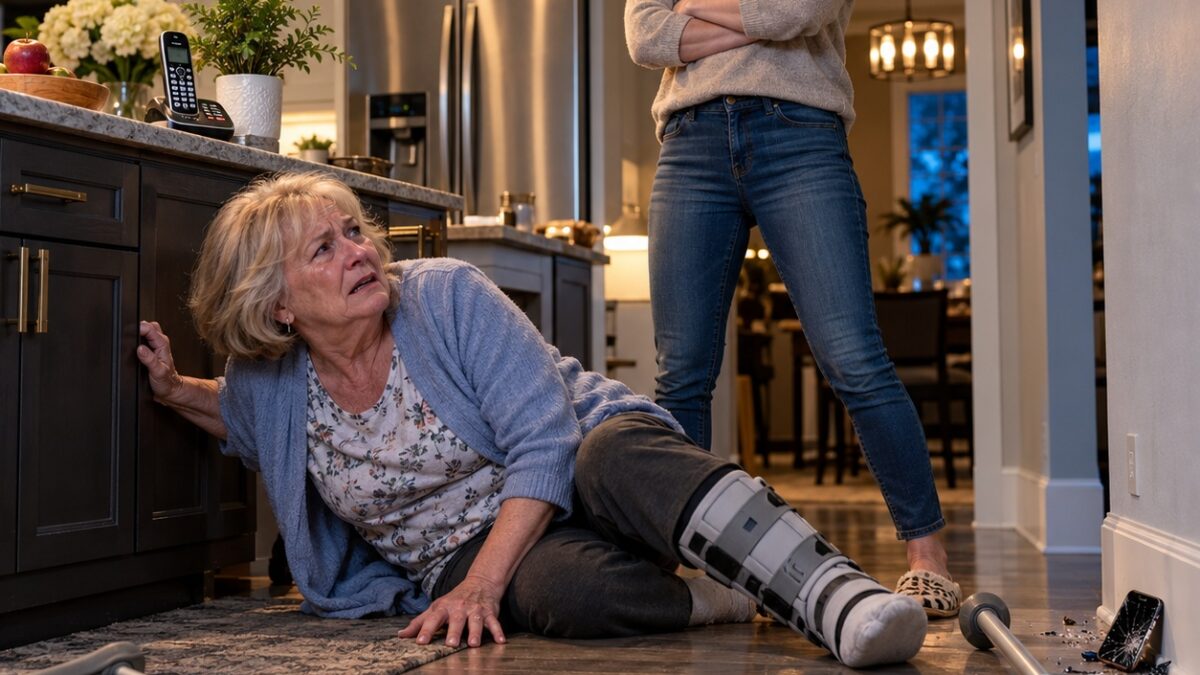
Kicked away my crutches.
Shoved me.
Threatened me.
Called 911.
And lied.
When the paramedic asked what happened, I looked at Sarah behind him.
Her eyes said everything.
I whispered:
“I fell.”
I hated myself for it.
But I was injured.
Afraid.
Trapped in a home she controlled.
At the hospital, Dr. Walsh found new fractures near the surgical hardware.
Part of the incision had reopened.
Internal bleeding.
My blood pressure dropped dangerously.
I needed another surgery.
David drove home from Indiana.
Sarah told him:
“Your mom tried doing too much.”
David believed her.
“We may have to consider assisted living.”
Sarah nodded.
“I hate saying it.”
I lay in a hospital bed knowing the woman who had pushed me was helping plan where to imprison me.
My second hospital stay lasted three weeks.
That saved my life in more ways than one.
Because Sarah could not control everyone there.
One nurse noticed.
Linda Carter.
She had a calm face and the kind of eyes that made lying feel unnecessary.
One afternoon, she asked:
“How do you feel about going home?”
I answered automatically.
“Fine.”
She waited.
Then:
“Really?”
Something inside me broke.
“Scared.”
Linda put down the blood-pressure cuff.
“Of recovery?”
I looked toward the door.
“No.”
She moved closer.
“Of whom?”
“My daughter-in-law.”
I expected doubt.
Instead she said:
“Tell me.”
So I did.
Mail.
Money.
Notebook.
Medication.
Fall.
Crutches.
Threats.
Everything.
Linda did not interrupt.
When I finished, she asked:
“Do you have documentation?”
“My journal.”
“Anything else?”
“The camera.”
“What camera?”
“The kitchen security camera.”
Her expression sharpened.
“Was it operating?”
“I don’t know.”
“That could be important.”
Two days later, Linda introduced me to James Brennan.
Attorney.
Specialized in elder abuse.
Silver hair.
Quiet voice.
No theatrics.
He sat beside my bed.
“Mrs. Morrison, Linda told me enough to be concerned.”
“I’m afraid David won’t believe me.”
“We don’t need to begin with belief.”
I looked at him.
“We begin with evidence.”
For the first time in months, I felt safe.
He ran Sarah’s background.
Previous arrest.
Financial fraud.
Hidden debt.
That alone did not prove abuse.
But it established pattern.
Then we discussed the camera.
David owned the account.
James proposed a meeting.
Officially:
Planning my future care.
Exactly the kind of meeting Sarah wanted.
Sarah would attend willingly.
David would give access to home security footage because he believed it might show my accidents.
And Sarah would not know what we were looking for.
I was terrified to go home.
James arranged safeguards.
David hired a temporary private nurse named Margaret.
Round-the-clock for the first week.
Sarah hated it.
She hid that badly.
She could no longer hand me pills privately.
Could not isolate me.
Could not move things.
Could not threaten me without witnesses.
Two days later, we gathered around the dining-room table.
James Brennan.
David.
Sarah.
Me.
Coffee.
Pastries.
Sarah looked almost cheerful.
She brought folders.
Prepared.
Confident.
James opened:
“We’re here to discuss Mrs. Morrison’s current care needs and legal protections.”
Sarah leaned forward.
“Thank you. We’ve been very worried.”
“We?”
“David and I.”
David nodded sadly.
James said:
“Tell me your concerns.”
Sarah launched into her presentation.
Memory problems.
Confusion.
Repeated falls.
Medication noncompliance.
Agitation.
Then she pulled out screenshots.
Videos.
Me drugged.
Barely coherent.
She played one.
Sarah’s recorded voice asked:
“Fay, what day is it?”
On screen, I stared blankly.
Present-day Sarah shook her head sadly.
“It’s heartbreaking.”
David watched.
His face crumpled.
My own humiliation burned.
Even knowing the truth, watching myself in that state was painful.
Sarah continued.
“She needs professional supervision.”
James nodded.
“These are concerning images.”
Sarah brightened.
“Exactly.”
“Possibly memory care?”
“Yes.”
David looked down.
James paused.
“Before discussing placement, I’d like to review additional recordings.”
Sarah’s smile faded.
“What recordings?”
“Home security.”
She went still.
David said:
“I gave him access.”
Her face changed.
“Why?”
“To see whether Mom’s falls were captured.”
“That’s unnecessary.”
James opened his laptop.
“I disagree.”
Sarah stood halfway.
“Honestly, I think we’re upsetting Fay.”
“I’m comfortable.”
She looked at me.
For once, I smiled.
James pressed play.
The kitchen appeared.
Timestamp.
David leaned forward.
Sarah went white.
The video showed me standing with my crutches.
Sarah shouting.
Then kicking the first crutch away.
David stopped breathing.
Second crutch.
My plea.
Sarah blocking me.
The shove.
My body striking the island.
Falling.
My scream.
Sarah standing over me.
Look what you made me do.
David whispered:
“Oh my God.”
Sarah jumped up.
“This is out of context.”
James paused the video.
“In what context is kicking away an injured woman’s crutches appropriate?”
“She was provoking me.”
David looked at her.
“Sarah.”
“You don’t understand.”
He pointed at the screen.
“You pushed my mother.”
“I lost my temper.”
“You lied.”
“I panicked.”
“You told me she fell.”
“She did fall!”
“Because you shoved her!”
Sarah’s voice rose.
“She was impossible!”
James clicked another recording.
Earlier date.
Kitchen.
Sarah handing me pills.
Then twenty minutes later, Sarah filming my confusion.
David watched.
Slowly.
Horribly.
Understanding arrived.
“You were drugging her.”
“No.”
“Yes.”
“The medications were prescribed.”
“Not those doses.”
“You gave her something.”
“I was helping her sleep.”
David stood.
He moved away from his wife.
“You made her look confused.”
Sarah cried:
“She was confused already!”
James opened more footage.
Medication.
Verbal abuse.
Isolation.
Financial discussions.
My journal corroborated dates.
Sarah began losing control.
“You don’t know what it was like!”
David stared.
“What?”
“Living with her!”
She pointed at me.
“She was always watching me.”
“Because you were stealing from her.”
“I wasn’t stealing.”
“You went through her mail.”
“I was helping.”
“You wanted her bank accounts.”
“We were drowning!”
The room went silent.
James leaned forward.
“Financially?”
Sarah realized too late.
David said:
“What does that mean?”
She began crying.
“Credit cards.”
“How much?”
“David.”
“How much?”
“More than you know.”
“Why?”
“Gambling.”
He stared.
“Gambling?”
“Online poker.”
“You told me you stopped.”
“I was trying to win it back.”
My stomach turned.
Sarah continued.
“If your mother had just helped—”
David looked sick.
“What?”
“She has money.”
I closed my eyes.
Sarah’s desperation turned confession into a flood.
“Her pension. The house sale. Savings. We could have fixed everything.”
James asked quietly:
“So you wanted access to Mrs. Morrison’s assets to pay gambling debt?”
Sarah froze.
Then another confession came.
“It wasn’t only gambling.”
David looked exhausted.
“What else?”
Sarah covered her face.
At the dental clinic, she explained, elderly patients sometimes received prescriptions they did not fully use.
She had access.
She began taking excess medication.
Then replacing some prescriptions.
Selling pills.
She called it redistributing.
David looked as though he might vomit.
“You stole medication from patients?”
“They weren’t using all of it.”
“That’s stealing.”
“I needed money.”
James closed the laptop.
“I think we’re finished.”
Sarah looked up.
“What does that mean?”
“I am reporting this.”
“No.”
“Elder abuse.”
“No.”
“Assault.”
“James—”
“Medication tampering.”
“Please.”
“Financial fraud.”
Her face crumpled.
David reached for his phone.
“What are you doing?”
“Calling the police.”
“David.”
“And a divorce attorney.”
She started sobbing.
“Don’t.”
He looked at her.
I had never seen such pain in my son’s face.
“How long?”
“What?”
“How long have you hated my mother?”
“I don’t hate her.”
“You drugged her.”
“I was desperate.”
“You pushed her.”
“She provoked me.”
“You tried to make me believe she had dementia.”
Silence.
“You made me doubt my own mother.”
Sarah whispered:
“I love you.”
David shook his head.
“No.”
That one word ended their marriage before any legal paper did.
Police arrived within thirty minutes.
Detective Maria Santos specialized in elder abuse.
James had evidence ready.
Videos.
Journal.
Medication records.
Sarah’s statements.
She was arrested.
As officers handcuffed her, Sarah turned toward David.
“This will ruin us.”
He said nothing.
“Your career.”
Nothing.
“We can handle it privately.”
He turned away.
The investigation expanded quickly.
The dental practice audited medication.
Twelve elderly patients.
Eighteen months.
Missing painkillers.
Altered doses.
An eighty-three-year-old woman named Eleanor had received only half her prescribed medication after oral surgery.
A seventy-nine-year-old man named Frank had been given sugar pills instead of proper anxiety medication before painful procedures.
One victim after another.
People Sarah considered easy.
Old.
Dependent.
Unlikely to complain.
Just like me.
That realization hurt almost as much as the assault.
I had not been unique.
I had been part of a pattern.
David collapsed under guilt.
“How did I not see it?”
He asked again and again.
“I lived with her.”
“You trusted her.”
“She hurt you in my house.”
“Yes.”
“I believed her.”
“Yes.”
He flinched every time I answered honestly.
But comforting him with lies would have repeated the problem.
He needed truth without cruelty.
“I should have listened.”
“Yes.”
“I failed you.”
“You were manipulated.”
“That doesn’t erase it.”
“No.”
He looked at me.
“Are you ever going to forgive me?”
“I already love you.”
“That isn’t the same.”
“No.”
I took his hand.
“But we have time.”
He cried.
Sarah pleaded guilty six months later.
Five years in state prison.
Three years supervised probation.
Restitution.
Permanent surrender of her dental-hygiene license.
I attended sentencing.
So did several elderly patients.
Sarah looked different.
No polished hair.
No bright smile.
No confident manipulation.
When allowed to speak, she apologized.
She admitted debt.
Addiction.
Harm.
She said none of it excused what she had done.
I listened.
I did not know whether she was sincere.
I still don’t.
Trust does not become mandatory because someone finally says the correct words.
My leg healed.
Mostly.
Physical therapy restored much of my mobility.
I kept a slight limp.
At first I hated it.
Then I stopped.
My body had survived.
The limp was not shame.
I also received a settlement connected to professional liability and the harm caused through Sarah’s medical misconduct.
I could have used the money for comfort.
Instead, I created the Morrison Elder Safety Foundation.
We helped families recognize abuse.
Financial exploitation.
Medication tampering.
Isolation.
Coercive guardianship.
Predatory caregivers.
I began speaking at community centers.
Senior residences.
Churches.
Libraries.
I always said the same thing:
Document everything.
Maintain outside relationships.
Know your finances.
Keep copies of your own medical information.
And if someone repeatedly tells you that you are confused while benefiting from your confusion—
get another person involved.
Silence is where abuse grows.
A seventy-four-year-old woman named Grace contacted us.
Her nephew was stealing Social Security checks.
An eighty-year-old man named Robert called because his caregiver threatened abandonment unless he signed over property.
Each case reminded me why I survived.
David entered counseling.
He divorced Sarah.
Later, he met Amanda.
A kindergarten teacher.
Warm.
Patient.
She listened.
That was the first thing I noticed.
Not beauty.
Not charm.
Listening.
One night after dinner, I told David:
“She actually waits for you to finish.”
He laughed.
“Low standard?”
“After Sarah? Excellent standard.”
Their relationship moved slowly.
I approved of that.
Three years after everything happened, a letter arrived.
Prison return address.
Sarah.
I almost threw it away.
Instead, I opened it.
She wrote that she had entered addiction treatment.
Therapy.
She said she thought about the people she hurt.
Especially me.
She wrote:
I know I destroyed your sense of safety inside your own family.
I stopped reading for a moment.
That sentence was true.
She continued.
She did not ask for forgiveness.
She said she was trying to become someone who would never harm another vulnerable person again.
I folded the letter.
Put it in a drawer.
I never answered.
People sometimes confuse forgiveness with access.
They are not the same.
Maybe one day I will forgive Sarah completely.
Maybe part of me already has.
But forgiveness does not require inviting someone back into your life.
That is another lesson I learned too late.
The foundation has now helped more than two hundred families.
David and I rebuilt our relationship.
Not by pretending nothing happened.
By talking about everything that did.
One evening, he said:
“I promise I’ll never dismiss you again.”
I shook my head.
“Don’t promise that.”
He looked surprised.
“Why?”
“Sometimes I may be wrong.”
He smiled faintly.
“So what should I promise?”
“Listen.”
He nodded.
“I can promise that.”
“And I’ll promise not to expect automatic agreement because I’m your mother.”
“Deal.”
That was healthier.
The old relationship between us had been built partly on assumptions.
The new one was built on honesty.
I think about the camera sometimes.
That tiny blinking red light.
If it had not been there, would David have believed me?
Eventually, perhaps.
Maybe.
I had my journal.
Medication evidence.
Sarah’s debts.
But the video did something words could not.
It removed interpretation.
Sarah had spent months controlling interpretation.
Fay is confused.
Fay fell.
Fay misunderstood.
Fay forgot.
Then video entered the room.
Facts without commentary.
The truth did not need me to argue.
That matters to me.
Because abuse often survives inside the space between what happened and what powerful people can persuade others happened.
I had been a competent adult my entire life.
Managed marriage.
Money.
Illness.
Death.
Insurance.
A home.
Then one person entered my life and slowly taught everyone to look at me differently.
More frighteningly, she nearly taught me to look at myself differently.
That is what gaslighting does.
It isn’t only lying.
It is creating an environment where truth begins to feel embarrassing.
Where your own certainty feels suspicious.
Where defending yourself becomes evidence against you.
Sarah understood that instinctively.
If I objected:
I was agitated.
If I remembered:
I was obsessive.
If I questioned:
I was paranoid.
If I refused financial help:
I was incapable of understanding my needs.
If I cried:
I was emotionally unstable.
No response was allowed to be neutral.
That is a trap.
The way out was not winning arguments.
It was evidence.
Distance.
Witnesses.
Professional help.
After my speeches, people often approach me privately.
“Something like this is happening to my mother.”
“My brother controls Dad’s money.”
“My caregiver reads my mail.”
“My daughter says I’m confused.”
Not every concern means abuse.
Sometimes families truly are frightened.
Sometimes aging creates difficult realities.
But concern should increase dignity.
Not reduce it.
Care should increase safety.
Not fear.
Help should create independence where possible.
Not seize control.
Those distinctions matter.
Several years after Sarah’s arrest, David and Amanda invited me to dinner.
I walked into their house without a crutch.
Small limp.
No fear.
Amanda hugged me.
“Fay.”
She never tried calling me Mom before I was ready.
I appreciated that.
At dinner, David said:
“Remember when you used to hide your journal in the cookbook?”
I stared.
“How do you know where I hid it?”
He smiled.
“You told me eventually.”
“Which cookbook?”
“The old Betty Crocker one.”
I narrowed my eyes.
“I may need to change hiding places.”
Amanda laughed.
David became serious.
“I read parts of it once.”
“With permission?”
“Yes.”
“Good answer.”
He looked down.
“I couldn’t believe how long it had been happening.”
“I didn’t either.”
“You wrote one sentence over and over.”
“What sentence?”
He quoted:
I know what happened even if nobody believes me yet.
My throat tightened.
I had forgotten that.
Amanda reached across the table and touched my hand.
David continued:
“I think that sentence saved you before the camera ever did.”
“How?”
“You didn’t let her rewrite your own mind.”
I looked at my son.
Maybe he was right.
The journal had been more than evidence.
It had been a conversation with myself.
A way of saying:
You are still here.
Your memory still belongs to you.
Your reality still counts.
Sarah tried to take money.
Independence.
Credibility.
Safety.
But the most dangerous thing she tried to take was authority over my own experience.
That is why reclaiming my life felt bigger than winning a criminal case.
I moved with David into an apartment designed so we both had private space.
Some people found that unusual.
I did not.
After everything, we needed closeness without dependence.
My room.
His room.
Shared kitchen.
Shared dinners when we wanted.
Closed doors when we didn’t.
Eventually, as my mobility improved, I began considering my own smaller condo.
David said:
“Are you sure?”
“Yes.”
“You don’t have to leave.”
“I know.”
That was exactly why I was ready.
I wasn’t being pushed.
I was choosing.
Choice matters.
I found a small place near a park.
Two bedrooms.
Bright kitchen.
Balcony.
David helped move Robert’s chair.
He placed it beside the window.
For the first time since selling my old home, I felt something click into place.
Not returning to the woman I had been.
Becoming someone new.
On my first night there, I sat in Robert’s chair.
The apartment was quiet.
Years earlier, after his death, quiet had frightened me.
Now it felt different.
Peaceful.
Chosen.
I thought about him.
What would Robert have done?
He would have blamed himself for not being there.
Then probably threatened to personally remove Sarah from the planet.
I smiled.
“You always were dramatic.”
The room did not answer.
But grief had changed.
Robert’s absence was no longer an open wound.
It was part of me.
I had survived losing him.
I had survived Sarah.
Survival did not make me invincible.
It made me less willing to waste my remaining years afraid.
At one foundation event, Linda Carter attended.
The nurse who had asked the right question.
“Are you really okay going home?”
I hugged her.
“You saved me.”
She shook her head.
“You told me.”
“Because you asked.”
That distinction matters too.
People suffering abuse often do not announce it dramatically.
They test the room.
One word.
One hesitation.
“I’m scared.”
“I don’t like being alone with him.”
“She controls my medicine.”
“He gets angry about money.”
If nobody pauses, the door closes again.
Linda paused.
James Brennan believed me.
Detective Santos investigated.
David finally saw.
No single person saved me.
A chain did.
That is why isolation is so useful to abusers.
It breaks the chain.
Sarah’s greatest strategic success had been convincing me that speaking would sound crazy.
My greatest mistake was believing her.
My foundation teaches families to create multiple safe connections.
Doctor.
Attorney.
Friend.
Neighbor.
Financial adviser.
Adult child.
Social worker.
No vulnerable person should have only one gatekeeper.
Especially if that gatekeeper controls medication, money, transportation, and communication.
One afternoon, Grace—the seventy-four-year-old woman whose nephew had stolen from her—visited me.
She said:
“I kept thinking family wouldn’t steal from family.”
I understood.
“That’s why it worked.”
She nodded.
“You think blood protects you.”
“Sometimes.”
“Not always.”
“No.”
She looked at me.
“Do you still trust people?”
That question stayed with me.
“Yes.”
“Really?”
“Yes.”
“How?”
“More slowly.”
She laughed.
“That simple?”
“No.”
I smiled.
“But simple doesn’t mean easy.”
I trust David.
I trust Amanda.
Linda.
James.
But trust now includes boundaries.
Questions.
Documentation.
That does not make love cold.
It makes love sustainable.
Three years after Sarah’s letter, I still had it.
Unread again.
Folded.
One day, I took it out.
Read it from beginning to end.
She described addiction.
Debt.
Shame.
The progressive collapse of her choices.
She said that each bad decision made the next one easier.
Gambling became debt.
Debt became theft.
Theft became lying.
Lying required control.
Control required isolating me.
Isolation required discrediting me.
Then came medication.
Then violence.
I understood the chain.
Understanding is not absolution.
That is another distinction I value.
Sarah was not born inside my kitchen kicking away crutches.
She became that person through choices.
Perhaps trauma influenced her.
Perhaps addiction did.
Perhaps desperation.
But explanation and excuse are not identical.
I put the letter away again.
No reply.
Not yet.
Maybe never.
That was my choice too.
People sometimes ask whether I consider myself a victim.
Technically?
Yes.
Elder abuse victim.
Assault victim.
Medication tampering victim.
Financial exploitation target.
But I do not introduce myself that way.
I’m Fay.
Widow.
Mother.
Friend.
Founder.
Advocate.
Woman with a limp.
Terrible gardener.
Pretty good cook.
Still learning.
Survivor is part of me.
Not all of me.
That matters.
Because abuse tries to shrink your identity around what someone did to you.
Healing expands it again.
On the fifth anniversary of Robert’s death, David and I visited his grave.
Amanda came too.
We brought flowers.
David stood quietly.
Then said:
“Dad would kill me for what happened.”
I looked at him.
“No.”
“He trusted me to protect you.”
“Robert trusted you to love me.”
“I failed.”
“Temporarily.”
“Mom.”
“David.”
He smiled sadly.
“You’re impossible.”
“So was your father.”
We stood in silence.
Then I said:
“You learned.”
He nodded.
“I wish the lesson hadn’t cost you a leg.”
“I still have the leg.”
“Barely.”
“It works.”
“You complain about stairs.”
“Everyone should complain about stairs.”
Amanda laughed.
The sound felt good.
At the foundation, we eventually created a training program for dental offices and outpatient clinics.
Sarah’s crimes taught us something important.
Medication diversion involving elderly patients can hide beneath routine.
Someone says:
“They didn’t need the full prescription.”
Or:
“They’re confused.”
Or:
“They probably lost it.”
Older patients are often treated as unreliable reporters.
That assumption creates opportunity for abuse.
We trained staff to track medication discrepancies.
Encourage patient advocates.
Document dosage.
Escalate unusual patterns.
I thought about Eleanor Rodriguez.
Eighty-three.
Pain after surgery.
Given half the medicine meant for her.
She attended one of our events.
Afterward, she hugged me.
“We survived the same woman.”
“Yes.”
“She stole my pills.”
“She almost stole my life.”
Eleanor smiled.
“Then we both ruined her plan.”
I laughed.
“I suppose we did.”
But I never loved the language of winning.
Sarah lost.
Yes.
She went to prison.
Lost her license.
Marriage.
Freedom.
But my life was not restored by her suffering.
It was restored by my choices afterward.
That difference is important.
Revenge looks backward.
Recovery looks forward.
I could have spent years monitoring Sarah.
Appeals.
Parole dates.
Therapy reports.
Instead, I monitored my own life.
Physical therapy.
Foundation growth.
Friendships.
David’s healing.
My independence.
That was more satisfying.
One night, David asked:
“What did you think when you saw the camera light?”
I smiled.
“You’ve never asked that.”
“I’ve wondered.”
“I thought maybe someone would finally believe me.”
His face changed.
“That hurts.”
“It should.”
He nodded.
“I wish I believed you before I needed a video.”
“So do I.”
He looked at his hands.
“I’m sorry.”
“I know.”
“I’ll probably keep saying that.”
“Probably.”
“Does it annoy you?”
“Sometimes.”
He laughed.
Then I said:
“But I understand why.”
He looked up.
“Because you need to know I hear it.”
“Yes.”
“I do.”
We sat quietly.
That was enough.
The little red light did record everything.
Sarah kicking the crutches.
Sarah shoving me.
Sarah threatening me.
But when I think of it now, I remember another red light.
The one inside myself.
Small.
Blinking.
Warning.
I ignored it at first.
When Sarah opened my mail.
Blink.
When she examined my jewelry.
Blink.
When she moved my glasses.
Blink.
When she told David I was forgetful.
Blink.
When she searched dementia.
Blink.
When she asked for bank access.
Blink.
I had spent my life believing kindness meant giving people the benefit of the doubt.
It does.
Once.
Maybe twice.
But when evidence accumulates, endless benefit of the doubt becomes permission.
That is what I teach now.
Trust your instincts.
Then verify.
Do not accuse without evidence.
But do not dismiss evidence because accusation feels impolite.
Politeness nearly killed me.
That sounds dramatic.
It is also true.
Today, my leg still aches in cold weather.
I keep Robert’s chair near my window.
David visits every Sunday.
Sometimes Amanda comes.
Sometimes I cook.
Sometimes we order pizza.
Normal life.
The kind I thought I had lost forever.
My foundation continues growing.
More than two hundred families helped.
More calls every month.
More people who whisper:
“I thought nobody would believe me.”
I understand them.
I believed that too.
Then one day, at the end of a presentation, an older woman raised her hand.
“What if the person hurting you is family?”
The room went silent.
I thought about Sarah.
Then David.
Then myself.
I answered:
“Family changes the pain.”
She waited.
“It does not change your right to be safe.”
Her eyes filled.
I continued.
“Love does not require surrendering your dignity.”
A man beside her took her hand.
“And if people don’t believe you?”
“Document.”
I said.
“Tell someone else.”
“And if they still don’t?”
“Tell another person.”
Her chin trembled.
“Keep going until someone listens.”
Afterward, she came to me privately.
Her daughter controlled her finances.
Her son-in-law had threatened assisted living.
We connected her with help.
Months later, she called.
Safe.
Independent.
That call meant more to me than Sarah’s sentencing.
Because something that nearly destroyed me had become useful.
Not good.
I will never call the abuse good.
But useful.
There is a difference.
I cannot change the staircase.
The medication.
The kitchen.
The surgery.
The fear.
But I can decide what grows afterward.
Sarah once looked down at me on that cold tile floor and believed she had reduced me to a helpless old woman.
She thought age made me weak.
Grief made me isolated.
Injury made me dependent.
Medication made me unbelievable.
And fear would make me silent.
For a while, she was right about the fear.
Not the silence.
Not forever.
Because the most important thing that happened in that kitchen was not the camera recording her.
It was me understanding, finally and completely, that waiting for Sarah to become kinder was no longer an option.
I had to protect myself.
The camera gave me proof.
Linda gave me a safe place to speak.
James gave me legal protection.
David eventually gave me his belief.
But I gave myself the first thing I truly needed.
Permission to stop minimizing what was happening.
That was the beginning.
Years later, I sometimes sit by my apartment window after sunset.
Robert’s chair creaks when I shift.
My leg throbs.
Life feels ordinary.
I have learned to treasure ordinary.
No fear about which pills I am taking.
No belongings moved.
No one reading my mail.
No one explaining my own memory to me.
No one deciding that my age means I should surrender control.
Just quiet.
Chosen quiet.
On the shelf near me sits the old cookbook.
The one that once hid my journal.
I still have both.
Sometimes I open the journal.
The handwriting grows shakier near the end.
One of the last entries before my second hospitalization reads:
I am not confused.
Underneath:
I am frightened.
Then:
Those are not the same thing.
I stare at those words sometimes.
That woman—frightened, injured, isolated—did not know what would happen.
She did not know about Linda.
James.
Detective Santos.
The foundation.
Grace.
Eleanor.
Amanda.
She did not know she would one day stand in front of rooms filled with strangers and tell this story without trembling.
She only knew one thing.
What Sarah was doing was real.
That knowledge was enough to keep the truth alive until help arrived.
So when I think about the red light in the kitchen now, I don’t think of it as the thing that saved me.
Not exactly.
Evidence matters.
But evidence only matters if someone has the courage to preserve it, present it, and refuse to be silenced.
The camera recorded the moment Sarah crossed the line.
My journal recorded the months leading to it.
And my voice recorded everything that came afterward.
That is what ultimately changed my life.
I survived Sarah.
But survival was only the first victory.
I rebuilt my relationship with my son.
Reclaimed my independence.
Helped other people escape situations they thought no one would believe.
And learned something I wish every older person knew before they ever needed it:
Being vulnerable does not make you disposable.
Needing help does not erase your rights.
Age does not cancel your authority over your own life.
And love—real love—will never require you to become smaller, quieter, poorer, more confused, or more afraid so someone else can control you.
Sarah tried to make me disappear while I was still alive.
Instead, she forced me to find my voice.
And once I found it, I never gave it back.




