“AS SOON AS THE OLD LADY DIES, THE HOUSE IS OURS!” My Son Laughed as His Wife Called Me Useless — They Thought I Was Asleep, But My Phone Was Recording.
FULL STORY CONTINUATION
“No, Steven doesn’t know.”
Jenny’s voice floated through the partially open back door.
“You know how sentimental he gets about his mommy.”
I stood behind the wall separating the kitchen from the patio.
My heart beat so hard that I could feel it in my throat.
Jenny continued.
“I already talked to a lawyer.”
There was a pause while whoever was on the other end spoke.
“Since she never made a will, Steven is the only child. Everything goes to him. The house is probably worth three hundred thousand now.”
Three hundred thousand dollars.
That was what my life had become in Jenny’s imagination.
A number.
An inheritance waiting for a funeral.
“She doesn’t have anyone else,” Jenny said.
Another pause.
“Exactly. She won’t change anything. Women her age don’t think about trusts and estate planning.”
I almost laughed.
I was standing twelve feet away.
Sixty-eight.
Still alive.
Still thinking.
Very clearly.
Jenny lit a cigarette.
I heard the click of the lighter.
Another thing she lied to Steven about.
“The video?”
She laughed.
“Oh, that was content. It got engagement.”
I closed my eyes.
“She got mad, but what’s she going to do? Kick us out?”
Another laugh.
“She doesn’t have the guts.”
Something changed inside me at that exact moment.
The hurt stopped.
The planning began.
Jenny kept talking.
“As long as I keep her useful and make her think we’re one happy family, she won’t make any strange moves.”
Useful.
There was that word again.
Not loved.
Useful.
“She cooks. She cleans. She watches the kids.”
Jenny exhaled smoke.
“We just have to wait.”
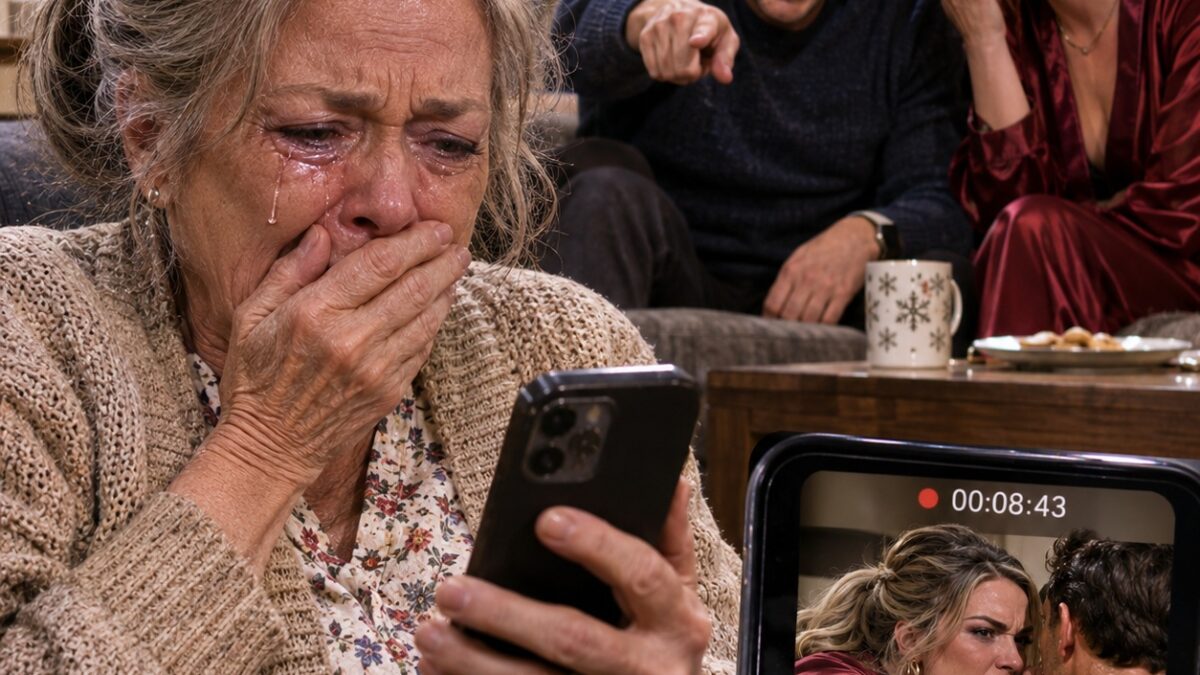
I looked down at my phone.
The red recording timer continued.
Seven minutes.
Then eight.
Finally:
“When the time comes, the house is ours.”
She ended the call.
I moved quickly.
Upstairs.
Bedroom.
Door closed.
My hands shook as I stopped the recording.
Eight minutes.
Forty-three seconds.
I played the beginning.
Jenny’s voice came through clearly.
I sat on the edge of my little bed.
Not the master bedroom.
I had given that to Steven and Jenny five years earlier because I thought newlyweds deserved privacy.
That decision suddenly felt symbolic.
I had not simply shared my home.
I had retreated from it.
Room by room.
Responsibility by responsibility.
Until Jenny believed the final step would be waiting for me to die.
I listened to the entire recording.
Then saved three copies.
One on my phone.
One emailed to myself.
One uploaded to cloud storage Caroline had taught me to use.
Jenny thought women my age did not understand technology.
That amused me.
Then I opened the old address book in my nightstand.
Two names mattered.
Harriet Ramirez.
And Robert Smith Jr.
Harriet had been my closest friend for thirty years.
Retired notary.
Sharp mind.
Sharper tongue.
Robert was my nephew.
Thirty-eight.
Probate and family attorney.
After his father died, I helped him through law school.
Every Christmas since then, he had told me:
“Aunt Eleanor, if you ever need anything, call.”
I had always answered:
“I’m fine.”
The next morning, I called.
Harriet opened her apartment door and took one look at me.
“What happened?”
No greeting.
No small talk.
That was Harriet.
“I need coffee.”
“That bad?”
“Worse.”
Her apartment smelled like cinnamon candles.
Books covered almost every wall.
We sat.
She poured coffee into thin porcelain cups her mother had given her decades earlier.
“Talk.”
I told her.
TikTok.
The comments.
Steven laughing.
The breakfast confrontation.
Then the phone call.
I played the recording.
Harriet listened without interrupting.
At one point, her jaw tightened.
When Jenny’s voice said, How long can she have left? Ten years? Five? Harriet removed her glasses.
“That woman.”
She stopped herself.
Then:
“That wicked woman.”
Harriet rarely insulted anyone.
I almost smiled.
“Is she right?”
“About what?”
“If I die without a will.”
Harriet leaned back.
“Possibly, depending on the applicable estate rules and how everything is titled. Which is exactly why you are not leaving this to chance.”
“The house is only in my name.”
“Good.”
“Steven has never been on the deed.”
“Better.”
“They do not pay rent.”
Harriet pointed at me.
“Excellent.”
“Excellent?”
“They are there because you allow them to be there.”
I looked at my coffee.
“I don’t want to hurt Steven.”
“Eleanor.”
“He’s my son.”
“Yes.”
“He doesn’t know what Jenny is planning.”
“That doesn’t erase what he did.”
I looked up.
Harriet did not soften it.
“He watched the video.”
“Yes.”
“He laughed.”
“Yes.”
“He minimized it when you confronted him.”
“Yes.”
“He may not be plotting to take your house.”
She leaned closer.
“But he has been enjoying the benefits of your disappearance.”
That hurt because it was true.
I called Robert.
He answered immediately.
“Aunt Eleanor?”
“Can you come to Harriet’s?”
“What happened?”
“Legal problem.”
“I’ll be there in forty minutes.”
He arrived in thirty-two.
Dark suit.
Leather briefcase.
Worried face.
He hugged me.
A real hug.
I almost cried from the simple shock of someone touching me as though I mattered.
We told him everything.
He listened to the recording twice.
Then he said:
“First, we protect the property.”
“How?”
“Estate plan.”
He opened his briefcase.
“Trust structure. Updated will. Powers of attorney. Everything.”
“Can Jenny claim the house because she has lived there?”
“Living somewhere does not magically turn you into the owner.”
“What if Steven inherits?”
“We can structure the transfer so any inheritance remains protected from marital claims to the extent the law allows.”
I felt my shoulders relax.
“So she cannot simply wait for me to die.”
Robert smiled slightly.
“She can wait as long as she wants.”
Harriet laughed.
I did too.
It was the first time I had laughed in days.
Then I said:
“I want them out.”
Robert became serious.
“Both?”
“I don’t know.”
I looked at him.
“I know I cannot keep living with Jenny.”
He nodded.
“And Steven?”
“He is my son.”
“That is not an answer.”
Lawyers.
Always forcing specificity.
“I want him to see the truth first.”
“Then don’t act emotionally.”
Harriet gave Robert a look.
“That is rich coming from a family lawyer.”
He ignored her.
“We document everything.”
Robert counted on his fingers.
“Property ownership.”
“Household items.”
“Trust.”
“Your wishes.”
“Any change in occupancy.”
“No dramatic midnight lockout.”
I frowned.
“I was planning something much more satisfying.”
Robert laughed.
“I know.”
“Can we at least make it satisfying legally?”
“That I can help with.”
Within one week, the trust documents were prepared.
I was lifetime beneficiary.
Control remained with me.
No one could sell or encumber the house behind my back.
What happened after my death would happen according to documents I chose consciously.
Not Jenny’s prediction.
Not Steven’s assumption.
Mine.
Signing those papers did something unexpected.
I thought I would feel vindictive.
Instead, I felt safe.
Safety is quieter than revenge.
And much more satisfying.
During those days, I changed nothing at home.
That was deliberate.
Breakfast at six.
Children ready for school.
Laundry.
Dinner.
I spoke politely.
Jenny relaxed.
She thought I had surrendered.
Then she and Steven announced they had won a weekend trip to Palm Springs.
“Three days,” Jenny said.
“How wonderful.”
Steven looked worried.
“You’ll be okay with the kids?”
“I raised you.”
He smiled.
“Fair.”
Saturday morning, they left.
I waved from the driveway.
Jenny hugged me loosely.
“Take good care of the children.”
“As always.”
Their car disappeared.
I closed the door.
Then called Robert.
“They’re gone.”
“I’m thirty minutes away.”
He arrived with a small moving van and two men.
Mike and Joe.
Both polite.
Both carrying clipboards.
Caroline and Sam were watching cartoons.
I had given them cookies and juice.
To them, it was simply a strange Saturday.
To me, it was reclamation.
Robert opened his notebook.
“Everything documented.”
“Yes.”
“Photographs before removal.”
“Yes.”
“Only property they brought.”
“Yes.”
“No touching personal documents.”
“Obviously.”
“Good.”
We started with the master bedroom.
The bedroom that had once been mine.
Their king-size bed came out.
Jenny’s LED vanity.
Floating shelves.
Designer dresser.
Television.
Shoe boxes.
Beauty products.
Steven’s suits.
Their towels.
Their hamper.
Their decorative pillows.
Everything photographed.
Everything inventoried.
Everything placed carefully into the van.
When the room emptied, I stood in the doorway.
Light-blue walls.
Hardwood floors.
My floors.
My room.
I remembered painting that wall fifteen years earlier.
Steven had brought me sandwiches while I worked.
I had forgotten that memory.
Jenny’s furniture had buried it.
“Everything okay?” Robert asked.
“Yes.”
My voice caught.
“This room looks bigger.”
We continued.
Living room.
Out went their enormous sectional.
Glass coffee table.
Sixty-inch television.
Sound system.
Modern decorative plants.
From storage, we brought back my old carved coffee table.
My smaller television.
And finally, my navy-blue armchair.
I ran one hand over the fabric.
“Welcome home.”
Robert laughed.
“You’re talking to furniture now?”
“It has been more loyal than some people.”
He could not argue.
Kitchen next.
Jenny’s expensive coffee machine.
Nonstick cookware.
Blender.
Microwave she had insisted on.
Minimalist white dishes I hated.
All packed.
I retrieved my floral plates.
The old glass pitcher from my mother.
My blue mixing bowls.
By noon, the house looked twenty years younger.
Or perhaps I looked twenty years younger inside it.
Mike loaded the last box.
“Storage address?”
Robert handed him the paperwork.
Unit rented for thirty days.
Everything safe.
Everything accessible.
Then Robert replaced the front-door lock.
Gold steel.
Three keys.
He placed them in my palm.
“One for you.”
Another.
“Spare.”
Third.
“Emergency.”
I closed my fingers around them.
“Are we sure?”
He looked at me.
“We have complied with the plan we discussed. And if there is any dispute, you call me before doing anything else.”
I nodded.
I liked that answer better than pretending law was simple.
The house became quiet after everyone left.
I cleaned.
Not because somebody expected me to.
Because I wanted to wash away the feeling of the last five years.
Then I sat in my blue armchair.
Coffee.
My mug.
My walls.
My life.
Caroline came in.
“Grandma?”
“Yes?”
“Why did all Mom’s stuff leave?”
I thought carefully.
“Sometimes people need to take their things somewhere else while adults solve problems.”
“Is Mom in trouble?”
“Your mother and I have something serious to work out.”
Caroline considered that.
“Are you mad?”
“Yes.”
Children deserve truth in age-appropriate pieces.
“But I still love you.”
She smiled.
“That wasn’t the question.”
“I know.”
She climbed into my lap anyway.
That weekend, we made cookies.
Went to the park.
Watched movies.
Sunday night, after the children were asleep, I sat alone beneath the lemon tree.
The house glowed behind me.
Monday would change everything.
I was afraid.
That surprised me.
I had legal documents.
Evidence.
Robert.
Ownership.
Still afraid.
Because consequences involving strangers are easier than consequences involving family.
I could protect my house.
I did not know if I could protect my relationship with my son.
Then I remembered Harriet’s words.
The family is already broken.
Making the fracture visible does not create it.
Monday.
4:30 p.m.
Their car pulled into the driveway.
I sat in my armchair.
Coffee prepared.
Children outside.
I heard laughter.
Luggage wheels.
A key in the front lock.
Turn.
Stop.
Again.
“What the hell?”
Steven.
Jenny:
“Try it again.”
Another metallic scrape.
Then knocking.
I walked to the door.
Opened it.
Steven stood there sweating.
“Mom. Thank God. The lock—”
“It isn’t broken.”
He frowned.
“I replaced it.”
Silence.
Jenny laughed nervously.
“Why?”
“Because I wanted new locks.”
Steven stared.
“What is going on?”
“Come inside.”
Jenny reached for her suitcase.
“Leave those.”
“What?”
“Outside.”
She looked at me.
I held her gaze.
Something in my expression made her obey.
They stepped inside.
Jenny stopped first.
Her face changed.
“Where’s the sofa?”
Steven turned slowly.
“Mom.”
Jenny looked toward the wall.
“The TV.”
Then she ran upstairs.
Ten seconds.
Fifteen.
A scream.
“STEVEN!”
He ran.
I remained in the living room.
Coffee.
Chair.
Breathing.
Footsteps thundered above.
Doors.
Closets.
Another scream.
“Everything is gone!”
They came down.
Jenny’s face was scarlet.
“What did you do?”
“Your belongings are in storage.”
“You stole our things!”
“No.”
I lifted a folder from the coffee table.
“Photographs.”
“Inventory.”
“Witnesses.”
“Address.”
“You moved our bedroom?”
“I moved your property.”
“We live here!”
“Yes.”
“You can’t do this!”
I looked at her.
“This is my house.”
Steven stepped between us.
“Mom, please. What happened?”
I looked at my son.
For a second, I saw the eight-year-old boy who once told me I was queen of the house.
Then the man who had laughed at me on TikTok.
Both existed.
“Sit.”
Jenny shook her head.
“No.”
“Then stand.”
I took out my phone.
“What is that?”
“You’ll recognize it.”
I pressed play.
Jenny’s own voice filled the room.
No, Mom, not yet. These things take time.
She went white.
Steven looked at her.
The recording continued.
As soon as the old lady dies, the house automatically goes to Steven.
Steven slowly sat.
Jenny whispered:
“Turn that off.”
I did not.
How long can she have left? Ten years? Five?
Steven covered his mouth.
Then:
Steven doesn’t know. You know how sentimental he gets about his mommy.
His eyes moved toward Jenny.
I watched his marriage change in real time.
It was terrible.
Necessary.
The recording played to the end.
The house is ours.
Silence.
Jenny’s lips moved.
Nothing came out.
Finally:
“That was taken out of context.”
I almost admired the desperation.
“Eight minutes and forty-three seconds of context.”
“It wasn’t—”
“True?”
She stopped.
“A joke?”
Another stop.
“Content?”
Her eyes filled.
Steven stood.
“Is it true?”
“Honey—”
“Is it true?”
“I was thinking about our future.”
“That is not an answer.”
“I wanted security for the kids.”
“By waiting for my mother to die?”
“Don’t say it like that.”
“How should I say it?”
Steven shouted now.
“You talked about how many years she had left!”
Jenny stepped toward him.
“Steven—”
“Don’t touch me.”
She froze.
It was the first time I had ever seen my son refuse her.
He turned to me.
“Mom.”
Tears filled his eyes.
“I didn’t know.”
“I know.”
“I swear.”
“I know.”
He sank back into the chair.
“I didn’t know.”
His voice broke.
That was when Robert knocked.
Perfect timing.
I opened the door.
He entered in a dark suit carrying his briefcase.
“Good afternoon.”
Jenny stared.
“Who are you?”
“Robert Smith Jr. Counsel for Mrs. Eleanor Smith.”
Steven recognized him.
“Cousin Robert?”
“Hello, Steven.”
Robert sat.
Opened his briefcase.
“Several matters need to be clarified.”
He placed copies of the trust documents on the table.
“First, your mother has completed a comprehensive estate plan.”
Jenny stared at the papers.
“The house is protected under the structure she selected. She retains control and lifetime beneficial rights.”
He looked directly at Jenny.
“No one can simply wait for an inheritance and assume access.”
Jenny lowered her eyes.
“Second, every item removed from the residence was photographed and inventoried. It is being held in a storage unit for thirty days.”
Keys.
Address.
Inventory.
“Third, neither of you should assume continued residence is guaranteed merely because you are family.”
Steven looked at me.
I took over.
“I am not throwing my son and grandchildren onto the street tonight.”
Jenny exhaled.
“However.”
Her relief disappeared.
“Things change now.”
Steven wiped his face.
“What do you want?”
“Rules.”
He nodded.
“First, rent.”
“Mom—”
“Three hundred fifty dollars.”
Jenny almost laughed.
“That’s nothing.”
I turned toward her.
“It isn’t about the amount.”
Steven understood before she did.
“Responsibility.”
“Yes.”
I continued.
“Second, household work will be shared.”
“No more automatic grandmother cleaning service.”
“Third, respect.”
“No filming me.”
“No using my image.”
“No mocking.”
“No plans involving my property.”
“No conversations about my death as a financial opportunity.”
Jenny looked physically smaller with every sentence.
“Fourth.”
I held up my phone.
“The TikTok comes down.”
“It already has two hundred thousand—”
“I don’t care.”
She stopped.
“And you post an apology.”
Her head snapped up.
“Publicly?”
“You humiliated me publicly.”
“That isn’t fair.”
I almost smiled.
“It is exactly proportional.”
“What if I refuse?”
I looked at her.
“Then you leave.”
Steven stared at the floor.
Jenny turned toward him.
“Honey?”
He did not look at her.
“Steven.”
Finally he raised his head.
“I need to think.”
She began crying.
“You’re choosing her?”
He stared.
“This is her house.”
“That isn’t what I asked.”
“No.”
His voice hardened.
“You asked whether I am choosing to pretend I didn’t just hear you discussing my mother’s death like a closing date.”
Jenny recoiled.
“I need air.”
Steven went outside.
Jenny moved after him.
“Let him go.”
She looked at me.
“For once, let somebody process without controlling the conversation.”
Her face changed.
Anger.
Fear.
Maybe both.
“You’ve destroyed everything.”
“No.”
I stood.
“I stopped pretending it wasn’t already damaged.”
She started crying harder.
“I did it for the children.”
“You filmed their grandmother to make strangers laugh.”
“I made a mistake.”
“You made several.”
“I can fix it.”
“Then begin.”
Twenty minutes later, Steven returned.
His eyes were red.
He looked older.
“Mom.”
“Yes?”
“We accept your conditions.”
Jenny turned.
“Steven—”
“All of them.”
He looked at her.
“And you and I are separating.”
That shocked even me.
“Steven.”
“This isn’t because you told me to.”
“I didn’t.”
“I know.”
Jenny began pleading.
“Please.”
“I need to understand who I married.”
“We can go to therapy.”
“Maybe.”
His voice was exhausted.
“But not while pretending everything is normal.”
He looked at me.
“The kids and I can stay?”
“Yes.”
“If we follow your rules.”
“Yes.”
“I’ll pay more than three-fifty.”
“No.”
“Mom.”
“Three-fifty.”
“Why?”
“Because I want you to remember the principle without needing to financially punish you.”
He began crying.
Then something happened I did not expect.
My thirty-three-year-old son knelt in front of me.
“Get up.”
“No.”
“Steven.”
“I need to say this.”
His voice shook.
“I laughed.”
I closed my eyes.
“I watched that video and laughed because it was easier than confronting Jenny.”
Tears rolled down his face.
“You gave us everything.”
“Your bedroom.”
“Your time.”
“Your money.”
“Your privacy.”
“And I let myself believe that was normal.”
He looked at me.
“I let you become small because it made my life easier.”
That sentence hurt more than the video.
Because it was true.
“Get up.”
He did.
I touched his face.
“I made myself small too.”
“No.”
“Yes.”
I took a breath.
“I was afraid boundaries would make you leave.”
Steven cried harder.
“I was afraid that saying no would make me a bad mother.”
“You were never—”
“I know that now.”
We stood there.
Mother and son.
Two people who had loved each other badly in opposite directions.
I overgave.
He overaccepted.
Jenny exploited the gap.
That was the truth.
Jenny deleted the original video that night.
The apology came the next morning.
At eleven, she set up her phone in the backyard.
No makeup.
Hair pulled back.
Red eyes.
She recorded four times.
Then showed me the final version.
On the screen she said:
“Two weeks ago, I posted a video mocking my mother-in-law.”
She swallowed.
“I said she did nothing with her life and that taking care of our home and children was her obligation.”
Her eyes filled.
“That was cruel.”
Pause.
“It was also a lie.”
I watched carefully.
“My mother-in-law raised my husband alone after being widowed.”
“She worked multiple jobs.”
“She bought and built the home we have been living in.”
“She allowed us to stay without rent.”
“She gave up her bedroom.”
“She cared for our children.”
“She cooked.”
“She cleaned.”
“And I treated gifts like obligations.”
The tears became real.
“I made her invisible.”
I looked away for a second.
Jenny continued.
“I owe her a public apology because the humiliation was public.”
She wiped her face.
“And I owe an apology to every older woman I helped people mock when I posted that video.”
Her voice cracked.
“I was wrong.”
“No excuse.”
“No context changes that.”
“I am sorry.”
The video ended.
Jenny looked at me.
“Is that enough?”
I did not know whether every tear was sincere.
It did not matter.
“Post it.”
She did.
Then Steven helped her begin packing what she needed for the next few days.
By evening, Jenny moved into the guest room.
The next day, she began looking for an apartment.
The children were confused.
We explained only what they needed.
“Mom and Dad need time.”
“Mom made some mistakes.”
“Adults sometimes need space to fix things.”
Caroline asked:
“Is Grandma staying?”
Sam immediately wrapped his arms around my leg.
“Grandma stays.”
“Yes.”
I said.
“Grandma stays.”
Those two words healed something enormous.
Jenny’s apology went viral faster than the insult.
Fifty thousand views.
One hundred thousand.
Then more.
Comments divided.
At least she apologized.
She only regrets getting caught.
Imagine treating the woman who houses you like a servant.
This is why older parents need boundaries.
My cousin Mary called.
Mary had more than two hundred thousand followers from her cooking videos.
“Eleanor.”
“No.”
“You don’t even know what I was going to ask.”
“You want to make a video.”
“Yes.”
“No.”
“Listen first.”
I sighed.
“Fine.”
“People are asking what happened.”
“I don’t want strangers in my business.”
“Your business is already there.”
That was unfortunately true.
“I want to tell the story without names.”
“Why?”
Mary became serious.
“Because there are thousands of women your age living exactly like you were.”
I went quiet.
“Mothers who sign houses over.”
“Grandmothers doing full-time childcare.”
“Widows being pressured.”
“Women who think asking for respect makes them selfish.”
She paused.
“Your story might help someone.”
I thought of the comments under Jenny’s first video.
Let the old lady earn her keep.
I thought of how easily strangers accepted that an older woman’s labor had no value.
“All right.”
Mary gasped.
“Really?”
“Respectfully.”
“Yes.”
“No attacking Jenny.”
“Fine.”
“No identifying the children.”
“Obviously.”
“No revenge nonsense.”
Mary sighed dramatically.
“You are destroying my creative freedom.”
“I am serious.”
“I know.”
Her video began:
“Today I want to tell you about a sixty-eight-year-old widow who forgot for a while that generosity and surrender are not the same thing.”
She told my story.
Factory.
Office cleaning.
Barbecue sandwiches.
The house.
Master bedroom.
Grandchildren.
TikTok.
Recording.
Trust.
Boundaries.
She did not turn me into a superhero.
That mattered.
She said:
“Eleanor’s mistake was not loving her family too much.”
“It was believing love required her to disappear.”
That line spread everywhere.
The video reached a million views.
Then reaction videos.
News sites.
Other grandparents telling their stories.
A phrase started appearing:
Dignity has no expiration date.
I hated being part of a trend.
But then something happened.
A woman named Patricia messaged me.
Seventy-two.
Living with her son and daughter-in-law for eight years.
She owned the home.
They controlled the bills.
Used her for childcare.
Made her ask before inviting friends.
Her message said:
I watched your story and cried all night. This morning I called an attorney.
I read it three times.
Then cried.
Not from humiliation.
From meaning.
A local morning program asked to interview me.
I almost refused.
Then remembered Patricia.
So I agreed.
The reporter sat across from me in my living room.
Blue armchair.
No disguise.
No distorted voice.
If strangers were going to discuss my life, they could see the woman whose life it was.
“What do you want older women to hear?” she asked.
I thought before answering.
“That being useful is not the same as being valued.”
She nodded.
“And?”
“That love does not require surrendering ownership of your home, your time, your money, or your dignity.”
“What would you do differently?”
I looked around the room.
“I would have said no sooner.”
“Do you regret helping your son?”
“No.”
“Giving them the room?”
“No.”
“Watching the grandchildren?”
“No.”
“Then what?”
“I regret giving without defining where the gift ended.”
The reporter was quiet.
I continued.
“When everything is always available, people can forget it was ever given.”
The interview reached millions.
Messages came from women I did not know.
Some heartbreaking.
Some hopeful.
One woman wrote:
Today I moved back into my master bedroom.
Another:
I changed my will.
Another:
My daughter now pays for childcare twice a week because I finally admitted I am tired.
Those messages meant more than going viral.
I printed some.
Kept them in a folder.
Proof that embarrassment can become something useful if you refuse to let embarrassment have the last word.
Two months after Jenny moved out, our house had a different rhythm.
Steven cooked breakfast three mornings a week.
The first time, he burned the eggs.
I ate them anyway.
He noticed.
“Mom.”
“Yes?”
“These are terrible.”
“I raised you. I’ve eaten worse.”
He laughed.
We created a chore board.
Monday: Steven bathrooms.
Tuesday: my living room.
Wednesday: shared cooking.
Caroline and Sam cleaned their own rooms.
Laundry was divided.
No one simply assumed my hands would find every dirty plate.
On the fifth of every month, Steven handed me three hundred fifty dollars.
The first time:
“Take more.”
“No.”
“Market rent is way higher.”
“This is not market rent.”
“Then what is it?”
“A reminder.”
“Of?”
“That staying in another person’s home is a privilege.”
He nodded.
I deposited every dollar into a savings account.
Not for myself.
I quietly intended it for Caroline and Sam someday.
But Steven did not know that.
He needed to pay because he was responsible.
Not because he would eventually get the money back.
The house felt lighter.
Not because Jenny was gone.
Because I was no longer carrying everyone.
Caroline noticed.
One Saturday while we made cookies, she asked:
“Grandma, do you love us more now?”
I stopped kneading.
“Why would you think that?”
“You play more.”
That broke my heart.
“I always loved you this much.”
“Then why do you play more?”
I looked at the flour on her nose.
“Because Grandma isn’t so tired now.”
“Oh.”
That answer satisfied her.
Children understand fairness more easily than adults sometimes.
Jenny took the children every Sunday.
At first, she honked from the driveway.
Steven brought them out.
We barely spoke.
Then she began knocking.
Three months after moving out, she came alone.
“Mrs. Smith.”
Mrs. Smith.
Not Mother-in-law.
Not Eleanor.
Interesting.
“Can we talk?”
I let her in.
We sat.
Me in my blue chair.
Jenny in a wooden chair from the dining room.
“I want to thank you.”
I stared.
She raised one hand.
“Please let me finish.”
I almost smiled.
“Go ahead.”
“I’ve been in individual therapy twice a week.”
“Good.”
“I learned things I did not want to learn.”
She looked down.
“I use people.”
There was no drama in her voice.
“I call it being practical.”
She looked up.
“I look for shortcuts.”
“I measure people by what they can do for me.”
Her eyes filled.
“And I thought that made me smart.”
I stayed quiet.
“It made me cruel.”
That was the most honest thing I had ever heard Jenny say.
“I don’t expect forgiveness.”
She continued.
“I don’t know if Steven and I will stay married.”
“They were doing couples counseling too.”
“But even if we don’t, I needed you to know that I understand something now.”
“What?”
“You weren’t taking care of us because you had nothing else.”
Her voice broke.
“You were doing it because you loved us.”
I swallowed.
“And I mocked the love because I was so used to receiving it that I stopped seeing the person giving it.”
I looked toward the kitchen.
That sounded uncomfortably familiar.
Steven had done the same thing.
So had I, in another way.
I had stopped seeing myself.
Jenny stood.
“I just wanted to tell you.”
“Wait.”
She stopped.
“Sit.”
She returned.
“I made mistakes too.”
Her eyes widened.
“No.”
“Yes.”
“You didn’t post—”
“Not the same mistakes.”
I leaned back.
“But I gave until giving became my identity.”
Jenny listened.
“I surrendered the master bedroom.”
“Childcare.”
“Cooking.”
“Cleaning.”
“Privacy.”
“Every boundary.”
“Why?”
I already knew the answer.
“Because I was afraid.”
“Of what?”
“That Steven would need me less.”
Saying it aloud hurt.
“I had spent my whole adult life being his mother.”
“His father died.”
“I survived by making sure Steven had everything.”
“And when he became an adult, I did not know how to stop.”
Jenny whispered:
“So I took advantage.”
“Yes.”
She flinched.
“But I also made taking advantage very easy.”
“That doesn’t excuse me.”
“No.”
I agreed.
“It doesn’t.”
A strange relief passed over her face.
Maybe she expected me to absorb part of her guilt.
I would not.
“But if I want to understand how we got here, I have to understand my part too.”
Jenny nodded.
“Can you forgive me?”
I thought for a long time.
“I don’t know.”
She lowered her eyes.
“I don’t hate you.”
She looked up.
“That is not forgiveness.”
“No.”
I smiled faintly.
“But it is peace.”
She began crying.
“I’ll take peace.”
Before leaving, she hugged me.
Briefly.
Carefully.
I let her.
Not because the recording vanished.
Not because the TikTok disappeared.
Because I did not want the worst version of Jenny to control my relationship with every future version of her.
People can change.
But boundaries decide whether you survive long enough to find out.
Steven changed more slowly.
And more deeply.
He and Jenny remained separated.
Their marriage did not recover.
Not because I demanded divorce.
I never did.
They simply discovered that what had happened exposed problems larger than the house.
Money.
Manipulation.
Avoidance.
Image.
Steven’s habit of surrendering difficult decisions to whoever pushed hardest.
Jenny’s habit of treating relationships as strategies.
They eventually divorced.
Quietly.
The children moved between them.
No ugly custody war.
No public attacks.
I respected them both for that.
One evening, three months after the confrontation, Steven joined me beneath the lemon tree.
“Mom.”
“Yes?”
“Today is exactly three months.”
“Since what?”
“Since you changed the locks.”
I laughed.
“You keep track?”
“Yes.”
He handed me an envelope.
“What is this?”
“Read.”
Legal document.
I adjusted my glasses.
Steven had signed a formal acknowledgment that he had no current ownership claim in my home and would not challenge my lifetime control of it.
I looked up.
“Why?”
“Because I need you to know why I’m here.”
“You’re here because you’re my son.”
“Yes.”
“And because you allow me.”
His eyes filled.
“Not because I’m waiting for anything.”
I folded the paper.
“You didn’t need to do this.”
“I did.”
“Steven.”
“I spent my whole life saying you would always have a home with me.”
He laughed bitterly.
“Then somehow I ended up believing that meant your home belonged to me.”
I touched his hand.
“I helped create that confusion.”
“Maybe.”
He shook his head.
“But I’m responsible for what I did with it.”
He looked toward the house.
“I remember when I was eight.”
My throat tightened.
“The day we got the keys.”
“You cried.”
“So did you.”
“I cried because you cried.”
We both smiled.
“I told you we were going to be okay.”
“Yes.”
He swallowed.
“You gave me that house.”
“No.”
He corrected himself.
“You gave me a childhood in that house.”
“That is different.”
“Yes.”
He finally understood.
“I am proud of you.”
He looked at me.
“For what?”
“Seeing the difference.”
He leaned his head against my shoulder.
For a moment, he was eight again.
Then he whispered:
“I’m sorry it took me this long.”
“So am I.”
We sat quietly.
That was what healing looked like for us.
Not dramatic speeches.
Repeated ordinary proof.
Months became a year.
I stayed in my master bedroom.
At first, I felt guilty every time I woke there.
Then I remembered that guilt is not always evidence of wrongdoing.
Sometimes it is only the residue of an old habit.
I filled the room with my things.
Photographs.
Books.
The yellow flowers Steven once gave me at graduation, preserved in an old picture.
I replaced the curtains.
Not because the old ones were ugly.
Because I wanted something new.
I joined a community gardening club.
Harriet laughed when I told her.
“You have had a garden for forty years.”
“Yes.”
“So?”
“Apparently I like having friends in it.”
I started taking weekend trips.
Small ones.
Three days at the coast.
A museum two towns away.
Once, I traveled alone.
That frightened me more than confronting Jenny.
But I did it.
I realized I had never learned how to enjoy my own company because there had always been someone to feed.
Someone to dress.
Someone to wait for.
When you stop living only as a supporting character, empty time initially feels like loneliness.
Then it begins to feel like freedom.
Mary continued posting cooking videos.
I appeared in exactly one.
We made my barbecue sandwiches.
The ones I used to sell outside church when Steven was little.
Mary introduced me simply.
“This is Eleanor.”
No victim.
No viral grandmother.
No warrior.
Just my name.
I liked that best.
The comments asked for my potato salad recipe.
I refused to give Mary the exact amount of mustard.
Some secrets should survive social media.
Jenny kept changing too.
The first year after the divorce, she rarely posted online.
When she returned, her content was different.
Less luxury.
Less mockery.
More parenting.
Budget meals.
Therapy reflections.
Shared custody.
She never used me for content again.
One afternoon, she asked permission to post a photograph of Caroline baking with me.
She sent it first.
No face visible.
Just our hands.
“Is this okay?”
I looked at the message.
There had been a time when she would not have considered asking.
I replied:
Yes. Thank you for asking.
That meant more to me than another apology video.
Change is not what somebody says while crying.
Change is what they remember to do when no one is forcing them.
A year after everything happened, Patricia visited.
The seventy-two-year-old woman who had messaged me after the interview.
She happened to live only forty minutes away.
We met for coffee.
She walked in wearing a bright red coat.
“Eleanor?”
“Patricia?”
We hugged like people who had survived the same storm in different houses.
She told me she had reclaimed control of her finances.
Updated her estate plan.
Stopped providing free childcare six days a week.
Her son had been furious.
Then adjusted.
Her daughter-in-law had stopped speaking to her for a month.
Then they slowly rebuilt.
“I thought boundaries would destroy my family.”
Patricia said.
“What happened?”
“They changed it.”
She smiled.
“Some people left.”
“Some stayed.”
“But at least now the people who stay know me.”
That sentence remained with me.
Because that was exactly what happened in my house.
When I stopped being endlessly useful, I discovered who actually loved Eleanor.
Not the childcare.
Not the cook.
Not the house.
Me.
One Christmas, two years after Jenny’s TikTok video, we all ate together again.
Not because the old family had returned.
It had not.
Steven was divorced.
Jenny lived elsewhere.
The children moved between homes.
I had my room.
My rules.
My life.
But Jenny came for Christmas dinner because Caroline and Sam wanted both parents there.
She asked first.
“Would that be okay?”
I thought about it.
“Yes.”
She arrived carrying dessert.
Store-bought.
“Still can’t bake?”
She smiled.
“Therapy fixed many things. Not that.”
Steven laughed.
The children ran between rooms.
Harriet came.
Robert came with his wife.
Mary came carrying three phones until I threatened to put them in the lemon tree.
Dinner was noisy.
Normal.
Jenny helped clear plates.
Not performatively.
She simply stood and asked:
“What do you want me to do?”
I handed her a stack.
“Kitchen.”
“Yes, ma’am.”
We both smiled.
At one point, Steven raised his glass.
My stomach tightened.
Family toasts had become suspicious territory.
He looked at me.
“I promise this is short.”
“Good.”
Everyone laughed.
He continued.
“To my mother.”
I looked down.
“The first home I ever had.”
He paused.
“And the first person who taught me that a home is not something you inherit.”
My eyes filled.
“It is something somebody builds.”
He raised the glass slightly.
“And if you’re lucky enough to be invited into someone else’s, you respect it.”
Jenny lowered her eyes.
Then raised her glass too.
“To Eleanor.”
Everyone repeated it.
Not Grandma.
Not Mom.
Not Mother-in-law.
Eleanor.
My name.
I liked that.
Later that night, after everyone left, I cleaned only half the kitchen.
Then stopped.
Old habits.
The dishwasher could wait.
I made coffee and went outside.
The lemon tree was older.
Thicker trunk.
Branches heavy with fruit.
I sat on the cement bench I built decades earlier.
The same place I sat after watching the TikTok.
The same place Steven sat after hearing Jenny’s recording.
The same place where so much had broken and changed.
My phone buzzed.
A message.
Unknown number.
Mrs. Smith, my name is Ellen. I saw your interview a year ago. Today I finalized paperwork protecting the house I paid for. My son was angry, but I am no longer afraid. Thank you for reminding me that being a mother does not mean giving away my right to exist.
I read it twice.
Then saved it in the folder with Patricia’s.
There were hundreds now.
Women in their sixties.
Seventies.
Eighties.
Some wealthy.
Some poor.
Some homeowners.
Some renters.
Different circumstances.
Same sentence appearing in different forms:
I thought saying no would make them stop loving me.
That fear has kept more women quiet than cruelty ever could.
I understood it because I had lived inside it.
I had been willing to work myself into invisibility because I thought my usefulness guaranteed belonging.
Then Jenny’s video showed me the opposite.
Usefulness without respect does not create belonging.
It creates expectation.
And expectation, left unchallenged long enough, can become entitlement.
That was the real lesson.
Not that daughters-in-law are dangerous.
Not that adult children are ungrateful.
Not that older women should throw everyone out.
Life is rarely that simple.
Jenny was wrong.
Steven was wrong.
But I had also participated in the pattern by refusing to define where generosity ended.
I taught them I would always say yes.
So eventually they stopped recognizing yes as a gift.
That did not excuse them.
It explained the environment.
Understanding that distinction allowed me to change without becoming bitter.
I never sold the house.
People often asked after the story went public.
“Why stay somewhere with so many bad memories?”
Because they were not the only memories.
Steven’s eighth birthday.
The lemon tree.
His high-school graduation party.
Caroline’s first steps.
Sam asleep on my chest.
Robert—my husband, not my nephew—laughing in the original kitchen before cancer took him.
My first night alone after paying off the mortgage.
Jenny’s wedding lights in the backyard.
Some memories hurt.
Some are beautiful.
A house can contain both.
So can a person.
What changed was that the house became mine again emotionally, not just legally.
I stopped thinking of myself as a temporary caretaker holding property for the next generation.
I was alive.
I had plans.
I might repaint.
Travel.
Replace the roof.
Plant another tree.
I might someday sell.
I might not.
My estate plan remained my business.
Steven stopped asking.
That was perhaps the clearest proof of his growth.
One afternoon, I brought it up myself.
“Do you ever wonder what happens to the house later?”
He frowned.
“Later when?”
“When I’m gone.”
He became uncomfortable.
“Mom.”
“I’m asking.”
He thought.
“Of course I wonder.”
“Do you expect it?”
“No.”
The answer came immediately.
I watched his face.
No hesitation.
No calculation.
“Why?”
He looked around the kitchen.
“Because you’re still using it.”
I smiled.
“Yes.”
“And because whatever you do with it is your choice.”
“That sounds suspiciously mature.”
He laughed.
“Therapy.”
“Expensive?”
“Worth it.”
Then he added:
“If you leave me nothing, I’ll survive.”
I touched his hand.
“That is exactly what I wanted to know.”
Jenny and Steven never remarried each other.
They became better co-parents than spouses.
That was painful.
But honest.
Jenny eventually apologized to me again without cameras.
No tears designed for an audience.
No deadline.
She came one morning carrying coffee.
“Can I say something?”
I looked at her.
“You usually do.”
She laughed.
That was new too.
“I used to think you ruined my marriage.”
I waited.
“For a long time.”
“And now?”
“I think the recording ruined a lie.”
I said nothing.
She continued.
“Steven and I were not happy.”
“We looked happy.”
“Yes.”
“Those are not the same.”
She nodded.
“I kept trying to manufacture a life that looked successful.”
“House.”
“Clothes.”
“Content.”
“Everything.”
“And when I realized the house might someday be his…”
She looked ashamed.
“I started treating your death like part of the plan.”
I appreciated that she said it plainly.
“That is difficult to forgive.”
“I know.”
“But I’m glad you can say it now.”
“So am I.”
She took a breath.
“I don’t expect to be your daughter.”
“You are the mother of my grandchildren.”
“Yes.”
“That is enough.”
She smiled.
“Enough can be good.”
I thought about that after she left.
For most of my life, enough had sounded like failure.
Enough money.
Enough love.
Enough help.
Enough sacrifice.
I always thought more was better.
Now I understood the wisdom of limits.
Enough.
Enough giving.
Enough tolerating.
Enough shrinking.
Enough saving adults from consequences.
Enough explaining your worth to people committed to benefiting from forgetting it.
Enough.
That word saved me almost as much as the trust documents.
On my seventieth birthday, Steven organized a party in the backyard.
He asked permission first.
That still amused me.
“Mom, can I host something at your house?”
“You mean our family party?”
“Yes.”
“You’re learning.”
He set up tables under the lemon tree.
Caroline helped hang lights.
Sam carried chairs.
Jenny brought flowers.
Harriet arrived with wine.
Robert brought a cake.
Mary tried to livestream.
I confiscated her phone.
At sunset, Steven handed me a small box.
Inside was a key.
I stared at it.
“What is this?”
He smiled.
“Go look in the driveway.”
I followed everyone outside.
There sat a used little blue convertible.
Nothing extravagant.
Old.
Beautiful.
I looked at him.
“Steven.”
“Before you say anything, I bought it myself.”
Everyone laughed.
“Why?”
“Because you spent thirty-five years driving practical cars.”
I ran my hand over the hood.
“You once told me you wanted something ridiculous when you retired.”
“I said that?”
“You were forty-seven.”
“You remember?”
“I remember more than you think.”
My throat tightened.
“This is too much.”
“No.”
He smiled.
“It’s a gift.”
Then he added:
“And gifts do not create ownership rights.”
I laughed so hard I cried.
That sentence told me everything.
He had learned.
So had I.
I drove that ridiculous car to the coast two weeks later.
Alone.
Top down.
Gray hair everywhere.
I thought about the twenty-eight-year-old widow sewing jeans until her fingers bled.
She would never have imagined me.
I wished I could tell her:
You make it.
Not perfectly.
Your son grows up and disappoints you.
You disappoint yourself.
People you welcome will hurt you.
You will lose your voice for a while.
But you find it again.
And when you do, it sounds stronger because you know what silence costs.
I still use TikTok.
That surprises people.
Why would I leave?
It is a tool.
The cruelty belonged to people, not the app.
I watch recipes.
Gardening.
Cats.
Sometimes Mary sends me videos about “iconic grandmothers.”
I ignore them.
Once in a while, somebody recognizes me.
“Are you the woman from that mother-in-law story?”
I usually say:
“I’m Eleanor.”
Because that is what the whole story gave back to me.
My name.
Not a role.
Not a function.
Not somebody’s mother.
Somebody’s grandmother.
Somebody’s mother-in-law.
I am all those things.
But before them, beneath them, after them:
Eleanor.
A woman who worked.
Built.
Loved.
Overgave.
Learned.
Changed.
That matters.
The last conversation about the house happened quietly.
Steven and I were sitting under the lemon tree.
Caroline was a teenager now.
Sam was getting tall.
Time had done what time always does.
Moved forward whether we were ready or not.
Steven asked:
“Do you remember what I told you when I was fifteen?”
I smiled.
“You told me many ridiculous things at fifteen.”
“The house.”
I thought.
Then remembered.
Someday I’m going to take care of you the way you took care of me.
“Yes.”
He looked ashamed.
“I failed at that.”
“For a while.”
“I thought taking care of you meant letting you do everything.”
“That is definitely creative logic.”
He smiled.
“I know.”
Then he became serious.
“I used to think the worst thing I did was laughing at Jenny’s video.”
“It was bad.”
“But it wasn’t the worst.”
I waited.
“The worst was that I had stopped noticing you before the video.”
That silenced me.
“You were always there.”
He continued.
“So I treated you like furniture.”
“Reliable.”
“Permanent.”
“Useful.”
His voice shook.
“I don’t know when that happened.”
“Neither do I.”
“I’m sorry.”
I touched his hand.
“I know.”
He looked toward the house.
“Do you forgive me?”
Years earlier, I might have said yes immediately.
To comfort him.
Now I answered honestly.
“Yes.”
He looked surprised.
I was too.
“When did that happen?”
“I don’t know.”
I thought about it.
“Probably slowly.”
Like disappearing.
Like healing.
Most important things happen slowly.
“I forgive you.”
His eyes filled.
“But I remember.”
He nodded.
“I hope you do.”
That answer confirmed I was right.
Someone who demands forgetting has not understood forgiveness.
He leaned over and kissed my forehead.
Then we sat together without speaking.
That evening, I opened the notebook I had begun after the TikTok video.
The first pages were angry.
Then practical.
Lists.
Attorney numbers.
Questions.
Later pages became calmer.
Reflections.
Things I noticed.
Things I wanted.
On a clean page, I wrote:
I used to believe love was measured by how much of myself I could give away.
I paused.
Then continued.
Now I think love is measured by whether two people can remain whole while giving to each other.
That felt right.
I looked around my master bedroom.
Mine.
Not because possession is everything.
Because I had learned how dangerous it was to surrender space without remembering I still had the right to occupy it.
My house was worth money.
Three hundred thousand.
Maybe more now.
But the number never mattered as much as Jenny believed.
The real value was what the house taught me.
I built it when the world told a young widow she could not.
I kept it when life tried to hollow me out.
I almost disappeared inside it because I confused sacrifice with love.
Then I reclaimed it without destroying everyone I loved.
That last part mattered most.
I could have thrown Steven out immediately.
Cut him off.
Disinherited him.
Humiliated Jenny publicly in the cruelest way possible.
Maybe some people would have cheered.
But revenge was never what I wanted.
I wanted respect.
I wanted safety.
I wanted truth.
And eventually, I wanted peace.
Peace required consequences.
But it also required knowing when the consequences had done their job.
Jenny lost the comfortable life she manipulated.
Steven lost the illusion that his mother’s generosity required nothing from him.
I lost the fantasy that being needed meant being loved.
All three losses hurt.
All three made something more honest possible.
I closed the notebook.
Turned out the light.
And slept in the room I had once surrendered because I thought young people deserved more space than old women.
I know better now.
We all deserve space.
Not infinite space.
Not at the expense of everybody else.
But enough to remain ourselves.
Enough to speak.
Enough to rest.
Enough to say no.
Enough to exist without earning our right to be there every morning.
That was what Jenny’s TikTok accidentally gave me.
Not fame.
Not revenge.
A mirror.
She showed thousands of strangers a woman washing dishes and called her useless.
I looked at that woman and finally understood how much she had done.
How much she had survived.
How much she still deserved.
Jenny wanted strangers to laugh at me.
Instead, she forced me to see myself.
And once I did, there was no making me invisible again.




