𝗙𝗨𝗟𝗟 𝗦𝗧𝗢𝗥𝗬: My Son’s New Wife Came to Evict Me From My $18 Million Estate, Certain the Papers in Her Hand Made Her Untouchable
𝗙𝗨𝗟𝗟 𝗦𝗧𝗢𝗥𝗬 


Three months earlier, Madison Parker had looked perfect.
That should have bothered me more than it did.
Ryan brought her to my estate for Sunday brunch in early summer.
I saw them through the bay windows walking along the stone path toward the terrace.
Ryan looked happier than he had since his divorce.
That alone made me want to embrace her before she even reached the door.
My son had always felt things deeply.
As a child, he cried when a neighbor cut down a tree because birds had nested in it.
As a man, he became an architect because he believed buildings should make people feel protected rather than merely impressed.
His first marriage ended brutally.
His wife left him for someone else.
Not quietly.
Not kindly.
Ryan spent the following year acting functional while everyone who loved him knew he was barely holding together.
He worked.
Ate.
Slept badly.
Stopped laughing.
Then Madison appeared.
She was twenty-eight, she told us.
Tall.
Elegant.
Auburn hair.
Pale green eyes.
Soft blue sundress.
She carried herself with an effortless confidence that seemed inherited rather than learned.
Over brunch she described working as a museum curator in Manhattan.
She mentioned a master’s degree from Columbia.
Her family’s philanthropy in Connecticut.
Art restoration.
European travel.
Historic preservation.
She knew enough about architecture to keep Ryan fascinated.
She knew enough about antiques to interest me.
She complimented the house.
My husband had built the estate after his technology company began succeeding in the mid-1980s.
Waterfront.
Stone terraces.
Long lawns sloping toward the Sound.
A main house large enough to be called a mansion by strangers and simply home by those of us who had lived there.
Madison noticed everything.
Crown molding.
Persian rugs.
Crystal chandeliers.
My husband’s art collection.
The hand-carved staircase.
At first, her attention flattered me.
“This architecture is extraordinary.”
“Thank you.”
“How old is the house?”
“Construction began in the late eighties.”
“Your husband designed all this?”
“With an architect who learned quickly that arguing with him was pointless.”
Ryan laughed.
Madison smiled.
Then she asked:
“So this eventually passes to Ryan?”
The question landed lightly.
Casually.
Almost joking.
I looked at her.
“Eventually?”
“You know what I mean.”
She touched Ryan’s hand.
“Family inheritance.”
Ryan laughed.
“Madison likes estate planning.”
“I find wealth structures fascinating.”
I smiled politely.
“I find gardening more relaxing.”
She laughed too.
Yet I noticed something.
The moment I mentioned my husband’s technology company, Madison’s interest changed.
Sharpened.
The questions became more specific.
Did Ryan have ownership interests?
Was the estate held personally?
Had inheritance taxes been considered?
Were there trusts?
Ryan teased her.
“Can we finish dessert before you audit my mother?”
Madison smiled.
“Occupational hazard.”
Except she was supposedly a museum curator.
That evening, after they left, I stood in the front hall thinking about the inconsistency.
Then dismissed it.
People have hobbies.
Some people enjoy tax law.
Strange, but possible.
Their relationship accelerated immediately.
Trips.
Weekends.
Constant phone calls.
Within six weeks Ryan told me he planned to propose.
I nearly dropped my coffee.
“Six weeks?”
“I know.”
“Do you?”
He smiled.
“Mom.”
“You barely know her.”
“I know enough.”
“Enough to marry?”
“When you know, you know.”
That phrase has ruined many intelligent people.
Still, Ryan was an adult.
And he was happy.
I promised to support him.
Madison became increasingly interested in our finances.
She suggested adding Ryan to property deeds “for inheritance efficiency.”
She asked whether I had updated my estate plan.
She repeatedly mentioned prenuptial agreements.
That part surprised me.
Most con artists avoid prenups.
Madison insisted on one.
“It protects everyone,” she said.
“Especially with complicated family assets.”
Two weeks before the wedding, she gave Ryan a document thick enough to stun an intruder.
I asked him whether Benjamin Torres had reviewed it.
Ben had represented our family for more than twenty years.
Ryan shook his head.
“Madison’s attorney handled it.”
“Your fiancée’s attorney?”
“We each had disclosures.”
“Did you have independent counsel?”
He looked irritated.
“Mom.”
“That means no.”
“It’s standard.”
“Standard documents do not require fifty pages.”
He laughed.
“Everything lawyers write requires fifty pages.”
He signed it.
Later, I learned he barely read it.
The wedding took place at my estate because Madison said she wanted something intimate and meaningful.
If by intimate she meant two hundred guests, an orchestra, imported flowers, custom china, and a silk pavilion covering half my lawn, then yes.
It was intimate.
I paid for everything.
I did not resent that.
My husband and I had the means.
Ryan was my only child.
I wanted the day to be beautiful.
But during the reception I noticed Madison talking to Harold.
Harold had managed the estate almost as long as I had owned it.
He knew where every document lived, which contractor installed which system, where keys were kept, and exactly how much wine disappeared whenever Ryan’s college friends visited.
Madison spoke with him nearly twenty minutes.
Later she cornered Ben.
When I passed nearby, I heard her asking about asset structures.
Trust administration.
Insurance.
Ben noticed me.
His expression said he found the conversation strange too.
After the wedding, Ryan and Madison honeymooned in Italy.
When they returned, she called me for lunch.
Ryan did not come.
Madison arrived with a leather portfolio.
We ate Caesar salads in my sunroom.
Halfway through, she said:
“I think Ryan and I should become more involved in managing the estate.”
I put down my fork.
“Why?”
“You shouldn’t have to worry about administration at this stage of life.”
“At this stage?”
“Retirement.”
“I enjoy administration.”
She smiled.
“You shouldn’t have to.”
“I don’t have to.”
I smiled back.
“I choose to.”
Something cold moved behind her eyes.
Then disappeared.
“Of course.”
She finished eating.
Changed the subject.
That night I called Ben.
“I need you to review Ryan’s prenup.”
“Susie, I can’t access a confidential agreement without Ryan’s permission.”
“I know.”
“Talk to him.”
“I’m trying.”
When I called Ryan, Madison answered.
“He’s sleeping.”
“At three in the afternoon?”
“Jet lag.”
“Have him call me.”
“He will.”
He did not.
The next day, same thing.
Two days later, same.
When I finally reached him, his voice sounded wrong.
“Hey, Mom.”
“Ryan?”
“Yeah.”
“You sound exhausted.”
“Just adjusting.”
“To what?”
“Everything.”
“Are you sick?”
“No.”
“Are you taking anything?”
Silence.
“Ryan?”
“Madison gives me supplements.”
“What kind?”
“For stress.”
“What are they?”
“Natural stuff.”
His words were slightly slow.
“Everything’s fine, Mom.”
There it was.
The phrase.
The next time we spoke, he said it again.
Everything’s fine.
Madison’s taking care of me.
My son had always hated being taken care of.
Even after knee surgery, he tried to drive himself home.
Now he sounded almost proud of surrendering control.
Something was wrong.
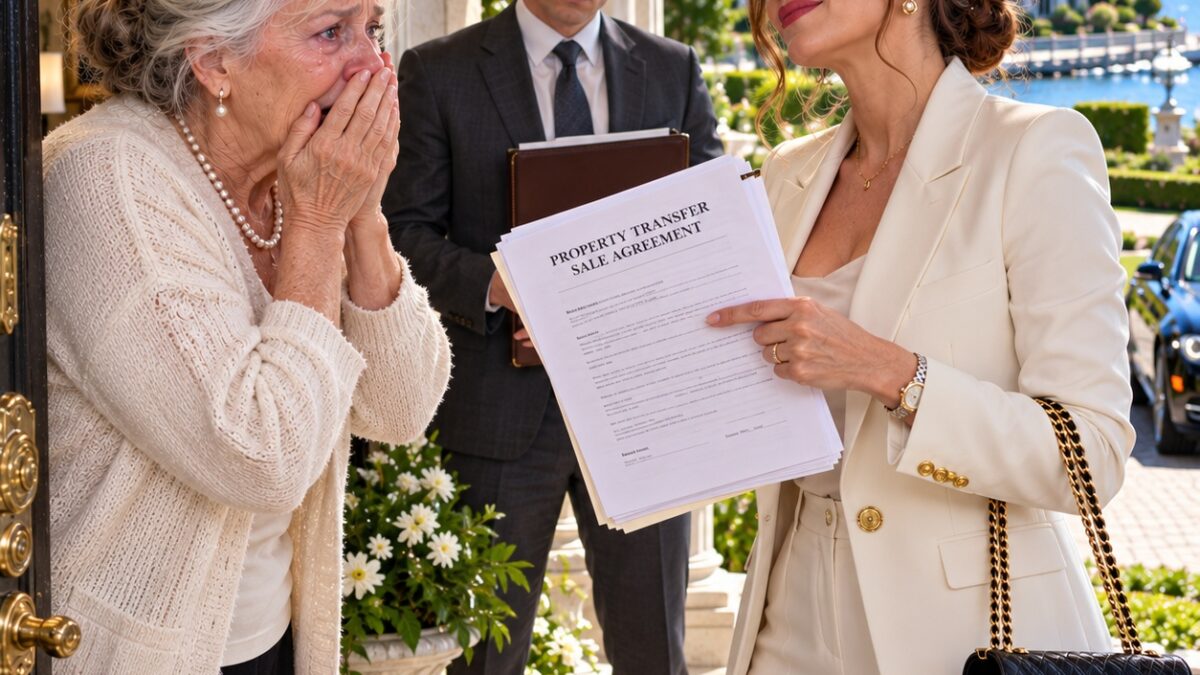
Then came Tuesday morning.
The roses.
The doorbell.
The notary.
The eighteen-million-dollar sale.
Friday eviction.
The instant Madison left, I hired Gloria.
We met that afternoon in Southampton.
She had already begun searching.
That was Gloria.
She did not believe in arriving empty-handed.
She opened her laptop.
“Madison Parker does exist.”
I felt relief.
“For about eleven months.”
Relief vanished.
“What does that mean?”
“The identity is constructed.”
She turned the screen.
Two driver’s licenses.
Same face.
Different names.
Madison Parker.
New York.
Miranda Blackwell.
Nevada.
“Her real name is Miranda Blackwell.”
I stared.
“She’s thirty-one.”
“She told Ryan twenty-eight.”
“That’s the least interesting lie.”
Gloria opened another file.
“Two previous marriages.”
Photographs.
Miranda in a wedding gown beside a much older man.
Texas oil executive.
Another wedding.
California technology entrepreneur.
Different hair.
Different makeup.
Same eyes.
“First husband owned a ranch,” Gloria said. “Within six months she had financial access and property authority.”
“What happened?”
“He tried to reverse a transfer.”
“And?”
“He suffered what records describe as a psychiatric breakdown.”
My stomach tightened.
“Convenient.”
“He was committed for a period of time.”
“Miranda got the ranch?”
“Yes.”
“Second husband?”
“Widower. Tech money.”
Ryan’s profile.
Almost exactly.
“Quick romance. Marriage. Financial transfers.”
Gloria paused.
“He died.”
I felt cold.
“How?”
“Heart attack.”
“That happens.”
“Yes.”
She looked at me.
“He had also been taking anxiety medication.”
Silence.
“His children suspected foul play but couldn’t prove it.”
I remembered Ryan’s slurred voice.
“Gloria.”
“I know.”
“She could be drugging him.”
“That possibility needs to be taken very seriously.”
Gloria found more.
Fake education.
Fake family background.
No Columbia degree.
No Connecticut philanthropy.
A childhood in foster care.
A criminal history beginning in adolescence.
False identities stretching back years.
And signs Miranda was connected to a network specializing in romance fraud, property theft, document forgery, and inheritance schemes.
“She researches targets,” Gloria said.
“How?”
“Public records. Divorces. Death notices. Property databases. Professional profiles.”
“Ryan.”
“Recently divorced.”
“Yes.”
“Emotionally vulnerable.”
“Yes.”
“Son of a wealthy widow.”
I stared at the table.
“Yes.”
“Architect with expected inheritance but limited immediate access to family property.”
My stomach turned.
“She picked him.”
“Most likely.”
Not love.
Selection.
My son had thought someone finally saw him again.
Miranda had seen a balance sheet.
We needed proof.
So I invited them to dinner.
Madison—Miranda—tried to refuse.
I insisted.
The following night they arrived at seven.
Ryan looked terrible.
Pale.
Sunken eyes.
Slow movements.
Miranda guided him by the elbow.
During dinner I watched her constantly.
Every drink Ryan took had passed through her hands.
Every plate.
Every cup.
She kept a small handbag beside her.
Twice, she reached inside when she thought no one was watching.
Ryan’s speech became more slurred as dinner continued.
“You okay?”
“I’m fine.”
“Are you sure?”
“Just tired.”
Miranda rubbed his shoulder.
“He has been anxious.”
“What are you giving him?”
She smiled.
“Herbal supplements.”
“What kind?”
“A natural blend.”
“Name?”
“Why?”
“Curious.”
Her smile tightened.
“Valerian. Magnesium. Things like that.”
After dinner, she went to the powder room.
Her purse remained on the chair.
I knew going through someone’s handbag was wrong.
I also knew my son could barely focus his eyes.
I opened it.
Beneath a makeup compact were three prescription bottles.
Lorazepam.
Alprazolam.
Zolpidem.
None carried Ryan’s name.
None carried Miranda’s.
I photographed them.
Closed the purse.
Seconds later Miranda returned.
She saw me standing near the chair.
For one instant her expression became murderous.
Then sweet again.
“Everything okay?”
“Looking for antacid.”
I patted my stomach.
“Too much butter.”
The next morning, Dr. Patricia Wells looked at the photographs.
“These are serious medications.”
“Could they cause Ryan’s behavior?”
“Absolutely.”
“If someone were giving them without his knowledge?”
Patricia stared at me.
“You need him here.”
Getting Ryan away from Miranda required help.
I called his business partner, Jake Morrison.
“I think Ryan is being drugged.”
Silence.
Then:
“I believe you.”
That surprised me.
“Why?”
“He’s missing meetings.”
My chest tightened.
“He never misses meetings.”
“I know.”
“He approved drawings last week with obvious structural errors.”
“That isn’t Ryan.”
“No.”
Jake devised the plan.
Urgent Saturday client meeting.
He picked Ryan up at six-thirty before Miranda woke fully.
Instead, he drove him directly to Patricia’s office.
Ryan resisted.
“Madison says I need rest.”
Jake replied:
“And after the doctor says you’re fine, I’ll buy breakfast.”
Blood tests came back while we waited.
Lorazepam.
Alprazolam.
Significant levels.
Enough to impair judgment and memory.
Patricia sat across from him.
“Ryan, are you knowingly taking these medications?”
He stared.
“No.”
“Have you been prescribed them?”
“No.”
“Do you take any tablets Madison gives you?”
His expression changed.
“Herbal supplements.”
“What do they look like?”
“White. Sometimes blue.”
“How do you take them?”
“She puts them in juice.”
My son looked at me.
And I watched the horror arrive.
“She’s been drugging me.”
I took his hand.
“Yes.”
He began crying.
Not loudly.
The quiet crying of someone realizing his own memories could not be trusted.
Then I showed him Gloria’s investigation.
Miranda Blackwell.
Previous husbands.
Fake identities.
Financial crimes.
The death.
The medications.
Ryan buried his face in his hands.
“How could I be this stupid?”
“You were targeted.”
“I married her.”
“You were vulnerable.”
“I signed everything.”
“You were being medicated.”
“I let her into our family.”
“Ryan.”
He looked at me.
“You survived a divorce that broke you.”
Tears streamed down his face.
“She studied that.”
I squeezed his hand.
“That makes her predatory. It does not make you stupid.”
Over the next several hours, as the medication began leaving his system, memories returned.
The prenup.
Power of attorney.
Property papers.
Financial authorizations.
Documents Miranda told him were routine.
There was more.
“She’s been blackmailing me.”
Jake stared.
“What?”
Ryan swallowed.
“She showed me records from the firm.”
“What records?”
“Client accounts. Transfers.”
Jake’s expression darkened.
“She said it looked like I had embezzled money.”
“There is no missing money.”
Ryan stared at him.
“She said if anyone found out, I’d lose my license.”
“She fabricated it.”
Ryan closed his eyes.
“She told me she could protect me if I cooperated.”
The scheme was larger than drugs.
Miranda had built an entire reality around him.
Sedation.
False evidence.
Fear.
Isolation.
Then my phone rang.
Her voice exploded.
“Where is my husband?”
“With his doctor.”
Silence.
“Why?”
“Because we discovered what you’ve been putting in his drinks.”
“I have no idea what you’re talking about.”
“We also know your name is Miranda Blackwell.”
Another silence.
Longer.
Then she laughed.
“Gloria Hernandez?”
That frightened me.
“You know Gloria?”
“I know nosy people.”
“We know about Texas.”
Click.
“California.”
Silence.
“The prescriptions.”
Her voice turned flat.
“You can’t prove anything.”
I looked at Ryan.
“Yes.”
I said quietly.
“We can.”
She hung up.
Ryan stayed at the estate that night.
For the first time in weeks, he slept without Miranda controlling what entered his body.
The next morning he looked sharper.
Ashamed.
Angry.
But himself.
“Mom.”
“Yes?”
“I need to fix this.”
“We.”
“What?”
“We need to fix this.”
His eyes filled.
“We.”
Ben arrived with copies of everything Ryan had signed.
The documents were sophisticated.
Individually, many looked ordinary.
Together, they created a path toward control over Ryan’s financial interests and potential claims against family assets.
Ben rubbed his forehead.
“She knew what she was doing.”
“Can we void them?”
“Duress and incapacity help.”
“We have blood tests.”
“Good.”
“But?”
“She has experienced lawyers.”
As if summoned, Harold appeared.
His expression grim.
“Mrs. Thompson.”
“What?”
“There’s a moving truck outside.”
I stood.
“Whose?”
“Madison’s.”
We reached the foyer just as three movers began carrying my grandmother’s antique dining chairs toward the truck.
Miranda stood there with a clipboard.
Designer suit.
Sunglasses.
Absolutely calm.
“Stop.”
She looked at me.
“Hello, Susie.”
“You are removing nothing.”
“We’re renovating.”
“This is not your house.”
She smiled.
“Actually…”
Ryan walked in behind me.
“Actually what?”
She froze.
He looked clear.
Alert.
Furious.
“Ryan.”
“Ask me.”
“What?”
“Ask me if I approved renovations.”
She stared.
“You’re not well.”
“I’m sober.”
Her face drained.
“You need your medication.”
“They weren’t my medications.”
“Ryan.”
“You drugged me.”
The movers stopped.
Miranda looked around.
“Everyone out.”
Nobody moved.
“I said out!”
Before the confrontation could go further, another car arrived.
Black sedan.
Steven Crawford stepped out.
I knew the name.
One of New York’s most feared divorce and asset-dispute attorneys.
Two associates followed.
He handed Ben papers.
“Court orders.”
Ben scanned them.
His face changed.
Crawford addressed me.
“Mrs. Thompson, my client has enforceable marital and property rights derived from agreements executed by your son.”
“While drugged.”
“That allegation remains unproven.”
“We have blood tests.”
“Blood tests prove ingestion, not criminal administration.”
He was good.
I hated him immediately.
Then he delivered the next blow.
“Mrs. Parker is pregnant.”
Ryan went white.
Miranda placed one hand over her stomach.
“That’s impossible.”
Crawford’s expression did not change.
“Pregnancy often surprises people.”
Miranda produced an ultrasound.
Positive test.
Documents.
“I wanted to surprise you.”
Ryan stepped backward.
She used the pregnancy to transform herself from suspected predator into vulnerable expectant wife.
Emergency motions followed.
That afternoon, Judge Patricia Martinez heard the dispute.
Crawford presented Miranda as a pregnant woman being persecuted by a rich, controlling mother-in-law.
Ben tried to introduce the criminal investigation.
Crawford objected.
Judge Martinez did what judges sometimes have to do when facts are incomplete.
She preserved the status quo.
Temporary order.
Nobody could remove Miranda from what she claimed was her marital residence until a full hearing.
I wanted to scream.
Miranda smiled at me outside court.
“You should have packed.”
That evening she returned to my estate with private security.
Then moved into the master bedroom.
My bedroom.
The room where my husband had spent his final days.
That was almost the moment I lost control.
Almost.
But rage was exactly what she wanted.
If I screamed.
If I shoved her.
If I ordered guards to drag her outside.
Crawford would have it documented within the hour.
Dangerous mother-in-law terrorizes pregnant wife.
So I walked away.
Then attacked the pregnancy claim instead.
Dr. James Lou examined photographs of the ultrasound images.
His response came quickly.
“These do not align with the gestational age being claimed.”
“What does that mean?”
“The fetal development shown is too advanced.”
“Could they be someone else’s?”
“Possibly.”
“Stock images?”
“Possible.”
Another crack.
Then federal agents arrived.
Agent Sarah Chen.
Search warrants.
Identity fraud.
Wire fraud.
Racketeering investigation.
Miranda had drawn federal attention long before we knew her name.
Still, Crawford argued that even criminal charges would not automatically void every civil property claim.
Miranda had planned for multiple contingencies.
She expected exposure.
What she had not expected was my husband.
Not alive.
But still protecting us.
Harold disappeared into the estate office for hours.
Finally, he entered my study carrying an old leather folder.
“Mrs. Thompson.”
“You look pleased.”
“I think Mr. Thompson would be very pleased.”
He placed the folder down.
Trust agreements.
Incorporation documents.
Property records.
Layers.
“What is this?”
“The real ownership structure.”
I stared.
“What do you mean real?”
“The public records only tell part of the story.”
My husband had structured the estate through trusts and related entities decades earlier.
Not simply for tax planning.
For protection.
He had deliberately separated occupancy, beneficial interests, control rights, and transfer authority.
Certain ownership protections remained effectively dormant unless someone attempted an unauthorized transfer.
Even I had not understood the entire structure.
“Why didn’t I know?”
Harold smiled faintly.
“You hated paperwork.”
True.
“And Mr. Thompson handled these structures privately with counsel.”
We called Margaret Foster, a specialist in complex estate law.
She reviewed everything.
Then leaned back.
“Your husband was paranoid.”
I smiled.
“Yes.”
“It may have saved you.”
“How?”
“Madison’s lawyers are asserting rights against the wrong layer of ownership.”
I frowned.
“In English.”
“They cannot transfer something Ryan never legally owned.”
I sat completely still.
Margaret continued.
“Even if every document Ryan signed were valid—and I don’t believe they are—he could not convey this estate.”
“What about my name on the public deed?”
“Not enough.”
“And the sale?”
“Built on defective authority.”
I almost laughed.
Miranda had spent months stealing keys to a door that did not lead where she thought it did.
But another revelation was coming.
Gloria had continued digging into Miranda’s marital history.
One relationship had never legally ended.
David Blackwell.
Her husband.
Not ex-husband.
Husband.
She had disappeared from him months earlier after running up debts in his name and taking his vehicle.
Which meant Miranda had not been legally free to marry Ryan.
No valid marriage.
No valid spousal standing.
No legitimate prenup between lawful spouses.
No marital-home claim.
No marital-property argument.
Her legal house of cards collapsed at once.
By then, federal agents had an arrest warrant.
Miranda barricaded herself inside my bedroom.
The FBI surrounded the estate.
She claimed a pregnancy-related medical emergency.
Then screamed at accomplices by phone.
Her lawyer backed away once evidence of bigamy and fraud surfaced.
Outside, David Blackwell arrived.
He looked exhausted.
Ordinary.
Nothing like Miranda’s polished former targets.
“She disappeared,” he told us.
“Left me with debt.”
“How much?”
“Enough.”
“She stole my identity.”
His voice shook.
“I’ve been living out of a motel while trying to find her.”
Ryan stared at him.
For the first time, both men understood they had been used by the same woman.
Different technique.
Same predator.
Inside the house, glass shattered.
Then china.
My mother’s china.
I closed my eyes.
“Please tell me that wasn’t what I think it was.”
Harold said nothing.
FBI negotiator Rebecca Torres arrived.
Miranda refused to surrender.
Then the day became surreal.
A white van pulled through the service entrance.
Three men in uniforms.
Badges.
Paperwork.
“U.S. Marshals.”
They claimed they had a federal property-seizure order.
Harold examined their credentials.
Something bothered him.
He quietly contacted Agent Chen.
She approached.
“Badge numbers.”
The men hesitated.
“Supervising office.”
One became defensive.
“We are operating under federal authority.”
Agent Chen’s voice stayed calm.
“So am I.”
They began backing away.
“Detain them.”
Agents moved.
Fake marshals.
More of Miranda’s network.
Then the master-bedroom door flew open.
Miranda emerged.
Her hair was wild.
Face streaked with tears.
And in her hands was what appeared to be a bomb.
Everyone froze.
“Stay back!”
Ryan tried moving forward.
Agent Chen caught his arm.
Miranda looked at us.
At me.
At Ryan.
At David.
At federal agents.
Everything she had built was gone.
“I want what I’m owed.”
Rebecca Torres spoke calmly.
“Miranda, nobody needs to get hurt.”
“I spent months on this family!”
The words echoed across the marble foyer.
Her mask was gone.
“This was supposed to be easy.”
Ryan stared at her.
“What?”
She laughed bitterly.
“You.”
His face tightened.
“You were supposed to be easy.”
Silence.
“Divorced.”
She pointed at him.
“Lonely.”
Another step.
“Desperate for someone to love you.”
Ryan looked as if she had stabbed him.
“And your mother ruined everything.”
I felt no victory.
Only grief for my son.
Miranda continued.
“All she had to do was leave.”
“You drugged me.”
“To make you manageable.”
The FBI was recording every word.
She no longer cared.
“You forged documents.”
“You signed what I needed.”
“Because you kept me sedated.”
“Because you were difficult when you were sober.”
Ryan’s face changed.
Something healed inside him at that moment.
Not fully.
But enough.
He finally understood.
This had never been a failed marriage.
It had been an operation.
Rebecca kept Miranda talking.
“What do you want?”
“The house.”
“You know the ownership claim failed.”
“Then money.”
“How much?”
“All of it.”
She laughed.
“Compensation.”
“For what?”
“For wasting my time on this pathetic family.”
David stepped forward.
“Stop.”
Miranda’s eyes snapped toward him.
“This is your fault.”
“My fault?”
“You tracked me.”
“You stole my identity.”
“Shut up.”
“You maxed my cards.”
“Shut up!”
“You took my truck.”
“SHUT UP!”
While they argued, one of the fake marshals began cooperating.
Jerry Price.
He told Agent Chen the truth.
“The bomb is fake.”
Electronic parts.
Modeling clay.
Built to frighten.
Agents adjusted.
Moved closer.
David kept talking.
“I lived in a motel for three months because of you.”
Miranda turned fully toward him.
That gave the tactical team the opening.
Two agents rushed from behind.
One caught her arm.
Another took her down.
The device hit the marble floor.
Nothing happened.
Handcuffs clicked.
Miranda screamed.
Threats.
Lawyers.
Money.
Revenge.
None of it mattered anymore.
Jerry Price confessed to six similar schemes across three states.
He named document forgers.
Corrupt legal professionals.
Medical providers supplying drugs.
Others began cooperating.
Miranda had promised fifty thousand dollars each if they helped her secure the Thompson estate.
Jerry told Agent Chen:
“She said it would be easy.”
“How?”
“Rich old women don’t fight back.”
That sentence stayed with me.
Rich old women.
Miranda never understood the difference between age and weakness.
Between kindness and passivity.
Between grief and stupidity.
Six months later, I sat in federal court for her sentencing.
She wore orange.
No designer dress.
No polished hair.
No Madison Parker.
Only Miranda Blackwell.
The judge described the crimes.
Identity theft.
Wire fraud.
Racketeering.
Conspiracy.
Multiple jurisdictions.
Multiple victims.
Fifteen years in federal prison.
Five years supervised release afterward.
Restitution.
Forfeiture.
Miranda did not apologize.
She stared straight ahead.
Cold.
Defiant.
That suited her more than the sweet smile she wore the day I met her.
Her network collapsed around her.
Fourteen accomplices were charged.
Steven Crawford, whose involvement extended far beyond merely representing her, received a long prison sentence for participating in multiple schemes.
Jerry and the fake marshal crew received varying sentences based partly on cooperation.
Medical professionals and document forgers faced their own consequences.
Our case was later cited as part of a broader push for stronger verification procedures involving suspicious inheritance and property transfers tied to recent marriages.
But none of that repaired Ryan immediately.
The drugs left his body quickly.
The shame did not.
He moved back into the estate.
For weeks, I would find him sitting alone on the terrace.
The same terrace where Madison first charmed us.
Sometimes he stared at the water for an hour.
One evening, I sat beside him.
“Talk to me.”
He shook his head.
“You don’t have to protect me.”
“I’m not.”
“You’ve barely spoken all day.”
His eyes filled.
“How do I trust myself again?”
That question hurt.
“You start small.”
“I married her.”
“Yes.”
“I signed things.”
“You were impaired.”
“I believed her.”
“She was trained to be believable.”
“I ignored you.”
“Yes.”
He looked at me.
I did not soften that one.
“You did.”
“I thought you were interfering.”
“I know.”
“You were trying to save me.”
“Yes.”
He began crying.
I took his hand.
“Ryan, being a victim does not mean you had no choices.”
He stared.
“You made some mistakes.”
His face fell.
“But accountability is not the same as blame.”
I squeezed his hand.
“Understand how she got inside your life.”
He nodded.
“So she never gets to keep living there after she’s gone.”
Therapy helped.
Dr. Wells referred him to someone who specialized in coercive control and psychological manipulation.
Ryan slowly rebuilt confidence.
He returned to architecture.
At first part-time.
Then fully.
His work changed.
He became fascinated by designing homes for older clients with stronger security features.
Private document storage.
Independent access controls.
Safer spaces.
Systems that made it more difficult for a manipulative caregiver, relative, or partner to quietly take over a household.
One afternoon he showed me plans.
“You added two secure offices?”
“One for records.”
“Isn’t that excessive?”
He looked at me.
I smiled.
“Just testing you.”
He laughed.
That laugh meant more to me than any legal victory.
The estate changed too.
A wing that had remained mostly closed since my husband’s death became the Thompson Center for Elder and Family Financial Protection.
Gloria left her investigation firm to direct research and prevention.
Patricia Wells helped develop medical training about signs of coercive medication.
Ben recruited attorneys willing to offer consultations.
Agent Chen began speaking at conferences.
Harold, now in his seventies, became a reluctant celebrity because everyone wanted to hear the story about the hidden trust documents.
He hated that.
Secretly, he loved it.
The center helped families facing romance scams.
Inheritance fraud.
Financial elder abuse.
Coercive control.
Property schemes.
Our first year, we worked with more than two hundred families across thirty states.
Some cases ended with arrests.
Some with recovered property.
Some simply with a frightened person realizing they were not imagining what was happening.
Those were the cases I cared about most.
One of our regular visitors was Eleanor Chase.
Miranda had taken her home in an earlier scheme.
For years, Eleanor believed she had simply been foolish.
“That’s what everyone told me.”
She sat across from me during a support meeting.
“My daughter asked why I trusted her.”
“What did you say?”
“I was lonely.”
Her voice broke.
“I thought that made it my fault.”
“No.”
“I signed things.”
“So did Ryan.”
“I ignored warning signs.”
“So did I.”
She looked at me.
“You?”
“I welcomed Miranda into my family.”
Eleanor gave a sad laugh.
“She was good.”
“Yes.”
“That’s what people don’t understand.”
I nodded.
Predators are not successful because every victim is stupid.
They are successful because they know how to appear safe.
A year after Miranda’s arrest, we had dinner on the terrace.
Ryan.
Gloria.
Patricia.
Harold.
Me.
And Sarah.
Sarah was another architect.
Ryan had known her professionally for years.
There was no whirlwind.
No instant declarations.
No rushed marriage.
Their relationship developed slowly enough that I almost missed it.
One evening Ryan told me:
“We’re seeing each other.”
“I know.”
His eyes widened.
“What?”
“I have windows.”
“Mom.”
“You smile when she texts.”
He laughed.
Then became serious.
“She knew me before Miranda.”
“That helps.”
“She saw what happened afterward.”
“That’s harder.”
“She doesn’t rush me.”
“Good.”
“She understands if I get suspicious.”
“Also good.”
“And she tells me when I’m being unreasonable.”
“Marry her.”
“Mom.”
“Too soon?”
He laughed.
“Much too soon.”
“Good answer.”
At dinner on the anniversary of Miranda’s arrest, Ryan raised a glass.
“A year ago I thought my life was over.”
Nobody interrupted.
“I thought I had lost my judgment.”
He looked at me.
“My family.”
At Sarah.
“My ability to trust anyone.”
His voice shook.
“But surviving it taught me something.”
“What?” Gloria asked.
“That strength isn’t knowing everything before it happens.”
He looked around the table.
“It’s what you do when you finally see the truth.”
We drank to that.
Later, Sarah said something I never forgot.
“The legal protections saved this estate.”
She looked toward the house.
“But the emotional protections saved your family.”
I thought about that.
My husband’s trusts mattered.
Gloria’s investigation mattered.
Patricia’s blood test mattered.
Federal agents mattered.
But Miranda almost succeeded before any of those protections became useful.
Because she had isolated Ryan.
Answered his phone.
Controlled his medication.
Reframed my concern as interference.
Made him afraid.
Made him ashamed.
Made herself the only person he believed could protect him from problems she had invented.
The center eventually made authentic connection one of its core prevention principles.
Not surveillance.
Connection.
Know your parents.
Know your adult children.
Know who suddenly entered their lives.
Ask uncomfortable questions.
Notice rapid changes.
If someone who normally calls stops calling, find out why.
If a capable person becomes confused after a new partner starts controlling medication, do not dismiss it.
If someone pressures a family into financial decisions using artificial urgency, slow everything down.
Miranda hated slow.
Con artists do.
Time gives people room to think.
Room to compare stories.
Room to ask someone else.
Room for lies to contradict each other.
Miranda’s entire method depended on speed.
Ryan had been divorced.
She loved him immediately.
Needed commitment immediately.
Marriage immediately.
Documents immediately.
Property rights immediately.
Pregnancy emergency immediately.
Eviction immediately.
Friday.
Always a deadline.
Always pressure.
Always a reason there was no time to think.
I understand that now.
The mansion still stands on the Sound.
Same terraces.
Same oak doors.
Same view my husband loved.
But it feels different.
Not because Miranda nearly stole it.
Because for a while, I thought protecting the house meant protecting our family legacy.
I was wrong.
The house is part of the legacy.
It is not the legacy.
My husband’s work mattered.
Ryan’s architecture matters.
The center matters.
The families we help matter.
The relationships Miranda tried to break matter most.
One afternoon, a reporter asked me:
“Mrs. Thompson, after everything Miranda did, what was the most satisfying moment?”
I knew what answer she expected.
The arrest.
The fake bomb hitting the floor.
The sentence.
The hidden trust.
Maybe Miranda discovering she was not legally Ryan’s wife.
I said:
“When my son laughed again.”
The reporter looked disappointed.
But it was true.
Justice is important.
Consequences are important.
But punishment does not automatically restore what crime damages.
Ryan’s recovery mattered more to me than Miranda’s suffering.
Months passed.
The center grew.
Harold found reasons to spend more time there despite claiming he was retired.
Gloria built a national database tracking known patterns and aliases used by financial predators.
Dr. Wells began training physicians to recognize signs that someone might be receiving sedatives or psychiatric medication without informed consent.
Eleanor recovered part of what had been stolen from her.
Other families came forward.
Some because they heard our story.
Others because something in it sounded familiar.
Too perfect.
Too fast.
Too much interest in money.
Too much isolation.
Too many new medications.
Too many documents no one understood.
I stopped feeling foolish for not seeing Miranda immediately.
That took time.
For months, I replayed our first brunch.
Her questions about inheritance.
Her eyes on the chandeliers.
Her interest in trusts.
I would think:
How did I not know?
Then Gloria finally said:
“Because if she looked like a criminal, she would be unemployed.”
I laughed.
Then she added:
“Susie, professional manipulation works because it resembles what people want.”
“What did I want?”
“A daughter-in-law who loved your son.”
That hurt.
“And Ryan?”
“Someone who made him feel wanted after rejection.”
I looked away.
“She didn’t invent those needs.”
“No.”
“She exploited them.”
Exactly.
That distinction became important in Ryan’s therapy too.
Miranda did not create his loneliness after divorce.
She found it.
She did not create my hope that he would build another life.
She found that too.
Then she turned both into entry points.
There is no shame in having an unlocked emotional door.
Everyone has one.
The danger comes when someone pretends love is a reason you should stop checking who is walking through it.
David Blackwell attended one support session.
That surprised me.
He sat near the back.
He had finalized his divorce from Miranda after her arrest.
When the meeting ended, he approached.
“I almost didn’t come.”
“I’m glad you did.”
He looked embarrassed.
“I feel ridiculous.”
“Why?”
“She wasn’t subtle with me.”
“Neither was she with us.”
“I ignored things.”
“So did we.”
He looked toward the windows.
“I kept asking myself how I let somebody ruin my finances and disappear with my truck.”
“Ryan asks himself how he let someone drug him.”
David looked at me.
“And what do you tell him?”
“That shame is one more way predators keep controlling you after they’re gone.”
His eyes filled.
He nodded.
Then smiled faintly.
“Still want my truck back.”
“That seems reasonable.”
We both laughed.
Miranda remained in prison.
From what I heard, she continued insisting others were responsible for her downfall.
I stopped asking.
There are people whose understanding you cannot make part of your healing.
Whether Miranda ever accepted responsibility was no longer my concern.
My life had become larger than her.
That was the real victory.
On the second anniversary of the wedding, I walked alone through the front hall early one morning.
The same hall where I had been arranging roses when the doorbell rang.
The same marble floor where the fake explosive later landed.
The same oak door through which Madison Parker had entered pretending to become part of my family.
I stopped near the table.
Fresh roses.
Again.
For a moment, memory layered itself over the present.
Madison smiling.
The notary holding papers.
“We’ve sold the house.”
“Pack by Friday.”
I smiled.
Not because it had become funny.
Because she had misunderstood everything.
She thought wealth was possession.
A deed.
A building.
An account.
A transfer.
A number.
She believed if she could capture the legal instruments, she could capture the life built around them.
But my husband had understood something she never did.
You protect what you love in layers.
Legal layers.
Financial layers.
Human layers.
Trusts can protect property.
Doctors can protect health.
Investigators can expose lies.
Courts can impose consequences.
But people protect one another by paying attention.
That was the layer we almost lost.
I picked up one rose.
Trimmed the stem.
Placed it in water.
Then heard footsteps.
Ryan.
“You’re up early.”
“So are you.”
“Couldn’t sleep.”
“Everything okay?”
He smiled.
“Everything’s fine.”
I froze.
He realized what he had said.
For a second, we stared at each other.
Then both burst out laughing.
“I need a new phrase.”
“Yes.”
“How about ‘No criminal is currently drugging me’?”
“A little specific.”
“Reassuring.”
He poured coffee.
Sarah was coming later.
They were moving slowly.
Deliberately.
I approved.
Not because I distrusted her.
Because healthy relationships survive time.
They do not need urgency to feel real.
Ryan looked at the roses.
“You know what today is?”
“I do.”
“Does it bother you?”
“A little.”
“Me too.”
He was quiet.
Then:
“I used to think recovering meant I’d eventually stop remembering.”
“No.”
“I know that now.”
He looked at me.
“I remember everything.”
“So do I.”
“It just doesn’t control me.”
I smiled.
“That sounds like recovery.”
He raised his coffee.
“To not being controlled.”
I tapped my cup against his.
Years earlier, my husband built legal barriers because he knew fortunes attract predators.
He could not have imagined Miranda.
The false identity.
The drugs.
The fake pregnancy.
The forged documents.
The fraudulent marriage.
The criminal network.
The men impersonating federal marshals.
But he understood risk.
He also understood preparation.
Harold once quoted him during a center meeting.
“Preparation is how you protect what you love before fear makes you careless.”
I had never heard my husband say those exact words.
It sounded like him.
So I kept it.
The Thompson Center adopted a simpler motto.
Slow down. Stay connected. Verify.
Those three habits would have disrupted nearly everything Miranda did.
Slow down the romance.
Verify credentials.
Stay connected when she tried isolating Ryan.
Slow down signatures.
Verify medications.
Stay connected with business partners.
Slow down property transfers.
Verify ownership.
Simple.
Not perfect.
But powerful.
By the end of our second year, the center had expanded.
More lawyers volunteered.
Banks requested training.
Health systems asked Patricia for guidance.
Law enforcement agencies used Gloria’s database.
Ryan occasionally spoke publicly about coercive medication.
That terrified him at first.
The first time, I sat in the audience.
He walked to the podium.
Paused.
Then said:
“My name is Ryan Thompson, and I was drugged by someone I believed was my wife.”
The room became silent.
“For months, I thought my confusion was stress.”
He looked toward me.
“My family noticed before I did.”
He spoke for thirty minutes.
No shame.
No excuses.
When he finished, people stood.
Later, a man approached him.
“My brother is acting like you described.”
Ryan immediately gave him Patricia’s contact information.
That night in the car, he cried.
“Bad?”
I asked.
“No.”
“Good?”
“I think so.”
I reached for his hand.
Miranda once targeted him because she believed being wounded made him weak.
She was wrong.
The wound became a place through which he recognized other wounded people.
The mansion still has three generations of memories.
My husband’s office.
Ryan’s childhood room.
The master bedroom Miranda violated.
The terrace where we first welcomed her.
The wing now filled with people working to prevent the exact crimes she committed.
I sometimes think there is poetry in that.
She entered the estate hoping to turn it into money.
Instead, what she did turned part of it into protection for strangers.
I doubt she would appreciate the irony.
I do.
One evening, as the sun lowered over the Sound, Harold joined me on the terrace.
He carried two glasses of lemonade.
“No alcohol?”
“You complain it makes you sleepy.”
“I am allowed.”
“You are.”
He sat.
For a while, neither of us spoke.
Then I said:
“Did my husband ever tell you why he created all those layers?”
Harold smiled.
“Several times.”
“And?”
“He worried Ryan would inherit too much too young.”
“That sounds like him.”
“He worried business partners might sue.”
“Also him.”
“He worried about divorce.”
I looked at him.
“Really?”
“Very much.”
I laughed.
“Ryan was twelve.”
“Mr. Thompson planned ahead.”
“Clearly.”
Harold looked toward the house.
“But he worried about you most.”
“Me?”
“He said you trusted people.”
“That was an insult.”
“He meant it affectionately.”
“Worse.”
Harold smiled.
“He wanted to make sure nobody could pressure you into signing away what you built together.”
My eyes filled.
“All those years and he never explained the full structure.”
“He thought knowing every technical detail would make you anxious.”
“He was right.”
“I know.”
I looked toward the windows.
“Still irritating.”
“Also true.”
Grief is strange.
Years after someone dies, they can still surprise you.
My husband saved our home without ever knowing it needed saving.
But I no longer think the hidden trust was the greatest thing he left us.
He left Ryan a sense of craft.
Me a lifetime of partnership.
Harold loyalty.
A family culture that, once shaken awake, refused to abandon one another.
Miranda underestimated that.
The criminal case made headlines.
Reporters loved phrases like eighteen-million-dollar estate and romance-fraud ring.
They loved the fake marshals.
The forged identity.
The explosive device.
Those were dramatic.
But when people ask me now what warning sign they should remember, I tell them something less cinematic.
Notice when someone starts making your relationships smaller.
Miranda did that first.
Before the property.
Before the drugs became obvious.
Before the courtroom.
She made herself the gatekeeper.
Ryan’s phone.
Ryan’s schedule.
Ryan’s health.
Ryan’s information.
Every predator wants fewer witnesses.
Connection creates witnesses.
That is why isolation matters.
That is why I trusted my instincts when my son’s voice changed.
Not because I knew about lorazepam.
I did not.
Because I knew Ryan.
I knew the pace of his speech.
His humor.
His resistance to being managed.
Something did not fit.
Knowing someone deeply is a form of protection no legal document can replace.
A few years earlier, I thought estate planning was mostly about money.
Now, when people ask me what they should plan for, I say:
“Decide who is allowed to notice when you stop sounding like yourself.”
That usually surprises them.
Then they write it down.
I still arrange roses on Tuesdays.
Not every Tuesday.
Enough.
I still live in the estate.
Ryan eventually moved back into his own home.
Sarah is often there.
I have learned not to ask too many questions.
Usually.
Gloria still investigates people for a living despite claiming the center consumes all her time.
Patricia still scolds me for skipping annual blood work.
Ben still sends documents with tabs because he thinks I will read them more carefully.
Harold finally retired.
Then started volunteering four days a week.
Apparently retirement is a flexible concept.
And somewhere behind federal prison walls sits Miranda Blackwell.
The woman who believed she had almost stolen our legacy.
She came close to stealing property.
That is true.
She came closer to stealing my son’s confidence.
But legacy?
No.
She never understood what ours was.
Not the eighteen million dollars.
Not waterfront acreage.
Not paintings.
Not antiques.
Not the company my husband built.
Legacy is Ryan learning how to stand beside another victim and say, I believe you.
It is Eleanor Chase recovering enough of her life to stop feeling ashamed.
It is Gloria finding patterns before another family loses a home.
It is Patricia teaching doctors that unexplained confusion might be coercion, not merely stress.
It is a frightened parent calling our center and hearing a real person answer.
It is Sarah sitting beside Ryan without rushing him.
It is Harold finding an old leather folder because loyalty made him keep looking after everyone else thought the papers had been exhausted.
It is a family surviving the moment when trust was used against it and deciding trust itself was still worth rebuilding.
That is something no forged signature can transfer.
No prenup can claim.
No criminal network can sell.
Miranda arrived at my door believing ownership gave her power.
She was wrong twice.
She did not own the house.
And she never understood where our real power came from.
The house is still here.
So are we.
But what matters most is that hundreds of families who never knew my husband, never met Ryan, and never walked through our oak front door are safer because one woman tried to take everything from us.
That is the part of the story I choose to keep.
Not the moment she told me to pack.
Not the moment she occupied my bedroom.
Not the moment she held a fake bomb in my foyer.
I remember the evening one year later, sitting on the terrace with Ryan, Sarah, Gloria, Patricia, and Harold as the sunlight turned the water gold.
Nobody was afraid.
Nobody was being controlled.
Nobody was pretending.
Ryan raised his glass.
I looked around the table.
And I finally understood something.
Miranda had spent her life believing the easiest people to steal from were those who had something to lose.
But sometimes having something worth losing is exactly what teaches people how hard they are willing to fight.
I had fought for the house because my husband built it.
I fought for my son because I loved him.
And afterward, we fought for strangers because once you know what it feels like to almost lose your life to someone else’s manipulation, walking away from other victims becomes impossible.
The mansion was never our greatest inheritance.
It was only where we discovered what the inheritance really was.
Courage.
Attention.
Connection.
And the refusal to let anyone convince us that love requires surrendering control of our own lives.




