The HOA Built an 8-Foot Steel Fence Across My Only Road—Then Grandpa Started the Bulldozer
Captain Kim heard it too.
She looked past Margaret.
Officer Martinez stepped toward the road.
Margaret frowned.
“What is that?”
I knew before I saw it.
“No.”
Sophie looked at me.
“What?”
I closed my eyes for half a second.
“Grandpa.”
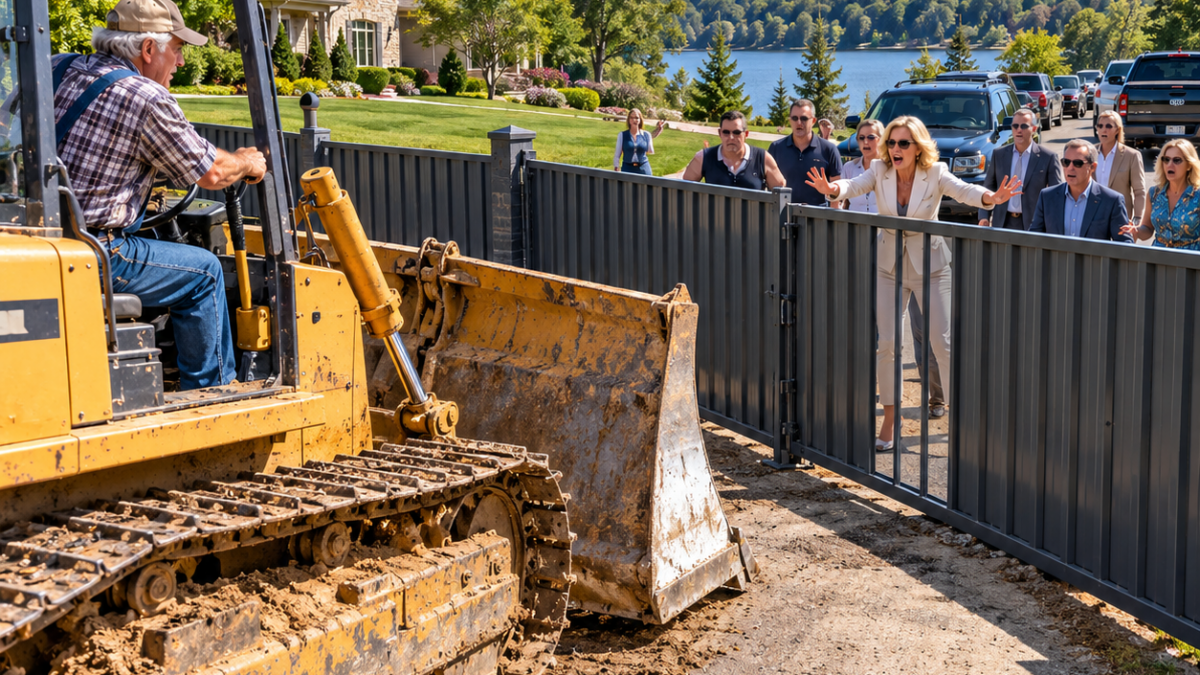
Around the bend came a yellow Caterpillar D6 bulldozer moving at walking speed.
My grandfather, Walter Holloway, sat behind the controls wearing an orange work jacket, an old Denver Broncos cap, and the expression of a man who had been handed exactly the kind of problem he considered entertainment.
Grandpa Walter was seventy-eight.
Retired excavation contractor.
Former Army engineer.
Owner of Holloway Earthworks until he sold the company to my uncle.
And constitutionally incapable of arriving quietly anywhere heavy machinery was available.
The bulldozer rolled to a stop fifty feet from Margaret’s Mercedes.
Grandpa shut the engine down.
Silence returned.
He climbed carefully from the cab.
Margaret stared at him.
“What is the meaning of this?”
Grandpa looked at the fence.
Then at me.
Then at Sophie.
“Morning.”
“Grandpa, why do you have a bulldozer?”
He shrugged.
“Had it nearby.”
“You live twelve miles away.”
“Nearby is relative.”
Captain Kim covered a smile with one hand.
Grandpa walked toward the fence.
Fresh concrete surrounded the steel posts.
He crouched beside one.
Touched it.
Scraped a little with his thumb.
“Still green.”
Margaret crossed her arms.
“Sir, stay away from association property.”
Grandpa stood.
“Association property?”
“Yes.”
He looked at me.
“Did you show her the easement?”
“Three times.”
“Recorded one from ninety-four?”
“Yes.”
“The one your dad and I fought with Caldwell over?”
I stared at him.
“You knew about this?”
Grandpa looked offended.
“Of course I knew.”
Margaret stepped closer.
“I don’t know who you are, but your family history is irrelevant. This roadway belongs to Pine Ridge Heights.”
Grandpa studied her.
“Walter Holloway.”
She waited.
Nothing.
“You’re supposed to know that name?” he asked.
“No.”
“Good.”
He pointed toward the pavement.
“I built this road.”
Margaret blinked.
Grandpa continued.
“Nineteen ninety-three. Holloway Earthworks. Eight inches compacted base. Three-inch asphalt cap. Rebuilt the western drainage after spring washout in ninety-four.”
He tapped his boot against the road.
“I also installed the culvert under your feet.”
Margaret recovered quickly.
“Construction work does not establish ownership.”
“No.”
Grandpa nodded.
“But surveying the access easement with the developer does help you remember where it is.”
That got everyone’s attention.
I walked toward him.
“What do you mean?”
“The old Foster place.”
“That was our property before the previous owners.”
“Exactly.”
Grandpa pointed toward my house.
“Back then this whole section belonged to Harold Foster. Developer bought most of the surrounding land for Pine Ridge but Foster refused to sell the homesite.”
I had heard pieces of that history.
Never details.
“When Maple Drive went in,” Grandpa continued, “Foster agreed to give the developer the strip needed for the neighborhood road, but he reserved permanent access from the new road back to his house.”
Margaret smiled tightly.
“You’re describing an easement.”
“Yes.”
“Our counsel has reviewed the documents.”
“What counsel?”
“That’s privileged.”
Grandpa looked at Officer Martinez.
“Does saying privileged make things disappear now?”
Martinez coughed.
“I’m staying out of that part.”
Captain Kim wasn’t.
She stepped toward Margaret.
“I’m not interested in title litigation. I’m interested in emergency access.”
Margaret turned.
“Emergency vehicles can contact association management for entry.”
Captain Kim stared at the chained gate.
“At two in the morning?”
“We have procedures.”
“What’s the response time?”
Margaret hesitated.
Captain Kim pointed toward Sophie.
“If she goes into labor tonight and experiences hemorrhaging, how quickly can your association representative arrive with a key?”
“That’s hypothetical.”
“No. That’s emergency planning.”
Margaret’s voice hardened.
“Captain, with respect, the association cannot surrender its property rights because one resident might someday need emergency assistance.”
Sophie spoke for the first time.
“I’m standing right here.”
Margaret glanced at her.
“I understand your condition.”
“No, you don’t.”
Sophie stepped forward.
“I work in an emergency department. I’ve watched women go from talking normally to crashing in minutes.”
Margaret said nothing.
“I’ve seen placental abruptions. Cord prolapse. Severe preeclampsia. Postpartum hemorrhage.”
“Sophie,” I said softly.
She shook her head.
“No. She needs to hear it.”
Margaret looked uncomfortable now.
Good.
“If I need an ambulance,” Sophie said, “nobody gets to stand at a steel fence waiting for you to find your keys.”
Captain Kim looked at Margaret.
“That is exactly my concern.”
Margaret’s answer came quietly.
“The fence remains.”
Grandpa nodded once.
“Okay.”
I knew that tone.
“Grandpa.”
He turned toward the bulldozer.
“Walter,” Captain Kim said sharply.
He stopped.
She apparently knew that tone too.
“You are not touching the fence.”
Grandpa looked back.
“Wasn’t planning to.”
I exhaled.
Margaret smirked.
Grandpa pointed at the shoulder beside the road.
“I was planning to inspect the drainage culvert.”
Margaret’s smirk disappeared.
“What?”
He walked toward the western ditch.
I followed.
The old culvert entered beneath the road about thirty feet before the fence.
Grandpa crouched.
“Jake.”
“Yeah?”
“See that marker?”
Half-buried beside the ditch was a rusted survey pin with faded orange plastic tied around it.
He pointed across the road.
“Other one should be near that pine.”
We found it under dead leaves.
Grandpa stood between the pins.
“Thirty feet.”
My pulse changed.
The fence posts were inside them.
Not beside the easement.
Inside it.
Dead center.
“They built directly inside the recorded access.”
Grandpa nodded.
“Looks that way.”
Margaret called from behind us.
“Those markers are obsolete.”
Grandpa laughed.
“Steel monuments don’t become obsolete because you dislike where they are.”
She walked closer.
“The HOA owns the underlying land.”
“Maybe.”
Grandpa pointed at the gate.
“But if Jake owns permanent ingress and egress over it, you cannot materially obstruct the easement.”
Margaret stared at him.
“You’re not an attorney.”
“Nope.”
“Then stop giving legal opinions.”
“Fair.”
He looked at me.
“Call one.”
I already had.
Three days earlier, when Margaret sent the first letter, I contacted attorney Rachel Monroe.
She specialized in real-estate disputes.
I had emailed her every document the night before.
She had promised to call Monday morning.
It was Saturday.
I dialed anyway.
She answered on the second ring.
“Jake?”
“Sorry.”
“You sound like something happened.”
“The HOA built a steel fence across the easement.”
Silence.
“A literal fence?”
“Eight feet.”
“Locked?”
“Two chains.”
Another silence.
“Send me pictures.”
I did.
While Rachel reviewed them, Captain Kim contacted county fire prevention.
Officer Martinez documented the obstruction.
Grandpa photographed the survey pins with a measuring tape between them.
Margaret stood near her Mercedes making calls of her own.
Twenty minutes later, Rachel called back.
“Jake, listen carefully.”
“I’m listening.”
“Do not cut the chain.”
I glanced at Grandpa.
He had bolt cutters in the bulldozer cab.
“I wasn’t planning to.”
“That pause was too long.”
“What can we do?”
“I’m reviewing your title now. The easement language appears strong.”
“How strong?”
“‘Perpetual, nonexclusive easement for pedestrian, vehicular, utility, emergency, service, and construction ingress and egress.’”
I looked at the fence.
“That sounds pretty clear.”
“It is.”
“So they can’t block it.”
“In my opinion, not like this.”
“What about the monthly license?”
“I see no basis for requiring you to buy a separate license to exercise an existing recorded easement.”
I smiled for the first time that morning.
Rachel continued.
“But we need an order if they refuse voluntarily. I’ll contact a judge for emergency relief.”
“Today?”
“Pregnant resident. Sole access. Fire department unable to reach the dwelling. Yes, today.”
“How long?”
“I’m not promising.”
“Understood.”
“Also, Jake?”
“Yeah?”
“Keep your grandfather away from the bulldozer.”
I looked toward Grandpa.
He was already sitting in the cab eating something from a paper bag.
“Working on it.”
At 10:40, another SUV arrived.
A silver Lexus.
Out stepped a thin man in his fifties carrying a leather portfolio.
Margaret immediately walked toward him.
“This is our attorney.”
Rachel was still on speaker.
“What’s his name?”
I waited until he introduced himself.
“Charles Bennett. Bennett & Lowe.”
Rachel laughed softly.
“What?”
“I know Charles.”
“Good?”
“Depends which side you’re on.”
Bennett approached us.
“Mr. Holloway?”
“That’s me.”
He looked at Sophie.
Then at the fence.
His expression became less confident.
“Margaret, may I speak with you privately?”
“I’ve already explained the circumstances.”
“I’d still like a moment.”
They walked twenty feet away.
Grandpa climbed down from the bulldozer.
“Lawyer looks nervous.”
Rachel heard him through the phone.
“Walter?”
Grandpa leaned toward the speaker.
“Rachel Monroe?”
“You two know each other?”
She laughed.
“I represented his excavating company fifteen years ago.”
Grandpa grinned.
“She kept the county from stealing six feet of my equipment yard.”
“The county was correcting a survey.”
“They lost.”
“They settled.”
“Same thing.”
Rachel ignored him.
“Walter, do not move the bulldozer.”
“Everybody keeps saying that.”
“Because everybody knows you.”
Bennett returned with Margaret.
His tone was careful.
“Mr. Holloway, the association is willing to permit temporary pedestrian passage through the gate while the title question is reviewed.”
Sophie stared at him.
“Pedestrian?”
“Yes.”
“I’m seven months pregnant.”
“I understand.”
“And if we need a car?”
“Alternative arrangements can be discussed.”
“What alternative arrangement?” I asked.
Bennett glanced at Margaret.
She answered.
“The monthly license.”
“One thousand dollars.”
“It reflects maintenance obligations.”
Grandpa whistled.
“Twelve grand a year for two hundred feet of pavement. I built the whole stretch for less than that.”
“That was thirty years ago,” Margaret snapped.
Rachel spoke through my phone.
“Charles?”
His face changed.
“Rachel?”
“Hi.”
He closed his eyes briefly.
“What are you doing here?”
“Representing Jake and Sophie Holloway.”
Margaret stared at him.
“You know her?”
Rachel continued.
“I’ve reviewed the 1994 easement. Unless you have a release I haven’t seen, your clients have obstructed recorded access.”
Bennett’s tone became formal.
“We dispute the scope.”
“Then explain the eight-foot fence.”
Silence.
“Charles?”
“We’re assessing.”
“Fire department says emergency vehicles cannot reach the residence.”
Bennett looked toward Captain Kim.
She nodded.
Rachel continued.
“And the beneficiary is seven months pregnant.”
Bennett rubbed his forehead.
“Margaret, I need to see the board authorization for installation.”
Margaret’s posture changed.
Slightly.
But I noticed.
Bennett noticed too.
“What board authorization?”
“The emergency access policy.”
“I asked for the vote.”
“We discussed the issue.”
“When?”
“Thursday.”
“Was there a vote?”
“The board supported enforcement.”
“That isn’t an answer.”
Grandpa leaned toward me.
“This is getting good.”
I elbowed him.
Margaret lowered her voice.
“I exercised presidential authority.”
Bennett stared at her.
“You ordered permanent physical obstruction of a recorded easement without a board vote?”
“It is not their easement.”
“You told me the title issue was unresolved.”
“It is.”
“That is not the same as saying no easement exists.”
Margaret’s face reddened.
“This conversation is privileged.”
“No, it isn’t,” Rachel said through the phone. “Half the county is standing there.”
Officer Martinez looked around.
“Technically six people.”
Nobody laughed except Grandpa.
Bennett pulled Margaret aside again.
This conversation lasted longer.
When they returned, Bennett looked exhausted.
“We are prepared to remove the chains temporarily while documents are reviewed.”
“Fence too,” Captain Kim said.
Bennett looked at her.
“Why?”
“Because an eight-foot gate with a locked control point remains an emergency-access vulnerability.”
“It can be left open.”
“Then leave it open.”
Margaret objected.
“That defeats the entire purpose.”
Captain Kim looked at her.
“Yes.”
The chains came off at 11:15.
Not because Margaret wanted them removed.
Because her own attorney told her to do it.
The gate opened.
I drove my truck through it once just because I could.
Grandpa applauded.
Sophie rolled her eyes.
“You’re both twelve.”
That should have been the end.
It wasn’t.
Margaret left the fence standing.
Two steel leaves folded open on each side of the road like a reminder.
Rachel filed for emergency injunctive relief Monday morning.
By Tuesday afternoon, a county judge issued a temporary order prohibiting the HOA from obstructing our access.
The order was short.
Clear.
The easement existed.
The HOA could litigate ownership and maintenance obligations later.
But until further order, it could not restrict ingress or egress.
Margaret responded by sending us an invoice.
ROAD MAINTENANCE ASSESSMENT: $6,000.
Six months retroactive.
I forwarded it to Rachel.
Her response was two words.
Of course.
We disputed it.
Then came another notice.
Unauthorized commercial use.
Apparently Sophie driving to the hospital constituted “occupational traffic.”
Then a violation alleging my grandfather’s bulldozer had created an “industrial nuisance.”
The bulldozer had been parked on the public road for forty-five minutes.
Another notice claimed our garbage truck damaged HOA pavement.
Then one accused us of “excessive delivery activity” because we received nursery furniture.
Sophie read that one at the kitchen table.
“Nursery furniture.”
“Yes.”
“For the baby.”
“Yes.”
She stared at me.
“Can I fight her?”
“No.”
“I’m pregnant.”
“That doesn’t make assault legal.”
“It should.”
Despite everything, I laughed.
We had spent years saving for the house.
Sophie loved the kitchen.
I loved the workshop.
The nursery overlooked the wetlands where deer occasionally wandered past the tree line.
This was supposed to be our long-term home.
Instead, we were documenting every trip in and out like we lived at a border checkpoint.
Then Margaret escalated again.
At 5:50 one Monday morning, I heard engines outside.
Not a bulldozer.
Three dump trucks.
They unloaded gravel onto Maple Drive.
Directly across our access.
Not a full blockage.
That would have violated the injunction too obviously.
Instead, the HOA announced emergency resurfacing.
Half the road disappeared beneath equipment.
No warning.
No traffic control plan.
No alternate route.
Sophie had a shift beginning at seven.
I walked toward the foreman.
“How long?”
“Two days.”
“You’re closing the road?”
“HOA told us residents beyond this point were notified.”
“We weren’t.”
He looked at his work order.
“Margaret Hastings?”
“Yes.”
He sighed.
Apparently her reputation was expanding.
“Can we maintain one lane?”
“I’ll need to call my office.”
Margaret arrived ten minutes later.
Of course she did.
“Construction is necessary.”
Rachel had told me to record every interaction.
So I did.
“You scheduled road work without notifying the easement holder?”
“The easement does not exempt you from temporary maintenance disruptions.”
“Sophie needs to leave for work.”
“There are hotels nearby.”
For a second, I genuinely thought I had misheard her.
“What?”
“If your family requires guaranteed access during maintenance, temporary lodging would be prudent.”
Sophie stepped beside me wearing hospital scrubs.
Margaret looked at her stomach.
Then at her face.
“Good morning.”
Sophie handed me her bag.
“Hold this.”
That worried me.
She walked directly to Margaret.
Not yelling.
Sophie was far more frightening when she didn’t yell.
“I spend twelve-hour shifts keeping people alive.”
Margaret stepped back slightly.
“I respect healthcare workers.”
“No, you respect hearing yourself say that.”
“Sophie.”
“No, Jake.”
She looked Margaret in the eye.
“You blocked an emergency road to a pregnant woman’s house.”
“That characterization—”
“You suggested I walk through the woods.”
“I never—”
“You suggested a hotel because you deliberately scheduled construction without notice.”
“This is routine maintenance.”
“Then show me the maintenance schedule.”
Margaret said nothing.
“The bid?”
Silence.
“The board vote?”
Margaret’s mouth tightened.
Sophie nodded.
“That’s what I thought.”
Then she turned toward the foreman.
“My attorney will contact your company. I’m going to work.”
The foreman moved equipment.
One lane remained open.
Margaret left furious.
That evening, Grandpa called.
“You need to come over.”
“Why?”
“Found something.”
His barn contained forty years of excavation records because Grandpa believed throwing away paperwork invited government tyranny.
He had pulled out three boxes from Pine Ridge’s original development.
Maps.
Invoices.
Contracts.
One was a 1994 agreement between developer Pine Ridge Development Corporation and Harold Foster, the owner of our original parcel.
The access easement was there.
We already knew that.
But attached to it was another document.
ROAD MAINTENANCE ALLOCATION AGREEMENT.
Grandpa tapped it.
“There’s your thousand-dollar fee.”
I read.
Foster and future owners of our parcel were responsible for twenty percent of actual documented maintenance costs attributable to the final road segment.
No monthly license.
No discretionary access fee.
Actual maintenance.
Documented.
Twenty percent.
“That sounds reasonable.”
“It was.”
Grandpa pointed at another paragraph.
“Read this.”
If the association materially obstructed access or failed to preserve emergency passage, maintenance reimbursement obligations were suspended during the period of interference.
I stared at him.
“You remember this?”
“Nope.”
“You built the road.”
“I built hundreds of roads.”
“You remember the culvert.”
“Culvert was a pain in my ass.”
Fair enough.
Rachel loved the document.
Not emotionally.
Lawyers express joy differently.
She went quiet for five seconds.
Then said:
“This is excellent.”
“How excellent?”
“It defines the exact financial arrangement Margaret claims doesn’t exist.”
“So the six thousand dollars?”
“Unsupported.”
“And the thousand monthly?”
“Unsupported.”
“What do we owe?”
“Potentially twenty percent of legitimate road maintenance.”
“Which I’m happy to pay.”
“I know.”
She paused.
“But now I want the invoices.”
That request opened the next part of the story.
The HOA claimed it had spent $42,000 maintaining the final section of Maple Drive over the previous five years.
Twenty percent would have been $8,400.
Except I lived there only eighteen months.
And when Rachel requested invoices, something strange happened.
The numbers changed.
Forty-two thousand became thirty-one thousand.
Then forty-seven.
Then the association’s treasurer, Paul Grayson, contacted me privately.
“Jake, can we talk?”
We met at a coffee shop three towns over because apparently HOA disputes eventually become espionage.
Paul was sixty-four.
Retired accountant.
Quiet.
The kind of man who apologized when a waiter brought him the wrong food.
He looked nervous.
“I didn’t approve the fence.”
“I know.”
“You do?”
“Your attorney said there was no recorded vote.”
Paul looked down.
“There wasn’t.”
“What about the road fees?”
He slid a folder toward me.
Inside were copies of financial statements.
“Margaret has been using a discretionary infrastructure account.”
“For what?”
“That’s the problem.”
Expenses labeled as Maple Drive maintenance included landscaping near the clubhouse.
Snow removal across the entire subdivision.
Security patrols.
Even decorative stonework near the entrance sign.
“They’re charging my easement for things that have nothing to do with it?”
Paul nodded.
“Margaret says all infrastructure expenses are interconnected.”
“That sounds creative.”
“I objected.”
“What happened?”
“She removed me from the finance committee meeting for being disruptive.”
I stared at him.
“You’re the treasurer.”
“I know.”
That might have been the most Pine Ridge sentence I ever heard.
Paul handed me another page.
A payment to Hastings Property Services.
Margaret’s husband owned Hastings Property Services.
I knew because his name was on three trucks parked behind their house.
The HOA had paid the company more than $68,000 over four years.
Road work.
Tree clearing.
Snow removal.
Emergency services.
Some contracts had never been competitively bid.
Some had no recorded board approval.
“Is this legal?”
Paul looked miserable.
“I don’t know.”
Rachel did.
“Related-party contracting isn’t automatically illegal,” she explained. “But failure to disclose conflicts, false billing, or misuse of assessments can become serious.”
“Can we prove false billing?”
“Not yet.”
So we kept looking.
Margaret helped.
She could not stop escalating.
The temporary injunction made her furious.
The financial requests made her more furious.
Then the county fire marshal issued a formal notice regarding the fence.
Pine Ridge was ordered to maintain unobstructed emergency access.
Margaret publicly blamed me for “inviting government interference.”
A neighbor sent me screenshots from the community Facebook group.
Margaret wrote:
Certain residents are weaponizing pregnancy and emergency services to avoid contributing their fair share.
I read it twice.
Then showed Sophie.
Her face went completely still.
“She wrote that?”
“Yes.”
“Publicly?”
“Yes.”
Sophie handed the phone back.
“Save it.”
Already done.
Something shifted after that post.
Residents who had ignored the dispute started asking questions.
One woman wrote:
How does someone weaponize being pregnant?
Another:
Why was emergency access blocked at all?
Then:
Why is the HOA paying Hastings Property Services without bids?
Margaret deleted the thread.
Screenshots remained.
She scheduled an emergency board meeting.
Rachel suggested we attend.
The clubhouse was packed.
Margaret stood behind a folding table.
Paul sat at one end.
Vice President Linda Carver sat at the other.
Two board members I barely knew sat between them.
Margaret opened with a speech about “protecting shared assets from exploitation.”
Then she displayed a photograph of our house.
The image had been taken from the road.
“Our community has subsidized access to a private luxury parcel for decades.”
Luxury parcel?
Our house was three bedrooms.
The kitchen cabinets were from 2006.
My water heater made sounds associated with dying farm animals.
Margaret continued.
“The Holloways demand unlimited use without fair contribution.”
I raised my hand.
She ignored me.
Paul didn’t.
“Jake?”
Margaret glared at him.
“We are not taking public comment yet.”
“I’d like to hear the response.”
She slammed her folder shut.
“Fine.”
I stood.
“I’m willing to pay every dollar I legally owe for actual road maintenance.”
That caught people off guard.
Margaret most of all.
She had built her narrative around me refusing to pay anything.
I continued.
“My deed includes an agreement requiring our parcel to cover twenty percent of documented maintenance on the final road section.”
Someone asked, “Then what’s the problem?”
I held up the association invoice.
“The HOA wants a thousand dollars every month simply for access.”
Murmurs.
“And six thousand dollars retroactively.”
More murmurs.
Margaret interrupted.
“Those figures reflect infrastructure burden.”
I looked at Paul.
“Does twenty percent of actual documented maintenance equal twelve thousand a year?”
He shook his head.
“No.”
Margaret turned.
“Paul.”
He kept looking at the audience.
“Not based on historical expenses.”
“How much?”
“Roughly sixteen hundred to twenty-two hundred annually, depending on snow and repairs.”
The room changed.
Margaret’s face flushed.
“He does not have complete information.”
Paul opened his folder.
“I’m the treasurer.”
A man behind me laughed.
Margaret ignored him.
I held up the Hastings Property Services invoices.
“Why are entrance landscaping costs included under road maintenance?”
“They are part of infrastructure presentation.”
“What does presentation have to do with the pavement leading to my house?”
“Community values are interconnected.”
“What about the $8,200 clubhouse retaining-wall repair?”
“That contractor mobilized through Maple Drive.”
Grandpa, sitting beside Sophie, whispered loudly:
“That’s bullshit.”
Half the room heard him.
Sophie kicked his boot.
Margaret looked at him.
“Mr. Holloway, if you cannot conduct yourself appropriately—”
Grandpa smiled.
“I built your road.”
People laughed.
Margaret lost control of the room for several minutes.
Then Linda asked the question that mattered.
“Margaret, did the board vote to build the fence?”
Silence.
Margaret’s eyes narrowed.
“The president has authority to address unauthorized property use.”
“That isn’t what I asked.”
“We discussed enforcement.”
“Did we vote?”
Margaret looked toward the other board members.
None spoke.
Linda repeated it.
“Was there a vote?”
“No formal vote was necessary.”
That answer did not help.
“Did the board approve Hastings Property Services installing it?”
“They were the available contractor.”
“Your husband’s company?”
A woman in the audience said, “Wait, what?”
Now everyone was listening.
Linda looked at Paul.
“How much did the fence cost?”
He checked a page.
“Fourteen thousand eight hundred.”
I almost choked.
For a fence that existed three days before being ordered open.
Grandpa leaned toward me.
“I could’ve done it for six.”
“Not helping.”
Linda stared at Margaret.
“Fourteen thousand dollars of association money was paid to your husband’s company to build a fence nobody voted on?”
Margaret rose.
“The association president has emergency authority.”
“What emergency?”
“Our road was being exploited.”
I looked at Sophie.
She looked at me.
And for the first time, I understood something.
Margaret genuinely believed that.
Not the facts.
The authority.
She believed if she decided something was necessary, that decision itself made it legitimate.
Linda called for executive session.
Residents were asked to leave.
Outside, people gathered in small groups.
Nobody went home.
Paul came out forty minutes later.
He looked exhausted.
“What happened?”
“Board voted to remove the fence.”
Grandpa grinned.
“When?”
“Tomorrow.”
Grandpa’s smile faded.
“Why tomorrow?”
“Contractor availability.”
He looked toward his bulldozer parked in my driveway.
Everyone followed his eyes.
“No,” I said.
Grandpa said, “Didn’t say anything.”
“You were thinking loudly.”
The next morning, Hastings Property Services arrived.
Not to remove the fence.
To reinforce it.
I wish I were exaggerating.
At 7:20, I saw workers unloading additional steel braces.
I walked down.
“What are you doing?”
The foreman looked uncomfortable.
“Work order says secure structure pending litigation.”
“The board voted to remove it.”
He showed me his phone.
Authorization signed by Margaret Hastings at 5:48 that morning.
I called Paul.
He answered immediately.
“She did what?”
I sent the work order.
Ten minutes later, Linda arrived.
Then two more directors.
Margaret arrived last.
Linda walked straight toward her.
“You countermanded a board vote.”
“I exercised emergency authority.”
“You lost that vote four to one.”
“The board acted based on incomplete legal advice.”
“Our attorney was present.”
“Our attorney is overly cautious.”
Linda stared at her.
“You cannot just declare every disagreement an emergency.”
Margaret pointed toward me.
“He is attempting to seize association property.”
“No,” I said. “I’m trying to drive to Costco.”
Grandpa’s truck pulled up.
Behind it came the bulldozer on a lowboy trailer.
I stared at him.
“Grandpa.”
He climbed out.
“What?”
“Why is that here?”
“Board voted to remove a fence.”
Linda looked at him.
Then at the bulldozer.
Then back at me.
“I did not hire him.”
Grandpa smiled.
“First one’s free.”
Margaret practically shouted.
“You will not touch association property!”
Grandpa looked at Linda.
“You president?”
“Vice president.”
“Board authorize removal?”
“Yes.”
“Four to one?”
“Yes.”
“Property owner consent to equipment accessing his easement?”
I raised my hand.
“Yes.”
Grandpa looked toward Officer Martinez, who had arrived after Paul called the sheriff.
“Court order says access can’t be obstructed?”
Martinez nodded cautiously.
“That is my understanding.”
Grandpa smiled.
“Well.”
Rachel arrived in her car at exactly the wrong moment.
She saw the bulldozer.
Her face dropped.
“Walter.”
“Morning.”
“Tell me you are not planning what I think you are planning.”
“I don’t know what you think.”
“You know exactly what I think.”
Linda stepped toward Rachel.
“Can the board remove its own fence?”
Rachel looked at Margaret.
Then the recorded easement.
Then the court order.
“The board can authorize removal of association improvements. Whether Walter should personally operate heavy equipment is a separate question.”
Grandpa looked offended.
“I have fifty-five years experience.”
“That is not comforting.”
The board met beside the road.
Literally.
Four directors signed a written resolution authorizing immediate removal of the obstruction.
Hastings Property Services refused to perform the work once Margaret told them not to.
Grandpa handed Linda a one-page estimate.
Fence removal: $1.
She laughed.
“What’s the dollar for?”
“Need consideration.”
Rachel stared at him.
“You’ve been spending time around lawyers.”
“Hate every second.”
Linda signed.
I signed the temporary equipment-access permission.
County fire prevention was notified.
Officer Martinez stood by to maintain peace.
Grandpa climbed onto the bulldozer.
Margaret walked into the road.
“No!”
Martinez stepped toward her.
“Ma’am, move away from the equipment.”
“You cannot allow this!”
“The board authorized removal.”
“I am the president.”
Linda finally said it.
“Not anymore.”
Silence.
Margaret turned.
“What?”
Linda held up another resolution.
“We voted before coming here. Effective immediately, your presidential authority is suspended pending a recall and financial investigation.”
Margaret’s face went white.
“You can’t.”
“The bylaws allow it.”
“I wrote those bylaws.”
“Apparently not carefully enough.”
Grandpa started the bulldozer.
The diesel engine rolled through the trees.
Not charging.
Not crashing.
He eased the blade beneath the first fence panel while two workers cut fasteners.
The concrete was less than a week old.
Still not fully cured.
The first post came out with a low grinding sound.
Grandpa backed up.
Set it beside the road.
Then the second.
Then the third.
Margaret stood behind Officer Martinez watching fourteen thousand dollars of her unauthorized fence come apart one section at a time.
No dramatic destruction.
No crushed steel flying through the air.
Grandpa treated it like a job.
Controlled.
Precise.
Infuriatingly calm.
When he reached the center gate, he stopped.
Climbed down.
Walked toward me.
“You want the lock?”
“What?”
“Souvenir.”
Rachel said, “Absolutely not.”
Grandpa shrugged.
“Lawyers hate history.”
By noon, the road was open.
Not the gate.
The road.
Completely.
The steel panels sat stacked on association property.
Emergency vehicles could reach the house.
Sophie drove to work without asking permission.
I paid Grandpa his dollar.
He framed it.
The recall meeting happened two weeks later.
By then, the independent financial review had begun.
Margaret fought everything.
She accused the board of conspiracy.
Accused me of manipulating Sophie’s pregnancy.
Accused Grandpa of property destruction even though the association had authorized the removal.
She filed a complaint against Captain Kim for “bias.”
Nothing stuck.
The financial review did.
Hastings Property Services had received more than $93,000 from Pine Ridge over five years.
Some work was legitimate.
Snow removal happened.
Trees were actually cut.
Repairs were performed.
But investigators found inflated invoices, missing bids, incomplete approvals, and several projects authorized solely by Margaret.
The fence became the easiest example.
$14,800.
No competitive bid.
No board vote.
Installed by her husband’s company.
Ordered against a recorded access right.
Then nearly reinforced after the board ordered removal.
That one invoice explained the entire problem better than a hundred arguments could.
The recall passed with eighty-three percent of voting households supporting removal.
Margaret sat in the front row as the result appeared on the screen.
She did not cry.
Did not shout.
She simply stared.
Linda became interim president.
Her first announcement was that all disputed fines and special assessments issued under unilateral presidential authority would be reviewed.
Her second was that Pine Ridge would retain independent counsel.
Her third was that no contractor related to a board member could receive association work without disclosure and competitive review.
Grandpa whispered:
“Common sense finally entered the building.”
Sophie whispered back:
“Behave.”
He did not.
Our civil case settled three months later.
The HOA formally acknowledged our permanent easement.
The monthly access license was withdrawn.
The retroactive charges disappeared.
We agreed to pay our contractually required twenty percent of legitimate maintenance on the final road segment.
Exactly what we had offered from the beginning.
The association reimbursed part of our legal costs.
Hastings Property Services returned a portion of the fence payment after the financial review challenged the authorization.
Our court order became permanent through settlement language prohibiting gates, barriers, construction, or other access restrictions without our written consent except for genuine emergency work.
Rachel made that sentence painfully specific.
“Can they put a traffic cone there?” I asked.
“Temporarily.”
“What about two cones?”
“Jake.”
“I want to understand my rights.”
“You want to annoy me.”
“Both can be true.”
Sophie gave birth six weeks later.
At 2:13 in the morning.
Of course.
I woke because she touched my shoulder.
“Jake.”
I opened one eye.
“What?”
“I think my water broke.”
I was vertical before my brain fully turned on.
“Now?”
She looked down at the bed.
“No, last Tuesday.”
“Right.”
She laughed.
Then winced.
“Contraction.”
Everything changed.
Hospital bag.
Shoes.
Phone.
Car seat.
I called St. Anne’s.
Then Grandpa.
Why?
I still do not know.
Apparently panic makes adults call their grandfathers.
He answered immediately.
“Baby?”
“Yes.”
“Need bulldozer?”
“No!”
He laughed.
“Good luck.”
We walked outside.
The road was open.
I noticed that.
Of course I noticed.
Nothing blocking it.
No chain.
No sign.
No gate.
Just two hundred feet of dark pavement leading to Maple Drive.
I put Sophie in the passenger seat.
Then stopped.
She looked at me.
“What?”
“I’m just looking.”
“At what?”
“The road.”
Her face softened.
“Jake.”
“I know.”
She squeezed my hand.
“Drive.”
Our daughter, Emma Grace Holloway, arrived at 5:41 a.m.
Seven pounds, four ounces.
Healthy.
Loud.
Perfect.
Grandpa visited that afternoon.
He stood beside the hospital bassinet looking terrified.
A man who would drive a bulldozer toward an eight-foot fence without hesitation was afraid to pick up a seven-pound baby.
“Hold her.”
“No.”
“Grandpa.”
“She’s tiny.”
“You raised three kids.”
“Forgot.”
Sophie laughed.
Eventually he held Emma.
She wrapped one hand around his finger.
Grandpa went completely silent.
I had rarely seen that.
After a minute he whispered:
“Well, hello there.”
For a while, nothing else mattered.
Not Margaret.
Not Pine Ridge.
Not the fence.
Not court documents.
We brought Emma home two days later.
Grandpa had placed a small wooden sign beside our driveway.
EMMA’S ROAD
Sophie cried.
I nearly did.
Then I noticed smaller text beneath it.
BULLDOZER ACCESS BY APPOINTMENT ONLY
“Grandpa!”
He was sitting on our porch.
“Safety policy.”
The new HOA left the sign alone.
Smart people.
Margaret and her husband remained in Pine Ridge another year.
We barely interacted.
The financial investigation did not result in some spectacular prison sentence.
Real life is usually less cinematic.
The association pursued civil recovery over certain improperly approved payments.
Margaret and Hastings Property Services settled without admitting every allegation.
They returned money.
Paid legal expenses.
Lost future contracts.
Margaret was barred by settlement from serving on the board for several years.
Her reputation suffered more than any fine could have accomplished.
For years, she had defined herself as the person protecting Pine Ridge from irresponsible residents.
Now every homeowner knew she had spent association money erecting a fence that a judge essentially forced open days later.
That was difficult to recover from.
One afternoon the following spring, I was working near the garage when Margaret walked up Maple Drive.
No Mercedes.
No blazer.
Jeans.
Running shoes.
She stopped before the point where the fence had been.
“Jake.”
I put down the shovel.
“Margaret.”
“Can I come onto the property?”
That surprised me.
“Yes.”
She walked toward me.
For several seconds, neither of us spoke.
Then she looked toward the house.
“How’s Sophie?”
“Good.”
“The baby?”
“Also good.”
“What did you name her?”
“Emma.”
She nodded.
“That’s pretty.”
“Thanks.”
More silence.
“I came to tell you we’re moving.”
I already knew.
The FOR SALE sign had gone up three days earlier.
“Colorado Springs?”
She looked surprised.
“Linda mentioned it.”
“My husband’s sister lives there.”
I nodded.
Margaret looked toward Maple Drive.
“I handled the road badly.”
That may have been the most carefully constructed apology in American history.
“Yes.”
She almost smiled.
“You don’t make things easy.”
“I didn’t build the fence.”
“No.”
She looked down.
“I thought you were trying to avoid paying your share.”
“I offered to pay documented maintenance.”
“I know that now.”
“You knew it then.”
Her eyes met mine.
There it was.
The harder truth.
“Yes.”
“Then why?”
She took a long breath.
“Because once you challenged the license fee, other people started asking questions.”
“About finances?”
“About everything.”
“And that scared you.”
She looked toward the road.
“I had spent eleven years keeping that association running.”
“I believe you.”
“People called me for every problem. Snow. Trees. Garbage. Dogs. Contractors. Noise. Parking.”
“And?”
“And after a while, I stopped seeing a difference between being responsible for problems and having authority over everything connected to them.”
That was more honest than I expected.
“The road fee would have given us predictable revenue.”
“So you blocked my house.”
“I thought you would pay.”
I stared at her.
“You knew Sophie was pregnant.”
Her face tightened.
“Yes.”
“That’s the part I can’t excuse.”
“I know.”
I did not tell her it was okay.
It was not.
But I also did not need to punish her again.
Consequences had already arrived.
She looked toward Grandpa’s little sign.
“Emma’s Road.”
“Grandpa.”
“I assumed.”
“Technically the HOA owns the underlying road.”
She looked at me.
“Don’t start.”
For the first time, we both laughed.
Only a little.
She walked back toward the street.
At the point where the fence had once stood, she stopped.
“Jake?”
“Yeah?”
“I really did think that bulldozer was going through the gate.”
“So did I.”
“Would Walter have done it?”
I looked toward Grandpa’s house in the distance.
“No.”
Then I reconsidered.
“Probably.”
She laughed.
“That man is terrifying.”
“He’s seventy-nine.”
“Exactly.”
Margaret moved away three weeks later.
Pine Ridge became boring.
Beautifully boring.
Linda won the next election.
Paul remained treasurer after residents practically begged him.
The association created conflict-of-interest rules.
Maintenance expenses were published online.
Every contract above five thousand dollars required at least two bids unless there was a documented emergency.
Actual emergencies.
Not “Jake disagrees with Margaret” emergencies.
Road maintenance became straightforward.
Each year, we received an itemized statement.
Snow removal.
Asphalt repairs.
Drainage cleaning.
Our twenty-percent portion.
I paid it immediately.
Sometimes the amount was $1,400.
Once it was nearly $3,000 after a bad winter and a washed-out culvert.
I never complained.
Because the amount was real.
Documented.
Agreed.
Fairness is surprisingly easy when nobody is inventing power.
Grandpa remained obsessed with the road.
Whenever he visited Emma, he inspected it.
“Crack forming near the culvert.”
“Grandpa.”
“Drainage ditch needs cleaning.”
“Grandpa.”
“That shoulder’s settling.”
“You’re retired.”
“Road isn’t.”
When Emma turned three, she became obsessed with the bulldozer.
Grandpa let her sit in the cab while it was parked.
She called it “Big Yellow.”
Sophie hated that.
Not because of the machine.
Because Grandpa immediately ordered a miniature battery-powered bulldozer for Emma.
“She’s three.”
“Training.”
“For what?”
“Whatever comes up.”
I had to admit, watching my daughter drive a plastic bulldozer across the lawn while yelling “MOVE THE FENCE!” was one of the funniest things I had ever seen.
Sophie blamed me.
She was correct.
The story became neighborhood mythology.
New residents heard increasingly absurd versions.
Somebody claimed Grandpa drove through the fence at full speed.
False.
Someone else said the fire department cheered while he crushed it.
Also false.
One version included Margaret lying across the road.
Definitely false.
My favorite version claimed Grandpa arrived wearing his old Army helmet.
He did own one.
He did not wear it.
I asked him once whether the exaggerations bothered him.
He sat in his workshop sharpening a chainsaw.
“Nope.”
“People think you destroyed the whole fence.”
“I removed it.”
“Carefully.”
“Details.”
“You complain when newspaper articles get excavator models wrong.”
“That matters.”
“But whether you bulldozed an HOA fence doesn’t?”
He thought.
“Legend sounds better.”
Fair.
Years passed.
Emma grew.
Our second child, Noah, arrived three years after her.
No road drama.
No gate.
No fence.
Sophie joked that the birth was disappointingly normal.
By then Grandpa was slowing down.
His knees hurt.
His hands shook slightly.
He sold most of his remaining equipment.
The D6 was the last major machine to go.
Before selling it, he called me.
“Come over.”
I found him in the equipment yard standing beside Big Yellow.
Emma, six years old then, came with me.
She ran toward the bulldozer.
“You’re selling it?”
Grandpa nodded.
“Time.”
Emma looked devastated.
“But that’s the fence bulldozer.”
Grandpa smiled.
“It’s done other things.”
“Nothing important.”
He laughed.
Then looked at me.
“You want the key?”
“The key?”
“Kept the old ignition key after they hauled her out.”
He placed it in my hand.
Heavy.
Greasy.
Worn smooth on one edge.
“Why?”
“So next time an HOA blocks your road, you can shake it at them.”
Emma stared.
“Can I have it?”
“No.”
Grandpa looked at me.
“Give it to her.”
“She’ll lose it.”
“She’ll inherit your house someday.”
“Hopefully in about sixty years.”
“All the more reason to train early.”
Emma got the key.
She still has it.
Grandpa died two years later.
Eighty-five.
At home.
Quietly.
No hospital machines.
No emergency.
Sophie cried harder than I did at first.
Then I found the framed dollar I had paid him for removing the fence.
He had hung it above his workbench.
Underneath, he had written in black marker:
BEST JOB I EVER TOOK.
That broke me.
At his funeral, Linda attended.
So did Officer Martinez.
Captain Kim came in uniform.
Paul sent flowers.
Even Margaret sent a card from Colorado Springs.
Inside were four handwritten words.
He certainly made an entrance.
I laughed in the middle of crying.
That was Grandpa.
After the funeral, I drove home alone.
Sophie took the kids with her sister.
I wanted a few minutes.
When I reached Maple Drive, I stopped where the fence had stood all those years earlier.
You could not see evidence of it anymore.
No concrete.
No posts.
Nothing.
Just pavement.
Trees.
A ditch Grandpa had once complained needed cleaning.
I got out.
The afternoon was cold.
Quiet.
I thought about that morning.
Sophie on the porch.
The sign demanding a thousand dollars.
Margaret in her blazer.
Captain Kim furious.
Officer Martinez trying not to laugh.
Then the diesel engine around the bend.
Grandpa arriving in that absurd yellow machine as though somebody had called central casting for stubborn old men.
For years, I thought the bulldozer was the best part of the story.
It wasn’t.
The bulldozer was just a machine.
The important part was that Grandpa knew the road existed for a reason.
Access.
Connection.
Safety.
Property rights do not mean much if someone can physically trap you behind a gate.
Rules do not mean much if the person enforcing them can change them whenever challenged.
An association is supposed to manage shared responsibilities.
Not invent ownership over people’s lives.
Margaret forgot that.
The board forgot to check her.
Residents forgot to ask questions.
Then one fence forced everybody to remember.
Our revenge was never destroying Margaret.
We did not need to.
The best revenge was making the system work the way it should have worked from the beginning.
The fence came down.
The fake license disappeared.
The finances opened.
The conflicts were disclosed.
The road stayed open.
And years later, on the night Grandpa died, I could drive home without passing through a gate controlled by anybody.
That mattered.
When I reached the house, Emma was sitting on the porch with Sophie.
She ran toward me.
“Dad?”
“Hey.”
“Mom said you went to Grandpa’s road.”
I looked at Sophie.
She shrugged.
“She guessed.”
Emma pulled something from her pocket.
The bulldozer key.
She carried it everywhere that week.
“Do you think Grandpa can drive bulldozers in heaven?”
Sophie covered her mouth.
I crouched.
“If there are bulldozers there, he’s probably already complaining about how somebody parked them.”
Emma smiled.
“Do HOAs go to heaven?”
That one almost killed me.
“I don’t know.”
Sophie said, “Depends on the bylaws.”
We laughed.
All three of us.
Even Noah, who had no idea why.
Years later, the little wooden EMMA’S ROAD sign still stands near our driveway.
The paint has faded.
The smaller line about bulldozer access is almost impossible to read.
I could replace it.
I don’t.
Some things look better after weather gets to them.
Pine Ridge Heights still has an HOA.
That surprises people when they hear our story.
They expect me to say we destroyed it.
We didn’t.
Because an HOA was never the real enemy.
Unchecked authority was.
The current association plows roads.
Maintains common land.
Pays insurance.
Organizes the summer picnic.
Occasionally sends irritating emails reminding people not to leave basketball hoops in the street.
Normal stuff.
Necessary stuff.
The difference is that when somebody asks, “Where does that rule come from?” the answer is no longer:
Because the president said so.
They show the document.
If the rule does not exist, they vote.
If the board member has a financial interest, they disclose it.
If someone owns an easement, they respect it.
Boring.
Transparent.
Effective.
Margaret once believed the only way to protect authority was to make sure nobody challenged it.
Grandpa believed the opposite.
He challenged everything.
Sometimes excessively.
Especially restaurant bills.
But he used to tell me:
“If a bridge collapses because somebody asked how it was built, you never had a bridge.”
The same thing applies to rules.
A rule that cannot survive a question is probably hiding something.
A board that cannot survive transparency was never healthy.
A president who treats disagreement like insubordination should not be president for long.
And an eight-foot steel fence blocking a pregnant nurse from the only road to her house?
That is not governance.
That is an invitation for a seventy-eight-year-old excavation contractor to make himself involved.
One summer afternoon, Emma—twelve by then—asked me why I never sold the house.
We were sitting on the porch.
The wetlands were bright green.
Noah was throwing a football against the garage despite being told repeatedly not to.
“Why would we sell?”
“You hated the HOA.”
“I hated one version of it.”
“Mom says you almost moved.”
That was true.
During the worst weeks, Sophie and I had discussed it.
“What changed?”
I looked toward Maple Drive.
“A lot.”
“No. I mean why did you stay?”
I thought about that.
“Because leaving would have solved the wrong problem.”
She waited.
“The house wasn’t the problem.”
“The fence?”
“The people who thought they could build it.”
She nodded.
Then smiled.
“Grandpa fixed that.”
“Grandpa helped.”
“With a bulldozer.”
“With paperwork first.”
“Nobody tells that part.”
“I know.”
She was quiet.
Then:
“Paperwork is boring.”
“Exactly why it works.”
A few minutes later, a utility truck stopped near the entrance to our approach.
The driver got out.
Looked at a map.
Then started placing orange cones near the shoulder.
Emma watched.
“Are they blocking the road?”
“No.”
“How do you know?”
“Because I got a notice yesterday.”
“Did you read it?”
“Yes.”
“All of it?”
“Yes.”
She looked impressed.
Then disappointed.
“Not as exciting.”
“No.”
That was the goal.
Years after Margaret Hastings tried to charge me a thousand dollars a month to reach my own home, the most satisfying thing Pine Ridge could possibly become was boring.
No midnight fences.
No fake emergency powers.
No surprise fees.
No bulldozers.
Just notices arriving before construction.
Invoices matching actual work.
Roads remaining open.
People going home.
Whenever somebody new hears the old story and asks me what I would do differently, I usually say the same thing.
I would have pulled Grandpa’s records earlier.
That disappoints them.
They want me to say I would start the bulldozer sooner.
I wouldn’t.
Machines are loud.
Documents are patient.
The deed outlasted Margaret.
The easement outlasted the fence.
The old maintenance agreement outlasted every invented fee.
The survey pins sat in the dirt for thirty years waiting for someone to remember what they meant.
In the end, the most powerful thing we had was not thirty thousand pounds of Caterpillar steel.
It was a few pages of paper recorded at the county courthouse in 1994.
But I will admit one thing.
When Margaret stood beside that fence telling my pregnant wife that emergency vehicles could “request access,” and then the sound of Grandpa’s bulldozer came around that bend—
That was pretty damn satisfying.
Today, Sophie still works at St. Anne’s.
Emma wants to study civil engineering.
Grandpa would have been unbearable about that.
Noah says he wants to own an excavation company.
He is eleven.
He has already damaged two wheelbarrows.
We remain concerned.
Every winter, the HOA sends us our road-maintenance statement.
I open it.
Read every line.
Twenty percent.
Actual expenses.
Receipts attached.
Then I pay it.
No fight.
No lawyer.
No principle to defend.
Just neighbors sharing the cost of a road we all use.
Sometimes Linda adds a handwritten note.
No fences this year.
I usually write back:
Keep up the good work.
On cold mornings, I still stand outside with coffee.
Sometimes exactly where I stood when that steel wall first appeared.
The landscape has changed.
Trees taller.
House weathered.
Children louder.
Grandpa gone.
But the road remains open.
And when the sun rises over Maple Drive, there is nothing between my family and the outside world except pavement, fresh air, and the occasional deer that has absolutely no respect for right-of-way laws.
That is enough.
More than enough.
Because Margaret once tried to teach me that access to my home was a privilege she could sell.
Grandpa taught her the opposite.
Not by charging through the fence.
Not by destroying property.
Not by starting a war.
He showed up.
He remembered the history.
He found the boundary.
He found the documents.
And when the lawful board finally said the obstruction had to go, he climbed onto an old bulldozer and removed it one careful steel post at a time.
Margaret thought the machine was the threat.
She was wrong.
The bulldozer was only there to finish what the paperwork had already started.
And every time I drive home on that open road, I remember exactly what Grandpa taught me that morning:
You do not have to destroy someone to defeat them.
Sometimes you just make them prove they had the right to stand in your way.
And when they can’t—
you clear the road.




