She Chained Shut the Only Fire Road and Dared Anyone to Touch Her Gate
PART2
I drove straight into town and met Laurel Winslow, a land-use attorney who had been handling easement fights around Black Pine County for more than twenty years.
She listened without interrupting.
When I finished, she asked one question.
“You have the copy she gave you?”
I slid the laminated sheet across her desk.
Laurel stared at it for maybe ten seconds.
Then she picked up the phone.
We spent most of that afternoon in the county archive.
Old deeds.
Subdivision filings.
Survey maps.
Recorded easements.
Eventually Laurel pulled a yellowed folder from a box and placed it in front of me.
“There.”
The filing date was 1968.
Emergency Access and Fire Suppression Easement.
Raven Gap.
Forty feet wide.
Permanent.
No expiration date.
No release.
Nothing transferring control to Crestview Ridge.
Then we pulled the original subdivision plat from 2004.
The language was even clearer.
Every lot in Crestview Ridge had been created subject to all existing public-safety and emergency-access easements.
Laurel placed Jocelyn’s map beside the certified county copy.
For several seconds, neither of us spoke.
The documents were almost identical.
Same parcels.
Same scale.
Same seal.
Same road.
Except the authentic map had four words printed across Raven Gap in red:
40-FT EMERGENCY ACCESS EASEMENT.
On Jocelyn’s version, those words were gone.
Not crossed out.
Not legally released.
Gone.
Laurel leaned back.
“That’s not a misunderstanding.”
“Could it be an old version?”
“No.”
She tapped the recording information.
“This claims to be the same document.”
I thought about how quickly Jocelyn had pulled it away when I asked to examine it.
That afternoon, I also called Emmett Carver.
Emmett had worked for the county survey department before retiring and had personally inspected Raven Gap after a major wildfire in 2008.
He remembered everything.
“Crestview only got permission for the later phase because that road stayed open,” he told me.
“For fire access?”
“For engines, tenders, dozers, evacuation traffic. Everything.”
“And the HOA can close it?”
He snorted.
“They can’t close something they never owned.”
He still had copies of his old field notes.
Measurements.
Turning-radius calculations.
The county engineer’s approval.
A complete record showing Raven Gap had specifically been maintained to handle heavy fire equipment.
Laurel filed copies with the recorder.
Then I sent everything to Tessa Whitford, the Black Pine County fire marshal.
Tessa drove out the next morning.
She didn’t debate Jocelyn.
She measured.
Photographed.
Inspected.
The new gate already reduced the usable width of the corridor.
Worse, Jocelyn had placed concrete planters near the road edge.
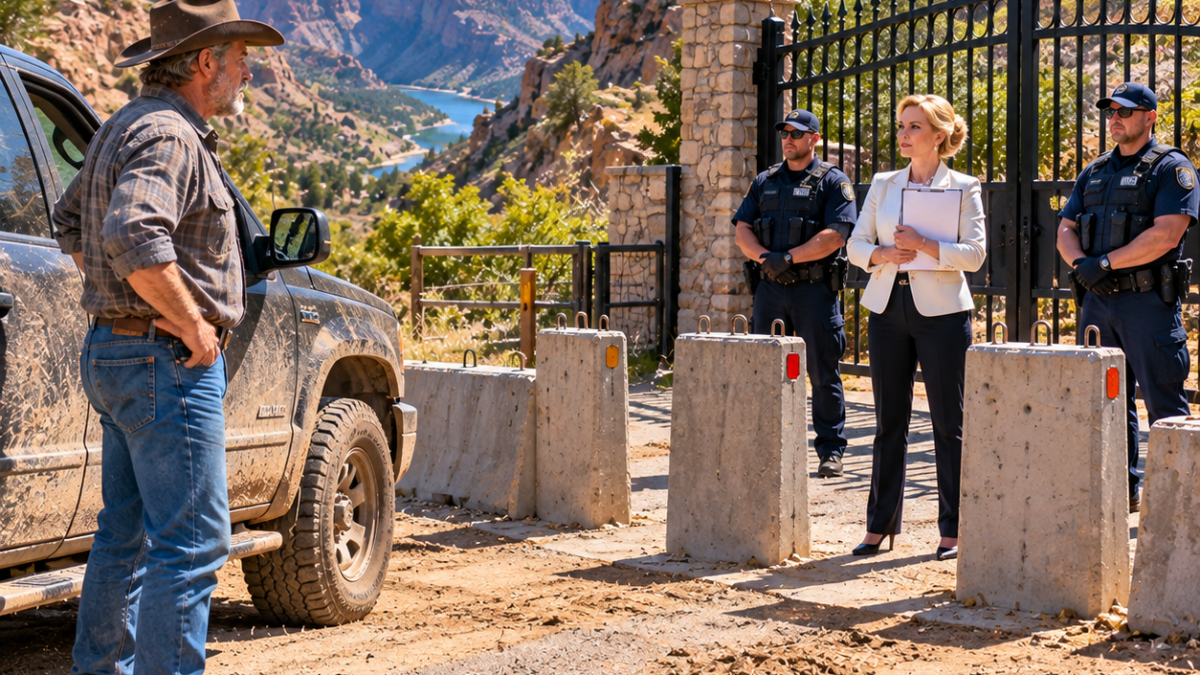
Tessa finished writing on her clipboard and walked directly to Jocelyn.
“This is an active obstruction of a designated emergency-access route.”
Jocelyn folded her arms.
“We dispute that designation.”
“You can dispute ownership in court. You cannot block emergency access while doing it.”
She handed Jocelyn a notice.
Seventy-two hours to remove everything.
Gate.
Blocks.
Posts.
Anything obstructing Raven Gap.
Jocelyn signed for the notice.
That signature mattered.
From that moment on, she could never honestly claim she did not know.
I assumed even Jocelyn would understand the danger.
I underestimated how badly she needed to prove she was in control.
That night, long after dark, I heard a heavy engine climbing Raven Gap.
I drove toward the sound.
A concrete truck was parked at the gate.
Jocelyn wasn’t removing anything.
She was reinforcing it.
By morning, two massive concrete barriers sat behind the steel panels.
New bollards had been sunk beside the road.
A security camera watched the entrance.
She had taken an illegal obstruction and turned it into a fortress.
Then she emailed every homeowner in Crestview Ridge.
Raven Gap, she wrote, belonged exclusively to the association.
Anyone attempting to interfere with the “security installation” could face prosecution.
One resident forwarded the email to me.
Attached was the same altered county map.
That concerned Laurel even more.
“She’s distributing this as official?”
“Yes.”
“If she knows it has been altered, Silas, this is no longer just an easement dispute.”
I wanted to drag the gate down with my tractor.
I could have done it.
Instead, I installed another camera on my side of the property.
Jocelyn wanted me angry.
She wanted footage of the rancher destroying the HOA’s expensive gate.
I wasn’t going to give it to her.
Tessa returned as the deadline approached.
Nothing had been removed.
Jocelyn met her at Raven Gap.
“Our attorney is reviewing the county’s position.”
“This order isn’t suspended because your lawyer dislikes it.”
“We believe this is private property.”
Tessa held up the notice.
“I’m telling you for the final time. Emergency access stays open.”
Jocelyn refused.
That evening, I stood near my pasture and saw dry lightning flickering west of Slate Creek.
No rain.
Just flashes.
The hills had been dry for weeks.
Anyone who lived around Black Pine long enough knew what that combination could mean.
By morning, a small wildfire had started near Slate Creek.
Only a few dozen acres.
Nothing dramatic yet.
Jocelyn actually used the fire to defend her gate.
According to homeowners who later spoke to investigators, she told residents the new security measures would stop outsiders from entering the neighborhood during an emergency.
Tessa sent another warning.
Keep every fire lane clear.
Jocelyn ignored that one too.
I drove Raven Gap that afternoon.
The road was good.
Wide.
Clear.
Strong enough for engines and bulldozer transports.
There was exactly one problem along the entire route.
Jocelyn’s blockade.
Late that afternoon, the wind changed.
The smoke column over Slate Creek doubled.
Then doubled again.
By sunset, orange light stained the western sky.
Mason Roark, the county wildland commander, was studying access routes.
Crestview Ridge had two.
The north entrance was the normal one.
Raven Gap was the backup.
That redundancy was why the neighborhood had been allowed to grow.
But the north road passed through timber and a narrow drainage.
If the fire crossed that drainage, Raven Gap would become the only safe way in.
Homeowners began asking Jocelyn to open the gate.
She refused.
“Fire crews can call us if they need access.”
One man asked her what happened if they didn’t have time.
Her answer was simple.
“They’ll have time.”
That night, the fire crossed a containment line.
My phone lit up with an evacuation-preparation alert.
I walked outside.
The ridge was glowing.
I drove straight to Raven Gap.
The concrete blocks sat exactly where she had put them.
Through my scanner, I heard a transmission.
North access may be compromised.
Prepare Raven Gap as alternate corridor.
I stared at the gate.
For the first time, this wasn’t about deeds.
Or arrogance.
Or HOA politics.
People’s homes were sitting behind that steel.
By morning, a power line had come down near the north road.
Smoke filled the drainage and visibility collapsed.
Mason redirected engines.
Water tenders.
A bulldozer transport.
All toward Raven Gap.
I opened every gate on my ranch.
Moved equipment away from the shoulders.
Dragged a trailer out of the corridor.
On my side, Raven Gap was completely clear.
At the other end, Jocelyn stood beside her locked gate.
Tessa called her.
I learned later exactly what was said.
“Open Raven Gap now.”
“I need our attorney to confirm liability.”
“This is not a negotiation.”
“I cannot authorize destruction of association property.”
“Jocelyn, unlock the gate.”
She still refused.
Then the sirens reached us.
The first wildland engine came around the bend, throwing dust behind it.
Another followed.
Then another.
Behind them came the bulldozer transport.
I stood off the roadway.
Jocelyn stepped into the center.
Raised her hand.
And made the lead engine stop.
Mason climbed out.
Smoke churned above the ridge behind him.
Jocelyn pointed at the sign.
“Private property.”
Mason held up his incident map.
“Emergency fire route.”
“The HOA owns this road.”
“I don’t care who owns the dirt.”
“You need authorization.”
“I have an active wildfire moving toward your neighborhood.”
“You cannot damage association property without a permit.”
Mason stared at her.
His radio crackled.
Fire had jumped another drainage.
Wind was driving it toward Crestview Ridge.
His entire expression changed.
Not anger.
Decision.
“Unlock the gate.”
“No.”
Mason turned toward his crew.
“Clear it.”
For one second, Jocelyn seemed genuinely confused.
As if she expected them to keep arguing until her lawyer arrived.
Then the bulldozer engine roared.
She screamed.
“You’re destroying HOA property!”
Nobody stopped.
The gate had been reinforced so heavily that cutting the chain wasn’t enough.
The panels were anchored to steel posts.
Concrete blocks sat behind them.
Bollards narrowed the road.
This had not been built to stop a teenager on an ATV.
It had been engineered to stop vehicles.
Including fire vehicles.
The bulldozer shoved the first block aside.
An engine pulled the gate frame free.
Metal folded.
Bolts snapped.
The white PRIVATE ACCESS sign flipped face-first into the dirt.
Then crews found two additional planters farther in.
The bulldozer cleared those too.
Jocelyn stood with her phone raised, filming everything.
“I have witnesses!”
Mason didn’t even look back.
“Move the convoy.”
Engines rolled through.
Then tenders.
Then the bulldozer transport.
They crossed my ranch and climbed toward the southern ridge.
Minutes mattered now.
And Raven Gap gave them those minutes.
Tessa arrived while Jocelyn was still standing beside the wreckage.
Jocelyn turned on her immediately.
“You’re going to pay for every dollar of this.”
Tessa pulled a document from her vehicle.
“Did you receive this order?”
Jocelyn stopped.
It was the removal notice.
The one she had personally signed.
Tessa pointed to the signature.
“Is that yours?”
Jocelyn said nothing.
Above us, engines were already positioning along the ridge.
Several hours later, the fire front swept through the western hillside.
A few outbuildings were damaged.
But crews had established a defensive line before the flames reached most of Crestview Ridge.
There were no fatalities.
No injuries.
The neighborhood remained standing.
Jocelyn had promised everyone there would be time.
There hadn’t been.
There had been minutes.
And she had spent some of them arguing over a gate.
After the immediate danger passed, the investigation began.
Jocelyn tried to control the story first.
She told residents the county had misunderstood legitimate HOA property rights.
She claimed emergency crews had destroyed the gate for convenience even though another route remained available.
Mason’s incident logs destroyed that argument.
The northern entrance had been compromised.
Raven Gap had become the viable emergency route.
Body-camera footage showed Jocelyn repeatedly refusing to open it.
Then Laurel returned to the altered map.
The county clerk produced another certified original.
We laid it beside Jocelyn’s version.
Same date.
Same seal.
Same parcels.
Same map.
One difference.
The emergency easement had disappeared from hers.
Then we found something worse.
Jocelyn had signed an affidavit for the HOA’s insurance broker certifying that every designated emergency route in Crestview Ridge remained unobstructed and fully compliant with county rules.
She signed it after installing the gate.
Financial records opened an entirely new problem.
Nearly $184,000 had been redirected from a reserve fund intended for vegetation clearing and wildfire mitigation.
Where did the money go?
Gate.
Concrete.
Bollards.
Security cameras.
Landscaping.
The very fund meant to reduce fire risk had financed the obstruction that blocked firefighters during a wildfire.
Most homeowners had never been told.
Then an internal board email surfaced.
One member had warned Jocelyn that county records still showed Raven Gap as an emergency-access easement.
Her written answer was devastating.
They would use the “updated version” instead.
And, according to her message, nobody was likely to challenge them during fire season.
That ended any credible claim that this was an innocent mistake.
She knew.
She built it anyway.
Laurel continued digging.
The HOA’s ownership claim collapsed next.
The original developer had transferred landscaping parcels and common areas to Crestview Ridge.
Raven Gap had never been among them.
The portion crossing my ranch still belonged to me, permanently subject to emergency access.
The corridor closer to Crestview Ridge was controlled through county emergency rights.
The HOA had limited landscaping responsibilities nearby.
That was all.
Jocelyn had taken permission to maintain landscaping and turned it into imaginary ownership of an entire road.
Residents called a special meeting.
This time, I attended.
Jocelyn stood at the front.
The room was packed.
A homeowner raised his hand.
“Why did we spend one hundred eighty-four thousand dollars from our fire fund on a security gate?”
Jocelyn tightened her jaw.
“The installation protected community property values.”
Another woman spoke.
“Why didn’t you tell us the fire marshal ordered you to remove it?”
“The county’s interpretation was disputed.”
I walked to the front carrying two maps.
I placed the certified original on the table.
Then Jocelyn’s version beside it.
People left their chairs to look.
The red emergency notation appeared clearly on one.
Nothing appeared on the other.
“You said this came from the county,” someone told her.
“It did.”
Tessa was standing along the wall.
“No,” she said. “It didn’t.”
The room went quiet.
Mason then confirmed that Jocelyn’s blockade had delayed emergency access during the fire.
A board member stood.
He looked miserable.
“There’s something else.”
Jocelyn turned.
He explained that she had specifically asked the board not to include the fire marshal’s warning in the information packet sent to homeowners.
She had said it might cause unnecessary alarm.
That was the moment the room turned against her.
Not because of me.
Not because of property law.
Because people finally understood she had known there was a safety problem and deliberately kept them from hearing about it.
A motion was made to remove her as HOA president pending investigation.
The vote passed overwhelmingly.
Jocelyn lost the position that night.
But that wasn’t the end.
The fire marshal forwarded the obstruction case.
The insurance company demanded records concerning the gate and Jocelyn’s compliance affidavit.
The HOA attorney notified the new board that the firm would not defend conduct undertaken knowingly in violation of an emergency-safety order.
Eventually, Jocelyn received a summons near the exact place where her gate had once stood.
She responded by trying to convince the association to sue the county.
And me.
The new board refused.
So she hired her own attorney.
At the hearing, Laurel did not need drama.
She needed dates.
Emergency easement recorded.
Crestview Ridge approved subject to that easement.
Then came Tessa’s removal order.
Jocelyn’s signature.
The reinforced blockade.
The wildfire.
Her refusal to open Raven Gap.
The body-camera footage.
The certified map.
Her altered copy.
And the email proving she knew the easement still appeared in county records.
Piece by piece, the story became impossible to explain away.
The judge ruled Raven Gap’s emergency easement permanent and enforceable.
The HOA had no authority to install gates, bollards, concrete barriers, or similar obstructions without county approval.
The remaining debris had to be removed.
The corridor had to be restored.
The association initially carried the restoration cost while retaining the ability to seek reimbursement from whoever was ultimately found personally responsible.
Meanwhile, the missing $184,000 remained under audit.
The insurer continued examining Jocelyn’s false compliance certification.
Reporters waited outside the hearing.
I didn’t stop.
I wasn’t interested in becoming part of the spectacle.
A few months earlier, Jocelyn had threatened to have me arrested for driving across a road that crossed my own ranch.
Now she no longer controlled the gate.
The HOA.
Or the story.
For a while, I considered installing another gate somewhere else on my property.
Not across Raven Gap.
Somewhere legal.
Somewhere that would make things less convenient for the neighborhood that had stayed mostly silent while Jocelyn pushed me around.
I had every right.
I never did it.
The people living in Crestview Ridge weren’t all Jocelyn.
And making ordinary residents pay for her decisions would have turned the whole thing into revenge.
Instead, I worked with Tessa, Mason, and the county.
Two permanent signs went up.
DESIGNATED EMERGENCY FIRE ACCESS.
NO BLOCKING — KEEP CLEAR AT ALL TIMES.
No HOA logo.
No private-property threat.
No ambiguity.
The new Crestview board adopted a rule requiring county review before anyone touched an emergency route again.
The fire-mitigation reserve was rebuilt.
Money went back toward brush clearance, vegetation management, and defensible space.
Where it belonged.
Jocelyn continued dealing with attorneys, insurance investigators, financial questions, and the consequences of a blockade she had repeatedly been ordered to remove.
But Raven Gap stayed open.
Months later, I was repairing fence near the road when Mason drove past.
He slowed his truck.
Looked down the clear corridor.
“No gate,” he said.
“No gate.”
He nodded.
“Looks better.”
I smiled.
“It was never really about the gate.”
Mason rested one arm against his window.
“I know.”
He had spent almost thirty years fighting wildfires.
He told me he had seen plenty of blocked roads.
Illegal fences.
Abandoned vehicles.
Locked ranch gates.
But never anything quite like Jocelyn standing in front of an approaching fire engine, insisting a laminated sign mattered more than the burning ridge behind her.
That image stayed with me too.
Not the hearing.
Not the money.
Not even the forged map.
The moment that stayed with me was watching steel come down while engines waited behind it.
Because Raven Gap had existed for decades for exactly one reason.
Someday, somebody might desperately need to get through.
Jocelyn spent $184,000 trying to prove she could decide who crossed that road.
When that day finally came, the fire crews needed only a few minutes to prove she never could.


