HOA Karen’s Son Parked His SUV in the Middle of My Lawn—Then He Saw Me Start the Tractor
HOA Karen’s Son Parked His SUV in the Middle of My Lawn—Then He Saw Me Start the Tractor
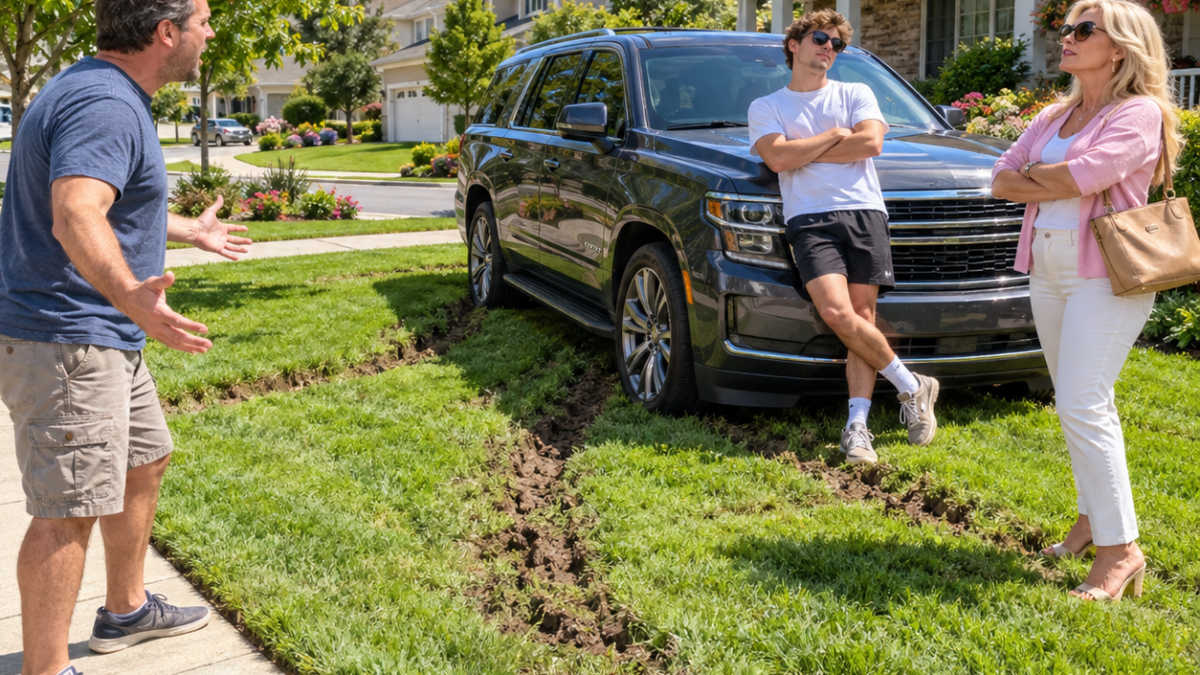
I walked outside and found the HOA president’s son leaning against a black SUV parked dead center in the lawn I had spent half of Friday repairing.
When I told him to move it, he laughed, looked straight at the tire ruts cutting through my grass, and said, “Relax, man—it’s just a yard,” like six months of harassment from his mother had finally given him permission to treat my property as theirs.
Ten minutes later, I turned the key on my grandfather’s old tractor, and the instant that diesel engine came alive, his smile disappeared.
My name is Daniel Mercer.
I had lived in Hawthorne Ridge for nine years, which was long enough to know that Saturday mornings usually belonged to lawn mowers, garage doors, barking dogs, and husbands pretending one trip to Home Depot would somehow be enough.
That particular Saturday had started unusually quiet.
I stood near the front window with a mug of coffee, enjoying sunlight across a lawn that, for once, looked exactly the way I wanted it.
I had spent nearly five hours on it the day before.
Mowing.
Edging.
Reseeding two thin patches.
Resetting stones around the flower bed.
Replacing a sprinkler head someone had driven over three weeks earlier.
I was not one of those guys who measured grass with a ruler.
I simply liked taking care of my home.
After my divorce, the house had become one of the few things in my life that felt completely mine.
I had rebuilt the porch myself.
Painted the fence.
Planted the maple near the driveway.
Restored the old red tractor my grandfather left me.
There was satisfaction in looking at something after a long week and knowing my own hands had made it better.
Unfortunately, HOA president Karen Whitmore seemed to consider that happiness a zoning violation.
For six months, she had found something wrong with almost everything I did.
My mailbox was “inconsistent with neighborhood character.”
My garden edging was half an inch too tall.
A flagstone path beside my garage had supposedly been installed without architectural approval even though it existed before Karen moved into the neighborhood.
I once received a warning because my garbage cans remained visible from the street until 7:08 p.m.
Pickup happened at 4:30.
The rule said they had to be removed “by evening.”
Apparently Karen had appointed herself astronomer too.
Individually, none of it was serious.
That was what made it exhausting.
Every letter was small enough that fighting it seemed ridiculous.
So I corrected things I should never have needed to correct.
Answered emails.
Attended hearings.
Showed photographs.
Paid one seventy-five-dollar fine just because I was too tired to spend another Thursday night arguing about whether my pickup trailer had been visible for twenty-seven minutes longer than allowed.
I kept telling myself the same thing.
It wasn’t worth a war.
What I failed to understand was that certain people do not interpret restraint as maturity.
They interpret it as permission.
I took another sip of coffee that Saturday morning and saw something through the front window.
A black Chevrolet Tahoe.
At first, my brain placed it on the street.
Then I realized the perspective was wrong.
The SUV was not beside my lawn.
It was on it.
Not one wheel.
Not half a tire.
The entire vehicle sat at least twenty feet inside my property.
Fresh tracks curved from the road, crossed the sidewalk, and cut straight through the grass I had repaired the previous afternoon.
I lowered my coffee.
Then I saw the driver.
Brandon Whitmore.
Karen’s twenty-six-year-old son.
He was leaning against the open driver’s door staring at his phone.
He lived with Karen despite regularly describing himself on social media as an “entrepreneur.”
As far as I could tell, his primary businesses were expensive sneakers, gym selfies, and driving the Tahoe his parents had apparently purchased for him.
I put my mug down.
By the time I opened the front door, he was looking toward me.
He did not move.
Did not wave.
Did not apologize.
I walked down the porch steps.
The damage looked worse outside.
Deep tire marks.
Crushed grass.
One wheel had crossed the edge of the flower bed.
“Brandon.”
He slipped his phone into his pocket.
“Morning.”
“What exactly are you doing?”
“Waiting for somebody.”
“In my yard?”
He glanced around as though he had only just discovered grass beneath his tires.
“Yeah.”
“Move it.”
His mouth curled into a smile.
“Relax.”
“I am relaxed. Move your SUV.”
“It’s just grass.”
That sentence did it.
Not because of the grass.
Because of everything behind it.
Six months of notices.
Karen photographing my house.
Board members appearing at my door.
Brandon laughing whenever his mother talked about “problem properties.”
Every small insult designed to make me either surrender or explode.
I looked at the Tahoe.
Then at Brandon.
Then beyond him toward the detached garage.
Inside sat my grandfather’s 1974 Ford tractor.
I nodded once.
“Okay.”
Brandon looked almost disappointed.
I turned around and walked away.
He called after me.
“See? Was that so hard?”
I did not answer.
I entered the garage.
Opened the fuel valve.
Climbed into the cracked vinyl seat.
And turned the key.
The old diesel engine coughed twice.
Then it roared awake.
Through the open garage door, I saw Brandon slowly straighten.
For the first time that morning, he stopped smiling.
[END OF FACEBOOK OPENING — STOP HERE FOR PART 1]
The tractor had belonged to my grandfather, Henry Mercer.
He bought it used when my father was still a kid and somehow kept it running through forty years of neglect, improvised repairs, and parts that technically belonged on three different models.
When Grandpa died, everyone assumed I would sell it.
Instead, I hauled it home.
Restoring the thing took two years.
It still looked ugly.
Faded red paint.
Rust along the fenders.
A seat held together with black tape.
But the engine was strong, the hydraulics worked, and I had fitted a small front loader to it for landscaping.
Brandon watched me back out of the garage.
His confidence was trying to return.
He crossed his arms.
“You planning to mow around me?”
I stopped the tractor twenty feet from his Tahoe.
“No.”
He laughed.
“Then what?”
I lowered the bucket.
It scraped across the gravel beside my driveway.
Brandon’s smile weakened.
“What are you doing?”
“Working on my property.”
“With a tractor?”
“That’s usually what tractors are for.”
I turned toward the pile of landscaping stones stacked beside my garage.
They were not decorative pebbles.
Each stone weighed somewhere between six hundred and a thousand pounds.
I had bought them months earlier to rebuild the retaining edge along the side yard.
The project kept getting postponed.
Suddenly, my schedule had cleared.
I slid the bucket beneath the first stone.
Brandon finally stepped away from the Tahoe.
“Hey.”
I lifted it.
The tractor groaned.
“What are you doing with that?”
“Landscaping.”
I drove toward the front edge of my property.
Not toward the SUV.
I was angry.
I was not stupid.
I had no intention of touching his vehicle.
Instead, I placed the stone beside the curb where the tire tracks entered my yard.
Then I went back for another.
Brandon watched me.
“Daniel.”
I collected the second stone.
“Daniel!”
I set it several feet from the first.
The entrance he had created across my lawn was getting narrower.
His expression changed.
“Are you blocking me in?”
“No.”
“You are literally putting rocks behind my truck.”
“SUV.”
“What?”
“You keep calling it a truck.”
“Are you serious?”
“Very.”
He looked toward the street.
He still had room to leave.
Plenty.
If he moved now.
I climbed down from the tractor.
“You can drive out the same way you came in.”
He stared.
“Over your grass?”
“You didn’t seem concerned about that ten minutes ago.”
“I’m waiting for someone.”
“Then move to the street.”
“My mom said I could park here.”
There it was.
I tilted my head.
“Your mother told you that you could park on my lawn?”
“She said this strip is basically common frontage.”
“This strip?”
I pointed around us.
“My front yard?”
“She said the property boundary is disputed.”
“It isn’t.”
“She’s HOA president. I think she knows.”
I almost smiled.
Karen had finally made a mistake.
Not a small one.
A useful one.
“Did she tell you that in writing?”
Brandon’s face changed.
Only a little.
But enough.
“Why?”
“No reason.”
I took out my phone.
He immediately became defensive.
“Don’t record me.”
“You’re standing on my property.”
“You can’t just film people.”
“My security cameras have been filming you since you drove in.”
He turned toward the house.
There were two cameras.
One above the garage.
One near the front porch.
Both visible.
His jaw tightened.
“Whatever.”
“Move the Tahoe.”
“No.”
I waited.
He expected an argument.
I gave him silence.
Finally he said, “What?”
“Nothing.”
“You’re acting weird.”
“I asked you to move.”
“I said I’m waiting.”
“Then wait.”
I climbed back onto the tractor.
The third stone went near the maple tree.
The fourth beside the driveway.
I was not trapping him.
I was establishing a landscaped border along the section of lawn where he had entered.
Something I was legally allowed to do.
And something I had been planning anyway.
By the time I picked up the fifth stone, Brandon was on his phone.
I could not hear the conversation over the tractor.
I did not need to.
Eight minutes later, Karen Whitmore came marching down the sidewalk.
She wore leggings, a cream-colored vest, and sunglasses large enough to qualify as protective equipment.
She did not look at the tire ruts.
She did not look at the SUV.
She looked at the tractor.
“Turn that off!”
I lowered the engine speed.
“What?”
“Turn it off.”
“I can hear you.”
“You are threatening my son with heavy machinery.”
Brandon nodded behind her.
“Exactly.”
I stared at him.
“With landscaping rocks?”
Karen moved closer.
“You are deliberately intimidating him.”
“He parked in my yard.”
“This area is subject to HOA easement rights.”
“No, it isn’t.”
“You don’t understand the declaration.”
“I have a survey.”
“Surveys can be interpreted.”
I laughed.
That was new.
“Property pins are philosophical now?”
She pointed toward the tractor.
“Shut that machine down before somebody gets hurt.”
“Nobody’s near it.”
“You are behaving aggressively.”
I pulled out my phone again.
Karen immediately noticed.
“Stop recording.”
“I’m not.”
She looked suspicious.
I held up the screen.
“Calling the police.”
Her face changed.
“Why would you call the police?”
“Vehicle trespassing on private property.”
“This is an HOA matter.”
“The Tahoe isn’t owned by the HOA.”
“My son has permission.”
“From you.”
“As association president.”
“You cannot give somebody permission to park in my front yard.”
She smiled in that maddening little way she used during board meetings.
“That is your interpretation.”
“No, Karen. That is ownership.”
She folded her arms.
“You’ve been hostile from the moment I asked you to follow the same standards everyone else follows.”
“That’s not what we’re discussing.”
“It absolutely is.”
“Your son drove across a sidewalk and parked twenty feet into my property.”
“He was told this frontage was available during today’s pool event.”
I looked at Brandon.
Pool event.
Now things made sense.
The community pool was two streets over.
Every summer, the HOA organized a large opening-weekend gathering.
Parking always became a mess.
Normally, overflow cars lined Oak Avenue.
But construction had closed half that street.
Karen needed parking.
Apparently, my yard had become Plan B.
“How many cars?”
“What?”
“How many people did you tell could park here?”
Karen did not answer.
I looked at Brandon.
His face gave me the answer before his mouth did.
“Oh, you have got to be kidding me.”
Karen lifted her chin.
“It would only have been for several hours.”
“You planned to use my lawn as overflow parking?”
“This section is underutilized.”
“Because it’s my front yard.”
“You have more lawn than you need.”
I actually had to process that sentence.
“What?”
Karen gestured toward the property.
“Your lot is significantly larger than most homes in Hawthorne Ridge.”
“And?”
“The community has temporary needs.”
“So your solution was to take mine.”
“Nobody is taking anything.”
“You sent your son onto my property.”
“We intended to discuss temporary access.”
“When?”
“Today.”
“After he parked here?”
“You’re being deliberately difficult.”
I smiled.
“No, Karen. I’m finally being precise.”
The police cruiser arrived eleven minutes later.
Officer Nicole Alvarez stepped out.
I knew her only by sight.
She had responded once when teenagers smashed mailboxes farther down the street.
Karen immediately approached her.
“Officer, thank goodness. He is threatening my son with a tractor.”
Alvarez looked at the tractor.
Then at me.
Then at the Tahoe.
Then at the lawn.
“Who owns the SUV?”
“My son.”
“Who owns the property?”
Karen hesitated.
Alvarez looked at me.
“I do.”
“Do you have proof?”
“Deed and survey inside.”
“Get them.”
Karen interrupted.
“This land is subject to HOA community-use authority.”
Alvarez gave her a neutral look.
“Do you have documentation?”
Karen opened her mouth.
Then closed it.
“I’m the association president.”
“That wasn’t what I asked.”
I liked Officer Alvarez immediately.
I returned with the survey and deed.
The survey pins matched the map.
My property extended all the way to the sidewalk.
No parking easement.
No common frontage.
No community-use strip.
Alvarez walked toward Brandon.
“Sir, the homeowner wants your vehicle removed.”
Brandon glanced at Karen.
She said, “We’re disputing the boundary.”
Alvarez looked back at the survey.
“You can dispute it later. Right now, you need to move the vehicle.”
Brandon’s face reddened.
“This is ridiculous.”
“Move it.”
“I wasn’t doing anything.”
“You are parked on somebody else’s lawn.”
“My mom said—”
“Your mother doesn’t own the lawn.”
He looked at Karen.
That sentence landed harder than anything I could have said.
Karen stepped forward.
“We need to speak with your supervisor.”
“You’re welcome to call.”
“This officer clearly doesn’t understand HOA authority.”
Alvarez remained calm.
“Ma’am, if you have a court order or recorded easement allowing vehicles on this parcel, show me.”
“I don’t carry association records around.”
“Then your son should move the SUV.”
Brandon finally climbed in.
He started the engine.
Then he realized the route he had used to enter was now bordered by several large rocks.
He rolled down the window.
“You blocked me.”
“No.”
“You put rocks there!”
“You still have twelve feet.”
“It’s tight.”
The Tahoe was just over six feet wide.
There was plenty of room.
He simply did not want to admit he was nervous about driving through the gap.
Officer Alvarez looked at it.
“You can get through.”
Brandon stared at me.
“Move the rocks.”
“No.”
Karen snapped.
“Daniel, move them.”
I shook my head.
“They’re landscaping.”
“You put them there five minutes ago.”
“Perfect time to start.”
Brandon reversed.
Then moved forward.
Stopped.
Adjusted.
Reversed again.
A group of neighbors had begun watching.
Nothing attracts suburban attention faster than a police cruiser and a tractor.
Brandon’s face grew redder each time he repositioned.
Finally he made it through.
He drove onto the street.
The moment all four tires reached asphalt, I said, “Stop.”
He ignored me.
Officer Alvarez raised a hand.
“Sir.”
He stopped.
I pointed toward the lawn.
“You damaged the sprinkler.”
He looked out the window.
“Seriously?”
“Yes.”
“It’s grass.”
“Drive away.”
He did.
Karen stayed.
“This isn’t finished.”
“Good.”
That surprised her.
“Excuse me?”
“I said good.”
I looked at Officer Alvarez.
“Can I get an incident number?”
“Absolutely.”
Karen’s expression shifted.
“What for?”
“Documentation.”
“For grass?”
I looked at her.
“For the plan to use my private property as HOA overflow parking without permission.”
Her face tightened.
“You cannot prove that.”
I turned toward my front porch.
The security camera microphone had captured almost the entire conversation.
Including her statement.
The community has temporary needs.
We intended to discuss temporary access.
I looked back at her.
“I think I can.”
She left without another word.
Officer Alvarez stayed while I photographed the damage.
Six long tire tracks.
A broken sprinkler head.
One crushed section of flower bed.
Nothing catastrophic.
Maybe eight hundred dollars if I hired everything out.
Probably half that if I repaired it myself.
But the dollar amount was not the important part anymore.
The important part was intent.
For months, Karen had treated HOA authority like a magic wand.
Send a letter.
Invent an interpretation.
Call something common area.
Call something noncompliant.
People usually gave in because nobody wanted a neighborhood dispute over seventy-five dollars.
That Saturday, however, she had moved beyond letters.
She had sent a vehicle onto my land.
And admitted she intended to send more.
I called my attorney Monday morning.
His name was Samuel Ortiz.
Sam had handled my divorce and once told me that neighborhood disputes were more emotionally dangerous than divorces because “at least ex-spouses eventually stop sharing a mailbox cluster.”
I sent him the video.
The survey.
The police incident report.
Photographs.
Copies of my last six months of HOA notices.
He called twenty minutes later.
“Daniel.”
“Yeah?”
“Please tell me you did not touch the Tahoe with the tractor.”
“I didn’t.”
“Did you threaten to?”
“No.”
“Did you block it so completely that he couldn’t leave?”
“No.”
“Excellent.”
“You sound disappointed.”
“I’m an attorney. Responsible clients are less entertaining.”
“What about Karen?”
“Karen is entertaining.”
“Legally?”
“Potentially.”
He paused.
“Send me the HOA declaration.”
I did.
Two hours later, he called again.
“Interesting.”
“What?”
“The frontage argument is nonsense.”
“I know.”
“The HOA has a five-foot utility easement along portions of the neighborhood.”
“My yard?”
“Near your side boundary. Not where the Tahoe parked.”
“So she lied.”
“She may claim she misunderstood.”
“She’s been president eleven years.”
“Then misunderstanding becomes less persuasive.”
I leaned back.
“What do we do?”
“First, demand reimbursement for the property damage.”
“That’s it?”
“First.”
Sam sent the letter.
Repair estimate: $1,240.
Sprinkler.
Sod.
Flower bed.
Survey confirmation.
Attorney’s administrative cost.
He also demanded written confirmation that neither the HOA nor its officers would authorize vehicles onto my parcel again.
Karen responded herself.
Not through counsel.
That was mistake number two.
Her email said:
The Association rejects Mr. Mercer’s exaggerated claims and maintains that the disputed frontage has historically been available for temporary community access.
Sam called me.
“Historically?”
“That’s what she wrote.”
“Daniel, do you know what this means?”
“She’s annoying?”
“It means she has just transformed a single trespass incident into a claim of ongoing HOA rights over your property.”
“That sounds bad.”
“For her, yes.”
“Why?”
“Because now we can formally demand the evidence supporting the claim.”
And we did.
Recorded easement.
Board resolution.
Historical agreements.
Maps.
Meeting minutes.
Maintenance records.
Anything demonstrating the HOA had ever possessed parking rights on my lawn.
They produced nothing.
Instead, Karen sent another notice.
This one accused my landscaping stones of violating sightline standards.
Fine: $300.
I called Sam.
“She fined my rocks.”
“I see that.”
“They are twelve feet from the intersection.”
“I see that too.”
“The rule says six.”
“I see that too.”
“So?”
“So we appeal.”
“Can’t we just tell her she’s wrong?”
“We can.”
“And?”
“She’ll deny it.”
“You sound happy.”
“I enjoy predictable opponents.”
The appeal hearing happened Thursday evening.
Three board members sat at a folding table in the clubhouse.
Karen in the center.
Treasurer Robert Mills on her right.
Secretary Elaine Foster on her left.
Karen read the violation.
I placed the survey and photographs on the table.
“The stones comply.”
Karen barely looked at them.
“They create an unwelcoming appearance.”
“That isn’t the rule.”
“The board interprets the rule.”
Robert picked up the photograph.
“How far from the road are these?”
“Twelve feet.”
Karen interrupted.
“That isn’t relevant.”
“It’s literally the measurement requirement,” Robert said.
I watched him.
Interesting.
Elaine read the bylaw.
“Six feet minimum.”
Karen looked irritated.
“The intent is broader than the numerical standard.”
Robert leaned back.
“Then why have a number?”
Silence.
It was the first time I had seen another board member openly question her.
The fine was dismissed two to one.
Karen voted to keep it.
Outside, Robert caught up with me.
“Daniel.”
I stopped.
“I’m sorry about Saturday.”
“You weren’t there.”
“I’m on the board.”
“You didn’t send Brandon.”
“No.”
He hesitated.
“I also didn’t know she had authorized overflow parking on your property.”
I turned fully toward him.
“What?”
His face changed.
“You didn’t know?”
“I knew she wanted extra parking. I did not know she’d selected your yard.”
“Was there a board vote?”
“No.”
“A discussion?”
“Not that I attended.”
“Did she tell anybody she had rights over my frontage?”
“Not until after Saturday.”
I stared at him.
“Robert, she told a police officer the HOA had community-use authority.”
He rubbed his forehead.
“I know.”
“Where did she get that?”
“I honestly don’t know.”
That was the moment this stopped being a personal feud.
If Karen was inventing authority without board approval, then every fine and enforcement action deserved another look.
“Robert.”
“Yeah?”
“How many things does she approve without you?”
His eyes met mine.
Too long.
That was answer enough.
Over the next month, Hawthorne Ridge changed.
Not visibly.
The lawns remained cut.
The pool stayed open.
Kids rode bicycles.
But beneath the normal surface, residents started asking questions.
It began with Robert.
Then Elaine.
Then a neighbor named Marissa Cole, who had paid a $425 landscaping fine the year before.
Then Mr. Jenkins, who had been forced to remove a small shed Karen claimed violated setback rules.
He later discovered three nearly identical sheds on properties belonging to Karen’s friends.
People compared letters.
Dates.
Fine amounts.
Appeal outcomes.
Patterns appeared.
Homeowners who challenged Karen received more inspections.
People who supported her rarely received any.
The HOA’s towing contractor belonged to Karen’s brother-in-law.
That was interesting.
The landscaping company handling common areas belonged to a business partner of Karen’s husband.
More interesting.
Neither relationship had been disclosed in board minutes.
Sam became very interested.
“Conflict of interest doesn’t automatically mean fraud,” he warned.
“But?”
“But undocumented related-party contracts deserve sunlight.”
Robert called a special records review.
Karen opposed it.
She lost the vote.
Three to two.
That was the first time anyone could remember her losing a board vote.
She did not handle it well.
Two days later, I received four violations.
Trash can visibility.
Unauthorized trailer.
Commercial vehicle.
Lawn discoloration.
The lawn discoloration was caused by her son’s Tahoe.
I framed that one.
Then I appealed all four.
At the hearing, I brought photographs.
My trash cans were inside the garage.
The trailer belonged to my brother and had been there for forty minutes while we unloaded lumber.
My pickup was registered personally, not commercially.
The lawn discoloration matched the police report documenting Brandon’s trespass.
Elaine stared at the last violation.
“Karen, seriously?”
Karen’s face went cold.
“The homeowner remains responsible for property condition regardless of cause.”
Robert almost laughed.
“You’re fining him for damage your son caused?”
“My son did not cause—”
I placed the police report on the table.
“He admitted he drove onto the lawn.”
Karen pushed it away.
“This board is not bound by police interpretation.”
Robert said, “We’re bound by reality.”
The room went silent.
All four fines were dismissed.
Karen walked out before the meeting formally ended.
That night, somebody drove past my house four times.
White Lexus.
Karen’s car.
My cameras recorded each pass.
Two nights later, she stopped in front of my property and photographed the tractor.
Then the stones.
Then my truck.
Then the house.
Sam told me not to confront her.
“Let the camera work.”
“I’m getting tired of letting cameras have all the fun.”
“That is why I’m the lawyer.”
The independent financial review began in July.
A CPA named Denise Wallace examined three years of HOA expenses.
The findings were not spectacular enough for television.
They were worse in a more ordinary way.
The HOA had paid above-market rates to vendors connected to Karen.
Board approval was missing on multiple contracts.
Some fines had been transferred into a discretionary “community enhancement” account controlled almost entirely by the president.
Receipts were incomplete.
Several thousand dollars had been spent on “resident compliance administration” without clear supporting documentation.
Then Denise found reimbursements.
Gas.
Meals.
Printing.
Mileage.
Personal phone expenses.
Karen had been treating HOA management like a private expense account.
Not millions.
But enough.
Enough that homeowners who had been fined for trivial things started getting angry.
Enough that board members realized they had not been supervising the president.
Enough that Karen’s reputation as the person “protecting property values” began to crack.
Then Brandon made his second mistake.
He came back to my property.
This time at night.
My camera alert woke me at 1:38 a.m.
Motion near the driveway.
I opened the feed.
Brandon stood beside one of the landscaping stones.
Another man was with him.
A pickup waited at the curb.
I watched them attach a chain around the largest stone.
For a few seconds, I genuinely could not believe what I was seeing.
They intended to move it.
Maybe steal it.
Maybe drag it into the road and create a safety complaint.
I called the police.
Then I stayed inside.
That part was hard.
Everything in me wanted to walk outside.
Instead, I watched.
Brandon connected the chain to the pickup.
The driver eased forward.
The chain tightened.
The stone moved maybe three inches.
Then the police arrived.
Two cruisers.
Blue lights flooded my yard.
Brandon froze.
The driver tried to unhook the chain.
Too late.
Officer Alvarez stepped out of the first cruiser.
I almost felt sorry for Brandon.
Almost.
She recognized him immediately.
“You again.”
He started explaining.
Apparently, they believed the stone was in a public right-of-way.
At one thirty-eight in the morning.
With a chain.
After the HOA had lost a formal appeal confirming the stone complied.
Officer Alvarez looked at me.
“Do you want to press charges?”
Brandon stared.
This was the moment he expected me to back down.
Again.
I thought about Saturday morning.
“It’s just grass.”
I thought about the broken sprinkler.
Karen’s false authority claim.
The retaliatory violations.
Then I looked at the stone.
Three inches from where I had placed it.
“Yes.”
Brandon’s expression changed.
“Come on, Daniel.”
I said nothing.
“My mom will fix it.”
That sentence was exactly why I said yes.
He had spent too long believing consequences were something his mother could cancel.
The charges were relatively minor.
Trespass.
Attempted property damage.
The driver received citations too.
But the arrest report mattered.
Especially because investigators later learned Karen had texted Brandon earlier that evening.
The message did not explicitly tell him to move the stones.
It said:
Those ridiculous rocks are why everyone is upset. If they disappeared, half this nonsense would go away.
Brandon replied:
I’ll handle it.
Karen claimed that was not an instruction.
Maybe it was not.
But it did not help her.
By August, enough homeowners signed a petition for a recall meeting.
Karen called the effort a “hostile takeover.”
She sent a four-page letter claiming a small group of disgruntled residents were attempting to destroy community standards.
She mentioned me fourteen times.
Sam counted.
“Congratulations.”
“For what?”
“You’re apparently the mastermind.”
“My greatest accomplishment was buying landscaping rocks.”
“History turns on small hinges.”
The recall meeting filled the clubhouse.
More than a hundred homeowners attended.
Karen sat at the front beside her attorney.
For once, she did not control the microphone.
Robert presented the financial review.
Denise explained the undisclosed vendor relationships.
Elaine showed correspondence demonstrating several policies had been implemented without proper board votes.
Marissa described her landscaping fine.
Mr. Jenkins described his shed.
A retired couple named the Parkers described being threatened with legal action over a wheelchair ramp that had already been approved by the city.
Then my turn came.
I had not planned to speak.
Sam suggested I should.
“Keep it factual.”
“I’m always factual.”
He stared at me.
“Keep it boring.”
That was harder.
I stood.
“My issue started with a vehicle.”
Karen rolled her eyes.
I continued.
“On May eighteenth, Brandon Whitmore drove his Tahoe across the sidewalk and parked approximately twenty feet inside my front lawn.”
I displayed the security image.
The room murmured.
“I asked him to move.”
Then I played the audio.
Brandon’s voice:
Relax. It’s just grass.
A few people laughed.
Karen did not.
I showed the tire tracks.
Police report.
Repair estimate.
Then Karen’s own recorded statement:
The community has temporary needs. We intended to discuss temporary access.
I stopped the recording.
“That matters because there was no HOA easement.”
I displayed the survey.
“No board vote.”
Robert nodded.
“No permission from me.”
I looked around the room.
“The issue was never grass.”
The room became quiet.
“It was the idea that if somebody has enough authority, they don’t need permission.”
Karen shifted in her chair.
I continued.
“My property damage was small. I repaired it. The larger problem was what happened afterward.”
I displayed the retaliatory violations.
The rocks.
The trailer.
The trash cans.
The lawn damage Brandon caused.
A woman in the back actually said, “Wow.”
“I’m not asking anybody to vote against Karen because I dislike her.”
Karen laughed sharply.
I looked at her.
“I’m asking you to look at records and decide whether this is how you want your association governed.”
Then I sat down.
No speech about revenge.
No applause line.
No tractor story.
Just evidence.
The vote happened by secret ballot.
Karen lost.
Seventy-six percent voted for removal.
She remained seated when the result was announced.
For several seconds, nobody moved.
Then she stood.
“This association will regret this.”
Nobody answered.
She looked at Robert.
“You encouraged them.”
He shook his head.
“You did.”
Then she looked at me.
I knew that look.
I had been seeing versions of it for months.
“You’re satisfied?”
“No.”
That surprised her.
“I’ll be satisfied when the board stops treating homeowners like subjects.”
“You think you won.”
“No.”
I glanced around the clubhouse.
“I think you lost.”
There was a difference.
Robert became interim president.
His first action was freezing all pending violations until they could be reviewed.
His second was hiring independent HOA counsel.
His third was publishing every contract.
The towing contract with Karen’s brother-in-law was canceled after competitive bids showed Hawthorne Ridge had been paying nearly thirty percent above market rates.
The landscaping contract was rebid too.
Annual costs dropped.
HOA dues did not need to rise the following year.
That fact did more to destroy Karen’s remaining support than anything I could have said.
Money has a way of clarifying philosophy.
Brandon’s case ended with restitution, community service, and an agreement to stay off my property.
The lawn repairs were paid.
The sprinkler was paid.
Even Sam’s fees associated with the property claim were largely covered through settlement.
I never got the dramatic courtroom scene neighbors expected.
Real life rarely gives you one.
Mostly there were emails.
Forms.
Negotiations.
Signatures.
Checks.
But sometimes quiet consequences are better.
Karen continued living three houses away.
That was awkward.
For the first month after the recall, she did not look at me.
Then one afternoon in October, I was changing the oil on the tractor when she stopped on the sidewalk.
“Daniel.”
I turned.
“Karen.”
Her expression was tired.
Not angry.
Tired.
“Was it worth it?”
“What?”
“All of this.”
I wiped my hands.
“You’ll have to be more specific.”
“The lawyers. Meetings. Financial review. Turning the neighborhood against each other.”
“I didn’t award those contracts.”
“You started digging.”
“After your son parked on my lawn.”
“There it is again.”
“What?”
“That lawn.”
She shook her head.
“You never let anything go.”
That almost made me laugh.
“Karen, your son drove an SUV into my yard because you told him you had authority over my land.”
“I told him the frontage was disputed.”
“It wasn’t.”
“You knew what I meant.”
“No. I really didn’t.”
She folded her arms.
“You could have asked him to move without bringing out that ridiculous tractor.”
“I did ask.”
“You were trying to scare him.”
“I moved landscaping stones on my property.”
“You enjoyed it.”
I thought about lying.
Then decided not to.
“Yes.”
Her eyes narrowed.
“I enjoyed watching him realize I wasn’t going to keep letting your family treat my property like yours.”
At least that was true.
She looked toward the tractor.
“Henry would have hated this.”
That stopped me.
“You knew my grandfather?”
“Everyone knew Henry.”
Grandpa had lived nearby before I inherited the tractor.
Karen’s family had been in the area almost as long.
“He believed in neighbors helping each other,” she said.
“He also believed people should ask before borrowing tools.”
“That is not the same.”
“It’s exactly the same.”
She shook her head.
“You’re impossible.”
“Probably.”
For some reason, that made her smile.
Barely.
Then it vanished.
“I didn’t tell Brandon to go back for the stones.”
“I know.”
“You believe me?”
“I believe you told him you wanted them gone.”
Her face tightened.
“That’s different.”
“It is.”
She seemed surprised by the concession.
I continued.
“But that was always the problem.”
“What?”
“You said things and expected everyone else to understand where the line was.”
She said nothing.
“You told homeowners to comply, but sometimes the rule didn’t exist.”
“You told Brandon the frontage was disputed, and he heard that he could park there.”
“You complained about the rocks, and he heard that he should move them.”
“You treated your opinion like authority for so long that people around you stopped hearing the difference.”
For once, Karen had no immediate response.
She looked down the street.
“I was trying to protect the neighborhood.”
“I believe you thought that.”
She turned back.
“That sounds condescending.”
“It isn’t.”
“What does that mean?”
“It means intentions don’t erase what you do.”
She stared at me.
Then nodded once.
Not agreement.
Maybe acknowledgment.
She walked away.
That was the longest conversation we ever had after the recall.
Winter came.
My grass went dormant.
Which was a relief because nobody could complain about discoloration.
The new board created a simple enforcement policy.
Written complaint.
Photographic evidence.
Citation to an actual rule.
Opportunity to respond.
Board review before fines above one hundred dollars.
Conflict disclosures.
No president could unilaterally authorize towing except in genuine safety emergencies.
People complained the new system was slower.
Robert considered that a feature.
“If we can’t wait forty-eight hours before fining someone over a flower pot, we have bigger problems.”
I liked Robert.
The following spring, the lawn recovered.
The damaged flower bed returned.
I finished the stone border.
All seven boulders.
Perfectly spaced.
Legal.
Surveyed.
Karen never complained again.
One Saturday in April, I was using the tractor to move mulch when a silver SUV stopped at the curb.
For half a second, my shoulders tightened.
Old instinct.
Then the window rolled down.
Brandon.
He looked different.
Shorter hair.
No sunglasses.
The black Tahoe was gone.
He drove an older Honda Pilot.
“Daniel.”
I left the tractor idling.
“What?”
He glanced toward the lawn.
Then at me.
“I’m not coming onto the property.”
“Good start.”
He gave a small laugh.
“I wanted to say something.”
I waited.
“My mom told me to leave it alone.”
“Probably smart.”
“I know.”
He looked uncomfortable.
Good.
“I was an ass.”
I said nothing.
“The parking thing.”
“Which one?”
He looked at me.
“Okay. Fair.”
He rubbed his hands against the steering wheel.
“I thought because she was president she could basically decide things.”
“So did she.”
“I shouldn’t have parked there.”
“No.”
“And I definitely shouldn’t have come back for the rocks.”
“No.”
He nodded.
“I paid for everything.”
“I know.”
“My attorney says the restitution is complete.”
“It is.”
“So…”
He hesitated.
“I’m sorry.”
There were times in my life when I imagined apologies would feel larger.
More satisfying.
Like a movie ending.
Mostly they feel quiet.
“Thank you.”
He looked surprised.
“That’s it?”
“What were you expecting?”
“I don’t know.”
“A tractor chase?”
He laughed.
“No.”
“Then we’re good.”
He started to drive away.
Then stopped.
“Daniel?”
“Yeah?”
“When you started that tractor…”
I raised an eyebrow.
“I seriously thought you were going to push the Tahoe into the street.”
I laughed.
“I’m not insane.”
“I didn’t know that.”
“That says more about your family’s imagination than mine.”
He nodded.
“Probably.”
Then he left.
I watched him disappear around the corner.
And that should have been the end of the tractor story.
Except neighborhoods love stories more than facts.
Within a year, new residents had heard five different versions.
In one, I supposedly lifted Brandon’s entire Tahoe with the tractor bucket.
Impossible.
In another, I pushed it into a pond.
There is no pond.
My favorite version claimed I surrounded the SUV with concrete blocks and charged him fifty dollars per block to remove them.
Creative.
False.
A teenager once asked if I really threatened Karen with the tractor.
“No.”
“My dad said you did.”
“Your dad wasn’t there.”
“He says everybody knows.”
“Everybody is wrong.”
The kid looked disappointed.
“What actually happened?”
“I landscaped.”
“That’s boring.”
“Most effective revenge is.”
He stared at me.
“That sounded cool.”
“I know.”
Karen eventually sold her house.
Not because of me.
At least, not directly.
Her husband retired and wanted to move closer to their daughter in North Carolina.
The FOR SALE sign appeared in August.
She lived there another six weeks.
On moving day, I was outside repairing a hydraulic hose on the tractor.
Of course I was.
Some things are too perfectly timed to plan.
Karen walked over.
For the first time, she stepped onto my property only after saying:
“Can I come over?”
I almost looked around for hidden cameras.
“Sure.”
She approached the tractor.
“You’re keeping this forever, aren’t you?”
“That’s the plan.”
“It’s ugly.”
“That’s why I like it.”
She touched one faded fender.
“Your grandfather really owned this?”
“Forty years.”
“I remember him driving it down Oak Road.”
“That was probably illegal.”
“He didn’t care.”
“He cared. He just knew which rules were stupid.”
She looked at me.
“Sounds familiar.”
“That might be the nicest thing you’ve ever said to me.”
“Don’t get sentimental.”
We stood quietly.
Then she looked toward the stone border.
“I hated those rocks.”
“I know.”
“I still do.”
“They’ve handled the criticism well.”
That got a laugh.
A real one.
Then Karen became serious.
“I made mistakes.”
I did not rescue her from the sentence.
She continued.
“I got used to people expecting me to solve things.”
“Okay.”
“And after a while, I stopped asking whether I was actually supposed to solve them.”
That was the closest she ever came to explaining herself.
“The HOA was chaotic before I became president.”
“I believe that.”
“People wanted rules.”
“Rules weren’t the problem.”
“I know.”
She nodded.
“I know now.”
A moving truck door slammed across the street.
Her husband called her name.
Karen looked toward him.
“I should go.”
“Good luck in North Carolina.”
“Thank you.”
She took two steps.
Then stopped.
“Daniel.”
“Yeah?”
“That morning?”
“With Brandon?”
“Yes.”
She looked at the tractor.
“I thought you were going to crush his Tahoe.”
“So did he.”
“I was terrified.”
“Good.”
She stared at me.
I smiled.
“Sorry. That slipped out.”
She shook her head.
“You’re terrible.”
“Safe drive, Karen.”
She walked away laughing despite herself.
Her house sold to a family with three children and a golden retriever named Biscuit.
Biscuit frequently escapes.
No HOA citation yet.
Progress.
Robert eventually stepped down as president.
Elaine replaced him.
The board adopted term limits.
Financial statements went online.
Vendor relationships had to be disclosed.
Residents could attend every non-confidential meeting.
The rules became less mysterious.
Not weaker.
Clearer.
That mattered.
Hawthorne Ridge never became some perfect community.
People still argued.
One neighbor thinks Christmas lights should be allowed until February.
Another believes January 7 should be punishable by imprisonment.
Someone keeps leaving cardboard beside the recycling bins instead of inside them.
A committee spent two meetings discussing whether dark charcoal counted as black for exterior shutters.
Civilization continues to struggle.
But nobody pretends the HOA owns property it doesn’t.
Nobody receives mystery fines without a rule citation.
Nobody tows vehicles without documented authority.
And nobody has parked on my lawn since Brandon.
That might be the rocks.
The lawn itself eventually became less important to me.
Funny how that works.
After all that conflict began with grass, I gradually replaced almost a third of it with native plants.
Blue grama.
Coneflowers.
Little bluestem.
Black-eyed Susans.
Karen would have hated it.
The new board approved it unanimously.
Actually, they didn’t need to approve most of it.
That was even better.
One morning, Elaine stopped while I was planting.
“You’re removing lawn?”
“Some.”
“After everything?”
I laughed.
“It was never about the grass.”
She nodded toward the tractor.
“I know.”
That was the part outsiders always misunderstood.
People heard the story and assumed I fought Karen because I was obsessed with my property.
In some ways, yes.
Property matters.
Boundaries matter.
But the larger issue was permission.
A small word.
Huge meaning.
Can I park here?
Can I use this?
Can I enter?
Can I change something that belongs to you?
Karen had slowly stopped asking those questions.
Brandon had never learned to.
The tractor did not teach them.
Neither did the rocks.
Consequences did.
Documentation did.
The police report did.
The audit did.
The recall vote did.
More than anything, a hundred neighbors comparing experiences did.
Karen’s power had never come entirely from bylaws.
It came from people assuming somebody else had checked.
Someone else had voted.
Someone else had verified the rule.
Someone else had approved the contract.
Someone else knew where the property line was.
Then one stupid black Tahoe drove across my lawn.
And people finally started checking.
Sometimes I think about how different everything might have been if Brandon had simply said:
“Sorry.”
If he had moved the SUV when I first asked.
I probably would have repaired the grass.
Complained to a friend.
Then forgotten about it.
Karen might have remained president for years.
The contracts might never have been examined.
Residents might have kept paying unnecessary fines.
I might still have been wasting Thursday nights defending my garbage cans.
Instead, Brandon smiled.
“It’s just grass.”
Four words.
That was all.
Four words told me exactly how he saw the situation.
What mattered to me did not matter because it inconvenienced him.
That attitude had been hiding beneath every HOA letter I received.
His mother simply knew how to put it on official-looking paper.
Years later, the old tractor still sits in my garage.
I use it less now.
The hydraulics leak slightly.
The starter complains in cold weather.
Every summer I tell myself this is the year I will repaint it.
Every summer I decide the faded red looks better.
Grandpa would approve.
Mounted above my workbench is a photograph my neighbor Marissa took that Saturday morning.
I did not know she had taken it until months later.
The picture shows me on the tractor.
Bucket down.
One massive landscaping stone in front.
Brandon standing beside his Tahoe.
Karen halfway across the lawn.
Officer Alvarez’s cruiser visible at the curb.
It looks far more dramatic than the reality.
Marissa had the photograph framed for my birthday.
Underneath, she added a small engraved plate:
IT’S JUST GRASS.
I laughed for five straight minutes.
Then hung it above the workbench.
People ask whether that was my revenge.
No.
The revenge, if you want to call it that, was quieter.
Brandon learned that his mother could not erase every consequence.
Karen learned that a title does not turn someone else’s property into community property.
The board learned that oversight is a responsibility, not an insult.
The neighborhood learned that asking questions does not make you difficult.
And I learned something too.
Peace does not mean endlessly giving way.
For months, I thought I was being mature by swallowing every petty insult.
Sometimes I was.
Other times, I was simply teaching Karen that there was no cost to pushing harder.
Boundaries are not wars.
Saying no is not aggression.
Documenting mistreatment is not revenge.
And starting an old tractor on your own property is definitely not a threat.
Usually.
One Saturday several years later, I stood near the same front window with a mug of coffee.
The morning looked almost exactly like the one when everything started.
Sunlight.
Quiet street.
Birds.
Fresh lawn.
Or what remained of it between the native gardens.
A vehicle slowed in front of my house.
Black SUV.
My body reacted before my brain did.
Then the driver waved.
Brandon.
He had his wife in the passenger seat and a little boy in the back.
They were visiting friends farther down the street.
He rolled down the window.
“Morning, Daniel.”
“Morning.”
His son pointed toward the garage.
“Is that the tractor?”
Brandon covered his face.
His wife started laughing.
Apparently, the story had become family history.
The boy called out:
“Dad says you almost crushed his car!”
“I did not!”
Brandon shouted immediately.
“Keep driving, buddy.”
His wife laughed harder.
I yelled after them.
“Your dad parked on my lawn!”
“I KNOW!”
The SUV disappeared around the corner.
I stood there smiling.
Then I looked toward the garage.
The tractor sat exactly where it had that morning.
Old.
Scarred.
Faded.
Harmless until somebody gave it a reason not to look harmless.
I went outside.
The grass was still wet with dew.
The stone border remained straight.
Biscuit the golden retriever was running down the sidewalk with his owner thirty feet behind him shouting his name.
Normal neighborhood chaos.
Good chaos.
I walked to the edge of my property.
For years, that invisible line had been the center of arguments.
Now it was simply a boundary again.
Nobody debating it.
Nobody interpreting it.
Nobody deciding that what belonged to me could become theirs because they had a temporary need.
I took a drink of coffee.
Then I noticed one of the landscaping stones had shifted slightly over winter.
Maybe an inch.
I sighed.
Went to the garage.
Climbed onto the old Ford.
And turned the key.
The engine coughed.
Then roared.
Across the street, my neighbor looked over.
“You starting another HOA war?”
I laughed.
“Just landscaping.”
And this time, that was all it was.




